



Abstract
Life in the 21st century is increasingly complex, paradoxical, and ambiguous, bringing into question the ways that graduate adult education programs function. In this article, we describe an action research study involving the method of collaborative developmental action inquiry conducted with key stakeholders of a program in adult education at a research one university. Collaborative developmental action inquiry created opportunities for transformative learning to take place. The study process and outcomes suggest that the method and practices of collaborative developmental action inquiry could themselves create favorable conditions for transformative learning to occur.
Keywords
Introduction
We recently read an advertisement for a “smart, artisanal coffee machine” that stores and automatically grinds the correct amount of beans for each preprogrammed cup of coffee (poppyhome.com). It also comes with an app, which will automatically order refills of filters and beans on Amazon when it detects that they are running low and have them delivered to your home (poppyhome.com). The company advertises itself as offering “products that think for you” (poppyhome.com). This is a far cry from our grandmothers’ electric coffee percolators which had to be manually filled, started, switched off, and cleaned daily. This typifies the constant change, which now characterizes ordinary, daily life making it feel “liquid” instead of stable (Bauman, 2007). This pace of change requires adults to be flexible and adaptable or risk being left on the sidelines as work processes, technology, and even mundane tasks like grocery shopping shift to new forms and patterns. Adults now face unprecedented demands to learn how to cultivate the capacity for skillful responsiveness (Nicolaides, 2015) to this new “curriculum” that leaves many adults in over their heads (Kegan, 1994).
Partly in response to these changing circumstances, the field of adult education is gradually undergoing a shift away from modern, instrumental approaches towards more transformative approaches to teaching and learning (Merriam & Bierema, 2014; Merriam & Brockett, 2007). Adult education programs are adapting through the use of critical theory and an increased recognition that education can function as a liberatory practice (Bridwell, 2012). Various types of action inquiry are also becoming more common, as adult education seeks to address some of the major societal needs of today (Ginsberg & Wlodkowski, 2009; Innes & Booher, 2010). However, modern rational approaches to learning also persist, and current education models may still operate through educative structures that are aligned with static and instrumental learning, favoring the traditional approaches (Ginsberg & Wlodkowski, 2009) with a focus on training in specific skills or behaviors (Merriam & Brockett, 2007). Although scholars in adult education are increasingly interested in teaching and using action research for classroom and organizational transformation, there has been little work done to understand the degree to which an action inquiry study might, itself, function as a move towards transformative learning (TL) for researchers and participants alike.
The purpose of this article is to reflect on the potential for TL created while conducting a collaborative developmental action inquiry (CDAI) study (Fisher, Rooke, & Torbert, 2003; Nicolaides & McCallum, 2014; Torbert & Associates, 2004) into possibilities for different futures for adult education graduate programming. CDAI was used to investigate how adult education as a profession, field, and practice could support adults, organizations, and society to better function in the 21st century. As Coryell (2013) points out, forms of collaborative inquiry are particularly suited for educators to use in inquiring into their own practices of learning and teaching. In this article, we take precisely that approach to deepen our understanding of how CDAI might prompt TL for ourselves as well as our study participants.
Our article features the method and discusses the conditions that generated space where TL could emerge. We begin with a brief overview of the literature that informed our approach. Then we describe our methodology in some detail, showing how CDAI created conditions for the potential for transformative experience in the midst of the actions of the study. Rather than focus on our findings, we discuss our reflections and some implications of the applicability of CDAI as a research methodology that could undergird and support space for TL to occur.
Literature Review
TL theory has expanded and developed significantly in the decades since Mezirow proposed his model (Baumgartner, 2012; Taylor, 1997). In this section, we review the literature that support our study. In particular, we bring into sharper focus the relationship between two fields of discourse that are underexplored: Jack Mezirow’s theoretical analysis of adult learning and Torbert’s theoretical analysis of learning loops through CDAI. We begin with a brief discussion of Mezirow’s vision regarding the transformation of meaning perspectives and how other approaches to TL deal with it. Our exploration of TL literature focuses on recharacterizing TL in terms of single-, double-, and triple-loop learning. After analyzing this relationship, we describe the way in which the methodology of CDAI functions to facilitate the learning and transformation characterized in the two discourses.
Transformation in Meaning Perspectives
According to Mezirow (2000), transformative learning refers to the process by which we transform our taken-for-granted frames of reference (meaning perspectives, habits, or mind-sets) to make them more inclusive, discriminating, open, emotionally capable of change, and reflective so that they may generate beliefs and opinions that will prove more true or justified to guide action. (pp. 7–8)
Historically, the notion of transformation has been explored and theorized from a variety of perspectives and disciplines; it is clear that learning is a change in assumptions. Taylor (2008) characterizes the primary perspectives of TL as psychodevelopmental, psychoanalytic, and social emancipatory. Others have suggested additional perspectives, such as neurobiological, cultural–spiritual, race-centric, and planetary (Hoggan, 2014; Merriam, Cafarella, & Baumbgartner, 2007; Taylor, 2008). These literatures and disciplines focus on distinct forms and outcomes that are transformative. For example, ways of knowing situated in the psychodevelopmental discipline focus on the form of transformation as how we know and increasing the complexity of our consciousness to include a greater capacity for perspective taking and compassion (Drago-Severson, 2009; Gunnlaugson, 2011; Kegan, 1994). Social emancipatory literatures focus on identity as the form that transforms where the self is reframed and or recasted through increasing one’s capacity for personal emancipation, empowerment, and self-efficacy (Ashby, 2013; Babacan & Babacan, 2012; Hanson, 2013; Illeris, 2013; Nitschke & Malvicini, 2013; Williams, 2013). For the purpose of this study, we focus on the psychocritical approach of Mezirow (1991), where the process of transformation highlights the ongoing critical reflection on assumptions that leads to sustained transformation.
TL Recast in Terms of Single-, Double-, and Triple Loop Learning
Mezirow also noted that transformation occurs through rational critical self-reflection and communicative discourse—engagement in conversation with others (Cranton, 2006; Mezirow, 2000)—and leads to reflectively and critically taking action on the transformed frame of reference (Mezirow, 1991). In particular, Mezirow (1991) emphasized that “to take the perspective of other involves an intrapersonal process … [and] also involves an interpersonal dimension, using feedback to adapt messages to the other’s perspective” (pp. 59–60, italics added). In this expression of his model, Mezirow draws attention to the environment and interactions in which transformation can take place (Baumgartner, 2012). CDAI is a research-in-action method that explicitly integrates learning loops to attend to the intrapersonal and interpersonal dimensions of transformation.
Loop learning is a specific type of feedback and meaning making that functions as a means of adult learning in the midst of action (Torbert & Associates, 2004). Loop learning can operate on three levels: (a) single-loop learning with a focus on behavioral adjustments, (b) double-loop learning with a focus on the exploration and potential revision of underlying assumptions for meaning making, and (c) triple-loop learning or “awareness in action,” which is vigilance about how one’s intentions, actions, and impacts are aligned (Fisher et al., 2003; McCallum, 2008; Torbert & Associates, 2004). Loop learning recasts TL through deliberate attention to levels of learning that lead to the transformation of one’s ways of knowing, being, and doing (Nicolaides & McCallum, 2014). In this study, loop learning exemplifies the TL potential of the CDAI method. In what follows, we offer discussion of the learning loops and the specific type of change that each loop generates.
Single-loop learning is the level of learning and behavioral adaptation that brings about performance that is more effective. Single-loop learning means we adjust our behavior to achieve a different outcome without having to adjust our habits of mind. This level of learning relies on past achievements and routinized responses to tasks. For example, a supervisor asks a novice to make a presentation for the first time, and the novice reads a book about how to prepare a good presentation. In the context of the action research group, this level of learning would be an all too comfortable fallback in response to the demands of coinquiry integrating both task and relationship. The level of change is characterized by an increase in one’s fund of knowledge without any risk to already well-formed worldviews and habits of action.
Double-loop learning means we transform our “structure or strategy, not just amend [our] behavior” (Torbert & Associates, 2004, p. 18). Double-loop learning enquires into the assumptions that guide the development of action; it requires a greater awareness and a more challenging degree of learning in order to surface, understand, and revise those assumptions (Nicolaides & McCallum, 2014). In the case of an action research group, this might mean rethinking our strategy for engaging each other, and with the study, adjusting each of our assumptions about what it means to be coinquiring and colaboring to execute the goals of the study as a group and not as individuals. The level of change is characterized by a critical exploration of one’s ways of knowing and the assumptions that undergird how one sees and acts in the world, leading to the transformation of one’s frames of reference.
Triple-loop learning is the most complex, requiring a shift in our attention, intention, or vision (Fisher et al., 2003). Triple-loop learning involves unpredictable and uncontrolled learning that integrates how individuals seek and make meaning and then act based on values and beliefs that are permeable, in order to revision action from moment to moment. In the case of action inquiry groups, this could involve questioning the value of collaboration and how to maintain integrity with the process of colaboring in a mutual discovery process compared to independent work. Alternatively, it could involve questioning our internal resistance to collaboration and questioning why we are perpetually in a state of work avoidance when engaged with others in discovery. If individuals and members of action inquiry groups come to value full presence and engagement over independence and control, or come to a new personal perspective on mutual discovery, then transformation has likely occurred.
While single-loop learning might suffice as learning that increases the fund of knowledge and technical know-how, double- and triple-loop learning are necessary in today’s complex, ambiguous world in order for adults to adapt and thrive. It is at the levels of double- and triple-loop learning that truly TL takes place (Fisher et al., 2003). TL is essential to help adults transcend the limits of informational and behavioral single-loop learning in order to foster both perspective shifts and possibly even the conversion of strategies, goals, and guiding intentions entailed in double- and triple-loop learning (Argyris & Schön, 1974; Fisher et al., 2003; Torbert, 1999; Torbert & Associates, 2004; Torbert, Herdman-Barker, Livne-Tarandach, McCallum, & Nicolaides, 2010).
CDAI and Critiques of TL
Some of the more common critiques of TL are that it is overly individualistic, does not take issues of positionality into account, and is overly linear (Baumgartner, 2012; Taylor, 1997). A CDAI study has the potential to overcome each of these barriers. The collaborative nature of the study can assist adults to engage in critical reflection of our own thoughts; it encourages a willingness to consider others’ perspectives, so that we do not remain stuck in old meaning patterns. However, good intentions alone are insufficient. For example, when writing about the difficulties of uniting Black and White feminists, hooks (1994) laments precisely the lack of developmental capacity among some White feminists, which prevented them from considering the Black women’s perspective and learning from and therefore being transformed by it. She argues that although the desire for transformation was sincere, without growth in understanding, it was not successful.
Another issue hooks and other critical scholars address is that of power. As a discipline in the tradition of Freire, CDAI is directly concerned with power, and in so doing, it addresses the critique that TL fails to deal with the issues of positionality (Baumgartner, 2012). Traditional research has focused on the power of the researcher over the participants; the researcher makes choices regarding the study, the participants, and the representation of the findings (Hesse-Biber, 2007). In CDAI, with researchers and participants integrally involved together throughout the process, the emphasis is not on status and power-over differences, rather it seeks to create “mutually transforming power” which can lead to authentic, sustainable change, both personally and organizationally (Torbert & Associates, 2004, p. 8).
Finally, CDAI, with its developmental emphasis, does not insist on a linear process; to the contrary, the entire premise of loops of learning is that feedback loops generated in action and reflection with others can lead adults into cycles of growth and transformation (Torbert & Associates, 2004).
One function of adult education, therefore, should be to create an environment for adult cognitive and emotional development, in order to support adults’ capacity for single-, double-, and triple-loop learning (Merriam, 2004). Another function should be to create an environment that fosters critical reflection and a willingness to examine taken-for-granted assumptions, creating space for transformational learning to occur. These aspects of CDAI theory, the fact that it is a methodology that focuses on timely and transformative action and that relies on TL (Mezirow, 1991, 2000), informed our choice of CDAI. We believe that this is precisely the kind of learning needed in the process of leading adults to grow in their cognitive capacities and to develop more complex ways of knowing in order to function in the ambiguities and paradoxes of the 21st century. Additionally, we chose a reframing process that engages deep reflexive inquiry on and in action (Argyris & Schön, 1974) to bridge the gaps between intention and impacts. This combination of theory and practice led us to choose CDAI to conduct our study.
CDAI as Intentionally Transformative
CDAI is itself meant to be a transformational method of inquiry in and on action (Coghlan & Brannick, 2006). Fisher, Rooke, and Torbert (2003) define CDAI as: a method to explore a kind of behavior that is simultaneously inquiring and productive. It is behavior that simultaneously learns about the developing situation, accomplishes whatever task appears to have priority, and invites a redefining of the task if necessary. (p. 115)
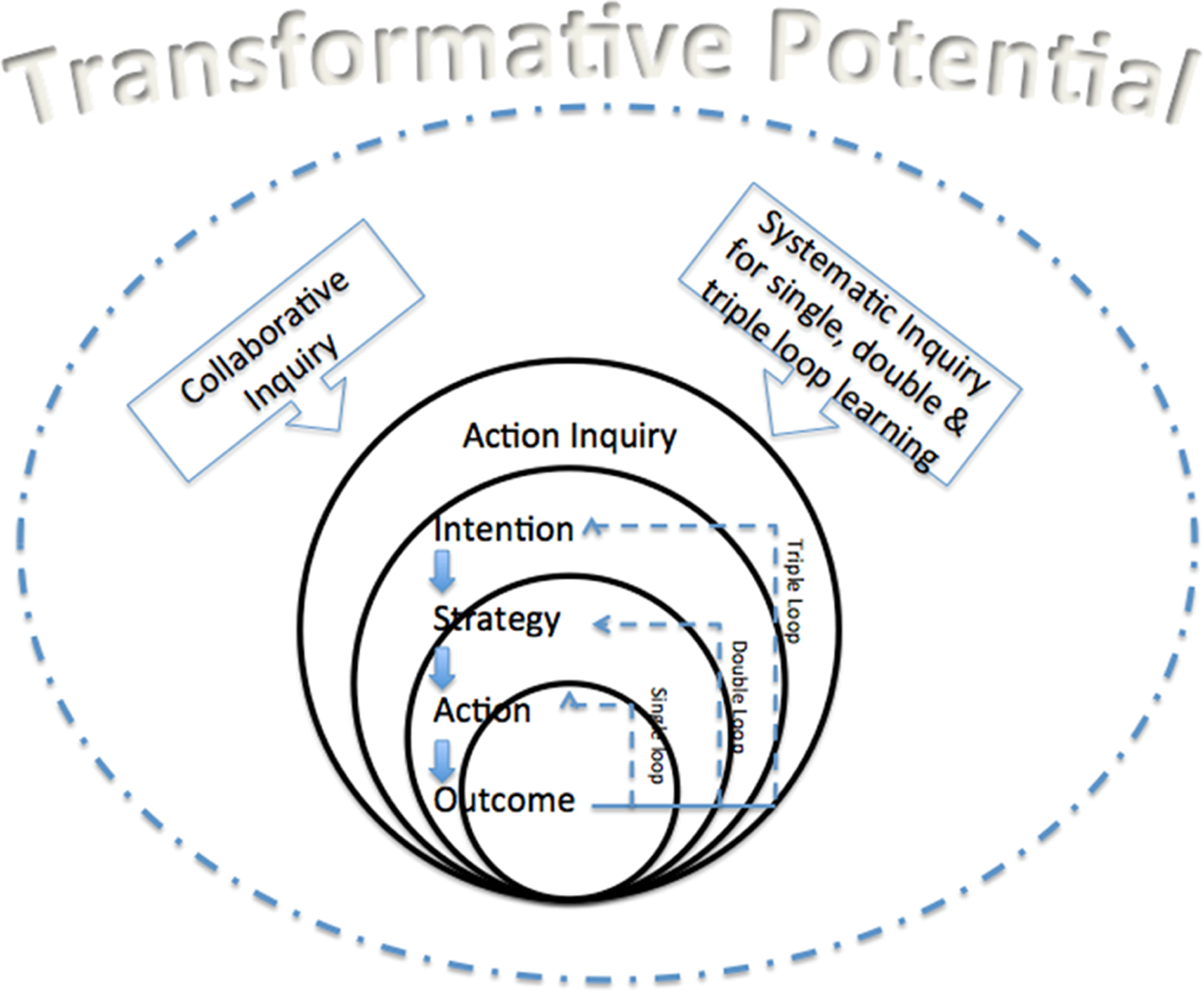
Process of collaborative developmental action inquiry.
The Process of CDAI
CDAI identifies three main units of experience: the first person (subjective), the second person interpersonal (intersubjective), and the third person (objective and systemic). Based on principles of action research (Chandler & Torbert, 2003; Lewin, 1948/1997; Reason & Bradbury, 2008) and action science (Argyris & Schön, 1974), CDAI proposes a means of personal, interpersonal, and organizational development that integrates inquiry and action. More specifically, by using feedback loops of learning and knowing, CDAI directs attention towards gaps that exist between individual, team, and organizational intentions, strategies, actions, and outcomes.
Action research becomes explicitly developmental when it incorporates the expectation of and capacity for growth (Fisher et al., 2003; Reason & Bradbury, 2008; Torbert et al., 2010) because each successive loop requires a greater level of developmental capacity to initiate, to learn through, and to complete. At the individual level, researchers are consciously attentive to the perspective they take and the meaning they make of unfolding events; they reflect critically on their own subjective meaning making and test its validity. At the second-person or intersubjective level, researchers and participants interact and communicate regarding goals, perspectives, and intentions, in a consciously attentive way that gives space for trying new perspectives and learning from one another. At the third-person, objective level, the system or organization itself may validate the process through the resulting outcomes, or lead researchers and participants back into another cycle of thinking, acting, and reflecting. Thus, as we engage in the cycles of inquiry, we also continually engage in critical reflection about the way we are thinking. This is the aspect of action inquiry sometimes called reflection on action; it is simultaneous and ongoing with the process of reflection in or during action (Argyris & Schön, 1974). Therefore, as we conducted this study among fellow students, faculty, staff, and graduates—the major stakeholders in the graduate program—we paid careful attention to our first-, second-, and third-person inquiry cycles.
Methodology: Enacting the CDAI Cycles
The question guiding the original research project was “How does adult education help adults, organizations, and society function effectively in 21st-century life?” To answer this question, our class in program planning and development, under the guidance of the professor and with institutional review board approval, conducted a CDAI study (Fisher et al., 2003; Torbert, 1999; Torbert & Associates, 2004). In this article, we focus on the influence of the very method of the study in generating space for our own transformative potential to reshape us in the action of conducting this study.
First, our researchers divided into four teams for our initial round of investigation. One team interviewed students, alumni, and faculty of the online master’s degree program of our University; they also conducted a spontaneous focus group interview when the topic of online education arose in another class. The second group interviewed several College of Education deans, the third group interviewed faculty who teach in our adult education program, and the fourth group conducted a focus group with master’s degree students. Of course, this process was somewhat delicate, as we were actively engaging our colleagues, professors, and supervisors in a process of questioning our own program—action inquiry is somewhat subversive because it encourages that act of questioning (Coghlan & Brannick, 2006). Since these people were the key stakeholders in the graduate program and the ones with most knowledge of the topic, they were the ideal CDAI participants for the study. Once we had completed their interviews, we gathered as a class to present our findings to one another. Each group presented its research and together we began to compile a preliminary collection of themes across the groups. This step represents the intersubjective stage of CDAI, where the group considers the questions and answers.
The second round of investigation took place at our home institution’s annual research symposium for adult education graduate students. By bringing the initial findings to a larger group, we engaged in the process of third-person inquiry, asking everyone present to reflect on and engage with our findings. At the same time, we were also conducting another round of first-, second-, and third-person inquiry. During our hour-long session, each student researcher hosted a roundtable discussion with five or six symposium participants. We followed the three-part process of (a) individually reflecting on the research question, (b) then mutually reflecting as small groups, and (c) finally collaborating with all participants to look for themes and similarities in the data. After the symposium, we again met as a class to analyze the findings and merge them with our first round data. At this point, we were still engaging in the second-person level of inquiry, and our findings indeed led us back to another round of inquiry.
For the third round of investigation, four of us presented our collected findings at the American Association of Adult and Continuing Education conference in November 2011. In the session at that conference, we again invited attendees to participate in the same three rounds of inquiry as they interacted with and added to the current body of data. At each step of the way, we carried out both the generating and analyzing of data in a reflective, participatory process that allowed space for critical reflection, dialogue, and growth among researchers and participants alike. By developing our own capacities to inquire at the personal, group, and organizational level, we called attention to our own and others’ capacity for transformation, especially in the ways in which we became mindful of moments of emergence throughout our inquiry.
Finally, moving into the third-person or objective level, we attempted to validate our findings through the broader system. At the 10th International TL Conference in November 2012, we hosted a conversation to present the findings of our study and invited attendees to engage in a critical review of the CDAI method. At this stage, we had incorporated all the findings from the first three rounds of CDAI, and we presented that to our audience in order to engage in one more session of conversation and reflection. The focus of the conversation at the conference was to bring into relief the gap between adult education approaches that met 20th-century needs and the current ambiguous reality that characterizes life in the 21st century.
Analysis of TL Opportunities
In this section, we highlight some of the transformative opportunities that occurred as we conducted our research. Two groups with whom we interacted clearly demonstrated some revised assumptions and shifting perspectives; two other groups, although the possibility of a shift emerged, did not in the end experience TL. A visible shift happened in the focus group with master’s degree students. Until that discussion, although they were studying adult education, the students had not actually perceived themselves to be adult learners. Rather, they thought of themselves as preparing to work with those older than themselves. As the discussion unfolded, however, they began to ask for definitions of terms such as “adult” and “adult education.” This led them to consider how society understands those terms and how their own thinking had changed as a result of their studies. Eventually, they began to realize that they themselves were actually adult learners and that much of what they were learning about adult education actually applied to themselves as well. In that one conversation, their entire meaning structure shifted to enable them to consider themselves as adult learners (Mezirow, 1991, 2000). The process of engaging with them in the first- and second-person inquiry appeared to allow the whole group to simultaneously shift their understanding of what it means to be an adult.
A second shift happened in the third-person inquiry at the 2012 TL conference. The conversation yielded two insights for the attendees and for us, the researchers. The first insight was that there is much more rapid prototyping of novel learning approaches in organizational settings than in higher education and the social context such as community development settings and/or citizen engagement programs. Perhaps organizations have better implemented the idea of the learning organization (Marsick, Volpe, & Watkins, 1999) than has higher education. The second insight was the discovery that many adults graduate from adult education programs yet do not graduate with a developed reflective capacity. This insight was enlightening as the researchers found an edge of our own learning that was not being fulfilled by the “authorities that be” (i.e., adult educators). We recognized that not more education but a richer education was needed in order to prepare students for skillful and timely responsiveness and participation in the new landscapes they would encounter in life and at work (Daloz, 1999). A seeding of transformation occurred in those times of recognition, through the insights that emerged out of the second- and third-person inquiries.
In contrast to the first two groups, a perspective shift began but failed to gain traction with the focus group on the topic of online learning. The students were taking a traditional, face-to-face course in feminist pedagogies, and the instructor asked them to describe how online learning could support feminist pedagogical principles. Initially, the group seemed poised to revise their assumptions favoring traditional classrooms and accept that online learning offered many benefits. One student pointed out that online classes seem more democratic; another added that the online environment offers an opportunity for “voice and self-disclosure” to develop. A third said that both the “creation and distribution of knowledge are broader due to increased access.” The comment that most resonated with the group was that “you can’t see people, so race, class, ethnicity, and maybe even gender are obscured.” This makes it less likely that traditional stereotypes will “kick in” and take over the interactions, the student added. At this point, the group seemed ripe to enter into a double-loop learning experience, where they could question the traditional model of face-to-face education most of them were pursuing and consider the value of other approaches. However, a few women in the class quickly began to argue for the status quo. One said that she “couldn’t let go of family responsibilities to participate in an online class.” For her, the only successful way to study was to leave home. Another described her inability to manage the technical aspects of online learning. A third thought that since online learning requires access to a computer, online learning is just as limited to privileged groups as traditional classrooms. The students who favored the traditional classroom were able to persuade the group, and the conclusion was that instructors might not be able to negotiate their power and positionality online or create a safe space and community for learning. Therefore, the class concluded that online learning is probably “not done well by faculty and has lessened value for the students.” What initially started as an opportunity to reconsider their taken-for-granted assumptions about pedagogical methods became instead a review of their own personal preferences for traditional classrooms.
Finally, a moment that seemed ripe for a transformational learning experience never quite materialized for one group of study participants, though it did for some of the researchers. The researchers had interviewed the online students, and in combining the findings, they realized how hard those students worked to simplify issues of complexity in their daily lives. For example, in response to the question of what demands adults face in the 21st century, juggling competing demands for time and energy was a prominent theme. One student commented that “time is probably my biggest challenge. How can I schedule everything and not let anyone get shorted?” Another said, “Keeping up with technology is a big challenge. It is always changing; I feel like I am always behind. Am I taking full advantage of what’s available to be the most efficient?” Several discussed the competing demands of work, children, ageing parents, and personal interests as an impossible juggling game. They sought to define the demands of life in a bifurcated manner of work versus leisure and “go fast versus go deep” in their learning. They tended to differentiate strongly between people skills and technical skills, even though the demands of an online learning environment require a blend of both. Thus, it was clear that demands and constraints on time were an ongoing obstacle for them as for many modern Americans; yet rather than adjusting their mental expectations, they sought to accomplish increasing amounts of work by multitasking, working from home, and taking classes online.
Not one of the students commented on the very real possibility that these demands are too big, too time consuming, and impossible to fulfill completely to everyone’s satisfaction. In the end, they did not move towards double-loop learning that would have allowed them to question their fundamental assumptions about life. Rather than recognizing that their mental models were perhaps insufficient in meeting the current demands placed on them (Kegan, 1994), they remained in single-loop learning as they fought to reduce the ensuing complexity and make the world fit their conventional and well-honed mental models.
As researchers, we were struck by the energy invested in simplifying complex demands to meet the ideals of an earlier era, rather than critically reflecting on and even questioning the demands society placed on them (and us) to be perfect parents, partners, students, employees, and neighbors, as Kegan (1994) would have us do. When we asked the students what skills adults needed to meet the 21st-century demands, some form of being “in control” was a common answer. “Keeping up your skills,” said one; “learning to learn” and “taking responsibility for yourself” said another. Another crucial skill was “willingness to do what it takes” thought one student; another said learning to “manage change” would make it possible to meet the demands placed on adults. These answers reflect a view of life that appears simple, almost mechanistic. The students seemed to believe that if things could be measured, analyzed, broken into pieces, fixed, and reassembled, then life would keep running along smoothly (Innes & Booher, 2010). No one seemed to consider that perhaps the modern world is more like a living organism than a machine or that things interact, evolve, and change rather than remain stable and simple (Innes & Booher, 2010). None of them seemed to realize that multitasking, juggling, managing, and above all “doing whatever it takes” might actually be counterproductive. Rather than evaluating the validity of the competing demands, they strove to find ways to meet them all in an endless attempt to “manage” the unmanageable. The problems adults face are complex, perhaps even “wicked” in the sense that it is impossible to fully satisfy the competing and mutually exclusive demands of family, parents, children, employers, and self (Innes & Booher, 2010). Yet, by trying to manage all of them without questioning the demands themselves, the students remained stuck in a perpetual condition of overextension. With neither the time, nor the space to develop the capacity to reframe how they encountered these demands they missed the opportunity to develop the skills they truly needed.
We wondered whether the inability to entertain a new perspective reflected a lower level of cognitive development, as Merriam (2004) suggested it could. We wondered if the acceptance of social demands reflected an “uncritical assimilation” to the culture (Merriam, 2004). We also wondered if it were somehow our own responsibility that the students could not question their assumptions, that we failed to create conditions for double-loop learning to occur (Merriam, 2004). We were struck by the students’ behaviors of avoidance and of working their single-loop learning into an ever-deepening groove, and we questioned ourselves as we reflected on them.
These participants were not experiencing transformation as a result of their dilemma, but we as researchers had the opportunity to reflect on ourselves as the mirror of graduate demands and higher education was held up for us. As we compiled and discussed the participants’ responses, we also engaged in critical reflection on our own need not to simply repeat the same old patterns that no longer work. In fact, we found that the tension involved in engaging the complex demands of our lives as professors and graduate students influenced our own willingness to interrogate the complexity, just as it did the students. It was temptingly easy to revert to instrumental, single-loop approaches ourselves. “We could reconfigure online classes this way” or “we could recommend the university do this or that” ran through our discussions as we reverted to the machine view of organizations (Burke, 2002; Morgan, 1997). Yet at another level, we recognized that the 21st-century world might well require a whole new approach to education, one that has not occurred to any of us yet.
Discussion and Implications
As we sought to make sense of the different responses and experiences we encountered during the study process, we realized that CDAI seemed to hold significant promise for TL to occur. Both participants and researchers struggled to move from our preconceived mental models, and from a tendency to repeat our well-learned behaviors, to a space where we could question and then revise our assumptions about graduate life and education. As we further examined the CDAI model, it seemed clear that the potential is there for TL events to occur in the midst of a study.
One reason for this is that the CDAI approach to research allows researchers to engage in coinquiry with one another and with participants at every phase of the study. By bringing this three-level awareness to our inquiry, we were able to recalibrate as needed along the way. This led to the discussion of the term adult with the master’s degree students and led to the spontaneous focus group with the students in the feminist pedagogies class. Taking advantage of those emerging opportunities rather than sticking with the preplanned approach could be viewed as a move towards double-loop learning. In this way, we as researchers were able to “mind the gaps” in the inquiry and in ourselves, as well as in the participants, as the research progressed (Torbert & Associates, 2004).
Another reason is that CDAI offers the opportunity for researchers and participants to question their existing mental models and taken-for-granted assumptions. The potential for this questioning was visible in the discussions we had with online students, as our study questions themselves brought to the students’ conscious awareness the impossibility of meeting the multiple, complex demands on their lives. With these increasingly complex demands of modern life, when our existing mental models fail us because they cannot attend to the multiplicity of calls on our attention and energy, we are ripe for a transformative shift in our thinking, both personally and organizationally (Kegan, 1994; Shaw, 2002). The students’ comments revealed this tension and could have created a “disorienting dilemma” for them as they recognized the mismatch between how they had previously thought and with the realities of their current lives. Because of its emphasis on critical reflection and its willingness to challenge assumptions and entrenched thinking patterns, CDAI could create a “holding environment” (Kegan, 1994) where they could test new ideas and explore new perspectives. By engaging in the cycles of CDAI together, we could create space for TL to occur both individually and collectively. However, in the press of the moment, most of the students seemed unable to make that shift, and even we, as researchers with a deeper understanding of the potential for transformation as well as the process of single-, double-, and triple-loop learning, struggled to make the shift. The pull of single-loop learning is strong, and moving beyond it requires collaborative strength as well as a secure environment.
The fact that two groups of respondents did experience a changed perspective (Kucukaydin & Cranton, 2012) of transformation, and another group at least briefly considered the possibility of a new viewpoint as they reflected on our questions, seems to indicate that CDAI as a research methodology might, in itself, create conditions ripe for a TL moment. The fact that a fourth group did not experience a shift may indicate that we as researchers failed to engage, challenge, or create conditions for that transformation, or it may indicate that the participants were not yet ripe for that kind of experience.
What interests us as researchers is the relative lack of discussion about using CDAI as a method to create transformational learning opportunities. In 2004, Merriam argued that it is “imperative” for adult educators to create the conditions where TL can occur (p. 65), and yet 10 years later, the conversation does not appear to have moved forward much. Outside of venues like a conference and similar specialized events, the capacity to create environments for TL to occur appears quite limited. The everyday adult learning classroom may teach TL as one of multiple adult learning theories, but as far as integrating it into our praxis goes, we appear to be falling short of fulfilling the capacity and promise offered by the literature. Further, although action-inquiry approaches could easily serve our field to help us fulfill our historical and ongoing mandates of social justice and equity (Johnson-Bailey, Baumgartner, & Bowles, 2010; Merriam & Brockett, 2007), it would appear that we are neglecting this resource; too often we continue to support an instrumental, career-development model of education that serves business more than it does the field of adult education.
Conclusion
In our study, we explored the learning demands placed on adults and considered the extent to which current curricula of adult education programs met those demands for learning. In our reflections on that study, we discovered that both researchers and participants had vacillated between single- and double-loop learning as we attempted to interrogate the current practice of an adult education graduate program. Having reflected on our participants and having carried out self-reflection, we believe that CDAI holds great potential to create and enable a TL experience for all of us. For the researchers, CDAI encouraged us to be authentic, to develop integrity in ourselves, and to be consciously aware of the gaps in our ways of knowing (Torbert & Associates, 2004). At the intersubjective level, CDAI encouraged mutuality rather than hierarchy, encouraging us to learn from and be transformed by our interactions with one another and with our participants (Torbert & Associates, 2004). In addition, at the social and communal or objective level, it offered the ability to tackle complex problems and allow solutions to emerge, rather than our having to use linear methods to arrive at relatively predetermined answers (Shaw, 2002).
Because it could allow space for transformative experience in the midst of the actions, we believe that using a CDAI approach to a study could create conditions where the study itself might become a TL experience. Our findings offer tantalizing hints of ways in which graduate adult education programs might adjust to more transformative approaches to teaching and learning (Bierema, 2010; Merriam & Brockett, 2007). Further research on CDAI as a means for promoting TL seems warranted and could provide additional support for the suggestions we have presented here.
As we discussed earlier, early 21st-century life is complex and ambiguous, requiring adults to learn how to cultivate the capacity for skillful responsiveness. TL is necessary for effective shifts in frames of reference to occur. CDAI appears to provide a space within which the growth of critical reflection could be possible and in which shifts in perspective might emerge. In our study, the use of CDAI generated the possibility of different futures for adult education graduate programs. We would suggest that use of the method could provide the same learning environment for a range of problems facing adults. CDAI could be used not only in academic settings but in corporate and community settings as well. Each time we lead adults into developing the capacities for TL, we are one step closer to discovering how to move forward together (Shaw, 2002) in these times.
Footnotes
Authors’ Note
An abbreviated version of this article was presented at the TL Conference, November 10, 2012, in San Francisco, CA.
Declaration of Conflicting Interests
The author(s) declared no potential conflicts of interest with respect to the research, authorship, and/or publication of this article.
Funding
The author(s) received no financial support for the research, authorship, and/or publication of this article.