




Abstract
Using data from preservice teachers enrolled in a diversity course in a predominantly White teacher education program, researchers uncovered that diversity education was indeed a catalyst for preservice teachers to increase knowledge of diversity and their understanding of the process of critically reflecting on their teaching and learning practices. The findings revealed that the teachers not only taught with cultural relevance in mind but also adopted a philosophy of education that incorporates social reconstructionism and transformative learning, viewing themselves as social justice advocates for children and families.
Introduction
There is no more pressing issue in teacher education than the preparation of teachers to work with diverse students and communities (Villegas & Lucas, 2002). The field of education continues to be saturated with research regarding the importance of diversity, teacher education, and multiculturalism in the preparation of teachers (Banks & McGee Banks, 2004; Gay, 2010; Ladson-Billings, 2001). This trend is necessary because the student body of America’s schools reflects a growing mosaic that is diverse racially, culturally, linguistically, and religiously. As such, teachers working with diverse populations should be culturally competent, sensitive, responsive, and effective at teaching and working with these students and their families. Consequently, teacher education programs continue to grapple with the task of educating its mostly White, middle class, monolingual preservice teachers (Vaughan, 2005; Wong, 2008) with the knowledge, skills, dispositions, and sensitivities needed to teach in diverse milieus. Teacher educators who utilize diversity discourses through coursework, modeling, mentoring, and field-based practices can help prepare teachers to respond to the needs of a growing student population that is culturally and linguistically diverse (Milner, 2010). If not, teacher education programs will continue to forgo the opportunity to broaden the frames of reference of their mostly White preservice candidate pool by graduating teachers who lack the knowledge, skills, and disposition to teach in culturally relevant ways, thereby inhibiting them from being cultural border crossers (Wong, 2008). In an effort to add and expand the extant literature on the role of diversity studies in teacher education programs and its role in highlighting the intersectionality of race, culturally responsive teaching (CRT), reflective teacher practice, and transformational learning, this article presents findings from a case study of a diversity education course at a private, selective, predominantly White teacher education program. As the teaching population continues to be predominantly White and female, this course was designed specifically to increase diversity knowledge, skills, and awareness of the mostly White preservice teachers in order to facilitate their cultural competence and effectiveness in working with diverse populations. To this end, the course content was structured and included intensive critical reflections, a panel discussion, an immersion experience, direct community experiences, and an inquiry project—all utilized to facilitate transformative learning and increase the preservice students’ abilities to become efficacious border crossers.
Review of Literature
Diversity Education, Culture, Race, and Teacher Education
Diversity education is central to helping preservice teachers understand their beliefs as they interact with the diverse children and families in communities across the United States. Lee and Dallman (2008) posit that teacher beliefs are interconnected with the sociocultural contexts of teaching and learning. Hence, diversity education is an essential component for increasing the self-awareness of preservice teachers who have little experience with diversity discourses. Within the teacher education literature, many researchers (Cochran-Smith, 2004; Milner, 2010) have long espoused the importance of diversity education in helping shape teacher effectiveness for working with a diverse population. According to Milner (2010), The task of preparing teachers for the diversity they (will) face in P-12 schools is shaped and grounded in a range of complex realities in U.S. society and in education. Whether through traditional or alternative teacher education programs, preparing teachers for diversity, equity, and social justice are perhaps the most challenging and daunting tasks facing the field. (p. 119) The sense you [teacher] make of students and the work of teaching is filtered through your cultural lenses: the beliefs, assumptions, and experiences you bring to the classroom. It is impossible, in fact, to understand other people without first understanding yourself and how your perspective shapes how you interpret others. (p. 10) a distinction must be made between the negative racial attitudes held by individuals of color and White individuals, because it is only the attitudes of Whites that routinely carry with them the social power inherent in the systematic cultural reinforcement and institutionalization of these racial prejudices. To distinguish the prejudice of students of color from the racism of White students is not to say that the former is acceptable and the latter is not; both are clearly problematic. The distinction is important, however, to identify the power differential between members of dominant and subordinate groups. (p. 3)
Overall, preparing preservice teachers with diversity knowledge requires course content that promotes the use of multicultural and social justice education, hence the use of diversity pedagogy theory (DPT; Sheets, 2009) as a lens for understanding the intersectionality of culture and education is appropriate and effective because the principles of critical multicultural theories and other critical pedagogies are embedded within the framework of this theory. According to Sheets (2009), “Diversity Pedagogy Theory (DPT) is a set of principles that point out the natural and inseparable connection between culture and cognition” (p. 11). Based on its foundations of using culture as a magnifier for effective teacher practices, DPT is a conduit for examining the interconnected nature of diversity, education, culture, race, and teacher education. As such, the teacher narratives in this article reflect how DPT was used by the teachers to transform their understanding of self and community during their student–teaching experiences.
Teacher Beliefs and Critical Reflection
Along with a specialized body of knowledge, autonomy, and ethics, reflection is another characteristic of why teaching is a profession (Kauchak & Eggen, 2011). Criticality in the reflective process is manifested when preservice teachers realize the constructivist nature of reality, and that reality is socially constructed by individuals and groups. In other words, when criticality is introduced to the reflective process, preservice teachers begin to deconstruct the epistemological, axiological, and ontological navigations that drive their teacher identity and interactions with diverse students, families, and communities. Most notably, Gay and Kirkland (2000) believe that critical racial and cultural consciousness should be coupled with critical self-reflection in order to increase educational outcomes for students of color. They state, teachers knowing who they are as people, understanding the contexts in which they teach, and questioning their knowledge and assumptions are as important as the mastery of techniques for instructional effectiveness. Critical racial and cultural consciousness should be coupled with self-reflection in both preservice teacher education and in-service staff development. (p. 181) Bronfenbrenner’s theory is an attractive one for our work around high school reform because it is expansive, yet focused; one eye is trained on the complex layers of school, family and community relationships, and the other eye is sharply focused on individual student development. (p. 990)
Critical reflection can take many forms in diversity courses and general preservice teacher education. It can be in the form of immersion experiences (Vaughan, 2005), critical incidents examination (Ladson-Billings, 2006), or teacher visioning and building blocks for increasing teacher identity (Grant & Sleeter, 2011). In Vaughan’s (2005) study, she assigned a cultural immersion experience as a way for her 38 graduate students to increase their cultural sensitivity and overall reflective teacher practices. She found that as a result of the immersion experience, the teachers gained cultural knowledge, experienced personal convictions, and dispelled misconceptions and stereotypes. Analogously, Ladson-Billings (2006) used critical incidents in the form of interviews, student journals, and electronic portfolios to underscore the importance of having preservice teachers think deeply about the concept of culture as a way to increase their awareness of themselves as cultural beings. She states, “teacher educators need to structure experiences and activities so that our students can take a close look at their cultural systems and recognize them for what they are—learned behavior that has been normalized and regularized” (p. 109). As such, examining critical incidents allows preservice teachers to more clearly see the power inequities, oppression, and privilege that shape the experiences in the classroom, especially in the teacher–student dyad.
In a similar manner, Grant and Sleeter (2011) used numerous teacher visioning techniques, as well as the building blocks, to help teachers visualize the type of educators they want to become. The first two steps in what they term becoming a “fantastic teacher” included critically examining self and developing a philosophy of good multicultural teaching. They forward, “it is impossible, in fact, to understand other people without first understanding yourself and how your perspective shapes how you interpret others” (p. 10). Techniques used to promote critical reflection included a vision statement, an examination of the words helping and loving, family decision-making patterns, a self-study, and a reflection on home and family culture (Grant & Sleeter, 2011).
Quintessentially, critical self-reflection provides a third space, where preservice teachers can begin the process of critiquing their own positionality as it relates to their teaching and learning practices when working with diverse students and families. Hrevnack (2011) underscores that it is through reflection that teachers learn to recognize the congruence between theory and practice. Such congruency is important if preservice teachers are to be transformed as teachers with the critical pedagogies needed to teach in a culturally relevant manner. Thus, diversity-related courses should provide robust, germane, and critical opportunities for preservice teachers to examine what they bring to practice as a means of increasing their own social and cultural efficacy to be advocates for diversity within the classroom.
Culturally Relevant Teaching
Culturally relevant teaching is a lens through which teachers can maximize culture in order to increase educational success for all students, especially those from diverse racial and ethnic backgrounds. Intentional diversity education courses can be mediums, where the conceptual, theoretical, and pedagogical underpinnings for inserting education into culture (Ladson-Billings, 1995) are infused. Such courses can help equip preservice teachers with the knowledge, skills, and dispositions needed to teach in culturally relevant ways. Villegas and Lucas (2002) advocate that in preparing preservice teachers to teach culturally responsively, teacher education programs should infuse sociocultural awareness, an affirming attitude toward students from culturally diverse backgrounds, a commitment and skills to act as agents of change, constructivist views of learning, and learning about students and CRT practices as meaningful strategies across the curriculum.
Infusing diversity studies in preservice teacher education provides a frame of reference for critiquing social inequities, prejudice, discrimination, and oppression, thereby increasing the necessity of critical teacher reflection. Ladson-Billings (1995) identifies three tenets of culturally relevant teaching: (a) academic success, (b) cultural competence, and (c) critical consciousness. In terms of academic success, teachers who teach from a culturally relevant position understand that academic success is the ultimate outcome of any intervention strategy. First, Ladson-Billings (1995) encourages teachers to value the ability of students and help them get to a place where “they choose” (p. 160) academic excellence. Secondly, teachers who apply cultural relevance in the classroom use culture as a strength instead of a deficit to cultivate and reinforce competency in their students. The use of cultural mechanisms such as home language, popular culture, and community experts can be incorporated in the classroom as means of providing the depth that is needed in the current common core standards. In developing competency, teachers should integrate reality/representation and relevance (Gay, 2004) as threads of connection between home and school. Thirdly, culturally relevant pedagogy promotes critical consciousness, and according to Ladson-Billings (1995), such consciousness allows students to not just intellectualize social inequities but create and execute action and advocacy outside the walls of the school.
Essentially, diversity courses in teacher education should afford access to the rich narrative surrounding culturally relevant teaching, its principles, key theorists, and opportunities to view classrooms, where teachers consciously enact these practices. Through culturally relevant teaching, preservice teachers gain a robust understanding of the concept of culture, thereby allowing for a deconstruction of their own cultural affiliations, identity, norms, and family backgrounds. Such a deconstruction allows preservice teacher candidates to move from surface-level components of culture such as food, music, and dress (Moule, 2011) to deeper understandings of the lived experiences of diverse communities. Fostering a deeper perspective on culture and its relevance in the classroom provokes preservice teachers to construct a conception of teaching and learning that is not formulaic but nuanced and robust, accounting for pragmatism, veracity, and family and community cultural and social capital.
Transformative Learning
Diversity education in teacher education not only promotes critical teacher reflection and a propensity to teach with cultural relevance in mind, but it is also a catalyst for transformative learning. When classroom discussions, lectures, inquiry projects, field experiences, field trips, and written assignments are intentionally designed to promote critical thinking, disequilibrium, and flexibility, preservice teachers experience a confluence of perspectives that can help to promote transformative learning. As such, transformative learning will be discussed from these three overlapping concepts: conscientization (Freire, 1992), social change, and identity.
Conscientization
The role of transformative learning in adult education has been well documented in the research (Merriam, 2004; Mezirow, 1991, 2000, 2003). From a Mezirowian perspective, transformative learning is learning that transforms problematic frames of references—sets of fixed assumptions and expectations (habits of mind, meaning perspective, mindsets)—to make them more inclusive, discriminating, open, reflective, and emotionally able to change. Such frames of reference are better than others because they are more likely to generate beliefs and opinions that will prove more true or justified to guide action. (Mezirow, 2003, p. 59) There are many facets to the human psyche and many contexts within which human beings live, love, reflect, and dream. To try to describe the way people transform or open up their perspectives, grow and develop as persons, and learn to live according to their authentic selves, we need to honor the complexity of human life and its social setting. (p. 97) teachers must not be afraid of tenderness, must not close themselves to the affective neediness of beings who are indeed kept from being. Only the poorly loved ones can understand teaching as a trade for the insensitive, so filled with rationalism that they become empty of the life or feeling. (p. 50)
Social Change
Within the context of preservice teacher education, transformative learning is married to the process of critical teacher or self-reflection. It is through critical reflection that preservice teachers are able to examine their blind spots, dominant ideologies, and hegemonic frames of reference that guide their developing teaching and learning practices. For example, Wong (2008), who studied 106 mostly European American female preservice teachers, found that a multicultural service learning experience that required her students to tutor students identified as English Language Learners provoked elements of transformative learning in the research participants. The data used for this study were drawn from journal entries completed by the preservice teachers at the end of each tutoring session. This study embodies many elements of Mezirow’s definition of transformative, as she found that most of the participants had transformative learning experiences, authentic relationships with their tutees, and became curious about their tutees’ cultural backgrounds. Expanding on the transformative learning continuum, Wong (2008) found that some of the preservice teachers experienced a sense of transcendence, meaning they not only recognized the self-worth and sociocultural validity of their tutees but took it a step further by recognizing social inequities and began to view themselves as agents of change.
Social change, as a result of diversity education in teacher education programs, relates to transformative learning in that individuals are able to problematize micro-, meso-, and macrosystem variables in order to enhance the academic achievement for students and their families. Moore (2005) posits that transformative learning is a constructivist frame of reference, thereby “altering frames of reference through critical reflection of both habits of mind and points of view” (p. 82).
In a study of four teacher education programs, Ensign (2009) found that in the two teacher education programs where diversity discourses were minimal and not intentional resulted in a culture that maintained the status quo where teacher candidates received “training for fitting into an educational system that replicates the existing system that privilege dominant culture students” (p. 170). Consequently, these preservice teachers formulated a deficit perspective of the students and families. In contrast, the preservice teachers in the two other teacher education programs where diversity discourse was embraced more than just a sidebar or footnote and incorporated culturally relevant teaching and multicultural texts, cooperative learning resulted in their preservice teachers having a more complex and strengths-based understanding of culture, family background, and school success. Like Wong’s (2008) study, the two diversity-laden teacher education programs in Ensign’s (2009) study created opportunities for the teacher candidates to reflect and become change agents who viewed diversity, culture, and education within the context of social and cultural inequities. Overall, social action and problem solving are elements of transformative learning, allowing individuals to recognize their position within the society as democratic citizens (Mezirow, 2003) who understand their role in maintaining or challenging power, privilege, and oppression.
Both of these studies utilize some elements of critical reflection, which is central to the transformational learning discourse. In fact, Mezirow (2003) posits that “transformative learning involves critical reflection of assumptions that may occur either in group interactions or independently” (p. 61). As discussed earlier, critical reflection in teacher education programs that provoke preservice teachers to examine their identities within the context of a diversity course and with a critical pedagogue who designs intentional assignments, as well as direct multicultural experience, can create teacher candidates who are social justice advocates for diverse families and communities. Mezirow (2003) addresses the role of educators in promoting transformative learning. He forwards, transformational learning addresses the other side of the coin, direct intervention by the educator to foster the development of the skills, insights, and especially disposition essential for critical reflection—and self-reflection—on assumptions and effective participation in critical—dialectical discourse (reflective judgment)—essential components of democratic citizenship. (p. 62)
Identity
Identity formation has recently been a topic of interest related to transformative learning (Illeris, 2014). As teacher education programs continue to reform their curriculum to include purposeful inclusion of diversity-related courses, close attention has been given to the multiple identities of the student population. Although whiteness as a concept is not monolithic, White identity formation, especially considering the context of this study at a southern predominantly White institution, is a necessary lens for examining the role of identity in transformative learning. Illeris (2014) supports the consideration of self and identity as important categories in transformative learning. For Illeris (2014), the structure of identity is interlocking and has three components: the core identity, the personality layer, and the layer of preference. The core identity is defined as the biological identity which individuals often use to balance disequilibrium (Illeris, 2014). This is the self-component of identity. The personality layer of identity can be considered the interaction between the individual and the society, and the final component is the layer of preference, which is the layer of identity that interacts with all aspects of everyday life (Illeris, 2014). Thus, identity development is linked to transformative learning, as it is through the interaction of the self and society that raises preservice teachers’ consciousness and appetite for social change. A well-designed diversity-related curriculum in teacher education programs should center these aspects: conscientization, social change, and identity development in order to support transformative learning. Baily, Stribling, and McGowan (2014), in their recent article on transformative teacher education and social justice, support the conundrum of diversity-related curriculum in teacher education programs, reflection, and transformative learning. They state, we as teacher education faculty struggle to extend and deepen the conversation on transformation for practicing teachers (our students), and experiment with new innovations within teacher education curriculum to see lasting and progressive transformation, not only for teachers but also for the students with whom they are working. (p. 249)
Method
Study Design
Methodologically, the design of this study was centered in a case study approach. According to Yin (1981), “as a research strategy, the distinguishing characteristic of the case study is that it attempts to examine: (a) a contemporary phenomenon in its real-life context, especially when (b) the boundaries between phenomenon and context are not clearly evident” (p. 59). Hence, consistent with Yin’s (1981) definition that a case study examines real-life contexts, the diversity course in this study was the real-life context being studied. As such, this explanatory case study aims to add and expand on the role of diversity studies in teacher education programs and its role in highlighting the intersectionality of race, CRT, reflective teacher practice, and transformative learning. Thus, this research study examined the impact of a diversity course on increasing the diversity knowledge and skills of mostly White preservice teachers. In this manner, data collection was mixed in that both qualitative and quantitative data were gathered to examine the course as the context of study and how it impacted the preservice teachers’ teaching and learning. Creswell (2005) states that an explanatory research design, consists of first collecting quantitative data and then collecting qualitative data to help explain or elaborate on the quantitative results. The rationale for this approach is that the quantitative data and results provide a general picture of the research problem: more analysis, especially through qualitative data, is needed to refine, extend or explain the general picture. (p. 515)
The Context of the Study
Data for this study were collected in different semesters from two separate groups (elementary and secondary education students) of preservice teachers in a Diverse Learners class at a predominantly White liberal arts institution in the South. This is a 400-level course that students who major in elementary education take in their senior year and in the semester before they begin student teaching. For students in the secondary education program, this course is taken in their junior year. While in the diverse learners class, students are also placed in a practicum and are enrolled in courses such as “advanced principles of teaching and learning,” “literacy for struggling readers,” and “assessment.” Of note, diverse learners is the official diversity course that is offered in the teacher education program. As such, this course covers theories for teaching diverse learners and critical pedagogies, critical self-reflection, and various diversity strands such as special education, socioeconomic status, religion, linguistic diversity, race and ethnicity, working with diverse families, geographic diversity, gender and sexual orientation, and using multicultural literature.
Content of the Course
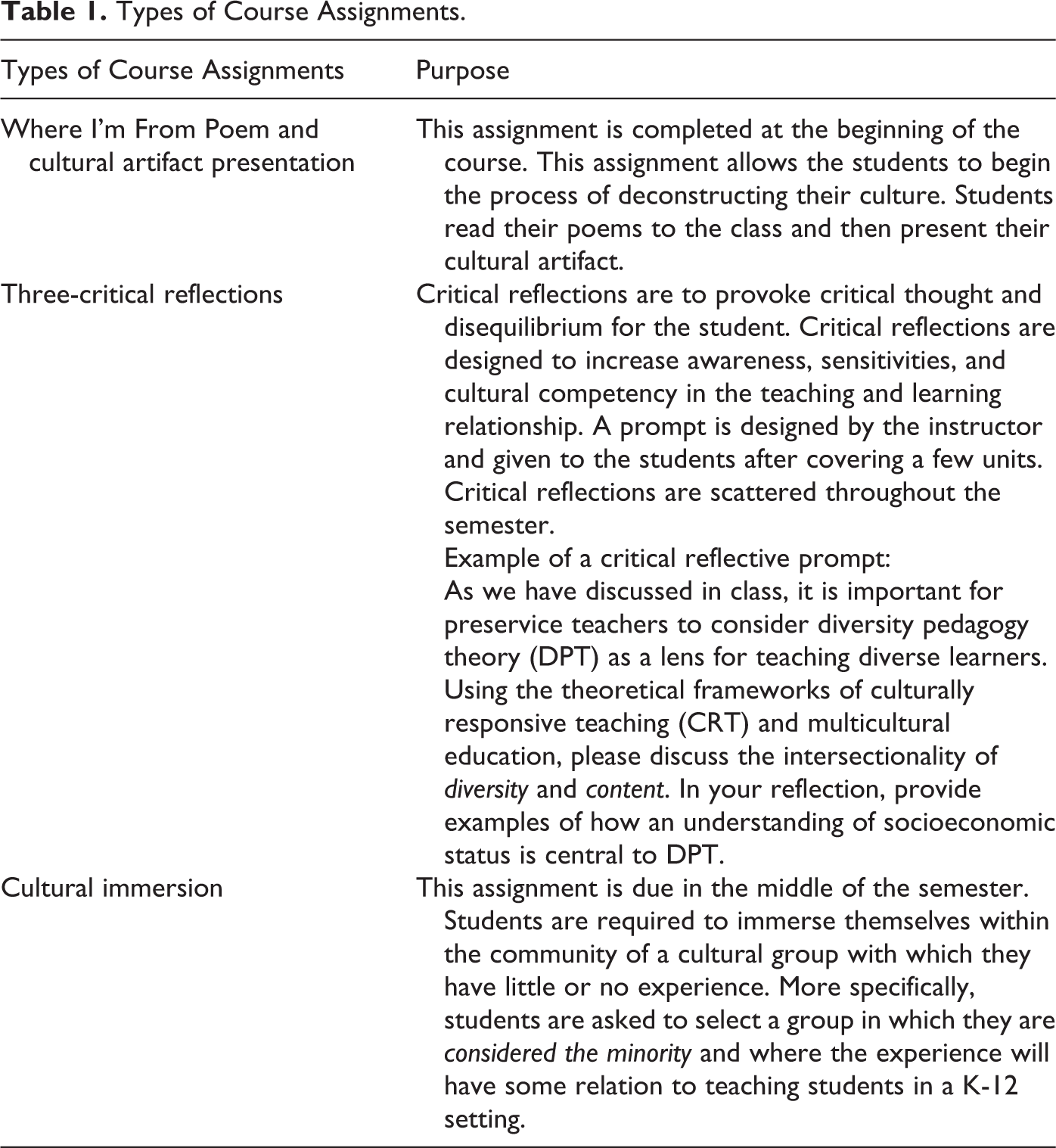
Students in the diverse learners class were exposed to extensive literature within the field of diversity studies. The course text was Multicultural Education in a Pluralistic Society by Donna Gollnick and Peter Chinn (2012). Additionally, over the course of the semester, students were exposed to over 52 articles related to diversity. In order to promote critical reflection, culturally relevant teaching, and transformative learning, students were expected to complete several assignments aimed at helping them internalize the knowledge, skills, and dispositions needed to teach diverse learners (see Table 1 for assignment guide).
Types of Course Assignments.
In addition to the class assignments, students took a field trip to a local public school that serves only refugee and immigrant children. Students who are newcomers to the United States attend this school for a year before they enter traditional public school. This school is very special, as it is the only one in the state. The preservice teachers visited the school and were able to see culturally relevant teaching in practice. In addition, the preservice teachers were also exposed to a panel discussion on working with diverse families. Panelists included principals, assistant principals, teacher education faculty, expert teachers, and professionals who all have direct experience working with diverse families.
Participants
The participants were enrolled in two separate diversity courses. Data were collected first from 13 elementary education students who were enrolled in the elementary section of the diversity course. Two semesters later, which was the next time the first author taught the diversity course, the researchers then collected data from 15 secondary education students in the secondary section of the diversity course.
In the elementary cohort, the students were all female; 12 classified themselves as White and 1 student identified as biracial. The secondary cohort consisted of 12 females and 3 males. Of the 12 female students in the secondary cohort, 2 identified as belonging to a racial or ethnic group, 1 classified herself as African American, and the other as Asian American of biracial decent. The 13 remaining students all identified as White. All 28 participants had field placement in a small suburban school district, where they interacted with diverse students and families.
Data Collection
Based on the researcher’s teaching rotation, data were collected in two separate semesters from two different cohorts of students. Based on this rotation, the researcher (first author) was only able to conduct a focus group with the first cohort of students, which were the students enrolled the elementary section of the course. Hence, in the 2011–2012 school year, data (pretest and posttest surveys and focus group) were collected from the 13 students in the elementary cohort of the diversity course. The next time the researcher (first author) taught the diversity course was in 2012–2013 school year. Hence, the second set of data (pretest and posttest surveys only) was collected from the secondary cohort in the spring of 2013. These two groups were treated similarly because of the nature of our teacher education program. The teacher education program is small with an average class size of 15–20 students, so students tend to socialize and attend similar training and activities together as well as the content of the diversity course being similar for both groups of students. Both cohorts had the same pretest and posttest survey, class assignments, course content, and instructor. As we are a small teacher education program, these students were a representative sample of student population, as our teacher education program graduates approximately 55–60 students annually.
Survey: Spradlin’s Diversity Knowledge Survey
In both classes, the students were given Spradlin’s Diversity Knowledge Survey (DKS, 2012) on the first day of class as a way for them to evaluate their knowledge base. The survey can be found in Lynn Spradlin’s (2012) book, Diversity Matters: Understanding Diversity in Schools. In this mixed study, qualitative and quantitative data were collected and analyzed to determine the impact of a diversity course on preservice teachers’ critical reflection skills, culturally relevant teaching, and their transformative learning. Central to critical reflection are awareness and knowledge of the phenomenon being explored. DKS (2012) was used to collect pre- and postquantitative data on preservice teachers’ awareness and knowledge of diversity-related terminology, issues, programs, laws, factors, multicultural teaching, and cultural historical texts. The DKS presented 37 items, and the preservice teachers had to indicate their level of familiarity with each item on a scale of 1–7, spanning none (no familiarity) to extensive knowledge. An example of 1 item and its choice of responses on the DKS reads, “My knowledge about … civil rights legislation … is” none (1), minimal (2 or 3), average (4 or 5), or extensive (6 or 7).
As such, the pretest survey was given on the first day of class for both cohorts. The researchers then collected the surveys and kept them until the end of the semester. On the last day of class, the students were given another copy of Spradlin’s survey to evaluate their diversity knowledge after experiencing the course. This survey was also collected by researchers after the students had a chance to view their pretest responses and then compared their posttest responses. The total number of participants in the study was 28; however, it is important to note that only 25 surveys were used for this study, as three of the surveys contained missing data.
Focus Group: Elementary Education Cohort
It is important to note that a focus group was conducted with only the elementary cohort. The elementary diversity course was sequenced in such a way that allowed the researchers to conduct a focus group with the students after they had completed the diversity course and were in their student–teaching placement. Hence, the focus group was conducted during their student teaching semester. This allowed the researchers to gather focus group data regarding how the students were applying their diversity knowledge and skills with children and families a semester after they had taken the diversity course. Hence, the narratives embedded in the findings section of this study are solely from the elementary cohort.
During their student–teaching semester, researchers sent an e-mail to the elementary education cohort members who were now student teaching, asking them to be a part of a focus group examining the impact of the diversity course. Based on scheduling conflicts, nine students from the elementary cohort agreed to the focus group interviews. The focus group was conducted in the evening in the teacher education building, a space that was familiar to the students and convenient for them to attend. The focus group lasted for approximately two hours; it was recorded for analysis. Students received no compensation for participating in the focus group. Examples of focus group questions were: (a) What were your expectations at the beginning of the diversity class? (b) Discuss the application of the course to your teaching practice and lesson plans and design, (c) How did this class prepare you to work with diverse learners? and (d) How did this class increase your knowledge of diverse cultures and families overall?
On the other hand, due to the sequence of the secondary course, the researchers were not able to conduct a focus group with the secondary cohort, as they did not have their student–teaching placement the semester following the diversity class. The researchers are aware that focus group data from the secondary cohort would have complemented this study. However, we remain convinced that the voices of the elementary education cohort provide a narrative that is beneficial in understanding the phenomenon and context of this case study.
Researchers’ Subjectivity
As researchers, we understood the nuanced role of using one’s course as a site of research. More specifically, the first author who is the instructor of the course was mindful to pay close attention to issues of power, privilege, and identity throughout the course. The second author, who was not directly involved in the course, and the first author often engaged in discussions about our racial and ethnic identities, biases, connection to the research, and how our epistemological, ontological, and axiological frames affected the data. Our consistent examination of our identities assisted us in increasing our consciousness of our role within the context of our study. This is important, as Peshkin (1988) states that when researchers don’t examine their role, “their subjectivity remains unconscious, they insinuate rather than knowingly clarify their personal stakes” (p. 17). In the qualitative research tradition, the researchers did not assume an objective stance but engaged in the iterative process of examining our reflexivity. As such, the researchers examined the data with Dwyer and Buckle’s (2009) sentiment that, being a member of the group under investigation does not unduly influence the process in a negative way. Disciplined bracketing and detailed reflection on the subjective research process, with a close awareness of one’s own personal biases and perspectives, might well reduce the potential concerns associated with insider membership. (p. 59)
Data Analysis
The reliability and validity values of the DKS were not readily available. Consequently, the researchers conducted a Cronbach’s α reliability analysis of the survey overall and on thematic classifications of the DKS items (see Table 2). It is apparent that all the thematic classifications, except education laws, correlate highly (.858 to .972). And, even though a factor analysis would have been preferred, it was not feasible with a small sample size of 25. The purpose of the survey was to assess diversity knowledge and was used in conjunction with the qualitative data which more intensely explored attitudes and values. It is important to note that this mixed study was primarily qualitative with quantitative details as a supporting secondary methodology.
Reliability (Cronbach’s α) of Thematic Classifications Identified in the Diversity Knowledge Survey.

aEducation laws will not be used as a thematic classification. Instead, each item in the category will be analyzed independently.
Secondly, data for the focus group were analyzed using constant comparison analysis. After the focus group, both researchers discussed our general observations. We then read the transcripts separately and recorded our preliminary codes. Once this was done, we developed a codebook and reread the interviews, using the newly developed codes as our way of generating interrater reliability. We then generated overarching themes based on our coding schema.
Findings
Impact of Diversity Course: Quantitative
The participants consisted of secondary juniors (n = 12) and elementary education seniors (n = 13). A preliminary analysis was conducted to determine whether the two groups ought to be treated as two separate groups or as one group. The analysis revealed no statistically significant difference between the two groups, t(23) = .288; p = .776. The overall average score in awareness and knowledge of the elementary group (M = 3.469, SD = 1.007) prior to the diversity course was not significantly different from secondary students in the prediversity course (M = 3.344, SD = .806). Consequently, the secondary and elementary groups were considered as one class of the diversity course.
Further analysis of each item revealed that the difference between the two groups on each of the 37 pretest items was not statistically significant except for Item 30 (an education law item, specifically Title IX education guidelines). The secondary group (M = 4.42, SD = 1.115) was more familiar with Title IX educational law and guidelines than the elementary group (M = 3.08, SD = 1.165) at the baseline data point. The researcher/course professor noted that, of the two groups, the secondary group, as was to be expected, had very little knowledge of educational laws. Consequently, they had asked for more detail and explanation and gained more self-efficacy in educational law than the elementary preservice group. To determine the impact of a diversity course on preservice teachers’ diversity proficiency, a paired samples t-test was conducted, and it showed a statistically significant difference in the level of preservice teachers’ awareness and knowledge of diversity before and after the diversity course, t(20) = 7.692; p < .001, µ2 = .74. The preservice teachers’ awareness and knowledge of diversity prediversity course (M = 3.324, SD = 1.124) was significantly increased at postdiversity course (M = 5.368, SD = .806). The effect size, .74, indicates that 74% of the change (growth) in awareness and knowledge of diversity can be attributed to the diversity course. In this primarily qualitative study, there was no comparative nonexperiential group. The evaluation design was not able to draw causal conclusions; however, much can be learned from identifying relationships between outcomes and the many components of the designed effort. Each preservice teacher showed an increase in the diversity knowledge postdiversity course (see Figure 1).
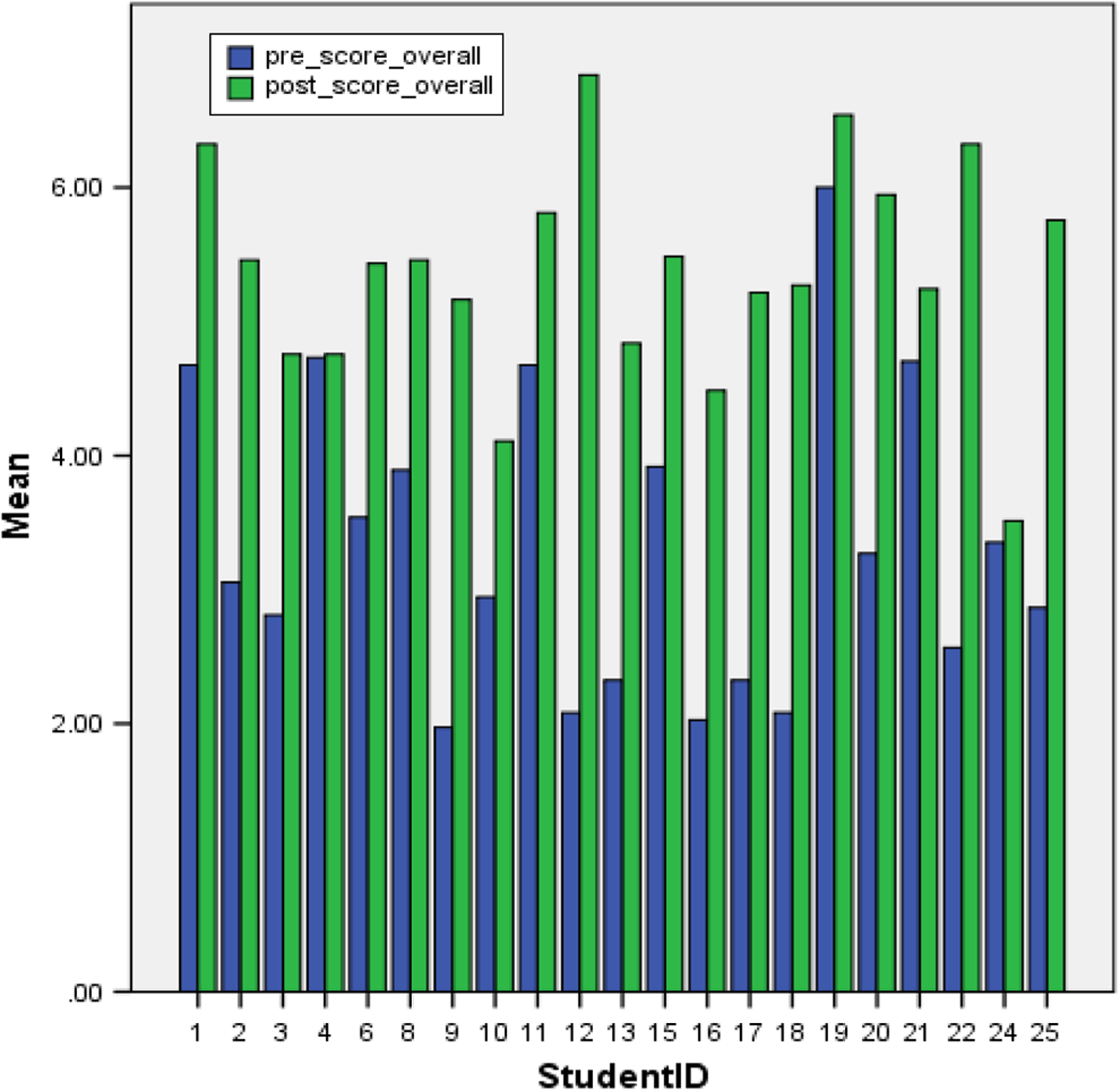
Preservice teachers’ average Diversity Knowledge Survey scores pre and post the diversity course.
Further analysis revealed that each of the identified six thematic classifications in DKS demonstrated statistically significant growth in preservice teachers (see Table 3).
Paired Samples Test.
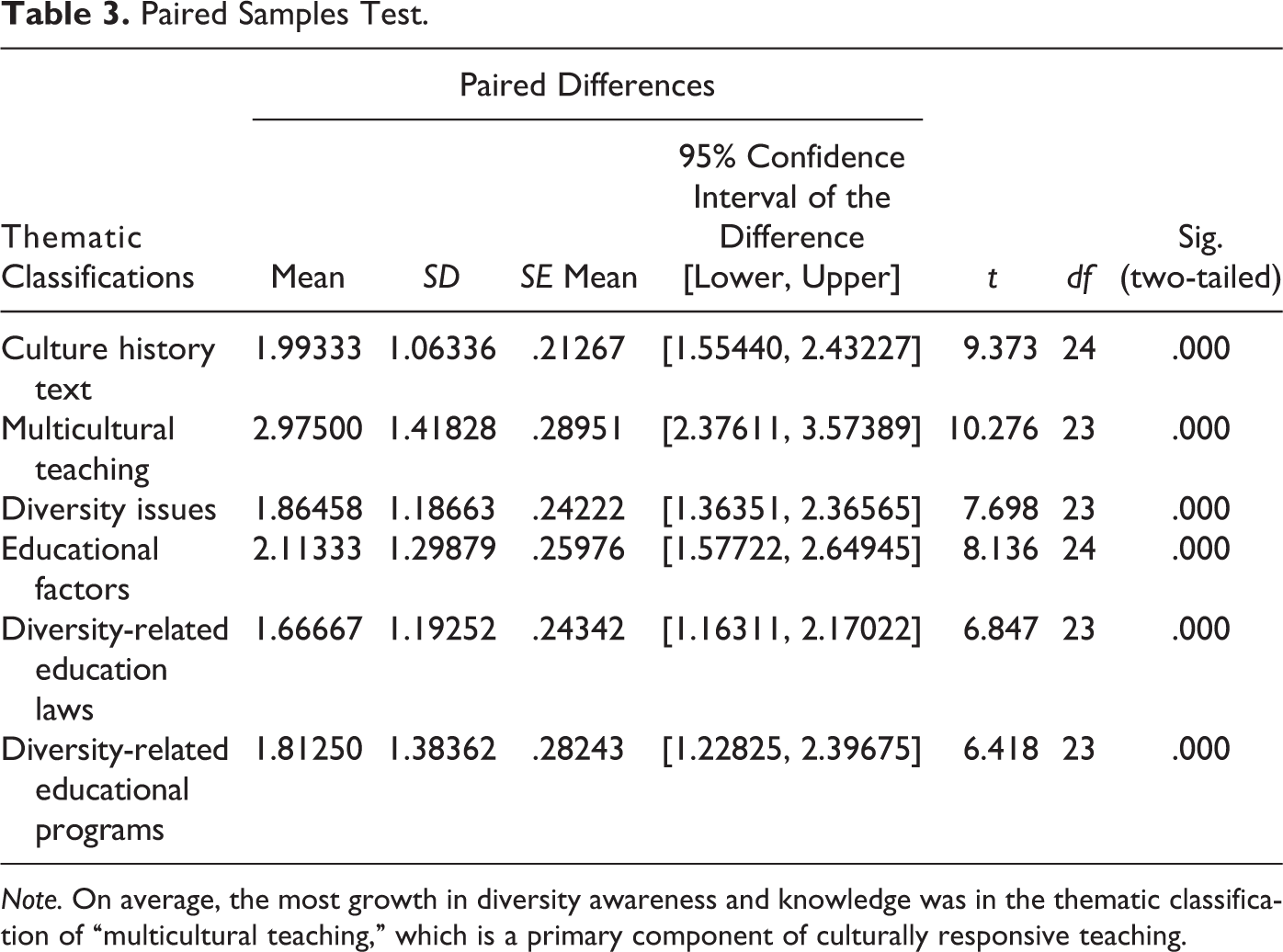
Note. On average, the most growth in diversity awareness and knowledge was in the thematic classification of “multicultural teaching,” which is a primary component of culturally responsive teaching.
In conjunction with the survey data, the focus group provided the context for understanding the phenomenon and results from the quantitative portion of the study. Overall, the nine elementary preservice students who participated in the focus group provided context for the surveys. The focus findings revealed preservice teachers who increased in their understanding of diversity culture and education, who understood the importance of pedagogical applications, and who saw themselves as change agents.
Impact of Diversity Course: Qualitative
Critical reflection: “Once we started opening up other doors”
Without a doubt, the participants’ diversity knowledge increased from a surface-level understanding of diversity to one that was deeper, more reflective, and transformative. The data revealed that based on the information presented in the diversity course, participants became not only consumers of the information, but the knowledge gain was filtered through their individual epistemology and produced permanent change in how they viewed themselves. In totality, all nine participants saw themselves as cultural beings, which is congruent with the extant literature on critical reflection and cultural diversity work. Concomitantly, as the information became more challenging, the students employed critical reflection to help construct and create new meaning of the discourse. For some, the knowledge and experiences in class began to create teachers who understood that difference does not mean deficit. The course was transformative in providing an intimate experience with the concepts and precepts that truly opened the doors for the students to critically reflect on the intersectionality between diversity, culture, and education. This quote from Lex represents that transition: I think it [the course] changed my whole idea on what diversity is, and I knew I didn’t really know. I thought of it more along the lines of ethnicity and race, and now it’s frustrating when I hear other teachers say my class isn’t diverse or that I don’t have much diversity in my classroom. I just want to say no, you do have diversity. You have kids with different needs, different interests, different cultures, and I look at it as something much more deeper than that race and ethnicity now. I also feel like it helped. The class helped a lot, in terms of terminology that’s good to use or not. For instance, I noticed things that I have said like, last year I would always say parents as opposed to families, and even though I know that not all my kids have two parents or parents at all, I would just instinctively say parents and parent involvement and all that kind of stuff, and now I am more aware of using the term family and being aware that families are not, may not be your typical or not necessarily be a mom and a dad, you know, like your traditional American family, so definitely terminology is something I took away from the class. I think before I came in [the class], I had very set definitions of myself, like I identified with one group and that was it, and you know, I was proud to identify with that group, but that was kind of it. Then, we talked about more. It’s about more than the color of your skin or where your family comes from or what religion you are or whether you are male or female. Once we started opening up these other doors, it was well, I also identified with this and with this, and that allowed connecting with other people who identify similarly or differently, or you can have these discussions and connecting in a way that I really did not have. Before I thought, you know, I was a white girl, and then after this class, I have at least seven other things to identify with as well.
Culturally relevant teaching: “Diversity is part of my instruction—carry over into our classroom”
As the students’ worldview transformed into one that incorporated more cultural ways, diversity and content became interwoven into a narrative that created classrooms, where culturally relevant teaching was the norm and not the outlier. This was transformative as these nine preservice teachers were interviewed after student teaching and were very strong in their vision of having classrooms where cultural diversity was celebrated. Essentially, the participants incorporated the knowledge gained in the diversity course into every aspect of the classroom, creating a route for direct transfer into their practice and according to Ulia, “before I thought of diversity as a separate entity or an addition to my instruction, and now I think of it as part of my instruction.” Aura expands on Ulia’s comments, showing another application of the concept of direct transfer from the diversity class into student teaching and beyond. Aura forward, Like Ulia said, a lot of it we did in our class [diversity course]. I was able to carry over into our classroom, and fifth grade is nice because we get to do lots of interesting activities that are a little mature, and we’ve had debates on presidential candidates and also research. This week we are finishing up our debate on stem cells, and because of the way we structured our class, we were able to take that and structure our reading class, so you know we were able to share thoughts as long as we were respectful and honest like we [students in the diversity course] did, and they did a great job with it. They took it very seriously, and they were very respectful of each other, and I think it was because we had this class and because of all that I’ve learned from the class I was able to carry that into that class as well. I also just want to go off of that and how important it is to have multicultural literature in the content area. In diverse populations like your school, they [students] need to see themselves in books, and if they don’t see themselves in books, then they don’t see themselves as a function in society. If they see themselves in books and can see themselves as parts of the community, then they will feel a lot like they fit in, and you know, … I can be a teacher and I can be a business person and I can be, you know … I think making sure they use the literature to see them as an asset to the community. I think that some people see it [multicultural content] as like an extra step, an extra effort. However, I feel like it means that much to that one child that you have in that class that affects them in some way in that they can see that certain book you are reading or that certain topic you are covering or incorporating their diversity into that topic. I guess it is reflected in my lessons, and during my first practicum, I did not really even consider cultural diversity or anything like that. If I was doing my read aloud, I was just reading. This is just one example, but I just never really think about it [incorporating cultural diversity]. Now I am thinking about those lessons and going back and being like, ok how could I have done that better? How could I have made sure I was reaching all of my students and thinking about that when I am planning lessons now?
Transformative learning: “I feel like it is a movement”
Transformative learning skills include questioning what we have come to accept or know through our life experience, especially unpacking those things that our society may predispose us toward, and which we—without active engagement and questioning of how we know what we know—accept. Transformative learning involves developing a self-authorship toward advocacy for a better society. Transformational learning is making meaning with different dimensions of awareness and understanding. Additionally, this study points to the affective or emotional dimension of transformative learning; and according to Dirkx (2006), emotions do influence transformative learning in two ways: (a) via critical reflection and (b) unconscious emotions involving individuation. Thus, the narratives of these preservice teachers echo central themes in transformative learning, conscientization Freire (1992), social change, and identity.
Based on the statements of the preservice teachers in the course, it was evident that transformative learning occurred and that preservice teachers are armed with transformative learning skills, which they will, in turn, teach their students and colleagues. As an outcome of this course, at least a quarter of the preservice teachers felt they had become an advocate for students (specifically those students whom other teachers are uninformed about). They also felt the course had had more of an effect on their social belief system as preservice teachers than any other class they had taken at the university. It had opened up a whole new world. Of note, the students collectively felt as if the class created a community, as they felt a level of mutual respect and support both from the class and the program as a whole. In final focus group segments, the students compared their transformation to a movement—with Asmine stating, “I feel like this is a movement.” When asked to explain, Atey declared, of course, I think in a few days when we all graduate and go off in our different way, it’s gonna be hard to stay like a community, but we all have the same knowledge now that we can apply in a different way, over the country or the world, wherever we are and apply that knowledge and spread it. and, being responsible for doing that [applying and passing on diversity knowledge] since we are fortunate to be given that knowledge to work with it and just continue to pass along. If it wasn’t for people like you [course instructor] and people like us taking the class, we would never have gotten that and never be able to pass it on now that we have it. We can do something with it. I think it [diversity class] has created leaders in us to be able to take what we have learned and not only we lead in our PLC (professional learning communities) in our schools that we will be working with and just being able to teach other professional about what we already know and just the importance of that. Because we learned so much good, good information, I think that it is just important to share with everyone. I think that is how the movement would continue as we all take what we have learned and share with other people and professionals.
Discussion
As America becomes more diverse, teachers must be equipped with the knowledge, skills, and disposition to deal with diversity issues using a comprehensive approach. This study highlights the importance of intentional diversity studies at the preservice level in a predominantly White teacher education program. Most importantly, intentionality should include diversity courses with a design emphasis on foundational theories in diversity education, critical self-reflection, and the examination of various diversities. The course in the study was taught in such a manner that students had an understanding of foundational theories and the ability to engage in critical self-analysis being introduced to various types of diversities. This provided space for the instructor and students to engage in deconstruction of problematic frames of references before unpacking how various diversities affect the teaching and learning process. Moore (2005) views such examination as transformative and purports that transformative learning involves a revision of old assumptions and ways of being. As such, this course is an iterative process where diversity theories and critical reflection are taught early in the course, so that students can use the strength-based approaches of DPT, critical multicultural education, and social justice to examine the experiences of diverse students, families, and communities.
As such, critical reflection is crucial as a beginning component of a diversity course because it allows preservice teachers to deconstruct their own familial and sociocultural histories before they begin to construct often deficit perspectives of diverse families. Furthermore, the organization of the course progressed from awareness to competence in order to help the students acquire skills in order to fully understand diversity and culture and the cross pollination of these issues with micro-, meso-, and macrosystem variables. It is within the context of systems theory that students are able to navigate the complexities of power, privilege, and oppression affecting diversity discourses within teacher education, public schooling, policy making, and communities at a local to national level. Consequently, Bronfenbrenner’s (1986) ecological system theory is an essential catalyst for teaching preservice teachers about the systemic issues involved in the teaching and learning of diverse students and communities, as it underscores the intersectionality of individual-level experience with institutional policies and practices in education.
In conjunction with the organization of the course, the assignments for the course were carefully selected to promote transformative learning. For example, three critical reflections and a cultural immersion project allowed students to examine how their personal and familial backgrounds interacted with the pedagogical and research literature regarding diversity in teacher education.
As shown in the narrative of the teachers, on one hand, issues of disequilibrium arose as a result of the assignments, while on the other hand, the teachers grew in their ability to act as change agents on behalf of children and families. Such findings are in line with the current research. Taylor (2000) cautions that disequilibrium in classroom spaces can be new territory but also offers another perspective stating, “Teachers and learners who are willing to engage each other in open and safe group settings, participate in challenging experiential activities, and explore learning beyond the rational to include the extrarational, have the potential for transformative learning” (p. 14). Thus, the organization and carefully selected assignments and experiences embedded in diversity courses were aimed to provide the instructor and students “with a voice, with the ability to name the world and, in so doing, construct for ourselves the meaning of the world” (Dirkx, 1998, p. 3). This echoes Dirkx’s (1998) proposition that a sense of critical consciousness is an important aspect of transformative learning. The careful placement of critical reflection at the beginning of the course allowed the preservice teachers the opportunity to interrogate their worldviews, developing teacher identity and their role as change agents which are all elements central to transformative learning.
The results also uncovered that thinking and reflecting critically on diversity, culture, and schooling are also enhanced when preservice teachers are exposed to critical pedagogies in education such as culturally relevant teaching, social justice education, and multicultural education. An understanding of these critical frameworks provides preservice teachers with pedagogical tools to create culturally sensitive classroom teaching and learning experiences that will benefit all children. Also, teacher educators should include pathways of learning that support the inclusion of external constituencies and experience such as field trips, speakers, and immersion activities, as these provide avenues for students to become active participants in increasing their diversity knowledge.
Overall, the results from this study show that when teacher educators create diversity courses critically and intentionally, students increase not only in their diversity knowledge but become actual advocates for social justice, equity, and social change for students and families. As such, teacher education programs nationally may want to revisit the membrane and structure of their diversity courses and examine the sequence of the course, the structuring of readings and assignments, and the ways in which instructors involve external constituencies and experiences to enhance classroom learning.
Footnotes
Declaration of Conflicting Interests
The author(s) declared no potential conflicts of interest with respect to the research, authorship, and/or publication of this article.
Funding
The author(s) received no financial support for the research, authorship, and/or publication of this article.