




Abstract
The 21st century is seeing dramatic shifts in the business environment. In order for organizations to adapt to these shifts, they must be more flexible and learning oriented. To thrive in this environment, organizational leaders must facilitate and build the capacity for learning throughout the organization. Organizational leadership is looking for employees to bring more than technical competencies or subject-matter expertise to their work; they are requiring specific learning-oriented competencies such as critical thinking, problem-solving, agility, adaptability, initiative, communication, and collaboration among others. To that end, business education is under heavy criticism for failure to produce the workforce needed to meet the demands of the 21st century. We set out to develop a conceptual teaching and learning model anchored in transformative and constructivist perspectives of learning that engages the whole learner in learning, reflective practice, and interactions with learning facilitators, other learning agents, and actors in a learning context.
Keywords
The demand for innovation and learning within organizations today is a worldwide concern (Moustaghfir & Schiuma, 2013). According to an innovation and commercialization global survey (McKinsey & Company, 2010), 84% of executives identified that innovation is extremely or very important to their company’s growth strategy. Sullivan (2011) identified innovation in a business context as “Involv[ing] something new or novel…[covering] the gamut of what underlies an organization’s capacity to be successful and sustainable” (p. 493).
In order to facilitate innovation, existing rules, practice, modes of organizational operation, and historical mental models and worldviews must be broken (Jacobs & Heracleous, 2005). In other words, to facilitate innovation, an organization must strengthen its adaptability and responsiveness to the unpredictable environment by integrating its capability for learning (Moustaghfir & Schiuma, 2013). Research suggests that organizational learning, transformation, and innovation are directly related to individual employee capacity for innovation and learning (Sullivan, 2011; Wang & Ellinger, 2011). As a result, organizational leadership is looking for ways to foster individual employee learning capabilities and behaviors (Skilton & Dooley, 2010) and seeking to hire employees who will effectively contribute to workplace innovation–professionals who are able to adapt to ambiguity, think critically, and routinely make decisions on their own.
According to Reid, Dahlgren, Petocz, and Dahlgren (2008), Entering an educational programme in higher education…can be seen as the start of a trajectory of professional formation, which includes both the appropriation of a body of knowledge and of the history, social practices, skills and discourses that are part of the respective discipline or profession that is studied. (p. 730)
Transformative learning, as explained by Mezirow (2009), goes beyond content knowledge and encourages learners to question their own assumptions and frames of reference and become critically reflective of the content, the problem, the way in which a problem is articulated, and/or the process by which to solve the problem (pp. 22–23). Such reflective learning requires time (Helyer, 2015). In her paper exploring the role of reflection in work-based learning, Helyer (2015) argued that both reflective practice and lifelong learning are linked to one’s becoming a professional. Yet, the importance of reflective practice as a skill is often neglected and not stressed in business education, which by all accounts focuses on the development of new business professionals (Belton, Gould, & Scott, 2006; Berdrow & Evers, 2011; Peltier, Hay, & Drago, 2005; Scott, 2010). When reflection has been included, it is often an afterthought or add-on (Hedberg, 2009). Business schools must shift from the old teaching paradigm and explore models that facilitate critical reflection (Dirkx, Mezirow, & Cranton, 2006) as well as help “students develop a disciplined habit of learning” (Hodge, Proudford, & Holt, 2014, p. 2), so that upon graduation, they will quickly be able to contribute to organizational learning and innovation.
As coauthors, we share an interest in moving beyond traditional models in business education, having individually explored transformation through diverse perspectives. Each author comes to this work with different, yet important, lenses and disciplines. Anne-Liisa is an adult learning facilitator with over 10 years in business undergraduate education. Anne-Liisa’s background and research interests include adult and organizational learning, individual and collective transformative learning, reflective practice, spirituality in learning, and complex adaptive systems (Longmore, 2007, 2014). As a Jungian psychotherapist and academic innovator for over 12 years, Grant (2005, 2014) has conducted research in creativity and innovation, values-based leadership, and transformative corporate cultures. Having facilitated learning in business education for over 10 years, Golnaraghi has lead research on the efficacy of problem-based, adventure learning (Doering, 2006) in leadership development education which she codesigned with several colleagues (Golnaraghi, Noka, Bouffard, & Staples, 2013) and program-level portfolio learning model in undergraduate business education (Golnaraghi, Theoret, & Wells, 2015).
We initiated our collaboration in transformative business education in 2014 with an earlier iteration of a transformative learning model (Golnaraghi, Grant, & Longmore, 2014) and critical reflection for deepening learning experiences (Grant & Golnaraghi, 2014; Golnaraghi, Grant, & Longmore, 2015). Building on this work, we set out to develop a conceptual teaching and learning model in business education that views learning as a highly individualized yet socially constructive and reflective activity. A model that is intentionally guided and scaffolded by a learning facilitator as companion, partnered with additional learning agents and actors, where learners (both individually and collectively) explore real-world challenges, engage in discourse, and make sense of course content in an iterative and dynamic context. The framework for this model and study draws from the principles of human learning (Jarvis, 2006), transformative learning (Jarvis, 2006; Mezirow, 1997, 2012; Mezirow, Taylor, & Associates, 2009), and reflective practice (Brookfield, 1995; Mezirow, 1990, 1998; Schön, 1995).
Theoretical Framework
We define learning as “the process of using a prior interpretation to construe a new or revised interpretation of the meaning of one’s experience as a guide to future action” (Mezirow, 2012, p. 74). Transformation, according to transformative learning theory, refers to “a movement through time of reformulating reified structures of meaning by reconstructing dominant narratives” (Mezirow, 2012, p. 84).
The developing conversation on transformative learning theory in education first introduced by Mezirow in the 1970s has continued to evolve to include relational, spiritual, and contextual constructs as well as reflecting both social and individual learning (Cranton & Taylor, 2012). Our transformative teaching and learning model is grounded in a number of theoretical constructs, which we outline in this section.
The Whole Learner Learns
One criticism of Mezirow’s transformative learning model is that it is primarily focused on the cognitive transformation of the learner(s) (Cranton & Wright, 2008). In their study of literacy educators, Cranton and Wright (2008) contended that educators must attend beyond the cognitive aspects of the learner, to the whole person, when facilitating transformative learning. Our model is premised upon the notion that as learners engage in learning experiences with others, within a particular environment, each is learning with the whole self. Jarvis (2006) contended: Human learning[is] the combination of processes whereby the whole person—body (genetic, physical and biological) and mind (knowledge, skills, attitudes, values, emotions, beliefs, and senses) experiences a social situation, the perceived content of which is then transformed cognitively, emotively, or practically (or through any combination) and integrated into the person’s individual biography resulting in a changed (more experienced) person. (p. 13)
Experiences, Disjuncture, and Critical Reflection as Conduits to Learning
Viewing learning as entwined with becoming helps to see how learning experiences (both intentional and unintentional) inform a learner’s becoming. When a learner enters into a learning situation, so too does the learner’s biography and currently held meaning schemas (Jarvis, 2006). Over time, a learner’s meaning schemas and biography evolve and expand, becoming more complex as new understandings and learning are integrated. If an experience confirms previously held meaning schemas or beliefs, then this experience will serve to maintain that belief (Beard & Wilson, 2013). Alternatively, when an experience diverges or somehow does not connect to previous meaning schemas or beliefs, the learner experiences what Jarvis (2006) calls disjuncture. According to Jarvis (2006), “disjuncture occurs when our biographical repertoire is no longer sufficient to cope with our situation, so that our…harmony with our world is disturbed and we feel unease” (p. 16). Learners experiencing disjuncture will seek ways to move back toward a state of equilibrium and ease (Jarvis, 2006). That being said, experiencing disjuncture does not automatically lead to learning. For example, a learner may experience disjuncture and not acknowledge or know what it is. Or a learner may acknowledge disjuncture and decide to ignore it, thereby not resolving disjuncture (Jarvis, 2006; Mezirow, 2012).
When resolving disjuncture one “transform[s]…frames of reference through critical reflection on the assumptions upon which…interpretations, beliefs, and habits of mind or points of view are based” (Mezirow, 1997, p. 7). It is the learner’s intentional critical reflection that leads to deep, transformative learning. In other words, the exploration of the what, how, and why of the experience helps to revise preexisting meaning schemas and integrate the new meaning into one’s biography (Beard & Wilson, 2013; Jarvis, 2006). Mezirow (1997) identified four levels of reflective practice: habitual action, understanding, reflective action, and critical reflection. Habitual action or nonreflection refers to the engagement in routine activity with little to no conscious thought. Understanding refers to a learner comprehending and applying knowledge in context. During reflective action, learners will work through problems and make decisions without questioning the underlying beliefs or assumptions. Mezirow’s (1997) critical reflection is where a learner questions the underlying assumptions and beliefs and considers the implications. Our model focuses on critical reflection.
Learning Is Emergent and Socially Constructed
Learning, like knowledge, is emergent in nature. As learners engage in experiences with others, and reflect in, upon, and prior to those experiences, new understanding, meaning schemas, and knowledge emerge. The new knowledge is then brought forward to inform the next interaction or experience and so on. This cycle continues indefinitely through continuous loops of learning. According to Taylor (2011), “emergent learning means more than acquiring knowledge over a lifetime; it means that we create new knowledge continuously as we encounter new conditions and challenges” (pp. 31–32).
Transformative learning theory is also premised on constructivist assumptions where learning and understanding of the world are formed through a learner’s engagement with the social world (Cranton & Taylor, 2012). We contend that learning is a complex process embedded in social interactions, whether interactions are taking place in small groups or in the broader community (Jarvis, 2006). Learners make meaning or create understanding and knowledge during their interactions and experiences with others. Consequently, if during this process, each learner is weaving an intricate pattern of understanding based upon the interactions, exchanges, and experiences with others, then they are also individually and collectively cocreating knowledge and respective perceptions of reality (Berger & Luckmann, 1966; Kakihara & Sorensen, 2002; McVee, Dunsmore, & Gavelek, 2005).
McVee, Dunsmore, and Gavelek (2005) argued that “cognition does not exist as an isolated process within the individual but as a ‘bio-social-cultural process’ that is both public and private” (p. 533). In a formal learning context, the biosocial–cultural process in which a learner is engaged in a particular course is likely to be comprised of a combination of the following elements: the learning facilitator, the room itself, the content, the methodology used, the other learners, and the learner him or herself (Pratt & Associates, 1998; Pratt & Smulders, 2016). Knowledge and learning emerge through this context by way of mindfully crafted and scaffolded individual and collective activities. Given that each individual learner is unique and is embedded in the learning process and social context, according to social constructivist pedagogy, “each learner will construct knowledge differently and that these differences stem from the various ways that individuals acquire, select, interpret and organize information” (Adams, 2006, p. 245). Adams (2006) suggested that: Implicit within the social constructivist position…is the need to focus on the learner and not the subject matter to be taught, whilst simultaneously recognizing that there is no knowledge independent of the meaning attributed to experience by the learner within the learning community. (p. 246)
Instructor as Learning Facilitator and Companion
In order to facilitate transformation, it is contended that instructors are facilitators and companions of learning (Cranton & Wright, 2008), not disseminators of static blocks of knowledge. According to Cranton and Wright (2008), the notion of a learning companion is: One who helps the learner to recognize his or her own expertise and experience and draw on that…helping the learner deliver their words to the world and put the learner into the conversation. The learner companion encourages a shared curiosity and engages in an exchange of learning so that the perspectives of both educator and learner are enhanced. (p. 36)
Conceptual Framework
Conceptually, our transformative teaching and learning model is informed by a number of constructs, which we outline in this section.
Model of Human Learning
Jarvis’s (2006) model of human learning (see Figure 1) incorporates many of the theoretical constructs framing our model. While Jarvis’s (2006) model may resemble Kolb’s often cited experiential learning cycle, it builds upon Kolb’s model by adding the elements of the learner, the bodily sensation of experience, the social interaction, and construction of experience, reason, emotion (pp. 10–11).
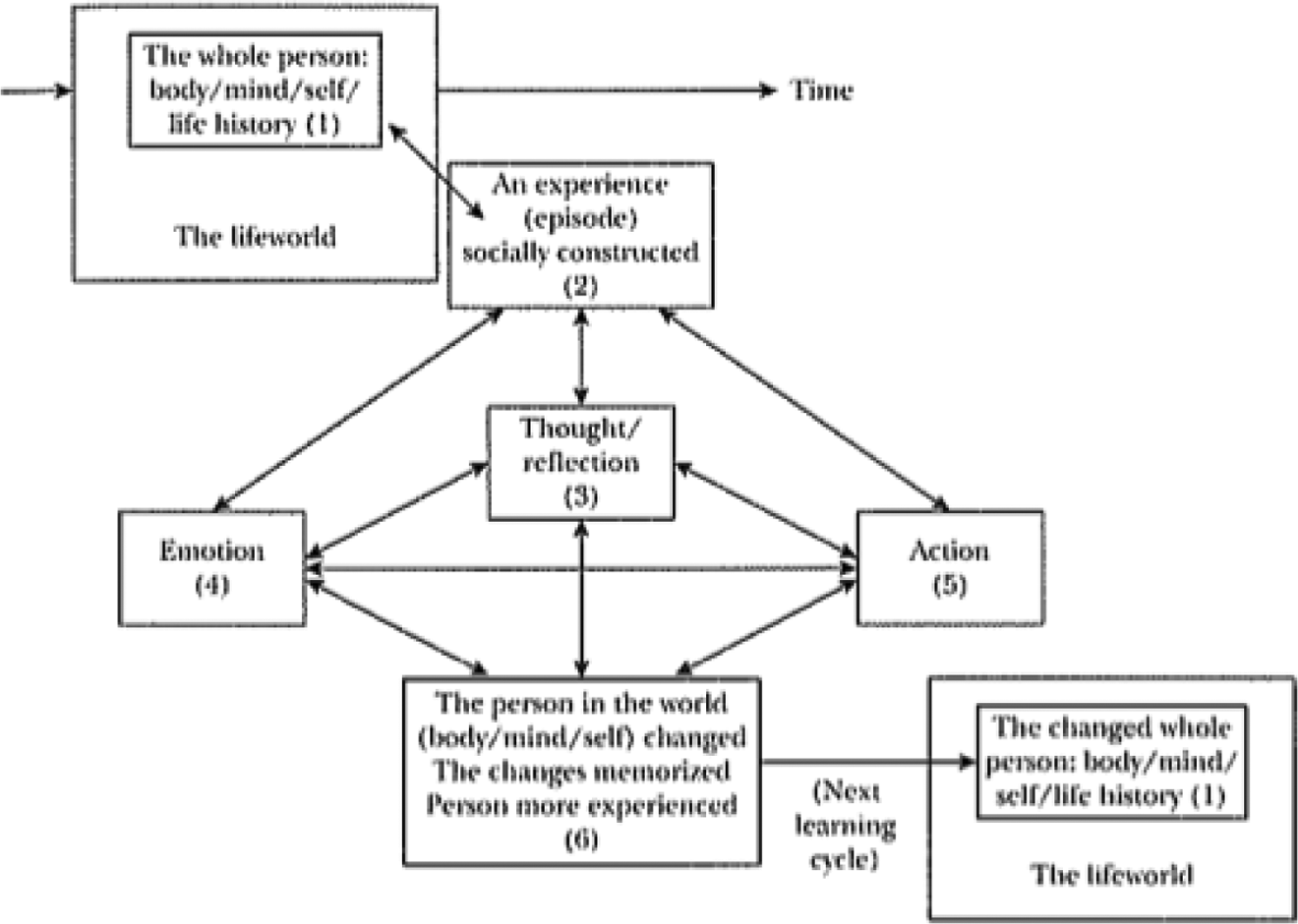
The transformation of the person through learning. Adapted from Jarvis (2006). Copyright 2006. Reprinted with permission.
We believe Jarvis’s (2006) model of learning effectively illustrates the concept of the whole learner and biography, engaging in and informing learning through the dynamic interactions of mind, body, and self with disjuncture, emotions, thoughts, reflection, and/or action with experience. Jarvis (2006) posited: I learn to be me—we all learn to be ourselves through the process of living.…The wider our experience of life and the more we learn to reflect on it and not take it for granted, the more we learn and the more we become whole people. (p. 50)
General Model of Teaching
To many, “teaching is conceived of as a potentially neutral, skillful performance—setting objectives, leading discussions, giving lectures, asking questions, providing feedback and so forth” (Pratt & Associates, 1998, p. 16). In fact, effective teaching is often portrayed as mastery of a set of generic skills or techniques. Suggesting that content knowledge, combined with best practices in teaching, is all that is required to be effective (Pratt & Associates, 1998, p. 16). These assumptions often lead to “homogeneous and limited interpretations of what curriculum and learning are about” (Davis & Upitis, 2004, p. 113).
Pratt and Associates (1998) suggest an instructor’s views and beliefs of learning influence the way in which one develops curriculum and the ways in which one teaches. Often instructors are unaware of their beliefs and views, as they go unexplored during our conversations about what they do as teachers. According to Pratt and Associates (1998): Our perspectives…govern what we do as teachers and why we think such actions are worthy or justified.…If we wish to understand…people’s teaching, we must go beneath the surface to consider the intentions and beliefs related to teaching and learning which inform their assumptions. (pp. 10–11)
Pratt and Smulders (2016), building on the earlier work of Pratt and Associates (1998), developed a general model of teaching (see Figure 2) that aligns with prior constructions and illustrates the interconnections and interplay of what they have identified as the five elements in a formalized teaching process—instructor, learners, content, context, and ideals. Their model also explores teachers’ commitment levels to three relationships among the elements: the relationship between the learners and the content (as identified by line X), the relationship between the instructor and the learners (as identified by line Y), and the relationship between the instructor and content (as identified by line Z). We contend as one enters into and continues to engage in professional practice as a teacher, one’s whole self is learning what it means to teach. As much as there is diversity in learners, there is also diversity in teaching due to the “diversity…of deeply held beliefs applied to a vast array of learners, subjects, and contexts” (Pratt & Associates, 1998, p. 280).
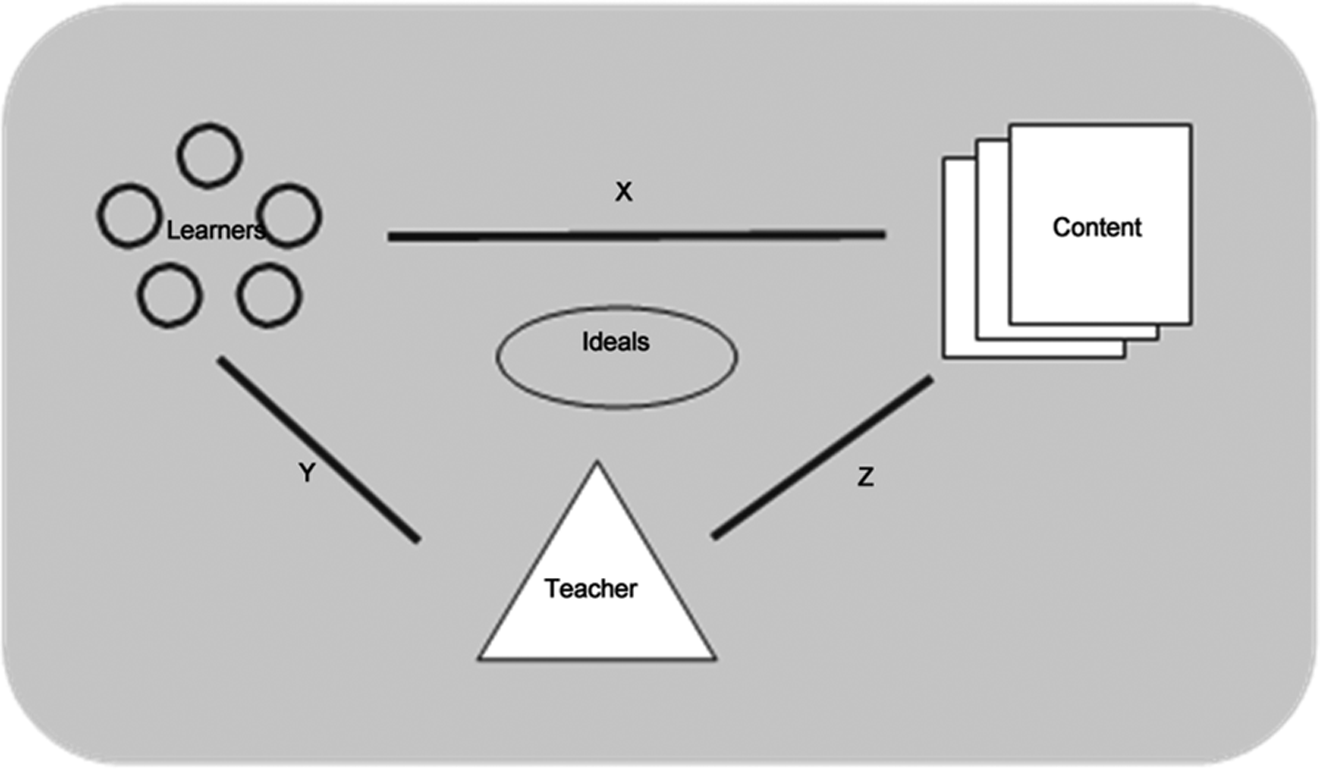
General model of teaching. Adapted from Pratt, Smulders, and Associates (2016). Copyright 2016. Reprinted with permission.
In developing the five elements of their model, Pratt and Associates’ (1998) study of teachers found that those interviewed “were committed to uniquely blended combinations of actions [what a teacher does while teaching], intentions [what a teacher is trying to accomplish while teaching] and beliefs [what a teacher believes about teaching]” (p. 6), each of which informed the teacher's perspective. They posited that each educator’s views of, and commitment to, the five elements influences the way in which the teacher thinks about or plans his or her teaching practice. The five perspectives or views of teaching identified by Pratt and Associates (1998) are transmission, apprenticeship, developmental, nurturing, and social reform (see Table 1). Pratt and Smulders (2016) posited that most teachers have one (or sometimes two) dominant teaching perspective(s) with one other as recessive and the remaining two or three perspectives as backup.
Key Beliefs of Teaching Perspectives.
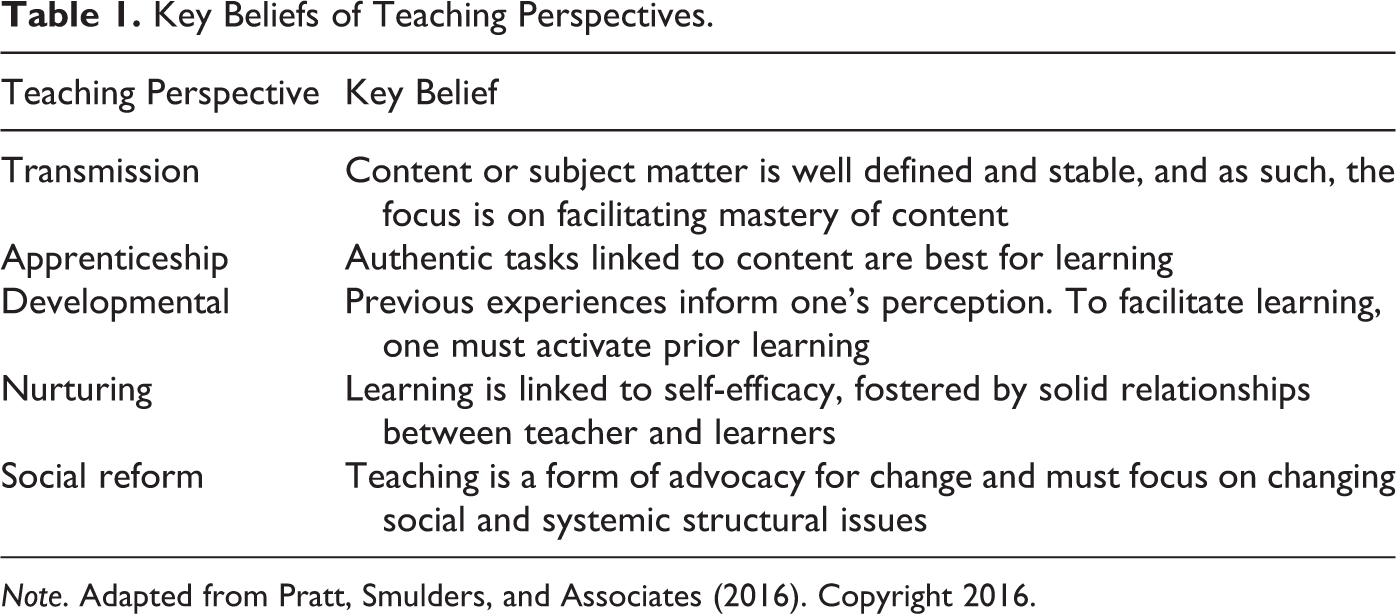
Note. Adapted from Pratt, Smulders, and Associates (2016). Copyright 2016.
After comparing the theoretical constructs framing our model and Pratt and Associates’ (1998) five perspectives on teaching, we believe an alignment with the developmental, apprenticeship, and nurturing perspectives emerges. If we were to assume that either the developmental, apprenticeship, and/or nurture perspectives are one’s dominant perspective(s), then one’s model for teaching could be represented as an amalgamation of the models for developmental, apprenticeship, and nurturing (see Figure 3). In the developmental perspective, the focus is on Line X, bridging prior knowledge to present new and desired ways of thinking (Pratt & Smulders, 2016, p. 250). Development focuses on building bridges to existing and new knowledge, asking probing questions to explore understanding and helping to foster deeper learning and more complex ways of thinking (Pratt & Associates, 1998). In the nurturing perspective, the focus is on Line Y, fostering a strong connection between teacher and learner (Pratt & Smulders, 2016, p. 259). The nurturing view supports the whole learner through the intentional facilitation of self-efficacy, helping to navigate disjuncture, building relationships, and promoting a climate of trust, caring, and encouragement (Pratt & Associates, 1998). The apprenticeship perspective focuses on context, content, learners, and teacher—using authentic experiences with learners to foster understanding of professional practice and become contributing members of the community (Pratt & Smulders, 2016). Engaging learners in learning through doing, problem-solving, participating in authentic practice, and building and scaffolding professional skill and competency development is the focus, ultimately leading to membership of a professional community. Teachers with this view lead by example and facilitate the transition from student learner to professional member of community (Pratt & Associates, 1998).

Amalgamation of developmental, apprenticeship, and nurturing teaching perspectives. Adapted from Pratt, Smulders, and Associates (2016). Copyright 2016. Reprinted with permission.
The learning facilitator intentionally draws upon learners’ prior knowledge, working with individual learners and the collective cocreating bridges through authentic activities and reflection, within the learning context, to create new knowledge and ways of being, while fostering relationships between and among all learners and agents.
Triple Helix Model
The visual of our triple helix model is informed by the work of Bateson (1972). Bateson, a pioneer in the field of learning, reframed learning into a systems perspective and proposed the interdependence of actors in any learning system, while suggesting that learning itself is a process of interactions, relatedness, and connection. He also contended that learning was comprised of four different levels, each of which may take place simultaneously and/or sequentially. Bateson’s levels of learning change from Level I learning, where learners engage in an experience but do not change behavior based on that experience through to Level III learning also known as transformative learning (Cranton, 1996; Mezirow, 1990). As a learner engages in Level III learning, he or she begins to experience a shift in not only his or her worldview but also a shift in how he or she sees himself or herself within that world. In essence, the learner begins to see how interconnected he or she is to all that surrounds him or her. According to Visser (2003), “Change of this kind…almost exclusively occurs at the unconscious levels and only afterward is given a rationale” (p. 276).
We concur with Bateson’s (1972) contention that people are not individual entities, separate and distinct from one another or their contexts. Bateson’s construct suggests that all learners within a learning environment are interconnected and that it is through the interactions, relationships, and collective experiences that learning and growth occur for both the individual learner(s) and the collective whole (Charlton, 2008).
Both double and triple helix models have been used by others in their work on learning. For example, Colby, Ehrlich, Sullivan, and Dolle (2011) use the double helix metaphor to demonstrate the link between student learning of business with liberal arts learning and how the two together inform a broader view of the world. Jordan (2014), in her exploration of learning from a human evolutionary perspective, suggested that the image of the double helix “allows a view that focuses on growth and development through processes of mutual influence, of coevolution, of imbrication, of a path taken when others could have been taken” (p. 194). As well, Garner (2016) used a helix to illustrate her coaching model, which incorporates four aspects of learning—brainstorm, defend/deny, turn and transform, and reflect and review.
In their study of university–industry–government relations, Etzkowitz and Leydesdorff (2000) contrasted the double helix with a triple helix, purporting that the triple helix is more effective as a metaphorical image to represent the complexity of the emerging and evolving dynamics of multiple elements in a learning situation and the ongoing nature of transformation.
Triple Helix Transformative Teaching and Learning Model in Business Education
Drawing on the theoretical and conceptual constructs outlined in this article, a three-dimensional model was created (see Figure 4) to represent the interactions of the elements within our transformative learning process. Our proposed teaching and learning model focuses on the whole learner, incorporates, and makes explicit the context and learning environment, and the dynamic nature of interactions of all of the learning agents. Furthermore, our model illustrates how the individual learner engages interpersonally (through reflection) and intrapersonally (through interactions and experiences) with other learning agents to cocreate new knowledge and understanding.

Triple helix transformative teaching and learning model in business education.
As with the covalent bonds within the structure of the DNA molecule, each strand of the helix is bonded to other strands demonstrating the interdependent patterns that emerge during the learning process. The positioning and movement of the triple helix over time and space can be viewed as the unfolding and scaffolding of a learner’s progression toward the learning outcomes and both the learner’s personal transformation and professional becoming. Jarvis (2006) suggested that the element of time and space is often hidden in the learning process and not explicitly presented. Time and space have been explicitly identified in our model, to bring into mind the flow of time in the learning process, the space in which learning may occur, and the notion of becoming.
The Context and Learning Environment
Although we believe Jarvis’s (2006) cycle of learning incorporates many of the theoretical constructs explored earlier, it does not clearly and intentionally illustrate the learning context, the content being explored, the collective interaction among different learning agents and actors, nor the role of the learning facilitator in stewarding the process in a formal learning environment. According to Pratt and Associates (1998), “What is learned is determined, in part, by the context in which it is learned and applied” (p. 28). This context may either be face-to-face, online, in the class, outside of the class, or a combination of all. Further, the context may be synchronous or asynchronous in nature and/or simultaneous or sequential. It is in this dynamic context and learning environment where the whole learner (Strand 1), the content and knowledge (Strand 2), and other learning agents and actors (Strand 3) continue to interact in multiple and continuous cycles over time and space. While our proposed model focuses on one course, we argue that as the whole learner engages in multiple courses (with different facilitators, other learners), participates in extracurricular cocurricular activities, and work-integrated-learning opportunities, as part of a program, the learner is engaged in a process of becoming and is transforming—experience by experience.
Strand 1—The Whole Learner
The first strand represents (see Figure 4) the whole self as learner, which includes the physical presence of the learner and the learner’s mind which includes both the cognitive and emotive—and is comprised of the learner’s knowledge, skills, competencies, attitudes, values, emotions, identity, beliefs, and senses (Jarvis, 2006).
We agree with Jarvis’s (2006) proposition that the learner’s entire biography enters into the learning space and have adopted his model of human learning to represent the learning process for each individual. From a business education point of view, as learners participate in their respective courses, they are becoming members of their chosen professional community, by learning language, content, technical skills, competencies, apprenticing behaviors, professional conduct, as well as building thinking and learning competencies required for the challenges of the 21st-century workplace (Colley, James, Diment, & Tedder, 2007). If, as we suggest, learning in business is linked to one’s becoming a member of a professional community, then the importance of the whole self, one’s emergent identity, and one’s evolving biography, engaging in what it means to be a member of that same professional community—mind, body, and self must be incorporated intentionally into the practice of teaching and learning.
We argue that it is through interactions with the other elements/agents, guided individual and collective activities, and critical reflection upon those interactions and experiences that learners may experience disjuncture and transformative learning may be facilitated. In an undergraduate business program, disjuncture may occur at many points throughout the learning journey. For example, when a freshman enters into university for the first time, and encounters new content, theories, or professional language and terms, tasks for which they have no previous frame of reference and/or interpersonal and social challenges, disjuncture, and an opportunity for transformative learning are present.
During one's learning journey, the whole learner weaves an intricate pattern of new understanding that builds upon past experiences, makes sense of the present, and anticipates actions for the future (Jarvis, 2006), and over time, through multiple iterations of learning cycles, may experience transformation. Consequently, one is not only learning content and processes as is the case in business education today, the whole learner is learning to learn, and learning to become a business practitioner. Focusing on the whole learner helps to intentionally engage learners with the complexities of everyday life in their social and ultimately professional worlds, “world[s] rich with experience…world[s] of sights and sounds and smells…world[s] of doing and seeing and feeling and listening” (Mintzberg, 2004, p. 66).
Strand 2—Content and Knowledge
The second strand represents the content, theory, and professional knowledge of the community that is to be explored in a course. The learner will engage with course content and industry/professional knowledge through reading of texts, listening to lectures, conducting project research, exploring industry relevant projects and processes, solving real-world problems, participating in activities, and engaging in critical reflection. Furthermore, engagement will foster the cocreation of new knowledge and understanding through guided discourse, reflections, and interactions within the broader learning context (see Figure 2). We further contend that both content and knowledge creation is embedded in the context and arises from and through it. While each learner individually makes sense of the constructs and gains new understanding, that knowledge becomes part of his or her biography. The model posits that the knowledge and learning has been socially constructed through the interactions between and among all learners and learning agents as they have individually and collectively explored and reflected upon course content and their interactions in real time and afterward through guided prompts and questions (Cowan 2014; Schön, 1995). We argue that the learning facilitator plays a key role by stewarding and encouraging open, iterative, and democratic learning discourses that allow learners to make sense of experiences.
Strand 3—Other Learning Agents and Actors
Given this model is premised on the notion that learning is socially constructed, the third strand represents other learning agents and actors (i.e., other learners, learning facilitator, and business partners such as guest speakers, etc.) within the learning environment. We imagine the learning space as a complex system of individual learners interacting and engaging with one another and the content and knowledge. We propose that each of these learning agents and actors cycles through the model simultaneously (albeit differently as informed by their own individual biography) and sequentially within each intentional and unintentional learning experience. Together, their learning cycles weave an iterative and continuous process of learning and becoming over time.
We argue that current positivist approaches to business learning and the teaching paradigm have enculturated learners into ways of being that are outdated and no longer applicable in the current organizational environment. We contend that if a learning facilitator is aligned with the developmental, apprenticeship, and nurturing perspectives, he or she does not cause a learner to learn (Pratt & Associates, 1998; Pratt & Smulders, 2016) but activates prior knowledge, engages learners in authentic tasks linked to content, and fosters learner self-efficacy and becoming. Through a developmental perspective, the learning facilitator honors the whole learner’s biography, endeavoring to draw upon previous experiences and knowledge as a means to begin the sense-making process of new constructs. Recognizing the importance of the relationships in the learning process and the importance of support and encouragement through disjuncture, the nurturing perspective also honors the whole learner in the areas of individual growth, self-efficacy, and cocreation of a trusting environment (Pratt & Smulders, 2016). Through an apprenticeship perspective, the learning facilitator introduces learners to professional constructs, language, and behaviors, working from the simple to progressively complex and guides learners from one identity to the other (Pratt & Smulders, 2016). Through his or her actions, interactions, and relationships, the learning facilitator will inform the learning process and thus the learning of all other agents in the learning context. We further contend, from a business education perspective, that to truly understand, and learn about, the business world, intentional opportunities for engagement with other agents (business partners) and real-world engagement are necessary. We argue that one of the ways in which to remain current and adapt and improve business curriculum is to actively engage business partners in the learning process.
Connecting the Strands—Interactions, Experiences, and Knowledge Cocreation
The overlaps of each strand represent the interactions, and act as bridges, between the elements during the learning process, whether those interactions and experiences are cultivated and shepherded by the learning facilitator or whether they spontaneously occur during the social interactions of learners and other agents. Kakihara and Sorensen (2002) claimed, “Knowledge does not exist in isolation from the social environment; rather it is embedded in the social fabric of human interaction and emerges out of ongoing complex human interactions with other actors” (p. 55).
We draw on Etzkowitz and Levesdorff’s (2000) contentions and believe that the transformative triple helix teaching and learning model metaphorically represents the dynamic and complex nature of the learning environment within business education. The model attempts to reflect the complexities and evolving elements, providing the space and time through which business acumen in the form of technical discipline specific knowledge, 21st-century skills, and development as a whole learner and person is fostered.
Conclusion
We believe our model reconceptualizes teaching and learning for transformation within business education. Compared to the traditional methods of teaching in business schools with their positivist views (Mintzberg, 2004), our proposed three-dimensional model is anchored in social constructivism. Our proposed model moves beyond the emphasis on the teaching paradigm focused on instruction and cognitive mastery of content, toward a more complex, dynamic, and intentional process that fosters an environment for transformative learning and the development of learning competencies. By developing learning competencies, our model engages the learner to move from student identity toward a professional learner identity and better prepares graduates to become active members of their respective professional communities by being able to quickly and positively contribute to the organization’s learning capability and innovative capacity. Business education has been under scrutiny to provide professionals who meet the learning and innovation challenge within the 21st-century business environment. We argue that in order to meet the needs of employers, business education must shift from a traditional teaching paradigm toward a transformative teaching and learning model that facilitates deep learning and critical reflection, builds learning competencies, and fosters professional formation of learners who meet the 21st-century innovation challenge.
Our triple helix teaching and learning model seeks to meet the 21st-century needs of the business environment cultivating professionals who can challenge taken-for-granted assumptions, think differently, adapt to ambiguity and rapidly changing contexts, and routinely make decisions and problem-solving on their own. We propose that our model does so by cocreating opportunities for learners to intentionally interact with, and be guided by, learning facilitators, other learning agents and actors, content and knowledge, within the learning environment, in such a way as to explore, reflect upon, and challenge existing individual mental schemas and assumptions, make sense of content, and cocreate new knowledge. Over time, learners broaden their self-understanding, knowledge, skills, and their abilities to create, analyze, and transform information into insight moving from student learner to professional learner. We believe our teaching and learning model will support learning facilitators to identify ways in which to interact with and guide their learners, as they master not only technical skills but also the 21st-century skills necessary to thrive in today’s rapidly changing and complex business environment. Our proposed model seeks to reflect the complexities of the learning environment and the intentionality needed to foster a transformative learning space that supports the whole learner becoming through continuous cycles of learning.
We believe the value of this model is promising, pointing to the need for interdisciplinarity across a variety of disciplines. We suggest the model has far-reaching impact beyond business disciplines and has potential in other professional learning environments within higher education as well as the faculty learning and development context. Additional cross-disciplinary research will be beneficial in assisting with the evolution of our model. A deeper understanding of this approach, its efficacy for learners, learning facilitators, business partners, and implications for business education is important for furthering and understanding transformative learning experiences within business education. This article is an initial step in offering a meaningful theoretical and conceptual framework to allow for movement in this direction. We see the need for 21st-century learning that continues to move business education away from the traditional transmission-oriented approaches into meaning-making approaches that invite learners to be reflective practitioners who look inward to relate learning to their experience and use critical thinking about what they know and what they learn.
Footnotes
Authors’ Note
An earlier version of this work was presented at the Society for Teaching and Learning in Higher Education 2014 conference, Queen’s University, Kingston, Ontario. The views expressed in this article are the views of the authors and do not necessarily reflect those of the Ontario Ministry of Training Colleges and Universities (now called The Ministry of Advanced Education and Skills Development).
Acknowledgments
We thank Susan Shepley (Scholarly Engagement and Applied Research Librarian) and business students Krisha Amatya, Paulina Juszczak, and Antoine Sarhan from Global Business Management BBA program, Dalton Gosbee from the Finance Diploma Program, Rebecca Massey and Rupak Sarma from the Business Process Management Graduate Certificate Program, and Sumayya Daghar from the Project Management Graduate Certificate Program for their contributions to the literature search for this article.
Declaration of Conflicting Interests
The author(s) declared no potential conflicts of interest with respect to the research, authorship, and/or publication of this article.
Funding
The author(s) disclosed receipt of the following financial support for the research, authorship, and/or publication of this article: This work was supported by a grant obtained by Faculty of Business Professors Ginger Grant and Golnaz Golnaraghi in a Productivity and Innovation Fund from the Ministry of Training, Colleges, and Universities (now called The Ministry of Advanced Education and Skills Development; Project # SHER-CPR4-I-Full) and conducted at Sheridan College’s Pilon School of Business in Ontario, Canada. The grant enabled the researchers to create a research team that resulted in extensive primary and secondary research, successful prototyping, the redesign of several business courses, and the development of a transformative teaching and learning model.