




Abstract
The lens of transformative learning provided a deeper understanding of students’ experiences and the process of learning within an interdisciplinary creativity course for first-year college students. Through the thematic analysis of 930 reflective narratives written by 93 students, the research identified how the overall course activities expanded and reframed their insights on creativity. Three frames of creative minds are presented to show the potential for transformations using students’ voices about impactful experiences: creative dynamics, transformation as a heightened awareness of the value of creativity to society and self; creative mindsets, transformation as a deeper understanding of diverse aspects of creativity; and creative confidence, transformation as a transfer in perspectives to real-world applications. In addition, the findings from this study proposed a framework to build creative confidence via educational strategies for creative learning.
Understanding and teaching creativity should become an indispensable part of today’s educational institutions. Studies have found that students during their time in college perceive a strong need to improve their own overall approach to creativity or develop creative skills to leverage their competitiveness in the real world (Cheung, Roskams, & Fisher, 2006; McWilliam & Dowson, 2008). Based on the assumption that creative potential is universal (Runco, 2003, 2008), the primary concern is what aspects could be developed in students who are learning skills in creativity.
Recently, the case for cultivating student creativity explicitly in higher education has increased (Byrge & Tang, 2015; Cheung et al., 2006; Karpova, Marcketti, & Barker, 2011; Miller & Dumford, 2016; Plucker & Dow, 2010; Zampetakis, Moustakis, Dewett, & Zampetakis, 2008). But relatively insufficient attention has been paid to the ways to do this effectively by understanding how learning can change students’ creative attitudes, perceptions, and self-beliefs about creativity (Petocz, Reid, & Taylor, 2009). Identifying ways to develop creativity through guided learning experiences would provide an essential dimension to better nurture students’ learning ability: encouraging individual maturation and advancing an ongoing goal for higher education.
According to transformative learning theory (Mezirow, 1991, 2000), encountering a “disorienting dilemma” that challenges one’s assumptions and beliefs triggers a sequence of emotions, critical self-reflection, and exploration of new roles that can result in skills acquisition and confidence building. This can initiate a significant change in the way individuals see themselves and how they experience their worldview (Brock, 2010; Curry-Stevens, 2007; Kegan, 2000; Mezirow, 2000). The lens of transformative learning allows for scrutiny about what makes change possible and helps inform successful learning experiences, as well as insight into what creativity and creative processes mean to students. When transformative learning theory is applied to the study of creativity, it yields insights into potential affective and cognitive avenues of growth. Therefore, the current pedagogic study aims to investigate the role of a one-semester creativity course in igniting transformative learning about creativity that likewise heightens awareness of the creative self among first-year university students. By identifying learning experiences that begin to disrupt and reshape commonly held assumptions about the creative product, process, person, and press, insights can be offered on how transformative learning theory can be applied to teaching creativity.
Literature Review
Understanding Creativity
One prominent definition of creativity is that a creative product or behavior satisfies the criteria of being novel (i.e., original, unexpected) and appropriate (i.e., useful, adaptive concerning task constraints; Runco & Jaeger, 2012; Sternberg & Lubart, 1999). Also, creativity can be understood within four major categories, known as the 4Ps, as outlined in the framework by Rhodes (1961). These include: creative product that results from creative activity, creative process involved in the creation of ideas, creative person who creates, and creative press or environmental influences on creativity.
Among these interrelated dimensions of creativity, Csikszentmihalyi (1996) and Runco (1995, 2003) focused on the creative process as a methodology that can be used to develop new ideas to solve problems in any particular field. This view is related to personal creativity that indicates creativity as the potential to develop thinking and interpretive ability in a way that educators should encourage (Runco, 1995, 1996, 2003; Runco & Chand, 1995). For a pedagogical approach, the long-term goal of teaching creativity can foster the dimension of the creative process such as the generation of imaginative ideas, so that students could apply and transfer their creative learning experiences into many different fields.
In addition, Kaufman and Beghetto (2009) expanded the classic model of creativity by proposing a 4-C model that considers the relative creative value and impact of: everyday creativity (little-c) that takes a creative approach to most aspects of life, eminent creativity (Big-C) that defines highly significant original work, inherent creativity (mini-c) that consists initially of interpretative abilities that every creator has, and professional-level expertise creativity (Pro-c) that represents the expertise acquisition approach to creativity.
The 4-C dimensions could represent a developmental trajectory of creativity across the life span (Kaufman & Beghetto, 2009), from the initial explorations of mini-c and little-c to the Pro-c or Big-C levels, after specific achievements or contributions surface throughout life and over the passage of time as the impact of the creative work shifts into focus. From an educational perspective, case examples of Pro-c and Big-C creativity offer role models to inspire and guide students across disciplines (Sternberg & Williams, 1996). The approach suggests initially exposing students to perhaps more relatable little-c and mini-c models in diverse real-life situations (Cho, Chung, Choi, Seo, & Baek, 2013; Kaufman & Beghetto, 2009).
Although a range of options exists for teaching creativity in higher education, numerous studies support the finding that creativity can be taught and developed in college students (Cheung et al., 2006; Clapham, 1997; Karpova et al., 2011; West, Tateishi, Wright, & Fonoimoana, 2012; Zampetakis et al., 2008). Some studies have demonstrated higher levels of creative thinking, measured by standardized thinking test scores and gathered after completing a series of creative activities (Karpova et al., 2011; West et al., 2012). Others have reported enhanced self-ratings of creative abilities or found perceptual changes, assessed through interview data (Cheung et al., 2006; Mathisen & Bronnick, 2009; Plucker & Dow, 2010).
Educational Approaches to Creative Learning
Arguably, the most recognized pedagogical approach for developing the creative process involves hands-on, skill-building activities in college creativity courses (Daly, Mosyjowski, Oprea, Huang-Saad, & Seifert, 2016). For example, many courses that have been reported in the literature mainly provided opportunities for students to explore and practice creativity techniques such as idea generation methods or imagery training (Clapham, 1997; Scott, Leritz, & Mumford, 2004; West et al., 2012).
Moreover, creative projects addressing exploratory as well as individual and group-based learning strategies appeared to encourage students to think about and improve their own creative process across courses (Daly et al., 2016; Kind & Kind, 2007). To encourage more mature attitudes towards creativity, Reynolds, Stevens, and West (2013) found that students welcomed creative assignments that focused on authentic processes, such as composing a reflective portfolio or a journal of their own creative work. The findings indicated that, in particular, students valued exploring creativity through more internal perspectives that involved risk-taking, freedom, and self-awareness of their own creativity.
Finally, incorporating foundational knowledge and theories of creativity into creative learning experiences was beneficial for students in shaping their perspectives (Mathisen & Bronnick, 2009; Plucker & Dow, 2010). In addition, a case-based approach influenced positive attitudes and beliefs toward students’ own creative abilities (Zampetakis et al., 2008) when repeatedly exploring the creative process and actions of eminent creators. This approach helped students to frame their own personal creative attitudes.
Perspective Transformation in Creative Learning
Perspective transformation is the central process occurring in transformative learning. A lack of scholarly literature exists that directly connects creativity with transformative learning. However, theories of creativity and transformative learning involve changes in ways of thinking that will ultimately lead to personal growth (Cranton, 2006; Csikszentmihalyi, 1996; Runco, 2003; Taylor & Laros, 2014). The concept of mini-c creativity perceives creativity as having the inherent potential to interpret and construct one’s own meaning (Kaufman & Beghetto, 2009; Runco, 1996), while transformative learning theory views learning as the process of developing and reconstructing one’s meaning structure (Mezirow, 2000). These transformational shifts involve subjective reframing of our beliefs, perspectives, and behaviors by disrupting commonly held assumptions (Cranton, 2006; Csikszentmihalyi, 1996; Fetherston & Kelly, 2007). Based on the link between creative and transformative learning, the lens of transformative learning may help to understand the meaningful changes or development in personal creativity as we break down the process of learning (Brock, 2010; Dirkx, 1998; Mezirow, 2000; Troop, 2017).
Indeed, the process of perspective transformation can be described through 10 phases (Mezirow, 1991, 2012): (1) experiencing a disorienting dilemma; (2) provoking self-examination; (3) critically assessing assumptions; (4) recognizing that the inherent dissonance and the process of transformation are shared; (5) exploring options for new roles, relationships, and actions; (6) planning a course of action; (7) acquiring knowledge and skills to implement one’s plan; (8) provisionally trying out new roles; (9) building competence and self-confidence in new roles and relationships; and (10) reintegrating new perspectives and capacities into one’s life based on the new perspective.
Guided by this model, Brock (2010) empirically identified transformative learning for undergraduate business school students by emphasizing the role of critical self-reflection of assumptions, disorienting dilemmas, and trying on new roles. Thoroughly examining one’s beliefs appeared to be central to enhanced self-understanding and learning. Critical self-reflection was necessary to revise prior belief systems and, ultimately, can provoke personal growth (Dirkx, 1998; Mezirow, 1991, 2000). Disorienting dilemmas create tension which begins to develop perspective transformations by questioning about the prior conceptions (Mezirow, 1991; Taylor, 2008; Tennant, 1993). Trying new roles through exploration, awareness, and reframing fosters transformative learning and builds self-confidence in applying new perspectives (Curry-Stevens, 2007). Moreover, developing confidence which embodies the last four steps among the aforementioned 10 phases of perspective transformation calls on changes in thinking, feeling, and doing (Curry-Stevens, 2007; Howie & Bagnall, 2015).
The following forms of transformative learning weave throughout the process of perspective transformation: elaborating on existing frames of reference, learning new frames of reference, developing a new point of view, and transforming habits of mind (Mezirow, 2000). These frames of reference anchor one’s values and sense of self. An expanded or new frame of reference can trigger perspective transformation. And this process helps connect new and existing knowledge, enriching frames of reference that is a common objective in higher education (Brock, 2010; Miller & Dumford, 2016). Being able to change points of view is critical to perspective transformation. The experience of “trying on” new roles allows students to better understand the interaction between themselves and situational factors (Howie & Bagnall, 2015). This is at the crux of the creative process (Davis, 2004; Runco & Jaeger, 2012). Habits of mind can contribute to one’s beliefs and assumptions (Cranton, 2006). Identifying and critically reflecting habits of mind is important for transformative learning as we apply our new knowledge relating to the world based on our background, experience, and culture (Mezirow, 2000). By applying new ideas and roles into broad worldviews, students could build confidence and competence through practices of making more effective choices about their actions (Curry-Stevens, 2007).
Method
Context of This Study
The current study investigated the reflections of first-year college students on their creative learning experiences during a 16-week creativity course at a large public research university in the United States. The sample consisted of students from a broad range of majors who enrolled in an interdisciplinary undergraduate program focusing on innovation. These students were in the first semester of the program and were required to enroll in a foundational creativity course, with 2-hour class sessions weekly.
This introductory creativity course for first-year students initially contained three educational components based on the creativity and creative training literature: Theory and Research, Exploration of Creative Processes, and Application and Preparation. Essential elements of successful creative learning include helping students discover and engage in creativity, understand creativity, explore and examine the fundamental techniques for the creative process, and develop creative attitudes for specific applications (Cheung et al., 2006; Clapham, 1997; Davis, 2004; Karpova et al., 2011; Mathisen & Bronnick, 2009; Plucker & Dow, 2010). In addition, observing and exploring examples drawn from diverse disciplines were effective learning strategies used to develop an in-depth understanding of the creative processes through the use of role models (Lyons, 2004; Sternberg & Williams, 1996; Zampetakis et al., 2008).
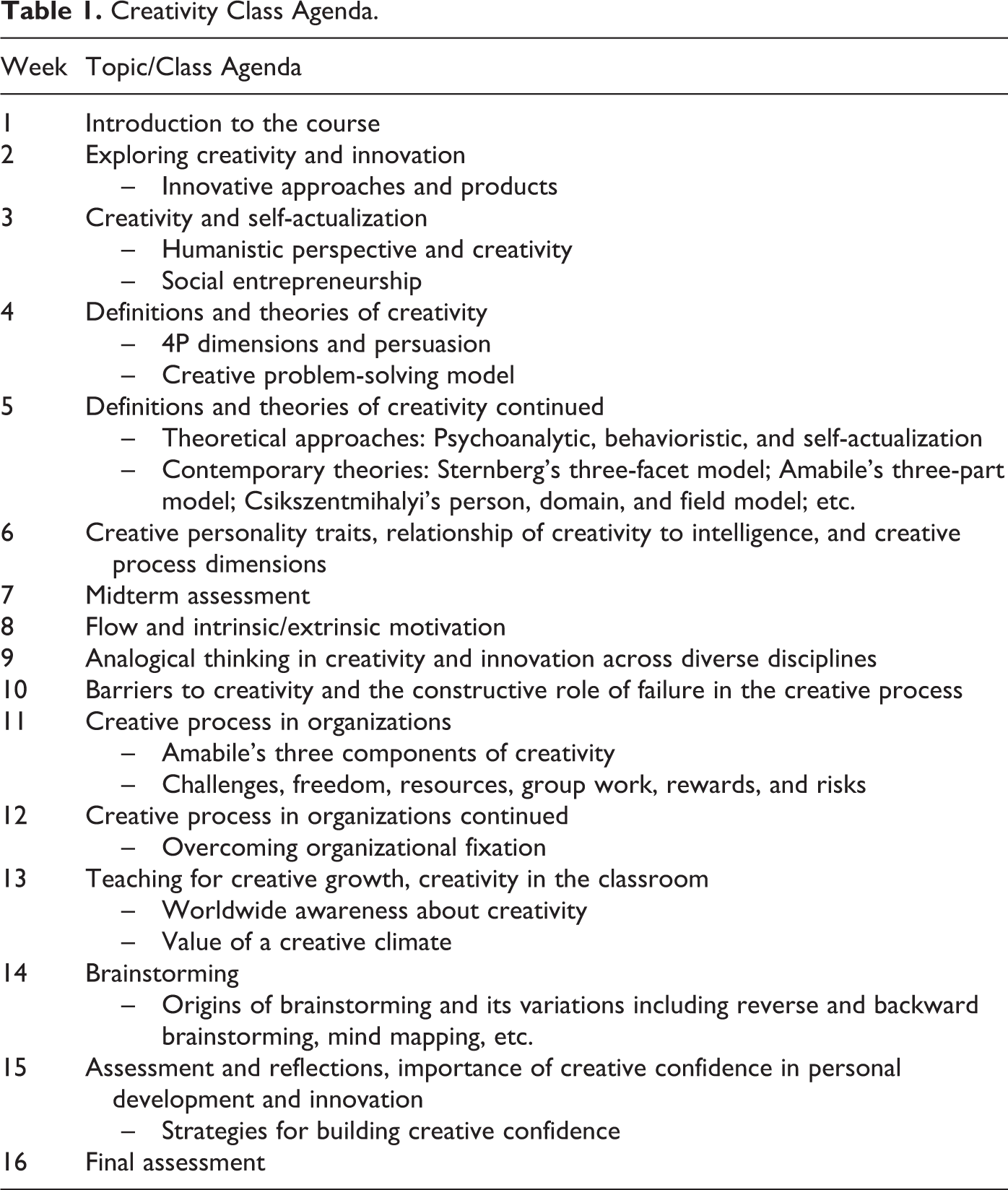
Throughout the semester in Spring 2014, the creativity course covered about two thirds of the course content across 14 sections overall. Materials were drawn from the textbook Creativity is Forever by Davis (2004) and case studies relating to the creative person, process, or product came from sources including Harvard Business Review and video clips on activists, artists, musicians, scientists, writers, and so on. The remaining one third of the content and activities were independently chosen by instructors who had expertise and experience in multiple disciplines including art, art therapy, dance, education, engineering, interior design, political science, sustainability, and theater. Table 1 shows the course agenda integrated across sections. In this interactive class, students explored creativity activities in-class, discussed topics from instructor-and-peer-led presentations, shared insights from hands-on activities, and learned about creativity theory and research based on the course textbook. More detail on course activities is provided in Table 2, including projects and examples of instructor-selected activities.
Creativity Class Agenda.
Descriptions of Major Course Activities.
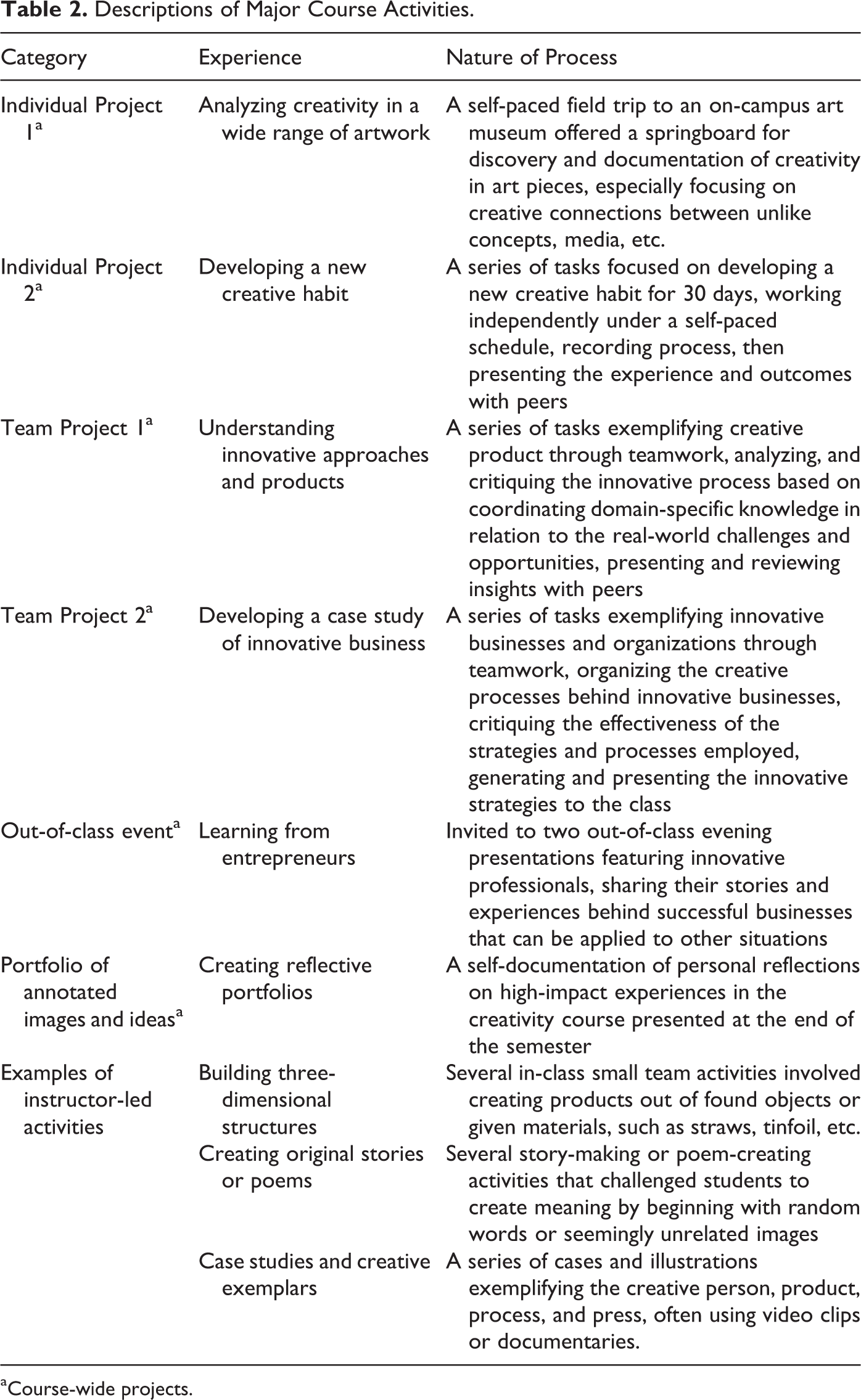
aCourse-wide projects.
Participants
The participants in this study consisted of 93 students who took the creativity course during their first semester in college. About half of the sample identified as female (n = 49, 52.7%), 43 as male, and 1 not reported. The age range was relatively homogeneous, ranging from 18 to 20 (mean age = 18 years old, SD = 3.37). Student-reported majors spanned various fields of study, including the College of Business (n = 26, 28.0%), Liberal Arts and Sciences (n = 25, 26.9%), Agricultural and Life Sciences (n = 14, 15.1%), Engineering (n = 11, 11.8%), Journalism and Communications (n = 11, 11.8%), and Public Health and Health Professions (n = 5, 5.4%), with one major not reported.
Student Portfolios and Data Collection Procedure
At the end of the spring semester, students created an original digital portfolio capturing the top 10 lessons learned from the creativity course. These portfolios featured what perceived class activities elicited the best lessons or insights on creativity gained from any particular class exercise, project, discussion, presentation, guest speaker, reading, and so on. Each portfolio content included written annotation explaining the student selections with images. It was the prerogative of the instructors to assign the projects or require annotation; therefore, any portfolios that omitted narratives were excluded from the analysis of this study. From the 349 students in 14 sections of the course, 93 of the 204 portfolios met the selection criteria.
Analysis Procedure
The contents and insights of the 930 most creative learning experiences were coded using inductive thematic analysis. This qualitative approach provides a rich and descriptive account of patterns within the data set, with identified themes strongly linked to the data itself (Braun & Clarke, 2006). To identify the most impactful student learning experiences regarding their perspective transformation in creativity, the thematic analysis focused on identifying (1) how the course changed the perspectives on creativity, (2) whether the course challenged existing ideas of creativity, and (3) whether the course changed the way of doing things regarding creativity (Kember et al., 2000).
For Phase 1, data familiarization was based on careful review of each portfolio file including reading, checking, and rereading the descriptions for the 10 lessons of the course. Phase 2 involved initial coding of the themes underlying the impactful student experiences, as well as evidence of perception changes which occurred throughout the semester. In Phase 3, the subthemes were sorted into four tentative themes based on repetition and comparison methods (Ryan & Bernard, 2003). During Phase 4, review and refinement of the three themes were carried out by rereading the entire descriptions. Although each theme was related to different types of perspective transformation on student creativity, the relationships between the three final themes were not separate but interrelated and identified. In Phase 5, labels and definitions were given to each theme, capturing the language of the students related to creativity theory and research. Finally, the results informed the overall framework defining three frames of creative minds with potential transformations and teaching strategies.
Results
Ten Most Impactful Learning Experiences
The study recognized the frequencies of the most impactful learning experiences highlighted by students. Among the 930 reflective descriptions for this study, the most significant learning experiences centered on the Exploration of Creative Processes module (n = 402, 43.2%), followed by the Application and Preparation module (n = 320, 34.4%) and the Theory and Research module (n = 208, 22.4%). The Exploration of Creative Processes module included learning from the analysis and interpretation of examples that was one of the successful strategies for teaching creativity (Zampetakis et al., 2008). The Application and Preparation module for creativity was one of the popular teaching strategies in the literature (Cheung et al., 2006; Davis, 2004; Mathisen & Bronnick, 2009), which consisted of multiple situations asking unique application of creative thinking and self-reflection. The literature also suggested that Theory and Research module can be one of the important approaches to provide the broaden understanding of creativity (Karpova et al., 2011; Mathisen & Bronnick, 2009; Plucker & Dow, 2010).
As a single content of the course, Table 3 shows the top 10 most impactful learning experiences as indicated by 93 students. These experiences included specific course-wide activities (i.e., two individual projects, two team projects, and out-of-class presentations) and common contents experienced by the students across the sections of the course (i.e., video on Maya Lin and theory of Self-actualization and creativity). Some in-class discussions and small group activities created by individual instructors were also included in the top 10 most impactful learning incidents, such as building three-dimensional structures or creating a story or poem.
Top 10 Impactful Student Learning Outcomes.
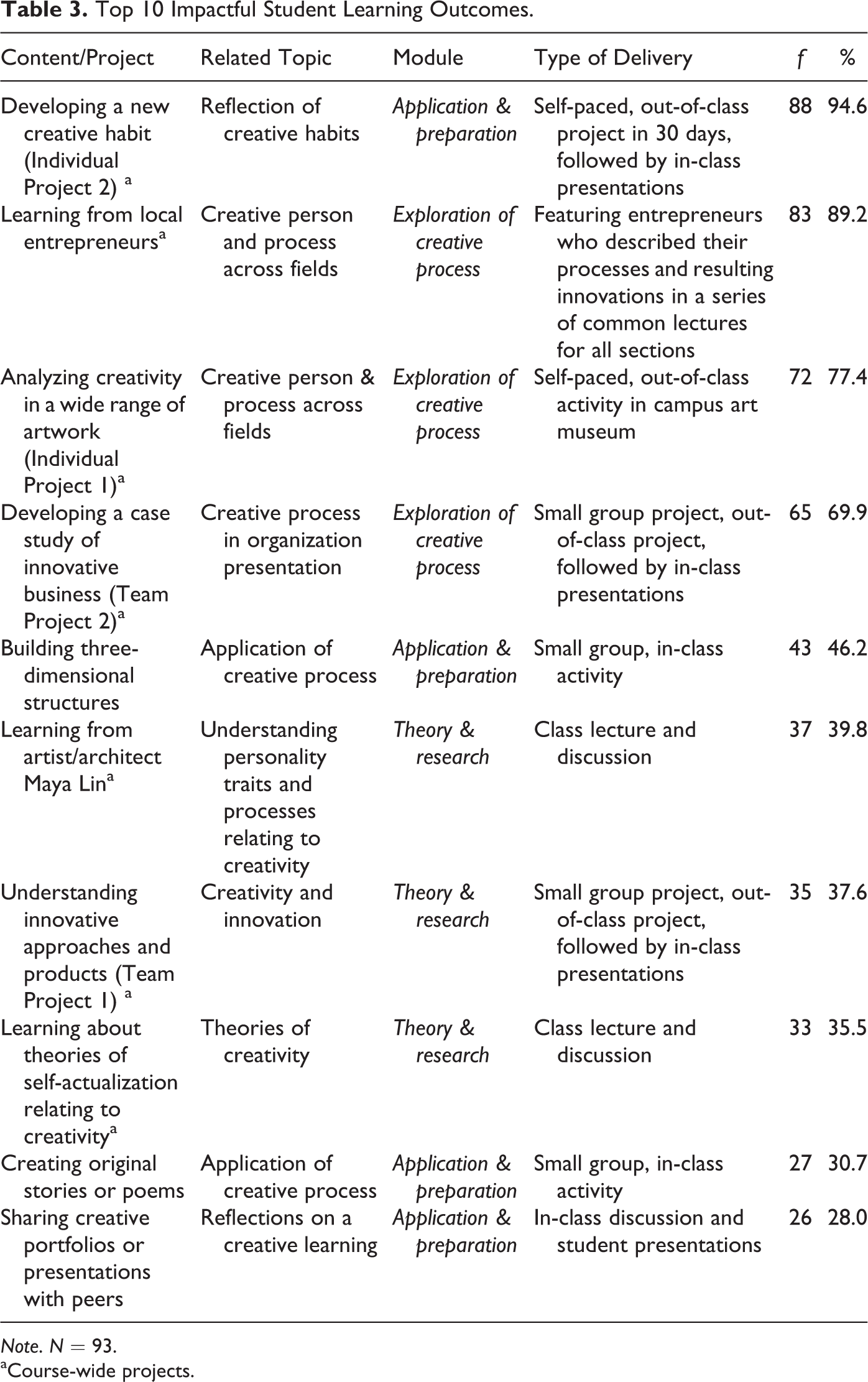
Note. N = 93.
aCourse-wide projects.
Perspective Transformation in Creative Learning
Initially, this study reviewed the 930 reflections line by line and found that 699 narratives (75.2%) described changes or adjustments made through creative learning experiences. The other descriptions (n = 231, 24.8%) were deemed not illustrative of perspective transformation and were excluded from the thematic analysis. Therefore, the authors considered a total of 699 reflections that included the potential of a wide range of transformations, indicating any challenges of the former assumptions, any changes of the way of look at creativity and creative self, or any alternative beliefs of doing things. Typical examples included: “It really shifted my perspective on failure in general” (Student #23) or “I would not consider myself a creative person but this showed me that anyone can be creative when given the time” (Student #12).
Three main themes emerged: creative dynamics (n = 260), creative mindsets (n = 328), and creative confidence (n = 168). Among those preliminary examples, 642 narratives (91.8%) were categorized into one theme along with the other 57 descriptions (8.2%) classified into multiple categories. The final themes and the related subthemes, with representative student descriptions, are provided in Table 4. The themes illustrated the potential relationship among three different types of perspective transformation. Creative dynamics allows the students to explore an expanded view of the value of creativity to society through the creativity course. Creative mindsets is associated with diverse aspects of creativity observed through the contents. Finally, creative confidence reflects a deeper involvement with the new insights of creativity as students tried this out within a particular context. The thematic descriptions mostly illustrated how students appeared to gain new insights and, in some cases, changed behaviors stemming from their new perspectives gained on creativity. The following section offers examples of the themes that surfaced in the words of the students.
Three Themes of Perspective Transformation.

Creative dynamics
Creative dynamics was described as an awareness of creative value in the real world across various disciplines. Three subthemes representing the importance of creativity were identified: creativity is everywhere, core competency, and creative potential. The course led the students to consider creativity “not just for artists” but “in everyone and everywhere” and to comprehend that there are “different forms of creativity” (Student #41). As students were exposed to creative and innovative examples, they reported how “being creative can help” society (Student #9). Also, the learning experiences guided students to challenge their own potential by saying, “It expanded my view of what my possibilities are” (Student #40).
This theme appeared in a dominant way within the descriptions of three learning experiences: analyzing creativity in a wide range of artwork, understanding innovative approaches and products, and learning about theories of self-actualization and creativity. These experiences included a wide range of applications of 4P and 4-C dimensions as well as diverse types of assignments, from in-class lectures to out-of-class activities, from self-paced through small group or class discussions, and from theoretical approaches to exemplary cases. Through these experiences, students observed not only diverse ways of looking at things around themselves but also learned what impacts innovative people could make. Moreover, the concept of self-actualization and creativity changed students’ perspective about who could be considered a creative person with an awareness of their own potential. Representative reflections regarding these assignments are shown in Table 4.
The hallmark of learning experiences in this theme involved demystifying creativity. This challenged students to think beyond creativity as a product—a novel, an invention, or a painting—by exploring multiple dimensions of creativity more holistically. As Maslow (1968) famously remarked, “A first-rate soup can be more creative than a second-rate painting” (p. 136). Students did not come to the course thinking that creativity involved process, person, press, and product, but by the end of the semester many of them did. While they demystified the role and impacts of creativity, students elaborated the existing frames that resulted in shifting perspectives of creativity by focusing on real benefits in society as well as their own possibilities to be creative. In essence, the transformation in this theme suggested the challenge to stay within those existing assumptions and to redefine the boundaries of creativity and the creative self.
Creative mindsets
In the creative mindsets theme, students explicitly explained how their perceptions and attitudes toward creativity were changed throughout the semester. In particular, they used this theme in their own words to define creativity under the two subthemes: different angles and pursuing ideas. In-depth exploration of the creative person, process, product, and press from a diverse pool of historical figures and contemporary innovators helped better understand the nature of creativity. For example, many students reported that they “changed perspective on the things that I see every day around me” (Student #2). They learned “to go outside the comfort zone and accept failure as a part of the process” (Student #6) and developed the knowledge that “creativity comes with effort” (Student #63).
Creative mindsets included dominant learning experiences acquired from participating in the following three activities: learning from local entrepreneurs, developing a case study of innovative business, and analyzing Maya Lin’s creativity as a creative case. The learning experiences in this theme consisted primarily of person-process narratives, especially within Pro-c and Big-C levels. These stories enabled students to learn more detailed methods to use to achieve creative results. For example, through conversations with entrepreneurs from local businesses, students were inspired to learn innovative processes behind achievements in a competitive economy.
The significance of this theme suggests that students discovered the other side of creativity—effort and failure—which they thought irrelevant to creativity before the class. Through one documentary that students found particularly compelling on architect/artist Maya Lin, students seemed to recognize that importance of tenacity, persuasion, and passion in the creative process. Moreover, students not only described how the stories established new frames of creativity but also how they would like to use it to reflect upon creative processes in their disciplines or daily lives for their little-c and mini-c levels. Through a deeper understanding of creativity, students began to critically reflect their shifted assumptions and internalize the new frames of creativity for their own work.
Creative confidence
Creative confidence can be interpreted by evaluating what students actually gained during the semester, utilizing the three subthemes: courage to leap, challenging myself, and creative authenticity. The majority of the students valued how they were inspired and motivated by experiential learning, and thus, they were willing to employ creative processes in their own experiences. Moreover, as they developed full courage to try things in more creative ways, students pushed themselves to challenge their potential and finally found themselves becoming more creative. Students described the course in the following way: “It definitely pushed me to be more creative and to just let myself create” (Student #59) and “not only was I more creative…this project [trying creative habits for 30 days] really helped me get back into [my] own creative process” (Student #2).
Creative learning experiences in this theme were mostly related to “trying out” creative behaviors, such as developing a new creative habit, building three-dimensional structures, creating original stories or poems, and sharing presentations with peers. Focusing on the little-c and mini-c of students, these activities were intended to apply what they learned from the creativity course to their real-world context. Individual Project 2, the most frequently mentioned learning experience among the 93 students, invited students to try a new creative habit for 30 days, then record the process and present the outcome in a peer review. Habits ranged from painting, cooking, and writing, to physical workouts. The repetition of trying creative habits for 30 days and the experience of achievement developed within the context led to confidence and competence in creative behavior. Students also valued the benefits of creating and sharing exercises with their peers, as they had time to express their ideas and to get evaluative feedback.
Discussion
The present study revealed valuable opportunities for first-year university students to develop creative minds during a one-semester creativity course. Creative learning experiences within the entire course provided an introduction about the fundamental knowledge of creativity, explorations of multiple perspectives across domains, and opportunities for students to lead their lives as innovators. As overall course activities helped students think outside the box throughout the semester so they could establish their own perspectives on creativity as well as develop creative confidence, the creativity course could be explicitly included in the general university curriculum. These results were far above the previous studies on students after a one-semester course of creativity (Byrge & Tang, 2015; Cheung et al., 2006; Plucker & Dow, 2010), as the course changed the students’ overall attitudes toward creativity. Remarkably, 10 of the 93 students mentioned that the whole structure of this course was one of their most impressive takeaways in the reflective portfolios. Students illustrated how the overall perception of creativity and the creative self was changed throughout the semester, including the most significant message of teaching creativity—creativity can be taught. For example: This is the big one. Like many people in the [program], I scoffed at the idea that creativity could be taught.…I just assumed that some people were born with the ability to be more creative, and some were not. However, thinking about it, it makes complete sense. All children play, everyone lives their lives in a different way, everyone has a different way of going about things. This is proof enough that all people are creative in their own way. This class has opened my eyes to this fact, and I am so ready to begin learning how to be even more creative than I already am! (Student #82)
This study recognized the potential for transformative learning to reframe the personal meanings of creativity with the potential to creating life-long creative habits. The importance of these student learning experiences can be interpreted as critical stages to transform perspectives in previous studies (Curry-Stevens, 2007; Fetherston & Kelly, 2007). Introducing tension between existing and new concepts that expanded explorations and guided self-reflection, students heightened awareness, understanding, and application of creativity by disrupting commonly held assumptions about the creative product, process, person, and press. With the influential learning associated with transformations of perspectives, this study demonstrated that creative learning could ignite the process of perspective transformation for students to be more confident in expressing creative potential in their daily lives. Awareness of self-creativity and discoveries of these creative processes were the most important goals for the creativity classes (Byrge & Tang, 2015; Cheugn et al., 2006; Daly et al., 2016). Although this seems to emphasize aspects within individual creativity, the concept of personal creativity cannot be disconnected from one’s sociocultural background (Runco & Jaeger, 2012). Students were highly inspired by eminent creators who created social changes as well as local entrepreneurs who showed real-life challenges and domain-specific knowledge of their time. As transformative learning embodies individual and contextual changes (Dirkx, 1998; Mezirow, 2000; Tennant, 1993), part of its definition as “usefulness” implies what is considered a creative product, process, person, and press within the contexts.
The lens of transformative learning also helped to translate the process of students’ changes. Previous studies have focused only on the outcomes of creative training (Cheung et al., 2006; Mathisen & Bronnick, 2009; Miller & Dumford, 2016), but transformative learning allowed us to follow the challenges of students and how it changed their minds. In order to analyze the overall enhancement, the reflective portfolio was effective to understand students’ experiences of learning that allowed to recognize the precursor to transformations.
The conceptual framework used to build three frames of creative minds presented the potential transformations within the creativity classroom: through creative dynamics, creative mindsets, and creative confidence (Figure 1). From the recognition of relationships between the potential changes in students’ perspectives of creativity, the framework represented the types and strategies of learning experiences as most impactful for each theme. Overall, three frames illustrate the inherent tension in raising awareness about the value and impact of creativity, and developing confidence through the application of skill-building, presenting and sharing. Through pedagogies used within the creativity classroom, it was possible to expand existing frames and generate new points of view. By using the presented teaching strategies, students could challenge prior understanding and mindsets and develop trust in their creative abilities toward the core value of creative education, creative confidence.
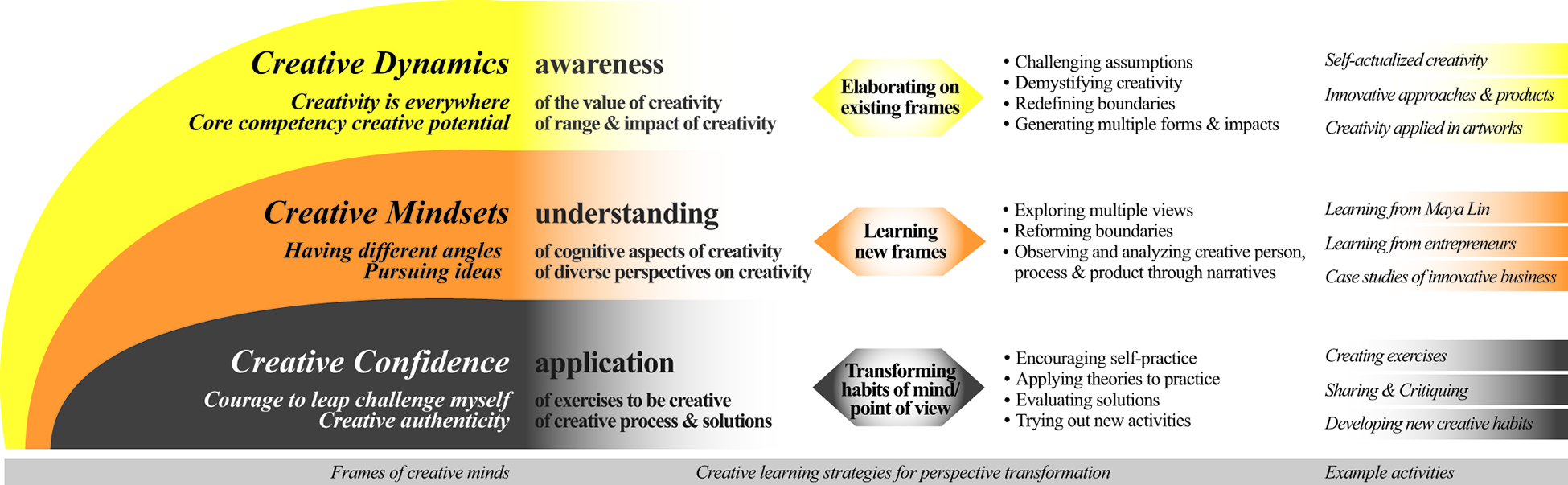
The three frames of creative minds with potential transformations.
The key aspects of students’ reflections focused on their personal creativity which described the experiences and process of individual growth. Moreover, while each theme exists at slightly different levels of student engagement, the importance of each assignment cannot be diminished when it comes to considering the internal links between them. The following discussions include how creative learning experiences in each theme ignite student transformations in their perspectives on creativity.
Crossing the boundaries of the disciplinary range and social impacts of creativity challenged students’ prior assumptions about creativity. Most students explained that they critically examined their expectations of how a creative person or product should be and tried to demystify its impact and roles in their daily lives. Challenging and upending existing concepts or perceptions could heighten their awareness, and this can become the first step in the process of perspective transformation (Curry-Stevens, 2007) as well as the important step toward becoming more confident in creative abilities (Runco, 2003). The contents in creative dynamics theme were significantly reflected when they described the learning a wide range of 4Ps and 4-C dimensions of creativity from contemporary studies. Students’ general perspectives of creativity shifted from something mysterious to inherent competency that can be strengthened. This also suggests the value of traditional teaching methods (e.g., lectures, presentations) to help students establish their own frames to view the world by providing a sufficient knowledge base.
The in-depth understanding of creativity was beneficial to frame a new perspective. Students expressed original meanings of creativity for themselves, without using the previous terms of creativity definitions, as they expanded their learning to specific creative/innovative cases across disciplines. Curry-Stevens (2007) mentioned that this step of critical understanding is significant because it requires a replacement of old thinking with new awareness. The narrative approach frequently appeared to be the dominant method of this learning in the creative mindsets theme. Students seemed more engaged and inspired by the stories behind the creative/innovative person, process, or products, which led them to internalize the knowledge to develop their own creative process. Interestingly, students also reframed the dimensions of creativity as a creative person-process, not using the single dimensions provided from 4Ps. Demonstrating the complexity of creativity in a real context, this connection was one of the most frequently recognized dimensions among the 4Ps from the creative cases (Portillo, 1996). Furthermore, the majority of students frequently crossed the 4-C categories: Big-C or Pro-c through little-c or mini-c. Learning from the role models, students were encouraged to transfer those assumptions and worldviews into their daily-based problems. This transformational conception of creativity is premised on the fact that the initial creative interpretations (i.e., mini-c creativity) seem to be characteristics of all creators (Kaufman & Beghetto, 2009).
A significant driver for creative learning among the perception shifts of students included opportunities to actively explore their own creative potential. In every portfolio, student narratives were most engaged with the development of personal creativity, especially when they described the impacts of hands-on activities that were self-directed. As many educational approaches discussed providing students with opportunities to transfer their learning into a different form or context (Halpern & Hakel, 2003; Karpova et al., 2011; Petocz et al., 2009; Reynolds, Stevens, & West, 2013), the exercises in creative confidence theme influenced conative aspects. Transformative learning emphasizes the importance of “trying out” new roles (Brock, 2010; Curry-Stevens, 2007), by valuing opportunities for “doing,” not just “knowing,” because it engages more actively in learning situations. Students’ reflections on the most referred-to project included that they became more confident in their creative abilities as they tried to more creatively engage in their lives through their own process of discovery. This supports the notion that creative confidence could stay higher in people who pursue creative thinking in daily life (Mathisen & Bronnick, 2009).
There was one more change that is important to note in this research. About 20% of students emphasized how the “failure exercise” shifted their mindset: Failure was reframed in much more positive terms. Although student pressures to perform for faculty and others who judge them, identifying and critically reflecting their barriers to creativity made failure seem like more of the natural creative process. Further, this insight appeared to make some students feel more “confident” for the next step of creating. This finding recognizes that a significant milestone for first-year college students is to have them explore ideas, take intellectual risks, and try out new roles despite a fear of failure. As the following narrative shows, students can begin to consider failure as a part of success: [S]uccess is not guaranteed just from having a good idea and a way to make it a reality. The path to success is indeed lined with trials and tribulations. As a freshman, however, I feel it is important to acknowledge this insight and realize that failure is not meant as an obstacle; rather, it is a hurdle we must overcome in order to make ourselves stronger. (Student #8)
Conclusion and Future Research
The creative minds framed in this study demonstrated how targeted pedagogical interventions can support the transformation of student perceptions of their own creativity and creative potential. The lens of transformative learning provided a deeper understanding of the scopes and the possibility of creative learning experiences. Further, educational strategies for teaching creativity can be successful in encouraging heightened student introspection and perceptions of creativity. During the college experience, creative development should not be left to chance. From a long-term view, curricula for developing creativity could benefit from combining transformative learning with teaching for creative dynamics, creative mindsets, and creative confidence. Further, the pedagogical approaches to creative learning identified in the framework of this study can be effective in developing student deep learning for any field, accounting for student cognitive and affective change with the potential for action. Given self-reported data only represented the students’ first semester in college, the authors would like to stress that the effects of creative learning had most likely just begun. A continued quest for critical and creative thinking within their academic journey would be essential to encourage ongoing transformations and the ultimate growth of students.
The study also highlights the need to develop diverse evaluation tools to observe student creative learning across modes. The reflective portfolios offered one clear window to explore how students internalized their creative learning experiences. However, focusing on the outcomes of learning with student reflections is not sufficient to explore the process of perspective transformation, despite rich information gained from this course. Next steps might incorporate multiple measurements to assess student learning outcomes over time. Also, a diverse sample of dedicated creativity courses could be examined to consider and compare the results of the present study. Future research may also want to delve into additional student and instructor variables that could influence the teaching and learning process relating to the study of creativity. Ideally, there is a clear case to be made for developing and integrating creativity courses across the curriculum at the university level. The reality of this call will likely necessitate investing in resources to support instructor training, developing engaging learning environments, and assessment strategies that holistically support transformational change. And this is truly an investment worth making.
Footnotes
Acknowledgments
The authors gratefully acknowledge the generous support of Dr. Jeff Citty, the director of the Innovation Academy at the University of Florida, who fully supported this research.
Declaration of Conflicting Interests
The author(s) declared no potential conflicts of interest with respect to the research, authorship, and/or publication of this article.
Funding
The author(s) received no financial support for the research, authorship, and/or publication of this article.
