



Abstract
Transformative learning theory has provided a sound theoretical base for adult education’s Western and Eastern academic field. This article aims to introduce the mandala model of transformative learning by transferring Mezirow’s theory of perspective transformation onto a mandala map. In the mandala model, the learning agent exercises two capabilities—knowledgeability and reflexivity—to solve and pose problems in learning contexts. The learners accomplish the circle of transformative learning through the four phases of acquiring knowledge, taking actions to praxes, and generating wisdom; they are on the way to fulfill transformative learning. The theoretical model of transformative learning postulates to implement learners’ capabilities and manifest the dynamics of generative mechanisms. Moreover, it postulates to integrate knowledge into personal life and societal situations through actions and praxes and elucidate wisdom and beneficial outcomes in the intrapersonal and interpersonal contexts.
The Global Situation of Transformative Learning
Mezirow’s theory of perspective transformation has proved to be a prominent role in adult education for over four decades; the original theory from Mezirow has encouraged researchers and educators to employ transformative learning as a theoretical and applicative tool kit to solve the problems and improve their work. Because of the global development of adult education, the theories of transformative learning have been popular in the Chinese-speaking academic field of adult education for over 20 years. In the last two decades (1999–2019), there have been about 800 Chinese theses, dissertations, and journal articles relating to transformative learning in Taiwan. It tells that Chinese-speaking scholars have been paying attention to transformative learning theories and have contributed to the research of transformative learning. Given the globally diverse application of transformative learning theory, it is essential to promote a more integrative and adaptable theoretical model of transformative learning to keep up with adult education’s future challenges and support adult education development in non-Western culture systems. It is not only to satisfy the demands of Asian communities but also for perfecting the theories of transformative learning.
A Breakthrough Point of Transformative Learning
Transformative learning theory is considered as a generative, imperfect, and still relevant theory for adult education (Hoggan et al., 2017), but “Complex aspects of perspective transformation, and the strengths, weaknesses, and opportunities for further theoretical development are therefore overlooked” (Hoggan et al., 2017, p. 49). Dix (2016) had criticized that unduly intellectualist assumptions of Mezirow’s transformative learning theory constrain transformative learning within a narrow conception of cognition; he proposed the question: “What is the essence of transformative learning?” (p. 140). As he argued that: the essence of all transformative learning is cognitive transformation involving metacognitive reconstrual and commitment that reshapes the learner’s cognitive-motivational perspective. However, to see this, we need to abandon the unrealistically narrow, intellectualist conceptions of cognition often presupposed in the current literature…to develop a deeper, more comprehensive, and integrative understanding of cognitive transformation. (p. 140)
For improving further theoretical development of transformative learning theory, the model of transformative learning needs to satisfy the demands of nonintellectual and non-Western groups. Therefore, identifying the essence of transformative learning might depend on two concerns. One is how to analyze and construe Mezirow’s theory with more essential and inclusive points of view, another is how to include non-Western ontology and epistemology into a theoretical framework for refining the application of transformative learning theories. These two concerns are related to each other. Based on the two concerns, three questions are addressed to Mezirow’s theory of transformative learning: (1) Does transformative learning start only from a cognitively disorienting dilemma? Does it merely terminate the action? (2) Does the transformative learning process through the linear path? Or it progresses by an infinitely circular or spiral path? (3) When adults involve themselves in transformative learning, what is generated from the learning process?
In light of the above concerns, this article aims to introduce a theoretical model of transformative learning by transferring Mezirow’s theory of perspective transformation onto mandala’s map for illuminating the attributes of circularity and generativeness of transformative learning.
Mandala as a Map of Transformative Learning
“The mandala has appeared throughout human history as a symbol of integration, harmony, and transformation” (Krippner, 1997, p. 22). Mandala, in Sanskrit, literally means “center-surround” (Preece, 2006). As Grey (2001) explained, “manda” literally refers to “essence” and “la” means “container,” “possessor,” and “signpost,”’ the meaning of mandala is a sense of world model. It signifies the symbol of the circle, completeness, wholeness, and everything in the universe. For instance, in Tibetan Buddhist practices, the third stage of four preliminary meditations is practiced through the mandala offerings. The practitioner donates over a hundred thousand mandalas to the deities through visualizing every mandala as the whole universe. Ultimately, the realm manifested within a mandala expresses an entire or complete system’s essence without interference from external factors (Preece, 2006). According to Leidy and Thurman (2006), a mandala is “a matrix or model of a perfected universe, the nurturing environment of the perfected self in ecstatic interconnection with perfected others. It is a blueprint for Buddhahood” (p. 127). Depending on Buddhism’s view of nonduality, the realm within a mandala demonstrates both the perspectives of conventional reality and ultimate reality; the two realities simultaneously appear in samsara like two sides of a coin. Mandalas are not only the metaphysical representations of sacred space in Buddhist views but also the expressions of worldly views in Hindu, Jain, Buddhist, Navajo, Islamist, and Western cultural traditions throughout human history (Grey, 2001; Krippner, 1997; Walcott, 2006; Davis, 2016).
As Jaffe (1964) stated, European alchemists had created many names and symbols to represent the mind and body’s integrity since about 1000 AD, which is called quadrature circle. Jung used the term “mandala” to describe the quadrature circle divided into four segments (Krippner, 1997) and presented the mandala as a universal image of wholeness and an essential image of the self in most cultures with many different forms (Preece, 2006). Jung (1963) had been investigating collective unconsciousness since 1918, and later, he discovered that the mandala is a universal symbol. Jung mentioned his insight about the mandala in his autobiography: To make sure of my case, I spent more than a decade amassing additional data before announcing my discovery for the first time. The Mandala is an archetypal image whose occurrence is attested throughout the ages. It signifies the wholeness of the self. This circular image represents the wholeness of the psychic ground’s wholeness to put it mythic terms, and the divinity incarnates in man. (p. 334)
As Jung (1963) said in his work, “Only gradually did I discover what the mandala is: Formation, Transformation, Eternal Mind’s eternal recreation” (p. 195), in both Eastern religions and Western psychology, the dynamic force of transformation is inherently comprised within the metaphor of the mandala. Krippner (1997) specifically explained the mandala as “a metaphor for self-development, the reconciliation of opposites, and the cycles of existence” (p. 28), which points out that the mandala as a metaphor possesses the essence of transformative learning, which contains the attributes of self-developing, self-reconciliation, and endless cycling.
No matter how mandalas were created through the two-dimensional portrayals such as sandpainting and thangkas or the three-dimensional constructions such as pagodas and temples, the creators of mandalas mainly intend to concretize the indescribable Buddhahood and to provide the maps of mind-training for the Buddhist tantric practitioners in the specific ceremonies and the secret oral teachings. As Leidy and Thurman (2006) declared that “A mandala is compassion, it is a form, and it is infinite wisdom expressing infinite love…. It opens a door of liberation, a gateway to freedom, a portal to the infinite” (p. 130). The ultimate purpose of creating mandalas is to guide the practitioners on their path of approaching Buddhahood’s realization and the fulfillment of ultimate wisdom. Therefore, the model of a mandala is not only identified as the spatial symbol of the pilgrimage journey, but it also embodies the learning map of transforming the ego-clinging of mundane self to the nonself of Buddhahood. Furthermore, the mandala’s model exists throughout the general framework of Buddha dharmas, such as the Wheel of Life mandala (Grey, 2001; Lama, 2015), the Four Noble Truths of Siddhartha Gautama (Zopa, 2018), and the Four Dharmas of Gampopa (Tulku, 2012).
According to the Four Dharmas of Gampopa, Tulku (2012) stated that “whatever good dharma practice you do—whether studying, reflection, listening…or meditation—it should not become just another activity. Instead, dharmas practice should be transformative” (p. 34). Lord Gampopa taught that “we can realize true peace and happiness through four stages of practice: (1) What we call ‘the dharma’ is practiced as the dharma, (2) the dharma becomes the path, (3) the path dispels delusion, (4) delusion arises as wisdom” (p. 35). Lord Gampopa concluded that “Once our awareness is fully experienced, delusions are recognized as wisdom” (p. 50). In the perspectives of transformative learning, learners reach to be fully experienced in transformative learning, then their knowledge, confusion, and obstacles could be transformed into wisdom.
Tulku (2012) reminded that merely keeping some kind of conceptual understanding is impossible to transform delusion into wisdom. While the practitioners are engaged in the four stages of preliminary meditations, they must keep nonstopping praxes to internalize the Buddha dharmas and their inward understanding. All their doing is merely for transforming mundane behavior, speech, and consciousness into the same as Buddha’s behavior, speech, and consciousness.
The practice of the Four Dharmas is a transformative model of endless circularity, including both outer and inner levels, which is named as the view of co-emergence. Relating to perspectives of transformative learning, the inner level refers to learning knowledge and the outer level relates to conducting actions and praxes and generating wisdom after learning knowledge.
As a result, the Four Dharmas onto the mandala model is illustrated by two figures. A two-dimension mandala is demonstrated in Figure 1, and a three-dimension mandala is demonstrated in Figure 2. In both figures, the self is defined as the dynamic of an individual bound by ego-cling. In the book Introduction to the Middle Way, Master Chandrakirti stated that “the sutras say that ‘self’ depends upon the aggregates; this shows their mere coincidence is not the self” (Mipham, 2002, p. 87). Mipham (2002) further explained that “the self is imputed in dependence on the gathering of the aggregates” (p. 292) and “but not that the self is the aggregates” (p. 293).
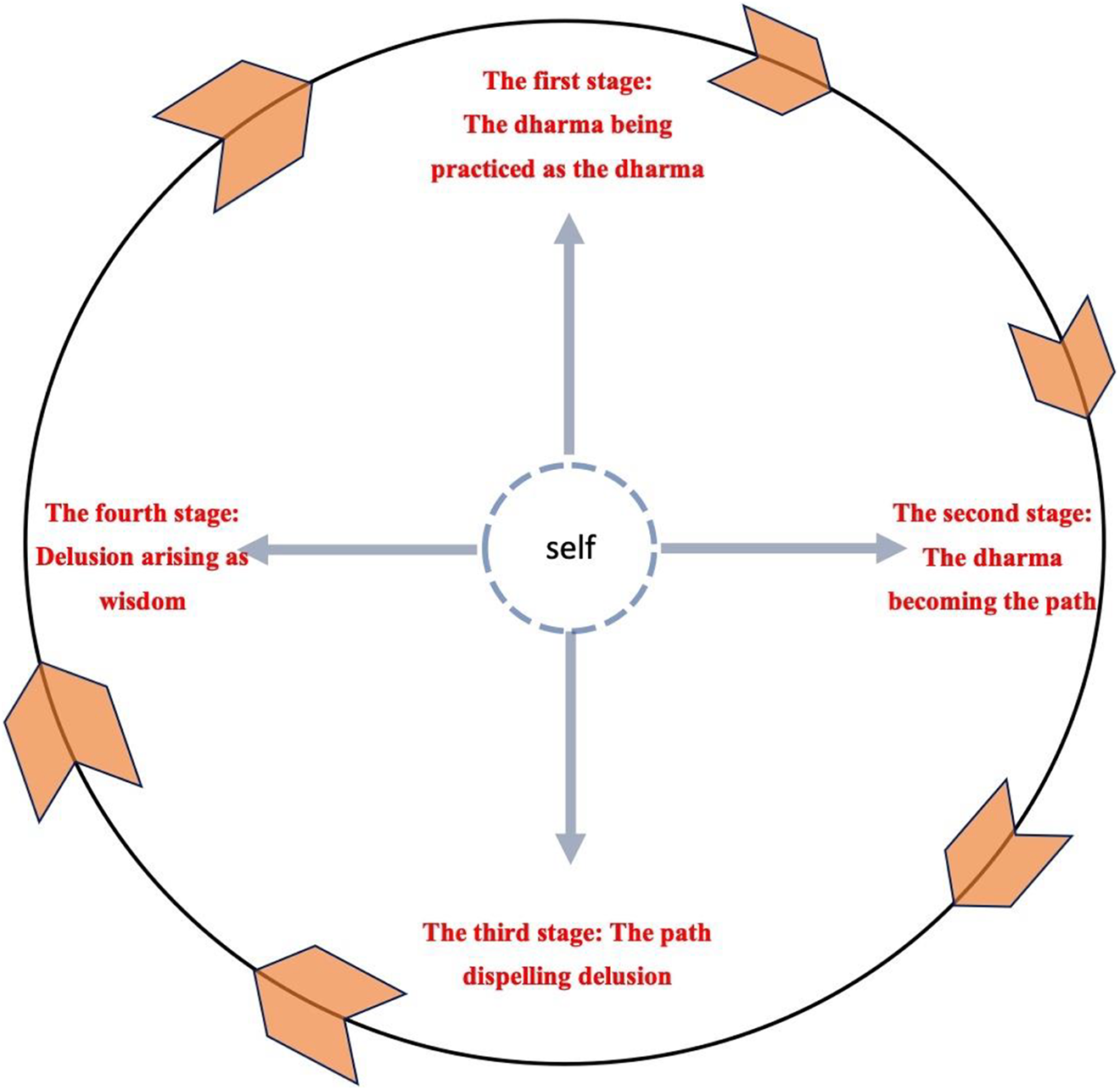
The two-dimensional mandala model of the Four Dharmas of Gampopa.
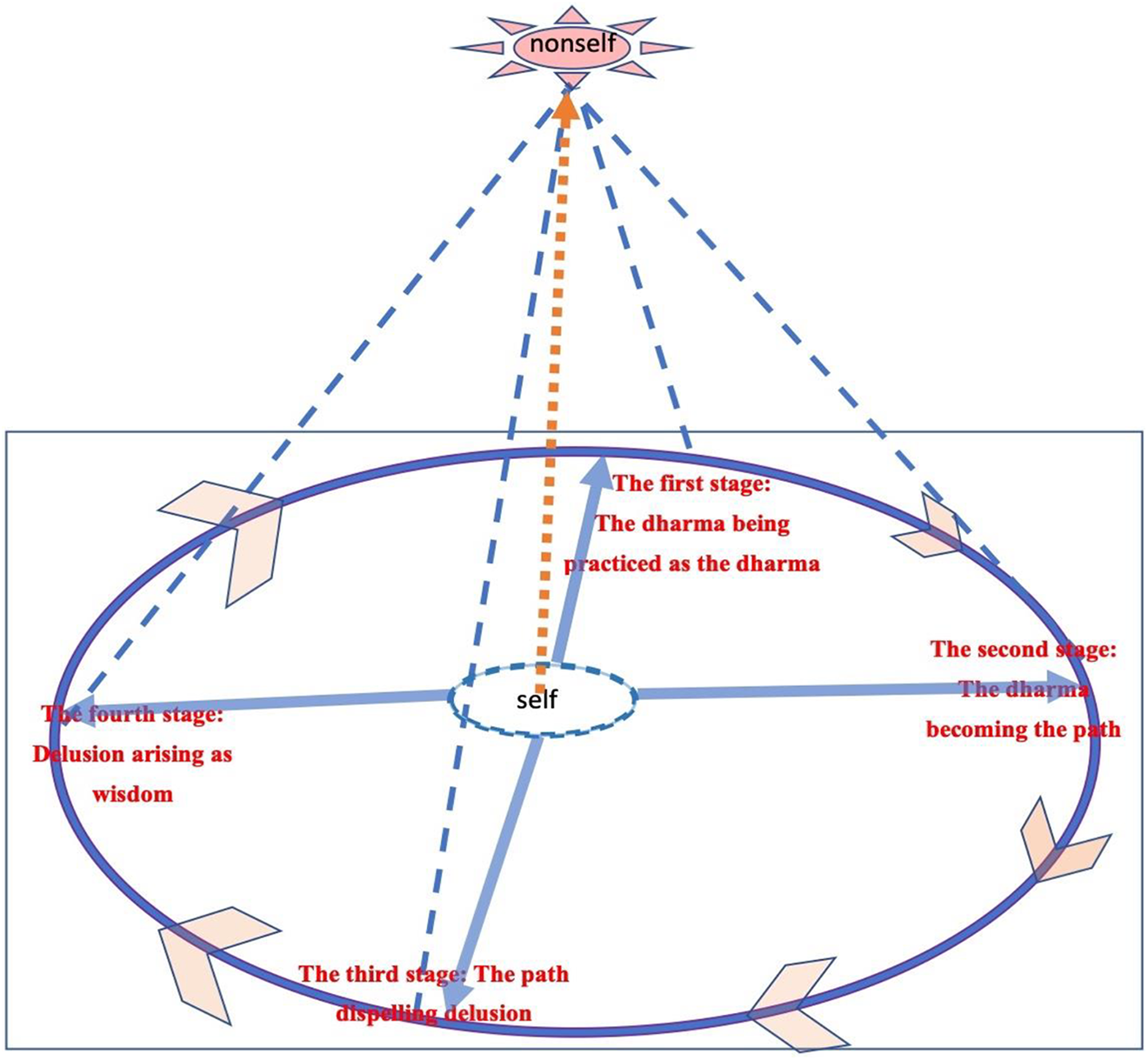
The three-dimensional mandala model of the Four Dharmas of Gampopa.
In Buddhist perspectives, the self is not a coherent, concrete, and permanent reality; it just arises from various conditions on mutual interdepending, the self is the fundamental cause of human’s confusions and confrontations. Because the ultimate goal of dharma practicing is located on Buddhahood’s enlightenment, realizing the authentic nature of the self becomes the premise of enlightenment. Before achieving enlightenment, dharma practitioners need to learn the dharmas about themselves and integrate the dharmas into daily life practically and deeply. However, so-called nonself is also declared as nonexistence in Buddha dharmas; there is no destination of attaining to nonself. Lama (2005) asserted that the term nonself refers to realizing the self lacks intrinsic existence. As Master Nagarjuna stated that “The Buddhas said ‘I am,’ they taught as well that the self does not exist. They also said that self and nonself are completely nonexistent” (p. 60). Hwang (2011) defines that the self is the locus of empirical experience, and it can take various actions depending on the social contexts. In the nonself theory, Shiah (2016) defined the self as egoism and assumed egoism is a central point of reference for psychological activities that follow the hedonic principle of pursuing stimulus-driven pleasure.
On the contrary, the psychological state of nonself means that dharma practitioners totally renunciate the worldly pursuing. While practitioners learn the Buddha dharmas and involve themselves in dharmas practicing, they will fully experience transformative learning and transform the self’s cognition to the nonself. Consequently, the nonself in Figure 2 means that an individual has realized that the perception of five aggregates is only an illusionary phenomenon and renounces ego-clinging. Even so, when an individual realizes the nonself, it does not mean the one has already become a Buddha.
Employing mandala’s metaphorical meanings, the mandala can provide an essential framework to transform Mezirow’s theory from linearity to circularity.
The Mandala Model of Self (MMS)
The MMS employs the mandala as a metaphor to depict the prototype and the deep structure of the self (see Figure 3); MMS elucidates the well-functioning self in all culture systems which is inspired by Buddhism, Eastern philosophy, and Jung’s psychology (Hwang, 2011, 2014, 2018a, 2018b, 2019).
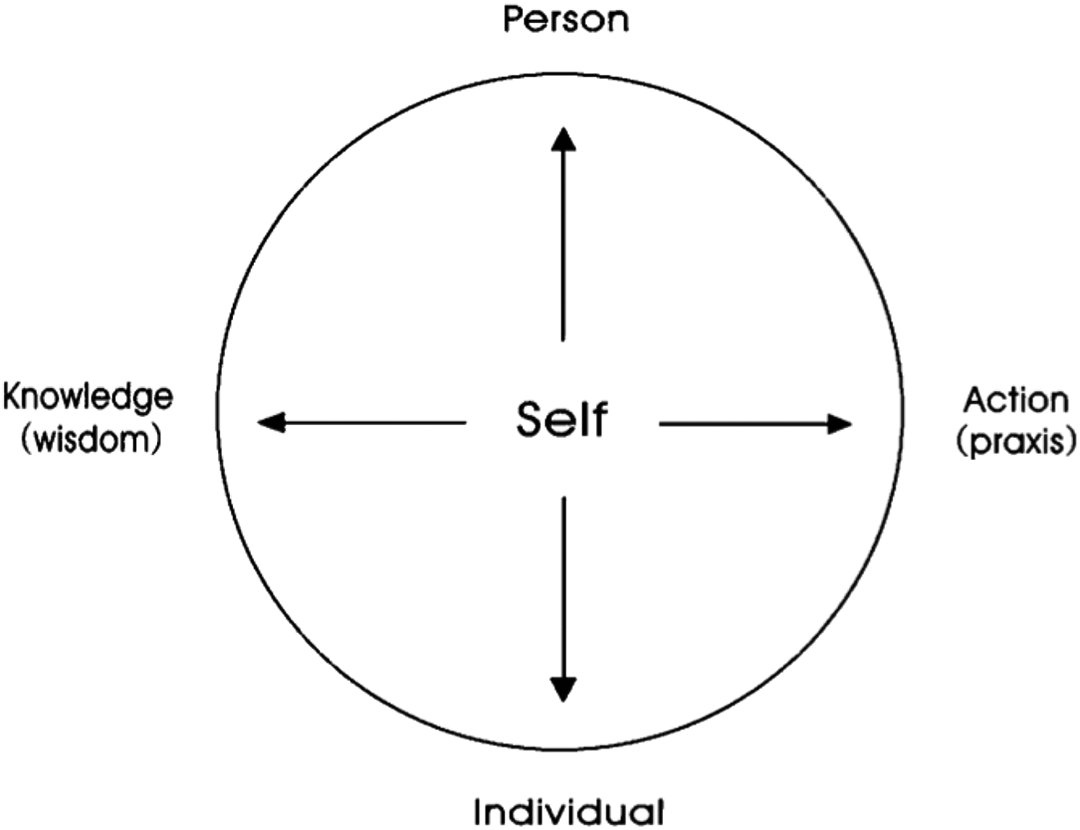
The mandala model of self (Hwang, 2011, p. 330).
According to Hwang (2011), the circle represents the ultimate wholeness of the human being; the square indicates the human world’s mundane sphere. In the center of the mandala, the self is identified as a locus agent located between bidirectional arrows. The right end of the horizontal arrow points to action and praxis, the left-end points to wisdom and knowledge. The top of the vertical arrow points to the person, and the bottom points to the individual. All four of the terms are located outside the circle but within the square.
The MMS arrangement indicates that the self is influenced both by the internal force and the external environment. Adopting from anthropologist Grace Harris’s (1989) interpretation, Hwang defined the three terms—person, self, and individual as three distinct meanings. The self is a psychological concept represented by a subjective role as the locus of experience. The individual is a biological concept of a human being as one of the species whose status is equal to that of other universal species. The person is a sociological or cultural concept conceptualized as an agent in society by social or cultural orders. Hwang (2011, 2018a) claimed that each culture system defines the appropriate and permitted behavior according to their values and meaning structures transmitted to an individual through socialization.
Hwang (2011) also adopted Giddens’s structuration theory to clarify the inherent capabilities within the self. According to Giddens (1993), the self, as the agency’s subject, is endowed with two critical capabilities: reflexivity and knowledgeability. Reflexivity means that the self can reflect one’s thoughts or actions with rationality. Knowledgeability implies that the self can memorize, store, and organize various forms of knowledge into a well-integrated system (Hwang, 2011). On one side, the self can operate knowledgeability to learn, and the self can activate reflexivity to generate wisdom through learning.
On the other hand, the self has the incentive to persist in action to solve problems or fulfill the desires. As Hwang (2011) stated when people encounter the issues, they may search for solutions with capabilities of knowledgeability and reflexivity by attaining knowledge/wisdom and taking action/praxis; this process refers to human adaptation. The process of human adaptation is analogous to the transformation of meaning schemes and perspectives through problem-solving and posing. In general, the MMS can provide a new framework to optimize transformative learning theories.
Mezirow’s Theory of Transformative Learning
Transformative learning is—defined as the process by which we transform problematic frames of reference (mindsets, habits of mind, meaning perspectives)—sets of assumptions and expectations—to make them more inclusive, discriminating, open, reflective, and emotionally able to change. Such frames are better because they are more likely to generate beliefs and opinions that will prove more true or justified to guide action. (Mezirow, 2009, p. 112)
According to Mezirow’s definition, three considerations relate to the essence of transformative learning: (1) Where does transformative learning occur? (2) How does transformative learning progress? (3) What does transformative learning generate?
Where Does TL Occur?
The playground of transformative learning is the frames of reference with problematic issues, including an individual’s internal cognitive perspectives and externally situated causes and conditions. However, individuals might live with some problematic issues without recognizing their problematic frames of reference. Mezirow had used various terms to articulate the field of transformative learning, such as the frames of reference, mindsets, habits of mind, and meaning perspectives.
However, Mezirow (1991, 2009) claimed that meaning perspective is equally widespread in philosophy and linguistics, constituted with some sets of codes, such as sociolinguistic, moral-ethical, learning styles, religious, psychological, health, and aesthetic. Mezirow (1994) defined that “Meaning scheme is the specific manifestation of our meaning perspective” (p. 223). In further reasoning, a meaning perspective does not only contain a constellation of meaning schemes, but it also activates an individual to embody the related meaning schemes through behaviors or actions.
It is possible to figure out the transformation of meaning schemes through observing behaviors and actions directly and objectively. However, while researchers are involved in the empirical research of transformative learning, the transformation of meaning perspectives just may be recognized indirectly through the learner’s self-narration and the researchers’ subjective observation. In brief, the meaning perspectives are related to an individual’s beliefs, while the meaning schemes are related to an individual’s actions. If we do not observe any new actions related to new-learned meaning perspectives, transformative learning may not be fully completed. Consequently, the action is not only the directive and objective manifestation of meaning perspectives and schemes but also the first destination of transformative learning.
How Does TL Progress?
Various meaning perspectives and schemes held by an individual are impossible to sustain in a harmonious tone at all times; they are usually diverse and dissonant and even conflict with each other. This individual might recognize the conflicts as life problems or disorienting dilemmas.
At this moment, the individual can be aware that this is an opportunity to transform the inappropriate or dissonant meaning perspectives and schemes and intends to complete the internal and external transformation, the awareness and intentionality will activate the progress of transformation. If the individual lacks the awareness and intentionality to transform anything, he may be stuck in a dilemma depressively. Contrarily, a transformative learner may prefer to solve life problems through engaging actively in transformative learning, including learning new knowledge, self-reflecting and practicing knowledge through actions, and finally resolving the dilemma. They positively involve themselves in transforming the problematic meaning perspectives and schemes with awareness and intentionality.
What Does TL Generate?
The awareness and intentionality of transformation drive individuals to learn new knowledge for solving life dilemmas. Consequently, wisdom might arise within the process. In Buddhism, it is called transforming confusions and obstacles to wisdom (Tulku, 2012). According to the view of Karl Popper, new knowledge gained from the process of problem-solving is a correction rather than an extension of old knowledge (Mezirow, 1991, p. 39). When individuals apply new knowledge in real life through taking actions, the experiences of taking actions can generate the realization about new knowledge and drive them to reflect their old meaning perspectives and schemes. At this moment, new knowledge can transform into wisdom. In other words, wisdom is generated from transformative learning. And then, the transformative learners continue to apply wisdom to self-reflection and take new actions and obtain another new realization. It is a circular process of transformation.
In the studies of exploring adult wisdom in real-life contexts, Yang (2013b) stated that “wisdom can be seen as real-life phenomena that lead to success in handling human affairs or in the effort to live a good life, people seek wisdom because it can promote a good life for everyone” (p. 179). Relating to adult learning, the ability to manifest wisdom is also developed through real-life learning (Yang, 2013a). Even though Mezirow had not explicitly described this significant point, his definition implied that wisdom could generate from transformative learning.
The Moving Path of TL
Mezirow explained the moving path of transformative learning with two figures. Mezirow (1991, p. 67) illustrated the moving path of validation and reformulation of the meaning structure through the line of action (see Figure 4). This figure demonstrates with starting from the action, going by interpreting problems (problem-posing) through reflection, and approaching to the empirical or consensual validation and the imaginative insight. It finally reaches a new interpretation. “Every phase of the validation process is affected by our meaning perspectives, which may be transformed as a result of premise reflecting” (Mezirow, 1991, p. 66). Mezirow stated that premise reflecting results in the validation process; the action in this figure could be activated by premise reflection.

Validation of learning (Mezirow, 1991, p. 67).
In the figure of problem-solving (see Figure 5), Mezirow (1991, p. 95) reversed the moving direction to demonstrate the process of problem-solving. The figure of problem-solving starts from interpreting and scanning problematic meaning schemes and goes on reaching a new cognitive interpretation and remembering; it ends to the action. As reviewing Mezirow’s theoretical frameworks, the two figures’ actions are not the same indication; they are the beginning and the end of a circular process in transformation. There are no definite beginning and definite end within a circle. Mezirow had implied the circular attribute of transformative learning, and it is just a lack of an eastern theoretical framework to manifest his insights.
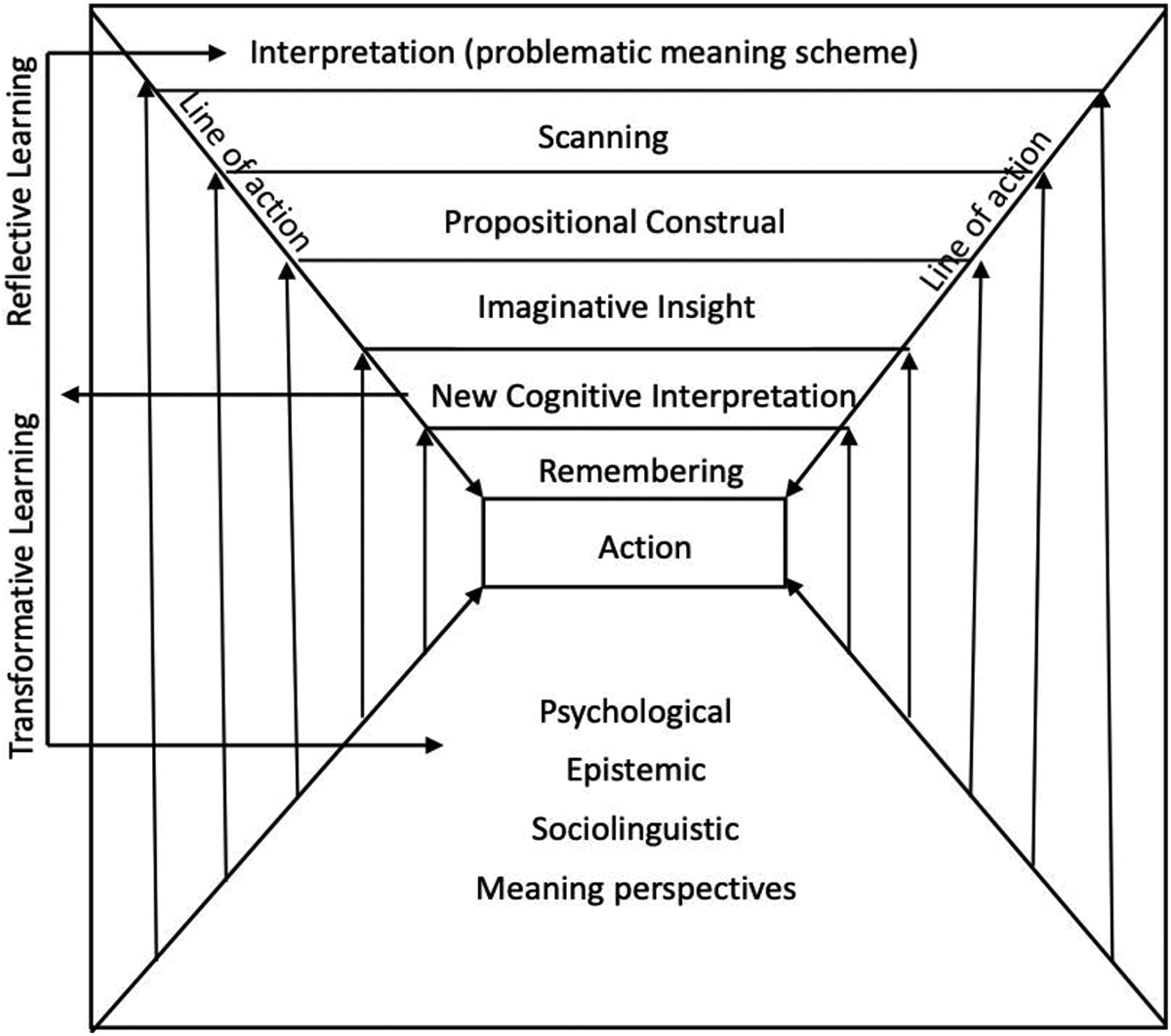
Problem-solving (Mezirow, 1991, p. 95).
In the figure of the process of reflective action (see Figure 6), Mezirow (1991, p. 109) regarded thoughtful action to reflect meaning schemes as reflective learning and defined retroactive reflection on content, process, and premise, referring to meaning perspectives as transformative learning. It is a lack of precise interpretations of the interactive relationship between reflective learning and transformative learning. Does transformative learning include reflective learning? Does reflective learning facilitate transformative learning? Do they proceed separately? Or do they proceed through interweaving each other? This ambiguous statement is an unsolved issue of Mezirow’s theory.
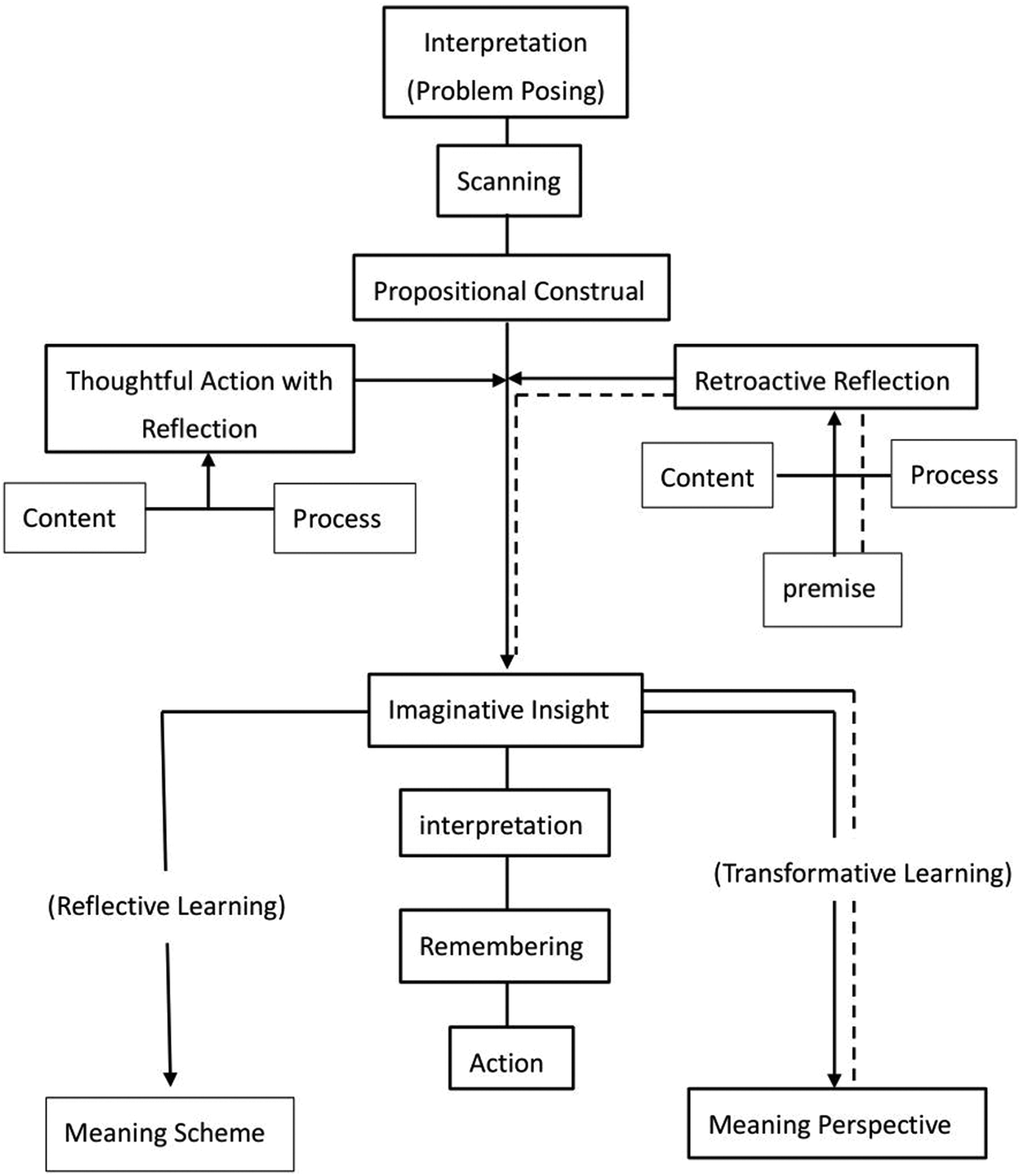
The process of reflective action (Mezirow, 1991, p. 109).
As mentioned above, the three figures of Mezirow’s theory of transformative learning are concluded in Figure 7. Figure 7 starts from taking action to learn and demonstrates three paths of transformative learning. The dotted line indicates without transformation. The solid line indicates about progressing reflection and transformation.

The synthesis figure of Mezirow’s theory of transformative.
The Mandala Model of Transformative Learning
As the view of critical realism, generative mechanisms of nature provide the fundamental basis of causal laws. Bhaskar (2008) argued, “Such generative mechanisms are nothing other than the ways of acting of things. Furthermore, causal laws must be analyzed as to their tendencies” (p. 14). Mezirow (1991) stated that: The goal of adult education is to help adult learners become more critically reflective, participate more fully and freely in rational discourse and action, and advance developmentally by moving toward a meaning perspective that is more inclusive, discriminating, permeable, and integrative of experience. (p. 224)
Related to the views of Bhaskar and Mezirow, the theoretical model of transformative learning would be postulated to implement the capabilities of learners as well as to manifest the dynamics of generative mechanism; secondly, it would be postulated to integrate knowledge into personal life and societal situations through actions and praxes as well as to elucidate wisdom and beneficial outcomes in both intrapersonal and interpersonal contexts.
As mentioned above, the mandala model of transformative learning is presented in Figure 8. The square indicates the learning realm in which the learners involve in and transformative learning occurs. The circle indicates the path of learning, the arrows indicate the direction on the learning path.

The mandala model of transformative learning.
The model is clarified in four parts. In the first part, the ten phases of Mezirow’s research are transferred into Hwang’s four practices of adaptation. Second, the lexicons in the model are clarified. Third, the whole progression within the mandala model of transformative learning is interpreted.
Mezirow’s 10 Phases of Perspective Transformation
Mezirow (1981, p. 7) had identified ten phases of perspective transformation: (1) a disorienting dilemma; (2) self-examination with feelings of guilt or shame; (3) a critical assessment of epistemic, sociocultural, or psychic assumptions; (4) recognition that one’s discontent and the process of transformation are shared; (5) exploration of options for new roles, relationships, and actions; (6) planning of a course of action; (7) acquisition of knowledge and skills for implementing one’s plans; (8) provisional trying of new roles; (9) building competence and self-confidence in new roles and relationships; and (10) a reintegration into one’s life based on conditions dictated by one’s perspective.
According to the MMS, the process of adaptation refers to knowledge/wisdom and action/praxis (see Table 1). Phases 1 and 2 can be viewed as the phases of prelearning. Phases 3–5 are transferred into the phase of attempting to learn. Phases 6 and 7 are identified as the phases of starting to learn and acquiring knowledge. Phase 8 could be regarded as the phase of taking new actions with newly learned knowledge. Phases 9 and 10 are in accord with taking praxes and cultivating wisdom.
The phases correspond to the adaptation of cognitive development in which an organism reaches a state of equilibrium (Hwang, 2011; Sinnott, 2009). Consolidating the ten phases into the four practices of adaptation can illuminate the circularity and generativeness of transformative learning.
Transferring Mezirow’s ten Phases of Perspective Transformation to the Mandala Model of Transformative Learning.

The Lexicons in the Mandala Model of Transformative Learning
In this section, the five concepts in the mandala model of transformative learning are clarified.
Self
In the interview with Roy Bhaskar, David Scott posed a question: “What about transformations of the self? Or transformations of agency? I wondered what you thought about the transformations of agency?” (Scott & Bhaskar, 2015, p. 38).
Bhaskar replied by explaining the threefold notion of the self in the meta-reality model. The first is the sense of ego. Because of the sense, they consider themselves separate and different from everyone else, it is at the center of our civilization and the heart of capitalism. However, Bhaskar argued this sense as an ego is an illusion. Secondly, the self is a concept of embodied personalities, which is a highly volatile concept and keeps changing from context to context by growing older. Thirdly, the self identifies oneself with the higher self as a transcendentally real self (Scott & Bhaskar, 2015). To summarizing Bhaskar’s view, the first fold refers to the sense of an ego as a locus of experiences, and the second fold refers to the changing self as a potential agent to embody transformation, the third fold refers to the self with the incentive to pursue wisdom or the transcendent self. When learners attend to approach the higher self, they may encounter some external and internal challenges and devote themselves to dealing with frustrations. Then, they will complete more complex reasoning ability of postformal thought (Sinnott, 2009, 2014), which could be one of the outcomes from transformative learning.
Accordingly, in the mandala model of transformative learning, the self is defined as an agent of learning and located in the small dotted-line circle, which means the self has the incentive to extend one’s mind and keeps changing constantly. The learning agent embodies the generative mechanism of transformative learning and exercises two capabilities of knowledgeability and reflexivity to solving and posing the problem. On the upper side’s vertical arrow, pointing to knowledge, the learning agent performs knowledgeability to acquire knowledge with reflexivity. On the right side’s horizontal arrow, the learning agent takes actions by activating reflexivity on knowledge. On the downside’s vertical arrow, pointing to praxes, the learning agent engages in the previous actions with reflexivity on knowledge and has grown accustomed to actions. Actions are regarded as praxes. On the left side’s horizontal arrow, pointing to wisdom, the learning agent performs both knowledgeability and reflexivity on realization from praxes. Reflexivity refers to the capability of both intrapersonal and intersubjective reflection.
Actions and praxes
As Mezirow’s definition of learning is “action in transformation theory is not only behavior, the effect of the cause, but rather ‘praxis,’ the creative implementation of a purpose” (Mezirow, 1991, p. 12). Mezirow had indicated the significance of actions to praxes. In practice, the term action indicates a series of practices. Therefore, in the mandala model of TL, the terms “action” and “praxis” are supposed to be plural. Actions are defined as implementing knowledge, not only with conceptual speaking and understanding but also with physical conducting. Praxes are defined as persisting actions to integrate knowledge into the lifeworld. By devoting themselves to praxes, the learning agent is involved in transforming meaning perspectives and schemes; simultaneously, they shall overcome internal and external challenges.
Knowledge and wisdom
Knowledge and wisdom are correlated with each other and relevant to human learning. For the most part, without learning knowledge and paying effort to reflect and practice, wisdom could not be generated. Baltes and Smith (2008) defined wisdom as an “expert knowledge system dealing with the conduct and understanding of life” (p. 58).
Grossmann (2017, pp. 235–236) explained that wisdom is more than knowledge. He and his colleagues synthesized the facets of cognition in a framework of wise thinking and included that wisdom-related cognitions refer to (1) intellectual humility or recognition of limits of own knowledge, (2) appreciation of perspectives broader than the issue at hand, (3) sensitivity to the possibility of change in social relations, and (4) compromise or integration of different opinions. Regarding Grossman’s statement, wisdom is related to transformative learning; the self as an agent of learning ignites the transformative fire to flame knowledge to wisdom.
Ardelt (2003) stated that wisdom is the integration of more in-depth insight into generally known facts, reflective ability on one’s limitations, and taking an empathic/benevolent perspective. In truth, the ultimate purpose of reflection is not to criticize others or to deconstruct the existing structure. Cultivating critical reflection is for generating wisdom and becoming a more self-aware, inclusive, and empathic person, which is the purpose of transformative learning. As Mezirow emphasized, “people make an intentional movement in adulthood to resolve these contractions and move to developmentally advanced conceptual structures by transforming meaning schemes and perspectives through critical reflection” (Mezirow, 1991, p. 147). In general, when a learner involves in transformative learning, wisdom would be generated through critical reflection.
Similarly, Vervaeke and Ferraro (2013) also conceptualized wisdom as an ability to show critical insight when solving social problems, guided by the idea of relevance realization, which is flexible selection and integration of information to enable actions promoting a good life. Levenson et al. conceptualized wisdom as a developmental process toward integration among different aspects of the self, concluding with the “dissolution of obstacles to empathy, understanding, and integrity” (Levenson et al., 2005, p. 129). Regarding Mezirow’s (1991) developmental view, “transformation can lead developmentally toward a more inclusive differentiated, permeable, and integrated perspective…we all naturally move toward such an orientation. It is what development means in adulthood” (p. 155). Transformative learning leads toward human development and actualizes the more inclusive, differentiated, permeable, and integrated meaning perspectives and schemes, and it could regard as the generative process of wisdom.
In the empirical studies of Taiwanese Chinese descriptions of a wise person in the East Asian country which has Confucianism, Taoism, and Buddhism as its predominant philosophies, Yang (2008a, 2008b, 2013a) identified three common themes of core elements of wisdom, which are integration, embodiment, and positive effects. The result of Yang’s study suggested that wisdom is manifested in real life through (1) striving for the common good by helping others and contributing to society, (2) achieving and maintaining a satisfactory state of life, (3) deciding and developing life paths, (4) resolving difficult problems at work, and (5) insisting on doing the right thing when facing adversity (Yang, 2008b). In Buddhism, the Sanskrit term prajñā is translated to discerning wisdom, or intelligence, depending on the different texts. According to Abhidharma taxonomy, prajñā refers to a specific mental factor that helps evaluate an object’s properties or qualities. In the Mahayana path, prajñā contains profound insights into the emptiness of all phenomena (Lama, 2015). In summary, prajñā referring to contemporary academic definition indeed contains knowledge, intelligence, and wisdom.
As reviewed above, knowledge is defined as an acquisition from learning contexts, such as participating courses, watching TV, website or app, reading books or paper texts, online instructions, encountering daily life events, receiving religious instructions, devoting religious practices, and so forth. If the learners are aware of a piece of information as learning, the information could be considered as knowledge. Wisdom is defined as aggregations of realization from previous dedications of learning. When learners continue to realize deeper and broader understanding by integrating and embodying knowledge, they can transform their meaning schemes and perspectives to nurture a better life.
The Progression of the Mandala Model of Transformative Learning
The phase of self to knowledge
The dynamics of the mandala model starts with performing knowledgeability to acquire knowledge with reflexivity. In this phase, knowledge includes new meaning schemes and perspectives. The learning agent does not only absorb the new meaning schemes and perspectives, but it also reflects the old meaning schemes and perspectives. Without reflexivity, the learner may not apply knowledge to actions in real-life contexts.
The phase of knowledge to actions
After acquiring knowledge, the learning agent conducts actions to practice knowledge with reflexivity. In this phase, the learning agent will integrate new reflection into previous knowledge through actions. In other words, the learner tries to utilize newly learned meaning schemes and perspectives to solve life problems. However, the emergence of transformation could not only depend on the two innate capabilities of knowledgeability and reflexivity. The learners must exercise six steps of Mezirow’s reflective action upon meaning schemes and perspectives (Mezirow, 1991, p. 109): (1) interpretation (problem-posing), (2) scanning, (3) propositional construal, (4) imaginative insight, (5) interpretation, and (6) remembering. When six steps of Mezirow’s reflective action are fulfilled, the phase of knowledge to action continues to the next phase. This phase also is the beginning of solving problems. In the process of solving problems, new challenges or frustrations might emerge from the domains of relationships, social context, and personal emotion. Various challenges would penetrate through actions to praxes and could cultivate wisdom.
The phase of actions to praxes
Conducting actions to praxes with reflexivity and knowledgeability is the way of integrating new meaning schemes and perspectives into the old ones. On the one hand, the learners persist in praxes through the six steps of reflective action. On the other hand, they may encounter more challenges or new problems. For solving new problems, problem-posing would be activated in this phase. While they conquer the new problems, the transformation of meaning schemes and perspectives will move forwardly.
The phase of praxes to wisdom
When wisdom is generated from conducting praxes, the learning agent is approaching the fulfillment of transformation. In the phase of praxes to wisdom, the learning agent conducts praxes with reflexivity through the six steps of reflective action and develops a more conscious awareness of what they have thought, spoken, listened, and done in daily life. Meanwhile, the learning agent operates knowledgeability to generate and accumulate realization from self-reflection. It could be recognized as the generation of wisdom. Wisdom can be concluded as the positive outcome of transformation, contributing to more profound transformative learning in the next phase.
The phase of wisdom to knowledge
When the learning agent reaches the phase of wisdom to knowledge, it means that the first circle of the mandala model of transformative learning has been completed. At this moment, the learning agent embodies newly transformed meaning schemes and perspectives to acquire new knowledge through reflexivity and knowledgeability and continues the next circle with more excellent learning capabilities.
Conclusion
For validating the prevalent transformative learning theory, the goal of the mandala model of transformative learning would be to explain multiple learning phenomena, especially for non-Western cultures. Moreover, two extensive applications were suggested by the mandala model of transformative learning. First, the model’s four phases are relatively clear and easy to configure the courses, especially for not-well-educated people. Therefore, the model could be applied to adult educators’ training programs, especially for training the teachers who serve in suburban and desperate areas or aging communities. The theoretical framework of the conceptualization of learning selves and various technologies of the self (Tennant, 2005, 2012) could be adopted for classifying the framework and purposes of curricula. Second, the evaluation tool for transformative learning might be built on the mandala model of transformative learning. Depending on the specific goal of curricula, educators can create the evaluation tool in every phase. The evaluation tool can help learners to realize and self-direct their learning condition, and educators can use the tool to inspire learners. Moreover, educators also can use the tool to self-evaluate the teaching effectiveness and revise the courses.
In essence, “Learning is an extremely complex phenomenon. None of the existing theories have explained the whole of the learning process” (Jarvis, 2006, p. 197); it is what the adult education scholars work for fulfilling imperfect theories to perfection. Mezirow (1991) had stated that “Not all learning is transformative” (p. 223). However, it is believed that all learning can become transformative, provided that the educators purposefully foster knowledgeability and reflexivity within their teaching. Therefore, academic institutions should provide more effective support to adult educators, especially the teachers serving the unwell-educated population and demand to improve their lives. It is believed that adult education is one of the opportunities which can liberate people from suffering and challenging positions.
Footnotes
Declaration of Conflicting Interests
The author(s) declared no potential conflicts of interest with respect to the research, authorship, and/or publication of this article.
Funding
The author(s) received no financial support for the research, authorship, and/or publication of this article.
