



Abstract
Research findings generally agree that international-service-learning (ISL) experiences may contribute to changes in the self in service learners. However, few studies have investigated how the self is experienced and rediscovered in the process of ISL. The purpose of this study was to investigate how students experienced their own self-becoming in interpersonal encounters with locals during ISL experiences. Seven in-depth, semistructured interviews were conducted with seven college students engaged in a 21-day ISL project in Ghana; their accounts were analyzed using interpretative phenomenological analysis. Three major themes emerged from the data analysis: (1) experiencing a gap, (2) launching out into the deep, and (3) embracing new possibilities. The findings provide a basis for future research and demonstrate the potential of ISL to help students explore and reconstruct their sense of self.
Keywords
The self is constantly in the process of becoming. Many contemporary writers maintain that the self is a process and an ongoing fluid construction through interaction with others. Wosket (1999) posited that self-identity, which is initially and profoundly formed through interactions with significant others as an infant, does not remain fixed but is “constantly being adapted and refined in response to environmental factors” (p. 10). From a social constructionist perspective, Gergen (1999) argued that “we are made up of each other”; “whatever we are…is either directly or indirectly with others” (pp. 137–138). Everything we do and are is constituted in interrelationships either current and close to us or more distant in time and space.
Service-learning is an experiential learning method in which students engage in activities that address human and community needs through organized projects and structured reflection intentionally designed to promote student learning and development (Flecky, 2010; Jacoby, 1996). When such activities are implemented in an international context in response to the needs of international communities, it is called international service-learning (ISL).
Research has identified a significant number of benefits of ISL for participants’ personal growth and professional development. This includes increased global awareness, more social responsibility and self-direction, less dependence on false assumptions, greater ability to analyze and appreciate local customs and cultural contexts, and personal development in areas of adaptability, flexibility, maturity, values, and spiritual beliefs (Crowder, 2014; Taylor et al., 2018; Yang et al., 2016).
When Crowder (2014) studied five ISL college students from Canada in Tanzania, East Africa, she found that the intercultural experience challenged these students to reevaluate their understanding of self, their convictions, and their behaviors and to rethink their professional future and how to apply what they had learned to their academic and professional agenda. Similarly, Kiely (2004) conducted a longitudinal case study of 22 university students participating in an ISL initiative in Nicaragua from 1994 to 2001 to explore how students were transformed through participating in ISL. He also reported that these students experienced “profound changes in their world-view in at least one of six dimensions: political, moral, intellectual, personal, spiritual, and cultural” (p. 5).
Further, the study of Yang et al. (2016) involving 48 ISL undergraduates from Hong Kong in Thailand, Indonesia, Mainland China, Ghana, and Denmark revealed qualitative differences in students’ conceptions of self in relation to moral, cultural, and leadership values. The findings of their study confirmed the potential of ISL to instill students with altruistic values, help them develop a better appreciation of cultural and ethnic diversity and provide care and support for culturally diverse community members, and enable them to collaborate with peers and others in working toward service goals.
With proper preparation, guidance, and reflection, ISL can indeed be transformative for service learners. In a study of seven graduate students and five undergraduate students involved in a predeparture course and 3-week program in Ecuador, Taylor et al. (2018) reported that the experience helped these students gain more complex understandings of service and themselves and helped transform their ways of making meaning of themselves, their relationships, and their worldviews.
Mezirow (1991), a leading proponent of transformative learning theory, argued that for learning to be transformative, three elements are crucial: the centrality of experience, critical reflection, and rational discourse. Experience is the starting point and the subject matter of transformative learning; once it is seen as socially constructed, it can be deconstructed and acted upon. Critical reflection serves to raise doubts about the integrity of one’s previously established assumptions, which often occurs when one becomes aware of a contradiction among one’s thoughts, feelings, and actions. Mezirow considered this most important in effecting change in one’s established worldview. The third element, rational discourse, is essential for transformation to be promoted and developed. According to Mezirow (1991), this is where experience is reflected upon, assumptions and beliefs are questioned, and meaning schemes are ultimately transformed.
Indeed, critical reflection is indispensable for ISL to become a transformative learning experience for service learners. However, reflection is more than a rational process. Reflection can only begin once emotions have been validated and worked through (Larson, 2017; Liou, 2020; Mezirow, 2000; Taylor, 2000). Larsen (2017) underlined the importance of emotions in ISL and advocated that emotional experiences be regarded as forms of understanding, not merely as precursors to understanding. Liou’s (2020) research findings also demonstrated how emotions that emerged during ISL prompted students to reexamine their assumptions about people, relationships, culture, and the world and grow toward greater self-awareness, more openness, better understanding, and greater appreciation of differences.
Together, the research findings generally support the benefits of ISL for service learners’ transformation of the ways they make meaning of themselves, their relationships, and their worldviews, either through the path of critical reflection or working with emotions. That is, the researchers agreed that ISL experiences may contribute to changes in the self in service learners. However, few studies have investigated how the self is experienced and rediscovered in the process of ISL.
The purpose of this study was to investigate how students experienced their own self-becoming in interpersonal encounters with locals during ISL experiences. It is my hope that this study will help teachers in higher education better understand the intersection of ISL activities and college students’ self-development as well as benefit international readers with an interest in ISL experience and self-becoming.
Research Methodology
This study adopted an interpretative phenomenological approach (IPA) to investigate how students perceived their own self-becoming through interpersonal encounters with locals in the process of ISL. IPA is a qualitative research method that draws upon three primary theoretical underpinnings: phenomenology, hermeneutics, and idiography. Its phenomenological dimension focuses on people’s subjective lived experiences of particular phenomena from their subjective points of view. Its hermeneutic dimension enables the researcher to understand what the experience is like from the research participant’s viewpoint and to make sense of what is happening to them through interpretative activities. Its idiographic dimension highlights the importance of the detailed experience of each case in seeking to understand shared experiences (Smith et al., 2009).
Research Participants
The participants were seven college students from a Catholic university located in Northern Taiwan: two males and five females aged between 21 and 23 who were engaged in a 21-day ISL project in Ghana, West Africa, in July 2018. For more than half a year before their departure, they received regular volunteer training in subjects such as the ethos and ethics of volunteering, servant leadership, emotional management, and communication skills. They also met to plan their community service-learning activities in Ghana. The service component included delivering classes on basic computer skills, nutrition and health, and basic sewing skills in the morning and making home visits, playing meaningful and inspiring games with primary school children and junior high school adolescents, or having casual interactions with the local people in the afternoon. Group reflection took place in the evening. The researcher served as a companion for the students and a facilitator for group reflection (see Table 1).
Basic Information of the Participants.
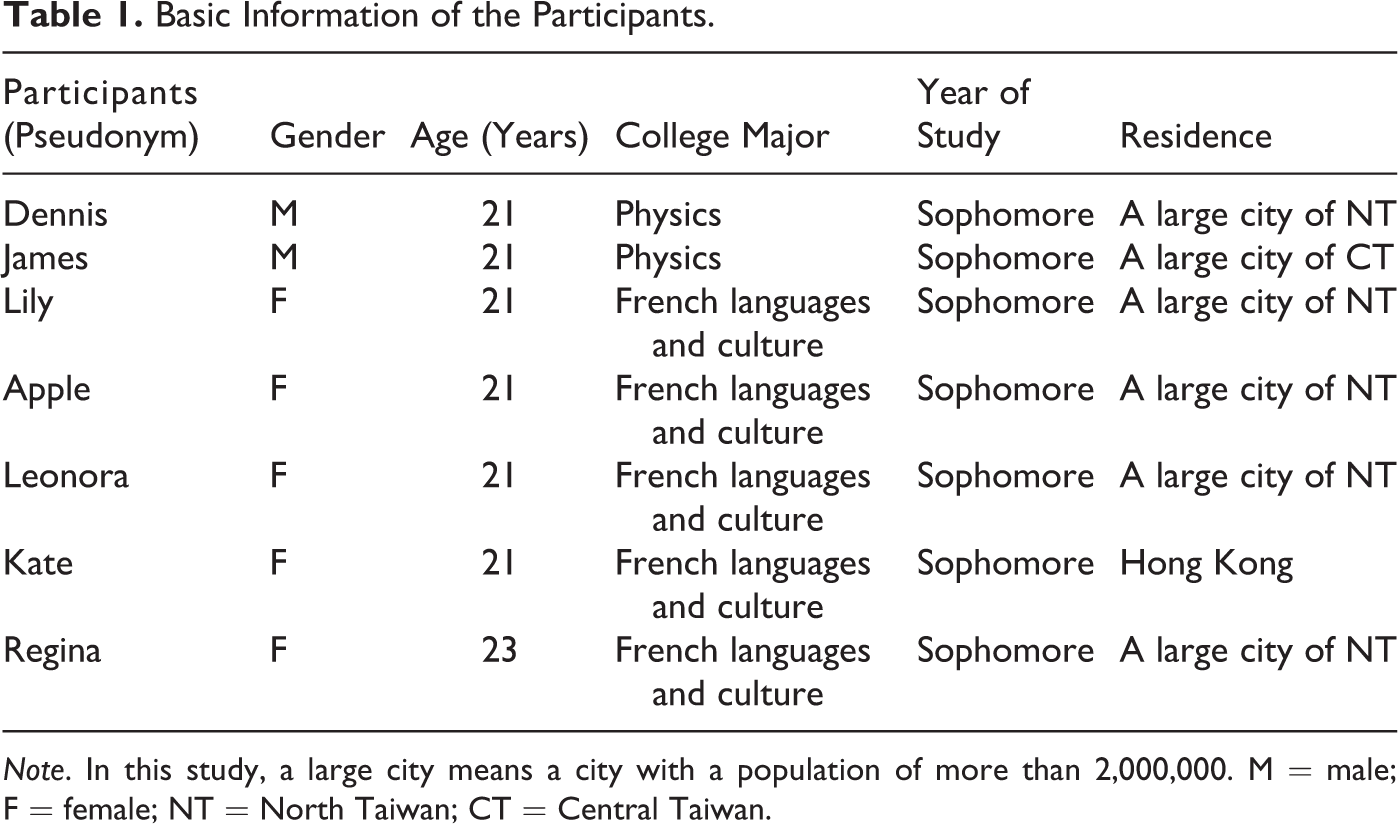
Note. In this study, a large city means a city with a population of more than 2,000,000. M = male; F = female; NT = North Taiwan; CT = Central Taiwan.
Data Gathering
The transcriptions of seven semistructured interviews provided data for this qualitative study. Each participant was given an information sheet to read and had the opportunity to ask questions at any point before they signed the consent form, which indicated their agreement to participate in the study.
The semistructured, open-ended, in-depth interviews chosen for this study involved a single-session interview with each student 1 week after the ISL experience. The interviews were guided by an interview schedule that followed the format of open-ended questions, follow-up questions, and prompts. Each interview lasted between 60 and 90 min. Interviews took place in the author’s office. All participants consented to the digital recording of their interviews.
Data Analysis
The interview transcripts were analyzed using the guidelines of interpretative phenomenological analysis (Smithet al., 2009). The analysis began by examining the cases individually, using inductive coding within five discrete stages: (1) familiarization with the material through reading and rereading each transcript; (2) taking note of first impressions of the account; (3) making exploratory and mainly descriptive comments that reflected the content and meaning found; (4) making conceptual/interpretative comments and identifying themes that captured the essential qualities of the account; and (5) looking for patterns and connections between those themes and organizing them into a meaningful hierarchy for the account using clusters, super- and subordinate levels, and so on (Ceuninck van Capelle et al., 2016).
When each table of themes on the six participants had been completed, connections across the whole group were made. Within the individual transcripts, there were several emergent themes. When the same themes appeared in more than half of the entire group, they were identified as recurring themes that captured the most powerful and interesting aspects of the participants’ experiential accounts. They would be then incorporated into the master table for analysis (Smith & Osborn, 2003).
Transparency in the analytical process was ensured by keeping a record of decision making and reflections during the analysis. In order to demonstrate the density of evidence for each theme, as suggested by Smith (2004), extracts from at least three participants were used to support each theme.
Findings
This article focuses on how the students providing ISL perceive their own self-becoming through the ISL experiences. Three major themes identified from the analysis were (1) experiencing a gap, (2) launching out into the deep, and (3) embracing new possibilities. The data related to the three core themes will be presented and discussed below.
Experiencing a Gap
In Ghana, the students strongly experienced that there was a big gap between what they saw and what they had expected or imagined. Some of these gaps occurred in class related to students’ attitudes towards learning, others on the street in connection with interpersonal interaction, and still others when helping the villagers to repair solar panel in relation to the use of materials. Sometimes, these gaps could also happen during a casual conversation regarding attitudes towards life.
The experience of these gaps caused a disorienting dilemma, feelings of anxiety, confusion, and a sense of not knowing what to do, and urged the students to reexamine their underlying assumptions, beliefs, and values. The students discussed the shared common experiences of discrepancy in the group and looked for ways to revise their perspectives and open their lives to new possibilities.
The following examples of Lily and Dennis illustrate this point across the data.
Due to the distance from the lodging to the place where the service-learning project was implemented, the students had to travel daily for more than 2 hr by car, going and coming back. This meant that they were often on the road and had opportunities to meet the locals who knew them. What impressed me most was that I often heard my name called from outside the car…. I was startled. I felt nervous and did not know what to do…. When raising my head, I saw a group of junior high school students whom we interacted within the recent days…I then calmed down and greeted them back with a big smile. (Lily)
Coming from a big city where people are used to larger interpersonal distance and experiences of interpersonal alienation and indifference, hearing her name being called loudly on the street, Lily was not only astonished by such an unexpected connection but also felt confused and disoriented. These feelings of confusion and disorientation triggered a questioning of the assumption she previously held about human nature and interpersonal relations.
Being shy and timid by nature, Lily hardly ever took initiative to greet others, much less the strangers. However, the experience of discrepancy between expectations and actual events as presented above in her account brought her to self-examination and assessment of her underlying assumptions. After some time, Lily finally came to realize that “actually most people are good and friendly.” “The fact that they do not take the initiative to greet me does not necessarily mean that they don’t like me.” “I believe that if I take the first step to say ‘hello’ to others, most people will certainly greet me back….” That is, Lily gradually came to understand that people are not as scary as she thought, and the interaction between people can be warmer and more active.
Lily’s example shows that the experienced discrepancy between reality and expectations during service-learning not only triggered feelings of confusion and disorientation but also challenged these students’ assumptions about human nature and interpersonal relations and made them move toward change.
In the following example, Dennis gives another account of the discrepancy which he encountered during a computer class. I remember that once there was a power outage during a sudden storm. I was distracted by this, and thought that all the students might have gone outside to watch the wind and rain. Yet, surprisingly, nobody left the classroom. Instead, all of them remained seated as if nothing had happened. On seeing this, we immediately broke away from the attraction of the wind and rain and continued the class. (Dennis)
Due to limited electric power, blackouts often occurred in the areas where the service-learning activities took place. This happened especially frequently during the rainy season and when there was a thunderstorm. During a power outage, it was dark outside and even darker inside the classroom. When this happens in Taiwan, students ask teachers to stop class because they cannot see anything. Those performing service-learning in Ghana witnessed something completely different, however.
In the above account, the discrepancies Dennis experienced between his expectations and reality first confused him and then roused his admiration. Dennis was confused because the students in class with him did not behave the way he had expected. He admired them because he witnessed how they lived out the values of diligence, hard work, and perseverance, which he had been taught since childhood.
As a student majoring in physics, Dennis works hard and, for the past 3 years, has been staying ahead of his peers both in the same department in the College of Natural Science and Engineering. Growing up in a family with financial difficulties after his father’s business failure, Dennis’s greatest desire was to make lots of money after graduation. However, when seeing these young Ghanaians working so hard in such a difficult environment, he began to question the value he previously held about the purpose of studying. Dennis gradually realized that “there must be something in life that is more valuable than making money.” He even made a resolution, as follows. In my graduate study, I will choose a program with a special focus on electric power systems…. I hope that someday in the future, I will be able to make use of my expertise to help improve access to electricity energy for people living in less favorable environmental conditions. (Dennis)
Dennis not only changed the value he previously held but also made a career decision based on the value he newly embraced.
Dennis and Lily’s examples indicate that the ISL experiences in Ghana have opened the students’ minds to see and find meaning in the discrepancy between what they had expected to see and what actually happened. These experiences also invited them to change their values and to act accordingly.
Launching Out Into the Deep
During their ISL in Ghana, the students also experienced cultural differences manifested in attitudes towards life, communication style, values, and attitudes towards learning. These differences have impacted and challenged the ways of thinking and behaving these students were accustomed to, and took for granted.
They also served as a driving force for these students to re-examine the assumptions, values, and beliefs underlying their attitudes and behaviors and to make new choices.
The following accounts by Leonora and Apple provide examples of this point.
The distance between Taiwan and Ghana is about 12,691 km, and there are no direct flights. One of the accompanying teachers missed the plane while he was in transit and was unable to reach his destination on time. Faced with such an experience, the attitudes of the students and the views of their local friends were very different. There was a time when all of us got upset because of “the bad news” that one of us missed his flight on his way to Ghana. Yet, a local friend told us: It is not bad news, but a challenge! He said: As long as one is still alive, nothing can be too bad. On hearing this, I fell into deep thought…thinking that the perspective through which we see things indeed has a great influence on the steps we take. (Leonora)
In the area the students implemented service-learning, three accidental deaths had occurred in the previous week. Perhaps the local people were used to traumatic events that occurred repeatedly, so they seemed to hold a mentality of hoping for the best and preparing for the worst. In contrast, this group of students were still inexperienced in real life events, and any unexpected interference could become a big issue for them. This may be one of the reasons why there was such a great difference in reaction to the same incidents!
Leonora, who has double majored in French and child and family studies in her university years, is full of interest and curiosity in and about foreign cultures. Faced with the different attitudes towards life, she was confused and fell into deep thought. She tried to figure out the difference between bad news and a challenge. That event was definitely bad news for her at that moment because nobody would like this to have happened to them. She could not understand why it was a challenge. She thought to herself for some time and also discussed it with her peers. She gradually arrived at the realization that these two terms actually reflect two different attitudes towards life.
Bad news refers to something which does not happen the way one would have expected while a challenge means that although things do not happen the way one would have wanted, he or she still makes effort to overcome obstacles faced. Leonora reflected on herself and came to understand why she easily got stuck when things went against her wishes. She decided to change herself, to “regard difficult things as a challenge, and to face and overcome challenges in life with confidence.”
In the same way, Apple also experienced the impact and challenges brought about by cultural differences. In Ghana, nothing is impossible. Things that we thought could have happened in one way had occurred in a very different way…. Perhaps it was sort of culture shock…I found that people’s attitudes and ways of doing things here are so different from ours…I constantly told myself to be open, to take things as they come, relax, and be flexible…I think I have learnt something profound on this journey…I think I have learnt how to respect other cultures and people of other cultures, not to complain, but to go with the flow. (Apple)
Coming from a conservative family, Apple tends to take everything for granted. Being in a foreign country and having contact with a new culture, Apple experienced that attitudes, ways of doing things, and the way Ghanaian friends interact with one another are very different from the way she is familiar with. This made her feel uneasy, shocked, and challenged.
The cultural differences experienced in Ghana conveyed a message to Apple that there are life attitudes and perspectives different from hers. This made her wonder that she might be too one-sided, believing that everything happened with only one cause and one possible evolvement. “Perhaps this is why I easily feel uneasy and upset when things did not happen according to a certain pattern and proceed in a way that I am familiar with.” She decided to change her perspective, to be open to different possibilities in life, and not take things for granted. She slowly learned to regard this difference as an invitation for her to open herself up, to let go of prejudice, and to appreciate diversity.
The above two examples illustrate that although experiences of differences and discrepancy can bring unease, shock, and challenge, these experiences can also be transformed into an opportunity for the students to engage in deep reflection on the underlying assumptions of whatever is taken for granted and to make new choices for a change in thinking and attitude.
Embracing New Possibilities
The experiences of gaps and differences invited these students to examine their existing beliefs about which they may have been unaware, values, and underlying assumptions. This prompted them to make choices and take concrete actions to implement their choices. The specific aspects that students carried out included cherishing food and everything one has, social engagement, and changes in professional career planning.
The following accounts of Regina, Kate, and James are examples to illustrate how the 21-day service-learning in Ghana has helped them to walk on the path of self-transformation. In Ghana, I have learnt to cherish all things which have been given to me…. For example, the food, I have learnt to treasure it, and if it was not completely unacceptable, I still ate it bite by bite. When it was beyond my ability to finish, I shared the food with people in need. In this way, I was not wasting food; instead, I was sharing food with those in need. (Regina)
Growing up in an environment with plenty of food, Regina was accustomed to “choosy” eating and did not eat or even chose to throw away food that she did not like. But after 3 weeks of ISL experiences in Ghana, she changed completely at least in terms of her eating habits as described above in her account.
During the ISL, what impacted her the most was to see daily nothing but a large pot for porridge and a wood-burning stove in the kitchen of the middle school where the students taught, and nothing but a small bowl of porridge the borders ate every day for breakfast. She also met many children who were malnourished. Seeing all this, Regina felt sad, distressed, and even speechless….
Regina began to reflect on herself and came to understand that she was a choosy eater, because she had never really believed that someone in the world didn’t have enough food to eat. She acknowledged that her assumption about the world was wrong. “I feel the need to change my worldview, my attitude toward the material world, and my eating habits.”
The above account showed how Regina changed her eating habits in a realistic manner by trying her best to eat up all the food on her plate or sharing the food she could not finish with those in need. After ISL in Ghana, Regina began to cherish all the blessings she has received in her life and to develop a sense of solidarity with people with fewer resources.
Similarly, Kate also underwent a profound transformation during the ISL experience in Ghana. The students heard about the existence of “witch villages” in the area they served. The “witches” stories reached their ears during the first 2 days in Ghana in a cultural orientation course organized especially for the students to have some knowledge of the Ghanaian culture, history, and way of living. From the input, they came to know that some women were listed on the “witch list” because they were more talented than men. These women were kicked out of their homes, expelled from their villages, and placed in “witch villages.” All the women in that area who suffered the same fate were placed there. They suffered from social discrimination, had no jobs, no income, and lived on the grain they picked up from the ground in the market area. Knowing this, the students became indignant and sad.
On the third day, the students had an opportunity to visit the “Witch Village” in person and found that the women being called “witches” were as normal as anyone else, and the children were very sweet with cute, innocent faces. Seeing the real situation, they felt outraged by such an injustice done to these women and children, and hoped to do something for them. “Witch Village” was a place that made me feel sad. I felt indignant to know the existence of such a place in the 21st century. These women were placed there simply because they had abilities superior to men. The so-called “witches” were framed and expelled…. They could only live on whatever they picked up from the floor of the market. I felt really angry and hurt when seeing the women living in the “Witch Village” were not “witches” at all. They were as normal as anybody else and the children there were the most beautiful and innocent I have ever seen in the world…. (Kate)
Kate majored in French in the university and was interested in music and singing. She participated once in the Asia Pacific Singing Competition and won second place. She indulged herself in literature and art and showed little interest in world affairs. However, after her ISL experience in Ghana, and having witnessed the fate of the women living in the “witch village” and the injustice done to them, she realized that the world was not the way she had thought. Kate felt this was unfair and sad about this.
After self-reflection and discussion with the group, Kate found that her worldview was too simplistic and narrow. She understood that what she had seen was hard to swallow, yet they were real and part of the facts of the world and human life. “News reports such as the uneven distribution of resources, the deprivation of human rights, and the overpowering of the weak, which I read every day, have become a reality right in front of me.” Kate’s new understanding of the world urged her to change her attitudes towards life and to take the necessary action to help improve the world. She was determined to get out of her small world. She later on joined a nonprofit organization, a group dedicated to women.
The ISL experiences also brought about major changes for James. Growing up in a well to do family, James had a hard time to convince his parents and other family members to allow him to go to Ghana. The family’s negative stereotypes of Africa were ingrained very deeply, and James found it difficult to convince them that there was actually another aspect of Africa that they had never imagined. Therefore, he took numerous photos and videos, hoping that his family would see them and change their views on Africa. I think there must be a difference between those who have been in Africa and those who have never been there…. The latter tend to make a judgement based on their imagination…. Yet, they will have a chance to change their unrealistic image of Africa if those having been in Africa share with them their experiences…. The sharing can be even more powerful when photos and video recordings are used. (James)
Overprotected by his parents, James tended to think a lot and had a lot of complaints about her parents and other family members. He disagreed with them on their values and misconceptions, flawed perceptions, and negative stereotypes about Africa. James had to work very hard to convince his parents to change their stereotypes of Africa.
During group reflection, James found himself having difficulty sharing his feelings with the group; yet it was not the case with any of his peers. When reflecting on himself, he found that he often felt pain in different parts of the body at different times and wondered that this might be somatic symptoms related to his inability to discharge negative emotions. He realized that he should not continue to be like this. He decided to make a change. He learnt to put aside his camera, to have face-to-face contact with the local people, to talk about his feelings, and to believe that personal experiences and the transformed self could be a testimony more powerful than the photographic evidence or videos.
Upon returning to Taiwan, he did not use any of the photos he took; instead, he shared his very self, a changed self with a different worldview, with his family and friends, by saying that “in the process of service-learning, I left behind my little world to make contact with those different from me and turned this into part of me,” and “service-learning for me is actually a process that uses the power of life to affect the lives of others.”
Like Danny, ISL in Ghana also changed professional career plans for James. He is now actively preparing for graduate school exams, hoping to be admitted to a graduate program related to solar power generation. It is his wish that later on he can make use of what he has learned to help disadvantaged groups like “Witch Village” improve their quality of life and obtain basic living needs.
Discussion
In this article, I have presented how the self was experienced and transformed during cross-cultural service-learning by seven college students engaged in a 21-day ISL project in Ghana. The transcripts of seven semistructured in-depth interviews were analyzed using IPA guidelines, yielding three core themes: experiencing a gap, launching out into the deep, and embracing new possibilities.
Corresponding with the research findings of Taylor et al. (2018) and Yang et al. (2016), the results of this study showed that this 3-week ISL in Ghana became a transformative learning experience for these students. They experienced the shock, anxiety, and challenge brought about by cultural differences and confusion caused by the experiences of discrepancy between expectations and facts. However, they did not let the opportunity pass them by. To the contrary, they grasped these learning opportunities for their personal growth. They became aware of the beliefs, values, cultural norms, and other underlying assumptions learnt uncritically since childhood during their self-examination and critical reflection.
They began to question their meaning structures and explore new ideas and behavior patterns as they reflected and shared together as a group. They thought about how to get out of their comfort zone and construct their future code of conduct and life direction based on the new frame of reference.
The data depicting these students’ lived experiences of self-becoming reflect the three key components of Mezirow’s (2000, 2009) 10-phase transformation process: experience, critical reflection, and reflective discourse (Taylor, 2000).
First of all, the students went through a disorienting dilemma. They encountered experiences different from what they had expected to happen, such as ways of saying hello on the street, insistence of students to stay indoors for class in dark stormy weather without electricity, an attitude of treating adverse circumstances as challenges, not misfortunes, and awareness of local women suffering injustice. These student experiences did not fit their preexisting meaning structures, causing disorienting dilemma.
The experiences of disorienting dilemma brought these students to self-examination and critical reflection. When the students examined their values, beliefs, and underlying assumptions, a variety of emotions such as guilt, shame, anger, sadness, confusion, shock, helplessness, anxiety, and unbelievable feelings arose…. They felt sad because they had witnessed how people suffered from poverty, deprivation, and injustice. The felt ashamed and guilty, because they came to realize that for so many years, they were only concerned about their own needs, and cared about their own enjoyment and comfort, while ignoring the needs of the poor. They were confused and disoriented because their beliefs that the purpose of studying was to find a good career and make a lot of money was challenged.
The students reflected on their emotions, and let the messages hidden behind these emotions speak to them, and lead to critical self-examination of their assumptions about human nature, interpersonal relations, cultural norms, self-concepts, and the how and why of their study.
The way these students dealt with their emotions reflect Liou (2020), Mälkki (2010), Mezirow (2000), and Taylor and Cranton’s (2013) position regarding the importance and role of emotions in the process of transformation. The students recognized, acknowledged, and processed these emotions as integral aspects of their learning and transformed them into something that helped expand the depth and breadth of critical reflection.
According to Mezirow (1991), meaning structures are inclusive of sets of codes: sociolinguistic codes, psychological codes, and epistemic codes. Sociolinguistic codes refer to the effect a society has on people’s meaning structures including social norms, cultural expectations, socialization, and the use of language. Psychological codes concern the way people look at themselves including their self-concepts, needs, preferences, and so on. Epistemic codes refer to how people recognize and use knowledge.
The students examined these three aspects and became aware of the ways of thinking in which they were instilled, the habits they had developed, and the assumptions they had made about themselves, human nature, interpersonal interaction, and the meaning of life since childhood. For example, what they were made to believe was that when there is a power outage, suspension of classes results; failure to catch the plane is a very bad thing; you should keep a distance from strangers; you should not greet strangers casually on the street; and one should respect human rights and gender equality.
However, the experiences of cultural differences and discrepancy between facts and expectations made them question what they used to hold to be true and begin to challenge the validity of presuppositions in their prior learning.
The students felt that meaning perspectives they used to understand the experiences they encountered are no longer applicable. They felt the need to readjust and find new possibilities.
Together with other students, they reflected on their shared experiences of cultural differences and discrepancies between facts and expectations. They also discussed in groups various perspectives on human nature and interpersonal interaction they had previously held, and the attitudes towards life, worldview, purpose of life, and lifestyle they previously owned. After discussion, they came to realize that some assumptions, beliefs, and values previously held were valid no more and together they also found the need to explore new possibilities.
The data indicated that these students experienced changes in three dimensions: psychological, convictional, and behavioral while engaged in ISL in Ghana. These changes have made a difference in the way the students look at themselves, their beliefs, and lifestyles. Some of the students were able to take the initiative to greet people first, others began to live a simple life, and still others believed that they can influence people’s views on Africa. One of the students joined a human rights organization that speaks for women and the two physics students have been admitted to a graduate degree program in renewable energy.
The data reflect Clark’s (1991) point that the perspective transformation of opinions should include three aspects: psychological, which refers to change of self-understanding; convictional, which is about the modification of a belief system; and behavioral, which is concerned with changes in lifestyle (Taylor, 2000).
Taking together, the 21-day ISL in Ghana allowed the students to move out of their comfort zone and reach out to others from a very different cultural background, living in a distant land, to experience disorienting dilemmas caused by the gap between realities and expectations and to question and challenge their underlying meaning structures.
Through this ISL experience, these students became more aware of beliefs, values, and behavioral patterns developed or learnt uncritically since childhood. They reaffirmed and strengthened some of their beliefs and values and made changes to the meaning perspectives underpinning their problematic behaviors and unhealthy lifestyles.
They stepped out of their familiar thinking patterns and moved towards a more comprehensive way of thinking and worldview; they let go of behavioral patterns inconsistent with a new reference framework. They have undergone transformative learning experiences. They are deeply aware that they have embarked on a journey of self-becoming.
Footnotes
Author’s Note
Portions of these findings were presented as a keynote speech at the 2019 Orange Beneficence International Conference: Sustainable Development, New Taipei City, Taiwan.
Declaration of Conflicting Interests
The author(s) declared no potential conflicts of interest with respect to the research, authorship, and/or publication of this article.
Funding
The author(s) received no financial support for the research, authorship, and/or publication of this article.
