



Abstract
This article develops a framework for this special issue of JTE, and assesses the assessment of transformative learning. What and whom are the contributors assessing? For what ends? And how effectively? The call for manuscripts cited two “megatrends” in the transformative learning literature: 1. The importance of deep and transformative learning experiences that profoundly affect adult learners’ sense of self and their relationships and behavior in their community and broader world; 2. The need to clearly document these learning experiences and interventions and rigorously assess their outcomes, both proximal and distal. In what follows, I pose questions that these trends suggested to me and use them to take stock of transformative learning theory and education in the 21st century. At the end of each section, I synthesize what I found to be relevant from my review of the articles in this issue, highlighting what I see to be major contributions.
Keywords
A Brief Retrospective
Fifteen years ago, and decades after the publication of his seminal article “Perspective Transformation,” Jack Mezirow continued a dialogue with John Dirkx in this journal that they had begun at the Sixth International Transformative Learning Conference (TLC) in 2005 (Dirkx et al., 2006). They provided overviews of their perspectives on transformative learning, its meaning, context, and process. Cranton observed that their views were “complementary rather than contradictory” and that “the complex endeavor that is transformative learning encompasses both a rational process of learning within awareness (Mezirow) and the deep learning that integrates experiences of the outer world with the inner community of the self (Dirkx)” (Washburn, 2006, p. 102).
As the new editor of JTE at the time, I related that I had been half expecting and hoping that this dialogue would mark the inception of a GUT—grand unifying theory—but concluded that I really did not want such a thing. I agreed with Regina O. Smith who, in reflecting on the 2005 TLC, wrote, “A part of me wants to see the theories more bounded by a clear definition, but another part of me resists attempts at boundedness because the theories would have little opportunity to be inclusive of fundamental differences in adults” (Cranton, Dirkx, Gozawa, et al., 2006, p. 152). The diversity of particular concern to Smith was that of race, and it was clear, as Elizabeth Kasl noted in her reflections on the conference, that, although the field had expanded to include emancipatory learning linked to social justice and action, theorists and practitioners from diverse racial and ethnic backgrounds were not represented in proportion to their numbers and influence. Joanne Gozawa’s reflections completed the report with a challenge to “deeply transform our frames of reference, to adopt a ‘cyclical, cumulative rather than a linear, discreet perspective of educational foundations’” (p. 103).
In this same issue of JTE, Maureen O’Hara (2006), too, critiqued the philosophical assumptions of Western education, with an urgency that many, perhaps, are just now beginning to feel. She wrote that the charge for education in this time of anxiety- and fear-provoking change and complexity that is the postindustrial information age is to expand and evolve “the modal consciousness of our species” (p. 113). This massive undertaking will require nothing short of a “wholesale reworking of the mission, curriculum content, pedagogy, and modes of inquiry of our educational institutions” (Washburn, 2006, p. 101). To information literacy, O’Hara added eco-literacy, spiritual literacy, and epistemological fluency among the competencies required for these times with learning to be supported by the whole-person pedagogies and contemplative modes of inquiry.
This brief retrospective of how prominent theorists and practitioners viewed transformative learning 15 years ago suggests that the richness of the domain, the expansiveness of the problem space, were apparent then as now. An apt metaphor for this aspect of the enterprise is a riotously-colored and enormous tapestry, the warp and weft of which are the aspirations undergirding a shared interest in “another education” (Markos & McWhinney, 2003, p. 4). Also apparent years ago was the inherent complexity of the individual persons and systems that have been our concern, as well as the great diversity amongst all. Perhaps a crazy quilt is a better metaphor for what we have been about, each patch unique and some clashing with adjacent others, reflecting the tensions amongst the often widely disparate viewpoints of those focusing on discreet areas of the patchwork. It was also clear then, as now, that any attempt to succinctly define transformative learning, the phenomenon of interest, is exceedingly difficult. Switching from fabric to animal metaphors, others (e.g., Cranton & Taylor, 2012; Markos & McWhinney, 2003) have evoked the familiar Sufi parable of the blind men and the elephant to characterize our efforts to grasp a sense of the whole of our work. This challenge has implications for theory development that, in turn, impact our ability, for example, to design and evaluate innovative curricula to support learners who aspire to better their own lives and to improve their communities.
A strategy to advance the field—and the impetus for this special issue of JTE—is to document in a systematic fashion learners’ experiences and to assess the associated outcomes using tools that operationalize key constructs of transformative learning theory. The mix of metaphors that I just used to quickly take stock of the field suggests that researchers will be challenged to design methodologically sound protocols for data collection and analysis. What thread or threads in that tapestry do you pull? Which patch or set of patches do you examine? And then what? If you are focused on the elephant’s trunk, are you missing something vital on its backside? After decades of theoretical and empirical work and faced with sometimes withering critique, I have wondered how we will proceed now and with what success.
Whither Transformative Education?
In The Handbook of Transformative Learning, editors E. W. Taylor and Cranton (2012) observed that since the introduction of transformative learning to the field of adult education decades ago, no other theory had shown such promise, stimulated so much research, or sparked such controversy. Addressing this last point, the notion of transformative learning has been characterized as simply good learning (Newman, 2012) and the theory itself as problematic in many respects, except at the level of a conceptual metaphor, albeit a beautiful one (Howie & Bagnall, 2013).
In the Adult Education Quarterly article in which he first shared his “mutinous thoughts,” Newman (2012) discussed a number of flaws that mark explanations of transformative learning. He began with the “false premise” made by Mezirow in 1978 that “transformative learning differs from other learning in kind rather than degree” (p. 40) and ends with the “most troubling flaw…the way some writers have associated spirituality with transformative learning…as if its inclusion were unproblematic” (p. 46). Addressing the responses his critique not surprisingly invited, Newman concluded in his 2014 Adult Education Quarterly article that transformation, the word itself, “raises false hopes” and that the role accorded to transformative learning is “simply too big” (p. 350). He quoted O’Sullivan who in 2012 wrote Transformative learning involves experiencing a deep, structural shift in the basic premises of thought, feelings and actions. It is a shift of consciousness that dramatically alters our way of being in the world. Such a shift involves our understanding of ourselves and our self-locations; our relationships with other humans and with the natural world; our understanding of relations of power in interlocking structures of class, race and gender; our body awareness, our visions of alternative approaches to living; our sense of possibilities for social justice and peace and personal joy. (p. 350)
Howie and Bagnall (2013) not only critiqued transformative learning theory but “mutinous” commentary on it such as Newman’s (2012). They discussed a dozen interwoven problematic areas for the theory that together argue for interpreting it as a metaphor. Among these are unidirectional theorizing, with the theory as outlined by Mezirow (1978; 1991) leading to new applications with little impact on the theory itself: lack of quantifiability with no agreed-upon measures; lack of predictiveness resulting from the theory’s descriptively grounded development from a specific, small sample of participants; and problematic exemplary cases. In reviewing this latter area of weakness for the theory, the authors concluded that this inability to identify what transforms is “representative of much of the research, in which outcomes are purported to be transformative while the causal mechanisms remain unarticulated and unclear” (p. 826). Howie and Bagnall concluded that, if transformative learning, which has such strong face validity that it is widely and uncritically accepted, is regarded as a conceptual metaphor rather than as a theoretical construct, then it may be more fruitful in practice. For example, generating an image of learning—the target domain of the metaphor—as a transformative experience—the “light on the road to Damascus” source domain of the metaphor—stimulates “academic enquiry and investigation into hitherto unexamined human learning processes relating to significant shifts in individual’s perceptions of themselves, the world and how the world works” (p. 831). Howie and Bagnall added that, because they can be “extended, modified, reformulated, added to, redefined, re-envisioned, and played with” (p. 831), conceptual metaphors can be applied in more diverse contexts than operationalized theoretical constructs. They cited applications in corporate America in workplace learning and coaching, as well as in women’s education and work in Bolivia and farming schools in rural West Africa.
In This Issue
Whither transformative education? This question suggests, and critiques in recent years have maintained, that transformative learning as a theory and, by extension, transformative education as a practice are wandering and meandering to whatever place, whithersoever. Some may indeed, as Howie and Bagnall (2013) suggested, employ the term transformative learning as a conceptual metaphor, however implicitly. However, that does not seem to be the case with the authors of the articles in this issue, some of whom discuss at length—and reflectively, critically—the theoretical underpinning of their work. Importantly for our purposes here, these educator scholars have proposed and, in some cases, tested new approaches to assessing transformative learning, including methods that operationalize key constructs in transformative learning theory.
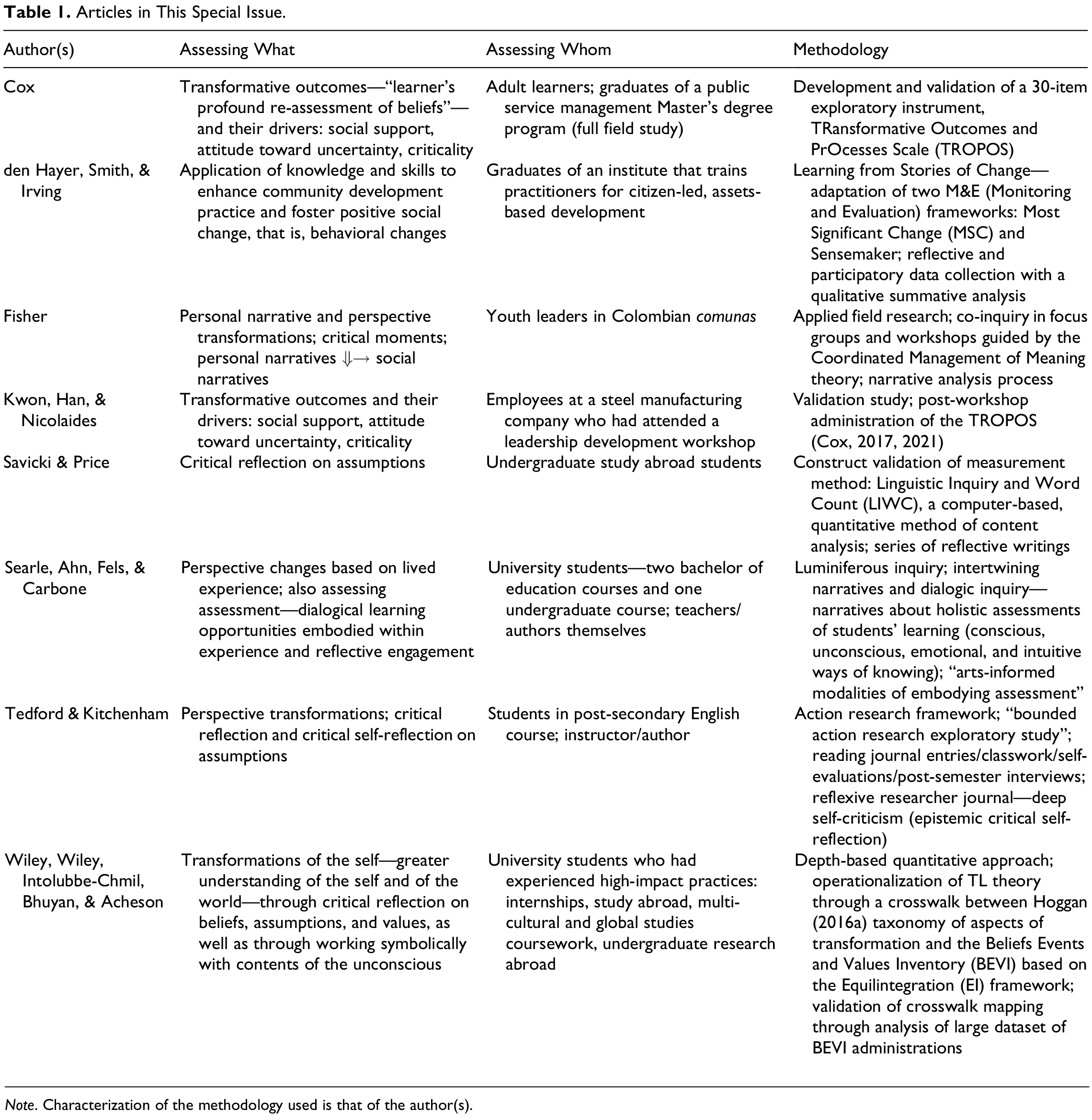
Table 1 lists for each article what was assessed, who was assessed, and what methodology was employed to better understand the processes and outcomes of transformative education. This body of work reflects the transformative learning literature of the past several decades both in the variety of the learning experiences examined and in what settings. This work also advances the field in various ways that I address in response to questions that we have often asked ourselves as educator scholars who want to better support our learners.
Articles in This Special Issue.
Note. Characterization of the methodology used is that of the author(s).
Why Transformative Learning?
To the problematic areas discussed above, Howie and Bagnall (2013) added the “uncritical acceptance of the theory’s theoretical solidity” such that it is describing an existing entity, “a thing out there to be researched, elucidated, explicated, polished and refined rather than as an explanatory and predictive interpretation of experiences and phenomena” (p. 828). That the theory itself has been reified—a thing to be polished—by some is no doubt true but what is indeed solid, or as solid as any complex human phenomenon can be, are types of experiences that learners report and that educators seek to foster. As I began working on this article, two compelling exemplars of what we are about presented themselves as grist for my mill.
My book club recently read Tara Westover’s memoir Educated (2018). The youngest of seven in a Mormon survivalist’s family in rural Idaho, Tara was unschooled until she powered her way through a curriculum she devised to pass the ACT and gained admission to Brigham Young University. Among the new discoveries for the incoming freshman was the Holocaust and Dr. Martin Luther King, Jr. In a meeting with a professor I explained as best I could, that my parents didn’t believe in public education, that they’d kept us home. When I’d finished, he laced his fingers as if he were contemplating a difficult problem. “I think you should stretch yourself. See what happens.” “Stretch myself how?” He leaned forward suddenly, as if he’d just had an idea. “Have you heard of Cambridge?” I hadn’t. “It’s a university in England,” he said. (p. 230) My life in Cambridge was transformed—or rather, I was transformed into someone who believed she belonged in Cambridge. The shame I’d long felt about my family leaked out of me almost overnight. For the first time in my life I talked openly about where I’d come from. I admitted to my friends that I’d never been to school. I described Buck’s Peak, with its many junkyards, barns, corrals. (p. 272) Everything I had worked for, all my years of study, had been to purchase for myself this one privilege: to see and experience more truths than those given to me by my father, and to use those truths to construct my own mind. I had come to believe that the ability to evaluate many ideas, many histories, many points of view, was at the heart of what it means to self-create. (p. 304) For the first month of the Last Mile, a program that teaches business and software skills in prisons, Aguirre and his fellow students didn’t have access to computers. They relied on books and pens to scribble out code on scratch paper. For his first project, Aguirre handwrote code to re-create the In-N-Out Burger website using only a printed-out copy of the chain’s homepage as reference. (para. 5) “If you want to understand a societal issue, you have to get close to it,” said Leal, who, as an inmate at San Quentin, also went through the Last Mile program.…“It’s a huge paradigm shift—going from living in a 6-by-9-foot cell and having very little decision-making power in your life to all of a sudden being part of the 21st-century gold rush,” Leal said. (para. 17)
Why transformative learning? How can we explain the ascendance and prominence of transformative learning theory in adult education? As Howie and Bagnall (2013) maintained, the theory has face validity, arguably because it names “what is” in some instances for learners, as well as for educators. Individual learners like Tara Westbrook may report a dramatic and qualitative shift in their sense of self and/or consciousness. Alternatively, others may notice a substantive alteration in a learner’s way of being in the world that may materially impact the larger community, as seems to be the case with Slack’s new software engineers. Transformative learning arguably is at once an experience or series of experiences with consequential outcomes for the individual and an approach to adult education that addresses pressing societal needs.
In This Issue
Why, then, transformative learning? The consensus answer from this issue’s contributors to what is the existential question for our endeavors is that, through what are intended to be high-impact interventions, transformative education will make a difference, often a profound one, in the adult learners with whom we work. The outcomes sought are to be consequential for the individual.
The transformative outcomes of interest to Cox (2021), for example, are those shaped by the “learner’s profound re-assessment of beliefs, typified by changed assumptions and a more inclusive, open perspective toward self and others” (p. 3 of October 5, 2020, manuscript).
Tedford and Kitchenham (2021) focus specifically on how learners’ perspectives on racism and non-violent activism shift after studying the second graphic novel in the March trilogy (Lewis et al., 2015) chronicling John Lewis’ civil rights legacy.
They found, however, that any shifts of perspective evidenced by participants in their journal entries, classwork, self-evaluations, and post-semester interviews were “not drastic,” suggesting rather that they were “experiencing a gradual process of transformation” (p. 7 of 9/5/20 manuscript).
Consequential distal–societal, as well as proximal–individual, outcomes are a focus of several contributors. The purpose of the evaluation study conducted by den Hayer et al. (2021) was to determine to what extent graduates of programs for development practitioners were applying their new knowledge, skills, and, critically, attitudes and motivations to foster positive social change. Online surveys administered on a rolling schedule post-graduation asked respondents to share a story of the most significant change that affected their communities. The work of Fisher-Yoshida and Lopez (2021) has a similar aim of exploring how the personal transformation of youth leaders begets social transformation in their conflict-ridden Colombian comunas. Importantly, what Fisher finds in an analysis of critical moments that shaped the youths’ experiences and narratives was that this arc of virtuous change comes full circle—that is when the social narrative changes so do the individual narratives that emerge from this foundation.
Wiley et al. (2021) echo O’Hara (2006), whose reflections about the societal and global function of higher education I shared earlier, when they note that what is urgently needed in these times is a shift from “content conveyance to internal capacity building in order to prepare citizens for the globally entangled reality formed by our economic, political, and social environments” (p. 15, October 26, 2020, manuscript). Two other observations they make about the import of transformative learning have struck me as particularly important and, I believe, are not often discussed. First, they note that, in contrast to other theoretical frameworks for assessing learning outcomes, transformative learning theory is not neutral. What we hope to see is the “development of more self-awareness, more connectedness with the larger world, more complex thinking” (p. 8, October 26, 2020, manuscript). The second point Wiley and colleagues make follows from this, that given the profound changes we aim to foster, it is our ethical responsibility to understand what these transformative outcomes will mean to the individual student who experiences them.
What Exactly Is Transforming?
And how would we know that a transformation has occurred? I will address this second question in a later section as it very much depends on the response to the first, which asks, as Kegan (2008) has: What “form” transforms? Kegan maintains that the consequential change that we recognize as transformative occurs with a shift in the “deep underlying epistemology (the form that transforms) we use to organize meaning” (p. 46). On this view, we not only construct meanings from what we encounter in our inner and outer experiencing (and with further encounters change these meanings), we also change the very form itself by which we make these meanings. Kegan suggested that Mezirow’s frame of reference is a form of knowing—that is, an epistemology—which can change in the deep and consequential way we would recognize as transformative.
Illeris (2014) later argued that Kegan’s question—What form transforms?—had never been satisfactorily answered and that this is problematic in at least two respects. First, uncertainty about the boundaries of the form in question invites all manner of learning activities and endeavors to be considered transformative. Second, a tendency to prioritize the cognitive dimension—Mezirow’s frames of reference, meaning perspectives, and habits of mind—over the emotional and social dimensions and the situatedness of learning processes has overly restricted the domain of transformative learning. Illeris noted that Cranton (2005), Dirkx (1997; 2006), E. W. Taylor (2009), as well as Mezirow (2006, 2009), had critiqued this imbalance, and he credited Kegan with most clearly defining, although not explicitly naming, the target area. That is to say, the form that transforms comprises intrapersonal and interpersonal, as well as cognitive, lines of psychological development (Kegan, 2008).
So, failure to identify—and name—the form that transforms results, on the one hand, in too broad a target domain and, on the other, a construct that is too narrow to encompass important aspects of the human experience. Among the candidate names for the Goldilocks form that transforms, which Illeris (2014) considered, are the person/individual/learner, the personality, the self, and the soul. Of these, self “as the center of the individual consciousness, collects and holds together the outcomes of important learning” (p. 151). He settled on identity, however, explaining that it is similar in composition to the self but that it has been understood, beginning with Erikson’s (1994; 1998) theoretical work, as a psychosocial construct wherein interactions between the person—and self—and the social environment influence development over the lifespan. Notable among the reasons Illeris gave for adopting identity as the form that transforms is that it then “becomes possible to establish a direct connection to the current conditions and frames of society that create both the growing need for and the conditions of the transforming processes” (p. 153). He concluded that identity “spans all the dimensions of learning and mental processes: the cognitive, emotional, and the social as well as the environmental and societal situatedness of this totality” (p. 160). Arguably, in both of the cases discussed earlier, there were deep and consequential changes in identity; for Tara Westover, it was a compelling, at times tumultuous, personal transformation and, as we read about with the parolee Slack engineers, it is the societal situatedness of their individual transformative experiences that is salient.
Newman (2012) contrasted identity and consciousness, something that he said the transformative learning literature had failed to do. The former, the “more superficial of the two,” is but the “mask, the persona we present to the world” (p. 42), which we can alter at will. Although the notion that we have full control over our identity is likely not the consensus position of psychologists, Newman’s claim serves to make his point that it is consciousness, our “experience of existence,” that must be reworked for something like transformative learning to occur. This ground of our being develops over our lifetimes “in the continual encounter between our self and the social and material world…and any learning effectively done contributes to the continuing creation of our consciousness” (p. 42). Newman added that the contrast between identity and consciousness is evident in a comparison of Mezirow’s (1981; 1991) perspective transformation and Freire’s (1972) conscientization. He explained that, whereas the former tends to involve intense self-examination resulting, for example, in “Provisional trying of new roles” (p. 42), the latter, as a collective activity, results in a “heightened form of consciousness in which we feel and we think and we do with clarity and intensity” (p. 43). Newman cautioned though that educators and program facilitators often mistake mobilization for transformation and added this to his list of flaws in the transformative learning literature.
In response, Dirkx (2012) argued that Newman’s (2012) analysis was based primarily on a sociological framing of self-formation that “minimizes important psychological dynamics associated with consciousness development” (p. 399) and, further, that he used the idea of consciousness development to argue against transformative learning as being anything other than good learning. Dirkx characterized transformative learning as self-formation that involves critiquing the self as it has developed in a particular sociocultural context as well as nurturing that which is innate in one’s psyche. That is to say, the “former seeks to address self-deceptive practices and the latter helps encourage the unfolding of a more integrated and authentic self” (p. 402). Further, these intertwined processes, which tend to be continuous and ongoing, manifest themselves a deepening and broadening understanding of one’s sense of self, the world, and being in the world that may, on occasion, be experienced as a transformation—and even an abrupt one—of consciousness. On this view, then, the form that transforms is consciousness, as Dirkx recently confirmed (personal communication, November 18, 2019).
Cranton and Kasl (2012) also commented on Newman’s (2012) article, asserting that many of the flaws he identified in the transformative learning literature are the result of a general failure to distinguish among process, outcomes, and context. Outcomes for Mezirow, they explained, would be shifts in habits of mind or, using Newman’s terminology, shifts in consciousness. Among the processes that could foster or precipitate these shifts are critical reflection, experiential learning, and ideological critique, any of which could occur in a wide variety of contexts, “and then within that, several ways in which people revise their perspectives (cognitive, extrarational, social, relational, artistic, and intuitive.). Each path leads to transformative learning in a different way” (p. 397). Cranton and Kasl suggested that a unified theory of transformative learning that takes these different trajectories into account would directly address many of Newman’s “mutinous thoughts.”
In This Issue
What then transforms as a result of the high-impact experiences we provide our learners? Most of the contributors to this issue explicitly adhere to what one (Kwon, Han, & Nicolaides, 2021) calls Mezirow’s (1981, 1991) “narrow conceptualization” of transformative learning—that is, what transforms are learners’ perspectives, worldviews, or habits of mind. Serle and colleagues (2021) have assessed “a change in perspective”; Tedford and Kitchenham (2021), “perspective transformation”; and Cox (2021), a “learner’s profound re-assessment of beliefs” as did Kwon and colleagues (2021), who reports on a validation study of Cox’s Transformative Learning Outcomes and Processes Survey (TROPOS) (Cox, 2017).
Evident in nearly all of the articles, though, are hints, if not clear assertions, that what is changing in transformative learning is something broader and deeper than a shift in perspective about some aspect of the world. The transformative outcomes measured by the TROPOS are typified by a “more inclusive, open perspective toward self and others” (Cox, 2021, p. 3). den Hayer and colleagues (2021) have a similarly broad view of what transforms in learners whose worldviews begin to shift. The positive social change that their graduates are fostering in the communities in which they work requires not just that they have acquired critical knowledge and skills but that they have the capacity to interrogate their own motivations for action and, importantly, their own power. What transforms for the young graffiti artists with whom Fisher-Yoshida and Lopez (2021) work are their personal narratives. As they continued their self- and social-inquiry, they elicited more ways in which they could make sense of their experiences.…They did not feel in control until they made advances to change their narrative into one where they and others around them could enjoy art, their communities, and the experience of being human. (p. 9, December 11, 2020, manuscript)
Similarly, Savicki and Price (2021), who examined reflection in study abroad undergraduates, note that some of their assumptions and presuppositions about their experiences may operate at an unconscious level “as ‘habits of mind’ (Mezirow, 2000) or, in a cultural context, ‘software of the mind’ (Hofstede, 2010)” (p. 2, December 11, 2020, manuscript). What transforms for some of these learners, as they observe, review, and analyze the cognitive and, importantly, the emotional content of their experiences may well be deeper than the making of new meanings or the shifting of perspectives. Savicki and Price emphasize that the “full self—affective, cognitive, and behavioral—needs to be engaged to construct the meaning that is a goal of reflection” (p. 4, December 11, 2020, manuscript). If this is the case, that it is the self—comprising an identity, consciousness, unconscious contents—that is reflecting upon experiences in a study abroad program, then would not it be the self that has transformed and then transforms further upon reflection?
What clearly transforms for Wiley and colleagues (2021) is the self. They ask If high impact practices are intended to bring about transformative learning, why are we not assessing the actual transformation of the self? Why isn’t there a more robust body of literature describing how, what, and for whom transformation of the self occurs in a given learning environment? (p. 4)
How and for What Ends Do We Broaden the Construct of Transformative Learning?
In their concluding chapter to the 2012 Handbook of Transformative Learning, Taylor and Cranton observed that the theoretical tensions among scholars and practitioners appear due, at least in part, to differences in the discourse used to characterize the dramatic shifts associated with transformative learning. They contrasted, for example, the emphasis by K. Taylor and Elias (2012) on psychological changes experienced by the individual learner, using a developmental perspective after Kegan and Daloz (as cited in E. W. Taylor & Cranton, 2012), with Brookfield’s focus on the individual’s changing relationship with society, using critical theory after Habermas. In the first instance, the transformation might be from a socialized mind, characterized by an inner state of subjectivity and self-consciousness, to a self-authoring mind that can reflect on these and is experienced as autonomous and individuated (Kegan, 2008). In the second, the transformation is “from the competitive, individualist ethics and systems of capitalism to the collective, interdependent, and cooperative ethics and systems of democratic socialism” (Brookfield, 2012, p. 131).
E. W. Taylor and Cranton (2012) noted, however, that despite their different emphases, these theorists and others represented in the volume were attempting to expand the focus of their scholarship and research. The new discourse they saw in Brookfield’s (2012) work includes individual cognition as a unit of analysis with transformation defined as a “qualitative ‘change in the way people think, not just a change in external political and economic arrangements’” (p. 557). Similarly, Dirkx (2012) and K. Taylor and Elias (2012), while focused on personal transformation, recognized that changes in one’s self occur in, and are affected by, the community in which one resides. Whereas these efforts suggest that a more integrated theory of transformative learning seems possible, what all it might encompass was not clear at that time. Taylor and Cranton concluded that most theorists still seemed “strongly rooted in their units of analysis” (p. 558).
Several theorists have explicitly argued for a broad interdisciplinary systems approach to transformative learning theory. To understand the inherent complexity of individuals who themselves live and learn in multiple social-ecological contexts—from the microsystem of the family and school to the macrosystem of cultural attitudes and ideologies (Bronfenbrenner, 1979)—requires, as Alhadeff-Jones (2012) suggested, “multiple levels of analysis (individual, organization, institutional, societal) in order to question what characterizes their mutual relationships and how they are intertwined with each other” (p. 184). In their review of research on transformative learning theory from 2006 to 2010, E. W. Taylor and Snyder (2012) found increased interest in how relationships at the microsystem level affect the individual learner. They cited Nohl’s (2009) early biographical explorations with a small sample of individuals that found that transformative learning depended to a large extent on social recognition—that is to say, acknowledgment and possibly appreciation by peers of the changes experienced and manifested. He later replicated this work with diverse age and topic domain groups (2017) and presented a detailed typology of phases of transformative learning that departs in significant ways from earlier models. For example, he found that the process of transformation typically begins, not with a disorienting dilemma, but when “novelty, neither anticipated nor planned, breaks into life” (p. 39). In two of the phases—social testing and mirroring and social consolidation and reinterpretation—interpersonal relationships are central to and “boost” the process.
Other scholars and researchers have incorporated insights into their work from seemingly far-flung disciplines. Complexity theory, which originated decades ago to investigate physical and biological systems, has framed recent studies of teacher practices and education (e.g., Martin & Dismuke, 2018). The approach to the study of transformative learning advocated by Alhadeff-Jones (2012; 2019) is also informed by complexity theory, as is that of Lange (2012; 2015; 2018). This perspective from New Science “means embracing tensions found between a linear (such as phases) and a non-linear (for example, recursive, spontaneity) transformative process, the singular or local and the universal, and the predictable and unpredictable” (E. W. Taylor & Cranton, 2012, p. 358). To theoretical insights from quantum physics, Lange added what can be learned about transformative learning from other relational ontologies, including North American Indigenous philosophies and Eastern mysticism.
Ntseane (2012) contrasted adult education in collectivist African and individualistic Euro-Western systems, the latter often paying little attention to the sociocultural contexts that shape learning—and transformation. Among the African worldviews that she saw as potentially contributing to the continued development of transformative learning theory is übuntu or botho, an African humanism that holds that we can only be human in relation to others and that through understanding this deeply, we come to care for and be of service to others. Ntseane noted that the “persistent determination” she and her Third World colleagues have to bring African worldviews like übuntu to the further development of transformative learning theory “speaks to our marginalization in knowledge construction circles” (p. 278). Indeed, Finnegan (2019) recently observed that judging by our conferences, journal editors, etc. our community is not yet fully global. A global community of scholars is required to map the “ecology of knowledges” that reflects the “rich diversity of contexts and cultures across the world and the multiplicity of ways the local and global is being reconfigured” (p. 109). Beginning to join such an effort are scholars familiar with the German notion of Bildung, a 200-year-old concept prominent in continental Europe education.
According to the editors of Transformative Learning Meets Bildung, with no literal translation into English, Bildung connotes a “cultivation of the self by the self, as well as to the state of being educated, cultivated or learned” (Fuhr, Laros, & Taylor, 2017, p. ix). They observed that the two theoretical approaches conceptualize learning in a similar fashion—namely, the reconstruction of experiences as one comes to develop a critical perspective on knowledge—with Mezirow from one tradition and Marotzki from the other agreeing that meaning is, at once, a cognitive event and a “social construct that is produced and changed in social interactions” (p. ix). Two differences between Bildung and transformative learning are particularly pertinent to this discussion. One, the former is embedded in continental and other philosophical traditions with much of the scholarly discourse based on theoretical inquiries whereas research on the latter has been predominantly empirical. Fuhr and colleagues suggested that the latter pay more attention to its own theoretical foundations, as well as to recent inquiries into “core concepts of transformative learning outside research on adult learning” (p. xiii). Two, and related to the first, is Bildung’s application to learning across the lifespan—from childhood to youth to adulthood—in contrast to transformative learning’s focus on adult learning. The editors conclude that the transformative learning theory might advance from studies that examine, for example, the similarities between learning in youth and adulthood. 1
Shortly before transformative learning theory met Bildung (Fuhr et al., 2017), Hoggan (2016a) suggested that Mezirow’s rather circumscribed approach be referred to as perspective transformation and that transformative learning be applied to a broader range of similar phenomena. As such, it would serve as a metatheory—that is to say, an “umbrella under which several theories of development or learning are classified together based on their commonalities regarding human nature” (Aldrige et al., as cited in Hoggan, 2016a, p. 63). Derived from a systematic review of research literature published over 12 years (2003–2014) in JTE, Adult Education Quarterly, and Adult Learning, Hoggan’s (2016a; 2016b) typology comprises six broad categories of outcomes that represent changes in Worldview, Self, Epistemology, Ontology, Behavior, and Capacity. Each category includes subcategories that reflect the complexity and richness of learners’ experiences as documented by the research literature. Hoggan (2016a) concluded the presentation of his empirically-based, wide-ranging typology of transformative learning experiences with a definition of transformative learning as a metatheory: “Transformative learning refers to processes that result in significant and irreversible changes in the way a person experiences, conceptualizes, and interacts with the world” (p. 71). He explained that three criteria must be met for a change to be considered transformative. First, the change must be of sufficient depth that it has a significant impact on the person’s lived and felt experience, on how he or she understands or how makes sense of the world, and on how he or she acts, including the specific behaviors chosen and the way in which they are performed. Second, the breadth of the change must be such that it is manifest across a number of contexts in the person’s life. And third, the change must evidence relative stability; indeed, in common parlance, the term transformation implies that the new form is permanent, irreversible. With perhaps the exception of third, which implies that that which has transformed cannot change further, Hoggan’s conceptualization appears to be the consensus view of most educator-scholars, including the contributors to this issue.
In This Issue
E. W. Taylor and Cranton (2012) posed but did not answer the question of the feasibility of a unified theory of transformative learning. Hoggan’s (2016a; 2016b) metatheory is, perhaps, a start as it encompasses the many approaches to transformative learning grounded in specific disciplines or viewed through particular cultural lenses. Kwon and colleagues (2021) support this approach, noting the wide divergence in the meaning and boundaries of transformative learning seen in both theory and in practice. He further states that because of this broad conceptualization of the phenomenon of transformation, the field has failed to advance, for example, in the development of reliable and valid quantitative measures. If this is the case, then perhaps a narrow focus on a particular aspect of transformative learning makes sense and educator researchers can remain “strongly rooted in their units of analysis” (Taylor & Cranton, p. 558), as have some of the contributors to this issue who limit their inquiry to perspective transformation. The units of analysis for others though, most notably Wiley and colleagues (2021) with their focus on transformations of the self, are arguably more expansive and complex.
These and other conceptualizations of transformative learning adopted by contributors to this issue clearly map onto Hoggan’s (2016a) typology. Hoggan (2016a) noted that Assumptions, beliefs, values, expectations, the first subcategory of outcomes under Worldview and the one most frequently represented in the literature he reviewed, aligns very closely with Mezirow’s “‘broad, generalized, orienting predispositions that act as a filter for interpreting the meaning of experience’” (p. 65). The remaining subcategories are Ways of interpreting experience, More comprehensive or complex worldview, and New awareness/new knowledge, each of which are a focus by contributors to this issue. An example of a learning outcome that would fall into the last subcategory is “becoming aware of the existence of social, economic, and political contradictions in society or the role power, privilege, and oppression play in people’s lives” (p. 66). These outcomes are explicitly assessed by Tedford and Kitchenham (2021) with students studying March Book Two, a graphic narrative of the late U. S. Representative John Lewis’ experiences with racism and police brutality.
Self, the second category in Hoggan’s (2016a) typology, includes Identity/View of self, Personal narrative, and Empowerment/Responsibility. The focus of Fisher’s (2021) work is the youth leaders’ personal narratives, which are often punctuated by critical moments that mark when they realize that they have some control over their relationships and the situation in which they find themselves. With this newfound agency come the twin senses of empowerment and responsibility and the consequent changes in their social narratives—a strong emancipatory thread that Serle and colleagues (2021) also identified in their students enrolled in arts-based courses: “The domain most reflected in our narratives is emancipatory. This domain focuses on social transformation, introspection of beliefs, self-regulation, and self-knowledge” (p. 18).
Wiley and colleagues (2021), whose work falls squarely in Hoggan’s (2016a) Self category, warn that Without deep thought into how the learner experiences transformation, we risk stagnating in the industrial models of education that do not respond to the individual needs and aspects of the learner nor consider how the context of learning affects the learner…(p. 3, October 26, 2020, manuscript).
Among the subcategories of Epistemology in Hoggan’s (2016a) typology are More discriminating, More open, and Utilizing extra-rational ways of knowing. Outcomes in Ontology category include Affective experience of life, Ways of being, and Attributes of the learner such as generosity, compassion, and empathy or “becoming more whole.” In a relational ontology, we would attend to whole persons—body, emotion, spirit, and will, as well as mind—and the nested systems—the contexts and patterns of interactions—in which they are embedded (Lange, 2018). In this issue, Serle and colleagues (2021) describe the innovative, real-world experiential, and arts-based reflective methods they have devised to more fully engage learners. Influenced, as is Lange, by complexity theory, they cite the growing challenges educators face in supporting the whole persons of learners as they make meaning from new experiences to then guide future liberatory action.
We can expect emancipated learners to evidence outcomes in the final categories in Hoggan’s typology: Ontology, Behavior—Actions consistent with new perspective, including Social action—and Capacity—Cognitive development, Consciousness, and Spirituality. With the exception though of Fisher (2021) and den Hayer and colleagues (2021), behavior such as social action was not assessed by the contributors to this issue. Melacarne (2019) observed that “…it appears that we are at the beginning of a new interesting shift from a cognitive-individual to a whole-person social way to interpret Transformative Learning and to develop strategies for developing and supporting it (Neal, 2018)” (pp. 202–203). When this shift has evolved further, perhaps behavioral changes leading to community involvement and social action, as well as the increases in the capacities required to undergird and impel this work, will be intentionally fostered and routinely assessed.
The heading for this section asks: How and for what ends do we broaden the construct of transformative learning? With Hoggan’s (2016a) meta-theory approach, we can address the how. For what ends? Wiley and colleagues (2021) ask “What transformations will serve the learner? What transformations in the self of the learner do we need to build a sustainable society?” (p. 3, October 26, 2020, manuscript). The ends implied in these questions are those that benefit and emancipate the learner who can then contribute to society in ways that enable us all to thrive. My review of the articles in this special issue finds that this is the consensus position of the contributors.
How Do We Assess Transformative Learning to Advance Transformative Learning Theory?
In their critique of a “theory in progress,” E. W. Taylor and Cranton (2013) outlined issues that they hoped would provoke further discussion and research. Three focus on central constructs of the theory: experience, empathy, and desire to change. They noted that, although ever present, these aspects of transformative learning are “rarely deconstructed or explored in depth” (p. 35). Most central is experience, the “core substance of a transformation,” about which can be asked: “What constitutes an experience (which should lend insight into what is not an experience)? What gives meaning to an experience? What distinguishes a transformative experience from other types of experiences?” (p. 35). Imperative for future researchers, they concluded, is to recognize the “dialectical nature of experience and context—it is a reciprocal process of the sociocultural and historical setting, others (social recognition, relationships) and the personal interpretation of change” (p. 37). Another issue that Taylor and Cranton discussed concerns the inherently positive orientation of transformative learning; grounded in humanistic and constructivist assumptions about learners, an outcome such as self-actualization that, in turn, contributes to the greater good of the community is presumed.
Figure 1, which is intended to represent the complex space in which educator-scholars and researchers work, presents a heuristic that could be used to suggest future research questions, the answers to which could drive further theory development. In its construction, I considered the issues raised by E. W. Taylor and Cranton (2013) in their critique. Reading from left to right, the figure first lists examples of antecedent personal and sociocultural factors that characterize or affect the learner. In the center are intervening mechanisms—mind/body systems—and processes—experiential/educational—that mediate or moderate transformative changes. Outcomes at both the individual and social/organizational levels of analysis are listed on the right. The ellipses are placeholders for additional antecedents, mediators/moderators, and outcomes.
Hoggan’s (2016a) typology of learning experiences provides examples of constructs that could be explored using qualitative strategies—such as semi-structured interviews, narrative inquiry, and arts-based techniques—or operationalized and assessed using quantitative methods. Several of his constructs are included at the top of the figure as experiential outcomes, and others at the bottom as proximal outcomes. Including measures of selected antecedent personal and sociocultural factors in research designs could lead to a better understanding for whom a particular type of experience or intervention leads to change that is transformative. In addition, research that systematically varies aspects of an innovative educational strategy and compares outcomes in between-groups designs would increase our understanding of the process of transformative learning.
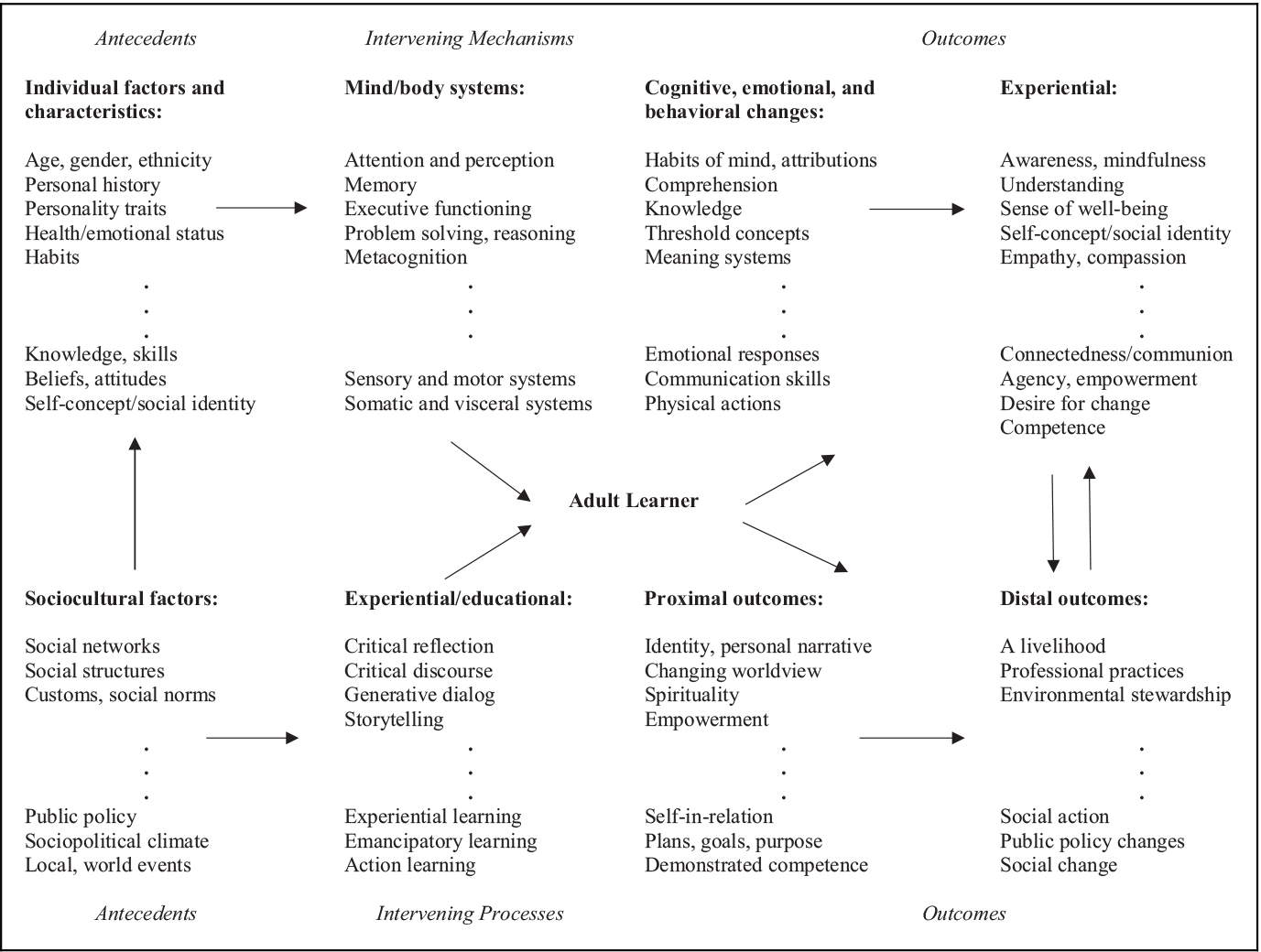
Research framework.
I shared an earlier version of this figure with a colleague who immediately saw “path analysis” in the whole whereas I, as one interested in individual learners’ lived experience of personal transformation, had thought “phenomenology” in focusing on the upper right-hand quadrant. This is indeed a great time to be a methodologist. Quantitative researchers like my colleague have increasingly more sophisticated data management systems and innovative statistical tools: multidimensional scaling, hierarchical clustering, etc. (Rencher & Christensen, 2012). Qualitative researchers, as well, have more—and more confronting—strategies of inquiry: critical ethnography, hermeneutic phenomenology, dramaturgical interviewing, performative writing, etc. (Berg & Lune, 2017). With the exception of King’s studies from 15 to 20 years ago that combined student surveys and interviews (e.g., King, 1999; 2004), largely missing from the research strategies employed in our endeavors are mixed methods. A search of the databases accessible through my university library yielded just three recently-published mixed methods studies of transformative learning (Kum-Yeboah & James, 2014; McCusker, 2013; Wilhelmson et al., 2015).
Researchers in the social and behavioral sciences are increasingly combining quantitative and qualitative approaches in more, as well as more complex, strategies of inquiry (Tashakkori & Teddlie, 2010). As qualitative—as well as quantitative—methods have evolved, researchers have found that by combining these disparate approaches, greater insight can be gained about the inherently complicated human condition and the wicked problems persons and communities often face. 2 Among the many mixed-methods designs is one characterized by an initial phase of qualitative data collection and analysis that yields themes that are then used to inform the development of a quantitative instrument to further explore the research problem; in the final phase of these exploratory sequential designs, the findings from the two strands of data are integrated or linked (Creswell & Plano Clark, 2017). Taken as a whole, our field appears to be engaged in the first phase of such a strategy with ample qualitative findings to inform the creation of quantitative measures of processes and outcomes—a sort of widely- or crowd-sourced exploratory sequential design that is ready to move into phase two.
In This Issue
E. W. Taylor and Cranton (2013) ended their critique of the evolving theory of transformative learning with a call for new paradigms—for example, the critical epistemological perspective (Merriam & Simpson, 2000; Merriam & Kim, 2012)—and methodologies—for example, participatory action research (Merriam & Kim, 2012). As Table 1, which outlines what they are assessing—and with whom and how—shows, the contributors to this issue have devised and are testing diverse approaches to better understand how adult learners are affected by high-impact educational experiences such as service learning, study abroad, or certain types of work-related training. Both qualitative and quantitative approaches to assessment are represented, although as I discuss further below, several contributors concluded that increased use mixed methods designs would further advance theory generation and testing.
Qualitative approaches to assessment
Qualitative studies have enabled educator-scholars and researchers to identify and characterize transformative learning and to better communicate the constraints and affordances of the context in which it occurs. In their review of qualitative approaches to the study of transformative learning, Merriam and Kim (2012) concluded that the following methods in particular could deepen our understanding of the phenomenon: narrative analysis, arts-based inquiry, critical and emancipatory methods, and action research; this issue includes examples of each of these. Through the Learning from Stories of Change framework, den Hayer and colleagues (2021) engaged both staff and graduates of their residential programs in reflection and analysis of responses to the prompt asking about significant changes in the lives of people in the communities served. These “data parties” had the dual effect of refining the preliminary findings and supporting students' learning and internalization of the study results. The study authors further note that, whereas skills and knowledge were easily assessed with a combination of Likert scales and targeted open-ended questions, the attitudes and motivations to support their application—“a key link in the chain between learning, behavioral change and progress towards social justice” (p. 10)—were found in the stories.
Fisher-Yoshida and Lopez's (2021) applied fieldwork research uses a “rigorous narrative analysis process” comprising co-inquiry with youth leaders in focus groups and workshops guided by “the practical theory, Coordinated Management of Meaning [CMM] (Pearce, 2007)” (p. 2, December 11, 2020, manuscript). The CMM serpentine model elicited critical moments or turning points that had shaped the youths’ narratives in a conflict-ridden community, making explicit what they had tacitly experienced and causing them to “question the assumptions they held that restrained them mentally, emotionally, and physically” (p. 10, December 11, 2020, manuscript). Subtler perhaps than the critical moments in the narratives of Fisher’s (2021) youth leaders were each “tug on the sleeve” that one of the authors of the Serle et al. (2021) article urged learners to note and share on their postcards to her. “Why does this moment, this encounter, or this experience matter? What choices of action do you have within this moment? How might your experience and your learning, here and now, influence your future actions?” (p. 11, October 26, 2020, manuscript). Of the prompts for learners to reflect on their learning, the “tug on the sleeve” has struck me as particularly useful for qualitative researchers as it may help us understand the process of change as experienced in the moment and as these moments accumulate to produce a profound shift in perspective or some aspect of self. As a professor, what I also carry away with me after having read this article, is a reminder that our feedback can “bruise” and, importantly, the interesting notion that assessment can be a “celebration, recognition for steps untaken, a calling forth to begin anew. Not a mark. Not a bruise” (p. 21).
A major contribution of the Serle et al. (2021) article is their account of using what they termed luminiferous inquiry to grapple with and move beyond conventional forms of assessment, concluding that, perhaps, assessment is itself—or could be—a transformative practice. Two areas for further exploration by qualitative researchers relate to this possible reframing of assessment. The first, and one that Serle and colleagues suggest, is to focus on the process, rather than the outcomes, of learning using formative assessment: “Formative assessment represents a significant expansion in assessment thinking because it enlarged the purpose of assessment from a precise, unitary measure to processes that are dynamic, emergent and focused on learning progress (Brookhart, 2011)” (p. 5, October 26, 2020, manuscript). They claim, that, indeed, outcomes-based assessment may fail to illuminate transformation. The second area for which an exploratory qualitative approach is suitable is one that Serle and colleagues were piloting in their intertwining narratives and dialogic inquiry and that Tedford and Kitchenham (2021) explicitly call for—namely, to assess the assessor(s). While working with students and reading their journal entries, reviewing their coursework and self-evaluations, and analyzing their post-semester interviews, Tedford kept a research journal that, among other things, afforded an opportunity to critically self-reflect on assumptions brought to the assessment of learners’ experiences. Fisher (2021) and Wiley and colleagues (2021) also note that educator-researchers themselves often experience prospective changes in a collaborative inquiry process in the classroom, with the latter stating that “it is our responsibility, in collaboration with learners, to understand, articulate, and assess the changes that occur in the self (learners' as well as our own)” (p. 3).
I found the Savicki and Price (2021) study difficult to categorize but include it here because the data collected were qualitative; study abroad undergraduates submitted a series of seven reflective essays from pre-departure to when they were back home. Content analysis of the essays, however, was quantitative, using the Linguistic Inquiry and Word Count (LIWC) program. The study authors argue that a “computer-based, quantitative approach to counting words and sorting them into predetermined categories eliminates both the need for training of judges, and the specter of subjective drift by judges” (p. 7, December 11, 2020, manuscript). The longitudinal design of the study and the rigorous, objective approach to analysis enabled them to use repeated measures ANOVA to assess how language indicators of learners’ reflections—Immediacy, Making Sense, Making Distinctions, and Interaction—changed over time. Savicki and Price conclude with suggestions for further research using tools like LIWC to measure abstract constructs such as reflection, stating that a “quantitative measurement option may be a necessary step in evaluating methods to create occasions in which transformation is more likely to occur” (p. 1).
Quantitative approaches to assessment
In their critique of the theoretical grounding of transformative education, E. W. Taylor and Cranton (2013) concluded that, whereas much had been learned about individual learners’ experiences using interpretive methods grounded in constructivism, transformative learning theory was stagnating. In an earlier paper (Cranton & Taylor, 2012), they observed that much of the research to date had been qualitative and that it was time to develop and empirically validate quantitative survey instruments for assessing both the process and outcomes of transformative learning. Two papers published since have reviewed surveys developed to assess transformative learning processes and outcomes. Among the quantitative instruments discussed by Romano (2018), and the one that seems most promising for further theory development, is the Transformative Learning Survey (Stuckey et al., 2013). This validated 112-item measure reflects three dominant conceptions of transformative learning—the cognitive/rational (Mezirow, 1991), the extrarational (e.g., Dirkx, 1998; Tisdell, 2006), and the social critique perspective perspectives (Brookfield, 2012; Freire, 1970)—and affords learners an opportunity to provide feedback about what types of experiences precipitated transformative changes. Romano discusses both the strengths and limitations of this measure and the others he reviews and suggests directions for further research, noting that, at present, there is no consensus in the research community on what perspective transformation means. Melacarne (2019) reviewed some of the same measures, as well as those developed by Romano (2017) and Cox (2017), a contributor to this issue. He observed that the former, as a measure designed for evaluating learners’ progress in higher education settings, introduces to the debate on assessment the idea that “transformative learning and its evaluation is connected to a specific, situation, context and target,” and, further, that “transformation is not so much a property of mind but what happens in a situated context” (p. 197). According to Melacarne, a major contribution of the latter, Cox’s TROPOS, is an integrated approach to assessment grounded both in Mezirow’s conceptualization of transformative learning and in new critical perspectives. Kwon and colleagues (2021), who found TROPOS to be a valid measure of transformative learning in the workplace, observe that an advantage of this survey is that, because it integrates rational, extra-rational, and emancipatory theoretical perspectives, it is broadly applicable and practical.
In this issue, Cox (2021) describes the development and validation of the 30-item TROPOS. Subscales assess transformative outcomes, social support, attitude toward uncertainty, and criticality, which encompasses critical reflection; his pilot and fieldwork found TROPOS to be a reliable and internally valid instrument with a moderate positive correlation between transformative processes and outcomes. The strongest correlation was between criticality, which encompasses critical reflection, and transformative outcomes, but Cox cites evidence in his results that potentially constrains critical reflection as a principal driver of transformative learning and calls for further research to identify additional factors that moderate or mediate profound changes in how learners perceive themselves and others. Invoking Tisdell’s analogy of melodies as composites of harmonies, disharmonies, and cacophonies, he notes that longitudinal studies using non-linear, as well as linear and disconfirmatory, scales might reveal the complex dynamics—the “overlapping waves”—of transformative learning for individual learners. He adds that if, indeed, what learners experience is a complicated, spiraling process, then educator-researchers could turn to structural equation and systems dynamic models.
In their critical review of research on transformative learning theory from 10 to 15 years ago, E. W. Taylor and Snyder (2012) called for the development of a quantitative instrument that synthesizes both the theory and findings from qualitative studies of how people make meaning of transformative experiences. Wiley and colleagues’ (2021) have responded to this call with a depth-based quantitative approach that operationalizes the self-(re)constructive dimensions of transformative learning identified by Hoggan (2016b) with the 17 scales of the Beliefs, Events, and Values Inventory (BEVI) (Shealy, 2016). With an impressively large dataset collected over 10 years from 47 institutions, they demonstrated statistically the construct validity of this mapping. Principal considerations in the development of this approach to assessing transformative learning were that it be useful for formative assessments, scalable to large groups of learners, and applicable across a range of contexts, including mental health and wellbeing. 3
Mixed methods
Wiley and colleagues (2021) conclude that an important direction for further research would be to pilot ways to link qualitative and quantitative methods for a “robust mixed-methods approach to assessing TL in HIPs” (p. 17). Kwon and colleagues’ (2021) rationale for employing mixed-methods strategies contrasts the utility of qualitative and quantitative data. To be specific, quantitative data may provide useful information regarding the general pathways taken by people to engage in TL. However, these data are limited in their ability to provide detailed explanations of what people actually experienced. … If our goal is to effectively and holistically measure such deep learning outcomes as well as the processes that result from them, the use of qualitative methods in conjunction with quantitative methods seems necessary. (pp. 9–10) As does the meditator seeking Zen no-mindedness, the researcher using a no-method approach to inquiry will seek in a non-graspy way a state of clarity and alertness at all stages of the endeavor.…With no-method—or refusing to be stuck within a particular research approach—we can resist the pitfalls and constraints of methodolatry (Pereira, 2007) and possibly achieve a deeper understanding of some aspect of human experience about which we are curious. (Washburn, 2018, pp. 16–17)
Having Taken Stock, Whither Transformative Education?
To continue to support transformative change in adult learners now that we are well into the 21st century, we have asked: What have we aspired to do? What do we think we are doing? To what extent are we speaking past one another? (And is this really a problem?) There are no easy answers to these and other questions about the status of this work, but it does it not seem to be such a stretch to say that we have a general, shared sense of what we are about and for what ends. We have found that certain types of interventions—educational and experiential, formal and less so—appear to foster deep learning that otherwise might not have occurred. Further, to help us better understand the underlying processes involved, we have increasingly more sophisticated methods of inquiry. We have also reached consensus about broad categories of proximal and distal outcomes, situating our efforts at the intersection of the individual and social. And we have at hand, or can see our way to fashion, reliable and valid measures of these desired ends.
That our work is important—even urgent—is indisputable. As I write this, the SARS-CoV-2 (COVID-19) virus is known to have killed over three million people
5
worldwide as health care workers themselves sicken and die trying to save them (Johns Hopkins University & Medicine Coronavirus Research Center, 2021). This crisis, which has upended all of our lives, is undoubtedly made worse by the stressed systems and institutions that were already failing so many. Fifteen years ago, with no deadly pandemic in sight, I considered several scenarios from Garreau’s (2005) Radical Evolution (Washburn, 2006) in musings about thriving in a world with weird frogs and fewer polar bears. Both the Technology Drives History: Hell Scenario where technology virtually dissolves us into a “gray goo” and the Technology Drives History: Heaven Scenario of bionic organs and neural implants were terrifying, so I opted for the Human Beings Shape History: Prevail Scenario envisioned by Jaron Lanier, a world in which we make intelligent and ethical choices in what is an “infinite game…where people are in the center and there’s this ever-expanding game of connecting people that creates a game into the future (p. 197)” The Prevail Scenario, then, will require a search both for “deeper and better ways of bridging the interpersonal gap” (p. 200) and ways to employ human care, wisdom, and creativity, as well as connectiveness, to transform our consciousness and transcend our nature. Our field’s practitioners, researchers, and scholars, with our fellows in other disciplines, have been engaged for some time in this quest. At this point in human history, transformative education is not merely something nice to do, it is an imperative. (Washburn, 2006, pp. 100–101)
In the second edition of Dancing on the Edge: Competence, Culture and Organization in the 21st Century, published in late 2019 as the first COVID-19 cases appeared, futurists O’Hara and Graham observed that the first step for one seeking to become what Carl Rogers termed a “person of tomorrow” is awareness—that is, awareness of the fraught landscape we are in and of the ways we, individually and collectively, tend to respond. The next step is practice, practice that comes with the “rediscovery of agency in the face of a confusing and unknown future” (p. 9). At this perilous time, we are called to see more broadly, to care more deeply, to, as O’Hara and Graham have suggested, to “blow an uncertain trumpet” as we dance on the edge. The charge to transformative education is to continue to lead efforts to foster deep change and growth in adult learners who aspire to be persons of tomorrow.
To be successful, we must continue to develop innovative methods by which to generate new theories and practice concepts—and then to assess them. As Rogers, who with Abraham Maslow strongly influenced Mezirow’s conceptualization of transformative learning (Cranton & Taylor, 2012), said in one of his last speeches “I hope we’re always on the move to a new theory, new ways of being, to new areas of dealing with situations, new ways of being with persons. I hope we’re always a part of the ‘growing edge’” (Rogers et al., 2005, p. 396).
Footnotes
Declaration of Conflicting Interests
The author declared no potential conflicts of interest with respect to the research, authorship, and/or publication of this article.
Funding
The author received no financial support for the research, authorship, and/or publication of this article.