




Abstract
The need of being able to foster transformative learning (TL) has increased due to the demands for continuous development in today’s work life. Previous research has proposed six core elements to foster TL; however, in these a process perspective is missing. By using an adaptive approach and inspired by action research, drawing on teachers’ experiences, the aim of this article is to deepen the understanding of how teachers can create contextual preconditions to foster TL. The empirical data was based on teachers’ narratives, interviews with students, and observations from a university course. This article contributes by proposing a framework for contextual preconditions to foster TL by extending the six core elements with a recursive process and activity. To foster TL, the importance of continuously adapting the preconditions to the needs of each specific educational situation is emphasized.
The accelerating pace of change within organizations places increasing demands on employees to constantly develop and learn, which has contributed to an increased need to foster adult learning. Transformative Learning (TL) based on Mezirow’s (1991) work has been in focus since the 1990s as one of the most widely used theories of adult learning. Several studies have addressed how to foster TL (e.g., Cranton, 2002; Haber-Curran & Tillapaugh, 2015; Meijer et al., 2016; Platzer et al., 2000; Quillinan et al., 2019; Taylor, 2000a, 2000b, 2007, 2009) where some, more or less, have compiled a number of preconditions (Cranton, 2002, 2006; Taylor, 2000b, 2009). Of these, Taylor (2009) has compiled the most elaborated version; the six core elements encompassing individual experience, critical reflection, dialogue, a holistic orientation, an awareness of context, and establishing authentic relationships. However, in this, a process perspective interpreted as development and progression over time on different levels seems to be missing. Regarding a process perspective, Mezirow (1991) describes 10 steps to TL which could be interpreted as a process perspective on an individual level. Some studies highlight the importance of group development processes (Schapiro et al., 2011; Scribner & Donaldson, 2001), but do not combine this with other tools to foster TL. Other studies which adopted a process perspective have not expressed it explicitly or included it as a precondition to foster TL (e.g., Hersted, 2017; Taylor & Jarecke, 2009). Regarding activity, interpreted as the student’s opportunity to engage in the learning process, was also found to be missing. Being active is something which seems important when reading between the lines but is rarely mentioned explicitly.
The aim of this article is to deepen the understanding of how teachers can create contextual preconditions to foster TL. The article contributes by proposing an extension of Taylor’s (2009) six core elements with a process perspective, here called a recursive process, and activity. This proposition is based on conclusions drawn from studying a university course with signs of TL. An action research approach was used (Altrichter et al., 1993; McNiff, 2013) to take advantage of our experience as teachers. An adaptive theory approach (Layder, 1998), the aims of which are to generate new theory, was used in our search for understanding of how we created and could create preconditions to foster TL.
Methodology
The context of the study was a university course called Collective Learning Processes and the Learning Organization, 7.5 credits, given in the penultimate term of a Human Resources Bachelor program. The aim of the course was to learn how to enable collective learning within organizations. As teachers, my colleague and I wanted to foster deep learning and so have developed a course structure for this over the last 15 years. Since we, within this course over time, have identified signs of deep learning, that is, TL, in participants’ reflective writing, we were interested to gain a deeper understanding of what contributed to this.
The course is given over a period of 5 weeks and has been taught by myself and a colleague, with small changes, once a year since 2012. For this study, the data was collected in 2016 when the number of students in the class was 40, aged 21 to 52, with an average age of 27, five men and 35 women. For more information about the course schedule, see the Appendix.
In this study, I was both a researcher and a teacher analyzing my own course, using an action research approach, with the aim of improving action and theory (Altrichter et al., 1993; McNiff, 2013; Norton, 2018). The advantage of this methodology was to use our experience as teacher practitioners as we were familiar with the context, know the needs of the learning situation and are able to take action from the results. The difficulty was to balance proximity and distance (Lindhult, 2008; Svensson, 2008), power (Grant et al., 2008) and ethical issues (Swedish Research Council, 2017).
As teachers we had different preunderstandings and experiences when the data was collected. We were both researchers and well versed in pedagogical theories with 20 years of experience as teachers in higher education whereof 10 years in this specific course. A third researcher had only a little prior knowledge in the subject. However, none of us had knowledge of Taylor’s core elements at that time (Taylor, 2009).
In action research, there is a power aspect where the researcher/teacher has a position of power in relation to the student. The researcher must deal with this dilemma through transparency about the research process, reflexivity, encouraging participation and learning for all involved—including the researcher, acting respectfully, showing humility and being aware of the power imbalance (Grant et al., 2008). To enhance trustworthiness of qualitative action research studies, triangulation, disciplined subjectivity (reflexivity), thick description, member checking, peer review and making data auditing possible, are the most common methods (Efron & Ravid, 2020).
To handle the challenges with researching our own practice, several actions were taken. When starting the study, there were three researchers: a colleague and I who were also teachers on the studied course and one external researcher at the same university, previously unknown to us and the students. First, to handle power issues, the external researcher was appointed in the role of critical researcher to help create distance to the material. The external researcher was also assigned the task of classroom observations and conducting interviews to obtain an independent and different perspective (Altrichter et al., 1993). The external researcher tried to create an open atmosphere during the interviews as a way to reduce the risk of social desirability, that is, that the students responded based on what they thought was expected (Grant et al., 2008). Second, as teachers we wrote a narrative of how we tried to create preconditions to foster TL in the course (McNiff, 2013). This was done to distance ourselves from our own approach and actions, and to verbalize our knowledge (Altrichter et al., 1993; McNiff, 2013). Third, an adaptive approach was used where the teachers’ own experiences are analyzed inductively combined with a deductive analysis based on theory to create distance and a critical approach (Layder, 1998). Fourth, to maintain a critical approach and distance to the material we reflected on and discussed the results together and with other colleagues throughout the entire study, culminating in the current article (Alvesson & Sköldberg, 2017; Grant et al., 2008). Fifth, quotes from the data are presented in the Results section, that is, thick description, to enable the reader to make assessments of the credibility of the analysis (Efron & Ravid, 2020). Sixth, in the results it is clearly described who says what, to create distance between myself as the author and the material. Seventh, data was gathered from three sources to make triangulation possible and strengthen the validity of the empirical data (Altrichter et al., 1993; Grant et al., 2008).
Ethical issues were important in this study, since we acted as both researchers and teachers, and observations were conducted on a course with mandatory attendance (McNiff, 2013; Swedish Research Council, 2017). These dilemmas were somewhat reduced by the focus being on the teachers’ activities and the students as a group rather than individuals. However, power issues remain. Therefore, the requirements from the Swedish Research Council (2002, 2017) about information, consent, confidentiality, and data use were carefully followed. Thorough information about the research project, observations, interviews, confidentiality, and data use were given to the participants at the start of the course. Regarding consent, we emphasized that participation was voluntary and so refrained from observations where consent was not given. Before starting the observations and interviews the participants were asked to sign a consent form (McNiff, 2013; Swedish Research Council, 2017). Overall, the importance of openness and respect for the student’s autonomy was prioritized.
Data Sources and Collection
The three data sources were interviews with students, observations, and the teachers’ narratives.
Interviews with the students were made to elicit their views on what contributed to their learning in the course. The interviews were carried out some weeks after the course. Seven students were selected randomly (every fifth in the list of participants), five of these accepted to be interviewed, four women and one man, aged 21, 28, 30, 31, and 32; two declined. The number of interviews was considered sufficient since they would be combined with observations and teachers’ narratives. The interviews were conducted by the external researcher lasting approximately one hour each. A semi-structured interview guide was used to allow students to elaborate on their thoughts on the course in general, activities in the course and how these affected their learning (Norton, 2018). Specific questions were created to focus on whether the students experienced TL in terms of the levels of reflection formulated by Kember et al. (2000) and which activities they thought contributed to this. The interviews were recorded, transcribed totaling 51 pages, and checked by the interviewees.
The intention with the teachers’ narratives was to reveal the teachers’ views of how we consciously tried to create preconditions to foster TL. This was inspired by Altrichter et al. (1993) and McNiff (2013) to verbalize tacit knowledge and create a reflection on action; to also enable disciplined subjectivity and reflexivity to distance ourselves from our own values, experiences, and critically reflect from a metalevel (Alvesson & Sköldberg, 2017; Efron & Ravid, 2020). Individually we wrote how we tried to foster TL in the course, before combining our two narratives via thematizing the material into one four-page text.
Observations were made to obtain a critical outsider researcher perspective of the course structure and its effects. The observations were carried out by the external researcher throughout the 5 weeks of the course, once or twice a week, altogether six of nine course days, covering 18.5 hours out of a total of 39 scheduled hours. The observation was abductive and semi-systematic (Cohen et al., 2018), focusing on how the teachers created preconditions to foster TL by looking at what the teachers did, the students’ reactions, and signs of reflection to identify activities which may have contributed to the fostering of TL. The observations were registered continuously, and quotes were noted, in total six texts amounting to 33 pages. After the course, the observer also created an overall summary.
Data Analysis
The analysis had a cyclic nature during the whole study, a “zig-zagging back and forth between theoretical ideas, data collection and analysis” (Layder, 1998, p. 77). The process started from an inductive, insider perspective where we tried to raise our awareness of what we were doing by writing down our experiences, that is, the teachers’ narratives. Then a search was undertaken for theories concerning how to foster TL, and this is where Taylor’s six core elements (2009) emerged as a relevant theoretical analysis tool. Taylor has been a key figure concerning TL and has critically engaged and synthesized research on TL. His compilation of core elements for fostering TL was one of the few and most elaborate found.
To organize data for the analysis, NVivo software was used. The first step was to read and reread the data to obtain a clear understanding of the material. The second step was to analyze the data deductively using a theoretical perspective, in this case Taylor’s six core elements (Taylor, 2009), which gave us as teachers a new framework for understanding our experience. However, the empirical material also revealed parts which were not perceived using Taylor’s concepts. Thus, in the third step, the data was analyzed inductively and here the process perspective and activity were discovered. The fourth step was to undertake a search for theories about process and activity, that is, to search for an expanded theoretical basis. During this zig-zagging between theory and empirical data (Layder, 1998), the elements recursive process and activity emerged. From this research, a theoretical framework for creating preconditions to foster TL consisting of Taylor’s six core elements (Taylor, 2009) extended with the recursive process and activity could be proposed. In the next section, this framework will be described theoretically.
Preconditions to Foster TL: Extending the Six Core Elements with a Recursive Process and Activity
Transformative learning is a theory of adult learning focusing on becoming aware of, assessing and reinterpreting the habits of minds and points of view which have been taken for granted, in order to gain a more complete understanding and a higher degree of control over our lives (Mezirow, 1991). Based on our research, this section describes and develops a theoretical framework for how teachers can create contextual preconditions to foster TL. This means how a teacher plans, organizes, conducts, and adapts a course, and how students are encompassed by and able to use these preconditions to facilitate their own learning. Below is a description of Taylor’s (2009) six core elements: individual experience, critical reflection, dialogue, a holistic orientation, an awareness of context and establishing authentic relationships. The final theoretical framework will encompass these six core elements as well as a process perspective, here termed recursive process and activity which will also be described below.
Individual experience emphasizes the creation of opportunities for the student to link the course content to former experiences and normative assumptions, and/or to experiences created by the teacher in the classroom (Taylor, 2009). These experiences should be direct, active, personally engaging and stimulate reflection upon experience (Taylor, 2007).
Critical reflection is about questioning deeply held assumptions (Mezirow, 1991; Taylor, 2009), and could be fostered by creating opportunities for free writing (Burk, 2006; Kreber, 2012), dialogue (Kasworm & Bowles, 2012; Kreber, 2012), self-reflection (Cranton, 2002; Kasworm & Bowles, 2012), and to confront the student with unexpected, unfamiliar, surprising or disturbing events, role play, creative/expressive activities such as collages, drawings or sculpture (Kreber, 2012).
Dialogue provides the possibility to engage in true dialogue with others, involving attitudes, feelings, personalities, trust, and handling the discomfort from being on the edge of knowing (Taylor, 2009). Mezirow stresses the optimal conditions to fully and freely participate in a rational discourse; to have, for example, accurate and complete information, freedom from coercion, and openness to alternative points of view (Mezirow, 1991, 2009).
A holistic orientation includes the whole person in the course, providing other ways of knowing as affective and relational approaches of teaching (Formenti & Jorio, 2019; Taylor & Jarecke, 2009), for example by using varied media such as romantic fiction, novels, writings (Taylor, 2007), arts, literature, film, and drama (Kasworm & Bowles, 2012).
An awareness of context stresses how teachers inquire into and adapt to specific personal and sociocultural factors. An example of personal factors influencing learning is students’ different predispositions to change. Examples of sociocultural factors include different rules and sanctions in society, different cultures, and temporal constraints such as short class periods and resultant lack of time (Taylor, 2009).
Establishing authentic relationships creates a climate which allows students to “have questioning discussions, share information openly, and achieve greater mutual and consensual understanding” (Taylor, 2009, p. 13). Beyond this, the teacher also needs to give support (Taylor, 2007).
According to Taylor (2009), the six core elements should be seen as interdependent and in the context of the theoretical orientation of TL. However, our research indicates that this needs to be extended by integrating the six core elements with a process perspective and especially a recursive process which emphasizes both development over time and how the elements can be woven together in the process.
The recursive process contributes first and foremost by adding to and developing the process perspective, emphasizing group processes, progression, and the teacher as a process leader. Previous research stressed that the process concept is often used but rarely defined (Engeström & Sannino, 2012; Vayda et al., 1991). Therefore, in this article process is defined as “…a sequence of events that describes how things change over time” (van de Ven, 1992, p. 22). Processes can be studied on micro, meso, and macro levels (Stoyanova, 2015), here interpreted as individual, group and organizational level. A central focus of development process models is on progression (van de Ven, 1992). Mezirow (1991) describes 10 steps for TL which could be interpreted as a process perspective on an individual level containing progression, since it focuses on the individual’s learning process; starting with a disorienting dilemma and then self-reflection, recognition of shared experiences, exploration of new roles, planning-, learning- and trying new roles and reintegrating into life. However, previous research also highlights the importance of group development to foster TL (Platzer et al., 2000; Scribner & Donaldson, 2001). In this article, a meso level is added to stress the importance of creating contextual preconditions to foster processes and progression on both individual and group level as a way of promoting TL. This also adds the need to see the teacher as a process leader who constantly adapts activities to the process (Schein, 1999), in this case adapting the contextual preconditions based on the process.
The use of the term recursive process is influenced by systemic (Senge, 2006) and complexity theory (Guanglu, 2012), emphasizing the nature of the learning process as a non-linear, cyclic, and emergent process (Guanglu, 2012; Jess et al., 2016). Recursive means repeatedly (Oxford English Dictionary, n.d.), which here means to repeatedly return to the same issue (Taylor, 2000a), but with different perspectives and via different experiences. Everything which happens in the course could be used as input to foster learning. Recursion is here mainly about the elements experience and reflection, which will be exemplified in the following.
Recursive experience: This article contributes by emphasizing what we call a recursive experience, meaning to use dynamics which occur in the classroom as experiences and input for reflection. The student not only reads about a subject, but the teacher also creates experiences about the subject in the classroom. Further the teacher allows students to practice, the teacher models the content, commenting on it, that is, the teacher could use everything which happens in the classroom as experiences to promote TL. In previous research, this is similar to case-in-point pedagogy which concerns the use of the dynamics occurring in the classroom, (Haber-Curran & Tillapaugh, 2015) and modelling which means to “walk the talk” (implicit modelling), to meta comment what and how the teacher is doing (explicit modelling) and thereby facilitate the translation to the student’s own practices (Lunenberg et al., 2007).
Recursive reflection: Previous research has stressed the importance of reflection (Mezirow, 1991; Taylor, 2009), but this article wishes to highlight the process and progress aspect of reflection. It also contributes by stressing recursive reflection as a recurrent, systematic reflection from different perspectives, and on different levels, that is, meta-reflection, from different philosophical theories and valuation issues.
Beyond adding the recursive process, activity is added as a precondition. In the six core elements, activity is not mentioned explicitly but could be interpreted as implicit. However, drawing on the tradition of learning by doing from Dewey (1997) and Kolb’s experiential learning (Kolb, 1984), activity and experiencing is emphasized as important for learning. Therefore, in this article, activity is stressed as a precondition to emphasize the importance of the student’s own activity to foster TL, for example, via exercises, reflection, and dialogue within the groups.
Findings: Contextual Preconditions in a Course to Foster TL
This section will elaborate on the empirical basis for the theoretical claims outlined above. The empirical basis presented is data from the teachers’ narratives, observer notes and student interviews. The data is organized based on the eight contextual preconditions which emerged from the adaptive analyses process and were elaborated in the theoretical framework: individual experience, critical reflection, dialogue, a holistic orientation, an awareness of context and establishing authentic relationships (Taylor, 2009), a recursive process and activity. All quotes from the students and the observer are translated from the original Swedish by the author. Initially, some general information about the course is presented.
General Information About the Course
The overall schedule for the course, with literature, examination and themes for every course day is described in the Appendix. The lessons were obligatory since collective learning took place first and foremost there. Non-attendance required a written supplementary task regarding the lesson themes. Examination consisted of three written reflection protocols submitted throughout the course, and a summary report (termed “Credo”) at the end of the course. The students were divided into cooperative base groups (hereafter termed “group”), where almost all tasks and learning took place. These were randomly created groups, maintained throughout the course.
Individual Experience
The teachers emphasized linking theory to the students’ own experiences, both past and created during the course days, to make the course content relevant to the students. Regarding former experiences, the students had both during dialogues in the classroom and in their home assignments the task to link the theories to their own experiences. According to the interviewees this approach helped them towards a deeper learning and understanding of the theories.
Regarding experiences during the course days, the teachers used different kinds of exercises to create experiences to highlight core issues in the course, for example, to practice dialogue skills and reflection, create a workshop, but also games and competitions. The exercises were supposed to contribute to TL by creating dilemmas which could raise awareness of, and highlight different aspects of, the theories. The interviewees described that doing some of the exercises made them aware of unconscious mental models and behavior linked to these. The observer concluded that not all exercises lead to this but identified the exercises about meeting techniques and the final workshops as promoting TL. Regarding the final workshops all interviewees described them as important occasions for their learning. During the exercises, the groups planned and implemented a learning opportunity for their classmates which was based on what they had learned about how to promote collective learning. Yes, being in a realistic position where the focus is on doing. There is a great difference between doing and reading about how to do. I think that’s what you need during your education. No matter who you are, you need somewhere to react and have a responsibility for that. (Ann)
However, as mentioned, not all exercises provided the desired insights for all students. One interviewee (Mary) thought that some exercises felt silly and contrived. Nevertheless, the overall consensus was that the exercises played an important role.
Critical Reflection
In the course, the teachers used Kember et al.’s (2000; 2008) definition of reflection, based on Mezirow (1991). This includes two levels of non-reflection, habitual action and understanding, and two levels of reflection, reflection and critical reflection, where the latter two involve a critique of assumptions. The interviewees considered they reached Kember’s third level, reflection, and two of them even the fourth level of critical reflection. In their opinion, this was promoted by writing reflection protocols and reflections during the course days. For the teachers, reflection played a central role in the course with students continuously writing individual reflection protocols to link the theories to their own experiences, questioning their understanding, their behavior, and their assumptions. According to the interviewees this writing forced them to reflect, which they thought was difficult but useful. Reflection was done throughout the course days, in group dialogues and in whole class supported by the teachers. If I had to pick out one thing from everything that they stressed which in some way permeated the whole course, it is reflection, asking questions and reflecting. After all, we did that every day. We ended a day with, what have we done today? And we started the next day with, what did we do last? (Carol)
At the end of the first observation, the observer questioned what the teachers meant by reflection and asked for a more critical approach, that is, criticizing the literature. There is an absence of critical reflection. Isn’t questioning a form of reflection? (Observer)
Some of the interviewees felt there was too much reflection, they became tired and especially on the last day of the course they thought it became too much. … the [course] is very intense and you get very tired during such a day … then it can be nice to not have to sit and reflect when you have done it a hundred times earlier … or … maybe it would be nice to just do that you usually do [regular lecture] … not to say, not to think … but … yes. (Miriam)
Dialogue
The teachers wanted to promote dialogue so the students could learn from each other, share each other’s experiences, and see things from new perspectives, thus dialogue skills were taught and practiced. The observer confirmed that the students interacted a lot in their groups, that they seemed very active and committed and emphasized the dialogue between teachers and students. It arose as a culture when we all thought or tried to reflect together. It became collective learning in itself. When you come up with things because of what others say. (Tom)
Holistic
The interviewees highlighted that many senses were involved. According to the teachers, this was a conscious choice, using different media such as painting, mind maps, writing, exercises/activity, listening, talking, and case studies. It is as if there are several senses which become involved. And it becomes more real. So you get a lot more out of it. (Carol)
Beyond creating experiences as previously mentioned, the exercises were according to the teachers also supposed to create experiences and feelings, to allow students to recognize and come close to themselves, to increase their motivation to learn. Especially at one workshop, it became extra sensitive, something several interviewees commented on. I thought it was the one which gave the most. And I think that has to do with how the reactions were and that it also aroused feelings in me too. When you think back, you also remember as well. (Miriam)
The teachers express a warning about the use of exercises, since you as a teacher need to be aware of and prepared for difficult emotions which may come up, and you need to have a preparedness to deal with this, for example, by addressing what is happening and talking about it.
Context
Contextual factors are interpreted as the students’ different former experiences and backgrounds, the class, adapting to the situation, classroom layout, time, and expectations. Regarding former experiences, most of the interviewees expressed that they gained new knowledge about collective learning, but one had a background as a teacher and therefore the content of the course was not new to her (Mary). For another interviewee, the education and the course came at a time in life when a change was welcome (Ann).
Further, the students were a class in the third year of a Human Resources program. Thus, the joint context of human resource issues and interest in the subject may have fostered the cooperation (Ann). The observer noted that many exercises were targeted with direct relevance to the profession, a probable asset from an educational perspective, as expectations become more harmonized (Observer).
The teachers emphasized the importance of the physical context. In this case, the classroom was furnished without a teacher’s desk, with table islands for each group, where participants sat around a table to promote dialogue. The islands were placed in a semicircle for teachers and participants to see each other and the whiteboard, and the teachers could move freely in the semicircle. One of the interviewees mentioned that the classroom layout affected participation positively. Also how [teacher A and B] communicated with us. It was an eye opener, which you did not think of before, the more you remove the barrier between teachers and students the climate changes. When they are among the students, it becomes much more open. I noticed that I dared to talk more and participate more when the teacher was closer and not so far away. (Miriam)
Another aspect was time. Several interviewees pointed out that reflection and writing reflection protocols took time, but also that there was time during the course for reflection (Carol). At the same time, one interviewee pointed out that a five week-course was too short a time to change your behavior (Tom).
Relationships
All of the interviewees emphasized in different ways that they became close to each other in the groups, that the course structure based on groups had increased the coherence in the class and that the course climate had influenced their learning. The observer mentioned several times a surprise that the students seemed to be very committed and have great confidence in the teachers. A major focus for the teachers was to create a safe climate and therefore the relationships between the students, and between the students and teachers became important. The teachers highlighted that they based this work on three principles: working with the groups, climate, and information and clarity.
The course structure based on groups was according to the teachers a conscious way to provide safety and participation. I think that good dynamics create learning and that you interact with people that you might not otherwise have done. You dare to talk to different people and discuss and reflect. This is when you might learn to see things from a slightly different perspective. That’s what I think is so good about this. (Mary)
The teachers stressed the importance of classroom climate and accentuating their role as teachers; to respond to the students in a humble and respectful way, and to create a positive atmosphere. Carol expressed that she felt respectfully treated by the teachers. Tom emphasized that an atmosphere was created in the class which affected and promoted learning: It created opportunities for different people to reflect on hard issues. (Tom)
In terms of information and clarity, Carol pointed at the importance of having a study guide. Tom agreed with the observer that everything was well planned. The observer also notes dilemmas with this. Everything was extremely well thought out. Location, rotation, flow, feedback, etc. I was both impressed and envious. But if one is to reflect critically now. Are there any problems with that? Is there anything predictable in such a thorough organization? (Observer)
The teachers described that it is important that the course and course days are well planned, that the information is clear and that the students receive information continuously about the course structure and what will happen. At the same time, the teachers stressed the importance of adapting the course structure to the specific situation, the structure acting as a framework to be flexible within, see further in the next section.
Recursive process:
The teachers saw themselves as process leaders, handling and adapting to several processes during the course. One process was the group development process, and the teachers worked actively from day one and throughout the course to promote group development. The interviewees testify that they had been supported by their group members in their learning and that they were very satisfied with their groups. It became so cohesive with the groups, this way of working … it’s not like a regular group work. […] We were, like, very welded together. (Mary)
Another process according to the teachers was to create a safe climate, which was needed for example to be able to do the workshops and reflect on them together. Therefore, the difficulty and complexity of the activities were gradually increased. We started from the beginning with this as it was important. Had we not had that approach (meeting technique and workshops) from the beginning it would have been more difficult with the exercises. (Ann)
Progress in the course was in different ways, for example, exercises which built on each other, and literature including different perspectives triggering the students to question what the differences were due to. The observer described a critical meta-reflection that he perceived as an eyeopener for several students, when the conversation went from discussing the content of the literature to the difficulty of reflecting and why this was more difficult from one book to another.
The teachers stressed the importance of acting as process leaders, seeing their schedule as a base but constantly prepared to adapt to what happened during the course days, to follow the processes. The conversation mentioned above was an example of “waiting for the process,” that is, letting the student discover the differences themselves. The teachers continuously tried to capture what/how the students understood the content through listening to the students’ reflections. Since they told us at the end of a day, I know they had to change the ppt slides, that they also had to adapt. When I did the workshop myself, I had to adapt the program a little bit and so I saw that it is ok to do so, that it works. As for the teachers, it is possible to change a little and adapt the arrangement. (Mary).
Recursive Experiences:
The interviewees emphasized the idea “the course is the course” as interesting and helping them to understand. The teachers explained that both the course content and the structure were about collective learning, creating and giving the students experiences of collective learning. Thus, all activities focused on promotion of collective leaning processes, and by this the content became closer to the students, and the students could easily make the content their own. The meeting techniques, something that most people use, were also presented using those meeting techniques i.e., “the course was the course”. I thought that was also very interesting. Like those who had a mind map, that they had done it as a mind map and explained it as well. (Miriam)
The teachers emphasized practicing what you preach. Since the course was the course, their own actions were important; they had to act to promote learning throughout the course. They not only did this to teach us, but they also showed how the differences could happen in practice. That what they did had a purpose. How they acted. I thought it was easier, for example, when I was going to write these assignments. I could more easily connect to, [..] easier to do it in practice. (Miriam)
Further, the teachers emphasized learning dialogue and reflection by practicing it, and therefore they gave theory-based instructions, the possibility to practice and obtain feedback. The observer highlighted especially one occasion where a dialogue took place in the whole class, involving both students and teachers about the art of reflection and that it was difficult. While the students made interesting reflections that it was “difficult”, Teacher A and Teacher B made many contributions to develop the discussion. (Observer)
Recursive Reflection:
The teachers described that activities and exercises were followed up with recurrent focused reflections from different perspectives. First, content issues, that is, what was talked about during and/or after an exercise; what happened, how it was experienced, why. Second, how can you understand this from a specific theory or several different theories, and what you could have done differently according to each theory. Third, why we did this in the course, how it promoted collective learning—a meta-reflection. The reflections were recurrent, during the whole course, linked to each other in a progression.
Activity
According to the interviewees, the largest difference between this course and others was its active participation. The main difference is that there is so much more active participation. Almost all the parts are active parts—exercises, reflections, group work, hardly ever normal lectures. (Tom)
The teachers’ ambitions were to have variation in the course structure, through a mix of short lectures, exercises, group dialogues and whole class dialogues. The observer described a change in activity almost every 20 minutes. A general conclusion is that the activities increased the students’ learning.
Discussion
The overall aim of this article was to deepen the understanding of how teachers can create contextual preconditions to foster TL. As a result, this article contributes by proposing a theoretical framework extending Taylor’s (2009) six core elements to include the essential elements recursive process and activity. However, perhaps most important is the effect of adding a process perspective to the teacher’s role; becoming a process-leader, continuously adapting the preconditions to the needs of each specific situation, to lead the students to their learning edge.
Starting with the six core elements (Taylor, 2009), the results show examples of how they are practiced in the course, in line with previous research (e.g., Burk, 2006; Formenti & Jorio, 2019; Kasworm & Bowles, 2012; Kreber, 2012; Taylor, 2007, 2009; Taylor & Jarecke, 2009). However, the analysis proposes that these elements are not enough to capture the complexity of fostering TL. According to the analysis, the teachers emphasized the need to activate the students, and the students confirmed that doing helped them to learn (cf. Dewey, 1997; Kolb, 1984), that is, what Mezirow (1991) terms testing new roles. The analysis also highlights a process perspective where the teachers enable group development processes to promote a safe learning climate (cf. Platzer et al., 2000; Scribner & Donaldson, 2001), which the students experienced. On an individual level, the results could be interpreted as representing the process of 10 steps for TL (Mezirow, 1991) where experiences in the course worked as disorienting dilemmas, followed by critical reflection, and trying out new roles. The teachers also acted as process-leaders (cf. Schein, 1999), adapting to the situation, for example, by following the process and capturing the moment of reflection when the students identified a dilemma. Further, the analysis exemplifies how the teachers drove progression (cf. van de Ven, 1992), by increasing the difficulties of exercises, which the students experienced as a prerequisite for their learning. Regarding the recursive nature of the process, the results show that the recursive experience, “the course is the course,” contributed to the students’ learning through the benefit of both hearing, experiencing, and doing. Experiencing (Haber-Curran & Tillapaugh, 2015) and modelling (Lunenberg et al., 2007) are proposed to help a student make the theories their own and thus bridging the theory—practice gap. Finally, the analysis emphasizes recursive reflection, a systematic reflection, from different perspectives and levels, exemplified by the observer’s notes about meta-reflection. Recursive reflection could contribute to achieve critical reflection, which in turn is a basic prerequisite for TL (Kember et al., 2000; Mezirow, 1991).
The proposed preconditions to foster learning should not be seen as separate preconditions, but as interwoven. Below, four visualizations will describe how the proposed preconditions relate to each other. Starting with the process, Figure 1 visualizes the process perspective; to see the fostering of learning as a process with progression regarding content, assignments, and group development. A Process with Progression.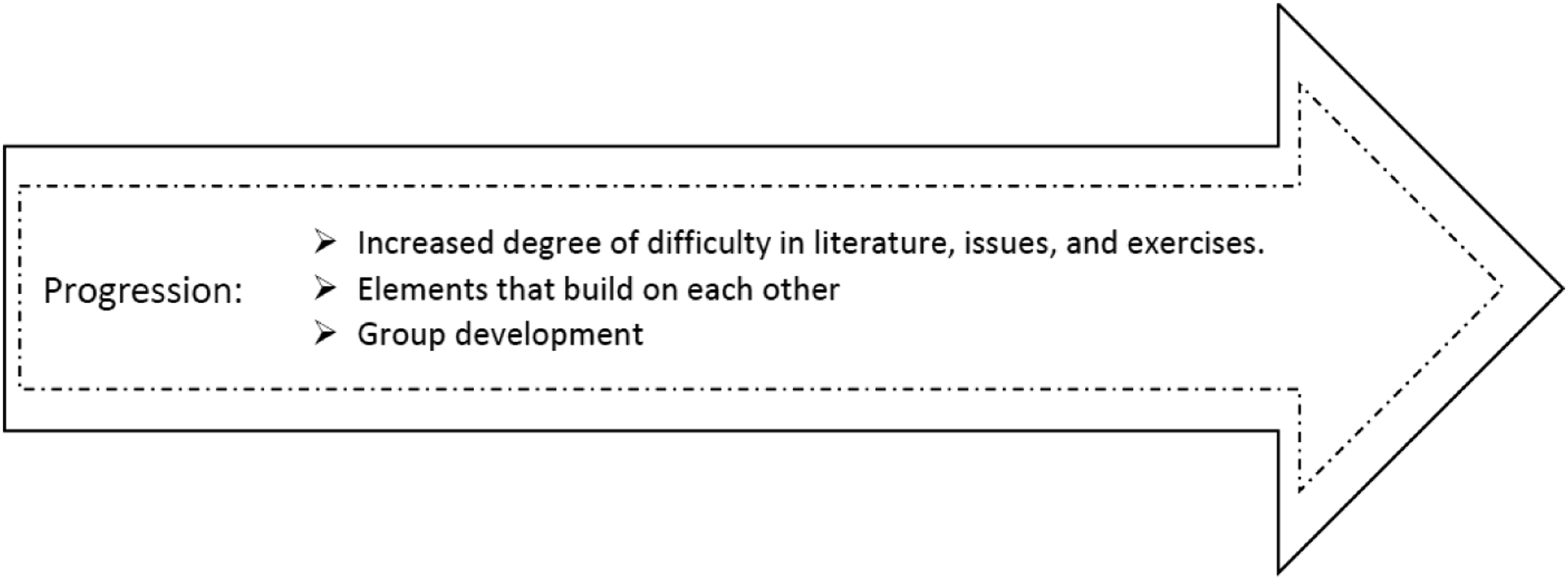
Figure 2 visualizes the classroom where the teacher uses the six elements and activity as a basis when structuring the course. Some preconditions occur between students and teachers and some within, but some are also affected by other preconditions. Six Core Elements and Activity.
Figure 3 visualizes the recursive nature of the process. The inner arrows visualize systematic reflection from different perspectives and the creation of different experiences. The outer arrows visualize the recursive experience and recursive reflection. The teacher uses and adapts recursion and the other core elements to the specific situation, to initiate disorienting dilemmas and foster critical reflection. The Recursive Nature of the Process.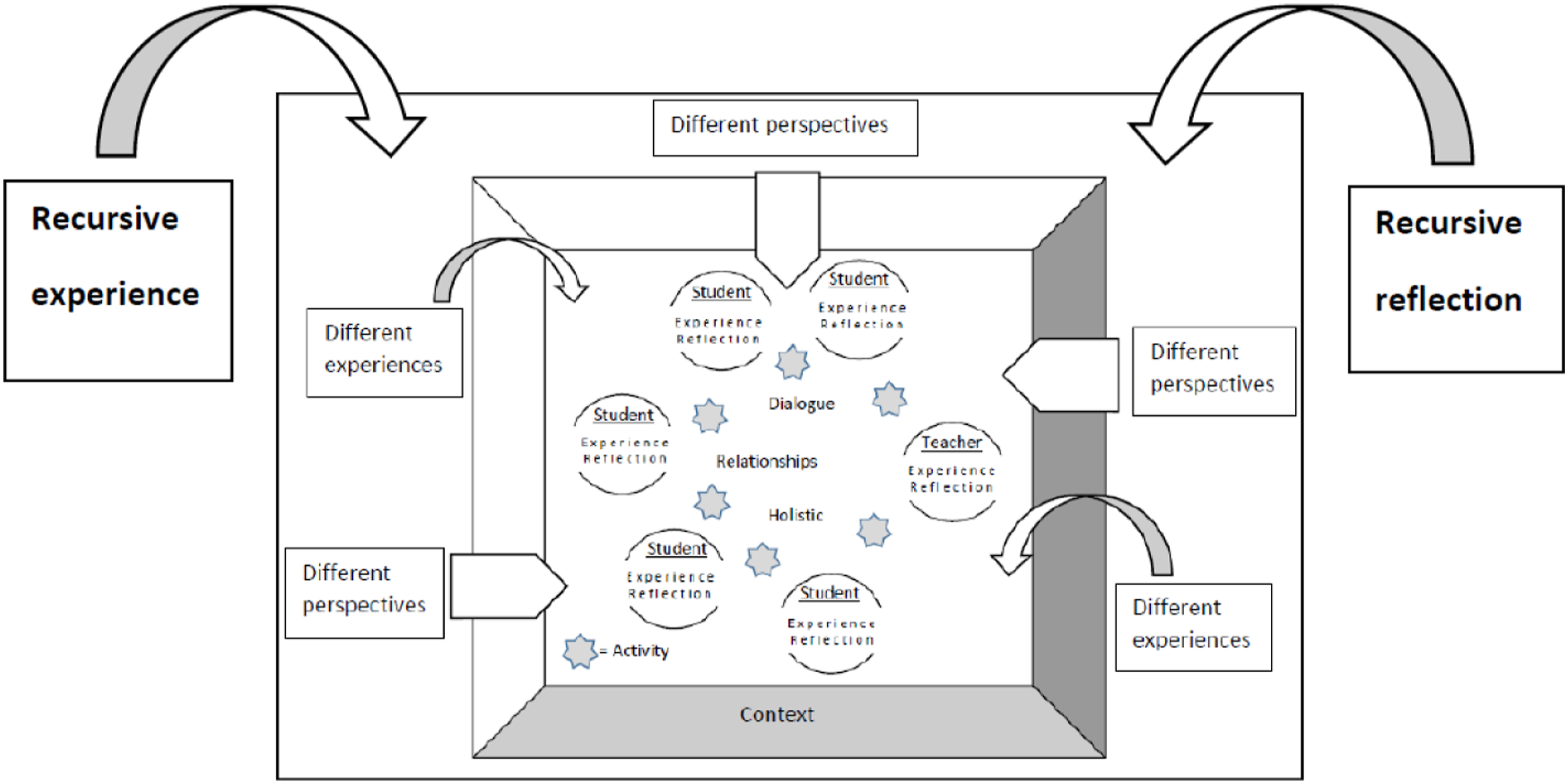
Finally, Figure 4 visualizes the recursive process as a whole, where Figures 2 and 3 are included in the larger process Figure 1, woven together in a stepwise progression through the course, where all the preconditions are needed, interacting and building on each other and therefore also affecting each other. Figure 4 also emphasizes how teachers act as process leaders, constantly adapting to the present situation by changing the preconditions to maximize learning possibilities. The Recursive Process.
This article has focused on how teachers can create preconditions to foster TL, and a limitation is not to have evaluated the extent to which TL has been achieved, and the extent to which the various preconditions contribute to this. Therefore, further research is needed here. Overall, it is important to be aware that TL is relatively uncommon (Dirkx, 1998); this article identified some factors which may limit the possibilities to attain TL such as time, the course is intense completed in just 5 weeks, and the students’ different past experiences. However, although TL is unusual, the result of this article indicates that teachers through their actions can create preconditions which make TL possible, and therefore should do their best to enable this.
Action research was a suitable method in this article. By using the teachers’ experiences, the process and activity elements were identified. The disadvantage of the method is handling proximity and distance, which was dealt with in several ways. Since this is a small study, the results are not generalizable; however, the results are assumed to be transferable to similar situations. Though, further research is needed to confirm the results.
Practical Implications
Teachers can create preconditions in a course to foster TL, and the preconditions proposed in this article add a recursive process and activity to Taylor’s six core elements (Taylor, 2009), that is, individual experience, critical reflection, dialogue, a holistic orientation, awareness of context and establishing authentic relationships. The process perspective emphasizes the teacher as a process leader, who constantly adapts the preconditions to the specific situation. The teacher can create experiences, model the content, and use what happens in the course as a learning input for students to reflect on from different perspectives; thereby, helping the students to link the theories to themselves.
Footnotes
Acknowledgments
I want to thank Bengt Pontén, my co-teacher and “co-thinker”—this article is also your article. Anders Avdic for acting as the third researcher—thanks for work performed, interesting input and dialogues. The students for contributing their experiences. Finally, to my supervisors for support in writing; Tina Forsberg, Susanna Toivanen and Ing-Marie Andersson.
Declaration of Conflicting Interests
The author(s) declared no potential conflicts of interest with respect to the research, authorship, and/or publication of this article.
Funding
The author(s) received no financial support for the research, authorship, and/or publication of this article.

Appendix
The different themes of the course days, literature, and examinations.
Week
Week 1
Week 2
Week 3
Week 4
Week 5
Day
Day 1, 9 am-3 pm
Day 2, 9 am-3 pm
Day 3, 9 am-3 pm
Day 4, 9 am-3 pm
Day 5, 9 am-3 pm
Day 6, 9 am-3 pm
Day 7, 9 am-3 pm
Day 8, 9 am-3 pm
Day 9, 9 am-3 pm
Content/ theme of the day
Repetition, Introduction of the concepts: learning, development, and change
The learning organization based on Senge
Different perspectives of learning organization based on Filstad
How to create a learning organization in practice
Meeting techniques, leadership for learning
Large group interventions
Work-shops
Work-shops
Speech day: Presenting the Credo Learning evaluation
Literature
Senge, P (2006) The Fifth Discipline
Filstad, C (2012) Organisationslärande (Organizational learning)
Engström, A (2014) Lärande samspel för effelctivitet (Thesis; Learning interaction for efficiency)
Five research papers Texts on Meetings
Examination
Reflection protocol 1
Reflection protocol 2
Reflection protocol 3, submitted by the end of week 4
Credo