



Abstract
This essay introduces a juxtaposition of adult education, futures perspectives, transformative learning theory, and democratic engagement. Within adult education, the promise of education, and the possibilities of transformative learning (TL) are often linked to democracy and human freedoms, yet that democratic promise is often left unfulfilled or incomplete. At the same time, futures perspectives coalesce around the strengthening of capacity for adults to change their conceptualizations of and relationships to the future and facilitate skills in navigating discontinuity, complexity, and ambiguity. The inclusion of futures work potentially shifts the TL discourse and may change the ways that we study and support how adults learn, change, and grow through shared human experiences. Futures literacy may become a new dimension for democracies.
The historical treatment of the relationship between education and democracy is complicated. Having an educated populace has long been touted as important to democracy. While implicitly connecting democracy with the future, the relationship among democracy, education, and social transformation as it relates to an educated populace is not always clear (Demirbolat, 2012; Zelenicky et al., 2010) and not always promising for all. Despite the challenges of connecting educational attainment as a social good and democratic justice for all, there is still an underlying belief that education is important for individuals to shape their futures through informed civic participation in the democratic process, guided by reason, logic, and the spirit of compromise.
Dewey’s treatment of democracy in his early writings (Dewey, 1899, 1916, 1927) emphasized the importance of key democratic principles for associated living (Waks & English, 2017). From political philosophy (Rawls, 1971) and social discourse (Habermas, 1981) perspectives, Dewey’s early ideas about democracy reflect the idea that decisions and policies in a democratic society should occur as a result of citizen participation and reasoned debate. Beyond a form of government, deliberative democracy impels all citizens to enact democratic processes through rational discourse of competing perspectives (Rawls, 1971), “put(ting) reason to use” (Habermas, 1962, p. 35) to arrive at the most fair and just decisions that uphold the democratic values of informed and equal participation in self-governance in support of the pursuit of happiness and self-fulfillment. This perspective of deliberative democracy as reflected in Dewey’s early writings emphasizes protecting the rights of individuals to pursue economic and social success as measures of accomplishment and contribution to society by participating in the democratic process.
In his early writings about democracy (Dewey, 1899, 1916), Dewey emphasized the role education played in forming the habits of mind and understandings that propelled both individuals and society forward (Waks & English, 2017), focusing on a rational process of debate among partners with equal voices and emphasizing the rights to learn and grow for individuals in their pursuit of contributory livelihoods. This historic promise of democracy focused on citizens’ rights and opportunities to participate in the democratic process, guided by reason and equal opportunity, and fulfill their potential as contributing members of society.
This promise, however, has, in some ways, gone unfulfilled. In his later writings, Dewey (1930/1984), for example, as a transition point for this perspective, revised his perspective of deliberative democracy as a form of rational and scientific application of the democratic process and ever-present guidepost for associated living, to develop a more critical understanding of democracy for individual and community transformation. Dewey’s later writings (Dewey, 1930; 1939) recognized the challenges for equal participation in the democratic process and that large portions of society were disenfranchised by not having their interests represented. The realization that Dewey came to, that “most individuals no longer see their interests represented … [resulting in] political apathy and their lives being dominated by anonymous powers” (Selk & Jörke, 2019, p. 39) is apparent today, describing the feelings of many in our current contexts who see little opportunity for self-determinism and equal participation in governance.
Democracy’s futures promise, as it stands today, acknowledges inequities and challenges of “associated living” as more “dynamic” approaches to civic engagement, political participation, and self-actualization point to the need to redefine an enactment of the democratic principles that support equity and justice for all. The crisis in democracy is not a failure of democracy but a learning crisis. This shift in focus from democracy as a form of associated living to a
Adult Education and Liquid Modernity
Adult Education has been a consistent champion offering learning and education as a pathway to democratic, egalitarian communities and has its own relationship with democracy’s promise. Addressing how adults can learn, evolve, and continually change and transform lives, adult education has been couched in a commitment to social justice and democratic participation. The dynamic tensions of individual and collective identity and of questions of education for whom, to benefit whom, persist (Brookfield, 2005; Fleece, 1960; Gastil, 2004; Heaney, 1992), however, as they did for Dewey, when instrumental and pragmatic focus pitted society’s needs for an educated workforce against the need of individuals for self-determination and equal participation in society.
Transformative learning (TL) theory provides a hopeful basis for analyzing how adults come to make sense of or make meaning out of their life experiences, and how human experiences shape potentially deep, lasting changes within individuals and communities. Hoggan and his co-authors (Hoggan et al., 2017) identified and explored Dewey’s principle of continuity as “a connection and interaction between one’s past, present and future experiences” (p. 50). They theorized that when a disorienting dilemma occurs, it is largely driven by a deep human need for a coherent worldview, and thus, there is a constant, underlying life process where we are sense-making and adjusting to ourselves in relation to our environments. In this process, we are transforming self and environment in the process. By adding the explicit dimension of time, this perspective of TL opens the door for a futures perspective of adult learning with associated strategies and opportunities for shaping both individual lives and social contexts, which will be explored later in this paper.
Disorienting dilemmas are consistent and pervasive aspects of societies that are undergoing radical change. As the challenges of uncertainty, ambiguity, rapid change, the proliferation of information, and the constancy of technological innovation assault all of society today, adults are continuously faced with the need to adapt to ambiguity and changing individual or social contexts. Transformative learning at individual and societal levels occurs when we engage in processes that meet the challenges of disorienting dilemmas with deliberation and focus towards creating a more coherent individual and collective worldview.
These current contexts of uncertainty, ambiguity, and rapid change are characterized at the social level as liquid modernity. Aspects of this dynamic tension between individual and social transformation in the study of adult learning can be understood through research on the role of ambiguity in learning situations, particularly in relation to liquid modernity (Bauman, 2007, 2010; Nicolaides, 2015) and as a component of transformative learning. The “liquidity” of society in the phrase “liquid modernity” can be understood from the perspective of process dynamics—like standing in a river and not being able to know or predict with certainty the turbulent flow around your feet. The role of learning and knowing in this context, of embracing and engaging uncertainty and complexity, requires a different kind of learning and action from simple, predictive causality and embraces a different kind of world view. Understanding systems relations, emergence, and complexity and a capacity to adapt becomes more important as transformative opportunities for learning to cope in these fluid contexts are explored. This kind of adaptive approach engages what Osborne and Wittrock (1983) refer to as “generative learning” (p. 493). Generative learning occurs when new and potentially disruptive ideas or experiences require new constructions of meaning. For our purposes, generative learning goes beyond a cognitivist perspective to support and engage new ways of doing, as well.
Nicolaides (2015) argues that generative learning can come from learning through ambiguity, especially in an era characterized by an absence of predictability. An individual’s ability to learn in the face of ambiguity is related to the transformative process and is an indication of how fixed or fluid we might actually be (Nicolaides, 2015).
There are implications for social deliberation and a more dynamic democracy that engages civic participation during times of social transformation, supported by generative learning. James Miller (1960), for example, was the first to introduce the idea of and need for liquid democracy to accommodate the challenges of a quickly changing, complex society, to ensure multiple kinds of participation and engagement essential to the democratic process. Liquid democracy combines “direct democratic participation with a highly flexible model of representation … (whereby) citizens can freely choose to either vote directly on individual policy-issues, or to delegate their votes to issue-competent representatives” (Blum & Zuber, 2016, p. 162). This perspective of democracy compels democratic societies to change and adapt to accommodate and encourage universal participation in the democratic process that is flexible, dynamic, and emergent, depending on issues, interests, and ideologies while providing for differential participation and engagement. Combining direct voting with representative democracy offers more complex and dynamic opportunities for civic participation while placing and reflecting new learning demands on individuals. Liquid democracy is an example of generative learning at a social systems level.
The demands on individuals for democratic participation and the needs of society for civic education assume a more complex relationship with learning and the need for individuals to not only adjust and shape responses to unexpected life changes but to develop an approach for ongoing or continuous decision-making during rapidly changing times (Palese, 2013). Beyond a generative learning approach, that accommodates rapid and unexpected change, we need ways of anticipating and creating potential futures. Especially during times of flux, with rapid social, technological, political, and economic changes, one’s relationship with the future changes. It is no longer sufficient to just adjust to the rapid changes but to anticipate, prepare for, and create new possibilities to thrive in the flux of rapid change. The fluidity we experience today requires developing new relationships with the future.
It is tempting, for many people, to approach the future as they did in the past, opposing short versus long-term planning, succumbing to fear, hoping for safety in the known versus the uncertainty of the unknown, and engaging in negative or neutral resistance to change rather than embracing risk and adventure. In adult and lifelong learning, there are certain periods in adult development that are thought to be more or less appropriate for treating the future as something to be welcomed, controlled, protected, or risked. The realization of rapid changes to society carries with it the need for different kinds of learning and knowing strategies, where anticipating and shaping the future in the context of increased ambiguity and uncertainty may signify a new sense of urgency for individual and human survival. These explorations of the role of ambiguity, the challenge to identity, and the need for generativity in liquid modernity make explicit the intellectual and practical space where an introduction of futures thinking allows for significant revisiting of critical assumptions of valuable theories such as TL. As adults, we are learning and experiencing our lives within a radically different present and futures context.
Futures Approaches to Individual and Social Transformation
The following model captures the relationship among social learning dimensions to support a more dynamic democracy in times of rapid change. This model captures the role transformative learning plays for individuals and societies in order to adapt to and change their individual and social realities. Embedded within liquid modernity are new requirements for transformative learning to support civic participation and engagement within the contexts of ambiguity and lack of predictability. This section of the paper will further develop transformative learning strategies using futures and strategic foresight approaches. In this way, one’s reflective and critical examination of contexts and experiences are supported by futures-oriented action when predictability, control, and certainty are no longer the norms.
This model (see Figure 1) suggests that futures approaches offer ideas and strategies for supporting adult learners as they address challenges with their experiences of uncertainty, discontinuities, and rapid change. It is important to make these connections apparent for successful implementation of futures strategies and for supporting civic engagement in the unprecedented context of social transformation. Futures approaches have not specifically focused on adult learners needs as evidenced by the lack of discussion of adult learning strategies associated with futures strategies in the recently published Handbook of Futures Studies (Slaughter & Hines, 2020) and in the Foresight Competencies developed by the Association of Professional Futurists (Hines et al., 2017) which delineate futuring strategies and foresight approaches. A goal of this paper is to more explicitly connect adult learning theory, specifically transformative adult learning theory, with futures methodologies to inform both disciplinary approaches. As it stands, the integration of adult education and futures learning is on an early trajectory (Fleener, 2022). Connecting futures studies with adult learning theory, especially TL, provides an important link between the pragmatism of foresight and theories of and research on how adults learn, accommodate change, and transform themselves and society. Transformative Learning and Futures Literacy for Dynamic Democracies.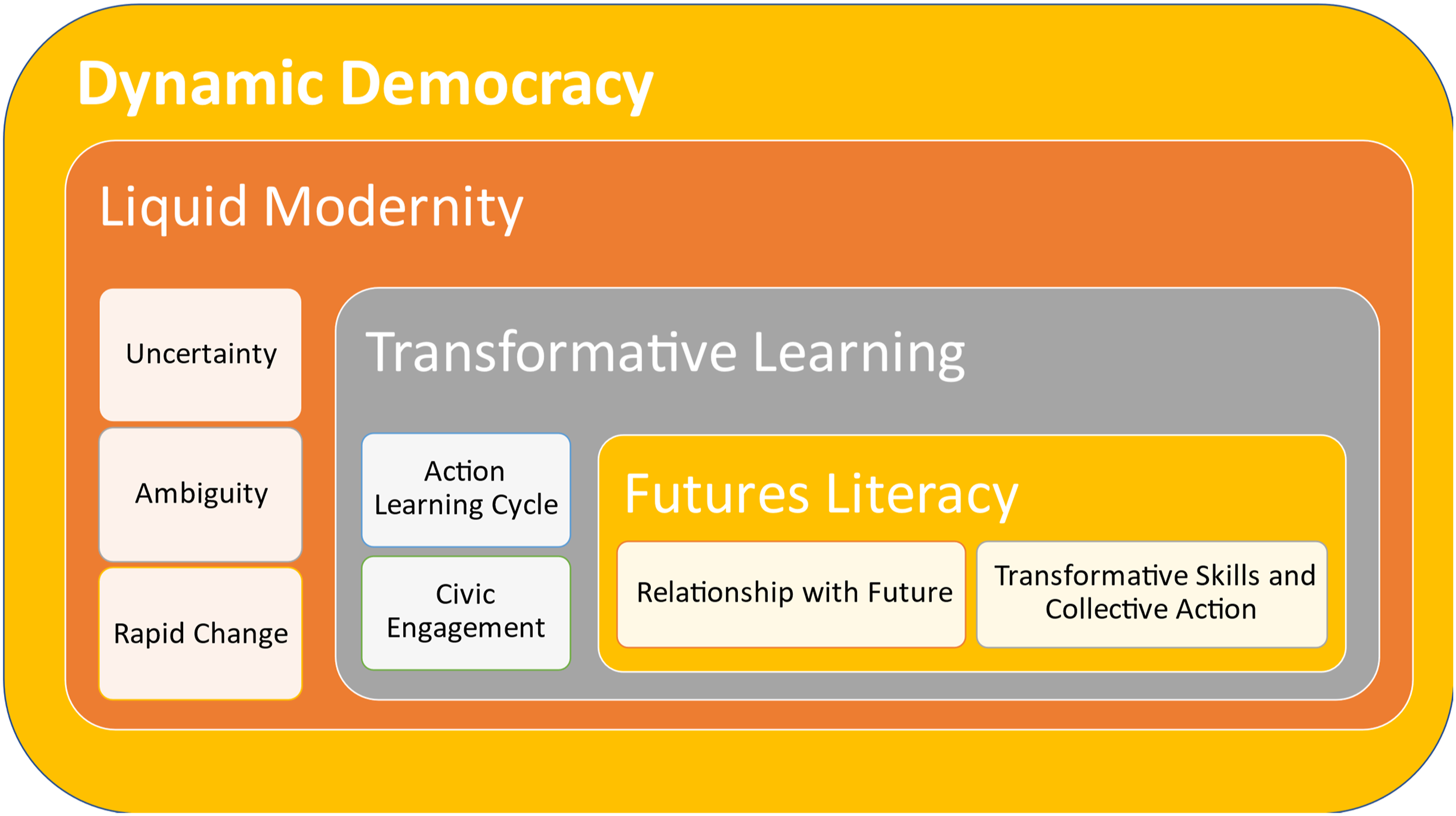
Futures thinking and strategies vary widely—yet they are unified by a commitment to identifying and building individual, organizational, and community capacity to welcome and navigate discontinuity (rather than privileging continuity) and to proactively and creatively attend to signals about future changes. Futures strategies include designing processes for reframing and adopting futurist professional tools, including, for example, sense-making, strategic foresight, scenario development, intelligent and creative forecasting, and imagining or creating visions for “what could be” (Dervin et al., 2003). Futures approaches robustly embrace the notion that we can intentionally learn and grow in our abilities to navigate discontinuity and ambiguity, as well as continually challenge our taken for granted structures through engagement with our communities. Emergent futures perspectives extend beyond strategic planning to rethink and create potential futures and adeptly pivot or adapt as contexts evolve. Emergent futures engagements support transformational approaches to generative learning and doing and create opportunities for creative and novel solutions that both accommodate and shape the rapid changes of the future.
Foresight Competencies.

There are many skills and approaches to futuring that support adult learning needs (Knowles, 1980) including problem posing (framing and scanning), experiential connectedness (futuring), motivation and meaning making for the need for change (visioning), readiness for change and action (framing, futuring, and visioning), directed and focused approaches to change (designing), and continuous learning through adaptive change (adapting). Through these various strategies, foresight approaches connect to Mezirow’s (1991) transformative learning cycle of engaging with disorienting dilemmas (as embedded in the Figure 2 below) through critical examination and assessment, recognition and exploration of possible, probable and preferred futures, planning of different courses of action through scenarios, and addressing challenges of letting go, diverging from traditional ways of doing things, and converging on new courses of action. Futuring strategies are embedded within the adult and transformative learning cycles below to capture these relationships and frameworks (See Figure 2). Figure 2 encapsulates a perspective of how futuring strategies work with and can be framed within adult transformational learning perspectives. Futures Strategies Embedded within Adult Learning Theory Perspectives.
One question to be explored is whether futures learning strategies already represent additional ways of supporting transformational learning or if transformational learning theory could benefit from more meaningful integration of these approaches. One of the areas where futures learning strategies has had specific success has been in working with organizations, policy makers, and governmental leaders for social transformation. Our suggestion is that futuring approaches could benefit from being informed by intentional adult learning theory integration, and that adult learning approaches to social transformation could benefit from applying strategies used by futurists.
As a case in point, Futures Literacy (FL) is one approach to futures learning that explores the nature and attributes of anticipatory, futures-oriented systems, and processes (Miller, 2015). As with reading literacy, FL uses strategies and skills that facilitate and support deeper, more meaningful relationships with the future. FL is a mindset for developing relationships with the future that includes investing in a process and engaging in meaningful action to transform current contexts in order to adapt to changes in our individual and collective environments. While we may “read” our environment in easily predictive ways in some contexts, such as deciding whether to carry an umbrella in case of rain, more and more, as a feature of liquid modernity, we need to collectively engage in envisioning possible, probable and desirable futures to create the changes, now, that will most likely provide longer-term opportunities and flexibilities in the future.
Futures Literacies are being supported by the United Nations and the United Nations Educational, Scientific and Cultural Organization (UNESCO) as ways to approach learning and sense-making, and to achieve meaningful global change (UNESCO, 2020). The role of adult learning is described in United Nations materials stating, “FL is a capability. It is the skill that allows people to better understand the role that the future plays in what they see and do” (UNESCO, 2020). To enact a practical use of FL, UNESCO has supported the development of Futures Literacy Labs (FLL). FLL are based in Dewey’s inquiry cycle to incorporate and connect anticipatory futures learning with inquiry and action (Miller, 2018). As a pragmatic approach to knowing and learning, FLL are conducted with policy makers, community and business leaders, and special interest groups to support community visioning and action for transformative change, especially in situations of ambiguity requiring novel action.
Koch (2018), for example, describes a project named Innovation Norway where a FLL was used to support “industrial innovation and entrepreneurship” (p. 140). Karuri-Sebina and Miller (2020) describe using FLL strategies in several African nations to support a “collective intelligence knowledge laboratory” (p. 161) to reimagine Africa’s future. In Ecuador, a FLL was conducted with a diverse group of leaders to tackle the problem of fragmentation associated with geographic, social, political, and economic diversity in Ecuador. As described by participants, “by strengthening the capacity of all segments of Ecuadorian society to use the future to diagnose problems, hopes and policies … [they were] cultivating a broader base for decision-making processes and enlarging people’s understanding of [futures ideas as well as the …] generation of shared responsibilities to face the country’s challenges” (Cedeňo & Arellano, 2018, p. 168). FLL support active learning but do not directly address the needs of adult learners to confront ambiguity and engage in transformative, generative approaches to creating, being and acting in rapidly changing environments. So, while futures literacy approaches are a piece of how we engage in democracy’s futures promise, each of these approaches and components need to be connected and confronted in deliberate and creative ways. (Notice, we have avoided the word “strategic” which carries with it elements of prediction and control, neither of which we are suggesting).
The prospect of bridging or connecting deeply meaningful examinations of transformative/generative learning theory, democratic engagement, and futures learning is quite interesting and potentially valuable for advancing adult learning theory. Transformative/generative learning, when studied carefully, does allow for rigorous analysis of our habits—of thinking, reflection, and behavior and human experiences. Much of our adult learning is a sense-making process also related to individual and community well-being and goals of social justice. Within adult education, conceptualizations of the future are often framed with an assumed potential need to resolve or overcome uncertainty or discomfort experienced in the past, recent present, or immediate future. Futures perspectives add strategies and longer-term perspectives on preferred futures by engaging many of these views of transformative and generative learning. Longer-term individual and social transformations are supported through futures strategies that anticipate and vision long-term and desirable futures to set in motion opportunities to create preferred futures in the present.
Hoggan et al. (2017) opened the door and invited theorists and practitioners to consider how temporal interpretations of human experience and adaptation may yield new, more meaningful interpretations or applications of TL by addressing the continuity between past, present, and future. These temporal distinctions hold sway in our consideration of how continuity, disruption, and transformative learning shape individuals and communities. There is real possibility that learners can skillfully acquire capacities to navigate their ongoing journey with ambiguity or to change deeply held habits without being confined by potential apprehension or perceived social consequences (Alhadeff-Jones, 2019).
Adult education and adult learning theories tend to focus on intensive study of the self, the self in relation to others, and how we, individually or collectively navigate change. Integrating more intentional, specific futures learning into adult learning theory allows for creative, individual and collective spaces of learning, more supportive of democratic participation in diverse, rapidly changing societies.
The Millennium Project (2020) is another example of the role of futuring to facilitate discussions of emergent futures needs, especially in relation to the future of democracies across the world. Using global foresight networks, the Millennium Project, a participatory think tank associated with the United Nations, identified 15 global challenges that include sustainable development and climate change, clean water, population and resources, global ethics, peace and conflict, status of women, and democratization. In a subsequent 2-year study involving hundreds of futurists, and community and policy leaders (Glenn, 2020), 93 recommendations were made for visions of society in 2050. In both the 2-year study and in their work with futurists to identify global challenges we are currently facing, there were clear understandings that democracies across the globe are under threat and there is a vital need for rethinking participatory democracy, individual identity in view of augmented human capabilities, learning supported throughout the lifetime, and self-fulfillment as an important function of governments in a new social contract with society. The results of the Millennium Project findings have major implications for higher education and the future of lifelong learning (Fleener, 2021) as well as for the future of democracies during liquid times.
One of the specific recommendations made in the Millennium Project report specifically addressed the challenges of “liquid democracies.” This recommendation has special meaning for the United States. While conceived as the first modern democracy, in a 2019 report of the Economist Intelligence Unit (Economist Intelligence Unit, 2019), the US ranked 25th out of 30 democratic countries behind all of our major European allies and was labeled a “flawed democracy” based on factors such as electoral process and pluralism, function of government, political participation, political culture, and civil liberties. Only Malta, Estonia, Israel, Botswana, and Cabo Verde came below the US in this ranking. The crisis in democracy is a learning crisis. We need to facilitate adults’ perspectives of and engagements with the future, supporting their emerging relationships with the future through Futures Literacy strategies, in order to overcome the tyranny of the majority, the lack of compromise, apathy, and cynicism about the political process, and the dysfunction that is occurring because we fail to create a vision of the future that accommodates a changing world.
Democratic Hope and Transformational Futures
Supporting futures literacy as individual and social approaches to engaging the future provides the important link among adult learning, transformational processes, generative learning and democracy’s promise of self-determination, freedom, and inclusive civic and ethical engagement. Through futures literacy development and practices, we seek to create “futures for the heart” (Bezold, 2020, p. 148) and “stretching approaches” (Prince, 2020) to align individuals and collectives for social transformation and creativity. In this way, developing futures literacy may be the new “civic education” as we support futures literacy development. Learning and participation in the deliberative process are valued as outcomes of democratic participation and social justice can be supported by the development of societal-level futures literacy and the use of futures approaches for public engagement, shared visioning, and enacting fundamental change.
Footnotes
Declaration of Conflicting Interests
The author(s) declared no potential conflicts of interest with respect to the research, authorship, and/or publication of this article.
Funding
The author(s) received no financial support for the research, authorship, and/or publication of this article.