




Abstract
Most emotional intervention programs are based on remedial approaches designed to improve one’s emotional management. However, few programs have aimed at promoting developmental changes not to mention value creation processes regarding their coping with emotional experiences. Accordingly, we implement and evaluate an emotional intervention program based on the specific needs of the participants. Nineteen Secondary School teachers volunteered through 5 sessions of 4 hours each. After the intervention, a follow-up was carried out by means of a discussion group and a post-test, using the Bar-On ICE questionnaire. Most emotional intelligence factors increased significantly their scores in the post-test. It is discussed to what extent there is evidence of a transformational change in the participants attributed to the developmental value creation intervention.
Introduction
Over the last 10 years, several research studies in the education field have emphasized the need of introducing socio-emotional competences as part of the basic and permanent training of teachers and/or students (Cabello et al., 2016; Ciarrochi & Mayer, 2007). Socioemotional competences refer to a wide range of capabilities ranging from intrapersonal competences such as self-control and emotion regulation to interpersonal competences such as perspective taking and relationship skills (Domitrovich et al., 2017; Malti & Noam, 2016). Irrespective of whether they are considered intrapersonal or interpersonal, they would facilitate understanding and accepting oneself, negotiating every-day situations and interactions with others, to deal with challenges and to adjust to changing conditions (Schoon, 2021). The development of emotional competence leads to emotional education, designed to facilitate these socioemotional competencies with the purpose of improving personal and social well-being. The teaching methodology of most programs of emotional education is characterized by detailed activities and techniques that have been shown to be effective for the management of emotions. These activities designed in advance are therefore part of a pre-established program (Beckett et al., 2015; Bisquerra, 2003).
Indeed, it seems that if teachers possess such abilities, they can contribute to generate an effective teaching and learning environment (Brackett & Katulak, 2006; Schutz et al., 2006), help students to have a better academic performance (Cohen, 2006; Iurea et al., 2011; Brackett & Salovey, 2004), favor a better climate in the classroom, and contribute to improve the teacher–student relationship (Durlak et al., 2011; Kremenitzer & Miller, 2008; Sutton & Wheatley, 2003). Recently, we have witnessed the rise of different intervention programs which seek to promote teachers’ emotional regulation. For example, the PINEP Program (Body et al., 2016) was applied to teachers to demonstrate the positive effects of mindfulness in their emotional self-regulation. Likewise, the Emotionally Intelligent Teacher program (Brackett & Caruso, 2005) was designed to help teachers to improve their emotional skills in order to employ them in their professional and personal relationships. On the other hand, the Happy Classroom program (Arguís Rey et al., 2012) aimed at promoting personal strengths and well-being in the school environment, by attempting to provide resources to enhance the personal and social development of students. In addition, many studies have been focused on measuring the impact of these intervention programs in order to promote their implementation with teachers, students, and the teaching–learning environment (Brackett et al., 2007; Cabello et al., 2016; Durlak et al., 2011; Maurer et al., 2004; Nathanson et al., 2016; Ruíz-Aranda et al., 2013; Soldevila et al., 2007). By analyzing these intervention programs, we have found common ground between them, despite their differences in content, approaches, and techniques. We refer to the deeply rooted, implicit conception underlying their ways of understanding the teaching–learning process.
According to van Rossum and Hamer learning-teaching conception model (van Rossum & Hamer, 2010, 2012; Hamer & van Rossum, 2015, 2017), there are six different implicit learning conceptions through which people make sense of what good teaching means and various other concepts such as understanding, applying, insight, intelligence, and so on. These authors realized that these conceptions formed profiles of ways of meaning-making with similarities to other developmental models of intellectual (Perry, 1970) and epistemological development (e.g. Baxter Magolda, 2009; Kegan, 1982, 1994; King et al., 1994; Kuhn, 1991). Longitudinal research supports the developmental nature of these epistemological models (Van Rossum & Hamer, 2010) tracking students from freshman through graduation, describing their progress in thinking at increasing levels of complexity. These conceptions are (c.1) increasing knowledge, (c.2) memorizing, (c.3) reproductive understanding/application, (c.4) understanding subject matter, (c.5) widening horizons through dialogue, and (c.6) growing self-awareness (Van Rossum & Hamer, 2010). The first two conceptions focus on memorization reflecting a lack of reflection. Conceptions three and four move from reproduction to (re) construction of knowledge. From the third conception, people conceive the teaching–learning process as a reproductive application. It stands for a knowledge seen as something to be applied in real life, a learning-teaching conception which allows people to solve problems or find solutions by means of fixed recipes, practical-uses activities, and structured dynamics. This kind of learning does not change the way in which people construct their learning; it does not even seek to transform people and their meaning-making of the world. Rather, it is particularly focused on teaching people new information and skills, providing what Kegan (2000) calls informative learning.
The third and fourth conceptions reflect the major change from reproductive to constructivist learning. Thus, they exemplify a leap from applying fixed procedures and strategies (c.3) to more flexible ways of creating tailored solution strategies to ill-structured problems (c.4). It is in the fourth conception when students realize they need to take and be given “a larger responsibility for their own learning to think for themselves” (Hamer & Van Rossum, 2017). This fourth conception defines a meaning-making characterized by the notion of self-authorship, the development of which is one form of transformative learning (Baxter-Magolda, 2009; Kegan, 1994).
This fourth conception gives rise to the last two conceptions (c.5 and c.6) which describe a shift from knowing to being, from asking how to know to asking how to be. Kegan refers to this way of meaning as self-transforming. Instead of authoring reality, the self-transform reality by an action.
This is not new in the field of transformational learning. Mezirow describes a similar process of increasing reflection when defining transformation as “effecting a change in one’s frame of reference by critically examining those assumptions, perceptions, thoughts and feelings that may be divisive, and moving towards a frame of reference that is more ‘inclusive, discriminating, self-reflective and integrative of experiences” (Mezirow, 1997, p. 5). Or according to Cranton and Taylor (2012), adult learners filter, mediate, and make sense of their life experiences through their values, beliefs, and assumptions. In this process, the learners reformulate these frames of reference which would allow one to be more open to others’ points of view and make sense of their life experiences, thereby ‘leading to more open, more permeable, and better-justified meanings and perspectives.’” (p. 3)
Literature on transformative learning, following Mezirow’s approach, focuses on how to intervene from a transformative learning approach emphasizing the need of preconditions for learning such as a disorienting dilemma usually caused by external demands, a cognitive conflict created and followed by critical self-reflection and feelings of insecurity, a supportive context which allows the reflective process and the motivation to engage in a likely open and uncertain scenario. For example, Wilhelmson et al. (2015) analyzed the different quality of learning outcomes of a group of 18 managers experiencing dramatic or major positive changes (five participants) to minor/no change or even negative changes (seven participants). Transformative learning involved acting upon disorienting dilemmas and cognitive conflicts, so that participants could generate new understanding and ways of doing things. In the context of online and distance education, Nichols et al. (2020) emphasize the need of self-reflection, critical discourse, and problem solving as some of the strategies to encourage transformative learning opposed to task-oriented outcomes which reduce the need for critical reflection in the case of traditional vocational education (Mezirow, 2000). As in Cranton (2002), they conclude that there is no single methodology that guarantees a qualitative change in the way we learn, although essays, personal reflections, and assigned readings had the highest association with transformation.
We consider that the inherent developmental nature of these six conceptions of learning is included in the literature on transformational learning, demanding, and promoting at least the possibility of understanding learning from a fourth conception based on reflection and aimed at building new understandings. However, these transformative possibilities are not taken into account in the literature on emotional competencies, and even less so in the literature on emotional education.
Through interventions that promote transformational learning, rather than informational learning, a more complex reflective process can be fostered. Such a process would encompass a reflection on the content of an issue (in the case of emotional management, this could be “what” emotions are), a reflection on the process, where the “how” of an issue is examined (e.g., how to manage emotions), and a type of reflection referred to as premise reflection. In premise reflection, participants would examine “the long-held underlying beliefs and assumptions” (Bhukhanwala et al., 2016, p. 3).
Indeed, in the field of emotional management interventions, to date, there is scarce evidence of studies seeking a transformation in their participants, either in their behavior, their way of thinking, or way of being in the world, as mentioned above. Moreover, lately, interventions in emotional management are being replaced with interventions increasingly designed with more specific techniques. For example, mindfulness interventions to improve social-emotional skills have increased exponentially (Zenner et al., 2014) and especially in the field of higher education (Ergas & Hadar, 2019). Numerous mindfulness studies and practices seem to have been adopted as a way to foster well-being, emotional regulation, and develop awareness of mental habits (Caballero et al., 2019; Goretzki & Zysk, 2017). The problem with most of these studies and practices is that contemporary approaches, designed to attract a Western audience, are decontextualized, moving away from the deeper meaning of mindfulness and its spiritual significance, ending up using mindfulness, in all its variants, as mere relaxation or attention-enhancing techniques, far from its initial meaning (Purser & Loy, 2013; Vörös, 2016).
All these mentioned approaches, based on a conventional way of dealing with emotions, would, in our opinion, promote mainly informative learning, if their teaching methodology is mainly based on a pre-established design, whose purpose lies mainly in the acquisition of a series of standard techniques, without explicitly including a reflective inquiry on the usefulness or appropriateness of such techniques. There are only few studies and interventions that use mindfulness for its liberating and transformational purpose (for one example, see Kumar, 2021).
The Current Study
The current study intended to suggest an alternative way to think about the teaching–learning process within the context of emotions training lessons, through the exploration of the impact of a different kind of emotional management intervention program. The main objective of this research was to apply an intervention in emotional competencies based on a more open methodology, exploring the extent to which transformational changes could be generated in the participants, instead of mere informational changes.
We sought to (1) design and implement an ad hoc intervention program based on the specific needs and characteristic of the participants of the research project, in order to (2) assess the quantitative and qualitative effects of the intervention, which was based at least on a fourth learning–teaching conception as a way to foster an epistemological change rather than exclusively a change in the behavioral repertoire (Kegan, 1994, 2000).
We intended to create value in the educational context, offering teachers a transformational change in their way of conceiving the teaching–learning process, by proposing a new approach not only in the way of managing emotions, but also in the way of how to create value from challenging situations. According to Ikeda (2018), the first step to revolutionize our own self and change the environment around us is to change the perception of things. By working deeply on their own self and their perception of the world around them, teachers would be better prepared to create value in all circumstances instead of following unnecessary values proposed by others, regardless of their assumed importance.
Our Starting Hypotheses Were as Follows
1. The secondary school teachers participating in the study will improve their scores in the emotional intelligence indicators, as it was the case in previous research (Ikiz, 2009; Kong et al., 2012; Uitto et al., 2015). 2. By means of the ad hoc emotional management intervention program, the participants of the study will be in a better disposition to change their learning–teaching conception, switching from an expected third conception to at least a fourth one. We would expect, given the importance of self-reflecting processes, that they will change their meaning-making of emotional experiences, by means of becoming authors and not mere spectators of their roles, feelings, values, and relationships, as in Nichols et al. (2020). 3. Participants will be aware of their developmental and epistemological transformation as they will qualitatively recognize the impact of the intervention program on their professional and personal daily lives (Bhukhanwala et al., 2016).
Method
Design
The present study carried out a mixed method sequential two-phase explanatory (QUAN-QUAL) design (Gelo et al., 2008) with two moments of measurement (pre-test and post-test), before and after the intervention program. The qualitative analysis provided additional significant information in order to interpret the quantitative results.
We collected baseline data on the first day of the intervention program, which consisted of a weekly four-hour class session distributed across 1 month. We collected post-test data on the last session of the intervention program. Participants were previously informed about the objectives of the instruments employed and how the results would be used, and they provided their written consent. Participants were also assured that data collected would be kept confidential and would only be used for research purposes.
Participants
We followed a convenience sampling procedure with a group of 19 Secondary School teachers from a rural area in northeast Spain who volunteered to be a part of the study. The average age of the participants was 47.8 years old. Participants worked in three of the four public and private secondary schools of the county. Before starting the intervention, all the schools in the county were asked to participate in the project, and both their schools’ management teams and teaching staff were informed about the nature and purpose of the educational program and research study. The local government and the educational organizations of the county expressed their wish to join the study, by suggesting a voluntary participation to all the Secondary School teachers of the area.
Instruments
The Spanish adaptation of the Bar-On ICE questionnaire, EQI BarOn (Ugarriza & Pajares, 2005) was employed as an instrument for our quantitative analysis in order to calculate the emotional intelligence coefficient and the variation of each factor included in it at the pre-test and post-test moments.
The questionnaire has passed both reliability and predictive validity tests. The internal consistency for the total inventory is .93 for all factors. Cronbach’s alpha coefficients give values above .70 (Ugarriza & Pajares, 2005). This instrument uses a Likert scale, with response intervals that range from 1 (“Rarely or almost never”) to 5 (“Very often or always”). The questionnaire is made up of 133 items, grouped into five categories: Intrapersonal component, Interpersonal component, Adaptability, Stress Management, and General Mood Scales. These categories are grouped into the following subcategories: • Intrapersonal subcategories: Self-Regard, Emotional Self-Awareness, Assertiveness, Independence, and Self-Actualization. • Interpersonal subcategories: Empathy, Social Responsibility, and Interpersonal Relationships. • Stress Management subcategories: Stress Tolerance and Impulse Control. • Adaptability subcategories: Reality Testing, Flexibility, and Problem Solving. • General Mood Scale subcategories: Optimism and Happiness.
Procedure
An ad hoc emotional management intervention program was designed according to the special needs and characteristics of the participants of the study. The intervention program employed an experiential process-oriented methodology (McWhirter, 2000a, 2000b, 2001) adding collaborative and dialogic distinctions (Iborra et al., 2008).
Throughout the development of the entire intervention program, we followed a process-oriented approach (Hoggan & Kloubert, 2020) in which we did not aim to bring about a transformation per se, and especially not one with immediately visible effects, but rather to facilitate processes able to produce transformative changes in the participants. By fostering new skills and competencies to deal with reality in a broader way, our aspiration was to facilitate in the participants’ processes of self-inquiry about their own values, purposes, thoughts, and competencies. They would thus have the potential to autonomously and independently question themselves, their previous knowledge, skills, and values. At the same time, they could develop the ability to acquire new habits, generating new values and meanings to their experiences and maintain them over time, thus producing a gradual transformation in their way of experiencing and interacting with the world. This approach could perhaps produce some disorienting dilemmas in the teachers who have participated in the intervention in terms of the process-oriented approach as a methodology, as they are generally oriented to conceive learning and competences as something that is acquired and not as a continuous process of transformation over time.
Furthermore, the program promoted a constructionist paradigm of emotions based on the “Conceptual Act Theory” (Barrett, 2017; Lindquist, 2013). According to the constructionist vision of the emotions, each emotional experience is unique because the brain constructs emotional events, through language, previous experiences, concepts, and the social and cultural context a person lives in instead of passively reacting to an external stimulus. Thinking of emotions as something we actively construct and not as something innate allows us to unlearn and at the same time transform patterns of behavior that are misaligned to the context or situation we live in. At the same time, it also enables us to get ourselves out of the emotional blockage in certain situations of our daily life by learning, through reflective processes and inquiry, to build and make sense of what we feel in a healthier and more suitable way. This will also transform our actions and thoughts in a constructive and positive way.
The intervention program took place in March 2019. It was made up of five in-person sessions. The assembly hall of one of the schools, which joined the research project, was the location of the course.
One month before the beginning of the program and one month after, two discussion groups were held. The one prior to the intervention program was carried out in order to explore the needs and characteristics of the group. The second discussion group aimed to monitor and evaluate the qualitative results of the intervention program.
The group we worked with presented the following picture of their initial circumstances: 1. They participated in the research project because they wanted to favor a better climate in the classroom. 2. They wanted to help students with their emotional management. 3. They confused repressing unpleasant emotions with managing emotions. In fact, many of them had the firm conviction that people always have to look for happiness instead of complaining about difficult moments of their lives. Some of them claimed they had never felt any unpleasant emotion at all. 4. They were expecting a course that would show them practical cases, which could help them to create associations with their context of work. They also were not aware of how they constructed their emotional experiences. They used to think about what they knew, but not how they knew it. 5. They thought they had high levels of EI because they had previously attended several emotional intelligence-training sessions, where they learned some vocabulary related to emotions and some coping strategies, so they needed the course only for their students.
Through the ad hoc intervention program, we worked with participants in the construction of generative changes, aiming to promote transformational learning (Mezirow, 2000; Kegan, 2000; Hoggan, 2016) instead of an informative one.
These kinds of changes are qualitatively distinct from remediative changes. Remediative changes (Dilts, 1991; Dilts et al., 1991), in fact, provide people with short-term benefits because they seek to patch up their problems. The premise for this kind of change is the existence of a concrete problem that needs to be solved. Generative changes (Abengózar et al., 2006) instead do not give the person a specific answer to their needs, but provide people with a new way of thinking, in which curiosity and open-mindedness are the protagonists of a process which allows them to create knowledge structures and construct a systemic thinking (Kegan, 1994). People learn how to generate more resources to understand themselves, the world, and their connection with it. Generative changes (Iborra et al., 2008) seek to foster a qualitative evolution of mind, allowing people to move from a third order of mental consciousness to a fourth one, or at least, help them to start a transitional process of change. Developmental changes (Abengózar et al., 2006), on the other hand, allow personal development, help people to reflect about the fact that the way they think or make meaning of their life experience are influenced by the society and culture they are part of, and, at the same time, open them to the possibility to create their own perspectives about life experiences and to understand others’ viewpoints.
From the very first moment of the intervention, we made explicit the methodology we would use. We emphasized that our program was not aimed at offering a series of techniques to deal adequately with emotions, but by a process of experiential inquiry, we sought to create conditions for participants to become more fully aware of their way of being in the world, of the biases with which they interacted in it, and of the intrinsic patterns with which they faced daily situations. In doing so, we collaboratively explored new possible distinctions when facing concrete situations in their daily lives. We tried to facilitate new ways of looking at experience, thus repositioning their initial standpoints in order to relate to the past in a healthier way and to live the present and the future with fresh resources and more open-minded perspectives toward change and uncertainty.
At all times, we encouraged dialogues in order to facilitate the process of experiential learning which would open up in the conversation itself and the self-exploration of whatever was going on inside the participants as they were living it. We repeatedly made it clear that the space generated was free of prejudice and value judgments and that, through the same dialogue and exploration, we would also have opened ourselves to discover what was generated in us as individuals and as a group. With both curiosity and amazement, we experienced firsthand these small and constant processes of transformation.
Data Analysis
We made use of paired t-test to assess the change from pre-test and post-test results. Effect sizes for mean comparisons between both moments (pre-test and post-test) were computed for each dependent variable using the r index (Field, 2009; Rosenthal, 1991; Rosnow & Rosenthal, 2005). A qualitative methodology of thematic analysis (Riessman, 2008) was carried out after the quantitative analysis. Two discussion groups, one developed before the intervention to detect the starting needs of the group and its characteristics, and another one realized after the intervention program were recorded digitally and then transcribed verbatim. This thematic analysis focuses exclusively on the content of “what” is said as opposed to “how,” “to whom,” or “for what purposes” something is said.
Results
Quantitative Results
Paired Samples T-Test.
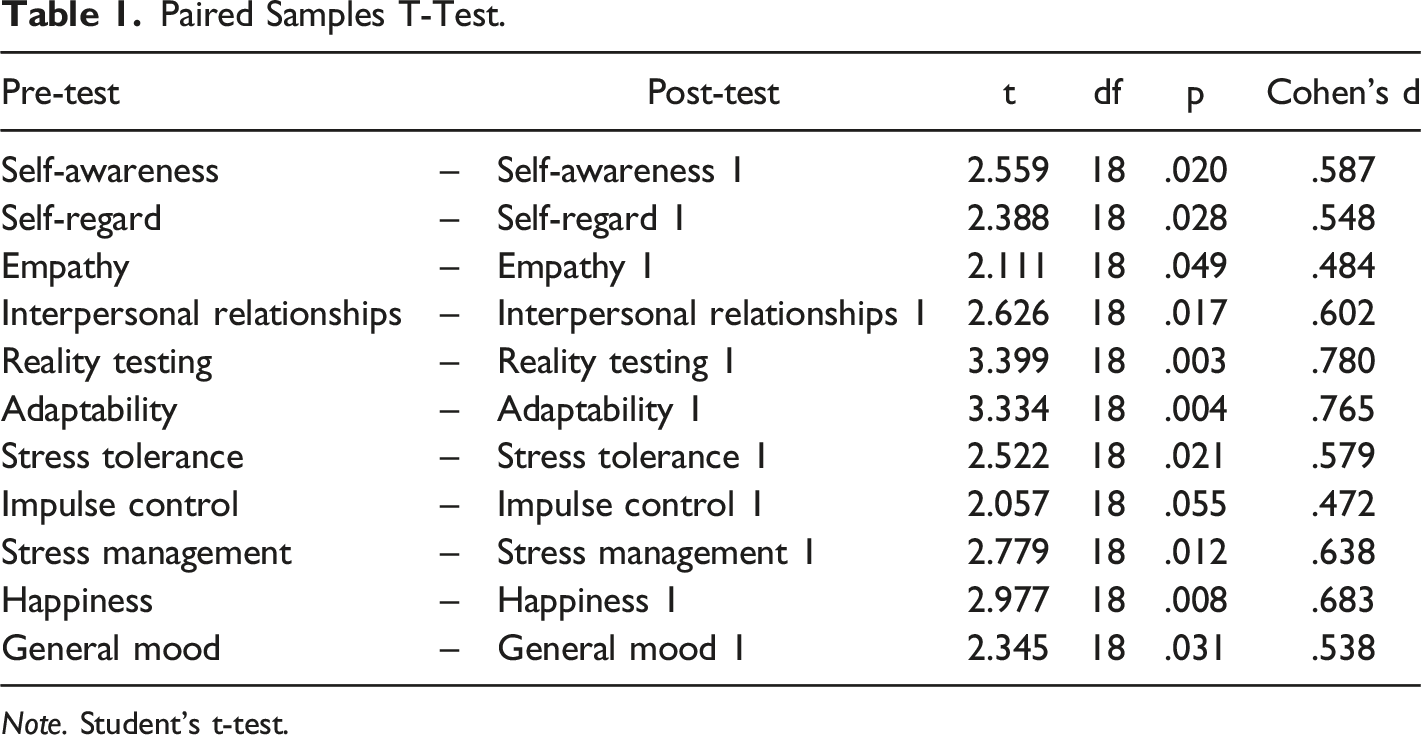
Note. Student’s t-test.
The data indicated that there were significant differences between the scores at pre-test and post-test for almost all of the factors regarding emotional intelligence.
All scores in the dimensions with significant differences increased their scores in the post-test, presenting also large size effects (above .5 for almost all the variables). The variable reality testing showed the highest size effect (.78) and impulse control the lowest (.57).
Qualitative Results
The qualitative results reflect the aspects dealt with in the course based on distinctions made possible through inquiry processes. These results show in our opinion a gradual transformation of the teachers in relation to their behaviors, self, and ontology (Hoggan, 2016). Regarding behavioral changes, these are evident in comments about empathy, being helpful to others, and putting themselves in the other’s place. As an example of the latter, we can mention that different participants argued that the intervention training promoted a process of reflection that helped them to put themselves in someone else’s shoes. Quotations such as the following are a good example of the aforementioned: Perhaps it has helped me a little, then, to stop in front of daily situations, to reflect, to look at another point of view and to put myself in the shoes of another person; but above all it helped me to try to analyze and reflect and understand how the other person feels, to manage conflicts or any other day-to-day thing in a different way. (Mario
1
) Everyone lives emotions in a different way, and everyone has their emotions, so emotions cannot be quantified, which makes it difficult, because one has to live this process from the deep self and only when one reaches their deep self, then it is when they can help themselves and can see the other and help other people. (Claudia)
In terms of changes in their way of being in the world, the results show how teachers have learned to become more sensible to their emotional world, their roles, transitions, to become more responsible not only for what they feel and how they construct their emotional episodes, but also for how they construct the reality around them. Some participants, indeed, highlighted the fact that after the intervention program, they felt emotionally empowered because they didn’t feel themselves as victims of their emotions anymore, but creators of them. This agentic aspect, an example of ontological change, may have helped develop their ability to become more aware of their potential to change their daily life and the contexts in which they operate.
The following quotes are a clear example of the above: Being aware that many times you are at home, the kids are screaming and as I am a teacher maybe I am thinking about school staff, moments like this before used to happen to me and now they aren’t...before I was not aware that I was thinking about other things, but now I am more aware of exercising various roles and now I have to be more attentive, I have to change my role as father, husband or whatever. (Alberto) When I left a class and went to the next one, I used to think about what I was going to tell students, how I was going to tell them what I was planning to tell, I used to plan the class, right? But not now, but now I do not plan the class while I’m going to have the following one. Now I look back at what I have left in the previous class, why it has happened. Then I say to myself, from now on, it is another timeline, another line that I have to start from scratch, that helps me to move from one situation to another, to reflect on how I get to the next class, how I feel, how I make sure that what has happened so far does not affect what is going to happen? (Pedro) The most powerful thing in my case is to know that emotions can be built because it was something that I felt and said to myself, maybe I'm going crazy, but I am able to build a positive emotion and also contaminate and spread it in a place where I am. […] You realize that you have been able to build an emotion like an explosion that illuminates this space. The course has helped me to tell myself that it is true that emotions are built and that we are not slaves of them, so the power we have is infinite. (Miryan)
As for issues related to epistemology, the results are clear evidence of the implicit conception of the teaching–learning process by the teachers and how it was transformed through the intervention. In fact, issues emerge such as the type of course format, which seemed new and unusual for most of them, as they were accustomed to more technical or practical courses, something typical in people with a reproductive third conception of learning. Even so, only a minority of them missed, after the course, a more remedial approach which required practical solutions to face their problems. The majority, on the other hand, claimed to appreciate the processual and experiential methodology followed in the course, reporting that this way of working helped them to gain introspection. Comments such as the one shown below are evidence for us of these changes: I had a slightly different idea about the course, I thought it was going to be something more like theory and things like that and I was surprised because I found the work at a personal level very interesting […] The fact that you can have that management and let's say that knowledge of your emotions, for me was very interesting. (Emilia)
Discussion
Emotional education is necessary in our current society, since it helps people achieve a better personal and social well-being (Bisquerra, 2003). However, most intervention programs in emotional education (Beckett Vermehren et al., 2015; Gilar-Corbi et al., 2018) follow a similar planning scheme meant to foster an improvement of socioemotional competencies through specific approaches, the design of detailed activities intended for the acquisition of one or another skill, the development of techniques that can be used to adequately face situations of emotional maladjustment, or through emotional regulation strategies that have been shown to be effective for the management of emotions.
These programs promote a teaching–learning conception based on a behaviorist paradigm (Hernández, 1998; Salas Madriz, 2002), which, in turn, can be placed within a positivist approach. Programs advocating a teaching–learning conception based on a behaviorist paradigm understand emotional regulation as something that can be objectively measured and learned by applying standard techniques, universally valid designs, practical application exercises which emphasize informative learning. The latter implies changes within an existing frame of reference (Kegan, 2000). Emotional regulation programs based on this conception of learning conceive the trainee (in this case, the people who participate in them) as a subject who passively accepts, without questioning, what the expert proposes, trusting in his or her knowledge and putting into practice in real life the techniques or learning acquired during the training sessions. Nor do trainees usually move away from this vision of the teaching–learning process and, generally, they enthusiastically accept to participate in these types of trainings, expecting from them a type of structure based on previously planned activities finalized to the development of contents and focused on products and formulas valid for everyone.
Instead, as our first contribution, our study moves away from a behaviorist/cognitive paradigm of education, thus promoting the creation and implementation of a specific kind of intervention in emotional management, based on a constructivist and sociocultural paradigm of education that fosters transformational learning. This paradigm, far from seeing reality as an observable phenomenon from an objectivist and easily measurable perspective, conceives knowledge as something that is actively constructed through the interaction of the subject with the world around him. The examination of our hypothesis shows evidence of the possible outcomes using this constructivist approach.
Our first hypothesis, that the secondary school teachers participating in the study would improve their scores in the emotional intelligence indicators, was supported. As we presented in the results, all scores in the dimensions with significant differences increased their scores in the post-test. Interestingly, the variable reality testing showed the highest size effect (.78). Reality testing is a factor that is included in the second order factor Adaptability along with Flexibility and Problem Solving (which did not present statistically meaningful differences). Reality testing, with its contribution to how we adapt to our daily circumstances, summarizes some of the main changes of our participants after attending our program, concerning how they make sense of their reality, in an epistemological sense. Reality testing is associated with processes of social testing or reinterpretations of social relationships so common in novelties introduced in the process of transformation (Alhadeff-Jones, 2019).
The second hypothesis was also confirmed as we consider that all participants could challenge their previous expectations about what they knew about emotions and about how to use them in daily situations. Instead of being passive spectator of their emotional experiences, they could begin to manage their feelings, roles, values, and relationships in a more active way. Most behavioral changes included examples of being more helpful and empathetic with others, even being more reflective in understanding others’ points of view.
The third hypothesis was also confirmed as we found evidence in the participant’s comments about being more aware of changes in their selves as they were becoming more responsible of the reality they were constructing and reacting to. This is evidence for us of how, through the intervention program, teachers were helped to become even more aware of themselves, to distinguish what they really felt from what they thought they felt, to look for a balance in order not to be carried away by emotions, but to learn how to deal with them instead. Therefore, they did not feel like victims of their emotions but active creators of them. This empowered or agentic self was connected so with the epistemological process of making sense of their daily experience in a more generative or proactive way, emphasizing how to create their personal set up of a situation instead or merely reacting to it.
Thus, following this paradigm, in our intervention, we implemented an experiential process methodology (McWhirter, 2001; Nogueiras et al., 2017), including dialogic and collaborative approaches (Iborra et al., 2008) to foster the emotional development of the participants. We promoted a situated, experiential, and self-regulated learning in which through active inquiry and direct exploration of emotional and relational phenomena, participants carried out a process of reflection on themselves, and their context (Illeris, 2014).
Throughout, interdependent relationships were fostered among the participants. Participants learned to become aware of their role in social relationships and their influence on others. They learned to give a new meaning to their way of being in the world, and consequently, instead of thinking as being part of a single reality. They understood the interdependence between all the participants when creating a shared meaning in such a situation. The participants have been able to come to assimilate, through the epistemological paradigm they were subjected to, that emotional episodes, communicative exchanges, and contexts are constructions within systems, where each piece “is related in such a way to the others that a change in one of them causes a change in all the others and in the total system” (Watzlawick et al., 1971, p. 120).
Working with emotions and their regulation cannot, according to our way of thinking, obviate contextual, processual, and experiential aspects, in addition to being unable to ignore the starting circumstances and specific characteristics of the subjects with whom we intervene. That is why we believe that one of the most relevant contributions of this study has been the design of an ad hoc intervention program, designed for a specific group of secondary school teachers to facilitate the management of their emotions based on their initial needs and specific problems, while facilitating a change in their understanding of the teaching–learning process.
Most of the emotional programs designed for teachers share a replicative third conception. The starting hypothesis of the study was corroborated by both the quantitative and qualitative results obtained by the group. The analysis of the quantitative results showed statistically significant differences between the pre-test and post-test, in favor of the latter in almost all the variables of emotional intelligence.
The quantitative and qualitative results go hand in hand, reflecting three main types of transformations that took place in the participants after the intervention. The teachers participating in the study, in fact, showed changes in the self, in their ontology and in their way of acting and interacting with others in the world. Changes in self, according to Hoggan (2016), have to do with self-knowledge, personality, empowerment and sense of responsibility. Teachers improved their scores after the course in variables such as self-knowledge, self-esteem, and reality testing. All this is also reflected in the qualitative results, where participants reported having learned to become aware of what they felt, to be conscious of their roles, their transitions, to be responsible for how they constructed not only their emotional episodes, but also the reality around them. These changes led them to feel empowered, to improve their self-esteem, and to know how to distinguish between their ideal and real selves. We could most certainly infer from these outcomes that going through a process of transformation in their selves has allowed them to create a new value in their way of learning, of relating to the world and of operating in it. As Hart (2001) suggests, “is not exclusively the shift in reference that allows for the transformative learning but the quality of the new reference point” (p. 12) being this new reference a new way of perceiving themselves and behaving accordingly.
All the aforementioned could be grouped into two other types of transformational processes. The first would consist of an ontological transformation, which would justify the participants’ improvement in variables such as empathy, adaptability, stress tolerance, stress management, optimism, happiness, and general mood. Through the course, participants learned to be more open, to accept uncertainty, novelty, and positions different from their own. They understood that there are multiple ways of knowing and learned to be self-directed learners.
All of the above also facilitated a change in their way of behaving and interacting in the world, which is reflected in their willingness to help others, in their actions being consistent with their new perspective and in their process of transformation when it comes to teaching and understanding the teaching–learning process. The results, in fact, also show significant changes in the way participants understood the teaching–learning process after the training. They, indeed, reported becoming step by step more aware of the methodology applied in the course, recognizing a certain difficulty in understanding this teaching–learning process at the beginning, which eventually they finally understood and appreciated.
All the progresses made by the participants are not only an explicit indicator of an improvement in their socioemotional skills (Bar-On, 1997), but above all, they could be evidence of a deeper transformation transition or a transformation from a third order of consciousness to a fourth one (Eriksen, 2008; Fossas, 2019). By means of the intervention program, the participants became ready to make this new perspective, as it was mentioned before. People achieving a fourth order of consciousness are able to think for themselves, take responsibility for their own lives, and separate what they feel from what they should feel according to learnt social standards (Kegan, 1994). In their statements, participants showed this transformation we are referring to. They, in fact, reported feeling emotionally empowered, by becoming authors of their own emotional experiences after the intervention program, instead of looking at themselves as victims of their emotional events. They also felt able to help others, thanks to a new ability to reflect on reality, which allowed them to perceive the same in a different way, by looking at their own personal and others’ experiences with a new gaze not steeped in prejudice or expectation. All these results reflect what Kegan (1994, 2001) calls “self-authorship,” that is, to have the capacity to be the author of one’s own roles, thoughts, feelings, values, and relationships.
Thanks to an intervention designed according to the participants’ specific needs and circumstances, this group of teachers could construct value in their day-to-day living through this new reflective capacity by means of which they could become more aware of their emotional experience, as well as how they were partly responsible for it.
Conclusions
Teachers are essential figures in facilitating change in our society and educating students to build a better world. For this reason, it is of fundamental importance to provide them with concepts and skills that allow them to examine their emotional regulation and other ways of experiencing and understanding reality, in order for them to be able to transform their way of being in the world and actively participating in it.
With our intervention program, we hope to have demonstrated that it is possible to improve the emotional regulation of the participants not by offering practical solutions to their problems, or by promoting remedial changes, but by changing their vision of the problem, of themselves, and of reality, through a change in their value creation process. We agree with Wiley et al. (2021) when they warn against an industrial model of education that considers neither the individual needs nor how the learning context influences the learner. We hope that through our intervention, indeed, we generated “possible ways in which share the power by creating inclusive, dialogic, democratic, and humane relationships” (Brookfield, 2000, p. 130).
Footnotes
Declaration of Conflicting Interests
The author(s) declared no potential conflicts of interest with respect to the research, authorship, and/or publication of this article.
Funding
The author(s) received no financial support for the research, authorship, and/or publication of this article.
