



Abstract
This literature review explores how various challenges and possibilities of enacting collaborative inquiry (CI) in online contexts intersect with this holistic action research method’s aims of transforming participant being, knowing, and doing. This article asks how digital tools and virtual platforms enable and constrain the democratic collaboration, solidarity-in-diversity, and multiple ways of knowing CI strives to cultivate. Findings and discussion offer guidance for conveners of online CIs and highlight further practical considerations.
Keywords
Collaborative inquiry (CI) is an action-oriented inquiry method and transformative experiential learning practice rooted in Heron’s whole person theory (Heron, 1992, 1996; Heron & Reason, 2008).
1
CI involves two or more people researching a topic through their own experience of it, using a series of cycles in which they move between the experience and reflecting together on it. Each person is co-subject in the experience phases and co-researcher in the reflection phases. (Heron, 1996, p. 1)
Collaborator Peter Reason (1988) described CI as a way of doing research in which all those involved contribute both to the creative thinking that goes into the enterprise – deciding on what is to be looked at, the methods of inquiry, and making sense of what is found out – and also contribute to the action which is the subject of the research. (p. 1)
Adult educators have used CI for creating connectedness across sociocultural silos (Ospina et al., 2008), cultivating the empathy required for collaboration across racial and cultural differences (Yorks & Kasl, 2002), and fostering the affective capacity for transformative learning through artful activities that elicit expressive knowing (Yorks & Kasl, 2006). While CIs often produce propositional outcomes, what a group learns about a topic, its ultimate aims are transformations of doing that are grounded in a phenomenologically informed experiential knowing of “unrestricted perception and radical meeting” (Heron, 1996, p. 52). Therefore, CIs strive to transform, through group engagement, how and, more importantly, why individuals act to change some aspect of their lifeworld through expansions of being, revising how participants relate to their selves and wider realities. 2 Heron also conceives CI’s transformative learning process as holding the potential to affect transformations on larger ecological and social scales: “the agenda as a whole is a participative approach to planetary transformation” (p. 38) and to produce “self-generating cultures” (p. 4). CI’s inspirational roots lie in many of the same ecological, quantum physics, and systems theories and Eastern philosophies that Lange (2018) cites in arguing for transforming transformative education through relational ontologies.
Traditionally, CI involves guiding small groups of people gathered in a shared physical space through cycles of action and reflection around a shared question. By emphasizing personal experience, CI asserts that all experience springs from the felt sense, an unclear, holistic body sense of an entire event or situation (Gendlin, 2007). Because Heron’s whole person theory privileges two or more persons interacting in a shared material context, how felt sense and CI might operate in virtual contexts remains a question (Heron, 1992; Reason & Heron, n.d.).
Given the transformative potential of this method and the increasing number of people learning and working in virtual spaces, a need to understand the challenges and potentials of facilitating online CIs exists. This literature review examines published reports of online CIs to understand possibilities around using digital tools to create online spaces for unfolding CIs. This review asks: 1. What did online collaborative inquiry groups experience as the potentials and challenges of unfolding a CI mediated by digital tools and platforms? 2. What practices did online CI groups report facilitated democratic participation, multiple ways of knowing, solidarity-in-diversity, and other quality criteria?
Literature Review Methodology
This integrative literature review (Torraco, 2016) provides a critical analysis and creative synthesis of scholarly reports of collaborative inquiries enacted through digital tools. Inclusion criteria acknowledge that no easily drawn boundaries between digital worlds and the “real world” exist and that most 21st-century CIs will likely have some online component (e.g., participant recruitment, data storage). Even when online, people are embedded in larger natural and sociocultural networks, always experiencing their everyday virtual interactions through embodied actions (Hine, 2015). Therefore, CIs featuring participants who had previously met offline were not excluded. Articles included in this review met two criteria: 1. The study described its methodology as a collaborative (or co-operative) inquiry or version of CI that used the conceptual components and values inherent in Heron’s whole person theory (e.g., extended epistemology/multiple ways of knowing). 2. The study used digital technologies to mediate the majority of the CI group’s interactions
Studies satisfying these criteria were located using a combination of terms (“collaborative inquiry,” “cooperative inquiry,” “online,” “virtual,” “digital,” and “computer-mediated”) to search general and education-related databases. These included Education Research Complete, Academic Search Premier, Google Scholar, JSTOR, and ProQuest Dissertations and Theses Global. I also hand-searched specific journals, like the Journal of Transformative Education and Action Research, that regularly publish collaborative inquiry reports. I read the abstracts to determine whether articles fit all criteria, then conducted full readings of those fitting the criteria, identifying additional sources through their bibliographic references.
The first criterion eliminated studies that used similar language (e.g., “collaborative inquiry,” “collaborative inquiry learning,” and “computer-supported collaborative inquiry learning”) but failed to incorporate participant collaboration in CI design and other values integral to Heron’s experience-based whole person theory. For example, Pow and Fu’s (2012) web-based collaborative inquiry determined the inquiry topic and the form participant reflections took without considering participants’ preferences or prior experiences. Others emphasized cognitive ways of knowing, scientific problem solving, and facilitator-led processes (Bell et al., 2010; Lee & Smagorinsky, 2000; Zhu et al., 2019). Based on the second criterion, co-located CIs that only incorporated digitally mediated interactions, such as blogging (Ciampa & Gallagher, 2015) or memoing in an online learning management system (West, 2020), as part of individual reflection between regular in-person meetings were excluded. Likewise, Brown et al.’s (2009) co-located CI investigating online pedagogy did not meet the criteria. This multi-pronged search yielded 13 articles.
The Ethico-Onto-Epistemology of Collaborative Inquiry
Barad’s (2007) term “ethico-onto-epistemology” recognizes that all inquiry methods and practices always reflect entwined ways of being and knowing in the world and that these are, furthermore, entangled with specific ethical orientations. This section explores how CI’s ethico-onto-epistemological foundation situates it within a participatory paradigm demanding quality criteria beyond scientific validity. This represents a transformative move away from the researcher-centered way even most qualitative research continues to be conducted. A firm grasp of this foundation helps illuminate the alternate criteria by which CI scholar-practitioners judge the trustworthiness of CI findings (Heron & Reason, 1997). These criteria also inform later discussion of how pursuing CIs in online contexts may impact their quality.
Participatory Ethics: Fostering Democratic Collaboration
Heron and Reason (1997) situated CI within a new participatory research paradigm, “part of a new worldview emerging through systems thinking, ecological concerns and awareness, feminism, education, as well as in the philosophy of human inquiry” (Reason, 1988, p. 3). Part of the “action turn” away from third-person research about and on people, CI incorporates second-person research with and first-person research within people (Torbert, 2013). Thus, CI belongs to a family of emerging methods that reject positivist binaries (e.g., subject/object, researcher/participant, and reason/emotion) that simplify the complexity of experience and render the often-unmeasurable nature of experiential knowing as untrustworthy (Reason & Torbert, 2001).
A high-quality CI depends on whether and how well the group achieves authentic collaboration, meaning non-coercive, power-sharing engagement of all participants, including the initiating researcher(s) (Heron, 1996). All participants must willingly engage in the experiential activities of the shared inquiry and learn the inquiry method well enough to participate in creative decision-making during all stages of the CI process. Heron called this “cognitive and methodological empowerment” (p. 63). Additionally, CI seeks to build “political empowerment” (p. 63), requiring every co-researcher to voice their preference about all group decisions. This reflects an ethical belief that every person possesses the capacity and right to political participation (Bray et al., 2000), being involved in making decisions that affect oneself. This participatory ethics enacts respect for human rights and personal dignity while facilitating grassroots experimentation with cultivating self-generating cultures (Heron, 1996).
CIs conducted in higher education and other organizational contexts, however, are prone to political pressures (Heron, 1996) that often prevent democratic, participative relations by influencing CIs toward specific propositional and practical ends while de-emphasizing experiential knowing (Kasl & Yorks, 2010). Heron (1996) urged facilitators to remain aware of such tensions that tend to bias inquiries and/or obstruct authentic collaboration. The more a CI allows co-researchers to act in ways that enact shared leadership in all phases of the inquiry, the more valid the CI’s findings may be considered.
One-and-Many Ontology: Cultivating Solidarity-in-Diversity
Through collaboration, CIs initiate participants into a relational subject-object ontology that recognizes the interdependence and co-constitution of individuated and participative experience. CI and its underlying whole person theory embrace ways of being that acknowledge that individual experiences always unfold relationally, within the context of a larger group, community, society, and environment. CI’s holonomic understanding of wholeness implying the participation of parts, with parts expressing aspects of a whole relates to hermeneutics (Reason, 1988), theoretical physics, Skolimowski’s (1994) participatory consciousness, and Buddhist thought (Heron, 1996).
All this means that individuals and groups co-create each other. The CI group acts as a supportive generative space in which sameness and difference, convergence and divergence are honored as facets of a larger, often unfathomable, whole. This aspect of CI’s philosophy insists on the interconnection of all participating elements. CIs that seek to transform consciousness and action around racism and privilege, aiming at fostering empathy across vast social differences, find this one-and-many ontology and the solidarity-in-diversity it demands particularly important to understand (European-American Collaborative Challenging Whiteness, 2005; Kasl & Yorks, 2016; Yorks & Kasl, 2002). Thus, CI quality can also be assessed according to whether and how the group openly pursues understanding unity across diverse perspectives and individual experiences in relational connection.
Extended Epistemology: Recognizing Multiple Ways of Knowing
Collaborative inquiry activates an expansive spectrum of knowing that whole person theory calls an extended epistemology (Heron, 1992). CI’s attempts to enact multiple ways of knowing initiate participants into recognizing that humans have the capacity, and corresponding need, to know in practical, experiential, imaginal, and conceptual ways. Through intentional actions, CI participants seek to immerse themselves in the experience of specific everyday practices to get in touch with experiential knowing, an often-unconscious awareness of how one’s embodied being is being affected by and affecting others (Heron, 1996). Imaginal knowing bridges between unconscious affective experiential knowing and the more familiar, conscious, and socially privileged realms of conceptual/propositional knowing (e.g., textual and verbal dialogue, reflection, rational thought) and practical knowing (Heron, 1992; Yorks & Kasl, 2002). Within adult education, Heron’s extended epistemology has influenced conceptualizations of experiential learning (Boud & Walker, 1993; Jarvis, 2006), and inspired the use of affective images (Dirkx, 2001) and artful practices (Lawrence, 2008) toward more holistic transformative learning processes.
Heron (1996) echoes John Dewey in asserting that “[a]ction in the form of reshaping our worlds … is the end of thought; thought is not the end of action” (p. 16). However, he rejected Dewey’s pragmatic view that propositional and practical knowing should be assessed by whether they worked to achieve specific goals. Calling this an “instrumental” view of knowledge, Heron asserted: “What validates thought … is its grounding in experiential knowing, in the lived-through world of primary meaning” (p. 169). The potential of CI to produce transformative learning derived, rather, from its ability to help people think and act differently by revising their understanding at the level of experiential knowing through continuous attunement to their experiences.
Therefore, multiple ways of knowing represents another way CI recognizes and invites difference. Assessing the trustworthiness of a CI in terms of this participatory aspect entails asking several questions: Did the CI engage the various ways of knowing in a balanced way? Can participants articulate how their actions connect to their thoughts and, ultimately, to their affective primary experiences? Did the group achieve a balance between action and reflection? Did the group engage in both expressive and propositional forms of reflection? All these criteria for evaluating the trustworthiness of CI as a participatory methodology inform this review’s analysis of the challenges and potentials of initiating and participating in an online CI.
This section has summarized how CI’s various theoretical underpinnings correspond to a complex ethico-onto-epistemological framework upholding CI as a method of participatory inquiry and transformative learning. CI scholars and practitioners argue that a CI’s quality rests on the extent to which it realizes participatory ethics aiming for democratic collaboration, a one-and-many ontology recognizing diversity-in-solidarity, and an extended epistemology embracing multiple ways of knowing (Bray et al., 2000; Heron, 1996). How and whether these elements emerge also present primary markers for assessing the challenges, potentials, and, ultimately, the quality of online CIs.
Review of Collaborative Inquiries Conducted Online
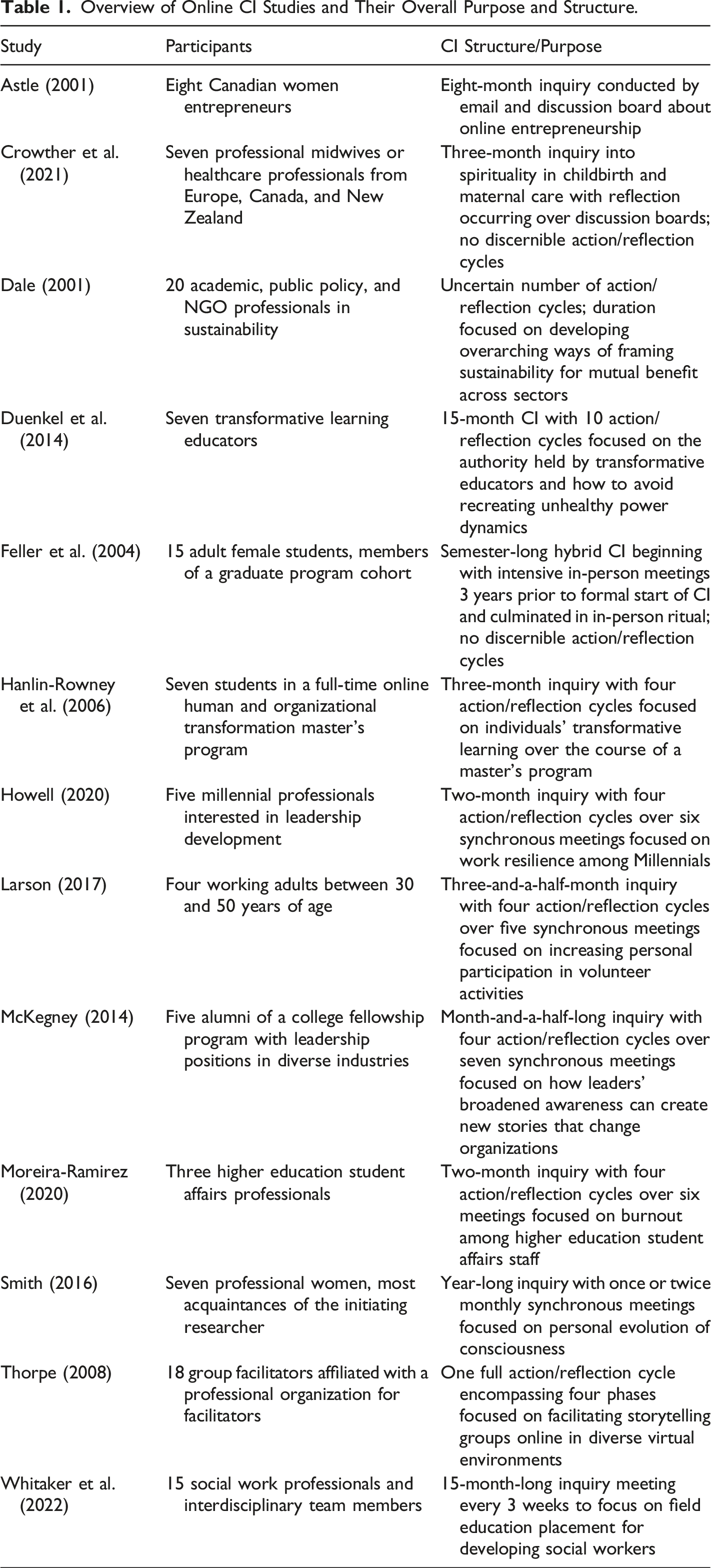
Overview of Online CI Studies and Their Overall Purpose and Structure.
The Potentials and Challenges of Mediating CI Processes through Virtual Platforms
Most studies lacked detailed accounts of how and why CI groups chose specific virtual platforms or how the qualities of chosen tool(s) challenged or enabled the groups’ interaction. Many reports tended to focus on the CI group’s propositional outcomes rather than offer detailed accounts of process. Where findings related to various online CI groups’ processes occurred, the role various technologies played often went unmentioned. Nevertheless, the 13 online CI studies yielded enough detail to surface useful insights, and some studies paid particular attention to the influence of the online context.
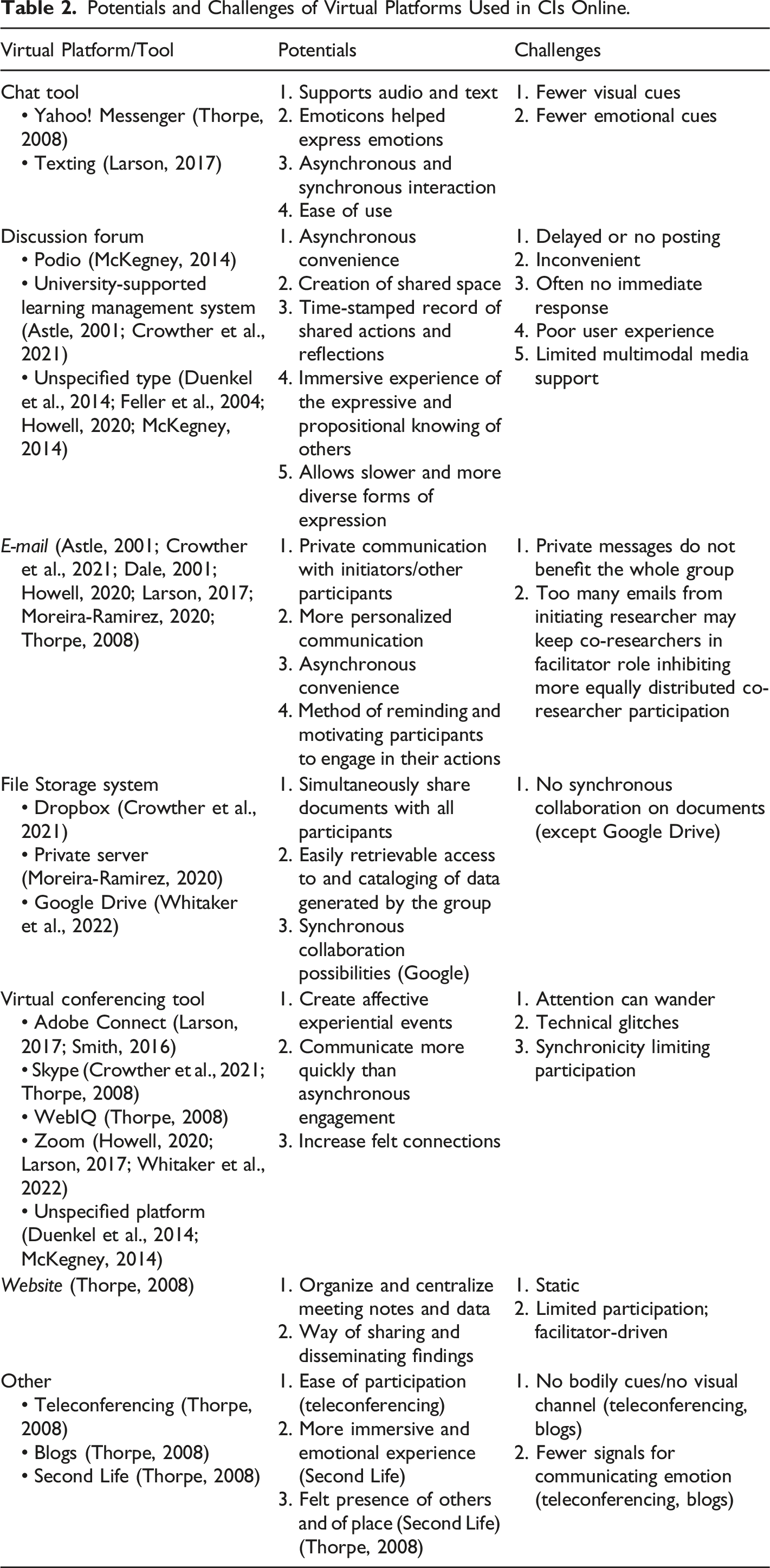
Potentials and Challenges of Virtual Platforms Used in CIs Online.
Asynchronous Engagement
The ability to engage asynchronously emerged as the most notable way online CIs differed from their in-person counterparts; and studies related the many potentials and challenges of creating asynchronous spaces with digital tools. Only one CI refrained from using any form of asynchronous engagement for extending group reflections, relying only on recordings of synchronous online meetings (Moreira-Ramirez, 2020). Many groups reported email figuring heavily in how participants communicated privately with other participants (Howell, 2020) and initiating researchers (Crowther et al., 2021; Moreira-Ramirez, 2020). Unlike discussion forums, participants did not find that email created a collaborative group space (Astle, 2001).
Discussion boards were seen to enable vulnerable sharing (Crowther et al., 2021), facilitate organizing documents in centrally accessible locations (Duenkel et al., 2014; Hanlin-Rowney et al., 2006), provide individual and commons spaces for reflection (Feller et al., 2004), and accommodate diverse and flexible participation across time zones (Astle, 2001; Crowther et al., 2021; Dale, 2001; Howell, 2020; Moreira-Ramirez, 2020; Thorpe, 2008). Further, asynchronous forums enabled time for deeper reflection (Hanlin-Rowney et al., 2006) and for non-native English speakers to communicate more confidently (Crowther et al., 2021). These factors cultivated the democratic participation, one-and-many perception, and multiple ways of knowing determining a CIs trustworthiness.
CI groups also highlighted the many challenges of asynchronous engagement, including the potential for unequal participation (Astle, 2001; Duenkel et al., 2014), feelings of isolation (Hanlin-Rowney et al., 2006), and loss of embodied emotional cues (Crowther et al., 2021). These decreased the interpersonal connections and reflective capacity of groups. Some participants found discussion boards inconvenient to access or regularly post to (Astle, 2001) while others delayed sharing their agreed-upon reflections until synchronous group meetings (Duenkel et al., 2014). CI researchers experienced similar frustrations when attempting to conduct member checks or involve participants in asynchronous data analysis (Howell, 2020; Moreira-Ramirez, 2020). The analysis phase benefitted from moving to synchronous gatherings (Crowther et al., 2021). Whitaker et al. (2022), however, reported success using Google Docs as a kind of less individually segmented discussion board to engage participants in a continuous dialogue in a single document between meetings and across CI phases.
Tightly controlled asynchronous environments procured through and supported by university IT departments also tended to promote facilitator-led CI. These systems required initiating researchers to provide more technological education and support and resulted in more facilitator-posed prompts to provoke reflective responses. Thus, unfamiliar platforms make the move from facilitator to participant more difficult and reduce the potential for co-researchers to assume equal power and authentic collaboration in an asynchronous inquiry (Astle, 2001; Crowther et al., 2021). Difficulty generating sustained engagement and timely responses suggests that asynchronous CIs benefit from larger participant numbers. Without a critical mass of participation, the diversity of expressed experience decreases while increasing the likelihood of frustration and disappointment related to delayed responses or receiving no response.
Initiating researchers must remain mindful that while technologies may be able to support continuous communication, no chaotic “flurry of response” (Crowther et al., 2021, p. 13) is guaranteed. The community must still be cultivated. Responding to these challenges, Astle (2001) emailed participants multiple times to alert co-researchers to discussion board activity and to remind them to contribute. Many newer collaborative platforms now include automatic notifications and application integration with mobile devices, alleviating the need for reminders. Likewise, newer platforms can better support multimodal communication, making asynchronous interaction more engaging and inclusive of multiple ways of knowing (Astle, 2001; Crowther et al., 2021).
In addition to finding the coordination of asynchronous engagement time-consuming (Hanlin-Rowney et al., 2006; Thorpe, 2008), asynchronous online CIs tended toward reflection on distant experiences and failed to incorporate actions. This imbalance, as well as the long response times, sometimes blurred the action-reflection cycles and made group development difficult to discern (Astle, 2001; Thorpe, 2008). Whitaker et al.’s (2022) strategy of working within a single Google document represented an outlier of sustained asynchronous engagement between synchronous meetings, offering one possible remedy to these challenges of asynchrony.
Playing with Distanced Synchrony
Most online CIs incorporated synchronous interaction. Connecting synchronously over Skype after corresponding by email, a group of storytellers reported “a new sense of each other. Working together in real-time was considered more familiar and similar to … facilitating face-to-face” (Thorpe, 2008, p. 133), including the spontaneity of synchronous interaction. Maintaining participant engagement, however, still proved challenging. Moreira-Ramirez (2020) remarked on the reality of “Zoom fatigue” and that participants “could choose to be out of frame, turn off their video, or look at other open windows on their computer screen” (p. 46). However, virtual worlds, like Second Life, that allow for complex three-dimensional visuals and embodied movements, can produce experiential immersion and feelings of deep connection to other participants (Thorpe, 2008). Furthermore, while Whitaker et al. (2022) reported their co-researchers mostly chose to remain on camera during Zoom meetings, they emphasized contributions to a shared collaborative document, which they also practiced synchronously, as a more accurate marker of deep engagement.
Anonymity and the levels of participant safety can decrease when over-relying on video and audio to engage synchronously, especially when groups recorded meetings. However, synchronous meetings can still build in spaces for anonymous communication, for example, by employing Zoom’s whiteboard feature or using a shared Google document where contributions of each individual may be impossible or more difficult to discern (Howell, 2020). Possibilities for anonymity also allow for spontaneity, which can steer an inquiry in unexpected directions (Thorpe, 2008). These considerations relate to honoring CIs one-and-many ontology and maximizing divergent perspectives in the inquiry.
Online CI Practices
Many of the same practices used in co-located CIs also facilitated democratic participation, multiple ways of knowing, and solidarity-in-diversity in online CIs. These included modeling vulnerability (Astle, 2001; Moreira-Ramirez, 2020), storytelling (Astle, 2001; McKegney, 2014), and engaging in various forms of expressive artful practice (Crowther et al., 2021; Duenkel et al., 2014; Howell, 2020). Digital contexts, however, altered how certain online CI practices were undertaken and the relative importance placed (or not placed) on particular practices.
Crowther et al.’s (2021) remark that “working both synchronously and asynchronously across time and space enabled a rich and complex conversation to unfold” (p. 3) indicates that tools for asynchronous and synchronous collaboration must be in place. A platform’s specific features and the ability to communicate in multiple modes (audio, video, and text) also matter in cultivating online CI spaces that welcome diverse participants and multiple ways of knowing. Choosing multimodal platforms helps compensate for diminished sensory feedback online, enabling a more immersive environment and increasing the potential for participants to experience the group as an emergent collaborative presence.
Initiation Practices
All the online CIs discussed the need to quickly create a shared foundation from which members could collaborate. CI initiators must cultivate common understanding and help co-researchers develop a shared language about the CI processes and the shared inquiry topic. This takes time, particularly when done asynchronously (Crowther et al., 2021). Building a sense of community and agreed-upon ways of pursuing the inquiry together involves fostering interpersonal connections through various exercises and explicitly revisiting the group’s shared purposes and passions (Astle, 2001). As in any CI, these activities unfold in the initiation phase, establishing a space of safety and mutual trust while creating a non-hierarchical power dynamic from which to engage with experiences as openly as possible.
Initiating researchers, however, particularly in online CIs, are positioned, especially early on, to make pivotal decisions that can influence the groups’ entire trajectories, including in participant selection. Several online CI initiators recruited participants from their existing network of professional acquaintances (Howell, 2020; Larson, 2017; McKegney, 2014; Smith, 2016). The majority involved participants who had prior in-person interaction with at least one other participant. Many involved individuals who had worked as colleagues in co-located academic contexts (Duenkel et al., 2014; Feller et al., 2004; Hanlin-Rowney et al., 2006). Hanlin-Rowney et al. (2006) described the “energetic bond” participants shared from having previously experienced “the indispensable magic generated by our collective physical presence” as instrumental to their ability to collaborate effectively (non-hierarchically and in a way that allowed them to question assumptions) (p. 322).
Online CIs that reported their participants had little or no prior relationships among participants, reported lower and less equitable participation (Astle, 2001; Crowther et al., 2021; Dale, 2001; Thorpe, 2008). Some built in-person options into their designs, including a hybrid opening meeting (Duenkel et al., 2014), an in-person closing ritual ceremony (Feller et al., 2004), and a conference reunion (Crowther et al., 2021). The number of participants involved also affects perceptions of whether the CI created authentic and equitable participation. As previously mentioned, facilitators of primarily asynchronous CIs thought larger numbers of participants would have increased the diverse perspectives and potential learning in their groups (Astle, 2001; Crowther et al., 2021). Meanwhile, Moreira-Ramirez (2020) found that a completely synchronous virtual CI group with three people (using no asynchronous platform) resulted in a highly participatory, richly divergent, and authentically collaborative experience. While Heron (1996) suggested groups larger than 12 persons may require professional facilitation, Whitaker et al. (2022) reported developing an ecology of digital tools that supported their 15-person group while allowing other interested parties to observe the group’s process.
Group Practices
Online CIs found sensory-focused reflection prompts (Astle, 2001), synchronous centering meditations (Hanlin-Rowney et al., 2006), storytelling (Astle, 2001; McKegney, 2014), facilitator-led prompting or summarizing in synchronous meetings (Whitaker et al., 2022), and scenario planning (McKegney, 2014; Moreira-Ramirez, 2020) to be particularly helpful practices in the virtual context. Feller et al. (2004) proclaimed that spaces for journaling “are ideal for an online community,” helping create individual safe spaces for experimenting with communicating affective experiences in artful ways, especially in a CI’s concluding analysis phase (p. 224).
Commonplace CI rituals for re-establishing interpersonal connection and group well-being are equally effective and especially important online. Moreira-Ramirez (2020) employed a simple verbal check-in where participants could share personal updates. Other practices that arose specifically from the digital context involved playing with the boundaries of synchrony and asynchrony. Hanlin-Rowney et al. (2006), for example, experimented with having co-researchers participate in the same action at a certain time every day. Likewise, Feller et al. (2004) sought to incorporate nature into digitally-mediated interactions. Some of their practice suggestions included: (a) posting images of nature in online spaces, (b) creating an online space called nature or sanctuary with the intention of discussing lessons learned from nature about transformation, and again, (c) members can agree to engage in body practices (i.e., yoga, stretching, walking, gardening, cooking fresh vegetables—any task that engages nature and the body) and share them online. (p. 228)
Discussion
Adapting CI to digital contexts extends the spirit of experimentation Heron (1992, 1996) encouraged CI participants to assume in attending to the fullness of their experiences. 3 The online CIs discussed here test the promise of CI in digitally mediated landscapes and make clear the necessity of creating ecologies of virtual platforms and tools that meet the needs of specific inquiry groups. The online CI’s ability to achieve experiential, propositional, and practical outcomes depends on creating this dynamic and contextually-sensitive digital ecology. The most successful online CIs, those that reported achieving authentically democratic collaboration, a one-and-many celebration of individual and diverse experience, and multiple ways of knowing, accommodated asynchronous and synchronous multimodal participation.
While online CIs attempted to dismantle or at least play with certain binaries (researcher/participant, personal/collective), many groups reasserted an offline/online binary, referring to online interaction as inadequate or less-than in-person engagements. It is important to note, however, that these reports spanned a more than 20-year time frame and that many participatory web technologies and applications for asynchronous and synchronous interaction have become much more accessible, familiar, and sophisticated during that time. Even so, many facilitators of more recent CIs still expressed a preference to conduct an in-person CI in the future (Howell, 2020; Moreira-Ramirez, 2020; Smith, 2016). Sentiments expressed by facilitators of CIs conducted in 2020, during the early months of the COVID-19 pandemic, may also relate to a heightened longing for in-person interaction amid the isolation of that time.
Nevertheless, Hanlin-Rowney et al. (2006) found that “vital, vibrant dialogue in an online medium” (p. 322) and a “sense of presence, peace, and engagement … stronger and more palpable than [participants] had experienced in face-to-face group meditations” (p. 324) was possible. This group’s experience of their online CI as “open, nurturing containers” (p. 331) echoes Feller et al.’s (2004) finding that “when engaged and cocreated in a specific way, online learning experience can be a powerful, dynamic container for transforming the individual and group” (p. 220). This group, however, also experienced, in online CI, a sharp tension between engaging in nature and using digital technology: “Community also thrives when connected physically to the natural environment. Computers are about as antithetical to nature as humans can get” (p. 228). While the strict boundaries drawn here between nature and technology may be critiqued, future online CIs should do this kind of active inquiring into the potentials and limitations of digital tools and how their affordances create virtual spaces that affect collaborative online processes.
Determining the quality of CIs being unfolded in the online space requires deep attention to the experience of digitally mediated interaction. Online CI groups often require extra effort to be more explicit and persistent in revisiting the purpose that brings co-researchers together and to inquire into what is happening within the group emotionally, especially related to power dynamics (Astle, 2001; Crowther et al., 2021). As many studies show, prior encounters between participants created safe and trusting foundations from which more open participation could emerge (Duenkel et al., 2014; Feller et al., 2004; Hanlin-Rowney et al., 2006; Howell, 2020). The most successful CIs involved participants with ongoing personal and/or professional engagement in the inquiry purpose, which tended to overlap with prior in-person interactions with other participants. In addition to building an ecology of digital tools for creating the kind of virtual space that will allow the online CI to flourish, then, the literature demonstrates the necessity of bringing together participants with a requisite level of engagement and readiness. Even the affordances of the most immersive and sophisticated virtual environments cannot overcome a group’s lack of commitment to a common purpose.
Where that passion does exist, CI facilitators must attend to the affective nature of digital technologies and how the affordances of certain digital tools sustain these motivations, help foster deeper social connections, and encourage more open ways of being, knowing, and doing. This cultivation of affective capacity is necessary for achieving CI’s aims to engender multiple ways of knowing, democratic participation, and one-and-many experience (Heron, 1996). Because affective experiential knowing plays an essential part in processes of learning that transforms (Perry, 2021), online CIs must pay special attention to what nurtures or hinders affective experience in virtual spaces.
While finding ways to achieve CI’s aims in virtual spaces remains central to successful online CIs, co-researchers might also seek ways to incorporate occasions for physical co-location, where possible. Given the emphasis these reports placed on the meaning participants found in opportunities to meet offline, online CI initiators should consider opportunities for participants to meet in person and to blur online-offline worlds. I imagine, too, that online CIs could play with challenging the persistent perception of a physical/digital material divide by collaborating on physical objects, as Allen et al. (2021) describe doing through postcard dialogues during the COVID-19 lockdown and Australian bushfires of 2020. Similarly, Larson (2017) sent co-researchers Play-Doh to use in an activity for artfully analyzing their online CI experience.
Future online CI initiators might pursue deeper engagements with the robust and growing literature on online group learning and virtual teams. This scholarship informed the design and implementation of the doctoral dissertation studies (Astle, 2001; Smith, 2016; Thorpe, 2008). Most, however, were concerned with whether and how the online CI produced transformative learning (Crowther et al., 2021; Duenkel et al., 2014; Hanlin-Rowney et al., 2006). Community of inquiry (COI), a framework created to address facilitation in online higher education spaces (Garrison et al., 2010) presents another potentially generative theory online CI facilitators might consider. This framework argues for the importance of facilitator/designer presence, social presence, and cognitive presence in online learning spaces. COI’s concept of presence may help in understanding how individuals perceive affecting and being affected online and highlight ways digital tools act as presences that shape online CI experiences in specific ways.
Conclusion
This review uncovered some of the common challenges and potentials of conducting CIs online, including difficulties surfacing divergent perspectives and balancing action and reflection across space and time (McKegney, 2014; Thorpe, 2008). However, it also explored how the very challenges and differences that asynchronous engagement and distanced synchrony introduced also created new practical possibilities. Just as Feller et al.’s (2004) online CI produced quadrinity, a variant of CI focused more explicitly on facets of presentational/expressive knowing, online CIs may produce further variations, thus expanding the reach of CI’s transformative potential.
Online CI reports seemed to confirm that by becoming “intentional with how we use technology we can use the very tools that alienate us to bring us together” (Lawrence & Paige, 2016, p. 70). Of course, questions remain: Can online CI’s capacity to blend asynchronous with synchronous interaction inspire new ways of being, knowing, and doing? Can the complex constellations of digital materials, dispersed embodied differences of experience, and affectively-attuned multiple selves CIs gather together create more inclusive “We spaces” (McCallum et al., 2016) that help us imagine new ways an expanding “We” might be(come) together?
Footnotes
Declaration of Conflicting Interests
The author(s) declared no potential conflicts of interest with respect to the research, authorship, and/or publication of this article.
Funding
The author(s) received no financial support for the research, authorship, and/or publication of this article.
