




Abstract
While workplace bullying often involves multiple perpetrators, limited research has investigated this important aspect of the phenomenon. In the present study, we explored the perceived severity and comparison of actual behaviors experienced when different perpetrators attack the target. Survey results showed that bullying by one’s supervisor is perceived to be more severe than bullying by a group of coworkers and that coworkers are more likely to bully when the supervisor bullies. When working as a group, bullies focus their attack on the target’s personal life rather than on his or her work life. Implications for research and practice are provided.
Recent studies have shown that workplace bullying is prevalent in workplaces around the world (Lewis, Sheehan, & Davies, 2008; Lutgen-Sandvik, Tracy, & Alberts, 2007; Namie & Lutgen-Sandvik, 2010; Nielsen et al., 2009), resulting in a growing scholarly literature over the past decade. Researchers have investigated individual antecedents of bullying (Hauge, Skogstad, & Einarsen, 2009; Hoel & Salin, 2003), consequences to targets (Einarsen & Mikkelsen, 2003; Hoel, Faragher, & Cooper, 2004), and organizational factors leading to bullying (Hauge et al., 2009), with an implicit focus on bullying perpetrated by a bully acting alone.
Researchers have converged on the following definition of bullying: Bullying at work means harassing, offending, socially excluding someone or negatively affecting someone’s work tasks. It must occur repeatedly and regularly over a period of time. Bullying is an escalating process in which the person confronted ends up in an inferior position and becomes the target of systematic negative social acts (Einarsen, Hoel, Zapf, & Cooper, 2003). Thus, bullying involves an ongoing, long-term series of attacks that over time lead to deleterious personal and professional consequences to the target. Perpetrators misuse power in an attempt to subjugate the target.
In his seminal work, Leymann (1990) adopted the term mobbing to describe the animallike behavior in which a group of more powerful animals bands together to attack a less powerful animal. Much like the alpha wolf dominates the wolf pack through frequent displays of aggression and superiority, the workplace bully can enlist the aid of less powerful group members to single out the omega (or least powerful) member for abuse (Hutchinson, Vickers, Jackson, & Wilkes, 2006). Leymann points out that people can behave as pack animals, which helps explain the “psychological terror” experienced by targets of workplace bullying. However, despite the early recognition that bullying might be a group phenomenon, the prevailing research perspective is of a lone perpetrator: frequently the target’s supervisor (Tepper, 2000). The present study seeks to address Ramsay, Troth, and Branch’s (2011) call for deeper investigation of the group-level manifestation of bullying.
Relative Severity
In one of the few studies addressing the perceived severity of bullying, Escartin, Rodriguez-Carballeira, Zapf, Porrua, and Martin-Pena (2009) reported that emotional abuse (personal attacks) was perceived as the most severe form of bullying, exceeding the perceived severity of work-focused attacks. These bullying behaviors are particularly likely to manifest as part of a group bullying campaign as scapegoating and public humiliation can be contagious among work group members (Mathisen, Einarsen, & Mykletun, 2011).
Previous research on the severity of workplace bullying has focused primarily on the characteristics of bullying behaviors (personal or work attacks) with limited regard for the differential in severity based on the number of perpetrators. Hershcovis and Barling (2010) found that targets suffer more serious attitudinal (decreased job satisfaction and organizational commitment) and behavioral (increased organizational deviance) outcomes when the supervisor bullies as compared to when a single coworker bullies. Targets of social undermining experience greater negative impact on self-efficacy and organizational commitment when the undermining is committed by a supervisor compared to a coworker (Duffy, Ganster, & Pagon, 2002). Prior research demonstrates that a supervisor’s negative conduct toward a target is more damaging than similar behavior committed by a lone peer. However, the relative harm caused by a group ganging up on the target remains underexplored.
Limited prior research has addressed the concept of perceived severity or relative harm with regard to bullying and bullying behaviors. Targets who experienced more severe bullying reported higher levels of stress and more psychosomatic complaints as well as decreased job satisfaction (Einarsen, Hoel, & Notelasers, 2009; Hoel et al., 2004; Lutgen-Sandvik et al., 2007). Thus, the perceived level of severity is an important, but little understood, aspect of bullying.
We look to related literatures in order to better predict the severity of bullying by a supervisor compared to a group of coworkers. Leader behavior serves as a powerful determinant of employee outcomes. The perceived level of support and fair treatment from a supervisor influences attitudes such as employee commitment and job satisfaction along with job performance (Carmeli, Ben-Hador, Waldman, & Rupp, 2009; Piccolo et al., 2012; Podsakoff, Bommer, Podsakoff, & Mackenzie, 2006; Winkler, Busch, Clasen, & Vowinkel, 2015). While coworker relationships are an important factor in job satisfaction and commitment (Janssen & Giebels, 2013), supervisor support had a stronger influence in employees’ customer orientation than support from coworkers (Yuann-Jun, Nai-Wen, & Aichia, 2010) and was more influential in job satisfaction, commitment, and turnover intentions (Ng & Sorensen, 2008). In turn, employees’ commitment to their supervisor has greater impact on their work attitudes and performance than does commitment to coworkers (Askew, Taing, & Johnson, 2013).
The dearth of previous research comparing the relative harm caused by a supervisor-bully compared to the harm caused by a group of coworker bullies leads to our first hypothesis. Based on related social support research presented above, we propose that the impact of actions (positive or negative) taken by an immediate supervisor will outweigh the same actions taken by a group of coworkers.
Bullying Behaviors
Bullying is distinguished by frequent, persistent malicious attacks over a prolonged duration against a less powerful organization member. Bullying behaviors focus on tearing down either the target’s personal and social well-being or the target’s work performance (Matthiesen & Einarsen, 2001). Personal attacks are typified by socially isolating the target, making the target the brunt of mean-spirited jokes, spreading false and malicious rumors about the target, and physically aggressing against the target. Work-focused attacks are exemplified by sabotaging the target’s work output, denying the target needed information or resources, and threatening the target with unsubstantiated termination.
Bullying campaigns typically involve a number of different acts against the target (Rayner & Dick, 2004; Zapf, Knorz, & Kulla, 1996). Some bullying behaviors can be committed by a lone perpetrator (e.g., being assigned demeaning tasks, threatened with termination) while others more likely require a group (e.g., spreading rumors, social isolation). Studies have generally shown that physical violence (e.g., pushing, grabbing, slapping) is rare and that psychological and verbal assaults are the norm (Einarsen et al., 2009; Zapf et al., 1996). The escalating nature of bullying results in increasingly more frequent and more harmful attacks. A bullying campaign may begin with low-level behaviors such as teasing or horseplay and over the weeks or months broaden to include sabotage, social isolation, rumormongering, and even physical abuse (Einarsen et al., 2003). Only one study to date has addressed the pattern of bullying behaviors experienced by targets (Rayner & Dick, 2004). They found that the overwhelming majority of targets experienced both personal attacks and attacks on their work performance.
Most previous studies of the frequency with which targets experience specific behaviors have adopted a lone perpetrator perspective (target’s superior or coworker; Bowling & Beehr, 2006; Rayner & Keashly, 2005). There remain unanswered questions regarding the impact of having multiple perpetrators involved in an attack and how group attacks compare to lone perpetrator attacks.
Pack Behavior Follows the Leader
While Rayner and Hoel (1997) observed that being targeted by one individual is qualitatively different from being targeted by a group, limited research has investigated the number of perpetrators involved in a bullying campaign. Multiple perpetrators were involved in approximately half of the cases reported in European bullying studies (Hoel & Salin, 2003; Zapf & Einarsen, 2005) and approximately one third of the cases in a U.S. study (Namie & Lutgen-Sandvik, 2010). Duration of the bullying experience has been tied to the number of perpetrators, with multiple bullies correlated with a longer duration (Zapf & Gross, 2001). A lone bully can only carry out a limited number of attacks whereas multiple perpetrators can attack from all sides at all times, thus resulting in a longer duration of bullying.
Predatory alliances among work group members at many levels within the organizational hierarchy can result in the planned, systematic abuse of the target (Hutchinson et al., 2006). Perpetrators conceal and protect each other and act in a self-preserving manner to promulgate bullying and embed this abuse within informal organizational networks. The group can more easily carry out a systematic campaign against the target if the supervisor either explicitly or tacitly condones the behavior.
Social identity theory (SIT; Tajfel & Turner, 1986) has been proposed as a theoretical explanation for the group bullying phenomenon (Ramsay et al., 2011). SIT explains how individuals develop a sense of “self” based in part on their membership in important groups such as the work unit. Members of a work group integrate important group characteristics (or social identities) into their own self-concepts, helping them make their existence meaningful. In-group members (those that embody the group’s social identity) are favored and treated more positively than out-group members (those that do not embody the group’s social identity; Smith, Tyler, & Huo, 2003). Targets of bullying may be selected due to being perceived by the group as out-group members who deviate from the stereotype image members hold of their group (Escartín, Ullrich, Zapf, Schlüter, & van Dick, 2013). Status and power differences between individuals in relationship can lead to feelings of victimization by the lower status member (Heames, Harvey, & Treadway, 2006; Lamertz & Aquino, 2004). Therefore, individuals are implicitly encouraged to conform to group norms and expectations and not behave in a way that will attract negative reactions from the rest of the group.
Research from the victimization literature has shown that workers who perform beyond expected standards may be singled out and abused by the work group in an effort to maintain group performance and behavior norms (Kim & Glomb, 2014). Performance deviations (both exceeding and failing to meet expectations) can lead to punishment by other members of a work unit (Jensen, Patel, & Raver, 2014). Because of their favorable status with managers, high performers experience covert forms of victimization such as being given the “silent treatment” and having critical job-related information withheld from them. Low performers, on the other hand, are abused more openly as they are not held in high regard by important organization decision makers.
Adolescent bullying is frequently instigated by status differences among students in the schoolyard. Collective school norms are a powerful force that guides behavior and socially vulnerable youth are often harassed by their peers for not conforming to dress and behavior expectations (Faris & Felmlee, 2014). Furthermore, norms may dictate endorsement of harassment and bullying through continuous social interactions within the collective institution (i.e., the school or classroom; Paluck & Shepherd, 2012).
According to SIT, members of a work group that seek to belong will behave according to the group’s norms and follow the group leadership and those in power. The now-famous obedience experiments (Milgram, 1965) demonstrate the remarkable power those in authority can command over underlings. Despite holding personal beliefs that might conflict with those in authority, people often behave in ways that they would abhor in a different context. Witnessing one’s superior commit bullying behaviors toward a coworker signals that the behavior is socially acceptable and even desirable. Furthermore, receiving encouragement or even instruction by that superior to also engage in bullying would be difficult to resist. The impact of such social influence can lead to lasting changes in group members’ attitudes and behaviors (Zitek & Hebl, 2007). A worker on his or her own may not act in an abusive and bullying manner. However, that same individual may be swept up in the dysfunctional group norms and follow the lead of more influential members of the group, especially the leader.
A supervisor’s influence has been described as emotionally contagious where the supervisor transmits his or her feelings to subordinates and can influence the subordinate’s behavior (Mathisen et al., 2011). Bandura, Barbaranelli, Caprara, and Pastorelli’s (1996) social-cognitive theory posits that members of a group may disengage from responsibility and behave in ways they might not if left on their own. Supervisors establish the culture and norms for a work group and individuals seeking to ingratiate themselves will more readily mimic the supervisor’s behavior. The “trickle-down” model of abusive supervision (Bardes Mawritz, Mayer, Hoobler, Wayne, & Marinova, 2012) speaks to this notion whereby abusive manager behavior leads to abusive supervisor behavior that trickles down to the work unit and fosters group-level interpersonal deviance. Work unit members clearly follow the lead of those higher in the hierarchy. The influential position held by the supervisor with respect to setting work group behavior norms leads to our second hypothesis.
Experience as a Target
Bullying is frequently experienced by targets as an ongoing, persistent barrage of mean-spirited negative behaviors (Einarsen et al., 2003). The frequency and focus of behaviors that targets experience by different types of perpetrators have not been studied empirically, and we explore this question in the following section.
We could locate no previous studies that addressed the ways in which targets are bullied by different perpetrators. We explore this aspect of bullying to better understand how targets are treated by supervisor-bullies compared to a group of peer bullies. Supervisor-bullies have a greater ability to manipulate the target’s working conditions, job responsibilities, and rewards. In their capacity as supervisors they can use a wide range of tactics under the guise of formal authority to bully the target. The rich literature on abusive supervision shows that making unreasonable work demands, taking credit for subordinates’ work, and blaming subordinates for mistakes are common manifestations of bullying by supervisors (Tepper, 2000). Under a premise of maintaining order and control, the supervisor can bully subordinates directly as well as enlist or even demand the cooperation of work group members in the bullying.
A supervisor can also undertake and instigate person-focused bullying such as public humiliation, social exclusion, rumormongering, and the like against the target. A group of coworkers has fewer tactics available due to the limited formal power of the group. If a supervisor initiates or participates in bullying the target, it is expected that the target will experience a greater number of distinct abusive behaviors than if bullying is done by a group of coworkers. This leads to our next hypothesis:
Harris, Harvey, and Booth (2010) found that coworker relationship conflict was a significant antecedent of coworker abuse while the quality of team relationships did not influence the level of abuse. Their measure of coworker abuse was limited to person-focused abuse such as being rude, making negative comments about coworkers, and giving the silent treatment. Seemingly functional teams can experience abuse among coworkers when organizational norms allow conflict to remain unresolved.
Mathisen et al. (2011) found that emotional abuse is the most common form of bullying by a group. Behaviors such as humiliating and ridiculing the target, spreading rumors and lies about the target, and threatening or intimidating the target are typical of emotional abuse. These behaviors are person focused rather than work focused because they do not directly attack the target’s work or work performance. This is intuitively appealing as coworkers may have fewer opportunities to thwart the target’s work activities. Checks and balances in the work system may prevent coworkers from sabotaging the target’s work or restricting the target’s access to needed information or resources. Our final hypothesis thus seeks to confirm Mathisen et al.’s (2011) findings.
Method
Our study aims to compare the relative severity and actual experience of the same bullying behaviors perpetrated by a supervisor or group of coworkers. No existing instruments were appropriate to answer our research questions and therefore we developed an instrument specifically for this study. We culled behavioral items from prior research (Einarsen & Raknes, 1997; Fox & Stallworth, 2005; Keashly, Trott, & MacLean, 1994) and selected those that represented both person- and work-focused bullying behaviors that could be committed by both a supervisor and a group of coworkers. Pilot testing was conducted to establish the clarity of items and to ensure that they were endorsed by all respondents as representing negative workplace behavior. The sample for the first pilot test consisted of 43 undergraduate students who were on average 21.8 years old with an average of 6 years of work experience. The first pilot test revealed several items that were ambiguously worded and caused confusion among respondents. Those items were modified and a second pilot test was conducted. The second pilot test used 68 undergraduate students who were on average 23.6 years old with an average of 7 years of work experience. The final instrument resulted in scale reliabilities of .772 for group bullying and .810 for supervisor bullying. The 12 bullying items included in the final survey instrument are shown in Table 1.
Items Included in the Final Survey Instrument.
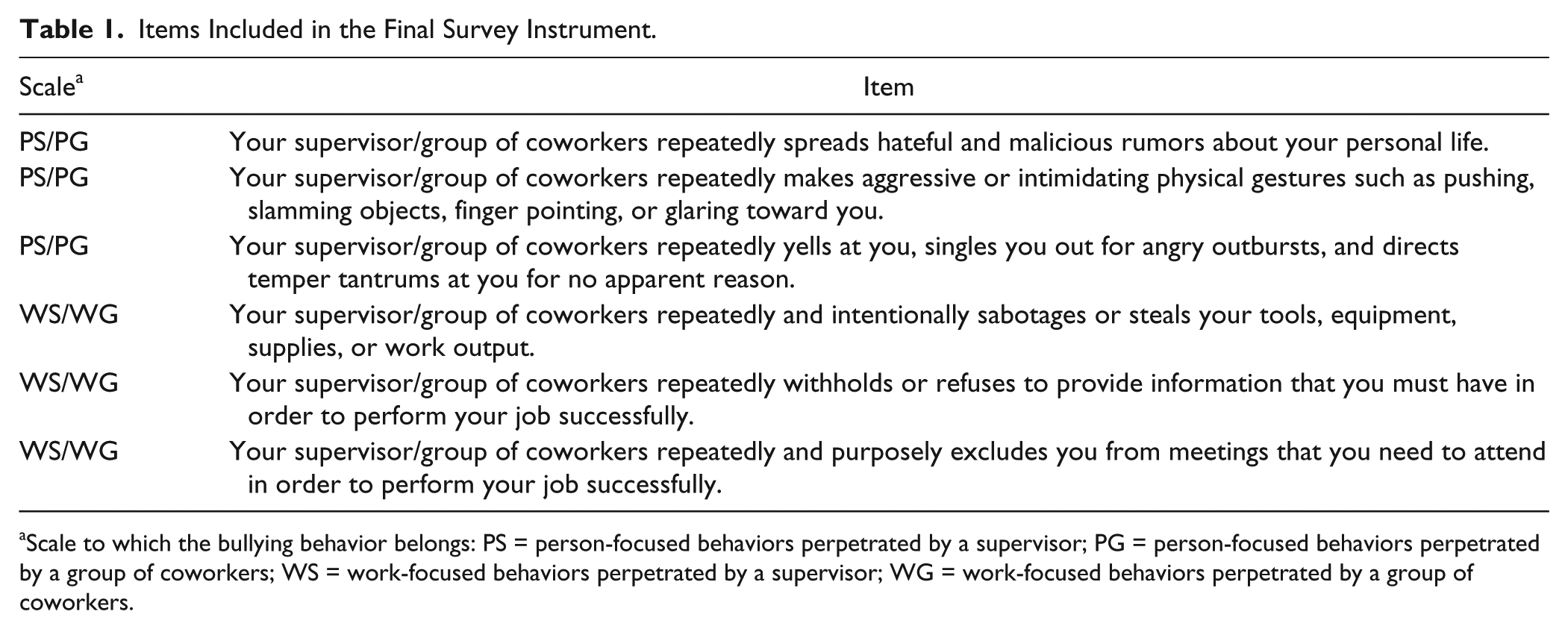
Scale to which the bullying behavior belongs: PS = person-focused behaviors perpetrated by a supervisor; PG = person-focused behaviors perpetrated by a group of coworkers; WS = work-focused behaviors perpetrated by a supervisor; WG = work-focused behaviors perpetrated by a group of coworkers.
In the survey instrument, question stems were phrased as “Your supervisor or group of coworkers repeatedly (commits the specified behavior).” The same six items (three person focused and three work focused) were repeated twice, once for each perpetrator, resulting in 12 total items. Respondents were asked to assess the severity of each behavior identified as bullying using a 9-point Likert-type scale that ranged from 1 (not at all severe) to 9 (as severe as it gets). Respondents were then asked if they had experienced each behavior as a target (yes or no) for a period of 6 months or longer. Four versions of the survey were created, with blocks of items presented in varying orders to control for sequencing and other unwanted systematic effects (Popovich, Licata, Nokovich, Martelli, & Zoloty, 1986).
Sample
The survey was administered to 220 working adults from employers in the Midwest and 299 undergraduate and graduate business students at a large Midwestern university. Only students who reported having more than 3 years of work experience were included in the data analysis to ensure that they could appropriately address the phenomenon under study. Sample characteristics are presented in Table 2. No significant differences in the perception of severity were found based on sample type or experience as a target of bullying, which confirms Escartin et al.’s (2009) finding that severity perceptions are not influenced by study participants’ experience with a phenomenon.
Sample Characteristics.

Measures
Bullying behaviors were categorized by two attributes, perpetrator power position (supervisor or group of coworkers) and focus of behavior (person or work). Perceived severity of bullying behaviors committed by a supervisor and group of coworkers was determined as a scale score of the related items. Averaging the severity scores of relevant items created two perceived severity scale scores. The supervisor scale score was the mean of the six supervisor bullying behaviors (µ = 6.88, α = .807); the group of coworkers scale was the mean of the six group of coworkers bullying behaviors (µ = 6.73, α = .765).
Experience as a target was determined as a summed score of the related items. The supervisor-bully score was the total number of behaviors each respondent reported as having experienced (µ = 0.54, α = .716). The group-bully score was the total number of behaviors each respondent reported as having experienced (µ = 0.56, α = .754). Overall, 35% (166) of the respondents reported having experienced at least one bullying behavior from either a supervisor-bully or a group-bully.
Results
The means and standard deviations for severity scores of each of the 12 bullying behaviors included in the final survey instrument are shown in Table 3.
Means and Standard Deviations of Severity Scores Arranged by Scale.
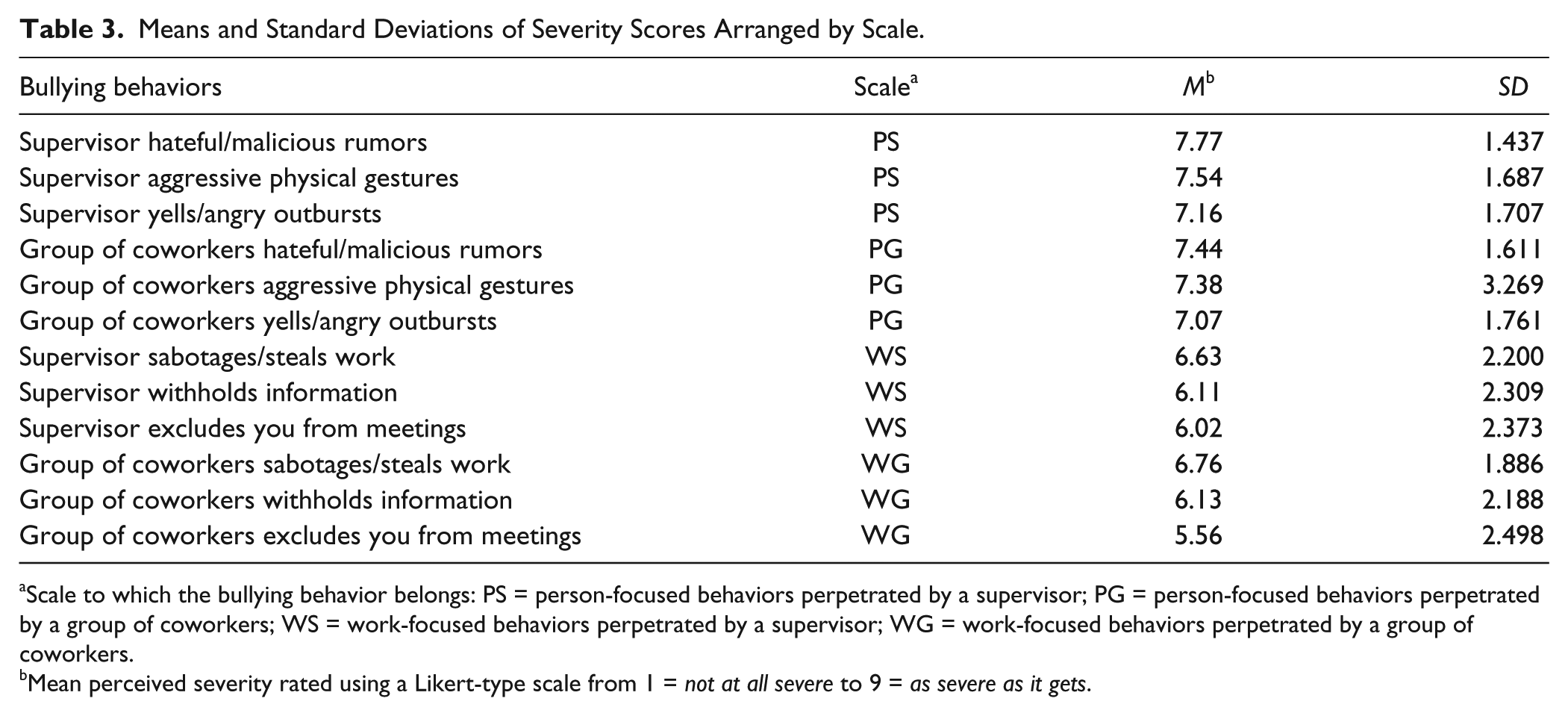
Scale to which the bullying behavior belongs: PS = person-focused behaviors perpetrated by a supervisor; PG = person-focused behaviors perpetrated by a group of coworkers; WS = work-focused behaviors perpetrated by a supervisor; WG = work-focused behaviors perpetrated by a group of coworkers.
Mean perceived severity rated using a Likert-type scale from 1 = not at all severe to 9 = as severe as it gets.
Hypothesis 1 posited that bullying committed by a supervisor would be perceived as more severe than bullying by a group of coworkers. A paired comparison t test was used to compare the mean severity of the six behaviors committed by a supervisor with the mean severity of the six behaviors committed by a group of coworkers. The mean difference between bullying by a supervisor (6.88) and bullying by a group of coworkers (6.73) was 0.148, 95% confidence interval [CL; 0.033, 0.264]. The effect size was small (d = 0.114). A two-tailed paired t test showed that the mean severity of bullying by a supervisor was higher than the mean severity of bullying by a group of coworkers (t = 2.523, p < .012). Hypothesis 1 was supported.
Hypothesis 2 posited that perpetrators would be more likely to bully as a group if the supervisor also bullies. There was a significant positive correlation between the scale scores for the total number of behaviors targets experienced at the hands of a supervisor-bully and a group of coworker bullies (r = .616, n = 439, p = .000), indicating a strong likelihood of co-occurrence of bullying by a supervisor and bullying by a group of coworkers. Hypothesis 2 was supported.
Hypothesis 3 posited that targets of supervisor-perpetrated bullying will experience a greater variety/number of bullying behaviors than targets of group coworker–perpetrated bullying. A paired comparison t test was used to compare the mean number of behaviors experienced by a target when the bully is a supervisor to the mean number of behaviors experienced by a target when the bully is a group of coworkers. The difference between the mean number of behaviors experienced by a target when the bully is a supervisor (0.54) and the mean number of behaviors experienced by a target when the bully is a group of coworkers (0.54) was 0.002, 95% CI [−0.091, 0.095]. A two-tailed paired t test showed that the mean number of bullying behaviors experienced when the bully is a supervisor was not different from the mean number of bullying behaviors experienced when the bully is a group of coworkers (t = −0.048, p < .962). Hypothesis 3 was not supported.
Hypothesis 4 posited that targets of group coworker bullies will experience more person-focused bullying behaviors than work-focused bullying behaviors. A paired comparison t test was used to compare the mean number of person-focused behaviors targets experienced at the hand of a group to the mean number of work-focused behaviors experienced at the hand of a group of coworker bullies. The difference between the mean number of person-focused behaviors (0.248) and the mean number of work-focused behaviors (0.307) was 0.059, 95% CI [0.002, 0.116]. The effect size was small (d = 0.191). A two-tailed paired t test showed that the mean number of person-focused behaviors targets experienced was statistically and practically different (higher) from the mean number of work focused bullying behaviors when committed by a group of coworkers (t = 2.036, p < .042). Hypothesis 4 was supported.
Discussion
To date, little research has been devoted to the investigation of bullying as a group-level occurrence. Our study set out to compare the relative severity and actual experience when the same behaviors are perpetrated by a supervisor or a group of coworkers. Our results indicate that when a supervisor bullies employees, it is perceived to be more severe than when a group of coworkers commits the same bullying behaviors. We extend the work of Hershcovis and Barling (2010), who found that bullying by a supervisor was worse than bullying by a lone peer. Our study considers multiple coworkers as perpetrators and contributes to the overall understanding of the seriousness of the phenomenon. This is meaningful because research has shown that more severe bullying leads to more deleterious consequences for the target(s). When supervisors commit bullying, targets and organizations suffer the greatest damage. Our study shows that even the collective assault by multiple coworkers ganging up on the target does not outweigh the magnitude of harm caused by supervisory abuse.
We further found that members of a work group are more likely to commit bullying if they witness the supervisor doing so. The influence of a supervisor’s behavior cannot be minimized. Consistent with SIT, group members may be driven to behave in ways that will ensure their inclusion in the in-group, particularly if the supervisor actively engages in bullying the target. The role model status of the supervisor pervades the culture of the work environment and demonstrates the behaviors that will be accepted, rewarded, and condoned. Group members who wish to be included will follow the lead of the supervisor and commit bullying behaviors as well.
We conducted exploratory research to investigate the experience of being targeted by a supervisor or a group of bullies. We did not find any significant difference in the number of behaviors that targets experienced at the hands of either perpetrator. While we thought that targets might experience a greater variety of bullying behaviors from supervisor-bullies because of their greater influence over the target’s work situation that was not the case. Perhaps there was a restriction in our study because only six behaviors were included in the instrument, thus limiting the number of behaviors for respondents to consider. The study was designed to assess the same behaviors committed by different perpetrators; however, supervisors have more levers to pull and our instrument may have inadvertently downplayed this reality.
We further investigated the types of behaviors committed by groups of coworkers when they bully a target. As predicted, targets of bullying by groups of coworkers are more often attacked personally rather than having their work attacked. While the magnitude of the finding is small, the results corroborate Mathisen et al. (2011) and confirm that socially or emotionally abusing a target is the more frequent manifestation of group bullying. This is noteworthy because it highlights the need to provide interpersonal skills training and reinforcement in addition to implementing checks and balances at the workplace to ensure successful job performance. Social isolation, rumormongering, and other personal attacks may more easily be dismissed when targets report such behaviors. Yet these actions by peers in the work unit can slowly tear down the target’s self-image and eventual effectiveness on the job.
Our study advances the literature in workplace bullying by confirming the severity of harm caused when supervisors commit bullying in the workplace. We provide empirical evidence of the “follow the leader” propensity for workers to engage in bullying if they witness the supervisor doing so. Targets reported that the experience of being bullied by a supervisor and/or by a group of coworkers was not quantitatively different as the number of bullying behaviors experienced by targets was not determined by the organizational status or number of perpetrators. Targets reported that when they are bullied by groups, the attacks focus more on their personal and social lives rather than their work lives. These findings contribute to the explication of the bullying construct by adding a much-needed perspective of bullying at the group level.
Limitations and Implications
While our findings shed light on some important elements of bullying, the study is not without limitations. Self-report data from a cross-sectional sample may limit the generalizability of our results. The reliance on convenience samples may limit the generalizability of findings in this study. While the use of a student sample may be perceived as a limitation, Baker, Terpstra, and Cutler (1990) found that student assessment of sexual harassment was consistent with working adult assessment of same. Furthermore, Thorsteinson’s (2003) meta-analysis showed that full- and part-time employees report little difference on job satisfaction and other organizational variables. University students were included in this study as they are a vulnerable employee population often with fewer resources to counteract workplace mistreatment while also needing to work in order to pay for schooling (Neill, 2015). They are familiar with bullying behavior as it occurs in schools and via technology—contexts with which they are particularly conversant (Schenk & Fremouw, 2012). Therefore, university students are a valid pool of respondents for research on mistreatment in the workplace. As mentioned previously, the limited number of bullying behaviors included in the study design may have restricted the robustness of the findings because the entire scope of bullying behaviors was not tested.
We close with a discussion of implications for future research and for organization managers. The dearth of previous research on group-level bullying provides a rich landscape in which future studies can be conducted to further explore how the bullying experience differs when a group of workers gangs up on the target. Questions about specific behaviors, frequency of bullying, supervisory involvement, and bully motivations are all important avenues for future research. While the present study considered bullying of individuals within the same work group, it is quite likely that intergroup bullying occurs as well. Future research might focus specifically on bullying within and across groups to identify factors that lead to such behaviors. Because groups and teams are a pervasive structure in modern organizations, it is critical for researchers to understand how negative group-level behavior manifests and how it affects targets.
Organization managers and human resource professionals must heed the call to train supervisors in appropriate workplace behavior. Recognizing the formidable power that supervisory behavior has on work group members means that supervisors must receive ongoing feedback in terms of their supervisor–subordinate interactions and undergo training and performance counseling to prevent negative behavior. On a positive note, supervisors should be recognized and commended for exhibiting positive, healthy interpersonal behaviors and for maintaining a respectful culture within the work group.
Since work group members are also known to join forces and bully others, it is vital to provide interpersonal skills and group dynamics training for all employees. As noted by Skogstad, Torsheim, Einarsen, and Hauge (2011), a poor social work environment fosters bullying in groups. Instituting work group norms of respectful treatment and holding all members accountable through performance assessment can set a tone of appropriate behavior expectations for all. Proactively addressing the issue of group bullying and providing an accessible and responsive reporting process to targets will demonstrate an organization’s commitment to creating a safe, productive work environment. Finally, framing work group behavior within the context of organizational ethics policies and programs will highlight the notion that humane treatment for all employees is part of the broader culture.
Dealing with workplace bullying requires both researchers who undertake the task of explaining the phenomenon to facilitate prevention and courageous organization leaders that tolerate no less than dignified, respectful treatment in the workplace from those in power and all members of the organization. Workplace bullying occurs not only in a downward direction but also laterally among coworkers. Creating a productive work environment means that all members of the organization operate in a professional, caring manner toward each other, regardless of their status within the formal hierarchy. Promoting workplace harmony is more than a “nice to have” in modern organizations. When harassment, bullying, incivility, and other disrespectful behavior go unchecked, organizations underperform and lose valuable talent. Turning a blind eye to a hostile environment is likely to lead to additional unethical behaviors by setting a tone of tolerance for inappropriate conduct. Organization leaders and other stakeholders must demonstrate intolerance for such unethical and damaging behavior and drive employees to act with dignity and respect in all matters.
Footnotes
Declaration of Conflicting Interests
The author(s) declared no potential conflicts of interest with respect to the research, authorship, and/or publication of this article.
Funding
The author(s) received no financial support for the research, authorship, and/or publication of this article.