




Abstract
This study examines whether work engagement enriches employees beyond the contribution of the domain of work, focusing on satisfaction with life and community involvement. Moreover, the ambivalence of scholars about the added value of the work engagement concept compared with similar work-related attitudes prompted us to assess the benefits that work engagement offers with regard to improving one’s satisfaction with life and community involvement compared with the benefits of other, similar work-related attitudes such as job involvement and job satisfaction. Furthermore, given the studies indicating the impact of sector of employment (public vs. business) on understanding the work/nonwork nexus, the current study also investigates the effect of the sector of employment on this enrichment process. Utilizing multilevel modeling analysis techniques on data from 554 employees in public and business sector organizations, we obtained results consistent with our hypotheses. Work engagement and employees’ outcomes beyond work had positive and significant relationships. Moreover, the relationship between work engagement and community involvement was stronger in public sector employees than in business sector employees. The implications for organizational theory, research, and practice are discussed as possible leverage points for creating conditions that promote engagement at work and beyond.
Introduction
Organizational research is abuzz with the concept of “work engagement,” pointing to it as redefining the employee–organization relationship and underscoring its contribution to organizational outcomes and effectiveness (e.g., Bakker, Albrecht, & Leiter, 2011; Macey & Schneider, 2008; Rothbard & Patil, 2010; Schaufeli & Bakker, 2010). Traditionally, studies tend to link work-related variables such as work engagement with outcomes within the same domain (i.e., work and organizational variables), raising the question of whether positive work attitudes also manifest themselves in a similar manner beyond the realm of work. However, while recent studies have indicated that work engagement is a significant factor in enhancing work outcomes (e.g., Bakker, Demerouti, & Brummelhuis, 2012; Demerouti & Cropanzano, 2010; Halbesleben & Wheeler, 2008; Rich, LePine, & Crawford, 2010; Xanthopoulou, Bakker, Demerouti, & Schaufeli, 2009), little is known about its contribution to employees’ outcomes beyond work, which is an indication of the dearth of studies about the spillover of work outcomes outside of work in general (e.g., Rothbard, 2001).
Indeed, scholars have argued theoretically about the potential contribution of engagement beyond the workplace (Bakker & Leiter, 2010; Bakker & Schaufeli, 2008; Schaufeli, Salanova, Gonzalez-Roma, & Bakker, 2002), but with the exception of two studies on the relationship between work outcomes and the family (Rothbard, 2001; Siu et al., 2010), there is a lack of studies about the spillover of work engagement into other areas of life. Moreover, while research into the spillover of work outcomes outside of work has drawn primarily on the depletion perspective and investigated negative spillovers (e.g., work/family conflicts and stress; Eby, Casper, Lockwood, Bordeaux, & Brinley, 2005; Edwards & Rothbard, 2000; Rothbard, 2001), it has overlooked another significant process—the enriching effect of work engagement on employees’ lives.
This study seeks to fill these gaps by examining how work engagement affects employees beyond the sphere of work, focusing on their satisfaction with life and community involvement. Such an examination presents a broader picture of the contributions of engagement at work and beyond (Bakker & Leiter, 2010; Bakker & Schaufeli, 2008). To the best of our knowledge, this is the first attempt to investigate how engagement at work fosters one’s life outside of work with regard to the individual’s well-being (satisfaction with life) and the impact on communal well-being (community involvement). Moreover, the ambivalence of scholars about the added value of the work engagement concept compared with similar work-related attitudes (e.g., Christian, Garza, & Slaughter, 2011; Griffin, Parker, & Neal, 2008) encouraged us to assess the benefits that work engagement offers with regard to improving one’s satisfaction with life and community involvement compared with the benefits of other, similar work-related attitudes such as job involvement and job satisfaction. Furthermore, given the studies indicating the differences in the impact of working in the public or business sector on understanding the work/nonwork nexus, we also investigated the effect of the sector in which the employee works on this enrichment process (e.g., Parasuraman & Greenhaus, 2002 ; Grzywacz & Marks, 2000a, 2000b). By demonstrating the positive effect of engagement on employee well-being and community involvement, we might find answers to contemporary dilemmas such as social involvement, extended working hours, and the work/life conflict, dilemmas that present new challenges for employees and organizations in creating a more fruitful interface between work and nonwork.
Theoretical Conceptualization and Hypotheses
Work Engagement as Enriching the Satisfaction With Life
Work engagement refers to one’s active allocation of personal resources and energies in performing one’s job (Bakker & Leiter, 2010). It has become a critical factor in organizational behavior ever since studies established its contribution to the performance and prosperity of organizations (Christian et al., 2011; Rich et al., 2010). In his seminal work, Kahn (1990) defines engagement as “the simultaneous employment and expression of a person’s preferred self in task behaviors that promote connections to work, personal presence (physical, cognitive, and emotional) and active full performances” (p. 700). Thus, from Kahn’s (1990, 1992) perspective, work engagement is best described as a motivational concept reflecting the simultaneous and holistic expression of an employee’s physical, emotional, and cognitive energy in a work role. Schaufeli et al. (2002) defined work engagement as a positive, fulfilling, motivational state of mind characterized by vigor, dedication, and absorption. Vigor refers to high levels of physical energy. Dedication refers to being emotionally involved in one’s work and experiencing a sense of enthusiasm, inspiration, and pride. The third component, absorption, involves cognitive concentration on one’s work to the point of experiencing time as passing quickly (Schaufeli et al., 2002). Building on earlier seminal conceptualizations of work engagement (e.g., Kahn, 1990; Schaufeli et al., 2002), Shuck and Wollard (2010) devised a similar definition of work engagement as “an individual employee’s cognitive, emotional, and behavioral state directed toward desired organizational outcomes” (p. 103). In sum, work engagement is an active, fulfilling, motivational concept. Indeed, an agreement in the literature seems to be emerging that work engagement refers to the simultaneous expression of multiple investments of physical (vigor), affective (dedication), and cognitive (absorption) resources in work. Our contribution to the literature is in arguing and demonstrating that beyond fostering the prosperity of organizations, work engagement also enriches the employees’ lives as well in terms of their satisfaction with life and community involvement.
Our model positions work engagement as a key mechanism in creating positive affect and a sense of purpose, and proposes satisfaction with life as a desirable, positive result emanating from it. Satisfaction with life is defined as the individual’s appraisal of his or her overall degree of contentment with life (Pavot & Diener, 1993). Our argument that work engagement can increase one’s satisfaction with life is based on Fredrickson’s (2001) broaden-and-build theory, which maintains that the experience of positive feelings such as joy, interest, challenge, enthusiasm, and inspiration can expand the individual’s attention, thought processes, and actions, all of which build enduring psychological and social resources that promote emotional well-being (Fredrickson, 2003; Fredrickson & Branigan, 2005; Fredrickson & Joiner, 2002). For instance, joy expands resources by promoting the urge to be outgoing and helpful to others, and more sensitive to opportunities in life (Cropanzano & Wright, 2001). Interest fosters the desire to explore and assimilate new information and experiences (e.g., Fredrickson & Losada, 2005). Indeed, studies have shown that inducing positive feelings and experiences expands the scope of visual attention and broadens the repertoires of other positive attitudes at work and beyond (Cropanzano & Wright, 2001; Fredrickson & Branigan, 2005; Schaufeli et al., 2001). Based on Fredrickson’s (2001) broaden-and-build theory, we argue that work engagement that embraces positive, challenging, meaningful, and inspiring work experiences will generate a broad spectrum of positive thinking and feelings, and build the personal resources that help individuals achieve their personal goals and aspirations, improving their satisfaction with life in general.
Moreover, research on positive spillover (Bakker & Schaufeli, 2008; Edwards & Rothbard, 2000; Rothbard, 2001) and work/nonwork enrichment (Greenhaus & Powell, 2006) has defined the positive effect that work can have on other domains in an employee’s life such as the transfer of people’s multidimensional resources from one domain to another, thereby benefitting them and improving their functioning in the other domain (Rothbard, 2001). Therefore, work engagement may also promote satisfaction with life because it fosters personal growth and development, provides the individual with psychological, social, and cognitive resources such as self-efficacy, self-esteem, social contacts, and knowledge (Albrecht, 2010; Bakker et al., 2011; Kahn, 1990, 1992; Rothbard, 2001; Rothbard & Patil, 2010), and thus triggers upward spirals of resources toward satisfaction with life. To date, to the best of our knowledge, no study of work engagement has examined its positive potential to improve employees’ satisfaction with life. Thus, we posit that
Work Engagement as Enriching Community Involvement
Work engagement may also be significant in the wider community context (Macey & Schneider, 2008; Schaufeli et al., 2001). In addition to striving for engaged employees, we must also look for and encourage the engagement of citizens in their communities. Community involvement refers to the activities of individual citizens such as belonging to community associations and school committees, and taking part in cultural activities aimed at influencing the community (Verba & Nie, 1972). According to the spillover theory (Wilensky, 1960), perceptions, attitudes, and behaviors in one’s social setting can be manifested in another setting as a reflection of one’s skills and experience. In other words, work-related activities and involvement provide an employee with the skills and desires to participate in other domains of life in general and social life in particular (Cohen & Vigoda, 1998; Vigoda-Gadot, Mizrahi, Miller-Mor, & Tevet, 2008). Therefore, when employees are engaged in their work, these positive feelings and energies will likely spill over into the community domain (Golembiewski, 1995; Sobel, 1993). In line with the positive psychology approach (Seligman & Csikszentmihalyi, 2000) and positive spillover research (Bakker & Schaufeli, 2008; Grzywacz & Marks, 2000a, 2000b; Lazarova, Westman, & Shaffer, 2010), the enriching trade-offs between work and other domains of life are conceptualized as “the extent to which experiences in one role improve the quality of life in the other role” (Greenhaus & Powell, 2006, p. 73). According to Greenhaus and Powell’s (2006) model, knowledge, skills, and resources in one role such as work directly improve performance in another area such as the family. Here, we argue that the resources, positive affect, and involvement at work exemplified by a high degree of work engagement, spill over into—and are utilized in—the communal domain.
There are two reasons for postulating a positive relationship between work engagement and community involvement. First, positive feelings are associated with benevolence, generosity, and increased assistive behavior (George, 1991; Schaufeli et al., 2001). Second, engagement in the workplace may provide resources to individuals such as social contacts, self-esteem, knowledge, and self-efficacy that can prove valuable in other domains (Kahn, 1990, 1992; Rothbard, 2001) and enhance individuals’ communal functioning (Cohen & Vigoda, 1998). To date, to the best of our knowledge, no study has examined the positive spillover potential of work engagement and its significance in the communal domain. Thus, we posit that
The Contribution of Work Engagement Over and Above Job Satisfaction and Job Involvement
According to Greenhaus and Powell (2006), the enrichment spillover can occur in three separate dimensions: (a) behavioral enrichment in which skills or behaviors acquired at work help the individual achieve goals or perform better in other areas, (b) affective enrichment in which positive moods in one role create positive moods in other roles, and (c) cognitive enrichment in which values developed and applied in one domain transform and enrich those in another area of one’s life. We argue that the concept of work engagement may provide a more comprehensive explanation for positive spillovers than other work-related attitudes such as job satisfaction and job involvement. Job satisfaction refers to “a pleasurable or positive emotional state resulting from the appraisal of one’s job” (Locke, 1976, p. 1300) and can be conceptualized in terms of affective enrichment, while job involvement, defined as a “cognitive or belief state of psychological identification” (Kanungo, 1982, p. 342), is based on another aspect of the employee’s enrichment in terms of cognitive energy. In contrast, work engagement encompasses all three aspects of Greenhaus and Powell’s (2006) dimensions. While these explanations that are either affective or cognitive could also account for the employees’ enrichment, they do not account for the simultaneous and holistic behavioral, affective, and cognitive employee enrichment embodied in the concept of work engagement (Kahn, 1992; Schaufeli et al., 2002).
According to Hobfoll’s (1989, 2001) conservation of resources theory, employees seek to accumulate and retain the resources that are desirable and instrumental in realizing higher order goals and improving their well-being. This phenomenon, which Hobfoll (1989) labelled “gain spirals,” is plausible, because when initial gains are made, even greater resources become available, providing employees with a surplus that they can invest (Hobfoll, Johnson, Ennis, & Jackson, 2003) which lead to positive outcomes (Hobfoll, 2001, 2002). Using this idea along with Greenhaus and Powell’s (2006) enriching spillover explanation may help us understand the enriching effect of work engagement above and beyond job satisfaction and job involvement. By conceptualized work engagement as a state in which employees simultaneously have physical, emotional, and cognitive resources at hand, we can view engaged employees as those who are in a better position to invest their resources in a manner that spills over more comprehensively into nonwork outcomes such as satisfaction with life and community involvement. Job satisfaction and job involvement may also relate to these areas. However, given that both are based on a single aspect of the resource enrichment of the self (affective and cognitive, respectively), they do not account for employees’ ability to invest their physical, affective, and cognitive resources in the simultaneous and holistic manner that characterizes work engagement. Therefore, we suggest:
The Relationship Between Work Engagement and Community Involvement: The Moderating Role of Sector of Employment
Differences between the public and the business sectors are well documented in the literature (e.g., Dye, 1995; Rainey, 2003). While the main purpose of the former is to provide services to society and its citizens, the business sector generally seeks to maximize financial gains (Ghobadian, Gallear, Viney, & O’Regan, 2007). The public sector’s mission is to implement social and public policies. This unique sense of purpose calls for committed, involved, and engaged employees who serve rather than simply do the job. Indeed, the person–organization fit theory argues that employees seek work in professions or organizations that accord with their own individual attitudes (Judge & Bretz, 1992). Additional support for this thesis comes from a recent research approach called public sector motivation (Moynihan & Pandey, 2007; Wright, 2004; Wright & Pandey, 2008). It stipulates that individuals who seek work in the public sector are fundamentally motivated by and identify with the interests of society and serving the public, and therefore may be predisposed to “respond to motives grounded primarily or uniquely in public organizations” (Perry & Wise, 1990, p. 368). The enjoyment or self-satisfaction associated with serving and benefiting society and helping the needy becomes a driving motivation.
Thus, we expect to find differences between public and business sector employees with regard to the relationship between work engagement and community involvement. The drive to serve society and the sense of mission among public employees may encourage higher levels of performance not only at work but also beyond it, leading to greater involvement in their community life and activities. Moreover, by definition, work engagement consists of mission-related characteristics such as dedication, absorption, and devotion (Schaufeli, Bakker, & Van Rhenen, 2009; Schaufeli et al., 2002), which are the core goals and characteristics of public service employees. Furthermore, previous studies have consistently found that public sector employees value helping others and making a contribution to society more than business sector employees (Frank & Lewis, 2004; Karl & Sutton, 1998; Lewis & Frank, 2002). Accordingly, we expect that the relationship between work engagement and community involvement will be stronger among public sector employees than among business sector employees. Therefore, we propose:
Method
Sample and Procedures
We devised a questionnaire that we distributed among 746 employees in 12 Israeli organizations (9 from the business sector and 3 from the public sector). These organizations included a wide variety of fields such as manufacturing, technology, health care, services, and finance and differed in terms of their number of employees and geographical locations. After eliminating the questionnaires with missing values, the final sample consisted of 554 participants who had full questionnaires (a 76% response rate). The participants were very heterogeneous in all demographic and occupational aspects, encompassing a wide range of ages, educational levels, seniority, and occupations. With regard to gender, 37% of the sample was female, and the average age was 38 (standard deviation of 10.47 years). Most of the sample was married (63%). On average, the participants had 15 years of education (standard deviation of 2.73 years). The average of seniority in the organization was 6.41 years (standard deviation of 8.81 years), and the overall seniority was 14.73 years on average (standard deviation of 10.57 years).
The employees answered questions about their work attitudes with regard to their engagement with their work, job satisfaction and job involvement, and their attitudes outside of work such as satisfaction with life and community involvement. To increase the participation rate, the survey was advertised within the workplace in multiple ways (e.g., e-mails from the executive management and team meetings) along with an explanation of its contribution to the organization and the employees, and a specific promise of full confidentiality. In addition, several days prior to the data collection stage, the researchers sent out a personal e-mail to all of the employees with the following details: the academic background of the researchers, the purpose of the study, a further guarantee of complete secrecy, and an assurance that the data would be used only for the purpose of the study. To maximize the return rate and increase employees’ trust, the researchers themselves distributed the questionnaires and collected the data in the workplace without any involvement of the organizations’ managers or HR personnel of any level. All of the questionnaires were collected immediately on completion, which increased the return rates.
Measures
Work Engagement
We used the short version of the Utrecht Work Engagement Scale, validated by Schaufeli, Bakker, and Salanova (2006), which relies on the definition and validity of Schaufeli et al.’s (2002) long version. The short scale includes nine items pertaining to three different enriching factors: vigor (i.e., physical), dedication (i.e., emotional), and absorption (i.e., cognitive). Previous studies have established the validity of the Hebrew version we used (Vigoda-Gadot, Eldor, & Schohat, 2013). Recent confirmatory factor analyses have supported the one-factor structure of Utrecht Work Engagement Scale–9 (e.g., Bakker et al., 2011; Bakker et al., 2012; Hallberg & Schaufeli, 2006; Schaufeli et al., 2006). The respondents were asked to rank their answers on a 5-point Likert-type scale ranging from 1 (never) to 5 (always). Sample items are “At my work, I feel I am bursting with energy” (vigor); “My job inspires me” (dedication); and “It is difficult to detach myself from my job” (absorption). The internal reliability coefficient was .90.
Job Satisfaction
We measured job satisfaction using four items from Schriesheim and Tsui’s (1980) Job Satisfaction Scale. Respondents were asked to rank their answers on a 5-point Likert-type scale ranging from 1 (do not agree at all) to 5 (strongly agree) about their satisfaction with their current job, salary, opportunities for promotion, and work in general. Sample items are “I am satisfied with my current job” and “In general, I am satisfied with my job.” The internal reliability coefficient was .81.
Job Involvement
We measured job involvement using three items from Kanungo’s (1982) Job Involvement Scale. The scale ranged from 1 (do not agree at all) to 5 (strongly agree). Sample items are “Most of my interests are centered on my job” and “The most important things that happen to me involve my present job.” The internal reliability coefficient was .83.
Satisfaction With Life
We used five items from Diener, Emmons, Larsen, and Griffin’s (1985) Satisfaction With Life Scale. The items were ranked on a 5-point Likert-type scale ranging from 1 (strongly disagree) to 5 (strongly agree). A sample item is “In most ways, my life is close to my ideal.” The internal reliability coefficient was .84.
Community Involvement
We used Burns, Schlozman, and Verba’s (1997) seven-item scale to measure community involvement. The respondents were asked to evaluate the degree of their involvement in community affairs ranked on a 5-point Likert-type scale: 1 (not at all characteristic) to 5 (highly characteristic). A sample item is “I participate in community cultural activities.” The internal reliability coefficient was .90.
Sector of Employment (The Moderating Variable)
We coded public sector employees as 0 and business sector employees as 1.
Data Analysis
We used a multilevel model (MLM) analysis to measure the variance arising from the dependence between observations. Given that employees in the same workplace work together and share the same experiences, such an analysis is an appropriate method (Klein & Kozlowski, 2000). In the current study, the 554 sampled employees came from 12 organizations. Therefore, the assumption of independence between observations does not exist. Moreover, we determined the existence of this dependence by conducting a one-way analysis of variance. In other words, we estimated a null model of each of the study’s dependent variables, which provides a statistical test of between-group variance estimates, namely, the ICC1 (intraclass correlation coefficient; Castro, 2002; Grawitch & Munz, 2004; Klein & Kozlowski, 2000). The ICC1 values for the study’s dependent variable were ICC1 Satisfaction With Life = .04 and ICC1 Community Involvement = .15 (the minimal criterion is .05; Bliese, 2000), and the random variance effect was significant for both of these variables (p ≤ .001). Given that dependency between the sample observations exists, we conducted an MLM analysis using the HLM7 software package (Raudenbush, Bryk, Cheong, Congdon, & Du Toit, 2011) to test our hypotheses. In addition, to test Hypothesis 4, we followed Preacher, Curran, and Bauer’s (2006) guidelines for estimating indirect effects and probing moderating effects. We then analyzed two slopes, one for each type of sector of employment for the relationship between work engagement and community involvement. Prior to this stage, following the recommendation of Aiken and West (1991) for assessing interaction effects, we centered the independent variable (i.e., group mean) to remove the multicollinearity introduced by the interaction effects.
Findings
Table 1 presents the means, standard deviations, and correlations (Pearson’s r) between the study’s main variables. As Table 1 shows, there was a positive and significant relationship between work engagement and satisfaction with life (r = .44, p ≤ .001) and work engagement and community involvement (r = .18, p ≤ .001), respectively. These findings provide preliminary support for the hypotheses dealing with the direct relationships. Although the results showed moderate to strong relationships between work engagement and the similar work-related variables of job satisfaction (r = .55, p ≤ .001) and job involvement (r = .37, p ≤ .001), they still indicate the nonexistence of multicollinearity (r ≥ .08) with these similar variables (see the recommendations of Field, 2005).
Descriptive Statistics, Intercorrelations (Pearson’s r), and Reliabilities (Cronbach’s α in Parentheses) of the Main Variables of the Study (N = 554).
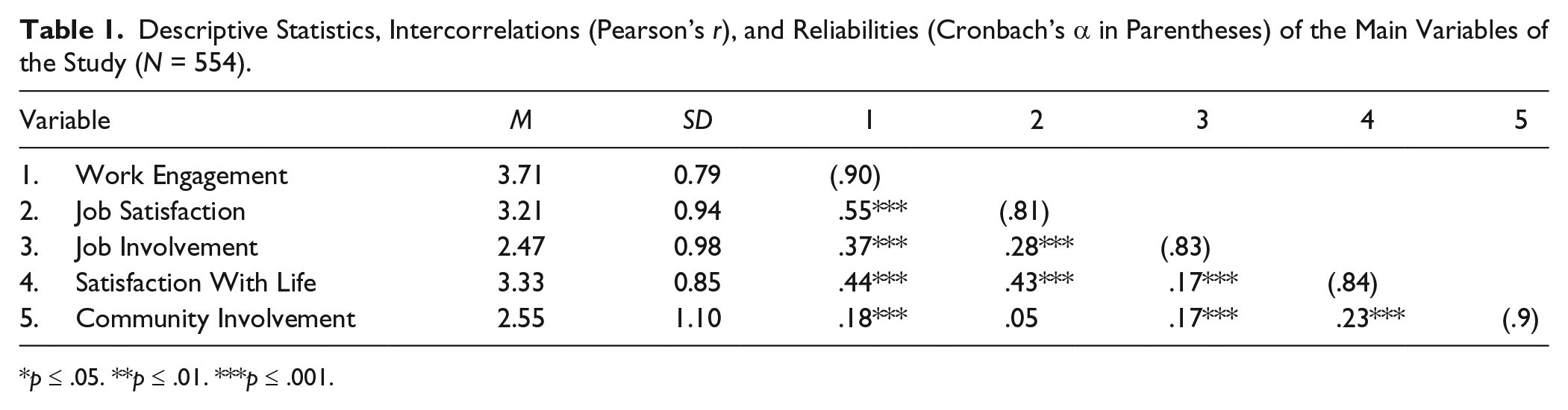
p ≤ .05. **p ≤ .01. ***p ≤ .001.
Before testing Hypotheses 1 to 3, we created a model containing only the control variables—gender, age, education, and seniority. This was an important step in showing that the impact of work engagement, the main independent variable, on each dependent variable is above and beyond that of the control variables, because previous studies have demonstrated associations between these variables and employees’ expressions about their well-being (Diener et al., 1985; Morrison, Erickson, & Dychtwald, 2006; Pavot & Diener, 2008).
To test Hypotheses 1 and 2, we ran two multilevel hierarchical regression models for each hypothesis, in which work engagement was considered the independent variable. The first regression model (Model 1) includes only the control variables, whereas the second regression model (Model 2) contains the work engagement variable as well. Table 2 presents the results of these analyses. Hypothesis 1 assumes a positive relationship between work engagement and satisfaction with life. As Model 2 indicates, work engagement has a significant, positive impact on satisfaction with life at the employee level (estimate = 0.470, p ≤ .001), above and beyond Model 1, which includes only the control variables (ΔR2 = .17, p ≤ .001). Thus, Hypothesis 1 is supported. Hypothesis 2 assumes a positive relationship between work engagement and community involvement. As we can see, Model 4 (Table 2) indicates that work engagement also has a significant, positive impact on community involvement at the employee level (estimate = 0.290, p ≤ .001), above and beyond Model 3, which contains only the control variables (ΔR2 = .04, p ≤ .001). Thus, Hypothesis 2 is supported.
MLM Analyses of the Effect of Work Engagement on Outcomes Beyond the Workplace: Satisfaction With Life and Community Involvement.

Note. MLM = multilevel model; SE = standard error. N = 554.
p ≤ .05. **p ≤ 0.01. ***p ≤ .001.
Table 3 presents the results of the analyses for the examination of Hypothesis 3, which suggests that work engagement contributes to each of the beyond-work dependent variables—satisfaction with life (Hypothesis 3a) and community involvement (Hypothesis 3b)—above and beyond similar work-related attitudes such as job satisfaction and job involvement. To test Hypotheses 3a and 3b, we ran two multilevel hierarchical regression models for each of the two dependent variables. The first regression model (Model 5 and Model 7) includes the control variables of gender, age, education and seniority, and the two similar work-related variables (job satisfaction and job involvement). In the second regression model (Model 6 and Model 8), we added the work engagement variable as well. Table 3 presents the results of these analyses. Hypothesis 3a assumes that work engagement will contribute to satisfaction with life above and beyond job satisfaction and job involvement. As Model 6 indicates, adding work engagement (estimate = 0.316, p ≤ .001) to the equation significantly increases the explained variance (ΔR2 = .7, p ≤ .001) from Model 5, which includes only the control variables and two work-related variables. Hypothesis 3b assumes that work engagement will contribute to community involvement above and beyond job satisfaction and job involvement. As Model 8 demonstrates, including work engagement (estimate = 0.280, p ≤ .001) in the equation significantly increases the explained variance (ΔR2 = .03, p ≤ .001) from Model 7, which includes only the control variables and two similar work-related variables. Thus, Hypothesis 3 is supported in its entirety.
MLM Analyses of the Effect of Work Engagement on Outcomes Beyond Workplace Above and Beyond Similar Work-Related Attitudes.
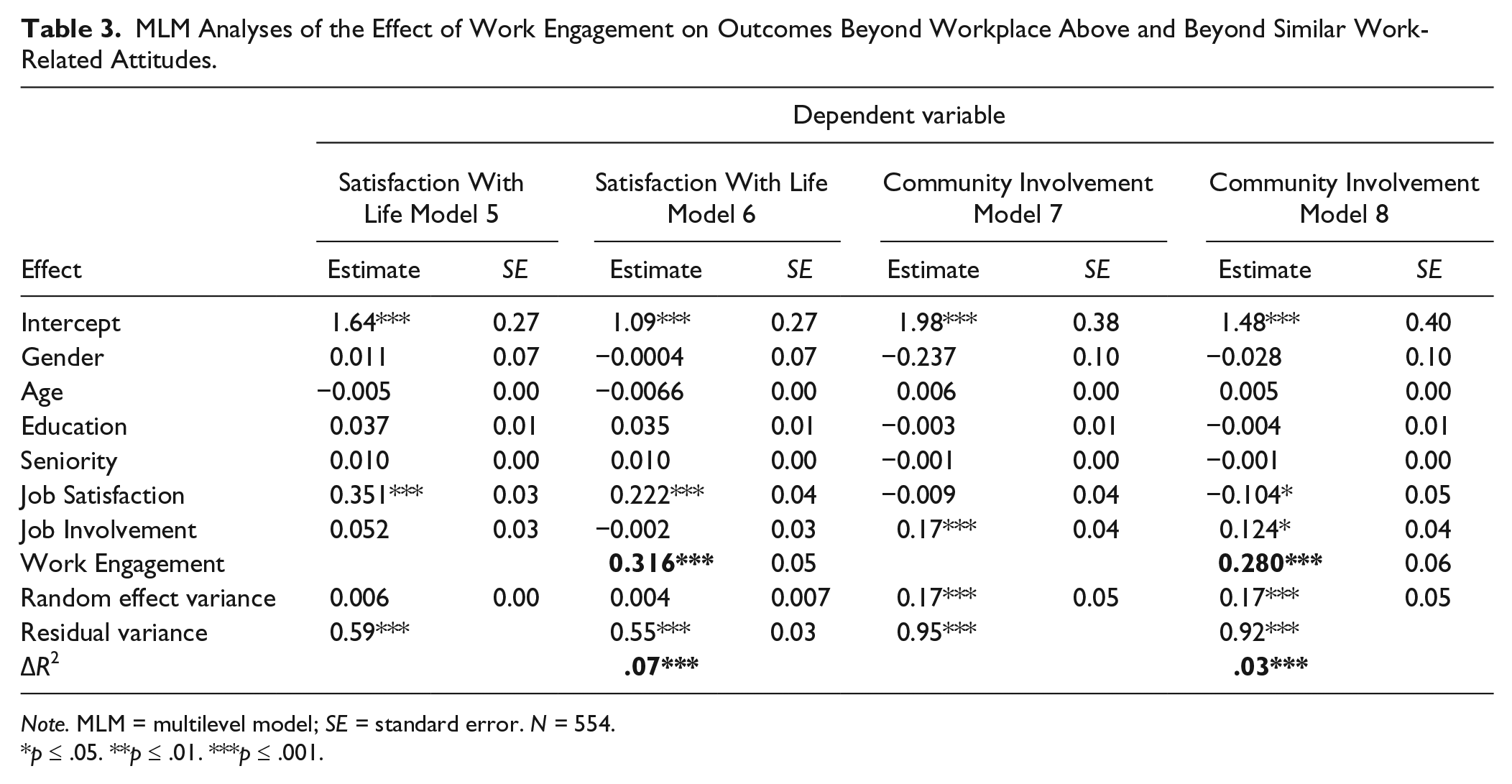
Note. MLM = multilevel model; SE = standard error. N = 554.
p ≤ .05. **p ≤ .01. ***p ≤ .001.
Table 4 presents the results for Hypothesis 4 that predicts that the sector of employment will have a moderating effect on the relationship between work engagement and community involvement. Specifically, we hypothesized that the relationship between work engagement and community involvement would be stronger for public sector employees than business sector employees. Following the recommendations of Aiken and West (1991) for conducting a moderation analysis and with an adjustment for multilevel analysis modeling (Preacher et al., 2006), the independent variable, work engagement, was mean-centered. To test Hypothesis 4, we ran two multilevel hierarchical regression models. The first regression model (Model 9) includes the control variables, the independent work engagement variable and the moderating variable being tested (sector of employment). In the second regression model (Model 10), we added the interaction variable as well by multiplying work engagement by the sector of employment.
MLM Analyses of the Moderation Effects of Employment Sector on the Relationship Between Work Engagement and Community Involvement.
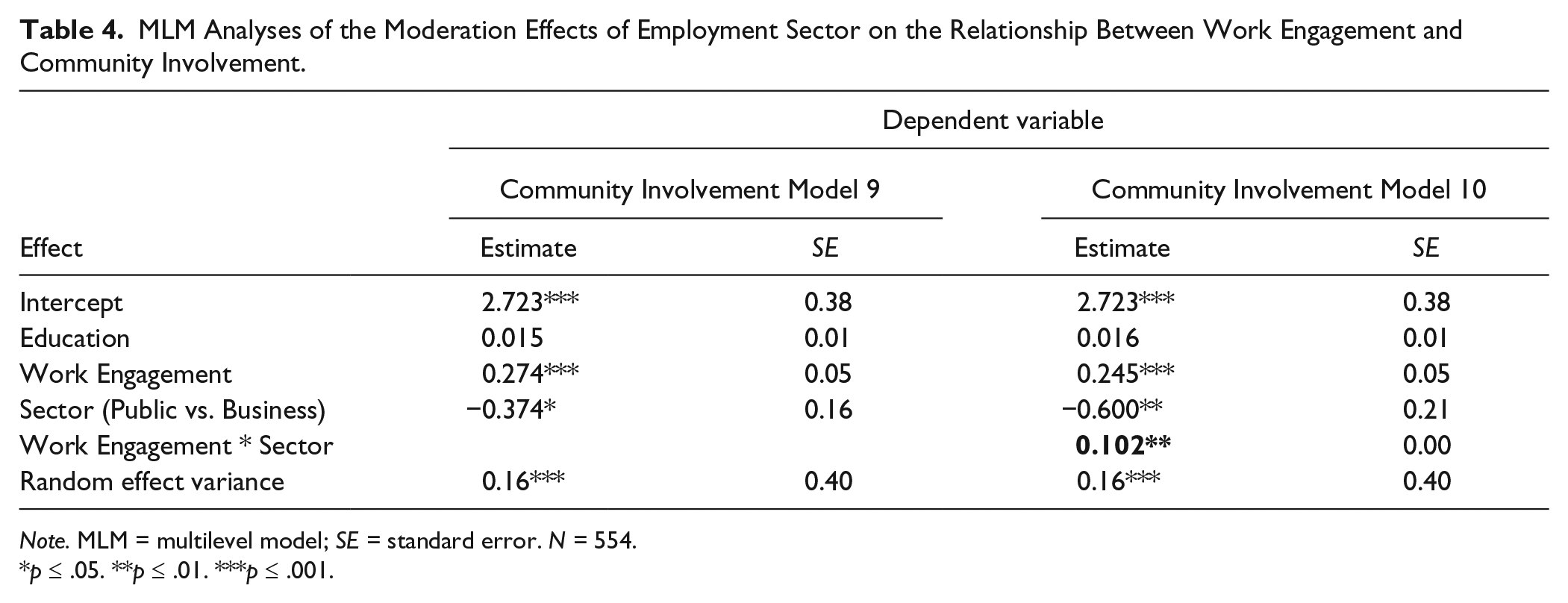
Note. MLM = multilevel model; SE = standard error. N = 554.
p ≤ .05. **p ≤ .01. ***p ≤ .001.
Results demonstrate that the interactive effect of work engagement and sector on community involvement is significant (estimate = 0.102, p ≤ .001). Following Preacher et al.’s (2006) guidelines for probing moderation effects in MLMs, we analyzed two slopes of the sector employment variable: one for the public sector and another for the business sector. Plotting the results and evaluating the simple slopes clearly reveals that as predicted, in both the public (b = 0.39, standard error = 0.09, t = 4.02, 95% confidence interval [0.20, 0.58]) and business (b = 0.11, standard error = 0.05, t = 2.08, 95% confidence interval [0.006, 0.21]) sectors, the relationship between work engagement and community involvement is significantly positive. As Figure 1 illustrates, in public sector organizations, the relationship is significantly stronger than in business organizations. Thus, Hypothesis 4 is supported.

Interactive effect of work engagement and employment sector on community involvement.
Discussion
The goal of the study was to examine the contribution of work engagement beyond the workplace domain, suggesting that the positive impact of engagement is not confined to the realm of work but spills over into employees’ personal life. Specifically, our findings indicate that the way employees feel about their work (i.e., engaged) is associated with the attitudes they have about their life beyond work: their satisfaction with life and their involvement in the community. These findings contribute to the work engagement literature by pointing out the enriching potential of engagement at work and its functionality in the permeable nature of the work/nonwork boundaries (Rothbard, 2001). To date, engagement has been examined primarily in the workplace context, and there is a noticeable lack of theory and research about the means by which engagement can also create added value beyond work and enrich other domains of an individual’s life (Bakker & Leiter, 2010; Bakker & Schaufeli, 2008; Rothbard, 2001). Moreover, the literature has already pointed out that the research about work/nonwork spillovers, particularly positive spillovers, is scarce (e.g., Edwards & Rothbard, 2000; Greenhaus & Powell, 2006; Rothbard, 2001; Siu et al., 2010). While the role of conflict and stress is a dominant theme in the literature about the work–beyond work interface, which assumes that work and nonwork roles detract from one another (Rothbard, 2001), this study’s findings indicate that the different domains of an individual’s life can also be interrelated, with the benefits associated with engagement in one’s work spilling over into other areas.
A significant finding of this study is the positive and strong relationship between work engagement and satisfaction with life, which is consistent with the broaden-and-build theory of positive emotions (Fredrickson, 2001). Linking work engagement and satisfaction with life suggests that positive, challenging, and meaningful work experiences generate a broad spectrum of positive thinking and feelings in life in general, build personal resources, and help individuals achieve their personal goals and aspirations (Fredrickson, 2002, 2003). Moreover, the notable contribution of engagement to the explained variance of satisfaction with life underscores the important role of work as a determinant of an individual’s satisfaction with life.
Another contribution of our study is that it emphasizes the relationship between work engagement and community involvement, underscoring that feelings, energies, and behaviors acquired in the workplace can be transformed into general codes of behavior in the community (Wilensky, 1960). Specifically, our results support and expand Greenhaus and Powell’s (2006) model of the enriching trade-offs between work and other areas of life. Several of the arguments posed by Rothbard (2001) and Siu et al. (2010) in explaining the relationship between engagement at work and the family domain also support our findings about the spillover between work and community domains. First, engagement in the workplace may provide benefits to individuals such as social contacts, knowledge, self-esteem, and self-efficacy that prove to be valuable resources for successful communal functioning and enhance their performance in social domains other than their work (Salanova, Llorens, & Schaufeli, 2011; Salanova, Schaufeli, Xanthopoulou, & Bakker, 2010). In addition, positive emotions are associated with an outward focus of attention: When people are happy, they report increased fondness toward others and are more willing to initiate and offer help (Isen & Baron, 1991; Wood, Saltzberg, & Goldsamt, 1990). Finally, the presence of energy, positive emotions, and meaningful enrichment suggests that the individual may have more personal resources that he or she can invest in another role (Hobfoll, 1989; Marks, 1977). These arguments highlight the importance of our finding regarding the spillover of the engagement at work into community life, because it is usually rare to find research on the relationship between an emotional attitude at work and a behavioral outcome in the community sphere.
Furthermore, our findings reveal that focusing on work engagement produces a more effective work-related attitude than job attitudes such as job satisfaction and job involvement. Consistent with Greenhaus and Powell’s (2006) theoretical proposition that behavioral, emotional, and cognitive experiences at work have also the potential enrich beyond-work attitudes, our results demonstrate the likelihood that these experiences will enrich the gains from one role to another role when these experiences occur simultaneously and in a holistic way (i.e., work engagement; Kahn, 1992; Schaufeli et al., 2002). As mentioned in the introduction, scholars are ambivalent about the added value of work engagement as a predictor of various work outcomes compared with parallel concepts about the employee–organization relationship (e.g., Griffin et al., 2008; Vigoda-Gadot et al., 2013). Some scholars have argued that work engagement is no more than a blend of old wine in a new conceptual bottle (e.g., Dalal, Brummel, Wee, & Thomas, 2008; Griffin et al., 2008; Newman & Harrison, 2008). Recent research, however, provided additional empirical evidence of the distinctive nature of the work engagement construct and its theoretical and empirical contribution (Christian et al., 2011; Rich et al., 2010; Shuck, 2011; Shuck, Ghosh, Zigarmi, & Nimon, 2013). Moreover, work engagement has recently been introduced as a potentially optimal means of redefining the employee–organization relationship, because it encapsulates the notion of a coherent and simultaneous expression of multiple enriching resources (i.e., physical, emotional, and cognitive; Albrecht, 2010). According to our findings, work engagement offers an added value above and beyond similar concepts such as job satisfaction and job involvement. Thus, the recent focus on work engagement is not a case of the old employee–organization relationship concept being repackaged (e.g., Dalal et al., 2008; Griffin et al., 2008; Newman & Harrison, 2008); rather, it reinforces the argument of work engagement leading to a contemporary framework for investigating the employee–organization relationship (Albrecht, 2010; Bakker et al., 2011; Vigoda-Gadot et al., 2013). Future studies should expand this line of research and examine the potential enrichment of work engagement relative to other similar work-related attitudes and behavioral concepts such as prosocial motivations, organizational citizenship behavior, or prosocial behavior.
A noteworthy finding of this study is that the relationship between work engagement and community involvement is moderated by sector of employment. Specifically, the work–community engagement and enrichment relationship is stronger among public sector employees than among business sector employees. This result is in line with previous studies indicating that public sector employees are motivated by a sense of mission, social, and collective rewards (Crewson, 1997; Frank & Lewis, 2004; Gabris & Simo, 1995; Lewis & Frank, 2002; Rainey, 2003). Conversely, business sector employees are motivated by tangible and more individual rewards (LePine, Erez, & Johnson, 2002; Podsakoff, MacKenzie, Paine, & Bachrach, 2000; Rotenberry & Moberg, 2007). The research into public sector motivation provides additional confirmation of our findings indicating that public sector employees have a unique affective attachment to work that serves society. They tend to identify with their roles and are generally more service and socially oriented than business sector employees (Moynihan & Pandey, 2008; Wright & Pandey, 2008). Thus, the enjoyment and self-satisfaction associated with serving society in general and being involved in the community in particular becomes a motivating enrichment force for public service employees (Sangmook, 2006; Wright, 2007). This perspective might be helpful in understanding the distinction between public and business organizations. The nature of these differences suggests that future studies about the work/community engagement interface—as well as other types of multiple roles—should explore these sectorial differences more thoroughly. Such research may reveal significant insights and shed light on the distinction between the ways that public and business organization employees experience engagement in multiple roles.
Contributions and Future Research
This study makes several notable contributions to the literature and fills several gaps in the research field. First, it demonstrates the contribution of engagement beyond work and into the realms of community involvement and personal well-being. Studies linking between work and the domains beyond work are sorely lacking in the literature in general and particularly in the field of work engagement (Albrecht, 2010; Bakker et al., 2011; Bakker & Leiter, 2010; Bakker & Schaufeli, 2008; Edwards & Rothbard, 2000; Lazarova et al., 2010; Rothbard, 2001; Westman, Etzion, & Chen, 2009). Therefore, our findings enhance this body of knowledge, illustrating the permeable nature of the boundaries between work and beyond-work domains. These separate domains of research should be brought together to expand the scope and implications of the spillover theory. Future studies should also broaden the spillover theory to include the opposite direction, namely, the impact of various events in the employee’s life and community on the degree of engagement at work. Second, this study contributes to the work engagement literature by identifying the multiple aspects of the enriching resources (i.e., behavioral, emotional, and cognitive) by which engagement in work promotes engagement in others domain of the individual’s life, above and beyond other work-related attitudes. Third, while most of the research into the spillover of work into family life assumes that the former has a negative effect on the latter, our findings underscore that the dynamics between these two areas are more complex. Our findings, therefore, point to the importance of examining the enrichment perspective in exploring the complex dynamics between engagement at work and beyond. While investigating the process that underlies the contribution of work engagement to nonwork outcomes is beyond the scope of the current study, we encourage future studies to expand our model and examine the theorized mechanism(s) such as increasing positive thinking and building personal resources as potential enriching and positive mediators of the spillover process.
Limitations
Despite its contributions, the study’s findings should be considered in light of its limitations. The first limitation is the cross-sectional design, which implies that the findings presented in this study should be interpreted with caution with regard to their direction and causality. Future research should utilize a longitudinal method with data collected at several points in time to determine the direction of the relationship and its stability more accurately. The second limitation is the use of self-report survey data and the resulting possible problem of common method and common source variance. However, because the study’s model focuses mainly on employees’ perceptions of their work engagement, satisfaction with life, and community involvement, answers from the employees themselves are needed. An addition of objective data in future research would have an added value to the findings. A third limitation may stem from the sample being drawn from a single country and culture. While the sample represented a broad range of job types and occupations in Israel, further research using other countries and cultures is required to ensure that our results can be generalized to broader populations. However, Israel may be considered a microcosm for studies representing the broader Western world, because it is a pluralistic and individualistic society, like most industrialized Western nations (Harpaz & Meshoulam, 2010). Thus, this limitation is likely not a major issue.
Another limitation is that our model oversimplifies the enrichment process through which work engagement relates to beyond-work outcomes such as satisfaction with life and community involvement. Therefore, future research should investigate the role of other moderating/mediating variables. Such variables might include organizational behavior citizenship or prosocial behavior as a further explanation of the relationship between engagement and community involvement, and/or social support from peers or supervisors as moderators of the relationship between work engagement and satisfaction with life. Furthermore, further research is needed to fully interpret the nature and causes of our findings. It is important, for instance, to determine the effects of individual differences and sectorial employment choices made by employees on our findings. Finally, additional nonwork indicators, preferably objective ones such as measures of community service and participation, social engagement, and proenvironmental behavior should be used in future studies.
Practical Implications
Our findings also have several practical implications. If organizations and managements care about the balance between their employees’ lives and their work (and there are empirical reasons that they should; Greenhaus, Collins, & Shaw, 2003; Siegel, Brockner, Fishman, Post, & Garden, 2005), they can positively affect their employees’ beyond-work lives by providing them with intrinsic rewards such as challenging, meaningful, and interesting jobs, in other words, promoting engagement at work. For employees, the study’s findings are encouraging given the amount of time they spend at work and the ongoing concern with the deleterious effects of work stress on their overall life. Our findings suggest that, for employees, work is much more than an instrumental mechanism for making money and achieving job security. It is engagement at work that enriches their lives both at work and outside it. Moreover, the consequences of having an engaging job spill over into their beyond-work lives, further reinforcing the importance of having an engaging job (Sharabi & Harpaz, 2010).
A Final Note
This article is an initial step in revealing the potentially enriching role of engagement at work beyond the domain of work itself. Employees who have multiple responsibilities often feel overwhelmed by the demands of numerous commitments. However, in contrast to the common assumption in research about the work/nonwork debate, our findings indicate that engagement within multiple domains can be enriching. Thus, this study suggests that the work/nonwork debate should reconsider the enriching and positive spillover effect of multiple domains. Most individuals’ lives are composed of various duties, roles, and commitments in parallel domains. Echoing George’s (1989) argument that, “Not only should we consider how workers feel at work, but also how they feel off the job” (p. 321), we should therefore consider more integrated multidomain models if we want to obtain a more accurate understanding of the individual’s life and the effects of these multiple roles.
Footnotes
Declaration of Conflicting Interests
The author(s) declared no potential conflicts of interest with respect to the research, authorship, and/or publication of this article.
Funding
The author(s) received no financial support for the research, authorship, and/or publication of this article.