




Abstract
In this article, drawing on leader categorization theory, we examined the influencing processes of team leaders’ humor on their teams’ performance. Using a time-lagged study, including 244 leaders and 815 followers in a manufacturing firm in Northern China, we found that leaders’ humor is positively related to subordinates’ perceptions of transformational leadership, which in turn, has a positive effect on the team’s performance. In addition, we found that the relationship conflict between a team leader and his or her team members moderates the positive, indirect effect of leader humor on team performance through subordinates’ transformational leadership perceptions. When the relationship conflict between the leader and his or her team members is high, leader’s humor becomes more relevant to subordinates’ perceptions of leader’s transformational leadership, and therefore exerts a stronger positive influence on team performance. The model developed in this study furthered the current understandings on leader humor and its usefulness in practical settings.
Keywords
In modern organizations where formal hierarchy and its rigidity often bound and restrict people’s interactions with one another, humor and laughter provide an instant and easy way to set oneself free from the imaginary barrier that prevents individuals to communicate effectively (Malone, 1980). Scholars, especially since the 1980s, have tried to garner better understandings on the nature and the impact of humor in the workplace and have associated humor to be a very practical and valuable managerial tool to facilitate top-down influences (e.g., Decker & Rotondo, 2001; Priest & Swain, 2002; Romero & Cruthirds, 2006). Among these scholars, many have associated humor to be an important leader trait due to its positive association with leadership effectiveness (e.g., Avolio, Howell, & Sosik, 1999; Bass, 1990; Clouse & Spurgeon, 1995). Ronald Reagan, a much beloved and witty leader, was well-known for his humorous leadership style (Adler, 1997) that earned him the nickname “The Great Communicator.”
A quick review of the literature on humor suggests that humor’s social value and practical usefulness is “beyond measure” (Allen & Fry, 1976, p. 248). Much of humor’s value can be attributed to the fact that workplace humor helps create a fun, relaxing, and easy-going environment that makes work life of those within more enjoyable (Romero & Cruthirds, 2006). Evidently, humor has been found to improve interpersonal relationship between a leader and a member by reducing stress levels, enhancing communications, and motivating followers in the workplace as well as inducing effective functioning in an organizational context (Davis & Kleiner, 1989; Gkorezis, Hatzithomas, & Petridou, 2011; Mesmer-Magnus, Glew, & Viswesvaran, 2012).
Despite these positive effects of leader humor on followers’ behaviors, little is known about the influencing mechanism that facilitates this process. In addition, although research suggests humor can be used to resolve interpersonal tensions (Mesmer-Magnus et al., 2012), no study has explored its effect on team performance. Filling this void can yield interesting findings on humor’s role in the shape-up of followers’ perceptions of effective leadership (Avolio et al., 1999). Consequently, in this article, we attempt to answer the following two questions that are largely missing in the literature: (a) How can a leader’s humor influence subordinates’ perceptions of the leader’s transformational leadership? and (b) How does the relationship between a leader and his or her team members influence the effect of leader’s humor on team performance?
To address these questions, we proceed to conduct a time-lagged study that includes 244 leaders and 815 followers in a manufacturing firm in Northern China, investigating how leader humor can affect team performance through subordinates’ transformational leadership perceptions. The rest of the article is organized in such way that, first, we review literature on humor, and examine how leader humor can shape up followers’ perceptions of the leader’s transformational leadership behavior. Second, we propose that a leader’s humor will pass through subordinates’ transformational leadership perceptions to influence his or her team’s performance. Third, we investigate how the relationship conflict between the leader and his or her team members can influence the relationship between his or her humor and his or her team’s performance. The overall theoretical model is presented in Figure 1.
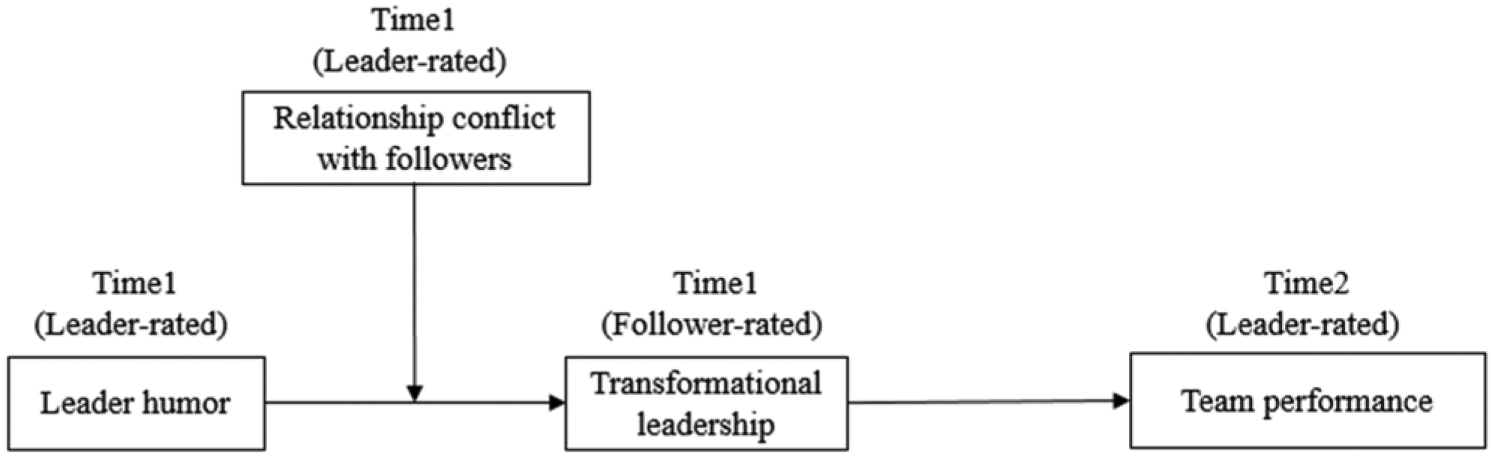
Theoretical model.
In sum, our article makes three primary contributions to the literature. First, we suggest that followers’ perceptions of their leader’s transformational leadership is a cognitive attribution process (Lord, Foti, & De Vader, 1984; Nye & Forsyth, 1991), and that leader humor is a trait that matches well with the prototype of a transformational leader. Second, we unfold the mechanism in how exactly leader humor imposes positive impact on followers by emphasizing the importance of leadership behavior as an ambient stimulus (Hackman, 1992; Liao & Chuang, 2007). Third, incorporating relationship conflict between a leader and his or her team members into the influencing process, we propose that leader humor would be further valued by followers as a desired leader quality in context when relationship conflict is high. These theoretical contributions enhance the overall understandings on leader humor and its positive impact in organizational settings.
Theory and Hypotheses
Humor
Common conceptualizations on humor identify it as a personality trait (Mesmer-Magnus et al., 2012; Thorson & Powell, 1993b) that can induce positive effects to the self and to others. For example, humor can regulate one’s own physical and emotional conditions such as by fostering mental flexibility, attention, and memory (Derks, Gardner, & Agarwal, 1998; Morreall, 1991). It also helps one’s physical and mental health by allowing the release of nervous energy, and therefore tension, through laughter that enhances one’s mood (Meyer, 1990). Humor can, in addition, strengthen one’s quality of functioning and work-related outcomes under stress (Bizi, Keinan, & Beit-Hallahmi, 1988; Mesmer-Magnus et al., 2012).
In addition to the benefits that humor can bring to oneself, its role in facilitating social communications has also been examined. An individual with high sense of humor will reflect one’s ability to create humor (Thorson & Powell, 1993b), and that individual is likely to use humor to facilitate social communications with the purpose to reduce friction and awkwardness in interactions (Fine & DeSoucey, 2005). It can then eliminate interpersonal barriers as bounded by workplace formal hierarchy (Vinton, 1989), quickly establish a bond with the target audience, and to cope with the environmental context (Crawford, 1994). Empirically, leader humor has been identified as an important predictor to individual follower and work team outcomes. At the individual level, leader humor is positively related to higher levels of members’ morale (Gruner, 1997), motivation (Crawford, 1994), job satisfaction (Mesmer-Magnus et al., 2012), productivity (Duncan & Feisal, 1989), creative thinking and innovation (Csikszentmihalyi, 1996), and job performance (Avolio et al., 1999; Vecchio, Justin, & Pearce, 2009). It also leads to a lower level of subordinate work withdrawal (Mesmer-Magnus et al., 2012). At the collective level, leader humor has been identified as a factor in developing a positive organizational culture (Clouse & Spurgeon, 1995) as well as enhancing group cohesion (Byrne & Neuman, 1992; Duncan, 1982, 1984), group and organizational creativity (Csikszentmihalyi, 1996; Lang & Lee, 2010; Thorson & Powell, 1993b), and unit’s collective performance (Avolio et al., 1999).
To understand how leader humor elicits these positive outcomes, Hackman (1986) identified the importance of leader’s role in the influencing process. Cohen and Ledford (1994) concurred the notion, and suggested that leader is integral in shaping followers’ goals and expectations. Manz and Sims (1987) argued that leaders should demonstrate behaviors that encourage followers to take actions. Hence, examining the role that leadership serves as an influencing mechanism that facilitates the positive effects that leader humor elicits emerges as a promising focus of research.
Leader Humor and Transformational Leadership Perceptions
A sense of humor is a personality trait that is frequently associated with leadership effectiveness (Bass, 1990; Priest & Swain, 2002). Previous research has identified leader humor to be positively correlated with transformational leadership. For instance, Avolio et al. (1999) found a significant positive relationship between leader humor and followers’ perceptions of leader’s transformational leadership behaviors. Priest and Swain (2002) discovered that humor is associated more with a transformational leader than with a less transformational leader. Similarly, Hughes and Avey (2009) also reported a positive association between leader’s use of humor and followers’ perceptions of leader’s transformational leadership behaviors. The above findings suggest that a humorous leader will demonstrate desirable behaviors that his or her followers might perceive as transformational leadership behaviors. However, the underlying theory and mechanism linking leader humor and followers’ transformational leadership perceptions is still unclear.
We propose that leader categorization theory (Lord et al., 1984; Nye & Forsyth, 1991) can be adopted to explain how leader humor affects followers’ transformational leadership perceptions. According to leader categorization theory, “individuals rely on schemas or prototypes to simplify information-processing tasks” (Judge, Colbert, & Ilies, 2004, p. 543). This information processing based on the leader prototype would influence individuals’ leadership perceptions and expectations (Lord et al., 1984). Since there exists a cognitive drive for people to naturally classify objects into meaningful and understandable categories, there are two subsequent sequential steps involved with leader categorization process. First, once the categorization of leader is complete, every individual would develop his or her own ideal leader prototype (i.e., what the leader is supposed to be like). Based on such prototype, the follower would then compare his or her leader with his or her desired leader prototype (Nye & Forsyth, 1991). If the leader matches well with his or her idealized leader prototype, attributions of leadership would emerge. On the other hand, if the leader matches poorly with his or her idealized leader prototype, the leader would be perceived as ineffective. Once the attributions are developed, the follower will generate further assumptions about the leader’s behavior (Hains, Hogg, & Duck, 1997), suggesting that followers’ attribution and categorization will be affected by prior experiences that will shape up their evaluation of leader prototype.
Humor has been proposed to be related to leader’s charisma (Romero & Pescosolido, 2008). Charismatic leaders are those who engage in behaviors that “make things meaningful” for followers (Yukl, 1999). Humorous leaders are witty, clever, and likeable individuals that attract followership through their speeches or actions. A humorous individual is keen to observe the unanticipated inconsistency (Berger, 1976) and reacts by saying or acting in an unexpected and surprising manner that is incongruent to the “common” behavior (Chapman & Foot, 1976). With such, humorous individuals bring joyfulness to the surrounding people and therefore draw more liking than those nonhumorous individuals (Bressler, Martin, & Balshine, 2006). Humor facilitates interpersonal communications by inducing positive affect and liking that will enable a humorous leader to be seen as more persuasive than a less humorous leader (Kuiper, McKenzie, & Belanger, 1995; Morkes, Kernal, & Nass, 1999). Humor has the ability to signal important or sensitive information as well as increase the persuasiveness of a message by making the message more interesting (Adelswärd & Öberg, 2009; Greatbatch & Clark, 2002; Lyttle, 2001). This positive affect and liking resulted by enhanced interpersonal communications will induce the follower to identify, learn, imitate, and see their leader as their role model (Avolio & Bass, 2004). Consequently, charismatic leaders’ humorous behaviors extend beyond the economical exchanges with their followers by developing an emotional bond with their followers (Kearney & Gebert, 2009) that draw strong identification from their followers.
In addition to charisma, we also believe that leader humor would be related to other transformational leadership facets. For instance, a humorous individual shows caring toward other people’s emotions by engaging in timely humorous activities that effectively alleviate their stress (Druskat & Wolff, 2001). By inducing laughter, tension is relieved and the atmosphere is energized (Berlyne, 1972; Giles, Bourhis, Gadfield, Davies, & Davies, 1976). Moreover, Barbour (1998) suggested that leaders can use humor to facilitate follower learning and creativity because humorous leaders can influence the behavioral norms by fostering a more open environment that encourage individuals to be themselves (Romero & Pescosolido, 2008). Evidently, leader humor has been found to facilitate members’ thinking and to inspire them to use creative thinking and find innovative solutions to complex problems (Dixon, 1980). Furthermore, humor has been identified as a control mechanism in the workplace that leaders can use it as a strategic tool to inspire followers to identify with the organization (Collinson, 1988, 1992; Lynch, 2002). Therefore, when followers try to evaluate and label their leader, the warm, positive, and friendly behaviors that humor elicits will be perceived as effective leadership behaviors (Nye & Forsyth, 1991). This generalization process is echoed and supported by Priest and Swain (2002). In their findings, they suggested that humor can be a predictor of transformational leadership. Since categorization is an individual-based evaluation and perception, a humorous leader will be perceived as a transformational leader not necessarily by the actual behaviors that he or she demonstrates, but rather by the perceptions of having this desirable prototypical leadership quality (Rush & Russell, 1988). Although not empirically tested before, we theorize that leader humor will be positively related to subordinates’ transformational leadership perceptions.
Transformational Leadership as a Mediator Linking Leader Humor and Team Performance
Leaders can employ humor as a way of influencing their followers to obtain favorable outcomes. When leader uses humor, either verbal or nonverbal, it can trigger receivers’ both affective and cognitive responses (Crawford, 1994). Although previous research on leader humor and its positive effect on followers’ behaviors have been attributed to leader facilitating learning, helping changing behavior, reducing tension and stress, and providing inspiration and motivation (e.g., Barbour, 1998; Martin, Puhlik-Doris, Larsen, Gray, & Weir, 2003; Mesmer-Magnus et al., 2012), no empirical research has considered and tested subordinates’ transformational leadership perceptions as an overarching influencing mechanism. In addition, as work teams “are becoming a basic building block for many contemporary business organizations” (Stewart & Barrick, 2000, p. 135), studying team-level influencing processes and consequences are increasingly important. Despite that, surprisingly, there is “no model that explains how successful organizational humor can impact work groups” (Romero & Pescosolido, 2008, p. 395).
Research conducted by Romero and Pescosolido (2008) propose that leadership can be an explaining mechanism that links leader humor to group productivity. Extending their findings and again adopting leader categorization theory (Lord et al., 1984; Nye & Forsyth, 1991), we propose that a team leader’s humor is likely to positively influence the team’s performance through team members’ perceptions of their leader’s transformational leadership behaviors. Such transformational leadership perceptions will be perceived by all team members and affect the work team as a whole by means of ambient stimulus that is perceived and shared among team members (Hackman, 1992; Liao & Chuang, 2007). Essentially, a team leader can develop an overall pattern of transformational leadership behaviors that is displayed to the entire work team that induces plausible team behaviors. Such leader’s display of transformational leadership behaviors will transcend followers’ individual interests to focus on pursuing collective goals (Bass, Avolio, Jung, & Berson, 2003). In addition, empirical findings have suggested that transformational leaders affect team performance through enhancing followers’ potency (Jung & Sosik, 2002; Schaubroeck, Lam, & Cha, 2007). Therefore, we posit that a team leader’s humor is likely to positively influence team performance through team members’ perceptions of transformational leadership behaviors.
The Contingent Effects of Relationship Conflict
Leadership dynamics cannot be fully understood without considering the context (Avolio, Walumbwa, & Weber, 2009). It is because the saliency of leader behaviors and leadership influence can vary in different contexts. Since leadership is seen as an “influencing process” (e.g., Katz & Kahn, 1978; Rowden, 2000; Yukl, 1998), relational factors between leaders and followers will play a role in determining the overall effectiveness of leader humor. In interpersonal interactions, humor can act as a relational lubricant that facilitates social communications and reduces interactional frictions (Mesmer-Magnus et al., 2012). As interpersonal conflict is certainly unavoidable in the workplace and between the leader and his or her team members, it is important to understand how leaders can use their sense of humor to deal with the relationship conflicts in leading their teams.
Relationship conflict pertains to interpersonal incompatibilities, which typically include tension, animosity, and annoyance that are resulted from conflicts such as personal taste, values, and interpersonal style (De Dreu & Weingart, 2003; Jehn, 1995). There can be various ways in which relationship conflict is triggered between a leader and a follower. For instance, the leader may show disrespect toward the follower through the use of harsh language (Pelled, 1996); such use of harsh language will result in tension, animosity, and interpersonal conflict between the two constituents (Simons & Peterson, 2000).
We propose that leader humor can be perceived differently by followers depending on the relationship conflict between leaders and followers. Previous research indicates that whether leader’s humor is perceived as the ideal leader prototype by followers may be subject to different contexts. For instance, Priest and Swain (2002) found that good leaders are rated more highly in humor than bad leaders in a military context. We once again draw on leader categorization theory (Lord et al., 1984; Nye & Forsyth, 1991) to explain this moderating effect of relationship conflict on the indirect effect of leader humor on team performance. When the relationship conflict between a leader and his or her followers is high, the followers are more likely to consider leader’s ability to reduce the interpersonal tension to fit in their ideal leader prototype. As a result, when the leader is humorous, the impact of the leader’s sense of humor will become more salient to the followers in a high relationship conflict context. Followers are thus more likely to perceive their leader to be a transformational leader which, exerts a stronger, positive influence on team performance. In contrast, when the relationship conflict between a leader and his or her followers is low, leader’s use of humor becomes less important to followers and hence less likely to be viewed as an important leader prototypical quality. Leader humor, therefore, has a weaker, positive effect on followers’ transformational leadership perceptions and the team’s performance. Hence, we suggest that relationship conflict is an important contextual factor that will influence the positive effect that leader humor has on team performance through subordinates’ transformational leadership perceptions.
Methods
Participants and Procedures
A survey study was conducted to examine our hypotheses. Our survey study was collected from two sources (leaders and followers) and at two points in time. Employees in a large manufacturing company (more than 10,000 employees) in northern China participated in our survey study. Due to the nature of the industry, the majority of the employees are men. Considering the low education level of the production line workers and technicians, we excluded these employees from our surveys. Consequently, our participants were all at the management positions. With the strong support from the company’s top executives, we were able to include all personnel who occupy management positions (245 leaders, 850 followers) to participate in our surveys. All surveys were conducted by paper and pencils on site. Leaders and followers were arranged in different conference rooms. The human resource department of the manufacturing company collaborated with us to conduct the study.
In total, 245 leaders and 850 followers participated in the on-site Time 1 survey. In the Time 1 survey, followers provided responses on transformational leadership perceptions toward their leaders and their own demographic backgrounds. Leaders rated their own humor, their level of relationship conflict with followers, and provided their own demographics. We asked leaders to report their own humor because we have followed previous literature and theorized that leader humor is a personality trait (e.g., Thorson & Powell, 1993a). At the end of the data collection, 244 leaders and 826 subordinates returned the questionnaires. All 826 subordinates’ questionnaires were successfully linked to their leaders. One month later, we distributed the Time 2 questionnaires on-site to the same 245 leaders who had participated in the Time 1 survey. In the Time 2 survey, we asked the leaders to rate their team’s performance. We excluded those unfinished questionnaires, and the final sample, after both studies, contained 244 leaders and 815 followers. Each team consisted of a leader and an average number of 3.34 followers (SD = 0.68).
Among the 244 leaders, 237 (97.1%) were male. 18% of them were younger than 35 years, 62% were between 35 and 45 years, and 20% of them were 45 years or older. As for their education level, 19% had a bachelor degree or above, 54% had a junior college degree, and 27% had an education of high school or below. On the other hand, among the 815 followers, 716 (88%) were male; 28% of them were younger than 35 years, 66% of them were between 35 and 45 years, and 6% of them were 45 years or older. Among them, 26% had a bachelor degree or above, 34% had a junior college degree, and 40% had an education of high school or below.
Measures
A Chinese version of measures for leader’s humor, transformational leadership, leader’s relationship conflict with followers, and team performance were translated from the original English scales following Brislin’s (1980) back-translation processes.
Leader Humor
Team leaders rated their own humor using seven items suggested by Thorson and Powell (1993a). Sample items were “I say things in such a way as to make people laugh” and “I use humor to entertain coworkers” (1 = never; 7 = always). Cronbach’s alpha for this scale was .87.
Transformational Leadership
The four dimensions of transformational leadership were measured with items from the Multifactor Leadership Questionnaire (Form 5X; Bass & Avolio, 1995). The 16 items were rated on a 5-point Likert-type scale (1 = strongly disagree; 5 = strongly agree). Cronbach’s alpha for this scale was .91. Transformational leadership was measured at the individual level; then the individual responses were averaged and aggregated to the team level.
We examined the interrater agreement (rwg) and intraclass correlation coefficients ICC(1) and ICC(2) for our aggregation check. We assessed interrater agreement by computing James, Demaree, and Wolf’s (1984) rwg(j). For transformational leadership, the average rwg was .98 (median rwg = .98), indicating strong within group agreement. The ICC(1) was .30 and the ICC(2) was .60, both met the requirement level of aggregation.
Relationship Conflict
Team leaders rated relationship conflict with their followers with the four items suggested by Jehn (1995). Sample items were “How much friction is there between you and your followers?” and “How much tension is there between you and your followers?” (1 = none; 5 = a lot).0 Cronbach’s alpha for this scale was .74.
Team Performance
Team leaders rated the overall team performance of their respective work team using Janssen and Van Yperen’s (2004) five-item in-role job performance scale that was first developed by Podsakoff and Mackenzie (1989). A sample item from this scale was “My team fulfills all responsibilities required by the job” (1 = strongly disagree; 7 = strongly agree). Cronbach’s alpha for this scale was .75.
Control Variables
We controlled for several key variables in our analyses. Past research has shown that perceptions of leader behavior can be affected by leaders’ demographics (e.g., Eagly & Johnson, 1990). Therefore, we controlled for leaders’ gender, age, and education level.
Results
Descriptive Analysis
We first conducted the skewness and kurtosis tests on our sample to confirm that the variables involved in our model were subject to normal distribution. According to George and Mallery (2003), the acceptable values for skewness and kurtosis should be within the range of −1 and 1 to suggest that the data approaches a normal distribution. The skewness and kurtosis values for leader humor were −.41 and 38, for transformational leadership were −.78 and .60, for relationship conflict were .91 and .98, and for team performance were −.31 and −.16. Indeed, these results suggested that the distributions of these variables all approached a normally distributed pattern. The descriptive statistics, internal consistency reliabilities, and intercorrelations of all study variables are presented in Table 1. As shown in the table, leader humor was positively related to followers’ transformational leadership perceptions (r = .13, p < .05) and team performance (r = .18, p < .05). Followers’ transformational leadership perceptions were positively correlated with team performance (r =.15, p < .05).
Descriptives, Team-Level Intercorrelations, and Internal Consistencies.
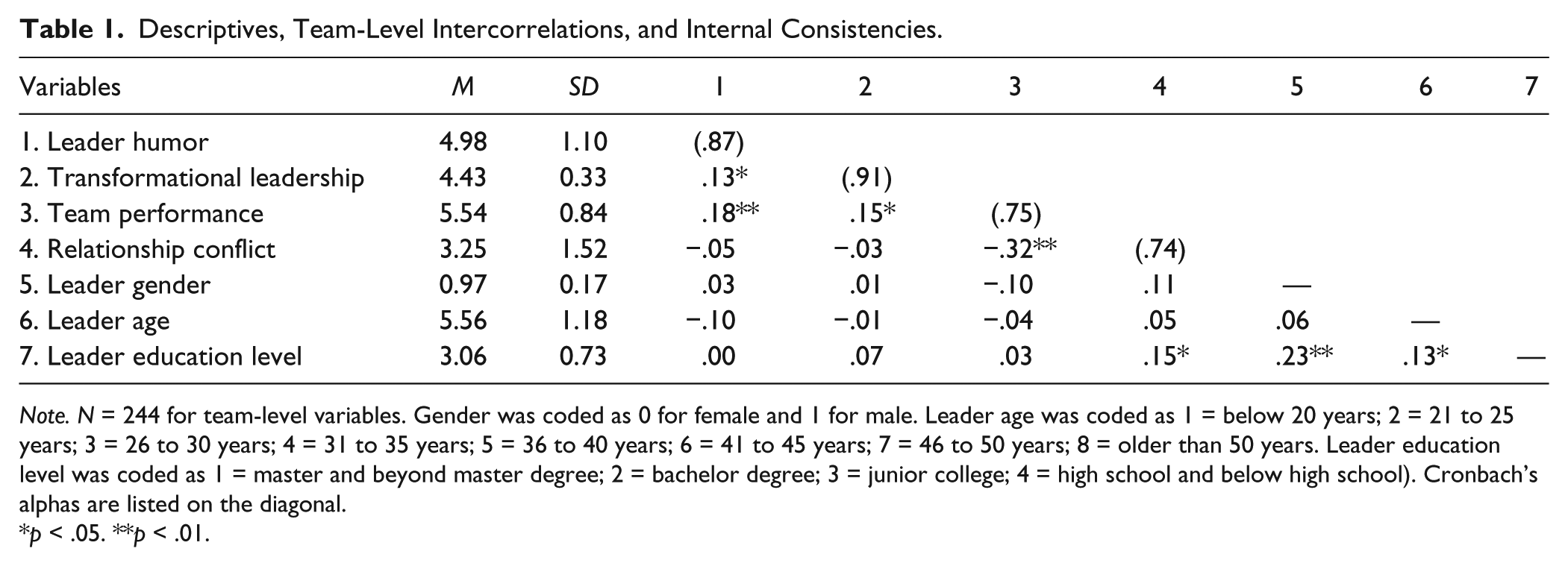
Note. N = 244 for team-level variables. Gender was coded as 0 for female and 1 for male. Leader age was coded as 1 = below 20 years; 2 = 21 to 25 years; 3 = 26 to 30 years; 4 = 31 to 35 years; 5 = 36 to 40 years; 6 = 41 to 45 years; 7 = 46 to 50 years; 8 = older than 50 years. Leader education level was coded as 1 = master and beyond master degree; 2 = bachelor degree; 3 = junior college; 4 = high school and below high school). Cronbach’s alphas are listed on the diagonal.
p < .05. **p < .01.
Confirmatory Factor Analysis
To establish the construct distinctiveness of the main variables used in this study, we conducted a series of confirmatory factor analyses using Mplus version 7 (Muthén & Muthén, 2015). We reported the comparative fit index and root mean square error of approximation based on suggestions from Williams, Vandenberg, and Edwards (2009). The confirmatory factor analysis results showed that the baseline four-factor model fit our data well (χ2 = 807.88, degrees of freedom = 458, root mean square error of approximation = .06, comparative fit index = .91). In addition to the baseline model, we conducted three additional alternative models: Model 1 (three factors) combined transformational leadership and team performance into one factor; Model 2 (two factors) combined relationship conflict, transformational leadership, and team performance into one factor; Model 3 (one factor) combined all four variables into one factor. The results indicated that the baseline model fitted the data significantly better than the other three alternative models (Δχ2 = 367.80, 560.34, and 1334.37 respectively, p < .01), supporting the construct distinctiveness of these variables (see Table 2).
Comparison of Measurement Models in the Study.
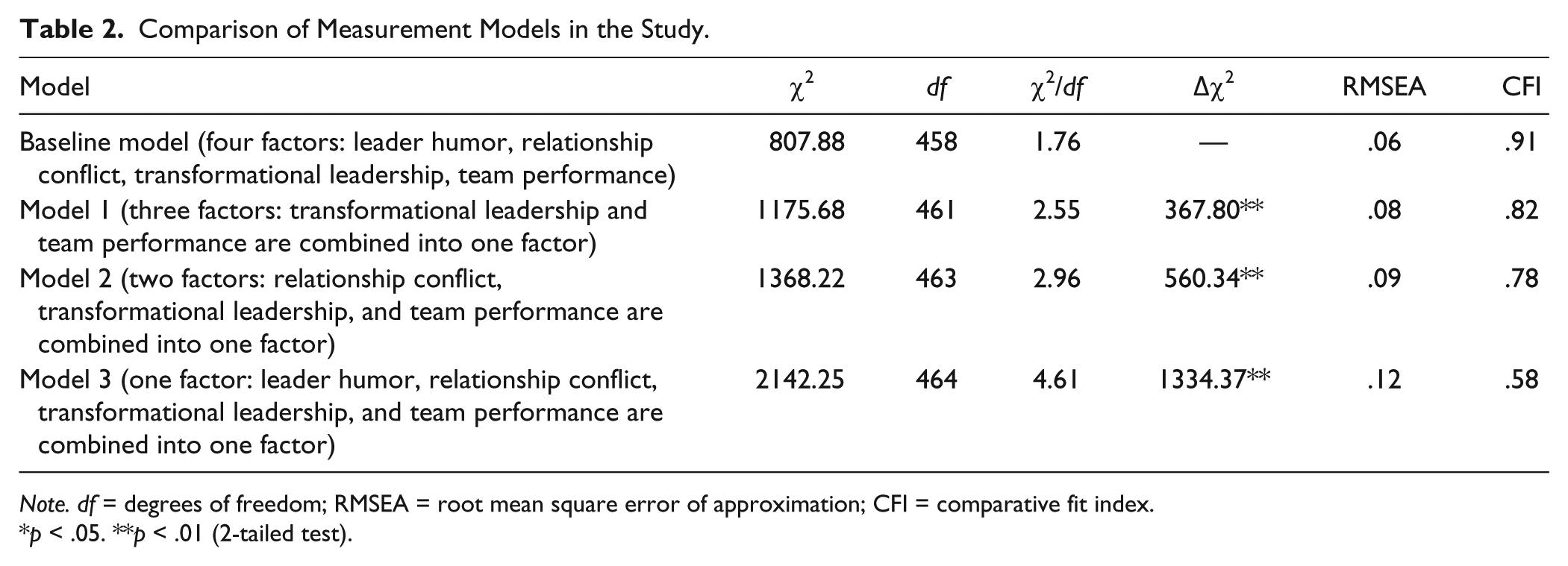
Note. df = degrees of freedom; RMSEA = root mean square error of approximation; CFI = comparative fit index.
p < .05. **p < .01 (2-tailed test).
Hypothesis Tests
Hypothesis 1 suggests that leader humor is positively related to subordinates’ perceptions of transformational leadership. To test Hypothesis 1, we conducted an ordinary least squares regression. Leader’s humor and all control variables including leaders’ gender, age, and education level were entered in Model 2 (see Table 3), and the results revealed a positive relationship between leader humor and subordinates’ perceptions of the leader’s transformational leadership (β = .13 p < .05; see Table 3). Therefore, Hypothesis 1 was supported.
Ordinary Least Squares Regression Analyses Results.

Note. The coefficient results are reported with robust standard errors (SE). Two-tailed tests. N = 244. Gender was coded as 0 for female and 1 for male. Leader education level was coded as 1 = “master and beyond master degree”; 2 = “bachelor degree”; 3 = “junior college”; 4 = “high school and below high school”).
p < .10. **p < .05; ***p < .01 (2-tailed tests).
Hypothesis 2 posits that leader humor has a positive, indirect effect on team performance through its positive effect on subordinates’ transformational leadership perceptions. We followed the recommendations of Preacher and Hayes (2008) and used the statistical software developed by Hayes (2013) to examine our mediated model by using a bias-corrected bootstrapping procedure (see Hayes, 2009, for a summary of the advantages of this procedure). Controlling for leaders’ gender, age, and education, bootstrapping analyses (5,000 resamples) revealed a significant indirect effect. The coefficient for the indirect effect of transformational leadership was .0123 (standard error = .0091), and the bias-corrected 95% confidence interval (CI) did not include zero (95% bootstrapped CI [.0003, .0376]), indicating support for Hypothesis 2 (see Table 4).
Summary of Regression Results.
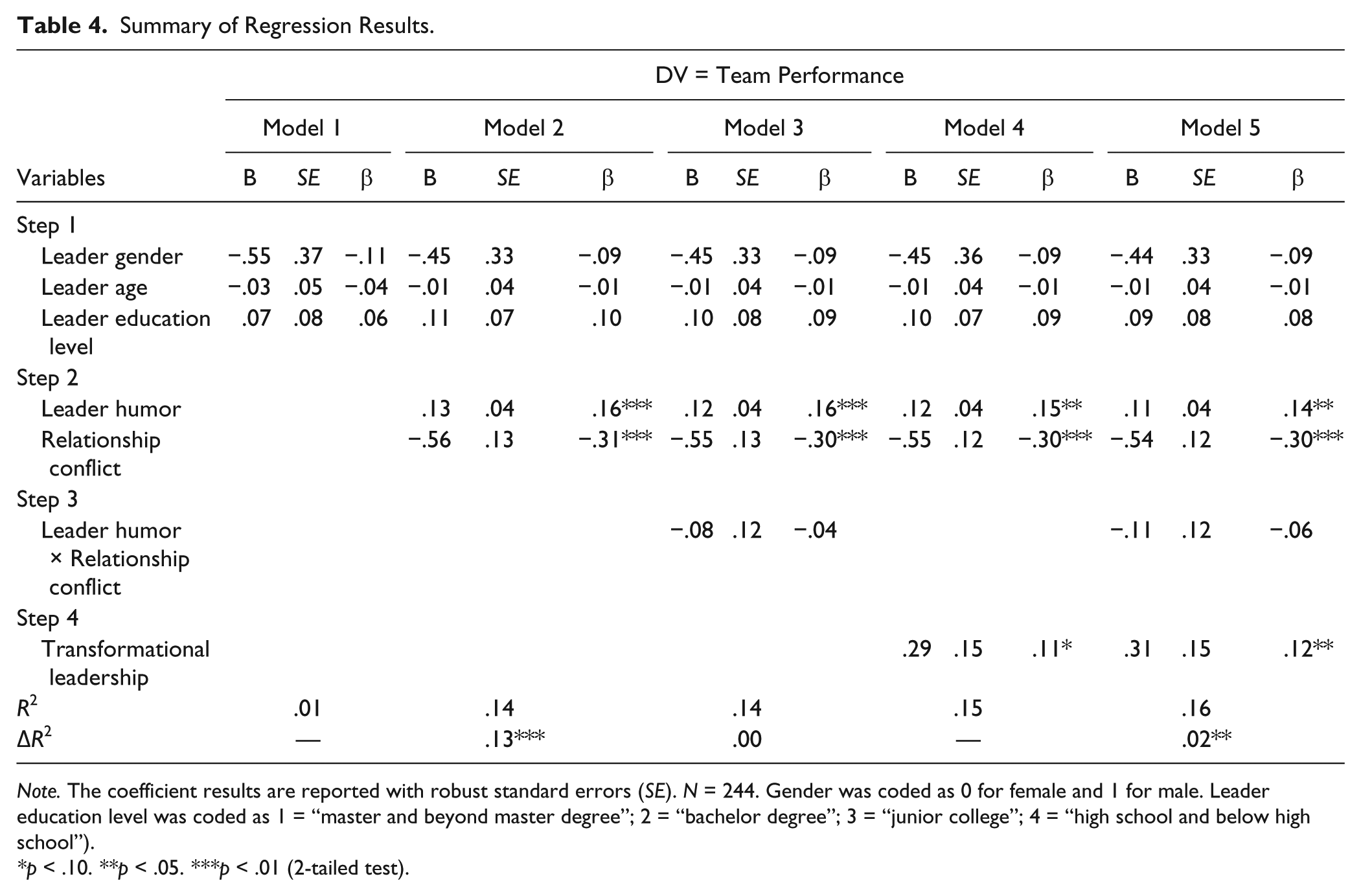
Note. The coefficient results are reported with robust standard errors (SE). N = 244. Gender was coded as 0 for female and 1 for male. Leader education level was coded as 1 = “master and beyond master degree”; 2 = “bachelor degree”; 3 = “junior college”; 4 = “high school and below high school”).
*p < .10. **p < .05. ***p < .01 (2-tailed test).
Hypothesis 3 theorizes that leader humor has a conditional indirect effect on team performance, such that the indirect effect through subordinates’ transformational leadership perceptions will be stronger when relationship conflict between the leader and his or her team members is high. To test our hypothesized moderated mediation model, we once again entered leaders’ gender, age, and education as control variables and began by examining the interactive effect of leader humor and relationship conflict on transformational leadership. Results yielded a significant interaction (β = .13, p < .05; see Model 3 of Table 3). The interactive effect between leader humor and relationship conflict was plotted in Figure 2, following Aiken and West’s (1991) instructions. In addition, Hayes’s PROCESS macro bootstrapping method was used to conduct the simple slope tests for each slope. The results in Table 5 indicated leader humor was positively associated with transformational leadership when relationship conflict is high (95% bootstrapped CI [.0244, .1558], excluding zero) but not when relationship conflict is low (95% bootstrapped CI [−.0543, .0556], including zero).
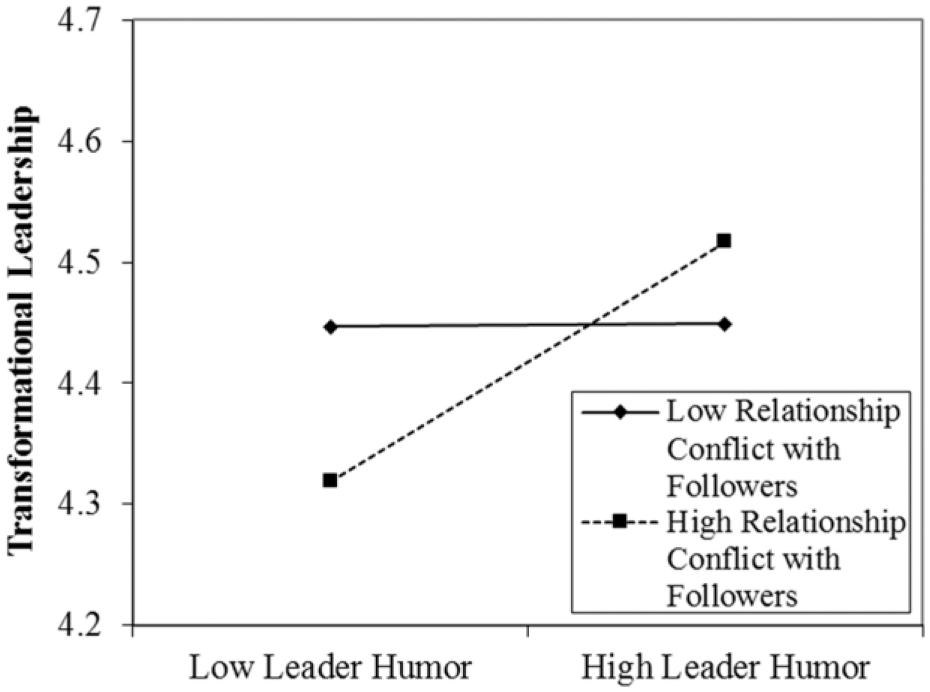
The interactive effect of leader humor and relationship conflict on subordinates’ transformational leadership perceptions.
Bootstrapping Analyses Results.

Note. LLCI = lower level confidence interval; ULCI = upper level confidence interval. N = 244. Bias-corrected confidence intervals (CIs) are set at 95% from the bootstrapping analyses with 5,000 bootstrap resamples.
We tested the moderated mediation prediction using Hayes’s PROCESS macro, and used the index of moderated mediation to evaluate the model’s significance. Results showed that when leader’s relationship conflict with followers was high, the indirect effect model was significant. However, when leader’s relationship conflict with followers was low, the indirect effect model was not significant (see Table 5). The index for moderated mediation was .0331 (standard error = .0238, 95% bootstrapped CI [.0010, .0994], excluding zero). Thus, Hypothesis 3 received support.
Discussion
Adopting leader categorization theory (Lord et al., 1984; Nye & Forsyth, 1991) as the overarching theoretical framework, the present research is the first study to examine the relationship between leader humor, transformational leadership, relationship conflict, and team performance. We demonstrated that a humorous leader will likely be perceived by subordinates as a transformational leader, and leader’s humor has direct implications on members’ performance, such that humorous leaders are more likely to enhance the overall work team’s performance via subordinates’ transformational leadership perceptions than those who are less humorous.
In addition, a moderated mediation effect offered some insights to how leader humor may exert favorable effects on team performance in situations of high relationship conflict between the leader and his or her team members. The interactive effect of leader humor and high relationship conflict on team performance was mediated by subordinates’ perceptions of leader’s transformational leadership. These interesting findings were in line with our theoretical model, and we will discuss theoretical and practical implications as well as limitations and future insights in the following sections.
Theoretical Contributions
The present study has several theoretical contributions to both trait and leadership literature. The first contribution of this article was that using perspectives of leader categorization theory (Lord et al., 1984; Nye & Forsyth, 1991), we showed how leader humor can be linked to subordinates’ perceptions of leader’s transformational leadership. We identified that leader humor is a trait that matches well with the prototype of a transformational leader and established the theoretical framework linking leader’s humor to subordinates’ transformational leadership perceptions. This research indicated strong support for the usefulness of leader categorization theory in explaining how leader’s humor is positively related to followers’ perceptions of leader’s transformational leadership behaviors.
Second, we built on the literature of transformational leadership as an ambient stimulus (Hackman, 1992; Liao & Chuang, 2007) and highlighted it as a novel mechanism through which leader humor is likely to positively influence team performance. Previously, no empirical research has considered and tested transformational leadership as a mediating factor that would explain the positive associations between leader humor and team performance. Our study also contributed to the literature on team performance by identifying a new process in which how leader’s disposition can stimulate team outcomes.
Third, we emphasized the importance of leaders displaying humorous acts in conditions when hostility exists between a leader and his or her team members. By exhibiting humorous behaviors, leaders can enhance interactional communications with their subordinates by means of reducing tension and awkwardness, and thus achieving plausible outcomes. Our intrigue finding suggested that not only is a humorous leader more suited and more effective in dealing with interpersonal conflicts but also the positive effects will be magnified when relationship conflict between the leader and his or her team members is high. In sum, we hope that our theoretical framework, analyses, and findings can enrich the current understandings on leader humor and its impact in organizational settings.
Limitations and Future Research
Our findings should be considered and interpreted in respective to a few limitations. First, our measure of leader’s humor was associated with humor in general rather than differentiating humor into positive or negative style of humor. Since our theories and propositions focused on the positivity of leader’s humor and the subsequent follower outcomes, our findings only went as far as generalizing the influence of positive style of humor. Future research can conduct more thorough analyses on investigating the effect that different styles (i.e., positive vs. negative) and different types of humor (e.g., affiliative, self-enhancing, aggressive humor, self-defeating; Martin et al., 2003) can have on followers’ behaviors.
Second, due to the industry nature of our sampled organization, most of our leader samples were men. When conducting our analyses, we did control of leader’s gender. However, difference in leader gender may result in different follower attributions and, therefore, different followers’ responses, as accounted by a few scholars (e.g., Eagly & Karau, 2002; Wang, Chiang, Tsai, Lin, & Cheng, 2013). Perhaps, male and female leaders’ sense and use of humor will result in different followers’ perceptions of their leader’s leadership behaviors and have different consequences on the followers (Decker & Rotondo, 2001). Future researchers can examine leader humor across different contexts and environments and compare with the findings presented in this research.
Third, although we collected our samples in two different time frames, the fact that the team leaders provided their ratings on their own humor and their team’s performance may potentially suggest a reversal causal direction. That is, leader’s use of humor may be affected by prior team’s performance in a way that when the team performs well, the leader has more luxury to be humorous, and when the team performs poorly, the leader may be not in a mood to tell jokes. Future studies can eliminate this concern by controlling for the team’s prior performance.
In this research, we drew an association between leader humor and followers’ transformational leadership perceptions. However, this association was based on the assumption that humorous leaders will demonstrate humorous behaviors that will be subsequently perceived by the followers. Future research should disentangle and empirically examine how followers perceive the leader humor trait and form their perceptions.
Another interesting future research direction left to be investigated is other influencing processes or mechanisms that could help explain how leader’s humor can affect followers’ behaviors. We explored leadership behavior in this research; we also expect that leader’s humor can help shape up an organization’s culture (Clouse & Spurgeon, 1995) that would in turn, influence the members within. In addition, we encourage future researchers to examine other boundary conditions across different levels of analysis to have a better and clearer understanding on the overall influence that leader humor has on follower activities.
Practical Implications
Our theoretical analyses on leader’s humor and its positive influences have a few meaningful implications for practitioners to take away. First, organizations should encourage more positive humorous behaviors and activities in the workplace because humor not only positively affects one’s own mental and physical conditions (Meyer, 1990) but also can help facilitating social interactions to develop closer interpersonal bonding. On the contrary, negative humors such as racist and sexist jokes or any other derogative humors should be discouraged (Martin et al., 2003).
Second, in selecting leaders, organizations should consider those who have a better sense of humor because those are the ones that can communicate better with their followers and exert positive leadership influences. They will incorporate their humorous personality into leadership influence that will inspire, motivate, and stimulate their followers, while in the meantime, show consideration for them.
Third, leaders should avoid getting into relationship conflicts with their followers; however, when these relationship conflicts do inevitably occur, leaders should possess the abilities to effectively resolve and ameliorate the situation. A leader can employ humor as an effective way to release tension and stress to improve communications with the conflicting members. In context of high relationship conflict, leader’s demonstration of humorous acts will result in enhanced followers’ performance. We are optimistic that our findings and discussions will be insightful to practitioners.
Conclusion
Employees nowadays expect work environment to be enjoyable (Romero & Pescosolido, 2008). Humorous leaders are naturally equipped with the ability to make workplace fun and relaxed. In this research, we suggested that leader humor can be a great aid in facilitating social interactions between leaders and their subordinates that would translate into positive subordinate performance. We also discovered that the positive effect of leader humor on team performance would be more salient in context of high relationship conflict between a leader and his or her subordinates. We hope that our study laid a foundation that encourages future scholars across different disciplines to investigate leader humor in organizational settings. We urge for more comprehensive studies to be conducted to get a better understanding of its importance.
Footnotes
Declaration of Conflicting Interests
The author(s) declared no potential conflicts of interest with respect to the research, authorship, and/or publication of this article.
Funding
The author(s) received no financial support for the research, authorship, and/or publication of this article.