



Abstract
The continual development of leaders is one effective strategy for organizations to compete in today’s rapidly changing society. Despite awareness of this need, human resource professionals and managers find it challenging to promote or encourage ongoing development among leaders. Addressing the need for continuous learning, we extend the construct of psychological capital to the context of leader development. Specifically, leader development psychological capital (LD PsyCap) is defined as an individual’s motivational propensity to develop as a leader and consists of efficacy, hope, optimism, and resilience toward leader development. Using an online survey of 120 leaders, we found that LD PsyCap predicted leader development behaviors beyond other individual differences. We also found that LD PsyCap mediated the relationship between learning climate, organizational support, social support, and workload on leader development behaviors. Promoting LD PsyCap can help facilitate ongoing leader development in organizations.
Organizations are becoming increasingly concerned with continuous leader development. Deloitte University found 85% of 3,300 organizations from 106 different countries view leader development as important (Haims, Stempel, & van der Vyver, 2015). However, these organizations also reported not feeling capable of supporting that endeavor. Furthermore, in a study of over 1,500 practitioners and researchers, Banks, Pollack, Kirkman, O’Boyle, and Whelpley (2015) identified leader development as one of 24 grand challenges facing the field of management. Organizations are experiencing a disconnect between a desire to promote leader development and a sense of uncertainty and ambiguity of how to effectively develop leaders. To address this gap, organizations and their leaders need adequate capital to help them actively and confidently engage in continuous leader development.
Capital exists in many forms such as economic, social, or human capital. Positive psychological capital, or PsyCap, has been introduced as an additional intangible form of capital that facilitates work outcomes (F. Luthans & Youssef, 2004, 2007). PsyCap provides a competitive advantage due to its long-term, unique, cumulative, interconnected, and renewable characteristics (F. Luthans & Youssef, 2004). PsyCap refers to motivational propensity and includes the positive psychological states of efficacy, hope, optimism, and resilience of organizational members (F. Luthans, Avolio, Avey, & Norman, 2007). PsyCap is domain-specific (F. Luthans, Youssef, & Avolio, 2007) and, in the current study, we bring the established and well-researched construct of PsyCap from the domain of the workplace (i.e., workplace PsyCap) into the domain of leader development.
Leader development PsyCap (LD PsyCap) is an essential form of capital for continuous leader development because effective development requires a high level of motivation (Seyler, Holton, Bates, Burnette, & Carvalho, 1998). Because of its motivational propensity, we expect LD PsyCap to predict engagement in leader development behaviors. Thus, we examine its predictive validity above and beyond the related individual differences variables of core self-evaluations, workplace PsyCap, proactive personality, and motivation to lead. As shown in the theoretical model in Figure 1, we also examine the organizational-level predictors of learning climate (i.e., the organization’s ability to facilitate learning among its members), organizational support (i.e., employees’ perceptions regarding the degree of organizational resources and guidance), and social support (i.e., support of supervisors, peers, and coworkers) with expected positive relationships with LD PsyCap and, ultimately, leader development behaviors. Alternatively, a common obstacle for leaders’ development is their high amount of workload relative to their limited amount of time (Noe & Wilk, 1993). Leaders suffering from a high workload may have a lower motivational propensity to develop, or LD PsyCap. We examine workload as a job-level characteristic and expect it to negatively predict engagement in leader development behaviors, as mediated through LD PsyCap.

Theoretical model depicting the mediating role of LD PsyCap.
We first discuss leader development, then define LD PsyCap and its conceptualization as a core construct. More specifically, we build the case for LD PsyCap as a predictor of engagement in leader development behaviors. Next, we discuss the organizational and job-level antecedents of LD PsyCap.
Leader Development
Leader development refers to “the expansion of the capacity of individuals to be effective in leadership roles and processes” (Day & Dragoni, 2015, p. 134). Scholars distinguish leader development from leadership development (Day, 2000). Whereas leader development focuses on the individual’s capacity, such as the development of intrapersonal skills and abilities necessary for an individual to complete their leadership roles; leadership development refers to the development of the collective capacity for leadership among a group or organization. In the current article, we focus on leader development because of its focus on individual-level skills.
Despite the positive effects of leader development (Day, 2000; Day, Harrison, & Halpin, 2009), it is often a challenge to create a leader development program that can target the specific needs of all leaders and provide the necessary support for development. Formal training of leaders is effective, yet tends to be short-term in nature (i.e., a few days; Avolio, Reichard, Hannah, Walumbwa, & Chan, 2009) even though leader development is a longitudinal process (Day, 2010). Demonstrating the longitudinal nature of leader development, Day and Sin (2011) found different growth trajectories of leaders over the course of a 3-month action learning project. Some argue that leaders learn best over time from experience (McCall, 2010), yet this requires deliberate practice (Day, 2010). As Day, Fleenor, Atwater, Sturn, and McKee (2014) point out, the “ongoing practice through day-to-day leadership activities is where the crux of development really resides” (p. 80). Thus, leader development scholars have moved toward leader self-development, a more self-directed and ongoing approach to leader development (Boyce, Zaccaro, & Wisecarver, 2010). More specifically, Boyce et al. (2010) defines leader self-development as “a process in which leaders take personal responsibility for initiating, sustaining, and evaluating growth in their own leadership capacities and in their conceptual frames about the conduct of leadership” (p. 162).
Leader self-development involves the deliberate decision on how to learn and what to learn, where the individual leader dictates the process of developing (Boyce et al., 2010). Leaders have responsibility and control for learning (Reichard & Johnson, 2011). Leader self-development allows the leader to engage in development in one area or several areas as needed. Self-development behaviors may include seeking leadership opportunities such as webinars or special projects, asking for feedback from a mentor, or understanding one’s leadership strengths through reflection. Because of its long-term and self-directed nature, engaging in leader self-development behaviors benefits from having psychological resources, or LD PsyCap.
Leader Development PsyCap
Researchers have defined PsyCap as domain-specific (F. Luthans, Youssef, et al., 2007) and have empirically examined PsyCap in various contexts including work (Avey, Reichard, Luthans, & Mhatre, 2011), academic (B. C. Luthans, Luthans, & Jensen, 2012), and cross-cultural domains (Dollwet & Reichard, 2014). PsyCap was initially established and predominantly studied in the domain of the workplace (F. Luthans & Youssef, 2004), and its consistent positive relationship with desired workplace outcomes has been well documented via meta-analysis (Avey et al., 2011). By adapting the original workplace PsyCap definition (F. Luthans et al., 2007), we define LD PsyCap as
(1) having confidence (efficacy) to take on and put in the necessary effort to succeed at challenging leader development tasks; (2) making a positive attribution (optimism) about succeeding now and in the future in terms of developing as a leader; (3) persevering toward leader development goals and, when necessary, redirecting paths to goals (hope) in order to succeed; and (4) when beset by problems and adversity, sustaining and bouncing back and even beyond (resilience) to attain success at leader development. (Italics added, p. 3)
Thus, we define LD PsyCap as a higher order construct composed of four primary constructs of leader development efficacy (LD efficacy), leader development hope (LD hope), leader development optimism (LD optimism), and leader development resilience (LD resilience).
Although these four constructs are distinct; they also contain a fundamental linkage tying them together into an overarching, higher order construct of LD PsyCap. For example, LD efficacy refers to a “leader’s judgment regarding whether he or she can develop a specific ability or skill to employ in a certain leadership context” (Avolio & Hannah, 2009, p. 285). Similarly, LD optimism is the expectation for positive outcomes (Scheier & Carver, 1992) when it comes to leader development. However, LD optimism also reflects the attributions made following positive or negative events. Individuals high on LD optimism attribute positive developmental events to stable and internal causes while categorizing negative events as due to temporary causes and external factors (Seligman, 1991). Like the expectations and drive for success characterized by LD efficacy and optimism, leaders high in the willpower portion of LD hope are characterized by the agency to achieve leader development goals (Snyder et al., 1991). However, LD hope goes beyond goal-directed energy to also include waypower, which results in the identification of alternative pathways to pursue leader development when the primary strategy is blocked. Finally, LD resilience provides the unique addition of how a leader reacts to rather than anticipating developmental events. A leader high on LD resilience would respond favorably to both positive events (e.g., increased expectations and responsibility) and negative events (e.g., conflict, setbacks, and failures). The underlying, fundamental linkage that ties these four components together into a core construct of LD PsyCap is referred to as motivational propensity to develop as a leader (F. Luthans, Avolio, et al., 2007).
In addition to being domain-specific, PsyCap is a state-like construct (F. Luthans, Youssef, et al., 2007), which means that it is malleable and open to change and development. F. Luthans and Youssef (2007) describe a continuum of individual differences ranging from traits and trait-like characteristics to state-like characteristics and states. At one end, traits and trait-like characteristics, such as core self-evaluations or personality, are considered relatively stable over time and across situations making them difficult to change or influence through organizational interventions or job design. At the opposite end of the continuum, states (e.g., moods) fluctuate from moment-to-moment making the effects of an organizational intervention short-lived. State-like characteristics, on the other hand, do not fluctuate as much as states remaining stable for months; yet are more malleable than fixed traits making them an ideal target of organizational interventions (Wright & Quick, 2009). Research also supported the effectiveness of a micro-intervention that showed that workplace PsyCap can be enhanced through short-term bursts of training (F. Luthans, Avey, Avolio, Norman, & Combs, 2006).
The state-like status is not exclusive only to PsyCap. For example, the psychological construct of gratitude, “a feeling that occurs in exchange-based relationship when one person acknowledges receiving a valuable benefit from another,” is similarly state-like in nature and can be developed through interventions (Lamas, Froh, Emmons, Mishra, & Bono, 2014, p. 3). Gratitude interventions like counting blessings, writing down three good things, grateful self-reflection, and writing gratitude letters consistently produce positive benefits, which endure over several months. Like workplace PsyCap and gratitude, the state-like ontological status of LD PsyCap suggests that it is possible that people’s LD PsyCap can be increased. However, LD PsyCap is useful to the extent that it predicts leader development.
LD PsyCap and Leader Development
By examining its components, we expect the higher order construct of LD PsyCap to relate to leader self-development for several reasons. First, generalized efficacy for development has been found to be a positive predictor of attitudes toward developmental opportunities, participation in development (Maurer, Mitchell, & Barbeite, 2002; Maurer & Tarulli, 1994; Maurer, Weiss, & Barbeite, 2003), and motivation during training (Colquitt, LePine, & Noe, 2000). In fact, Reichard Walker, Putter, Middleton, and Johnson (2016) found that LD efficacy predicted intentions to engage in leader development, which in turn predicted implementation of leader development behaviors 1 month later. Individuals with high efficacy are motivated to pursue challenging goals, persist in the face of feedback, and effectively regulate goal-directed behaviors (Murphy, Reichard, & Johnson, 2008). Second, because leader development requires goal-directed energy and planning, the LD hope component of LD PsyCap will facilitate leader development. In fact, hope in the related domain of work has demonstrated a significant, positive relationship with employee performance (Reichard, Avey, Lopez, & Dollwet, 2013) and has been related to success and personal growth (Meyers, Woerkom, Reuver, Bakk, & Oberski, 2015). Third, LD optimism aids leaders through the longitudinal process of leader development through maintenance of the belief that leader development success is likely. Finally, development is not always a linear process; leaders are likely to have some setbacks like less than favorable reviews or failed attempts at incorporating new strategies. Individuals high in LD resilience will bounce back from those setbacks and attain higher levels of success in their future leader development activities.
Taken together, if people are high in LD PsyCap, they will be more engaged in developing their leadership capabilities than those with lower LD PsyCap. We expect that people who are high in LD PsyCap would assess the situation related to their leader development activities and activate the necessary courses of action (Bandura, 1977, 1986) that will increase their chances of engagement in those activities (Avolio & Hannah, 2009; Hannah, Avolio, Luthans, & Harms, 2008; Reichard et al., 2016). Those higher in LD PsyCap would be expected to find the resources, paths, and methods to support their leader development, thus resulting in enhanced chances of success. By being confident, hopeful, optimistic, and resilient toward one’s leader development, leaders would be more likely to practice and improve their LD capabilities. Therefore, we expect that the core construct of LD PsyCap will be positively related to engagement in leader development behaviors.
Incremental Predictive Validity
The value of LD PsyCap as a meaningful predictor of leader development behaviors is limited if it does not provide added predictive power beyond already established individual differences constructs. As a core construct, we expect LD PsyCap to positively predict engagement in leader development behaviors above and beyond the other related individual differences variables of workplace PsyCap, core self-evaluations, proactive personality, and motivation to lead.
Workplace PsyCap
F. Luthans, Youssef, et al. (2007) originally conceptualized PsyCap in the domain of the workplace and defined PsyCap as composed of the four positive psychological states of efficacy, hope, optimism, and resilience toward workplace success. Meta-analysts aggregated the extensive research on workplace PsyCap and found that it was significantly and positively related to desirable work outcomes including job satisfaction, organizational commitment, psychological well-being, organizational citizenship behaviors, and employee performance (Avey et al., 2011).
Although no prior research has examined the relationship between workplace PsyCap and leader development, we expect a positive relationship between these variables because a leader high in self-efficacy, hope, optimism, and resilience toward work is likely to have the resources available to both succeed in the leadership role and develop as a leader. Second, we expect workplace PsyCap to positively relate to leader development because leadership and leader development behaviors are important components of work performance for leaders. Finally, because we expect an overlap between workplace PsyCap and LD PsyCap, it is plausible that a leader who has high workplace PsyCap will engage in more leader development behaviors.
Despite the expected positive relationship between workplace PsyCap and leader development behaviors, LD PsyCap will predict this outcome beyond workplace PsyCap. Workplace PsyCap is anchored in the broader work context such as administrative duties of budgeting, selection, and individual responsibilities. Because LD PsyCap aligns more closely with leader development behaviors than workplace PsyCap, we expect it to be a better predictor.
Core Self-Evaluations
Although core self-evaluations are also likely to be positively related to engagement in leader development behaviors, we expect LD PsyCap to add incremental validity beyond core self-evaluations, like that found in prior workplace PsyCap research (F. Luthans, Avolio et al., 2007). Judge, Locke, and Durham (1997) first proposed the trait of core self-evaluations, which refers to the way in which individuals internally evaluate themselves (Judge, 2009). It consists of four personality traits: self-esteem, generalized self-efficacy, emotional stability (i.e., the opposite of neuroticism), and internal locus of control. All four traits in core self-evaluations encompass three main components: evaluation, basic (rather than broader) traits, and global or large scope (Judge et al., 1997).
We were unable to identify any prior research that focuses directly on the relationships between core self-evaluations and leader development or leader effectiveness. The studies on core self-evaluations focus mainly on job satisfaction and performance (Bono & Judge, 2003; Judge & Bono, 2001); however, some research considers perceived leader effectiveness as a contextual factor that moderates the relationships between individual core self-evaluation and performance (e.g., Kacmar, Collins, Harris, & Judge, 2009). Despite this, there is reason to expect that core self-evaluations will positively relate to leader development behaviors.
Leaders high in core self-evaluations may be more optimistic about their leader development processes. Leaders who have high core self-evaluations evaluate themselves positively. These leaders feel that they are the ones who control situations and create outcomes (internal locus of control). On the other hand, leaders who have low core self-evaluations tend to evaluate themselves negatively, as they tend to feel that they are incompetent in completing tasks (i.e., low generalized self-efficacy, low self-esteem). Thus, leaders low in core self-evaluations may feel hopeless about their leadership development activities.
Although leaders high in core self-evaluations engage in more leader development behaviors, it is rather a broad construct that is not anchored specifically to leader development. In other words, having more optimistic self-evaluations in general may not suggest a strong link with leader development behaviors compared with LD PsyCap. Thus, we expect LD PsyCap to predict above and beyond core self-evaluations. Because core self-evaluations and LD PsyCap are distinct constructs (trait-like vs. state-like; F. Luthans, Youssef, et al., 2007), it is valuable to examine the additive value of LD PsyCap in uniquely explaining leader development behaviors.
Proactive Personality
Next, we expect LD PsyCap to predict engagement in leader development behaviors beyond the relevant trait of proactive personality. Proactive personality refers to an individual’s ability to make a change in their immediate environment (Bateman & Crant, 1993). An individual with a proactive personality is someone not restrained by their environment and sees possibilities regardless of the barriers in the environment. Prior research has found that proactive personality predicts objective and subjective career success, entrepreneurial intentions, and employee creativity (Crant, 1996; Major, Turner, & Fletcher, 2006; Seibert, Crant, & Kraimer, 1999; Seibert, Kraimer, & Crant, 2001).
Proactive personality is likely to be associated with leader development behaviors. For example, a leader high in proactive personality would not likely be affected by obstacles such as tight deadlines or lack of developmental opportunities. A leader high in proactive personality would actively seek opportunities to develop as a leader as opposed to passively waiting for developmental experiences or opportunities. However, LD PsyCap should lead to leader development intentions in a unique way.
LD PsyCap and proactive personality have a small overlap, in that they both address the ability to create multiple pathways to reach goals, but LD PsyCap should explain more of the variance in leader development behavior. LD PsyCap is more encompassing of an individual’s motivation propensity to develop as a leader than proactive personality. LD PsyCap is a form of capital, which includes more resources than one singular personality trait. LD PsyCap is a domain-specific, proximal predictor of leader development, allowing for a more direct impact on motivation. On the other hand, proactive personality is a distal predictor of motivation, meaning its impact on motivation is indirect and must go through a more proximal predictor. Finally, it is possible for a leader could have a high proactive personality but a low level of LD PsyCap. Overall, LD PsyCap should be more predictive of leader development behaviors than proactive personality.
Motivation to Lead
Finally, we expect LD PsyCap to predict leader development behaviors beyond the individual difference of motivation to lead. Per Chan and Drasgow (2001), motivation to lead affects an individual’s “intensity of effort at leading and persistence as a leader” (p. 482). They define three dimensions of motivation to lead including social normative, noncalculative, and affective-identity. Of the three dimensions of motivation to lead, we focus on the affective-identity dimension because it has the strongest relationship with leadership experience, leadership self-efficacy, and leadership potential (Chan & Drasgow, 2001). Leaders high in affective-identity motivation to lead simply enjoy leading others and are theorized to demonstrate higher levels of participation in leadership training. Leaders who have high motivation to lead tend to have a strong drive toward enhancing their capacities and seeking more effective ways lead. In doing so, they engage in leader development behaviors.
Because of their common roots in motivation and leadership, motivation to lead and LD PsyCap are likely to overlap significantly. However, it may be the case that a leader high in motivation to lead does not see any need to develop his or her leadership per se. Such leaders may view themselves as already effective at leadership and, thus, are motivated to step into a leadership role. Whereas the motivational propensity in LD PsyCap is specifically directed at leader development, the motivation underlying motivation to lead focuses on taking on leadership, not developing it. Therefore, we expect LD PsyCap to be a stronger predictor of leader development behaviors because it is specifically anchored to leader development rather than to leadership, more broadly.
Antecedents of LD PsyCap
In addition to individual differences, theory and research assert the effects of the environment on leader development. When considering leader development in the context of adult development, the environment is one of the most significant factors in adult development (Day et al., 2009). Past literature has examined the impact of components of the organization, such as organizational support and time constraints, on leader self-development (Boyce et al., 2010). It is likely that the organizational context can affect leader development behaviors through LD PsyCap. An investigation into the antecedents of LD PsyCap can guide organizations to effectively promote LD PsyCap in their leaders and ultimately facilitate continuous leader development.
The current investigation will consist of both organizational and job-level antecedents of LD PsyCap. We first discuss three organizational-level constructs (i.e., learning climate, organizational support, and social support) followed by a discussion of a job-level predictor (i.e., workload). Theory and prior research aided in the selection of the specific antecedents examined in this study.
Learning Climate
Organizations that foster a learning climate provide a trial-and-error-based learning environment, which may positively influence LD PsyCap. Learning organizations help facilitate members’ learning and developmental processes, which expands organizational capacity (Egan, Yang, & Bartlett, 2004; Popper & Lipshitz, 2000; Senge, 1990). Learning organizations encourage individuals to take risks in their learning and development without having to worry about negative consequences such as making mistakes (Marsick, Watkins, Callahan, & Volpe, 2009). The influence of learning climate on leader development is positive because leaders can try out different leader development approaches and focus on learning, rather than only performing as a leader. Leaders in learning organizations are not expected to know the answers for everything and perform perfectly. In fact, with a positive learning climate, organizational members understand that mistakes are part of the development of their leaders and they are willing to support their leaders’ development.
Learning climate influences leader development behaviors through its relationship with LD PsyCap. For example, a positive learning climate provides a safe space for leaders to explore different ways to develop. Having multiple pathways toward leader development goals is related to LD hope. Leaders may also be more resilient in their development as they know that even if they fail, they can try again. For this reason, they can increase their coping skills, which will increase their LD resilience. Furthermore, learning climate may encourage leaders to learn continuously, which could strengthen their LD efficacy. On the other hand, an organization with a weak learning climate or with a climate focused on performance would prevent its leaders from engaging in leader development behaviors because such behaviors are not rewarded. Leaders would doubt their ability to develop as a leader in a “sink or swim” performance-oriented climate. In summary, learning climate can play an important role in supporting leader development through its relationship with LD PsyCap.
Organizational Support
Organizational support reflects employees’ perceptions that the organization cares about their input and well-being (Eisenberger, Cummings, Armeli, & Lynch, 1997). Employees make a judgment about the organization by judging its parts, such as the top leaders or key members of the organization. When employees view top leaders or key members as supportive and caring, then the organization is perceived to be supportive. This macro level of support can promote leader development behaviors through LD PsyCap.
Organizational support is a resource that likely aids leaders in their motivation to develop (Maurer et al., 2003). When leaders perceive that the organization cares about their well-being, they are more likely to overcome setbacks toward their development (i.e., LD resilience) and establish multiple pathways to develop (i.e., LD hope). When an organization is perceived to care about a leader’s input, it can make a leader feel valuable and make them believe that they can improve as a leader (i.e., LD efficacy). With access to organizational resources, organizational support promotes a leader’s positive expectancy toward future leader development efforts (i.e., LD optimism).
Prior research has examined the relationship between organizational support and leader self-development behavior with mixed findings. For example, Boyce et al. (2010) conceptualized organizational support as an organization-sponsored website consisting of developmental resources; yet found it not to moderate the relationship between leader individual differences (e.g., core self-evaluations) and leader self-development behavior. However, prior studies did not consider PsyCap as a mediator between organizational support and development. In the body of research on workplace PsyCap, F. Luthans, Norman, Avolio, and Avey (2008) found a full mediation of workplace PsyCap on the relationship between supportive organizational climate and employee performance. They proposed that supportive organizations could create the necessary environment for establishing and growing workplace PsyCap. Similarly, having supportive environment, leaders are encouraged to engage in leader development behaviors through the increase in their LD PsyCap. Thus, we expect that organizational support will relate to leader development through its effects on LD PsyCap.
Social Support
Social support differs slightly from organizational support. Whereas organizational support refers to broad perceptions of the whole organization, social support is the aid provided by the leader’s coworkers and managers, specifically (Noe & Wilk, 1993). Social support is proposed to promote LD PsyCap, and ultimately leader development, for several reasons.
First, F. Luthans et al. (2008) have argued that high levels of social support will enable individuals to better identify strategies toward goals and have greater hope to complete new tasks. Under high levels of social support, managers provide coaching or guidance to the leader and coworkers provide help complete a job assignment. Verbal persuasion and instruction can facilitate the development of LD efficacy. In fact, Liu (2013) found that employees who reported high supervisor support had higher levels of workplace PsyCap.
Second, leaders who have social support will be more likely to bounce back from adversity (i.e., LD resilience) and be more hopeful about their leader development. Guidance, time, and attention given by managers and coworkers can effectively help leaders plan new courses of action after a setback providing alternate pathways toward future goals (i.e., LD hope). Consider a leader who has just failed to achieve his first developmental stretch goal, and consequently, may be experiencing feelings of inferiority. Social support from his manager can help mitigate these feelings, allowing him to effectively cope and go on to achieve other leader development goals.
Supportive peers, supervisors, and subordinates are expected to play a central role in fostering LD PsyCap and, thus, leader development behaviors. Leaders who are developing are likely to experience failure or setbacks in trying new techniques. The unsteady nature of development could cause leaders to fear to make mistakes or to take risks. Leaders who have supportive peers and supervisors experience less fear and truly engage in development due to heightened levels of LD PsyCap.
Workload
Workload is expected to be a job-level antecedent of LD PsyCap. Workload refers to the volume and pace of work required of a leader (Spector & Jex, 1998). Workload can include requiring leaders to work at fast speeds or requiring multiple tasks to be completed in little time. A high-volume and fast-paced workload could cause strains such as frustration and anxiety. When leaders face 12 hours of work in a scheduled 8-hour workday, leaders may feel uncertain about their ability to complete leader development behaviors, creating negative emotions (Beehr & Bhagat, 1985) and lowering their overall LD PsyCap. Furthermore, a high volume of work could cause leaders to give less attention to accomplishing long-term goals including leader development, as they focus attention on merely staying “above water” (Spector & Jex, 1998).
A leader’s workload can create barriers to LD PsyCap. Imagine a leader bombarded with multiple tasks from different parties, several missed calls and e-mails, and an overwhelming amount of urgent issues within the first 10 minutes of the workday. As the leader attempts to maintain a continuous high volume of work, limited time is available for leader development behaviors such as after action reviews, reflections, and experimentation. After weeks and months of high workload, the leader could lose the feelings of leader development success in the future (LD optimism) and the perceived ability to develop successfully (LD efficacy). This lack of time will dilute the leader’s ability to create pathways to reach leader development goals and ways to overcome obstacles (LD hope) as most time is spent being reactive instead of proactive. Last, with the frustration and anxiety from the workload the leader has less emotional energy to bounce back from a negative leader development event (LD resilience).
Overall, high-volume and fast-paced workloads distract leaders from their ability to think long-term and build valuable psychological resources. As leaders focus on keeping up with the high demands, their frustration and anxiety increase. Thus, high workload creates a foundation that is not conducive to the attainment of LD PsyCap and, as a result, leader development behaviors.
Method
Participants
Study participants were 120 U.S. leaders with supervisory responsibilities. We recruited participants from a database of leaders who previously engaged in assessments or training as part of a small, regional consulting firm. The mean age was 49.54 (SD = 13.07). The majority of the sample was Caucasian (78%) and female (60%). On average, participants had 28 years of work experience. More specifically, participants had an average of 18 years of leadership experience with an average of 16 direct reports (SD = 36.4). Many participants (42%) worked in medium-sized organizations (between 50-500 employees) and in education (47%) and arts, entertainment, and recreation (18%) industries. The sample was well-educated with 42% of participants having a master’s degree and 24% having a doctorate.
Measures
Leader Development PsyCap
Items from F. Luthans, Avolio, et al. (2007) workplace PsyCap were modified to fit with the leader development context. For example, the original workplace PsyCap item, “At this time, I am meeting the work goals that I have set for myself,” was slightly modified to assess LD PsyCap by replacing the phrase “work” with the phrase “leader development” as follows: “At this time, I am meeting the leader development goals that I have set for myself.” In total, there were initially 32 items consisting of 7 LD optimism items (e.g., “When facing difficulties in my development as a leader, I usually expect the best.”), 8 LD hope items (e.g., “I can think of many ways to reach my current leadership developmental goals.”), 10 LD efficacy items (e.g., “I feel confident seeking feedback to improve as a leader.”), and 7 LD resilience items (e.g., “I usually take stressful leader development activities in stride.”).
To ensure that the adapted items operated effectively, we tested the adapted 32 LD PsyCap items with 264 U.S. managers or supervisors on Amazon’s Mechanical Turk (20-cent compensation). After removing 19 careless responses (e.g., trap items and extremely fast completion times) and multivariate outliers, we ended up with the sample size of 245. The managers validly responding had an average age of 37, were mostly Caucasian (78%) and female (60%), and had an average of 16 years of work experience, 7 years of leadership experience, and an average of 10 direct reports.
To examine item fit, we performed confirmatory factor analysis in Mplus 7. Initial fit indices for a four-factor structure within a second-order model indicated mediocre fit, root mean square error of approximation (RMSEA) = .08, 90% confidence interval (CI) [.08, .09], comparative fit index (CFI) = .83, standardized root mean square residual (SRMR) = .06 (Cheung & Rensvold, 2002; Hu & Bentler, 1999). We examined factor loadings and all five of the reverse-coded items, which can sometimes negatively influence reliability (Woods, 2006), had poor loadings (less than .5). In addition, two other items exhibited lower factor loadings (less than .5). Thus, we removed a total of seven items including four items tapping optimism, two items tapping resilience, and one item tapping efficacy. For example, the reverse-coded LD resilience item, “When I have a setback when developing my leadership, I have trouble recovering from it and moving on” had a low factor loading of .41 and was removed from the scale. The removal of these seven items significantly improved model fit, Δχ2(189) = 561.35, p < .001, resulting in fair to good fit (RMSEA = .08, 90% CI [.07, .09], CFI = .90, SRMR = .05) with all 25 factor loadings greater than .6. We compared the second order model with alternative models and it had significantly better fit over a one-factor model, Δχ2(4) = 14.69, p = .005, and similar fit to a four-factor model, Δχ2(2) = 0.37, p = .83.
Therefore, in the current study, LD PsyCap was measured using 25 items adapted from the original workplace PsyCap scale to the domain of leader development. 1 The rating scale was a 6-point Likert-type scale ranging from 1 (strongly disagree) and 6 (strongly agree). The overall LD PsyCap score was computed by averaging the 25 items, which demonstrated strong reliability (α = .94).
Leader Development Behaviors
As the dependent variable measure, we measured leader development behaviors using Reichard’s (2006) instrument consisting of 18 items. Each item asked leaders to identify the degree to which they intend to engage in each specific leader development behavior in the next month. Some examples include “in the next month, I will implement my game plan/strategies for my leadership development,” and “in the next month, I will seek jobs/positions that stretch my leadership skills.” The response option is a 5-point Likert-type scale ranging from 1 (very unlikely) to 5 (very likely). We calculated the composite score by averaging the scores of all 18 items on leader development behaviors (α = .92).
Workload
We measured workload by Spector and Jex’s (1998) Quantitative Workload Inventory consisting of five items. There were no reverse-coded items. A sample question includes “How often does your job leave you with little time to get things done?” Participants rated items on a 5-point Likert-type scale ranging from 1 (less than once per month or never) to 5 (several times per day). We calculated the composite score for workload by averaging the five items (α = .87).
Workplace PsyCap
Workplace PsyCap, or the original PsyCap, was measured using F. Luthans, Avolio, et al.’s (2007) 12-item PsyCap scale (short version). There were four subscales including efficacy, hope, resilience, and optimism with no reverse-coded items. A sample item includes “At this time, I am meeting the work goals that I have set for myself” with a 6-point Likert-type scale ranging from 1 (strongly disagree) to 6 (strongly agree). We calculated the overall score by averaging the individual items, which demonstrated strong reliability (α = .89).
Core Self-Evaluations
Core self-evaluations was measured using Judge, Erez, Bono, and Thoresen’s (2003) 12-item core self-evaluations scale. There were six reverse-coded items. The scale consists of four subscales (i.e., locus of control, generalized self-efficacy, self-esteem, and neuroticism). Sample items include “I am capable of coping with most of my problems” and “I am filled with doubts about my competence” (reverse coded). The rating scale was a 5-point Likert-type scale ranging from 1 (strongly disagree) to 5 (strongly agree). The composite core self-evaluations score was calculated by averaging the 12 items (α = .84).
Proactive Personality
To minimize survey length, we assessed proactive personality by randomly selecting five items from Seibert et al.’s (1999) 10-item scale. There were no reverse-coded items. A sample item includes “I am constantly on the lookout for new ways to improve my life.” The 7-point Likert-type scale used ranged from 1 (strongly disagree) to 7 (strongly agree). The overall score was calculated by averaging the five items, which demonstrated adequate reliability (α =.77).
Motivation to Lead
Motivation to lead was measured by Chan and Drasgow’s (2001) nine-item scale of affective-identity motivation to lead. There were four reverse-coded items. Sample items include “I am the type of person who likes to be in charge of others” and “I am definitely not a leader by nature” (reverse coded). Participants rated items on a 7-point Likert-type scale ranging from 1 (very strongly disagree) to 5 (very strongly agree). The composite score was calculated by averaging the nine items (α =.85).
Learning Climate
Learning climate was measured by Tracey and Tews’s (2005) nine-item learning climate scale. The learning climate scale consists of three subscales: facilitation learning climate, appreciation learning climate, and error avoidance learning climate. Each subscale consists of three items with the last subscale (error avoidance) being reverse coded. Sample questions include “my organization provides appealing educational facilities” (facilitation), “employees get quickly promoted here, if they engage in continuous professional development” (appreciation), and “in my organization, employees are anxious to openly discuss work-related problems” (error avoidance; reverse coded). The 5-point Likert-type scale ranged from 1 (strongly disagree) to 5 (strongly agree). We averaged the items across the three subscales to form the composite learning climate score (α = .76).
Perceived Organizational Support
We measured perceived organizational support using Eisenberger et al.’s (1997) eight-item scale. There were four reverse-coded items. Some sample questions include “the organization values my contribution to its well-being” and “even if I did the best job possible, the organization would fail to notice” (reverse coded). The rating scale ranged from 1 (strongly disagree) to 7 (strongly agree). The total score was computed by averaging the items (α = .88).
Social Support
To limit survey length, we randomly selected 12 of 24 items to measure social support from Noe and Wilk’s (1993) scale. Three reverse-coded items were selected. Sample items include “I feel comfortable discussing my skill weakness with my manager” and “In general, coworkers view training as a waste of time” (reverse coded). Participants rated each item on a 5-point Likert-type scale ranging from 1 (strongly disagree) to 5 (strongly agree). The average across all items formed a composite social support score (α = .88).
Control Variables
We controlled for years of work experience and years of leadership experience because these demographic factors can potentially influence leader development behaviors (Day, 2000). Reflecting the diversity of our sample, we observed a large range in these variables with years of work experience ranging from 1 to 59 with a mean of 27.96 (SD = 12.43) and years of leadership experience ranging from 0.5 to 48 with a mean of 17.62 (SD = 11.33). We did not control for age because it was highly correlated with years of work experience and demonstrated a similar pattern of results. Years of work experience is a more relevant control variable than age because it is conceptually more related to study variables.
Procedure
This study used a cross-sectional design collecting data via the Qualtrics online survey platform. Participants first had to meet the requirements (i.e., currently living in the United States and being in a supervisory role with at least one direct report) to participate. Then, they responded to the LD PsyCap items. We attempted to avoid common method bias by adding a distraction activity on the completion of the LD PsyCap measure. As recommended by Podsakoff, MacKenzie, Lee, and Podsakoff (2012), separating the predictor and outcome constructs can help mitigate common method bias. After a distraction task, participants completed the dependent variable measure of leader development behaviors. Because of the length of the survey, we prioritized the collection of the LD PsyCap and leader development behaviors measures. Finally, we collected demographics and the remaining independent variable measures (e.g., proactive personality, social support).
Results
Before engaging in hypothesis testing, we first examined statistical assumptions of the data. We identified 19 univariate and multivariate outliers, which were removed from the data set leaving us a sample size of 120. Skewness and kurtosis of all studied variables were between 1 and −1, which was acceptable (Aguinis, Gottfredson, & Wright, 2010). Next, we computed a correlation matrix of all study variables (see Table 1). Interestingly, age (r = −.28, p < .01) and years of work experience (r = −.29, p < .01) were negatively related to leader development behaviors. These correlations suggest that younger, less experienced employees in our sample engage in more leader development behaviors.
Correlations Among Key Study Variables (N = 120).
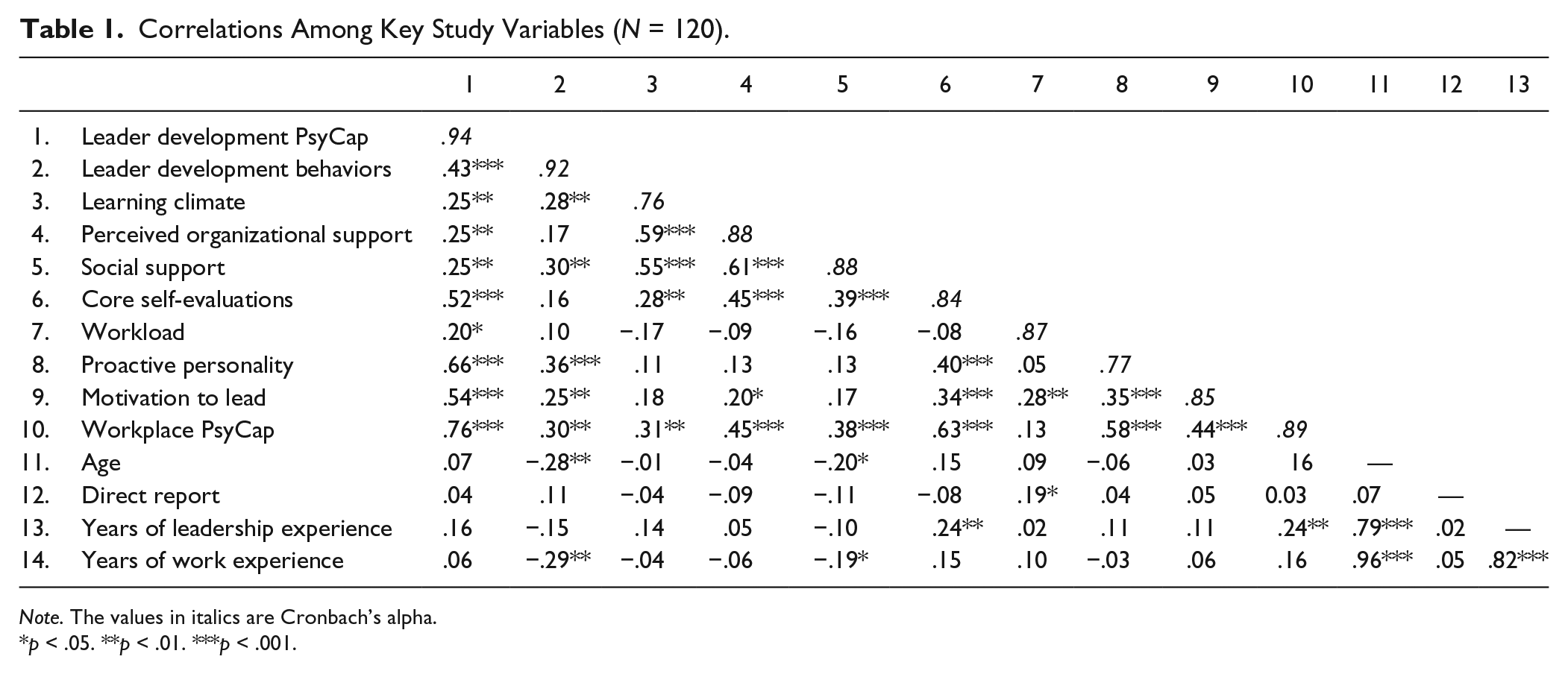
Note. The values in italics are Cronbach’s alpha.
p < .05. **p < .01. ***p < .001.
To test Hypothesis 1, we examined the relationship between the core construct of LD PsyCap with the outcome variable, engagement in leader development behaviors and found a positive correlation between LD PsyCap and leader development behaviors (r = .43, p < .001). Next, we conducted a hierarchical regression predicting leader development behaviors while controlling for years of leadership experience and years of work experience by entering these factors in the first step and entering LD PsyCap in the second step. Years of work experience (β = −.48, t = −3.19, p = .002) negatively and significantly predicted leader development behaviors, whereas years of leadership experience was positively but not significantly predictive. Moreover, results indicated significant results for LD PsyCap as a predictor of leader development behavior after controlling for years of leadership and work experience (β = .44, t = 5.46, p < .001). The results showed that LD PsyCap predicted above and beyond control variables accounting for an additional 18.4% to the prediction of leader development behaviors (p < .001). Altogether, we found strong support for Hypothesis 1 that LD PsyCap positively relates to leader development behaviors.
Next, for Hypothesis 1a to 1d, we expected that LD PsyCap would positively predict leader development behaviors above and beyond (a) workplace PsyCap, (b) core self-evaluations, (c) proactive personality, and (d) motivation to lead. To test these predictions, we conducted hierarchical multiple regression predicting engagement in leader development behaviors (see Table 2). First, we controlled for years of leadership experience and years of work experience by entering these factors in the first step. Next, workplace PsyCap, core self-evaluations, proactive personality, and motivation to lead were entered in the second step predicting leader development behaviors. Results were significant for workplace PsyCap (β = .21, t = 1.73, p = .086) and proactive personality (β = .19, t = 1.86, p = .066). Finally, after entering LD PsyCap as a predictor in the third step, we found that LD PsyCap (β = .37, t = 2.59, p = .011) significantly predicted leader development behaviors above and beyond the control variables and other individual differences variables, accounting for an additional 4.3% to the prediction of leader development behaviors. Therefore, we found support for Hypothesis 1 regarding the incremental validity of LD PsyCap above and beyond (a) workplace PsyCap, (b) core self-evaluations, (c) proactive personality, and (d) motivation to lead.
Hierarchical Regression, Workplace PsyCap, Core Self-Evaluations, Proactive Personality, Motivation to Lead, and LD PsyCap Predicting Engagement in Leader Development Behaviors (N = 120).

Note. LD PsyCap = leader development psychological capital; SE = standard error.
p < .05. **p < .01. ***p < .001.
Next, we turn to organizational-level predictors of LD PsyCap for Hypotheses 2 to 5. We predicted that (Hypothesis 2) learning climate, (Hypothesis 3) perceived organizational support, and (Hypothesis 4) social support would positively relate to LD PsyCap and that (Hypothesis 5) workload would be negatively related to LD PsyCap. Regarding correlations, the relationships between LD PsyCap with learning climate, perceived organizational support, and social support were statistically significant and positive (r = .25, p = .005; r = .25, p = .007; r = .25, p = .005, respectively). Contrary to expectations, the relationship between LD PsyCap and workload was also positive (r = .20, p = .026). To further test these hypotheses, we conducted four hierarchical regressions predicting LD PsyCap, controlling for work experience and leadership experience in Step 1, and entering the respective predictor variable in Step 2. In terms of control variables, we found that leadership experience (β = .32, t = 2.06, p = .041) significantly predicted LD PsyCap. In terms of predictor variables, we found that learning climate (β = .22, t = 2.35, ΔR2 = .044, p = .02), perceived organizational support (β = .23, t = 2.51, ΔR2 = .049, p = .014), social support (β = .26, t = 2.91, ΔR2 = .065, p = .004), and workload (β = .22, t = 2.44, ΔR2 = .047, p = .016) were significant and positive predictors of LD PsyCap. Taken together, we found support for Hypotheses 2 to 4; however, results testing Hypothesis 5 (workload) were significant in the opposite direction than expected.
Last, we examined the role of LD PsyCap as a mediator between the predictors and the outcome of leader development behaviors (see Table 3). Using the PROCESS macro by Hayes (2013), we conducted mediation analyses for each variable (i.e., learning climate, social support, perceived organizational support, and workload). The analyses followed Hayes’s (2013) recommendation for estimating the size and significance of the indirect effect of predictors on outcomes variables through a mediating variable using bootstrap CIs. We used 5,000 bootstrapped samples with bias corrected CIs and used 95% CIs to assess the significant effects. We analyzed the data examining the indirect effect of each predictor on leader development behaviors through PsyCap. After controlling for years of leadership experience and years of work experience, the results showed that relationship between all four predictors and leader development behaviors were partially mediated by LD PsyCap: learning climate (indirect effect = .097, CI [.020, .197]), perceived organizational support (indirect effect = .060, CI [.018, .148]), social support (indirect effect = .102, CI [.037, .197]), and workload (indirect effect = .062, CI [.015, .123]).
Mediation Effects of LD PsyCap on the Relationship Between Independent Variables (Learning Climate, Organizational Support, Social Support, Workload) and Leader Development Behaviors (N = 120).
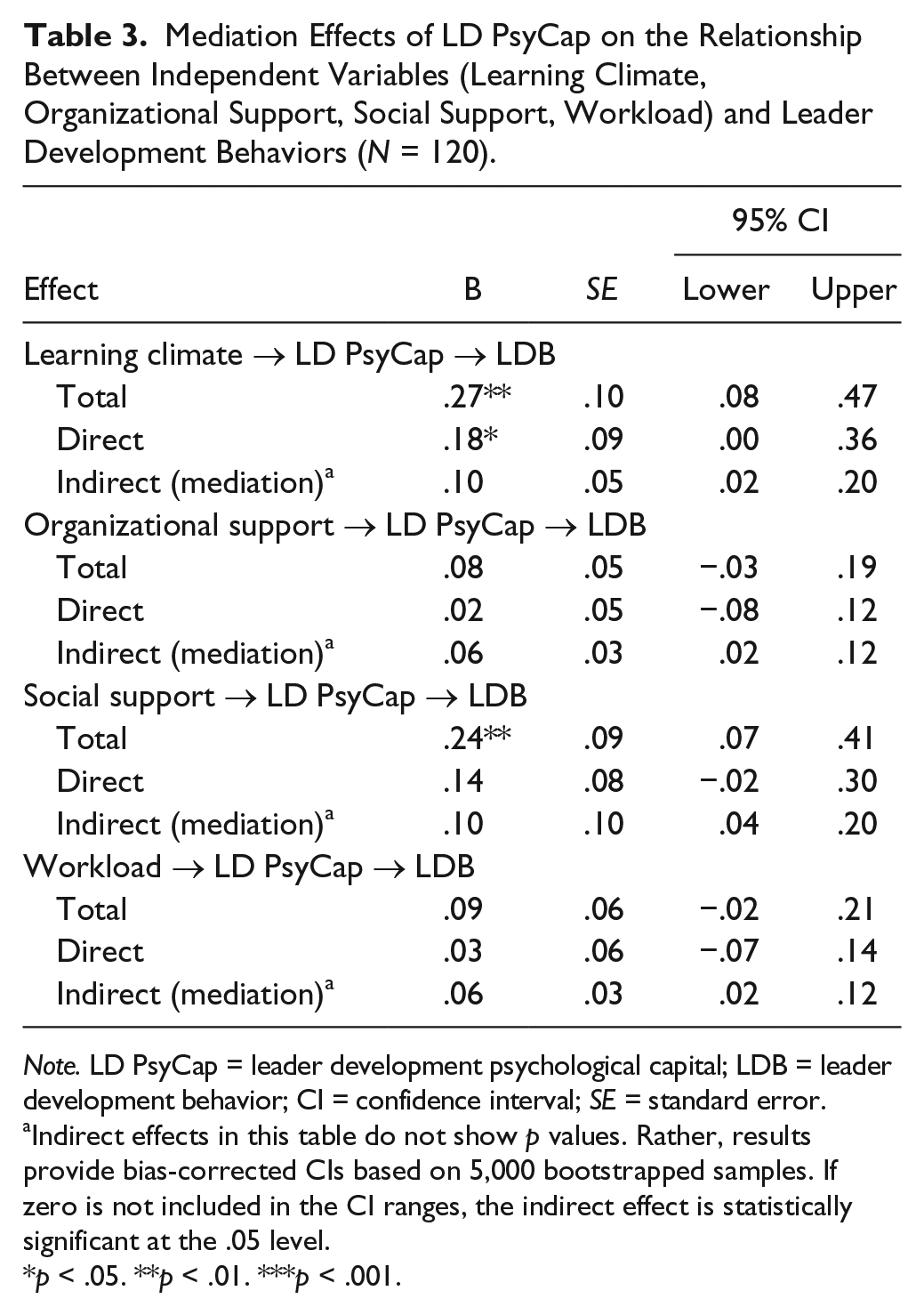
Note. LD PsyCap = leader development psychological capital; LDB = leader development behavior; CI = confidence interval; SE = standard error.
Indirect effects in this table do not show p values. Rather, results provide bias-corrected CIs based on 5,000 bootstrapped samples. If zero is not included in the CI ranges, the indirect effect is statistically significant at the .05 level.
p < .05. **p < .01. ***p < .001.
Discussion
Facilitating continuous leader development is an imperative in many organizations (Banks et al., 2015; Reichard & Johnson, 2011). Several forms of capital—financial, social, human, and positive PsyCap—are necessary to succeed in developing leaders. In this article, we focused on positive PsyCap because it adds a unique and difficult to replicate form of capital and because maintaining high levels of individual motivation propensity to develop is necessary for ongoing leader development (F. Luthans & Youssef, 2004, 2007). PsyCap grew from the field of positive organizational behavior and was initially studied extensively in the domain of the workplace with much utility in predicting important work outcomes (Avey et al., 2011). We built on this tradition and the domain-specific nature of PsyCap to adapt and define it in the context of leader development, specifically, as composed of LD efficacy, LD hope, LD optimism, and LD resilience.
We successfully adapted PsyCap to the leader development context, like how prior researchers adapted it to other domains such as academic performance (B. C. Luthans, Luthans, & Jensen, 2012) and cross-cultural interactions (Dollwet & Reichard, 2014). In fact, the utility of LD PsyCap in predicting leader development behaviors exceeded workplace PsyCap. Effectively adapting PsyCap has important implications not just for the predictive validity of the new construct of LD PsyCap but it also further demonstrates that PsyCap is, in fact, domain-specific and that it is important to align the PsyCap domain with the specific outcome of interest. In other words, although workplace PsyCap was positively related to leader development behaviors, LD PsyCap accounted for additional variance in this specific outcome. As such, we have broadened the theoretical boundaries of the PsyCap construct, as called for by Hackman (2009). Future scholars and practitioners can expect similar success in incremental validity when tailoring PsyCap to other outcome domains of interest.
In addition to outperforming workplace PsyCap, LD PsyCap predicted additional variance in leader development behaviors than the other relevant individual differences variables of core self-evaluations, proactive personality, and motivation to lead. If this were not the case, then the utility of the new LD PsyCap construct would be null. Furthermore, of the individual differences included in this study, LD PsyCap is expected to be the most malleable and, thus, open to development (i.e., state-like). This parallels the proposition from Chaplin, John, and Goldberg (1988) that traits are more stable, that they are longer lasting, and internally influenced, whereas states are more temporary, shorter lasting, and externally influenced. In this study, core self-evaluations, proactive personality, and motivation to lead are considered traits and trait-like characteristics, which are relatively stable. As mentioned previously, PsyCap is considered “state-like,” meaning it is more malleable than traits and persists over weeks and months. For example, in a classroom training intervention designed to increase cross-cultural PsyCap, Reichard, Dollwet, and Louw-Potgieter (2014) found that gains in PsyCap were maintained at least 1 month following training. Additionally, a study aimed at exploring the state-like nature of PsyCap yielded further support that workplace PsyCap is state-like and produced varied results from more trait-like constructs such as core self-evaluations (McElravy, 2014). Because LD PsyCap predicts beyond these traits and because it is a state-like individual difference (F. Luthans et al., 2006), human resources practitioners and managers can design and implement programs and strategies to facilitate the development of LD PsyCap in their current and future leaders (Chaplin et al., 1988; F. Luthans, Avey, Avolio, & Peterson, 2010). We can then reinforce this training through periodic, relatively short refresher interventions to extend the lasting impact of increases in PsyCap (F. Luthans et al., 2006).
One such strategy is to ensure that the organizational context and direct supervisor are perceived as supportive. Having a supportive context influences participation in development through LD PsyCap. Maurer et al. (2003) similarly found that work support (i.e., development-oriented policies, coworker support for development, and learning and development resources available) influenced participation in employee development through perceived intrinsic benefits. However, in their study, intrinsic benefits emphasized the learner’s interest in outcomes resulting from development, which differs from LD PsyCap’s focus on the motivational wherewithal possessed by the learner. Although Maurer et al. (2003) assessed developmental efficacy, which is like one component of LD PsyCap, they did not examine it as a mediator between situational support and participation in development. Therefore, in the current study, we find a new motivational mediator of the effects of supportive context on participation in development and in the context of leader development.
Contrary to our expectations, we found that workload was positively related to LD PsyCap; and that LD PsyCap positively mediated the relationship between workload and leader development behaviors. It is possible that leaders who have high work responsibilities are exposed to additional leader developmental opportunities. Ongoing practice through daily activities provides a rich context for leader development (Day et al., 2014). Moreover, these leaders are more likely to handle multiple projects and priorities beyond the average leader and, thus, are confident and optimistic about including leader development into their long list of work activities. Similarly, extending the rationale of the job demands–resources activation hypothesis (Bakker & Demerouti, 2007), high levels of workload activate the use of LD PsyCap to facilitate effective leader development. We maintain, however, that at extreme levels, workload may become a hindrance for LD PsyCap and leader development behaviors, which future researchers could test by examining a possible curvilinear relationship. In fact, DeRue and Wellman (2009) found a curvilinear relationship between developmental challenge and leader development. Perhaps, workload operates similarly.
Practical Implications
Because LD PsyCap is state-like and malleable (F. Luthans, Youssef, et al., 2007) and organizational context relates to LD PsyCap, we suggest strategies to develop LD PsyCap and its components based on F. Luthans et al. (2006). For example, human resource practitioners can facilitate LD PsyCap by having leaders establish leader development goals that are broken down into short-term steps and begin with easier leader development goals that gradually become more challenging, yet realistic stretch goals. Partnering leaders with mentors who encourage the leaders to develop, communicate effective leader development strategies, and role model leader development can further develop LD PsyCap. Building such social relationships and support for leader development (i.e., assets) while eliminating stress, conflict, abusive leadership, and job insecurity (i.e., risk factors) will facilitate LD PsyCap through high levels of social support and establishing a safe learning climate for development.
Facilitating the development of LD PsyCap can be beneficial prior to not only formal leadership training such as workshops or coaching but especially for experiential learning such as challenging assignments or on-the-job learning. Although leadership experience is at the core of leader development (McCall, 2010), translating experience into learning is not without limitations (Day, 2010). The criterion of leader development behaviors used in this study emphasized experiential leader development, including looking for leadership opportunities, seeking jobs that stretch one’s leadership skills, and reflecting on experiences. By boosting LD PsyCap prior to such leadership experiences, our findings indicate that leaders will be more likely to engage in leader development behaviors.
Limitations
A few methodological constraints limit the conclusions drawn from the current study. First, all data were collected from the same source making common method bias a threat to internal validity (Podsakoff, MacKenzie, Podsakoff, 2003; Podsakoff et al., 2012). To address this threat, we separated the LD PsyCap measure and the leader development behaviors measure with a distraction task as recommended by Podsakoff et al. (2003). We also included attention checks and eliminated participants who failed them. Similarly, the cross-sectional design of this study only allows for conclusions regarding correlations among variables and limits predictive conclusions. It would have been helpful to measure the dependent variable again after a few months to see if the independent variables predicted future behaviors. Finally, we adapted the prior measure of workplace PsyCap to the context of leader development. Although we collected preliminary data to examine item loadings, additional validation of the LD PsyCap measure is needed, particularly to establish the higher order nature of the construct.
Future Research
The conceptualization of LD PsyCap opens the door to the possibilities of several future studies. To begin, future researchers should overcome the methodological limitations of the current study. For example, a repeated measures design could examine the degree to which LD PsyCap is state-like versus trait-like by examining within-person and between-person fluctuations in participants’ responses over time. Researchers can implement experimental or quasi-experimental designs where groups of leaders receive an LD PsyCap intervention to examine if LD PsyCap can, in fact, be developed as theorized. Multisource data, such as 360-degree assessment, should be leveraged in future research to go beyond an examination of self-reported leader development behaviors toward understanding the change in others’ perceptions of leader effectiveness as a result of interventions targeting LD PsyCap. Research on LD PsyCap should be conducted on a larger sample of leaders both in the United States and in other countries to examine its generalizability. Overall, we encourage additional testing of the measure of LD PsyCap to further situate the construct in the nomological network and, thus provide further evidence of convergent, discriminant, and predictive validity.
Beyond LD PsyCap itself, understanding the relationships between workload, LD PsyCap, and leader development would be an enticing area for future research. Does workload activate psychological resources to further engagement in leader development? Or is there, in fact, a cutoff point where too much workload becomes detrimental? Specifically, future research can further investigate workload and LD PsyCap by examining their interactive effects on engagement in leader development and the curvilinear relationship between workload and LD PsyCap and leader development behaviors. Experience sampling methodology or the daily diary method would be instrumental for examining the dynamic interplay between workload, LD PsyCap, and leader self-development on the job.
Finally, the utility of LD PsyCap may go beyond leader self-development behaviors and influence other leader development processes and outcomes. Future research should examine if LD PsyCap relates to engagement in formal leader development programs such as training or mentoring. Differences in LD PsyCap may predict changes in proximal (e.g., self-awareness, leader identity, leadership knowledge, skills, and ability) and distal (e.g., meaning-making structures) developmental outcomes resulting from formal development (Day & Dragoni, 2015). Will those higher in LD PsyCap engage in leader development programs at a higher level? As a result, will they learn more as a result of programs? Will they subsequently perform better as leaders? Our understanding of the role of LD PsyCap in leader development is only just beginning, and we encourage future researchers to examine these questions.
Conclusion
In conclusion, LD PsyCap reflects an individual’s motivational propensity to develop as a leader and consists of the four positive psychological states of LD efficacy, LD hope, LD optimism, and LD resilience. Demonstrating initial utility, LD PsyCap accounts for additional variance in leader development behaviors beyond established traits and mediates the relationship between organizational context variables on leader development behaviors. Future practice and research should examine the development of LD PsyCap longitudinally to determine the true utility of the construct.
Footnotes
Declaration of Conflicting Interests
The author(s) declared no potential conflicts of interest with respect to the research, authorship, and/or publication of this article.
Funding
The author(s) received no financial support for the research, authorship, and/or publication of this article.