



Abstract
This article explores how experienced leaders address an inherent tension between leader role expectations and leader role identities when they enter a new position. Building on analysis of interviews with leaders in intrarole transition, role, and identity theories, we suggest they engage in a process of leader role crafting. We present four sets of role-crafting strategies which aim to influence the development of leader roles, and show how leader role identities both facilitate and impede the use of these. The article contributes to the leadership literature by extending contemporary perspectives on dynamic roles and role identities, while shedding light on an important challenge for today’s leaders who are faced with a particularly ambiguous and demanding role that is always in the making. The study also adds to practice by suggesting ways that leaders can engage in leader role crafting in a more reflexive manner.
Introduction
Roles, which may be understood as generalized expectations of behavior, rights, and duties tied to positions or status in organizational settings, facilitate social interaction and are vital for organizational members since they help them understand how they are expected to behave and how well they succeed (Turner, 1962; 2006). Meeting role expectations is important for leaders who wish to be perceived as effective (Fondas & Stewart, 1994; Tsui, 1984; Tsui, Ashford, St. Clair, & Xin, 1995). Still leaders need to show integrity and appear “authentic” in their role enactment in order to establish and maintain high-quality relationships that are important for successful job performance (Watson, 2008). If challenged by their context, they may therefore strive to remain “true” to their leader identity (i.e., who they believe they are as leaders; Shamir & Eilam, 2005).
So, when external leader role expectations and internal leader role identities diverge, which they may easily do (e.g., when subordinates have role expectations based on past leaders, feel the need for change, or have other unknown preferences that are ambiguous or even detrimental to the leader role identity of their current leader), leaders are faced with a dilemma: Should they meet role expectations or behave in line with how they see themselves in the role? This potential dilemma is particularly salient when a leader takes on a new position and attempts to “claim” a leader identity that she or he may not necessarily be “granted” by her or his new (potential) followers (DeRue & Ashford, 2010). It is easier to be granted a leader identity when one behaves in line with role expectations, and yet difficult to uphold this identity if it implies going against one’s self-in-role understanding. How the leader deals with this challenge may be crucial for job success and satisfaction in their new position.
A burgeoning stream of identity literature (e.g., Ashforth, Harrison, & Corley, 2008; Ashforth, Kreiner, Clark, & Fugate, 2007; Beech, 2008; Brocklehurst, Grey, & Sturdy, 2010; Clarke, Brown, & Hailey, 2009; Down & Reveley, 2009; Ibarra, 1999; Ibarra & Barbulescu, 2010; Ibarra & Petriglieri, 2010; Kreiner, Hollensbe, & Sheep, 2006; Pratt, Rockmann, & Kaufmann, 2006; Sveningsson & Alvesson, 2003; Thornborrow & Brown, 2009) has described how organizational members will engage in identity work when faced with role expectations and social interactions that challenge their sense of self, that is, “forming, repairing, maintaining, strengthening or revising” constructions of self to remain coherent and distinct (Sveningsson & Alvesson, 2003, p. 1165). Only a few studies investigate how organizational members will engage in role work (working to influence the forming, repairing, etc. of roles) when challenged (Ashforth, 2001; McCall & Simmons, 1987; Nicholson, 1984), and hardly any seem to attend to the role work of the leader role.
This disappearance of the role concept from the identity literature (Simpson & Carroll, 2008) and of the leader role concept from the leadership literature (Hiller, Day, & Vance, 2006; but interestingly not from practice), may give the false impression that when organizational members experience “identity threats” (Petriglieri, 2011), they will first and foremost aim to (re)construct identities through their acts (DeRue & Ashford, 2010) and narrations (Ibarra & Barbulescu, 2010). However, in many cases, they may (also) be trying to influence the construction of roles that allow their identities to remain somewhat intact. As a consequence, we risk misinterpreting a lot of behavior and narration as “identity work” that really is “role work” aiming to change external and not (only) internal structures.
The article addresses two research questions. First, what strategies will experienced leaders use to influence the creation of new leader roles? Here, we make the implicit assumption that experienced leaders purposely act to influence the construction of roles as a basis for leading effectively (Ladegard & Gjerde, 2014). Second, we ask how will their leader role identities influence these role-crafting strategies. To address these questions, we interviewed experienced leaders in intrarole transition and paid particular attention to how they engaged with role expectations from their subordinates and how they reflected on and made use of their leader role identities during this process.
We draw on two main fields in the leadership literature: role and identity theories. We follow a nascent stream of thought that argues in favor of a dynamic and exploratory understanding of roles (rather than a static one) and believe role identities will play an important part in their becoming (e.g., Järventie-Thesleff & Tienari, 2016; Simpson & Carroll, 2008). Finally, we borrow the recently suggested term “role crafting,” which refers to individuals’ attempts to innovate or modify “role-related expectations, ranging from minor tweaks to major changes” (Ashforth, 2012, p. 162). We argue that leader role crafting is a conscious, purpose-driven activity aimed at influencing the development of leader roles, and explore how it is interlinked with role identities.
The study contributes to the leadership literature by showing how leader roles and leader role identities emerge and are constructed in a dynamic process as leaders engage with their subordinates and their role expectations while being influenced by their own self-in-role understanding. The study adds to practice by proposing a set of empirically founded role-crafting strategies that leaders may reflect on and experiment with in order to take a more reflexive approach to role construction and perhaps relieve them of some of the tension that may follow in the wake of identity work (e.g., Ibarra, 1999; Sveningsson & Alvesson, 2003).
Theory: Leader Roles, Leader Role Identities, and Leader Role Crafting
Role theory is a field of confusion and variety of orientations (Biddle, 1986) and the conversation of identity and identity processes is “one of the fastest growing, most fertile, and perhaps most contested” ones in organizational studies (Dutton, Roberts, & Bednar, 2009, p. 4). Attempting to review role and identity literature in their entirety is beyond the scope of our article. We will focus our attention on the leader role and leader role identity, how the two are believed to mutually affect each other, and how contemporary perspectives on the dynamic evolving role may be useful to cast light on a challenging dilemma that today’s leaders are faced with.
The Leader Role
There exists a multitude of interpretations of the leader role, many inspired by Mintzberg (1973) and Katz and Kahn’s (1966) seminal books. Mintzberg (1973) once claimed that the leader role was one of the most significant of the 10 roles a manager has to play. He described it as a set of activities and behaviors that served a particular function in the organization such as encourage subordinates, define the working atmosphere, and align subordinate and organizational needs.
According to organizational role theory (ORT), roles are “standardized patterns of behavior” associated with given tasks that are tied to organizational positions (Katz & Kahn, 1966, p. 37). Katz and Kahn (1966) propose three types of leadership behavior that comprise the leader role: the introduction of structural change, improvisation, and the use of structure to keep the organization in motion. Management studies building on ORT have added to this understanding of the leader role and among the many predefined and preexisting leadership tasks, activities, and behaviors that are believed to make up the leader role we find: to give direction and purpose to the organization (McCall & Segrist, 1978; Shamir & Howell, 1999), facilitate subordinates’ growth (McCall & Segrist, 1978; Tsui, 1984), and achieve collective goals (Hoyt, Price, & Poatsy, 2013). ORT purports that role expectations are communicated or “sent” to the leader by individuals who have a stake in their role performance such as subordinates, superiors, and peers (Katz & Kahn, 1966). The leaders will “receive” these expectations and either conform to or deviate from them (Katz & Kahn, 1966; Tsui, 1984). Studies, which build on this role theory, have suggested that the leader role content and ways of enacting the role will be negotiated among the leaders and their role-set (subordinates, peers, and superiors) through this process of sending and receiving (e.g., Fondas & Stewart, 1994; Pfeffer & Salancik, 1975; Stewart, 1982; Tsui et al., 1995).
Over the years, since ORT was first presented, the leader role has evolved into a “particularly ambiguous” and poorly specified role (DeRue, Ashford, & Cotton, 2009, p. 221). What is deemed appropriate leadership behavior is often unclear, uncertain, and variable across contexts and varies among scholars and laypeople alike (DeRue et al., 2009). The long list of leader role expectations, influenced by a booming leadership literature and media’s craze of heroic leaders (to be authentic, charismatic, humble, considerate, strategic, transformational, and empowering, to name a few) presents contemporary leaders with an overwhelming demand. Some have even suggested leaders have to be “super-humans” to fulfill them all (Alvesson & Spicer, 2011, p. 9). Thus, simply sending and receiving a list of leader role expectations is no longer a viable option. Consequently, ORT (Katz & Kahn, 1966), which has provided much of the basis for our current understanding of leader roles, needs to be refined and adjusted to increase its relevance for contemporary practice in organizations. We need a more emergent perspective on leader roles that acknowledges its constant state of becoming, to properly address this challenge.
We find an emergent interpretation of role in the symbolic interactionist perspective (Blumer, 1969; Mead, 1934). This perspective suggests that roles come into being as individuals play with, create and attempt to modify behavioral patterns during social interaction (Stryker, 2006; J. H. Turner, 2006). Rather than assume that roles are fixed and taken-for-granted positions that may need to be negotiated, the interactionist perspective suggests that roles are constantly being formed through people’s coordinated behavior and jointly defined meanings (Ashforth, 2001). It is within this thinking that we find some of the few contemporary papers on role in the organizational literature (e.g., Järventie-Thesleff & Tienari, 2016; Simpson & Carroll, 2008). For example, Simpson and Carroll (2008, p. 34) suggest that roles are located in between actors as “boundary objects” that help translate meanings backwards and forwards and facilitate the emergence of identities, and that people are aware of the ongoing role construction that goes on between people as they interact.
In this study, we place our leader role understanding in a “middle range position” in the midst of a “paradigm divide” (Ashforth, 2001, p. 4) between ORT (Katz & Kahn, 1966) and the interactionist role perspective (Stryker, 2006). We argue that leader roles are partly stable and exist in the form of expectations toward the role incumbent, as roles tend to become institutionalized within organizations (Berger & Luckmann, 1966). At the same time, we believe that leader roles come alive and develop as leaders attempt to express valued identities (Ashforth, 2001; Kanter, 1977; Sveningsson & Alvesson, 2003) and enact their own role definition (Levinson, 1959), while their behavior is influenced by their role-set (Pfeffer & Salancik, 1975). Thus, throughout the article, we employ the term “leader role” (as opposed to “leadership role”) since this term also includes a social role. This means that the term “leader role” embraces not only behavioral expectations (which “leadership role” does) but also comprises attitudes and characteristics that are tied to a position in an organizational, social structure (McCall & Simmons, 1987).
There are two important role-related challenges that may undermine leaders’ performance in the leader role: role ambiguity, a lack of clarity about the role, and role conflict, when compliance with one sending will make it difficult to comply with another (Kahn, Wolfe, Quinn, & Snoek, 1964). We assume that experienced leaders may have developed a way to address these two particular challenges through the use of role-crafting strategies. For example, a study by Schuler (1975) found that negative effects of role ambiguity and conflict was more prevalent among leaders’ lower down in the hierarchy than higher up, and argued that as one climbs the organizational ladder, leaders develop an ability to manipulate situations of ambiguity and conflict. The aim of our study is to explore what such attempts at manipulation may look like in more detail, assuming they may take the form of role-crafting strategies, and investigate how the use of these strategies will come into play with leader role identities.
Leader Role Identities
The most common term that addresses leaders’ identities is simply “leader identity.” This term refers to seeing/thinking of oneself as a leader (Day & Sin, 2011; DeRue et al., 2009; Lord & Hall, 2005), or as having confidence in one’s ability to intentionally engage in leadership (Komives, Owen, Longerbeam, Mainella, & Osteen, 2005). Leadership scholars building on social identity theory (Tajfel & Turner, 1986) have suggested that a leader identity refers to how strongly individuals identify with the social leader category, how prototypical they find themselves to be of the leader role, and how central their identification with being a leader is to their self-definition (Hogg & van Knippenberg, 2003; Rus, van Knippenberg, & Wisse, 2010).
However, not everyone who identifies with being a “leader” believes that they are prototypical of the leader role (e.g., female leaders; Ely, Ibarra, & Kolb, 2011). And leaders’ confidence in their ability to lead effectively may fluctuate. Nevertheless, they may still have a self-in-role understanding of who they are in the leader role that guides them. Thus, in this study, we talk of “leader role identities” (Waldman, Galvin, & Walumbwa, 2013). This is to highlight that we explore the functions of a definition of self-in-role (Ashforth, 2001, p. 6) and not simply the function of identifying with being a leader (or not; Day & Sin, 2011; DeRue et al., 2009; Lord & Hall, 2005). We explore role crafting among experienced leaders, and so may assume that they already identify with being a leader which is what the term “leader identity” implies (“thinking of oneself as a leader,” Day & Sin, 2011, p. 547). We go deeper and explore how a contextualized understanding of self-in-role as a leader (i.e., leader role identity) affects the leaders’ attempts at leader role construction.
Leader Role Crafting and a Model in the Making
Role crafting is a recently suggested term by Ashforth who defines it as the process of innovation or modification of “role-related expectations, ranging from minor tweaks to major changes” (Ashforth, 2012, p. 162). He likens role crafting to similar concepts such as role development (Ashforth & Saks, 1995; Nicholson, 1984), role innovation (Nicholson & West, 1988), and role making (Graen, 1976; R. Turner, 1962). These perspectives on role development focus on the conditions and constraints of the role (e.g., role-discretion: latitude to alter task-related characteristics and role novelty: the degree to which the role permits use of prior knowledge) and of the role constituent (e.g., desire for control or feedback) and aim to predict different forms of role change (Ashforth & Saks, 1995). We adopt the concept of role crafting, as it describes role development as a conscious, purpose-driven activity that we believe is accurate for how experienced leaders approach the challenges of taking on a new role.
Although we assume that leader role crafting will resemble role development, role innovation and role making, we believe that leader role crafting will differ by being more conscious and deliberate due to widespread and diverse implicit leadership theories (Phillips & Lord, 1986) among leaders and followers, that is, “cognitive simplifications” about what constitutes leaders’ behavior and performance (Bresnen, 1995, p. 499) that inform their “commonsense views about what leadership does and/or should entail” (Bresnen, 1995, p. 504), and probably affect their attempts at influencing the leader roles in their development. In addition, we believe that experienced leaders will draw rather consciously on their previous understanding of self in role as a way to situate themselves in role (Ashforth, 2001) and get “up and running” (Watson, 2008) and thus attempt to change role rather than identity (Pratt et al., 2006).
From identity studies, we find that organizational members may try to enact their roles in line with their identities and that this may at times lead to tensions and struggles (e.g., Ibarra, 1999; Sveningsson & Alvesson, 2003). From the role literature, we have learned that people’s identities will affect the development of roles (e.g., Nicholson, 1984). And so, we know that roles and identities tend to coevolve (Järventie-Thesleff & Tienari, 2016; Simpson & Carroll, 2008). What we do not know is how this happens on a more detailed level for an ambiguous and dynamic role such as the leader role. What leader role-crafting strategies will leaders use? And what functions do their leader role identities have during this process? Figure 1 depicts how we expect that the leaders’ role interpretation, leader role identity and perception of subordinates’ role expectations will influence each other mutually and shows the missing piece of the puzzle that we set out to explore.
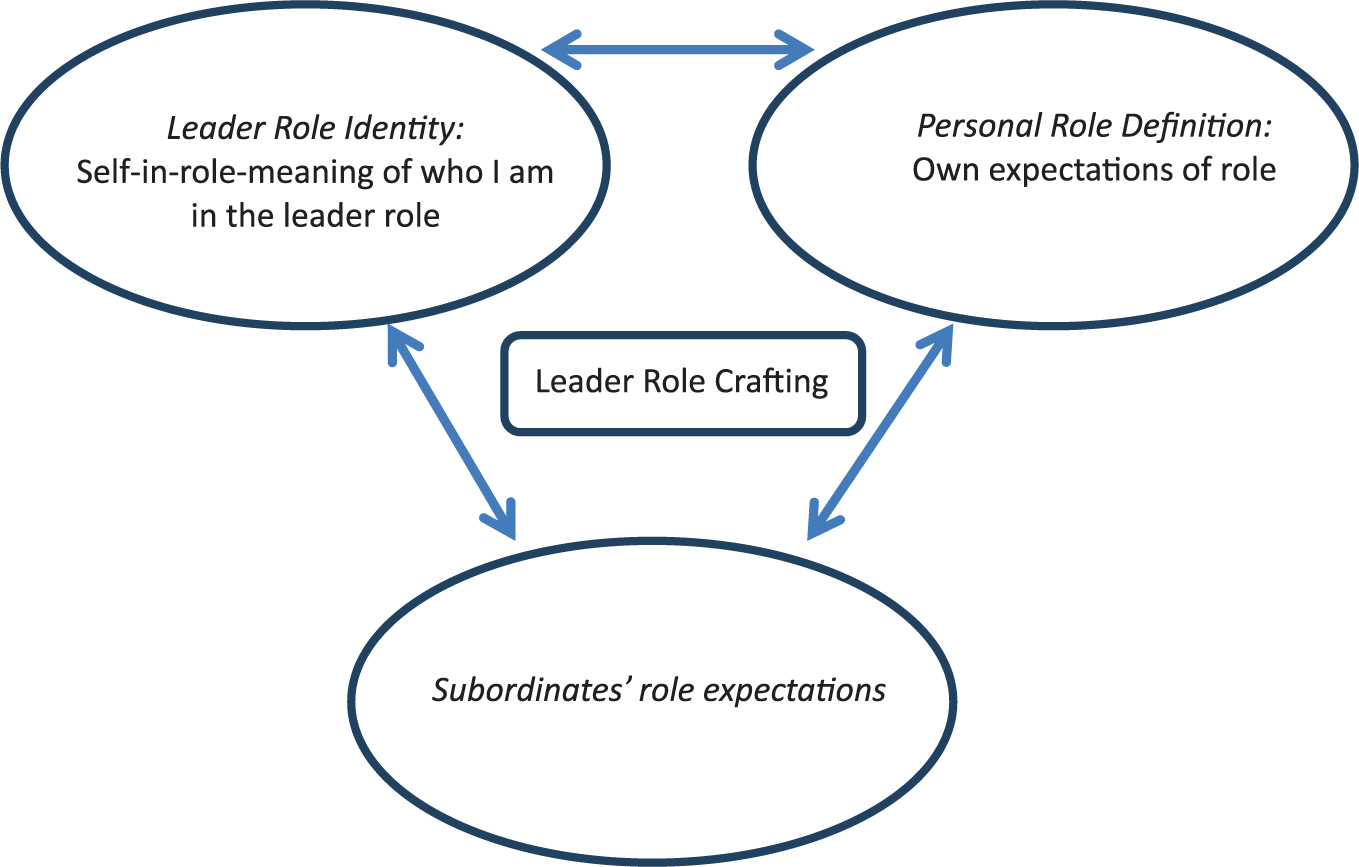
Leader role crafting.
Method
To investigate role-crafting strategies and the part leader role identities play, we applied an inductive research design (Eisenhardt, 1989) and interviewed 28 experienced senior leaders from four different organizational contexts in Norway. Comparing multiple cases across different contexts should improve theory building by helping reveal relevant concepts and their relations (Bryman, 2012; Eisenhardt, 1989). We wanted a richness in context to be able to obtain a broad picture and hence a potentially rich variation in role-crafting strategies.
Context, Participants, Data Collection, and Analysis
Contexts
The military, public service, banking/finance, and the technology sector were chosen through purposeful sampling to represent extreme contexts or “polar types” (Eisenhardt, 1989; Pettigrew, 1990) that vary along two main criteria: preparation time for role transition and explicit leader role expectations. We chose the technology sector as one extreme context due to the short time allowed to prepare for a new managerial role (an average of 2 weeks) and the loosely defined leader role expectations. The military was chosen as the other extreme due to its long preparation time (6 months) and very explicit set of predefined leader role expectations (e.g., years of training in and socialization into explicit leadership philosophy in the military service). Public service and banking/finance were chosen to represent contexts in between these two extremes.
Participants
We contacted HR directors in the organizations that represented our chosen contexts and asked for participants to our study. They were given a list of selection criteria: leadership experience (a minimum of three previous managerial positions with leadership responsibility which we defined as “personnel responsibility”), recent role transition (between 1 and 6 months), and tenure within the organization (a minimum of 1 year’s employment). During a 1-year period (2013-2014), we were provided with e-mail addresses for potential participants who met our selection criteria. The HR directors checked first with the potential participants before sending us their e-mail address, and everyone we contacted agreed to participate in the study.
Leadership experience was chosen as a selection criterion to augment the chances that the participating leaders had experience dealing with changing role expectations to which they could compare their current situation. As we wished to explore strategies for role construction, rather than identity construction, collecting data from experienced leaders was particularly suitable since as people gain experience in their work they may shift their emphasis from identity construction to role construction (Pratt et al., 2006).
To help provide fresh insights on role and role identity that were not limited by retrospective accounts, the leaders should be new to their job. To ensure that their reflections were related to the actual role transition and not to the socialization process of entering a new organization, the role transitions of the leaders had to be from within the same organization. We also wanted a balanced sample of women and men.
Due to our strict selection criteria, the leaders were not equally dispersed across all four contexts. Two were from the military, 7 from public service, 15 from banking/finance, and 4 from the technology sector. Fifteen were women and 13 were men, 9 held top management positions (e.g., CEO and HR director), and 19 upper middle management positions (e.g., bank leader). Their age range was between 28 and 62 years with the majority in their mid- to late 40s. We refer to the leaders using numbers (1-28) and acronyms for their belonging contexts. PS: public service, BF: bank/finance, TS: technology sector, and M: military.
Data Collection
To ensure that the interviews were effectuated in a similar manner, one interviewer (first author) performed all 28 interviews with a semistructured interview guide (see the appendix) which included subjects such as the leader role, who they were as leaders, how they experienced the change from one position to the other, and what they did to adjust and why. The interviews lasted between 90 and 120 minutes. The data coding and collection were conducted in a parallel. First handwritten notes were coded immediately after the interviews, and then the transcribed material was coded again (455 pages of single-spaced typing) with the use of a software program (QDA Miner). This enabled the exploration of emerging categories during the interviews through probing, which helped elaborate the categories further. As we reached 22 interviews, we experienced a form of saturation in categories (Corbin & Strauss, 2008), but decided to conduct six more interviews to gain additional examples and thus a deeper understanding of the strategies and functions. We acknowledge that a researcher may not be impartial or without an “interpretative frame of reference” (Charmaz, 2005, p. 509). Thus, to stay reflexive about own role throughout the study, we wrote diary notes reflecting on assumptions and consulted these during our analysis.
Data Analysis
The data were analyzed in three stages. First, we assigned open codes to the handwritten notes and performed an iterative analysis going back and forth between preliminary codes and extant role and identity literature (Eisenhardt, 1989; Glaser & Strauss, 1967). When all interviews had been transcribed, both authors separately coded all transcribed interviews. Emerging categories were discussed regularly and we developed a common “code book” with terms and attributes to ensure that we used the same code names and that the codes were interpreted in the same manner. For example, the same phenomenon was named “discrepancy” (Fondas & Stewart, 1994) by one and “misfit” by the other. After discussions and comparisons with extant theory, we concluded that “perceived misfit” was the code name that best captured its essence. During this process, codes such as “show” became “demonstrate,” “test” became “experiment,” and “confront” became “oppose.” The data were then recoded individually by both authors using our agreed on code book and the results were compared with ensure final agreement. First-order categories were then grouped into higher order categories/themes (Corbin & Strauss, 2008) resulting in four final role-crafting strategies, and the functions of leader role identities were grouped into three distinct functions with corresponding metaphors.
In the final stage, we performed cross case analysis across groups (context, hierarchical level, and gender) and individuals using the software program. We discovered that seven of the leaders experienced quite a strong “misfit” between own role interpretation, identity, and subordinates’ role expectations. In order to get a firmer grasp of this phenomenon, we wrote up short vignettes on the seven leaders, inspired by narrative analysis (Maitlis, 2009; Riessmann, 2008) and compared how their stories were similar to and different from each other. This advanced our theorizing and revealed further complexity in role crafting.
Findings
Strategy 1: Present: Informing and Demonstrating
The majority of the leaders reported that early in their role transition they informed their subordinates through formal and informal meetings, workshops, and/or plenary sessions about what to expect of their way of enacting the leader role. The main topic of these information sessions was their leadership style and what many referred to as their “leadership philosophy” or “leadership principles.” These were personal beliefs about how best to lead, much like we find in the implicit leadership theories (Bresnen, 1995; Phillips & Lord, 1986). The leaders also informed the subordinates about specific leadership tasks and duties they planned to pay particular attention to (e.g., regular coaching sessions, weekly motivation meetings), which resembles how Mintzberg (1973) would describe the leader role in terms of functions.
I gathered everyone in for a meeting, because I felt that they were more . . . I don’t know, but different to the ones I worked with last time, and so I got the feeling that I had to do something. And so, after four or five weeks I invited them all to a kick-off and told them what I expected of them and told them about my leadership principles, who I was as a leader. (PS3)
We labeled this strategy informing.
In addition to verbally telling the subordinates what to expect from them as a leader, the leaders also presented their interpretation of the role through specific behaviors. Several leaders described how they would deliberately delegate and ask questions rather than provide answers to convey that their way of enacting the leader role would involve coaching rather than instruction. One leader described how he invited more people to team meetings than his predecessor had done to show his involving leadership style (BF20). A senior leader (PS11) decided to sit in on client calls with subordinates many hierarchical levels below her and give feedback on their service, to convey the level of involvement they could expect of her. Some behaviors were of an even more symbolic kind. For example, one CEO sent a personal e-mail directly to all employees informing them about her plans and hopes for the future, to demonstrate an open and including leadership style (BF4). Another leader (TS28) transferred the task of writing up the minutes of annual appraisals to subordinates even though there was a general expectation that this was part of the leader role. This gesture was not so much about the task itself as the message she wanted to convey about her way of enacting the leader role. We labeled this strategy demonstrating.
Common for the two aforementioned strategies was how they presented their leader role expectations based solely on their own priorities and leader role identities. We grouped the two strategies into a second-order category labeled present. When the leaders made use of present strategies, we found that their leader role identities served as a guide that would help them steer acts of behavior, attitudes, and task priorities in a particular direction that was in line with how they saw themselves as leaders: In order to enact this leader role, I think you need to believe it is possible and see that you can fill it with who you are and in your way . . . I have a very clear idea about who I am and what I do. If I am to make it in this role, I have to be me and do it my way. (BF15)
However, as we will show in the following paragraphs, not all parts of their leader role identities were equally well defined and hence they could not always guide the leaders’ role enactment in a helpful direction.
Strategy 2: Adapt: Complying to and Moderating Behavior
In many circumstances, the leaders felt they needed to adapt to subordinates’ leader role expectations. As the leaders learned what was expected of them, either by asking explicitly or paying attention to what the subordinates seemed to value, they would sometimes simply comply with what was expected in terms of leadership tasks, duties, and responsibilities (even though this was not how they would normally behave): I spent a lot of time trying to understand my function and what they expected from me. One of my subordinates was very clear about his expectations regarding my presence in the everyday business of our organization so that I would understand what they do. Another one was very explicit about how he wanted me to let him do things his way and not micro-manage him. (M5)
In other cases, adaptation implied a deeper form of moderation of their behavior (sometimes acting against more deeply held preferences) to adapt to the needs of the subordinates. This strategy seemed to be aiming at the motivation of their subordinates. The leaders described how each individual had different needs and why they would go far in their attempts to adapt if this could improve their subordinates’ motivation: I realized that my subordinates are very different from what I am used to, and people are individually very different. Some are analytical, some are sales people, and they are motivated by different things, so I try to accommodate these needs, give people more support than I am used to, step down to “their level.” (BF19)
The leaders described how they worked hard to develop skills, moderate behavior, and act like role models to meet leader role expectations, all the while trying to keep their integrity intact: It’s easy to adapt the way I talk if I notice I will communicate better, and it’s easy to change as long as I see why. It’s like I tell my eldest daughter, there are certain compromises you just have to make. But if I feel I change due to lack of courage or integrity that would be hard. (BF23)
We grouped the two strategies of complying and modifying into another second-order category labeled adapt. The main focus of “adapt” was to try to meet subordinates’ expectations, and their leader role identity operated only in the background during these situations. Due to the way that the leaders adapted to certain role expectations while trying not to stray too far away from their self-in-role-meaning, we found anchor to be a suitable metaphor to describe its function: The leaders “anchored” themselves down to leader role identities to prevent themselves from drifting too far off while they attempted to accommodate their subordinates’ needs. At the same time, this anchor provided them with the flexibility required to adapt to the subordinates’ role expectations: I’ve made adaptations to how I behave during my meetings. I try to read the group and will sometimes speed up, tell stories, or be a more serious leader than I like to create the right atmosphere. But I will always keep the core of me in everything I do. (BF7)
Strategy 3: Challenge: Persuading and Challenging Expectations
The leaders often discussed leader (and subordinate) role behavior, tasks, and duties with their subordinates and actively tried to “sell in” their perception of the leader role. This strategy was used when the leaders wanted to change subordinates’ leader role expectations, but could not use the present strategy, either because the subordinates would ignore what was informed or demonstrated, or because the strategy would risk creating resistance and a lack of trust from the subordinates: This means that I need to work in a different way. I may perhaps need to behave differently, and not just behave, but I need to involve them, explain and anchor my ideas with them, put things into a different light, as I understand they are driven by different goals. (PS17)
The leaders tried different ways to persuade the subordinates about their leader role definition and some were quite creative: For example, one leader (BF16) who felt the subordinates were way too passive in their work invited a professor to talk about followership at a team gathering to get the subordinates to see that leadership is a cocreated process that involves leader and followers. This strategy we termed persuading.
At other times, the leaders insisted on enacting the leader role in line with own role definition and identity, despite explicit and implicit feedback from the subordinates that they wanted the leader to change approach: I need to handle her in a good way, because she is of great value to us, she is a great advisor and we want her to continue. And so, I need to be on the same page as her and find the right balance between being steadfast, firm and keeping my decisions on how to lead our group, at the same time as I listen to her ideas. So, I need to dare confront her in areas that I believe are right. (BF21)
We labeled this strategy opposing.
Persuading and opposing were strategies aiming to alter subordinates’ leader role expectations through discussion and communication, and we grouped them into a third second-order category labeled challenge. This seemed to be a strategy that had to be used early in their role transition, as one leader (BF16) remarked that unless you challenge role norms right away you either lose the right to challenge (as you will have given them a silent acceptance) or grow blind and become part of the system. When attempting to challenge subordinates’ role expectations, the leaders were very aware of their own leader role identity and own role interpretation and how these contradicted the leader role expectations of some of their subordinates. Thus, both leader role identity and subordinate expectations were at the forefront of the role-crafting process. We found that leader role identities played two complementary functions simultaneously as the leaders employed this strategy, that is, they alternated between operating as a guide that pointed the leader in a particular direction for role enactment, as well as an anchor that kept role enactment close to their leader role identity.
The leaders were more prone to challenge role expectations if these conflicted with core aspects of their leader role identities such as core values. Thus, similar to the way identity was employed during the use of the present strategy, this strategy involved aspects of the identity that were well defined and explicit: I just decided that these are my values, and I will not compromise them. I am very aware about what I take to the barricades. I mean you have to choose your battles. But you also need to know when you have reached the limit of what you can accept because of what you believe in. (BF4)
Strategy 4: Experiment With Old and New Ways
Several leaders reported that they continuously used a trial-and-error approach to align own leadership preferences with subordinates’ leader role expectations: I guess I experiment since I have to figure out a way to manage this new role and certain changes are needed. I know I have some strengths and I have had to think about how to behave to meet the demands of this new situation. I guess I could have been more conscious about this process. I don’t normally think a lot about what we are talking about now, so this experimenting it just happens without me being very conscious about it. (PS17)
The leaders experimented with behaviors derived from their own previous roles as well as external role models, constituting two substrategies. The first substrategy involved experimenting with old ways of enacting the leader role: behaving in old and well-rehearsed styles and paying attention to tasks and duties in the same way that they had previously done. The leaders drew on a vast variety of leadership experience from previous roles, childhood, hobbies, and parenthood and used these to experiment with. The leaders carefully tested the reactions of others and remained open to feedback. The purpose of this strategy seemed to be to determine what elements of leader role enactment from their past would be appropriate in their new position: I test the boundaries, since I know how I may appear to people. I notice when we get a good dialogue going, and then I open up a little more and use humor. I guess I test quite a bit. How far can I go? I’m at times surprised by how frank I can be and still get away with it [laughter]. But I have to feel that people want to work with me and so I take leaps out of the box and I’m prepared to explore that journey. If I notice no one is reacting I guess I can continue that way and it makes me really happy. (PS 23)
Experiment with new ways was the second substrategy. It implied copying role models (their leadership priorities, ways of behaving, thinking and expressing feelings, and performing leadership tasks and duties) and improvising with completely new ways of enacting the leader role. This experimentation is very similar to Ibarra’s (1999) descriptions of junior employees and how they would try on “provisional selves” by copying role models when settling into a more senior role. It is interesting to see how this copy/experimentation strategy seems to be valuable throughout the career, and how it goes against a popular advice from the authentic leadership literature which argues that authentic leaders do not arrive at their leadership style and convictions not through a “process of imitation,” because “authentic leaders are originals, not copies” (Shamir & Eilam, 2005, p. 397). Nevertheless, the experienced leaders argued that imitating role models helped them benefit from the “smart stuff of successful leaders” (BF 20), “learn from failed leaders’ mistakes” (BF12), and not having to “reinvent the wheel” (TS24). But, more important, by looking to others they did not have to become “paralyzed by fear of making mistakes” (BF16) since it gave them permission to enact the leader role in ways that they may not have dared to do on their own: Taking after role models gives you a frame to act within, so you know how to behave. Then you won’t need to be afraid. Even though we are leading bankers, who supposedly are very traditional and careful, we can now say “come on let’s kick ass!” And promise our customers we’ll fight for them. You didn’t say that some time back, right? If we’d had a more traditional bank director as CEO who was more of a “credit person,” we’d have to be more careful. (BF18)
The leaders made adjustments to what they copied in order to create a better “fit” and discovered new ways of engaging in leadership resulting in the emergence of new leader roles: I have learned from all my previous leaders. I’ve taken with me what they were really good at and I’ve thought that wasn’t so good, I’ll have to watch out for that. And then I’ll bring in my own ideas and ask those around me how can I do this better? If you copy you will most probably feel a bit uncomfortable and then you’ll need to adjust what you do, so that it becomes your own way of leading. (BF18)
The experimentation strategies involved purposeful interaction, feedback, and adjustment, where leader role identities and leader role expectations developed simultaneously. While experimenting their leader role identities and leader role interpretations were left in the background of the role-crafting process. Keeping them out of the way seemed to help the leaders remain curious about news ways of enacting the role rather than insisting on one correct role (some did, however, struggle to remain open, as we will return to later). During the trial and error processes, their leader role identities provided the leaders with a mental framework against which they could test their own reactions to their new ways of enacting the leader role in order to determine how well they fitted.
I try out different things and I know it’s me when it just clicks. (BF12)
Due to the manner in which the leaders “consulted” their leader role identities to check how well their role enactment resonated with how they saw themselves as leaders, we decided to use “sounding board” as a metaphor to describe its function. The leaders would in particular check in with their leader role identity in situations that involved discrepancies between own role definition and subordinates’ expectations. By scrutinizing their sense of self as leaders, and whether possible changes in behavior, tasks, and attitudes would conflict with their sense of self, they seemed to be able to discern what parts of their leader role identities were open for change. Furthermore, the leaders appeared to have a personal core that remained constant and which represented a limit to their ability to change.
Perceptions of Role Misfit
The four described strategies were used more or less by all of the leaders, and they alternated between them depending on the situation at hand. During the interviews, it became clear that attempting to create a shared understanding of a leader role that the leaders both could and wanted to enact was the main objective that fueled the use of these strategies. However, some of the leaders (seven) apparently struggled and seemed to experience a bigger sense of misfit with parts of their new leader role. These examples of misfit are interesting as they indicate the complexity involved during the leaders’ attempts to influence the creation of new leader roles.
One type of misfit was experienced by five of the leaders (BF1, TS28, M8, BF20, and BF22) as the difficulty of “being oneself” in the new position. Two of the leaders (BF1 and TS28) expressed that they could not enact the leader role in line with a role image (Vough, Cardador, Bednar, Dane, & Pratt, 2013) that did not suit them. However, the role image they described was not the result of information gathered from their subordinates, but a general one (e.g., to be an “almighty leader high above the rest” TS28). They did not use any of the aforementioned role-crafting strategies to address what may have been an actual role expectation or only an imagined one. Rather they chose to ignore these expectations, but still described what seemed like an inherent tension.
The third leader who expressed a sense of misfit (M8) refused to attend to “what others think I should do” and said that it was difficult because many would criticize his decisions. This leader rejected a definition of the “leader role,” insisting to just “be myself” and “do what was right” (according to him). However, it was apparent that lack of agreement between own leader role identity and the role expectations of his subordinates was a concern. The two final leaders in this group (BF20 and BF22) explained that they had not fully identified with being a “leader” and described role identities that were more “expert oriented” than leader oriented. These two leaders did not seem to be ready to let go of their previous “hands-on” expert identities in order to take on a more “hands-off” leader role identity. As a consequence, they declined to go into any of the role-crafting strategies.
The way these five leaders either chose to ignore leader role expectations as the first two leaders did, refused to enact a role altogether as was the case with the third leader, and refrained from addressing the leader role expectations of their subordinates as did the final two, all address difficulties in relating actively to expectations. However, it appeared that for these five leaders, perceptions of leader role expectations were not tested against reality and thus seemed to act as an excuse to avoid addressing expectations more explicitly.
The second type of perceived misfit was described as an explicit incompatibility between some of the subordinates’ expectations and the leaders’ own leader role definition. None of the four main strategies seemed to help solve this misfit, since the subordinates had sufficient power to resist the role-crafting attempts by the leader (TS14 and BF21). One leader had a strong, powerful, and professional subordinate who openly resisted the leader’s decisions to develop staff through a coaching style. The other leader worked in a politicized organization with power struggles that made these strategies difficult. Thus, power and politics seem to affect the degree to which a leader can craft a leader role based on own role definition and identity, and additional strategies, such as seeking support from superiors, may be necessary.
The four sets of role-crafting strategies are summarized in Figure 2 which give an overview of the data structure.

Overview of data structure of role-crafting strategies.
The Mutual Influence of Leader Role and Identities During Role Crafting
Judging from our empirical findings and theorizing, crafting the leader role is a complex process where leader role identity, subjective role definitions and external expectations act simultaneously and no single strategy is sufficient to create a shared understanding of a leader role that one may want and be able to enact. Leader role identity and the interpreted leader role expectations will have a more or less dominant function during the different role-crafting strategies.
We found that the leaders used all four strategies depending on the issue at hand. Present and challenge strategies were most often used for crafting the part of the leader role that involved general leadership tasks and responsibilities. Adapt was more often related to the subordinates’ needs and motivation and therefore leadership style, while experiment was concerned with all aspects of the leader role (leadership behavior, tasks, and duties).
Leader role identity played an important part in all four strategies and alternated between operating as a guide, an anchor and a sounding board. Thus, leader role identity was a major source of information for the leaders’ role definition and their role-crafting process. This coincides with how the leader in Sveningsson and Alvesson’s (2003) study used her professional identity as well as personal aspects of her self-identity as a source for role enactment.
Furthermore, leader role identities were clearly multifaceted and complex and while some aspects were flexible, others were regarded as “core” and were not subject to change. These self-in-role meanings provided the leaders with a broad range of opportunities and pathways to obtain a fit between themselves and their role, but would sometimes also work against the leaders in their attempts at role crafting. The examples of leader role misfit indicate that if leaders were too closely tied to their current leader role identity and did not acknowledge that subordinates have expectations of the leader role that will need to be addressed, they may be hindered in their attempts to adapt to and explore this role. At the same time, if their leader role identities are left too far behind when addressing the leader role, leaders may experience a sense of integrity loss and be perceived as inauthentic. Consequently, we find that leader role identities may both facilitate and hinder the leader role-crafting process.
Discussion
The objective of this study was to explore and provide insights on how experienced leaders address a challenging dilemma between meeting leader role expectations or enacting role in line with role identity, and to theorize the process of leader role crafting which attends to it. Our findings suggest that experienced leaders acknowledge this form of dilemma and attempt to solve it through a set of role-crafting strategies that we have described. The study highlights the relevance of role expectations (Fondas & Stewart, 1994; Tsui, 1984) and role identities (Nicholson, 1984) in role creation, and proposes that the driving force in the leader role crafting is a discrepancy between these. The high frequency of role transitions that today’s leaders experience (Levin, 2010), suggests that this discrepancy needs addressing again and again and therefore represents a perpetual challenge.
The study finds that there is variation in how the leaders engage in role crafting, and that some leaders struggle more than others. Their struggle resembles that of individuals in previous studies who try to hold on to “true self” only to experience tension and failed role adjustment (Ibarra, 1999; Sveningsson & Alvesson, 2003). Our findings shed light on these previous identity studies as we propose that the struggle may come from attempting an either/or response—changing role or identity—rather than address it as a “paradoxical dilemma” which suggests a both/and response (Smith & Lewis, 2011). The leaders who attempted to solve this challenge by changing role and role identity simultaneously did not experience this struggle.
We believe that the identity literature has been lopsided for a while as identity has dominated the debate with its focus on how organizational roles influence the development of work identities (e.g., Ashforth et al., 2007; Ashforth et al., 2008; Beech, 2008; Brocklehurst et al., 2010; Clarke et al., 2009; Down & Reveley, 2009; Ibarra, 1999; Ibarra & Barbulescu, 2010; Ibarra & Petriglieri, 2010; Kreiner et al., 2006; Pratt et al., 2006; Sveningsson & Alvesson, 2003; Thornborrow & Brown, 2009), while only a few studies have investigated how identity influences the development of roles (Järventie-Thesleff & Tienari, 2016; Simpson & Carroll, 2008). If left unattended to, this lack of attention to role may give us the impression that organizational members usually engage in “identity work” (Sveningsson & Alvesson, 2003) when roles and identities clash, but may in fact engage in “role work” which addresses external and not (only) internal structure.
In one of the few contemporary studies that do address organizational roles, Simpson and Carroll (2008, p. 34) propose that roles operate between individuals as “boundary objects” that help translate meanings back and forth and help identities emerge, and suggest that the actors are acutely aware of an ongoing role construction taking place between them. In much the same way, we find that the leader role operates between leaders and subordinates and that both parties consciously attempt to influence its creation. We have explored this process from the leaders’ perspective. We find that experienced leaders take an active and deliberate approach to role crafting. This finding differs from the passive role construction process that Järventie-Thesleff and Tienari (2016) present. They describe how new organizational roles emerge and coevolve with role identities, and argue that contrary to what role theory often suggests, these roles are neither determined by “a priori parts” nor preexisting “scripts” (Järventie-Thesleff & Tienari, 2016, p. 259).
Leader roles on the other hand tend to hold a number of a priori parts and scripts. The implicit leadership theories (Phillips & Lord, 1986) that leaders and subordinates carry imply that a preexisting role lingers in the air as the leader enters a new position. While a newcomer into a more senior position (Ibarra, 1999), a new profession (Pratt et al., 2006), or a first-time leader (Komives et al., 2005) may need to learn these scripts and a priori parts, and work at their identities in order to feel like a proper role incumbent, the experienced leader will most likely engage in role construction over identity construction (Pratt et al., 2006). It is, therefore, perhaps not surprising that our experienced leaders took quite an active role-crafting approach.
However, although our findings differ from Järventie-Thesleff and Tienari’s (2016) on one level, they coincide on another. We find that the leader roles develop through a continuous, interactive process, where expectations are enacted and formed through conversations, negotiations, and behaviors and during which role identities influence the process. Thus, our findings serve as a reminder of the importance of challenging implicit assumptions of roles as fixed and stable, and identities as dynamic and in flux (Järventie-Thesleff & Tienari, 2016; Simpson & Carroll, 2008). Our study shows how both leader roles and leader role identities are malleable and in a state of becoming. The proposed theoretical model depicts how these changing leader roles and leader role identities interact in a “simultaneous metamorphosis of self and role” (Ashforth & Saks, 1995, p. 173).
The three revealed functions that leader role identities play throughout this role-crafting process are particularly intriguing and advance our understanding of how leader identities may influence leaders in their practice. They also show us that having a leader role identity is not inherently good in itself, as we may be led to believe from the leadership literature (e.g., Day, 2013; Ibarra, Wittman, Petriglieri, & Day, 2014; Lord & Hall, 2005), but necessitates a mindful approach (Sinclair, 2011). First, we find that leader role identities operate as an input to the process and points or guides the role creation in a particular direction. However, this direction may not always be what subordinates want or the organization needs. Second, identities help the leaders anchor themselves to certain core understandings of who they are which prevents them from drifting off too far off as they adapt themselves to changing role expectations. But too tight an anchor allows no flexibility and so may lead to maladjustment, frustrations, and failing performances. Third, role identities may operate as sounding boards against which the leaders test whether what they do “feels like me” in a way that helps them determine what role expectations to meet and the limits of what is possible or comfortable to adopt as new role aspects. And like any sounding board, we cannot always trust it. Thus, rather than mindlessly pursue the development of leader role identities, believing a steady sense of leader self will always be beneficial, leaders should perhaps become better at observing how their identities in action appear (Sinclair, 2011).
To our surprise, we found no differences in the use of role-crafting strategies across contexts. Given that context has been found to generally affect leaders’ behaviors (Lord, Brown, Harvey, & Hall, 2001; Porter & McLaughlin, 2006), we had purposefully sampled our leaders across four contexts (two of which were extreme) assuming that this would lead to more variation and perhaps reveal a wider variety of strategies. The study’s lack of contextual variation could have led us to discard our only two leaders from the military. However, these leaders proved valuable during our analysis as they quickly pointed out that the role-crafting strategies seem to be more the result of personalized strategies than context. We found that the same lack of contextual variation repeated itself across the other three contexts. And so we concluded that although some organizations (e.g., the military) may provide clear leader role expectations through formalized leadership development programs, training, and time preparing for a new role, while others (e.g., technology services) have no formalized socialization into leader role expectations and have the leaders change their jobs overnight without preparation time, the leaders’ use of role crafting seems to be more directly influenced by their personal experiences and true-to-self-beliefs, than what these organizations offer in terms of an explicitly “sent role” (Katz & Kahn, 1966).
Our theorizing on leader role crafting clearly supports the notion of leadership as an interactive and mutual influence process that is shaped through dialogue and interaction between leaders and subordinates (Cunliffe & Eriksen, 2011). We argue in line with Pfeffer and Salancik (1975) that the role concept offers a valuable perspective that may help us understand how leadership emerges out of interaction. Our study shows how leaders engage in role crafting together with their subordinates to obtain a relatively stable context in which leadership can emerge and where a shared understanding of the leader role can be enacted with minimal obstacles and conflicts with their subordinates. At the same time, it shows that the role is dynamic and constantly develops together with evolving leader role identities. Our findings suggest that the leader role may have some predefined aspects that are included in a leader’s leader role definitions and remain the same, while other aspects are subject to continuous development through communication and feedback between leaders and subordinates. Such a contemporary interpretation of role that acknowledges both its stable and emerging form, offers a concept that is more compatible with today’s views on leadership as a “complex, multi-level and socially constructed process” (Gardner, Lowe, Moss, Mahoney, & Claudia, 2010, p. 952).
And finally, the empirical findings and theorizing of this study also have important implications for practice. By making sure leaders know about role crafting before they move into new roles may be particularly important, as transition periods represent both an opportunity and a challenge (Levin, 2010). Providing leaders with a broad array of tools, in this case, strategies for engaging in role crafting could help leaders in their attempts to master their leader role. Being aware of these strategies may perhaps give the leaders a needed sense of control that would enable them to address role expectations rather than ignore them, as the struggling leaders in our study did. Thus, formal leadership development programs may teach leaders about the different role-crafting strategies that are available if they want to play an active part in the shaping of role, and how leader role identities interact with this evolving role. Executive coaches may incorporate elements from our study into their coaching methodologies, to help leaders take a more proactive approach to the development of leader roles, while reminding them to be aware of how role identities both facilitate and hinder them in their role enactment.
Limitations and Future Research
An important purpose of this study was to generate theory and so data were collected through purposeful, theoretical sampling. Caution is needed when generalizing from a sample that is nonrandomly selected. Although our findings suggest that the four sets of role-crafting strategies are used across four different organizational contexts, future studies with a larger and random sample are needed to test the validity of our claims.
Furthermore, the participants of this study were experienced leaders and so our findings may not necessarily generalize to individuals who are newcomers to the leader role. Pratt et al. (2006) suggested that as people gain experience in their role, their focus might shift from identity construction to role construction. Future studies could test if (and how) newcomers and experienced leaders make use of different role-crafting strategies, and how successful they are at creating a person-to-role fit.
Unfortunately, there were only two participants from the military and so we cannot generalize our findings to this particular context. However, since our aim was theoretical generalization and not contextual and we made use of extreme cases and polar types in order to enable more variation in our data and make it easier to spot role-crafting patterns, having only two participants from the military should not be too grave a limitation. Nevertheless, studies wishing to advance our theory on role crafting may wish to address differences across organizational contexts more explicitly.
This study was conducted with Norwegian leaders, and so the relational and participative approach to role crafting that we have revealed, particularly in the adapt and experiment strategies (which implies that the leaders actively engage with their subordinates), may be representative of a Nordic leader role expectation. Norway is part of The Nordic cluster of countries that is characterized by “low power distance, high performance orientation and in-group collectivism” (Dickson, Den Hartog, & Mitchelson, 2003, p. 738). These cultural traits are associated with high scores on the endorsement of participative and value-based leadership (Dickson et al., 2003). Dorfman, Javidan, Hanges, Dastmalchian, and House (2012) argue that while some leadership behaviors such as charismatic/value-based leadership are universally effective, others such as participative leadership are believed to be much more culturally sensitive. Thus, although previous studies (e.g., Jepson, 2009) have questioned the importance of national context relative to other contexts such as organizational or hierarchical levels, we cannot exclude the possibility that this particular feature of the Nordic culture amplifies the importance of subordinates’ participation in the leader role crafting and in turn how the leaders will attempt to adapt accordingly. Future studies may look further into these cultural aspects and explore if and how role-crafting strategies differ across national contexts.
In addressing the leader role, we have limited our model to include expectations from subordinates only. Although our theoretical choice was guided by our empirical findings, this may pose a limitation, as leaders most certainly also attend to expectations from other constituents such as superiors and peers (Denis, Langley, & Pineault, 2000; Katz & Kahn, 1966; Pfeffer & Salancik, 1975). It would be of great interest to further investigate what part these other constituents’ expectations play in this complex process.
Gender and leader role crafting represent yet another viable course of future research. We did not discuss gender with our leaders during the interviews, and it would require a deeper analysis of our data with the explicit use of gender perspectives before we could claim any systematic gender differences in the leaders’ use of role-crafting strategies. However, given that previous studies have shown how women have fewer role models to guide them as they develop leader role identities (Ely et al., 2011; Sinclair, 2010), we believe it would make for an important line of research. A lack of role models will most likely influence how women make use of role crafting. We would expect women to be more prone to use challenge strategies, while men may perhaps employ more experimentation, copying current role models. Future research may investigate if this is so, and could explore what strategies female leaders find most useful to influence role creation. Such studies may help lay the foundation for reflexive leadership development programs tailored specifically for women (Ely et al., 2011; Stead & Elliott, 2013).
Conclusion
Leaders need to meet role expectations in order to be regarded as effective and at the same time they need to feel authentic and behave in line with their self-in-role understanding to keep their integrity, establish real relationships, and remain healthy. This study addresses this paradoxical dilemma and advances our understanding of how leader roles and leader role identities influence each other during a mutually informing construction process that we refer to as leader role crafting.
Our empirical findings and theorizing reveal the complexity of this process and suggest that role identities may both facilitate and impede this role-crafting process. The study adds to a nascent stream of literature that advocates for a more dynamic interpretation of role in the organization literature (Järventie-Thesleff & Tienari, 2016; Simpson & Carroll, 2008) while addressing an important challenge that today’s leaders are faced with. The study also contributes to practice by suggesting ways that leaders, in a reflexive way, may address role transition as an opportunity to influence the creation of leader roles that they are willing and able to enact. It also reminds leaders of the need to let go of their self-in-role understanding at times and experiment with different ways of being, thinking and behaving.
Footnotes
Appendix
Declaration of Conflicting Interests
The author(s) declared no potential conflicts of interest with respect to the research, authorship, and/or publication of this article.
Funding
The author(s) received no financial support for the research, authorship, and/or publication of this article.