



Abstract
Despite the recognized importance of leader development as a lifelong process, it remains unclear whether adolescents who engage in leadership will continue to do so into adulthood. Moreover, to what extent does leadership role occupancy facilitate internalizing future leader self-views? Conversely, to what extent does internalizing leader self-views facilitate future leadership role occupancy? The current paper examines these questions across three epochs of the lifespan (i.e., adolescence, early adulthood, and mid-adulthood) with a quasilongitudinal design. Drawing from a prospective database of 107 participants spanning over 26 years, we test within and between system effects of the leader experience processing system (i.e., leadership roles at ages 17, 29, and 38) and the leader self-view system (i.e., general self-concept at age 12, leader self-efficacy at age 17, and leader identity at ages 29 and 38). Structural equation modeling results support consistency in both systems, with more support for consistency in the leader self-view system. In addition, both systems mediate the other over time, suggesting a dynamic interplay whereby leaders integrate and build on leadership experiences in a process we call spontaneous leader development. Contrary to theory, we only found evidence for bi-directional relationships between systems in adolescence and early adulthood; in mid-adulthood at age 38, leader identity informed leadership roles but not vice versa. Implications of these findings for leader development theory are discussed.
There is increasing recognition that leadership skills build over a lifetime and that, by adolescence, young people are already developing critical internal and behavioral leadership capacities (Murphy & Johnson, 2011; Murphy & Reichard, 2011). Calls at the World Economic Forum urge organizations to invest in youth leaders not only as the ‘future’ of leadership but also as youth leaders for today (Shekhar, 2022; Wathuti & Prowse, 2022). Schools, sports leagues, scouting organizations, churches, and many other civic organizations emphasize building young people's leadership skills in conjunction with character, values, and self-confidence. Moreover, helping college students see themselves as leaders has also become an essential component of higher education, both in business curricula and co-curricular programming (Clapp-Smith et al., 2019; Owen, 2023; Priest & Middleton, 2016). Leader self-views, or the self-relevant mental structures people use to recognize, evaluate, and act on leadership opportunities, are crucial building blocks for developing leadership skills (Day & Dragoni, 2015). Adults continue building upon leader self-views through their leadership experiences in work and community contexts (Hammond et al., 2017). Over time, people are thought to integrate leadership experiences into their self-views to form a more coherent and complex sense of who they are as leaders, which, in turn, fuels further leader development (Day et al., 2009; Liu et al., 2021).
Despite the recognized importance of leader development as a lifelong process, it remains unclear whether adolescents who engage in leadership roles will continue to do so into adulthood. Are the people leading in their teens and twenties more likely to continue leading in their thirties? If so, through what pathways does this occur? Likewise, are people who see themselves as leaders in their teens and twenties more likely to see themselves as leaders in their thirties? Moreover, to what extent does participation in leadership roles facilitate internalizing later leader self-views? And conversely, to what extent does internalizing leader self-views facilitate future leadership role occupancy? Schools, colleges, civic organizations, and businesses making sizeable investments in youth leadership and early-career leadership programs would benefit from knowing how these processes unfold and where to focus their efforts.
The current paper addresses these questions by testing a theoretical model examining the dynamic interplay within and between leadership role occupancy and leader self-views across three epochs of the lifespan (i.e., adolescence, early adulthood, and midadulthood). To do so, we draw from lifespan leader development theory (Day et al., 2009; Liu et al., 2021; Murphy & Johnson, 2011) as well as the theory of identity formation (Ashforth et al., 2008; Ashforth & Schinoff, 2016; Stryker & Burke, 2000).
We contribute to leader development theory in several ways. First, by examining mediation relationships between leadership role occupancy and leader self-views, we advance our understanding of the relative importance of experience-based versus identity-based leader development. Recent theory suggests there are two mutually reinforcing and dynamic systems at play in lifespan leader development: an experience processing system in which people learn through leadership experience, deliberate practice, and application of new skills, and a leader self-view system, in which people develop self-awareness of their leadership strengths and weaknesses, build leader self-efficacy, and adopt a leader identity (Day et al., 2009; Liu et al., 2021). Currently, these systems are understood to operate in parallel with some level of cross-system pollination. Yet, the mechanisms through which that cross-system pollination occurs remain somewhat unclear. Examining cross-system mediation enables us to see to what extent these systems depend on one another for consistency across time. Doing so also illuminates developmentally appropriate opportunities for extra cross-system fertilizer through leadership training, coaching, or other interventions.
Second, given our unique longitudinal sample (i.e., Fullerton longitudinal study, FLS), results contribute to understanding leader development as it unfolds outside traditional leadership training programs. To illustrate this process, we integrate prior theory on trigger events (Gardner et al., 2005) to explain a broader process we call spontaneous leader development. Whereas most leader development research involves an intervention (e.g., training program), spontaneous leader development examines leadership activity in the absence of explicit interventions; it entails the extent to which people engage or disengage from leadership roles and self-views throughout their careers. Given that not all leaders have access to intervention opportunities, it is vital to understand how the leader development process unfolds more spontaneously.
Third, the longer timeframe in this study offers a rare glimpse into what level of baseline consistency we can expect from the experience-processing and self-view systems from adolescence to mid-adulthood. Understanding the baseline consistency of leadership role occupancy and leader self-views provides a foundation for future research to investigate the impact of interventions at critical developmental stages. Prior research finding moderate support for the idea that leaders exhibit some consistency in their leadership behavior (Michel & LeBreton, 2011) and leadership role occupancy (Park et al., 2011) across different situations are limited to a single point in time or only two time points. Despite these early insights into leaders’ consistency across time and context, neither study examined three or more epochs of the lifespan nor examined leadership role occupancy's relationship with leader self-views. The current study overcomes these limitations and begins to answer why any consistency exists by exploring the intersection of leadership role occupancy and self-views. Doing so extends theory on the mechanisms by which the leader self-view system and experience processing system relate to one another over time.
Lastly, this paper leverages valuable and unique data from the FLS, an ongoing prospective study of 130 individuals beginning in 1979. Because this dataset spans more than 20 years, it presents a rare opportunity to empirically test lifespan leader development models. Empirical tests of leader development theory are often limited to two epochs of the lifespan. For instance, research coming out of the FLS’ previous data collection (the only other round to include leadership variables), when participants were age 29, found that an intellectually stimulating adolescent family environment supports transformational leadership potential at age 29 via a positive self-concept (Oliver et al., 2011) and that extraverted teenagers are more likely to emerge as leaders at age 29 (Reichard et al., 2011). Only one prior FLS leadership paper included three epochs, finding that some leadership potential at age 29 can be explained by an approach temperament found in early childhood and adolescence (Guerin et al., 2011).
With the most recent round of data collected from the FLS, when participants were age 38, we add a third epoch of the lifespan and account for the beginning of mid-adulthood. So far, only one other leadership paper using the 38-year FLS data has been published, and it focused on antecedents of tyrannical implicit leadership theories (Walker et al., 2020). Three epoch leader development studies are scarce. Capturing 3 epochs enables us to draw more inferences about broader patterns between and among life stages of leader development, particularly around the consistency or inconsistency of constructs over time. Moreover, the extensive timeframe between the measurement time points in this study offers an extremely rare glimpse into the identity-based and experience-based building blocks of leadership from adolescence into mid-adulthood. Hence, this study uniquely leverages valuable longitudinal data from an ongoing project to extend our understanding of lifespan leader development.
Leader Development Over the Lifespan
According to several lifespan theories (Day et al., 2009; Liu et al., 2021; Murphy & Johnson, 2011), leader development unfolds over many decades as layers of leadership experiences build upon one another and become a meaningful part of a person's life story (Shamir & Eilam, 2005). In their lifespan model spanning from preschool (ages 0–6) to late adulthood (ages 60 and beyond), Liu et al. (2021) proposed an experiences-grounded approach that integrates two dynamic, context-based, and nonlinear systems for leader development—an experience processing system and a leader self-view system. The experience processing system focuses on leader behavior and the enactment of leadership roles, whereas the leader self-view system focuses on leaders’ internal mental states. These distinctions and the role of each system will be further outlined in the following sections. In short, Liu et al.'s (2021) model builds upon and integrates decades of robust leader development theory, bringing together a more coherent understanding of how various leader development constructs—typically studied in isolation—operate over an entire lifetime.
Within the integrated model, the two systems operate across various developmental windows that align with salient goals at each life stage. Each window presents unique opportunities depending on the context (e.g., school, work, family, community). The experience processing system and leader self-view system are thought to have both within-system and between-system effects over time. Yet, the precise nature of these within and between-system effects remains underdeveloped. The current study examines these linkages and develops a theoretical rationale regarding how the two systems contribute to one another over time. As depicted in Figure 1, we employ a quasi-longitudinal design to examine consistency within and cross-system effects between the experience processing system—comprised of leadership role occupancy from adolescence (ages 14–17) to early adulthood (age 29) through mid-adulthood (age 38)—and the leader self-view system—comprised of general self-concept (i.e., self-esteem; age 12), leader self-efficacy (age 17), and leader identity (ages 29 and 38).
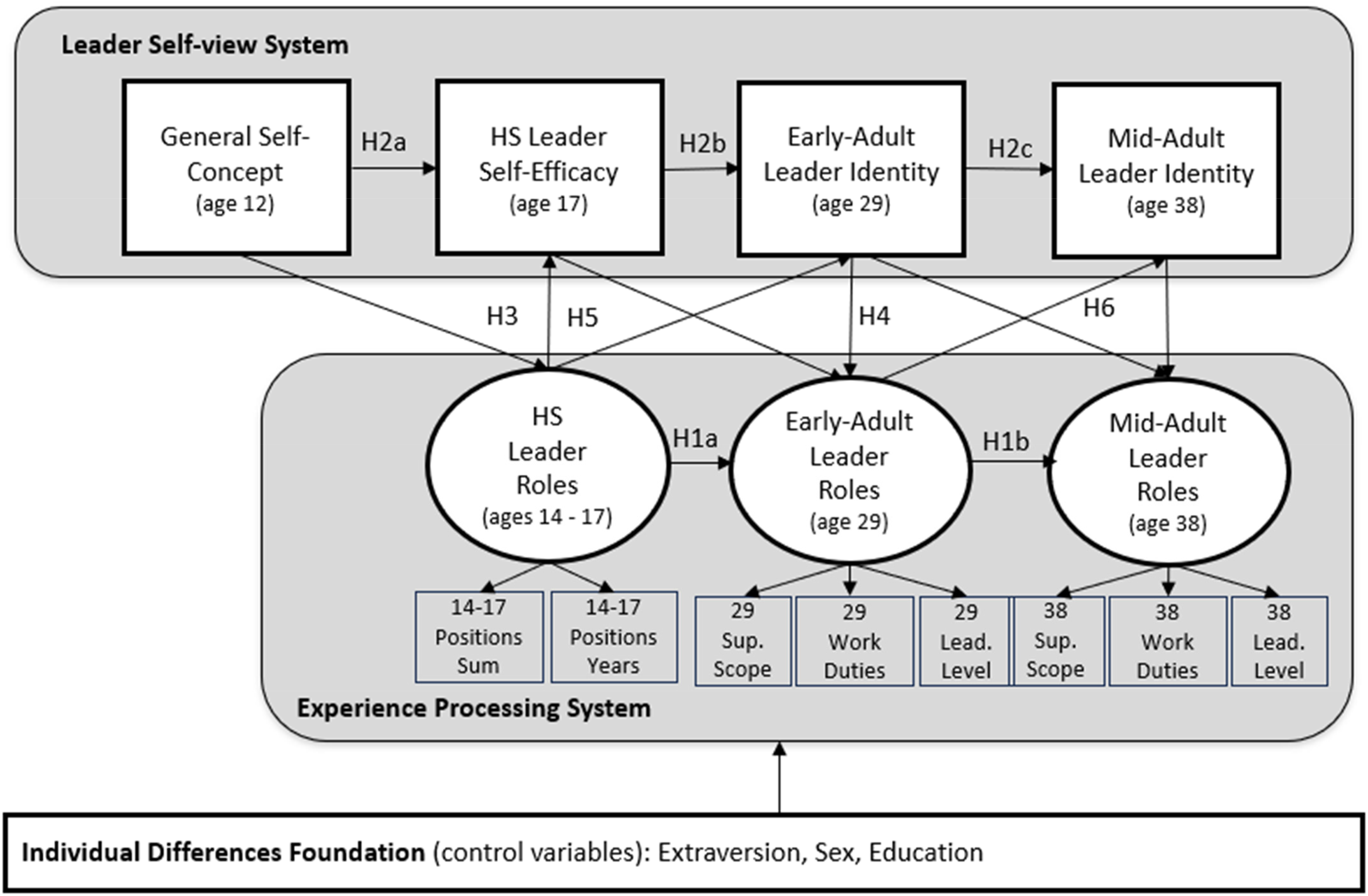
Theorized relationships within and between leader self-view system and experience processing system. Note: Model Adapted from Liu et al. (2021). HS = high school; Sup. = Supervisory; Lead. = Leadership.
The Experience Processing System Over Time
As noted, the experience processing system focuses on leader behavior and how people learn from leadership experiences. It includes a reciprocal relationship between three components: experiential learning, deliberate practice, and contextualized application (Liu et al., 2021). First, experiential learning explains how people gain abstract, generalizable leadership knowledge or skills from concrete activities (Kolb, 2014). The experiences can be simulated, such as in a training or educational program, or arise on the job or through community experiences (Hammond et al., 2017). Next, time and experience allow people to engage in deliberate practice—intentional activities to enhance performance in a given domain (Ericsson et al., 1993). Deliberate practice suggests that as a developing leader builds more specific leadership goals, they may seek opportunities to try new leadership techniques, observe their effects, learn from this feedback, adapt their approach, and try again. Such deliberate practice builds leadership expertise over time (Day, 2010). Finally, contextualized application entails recognizing how different situations call for different leadership approaches and adapting accordingly (Liu et al., 2021). Throughout one's lifelong leader development journey, it becomes essential to realize that what worked in the past in one specific context may not work in the future as the situation has changed (Goldsmith, 2007). Thus, even at high levels of leadership expertise, experiential learning, deliberate practice, and contextualizing application remain crucial to the experience processing system.
We leverage leadership role occupancy (Arvey et al., 2006) as a partial proxy for the experience processing system. It is ‘partial’ because whether someone holds the title of leader (i.e., a formally designated, socially prescribed role) does not necessarily mean they are engaging in experiential learning, deliberate practice, or contextualizing application. However, role occupancy tells us whether someone is in the leadership arena. Holding a formal leadership role is a helpful step to developing as a leader, as it provides regular opportunities to engage in and learn from leadership experiences.
As people enact leadership within the experience processing system and learn from their experiences, they build skills over time. There are at least two different yet complementary ways to study this process. One way is to assess leadership skills longitudinally, as developmental trajectory studies have done (e.g., Miscenko et al., 2017). This method examines the growth in leadership capacities through three or more identical repeated measurements (Day, 2011). Developmental trajectory studies have contributed significantly to our understanding of leader development by illuminating the nonlinear nature of growth. For instance, leadership effectiveness sometimes declines over time before increasing (Day & Sin, 2011). Despite the critical role of these studies, one shortcoming is that developmental trajectory studies have typically been conducted over relatively short periods (i.e., weeks or months).
Another way to assess the experience processing system is to employ a quasi-longitudinal method, which characterizes the current study. The quasi-longitudinal approach either does not track change in the same measure or includes only two rounds of data collection (Day, 2011). In this study, we examine leadership role occupancy across several decades but with only two waves of identical measures and one wave of a similar, yet nonidentical, measure. Although quasilongitudinal data cannot measure growth or malleability, it can measure consistency (Park et al., 2011), particularly if similar measures are used across time to tap the same underlying construct. Observing consistency or inconsistency in leadership role occupancy across more than twenty years, particularly in a sample of geographically dispersed people working in different organizations who may or may not hold managerial job titles, informs the construct we call spontaneous leader development.
Spontaneous Leader Development. Spontaneous leader development describes how people (dis)engage from leadership experiences and form leader self-views, without explicit leadership intervention (e.g., training). Although formal, planned interventions are vital triggers for sparking self-reflection and cycles of growth in leaders’ skills (Lacerenza et al., 2017), a lifespan approach to leader development calls us to look beyond short-term interventions and examine the broader pattern of one's leadership experiences over several decades (Liu et al., 2021). Prior theory also recognizes the importance of trigger events, which are dramatic or subtle changes in a person's circumstances that require the individual to think or act differently (Gardner et al., 2005). However, research on trigger events has tended to focus on dramatic changes in the environment, such as exposure to a different culture (Reichard et al., 2015), but subtle changes experienced slowly and over extended periods may also impact leader development. Spontaneous leader development builds upon and goes beyond trigger events, widening the aperture to include a broader pattern of leadership engagement that may or may not be tied to specific events. Hence, spontaneous leader development is a framework, not a theory per se, that can be used to indirectly test existing concepts like trigger events.
The emphasis on spontaneity shifts away from acute trigger events and toward the day-to-day context in which people lead. As spontaneous leader development is not necessarily focused on growth following specific events but rather on patterns of engagement, it is uniquely suited to study consistency in role occupancy and self-views over long periods. As such, the current paper examines spontaneous leader development over more than 20 years. Lifespan models of leader development provide insight into how unique contexts salient at different ages offer opportunities for engaging in and learning about leadership (Day et al., 2009).
For instance, Liu et al.'s (2021) lifespan model labels the years between 12 and 18 as the “experimental exploration” stage because it marks a transition from external/parent-driven activities towards adolescent-chosen activities (p. 101382). There are many opportunities to practice leadership in adolescence, ranging from school-based group projects to fundraising to student government (Murphy & Johnson, 2011). For example, adolescent extra-curricular activities like sports and scouting have been found to predict leadership emergence in adulthood in a sample of young men (Reitan & Stenberg, 2019).
Beyond adolescence, Liu et al. (2021) label the years between ages 18 and 30 to be the “self- and opportunity-oriented stage” because adults in this period make critical choices about the direction of their lives (p. 101382). Yet, there is still the significant possibility of re-inventing oneself. Hence, there is an emphasis on the opportunities one will choose to take (or not). During this period, some adults will attend college and gain exposure to leadership principles in the classroom and cocurricular programming, whereas others will gain leadership experience primarily in the workplace.
By midadulthood (ages 30–60), people enter what Liu et al. (2021) called the “purpose-driven stage” (p. 101382). During this stage of life, significant decisions may have already been made and shaped one's life trajectory (e.g., marriage, family, career). At this point, healthy development focuses on creating a personal sense of meaning in life. For many people, leadership can be an essential way of contributing to a bigger purpose. Each life stage presents new opportunities to engage in leadership. Given these changing life contexts, next, we turn to the question of whether we might expect more consistency or inconsistency in leadership role occupancy from adolescence to mid-adulthood.
Social psychological research on behavioral consistency across contexts yields insights into this question. In general, past behavior tends to be a strong predictor of future behavior (Ouellette & Wood, 1998). Of course, the personality of the person in question and the nature of the situation also matter (Funder, 2006). People with certain traits often self-select into similar situations that best utilize those traits, which further compounds behavioral consistency (Bandura, 1978). What does this suggest for lifespan consistency in leader role occupancy?
Given that up to 30% of leadership emergence can be explained by personality and other genetic factors (Arvey et al., 2007), we might expect relatively high consistency in leadership role occupancy over time. Indeed, initial evidence from a retrospective survey of leadership roles from high school into later adulthood supports the argument for consistency, with 20% of role occupancy explained by individual differences (Park et al., 2011). However, a limitation of Park et al.'s (2011) study is that retrospective accounts of leadership role occupancy taken at a single time point may be biased by participants’ beliefs about the stability of leadership, such that participants reconstruct memories to match their beliefs. Despite this limitation, the results of Park et al.'s (2011) study, along with the social psychological drive to find situations that leverage our traits and allow us to succeed (Bandura, 1978), suggest that there will be consistency in leadership throughout a person's life. Although leadership is indeed not fixed, there is a tendency toward consistently engaging in leadership roles over time. Personality may nudge someone into more leadership situations, and that experience compounds to make future leadership opportunities more enticing and fulfilling (Reichard et al., 2011). People can learn from their leadership experiences and integrate that learning into future roles and situations (McCall et al., 1988; Mumford et al., 2000). Therefore, we argue that people who lead in high school will likely continue to do so into early- and mid-adulthood.
There is consistency in the experience processing system over time as evidenced by (a) a positive relationship between leadership roles in high school (age 17) and leadership roles in early adulthood (age 29) as well as (b) a positive relationship between early-adult leadership roles (age 29) and mid-adult leadership roles (age 38).
The Leader Self-View System Over Time
Running parallel to and interacting with the experience processing system, the leader self-view system includes a reciprocal relationship between three components: leader self-efficacy, leader self-awareness, and leader identity (Liu et al., 2021). Leader self-efficacy refers to the confidence a person has in their leadership abilities (Murphy, 1992). With a robust bi-directional relationship with performance (Sitzmann & Yeo, 2013), self-efficacy simultaneously builds with experience and encourages people to take on new challenges (Bandura, 1997), reinforcing skill-building. In essence, the more confident people become in a given domain, the more success they have in that domain.
Next, leader self-awareness refers to knowing how one is doing as a leader, including strengths, weaknesses, and influence over others (Day et al., 2009). Self-awareness involves how much they know themselves and the extent to which that self-knowledge aligns with followers’ perceptions. Research suggests that higher alignment between a leader's self-views and followers’ views of the leader is associated with higher performance (Atwater & Yammarino, 1992). Experiential practice with feedback accelerates leader development by helping leaders gain insight into themselves and their growth opportunities (DeRue & Wellman, 2009).
Lastly, leader identity refers to “the sub-component of one's identity that relates to being a leader or how one thinks of oneself as a leader” (Day & Harrison, 2007, p. 365). Leader identity is a multifaceted construct that includes strength of identification with a leader identity (i.e., strong, moderate, weak), integration of a leader identity into one's broader self-construct (i.e., splintered, somewhat integrated, fully integrated), extent to which the identity includes other people (i.e., individual, relational, or collective focus), and the meaning one attaches to a leader identity (i.e., whether leadership is about dominance, interpersonal influence, or collaboration; Hammond et al., 2017). Leader identity is a dominant construct in the leader development field (Vogel et al., 2021). Given the self-reported nature of the FLS data and the lack of a second party against which to measure the alignment of self-awareness, the current study integrates two out of three leader self-views: leader identity and leader self-efficacy.
A significant body of identity theory suggests that identities change when circumstances jolt a person out of their usual roles (Ibarra, 1999; Miscenko & Day, 2016), which has been supported by existing leader development research. These studies have highlighted the dynamic nature of leader self-views following trigger events like leadership training, coaching, or other interventions. For instance, one study tracking leaders in a seven-week training program found an initial dip in leader identity followed by positive growth (Miscenko et al., 2017). Another study tracked leader identity and leader self-efficacy throughout a six-week training; results showed leader identity growing initially in a positive direction and then slowing over time, whereas self-efficacy grew in a consistently positive direction (Kwok et al., 2021). Finally, a study that measured leader identity throughout a 5-month training program found consistent positive linear growth in leader identity, with learning goal orientation supporting that growth (Middleton et al., 2019).
Thus, engaging in a leader development program that explicitly provides participants with identity-confirming or -disconfirming feedback has resulted in leader identity change. Feedback following experience prompts leaders to engage in identity work, in which people revise or maintain their identity constructions to form “a precarious sense of coherence and distinctiveness” (Alvesson & Willmott, 2002, p. 626). Much of our knowledge about leader identity and self-efficacy in the leader self-view system comes from short-term developmental trajectory studies. These studies demonstrate that leaders’ views of themselves are relatively malleable during the sensitive period surrounding a leadership program.
However, the dominant view from identity theory predicts consistency in the leader self-view system over time (Miscenko & Day, 2016). In general, strong self-views early in life are expected to manifest positively into strong self-views later in life, reflecting a pattern of consistency that aligns with identity theory more broadly (Stryker & Burke, 2000). As people construct their various identities, one central identity motive is the need for consistency over time (Brickson, 2013; Vignoles et al., 2006). Although identities naturally ebb and flow somewhat based on social feedback and contextual cues, maintaining a coherent sense of identity enables a person to reduce uncertainty. The ability of identities to be both stable and malleable arises from how people cognitively construct self-knowledge. Specifically, self-knowledge is thought to be organized hierarchically, such that people hold more stable, global notions of self that can be applied to various situations at the top of the hierarchy, and, at the same time, people hold more dynamic, situationally-tied notions of self at the bottom of the hierarchy (Swann, 1987). The situationally tied notions of self tend to be more malleable (Markus & Kunda, 1986).
Some scholars distinguish between these two levels by calling the more stable self-knowledge “self-construct” and the more malleable self-knowledge “identity” (Brown, 2015; Hammond et al., 2017). As discussed, most leader self-view research has focused on the malleable nature of identity, which is understandable given the field of leader development's emphasis on growth. However, there is also a need to understand how much people hold onto leader self-views over time because, without this baseline consistency in leader identity strength, there may be less possibility of building a more complex or collective identity.
Given the current study's focus on spontaneous leader development—how leadership roles and self-views evolve over time without explicit intervention—we expect to see more consistency than inconsistency in the self-view system. We expect consistency in leader self-views beginning in adolescence when people start to think about themselves in more complex ways. Liu et al. (2021) note that adolescence from age 12 to 18 is an epoch of significant identity work. Adolescents think more abstractly than children, engage in more metacognition, and see things as more multidimensional (Kuhn, 2009). Adolescents also develop an increased capacity for thinking about the future and their future selves (Nurmi, 2004). These increased cognitive capabilities and increased independence make identity particularly salient during adolescence.
We propose that adolescents’ general self-concept may create a fertile ground for the leader self-view system to take root because self-views tend to build on one another, becoming more complex and differentiated over time. General self-concept is a global representation of a person's collective knowledge, ideas, beliefs, and views about their self (Baumeister, 1999). Although people hold domain-specific self-concepts (e.g., academic, physical, artistic), the global dimension of self-concept, as the name implies, is a more general and higher-level construct. When measured directly versus as a higher-order statistical factor consisting of domain-specific self-concepts (as is done here), general self-concept is typically considered equivalent to self-esteem (Marsh & Yeung, 1999; Trautwein et al., 2006).
We focus on general self-concept rather than domain-specific identities because the former has broader relevance than relatively narrow domains such as academics or physical abilities. In addition, prior research suggests a link exists between self-esteem/self-concept and leader emergence (Atwater et al., 1999; Judge et al., 2002; Oliver et al., 2011). However, scholars have not yet examined the intervening developmental processes (such as leader identity formation) that might explain the link.
In early adolescence, identities are only beginning to form; the domain-specific self-concepts most relevant at this age are focused on academics, the arts, and physical ability (Marsh & Yeung, 1999). Domain-specific identities primarily rooted in adult contexts, such as a leader identity, may come with age. At the same time, young adolescents are actively doing the cognitive work necessary to build domain-specific identities later. For instance, compared to younger children, adolescents who are asked to describe themselves will identify a richer array of characteristics, will better contextualize their self-descriptions in terms of how others might perceive them in different contexts, and will organize their self-descriptions into a more coherent whole (Byrne & Shavelson, 1996; Harter, 2011; Steinberg, 2020). These increased cognitive capabilities set the stage for leader self-views. Hence, integrating general self-concept into the leader self-view system, especially during adolescence, may tell a more complete story about why and how self-concept matters in developing a leader identity.
General self-concept also informs possible or ideal selves (Markus & Nurius, 1986), suggesting that it may motivate trying on new identities. General self-concept may be an essential element of early leader identity formation because such an overarching positive self-view lays the cognitive and motivational foundation for developing more domain-specific identities, like leader identity, later in life. The transition between feeling good about oneself, generally, and feeling confident in oneself as a leader, specifically, may be especially pertinent in high school, given the identity differentiation, organization, and integration processes adolescents undertake during this critical time. General confidence in oneself would likely spill over to confidence in socially desirable domains like leadership. Likewise, teenagers with a negative general self-concept would likely also lack confidence in their leadership because such teenagers may assume others share their negative self-view and, therefore, would not endorse them as leader. Then, in later years, the identity motive for consistency will propel further engagement or disengagement with leader self-views.
There is consistency in the leader self-view system, as evidenced by positive relationships between (a) general self-concept in adolescence (age 12) and leader self-efficacy in high school (age 17), (b) leader self-efficacy in high school (age 17) and leader identity in early-adulthood (age 29), and (c) leader identity in early-adulthood (age 29) and leader identity in mid-adulthood (age 38).
Dynamic Interplay Between the Experience Processing and Leader Self-View Systems
Experience and self-views have a dynamic interplay over time. In general, how we view ourselves precedes the activities in which we choose to engage (Bandura, 1997). In addition, we derive a sense of who we are from past behaviors (Bem, 1972). More specifically and according to lifespan models of leader development (Day et al., 2009; Liu et al., 2021; Murphy & Johnson, 2011), the experience processing system and leader self-view system mutually reinforce each other. Past leadership experiences are thought to influence future leader self-views, and past leader self-views inform future leadership experiences and so on in a nonlinear cycle (Liu et al., 2021). In this way, active experimentation and concrete experiences (i.e., experience processing system) combine with reflective observation and abstract conceptualization (i.e., leader self-view system) to drive leader development over time (Kolb, 2014). The degree to which individuals internalize a leader role into their self-concept determines the influence that role has on their behavior (Ibarra et al., 2014), including time dedicated to developing in the leadership domain.
Both experience and self-views are equally essential phenomena for leader development. Therefore, we make no case for either being more critical than the other or necessitating the other. Consistent with the lifespan model of leader development (Liu et al., 2021), we see leadership role occupancy and leader self-views as mutually reinforcing. We propose that throughout one's life, prior leadership roles influence subsequent leader self-views. Conversely, individuals with strong leader self-views will likely seek future leadership roles.
Leadership Roles Mediating Consistency in Self-views. As argued earlier, the need for self-continuity is a central identity motive (Brickson, 2013; Vignoles et al., 2006) that may drive consistency in leader self-views over time. Additionally, part of that self-view consistency may be explained, or mediated, by leadership role occupancy because enacting a role provides a robust inferential signal about what is essential to that person. People define themselves, in part, through their behavior. Similar to the way people observe and make judgments about others based on their actions, self-perception theory (Bem, 1972) suggests people do the same based on their actions such that “the more individuals are able to display the prototypical behaviors associated with an identity, the more likely they are to internalize that identity as a legitimate definition of self” (Ashforth & Schinoff, 2016; p. 122). Based on this reasoning, the behaviors one is called upon to perform as a leader can verify one's leader self-view.
In addition, general self-concept may help build leader self-efficacy via high school leadership roles because of the drive for self-verification, or the motivation to confirm that others see us the way we see ourselves (Swann & Read, 1981). Leadership is a socially desirable role. Young people with positive general self-concept may be more drawn to leadership roles to affirm that others share this positive view. For example, adolescents who feel good about themselves are more likely to lead school projects, hold club officer positions, and run for student government (Farb & Matjasko, 2012; Feldman & Matjasko, 2005; Holland & Andre, 1987). In turn, enacting leadership and experiencing any degree of success enables adolescents to build confidence in their leadership because mastery builds confidence (Bandura, 1997; Hannah et al., 2008; Paglis, 2010; Sitzmann & Yeo, 2013). Dabbling in new roles and identities then internalizing self-views based on others’ reactions, is theorized as a crucial driver of leader development (Ibarra et al., 2010; Lord & Hall, 2005; Yip et al., 2020).
When someone exits high school believing they are skilled at leadership, this early leader self-efficacy may give them more reason to engage in further leadership roles during college or a first job. The momentum continues in college and in early careers, with more substantial and integrated leader self-views prompting further leadership role occupancy, which, in turn, solidifies self-views through social feedback and validation. Ibarra et al. (2010) connect leader development to identity shifts and role transitions, proposing that individuals first identify the roles they aspire to hold. Future possibilities motivate individuals to experiment with and try out different provisional identities. Practice allows them to evaluate where they stand before fully internalizing a new identity (Ibarra, 1999). Development continues as individuals identify new possible selves. Hence, we expect consistency in self-views to be mediated by leadership roles.
The relationship between general self-concept in adolescence (age 12) and high school leader self-efficacy (age 17) is positively mediated by high school leadership roles (ages 14–17) The relationship between early adult leader identity (age 29) and mid-adult leader identity (age 38) is positively mediated by early adult leadership roles (age 29).
Leader Self-views Mediating Consistency in Leadership Role Occupancy. Spontaneous leader development provides insight into how leadership role occupancy might help people internalize leader self-views because it orients us to see everyday work experiences as opportunities for leader self-view integration. Scholars theorize that change in leadership expertise is associated with change in the self-relevant mental structures people use to make sense of their experiences (Lord & Hall, 2005). Internalizing ‘leader’ into one's self-concept is essential to leader development because it helps people recognize and learn from leadership opportunities (Day & Dragoni, 2015). Identity theory suggests that self-views create a structure for attaching meaning to experiences (Miscenko & Day, 2016; Stryker & Burke, 2000). Therefore, leader self-views can become a container for sensemaking and interpretation of leadership roles. People who process their leadership experiences through the structure of their self-views may be more likely to continue leading because they have a personally relevant connection to these experiences and a reason to maintain them.
In high school, leading peers through clubs, scouting, sports, or other extracurricular activities provides exploration and experimentation opportunities (Murphy & Johnson, 2011). Trying on a leadership role can provide valuable social feedback and validation, which may become internalized into a leader identity and build leader self-efficacy (DeRue & Ashford, 2010; Ibarra, 1999). In turn, these leader self-views would likely drive future leadership experience because the self-view framework helps people look for, engage in, and learn from potential leadership opportunities.
Extending these ideas into early and mid-adulthood, we point to short-term, longitudinal research on the dynamic relationship between leadership experience and leader self-views. Specifically, Day and Sin (2011) found positive linkages between leadership skills and leader identity over 6 weeks in a sample of first-year university students. Building on these results, Miscenko et al. (2017) found that changes in postgraduate students’ self-perceived leadership skills have a causal influence on subsequent changes in leader identity over seven weeks. However, these studies measure short-term change only and focus on leadership skills rather than role occupancy. How these processes unfold over decades, particularly after the formative decades in which a young person is still figuring out who they are, has yet to be tested.
Thus, both theory and short-term empirical research suggest that individuals with increasingly integrated leader self-views may be more motivated to seek further developmental experiences, driving consistency in leadership role occupancy. Building on prior developmental trajectory research, we significantly extend the timeframe (i.e., from weeks to nearly a decade) and ages of participants (i.e., early 20 s to late 20 s and late 30 s) and propose similar linkages between leadership role occupancy and leader self-views.
The relationship between leadership roles in high school (ages 14–17) and leadership roles in early adulthood (age 29) is positively mediated by high school leader self-efficacy (age 17). The relationship between leadership roles in early adulthood (age 29) and leadership roles in mid-adulthood (age 38) is positively mediated by leader identity in mid-adulthood (age 38).
Method
Participants
The study design is a prospective, quasilongitudinal, self-report survey spanning 26 years. We used FLS data to test our hypotheses. The FLS is an ongoing longitudinal study that began in 1979 with a survey of 130 one-year-olds. Of the original 130 participants, 107 completed the outcome measures at age 38, resulting in an 82% response rate for the present study. About half of the sample is male (52%), and 90% are white. At the last measurement time point (age 38), the majority were employed (94%) and worked an average of 40 h per week (SD = 15.67). Seventy-three (68%) had earned a Bachelor's degree or higher, and the mode household income fell within the $100,000–$124,999 category.
We selected the waves of survey data included in this study based on the availability of the necessary variables and temporal precedence of the antecedent variables in relation to outcome variables. Temporally separated variables reduce endogeneity resulting from common method bias due to self-reported measures (Antonakis et al., 2014; Podsakoff et al., 2012).
Measures
General Self-concept. General self-concept in adolescence was measured at age 12 (α = 0.87) using 10 items from Marsh's (1990) Self-description Questionnaire-II (SDQ-II), which was designed to measure general self-concept in early adolescence. The ten items comprise the Total Self-Concept score and were averaged to create a mean-based score. Example items include “Overall, I have a lot to be proud of” and “Overall, most things I do turn out well.” Participants responded based on how true each item was for them using the following scale: 1 (false), 2 (mostly false), 3 (more false than true), 4 (more true than false), 5 (mostly true), 6 (true). Higher responses indicate a more positive self-concept. Alternating items were reverse-coded.
Leader Self-views
Second, leader self-views in early adulthood were measured at age 29 with the nine-item affective identity motivation to lead (MTL) scale (Chan & Drasgow, 2001). Participants were asked to indicate the degree to which they agreed with each statement on a scale ranging from 1 (disagree strongly) to 5 (agree strongly). Affective identity MTL describes individuals who see themselves as leaders and enjoy being in leadership roles. An example of an affective identity MTL item is “I usually want to be the leader in the groups that I work in.” Four items were reversed scored. Items were averaged to create a mean affective identity score (α = .90), with higher responses indicating higher leader identity.
Third, leader self-views in mid-adulthood were measured at age 38 with a four-item scale of leader identity (Hiller, 2005). An example is, “If I had to describe myself to others, I would include the word leader.” Participants rated the extent to which each statement described them on a 5-point scale ranging from 1 (not at all descriptive) to 5 (extremely descriptive). All four items were averaged into a mean leader identity score (α = 0.91).
Leadership Role Occupancy. Leader role occupancy was also captured at three points across the lifespan, the latter two-time points using identical measures. During high school, leadership role occupancy was operationalized using a latent factor consisting of two variables measured at age 17. One indicator was the total number of distinct athletic, academic, or other nonacademic leadership positions participants held from grades 9–12 (which covers roughly ages 14–17). Responses were between zero and eight. The second indicator was the number of years participants held one or more leadership positions during grades 9–12. Fifty-two percent of individuals held a leadership position or office for at least one year.
Leadership role occupancy in early adulthood at age 29 and mid-adulthood at age 38 were operationalized as latent factors for each age using three identical self-reported indicators: Supervisory scope, leader work duties, and leadership level. Supervisory scope was determined by the number of people that participants have ever managed or supervised at work. Responses at age 29 ranged from 0 to 400, with a median of four. Responses at age 38 ranged from 0 to 600 subordinates, with a median of 6.
For leader work duties, participants indicated how frequently they engaged in five activities (e.g., “taken charge of a special project” or “asked to represent my team's position with our management”) as a part of their duties at work on a five-point Likert scale ranging from 1 (never) to 5 (daily). We used a mean-based score for each age (age 29 α = 0.99; age 38 α = 0.81).
Leadership level was measured using a checklist of hierarchically ordered leadership positions. Participants indicated all the leadership positions they ever held, ranging from low-level shift supervisor to high-level president roles. We scored leadership level based on the highest level of leadership reported as (0) No managerial position thus far, (1) Workgroup/team/committee leader, (2) Shift supervisor, (3) Manager, (4) Director, (5) Vice-President, (6) President, and (7) CEO. Participants who left this question blank or indicated no managerial position were given a zero value. We also provided an “Other (please specify)” response option but, through visual inspection, found that none of the participants indicated higher positional levels than those already reported. This scoring method has been used in prior studies examining leadership role occupancy (e.g., Arvey et al., 2006).
Control variables. We controlled for the effect of extraversion, sex, and education on the three leadership role occupancy variables. Prior research has connected these factors to leadership activity. Specifically, men, highly extroverted people, and more educated people are more likely to emerge as leaders (Badura et al., 2022; Eagly & Karau, 1991; Judge et al., 2002). Extraversion was measured at age 38 using 12 items from Costa and McCrae's (1989) NEO Five-Factor Inventory (NEO FFI; α = 0.71). Participants indicated the extent to which they agree with each item from 0 (strongly disagree)–4 (strongly agree). Scores were t-score standardized using gender norms provided in the instrument manual (minimum = 0, maximum = 100; Costa & Mccrae, 2010). Sex was assessed at 12 months old and coded 0 = male and 1 = female. Education was measured by asking participants to indicate the highest level of schooling they completed at age 38 (1 = High school not completed, 2 = High School, 3 = Technical/vocational school after high school, 4 = Attended college/no degree, 5 = Associate's Degree or community college, 6 = Bachelor's degree, 7 = Master's degree, 8 = Doctoral/Professional Degree, Ph.D., MD, JD, etc.).
Results
Data Screening
We screened the data for missing values, outliers, and departures from normality. Although there were some missing values, results of Little's (1988) missing completely at random test, computed using SPSS 29, suggested that data were likely missing at random (
Supervisory scope at ages 29 and 38 each had one extreme outlier (i.e., more than 3 standard deviations from the mean). These values were winsorized (i.e., the outlier cases were replaced with the next highest values, 400 and 200, for age 29 and 38, respectively; Howell, 2013). Even with these replacements, the distribution of supervisory scope values substantially deviated from normality (i.e., skew and kurtosis > 2); therefore, we log-transformed the variables. One participant exhibited an outlier in the total number of high school leadership roles (z = 3.61, skew = 1.63, and kurtosis = 2.66). In addition, another participant had an extreme score on general self-concept (z = −3.88, skew = −1.41, and kurtosis = 2.33). To correct these outliers, both the number of high school leadership roles and general self-concept were winsorized. All of these transformations successfully reduced skew and kurtosis below 2.
Table 1 presents means, standard deviations, and intercorrelations for all study variables. As expected, extraversion was positively related to leader self-efficacy at age 17 (r = .36, p < .001) as well as leader identity at age 29 (r = .53, p < .001) and age 38 (r = .49, p < .001). Similarly, in line with expectations, women had fewer leadership work duties at age 29 (r = −.25, p = .008), held lower-level leadership positions than men at both age 29 (r = −.24, p = .01) and 38 (r = −.23, p = .01), and were less likely to identify as leaders at age 38 (r = −.23, p = .01).
Means, Standard Deviations, and Correlations Among Variables.
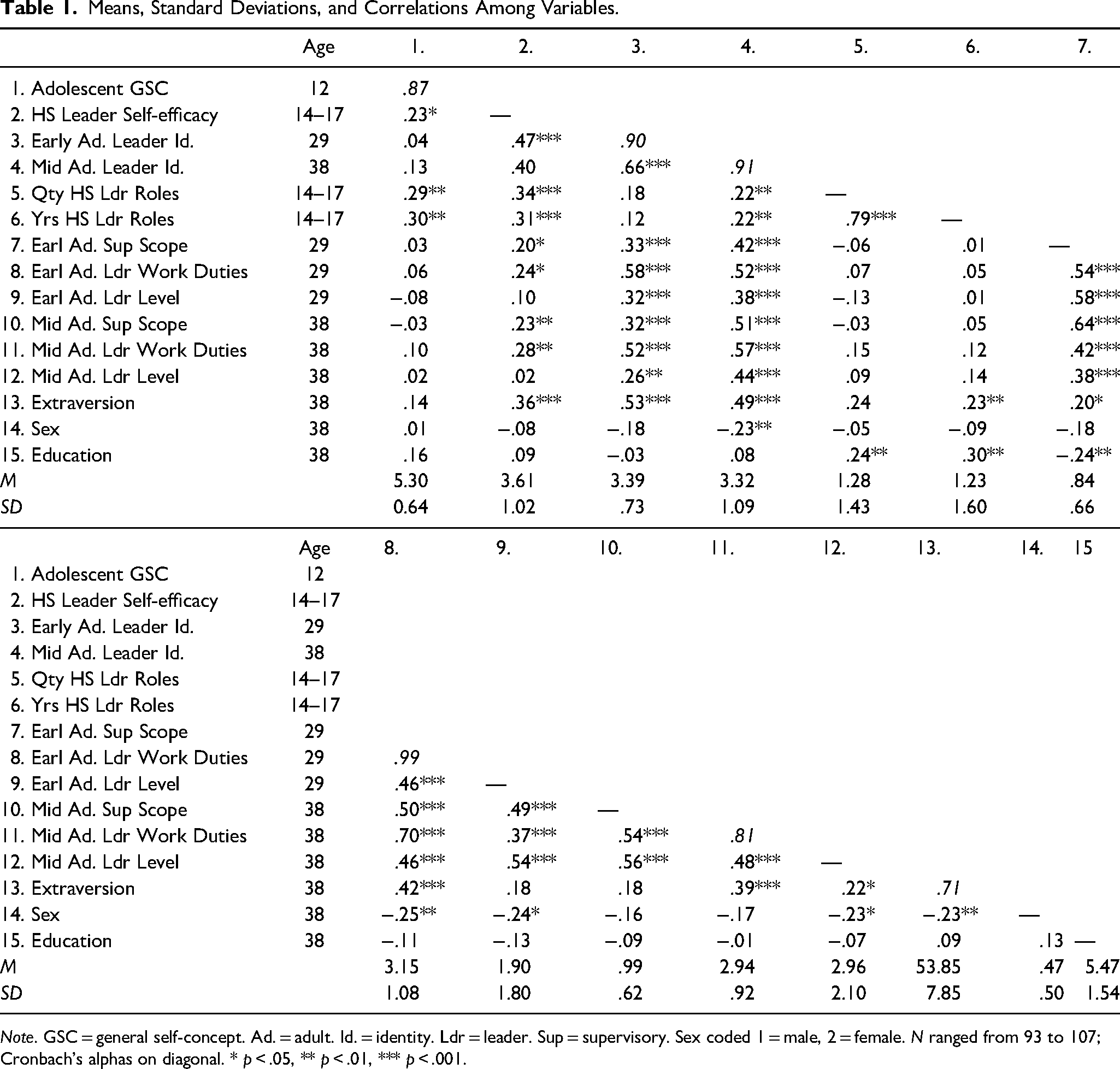
Note. GSC = general self-concept. Ad. = adult. Id. = identity. Ldr = leader. Sup = supervisory. Sex coded 1 = male, 2 = female. N ranged from 93 to 107; Cronbach's alphas on diagonal. * p < .05, ** p < .01, *** p < .001.
Measurement Invariance
Due to the identical repeated measures for leadership role occupancy at ages 29 and 38, we used a method factor technique to separate and quantify variance components due to method effects and measurement error (Eid et al., 1999; Geiser, 2020). This approach has been used in multi-trait-multi-method designs and longitudinal analysis (Eid, 2000; Eid et al., 1999), and it involves specifying two latent factors (i.e., “method factors”) consisting of repeated indicator variables (i.e., supervisory scope at age 29 and 38; leadership level at age 29 and 38).
Specifically, we tested configural and metric (factor loadings) invariance of leader role occupancy across ages 29 and 38 using confirmatory factor analysis (CFA). In addition, we conducted nested model comparisons using the difference in the model −2LL values with degrees of freedom equal to the difference in the number of model parameters. We applied parameter constraints in successive models to examine potential decreases in fit resulting from non-invariance constraints over the two occasions. To assess model fit, we used the chi-square statistical test (
First, a configural invariance model was specified in which two correlated leadership role occupancy factors were estimated simultaneously; all factor means were fixed to 0, and all factor variances were fixed to 1; all factor loadings, intercepts, residuals, and factor covariances were freely estimated for identification. As indicated in Table 2, the configural model exhibited good fit
Measurement Invariance of Leader Role Occupancy Across Time (age 29 and 38).

Note. RMSEA = root mean square estimate of approximation; CFI = Comparative Fit Index; SRMR = standardized root mean residual
Next, we examined a metric invariance model. The factor variance was fixed to 1 at time 1 (age 29) but was freely estimated at time 2 (age 38). All factor loadings were constrained to be equal across time; all intercepts and residual variances were still permitted to vary across time. Factor covariances and residual covariances were estimated as described previously. The metric invariance model demonstrated good fit
Measurement Model
After demonstrating measurement invariance, we specified a measurement model consisting of all latent variables using CFA to ensure that the measurement part of the model was viable before evaluating a structural model and alternative models (Anderson & Gerbing, 1988). Indicators for each latent factor are depicted in Figure 1.
We aimed to specify as many latent factors as possible. However, our small sample size limited the number of latent factors we could model. We prioritized modeling leadership role occupancy variables as latent because doing so enabled us to capture meaningful contributions of the relatively unique indicators (e.g., supervisory scope, leadership level). In contrast, Likert scale items for the leader self-views could more easily be aggregated into mean-based scales.
First, we specified a baseline model with the three latent variables from our hypothesized model (leadership roles in high school, age 29, and age 38). The baseline model demonstrated poor fit (
In the second CFA model, we specified the three latent leadership role occupancy variables plus the two method factors. The model estimation terminated normally. Results of a five-factor CFA demonstrated good fit (
Structural Model
Next, we tested the hypothesized structural model displayed in Figure 1 using structural equation modeling (SEM) in Mplus 8.0 and maximum likelihood (ML) parameter estimation (Muthén & Muthén, 2017). Maximum likelihood procedures are robust for moderate departures from normality (Muthén & Kaplan, 1985). Mediation hypotheses were tested using 2000 bootstrap samples to construct 95% bias-corrected confidence intervals (MacKinnon et al., 2004) around the estimated parameters. The hypothesized structural model demonstrated good fit (
The Experience Processing System Over Time. We began by examining the continuity of leadership experiences over time. Hypothesis 1a stated that high school leadership roles (ages 14–17) positively relate to leadership roles in early adulthood (age 29). As shown in Table 3 and Figure 2, high school leadership roles were not significantly associated with leadership roles in early adulthood (β = −0.02; p = .89). Therefore, H1a was not supported. Similarly, H1b stated that leadership roles in early adulthood (age 29) positively relate to leadership roles in mid-adulthood (age 38). As expected, leadership roles at age 29 were significantly related to leadership roles at age 38 (β = 0.70; p < .001). Thus, H1b was supported.

Standardized direct effects from structural equation model testing theoretical model.
Note: Bold arrows are significant (p < .05). HS = high school; Sup. = supervisory; Lead. = Leadership; RMSEA = root mean square estimate of approximation; CFI = Comparative Fit Index; SRMR = standardized root mean residual. Fit statistics for the hypothesized model:
Direct Effect Results from Theoretical Model.
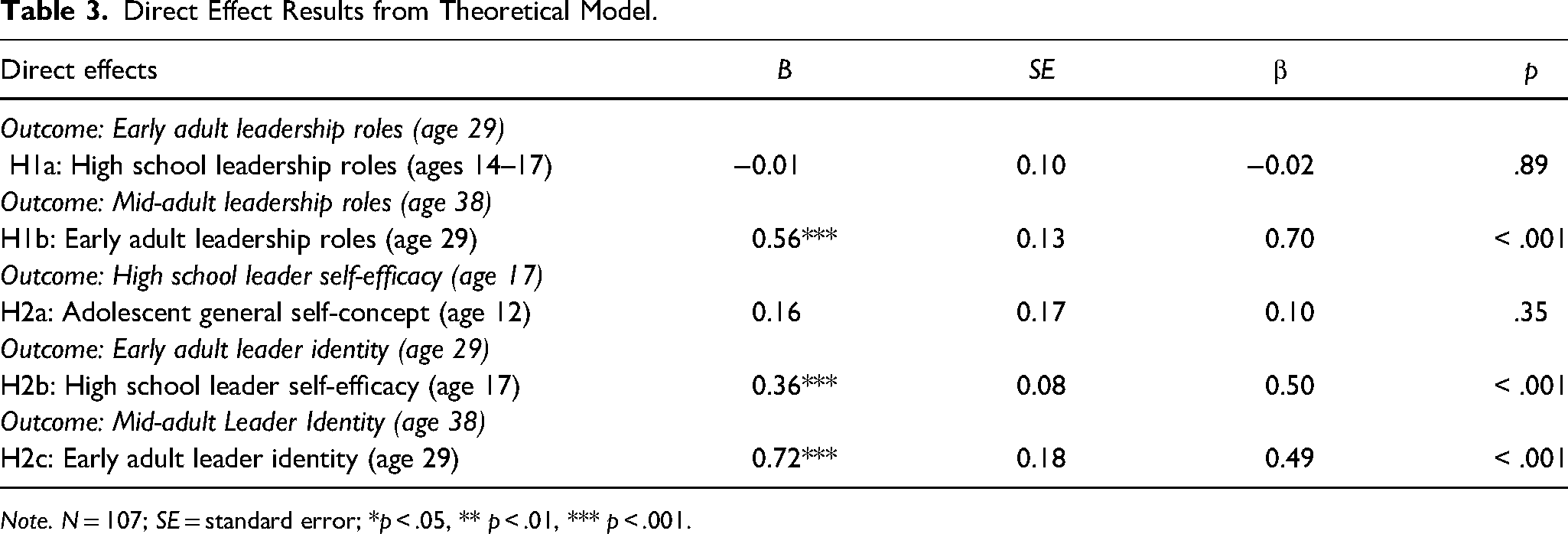
Note. N = 107; SE = standard error; *p < .05, ** p < .01, *** p < .001.
The Leader Self-View System Over Time. Next, we turn to continuity within the leader self-view system over time. H2a stated that general self-concept in adolescence (age 12) positively relates to leader self-efficacy in high school (age 17). General self-concept in adolescence was not significantly related to leader self-efficacy in high school (β = 0.10, p = .35). Therefore, H2a was not supported. We did find support for H2b in that leader self-efficacy in high school (age 17) positively related to leader identity in early adulthood (age 29; β = 0.50, p < .001). Moreover, leader identity at age 29 positively related to leader identity at age 38 (β = 0.49, p < .001), supporting H2c.
Leadership Roles Mediating Consistency in Self-views. Next, we turn to hypothesized mediation effects between the leader self-view and experience processing systems. H3 stated that the relationship between adolescent general self-concept (age 12) and high school leader self-efficacy (age 17) is positively mediated by high school leadership roles. As shown in Table 4 and Figure 3, H3 was supported, as the indirect effect was positive and significant (β = .09; 95% CI: .05, .26). Furthermore, the nonsignificant direct effect suggests full mediation.
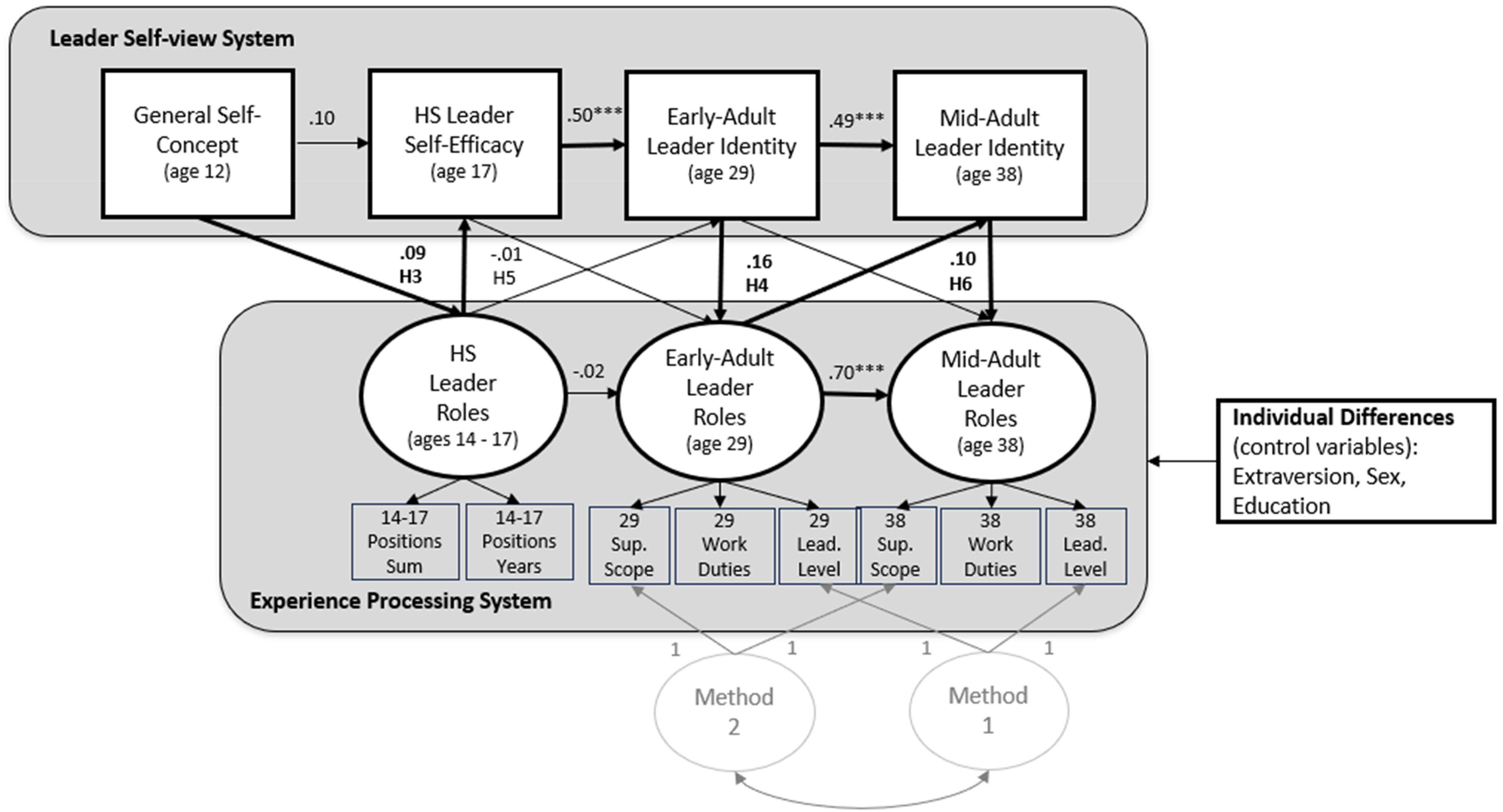
Standardized indirect effects from structural equation model testing theoretical model.
Note: Bold arrows are significant (*p < .05; ** p < .01; *** p < .001). HS = high school; Sup. = supervisory; Lead. = Leadership; RMSEA = root mean square estimate of approximation; CFI = Comparative Fit Index; SRMR = standardized root mean residual. Fit statistics for the hypothesized model:
Mediation Results from Theoretical Model.

Note. N = 107; GSC = general self-concept; HS = high-school; SE = bootstrapped standard error; LLCI = lower 2.5% limit confidence interval; ULCI = upper 2.5% limit confidence interval; bolded numbers indicate significant as determined by 95% CI not including zero.
H4 stated that the relationship between leader identity at age 29 and leader identity at age 38 is positively mediated by leadership roles at age 29. The indirect effect was significant (β = 0.16; 95% CI: .05, .36), suggesting partial mediation and supporting H4.
Leader Self-views Mediating Consistency in Leadership Role Occupancy. H5 stated that the relationship between high school leadership roles (ages 14–17) and leadership roles at age 29 is positively mediated by high school leader self-efficacy (age 17). The indirect effect was not significant (β = −0.01; 95% CI: −0.10, 0.06), failing to support H5.
Finally, H6 stated that the relationship between leadership roles at age 29 and leadership roles at age 38 is positively mediated by leader identity at age 38. The indirect effect was positive and significant (β = 0.10; 95% CI: 0.02, 0.22). Therefore, H6 was supported.
Exploratory Model
The leader self-view system and experience processing system are thought to be nonlinear and mutually reinforcing (Liu et al., 2021). We chose one direction of cross-system influence for our hypothesized model, although the opposite direction of influence is equally plausible given the nonlinear nature of these systems. Specifically, we initially tested (1) high school leadership roles influencing age 17 leader self-efficacy, (2) age 29 leader identity influencing age 29 leadership roles, and (3) age 38 leader identity influencing age 38 leadership roles. In an exploratory model (Figure 4), the direction of the three paths between systems was reversed, such that (1) age 17 leader self-efficacy influences high school leadership roles, (2) age 29 leadership roles influence age 29 leader identity, and (3) age 38 leadership roles influence age 38 leader identity. Testing the alternative model lets us see if either system influences the other more strongly or if the effects only operate in one direction.
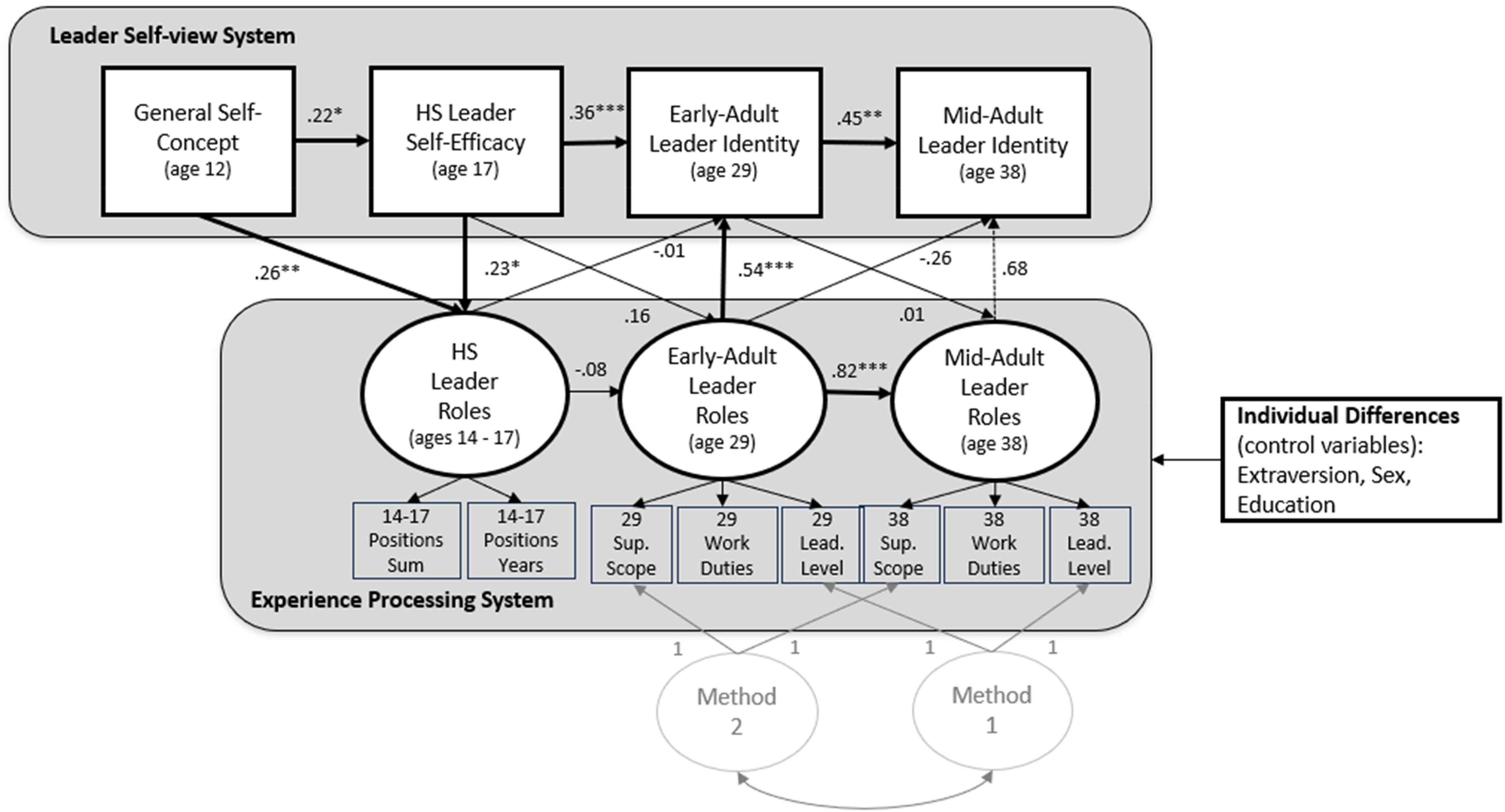
Standardized direct effects from structural equation model testing exploratory model.
Note: Bold arrows are significant (*p < .05; ** p < .01; *** p < .001). Dashed arrow represents a relationship that was significant in hypothesized model, with reversed direction of arrow, and is not significant in the exploratory model. HS = high school. Sup. = supervisory. Lead. = Leadership; RMSEA = root mean square estimate of approximation; CFI = Comparative Fit Index; SRMR = standardized root mean residual. Fit statistics for exploratory model:
Results of structural equation modeling indicate that the exploratory model also fits well (
As indicated in Figure 4, in the exploratory model, the path from age 38 leadership roles to age 38 leader identity was not significant (β = 0.68, p = .54; the reverse effect is significant). The other two between-system paths remained significant. This pattern of findings lends some initial support for the idea that both systems may influence one another bi-directionally, except perhaps not around age 38, when leader identity exerted a more substantial effect on leadership roles than leadership roles exerted on leader identity.
Discussion
Although leader development is widely understood to be a lifelong process, we know remarkably little about how the experience processing system and leader self-view system unfold and intersect over several decades. In the current study, we examined the interplay within and between the experience processing system and leader self-view system across three epochs of the lifespan—adolescence (ages 12–17), early adulthood (age 29), and midadulthood (age 38). Results support Liu et al.'s (2021) lifespan model of leader development. We found consistency in both systems, with more support for consistency in the leader self-view system. We also found support for both systems mediating the other over time. These are unique empirical contributions in that lifespan tests with three or more epochs extending over 20 years are extremely rare.
Theoretical Implications
The current study has implications for spontaneous leader development, specifically in terms of the continuity within the experience processing and leader-self view systems. Moreover, we provide explicit implications for the dynamic interplay between these systems, finding that self-views play a vital driving role after early adulthood.
Spontaneous Leader Development. First, we integrate prior theory on trigger events to introduce the notion of spontaneous leader development, which unfolds over decades of a lifetime and is not necessarily a response to a discrete intervention (e.g., training). Prior studies of leader identity development have typically occurred within the context of short-term leadership training programs (e.g., Kwok et al., 2021; Middleton et al., 2019; Miscenko et al., 2017), and we extend this perspective to capture leader self-view development as it unfolds over extended periods without an intervention. Understanding how training programs may prompt identity work is valuable (Alvesson & Willmott, 2002; Ely et al., 2011). However, taking a spontaneous approach provides an additional helpful lens, as it may more accurately test lifespan theories of leader development that emphasize how day-to-day work and life experiences become integrated into the leader’s self-view system. This approach highlights quasi-longitudinal designs’ unique strengths and limitations relative to true longitudinal designs (i.e., developmental trajectory studies). We agree with Day (2011) that both are “complementary approaches that address important—but different—questions about leader development across the lifespan” (p. 567). Thus, we provide insight into how leaders spontaneously develop through experience and self-views over time.
Although spontaneous leader development does not focus on growth per se, it also does not necessarily focus on stagnation. Instead, it is a framework that provides theoretical context and justification for quasi-longitudinal studies, as well as the kinds of research questions such studies can address. The emphasis on spontaneity shifts the focus away from acute trigger events and towards the day-to-day context in which people lead.
Spontaneous leader development aligns with and supports the notion of leader self-development, a process in which leaders take ownership of their leader development journey (Boyce et al., 2010; Reichard & Johnson, 2011). Spontaneous leader development could result from a leader self-development process, in which a leader recognizes opportunities to grow through self-evaluation and initiates some self-directed activities (e.g., reflection, experimentation, reading books, talking with mentors) targeted to meet their personal developmental goals. We next turn to evidence regarding whether people who lead at one point in their lives are likely to continue to do so later in life.
Experience Processing System. Overall, there was modest consistency in leadership role occupancy over time, evidenced by a significant positive relationship between work leadership roles at ages 29 and 38. This finding suggests that people leading in their twenties at work do continue to lead in their thirties at work. This finding could be explained, at least in part, by the fact that job candidates applying for leadership roles would be more competitive and, therefore, more likely to be hired if they had previously held a leadership role. However, the mediation effect through self-views suggests resume building is not the entire explanation. As will be explored in a later section, consistency in leadership role occupancy mediated through self-views suggests leader identity development may explain why people continue to lead.
Unexpectedly, leadership roles in high school did not predict work leadership roles at age 29. At least three reasons could explain the lack of consistency from adolescence to early career. First, this null effect may reflect the adult development process known as compensation, or how people cope with failure to attain their goals (Baltes, 1997; Day et al., 2009; Day & Sin, 2011). Participants in this study may have hit a wall in their leader development journey somewhere early in their first work role(s) and decided not to continue leading. They possibly placed leadership on the ‘backburner’ due to poor performance feedback, life circumstances, lack of motivation, or other factors. Future research should directly examine Baltes’ (1997) theory and the role of selection, optimization, and compensation in leader development goal attainment, specifically regarding disengagement from leadership roles. Alternatively, the lack of consistency in leadership experiences from adolescence to early career could be an artifact of the different leadership contexts measured (i.e., extracurricular high school leadership roles versus work leadership roles). These contexts may be so fundamentally different that they do not meaningfully inform one another. Third, there could be moderators unaccounted for in the current study. For instance, it might be that only certain types of high school leadership roles (e.g., those with significant responsibility, such as student body president) translate into work leadership roles in adulthood, whereas others (e.g., junior varsity team captain) do not.
Leader Self-view System. A third significant implication for theory relates to the spontaneously occurring continuity of the leader self-view system over time. What does continuity in the self-view system across more than two decades mean for leader development theory? One implication is that leader self-views may be more resistant to change than previously thought, especially for those with negative self-views. Although the current study cannot examine change, consistency suggests that those who started with positive self-views maintained positive self-views later in life, and those who started with negative self-views maintained negative self-views later in life. Robust long-term consistency suggests that despite attempts to alter a leader's self-view in the short run, it may be challenging to change it in the long run. We are not suggesting that leader development programs should stop addressing self-views; however, we are pointing out the potential difficulty of radical long-term change as people seem to hold similar leader self-views throughout their lives.
The finding that general self-concept at age 12 predicts leader self-efficacy at age 17 may have implications for developmental readiness (Hannah & Avolio, 2010; Reichard & Beck, 2017) and the potential for future growth. Specifically, it suggests that building up young people's self-esteem and self-confidence is a worthy investment in long-term leader development.
Dynamic Interplay Between the Two Systems. Finally, we turn to the role of self-views in translating past leadership roles into future leadership roles and vice versa. We found three mediated effects illustrating the interwoven nature of the experience processing and leader self-view systems. Specifically, we found support for the experience processing system reinforcing the leader self-view system and the self-view system reinforcing the experience processing system. This finding supports and advances the idea that the two systems are mutually reinforcing (Liu et al., 2021), with slightly more support for experience mediating self-views.
Experience to Self-views. Observing the self-view system mediating the experience processing system suggests that continuity in leadership roles across time is not simply a function of resume building (i.e., people with prior leadership experience are more likely to be hired for future leadership roles). Instead, the continuity can partially be explained by self-views. More specifically, it suggests that leaders glean personally meaningful information from their leadership roles. In line with self-perception theory and workplace identity theory (Ashforth & Schinoff, 2016; Bem, 1972), fulfilling leadership responsibilities signals who we are that we then use to build our identity. Then, that self-view propels further engagement in leadership roles. This finding provides initial evidence for spontaneous leader development occurring.
Self-views to Experience. Observing the experience processing system mediating the self-view system suggests that continuity in leader self-views is not simply a function of the drive for self-continuity (Brickson, 2013; Vignoles et al., 2006). Instead, it provides further evidence of leader development taking place in that people are integrating experiences from their leadership roles into their sense of self.
Perhaps the most interesting theoretical implication is that self-views seem to be more potent drivers of leadership roles over time, particularly following early adulthood. Bi-directional significant effects between systems were only observed in adolescence and early adulthood (age 29), not midadulthood (age 38). More specifically, an exploratory model that flipped the direction of influence between self-views and roles resulted in nonsignificant effects at age 38 when the direction of influence ran from roles to identity. This finding could indicate that, at least in mid-adulthood, self-views drive leadership role occupancy more than leadership role occupancy drives self-views. The exploratory model also resulted in a nonsignificant path from age 29 leader identity to age 38 leader identity, which might suggest that mid-adulthood is a critical period for leader self-view development. Perhaps middle-aged leaders’ notions of who is a leader begin to change as some people take on higher-level roles (e.g., executive, C-suite) and others remain middle managers.
Notably, the relationship between high school leadership roles and leader self-efficacy at age 17 remained significant no matter the direction of influence. This finding could indicate that the relationship between roles and self-views in adolescence and early adulthood is more reciprocal than later in adulthood, perhaps because identities are still under construction in adolescence and early adulthood. For instance, perhaps in high school, when identities are just beginning to form, validation from social roles inform a person's picture of who they are, and self-views propel a person into leadership roles. Then, as a person ages and their identity begins to crystallize, self-views more strongly inform the social roles a person takes on than vice versa. This inference is only preliminary and requires further testing, but the current results help clarify theory.
Future Research
Future research can expand upon the current findings in several important ways. First, spontaneous leader development could be used to better understand inconsistencies in leadership roles and self-views over time. Leader development is inherently about change (McCauley et al., 2004), yet we know that change does not always occur in an upward linear trajectory (Day & Sin, 2011). There is considerably less research on what leads to setbacks in leader development —even if they continue to hold a formal leader title—and why people choose to continue leading in one context even when they stop doing so in another. Spontaneous leader development helps address these questions by setting a broader framework less anchored to specific interventions.
Second, spontaneous leader development could be applied to shorter timeframes as well. For instance, experience sampling methods could be used to assess how workplace relationships (e.g., secure base support from mentors or supervisors; Wu & Parker, 2017) or factors in a leader's personal life (e.g., the birth and rearing of a child) facilitate engagement or disengagement from leadership roles and self-views. Hammond et al.'s (2017) theory of leader development beyond the workplace provides a robust theoretical grounding to examine cross-domain developmental triggers and sensemaking processes. Researchers can refine Liu et al.'s (2021) lifespan leader development model by attending to these and other salient variables across as many epochs as possible. Future empirical research on leader development within and outside the work context, including how those two spaces intersect, would be valuable to refining theory.
Third, future developmental trajectory research could follow up on the current results by examining the nature of growth, decline, and compensation with repeated measures of the same construct over years and decades. This approach would blend the benefits of developmental trajectory studies (3 or more repeated measures) with the benefits of quasilongitudinal lifespan studies (decades between two measurement time points). In addition to the commonly used growth modeling techniques, cross-lagged panel models, where two measures are repeated three or more times, could be used to make causal inferences (Usami, 2021).
Practical Implications
From a practical perspective, findings support efforts to facilitate reflection and sensemaking in leader development throughout the lifespan. Parents and other caregivers who run youth programming (e.g., Scouts, sports coaches) might consider building in more time for young people to reflect on the meaning of their leadership experiences in relation to their self-views. Especially at younger ages, adolescents and teens may not even recognize that what they are experiencing is leadership, particularly if no formally assigned roles are attached to the activity. In addition, more than simply labeling a child a leader, parents, and caregivers may need to explicitly guide young people toward acknowledging the leadership behaviors adolescents are enacting, thus supporting their awareness of their impact and influence. Such “granting” of a leader identity from older and respected figures may significantly impact an impressionable adolescent (DeRue & Ashford, 2010). Subsequently, with a strengthened leader identity, the adolescent may grow into a young adult seeking continued leadership experience.
Once leaders are in the workforce, fostering early opportunities for sensemaking and internalizing a leader identity is vital because by mid-adulthood self-views seem to be less influenced by leadership roles. Rather than focus leadership programming solely at the executive level, the current findings support investing leadership funds in leaders at all levels, including those in their twenties who are just starting their careers. Organizations can support sensemaking and reflection through leader self-development initiatives, including providing technology for self-directed learning (e.g., watching videos or reading blogs), activating social networks for peer and mentor support, and fostering a culture of learning (Reichard & Johnson, 2011). Leadership development programs also commonly include reflection exercises through journaling, talking with a coach, or creating some physical artifact. Liminal spaces where emerging leaders can try on identities and ultimately integrate old and new identities facilitate development (Ely et al., 2011; Yip et al., 2020). After-action reviews, which foster systematic analyses of leadership behavior and its contribution to performance outcomes, can also accelerate leader development (DeRue et al., 2012).
Limitations
Despite the quasi-longitudinal nature of the study, results are limited because the study design is correlational, not experimental, and therefore, no causal conclusions can be drawn. In addition, we used a single-item measure of leader self-efficacy, which limits the implications related to this construct. Certain features of the sample also limit results. Namely, participants are disproportionately white (90%), which does not generalize well to the population of potential leaders. Additionally, the current study did not include the role of the social environment and its effect on leader development. Participants whose leadership experiences were reinforced by others as successful or valuable to a group would likely have internalized leader self-views more readily than those whose leadership experiences were not (DeRue & Ashford, 2010). Finally, the participants in this study were selected based on their parents’ consent, unlike most leader development research, which selects participants based on the occupation of a supervisory role. However, this last limitation is also a strength of the study, as it may increase the variance of leadership role occupancy.
In addition, we could not account for any formal leader development training or other interventions in which participants may have engaged. Therefore, findings related to spontaneous leader development are only preliminary. Although some participants likely received leadership training at some point during the study, each likely received it at different times and formats, and some likely did not receive any leadership training. Future lifespan leader development research could ask participants about their training exposure and either control for this variable or examine its effects on the two systems over time. Whether spontaneous leader development or not, the experience to self-view to experience mediation makes it clear that some form of development occurs over the lifespan.
Conclusion
By its very nature, development occurs over time. Taking a lifespan view of leader development, we provide a rare empirical test of extant theory regarding the dynamic interplay between the experience processing and leader self-view systems over three epochs of life. Results offer essential insights into the consistency of both systems and their influence on one another over more than two decades.
Various phases of the FLS have been supported by grants from the Thrasher Research Fund; Spencer Foundation; California State University, Fullerton; California State University, Northridge; Kravis Leadership Institute; BLAIS Foundation; Army Research Institute (W911NF-17-1-0220), and W. K. Kellogg Foundation (P3034803). However, the views, opinions, and/or findings are those of the authors and shall not be construed as an official Department of the Army position, policy, or decision, unless so designated by other documents.
Footnotes
Declaration of Conflicting Interests
The authors declared no potential conflicts of interest with respect to the research, authorship, and/or publication of this article.
Funding
The authors disclosed receipt of the following financial support for the research, authorship, and/or publication of this article: This work was supported by the BLAIS Foundation, Spencer Foundation, Thrasher Research Fund, W. K. Kellogg Foundation, Kravis Leadership Institute, California State University, Northridge, Army Research Institute for the Behavioral and Social Sciences, California State University, Fullerton (grant number P3034803, W911NF-17-1-0220).
