



Abstract
This research presents a cross-domain exploration of leader identity. Drawing from theory about multidomain leader development and leader identity social processes, we examine how endorsement as a leader by those internal and external to work can impact an individual's own self-internalized sense of identity as a leader at work. Specifically, we examine how the collective endorsement of one's leader identity by family and friends in addition to work colleagues (managers, peers, and direct reports) influences the individual’s own self-internalized sense of identity as a leader at work. We also examine the relationship of the individual’s self-internalized sense of identity as a leader at work to enacted transformational leadership and contingent reward behaviors as rated by colleagues in the work domain. Data from a multisource and multidomain 360° evaluation of 256 leaders by 3,255 raters in the United States and Ireland provide support for the hypothesized relationships. Implications for theory and practice are discussed.
Keywords
Introduction
The notion that family members and friends play a significant role in the development of leaders and their workplace leadership actions is perhaps self-evident, as it seems intuitive that many leadership lessons take place in the context of family and friends. Indeed, popular press articles and leadership blogs abound with leadership advice obtained from the perspective of everyone from parents (Addison, 2016; Collins, 2007) to working mothers (Forbes, 2017)—even family pets can apparently offer leadership lessons (Cincotta, 2015). Given the folk popularity of these perspectives, it is somewhat curious that empirical evidence of the influence of family and friends on one's effectiveness as a leader remains limited. The research which does exist tends to focus on the theoretical role of family in shaping a leader’s sense of morality (e.g., Gardner et al., 2005; Trevino et al., 2000), or upon discrete theoretical and empirical cross-over processes related to skills (Popper & Mayseless, 2003; Ruderman et al., 2002) and emotions (ten Brummelhuis et al., 2014). These perspectives and initial findings are important, but we also suspect that a greater understanding of the dynamic interplay of the influence of friends and family on a leader's workplace leadership behaviors has the potential to deepen our knowledge of how leaders develop and perform.
One way to approach this topic is through the lens of leader identity, exploring the connections between the “being” and the “doing” of leadership (Day & Harrison, 2007; DeRue et al., 2009; Epitropaki et al., 2017). A focus on identity explores how leaders see and define themselves and provide unique insight into understanding leadership by addressing questions of who will lead and why (Epitropaki et al., 2017; Hammond et al., 2017). Although a significant body of work has examined how leaders affect the identity of followers (van Knippenberg et al., 2004), there is very little research considering the leader's own identity. Focusing on the leader's identity is important because it is grounded in the meaning of leadership a leader holds (Hammond et al., 2017) and supports observable aspects of leadership, such as leader behaviors and effectiveness (Day et al., 2009). Further, a leader identity influences the metacognition and self-regulation that underlie leader development processes (Lord & Hall, 2005). As Epitropaki et al. (2017, p. 124) stated, leader identity is “at the heart of our understanding of leadership dynamics.”
The lens of leader identity is particularly useful to our inquiry as leader identities are inherently multidomain; that is, they involve various spheres of one's life (e.g., work, community, friends, and family) as individuals hold multiple situation-specific (including domain-specific) identities in the context of an overarching, relatively stable self-concept (Day & Harrison, 2007; Epitropaki et al., 2017; Lord & Brown, 2004). Family and friendship networks, specifically, are important domains to consider, as the “seeds of leadership” begin early in life and often within such networks (Murphy & Johnson, 2011) and can shape leadership behaviors at work in adulthood (Barling & Weatherhead, 2016; Liu et al., 2020; Oliver et al., 2011). Despite its apparent multidomain nature, empirical research on leader identity is limited to work and educational settings (e.g., Day & Sin, 2011; Miscenko et al., 2017).
Hammond et al. (2017) explicated the multidomain nature of leader identity, theorizing that it develops through a sense-making process in which leaders notice trigger events, interpret those events through a cognitive process, author new personal leader identities, and enact the new identities as they build leader competence depth and breadth. A critical facet of the theory is the notion that much of identity development takes place at the intersection of two or more domains. In this study, we draw from Hammond et al.’s (2017) multidomain perspective to investigate the socially constructed aspects of leader identity (DeRue & Ashford, 2010) and to integrate identity research with established leadership theories and outcomes (Hammond et al., 2017). Some leadership researchers argue that the science of leadership suffers from an undue fascination with novel theory at the expense of rigorous testing (e.g., Antonakis, 2017), whereas management researchers have long lamented that only a small percentage of ideas presented in the Academy of Management Review are empirically tested (Kacmar & Whitfield, 2000). Thus, there is a critical need for empirical research to enhance our theoretical multidomain understanding of leader identity (Epitropaki et al., 2017).
Accordingly, our goal in this study is to empirically test a subset of relationships espoused in the multidomain leadership theory of Hammond et al. (2017). Heeding calls for multisource examinations in both work–family literature (Allen et al., 2014) and research about the socially derived aspects of leader identity (DeRue & Ashford, 2010), our multisource, cross-domain examination considers both the workplace domain and the personal domain of family and friends. We seek to contribute to the leadership literature by providing a “first look” on these concepts as we examine how both work and nonwork (family and friends) factors influence leader identity at work (cf., Hammond et al., 2017) and its subsequent observable leader actions (in this case, transformational and contingent reward leadership) (Day et al., 2009). We begin by providing an overview of leader identity and multidomain leadership theory as the explanatory mechanism for the relationship between how others perceive leaders, how leaders see themselves, and how such identity work manifests in competent leader behaviors. By testing the cross-domain effects of leader identity, we can create a more complete picture of how leader competence, in the form of transformational and contingent reward behaviors, emerges at work. We test our hypotheses with data gathered from a unique multisource (360°), multidomain (friends/family and work) sample of 256 working adults and their 3,255 raters collected in both the United States and Ireland. We conclude with observations and directions for future research.
Leader Identity and Multidomain Leadership Theory
Across domains and across the lifespan, the “leader self-view system” is a primary mechanism of leader development, and self-identity is a major component in this system (Liu et al., 2020). Individuals who adopt a leader self-identity may compare specific prototypical leader behaviors with their own capabilities and determine a prototype match (Foti et al., 2012; Hall & Lord, 1995). If such a match exists, the leader will undertake leadership behaviors that create the social interactions that become the input processes for self-internalization of identity (DeRue et al., 2009). A leader identity may develop within specific situations and contexts (such as only in the work domain) but may eventually become integrated and generalized across contexts (Sluss & Ashforth, 2007). As leader identity development is socially constructed, such development may also be due, in part, to affirmations or recognition of the leader first within domains and eventually across domains. The collective endorsement by family and friends of an individual's leader identity is recognition that the individual is considered to belong to the social group of “leaders” (DeRue & Ashford, 2010, p. 629). This collective endorsement by multiple individuals in multiple domains strengthens the individual's leader self-identity, potentially creating a stable, self-internalized leader identity that will cross-over into other domains such as work (Hammond et al., 2017). Hammond et al. (2017) referred to these reinforcements as cross-domain connections and posited that such connections would result in enhanced breadth and depth of leader behaviors. As noted above, these theoretical assertions are thus far untested in the literature.
At its foundation, a leader identity develops through interpersonal interactions (cf., Epitropaki et al., 2017). Over time, multiple social interactions of leading accrue to generate a personal leader identity that develops in an iterative upward spiral fashion. DeRue and Ashford (2010) suggested that “a leadership identity is internalized at the individual level, recognized in role relationships among individuals, and collectively endorsed in a broader organizational context” (2010, p. 641). Specifically, a leadership identity comprises three elements: self-internalization (an individual's own beliefs of his or her view of self as a leader), relational recognition (a reinforcement in a dyadic relationship), and collective endorsement (a shared perception of “leader” within a group based on a recognition and acceptance of a pattern of influence and view of the individual as a leader). The emphasis in this initial study is on the self-internalized individual level and on the group-endorsed collective level. As DeRue and Ashford (2010, p. 629) stated, “we expect that the more an individual is collectively endorsed as part of the group ‘leaders’…the stronger and more stable that particular identity construction will be.” Drawing from this social constructivist perspective, we first hypothesize a “within-domain” relationship such that:
While Hypothesis 1 draws from social identity constructivist perspectives of leader identity (DeRue & Ashford, 2010) to suggest that work colleagues’ collective endorsement of a leader identity relates to the self-internalization of a leader identity at work, a work-only perspective can be limiting. Multidomain leadership theory takes into consideration the interaction of many life domains, such as work, community, and friends and family, and their effect on the “being and doing” of leadership, leader identity, and leader competence (Hammond et al., 2017).
The cross-domain reinforcement of leadership can aggregate over time to relate to a strong leader identity in multiple domains. Longitudinal theorizing on early “seeds” of leadership (Gardner et al., 2005; Liu et al., 2020; Murphy & Johnson, 2011) and empirical work (Barling & Weatherhead, 2016; Oliver et al., 2011) highlight how early life experiences in family shape leadership behaviors at work in adulthood. Because of the history, intimacy, and importance of family and friend relationships, views of oneself from family and close friends might form the foundation of an assessment of oneself that carries over to other domains and vice versa (Zelizer, 2006). Evidence from counseling and relational psychology indicates that family relationships contribute to the identity formation process (Schultheiss & Blustein, 1994), and close personal relationships shape the content and valence of the self-concept (McIntyre et al., 2015). Furthermore, early work on leader identity construction by Komives et al. (2005) noted that both family members and friends played pivotal roles in the development of leader identity of college students. They found that adults, including family members, often encouraged young adults to take initial leadership roles—actions that exemplify the endorsement of leadership. Similarly, peers who were friends acted “as sources of affirmation and support” in the college setting (Komives et al., 2005, p. 597), thus strengthening leader identity. We argue that family and friend viewpoints continue to play a role in leadership even into later adulthood, as research on work–family enrichment highlights workplace skills that also enhance family and work domains. For example, Ruderman et al. (2002) highlighted transferrable skills across family life and managerial roles including both task and relational behaviors, and Popper and Mayseless (2003) applied a parenting perspective to transformational leadership. Similarly, some evidence suggests leaders’ family lives affect the manner in which leaders motivate followers through supportive behaviors and transmission of positive affect (ten Brummelhuis et al., 2014).
Based on this evidence and in accordance with multidomain leadership theory (Hammond et al., 2017), we suggest when friends and family endorse an individual's leader identity outside of work, this collective endorsement of leader identity is related to the individual's self-internalized leader identity at work.
Leader Identity and Leadership Behaviors
Prior theory (Day et al., 2009) and some empirical investigations (Day & Sin, 2011; Miscenko et al., 2017) suggest that self-internalized leader identity at work influences observable leader behaviors at work (e.g., Day et al., 2009; Venus et al., 2019). Day et al. (2009) suggested that leader identity development is highly associated with the process of leader expertise development; specifically, as leader identity develops, leaders are more likely to seek out additional experiences to engage in leadership behaviors. These experiences may provide an opportunity to further develop leadership skills, behaviors, and motivations. Similarly, Lord and Hall’s (2005) theory of leader development is based on broader theories of learning and expertise. They proposed that changes in leadership skills require deeper level changes as skills develop. These deeper level processes occur mainly in the areas of identity, metacognition, and self-regulation, in line with the interpretation phase of the sense-making process noted above. Identity serves a core function as self-regulation depends on one's active identity and metacognition develops alongside identity. Regarding identity, Lord and Hall (2005) posited that the process of developing leadership skills is facilitated by viewing oneself as a leader (perhaps as one authors a leader identity). Over time and with experiences, the development of leader identity occurs as a view of oneself as a leader solidifies and becomes a more important aspect of one's self-view.
Hammond et al. (2017) also discussed how leader identity affects leader behavioral competence. Following Day et al. (2009), Hammond et al. (2017, p. 492) surmised that “as leader identity develops in strength, leaders will seek additional experiences to enact leadership…to further develop, knowledge, skills, and abilities (KSAs) that are consistent with their leader identity.” The key to this development is simply practicing leader behaviors. Leadership skills and abilities develop with deliberate practice over time and across different situations (Ericsson et al., 1993; Lord & Hall, 2005). Hammond et al. (2017) posited that a stronger internalization of a leader identity would result in greater competence depth because of opportunities for practice afforded by leading in multiple domains. Individuals who lead in multiple domains have “opportunities for enacting different roles and responsibilities and performing different functions beyond leadership enacted in a single domain” (Hammond et al., 2017, p. 492). This theorizing aligns with the popular wisdom mentioned in the introduction. In other words, leadership lessons can be gleaned from the family dog not because the dog is a great teacher, but because the dog's owner has the opportunity to face new leadership-related situations and to practice responding to them.
As Hammond et al. (2017) suggested, an authored identity, or what we term here self-internalized leader identity, relates to enacting behaviors that align with a leader identity, which is the “making of that which is sensed” (Weick, 1995, p. 30). Although leader identity likely influences competence across a variety of leadership behaviors (Hammond et al., 2017), in this study we focus specifically on transformational and contingent reward behaviors because they represent the “full-range” of leader behaviors. Several meta-analyses have highlighted consistent moderate-to-strong positive relationships between transformational leadership and desired work outcomes such as leader effectiveness and follower satisfaction (Dumdum et al., 2013; Judge & Piccolo, 2004). Despite its criticisms (e.g., van Knippenberg & Sitkin, 2013), transformational leadership remains a robust construct of examination (e.g., Deinert et al., 2015; Joseph et al., 2015). More importantly, transformational leadership is by its nature grounded in a “concept of self…that is connected to friends, family, and community whose welfare may be more important to oneself than one's own” (Bass & Steidlmeier, 1999, p. 186), thus making it a logical topic for inquiry with respect to identity. Further, transformational leadership represents prototypical leadership behaviors (Bass & Avolio, 1989). As leaders strengthen their self-view as leadership, they are most likely to engage in behaviors they believe to be prototypical of leaders.
Relatedly, other extant research (Johnson et al., 2012; Venus et al., 2019) has explored the relationship between aspects of leader identity and transformational leadership, which speaks to the logic that a self-internalized leader identity likely contributes to the enactment of transformational leadership. What is missing from these studies is an examination of the relationship between leader identity and contingent reward behaviors, the prototypical dimension of transactional leadership (van Knippenberg & Sitkin, 2013). Because transformational leadership research has come to view transformational and contingent reward as mutually reinforcing, testing the effect of leader identity on transformational leader behaviors alone seems incomplete. Contingent reward leadership (such as pay for expected performance) also has a robust body of research supporting its effectiveness in motivating followers to meet expectations (Judge & Piccolo, 2004; Podsakoff et al., 1982). Because the body of research has now established the augmenting (Hater & Bass, 1988; Vecchio et al., 2008) and reinforcing qualities of transformational and contingent reward behaviors, we felt it prudent to consider both forms of leadership as representative of prototypical behaviors that may serve as leader competence as described in the multidomain leadership model (Hammond, et al., 2017; Podsakoff et al., 1990).
Method
Sample and Procedures
Data were collected from 332 working adults in executive MBA, executive education, and MBA programs at three universities in the United States and one university in Ireland from 2013 to 2017. Participants completed a 360° survey administered by the authors at the beginning of leadership development classes in their respective programs. The survey included questions about the participant's leadership skills and abilities (e.g., transformational and contingent reward leadership) as well as outcomes of leadership. Participants were given the option of receiving feedback in multiple domains (work, community organizations, and friends/family), and were instructed that they need not have formal leadership roles in order to receive feedback (i.e., they need not have direct reports at work). Participants who received feedback in more than one domain were instructed to complete the questions about each respective domain on different days in order to focus attention on each domain individually. In this study, we only included participants who chose to receive feedback in both the work and family/friends domains, yielding a final sample of 256 (140 from the United States and 116 from Ireland). Of these participants, 58% were men and the average age was 38.4 years. We received responses from 3,255 raters (observers from the work [managers, peers, direct reports, and other coworkers] and family/friends [family members, spouses, and friends] domains, respectively). Each participant averaged 8.02 raters in the work domain (SD = 4.60, range = 1–27 raters) and 4.70 raters (SD = 2.47, range = 1–17 raters) in the family/friends domain. Prior to combining the samples from the United States and Ireland, we conducted Box's M test to determine whether the covariance matrices from each sample were equal (Tabachnick & Fidell, 2013). The nonsignificant test result indicated that the covariance matrices were indeed equivalent (35, 67, p = .21). In addition, we calculated descriptive statistics by country (see Table 1) and calculated between-country t-tests for relevant variables (see Table 2). Given the mixed results of Box's M test and the t-tests, we opted to take a more conservative approach and controlled for country where appropriate in subsequent hypotheses testing.
Descriptive Statistics by Country.
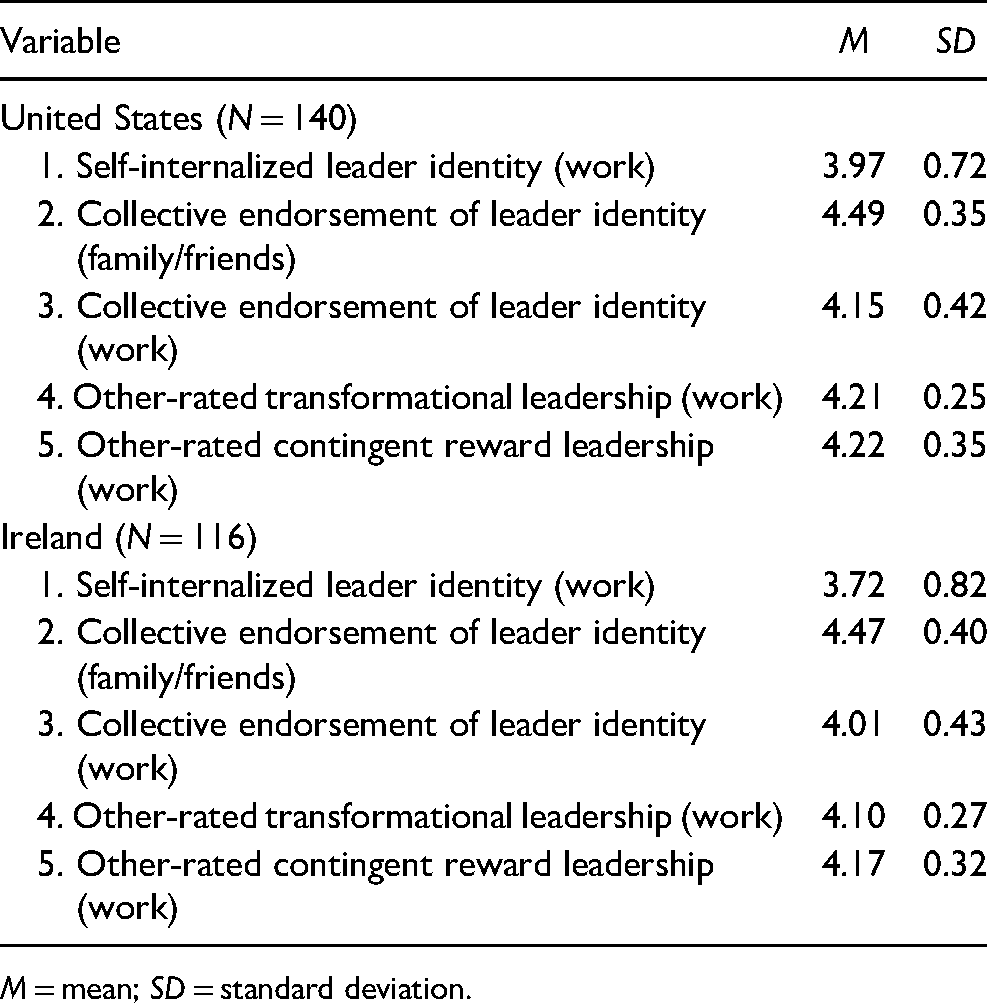
M = mean; SD = standard deviation.
t-test Results for the United States and Ireland (0 = United States, 1 = Ireland).
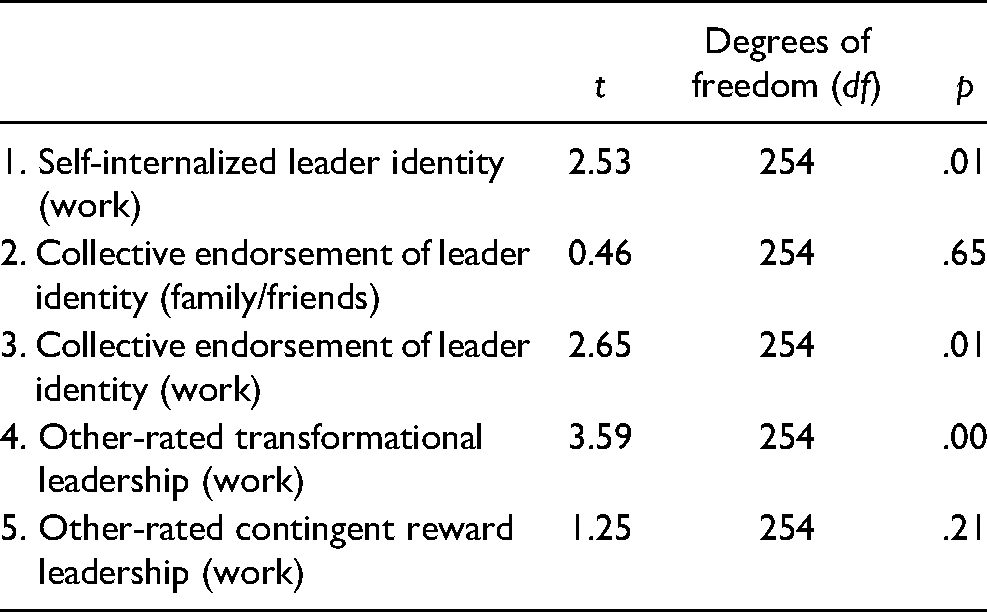
Measures
Collective Endorsement of Leader Identity. We used the four-item scale of leader identity developed by Hiller (2005) and used by Day and Sin (2011) to capture collective endorsement of leader identity, with items reworded slightly to reflect perceptions of the leader instead of self-ratings of identity. The items were rated on a 1–5 scale from 1 = strongly disagree to 5 = strongly agree and were worded as follows: (1) This person is a leader, (2) I see this person as a leader, (3) If I had to describe this person to others, I would include the word “leader,” and (4) I would like this person to be seen by others as a leader. This same scale was used for both work colleagues and family and friends in their respective domains. That is, friends and family members were asked to evaluate the leader in the family or friendship networks, whereas work colleagues were asked to evaluate the leader at work.
Self-internalization of Leader Identity at Work. We measured self-internalized leader identity in the work domain via self-reports with the same four items developed by Hiller (2005) that were used to capture collective endorsement. In order to provide matched data for participant feedback, participants answered the exact same questions as their raters. Participants were advised multiple times (verbally, in the survey instructions, and in the survey itself) that “this person” referred to the participant. The items were rated on a 1–5 scale from 1 = strongly disagree to 5 = strongly agree and were worded as follows: (1) This person is a leader, (2) I see this person as a leader, (3) if I had to describe this person to others, I would include the word “leader,” and (4) I would like this person to be seen by others as a leader.
Other-rated Transformational Leadership in the Work Domain. We measured the six dimensions of transformational leadership using the scale developed by Podsakoff et al. (1990). In the work domain, raters indicated the extent to which the individual demonstrated each of the following behaviors: acts as a role model (three items), sets a vision (five items), encourages teamwork (four items), sets high expectations (three items), displays intellectual stimulation (four items), and displays individualized consideration (three items). The items were rated on a 1–5 scale from 1 = strongly disagree to 5 = strongly agree. We averaged the items within each dimension, which resulted in a score for each dimension for each leader in the work domain.
Other-rated Contingent Reward in the Work Domain. Contingent reward leader behavior was measured using the contingent reward behavior scale developed by Podsakoff et al. (1990). In the work domain, raters indicated the extent to which the individual demonstrated the following contingent reward behaviors: (1) Frequently, if not always, gives positive feedback when others perform well, (2) gives special recognition when others’ work is very good, (3) commends others when they do a better than average job, (4) personally compliments others when they do outstanding work, and (5) frequently acknowledges others’ good performance. The items were rated on a 1–5 scale from 1 = strongly disagree to 5 = strongly agree.
Control Variables. As noted previously, we controlled for country in all analyses (0 = United States, 1 = Ireland).
Results
Descriptive Statistics and Correlations
Overall correlations and descriptive information are presented in Table 3. 1 Two outcome variables were significantly correlated with country as a control variable: self-rated leader identity in the work domain (r = −.16, p < .05) and other-rated transformational leader behavior in the work domain (r = −.22, p < .01).
Descriptive Statistics and Correlations.
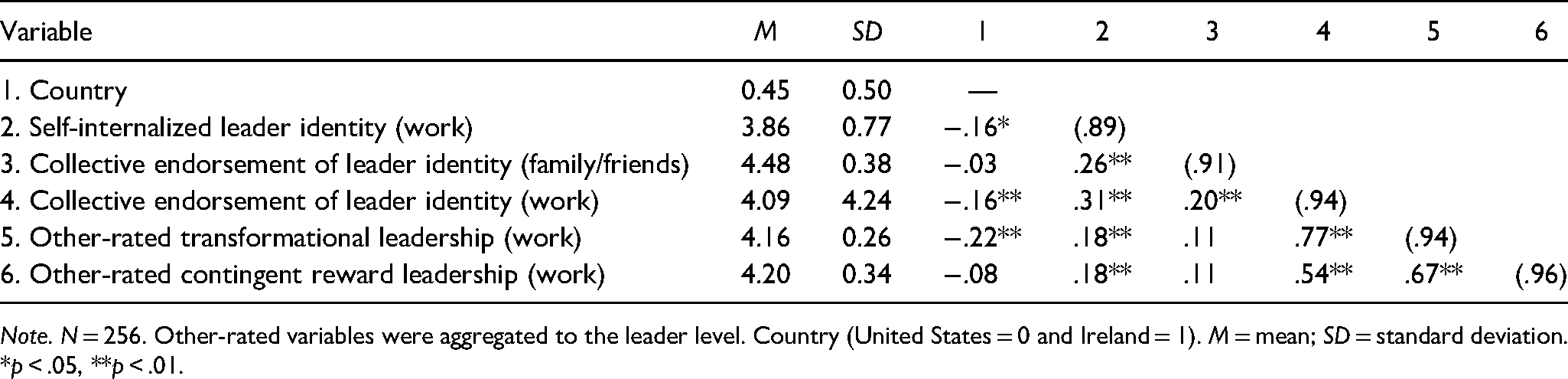
Note. N = 256. Other-rated variables were aggregated to the leader level. Country (United States = 0 and Ireland = 1). M = mean; SD = standard deviation.
*p < .05, **p < .01.
To aggregate collective endorsement of leader identity by friends and family and leadership behaviors across raters, we examined the level of agreement and reliability among raters within each domain (Bliese, 2000). When assuming a uniform null distribution, the average rwg estimates for collective endorsement as a leader in the family and friends domain, collective endorsement of leader identity in the work domain, other-rated transformational leadership in the work domain, and other-rated contingent reward leadership were 0.83, 0.72, 0.90, and 0.81, respectively. The intraclass correlation (ICC1) values ranged from 0.11 to 0.15. These results are presented in Table 4 and correspond with the typical cutoff scores for these indices (LeBreton & Senter, 2008) and the values that are commonly reported in the literature (Woehr et al., 2015). In an effort to ensure that we had not excluded meaningful variation in these ratings in our hypotheses tests, we performed post hoc tests that included rwg (uniform distribution) and standard deviation, respectively, as variables in our multiple hierarchical regression analyses. Neither variable impacted the results reported below.
Values for Aggregation Indices.
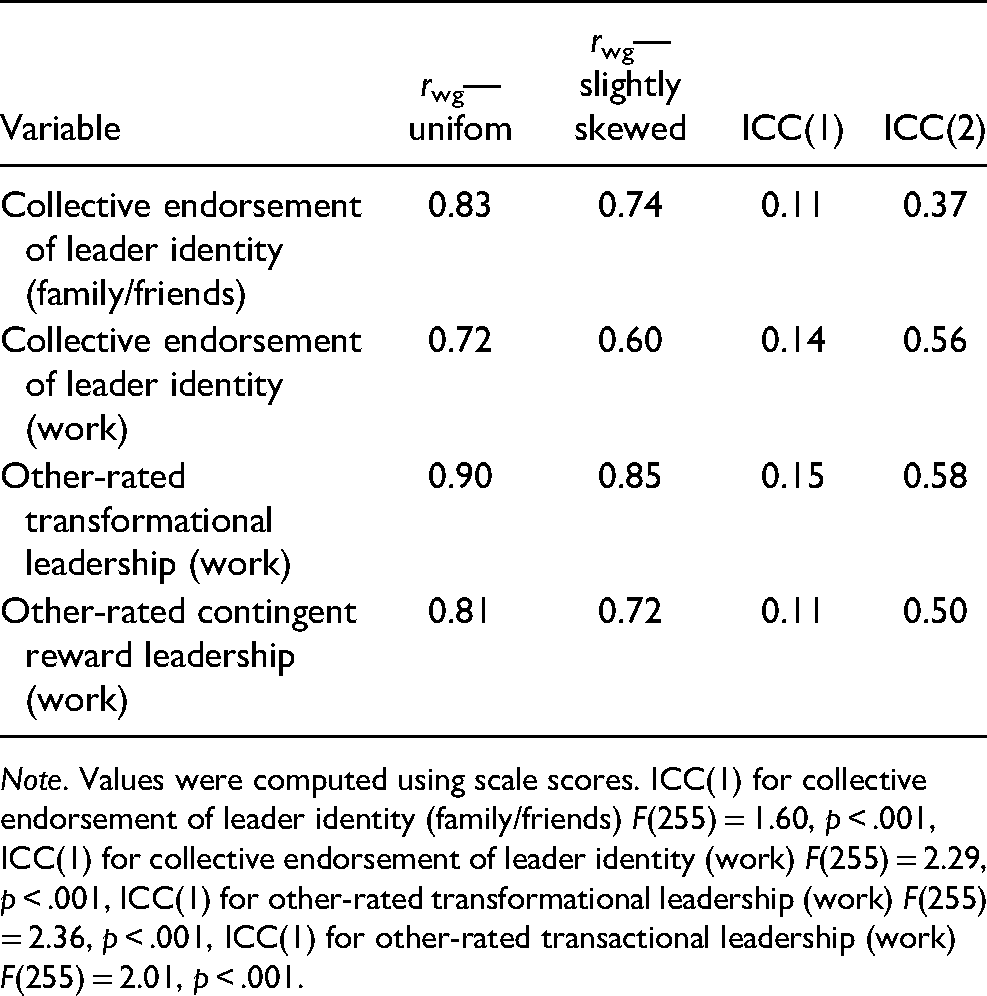
Note. Values were computed using scale scores. ICC(1) for collective endorsement of leader identity (family/friends) F(255) = 1.60, p < .001, ICC(1) for collective endorsement of leader identity (work) F(255) = 2.29, p < .001, ICC(1) for other-rated transformational leadership (work) F(255) = 2.36, p < .001, ICC(1) for other-rated transactional leadership (work) F(255) = 2.01, p < .001.
Test of Hypothesized Model
One of our underlying assumptions is that friends and family relationships tend to be longer in duration than workplace relationships (Zelizer, 2006). In support of this assumption, we note that raters in the family/friends domain reported an average relationship tenure with the leader of 15.63 years, whereas raters in the work domain reported an average relationship tenure with the leader of 4.51 years.
We used hierarchical multiple regression analyses in SPSS 25 to test Hypotheses 1 and 2 and the results of the regression analyses can be found in Table 5. The results indicated that, after controlling for country, collective endorsement of leader identity by work colleagues was positively related to self-internalization of leader identity in the work domain (b = 0.53, p < .01) and uniquely explained 8% of the variance in self-internalization. Thus, Hypothesis 1 was supported.
Results of Hierarchical Multiple Regression Analysis of Self-internalization of Leader Identity in the Work Domain.
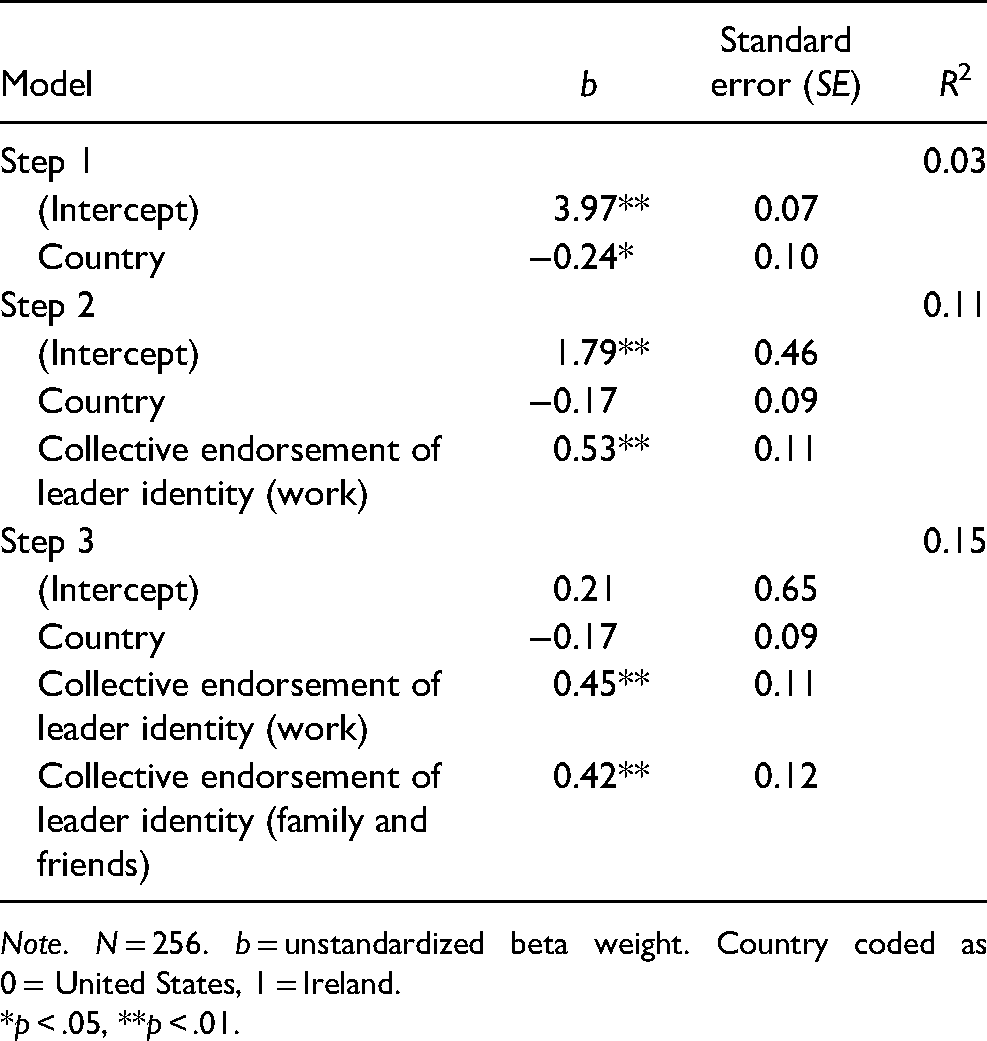
Note. N = 256. b = unstandardized beta weight. Country coded as 0 = United States, 1 = Ireland.
*p < .05, **p < .01.
Further, the results indicated that collective endorsement of leader identity in the family and friends domain was positively related to self-internalization of leader identity in the work domain (b = 0.42, p < .01) while controlling for country and collective endorsement of leader identity at work. Endorsement by friends and family explained an additional 4% of the variance in self-internalization of a leader identity above and beyond collective endorsement by work colleagues. Thus, Hypothesis 2 was supported.
In order to test Hypotheses 3a and 3b and due to the multilevel structure of the other ratings for transformational and contingent reward leadership in the work domain, we conducted two multilevel regressions in Mplus7 and the results of these analyses are presented in Tables 6 and 7. Each regression was specified with other-rated transformational leadership at work and other-rated contingent reward leadership at work as the Level 1 outcome variables. 2 The first step in our multilevel analysis was to examine whether there was meaningful variance in the Level 1 variables due to the Level 2 factor (leader). To do this, we examined the ICC(1) values (presented in Table 2) which indicated that there was significant between-person variation in each of our Level 1 variables. These values indicated that only 11–15% of the variance in these variables were due to Level 2 (i.e., leader) factors.
Multilevel Regression Results of the Relationship Between Self-internalization of Leader Identity in the Work Domain and Other-rated Transformational Leadership in the Work domain.

Note. Level 1: N = 2,053; Level 2: N = 256. Level 2 predictors were grand mean centered. Values (b's) are unstandardized regression coefficients. Country coded as 0 = United States, 1 = Ireland.
*p < .05, ** p < .01.
Multilevel Regression Results of the Relationship Between Self-internalization of Leader Identity in the Work Domain and Other-rated Contingent Reward Leadership in the Work Domain.
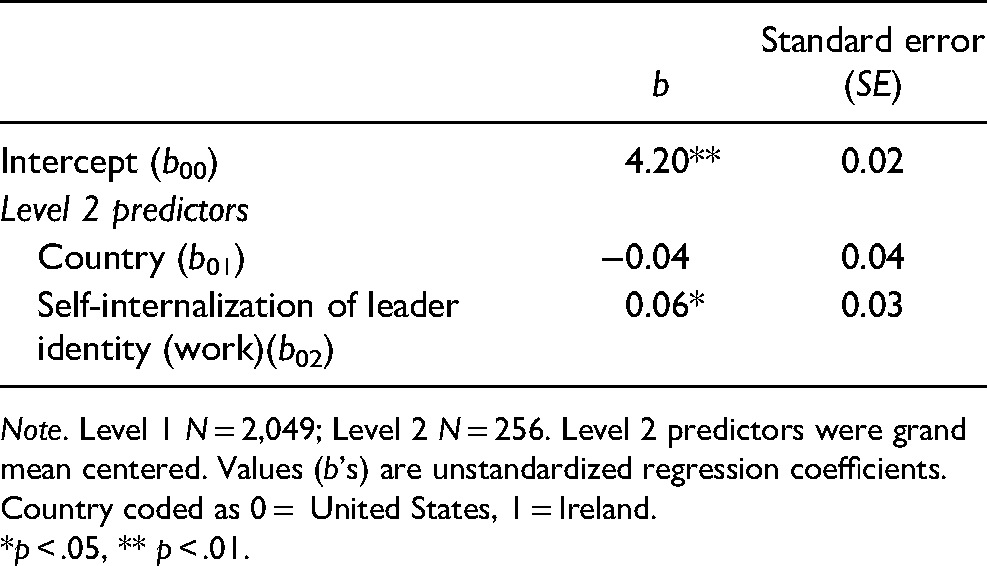
Note. Level 1 N = 2,049; Level 2 N = 256. Level 2 predictors were grand mean centered. Values (b's) are unstandardized regression coefficients. Country coded as 0 = United States, 1 = Ireland.
*p < .05, ** p < .01.
Consistent with other multirater studies (e.g., Aguinis et al., 2013), the Level 2 variables were centered at grand means. Table 6 presents the results of the multilevel analysis predicting other-rated transformational leadership in the work domain. Self-internalization of leader identity in the work domain was positively related to other-rated transformational leadership (b01 = 0.05, p < .05) above and beyond the control, supporting Hypothesis 3a. Approximately 3% of the variance in other-rated transformational leadership is due to self-internalization of leader identity in the work domain (pseudo R2 = 0.03). Table 7 presents the results of the multilevel analysis predicting other-rated contingent reward leadership in the work domain while controlling for country. Self-internalization of leader identity in the work domain was a significant positive predictor of other-rated contingent reward leadership in the work domain (b02 = 0.06, p < .05) above and beyond the control, which supports Hypothesis 3b. Approximately 2% of the variance in other-rated contingent reward leadership is due to self-internalization of leader identity in the work domain (pseudo R2 = 0.02).
Discussion
Using a multidomain (Hammond et al., 2017) perspective, we tested the relationships between collective endorsement of leader identity in the friends and family domain and self-internalization of leader identity at work. Leader identity formation is both a social and a multidomain process, in which individual-level characteristics of identity are socially influenced (DeRue & Ashford, 2010) and experiences in one area of life affect other areas (Hammond et al., 2017). Therefore, we posited and subsequently found support for the social influence process on leader identity across two domains. Specifically, results indicated that both work colleagues’ endorsement of leader identity at work (r = .31) and family/friends’ endorsement of leader identity outside of work (r = .26) contribute to a leader's self-internalization of leader identity at work. We further found that a leader's self-internalization of leader identity at work is associated with the enactment of transformational and contingent reward leadership behaviors at work (r = .18 for each). We note that the effect size of each of these relationships is consistent with a medium/moderate effect size in organizational research as identified in Bosco et al. (2015) meta-analysis. Perhaps the most striking finding is that endorsement of leader identity by friends and family members outside of work explained additional variance in self-internalized leader identity at work above and beyond endorsement by work colleagues. The incremental variance explained (r2 = .04) also indicates a medium/moderate effect size, indicating that both sources of collective endorsement are important.
Theoretical and Practical Implications
The results of this study make theoretical and practical contributions to the leadership literature. First, they highlight how multidomain leader development theory (Hammond et al., 2017) can help to explain the interplay of self-internalized leader identity strength and leader competence (i.e., transformational and contingent reward leadership in our investigation). Specifically, it provides evidence that extra-work experiences may play a role in workplace outcomes. Using three sources of data (friends/family, self, and work raters), findings also provide tentative support for the “seeds” of leadership (Murphy & Johnson, 2011) and life experiences in family shaping leadership behaviors at work in adulthood (Oliver et al., 2011; Reichard et al., 2011). Because relationships with friends and family have a much longer history (over three times longer on average in our study) and tend to be more intimate and personal in nature, views of an individual as a leader by friends and family might serve as a foundation for views of oneself as a leader.
Likewise, the results shed light on various aspects of leader identity construction (see Ibarra et al., 2014 for a detailed discussion of the various streams of leader identity research). Insofar as leader identity is socially constructed, we gain insight into how this process may occur. As people are collectively endorsed with respect to leader identity, their self-internalized sense of identity as a leader is strengthened. Importantly, this collective endorsement need not come exclusively from the same social environment. This insight is important to better understanding leader identity construction (DeRue & Ashford, 2010) and has potential implications in the work–family literature as well (Allen et al., 2014). It is also important to note that the lack of collective endorsement, due to little or no social network or due to cultural beliefs about leadership, may inhibit the self-internalization of leader identity and thus impede one's leadership abilities at work. Further, from a social identity standpoint, our findings might indicate that there are similar characteristics to leading at work and with family and friends, as social identity is predicated on acting in accordance with group prototypes. Finally, in accordance with leader identity theory, internalization of the leader role itself may positively impact the willingness to seek out leadership opportunities.
We operationalized leader identity endorsement of a leader identity as the mean of other ratings. However, we do not know to what extent the leaders’ friends and family members made their endorsement known to the leader. We may see stronger relationships with internalization for leaders who were provided with explicit recognition or endorsement than leaders for whom this endorsement was less known. This research took place within the context of a 360° evaluation, in which focal leaders and their raters evaluated independently. It may be interesting to examine these relationships after leaders examined their feedback reports. Further, recognition of leadership may affect subsequent leader behavior differently for those with varying strengths of internalized leader identities. Within the context of a moral identity, Winterich et al. (2013) found that recognition of prosocial behavior did not motivate volunteering for those with high internalized moral identities, but had a positive effect for those low on internalization who were also high on symbolization (a public desire to demonstrate moral behavior to others). Generalizing to a leader identity, we might expect an increase of leader behaviors following recognition for those with a less strong internalized leader identity, than those with a strong leader identity.
Self-determination theory (SDT; Deci & Ryan, 1985) provides one potential explanation to clarify the specific processes by which leader identity is shaped through nonwork relationships. SDT is a macro theory of human motivation, which is relevant for understanding growth, development, self-motivation, and identity internalization. Deci and Ryan (1985) claimed that meeting a person's psychological needs for autonomy, competence, and relatedness was essential to the internalization process. Contexts and relationships, across multiple life domains, that are supportive of these basic needs relate to greater self-motivation, satisfaction, well-being, and performance (Deci et al., 2017). The process of internalization is facilitated by basic psychological needs satisfaction, particularly in family and early life (Grolnick et al., 1997). Because of the intimacy of relationships with friends and family, the validation of needs by friends and family may be viewed as more fundamental to one's self-perception than workplace relationships.
In addition to family effects stemming from early family life, needs satisfaction has been proposed as a mechanism through which positive spillover from family to work roles occurs (Warner & Hausdorf, 2009). When needs are satisfied through family environments, both affect and performance in other roles should be enhanced. Because leadership involves skills and behaviors and is “an emotion-laden process” (George, 2000, p. 1,046), these avenues may be highly relevant to leadership. Indeed, Taylor et al. (2019) suggested that high-quality and successful leadership coaching relationships enabling self-discovery promote a leader's basic needs satisfaction. Specifically, they argue that the motivational effect of coaching on leader change is through basic need satisfaction. Relationships, in any domain, whether they be family, friends, community, or coaching, which satisfy basic needs may accelerate the internalization of a leader identity. We may find stronger effects of recognition of leader identity from home to a personal internalization of the identity when basic needs satisfaction is considered. LaGuardia (2009) highlights that individuals adapt themselves to situational contexts, especially to win approval from others. Taking on leadership roles may very well be a situation in which family approval is given through the perceived prestige of these roles. In such situations of “conditional regard,” the relationship may be weak, whereas when basic psychological needs are met without condition, one's leader identity may be internalized more autonomously, producing a stronger relationship. Because relationships within the work context tend to be more conditional on performance, and include impression management, we would expect stronger internalization from friends and family.
Finally, the results have important implications for practicing leaders, their managers, and those engaged in developing leaders (e.g., coaches and teachers). The most important implication is that what happens with family and friends can relate to a person's self-internalized sense of leader identity at work, thus impacting leadership behaviors at work. Thus, we recommend that those engaged in developing leaders or seeking to develop their own leadership, consider interactions with family and friends as potential developmental opportunities or search for ways to help build a strong social support network if one does not exist. We further suggest that feedback from family and friends is important for ongoing development. Our sample of 256 leaders and their 3,255 raters collected over multiple years in two countries provides initial evidence that multisource feedback instruments may benefit from the inclusion of nonwork rating sources (i.e., family and friends). This perspective may have the potential to further the conversation about the importance of unique rating sources in multisource feedback (cf., Hoffman et al., 2010; Lance et al., 2008).
Limitations and Future Directions
As in any study, limitations exist that may indicate potential future directions for research. First, although we have matched 360° survey data, the data used in these analyses are cross-sectional, thus we cannot make claims of unidirectional causality. It is important to note here that even using an experimental approach—usually the gold standard for demonstrating causality—would not likely result in evidence for a clear causal relationship. Prior research on leader identity (Day et al., 2009; Hammond et al., 2017) has strongly indicated that identity develops in an upward spiral fashion; in other words, models of identity development are nonrecursive. Thus, any study of any design will be limited by examining only a particular “slice” of the overall upward spiral. As a first study, we believe that it is important for the study design to capture the elements of theoretical interest. Here we were interested in the cumulative collective endorsement of leader identity from friends and family, who typically have known the leader more intimately and for a longer period of time than at work. As noted above, the average family and friends rater has observed the leader for over 15 years, while the average work domain rater has observed the leader for about 4.5 years. Thus, we believe that the study design is well suited to the research questions. Similarly, the design avoids common source bias, as each variable comes from a different rater source.
Despite these robust design elements, we acknowledge that our inferences are tentative. However, the moderate effect sizes in the study indicate promise for future research. When exploring leadership constructs, capturing even small amounts of variance can lead researchers to develop targeted developmental interventions—such programs (similar to those in community health campaigns), when applied to large numbers of individuals, can result in compelling societal impacts (Fishbein, 1996; Zatzick et al., 2009). These relationships likely have spiraling, reciprocating, or nonrecursive tendencies that evolve over many years of claiming and granting leadership behaviors (DeRue & Ashford, 2010) within and across domains (Hammond et al., 2017); thus, capturing any significant variance is instructive for future research. As such, to fully understand the spiraling nature of interactions between being a leader and doing leadership, we encourage researchers to utilize longitudinal research designs over multiple years of observation to develop a better—although still incomplete—grasp on the process of leader identity development.
Second, although multidomain leader development theory (Hammond et al., 2017) considers four dimensions of leader identity (meaning, strength, level, and integration) to explain what develops, this study only tests a portion of what constitutes leader identity; namely, strength (here operationalized as self-internalized leader identity). Other aspects of one's leader identity may differentially impact the relationships with leader behaviors. For example, Johnson et al. (2012) linked the level of identity with leader behaviors: a collective leader identity was related to transformational leadership and individual-level identities, especially paired with low collective identities were related to abusive leadership. Guillén et al. (2015) addressed aspects of the meaning or content of a leader identity (Hammond et al., 2017). They found that leader's self-comparisons (whether it be a prototype or role model), upon which their leader identity may be built, affect motivation to lead through different conditions and pathways.
Furthermore, Hammond et al. (2017) theory not only suggests what develops (leader identity), but also how leader identity develops through a sense-making process. A cross-sectional design, such as this study, is ill-suited to directly examine a sense-making process, although we can assume that the relationship between collective endorsement of leader identity as exemplified within particular types of relationships and self-internalized sense of leader identity represent some accumulation of sense making from the past. For example, in their qualitative study of how leader identity develops, Komives et al. (2005) noted that friends and family members play a supportive sense-making role in developing leaders. Still, a longitudinal design with qualitative data would be better suited to test the sense-making process that theory suggests is embedded in the findings. Therefore, future research that captures how leader identity develops would shed more light on the mechanisms we have observed in this study, such as those proposed by SDT (Deci & Ryan, 1983).
On a related note, in this study, we hypothesized relationships at the individual leader level of analysis, including the collective endorsement of leader identity both at work and with family/friends. We aggregated our sample data (collected from individual observers) to the leader level of analysis. While we believe that this approach is justified both theoretically and empirically, we are intrigued by the possibility that within-leader variability may be an important consideration in some circumstances (for a discussion of variability in leadership studies, see Lester et al., 2019). For example, does a leader with a significant within-domain variation of collective endorsement of leader identity (e.g., the leader has two friends who strongly agree that this person is a leader, but two other friends who strongly disagree) experience the same amount of self-internalized leader identity as leaders with more uniform ratings of collective endorsement? Similarly, leader identity in this study is based on a global perception of leadership, but it is possible that leader identity might be more nuanced. For example, perhaps there is a meaningful distinction between task-focused and relationship-focused leader identity, respectively. If so, then we might also investigate meaningful variation between different types of leader identity. We believe that there is ample opportunity for future studies to investigate these types of possibilities.
Conclusion
The notion that family and friends can and do play a role in shaping leaders is intuitive and likely fits with the lived experience of many who either benefit from or struggle without a strong social support network. However, empirical evidence lags behind popular wisdom for how this process may occur. In this study, we take a first step toward developing a better understanding of this process. The results indicate that collective endorsement of a person’s leader identity by work colleagues and family and friends outside of work impacts the person’s self-internalized identity as a leader at work. Further, results indicate that the self-internalized leader identity is related to transformational and contingent behaviors at work. These findings provide evidence for the link between the “being” of leadership (i.e., leader identity) and the “doing” of leadership (i.e., leader competence). Since leader identity is “at the heart of our understanding of leadership dynamics” (Epitropaki et al., 2017, p. 124), this study demonstrates that leader identity, formed in part through interactions with family and friends, is a concept which we believe warrants further study.
Footnotes
Declaration of Conflicting Interests
The authors declared no potential conflicts of interest with respect to the research, authorship, and/or publication of this article.
Funding
The authors received no financial support for the research, authorship, and/or publication of this article.
