



Abstract
Given the increasing use of intelligent technologies and the resulting requirement for leaders to be tech-savvy, an important question that emerges is whether perceptions of leadership effectiveness are changing too? Drawing from gender role theory and expectation violation theory, we propose and test a model of whether and how females can benefit from being tech-savvy. To explore whether women may stand to gain from the changing nature of the workforce or not, we ran a series of studies. Our data sources included a cross-sectional time-lagged field study and experimental studies with students and online adults. We found that a definitive skill of the current technological era, tech-savviness, changes perceptions and evaluations of female leaders in a much more positive way than it does for male leaders, as such allowing female leaders to be more likely to be perceived as effective leaders. The reason for the effect that tech-savvy women were more likely to be perceived as effective leaders was driven by the fact that tech-savvy women are seen as more competent and hence, attributed more social status. Our research goes beyond merely focusing on the negative effects of gender stereotypes by providing an actionable solution—that comes from promoting tech knowledge and savviness—for women to counter gender stereotypes that undermine them from being viewed as effective leaders.
Carl Sagan famously said that, “We've arranged a civilization in which most crucial elements profoundly depend on science and technology [and yet] … hardly anyone knows anything about science and technology.” While we play catch up in our understanding of rapidly evolving technologies, technology is already disrupting numerous professions and roles. It is likely to do the same with leadership (De Cremer, 2020; Larson & DeChurch, 2020). In the face of this disruption, the digital transformation efforts that organizations are implementing are placing leaders in a position where they have to quickly adapt to new ways of working with intelligent technologies (Kai-Uwe Brock & von Wangenheim, 2019). Within this context of digital transformations, leaders have to guide their employees to leverage their knowledge of technology to develop a competitive advantage. As a result, an important requirement for today's leaders is to be tech-savvy enough to understand how to make humans and intelligent machines collaborate effectively within an organizational context (De Cremer & Kasparov, 2021).
Being recognized as a person who is technologically savvy in today's business environment, where the use of intelligent technologies is widely prevalent, has become a necessity if one wants to stay relevant and innovate (Williams et al., 2021). In turn, this impacts social perceptions (Orlikowski, 1992), especially perceptions that are relevant to being seen as a leader (De Cremer, 2020). In other words, the ability to understand the use and necessity of intelligent technologies in today's organizational context, results in the expectation that this person can lead others in a setting where the use of intelligent technologies is becoming more important. A consequence of this line of reasoning could then also be that perceptions of leadership qualities are changing because of the important role that technology plays in organizations today.
In the present paper, we use the above assumption to explore whether this change in perception of what competencies are required to be perceived as a leader in an increasingly digital organizational environment, could specifically create an opportunity for women to be better positioned to be perceived as effective leaders, thereby reducing the gender gap. This is an important problem to address because it is well established that a gender bias exists when it comes to who is seen as a leader (Badura et al., 2018; Dirik, 2021; U.S. Bureau of Labor Statistics, 2021). Research over the years has explained this imbalance by demonstrating that women are perceived less favorably compared to men in leadership roles due to a perceived incongruity between being a woman and a woman being a good fit for a leadership role (Eagly & Karau, 2002; Koenig et al., 2011). Below, we first explain how this process of gender role congruity has led to this gender gap in leadership.
The Link Between Tech-Savviness and Gender Role Congruity
Gender role congruity refers to expectations that there should be a congruence between gender and other roles that people take on in society (Eagly & Karau, 2002). The basis of this theory is that the gender differences that play out in society are due to the fact that division of labor occurs along with gender lines (Badura et al., 2018). One area that these expectations of congruity affect is that of leadership. A wide range of studies have shown that leadership is often implicitly thought of in terms of skills and traits that are considered masculine in nature (e.g., assertiveness and dominance), rather than skills and traits that are considered feminine (e.g., kindness and nurturance; Cann & Siegfried, 1990; Koenig et al., 2011). In other words, the agentic qualities that men typically possess align closer with the prototype expected of a leader compared to the communal qualities that women typically possess (Eagly & Karau, 2002; Koenig et al., 2011). As a result, characteristics associated with leadership roles are more often linked to men than to women. In turn, there is often an implicit expectation that leadership fits with the masculine gender role more so than the feminine gender role. This leads to various outcomes.
For one, research finds that as leaders, women may be perceived to be less effective than men (Dirik, 2021; Eagly et al., 1992; Paustian-Underdahl et al., 2014). These studies have confirmed the existence of a gender bias with respect to leadership perceptions; however, in general, these studies have not concentrated on ways in which females can overcome this gender bias in perceptions of leadership effectiveness.
Our line of research considers the question of whether it is possible that technological savviness, a skill required for today's leaders, has the potential to shift the gendered effects of the perceptions of effective leadership. We define technological savviness as having a predisposition toward and knowledge of how to adopt new technologies for the purposes of accomplishing various work goals and tasks. Note that technological savviness is conceptually different from having technical competence in an area that requires technical expertise or professional training (e.g., engineering).
In order to determine whether the skill of technological savviness has the potential to shift the gendered effects of the perceptions of effective leadership, then as per gender role theory, it is first necessary to determine whether this skill is likely to be assigned attributions of masculinity or femininity. How do we make this determination? First, evidence exists that most STEM (Science, Technology, Engineering, and Mathematics) graduates around the world are males (Garcia-Holgado et al., 2020). Second, research has also revealed that parents of young boys, more so than parents of young girls, encourage their boys to explore skills that allow them to develop their technological savviness, skills that boys are believed to be naturally inclined toward (Eccles, 2015). Looking at this evidence, one would expect that skills related to having a predisposition toward and knowledge of new technologies are likely to be assigned attributions of masculinity. Consequently, and in line with the tenets of gender role theory, as expectations of being able to successfully navigate an increasingly technologically driven environment increase, not much will change. In other words, as tech-related skills grow in importance, men should continue to be perceived favorably in comparison to women when it comes to perceptions of effective leadership.
Importantly, the idea that the status quo is not likely to shift and that the gender gap may even widen further, is corroborated by observations that technology is commonly noted to be a male domain (Wang & Degol, 2017), as evidenced by the fact that the vast majority of graduates from engineering and the hard sciences are male (Garcia-Holgado et al., 2020) as well as the fact that universities and programs around the world are striving to attract more female students into such degree programs (Berman, 2021). Furthermore, evidence suggests that even when women in the fields of science and engineering complete the highest levels of education, it is not clear that they are recognized for their gains in expertise by those on their teams (Joshi, 2014).
All of the above thus suggests that the skill of technological savviness is perceived to be a masculine skill and continues to be a strongly masculine one. So, does this mean that promoting women's technological savviness may not help in reducing the gender gap that exists in the domain of leadership? In the present paper, we suggest that this is not necessarily the case. We argue that displaying their tech-savviness skills, may, in certain contexts, actually work to the advantage of women. Below, we rely on expectation violation theory (Jussim et al., 1987) to substantiate this claim.
The Link Between Technological Savviness and Expectation Violation Theory
Expectation violation theory (EVT) builds upon gender role theory by noting that even though the agentic qualities that men typically possess align closer with the prototype expected of a leader compared to the communal qualities that women typically possess, there is often a backlash against women who attempt to take on this bias by displaying agentic, or other masculine behaviors. But more recent research findings note that this backlash applies to women only in certain contexts (Lanaj & Hollenbeck, 2015; Schaumberg & Flynn, 2017). As it turns out, the negative stereotypes that women have to face regarding their leadership capabilities can sometimes lead to more favorable evaluations regarding their leadership capabilities due to a countervailing bias (Heilman, 2012; Lanaj & Hollenbeck, 2015). According to expectation violation theory, behaviors are evaluated more extremely when the behavior runs counter to stereotype-based expectations, but this comes with a specific caveat (Jussim et al., 1987).
EVT suggests that when women display characteristics that are prototypical leader characteristics, but atypical according to what is expected from someone of the female gender, they are likely to be evaluated more positively compared to men who display the same characteristics. More recent findings indeed show that if leader behaviors deviate positively from their gender roles, such as male leaders exhibiting emotional sensitivity or female leaders displaying decisiveness, they receive better evaluations than those who exhibit role-congruent behaviors (Anderson et al., 2006). Therefore, expectation violation theory predicts that due to a countervailing perceptual bias, in certain contexts women can be recognized, rather than have to pay a price for their leader behaviors.
Under what contexts can women be recognized for their leadership effectiveness? We argue that having a predisposition toward and knowledge of how to adopt new technologies (i.e., tech-savviness) will help women to be recognized as effective leaders, that is, if their organizational context is one where leaders are expected to manage and deal effectively with an increasing use of intelligent technologies. As we argued in our introduction, this context seems to have emerged as skills associated with the knowledge of and predisposition toward technology grow in importance in the business world (Haesevoets et al., 2021; Kai-Uwe Brock & von Wangenheim, 2019). Therefore, we propose that current organizational demands have given rise to a situation where women are just as likely to be perceived as effective leaders as men, when they are also perceived as being tech-savvy. Specifically, we expect that possessing the skills that fit with the technological savviness required from leaders today sets the stage for improving women's perceived leadership effectiveness.
This shift could take place because, first of all, it is generally men who are expected to be more interested and skilled in technology. Second, tech-savviness is beneficial for performing leadership roles but is atypical for the gender stereotype of women; hence, in line with the tenets of EVT, we would expect that in the current organizational context where tech-savviness is a requirement, tech-savvy women will be evaluated as more competent and be more likely to emerge as effective leaders in comparison to women not perceived to be tech-savvy. Moreover, if women are perceived to be technologically savvy, it should also follow that perceptions of their competence—as tech savviness is a highly valued professional skill today—should then increase, making it more likely for them to be recognized for their leadership effectiveness. Prior research shows that being perceived as competent in a specific area, in turn, contributes to one's status in that field (Bai et al., 2020; Brescoll et al., 2010) and given that status is related to leadership perceptions (Lucas, 2003), we suggest that because of these perceptions of increased competence and status, tech-savvy women will be just as likely to be viewed as effective leaders as compared to tech-savvy or non-tech-savvy men. In other words, possessing the skill of tech-savviness gives women an added boost to make up for the gap between men and women when it comes to perceptions of leadership effectiveness. This line of reasoning leads us to predict the following hypotheses:
H1: Gender interacts with technological savviness to predict leadership effectiveness, such that females will indirectly be seen as equally effective as males (regardless of whether those males are tech-savvy). H2: Gender interacts with technological savviness to predict leadership effectiveness via perceived competence and status conferral sequentially.
The Present Research
The purpose of the present set of studies is to draw from expectation violation theory to examine the relationship between gender and leadership effectiveness, as a function of technological savviness. Further, we examine whether perceptions of competence and status conferral explain the relationship between gender and perceptions of effective leadership, as a function of perceived technological savviness. We propose that the skill of technological savviness will provide the right set of conditions within which women are recognized for their leadership effectiveness. This construct takes into account different aspects of what it means to be perceived as an effective leader (Paustian-Underdahl et al., 2014). Therefore, across our studies, we consider perceptions of effective leadership by measuring it in different ways since research indicates that when looked at in relationship to gender, leadership effectiveness needs to be measured in a myriad of ways in order to get a full picture of what is going on (Paustian-Underdahl et al., 2014). Therefore, in Study 1, we focus on employee ratings of leader effectiveness, specifically those leaders who are selected to be leaders by those in a position of authority over them (Lisak & Erez, 2015). In Study 2, we measure perceptions of leader effectiveness from a third-party perspective. Finally, in Study 3, we measure perceptions of leader effectiveness in an interactive, simulated set up, that is, perceptions of leaders who become leaders through an interactive process (Hollander et al., 1977). In this way, we wholly capture perceptions and predictions of leadership effectiveness, thereby obtaining a fuller picture of the effects of possessing the skill of technological savviness.
To test our predictions, we conducted three studies. First, we conducted an exploratory field study in China where we examined how perceptions of technological savviness affected the extent to which male versus female managers were thought to be effective leaders. Based on the findings of our first study, that possessing the skill of technological savviness allows female leaders to be more likely to be perceived as effective leaders, we then ran two experiments to test our full moderated mediation model (H2). In other words, we then explored the reasoning behind why these leaders are viewed more positively, or more specifically, whether the effect of leader gender and technological savviness on leadership effectiveness can be explained by the sequential effect of competence and status conferral.
Study 1
For our first study, we conducted a field study to explore whether females in leading roles are more likely to be perceived as effective leaders, as a function of being tech-savvy. In this study, we focus on leaders who are selected to be leaders by those in a position of authority over them (Lisak & Erez, 2015). Using manager–employee pairs from multiple organizations in a major city in South Central China, we conducted a longitudinal field study to examine how both gender and leader technological savviness interact to affect leadership effectiveness.
Method
Participants
This research was approved by an IRB committee at a large university in Asia (IRB Approval #: DER-19-1203), and informed consent was obtained from all individual participants included in this and all of the studies that follow. We recruited full-time employees (Mage = 28.09 years, SD = 3.60, 53.8% female) and their direct supervisors (Mage = 34.38 years, SD = 5.23, 52.5% female) from multiple organizations in a major city in South Central China to conduct a multi-wave study. We intentionally recruited participants from multiple organizations and multiple industries to be able to increase the generalizability of our findings (Rousseau & Fried, 2001). A total of 120 manager–employee pairs completed all waves of the study.
In order to recruit these participants, we contacted alumni from part-time MBA and Executive MBA programs from a major university in China. All of the alumni contacted were either top executives or senior managers. We asked the alumni to help with the recruitment of their own employees for the purposes of study participation. Using alumni networks for the purposes of data collection in this manner is common in management research (e.g., Deng et al., 2019) and was advantageous for our context because it enabled us to access a diverse sample of teams to enhance the generalizability of our findings.
Procedure
First, we sought the permission of an executive manager from each organization. Then, we asked the human resources managers of each organization to randomly select (using a random number generator into which we input the employees’ work IDs) about ten employees and their direct supervisors. The HR managers provided us with time to deliver the surveys to each manager–employee pair. It should be noted that all the manager–employee pairs selected voluntarily agreed to participate in our study.
In the first wave of our multi-wave study, we gathered leader gender and other leader demographics. In the second wave, we measured leader technological savviness. Finally, in the third wave, we measured employee ratings of leader effectiveness. Each wave of the study was spaced approximately two weeks apart.
In the first and second waves, from the managers, we gathered self-reports of leader gender as well as self-perceptions of technological savviness. In the third wave, from employees, we gathered data on employee ratings of their manager's effectiveness as a leader.
Measures
All the materials were presented in Mandarin Chinese. Two independent bilingual researchers translated the items from English to Mandarin Chinese and then back-translated the items into English using Brislin's (1980) method of adapting content for cross-cultural research. All responses were recorded on a 5-point Likert scale, ranging from 1 (Strongly Disagree) to 5 (Strongly Agree).
Leader Technological Savviness
We assessed leader technological savviness using three items from Parasuraman (2000): (1) Other people come to me for advice on new technologies 1 ; (2) In general, I am the first among my circle of friends to acquire new technology when it appears; (3) I can usually figure out new high-tech products and services without help from others (three items; α = .89).
Leadership Effectiveness
We assessed perceptions of leadership effectiveness by using a four-item leader effectiveness scale developed by Giessner and van Knippenberg (2008). As noted earlier, we measured employee ratings of leader effectiveness, specifically those leaders who are selected to be leaders by those in a position of authority over them. Sample items of this measure included, “My supervisor is very effective” and “My supervisor is a good leader.” (four items; α = .96).
Results
We conducted an ordinary least squares (OLS) regression to test for the interaction between leader gender and leader technological savviness on leadership effectiveness (see Table 1 for means, standard deviations, and correlations). We found that the interaction predicted leadership effectiveness, as perceived by the employee (B = .30, SE = .14, t = 2.19, p = .03). The simple slope test results indicated that the effect of leader gender on leadership effectiveness was significant for those with high levels of technological savviness (B = .33, SE = .16, t = 2.13, p = .04), but not for those with medium (B = .13, SE = .11, t = 1.14, p = .25) or low levels of technological savviness (B = −.15, SE = .16, t = −.94, p = .35). As an additional check, we added participant gender, age, and educational level data as a control to our model. We found no significant differences in our results with these controls added.
Discussion
The results of our first study suggest that when female leaders are not tech-savvy, they are rated as much less likely to be perceived as effective leaders compared to their non-tech-savvy male counterparts, as such highlighting the presence of a gender bias (see Figure 1). However, when they are tech-savvy, females are evaluated as more likely to emerge as effective leaders compared not only to non-tech-savvy females but also as compared to tech-savvy and non-tech-savvy males. Overall, possessing the skill of tech-savviness allows women to overcome employee perceptions of their (reduced) leadership effectiveness.

Interaction of gender and tech-savviness on leadership effectiveness.
Our first study provided us with evidence to support our main assumption—that tech-savvy women are more likely to be seen as effective leaders. Therefore, building on the findings of our first study, we set out to test our full moderated mediation model where we predicted that the reason for the positive impact of tech-savviness on perceptions of women's leadership effectiveness is that tech-savvy women are seen as more competent and hence attributed more social status. If females are not seen as tech-savvy, they are not seen as more competent and attributed social status, and are consequently less likely to be perceived as effective leaders than both tech-savvy and non-tech-savvy men.
We tested our model in two experiments. The experimental setting allowed us to draw causal inferences with respect to the relationships that we predicted.
Study 2
Using participants from a large university in Singapore, we set up a role-playing business simulation in which participants were tasked with helping a multinational company in looking for a new general manager.
Method
Participants
A total of 286 undergraduate students from a large university in Singapore took part in the study (Mage = 21.0 years, SD = 1.64, 57% female). Participants were invited to take part in a university lab study and they were given course credit in exchange for study participation. Participants were randomly assigned to a 2 (female vs. male) × 2 (tech-savvy vs. non-tech-savvy) factorial design.
Procedure
Participants were invited to take part in a university lab study and were placed in adjacent cubicles in front of a computer station. They were then presented with the task materials on their computer screen. They were informed that the researchers conducting this experiment were frequently asked to provide advice to companies as consultants. In this specific case, they were tasked with helping out a multinational company that was looking for a new general manager. To facilitate this search for a general manager, the company had provided the researchers with the relevant information and the researchers were now going to present this information to the participants in order to get a better understanding of what should be taken into account when looking for a new general manager. Participants were provided information about the skill sets required for the position and then asked to evaluate potential candidates based on their profile, which included a description of the candidate's past work experience and performance. When describing past work experience and performance, we described the candidate as someone with a track record of excellence by describing the candidate as someone who had managed to transition their previous company from a net loss to a net gain position and someone whose efforts boosted market share by 3–7% within critical markets (see Appendix A for study materials).
After which, depending on the condition to which they had been randomly assigned to, they read one of two candidate profiles, in which we manipulated both the candidate's gender and the candidate's tech-savviness. In order to manipulate gender, we used typical male (James) and female (Sandra) names in our description of the candidate. In order to manipulate tech-savviness, we described the candidate's major, technology usage and how others describe them, etc. Upon reading this description, in order to visually depict the candidate's level of tech-savviness, we followed up with a pictorial image of the candidate's personal desk at home where in the tech-savvy condition we presented participants with a picture of a desk with the latest desktop computer and sleek gadgets whereas in the non-tech-savvy condition we presented participants with a picture of an outdated desktop with gadgets that were similarly out-of-date (see Appendix A for pictures used).
Finally, after reading the general manager candidate's profile and looking at a visual representation of the candidate's desk, participants were asked to evaluate the candidate's qualifications for the position by rating the candidate's competence, status conferral, and leadership effectiveness.
Measures
All responses were recorded on a 7-point Likert scale, ranging from 1 (Strongly Disagree) to 7 (Strongly Agree).
Competence
We assessed perceptions of competence using items adopted from Kim et al. (2004), adjusting the items to the scenario (three items; α = .95). A sample item was “Sandra (James) is very capable of performing her (his) job.”
Status Conferral
We assessed status conferral using items from Jachimowicz and colleagues (2019), adapted to fit the context (three items; α = .95). Sample items included “I admire Sandra (James)” and “I wish I could be like Sandra (James).”
Leadership Effectiveness
We assessed perceptions of leadership effectiveness by using a three-item scale developed by Porath et al. (2015). A sample item was “I would recommend Sandra (James) as a leader” (α = .97). As recommended in the literature, we used a different measurement approach in this study compared to Study 1 because this would allow us to get a comprehensive understanding of perceptions of leader effectiveness (Paustian-Underdahl et al., 2014).
Manipulation Check
To ensure the success of tech-savviness and gender manipulation, we asked participants to report “To what extent do you agree that this person is knowledgeable in the use of technology?” and “To what extent do you think this person is tech-savvy?” (two items; ρ = .98). We calculated an average composite score of the two items. After which we conducted a two-way ANOVA that examined the effect of the gender manipulation and the tech-savviness manipulation on the average composite of the tech-savviness manipulation check questions. We found a significant effect of the tech-savviness manipulation on the tech-savviness manipulation check questions, F(1,287) = 434.68, p < .001; Mnon-tech savvy = 3.10, SD = 1.50, Mtech-savvy = 6.15, SD = .92. The effect of the gender manipulation on the two tech-savviness manipulation check questions was not significant and neither was the interaction effect (F(1,287) = 3.67, p < .06; F(1,287) = 2.06, p < .16). Overall, this indicated that our tech-savviness manipulation worked and rightfully did not interact with our gender manipulation.
In the male condition, 89.3% of participants correctly identified James to be a male, and 89.7% of participants correctly identified Sandra to be a female. The results for the following statistical tests follow the same pattern with or without including those who did not accurately identify the gender of the candidate.
Results
In support of our predicted moderated mediation model (see Table 2 for means, standard deviations, and correlations), we found that the effect of gender on the indirect relationship between tech-savviness and leadership effectiveness via perceived competence and status conferral was significant (B = −.26, SE = .09, 95% CI = [−.46, −.12]). In the tech-savvy condition, the conditional indirect effect was nonsignificant (B = .02, SE = .04, 95% CI = [−.06, .12]), but in the non-tech-savvy condition, the indirect effect was significant (B = .29, SE = .08, 95% CI = [.16, .48]). This finding supports our hypothesis that when females are viewed as tech-savvy, they are equally likely to emerge as effective leaders compared to both tech-savvy and non-tech-savvy men because they are then seen as competent and hence, attributed more social status (see Figure 2).
Discussion
Our results reveal that when both parties are perceived as tech-savvy, women's leadership effectiveness is perceived to be similar to that of men's, meaning that women are able to overcome negative perceptions of their leadership effectiveness when they are technologically savvy. As per our hypothesis, we also looked at why is it that there is a shift in perception toward tech-savvy females. The results from our experiment reveal that when women are tech-savvy, they are perceived to be equally as effective as men, because they are then perceived to be more competent and awarded a higher social status to go with that. When women are not tech-savvy, they are less likely to be perceived as effective leaders in comparison to men, for the reason that non-tech-savvy women are perceived as less competent and in turn, awarded less status.
Study 3
Because the findings of Study 2 are novel and carry important practical implications, it was important to replicate the findings (Camerer et al., 2018; Maxwell et al., 2015) which we set out to do in Study 3. In addition, contrary to Study 2 where we presented participants with a supposedly real-life corporate context where we asked for their perceptions, in Study 3, we wanted to create a more involving and dynamic simulation. We did so by having participants engage in a survival task. Finally, rather than using undergraduate students as in Study 2, in Study 3, we used full-time employees as participants.
Method
Participants
A sample of 240 full-time employees was recruited through Prolific. Prolific is an online platform that is designed explicitly for online participant recruitment. Recent research demonstrates that data collected via Prolific is of the same quality as data collected in a traditional university lab setting and is of higher quality than data obtained through alternative online platforms (De Cremer et al., 2018; Peer et al., 2017).
After omitting participants who failed our attention check questions (see below for more details), we retained a final sample of 235 full-time employees (MAge = 35.7 years, SD = 10.34, 50.2% female). We used a between-subjects factorial design and randomly assigned the participants to one of four conditions: 2 (gender: male vs. female) × 2 (tech-savvy vs. non-tech-savvy).
Procedure and Manipulations
At the start of the experiment, we told participants that they were going to be partaking in a real-time simulation task. In order to create an experience of a business simulation, we started the experiment by asking participants to create a unique ID for themselves and to answer some questions related to their background and personal interests. Following this, participants went through a series of computer simulations, which were adapted to lead them to believe that they were participating in an interaction task with other participants. Specifically, participants were presented with a screen that depicted a search for the other participant that they were going to be paired with, that is, the preprogrammed e-confederate, whose background information and personal interests were presented to them upon matching. Participants were then informed that they would be assigned either to a supervisor role or to a subordinate role, when in fact, all participants were assigned to the subordinate role (see e.g., De Cremer et al., 2018 for a similar procedure).
We then introduced the gender manipulation of the team supervisor. In the condition where participants were paired with a male supervisor, they were told that the leader's ID was Knight_2000 whereas when participants were paired with a female supervisor they were told that the leader's ID was Tulip2020. This was followed by our tech-savviness manipulation.
Participants in the tech-savvy leader condition were told that the leader majored in computer science and as for hobbies, liked to keep up with the latest technological developments in addition to enjoying painting and team sports. Participants in the non-tech-savvy leader condition were told that the leader majored in Education, and as for hobbies enjoyed painting and team sports. We omitted any mention of enjoying keeping up with the latest technological developments in the non-tech-savvy leader condition.
Then, together with the preprogrammed computer-based confederate leader, participants had to complete a survival task, widely used in studies on teamwork and leader effectiveness (e.g., Rico et al., 2012). The task was to finish a short report on the topic of “plane crash.” We set the first part of the task up using a dummy program that mimicked the Google Trends website, a website that analyzes the popularity of top search queries. Participants were informed that the leader in the tech-savvy condition was able to use the dummy program to access and collate the information required for the task independently whereas the leader in the non-tech-savvy condition had to seek additional help from the dummy program when trying to gather the requisite information required to complete the task. With that, participants in both conditions received the same final output from the leader and were also told that the leader was able to complete the task successfully.
After experiencing how the leader handled working with Google Trends, participants had to complete an extension of the same plane crash survival task. The task was for the leader–subordinate pair to work together and select the five most important items to keep for the purpose of survival. The leader sent the participants preprogrammed messages telling the participants to rank-order their choice of items. Participants first selected their top five items individually, following which, the leader revealed their own choices to the participant, while explaining the rationale behind the choices. Finally, participants made the choice of following the leader's decisions or not. After completing both parts of the experiment, just as in earlier studies, we measured participant perceptions of the leader's exhibited level of competence, conferred status, and leadership effectiveness.
Measures
Leader competence (Cronbach's α = .94), status conferral (Cronbach's α = .86), and perceptions of leadership effectiveness (Cronbach's α = .96) were measured using the same items as in Study 2. In contrast to Study 2, however, we measured perceptions of leader effectiveness in an interactive, simulated set up, that is, perceptions of leaders who become leaders through an interactive process (Hollander et al., 1977) in order to get a comprehensive understanding of perceptions of leader effectiveness (Paustian-Underdahl et al., 2014).
Manipulation Check
The results of the gender manipulation check indicated that all the participants in the male condition considered Knight_2000 to be of the male gender. As for Tulip2020, all except one participant considered that user ID to belong to someone of the female gender. Overall, this meant that our gender manipulation was successful.
As for the tech-savviness manipulation check, to test whether our tech-savviness manipulation worked, we asked the participants, “To what extent do you agree that Knight_2000/Tuilp2020 is knowledgeable in the use of technology?” and “To what extent do you think Knight_2000/Tulip2020 is tech-savvy?” (two items; ρ = .92). We calculated an average composite score of the two items. After which we conducted a two-way ANOVA that examined the effect of the gender manipulation and the tech-savviness manipulation on the average composite of the tech-savviness manipulation check questions. We found a significant effect of the tech-savviness manipulation on the tech-savviness manipulation check questions, F(1,231) = 30.86, p < .001; Mnon-tech savvy = 4.77, SD = 1.19, Mtech-savvy = 5.62, SD = 1.16. The effect of the gender manipulation on the two tech-savviness manipulation check questions was not significant and neither was the interaction effect (F(1,231) = 0.22, p < .65; F(1,231) = 0.28, p < .60). Overall, this indicated that our tech-savviness manipulation worked and rightfully did not interact with our gender manipulation.
Results
In support of our moderated mediation model (see Table 3 for means, standard deviations, and correlations), we found that the effect of gender on the indirect relationship between tech-savviness and leadership effectiveness via perceived competence and status conferral was significant (B = −.20, SE = .09, 95% CI = [−.38, −.06]). In the tech-savvy condition, the conditional indirect effect was nonsignificant (B = −.09, SE = .06, 95% CI = [−.21, .003]), but in the non-tech-savvy condition, the indirect effect was significant (B = .11, SE = .06, 95% CI = [.01, .27]). This finding supports our hypothesis that when females are viewed as tech-savvy, they are equally likely to emerge as effective leaders compared to both tech-savvy and non-tech-savvy men because they are then seen as competent and hence, attributed more social status (see Figure 3).
Discussion
The results of this experiment provide further evidence that perceptions of being tech-savvy closed the male–female gap on evaluations of the leadership effectiveness of females, for the reason that tech-savvy female managers were perceived to be competent and hence acquired a higher level of social status. Conversely, we found that when women are not tech-savvy, they are less likely to be perceived as effective leaders, for the reason that they are perceived as less competent and in turn, awarded less status.
Discussion
Decades of gender research have shed light on the reality that men tend to be perceived as leaders far more frequently than women do. One of the reasons for this is that when people think of a manager, they often think of a man. Gender researchers refer to this as the “think manager, think-male” paradigm (Schein et al., 1996). It has been suggested that women should “lean in” and act more like men in order to advance into positions of leadership (e.g., Sandberg, 2013). Unfortunately, adopting masculine traits such as assertiveness can result in backlash toward women (Amanatullah & Tinsley, 2013). Fortunately, as per expectation violation theory, recent findings indicate that depending upon the specific context, this backlash may not occur. We demonstrate that in a world where every company prides itself in being a tech-driven company, the skill of tech-savviness allows women to emerge as effective leaders. As such, in an unexpected twist brought about by the onset of the technological era, our findings provide evidence that there appears to be a new solution to the problem of how women can combat perceptions of not being thought of as effective leaders.
We conducted three studies. Overall, these studies revealed that women who are tech-savvy can get a leg up over and above their non-tech-savvy selves to be recognized for their leadership effectiveness. We also found that being tech-savvy was helpful to women to overcome the perceptual barriers that they face when it comes to being perceived as an effective leader. Indeed, tech-savvy women were considered equally as effective as men (regardless of whether they were tech-savvy or not). As for the reason behind this occurrence, our research findings indicate that tech-savvy female managers are considered to be more competent. In turn, they are awarded higher social status, which then improves perceptions of their leadership capabilities.
Being tech-savvy or not did not have an effect on evaluations of the effective leadership of male managers, meaning that participants recognized the leadership effectiveness of male managers regardless of their technological savviness. Our findings indicate that men, regardless of being tech-savvy are recognized for their leadership.
Theoretical Implications
Our study makes several key contributions to the leadership and gender stereotype literature in the context of the contemporary tech era by pointing out that female managers are regarded equally as effective as male managers, but only when they are tech-savvy. First and foremost, it offers a demonstrable solution that allows women to combat the widely held negative gender stereotypes that often influence people's attitudes about women's leadership effectiveness. Therefore, our research goes beyond merely focusing on the negative effects of gender stereotypes by providing a feasible way for females to counter negative gender stereotypes.
In doing so, it goes beyond the factors traditionally considered in the study of leadership, such as the Big Five personality traits, psychological traits, such as self-esteem/efficacy, emotional, and intellectual intelligence. In going beyond these factors and examining the role of tech-savviness, a skill mainly thought to be possessed by males (Pinto dos Santos et al., 2019), we have laid the groundwork for the examination of a new set of factors that contribute to the perceptions of effective leadership in today's technological era.
Technology and its use within organizations is socially constructed through the different meanings that users attach to the new technology (Orlikowski, 1992; see Tang et al., 2023 for an empirical test). Therefore, it makes sense that the ability to understand and make use of intelligent technologies influences the social perceptions people have of the user (Orlikowski, 1992), including leadership perceptions. These perceptions include ramifications for the female users who do or do not have a predisposition toward and knowledge of how to adopt new technologies for the purposes of accomplishing work goals and tasks, that is, those who are technologically savvy or not. By identifying tech knowledge as something that people assume leaders today should possess, we can develop a better understanding of how a changing set of perceptions surrounding what competencies are required to be perceived as an effective leader may create opportunities for certain groups, including, women to be better positioned to be perceived as leaders. What is noteworthy is that not everyone benefits from demonstrating this skill. It is women who benefit, whereas men do not. Future research should examine whether this may be because there is an effective leadership ceiling effect for men, while at the same time, women are undervalued.
Interestingly, recent meta-analyses of public opinion polls in the U.S. on gender stereotypes suggest that the belief that men and women are equally competent has increased over time (Eagly et al., 2020). In fact, research findings indicate that there is actually a belief that females are altogether better among those who indicate a sex difference in competence, and interestingly, even male respondents share this belief that women are more competent than men (Eagly et al., 2020). Yet, it cannot be denied that despite these beliefs in competence superiority for women, a gender bias for women exists when it comes to who is seen as and becomes an effective leader, as demonstrated across our studies. Overall, our results thus indicate that we need to actively emphasize the fact that women are tech-savvy in order to make people see that they are indeed competent, which will in turn improve perceptions of their status, thus allowing them to be perceived as effective leaders. Fundamentally, this can occur because tech-savviness is a skill that we want to see in our leaders today.
Practical Implications
We believe our research is timely given the rapid development of technologies and the wide application of intelligent tools in organizations. To this end, we highlight several key practical implications of our work.
The first and most direct implication is that in order to help with the materialization of women's future leadership ambitions, in line with education policy worldwide to encourage women to join STEM careers, women may consider taking courses related to technology and engineering. Second, our findings highlight the advantages associated with women highlighting their tech-savviness. From an organizational perspective, this can be achieved by actions and decisions taken by organizational decision-makers. For example, organizational leadership may consider encouraging female employees to sign up for projects and workshops that focus on technology. In a similar vein, female employees may consider actively volunteering to be a part of teams working on tech-related projects and participating in tech-related courses that are being offered by the company. Third, our findings demonstrate the power of impression management when it comes to being perceived as tech-savvy. If female managers feel uncomfortable about communicating or self-promoting their technological capabilities, female employees may instead choose to visually, but explicitly display their real interest in technologies. One way, as our experiment shows, is to make technology a part of one's office space. Additionally, women may choose to integrate technological solutions into their team projects. This, of course, implies time spent on keeping abreast with the latest technological tools. Finally, women should effectively communicate their interest in tech-related issues, if not conversationally with colleagues, then certainly behaviorally, as described previously. Demonstrating a mastery over technology will send the message that this individual understands the technological-related challenges of the twenty-first century. When the time then comes to determine who should be promoted, the increase in perceptions of competence and social status stemming from women's real as well as perceived tech savviness—may make all the needed difference.
A possible criticism that might come from these implications is that the problem of negative perceptions related to women's leadership effectiveness is a structural one, so the onus for a solution should not be on women alone. While we do not disagree with that perspective, we are proposing that just as companies, for example, choose to be vocal in their demonstration of CSR-related activities, women too should be “vocal” in illustrating their tech-savviness. After all, external stakeholders such as customers of an organization do not actively look for evidence of corporate social responsibility. Rather, organizations have to bring it to the attention of their external stakeholders. In turn, these organizations reap the benefits of being known as socially responsible organizations. In a similar vein, we are using our research findings to provide evidence that in order to be recognized for their leadership effectiveness, women need to emphasize their tech-savviness.
Limitations and Future Directions
Our study has several merits, which include cross-sectional time-lagged field study data as well as data from students and online adults. Despite these strengths, some limitations of our research need to be noted. This research was executed within the context of the rapid digitalization efforts that organizations across industries are implementing. Today, even traditional industries are pushing full speed ahead in their adoption of new technologies and digitalization. As a result, both white- and blue-collar workers have been affected, albeit in different ways. In some organizations, we see a replacement of human workers due to automation; in other organizations, we see technology being used as an augmentation tool in the form of an adviser, but at higher levels of management. Despite the prevalence of these efforts across organizations, it should be noted that this push for digital upskilling may not be given equal importance across all industries. Further research is required to explore the generalizability of our findings to industries where the use of the skill of tech-savviness on the job may not be a required primary skill, such as healthcare or museum curation. Another point to note is that two of our studies, Study 1 and Study 2 were conducted in an Asian context. Specifically, Study 1 was conducted in China and Study 2 was conducted in Singapore. The governments of both countries have been backing digital transformation efforts heavily and publicly (Woetzel et al., 2014; Yeoh, 2022). While our Prolific sample in Study 3 provided a global representation of study participants, the Asian background context of our participants in two of our studies means that further research may be required to assess whether our findings generalize to countries where there is a less obvious backing of country-wide digital transformation efforts.
A limitation related to Study 2 to consider is that although the pictorial representation of the desk was also paired with a detailed written description of how tech-savvy vs. non-tech-savvy the person was, the nature of the experimental manipulation, that is, a focus on pictorial representation could have resulted in the introduction of confounding factors to the study. It is further possible that the nature of the experimental manipulation could have resulted in a confound between tech-savviness and competence, with one contributing to the other. Related to Study 3, another interesting area to potentially explore in greater detail in future research would be whether participants are more likely to follow the leader's choices when the leader is tech-savvy versus not. A limitation of both our experimental studies 2 and 3 was that participants had limited exposure to the leader. For this reason, data on promotions in organizations over time could be used to further support our current findings on leadership effectiveness in the workplace. Additionally, another important area to consider is how different levels of the organizational hierarchy affect our findings. Currently, our findings are especially generalizable to women seeking to transition from being team members to being team leaders. In other words, our findings are generalizable to those seeking to enter middle management roles. However, because having a predisposition toward the understanding of new technologies is an important skill for members across the organizational hierarchy and particularly those in strategic leadership roles (Cortes & Herrmann, 2021), we believe our research findings will be generalizable across the organizational hierarchy. Finally and importantly, if women can stand to benefit from the skill of tech-savviness to be perceived as effective leaders, further research should examine whether other marginalized groups such as older workers, people of color, and neurodivergent workers could also stand to benefit from improving upon and demonstrating their tech-savviness skills.
Conclusion
Given the advent of the high-tech era, we find that by acquiring and thereby, demonstrating tech-savviness, female employees are more likely to be perceived as effective leaders. This is an important finding in light of today's problem of women being underrepresented in leadership roles, as well as women not being recognized for their leadership effectiveness. While the introduction of technology in our organizations, and the resulting demand for leaders to be tech-savvy, may intuitively lead people to consider men to be even more suitable for leadership roles in today's business world, our findings indicate that educating people in becoming more knowledgeable about technology is a good way to help women to rise up within the ranks of an organization.
Taken together, we hope that our research findings ignite more research into the relationship between possession of technology knowledge and women's leadership effectiveness. This is an important call because recent research appears to indicate that gaps in digital skills appear to be growing (West et al., 2019). This is despite decades of interventions to inch closer toward the goal of gender equality (West et al., 2019). As such, gender equality in the C-suite may remain elusive until women master the use of technology in order to put their best foot forward in this digital age. Our findings demonstrate that women can use the skill of tech-savviness to more easily step over the gender gap of perceptions of a lack of leadership effectiveness, which is good news because, in today's technology-focused societies, the reality is that the ability to make the best use of digital technology competently is crucial to how leaders are perceived. For this reason, we hope that our research will inspire and motivate future researchers to further examine the need and importance of technological savviness in the development of perceptions of effective leadership.

Moderated mediation model.

Moderated mediation model.
Means, Standard Deviations, and Correlations.
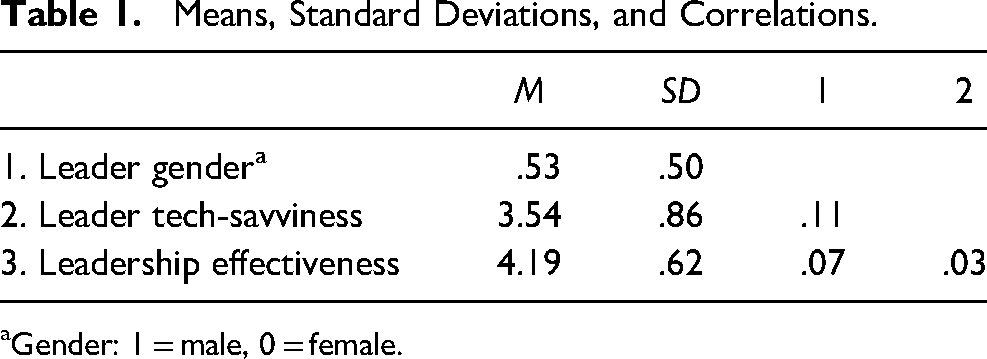
Gender: 1 = male, 0 = female.
Means, Standard Deviations, and Correlations.

Note. N = 286.
Gender: 1 = male, 0 = female. btech-savviness: 1 = tech-savvy, 0 = non tech-savvy.
p < .01, *p < .05.
Means, Standard Deviations, and Correlations.

Note. N = 235.
Gender: 1 = male, 0 = female.
Tech-savviness: 1 = tech-savvy, 0 = non-tech-savvy.
*p < .05. **p < .01.
Footnotes
Declaration of Conflicting Interests
The author(s) declared no potential conflicts of interest with respect to the research, authorship, and/or publication of this article.
Funding
The author(s) disclosed receipt of the following financial support for the research, authorship, and/or publication of this article: This work was supported by the National University of Singapore (NUS) start- up grant, Centre on AI Technology for Humankind, (grant number R-317-000-141-133, AiTH no.: N-311-000-781-001).
