



Abstract
Over the last few decades, the concepts of significance, contextuality and polysemy in museum collections have been repeatedly discussed within the international museum field. In this article, we develop and discuss a methodology for operationalizing these concepts in practical collection work. By collaborating with different communities in assigning meaning to collections, we combine the significance assessment of museum collections with citizen science. Through a number of experiments, we explore collaborations between museums and different communities and find that significance assessment as citizen science adds new perspectives to and creates co-ownership of museum collections and thereby democratizes the museums as public institutions.
Keywords
Introduction
Decisions about museum collections are often based on information about physical conditions, costs and the possibilities of preservation and restauration as well as on the existence of known provenance. As such, collection strategies are often based on quantitative parameters, while other forms of qualitative knowledge are often left out.
Furthermore, the museums routinely add and evaluate significance of their collections both in the process of registration, in assessing the state of preservation and in exhibiting the artifact. It is therefore at least partly museum practices that ascribe significance to the artifacts and establish the meaning of the collections. 1
However, knowledge reflected by the museum is hardly ever exhaustive. Artifacts are polysemic and their significance is both relative and contextual, depending on time, place, environment, and the interactions between the participants. Lack of knowledge about artifacts is not an immediate argument for rejection of artifacts, just as an artifact in a poor state of preservation can be highly significant to preserve. Therefore, the collection practices have been increasingly challenged by museologists in order to develop more inclusive practices involving perspectives beyond those of the museum professionals. 2 This paper investigates how collaborative evaluations of the significance of museum artifacts can be developed and formulated by involving various communities in the process of significance assessment thereby combining the already existing method for assessing the significance of museum collections with the method of citizen science.
The article is based on a project that was undertaken from April 2021 to May 2022 by the Danish Museum of Science and Technology and Museerne Helsingør for the purpose of developing, operationalizing, testing, and discussing a comprehensive methodology for a qualified, qualitative understanding of artifacts in cultural museum collections. Both museums were founded in 1911. Museerne Helsingør is a local museum with a geographically delimited collection, while the Danish Museum of Science and Technology is a specialized, national museum for the history of technology and industrial history and with a predominantly typological collection. The project, which was funded by the Danish Agency for Culture and Palaces, centered on three basic challenges in collection work: First, the museums did not have a clear and practical vocabulary for assessing and formulating the significance of artifacts. Second, the assessment will always be biased since significance is contextual and therefore subjective and negotiable. However, the museums’ collection strategies did not consider the evaluation of the significance of artifacts to be an ongoing process. Third, the curatorial staff does not necessarily possess all of the knowledge necessary to extensively determine the significance of the individual artifacts nor the logic of the collection.
Based on these challenges, we set up seven practical experiments (see Fact box 1) exploring how the process of assessing significance can be framed in terms of the collaboration between different groups or communities outside the museum institutions.
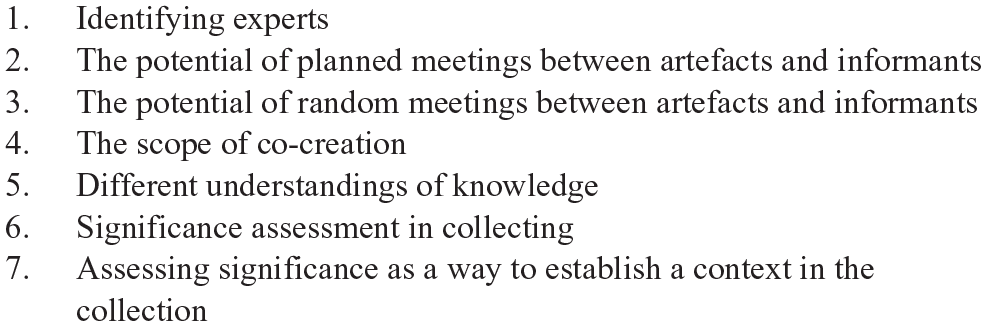
Seven experiments testing different set ups for significance assessment.
In the following, we will first briefly position the project in relation to the relevant fields of research and relate our project it to the existing concept of significance assessment. We will then present a work process for assessing collections consisting of five hermeneutic phases, which will be discussed based on our experiments. Along the way we will reflect on the key terms collection and knowledge as they are related to significance assessment. Finally, we will sum up the insights of the project and touch upon the challenges and potentials of the methodology.
Significance Assessment, Citizen Science, and Museum Artifacts as Boundary Objects
For decades, museum collections and collection practices have been discussed in academia, policy, and the practical museum field. In 2007, claiming that collections were underused, the British Museum Association launched a program for making collections more effective by focusing on organizing the exchange of objects between museums and the process of deaccessioning. 3 Also, the use of efficient storage facilities, cost and collection growth have been debated. 4
In Denmark, a focus on the improvement of storage facilities and museum mergers has prompted on-going collection reviews. Since the 2000s, the Danish Agency for Culture and Palaces has encouraged Danish museums to limit new acquisitions and to discard artifacts that do not fit the collection strategy of the museum; it is recommend that this be done both by subsidizing collection reviews and by participating actively in public debate. 5 These revisions have been guided predominantly by a wish to coordinate collections and by questions about known provenance, condition and representation, while the explicit evaluation of cultural qualities is a relatively new approach to collections—at least in the Danish context.
The first practical method for assessing museum artifacts was developed by a group of Australian museums in a project between 2001 and 2008 that included natural historical, cultural and art museums, both locally and regionally. The methodology was presented in the best practices report, “Significance 2.0,” published by the Collection Council of Australia in 2009. 6 Similar models have been developed, tested, and discussed in projects in England, Finland, Holland, Germany, Wales, and in museums in the US. 7
The Australian model is based on four basic assumptions:
Museums cannot preserve everything. Significance assessment is therefore fundamental in order to create targeted and conscious strategies for preservation.
Significance is not constant but rather contextual and changeable over time.
Significance assessment is an exercise of cultural power in which collective memory is created and preserved. Therefore, the museum should involve potential stakeholders in the process.
It is vital to articulate, respect, and document the context of the collection and the artifact when assessing significance. 8
As a result, Russell and Winkworth define a methodology stating: Significance assessment is the process of researching and understanding significance, and the statement of significance is the summary of how and why an item or collection is significant. Thus, “significance” is defined as the values and meanings artifacts and collections hold in their relation to individuals and to society. 9
In Russell and Winkworth’s model, artifacts or collections are assessed in relation to four main criteria, that is, their historical, scientific, social, and aesthetic significance. These criteria are related to four secondary factors that is, provenance, condition, representativity, and suitability for mediation. In other words, the significance of an artifact cannot be determined by its condition, representativity, mediability, or by a known provenance alone. It must also be related to a wider cultural context.
The significance of each artifact or collection is articulated in a mediating, reasoning, and argumentative text that contextualizes the artifact. Russell and Winkworth explain:
A statement of significance is a reference point for all the policies, actions, and decisions about how the item is managed. It is a means of sharing knowledge about why an item is important, and why it has a place in a public collection.
10
In short, the purpose of the methodology of significance assessment is to understand and describe how and why an artifact or collection is significant—thereby defining and documenting new museum value for the artifact or collection in question. 11
As a methodology, significance assessment reflects the post structural understanding of artifacts, which underlines the contextuality of their significance. Museologist Susan Pearce has been central to this development by combining the semiotic model of Ferdinand Saussure with models for communication developed by Edmund Leach to explain the artifact’s ambiguous potential and thus showing how objects are signifiers that can be interpreted both as signs and symbols. 12 Likewise, during the 1980s, the Brazilian museologist Waldisa Russio developed the idea of the “museum fact” as the relation between man and object and the museum as the place where the museum fact could be perceived. 13
This understanding of the polysemy of artifacts and the importance of context in their interpretation make the attribution of significance into a complex process that is both contextual and culturally conditional. This contextual perspective of significance is also central in the concept of artifact biographies, which was introduced by the American anthropologist Igor Kopytoff in 1986 and later developed by anthropologists Chris Gosden and Yvonne Marshall. 14 They point out that our perception of the significance of an artifact develops over time and depends on how it is included in different contexts. Thus, an artifact has its own biography, which is constantly defined and affected by its life outside as well as inside the museum. In the Dutch work with significance assessment, the development of value for a museum artifact has been explained as a balance between its values related to its use, to preservation, and to the potential development of further knowledge. 15
According to Pearce, to be perceived as valid and meaningful, the attribution of significance must always relate to, and reflect, the established cultural codes within which the museum operates. 16 However, museologists like Waldisa Russio and Hugues de Varine have underlined the role of communities as the holder of knowledge necessary for the meaningful interpretation of the museum objects. 17 Also, in a Norwegian study of heritage values in local communities, Leidulf Mydland and Wera Grahn concluded that the focus of institutions in charge of heritage management does not correspond with the heritage values in local communities. 18
Following this line of thought, the development of significance happens when the codes of the museum are challenged by other perspectives, which in turn can lead the museum to develop its understanding of the significance of the artifact and of itself. An obvious example is the wave of reinterpretations of ethnological collections that have taken place internationally within the last 20 years through collaboration with different heritage communities. 19
Likewise, using the concept of ‘boundary objects’ introduced by Susan Star and James Griesemer in 1989, 20 the Norwegian educational researcher Per Hetland defines the artifacts whose significance the museum and the citizens collaborate on establishing as existing on the border between institution and informants. 21 This collaboration opens up new cognitions and forms of knowledge, which ideally challenge and move both the institutional borders of the museum and the epistemological ground of the participating informants. As such, significance assessment can be seen as a co-creative citizen science process.
Over the last decades, the increasing focus on participation, inclusion and social relevance in the museum field has shifted the understanding of collections from being tools to produce and mediate knowledge and experiences solely for the guests to undertakings that involve the surrounding communities. In 2010, museum director Nina Simon introduced the concept of ‘institutional sharing.’ 22 Simon points out that it is pivotal to the relationship between museum and users that the latter feel that the museum is sharing their collections, and she identifies co-creation as the key to unlocking the collections for the users. She defines two types of user-involving projects: In consultative projects the museum can include the users within a predefined framework of collaboration to obtain new knowledge for the museum, while in co-creative projects the museum collaborates with the users in developing projects that may change the significance of the collections. With this terminology, Simon addresses a broad paradigm related to community and inclusion, which has also been discussed elsewhere, for example in the field of heritage studies, 23 and which also includes projects involving citizen science.
Citizen science (CS) was first defined during the 1990s by social scientist Alan Irwing as the inclusion of citizens in the collection and in the interpretation of scientific material. 24 Predominantly, CS has been used within the natural sciences for collecting and analyzing data. However, in the anthology A History of Participation in Museums and Archives, Norwegian social scientists Per Hetland, Palmyre Pierroux, and Line Esborg point out that involving volunteers in research is not a new phenomenon but can be seen as a general tendency within the academic field, where democratic values such as co-ownership, access, and openness have challenged pre-existing, more exclusively scientific practices. 25 Nevertheless, the method has been discussed and developed within the last 20 years 26 —for instance, in Denmark where the method has been applied within the field of archeology in the DIME project. 27
In this project, we have chosen to adopt the definition of citizen science formulated by the European Citizen Science Association (ECSA) in 2016 outlining up to 10 methodological characteristics for good citizen science across scientific fields, including the recognition of the participants as co-creaters and owners of the knowledge produced, requirements for feedback, scientific control and evaluation, and considerations on copyright. Citizen science was defined as projects which actively involve citizens in research projects generating new knowledge or increased understanding. The citizens can be contributors, collaborators, project managers or otherwise contribute meaningfully to the project.’ 28 Such a definition mirrors the ladder of participation introduced by American author Sherry Arnsteins in 1969, which describes eight steps of participatory access placed in three categories—that is non-participation, tokenism and citizen power. 29 In our project, we constructed seven experiments involving a number of external collaborators in order to discuss how and to what degree to frame the collaboration, asking who should we involve? How do we frame the process so that relevant knowledge is collected and the results become embedded in the museum institution?
The Practice of Significance Assessment
The significance of an artifact can be concretized in two interconnected questions: Should this artifact be preserved in the museum collection? And, if so, what role does the artifact play in preserving cultural heritage? However, these questions are rarely simple to answer. Our project originated in the museums’ general need for reviewing collections and for having a premeditated collecting practice as the basis for making well-qualified decisions about which artifacts to collect and preserve. Using the model for significance assessment proposed by Russell and Winkworth, 30 we constructed a model for the process of significance assessment, which can be depicted as a funnel divided into five phases homing in on the significance of the artifact (Figure 1).
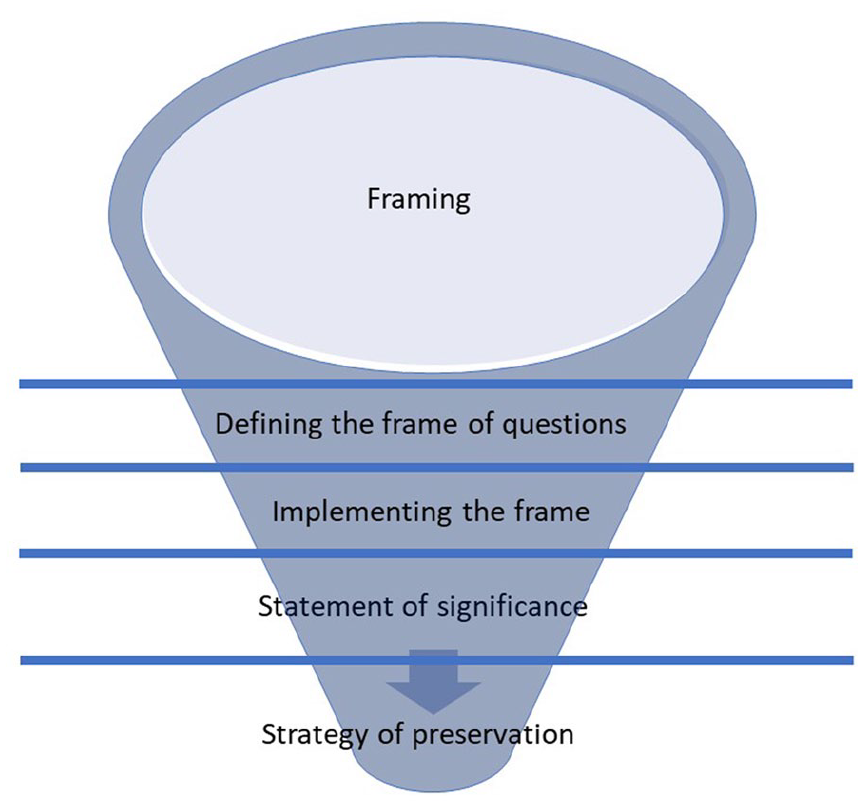
Model for workflow in significance assessment in museum collections.
The five phases are as follows.
Specific artifacts, collections, or topics are selected, and relevant partners are defined. While Russell and Winkworth define the collection of information as the first steps in the process, 31 we found it necessary to start with setting an institutional framework for the process so that significance assessment starts with the museum defining the artifacts or topic to be reviewed based on an overall understanding of the purpose and strategies of the museum. By not including external collaborators in the selection of the topics, we limit the participation to Arnstein’s fifth step of participation, which is termed “placation.” 32 On the other hand, the institution commits to allocating the necessary resources for the project by selecting the topic. However, framing the level of participation in the early phase of the process should be further examined.
A set of questions related to assessing the specific collection or topic is constructed in collaboration with the defined partners. The questions are not exhaustive, as they will reflect the context and perspectives of the group of assessors.
Relevant knowledge is collected.
The collected knowledge is evaluated, and a statement of significance is formulated.
Strategies for the future life of the collection are formulated. To the extent that such strategies involve financial resources or relate to the legal framework of the museum, this part of the process will be done by the museum, although participation from external partners is possible.
The process is hermeneutical so that the collection of knowledge (phase 3) also tests and qualifies the set of questions sometimes necessitating its renegotiation. Framing the process as citizen science by involving collaborators from outside the museum adds new perspectives on the significance of the process by defining new questions and including new knowledge. Also, it democratizes the collections, identifying and substantiating their cultural value. Since artifacts are polysemic, the process is iterative. The assessment can therefore always be repeated with other groups of collaborators, but how do we identify which stakeholders to include? And how do we frame the meetings between collections and collaborators? In the following sections of this article, these questions will be discussed further.
Who Are the Experts?
Collaborating on significance assessment requires the identification of individuals, groups, or communities, who are willing and able to participate in the process. However, identifying collaborators is not easy. In the project, we experimented with applying different criteria for collaboration.
At the Danish Museum of Science and Technology, a collaboration with the regional senior division of the Danish Society for Engineers formed the basis for recruiting collaborators, thus constructing working groups that were based on education and age. Likewise, at Museerne Helsingør, workers from the town’s closed-down shipyard were asked to assess tools from their former workplace, basing participation on education and relationship with a specific workplace.
However, informants with knowledge about historical artifacts can be difficult to identify. In experiment no. 2, Museerne Helsingør tested how to identify relevant informants by presenting several historical artifacts to groups of people who presumably would be able to contribute knowledge about the objects’ function given their occupation and/or gender. Old agricultural tools were presented to contemporary agricultural assistants; women at different ages were shown historical examples of female underwear. Neither of the groups provided new information about the artifacts.
Subsequently, the same artifacts were shown to a number of volunteers working at the museum who had no relationship with the presented artifacts. However, this group was far more capable of providing qualified information—possibly due to a general interest in history. Thus, the competence to contribute to the identification and assessment of the significance of an artifact can be difficult for the museum to identify. More importantly, in choosing collaborators, the museum inevitably influences the assessment. Therefore, setting up the assessment process forms an important part of the biography of the artifacts assessed and needs to be carefully documented to clarify any assumptions in the assessment.
Structured or Random Encounters
Framing the meeting between collection and assessor plays a great part in the assessment process. In experiments no. 2 and 3, we set up two different types of encounters in order to test the potential and effect of the framework. We termed them “structure” and “random encounters,” respectively. In both experiments, the physical collection formed the basis for the process.
The aforementioned collaboration with the Danish Society for Engineers at the Danish Museum for Science and Technology led to a number of relatively homogeneous work groups, working with collections related to their professional field of expertise. Thus, a group of four electrical engineers worked with a collection of radios, while machine engineers worked with industrial machines. In all cases, the idea was to assess the artifacts’ significance in relation to the Danish history of technology. Likewise, Museerne Helsingør paired two generations of shipbuilders with the purpose of assessing a collection of tools from the shipyard in Helsingør. This setup resulted in a fruitful, ongoing discussion of the objects’ significance based on the different experiences of the participants, thus bringing new perspectives to the collections. Not surprisingly, the museums’ conscious construction of communities for assessment processes plays an important role in directing the assessment.
However, recognizing that structured encounters are also somewhat limited by the cultural codes and imagination of the institution, we also wanted to test a different approach. In experiment no. 3, Museerne Helsingør asked a number of professionals outside the museum field, who entered the museum storage space for other purposes than to engage with the collections (i.e. craftsmen, movers, firefighters, cleaners and a real-estate agent) to contribute their knowledge and impressions related to the collection they saw in the storage area. The experiment showed that such random encounters between potential informants and museum artifacts triggered serendipitous responses and added unforeseen perspectives to the collections, predominantly in the form of personal reflections. In other words, by consciously framing the encounter between the artifacts and the chosen collaborators, the museum can gain access to different perspectives, thereby expanding the logic of the collection. On the other hand, by identifying specific collaborators, the museums also risk limiting the assessment to already defined logics. Opening the possibility to participate to a wider public can bring new insights and make it easier for multiple audiences to relate to the collections.
Defining a Set of Questions
In practice, the assessment can be defined as a set of concrete questions, which are thought to be relevant to the artifacts as well as to the purpose of the assessment. In the project, we identified three categories of knowledge as shown in Figure 2.
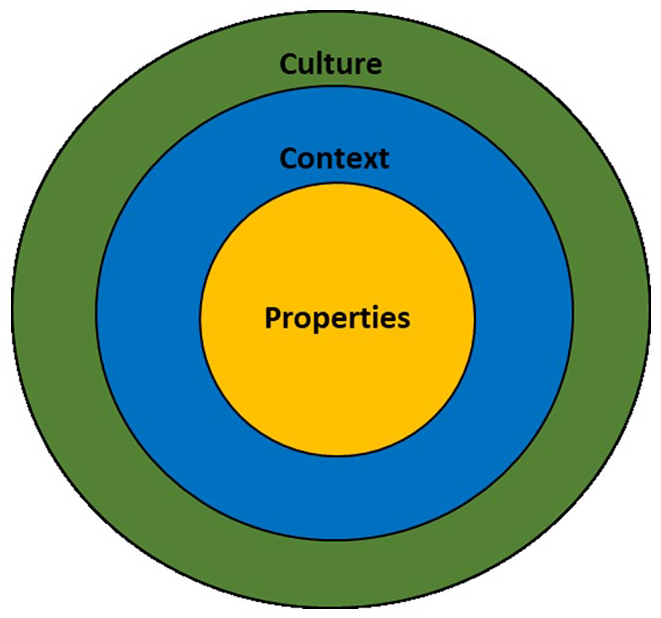
Typology of knowledge related to museum artefacts.
The first form of knowledge, termed properties, relates to the specific features of the artifact such as size, material, technical specifications, producer, and condition. It can also include economic value in the form of expenses related to storage and repair or purchase, insurance, etc. This type of knowledge can typically be recorded in the process of registration or during the physical review of the collection.
The second form of knowledge, context, concerns the relations of the specific artifact such as ownership, dating, history of use, historical events related to the artifact, design, etc. Thus, an ordinary English cannonball in the collection at Museerne Helsingør acquires contextual significance because it is known to have hit the house of the English consul during an English bombing of Helsingør in 1801. Such information is often obtained when the artifact is included in the collection, but it can also be collected through research into the provenance of the artifact or by inviting specific communities who are related to the physical objects to participate in the assessment process.
The third form of knowledge, culture, covers the artifact as cultural phenomena. Accordingly, an airliner at The Danish Museum of Science and Technology obtains significance representing the phenomena of charter tourism and holiday culture by collecting memories of holiday trips even though they are not related to the specific plane. Although an assessment of significance cannot rest solely on a few personal memories without representational and/or contextual arguments, personal accounts can make the artifact both more relational and representational. In other words, the specific plane does not obtain substantial significance just because Mrs. Nielsen has been to Mallorca in 1972 but rather when it is combined with other holiday memories as well as information about the use of the type of aircraft and technical details; in that case, personal stories add to the cultural significance of the artifact. By considering the type of knowledge collected, the assessment process can be broadened, defining different groups of collaborators and relevant questions.
Advisory or Collaborative Significance Assessment
In the project, the collaborators were originally given an advisory role in defining relevant questions and collecting information based on their knowledge about particular artifacts and topics. However, during the practical experiments, the process became increasingly collaborative.
In experiment no. 4, we focused on assessing 710 radios in the collection of The Danish Museum of Science and Technology. Faced with such a large number of artifacts predominantly collected with the purpose of establishing a typological overview of radios, and providing participants with very little knowledge about each object, the aim of the experiment was to find a way to organize a comparative significance assessment, adding technical as well as cultural information.
A group of retired electrical engineers collaborated with the museum on developing a set of generic questions in order to provide a manageable assessment process with a comparable result. The questions included museological questions such as provenance, dating, condition, etc., technical questions such as types of components and frequency ranges, and questions about model, producer, and cultural significance.
Information was then collected by the engineers who were asked to sum it up in a preliminary classification from one to four—one being preservable and four being discardable. The experiment showed that the informants largely took ownership over the process by taking on new roles in collecting and processing the data and renegotiating the set of questions—by, among other things, adding categories related to the functionality to the classifications. The experiment showed that a collaborative approach to the assessment added new perspectives that helped to qualify the process as well as make it manageable.
However, collaborating on defining relevant questions showed that collecting comparable, technical data is only one way to organize the assessment process. In experiment no. 5, a small group of mechanical engineers set out to evaluate industrial machinery at The Danish Museum of Science and Technology. The collection consists of a variety of specialized lathes, cutters, and similar objects with little information about their precise use or provenance.
It proved difficult to define a generic set of comparable questions. Therefore, the group started to clean and repair single machines, although the museum specifically had rejected operationality as a relevant criterion for significance. However, the chosen approach uncovered important knowledge about the condition and defects of the particular artifacts as well as about their function—exemplifying how the collaborative approach expanded the perception of relevant knowledge.
While working with the project, the Danish Museum of Science and Technology was offered a private collection of equipment for measuring sound and vibration produced by a well-known Danish company. The museum did not wish to incorporate the entire collection, but it needed to qualify which of the highly specialized objects would best preserve and represent the history of the company.
Among the participants in the project was a retired employee from the same company that produced the equipment. He gathered information about the function and place in the company’s production line for each object making use of his own network as well as the networks of other former employees and of social media. Thereby the museum got access to information of both a technical and personal nature that would otherwise have been difficult to obtain. The work resulted in recommendations as to which artifacts to include in the collection, constituting experiment no. 6. The recommendation was discussed with the curatorial staff and resulted in an accession of 19 artifacts out of the 70 objects that were offered.
Furthermore, working with another collaborator, the retired employee put together and tested a set of experimental setups using the surplus equipment aimed at mediating the measure of sound, which was later used in the museum’s exhibition. Finally, he also identified a set of research questions related to the company and general industrial history, which the museum can make use of in future research. In other words, the collaborative approach to significance assessment helped to qualify collecting decisions as well as present ideas for new initiatives in mediation and research.
All three experiments showed the potential of a collaborative approach to assessing and assigning significance to museum collections, adding new perspectives and qualifying knowledge. Nevertheless, it was equally clear that such collaboration required considerable time and flexibility from the museum. These are challenges that we will get back to at the end of the article.
Statement of Significance and Strategy of Preservation
According to Russell and Winkworth, the result of each assessment process is a statement of significance that in prose gives an answer as to why the artifact should be preserved and how it relates to the logic of the collection. 33
In the project, we defined a collection as a constructed context, reflecting a—more or less—well-defined institutional logic and different perceptions of museums over time. Ideally, the material has been collected and preserved purposefully in relation to shifting strategies for collecting, different museum paradigms, and different personal interests and understandings. As such, collections can be depicted as puzzles where each artifact is a piece that together forms a picture of the topic and the strategies the museum has developed over time.
However, the logic of a museum collection is not necessarily comprehensive or obvious, and the motive of the puzzle can therefore be hard to make out. Furthermore, the logic can be multidimensional since each artifact can carry several forms of knowledge. Nevertheless, the materiality of artifacts means that the museum is confronted by the different logics on a daily basis when working with the existing collections as well as assessing incoming new acquisitions or including community-perspectives. 34 As such, its material reality allows the museum collection to transcend changing museum paradigms, as is depicted in Figure 3.
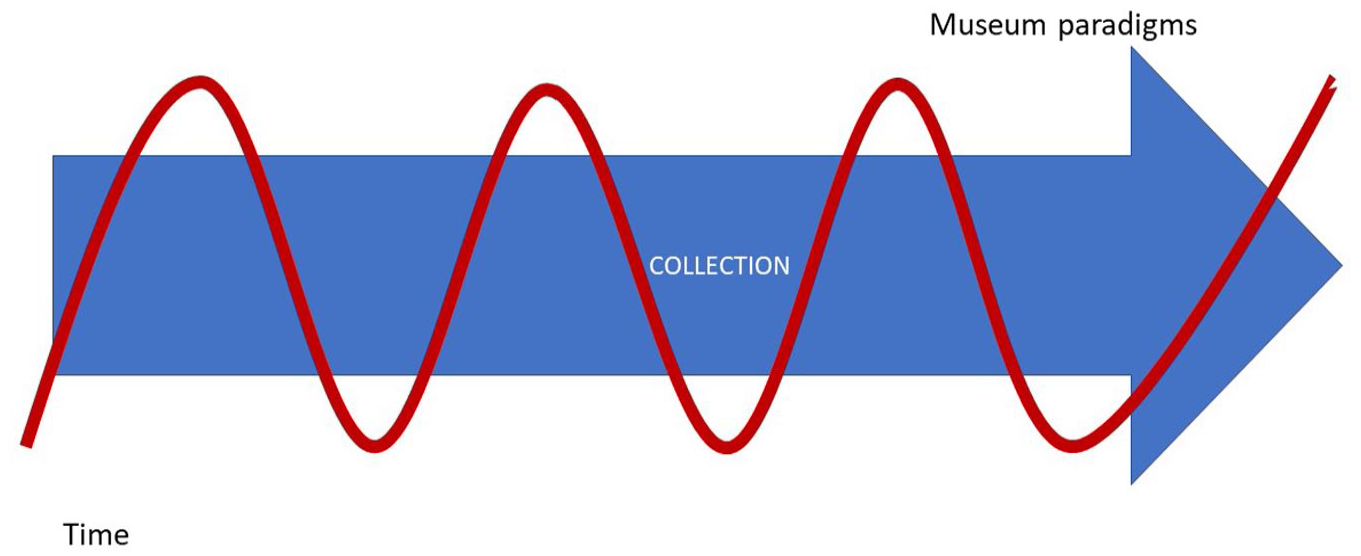
The logic and coherence of museum collections transcends changing museum paradigms.
To assess the significance of an artifact, it is important to consider if and how it fits in with and contributes to the logic or logics of the collection. In this way, significance assessment will always be comparative as well as contributory to the ongoing formulation of the logic.
This became evident in experiment no. 7, where the collection of cars at the Danish Museum of Science and Technology was assessed by a group consisting of five external informants with a long interest in antique cars. The collection consisting of around 75 cars is characterized by having been collected somewhat randomly over a long period of time and as overrepresenting cars from the 1930s. The review took place in three meetings where the group discussed the significance of each car by focusing on both the single object and its context in the collection. The collaborators were asked to rank the cars in three groups—namely, those worthy of preservation, potentially worthy of preservation, and those that were discardable—and to explain their ranking. The distribution of artifacts in the three categories was renegotiated twice, leading to both a recommendation of cars to be discarded and a potential proposal for the logic behind the collection of cars held at the museum.
We found that in writing a statement of significance, it is not possible to make a generic formula for how specific information should be weighted. An artifact with good provenance can be of less value if a similar artifact is already represented in the collection, or a unique artifact can be significant even if its condition is bad. Likewise, it can be desirable to preserve several equal artifacts to underline the object’s prevalence, just as it can be necessary to discard an artifact that can potentially contaminate other parts of the collection or would be too costly to preserve despite its cultural value.
The trade-offs between different arguments can be further complicated by including external informants with specific knowledge and interests in the assessment. During the project, a recurring discussion centered around the operationality of the artifacts. According to the collaborators at the Danish Museum of Science and Technology, testing and restoration of the single devices should be addressed and prioritized. However, such an effort corresponded poorly with the museum’s resources as well as the museum’s considerations for preservation. Such discussions demonstrated how artifacts work as boundary objects, and how citizen science can challenge the museum to reconsider and discuss its strategies and methods. As a result, the Danish Museum of Science and Technology is working on implementing a strategy for deaccessioning artifacts—including a number of cars—while maintaining and operating them as props in order to be able to demonstrate them as working artifacts without compromising their authenticity or state of preservation.
Following the formulation of the statement of significance, the museum devises a strategy of preservation that can be either passive—that is placing it in storage—or active—that is using the artifact in mediation or research or allocating resources for conservation. This strategy forms an important part of the process because the museum thereby actively relates to the artifacts’ potentials, explicitly prioritizing resources. Since preservation efforts are an important part of the financial priorities of the museum, it must ultimately be the museum institution that decides the final strategy for the artifact. Nevertheless, by inviting collaborators to participate in significance assessment of collections, the museum also commits to acknowledging and documenting different arguments.
Also, during the last year the Danish Museum of Science and Technology has collaborated with different communities about artifacts destined for deaccession. While this practice is complicated, it acknowledges that artifacts have value even if they do not fit into the logic of the museum collection.
Conclusion and Perspectives
Museum collections both require and constitute significant public and private resources. Therefore, it is important that the museums explicitly reflect on the potential significance and logic of the collections in order to justify and explain why the collections should be preserved. Also, the defined significance depends on the assessor, which makes it important to document the assessment for future generations. None of this is news. However, engaging with external collaborators can create an ecology of knowledge where the preserved collections function as boundary objects between the museum and the surrounding society. Thereby, the relevance of museum collections is elaborated, and new and unexpected discoveries are made underlining the relevance of museums.
This article has presented and discussed a practical, qualitative tool for holistically assessing significance in the collection of cultural museums that is applicable both in geographically and topically defined museums.
Based on the seven experiments, we have developed four insights about significance assessment as an inclusive process. First, we found that the method works as an iterative tool in reviewing existing collections, in evaluating new material and in uncovering potential logics in the collections. As a result, the method is now being implemented in the planning for the upcoming move of the Danish Museum of Science and Technology.
Second, in defining relevant collaborators and in framing meetings between artifacts and collaborators, the museum significantly affects the assessment process. An open approach to collaboration can contribute to a more participatory process. On the other hand, the degree of collaboration also determines the control of the museum over the process—potentially affecting resources and budgets. At least, all choices must be conscious and well-documented in order to make the assessment transparent.
Third, a collaborative approach to the assessment process develops co-ownership among the participants, which can add new and unforeseen perspectives to the collection. Likewise, we discovered that the collaboration also created social value for the participants by actively making use of their knowledge and including them in new communities. While this effect can be difficult to measure, it merits further research as a way to underline the social potential of museums.
Fourth, we found that the collaborative assessment process works best as an iterative, hermeneutic tool, since it can be difficult to fit the process into tight project related time frames. While it has not yet been possible at the participating museums, it is the goal to reiterate the assessment of some of the collections with different groups at the Danish Museum of Science and Technology in order to test and expand the logic of the collections in the future.
The ideal result of the presented methodology is a dynamic, multidimensional logic, which is constantly developed as a collaboration between the museum and the surrounding society, underlining the relevance of the museum. While museum practice is not there yet, the present project has pointed out a practical way to work. Nevertheless, the experiments also identified several important challenges for the museum institutions applying the method.
First, the method requires significant flexibility since a collaborative approach requires an ongoing alignment of expectations and a negotiation of the mandate between the museum and the collaborators. Furthermore, the museum must be prepared to deviate from the originally planned process, if new, relevant perspectives appear. Consequently, it can be difficult to develop effective predictions about the length of the assessment process, making it difficult to combine with the project-oriented business model of a modern museum.
Second, it can appear to be inefficient and resource-intensive to build up and maintain collaborative relations with informants with many, potentially opposing, interests. However, as already mentioned, the practice can also underline the social value of the museum as well as enhance its public relevance, making museums into places of common cultural heritage.
Third, the notion of artifacts as boundary objects between museum and society challenges the authority of the museum as a knowledge institution by relativizing the museums’ knowledge of their collections. If the museum openly admits that it does not hold the relevant information to assess the significance of its artifacts on its own—then who says that the museum is the most qualified to decide what is preserved and how? In other words, inclusion and collaboration requires the courage of the institution and the curatorial staff to explore and embrace new ways of looking at the collections.
The answer to all three reservations is that even though the method of collaborative significance assessment challenges the museums, it can also be seen as the concretization of a new museum paradigm focusing on establishing museums as legitimate socially and culturally sustainable institutions allowing for new, serendipitous discoveries to be made. As such, the method merits further research focusing on questions such as the role of the museum in society, the importance of preservation and the significance of participation.
Footnotes
Declaration of Conflicting Interests
The author(s) declared no potential conflicts of interest with respect to the research, authorship, and/or publication of this article.
Funding
The author(s) received no financial support for the research, authorship, and/or publication of this article.
2.
See for example Dos Santos (2010) and  .
.
4.
See for example Brusius and Singh (2018), Jones (2017) and .
5.
See for example Danske Museer (2018), Persson (2018), Munk-Petersen (2018) and .
7.
Reed (2018), Häyhä et al. (2019), Versloot (2014), Falkenberg and Jander (2018), CyMAL (2013), Furthermore, a number of projects focusing on defining significance have been undertaken – for example De la Torre (2002), Racine et al. (2009) and .
14.
Kopytoff (1986) and .
19.
The Pitt-Rivers Museum in Oxford has, for example, been reinterpreting their collection of material from Tibet in collaboration with a number of people of Tibetan descent. See websource: University of Oxford (2022) and .
23.
See for example Roued-Cunliffe and Copeland (2017), Smith et al (2010), .
25.
26.
27.
See Dobat et al. (2019) and .
31.
Ibid.