



Abstract
Following the exportation of Japanese media products such as TV dramas, Japanese culture and products have swept across many Asian countries, especially Taiwan. Based on the historical background and unique characteristics of games, this study investigates the cultural effect of Japanese video games on players in Taiwan. This study also presents an analysis of the differences between TV and the video game as cultural vehicles. We used both quantitative and qualitative methods. Results indicate a relationship between game-playing behavior and the identification of Japanese culture. However, the relationship between video game playing and consumption was nonsignificant. This shows the power of video games in nation-building but not in nation-branding, in contrast with TV. This study presents a discussion of the findings to shed light on the cultural effects of video games.
Introduction
In the 1980s, Japanese popular culture was also popular in many Asian countries, especially in Taiwan, Singapore, and South Korea (Leo, 1996). This was also a time when Japan was developing into a prominent global economic power. Combined with well-developed media, Japanese popular culture swept across Asia through mass marketing and the consumption of cultural commodities (Bestor, 1984).
The dissemination of contemporary Japanese culture in Taiwan exploded following the importation of Japanese TV programs in the early 1990s (Lee, 2004b). Taiwan banned Japanese music, movies, and TV programs in 1972 when Japan officially established diplomatic relationships with the People’s Republic of China. This ban was lifted in 1993 once the relationship between these two countries gradually normalized. Furthermore, cable TV was authorized simultaneously, and “a great deal of information about Japanese culture has been conveyed in the form of entertainment through an array of CATV channels in Taiwan” (Su, 1999, p. 61). Young Taiwanese viewers became not only fans of Hello Kitty or Japanese TV idols but also chased after “kawaii” (“Cute” in Japanese)-style street fashion for hair, clothes, and almost everything Japanese. Various businesses exploited the influences of Japan to encourage and gratify consumer desires for Japanese cultural products. This loyalty and obsessive consumption aroused stringent public concern over the stripping away of national pride and identity (Ching, 2000). This phenomenon led to the coining of the term hari, which consists of two Chinese characters—ha as craving and ri as Japan in Mandarin. The Hari tribe adored nothing but products from Japan.
The Japan-mania phenomenon seemed to have subsided gradually by early 2000, when the so-called Korean Wave arose. South Korean TV dramas are currently prevalent in Taiwan. However, these Korean TV dramas imitate the format of Japanese TV products in their intermixing of the market, music, and idol culture (Lee, 2004a).
The current generation of Taiwanese youth does not watch TV as much as the previous generation. Instead, they have turned to computers. According to an investigation, the most commonly used medium by adolescent Taiwanese is the Internet, and the next is TV (The Epoch Times, 2008). Japan is now once again a dominant force, this time in the video game industry, and especially with console games. Most game studies focus on the interactivity and player-dependent text and ignore that video games are also a form of cultural text encoded with ideological positions. Therefore, the contents of Japanese video games also convey Japan’s cultural values and essence. Although the popularity of Japanese dramas has faded in Taiwan, consumer fondness for Japanese media in the form of video games remains. In this case, is the fad for Japanese culture returning, in the same manner or in a different form, to the game generation in Taiwan? Unlike many previous studies, this study investigates the power of video games within a cultural framework instead of the culture in games.
Literature Review
Cultural Imperialism and Globalization Theories
Cultural imperialism is probably best demonstrated by the concept of “cultural hegemony” proposed by Althusser (1971), Gramsci (1971), and Williams (1976). Hegemony is defined as dominant groups imposing a false consciousness and recognition on subordinate groups. Williams (1976) explained that hegemony “is not limited to matters of direct political control but seeks to describe a more general predominance which includes, as one of its key features, a particular way of seeing the world and human nature and relationships” (p. 118). Drawing from such a thesis, Herbert Schiller, a pioneering critic of cultural imperialism, examined the role of American mass communication systems and policies. He criticized the capitalistic U.S. media and their dominance through the global export of TV programs (Schiller, 1969). Schiller’s view, which agrees with other critical views from the Third World, is known as “cultural imperialism.” After more than three decades since the introduction of cultural imperialism, many researchers have adopted this thesis to examine the dominance of the United States and the consequential decline of indigenous cultures. For example, Dorfman and Matterlart (1975) claimed that American cultural products, imbued with a capital ideology, helped normalize and naturalize the social effects of Western capitalism in less developed countries. A study of high school students in the Philippines concluded that American TV programs could influence the students to embrace U.S. value over their own (Tan, Tan, & Tan, 1987). Another study involving Israeli adolescents found that heavy viewers tended to hold a better image of American life, with wealth and a higher standard of living being prominent (Weiman, 1984).
Media imperialism has also stirred restless debates because of its simple assumption of one-way flow of global media (from the West to the rest), especially as the global cultural economy became increasingly complex in the late 1980s. In a study on Brazilian TV programming and transnational reception, Straubhaar (1991) argued that media flows in the global economy are not only one way and that audiences are inclined to choose national or regional TV programs rather than American imports on account of “culture proximity.” Critics further asserted that global cultural flows involved a complex, overlapping, and disjunctive order and incorporated the dynamic movements of ethnic groups, technology, ideology, and other facts (Appadurai, 1996; Lull, 2000; Rogers, 2006). Recent developments in media and cultural globalization theories emphasize the form of cultural hybridization rather than dominance (Lull, 2000; Mosco, 1996). Hybridization demonstrates local resilience and the capacity to assimilate and incorporate foreign culture into domestic life (Thompson, 1995). This theory argues that indigenous cultures have been stimulated and innovated instead of declining.
Many critics of the Japan-mania phenomenon in Taiwan, without the optimistic view of cultural hybridization, asserted that it would be detrimental to national identity because the craving for all things related to Japan actually manifested cultural particularity rather than hybridity.
Japanese Popular Culture in East Asia and Taiwan
Japan has been perceived as an economic superpower worldwide. In many regions of East Asia, Japan has emerged not only as an economic forerunner and industrial giant but also as a cultural power (Otmazgin, 2007). According to the reports by Sugiura (2003a, 2003b), the export value of Japanese culture, including the media, publishing, fashion, and other related entertainments, tripled between 1993 and 2003. This growth rate is astonishing, especially because the total amount of exports increased only by 20% over the same period. During these 11 years, Japan’s export of cultural products totaled JP¥52 trillion. Iwabuchi (2002), a pioneer in studying Japanese media overseas, observed that a few Japanese popular cultural products, such as computer games or some anime, have been successfully marketed worldwide. However, other cultural products, such as music, fashion, media, and idol culture, have a more limited circulation in East Asia. East Asia is significantly affected by Japanese cultural products in the digital era.
Among East Asian countries, Taiwan is probably the most infatuated with Japanese popular culture. In 2001 and 2002, Taiwan was the biggest export recipient of Japanese TV programs in terms of both the number of programs and the number of hours, followed by South Korea, Hong Kong, and Singapore (Hara, 2004). Taiwan and Hong Kong were the largest markets for Japanese music exports (Otmazgin, 2007). Based on data from an Industrial Report (2005), Taiwan also held the largest share of Japanese publication exports in Asia, followed by China, Hong Kong, and South Korea.
When Taiwan’s admiration of contemporary aspects of Japanese society and culture reached a high in the 1990s, critics expressed concern that Taiwanese youths would be drawn away from traditional values, that local social cohesion would suffer, or that self-identity would be undermined. The term Hari connotes irrational admiration for a specific nationality: Japan. Researchers have conducted many studies to explore the Japanese cultural presence in Taiwan and its effects on value, lifestyle, and consuming behavior. To disclose Japan’s superiority, Chiou (2002) analyzed Japanese trendy dramas from the viewpoint of cultural imagination and found that these dramas emphasized not only Japan’s differentiation but also its similarity to other Asian countries. Lee and Ho (2003) expressed concerns about the asymmetrical power relationship between Taiwan and Japan and indicated that constructing the “cultural identity of Taiwan” was an imperative project for the government. Regarding the effects on consumer behavior by Japanese popular culture, Chi (2003) concluded that Hsimenting in Taipei, an important location for youth subculture in Taiwan, had become “Hari City.” Other studies concluded that the preference for Japanese media content, including dramas and cartoons, was positively related to the identity of Japanese culture and the desire to own or consume Japanese goods (Lin, 2001; Su, 1999). Another study produced similar findings for Singaporean youth (Hao & Teh, 2004).
Conversely, some critics attempted to discover the reasons for Japan mania (Tsai, 2002; Wu, 2000). Huang (2011) argued that hari syndrome was the result of dynamic interfunctions between cultural industries and consumerism. It started with nation-building through media texts, such as trendy dramas, to signify Japanese idols and present beautiful national images of Japan. This subsequently led to nation-branding through marketing strategies in which local businesses cooperated with Japanese enterprises to encourage and promote Japanese products, such as the alliance between Taiwan travel agencies and Japanese TV stations. These companies arranged “Japanese TV drama tours” to studios and shooting locations. According to the Japan National Tourist Organization, 3.8 million foreign tourists visited Japan in 2004, of who 0.96 million were Taiwanese (Japan National Tourism Organization [JNTO], 2004). The Japanese TV drama tours, which embodied components of sign value in material objects, illustrated a successful process of nation-branding, which not only polished the national image of Japan but also increased the value of the country’s products. To cater to the hari tribe, Taiwanese businesses mimicked Japanese styles in marketing their own products.
In addition to the hari phenomenon, however, the high standard of Japanese TV dramas stimulated Taiwanese TV stations to produce better programs. Inspired by the aesthetics and media formats of Japanese dramas, Taiwan’s Chinese Television System released the first locally produced idol drama, titled Meteor Garden, in 2001. Meteor Garden was not only popular in Taiwan but also became a huge hit in Southeast Asian countries such as the Philippines, Indonesia, Thailand, and Malaysia. The popularity of Meteor Garden gave Taiwanese producers the confidence and financial resources to create more TV series, films, and pop idols. For a time, Taiwan became the leader in the world of Mandarin pop culture (Yang, 2010).
Japan and Video Games
A video game involves interaction with a user interface to generate visual feedback on a video device, such as computers, game consoles, and handheld devices (Video Game, n.d.). The technical efforts of a group of TV engineers led by Ralph Baer successfully converted TV sets into monitors for early gaming consoles.
The 1970s were marked by the birth and boom of video games as an industry in the United States when the American company, Atari, released the 2600 Video Computer System, which was designed as a multiple cartridge-based game console. In the 1980s, Atari controlled two thirds of the gaming industry in North America and had extensive influence in Europe (Lowood, 2006). The U.S. gaming industry experienced a sharp decline in the late 1980s. However, game consumption was restored a few years later when the Japanese company Nintendo established its console gaming market in North America. This event marked the beginning of Japan’s dominance in the U.S. gaming market for the following decades. Japanese games also became widespread internationally when video game marketing started to expand globally in the 1990s (Kohler, 2005).
Nintendo and Sony have traditionally dominated the console market. Although Microsoft has devoted hundreds of millions of dollars to developing the Xbox, the U.S. company has still been unable to assume the leading role in the gaming console industry. For example, the dominating game console in the late 1980s was the Nintendo Entertainment System, and Sony PlayStation became the most popular gaming system from 1990 to early 2000. Since 2006, the Nintendo Wii has been intensively competing with Microsoft Xbox 360 as the top-selling console (History of video game consoles (third generation), n.d.; Poh, n.d.).
The “Japan-rest” paradigm has replaced the “West-rest” as the dominant model of cultural flow or dominance (Consalvo, 2006). To compete with opponents in the Asian market, Microsoft has invited Japanese-based video game publishers such as Square Enix and Koei to design games (Console Game, n.d.).
Based on Japanese attitudes toward technology and culture and learning of support from the government, Japan became a superculture exporter. Prior to World War II, the Japanese perceived technology as the other, as something set apart from culture. In this view, the two were distinct, or even antithetical. This belief shifted during and after the war. The Japanese became aware that technology sprang from culture, and specifically, technological excellence, as a representation of cultural exceptionalism (Najita, 1989). The popularity of Japanese cultural industries in foreign markets enlightened Japan’s government to the fact that culture could be both a profitable export item and a way to boost Japan’s image overseas. With such an understanding, the first concrete action taken by the government was to explore the possibility of exporting TV programs to Asian countries. In 1991, the Japan Media Communication Center was established to be in charge of subsidizing the export of TV programs to developing countries. Culture-related industries soon occupied a large segment of Japan’s economy, and the Japanese government continued to examine ways to promote the country’s cultural exports, to generate economic benefits and nurture international admiration of the country. The Japanese government is still working to stimulate growth in cultural industries by providing adequate support and offering complimentary incentives in the new digital age (Otmazgin, 2007).
The Study of Video Games
Although video games have been a form of home entertainment for over 30 years, only in the last decade have they become a subject of serious research (Esposito, 2005). Previous studies often focused on violence and the media effects theory. Much of the research effort in recent years has moved beyond this perspective to understand the complex interactions between game players and their use of video games (Gosling & Crawford, 2011). However, with the rapid changing of games and technologies and a broad range of theoretical and methodological approaches from diverse disciplines, “video game scholarship is still in its formative stages” (Corliss, 2011, p. 4). Many studies use the terms narratology and ludology to reduce the scope of the game studies and contrast current perspectives in the literature (Corliss, 2011; Voorhees, 2009). Drawing from literary and/or media studies, narratology emphasizes the textual qualities of video games. Thus, a narratological approach to game studies not only analyzes games as text (Jenkins, 2004) but also based on the underlying ideologies, discourses, patterns of reception, and interpretation (Crawford & Gosling, 2009). Conversely, a growing number of researchers oppose the use of literary and media theory, and particularly narrative, in describing video games. From the perspective of ludology, video games should be treated on their own terms and not only as another form of storytelling. Given their interactive nature and simulation base, video games offer gamers a distinct and compelling experience that is unlike those of textual media (Aarseth, 2001; Frasca, 2000; Juul, 2001). In this regard, ludologists believe that the trend of a narratological approach limits the development of an adequate theoretical approach to game studies. Although the debate remains largely unsettled, Poster’s (2007) article seems to unify the perspectives of ludology and narratology. Poster claimed that the visual style and narrative agendas of games are derivatives of film and that they evoke embodied feelings through the combination of cinematic style and the increased interactivity of video games. Poster argued, “Game embodiment encourages a particular form of user agency that is endemic to digital media, but which only occurs by way of cinematic devices” (p. 325).
Beyond the debate between ludology and narratology, Corliss (2011) further claimed, “All games can be analyzed as sociocultural phenomena” (p. 6). Based on the recruitment efforts of the U.S. army through games, Corliss emphasized the need to “investigate the ways in which the distinct forms of interactivity genre might enable new forms of domination and hegemony,” and acknowledged that “the elements of gameplay may extend beyond the realm of the game, connecting with broader technocultural subjectivities” (p. 8).
Although researchers have developed video games through the lens of culture, Shaw (2010) critically examined various studies in this regard and found that many researchers regard the gaming culture as something distinct or separate from a constructed mainstream culture because of the tendency to focus on the entertainment medium niche. This concept has limited the field of study by taking for granted who plays, what to play, and how to play. Shaw argued that video game studies should be “critical” and “reflexive,” not “reactive” or “descriptive.” King and Krzywinska (2006) noted that, although game playing was a minor form of subculture in some way, “ … it has also established a place in the much wider landscape of popular culture and entertainment in the recent decades” (p. 222).
In responding to these perspectives, this study describes the new medium as a product of cultural contexts and analyzes the power of video games within a larger cultural context based on culture theories. Video games, with their unique characteristics of interactivity and embodiment, are unlike other narrative media. Because of the historical background of Japan’s cultural influences on Taiwan, this study also contributes to the understanding of the major differences between video games and TV dramas.
Method
This study uses both qualitative and quantitative approaches, the so-called mixed methods to gain insight into the cultural effects of video games (Tashakkori & Teddlie, 1998). Many studies have examined these two research approaches (Babbie, 2004; Berg, 2006; Denzin & Lincoln, 2005; Hayes, 2005). Quantitative research measures or examines the relationships between and among variables, and is more interested in generalizing across context, whereas qualitative research is more interpretive.
Qualitative and quantitative approaches are based on different sets of assumptions and epistemological frameworks. Because each method has strengths and weaknesses, the use of one methodology may lead to conclusions constrained by the other. Therefore, “ … quantitative and qualitative research methods may be best seen as complementing one another … Results that point in the same direction and obtained across the quantitative–qualitative divide offer greater merit because those findings were obtained regardless of the assumptions of a particular method” (Benoit & Holbert, 2008, p. 622). Because the effect of video games within a large cultural context remains a relatively unexplored realm, this study employs mixed methods—a combination of quantitative and qualitative approaches—to gain a whole and complete perspective of this issue.
Quantitative Method and Results
Research Hypotheses
A literature review shows that exposure to foreign media or cultural products is likely to affect people’s perceptions and consuming behavior in favor of the exporting countries. Thus, this study presents the following two hypotheses:
Participants and Procedure
According to data from the Nielson Media Index, most game players in Taiwan are aged from 15 to 34 years (Onmedia, 2009). Because this group is young and often surfs the Internet, an online survey was used to collect data. As mentioned, Japan is particularly dominant in the game console industry. The valid group of subjects in this study includes console gamers. To reach the targeted subjects, an online questionnaire was posted on the console game discussion board of Taiwan’s most popular gaming websites, Bahamut and Gamebase. According to a recent report, Bahamut is the most popular website in the category of gaming websites and reaches almost 90% of the gaming population in Taiwan (Digital Age, 2007). Over 4 weeks, 622 people answered the questionnaire. Four copies were incomplete, leaving 618 valid copies.
Measurement
The questionnaire in this study was developed based on previous studies, which used the deep interviewing methodology to analyze the effects of Japanese TV dramas on young people’s identification with Japanese culture and consuming preferences for Japanese products (Lii & Chen, 1998; Lin, 2001). The questionnaire contained three sections: (a) demographics, (b) identification with Japan and its culture, and (c) consuming preference for Japanese products. The questions in the second and third sections were formatted on a 5-point Likert-type scale ranging from 1 (strongly disagree) to 5 (strongly agree). At the end of the questionnaire, respondents were asked about their willingness to participate in an interview in the future. If yes, a contact e-mail was requested.
The questionnaire was pretested with 110 students from Asia University, Taiwan, to confirm its reliability and validity. The first section included demographic questions of gender, age, education level, most used console type, and playing pattern. The most used console type included five options: PlayStation (by Sony), Xbox (by Microsoft), Nintendo DS, Wii (by Nintendo), and “others.” Playing pattern required subjects to identify their gaming behavior as a heavy user (more than 3 hr/day on average), mild user (1–3 hr/day on average), and light user (less than 1 hr/day on average).
The second section included questions regarding identification with Japanese culture. Table 1 shows that two factors, “attitude” and “practice,” were extracted with relatively high Cronbach’s α coefficients. The “attitude” factor consisted of questions about the national image of Japan, whereas the “practice” factor included questions regarding the desire to learn more about the country and its culture.
Factor Analysis—Identification Toward Japanese Culture.

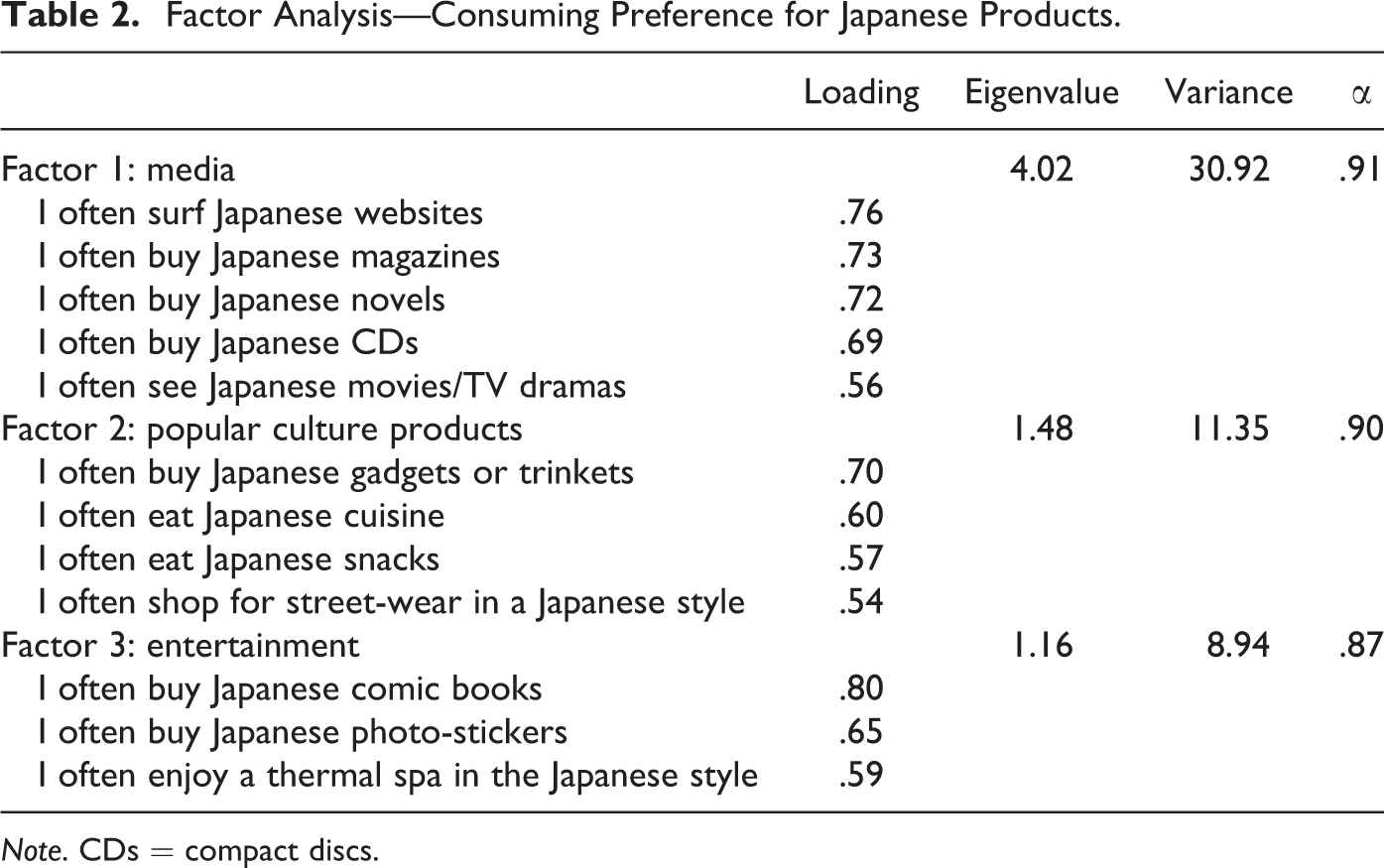
The third section consisted of questions about the consumption of Japanese cultural products, with questions being extracted by factor analysis. Principle component analysis and varimax rotation were used to find variable groups, and the retention of factors was specified for an Eigenvalue greater than 1.0. Three factors, “media,” “popular culture products,” and “entertainment,” were extracted with relatively high Cronbach’s α coefficients (Table 2). The “media” factor consisted of questions regarding the consumption of Japanese media other than video games. The factor “popular culture products” had questions about consuming Japanese-style fashion, food, or pop culture. Finally, the “entertainment” factor included questions about recreational activities related to Japan.
Factor Analysis—Consuming Preference for Japanese Products.
Note. CDs = compact discs.
Results
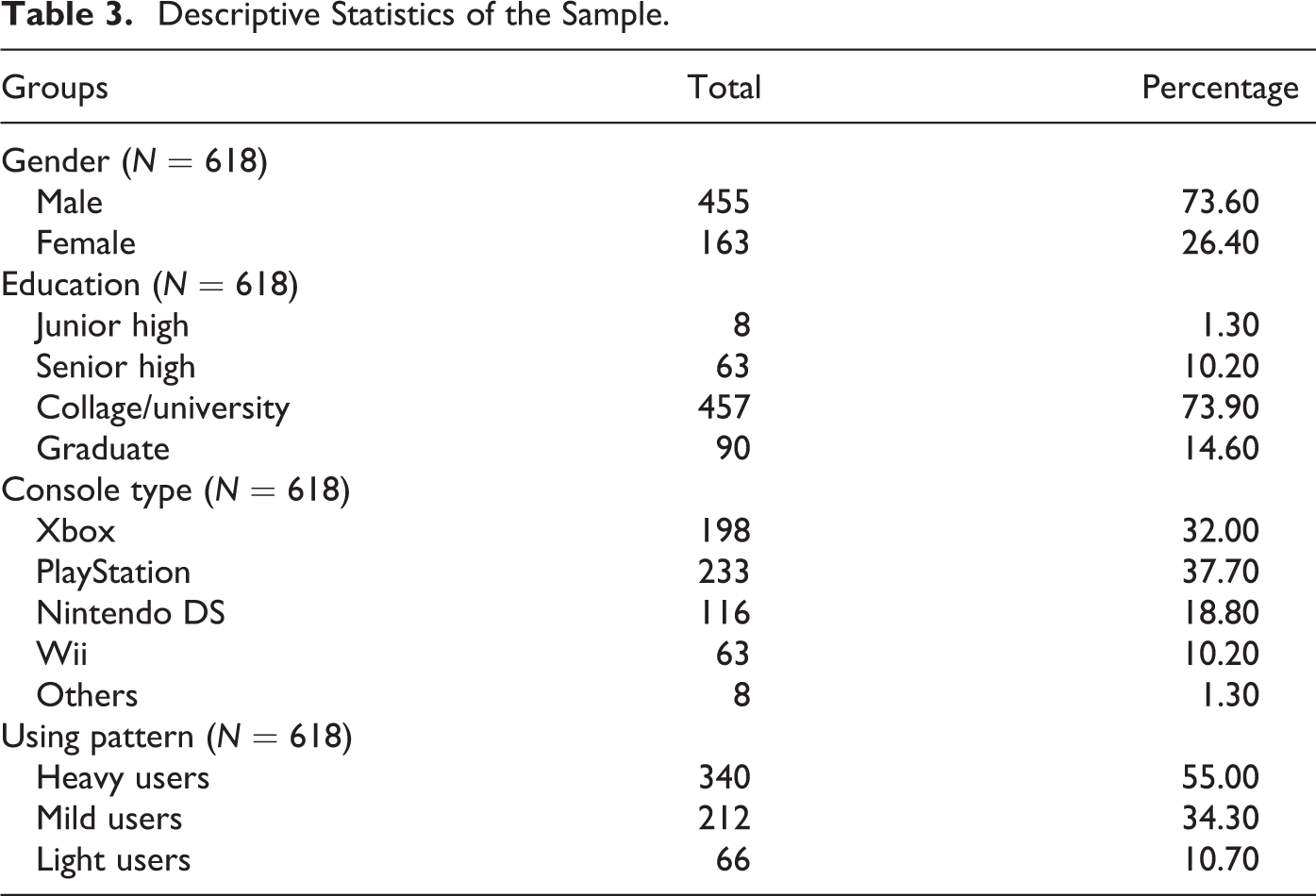
Data were analyzed using the SPSS 15.0 statistical program. Descriptive statistics were first analyzed to show the general background and console gaming habits of the sample (Table 3), which included more male (73.6%) than female (26.4%) gamers. The respondents averaged 22.3 years in age, with almost 90% being college level or above, and approximately 10% still in high school. The most popular console type among respondents was PlayStation (37.7%), followed by Xbox (32.0%), Nintendo DS (18.8%), and Wii (10.2%). For playing pattern, more than half of the respondents identified themselves as heavy users, with 34.3% as mild users, and 10.7% as light users. H1: Heavy console gamers identify with Japanese culture more positively than light users.
Descriptive Statistics of the Sample.
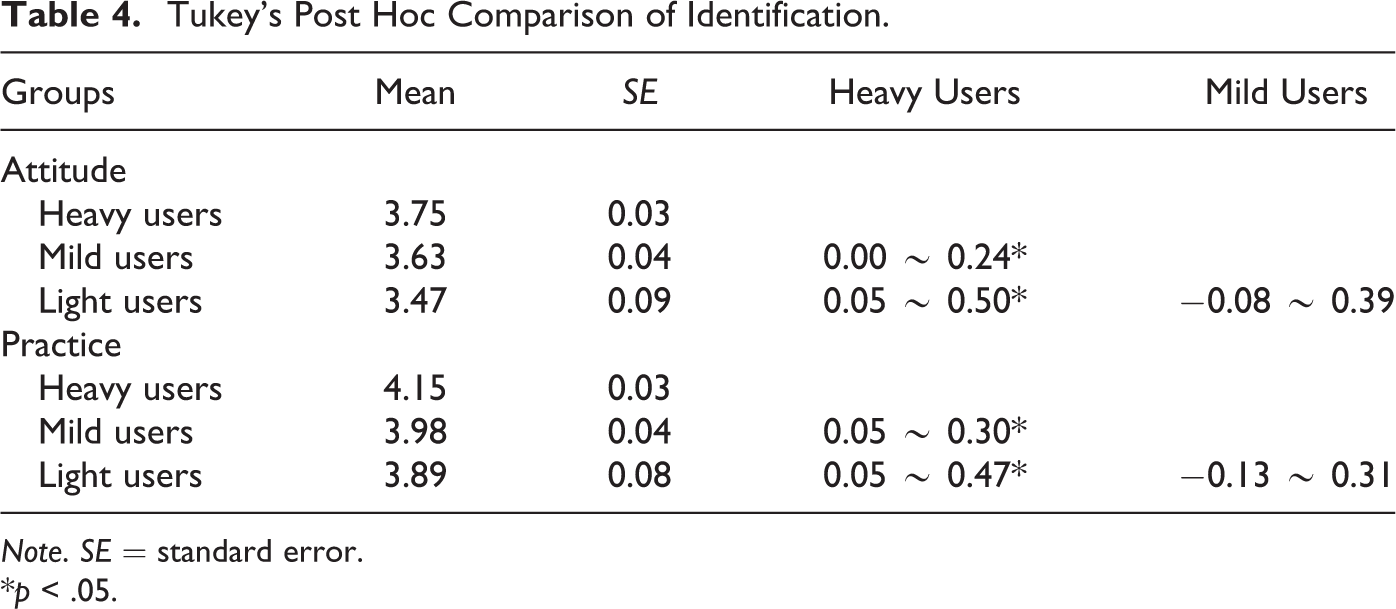
This study includes one-way analysis of variance (ANOVA) to evaluate the relationship between playing pattern and identification with Japan. Playing pattern had significant main effects on both factors of identification, attitude: F(2, 615) = 3.73, p = .03 and practice: F(2, 615) = 8.30, p = .00. Heavy console gamers had a more favorable attitude toward Japanese culture and a stronger desire to relate to Japan than mild or light users (Table 4). These data support Hypothesis 1 and demonstrate that console gaming behavior has a positive effect on the player’s identification with Japan. H2: Heavy console gamers are more likely to favor consuming Japanese products than light users.
Tukey’s Post Hoc Comparison of Identification.
Note. SE = standard error.
*p < .05.
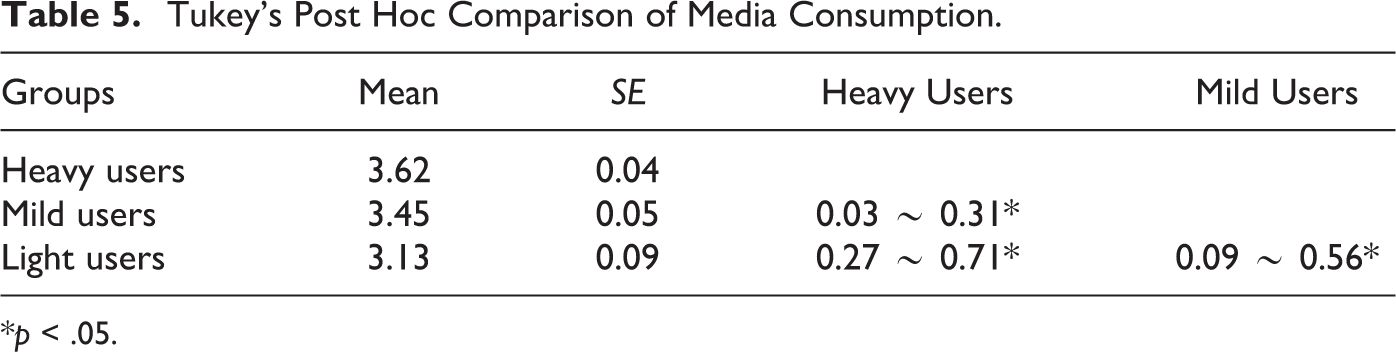
Hypothesis 2 predicts that heavy users have greater intentions to consume Japanese products than light users. ANOVA results show that the main effect of playing behavior on consumption was significant only for the “media” consumption factor, F(2, 615) = 15.98, p = .00. Heavy console gamers were more favorable toward consuming Japanese media than mild and light users (Table 5). However, the main effect of playing behavior was not significant for the other two factors “popular culture products” and “entertainment.” Thus, Hypothesis 2 was not fully supported.
Tukey’s Post Hoc Comparison of Media Consumption.
*p < .05.
Qualitative Method and Results
This study includes a series of qualitative in-depth interviews to gain explorative insights.
Participants
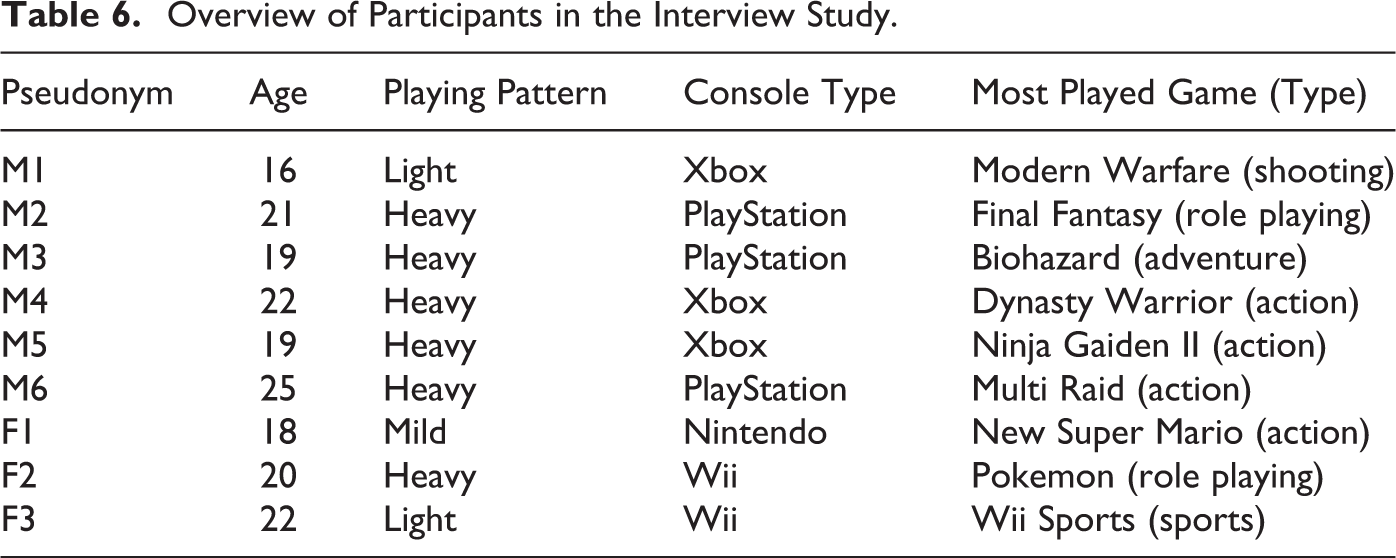
Participants were recruited from a pool of survey respondents who agreed to be interviewed, and 13 people were interviewed. After being invited by e-mail, six male respondents confirmed their willingness to be interviewed. To gain more insights into diverse perspectives, we hoped interviewees would vary in several dimensions. Therefore, three female subjects were recruited through snowball sampling. Table 6 shows the general backgrounds of nine participants, where “M” and “F” refer to the male or female gender. Except for M6 and F3, who were working, all interviewees were college students. The interviews were designed to identify the most played game and type, which were too various to be analyzed in the survey questionnaire.
Overview of Participants in the Interview Study.
Interview Arrangement and Questions
Five face-to-face interviews were conducted. Because of participants’ different schedules, the interviews proceeded with by individual or in groups (two or three persons). All interviews lasted 30–100 min, and included an informal preinterview conversation on demographic background and game preference. Interviews were conducted in the researcher’s office and the conversations were recorded (audio only) with the consent of participants.
The interview questions were semistructured. Depending on the context and the subject’s answers, follow-up questions were tailored to each individual to promote an open dialogue-like atmosphere. The questions were formulated in a way that demanded the interviewees to thoroughly examine the connection between their gaming experiences and their perception or admiration of Japanese culture. Participants were encouraged to talk as much as they liked about the relevant issues. The interviews included questions such as the following: In your own words, please describe your perceptions of Japan. Why do you have this preference? What impresses you the most when thinking of Japan or Japanese culture? Why? Do you like to use Japanese products? What type? Why? What is your impression about the hari tribe? Would you categorize yourself as a member of the hari tribe? Why? Does anything in your gaming experience have a connection with Japan? Do you think there is anything in your gaming experience that influences your perception of Japan or Japanese culture?
Results
Each interview was transcribed, and the transcripts were coded using the grounded theory approach (Strauss & Corbin, 1998). This coding procedure was used to compare all interviews for similarities and differences to locate and determine the cultural effects of video games. Key words were also used to track statements that could provide information about the influences involved.
The following paragraphs present some major themes related to the purpose of the study:
Perceptions of Japan and Japanese Products
Most participants indicated that Japanese were smart and that Japan was a country with a strong reputation for innovation in electronic production. “Made in Japan” was equal to an assurance of quality. I think Japanese are not only smart in hardware exploitation, but also creative in software design and development. I have used Playstation for many years. Mine is a PS2, and I am thinking of buying a PS3. I never thought of buying an Xbox instead, although Xbox is cheaper. I believe in Japan. (M3)
The Japanese are awesome. They have created so many entertaining characters, such as Hello Kitty, Ninja, Mario, and so on. I have always dreamed of taking a trip to Japan, especially visiting Sanrio Puroland in Tokyo. I am also thinking of learning Japanese so that I can take a backpack trip to Japan. (F1)
Connection Between Gaming Experiences and the Identification With Japan
Experience with console games seems to be an important cause for participants’ favorable impressions of Japan. Some mentioned their admiration for game consoles such as PlayStation and the Wii. One participant (M4) who used an Xbox spoke highly of Japanese game developers such as Koei and Square Enix. I watched the cartoon Pokemon when I was little. A year ago, I happened to play Pokemon on the Wii and I was addicted to it. The experience is incredible. I can foster my favourite species, like Butterfree and Slowbro, and train them to fight with other players. In other words, I can personally experience a situation that only existed on TV before. I do not play any video or online games except for the Wii. The Wii is super high quality and easy to use. I used to think the Japanese were good at producing cartoons. After playing the Wii, I further believe they are geniuses in creativity. (F2)
I grew up in the company of console games. You know, I have no problem reading some Japanese, although I never truly learned the language. This is because I often play games in Japanese because I cannot wait for a Chinese version to become available on the market. Little by little, Japanese has become as familiar as Chinese to me. (M5)
I am especially fond of games produced by Koei and Square Enix, including Final Fantasy, Dynasty Warriors, and Nobunaga’s Ambition. The narrative, aesthetics, and characters of these games are so delicate and sophisticated. I think no other game developer can beat the production teams of these two companies. After playing many games from various companies, I think Koei and Square Enix are the best. The Japanese are really sharp. (M4)
Regarding game influences on the preference for consuming Japanese products, a few participants indicated that they started watching Japanese historical TV dramas because their curiosity was aroused by playing historical games. This phenomenon corresponds with other findings about media consumption in statistical data. Some participants suggested no influence at all because they called themselves geeks who mainly stayed at home and rarely went shopping or socialized. Besides games, there is only one other thing in my life related to Japan, and that is TV drama, especially historical Japanese TV drama. My favourite game is Final Fantasy, which is set against the backdrop of Chinese history. Somehow, I feel the Japanese are good at adapting history for media content. As a result, I started watching some Japanese historical TV dramas. They’re pretty good. I like them, even though I don’t watch TV much. (M2)
I am a so-called geek. I don’t like to go out shopping or socializing, and don’t really consume any Japanese products. I believe Japan offers high-quality production. However, I don’t really have any strong feelings about using Japanese products, except games. (M5)
Different From the Hari Tribe
Most participants implied a distinction between themselves and the hari tribe. They thought the hari tribe included those who were strongly influenced by Japanese TV dramas and had a fetish for Japanese items. They, conversely, were “reasonable” admirers. I am definitely not a member of the hari tribe. My sister is one of them, so I know how much they favour Japan. I think I am more rational. Although I have a positive perception of Japan and their products from my experience playing games, I rarely use anything from Japan, except games. (M3) I admire Japan and their products. This is not like being crazy for them, like the hari tribe. I probably pay more attention to stuff from Japan, but I am still a reasonable consumer. (F1) I think there are some differences. The hari tribe blindly runs after Japanese styles. I am a calm admirer or observer. I would never become part of the hari tribe. (F3)
Conclusion
This study presents a summary of how young people in Taiwan are influenced by, and attracted to, Japanese popular culture after exposure to their media content, especially popular TV dramas in the early 1990s. The marketing strategy mentioned in the literature review, using the components of dramas, contributes significantly to the popularity of Japanese culture. Digital technology has ushered in a new era in which video games have become a popular form of entertainment, and Japan is still dominant in the game console industry. The interactivity and engagement involved in gaming likely have a stronger effect than other media on user perceptions and emotions (Egenfeldt-Nielson, Smith, & Tosca, 2008). This study explores the cultural power of video games and compares the results with TV dramas.
The quantitative data in this study show that heavy console gamers identified with Japan more positively than light users. This result corresponds with similar results for Japanese TV dramas (i.e., heavy viewers had a more favorable attitude toward Japan and its culture). Conversely, the data show limited support for the effects of gaming on the consumption of Japanese products. Heavy users were more in favor of consuming media products from Japan than mild and light users, but no significant difference existed in other types of consumption, such as that of popular culture products and entertainment. This finding differs from those of previous studies, which showed a strong relationship between viewing Japanese dramas and the desire to own or consume various Japanese products (Hao & Teh, 2004; Lin, 2001; Su, 1999). Interviews with gamers indicated that they spend a considerable amount of time at home playing games, rather than going out for social purposes. This may be a reason for these results.
This study includes qualitative in-depth interviews to gain greater and more in-depth perspectives regarding the issue. An analysis of interview transcripts is in agreement with the statistical results that console gamers positively identify with Japan. Participants used “smart,” “creative,” or “imaginative” to describe the Japanese and also mentioned their intentions to visit Japan or learn the language. One subject mentioned that her good childhood memories of watching Japanese cartoons on TV motivated her to play a game with the same cartoon characters. The amazing experience she had playing or interacting with the familiar characters in the game, which were impossible through TV, boosted her image of Japan as a nation of superior creativity. This example indicates that some people who play Japanese games might have a good initial impression of Japan, but their experience with gaming and watching TV increases their identification with Japan. Regarding the consuming behavior of Japanese products, the relationship only exists between gaming experience and media consumption. One interviewee, unlike the example mentioned, started watching Japanese historical TV dramas after his pleasant experience playing the same type of games.
The limited influence on consumption by games, compared to TV, might result from different media experiences. Based on a literature review, gaming is likely an engaged and embodied activity, unlike the use of other narrative media such as TV or film. In the article “As We Become Machines: Corporealized Pleasures in Video Games,” Lahti (2003) claimed that gaming overturned conventional divisions between the body and machine by creating the opportunity to extend the body into a virtual space. Therefore, what we admire on TV is something in the machine. The way for us to enjoy these things personally is to own or duplicate them in real life. The positive perceptions from TV, in addition to the influences of the marketing mechanism, can easily arouse viewers’ desire to consume. In contrast, what we enjoy in a game can be experienced only in the context of gaming. The enjoyment and concentration that exists in the gaming environment approaches the borders of reality, but never quite crosses over into real life. Therefore, players lack the stimulation required to consume products outside the world of the game.
The scope of this study is based on the assertion that video games should be studied culturally rather than as a culture (Shaw, 2010) or should be related with other media practices in consumption or social organization (Roig, San Cornelio, Ardevol, Alsina, & Pages, 2009). This study contributes to the discourse on video games with a broader cultural perspective. Based on these findings, the answer to the title question “Is the video game a cultural vehicle?” is that video games are as powerful in nation-building as TV, but not as obvious in nation-branding.
Footnotes
Acknowledgement
The author is indebted to the anonymous reviewers for offering insightful suggestions that greatly improve this article.
Declaration of Conflicting Interests
The author(s) declared no potential conflicts of interest with respect to the research, authorship, and/or publication of this article.
Funding
The author(s) received no financial support for the research, authorship, and/or publication of this article.