



Abstract
In this article, we develop the concept of “transplatform” to contribute to platform studies. We analyze the rivalry between the Atari Video Computer System (VCS)—the best-known member of the “second generation” of home videogame consoles—and Intellivision, which was the Atari VCS’s key competitor for most of this period. Through this analysis, we hope to provide conceptual tools for rethinking the notions of platform, culture, and context in platform studies. In particular, we seek to link the two main ways platforms are currently understood—“computing platforms” like the Atari VCS or Flash and “social platforms” like FaceBook or YouTube. Online sociality is increasingly “platform sociality” in some form. Understanding platforms not just in “context,” but as shaped by rivalries not ontologically subsequent to the platforms themselves, is vital to responding to these emerging formations.
It is 1981 and you sit on the carpet of your family’s living room. Your eyes of twelve take in the device, black and fake wood paneled. The TV that anchors the room hisses with static as you flip the power switch on your new Intellivision: Suddenly, before you is the title screen of Space Battle. A tap on a controller and you pilot ships through a starred expanse, shooting alien vessels. It is like an arcade game but there is no quarter to pay, no limit to how long you can play. Three more cartridges stacked nearby promise other worlds to discover.
This vignette, drawn from our memories, recalls how home video game consoles shaped the relationship between games and culture. In this article, we draw from a larger project on Intellivision to explore how that console, sitting in a living room in 1981, existed as part of a rivalry with the Atari Video Computer System (or “VCS,” also known as the “Atari 2600” and referred to as “the Atari VCS” in this article). Taking that rivalry as the subject of study provides insights into that period, with implications for the present.
Intellivision sold millions of units and was pivotal to what is often known as the “second generation” of home video game consoles, following an earlier generation like Pong and the Magnavox Odyssey series that usually lacked removable cartridges. This second generation’s dominance ended with the 1983 crash of the video game market. However, the commercial success and cultural impact of these consoles means that paradigms, practices, and social logics set into motion during this period have had enduring effects.
As a rule of thumb, we find unconvincing the trope of asserting that one’s scholarship is important because the topic is understudied. Claims of ostensible “gaps in the literature” leave one open to the charge of being poorly read, conflating relevance with the mere filling in of conceptual holes. However, it is truly shocking to observe the degree to which Intellivision has been erased from the history of home video game consoles. Some examples: In the edited volume Before the crash: Early video game history (Wolf, 2012), Intellivision appears only twice, compared to 22 often multipage citations to the Atari VCS. In Sheila Murphy’s monograph How television invented new media (2011), the chapter “This is intelligent television” briefly mentions Intellivision only twice after the opening paragraph, while Atari systems appear over 30 times. Nathan Altice’s study of the Nintendo Entertainment System (2015) mentions Intellivision only 4 times, compared to 18 often multipage citations to the Atari VCS. Even Nick Montfort and Ian Bogost’s study of the Atari VCS (2009) mentions Intellivision only 3 times, in passing. We compare citations for Intellivision and the Atari VCS because the consoles were intertwined at an ontological level, and this can provide insights into the constitution of platforms as culture. The Intellivision/Atari VCS rivalry is thus an important—possibly the original—example of a paradigm significant to digital technology ever since (e.g., Nintendo/Sega, Mac/PC, iOS/Android).
In this article, we develop the concept of “transplatform” to analyze the Intellivision/Atari VCS rivalry and its theoretical implications. We focus on theories of culture prevalent not just in platform studies, but game studies more broadly—where “culture” is central (as the title of this journal indicates) but its definition is often implicit. In the section that follows, we provide background to Intellivision itself. We then investigate theories of culture in platform studies that recall 19th-century anthropological theories of culture. Third, we explore the Intellivision/Atari VCS rivalry from a transplatform perspective. Fourth, we bolster our notion of transplatform by linking it to scholarship identifying “merographic” (part-whole) frameworks as a common feature of Euro-American understandings of culture and context. Finally, we discuss “third-party” game makers to illustrate the benefit of a transplatform perspective.
Through this analysis, we contribute to the place of Intellivision in the history of platforms. Additionally, we provide conceptual tools for rethinking the notions of platform, culture, and context in platform studies. We have entered an era where a new generation of “social platforms” like FaceBook and Twitter have expanded the reach and character of platforms in ways unimaginable in the 1980s. Online sociality is increasingly “platform sociality” in some form. Understanding platforms not just in “context,” but as shaped by rivalries not ontologically subsequent to the platforms themselves, is vital to responding to these emerging formations of digital culture.
Intellivision: Intelligent Television
Despite its near-absence in the games studies literature, Intellivision was central to the second generation of home video game consoles. To give one example, in the inaugural issue (January 1983) of the magazine TV Gamer, the editor’s “Dear Reader” missive states “This guide is for everyone who owns or is thinking of buying a video games system…. We deal with the two most popular systems of today, ATARI and INTELLIVISION” (p. 4; see Figure 1). What was Intellivision and why was it so popular?
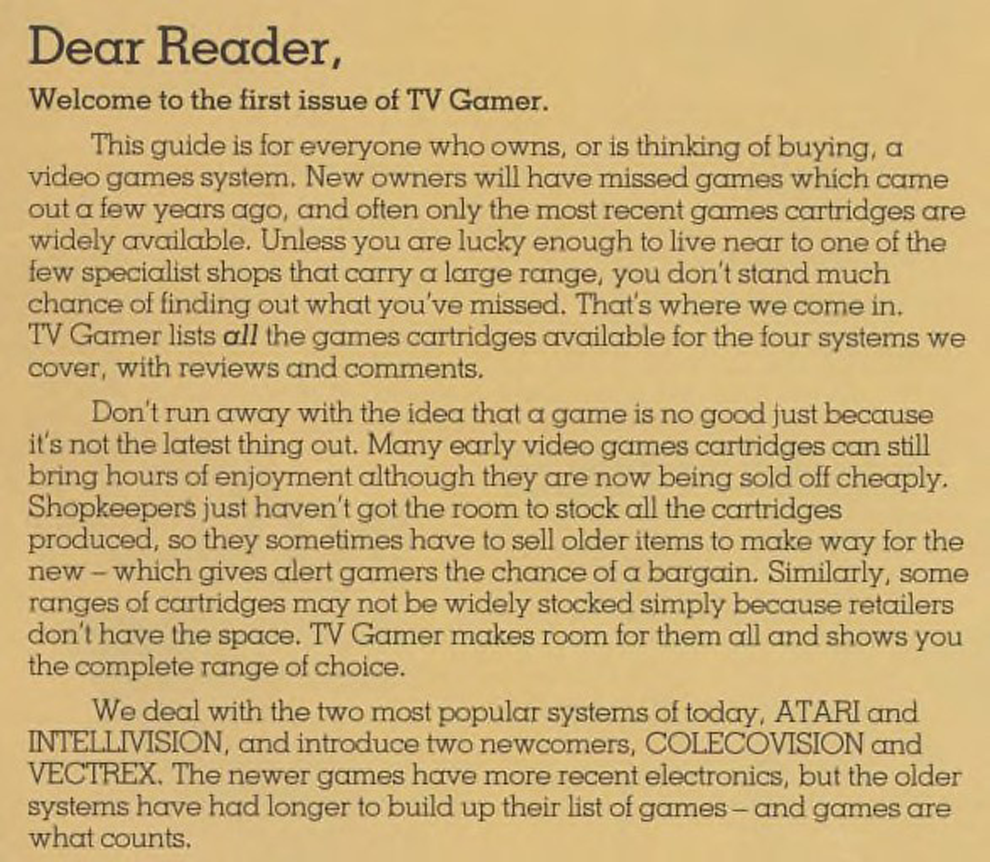
TV Gamer editorial, January 1983 (excerpt).
In most advertisements—even on the console itself (Figure 2)—the platform’s name was accompanied by the subtitle “Intelligent Television,” foreclosing any doubt regarding the origins of the portmanteau “Intellivision.” This was not mere nomenclature. A vision of intelligence permeated every aspect of the platform: from advertising to code, from the design of the controllers to the dynamics of gameplay, even the decision to forego the definite article (a practice we follow when referring to “Intellivision” rather than “the Intellivision”). Intelligence was the defining characteristic of Intellivision as “the first console for hard-core gamers who were not afraid of a more complex control scheme in exchange for a more rewarding and technologically advanced experience” (Dillion, 2011, p. 35).
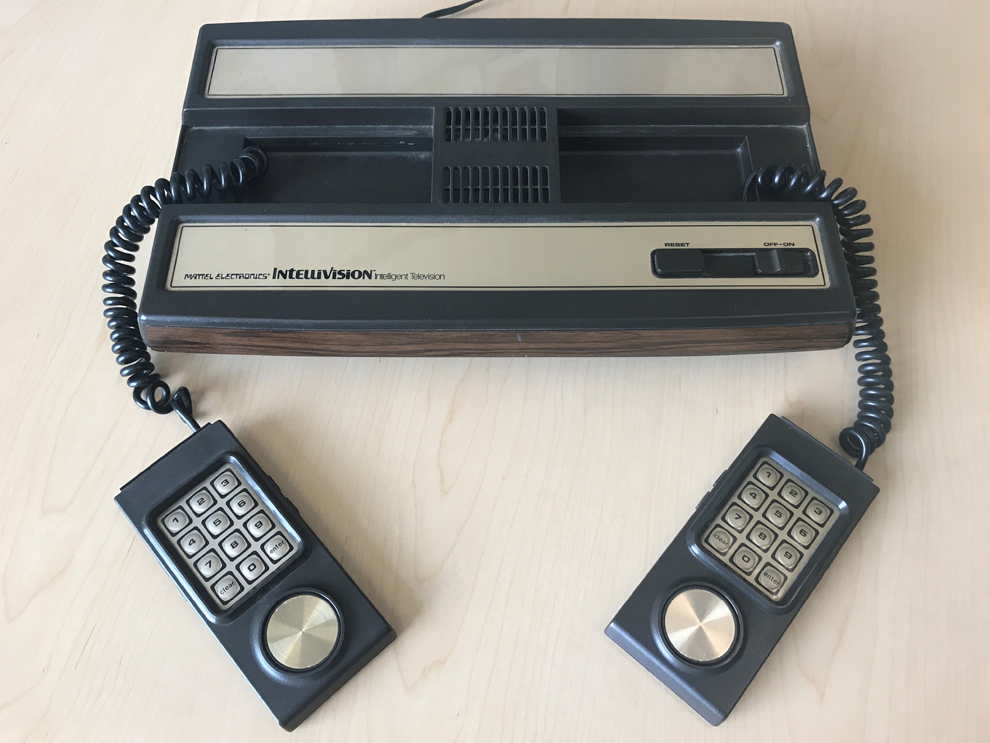
Intellivision.
One irony is that this “intelligent” platform was created by the toy company Mattel. In 1976, the company (formed in 1945) launched an unofficial electronics division (Mason, 2014, p. 54). The division achieved huge success with handheld, battery-powered games like Auto Race and Football: “From 1976 to 1979, Mattel’s earnings increased from $494 million to $805 million with most of the profits coming from the electronic games” (Herman, 2001, p. 46). This success led the company to develop a home video game console. Intellivision was first marketed in 1979 in Fresno, California, and officially launched nationwide in late 1980 (Burton, 2014).
As Figure 2 indicates, Intellivision is composed of a console (with a wood-grain plastic and golden-metal exterior) and two controllers. 1 The controllers feature a 12-button keypad with the numbers 0–9 as well as keys for “clear” and “enter.” The keypad uses a soft bubble interface, which was common in consumer electronics of the 1980s, including appliances like microwaves and washing machines. The controller also has two buttons on each side and a thumb-controlled disc registering 16 directions of movement. From the placement of the keypad above the circular disc to the curled cords connecting to the console, the controllers recall not gaming but the touch-tone phones that became popular during this period as more “intelligent” than rotary phones (Figure 3).

Touch-tone phone.
Another feature of the controllers reflecting a vision of intelligence is that plastic “overlays” can be inserted into the keypad, allowing the controller to gain functionality specific to particular games. Sea Battle illustrates a case where the overlays allow for a complex interface (Figure 4). The keypad numbers identify ships, but the numbers are reassigned to reflect how many of a particular ship can be created. For instance, a “1” appears over “Aircraft Carrier” (assigned to “1” on the underlying keypad) but a “1” also appears over “Troop Transport” (assigned to “2” on the underlying keypad), because only one of each of these ships is available in any one game. The “clear” key has been reassigned for creating new ships, an otherwise diametrically opposed use of the key. In other cases, overlays served more decorative purposes. For instance, Space Armada was a thinly veiled copy of Space Invaders, the arcade game requiring only left–right movement and a “fire” button. As a result, the overlays for Space Armada feature an image of gameplay that obscures eight of the twelve keys (Figure 5).
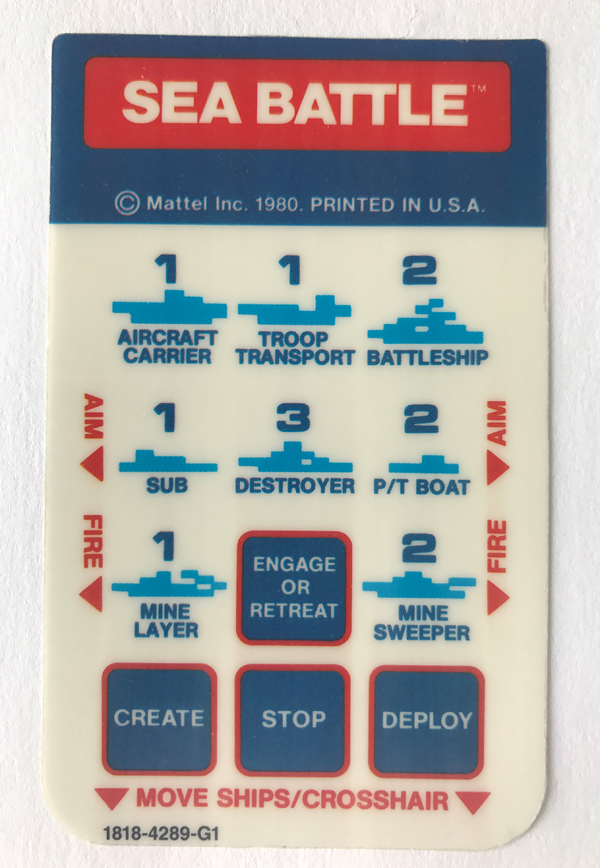
Overlays for Sea Battle.
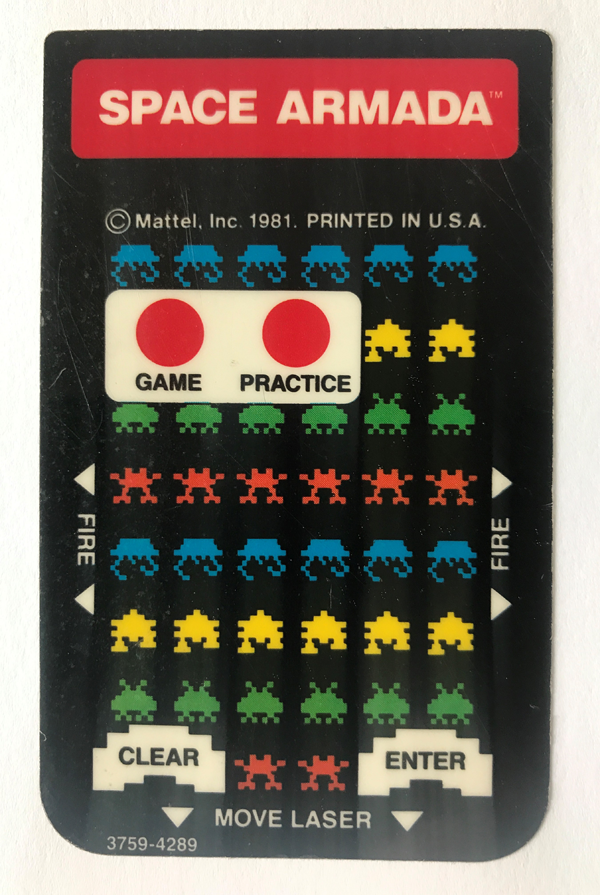
Overlays for Space Armada.
Another way a vision of intelligence shaped the platform in the software domain was an early emphasis on sports games, sponsored by the relevant official associations like the National Basketball Association and Major League Baseball. These games used Intellivision’s technical capabilities to offer detailed possibilities for strategy and movement (e.g., the NFL (National Football League) Football game “allowed players to choose from 160 offensive and 10 defensive plays”; Herman, 2001, p. 47). Thus, Intellivision sports games “weren’t just action games; they simulated both on-field action and coaching decisions” (Katz & Yates, 1996, p. 34). In this sense, the games instantiated intelligence by including their own contexts—not just the action on the field but the decision-making contextualizing each action. Nor was this dynamic limited to sports games. For instance, Sea Battle had a strategy phase where its complicated overlay was used to design and steer fleets of ships and a distinct battle phase where, in close-up, the actual shooting would take place (Figure 6). But in this instance, Intellivision’s vision of intelligence is highlighting a question of context that touches on the most fundamental and consequential questions regarding platforms, games, and culture. It is to these questions that we now turn.
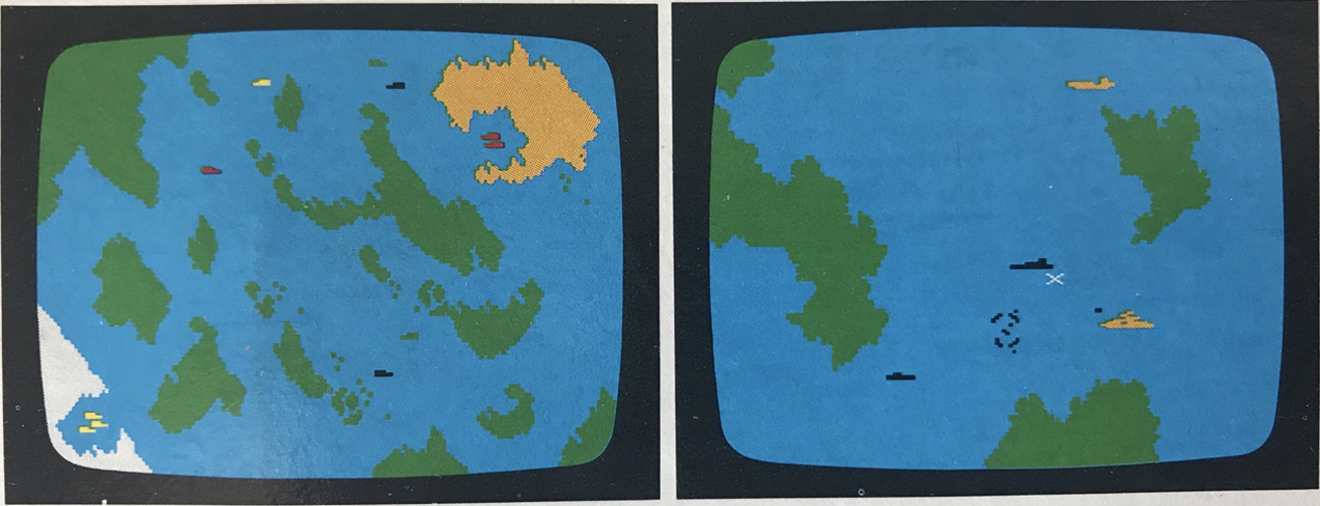
Strategy and battle phases for Sea Battle.
Cultures and Wholes
In this article, we theorize the Intellivision/Atari VCS rivalry from a perspective we term “transplatform” in that it examines social formations constituted at the nexus of platforms. 2 We thus use the term as a noun (referring to a social formation) and an adjective (referring to a perspective on platforms), recalling how many theoretical concepts evince such polysemy (e.g., games vs. a ludic perspective, cultures vs. a cultural analysis). A key point is that transplatforms are not subsequent to the platforms they enmesh. Rather, they are shaped by perduring platform effects (e.g., computational parameters), yet shape those platforms in turn. This move—from the idea of multiplicity to the idea of transplatforms that ontologically bootstrap their component systems—resonates with work exploring the overlapping diversity of Internet use in daily life, as in the notions of remediation and polymedia (Bolter & Grusin, 1999; Madianou & Miller, 2012). But it differs in that no individual necessarily encounters a transplatform in its totality. For example, the transplatform shaped the experience of Atari VCS and Intellivision players in the early 1980s, but players did not usually own (or even play) both platforms.
We are particularly interested in how a notion of transplatform might contribute to theories of culture in platform studies and game studies more generally. Given that game studies draws from scholarship in communications, cultural studies, media studies, and sociology, it is understandable that its dominant notions of culture are shaped by those disciplines. We seek to weave contemporary anthropological insights more strongly into these conversations, not least because many uses of “culture” in platform studies and game studies bear a striking resemblance to quite dated models of culture. These models appeared in the late 19th and early 20th centuries, when social science disciplines were far less distinct than today, and reacted to prior evolutionary models that ranked artifacts and beliefs from savage to civilized. Responding to such evolutionary models, Edward Tylor—the first person to hold a professorship in anthropology—famously defined culture as a “complex whole” that could be understood in synchronic terms (1871, p. 1).
This holistic model soon appeared on the other side of the Atlantic. Franz Boas, a founder of American anthropology, gained notoriety in part through his 1887 debates with Otis Mason regarding the arrangement of museum artifacts. Mason, following the established evolutionary model, placed items like fishhooks and baskets in sequence from “primitive” to “advanced” regardless of origin. Boas, working from the newer holistic model, insisted artifacts be placed with others from the same culture. Just as the meaning and function of a flute is best understood by its role in an orchestra, so a fishhook or basket—or for that matter, a kinship term or belief about gender roles—is best understood in cultural context. Boas pushed questions of causality and materiality further by adding that the “character of the music” of a culture “determines the form of the instruments,” not the other way around (Stocking, 1974, p. 5; see Burke, 2002, p. 160).
Unlike evolutionary models, holism allowed for benign variation, treating cultures as equally “evolved” systems of material artifacts, social practices, and shared meanings. Of course, holistic models have their own limitations, to which anthropologists have responded ever since. For instance, the holistic model of culture, by treating cultures as containing their own contexts (e.g., “The Japanese,” “The Apache,” “The Balinese”), made it difficult to address migration, globalization, media, and other translocalisms. This insight is worthy of attention in platform studies, as it wrestles with a keen awareness that platforms are not isolated phenomena. While an improvement on the antiquated evolutionary model (echoes of which persist, e.g., in the notion of “generations” of consoles), the equally antiquated holistic model cannot respond to key aspects of digital sociality. In other words, isolating platforms can be a problem, but the holistic model of culture as context has long been shown to be an incomplete answer to that problem.
We hope to identify alternatives to the holism that still often acts as a conceptual foundation for platform studies. Tylor’s full definition of culture in 1871 was a “complex whole which includes knowledge, belief, art, morals, law, [and] custom” (p. 1). Now observe how in his study of the Nintendo Entertainment System (NES) Altice defined the platform as “a holistic network of objects and texts, including cartridges, controllers, peripherals, marketing materials, play environments, and emulators” (2015, p. 7). Despite moving to the notion of network, we still find a holism including 6 items that might be read as an updated iteration of the six capabilities and habits Tylor included in his list. Holism’s legacy also appears in Montfort and Bogost’s influential concept of platforms as one of the five “levels” of digital media (see Figure 7).
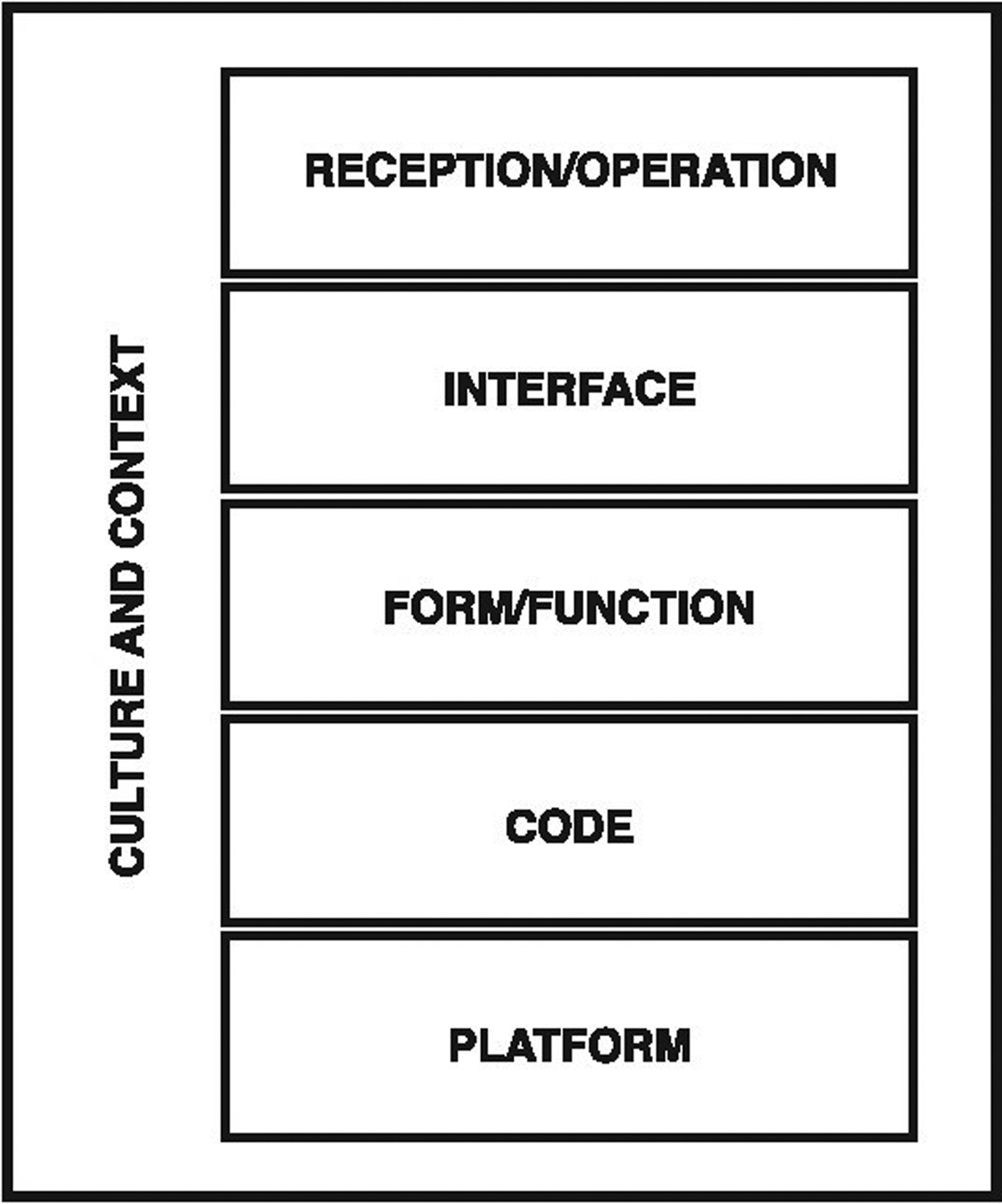
“The five levels of digital media, situated in context” (Monfort & Bogost, 2009, p. 146).
Montfort and Bogost provide two convincing explanations for the order of these levels. The first involves what an anthropologist might term their experience-near versus experience-distant character (Geertz, 1983, p. 57): from the topmost level, reception/operation, to “the platform [the bottommost level, which] is ‘deep’ or ‘far away’ from the user experience” (Bogost & Montfort, 2009, p. 5). The second involves scholarly attention: from reception/operation, the subject of “a wide variety of studies” (Montfort & Bogost, 2009, p. 145) to the “most neglected” platform (Montfort & Bogost, 2009, p. 145).
This is fundamentally an “archeological metaphor [whose] layered structure implies a vertical configuration wherein platforms provide the base, as well as the temporal precedence, for all subsequent layers” (Altice, 2015, p. 193; see also Leorke, 2012). 3 The metaphor is not necessarily inaccurate: Some things really do depend on other things for their existence. Our concern is that it is predicated on a holistic theory of culture. What insights might be suggested by alternatives to the model of digital strata stacked in a complex whole? What if, for instance, we considered these elements as columns, with none “resting” on another? Or as overlapping circles in a Venn diagram? In Figure 8, we playfully attempt two alternate representations, using the same categories as Montfort and Bogost. We find each attempt insightful in some ways, less helpful in others, but the exercise impresses on us the challenge of thinking platforms otherwise. The hope is that such alternatives, even with their limitations, might foreground how, for example, it is not necessarily true that the platform is the most experience-distant aspect of digital technology. Such alternatives could highlight multivalent relationships between materiality and the digital, including ones in which the material is not foundational.
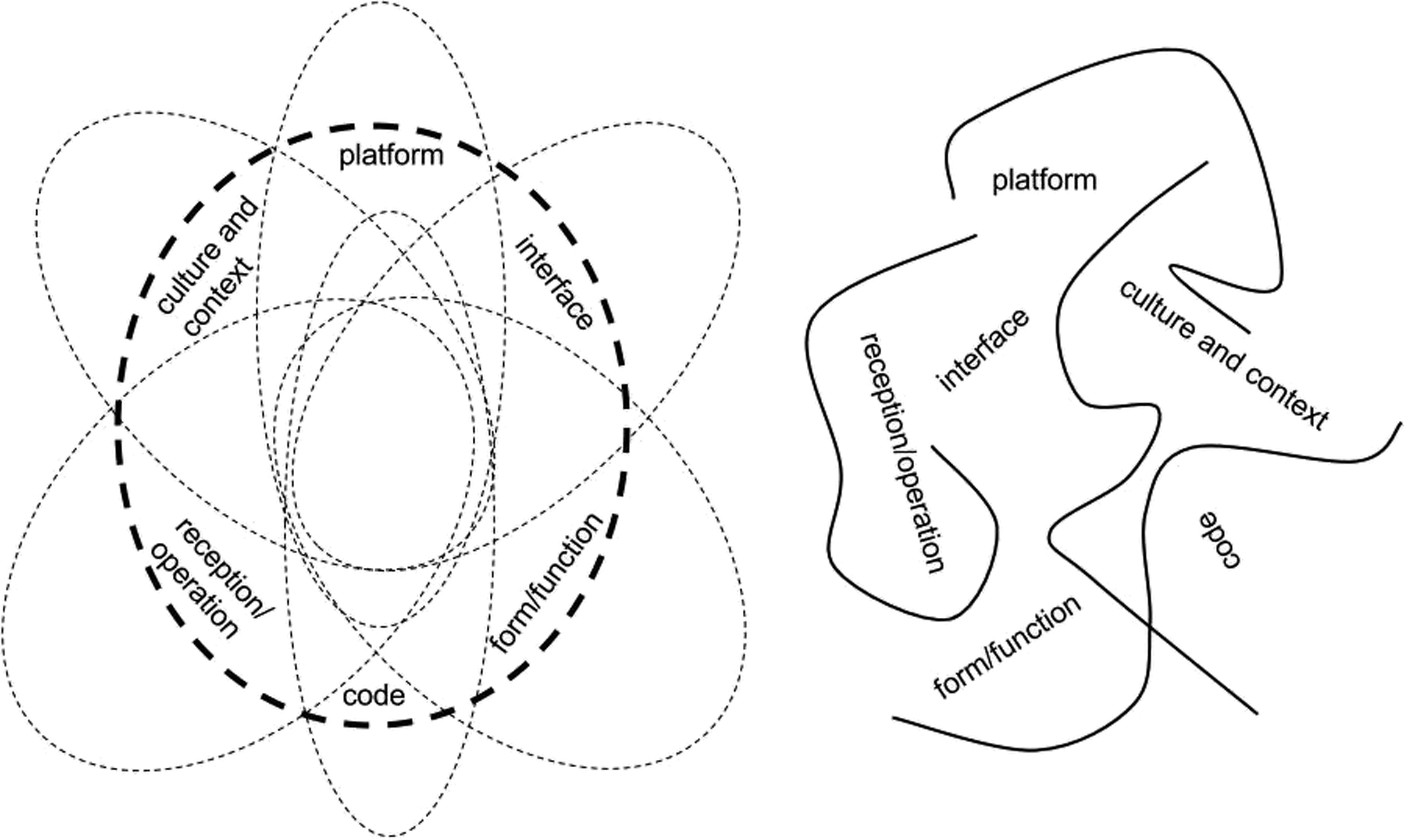
Two attempts to represent platforms otherwise.
Rivalry as Transplatform
Earlier, we provided a brief history of Intellivision, aware that the console is unfamiliar to many. Writing that history was challenging because we intentionally did so from a single-platform perspective. We now provide another brief history—this time from a transplatform perspective. In this second history, the Intellivision/Atari VCS rivalry is not ontologically subsequent to Intellivision. In part, this is a tale of competition as old as capitalism. But of interest to us here is how, in multiple domains, Intellivision was crafted in opposition (and thus relation) to the Atari VCS through a vision of intelligence.
The rivalry began before Intellivision even went into production. The Atari VCS was released in October 1977 and initially experienced disappointing sales due to consumer interest in handheld electronic games, a genre dominated by Mattel (Dillon, 2011, p. 27). Thus, weak sales of the Atari VCS, partially due to Mattel’s success, likely helped motivate the development of Intellivision in 1977–1978. By 1981, however, the Atari VCS “accounted for 75 percent of home videogame system sales” (Montfort & Bogost, 2009, p. 4). From its beginnings, then, Intellivision “was planned to be a serious rival for Atari’s best-selling games machine” (Mason, 2014, p. 54).
Intellivision’s designers worked to distinguish it computationally from the Atari VCS. The former had an 8-bit processor, but Intellivision was the first home video game console to have a 16-bit processor (Burton, 2014, p. 16). The Atari VCS had 128 bytes of random-access memory (RAM), while Intellivision had 704 bytes of system RAM, 256 bytes of scratchpad RAM, and 512 bytes of programmable graphics RAM (GRAM) for custom graphics manipulation. Moreover, Intellivision contained 7K of onboard read-only memory (ROM). This included 4K of 10-bit wide memory for the “Exec” (discussed below), as well as 2K of graphics ROM (GROM), which contained numerous ASCII (American Standard Code for Information Interchange) characters and a library of predefined shapes that could be used to build a game’s graphical environment. The impact of Intellivision’s GROM was immediately apparent when a player loaded a cartridge and was treated to an actual title screen with copyright information, a feat Atari games would not accomplish until much later. Even such an apparently innocuous distinction made the “intelligence” of Intellivision legible as a platform that could leverage the cultural cache of the written word.
The rivalry with the Atari VCS shaped Intellivision’s computational abilities. When deciding what chipsets to use, Mattel designers considered Texas Instruments, “but we walked away [because Texas Instruments] was unwilling to modify architecture” (Chandler, 1982, p. 5). The designers decided to work with General Instruments (GI) because GI agreed to redesign their system architecture. For instance, the original GI architecture included GROM but not programmable GRAM. Mattel’s designers saw this as a “debilitating limitation” (Blue Sky Rangers, n.d.) because programmers could only access prestored graphical elements, leading to a homogenous vision across games more in line with the Atari VCS. Including GRAM made graphical richness more feasible, because it “[added] a way for programmers to define new graphics for each game” (Blue Sky Rangers, n.d.). 4
Another key modification was the operating system developed for Intellivision, called the “Exec.” Programmed by David Rolfe, this was the first operating system developed for a home gaming console (Mason, 2014, p. 56). It handled many common procedures game programmers needed to accomplish without having to implement those procedures on the cartridge. Mattel requested GI double the memory for the Exec from 2K to 4K by adding a second onboard 2K chip; this significantly expanded the subroutines and code the Exec could store (Greenberg, 1978, pp. 2–3). The Exec thus represented one fundamental means by which Intellivision could be intelligent, not least because it freed up space on the 2K cartridges for additional graphics and expanded gameplay.
Intellivision’s 512 bytes of GRAM allowed for up to sixty-four 8 × 8 bit “cards” of unique graphics. These could populate the background or be used for “sprites” (movable objects). This background table (BACKTAB) was stored in the system RAM and consisted of a 12 × 20 arrangement of “cards” that could produce detailed background graphics. The BACKTAB “grid” is apparent in many Intellivision games, such as Utopia or Happy Trails, where one can easily discern the 12 × 20 matrix. This was far more powerful than Atari’s graphical rendering, which only allowed for 40 horizontal pixels or “blocks” (in many cases, half of these were defined as the “playfield,” which was mirrored to produce the second half of the screen, see Montfort & Bogost, 2009).
The computational rivalry resonated in the domain of marketing. Forms of comparative advertising date to the early 20th century (Beard, 2010), but from a present-day perspective it can be difficult to appreciate just how novel it was to directly compare technology platforms, since the best-known examples from the digital sector (Mac vs. PC, Nintendo vs. Sega) antedate the Intellivision/Atari VCS rivalry. Advertising was not an epiphenomenal layer above the material console or the digital code: The transplatform of the rivalry was fundamental to Intellivision across domains. Intellivision faced competitors other than the Atari VCS, but it is remarkable to note the degree to which the rivalry was understood in binary terms. This binary model has ever since played a significant role in digital economy and society.
When Intellivision was ready to go to market, Mattel pursued what some observers termed a “frontal attack” on the Atari VCS and “a full-scale war of advertising on prime-time television” (Bloom, 1982, p. 109). But this language of battle misrepresents how a vision of intelligence permeated the rivalry: “It all began when the television networks aired a number of Intellivision commercials where [the cerebral journalist and author] George Plimpton compared the Mattel sports games to the comparable VCS games” (Herman, 2001, p. 58; see Figure 9). The figure of Plimpton acted to “brand the Intellivision as a thought-provoking, ‘smart’ video game system” (Murphy, 2011, p. 41), not as a weapon of war.
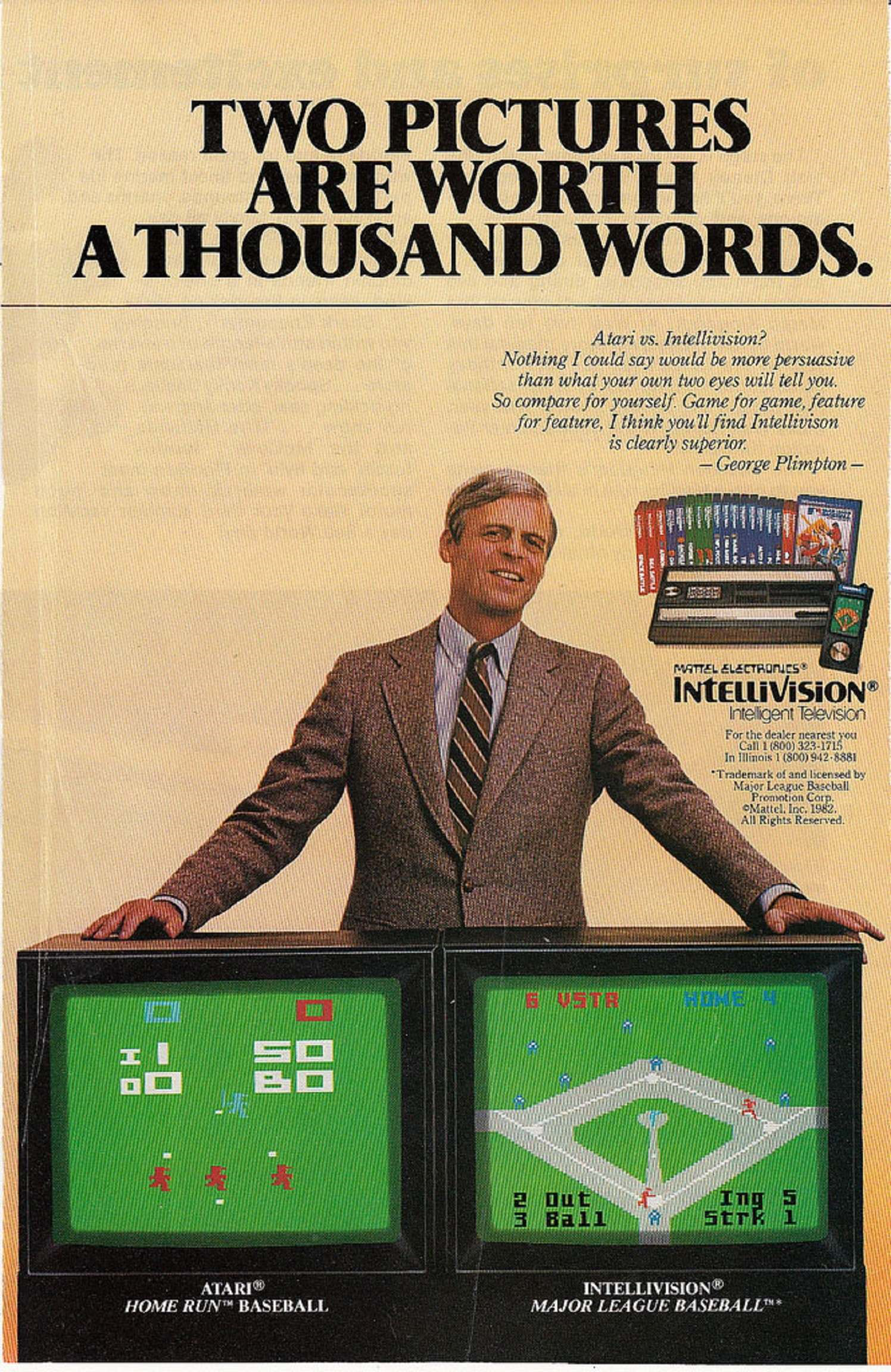
An advertisement featuring George Plimpton comparing Intellivision with the Atari Video Computer System.
These kinds of marketing campaigns, framed in terms of a rivalry, shaped a transplatform space that in turn shaped coding and game design. Innovation with regard to platforms—particularly older platforms—is sometimes framed in terms of individual programming geniuses who respond to technical limitations with unexpected solutions. But marketing, which ostensibly takes place after a product is finalized, can loop back to influence the platform. The founder of one third-party game maker once noted that “Mattel’s [George] Plimpton ads were just what we needed—it’s that sort of competitive instinct that goads people to go beyond what’s acceptable to what is unexpected” (Bloom, 1982, p. 111). Statements like this—and the broader history we trace—indicate that creative elaborations of a platform should be embedded in a wider sociocultural milieu, including rivalries.
In later years, computational consequences of the rivalry took on new forms. Just months before the video game crash of 1983, Mattel released the System Changer, a transplatform device that “changes” what rivalry can be taken to imply. This device allowed Intellivision to play Atari VCS games—but not, as might be expected, through emulation. Remarkably, the System Changer was a full hardware clone of an Atari VCS, using Intellivision’s power supply and RF (radio frequency) modulator to send information to a television (IntelliWiki, 2016). It used Intellivision’s controllers, which likely meant there was some software on The System Changer that transcoded controller data from Intellivision to Atari controller input. The System Changer also had its own controller inputs for Atari VCS paddle controllers. Since Intellivision did not include any form of video input, consumers had to ship their console to Mattel Electronics for a hardware modification that cost US$19.99. 5 Although it is unclear how many consumers actually sent their consoles to be modified, one glimpses here the malleability of a platform as it is transformed—in its materiality—by a rivalry. The System Changer created a transplatform object: It truly was a “game changer.”
When using the System Changer to play an Atari VCS game on Intellivision, a logo for “M Network” replaced the startup screen. But “M Network” had a second meaning that had nothing to do with the System Changer or even the Intellivision console. M Network was also the brand name for Mattel’s ports of many Intellivision games into versions that could be played on the Atari VCS. In its instantiated polysemy, “M Network” is thus another kind of transplatform object, referring simultaneously to (1) Atari VCS games playable on Intellivision with the System Changer device and (2) versions of Intellivision games playable on an Atari VCS, without any additional device. All this allowed Mattel marketers to claim Intellivision offered the larger game library. This was significant because “[t]he question prospective game-console buyers ask[ed] most is, ‘How many new games will there be?’” (Katz & Yates, 1996, p. 31). As the editorial from TV Gamer referenced earlier emphasized: “the older systems [Intellivision and the Atari VCS] have had longer to build up their list of games—and games are what counts” (see Figure 1).
The transplatform effects under discussion were not limited to the Intellivision side of the rivalry. Mattel advertisers could now claim that M Network (1982) games “have a surprising effect on your Atari VCS. Our graphics don’t move, they perform. And our challenging game-play makes every performance spectacular. Because M Network video games will now put new life in your Atari VCS” (pp. 2–3). We see this transitive deployment of the vision of intelligence (manifest, e.g., in graphics that “perform” not merely “move”) in a review of the Intellivision Astrosmash game that was available on the Atari VCS as Astroblast via the M Network: “Mattel prides itself on raising the intellect of game systems…now with the M Network series, it could be said that they are trying for Smartari” (Prince, 1982, p. 65). Through the Intellivision/Atari VCS rivalry, a vision of intelligence expanded into areas that cannot be analyzed in terms of Intellivision itself. Here is an example where a transplatform perspective can enrich the analysis of platforms as such, pointing toward new analytical possibilities for contemporary platforms and their politics.
Context and Merography
What distinguishes the two histories recounted above?
One answer might be that the first addresses Intellivision as a platform, while the second addresses Intellivision in “the context” of its rivalry with the Atari VCS. But that answer is predicated on dominant understandings of culture and context that limit our understanding of platforms, games, and the digital itself. Building on the insights of platform studies scholarship to rethink this dominant understanding is thus central to our argument. This is a tall order, because notions of culture and context are central to everyday, commonsense existence. They anchor what Pierre Bourdieu termed doxa, “[s]chemes of thought and perception [that produce] misrecognition of the limits of the cognition that they make possible, thereby founding immediate adherence, in the doxic mode, to the world of tradition experienced as a ‘natural world’ and taken for granted” (Bourdieu, 1977, p. 164). Doxa are part of all human life. We have long known that they are not limited to the Other, the “native,” or the “primitive.” Furthermore, we have long known that the hardest doxa to perceive are those closest to home—and therefore part of our own conceptual frameworks, whoever “we” might be.
With full appreciation for the challenges we face in this inquiry, and comforted by the fact that we seek only to contribute in a partial and provisional way to that inquiry, let us return to our earlier discussion regarding notions of culture and context in anthropology and platform studies. We noted two main ways that platforms are currently understood—“computing platforms” like the Atari VCS or Flash and “social platforms” like FaceBook or YouTube. We share the view that social platforms are not replacing computing platforms; rather, they now coexist as interlinked modes of online sociality, each “just as current as [the] other” (Bogost & Montfort, 2009, p. 4). What unites these two understandings of “platform” is the character of underdetermination. Platforms are actually existing potentialities, crafted through human action to require instantiation through further human action. The Atari VCS without game cartridges is not the Atari VCS; Twitter without tweets is not Twitter.
Underdetermination has also long been identified as central to the human: “We are, in sum, incomplete or unfinished animals who complete or finish ourselves through culture—and not through culture in general but through highly particular forms of it” (Geertz, 1973, p. 49). In another classic formulation, Bergson (1911) defined the human not as homo sapiens but homo faber (the crafting human) because “intelligence, considered in what seems to be its original feature, is the faculty of manufacturing artificial tools, especially tools to make tools, and of indefinitely varying the manufacture” (pp. 138–139). It is tempting to read Geertz and Bergson as construing culture, intelligence, or even the human as a platform. The interpretation is premature, yet it is worthwhile to consider how their formulations might be used to appreciate the immanence of culture and context to platforms. How might platforms represent “highly particular” forms of translocal culture, “tools to make tools” whose ability for “indefinite variation” powerfully shapes contemporary configurations of human being?
This speaks to a foundational insight of platform scholarship: Platforms are never in themselves. Earlier, we discussed how platforms are always linked to something glossed as culture or society. What we did not mention at the time is that the notions of culture or society in question are typically taken to contextualize the platform. Returning to Monfort and Bogost’s instructive framework (Figure 6), we see that five layers of digital media are situated not just in “culture,” but in “culture and context.” In their analysis (and the broader scholarship), “culture” and “context” are linked, overlapping, or even synonymous: Note how “culture and context” appears vertically, surrounding the five layers, but the caption refers to the layers as “situated in context” (not “situated in culture and context”).
We are not critiquing Montfort and Bogost, nor are we saying that the notion of culture as context is misguided. Rather, we claim that (1) the notion of culture as context is partial; (2) it is difficult to think outside this dominant notion for Euro-Americans (including ourselves); and that (3) despite this difficulty, identifying this notion’s entailments can contribute to the project of platform studies, including linking the study of computational and social platforms. The key entailment in question is that “context” in frameworks like that of Montfort and Bogost is not a layer itself: It has a different ontological status. In their discussion of this framework, Jones and Thiruvathukal extend Montfort and Bogost’s logic: “We’d go even further to suggest that culture (or social context) pervades and shapes every sublayer” (2012, p. 9). Yet culture/context remains ontologically distinct from that which it pervades and shapes. Even critiques of platform studies share this conceptual horizon. Consider the claim that at times, “the focus on a single platform through its material limitations and the culture in which it emerged becomes too confining” (Leorke, 2012, p. 265). This valid point relies on the same holistic model of culture as context (from which a platform “emerged”) as the work it critiques.
In technology studies, discussions of data, mobile devices, and cloud computing have foregrounded notions of context in terms of data and relationship (Dourish, 2004; see Seaver, 2015). Such understandings of context are implicit theories regarding how parts (e.g., layers of digital media, platforms) relate to wholes (e.g., culture, society). They are doxic from a dominant Euro-American perspective: They come “naturally” to one’s thinking if working within a holistic understanding of culture. This is one reason why relating platforms to social context is central to platform studies, why relating games to social context is central to game studies, why relating media to social context is central to media studies, and why relating science to social context is central to STS. It is a solution made solvable by the prior framing of context itself.
To reveal the presuppositions regarding parts and wholes that undergird these doxic views of context, Markus Schlecker and Eric Hirsch draw on the anthropologist Marilyn Strathern’s analysis of “merography”: Merography (literally mero = part, graphy = writing) is about the way in which Euro-Americans make sense of things by describing them as part of something else…. However…[,] Euro-American knowledge conventions posit all given entities as a priori unrelated. As a consequence, that which is created through the merographic exercise of relating (i.e. making something part of a context) is held to be a human product. Euro-Americans envisage that different aspects, brought into view through different relations (i.e. contexts), can add up to create an ever more appropriate representation of the object of study. (Schlecker & Hirsch, 2001, p. 72)
The merographic framework is so doxic that alternatives are difficult to imagine, but one avenue Schlecker and Hirsch provide is that “the loss of the idea of an a priori unrelatedness of given entities obliges one to acknowledge that description and what it describes are not separable”—a framework where “each description is understood to contain within itself that which it describes. Here, part and whole collapse into one” (2001, p. 80). Montfort and Bogost suggest such a possibility when noting “our technologies, our computer platforms, embody particular cultural concepts and ideals” (Bogost & Montfort, 2009, p. 2). In this spirit, we contend that the notion of transplatform can help destabilize the idea of the a priori unrelatedness of given entities. The Intellivision/Atari VCS rivalry represents a fascinating case study to explore what happens to the notion of platform when delinked from the holistic model of culture as context. This opens up possibilities for moving beyond a merographic approach to the study of individual platforms. This resonates with analyses contending that “platforms are not recalled and rediscovered through platform studies, rather in the process of ‘doing’ platform studies, a uniform platform is produced” (Apperley & Parikka, 2015, pp. 4–5, emphasis in original). It resonates as well with a “speleological” approach to games, employing metaphors of cave “spelunking” rather than “digging” through archeological strata (Nooney, 2013). A transplatform approach can thus help advance platform studies—not by implying that scholarship on a single platform is misguided, but by suggesting alternatives to holism and merography.
“Third-Party” Game Makers
In this penultimate section, we return to the Intellivision/Atari VCS rivalry to examine “third-party” game makers from a transplatform perspective, exploring how this helps us better understand Intellivision in nonmerographic terms.
In the early days of video games, companies who built consoles also designed the games played on them. For arcade games, this was self-evident (e.g., Space Invaders, Q-Bert). Home video game consoles pioneered the idea that one device could play multiple games. But this platform effect made it theoretically possible for other companies to design games. This also made it conceivable for companies to produce games for multiple consoles. Game makers engaging in one or both of these transplatform practices—practices made possible by the affordances of the platforms themselves—have long been known as “third-party” companies. 6 The phrase reflects the notion of rivalry, recalling “third-party” candidates outside the traditional two-party political system in the United States.
In 1979, the first third-party game company, Activision, was formed by former game programmers from Atari (Herman, 2001, pp. 48–50; Montfort & Bogost, 2009, pp. 99–101). Activision originally produced games only for the VCS, and while Atari was initially hostile to the new company, these third-party games impacted the rivalry itself: By the time the first four Activision cartridges were released [for the Atari VCS] in the fall of 1980, the Intellivision was enjoying a huge following…. The release of the four cartridges from Activision was a boost that Atari needed because they…showed the world that the versatile machine was more powerful than anybody had imagined. (Herman, 2001, p. 49)
Third-party games reshaped the dynamic of rivalries, but reshaped as well the relationship between hardware and software in the context of platforms. Many gamers were aware of third-party games, not least because such games allowed for new forms of comparison. In the example below, the authors of a review article in the gaming magazine Blip address Atari VCS players, comparing the game Phoenix (designed by Atari and based on an arcade game to which Atari owned the rights) to a similar game Demon Attack, designed by Imagic: The big question for Phoenix fans is this: Can Atari’s genuine adaptation beat Imagic’s derivation, Demon Attack? The answer is yes and no. Demon Attack for Intellivision is definitely the best of the lot…Demon Attack for Atari [VCS] features no final, go-for-it-all battle with an awe-inspiring mother-ship. Both Demon Attack for Intellivision and Atari’s Phoenix do include this battle. (Blip, 1983, p. 17)
Of course, competition is a general feature of capitalist production, but of interest here is how third-party games were not exterior to the Intellivision/Atari VCS rivalry. They were part of the transplatform and also likely opened the door to companies designing games for consoles other than their own, as in the case of the “M Network” discussed earlier. 8 Third-party games are incompatible with merographic analyses. They are not parts of a larger whole but interdigitate between domains and entities in a manner that cannot be adequately captured by a notion of “context.” Further attention to their history and implications can contribute to contemporary analyses of everything from cloud computing to data socialities.
Conclusion
In the technology domain, speculating about what may come is a time-honored but deeply problematic tradition. However, one prediction we feel confident advancing is that our future online social worlds will largely be platform worlds. From mobile devices to mainframes, from networks to profiles, from protest to surveillance, platforms increasingly represent the modality by which the digital is structured and experienced.
Our broadest goal in this article has been to contribute to the exciting body of scholarship on platforms by offering the notion of “transplatform” as an analytical point of departure to highlight social formations constituted at the nexus of platforms. The term can also thereby contribute to the important task of theorizing the constituent domains of platforms—particularly the ontological and causal relationships between them.
We have been particularly interested in opening a conversation regarding the role that “culture” and “context” play in conceptions of platforms. Drawing on anthropological debates regarding holism and alternatives to merography, we seek ways to comprehend (not deconstruct) platforms in ways that permit new understandings of their multiple materialities, ontologies, socialities, and politics. Such understandings might help clarify the relationship between “computational platforms” like the Atari VCS, the iPhone, and Flash, versus “social platforms” like Facebook, Twitter, and Youtube. These heuristics obviously overlap in that computational platforms are social and social platforms computational. Yet the differences are significant enough that we consider the nature and degree of this overlap to be an active research question. To what extent do these sets of epistemic objects represent the same kind of phenomenon? For instance, with regard to social platforms, a central concern has been the ability “to host and organize user content for public circulation, without having produced or commissioned it” (Gillespie, 2017, p. 1). But the character of this concern differs with regard to computational platforms.
To explore these broad issues, we focused on Intellivision—an underdiscussed but key member of the second generation of home video game consoles—and particularly its rivalry with the Atari VCS. Attending to this rivalry has helped us explore the notion of transplatform. It has also allowed us to investigate how a vision of intelligence acted as a defining set of tropes, practices, and materialities. Intellivision was not first created, marketed, and played, and then only later placed into a rivalry. The rivalry preceded Intellivision—and in fact, can be convincingly shown to have created the platform. This has consequences for understanding Intellivision as a platform in its own right. For instance, one could argue Intellivision was shaped by representational desires and imagined gameplay that operated in a manner that was not necessarily secondary to the material console or the code.
It is precisely in domains like digital culture—shaped both by the hype of the tech sector and the desire for scholarly novelty—that attention to history is so valuable. At present, discussions of “wars” among consoles, platforms, standards, and companies are, if anything, more salient than ever. Our analysis extends these discussions in two ways. First, we draw attention to what is likely the first significant example of this phenomenon. With regard to game studies, this is important because the paucity of scholarship regarding Intellivision has led many to frame the rivalry between the original eight-bit Nintendo and Sega systems as the first “console war” (Harris, 2015). But second, and more importantly, our analysis challenges the use of the militaristic metaphors of “war” to understand these rivalries and their consequences. A transplatform perspective destabilizes the “versus” in phrases like “Nintendo versus Sega,” calling attention to how the relationship in question—while clearly antagonistic with regard to capitalist logics of competition—is in fact a platform ecology far more multicausal and interdependent than a framework of “war” can reveal.
As kids sitting down for the first time with our Intellivisions—in an age before the Internet, indeed before a game could be saved—we were unaware of these multifarious implications. But even across the years of time unrecorded in any blog post or status update, we remember our sense of stepping over a threshold. We remember our sense of entering a new world of possibility, right there in that newly intelligent television screen, the controller in our hands, and the console connecting them. If we are, indeed, now what we might playfully term homo platform, it behooves us to linger in this space of wonder, and link that wonder to an analysis that leads to new understandings of platform cultures.
Footnotes
Declaration of Conflicting Interests
The author(s) declared no potential conflicts of interest with respect to the research, authorship, and/or publication of this article.
Funding
The author(s) received no financial support for the research, authorship, and/or publication of this article.