




Abstract
Teacher working conditions surveys provide biennial, comprehensive data regarding school leadership. This case describes how a Title I middle school principal proactively addresses end-of-year data to address identified needs and growth areas in a collaborative manner in her middle school. The principal works in a concerted manner with an assistant principal, district liaison, and teacher leaders to make a collaborative correction in her school to foster time in collaboration, increased teacher leadership, and enhanced professional development.
Keywords
Case Narrative
Tanya Jones slumped in her office chair and rubbed her forehead, pouring over the data. As a middle school principal in North Carolina, she, like all principals, received the North Carolina Teacher Working Conditions (NCTWC) survey results, which provided anonymous survey data from teachers regarding important areas such as school leadership, teacher leadership, use of time, professional development, and community engagement (NCTWC, n.d.). The biennial survey was administered during an already-busy 4-week window in the spring, and the results came in about a month later. For now, at least, her world stopped.
The NCTWC provides teachers with the opportunity to weigh in on important issues. In her second year as principal, Tanya had always considered herself an advocate for teachers and staff. Yet, as the fourth principal of the school in 6 years, she knew that morale was an issue in her diverse middle school of about 900 students located in the urban center of the North Carolina “Research Triangle.” Despite being surrounded by universities and a comparatively decent funding base, Jefferson Middle School still had a number of growth areas to address. Tanya buzzed her assistant principal, Mike Perez, on her radio and closed the door as he entered her office.
“The teacher survey data is in, Mike, and we’ve got some work to do,” she sighed. Noted on an agreement scale of 0% to 100%, Tanya and Mike highlighted together some interesting data that “jumped out” at them from the overall summary results (Table 1). The data were arranged to look at change over time (from the previously administered survey 2 years prior). Thus, they focused on the far-right column to see “their” data, while also looking at how the data had changed from 2 years ago.
Summary Results Comparison. a
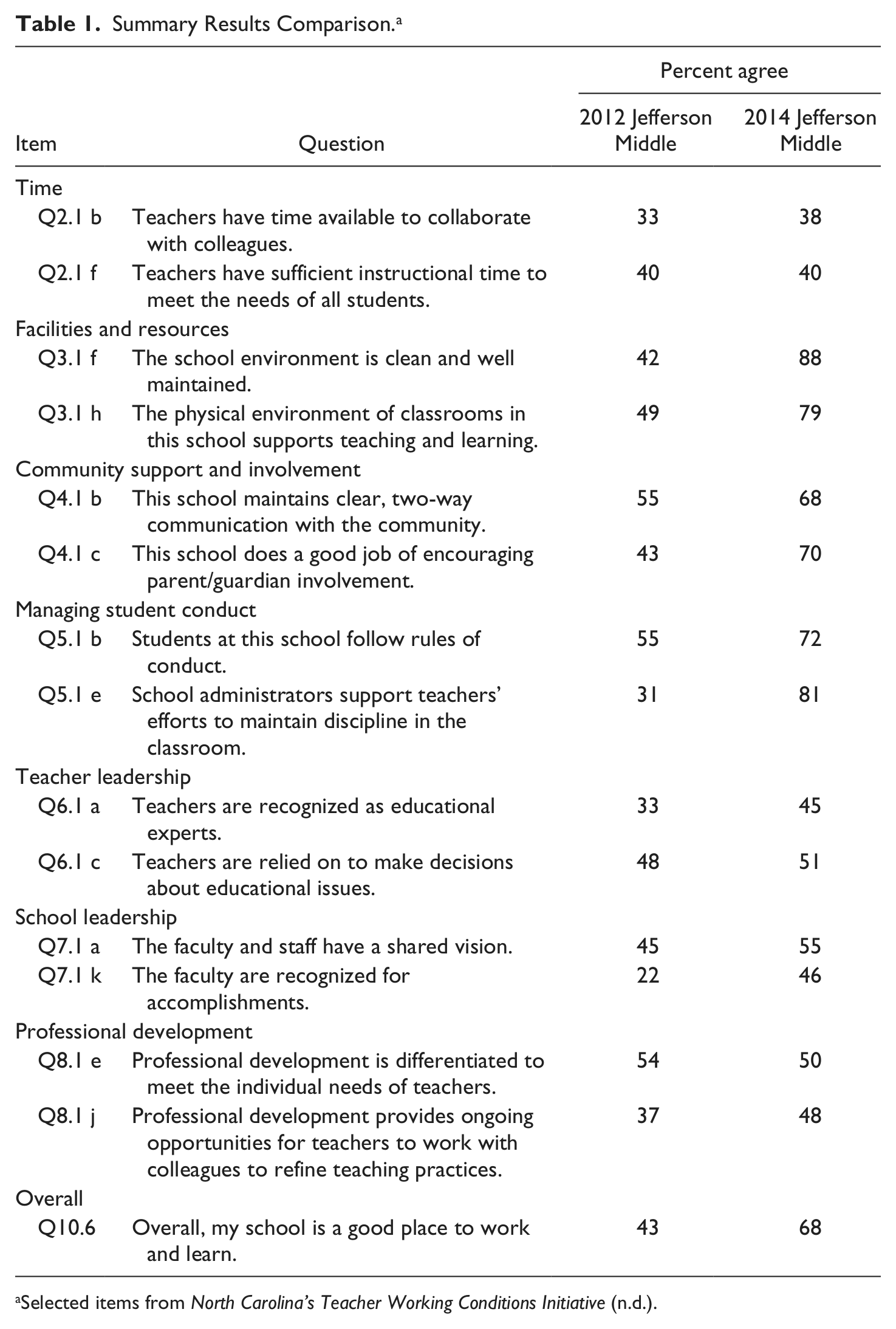
Selected items from North Carolina’s Teacher Working Conditions Initiative (n.d.).
“Hey, it’s not that bad,” Perez offered with a supportive voice. “Look here,” he said, pointing to the columns that showed marked improvement. “That work we did with the building has been appreciated,” he pointed to the “Facilities” column. Tanya smiled, remembering those endless mulch piles she helped volunteers spread and all the small projects she had embarked on to realize what Duke (2010) referred to as “quick wins” to help stakeholders realize that results were within reach. Improving the grounds helped bolster morale, and it was encouraging to see that teachers had noticed. Similarly, the administrators noted marked improvement in community support and student conduct categories, two key areas that often frustrated middle school principals.
“And it is encouraging that our ‘Overall’ score made a 25 point gain,” Tanya added, sizing up the data. “True,” Mike smiled, “most politicians would kill for a 68% approval rating.” Tanya shot him a dirty look, “Now don’t go comparing us to politicians” she said, feigning disgust, “We’ve got work to do.”
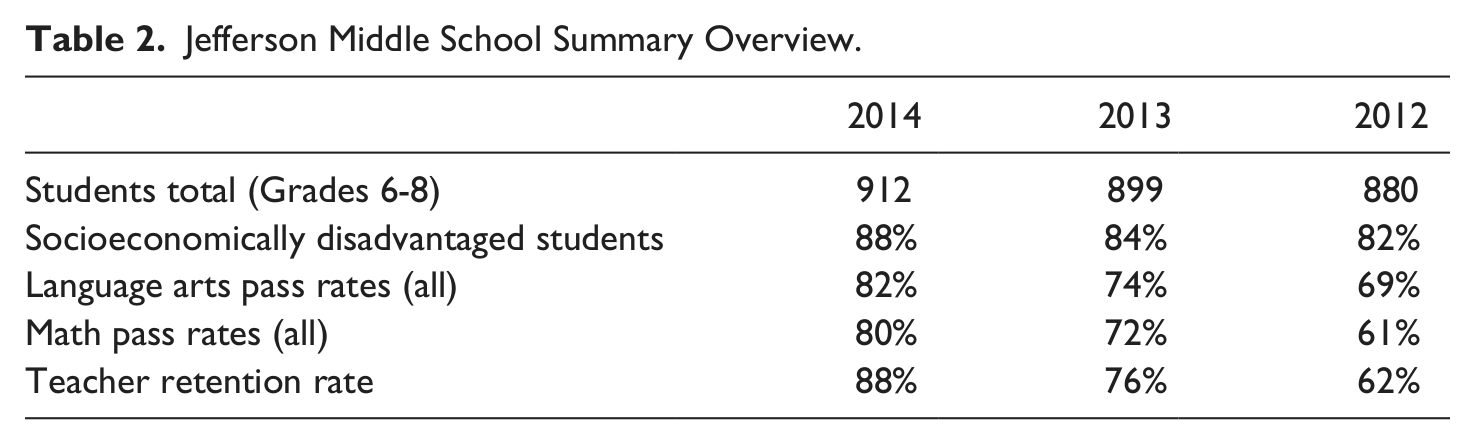
Having provided almost 3 years of consistent leadership at Jefferson Middle, Tanya and Mike realized they were poised for improving in some other key areas. They had already hired nearly half of the staff, test scores were on the rise, yet they realized their collaborative instructional leadership was lacking. Jefferson was a diverse school (over half the students identified as Black, one quarter as Hispanic, and nearly one quarter as White) and had made steady academic gains (Table 2).
Jefferson Middle School Summary Overview.
Tanya walked over to her whiteboard in her office and took the cap off a blue marker.
Well, this isn’t “nail in the coffin” data. Let’s focus on the areas in which we need to grow. We need to let our teachers know that we hear them and, more importantly, we are tuned in to their thoughts. If teachers feel successful and supportive, it’s a win-win for everyone at the school, especially the students.
She explained, “We shouldn’t treat this as ‘autopsy data’ that is final, but we should find ways to lead collaboratively and move this school forward.” “I think,” she continued,
that we need to look at this through three categories that York-Barr and Duke (2004) identify from the literature. This is a teacher leadership issue. Our test scores are going up, but teachers are telling us they want to be more involved in leading this work.
She then outlined three categories and the word “Strategies” under each (Figure 1).

Identified conditions for teacher leadership.
Strategies for Growth Areas
Tanya sketched in possible strategies under the areas of school culture and context, roles and relationships, and structures. They knew that simply relying on their own expertise would not necessarily bring about sustained change; teachers would likely view this as “more of the same.” They consulted the literature closely regarding teacher leadership and school culture. Tanya and Mike knew that they had to carefully consider how to approach this with both internal and external input to truly make a difference. They resolved to map out strategies, solicit input, and be transparent in addressing these key areas.
School Culture and Context
Matthews and Crow (2010) observe that school principals, along with strong professional learning communities, can “maintain and enrich” (p. 93) a successful school culture. Birky, Shelton, and Headley (2006) note that principals are pivotal in either encouraging or discouraging teacher leadership activities. To build a culture and context focused on shared leadership, administrators encourage collaborative leadership by focusing on the following:
Embracing change and allowing experimentation and risk taking by teachers;
Promoting and facilitating collaboration (including participation in meeting when helpful, and allowing independence when participation was not necessary); and
Involving faculty members in decision making (Birky et al., 2006, p. 96).
Similarly, principals can discourage teacher initiative leadership by
Withholding, controlling, or limiting power from teachers,
Placing teachers in isolation rather than in collaborative situations; or
Focusing too much on micromanaging the details of the work instead of providing and supporting the big picture—the larger goal (Birky et al., 2006, p. 96).
Understanding that teachers at Jefferson mirrored teachers in national surveys, the administration determined to find more time for collaboration to indeed empower them in supporting “the big picture.” Understanding that meetings are often seen as a waste of time, Tanya surveyed teachers by using an anonymous online poll and she received overwhelming responses indicating that more time learning from and with each other was desired. Respondents included feedback such as the following:
“We don’t even know what’s going on in other classrooms next door”
“Let’s cut the managerial crap and focus on learning”
“If you don’t need a faculty meeting, don’t just make something up, give us time in our classrooms!”
To better understand context and facilitate collaborative culture building, Tanya and Mike met with a small group of four team leaders (one from each grade level and a specialist) to devise the following plan for prioritizing faculty meetings as a productive time of learning and sharing.
By emphasizing to teachers that their time mattered, Tanya and Mike were able to effectively set the tone with regard to staff and professional development times. Focusing on best practices and effective strategies, some of which were already in place in Jefferson, enabled a shift in teacher perceptions of both professional development and use of time in this regard. Tanya charged Mike with continuing to periodically take online surveys to stay abreast of how teachers viewed this time.
Roles and Relationships
As Tanya continued to dissect the results from the survey, she was encouraged to see a 22% increase in teachers feeling they were experts in their field. However, she noticed that her teachers felt as though they were not relied on to make important instructional decisions. Tanya knew that building leadership capacity with her teachers would be critical helping to shape the vision and culture of Jefferson Middle by broadening power to her core teachers (Fullan, 2011).
Effective leaders are able to build effective learning teams focused on student learning and achievement (Haberman, n.d.). In his graduate studies, Mike had recently studied York-Barr and Duke’s (2004) conceptual framework on teacher leadership and knew that Tanya and he needed to better utilize the teacher leaders’ “solid foundation of teaching experience and expertise” (p. 267) to move the school forward. Specifically, he explained, “We need to build structures to enable teacher leadership from within . . . it’s not going to just happen on its own.” To build this capacity, Tanya decided on the following strategies:
Structures
The teachers at Jefferson Middle School are not unlike teachers nationwide who yearn for increased collaborative time. Even school leaders who serve in states that do not administer such surveys must be astutely aware that teachers desire greater collaboration. The MetLife Survey of the American Teacher (MetLife, 2010) reported the following:
Over two-thirds of teachers (67%) and more than three-quarters of principals (78%) think that greater collaboration among teachers and school leaders would result in a “major impact on improving student achievement”;
Most teachers (90%) agree that other teachers contribute to their success in the classroom; and that
Potential positive outcomes from a collaborative approach include improved school climate, career satisfaction, retaining qualified educators, and more effective teaching and learning. (pp. 9-12)
However, teachers are understandably busy. From adapting to curriculum changes and finding ways to communicate with parents, Tanya and Mike realized that teachers often worked in “silos” with the doors closed, oblivious to the successes that their colleagues enjoyed.
Tanya considered ways in which she might help share effective teaching strategies within the building (Kachur, Stout, & Edwards, 2013; Reeves, 2008; Sterrett, 2011; Sterrett, 2014). Over the next few weeks, she would also take time to draw on the insights of some trusted colleagues. She met monthly with a principal colleague to exchange ideas and conversation. She also routinely called up her mentor at the district office who now served as an assistant superintendent. Both offered thoughtful, specific advice culled from knowing Tanya, her school, and from their own years of experience.
Being the principal of a low socioeconomic status (SES) urban school, Tanya understood that her students face not only academic obstacles but also social and emotional issues as well. It was important for her to create cultural awareness with her staff and instill within them the belief that all of Jefferson’s students are capable of growth and success. It was Tanya’s mission to instill this belief in her staff by communicating the vision clearly in her everyday interactions with staff and students (Schmoker, 2011). Tanya also asked Mike for ideas on how to improve communication to the staff. Together, they identified the following strategies:
Conclusion
The importance of leadership in effective schools has been determined to be only second to classroom instruction when examining school-based factors. In fact, the impact of effective school leadership is also amplified in schools that need strong leadership the most and in schools serving lower SES populations (Leithwood, Louis, Anderson, & Wahlstrom, 2004).
Changing perceptions and attitudes does not happen overnight. By taking a team approach and fostering a climate of teacher leadership, Tanya and Mike sought to build a sustainable, shared spirit of collaboration with a strong learning focus. Realizing that the adults in the building were learners themselves, principals can forge an ongoing sense of inquiry and dialogue. Schlechty (2009) refers to schools that take this approach as “Learning Organizations,” whereby each member of the school is a learner, including the administrators who foster the climate of learning and help facilitate the change from a top-down approach to the learning organization model.
Not all schools, districts, and states participate in annual teacher surveys. However, there is the need to engage teachers in both formal and informal leadership functions (York-Barr & Duke, 2004). In this case, Tanya and Mike knew that sustained improvement would require ongoing collaboration and dialogue. They met frequently to check the pulse of the campus and to ensure they were allowing ample time for teacher collaboration and whole-campus collaboration. By striving to be continually responsive to the needs and insights of the staff and stakeholders, they began to receive positive feedback long before the next round of state-generated survey data.
Teaching Notes
Teacher working conditions surveys provide comprehensive data regarding school leadership. While not all schools utilize such surveys, research points to benefits of engaging in teacher leadership to foster school success. In this case, by proactively addressing end-of-year data to address identified needs and growth areas in a collaborative manner, a middle school principal—along with her team—works to foster time in collaboration, increased teacher leadership, and enhanced professional development.
The Role of Teacher Leadership
York-Barr and Duke (2004) ask, “What conditions influence teacher leadership?” and focus on three broad categories: school culture and context, roles and relationships, and structures (pp. 270-271). Consider the following questions regarding teacher leadership:
How can school leaders better understand the perceptions and attitudes of their teachers and staff before an annual (or biennual) survey occurs?
Consider York-Barr and Duke’s (2004) teacher leadership categories, how might the principals involve teachers in determining next steps after receiving feedback data?
How might teacher leadership play a role when it comes to the culture and climate of a school?
The Use of Survey Data
States rely on teacher surveys to better understand the climate and leadership of a school. Examine a set of teacher working conditions survey data from one of these three states:
Kentucky—http://www.tellkentucky.org
North Carolina—http://www.ncteachingconditions.org
Oregon—http://www.telloregon.org
Consider a school that you are acquainted with in your particular role. Then, find a similar school (in terms of size or demographics) in one of the above states and closely examine that school’s respective data. What insights do you glean from the questions and the data?
What questions should be added (or excluded) to better understand the climate and leadership of a school?
Do these surveys help or hinder the work of the school leader? Discuss.
If your state (or district or school) does not utilize a similar survey, how might leaders consistently “take pulse” of teacher perceptions in a similar manner?
Collaborative Discussion
Birky et al. (2006) note that it is “an administrator’s challenge” (p. 87) to influence teacher leadership. In their words and actions, principals can either encourage or discourage such engagement.
Consider the steps that Tanya and Mike took regarding time, school leadership, teacher leadership, and professional development. Do these steps effectively encourage teacher leadership? What other steps might have been taken?
Birky et al. (2006) note that administrators can encourage teacher leaders “not only by affirming their work but by truly collaborating with them” (p. 94). In what other ways might the administrators better collaborate with the Jefferson Middle School teachers?
Footnotes
Authors’ Note
The case and names of people, schools, and districts are fictitious.
Declaration of Conflicting Interests
The author(s) declared no potential conflicts of interest with respect to the research, authorship, and/or publication of this article.
Funding
The author(s) received no financial support for the research, authorship, and/or publication of this article.