



Abstract
Restorative justice, a nonpunitive alternative to traditional school discipline, emphasizes building and repairing relationships rather than punishing misbehavior. In addition to reducing reliance on suspension, restorative practices correlate with narrowed discipline gaps for minoritized student populations. It is essential for school leaders implementing restorative justice to cultivate trusting relationships and confront inequitable discipline practices. However, in an increasing number of states, new laws restrict or even prohibit such discussion. This case, set in a Florida high school, highlights the possibilities and complexities of “doing restorative” in the current political economy of schooling.
In our case, a principal and his staff take a restorative approach to violence and anti-trans bullying, navigating laws and politics that are increasingly hostile to any equity-oriented work. Restorative justice is a non-punitive approach to school discipline that centers on repairing harm rather than excluding students who cause harm (Vincent et al., 2021). Restorative practices range across contexts, but one common form is the “restorative circle” (Amstutz & Mullet, 2005), in which participants identify the root cause of a conflict and what steps are necessary to heal those harms (Costello, 2010). Restorative practices correlate with a decrease in suspension rates (Gregory et al., 2014) and increased student engagement (Reimer, 2019; Smith et al., 2018). In some cases, they correlate with narrowed racial discipline gaps (Gregory et al., 2014; Mansfield et al., 2018).
However, the majority of studies on suspension rates and restorative justice suggest that, even in districts using restorative justice, students of color are still suspended more often than White students (Anyon et al., 2016; Joseph, 2019; Robert & Okilwa, 2018). Even with the option to hold a restorative circle, leaders may still use exclusionary practices out of habit or for the sake of expediency (Abdou et al., 2023). They may cave to pressure from district policy and school boards. They may also be influenced by school resource officers (SROs; Gilzene, 2020), who are likely to become aggressive when they observe what they believe students are violating school rules (Kupchik & Bracy, 2009).
Furthermore, political climate is a growing challenge to restorative justice in many U.S. states. In Florida, for example, anti-critical race theory (CRT) laws restrict discussion of race or equity (Papaycik, 2022) and allow parents to restrict reading material in schools (Meehan & Friedman, 2023). Most relevant to this case is the Florida’s Parental Right in Education (colloquially known as the “Don’t Say Gay”) Act which “bans school districts from teaching about sexual orientation or gender identity in kindergarten through the third grade, or ‘in a manner that is not age-appropriate or developmentally appropriate for students’—language that critics say could extend the ban to higher grade levels” (Carlisle, 2022). Our case takes place during the 2022–2023 school year, when this ban has not yet been expanded to high schools, but school staff were anticipating that it would be. On July 1, 2023, after our case is to have taken place, this ban was extended to all grades (Izaguirre & Farrington, 2023). Even before this expansion, however, laws that restrict speech can create a general “chilling effect” on all related speech (Rissman, 2017). Examples of the chilling effect of the “Don’t Say Gay” Bill were a middle school teacher questioning whether he could continue teaching history lessons that mentioned an historical figure’s suspected homosexuality, and an elementary school teacher wondering if teaching about families might inadvertently lead her or her students into illegal discussions about same sex couples (Block, 2022). Legislative influence, advocacy group influence, and fear (spread and fueled by social media) amount to a political force pitted against any explicit discussion of LGBTQIA rights.
In addition to staying apprised of their local Parent Advisory Committees (PACs) groups, leaders must watch the leanings of national organizations like Moms for Liberty (M4L). Principals trying to implement restorative justice and protect historically marginalized student populations will have to consistently negotiate their choices with not only their legal supervisors but also with these local and national parent groups. Our case demonstrates the creative ways that students, school leaders, and restorative coordinators (staff in charge of restorative practices, as per Simidian et al., 2017) can make sense of their purpose and their constraints to advance social justice. As our Teaching Notes section explicates, we advocate studying this case through three frames: “adaptive sensemaking,” “social justice leadership,” and “ethics of care and justice.”
The School Context
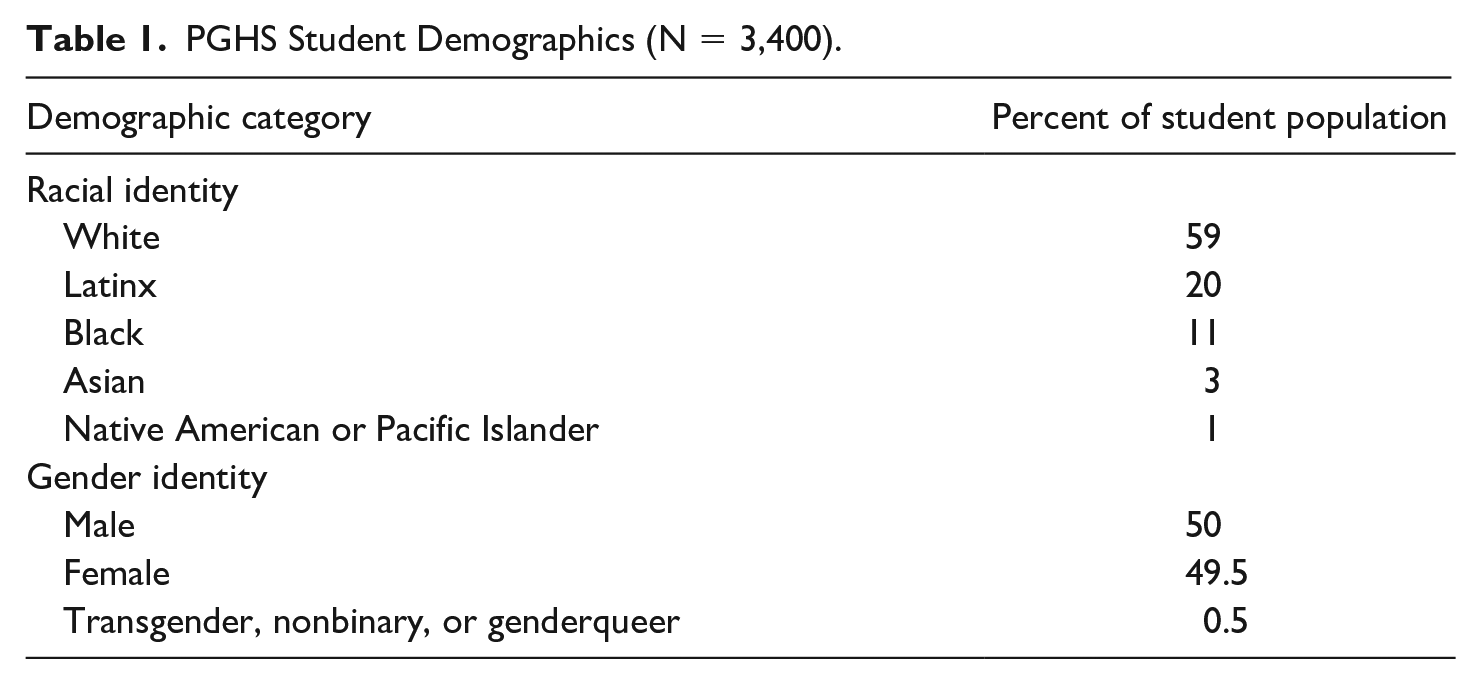
Palmetto Grove High School (PGHS) is the highest ranked of all twelve high schools in Palmetto Grove, Florida. The school offers various AP courses and extracurricular activities for students. The school’s main pride and joy is its football team, particularly this year’s “dynamic duo” forwards: Carlos Ramirez and Mason Woods. Table 1 shows PGHS’s demographic breakdown.
PGHS Student Demographics (N = 3,400).
Case Narrative
Ms. Burkes
Caroline Burkes pulls her red Honda up to PGHS and steps out, her rainbow flip-flops slapping the pavement. A social worker, Ms. Burkes as a Palmetto Grove County Title IV School Equity Initiative social worker. One of her main responsibilities is to coordinate restorative practices at each of these schools, though the label “restorative coordinator” was recently removed from her title on the county website. She splits her time among three elementary schools, two middle schools, and one high school in the county, where everyone recognizes the rapid tapping of her flip flops coming down the hall.
Today, Ms. Burkes knows she will lead a restorative process to help PGHS process an incident in which a student named Carlos pinned another student, Mason, against a wall. Ms. Burkes knows that, while Mason experienced physical violence, Carlos was defending a transgender student named Faithe Joseph who Mason had been bullying in Ms. Mendez’s Advanced placement (AP) Psychology Class. Ms. Burkes’s trusting relationships with staff and students are essential to her ability to get to the root of conflict and hold effective restorative circles. She has also spent the past week conducting preliminary conversations with each of the students involved, as well as the teacher in whose class the bullying was occurring. These preliminary conversations helped Ms. Burkes ensure that everyone involved felt safe and were willing to participate in a restorative circle (Morningside Center, 2018).
Before heading into the building, Ms. Burkes checks her social media. Local M4L Chapter Leader Judi Newman has re-Tweeted a post from the national M4L page, a meme that says “Restorative justice won’t stop bullets.” She gulps, hoping she can address the current conflict restoratively without drawing too much negative attention to the school.
Principal Dr. Louis Lopez
In his office, Dr. Louis Lopez, is having similar apprehensions. Like most mornings these days, he is fielding a worried call from Superintendent Dr. Steve Stucci, who encourages his principals to call him “Stucci.” Lopez appreciates these calls. They clue him into what might be getting said about PGHS among parent advocacy groups and the county government. Stucci is a bit of a unicorn among superintendents in Florida, in that he has his ear to the ground of the Florida Republicans but—hard of hearing all his life—experienced firsthand how Florida could let down its disabled students. His father was a longtime doner to the Republican Party, and through connections, he was allowed into a private school with a smaller teacher–student ratio that met his needs. He became a superintendent to ensure educational equity for Florida’s marginalized students. He shares Lopez’s commitment to racial and gender equity, but he keeps this opinion close to the chest. Thanks to his family’s legacy, however, Stucci is well-connected; he was recently invited to a fundraiser at Governor DiSantis’s mansion, a month before Stucci was elected superintendent of Palmetto County.
In general, Drs. Stucci and Lopez seem to share a commitment to social justice. Stucci has allowed the restorative program to continue, despite the Governor’s and parent groups’ denouncements of restorative justice and equity work. Lopez also suspects he gets some leeway given the school’s stellar football record, which is credit to star players Carlos Ramirez and Mason Woods. However, right now, there is a nervous edge in Stucci’s voice that Lopez does not recognize.
“You know I already felt nervous about that bulletin board business last month, right?” Stucci is asking him: I tempered the M4L Chapter Leader Judi Newman’s nerves when she called me about that. I basically told her it was a misunderstanding. But this Carlos incident involves a number of things that we cannot call a misunderstanding if you handle them with restorative justice. Gender, violence, restorative justice, AP Psych . . . I don’t know how much of this I can explain up the chain. I completely understand, Stucci. But Carlos did have a week’s suspension already. He and the other students need an opportunity to patch up whatever is going on between them before he can come back to class and the football team.
“He’s very lucky he’s such a star player,” Stucci chuckled.
Dr. Lopez paused. “Ms. Burkes has excellent relationships with students,” he continued calmly. “Restorative justice is part of her mental health training. If she believes this can be resolved through a restorative conference, I trust her.”
“Well, you know I’m rooting for you and for PGHS,” Stucci said. “Your football team is the pride of our county. And I personally do not want to have to ask you to do anything that is against either of our morals.”
“I know. Thank you.”
After they hung up, Dr. Lopez looked out the window and sighed. He always knew being a principal in his home county would require him to negotiate his morals with current politics. Recent laws and pressures were enough to make anyone nervous, but he remained confident that all he had to do was keep adjusting.
Three Weeks Ago: Background on the Incident
Carlos Ramirez, star PGHS football player, has an unlikely friendship with Faithe Joseph. They had connected when they were paired together during a project for AP Psychology about identity. They connected over their shared identities as children of immigrants who had faced bullying at school. Faithe’s parents, both Haitian-American public defenders, had worked hard to have her name and sex legally changed to ensure Faithe wouldn’t experience discrimination at school. Now that she could be open about her gender, Faithe started to carry herself in a more confident and joyous way. Carlos admired this about her.
Carlos told Faithe he had been bullied when he first moved to the United States due to his struggles with English. Faithe could relate, as she was currently being bullied by Mason Woods, Carlos’s football teammate. Carlos had noticed Mason call Faithe by her dead name 1 and hand her the boy’s bathroom pass as a joke. It infuriated Carlos that their teacher, Ms. Mendez, ignored this behavior. A first-year teacher, she was clearly struggling with disruptive classroom behavior.
After Mason deadnamed Faithe again in the middle of class, Carlos suggested he and Faithe talk to Ms. Burkes. Ms. Burkes agreed to meet with them, and convinced them to include Dr. Lopez, too. “You’ll be much better at convincing him than I will,” she tells Faithe cheerfully. Thinking of the new “Don’t Say Gay” act, she adds to herself: “Plus, this way, if I get in trouble for talking about sex and gender identity with a student, it will be clear that my principal knew what the meeting was about and approved it.”
In a meeting with Dr. Lopez, the four of them settled on creating a bulletin board about gender, transitioning, and deadnaming using material from their AP Psychology class. Judi Newman, on one of her regular tours through the building, noticed the bulletin board. She took a picture and emailed it to the superintendent and principal, requesting it be taken down. So as not to end up on the M4L social media pages, Dr. Lopez removed the board. Ms. Burkes and Dr. Lopez let Faithe and Carlos know they still supported them. Dr. Lopez assured them he would speak with Mrs. Mendez. Nevertheless, Faithe was scared, and Carlos was furious.
The Last Straw
The bullying continued. Since Dr. Lopez had spoken to her, Ms. Mendez tried to address Mason when he spoke out of turn. However, she fell short of naming his deadnaming and other bullying behavior. In the locker room after football practice, Carlos overheard Mason bragging about how funny his jokes were.
“Yo what does ‘transition’ even mean?” asked Mason. “Like is ‘he’ really a ‘she’ now?” he pointed at his crotch and raised his eyebrows, while explosive laughter echoed around him.
“Ha, he’s about to find out,” snarled Peter, pointing at Mason with his thumb and mockingly rolling his eyes.
“No but seriously,” Mason said. “I kind of want to know. And he-she-they-whatever won’t tell me . . . so . . . guess we’ll have to sneak into the bathroom and find out what ‘she’s’ got.”
“YO!” the word is out of Carlos’s mouth before he can stop it, more a reaction than an objection. Everyone stared. “That’s messed up,” he said, slamming his locker. “Y’all are messed up.”
Carlos hoped for an apology, or at least the silence of having been properly called out. But instead, the laughter broke out again. He looked at James, who was out as gay, but James looked away.
“Jealous, Ramirez?” Mason sneered. Carlos wheeled around and saw Mason looking at him, still mocking. The other guys watched them in anticipation, braced for a fight. Run, Carlos thought. He turned and stormed toward the exit.
Alerted to the yelling and locker slamming, Coach Smitty saw Carlos walking by and pulled him into his office. Once the door was closed, Carlos poured out the whole story. Smitty is always there for the guys when they need him—he can usually get a teacher to give them a passing grade or let them retake an exam so they can play a game. Carlos is relieved to speak to an adult he knows has power in the school.
“Carlos,” Smitty says when he finishes, his face deadpan. “Listen to me. I want you to stay out of this. Go home, take a cold shower, and come back tomorrow with your head on straight.”
Carlos left the office shaking with frustration and fear. What would happen to his friend if not a single adult in the school was willing to protect her?
Assault in the Hallway
The next day, Carlos saw Mason bolt for the door after Faithe when the bell rang. A few steps behind, Mason slid up to Faithe. The thought of him following Faithe into the restroom, as he’d indicated yesterday, flashed across Carlos’s mind. Before he could think, Carlos had lashed out and pinned Mason to the lockers.
“You talk about my friend one more time,” Carlos warned, inches away from Mason’s face.
Staring Mason in the eyes, Carlos heard his own breath. Then, he heard a scream, the static of a walkie talkie, and the squeak of shoes on the ground behind him. He felt his arm twist and turned, facing the SRO who begins to march him down the hall toward Dr. Lopez’s office. Having received word on his walkie talkie, Assistant Principal Matt Vonnegut was already on his way to the office as well. In accordance with due process for a suspension, Mr. Vonnegut met with Carlos and explained to him that his behavior was in violation of the school’s discipline code. He will be suspended for 8 days. The SRO, who has been present for this conversation, stays with Carlos while Mr. Vonnegut goes to Dr. Lopez’s office and shares the news of the suspension. Dr. Lopez calls Carlos’s mother and tells her, in Spanish, about the suspension and that she needed to come pick Carlos up.
In the car, Carlos’s mom burst into tears. She gently held his face and he could see the disappointment in her eyes. “Lo siento, Mami” Carlos muttered in Spanish, almost too choked up to speak. They drove home.
Carlos was suspended from class for 8 days. However, if he was willing to participate in a restorative conference, and cooperate with the consequences he receives to repair the harm he has caused his school community, his suspension could be reduced to 7 days. This aligns with the county’s discipline code, which states that a first-time violent offense receives a “one week suspension, plus additional consequence at the discretion of the principal.”
Preliminary Conversations
During the week of Carlos’s suspension, Ms. Burkes held individual conversations with Carlos, Mason Ms. Mendez, and Faithe. Each of them agreed to participate in a restorative circle. Ms. Mendez also agreed to an additional circle with her AP Psychology class to talk about this incident and frequent behavioral disruptions.
In her conversation with Carlos, Ms. Burkes found out how angry Carlos still was. He told her that the bullying in AP Psychology had continued, with Ms. Mendez still doing nothing to stop it. He also told her about what Mason had said in the locker room, that he had hinted plans to violate Faithe, and that he had disrespected Carlos for trying to calling him on his transphobic behavior. This new information helped Ms. Burkes contextualize the assault, though it of course did not excuse Carlos’s violent behavior.
In her meeting with Mason, Ms. Burkes asked if he knew why Carlos was so angry at him. Mason readily shared all the same things about the locker room conversation that Carlos had. He apologized for how he had treated his teammate, but he admitted he was still confused about what “’transgender’ means and all of that.” When Ms. Burkes broke down some of the terminology for him, he listened intently. He said afterward that he was very sorry he had been so disrespectful and that he wanted to find a way to repair the harm he had caused his teammate and Faithe, who he barely knew. He agreed to a restorative circle and to taking on some kind of consequence for his behavior toward both Carlos and Faithe.
A Restorative Circle to Repair Harm for Faithe and AP Psychology Class
The class circle in AP Psychology brings up a lot about that class community that needs more work and attention. Students pass the talking piece, a stuffed gator from Ms. Burkes’s alma mater, and speak one at a time about their concerns with the class in general and the incident last week. They have the option to pass, and the talking piece goes around repeatedly, giving everyone multiple opportunities to speak.
Peter, one of the students who sits near Mason and Faithe, says he is often distracted and uncomfortable by Mason’s behavior, and wants Ms. Mendez to address it. James shares that he noted the bullying Faithe was facing but was afraid to say anything and is really glad it has surfaced. Mason looks stricken by this, but when the talking piece comes to him, he acknowledges that he is simply confused and awkward about “all this trans stuff” everyone else seems to know about. He says he now has some more understanding of what things mean, and he apologizes to Faithe for deadnaming her. “I know I need to stop acting stupid just because I don’t know. I will try to ask next time and not make fun of people.”
When the talking piece gets to Faithe, she thanks Mason for his apology. Carlos apologizes to Mason and the class for endangering everyone, including himself, by slamming Mason into the lockers. He says he does not know what came over him and repeats something he had once learned about how teenagers sometimes make impulsive decisions because their brains are not fully developed yet. But then, he comes out with something even more powerful.
“I know I shouldn’t be violent,” he says, and I don’t mean to make excuses, but I know what it’s like to be bullied for who you are . . . that happened to me when I moved here and didn’t know English. Now Faithe is being bullied for being who she is, and she’s not going to change who she is, so the bullying has to stop, and I guess that’s why I . . .
trailing off, he glances at Faithe, then at Mason, then at his shoes. “I’m sorry,” he mumbles.
“Thank you, Carlos” Ms. Burkes says, retrieving the talking piece from Carlos so that she can wrap up the circle. “And thank you all. It is important in life to respect people for who they are and get along with the people we work and live alongside every day.”
A Restorative Circle to Repair Harm to Carlos and Mason
After the circle, Ms. Burkes asks Carlos and Mason if they are willing to meet with her privately, and if they both feel safe doing so. She wants to address what happened in the locker room, but does not want Faithe to have to hear about it. Carlos and Mason agree to the conversation and follow her to her office.
In her office, they talk about what happened in the locker room, and Mason apologizes to Carlos. Ms. Burkes suggests a journaling assignment to help them better understand themselves and each other, but she reminds Mason that he also committed to doing something to educate others about how to respect trans people. Then, her phone rings. When she comes back to the conversation, Mason and Carlos have come up with an idea.
“Carlos told me about the bulletin board,” Mason says, I know we can’t put that board back up. But learning what deadnaming is helped me know it was wrong. So, we were thinking maybe I could create something like a small poster for other students about it. Like what it is and why it’s bad. We could just save it for kids who need to learn. Would that be okay?
Ms. Burkes thinks this is a fantastic idea—if it is designed by a student, and not displayed as a school decoration, it can serve its educational purpose without drawing attention from M4L. She praises the boys’ adaptive ingenuity and sends them back to class.
Dr. Lopez Gets an Earful
Dr. Lopez spends the following day almost entirely on the phone. First, a parent calls complaining about the fact that Carlos Ramirez was allowed back to class after a “five minute suspension and a conversation with his victim.” A second parent calls with concerns about Ms. Mendez teaching about gender identity in AP Psychology. Third, there is the call from Sheryl Beth Daniels, who is James’s mother and Chair of the PGHS Parent Advisory Council (PAC). Sheryl Beth is calling to request Dr. Lopez’s presence at an emergency PAC meeting that evening.
Fourth, Judi Newman calls, saying she was invited to attend the PAC meeting, in her capacity as both a School Board Member and the M4L Chapter Leader. She implies that Dr. Lopez’s response to parent concerns at that meeting would determine what she posts to her constituents on social media and contributes to the national blog. Dr. Lopez knows Judi from church and appreciates her head’s up. However, the sickeningly sweet tone of her voice makes his blood run cold. “People count on me to represent certain morals. Getting out of a suspension early after assaulting a classmate? After Parkland and all these other terrible school shootings? No, sir. I’m sure you can understand”:
Stucci calls to strategize what Lopez should say at the PAC Meeting. He warns Lopez that it would be dangerous for the whole district if Dr. Lopez goes on record against M4L: You followed the discipline code. FERPA laws protect you from having to comment on it in detail. You do not need to defend restorative practices, but I’d emphasize that Carlos is facing consequences here. As for AP Psychology, just go by the standards, unpopular as they may be. Good luck.
An Emergency PAC Meeting
“Not another Parkland! Not another Parkland!” chant the 20 or so adults standing with protest signs outside the entrance to the school the following evening. One sign says, “Restorative justice won’t stop bullets.” Another says, “You can’t protect football players with restorative justice.” Other parents, and Dr. Lopez, file into the conference room.
Sheryl Beth opens the PAC Meeting with a mild “Good evening and thank you for coming.” Then, she begins: Why wasn’t I notified about PGHS becoming an increasingly violent school? Why are there no consequences for this? And why are we talking about gender and sexuality in a psychology class? If we’re talking about our sex identity, that’s pornography, not psychology.
She pauses here for cheers. “This is about parental rights and school safety. Ms. Burkes needs to be fired. We need real school safety, and a stop to pornographic discussions in school!” More cheers erupt as Dr. Lopez walks to the podium. He greets Sheryl Beth with an easy manner, and then turns to face the crowded room, which falls silent.
Principal’s Commitments
“Thank you all for coming. I have three items to share with you all this evening.
“First, we are of course all shaken by the recent event on campus. Violence has no place on our campus and the appropriate consequences were given to the those responsible. Family Educational Rights and Privacy Act (FERPA) protects this student from having the details of their disciplinary record shared. However, I want to emphasize that the discipline code stipulates no more than a 1-week suspension for violent acts, and that restorative discipline, like punitive discipline, involves real consequences.
“Second, our district’s social worker, Ms. Caroline Burkes, is a countywide treasure. She is excellent at providing powerful experiences for our students that help them repair harm and build accountability to and acceptance of one another. Given the sad history of school shootings, especially here in Florida, I think we can all agree that young people need to be learning how to solve their conflicts with words and not weapons: Lastly, as you know, we in Florida care about protecting young children from content that is developmentally inappropriate. AP Psychology standards includes topics on gender and sexual identity. These are the standards our state has deemed appropriate, and unless they change, we will respect these standards.
With that, he closes the meeting. A few parents come up to ask him additional questions, but no press seems to have arrived, and the gathering ends soon after.
Dr. Lopez and Ms. Burkes are the last to leave the building.
“Thank you for your support,” she says.
He shakes her hand. “No,” he says. “Thank you for yours.”
His heart fluttering, he takes out his phone to check what, if anything, M4L has posted about his speech.
Teaching Notes
This case ends ambiguously. In states where equity work is restricted or banned, principals acting for social justice navigate amid chronic uncertainty. Traditionally, federal and local policymakers dictate regulations for school leaders (D. Cohen & Lizotte, 2015; Scott & Holme, 2016). Leaders and school staff, however, are the “key levers for change” (Bryk, 2010; Bush & Glover, 2014), meaning they have agency within their domains (Hall & Hampden-Thompson, 2022; Taylor, 2007). In the contemporary political landscape, organizations driven by values, such as M4L, have also become key levers for change. Principals committed to social justice must grasp the parameters of this evolving educational economy and lead within its boundaries (Rodela & Bronstad, 2018b). Ganon-Shilon and Schechter (2016) call this “adaptive sensemaking,” and it is a useful frame for considering how leaders navigate the current political economy of schooling.
In our case, Dr. Lopez maintains his same school practices, but adapts how he communicates them based on the values of his constituents. He initially responds to students’ request for a bulletin board about transgender terminology and experiences, but removes it when confronted by his Superintendent and a politically prominent parent. His PAC speech represents a stronger stance, but he considers and caters to what he knows they value. He imagines they will respond better to arguments for mental health, physical safety, and state standards than equity or restorative justice. Norris (2022), writing about leadership sensemaking, calls this type of negotiation “sensegiving”: a leader’s framing of a reform according to stakeholders’ frames of reference. Several actors—the principal, the superintendent, the social worker, and even the coach—adapt their practices to support students within their sphere of influence. Ms. Burkes adapted by educating students without the board. She was aided by several students: Carlos, Faithe, and, eventually, even Mason.
We can also see this case through the lens of “Social Justice Leadership.” According to Theoharis (2007), socially just school leaders: (a) enhance school structures, (b) refocus and bolster school capacity, (c) fortify school climate and culture, (d) devise proactive strategies and coping mechanisms, and (e) confront resistance from various sources, both within and outside the school. Dr. Lopez’s support of Ms. Burkes aligns with these criteria, as her restorative practices effectively improve school structures, enhance capacity, and strengthen the overall climate. However, there are many ways in which he falls short of taking a direct and explicit stance for gender justice. While in direct response to an M4L Leader and the Superintendent, his decision to remove the bulletin board silences discussion and education about the transgender experience. Ms. Mendez’s refusal to confront Mason enables classroom bullying and creates an unsafe learning environment.
Frameworks of “Ethics of Care” (Bass, 2009; Riviera-McCutchin, 2021) and “Ethics of Justice” (Davidson & Hughes, 2020) articulate some of the critically reflexive, direct, resistant work of social justice leaders. Some argue that socially just school leaders should instill a culture of social justice within their school’s agenda (Horsford, 2011; McDonald, 2023); foster networks and social relationships among students, staff, and the community (Rodela & Bertrand, 2018a); engage in activism to challenge marginalization (Stevens, 2023; Wilcox, 2021); and engage in ongoing critical self-reflection (A. Cohen, 2014; Cunliffe, 2016; Genao, 2021). McQuillan et al. (2023) argue that school leaders who provide intensive gender-and-sexuality inclusivity professional development for school staff witness improvements in school climate benefiting LGBTQIA+ students and a reduction in behavioral incidents. While Dr. Lopez makes a series of decisions to support his students, perhaps he could have taken a more activist stance.
Discussion Questions and Activities
The following discussion questions provide opportunities for students to consider how they may have reacted if a similar case occurred in their school community. We particularly envision these questions and activities serving students as they near their internships and positions in schools. At this stage, students can practice articulating their moral obligations to marginalized groups and negotiating their technical and legal responsibilities with these obligations.
Discussion Questions
What do you think the outcome will be of Dr. Lopez’s speech?
Is Dr. Lopez a social justice leader? Explain.
Superintendent Stucci claims he shares morals with Lopez, but he is politically supported by a governor who promotes anti-equity legislation. Is this adaptive? Explain.
Do you think this story could happen at a school you have worked at? Why or why not?
In July of 2023, after this case would have taken place, Florida’s Parental Right in Education Act (colloquially known as the “Don’t Say Gay”) act was expanded to all K12 grades, prohibiting teaching about gender and sexual identity. How might Ms. Burkes address transphobic bullying in this new context? How might Stucci and Lopez support her?
How can school leaders create a safe school environment for LGBTQIA+ students?
How would you as a principal at a school using restorative justice encourage buy-in or scaffold teachers to use these practices and equity?
What should be done in a moment of physical violence between students to ensure all students are safe? Whose responsibility is this–that of SROs? School staff? Others?
Class transitions are notorious spaces to collect data on discipline, since they are a common scenario for violence. As a principal, what steps would you take to make class transitions safe, while also acknowledging common biases that play out in these types of situations?
Activities
The following activities encourage students to take on different perspectives, participate in a circle, and research different laws that affect their practice.
Activity 1: Hold a Panel Debate
Dr. Lopez walks a thin line between M4L’s demands and restorative justice. Could he have taken a more explicit social justice stance? Debate this question by assigning students to various perspectives, either in the story or conceptually. For example, a student could take the perspective of Faithe, her family, a parent (either an M4L member, or not), Ms. Burkes, or Dr. Lopez himself. Before the debate, give participants time to prepare by articulating their perspectives in small groups and making a list of talking points. Alternatively, each position on the panel debate could be occupied by a group of students who take turns being the spokesperson for that perspective.
Activity 2: Hold a Restorative Circle
Ask students to engage in a community-building circle discussion about gender equity or another topic that is meaningful to them. One student should serve as a facilitator. Students can sit in a circle, on chairs or the floor, or the circle can occur over Zoom if the class is online. Make sure the speaking order remains the same, rather than allowing for cross talk (if you are in a physical circle, you can go around the circle as many times as you have time for, using an object as a “talking piece” to designate who is speaking).
Please note that community-building circles, in the restorative framework, are not designed to address or resolve conflict, or repair harm. They are designed to help cultivate trust and understanding among members (Boyes-Watson & Pranis, 2015). Possible questions include the following:
What is the most beautiful thing you have ever seen, and why?
Was there a moment when you knew you wanted to become a school leader? Describe it in as much detail as possible.
Who in this case do you resonate with most, and who do you resonate with least? Explain.
If you could organize an additional circle with anyone in this case, who would you invite and what would your preliminary conversations look like?
Activity 3: Adaptive Training
Ask students to examine Anti-CRT or other Anti-Equity Laws in Florida or another state. Taking on the persona of Dr. Lopez, conduct a mock presentation or professional development for his teachers about how he wants them to work to support all students. What are your moral, social, political, and professional responsibilities you and your staff have in this moment, and what school-level programs, policies, and practices will ensure you meet these responsibilities?
Conclusion
In this scenario, Ms. Burkes, Dr. Lopez, and the students find themselves entangled in the intricate web of sociopolitical dynamics emerging within schools nationwide. Cordeiro and Cunningham (2012) encourage school leaders to continually adapt their practice in a way that both serves students and satisfies their superiors. Many of the actors in this story adapt their practices to both navigate their political reality and center developmentally appropriate support for each of their students. By analyzing his actions and language through various lenses, school leaders can develop a deeper understanding of the implications of their own decisions regarding relational harms and identity.
Footnotes
Declaration of Conflicting Interests
The author(s) declared no potential conflicts of interest with respect to the research, authorship, and/or publication of this article.
Funding
The author(s) received no financial support for the research, authorship, and/or publication of this article.
