




Abstract
From the 1970s onwards, women’s participation in gangs in the mainstream Western social contexts has been increasingly researched. However, the experiences of women in other cultural settings are rarely discussed. This qualitative study focuses on female members of the black-society style criminal organizations (BSSCO) in China. It starts with reviewing literature on female gang membership and on BSSCO so as to locate its discussions in the international criminological framework. This is followed by a methodology section, and then it analyses the empirical findings. This article seeks to provide some theoretical insights into the construction of female criminal membership in broader social contexts.
Introduction
In earlier studies, rarity and insignificance were associated with females’ involvement in the gang (see, for example, Thrasher, 1927). Thus, female membership has long been neglected in gang research. From the 1970s onwards, women’s participation in gangs has been increasingly researched, although what constitutes a gang is still widely contested (see Densley, 2013; Hallsworth & Young, 2008; Pitts, 2008; White, 2013). Also, research into female gang membership has been heavily focused on girls and young women, especially those of color and lower socioeconomic groups in certain mainstream Western social settings, such as the United States and the United Kingdom (see, for example, Archer, 1995; Batchelor, 2009; Bjerregaard & Smith, 1993; Campbell, 1991; Messerschmidt, 1995; J. Miller, 2001; Moloney, Hunt, Joe-Laidler, & MacKenzie, 2011; Young, 2009). As was early feminist work on women and crime in general, scholarship of female participation in the gang has appeared to be ethnocentric which often fails to consider the experiences of women in different socio-cultural contexts. This limitation has been responded to fairly quickly by feminist criminologists, and in recent years, an increasing number of studies have paid attention to women in non-Western cultural systems, although largely in transnational settings (see, for example, Hübschle, 2014; Jütersonke, Muggah, & Rodgers, 2009; Mancuso, 2014). However, Chinese women are outside these enquiries, and their participation in local criminal enterprises has not been a focus of research. Consequently, there is little known about women’s experiences in criminal groups in China—an important social context for feminist criminology.
To say China is an important context for scholarly studies on women and crime in general and on female participation in criminal enterprises in particular is not only because China is the most populous country in the world and thus feminist criminology without the inclusion of experiences of Chinese women cannot be complete and accurate. More importantly, findings from a context that has long been outside the “mainstream” feminist criminology will potentially challenge traditional perspectives. As Barberet (2014, p. 19) argues, “there is no macro theory of women and crime”; “rather, with time, the specificities and nuances have become more important than the generalities.” China, as an “unfamiliar” social context, offers a unique specificity to the wider empirical and theoretical debates to inform theorization. Furthermore, Brahm (1996) once pointed out that “Western perceptions of China are bound by a series of misconceptions and prejudices which, when combined, form the basic framework through which the events and changes occurring within China are misinterpreted” (p. 1). This observation is still true today and applies in general terms as well as in the construction of particular social phenomenon, such as female criminality. Knowing more facts helps a more balanced judgement. However, the reality is that China has long been overlooked in international criminology.
In fact, the study of female criminal membership in China has been neglected not only in international criminology but also in its home academic circles where research into women and crime as a whole is still in its infancy (Shen & Winlow, 2013). Unsurprisingly, little Chinese language literature is available on the subject. Therefore, the primary aim of this article is to provide some insights into the meaning of female membership in a particular criminal enterprise—the black-society style criminal organizations (“BSSCO”)—so as to explore some nature of female criminal membership in China and also seeks to contribute to a fuller understanding of the behavior of women in criminal groups.
To place the discussions of this article in the international criminological framework, it starts with a review of gang literature on female membership, and then a review of previous studies on BSSCO involving female members is provided to offer non-Chinese audience the background knowledge of the social reality of female BSSCO members. The two review sections serve to contextualize the empirical findings. To use gang literature on female members as a backdrop for literature review here is because both gangs and BSSCO have a key concept of “membership” that reflects the reality in these settings—individual members tend to have a sense of belonging and also attempt to facilitate the criminal activities of the group (Beare, 2012); secondly, gang literature on female membership has developed to a level that is capable of enabling key themes to form in new datasets and also for comparisons to be made; and thirdly, despite age and other differences between girls and young women in the gang and older women in BSSCO, there are similarities in females’ experiences in the male-dominated criminal world. Here, gender helps make sense of the similarities while age, culture, and other variables may help explain the differences.
Following literature review, the next section discusses the methodology used in this study and then it displays the empirical data that focus on the socio-demographic profile of the female members, their motivations for participating in the criminal organization, the role they played in group activities, and their interrelations with their male associates.
Before the discussions start, it is worth acknowledging that the notion of “West” or “Western”, as it is used throughout this article, is somewhat problematic. As Shen and Winlow (2013) explained in a similar context, although admittedly the phrase is structured in relation to a generalization, this generalization is functional as it communicates key characteristics, such as democratic governments and economics shaped by decades of neoliberalism, shared by a number of nation-states in the “Western”, developed world. “West” or “Western” is a contested term but used here “simply to communicate ‘the West’ in the general sense” (Shen & Winlow, 2013, p. 328) and the United States, Britain, and the larger economies in the “Anglo-American world” (Barberet, 2014, p. 16) in particular, which are also referred to in this article as “mainstream Western social settings/systems.”
Female Gang Membership
There is an increasing body of literature on female gang membership particularly in the United States and the United Kingdom, although similar research has also been conducted in other Western contexts (see, for example, Newbold & Dennehy, 2003; White, 2013). In both the U.S. and U.K. studies, gangs characterize life in economically dislocated minority locations and gang girls are found typically from deprived families in the impoverished communities with high concentrations of poverty, poor housing, and neighborhood problems (Joe & Chesney-Lind, 1995; Young, 2009). Early trauma of physical, emotional, and sexual abuses at home was commonly experienced by female gang members (Joe & Chesney-Lind, 1995; J. Miller, 2001; Valdez, 2007). In their “bleak” communities, there are limited employment prospects and fewer incentives to stay in school (Bjerregaard & Smith, 1993; Campbell, 1990; Joe-Laidler & Hunt, 2001). Living this powerless and marginalized life, girls participated in gangs at young ages, usually by “jumping in,” “sexing in” (Young, 2009), “drifting into,” or “joining the gang as a matter of ritual” (Southgate, 2011). Gang girls were frequently involved in alcohol and drug uses and street crimes (Moloney et al., 2011; Pitts, 2007; Young, 2009).
Female gang participation is traditionally interpreted as an avenue for challenging the traditional notion of femininity, although other incentives have also been acknowledged (see Archer, 1995; Campbell, 1991; Chesney-Lind, 1993; Connell, 1987; Taylor, 1993). It is argued that female participation in gangs is better understood as a mechanism of self-protection against poverty and victimization, and thus a response to marginalization in black communities (see, for example, Taylor, 1990). Research establishes that young women are drawn to gangs for familialism, welfare benefits, empowerment, and protection from victimization at home (Campbell, 1990; J. Miller, 2001; Moore, 1991). Gangs can provide boys and girls from deprived social backgrounds with a range of experiences and activities, and a sense of purpose, safety, security, and belonging (Joe & Chesney-Lind, 1995). In an environment with few legitimate avenues to obtain status and power, attaining a sense of self-esteem, self-importance, and respect from similarly situated peers is also an incentive for female gang membership (Joe-Laidler & Hunt, 2001; Messerschmidt, 1995). Therefore, it appears that gang experience provided girls and young women with a social life away from the constraint of their “troubled” home-life and with a social space where they could “explore their individuality, develop personality, and bond with people who share similar life histories and experiences” (Young, 2009, p. 232). Furthermore, recent studies in Britain reveal that some young women are attached to the gang for the glamour and celebrity that they believe they will find within the gang (Pitts, 2007); for some girls, joining the gang may be for the thrill of offending (Batchelor, 2009). Of course, it is salient to note the situational context of these findings, which is relevant and differs. Overall, the existing literature indicates a variety of motives for girls and young women turning to the gang and that female gang membership appears to be women’s response to their socioeconomic and familial conditions.
Apart from examining the social conditions and motivations of female gang members, previous studies have also investigated their role and status in the gang. Following Thrasher (1927), Turley (2003) contends that female members are placed in a marginalized position and usually relegated to secondary roles in male-dominated gangs. Although gang studies commonly characterize the female roles as secondary, ancillary, or subordinated (see Aldridge & Medina, 2008; Densley, 2013; Pitts, 2007), it is also recognized that gang girls play a range of functions (Beckett et al., 2013; Harding, 2014). For example, in the U.S. context, it reveals that women often perform traditional “feminine duty” in gangs (Connell, 1987; Gover, Jennings, & Tewksbury, 2009). A study on black gangs in Philadelphia suggests that female membership is an intrinsic part of the gang’s group identity (Brown, 1977). Other studies also suggest that female members play a significant, although unequal, role (Esbensen, Peterson, Taylor, & Freng, 2010; Joe & Chesney-Lind, 1995; Joe-Laidler & Hunt, 2001; J. Miller, 2001), and Anderson, Brooks, Langsam, and Dyson (2003) predicted a tendency towards equality in role and activities between male and female gang members. Although girl gangs do exist (Campbell, 1990; Jütersonke et al, 2009) and females could be leaders (Beckett et al., 2013), a study in Britain suggests that females had little, if any, possibility to hold a leadership position (Harding, 2014).
As to females’ activities in the gang, previous research indicates that gang girls are far less involved in serious criminal offending than boys (Joe & Chesney-Lind, 1995; J. Miller & Decker, 2001) but often engage in drug-related offenses, assault, fighting, and stealing (Moloney et al., 2011; Pitts, 2007; Young, 2009). Girls may be simply “hanging out” and “doing nothing” (Campbell, 1990), while some gang girls tend to go out “looking for trouble” (Joe & Chesney-Lind, 1995) or “setting someone up and having fun” (Young, 2009). Furthermore, past research also points out that some gang girls can be as violent and aggressive as their male counterparts (Campbell, 1991; Moore, 1991). Literature often suggests that girls’ violence is normalized and part of life in the gang and violence usually occurs within the context of street robbery, between rivals, or within the peer group (Joe & Chesney-Lind, 1995; Messerschmidt, 1995; Young, 2009).
The conventional criminological perspective on gender holds that gang girls’ involvement in violent crime is regarded as a voluntary strategy to seek equality with their boy counterparts (Daly & Chesney-Lind, 1988; Joe & Chesney-Lind, 1995) so as to stay in gangs and gain respectability (Adams, 1999; Joe-Laidler & Hunt, 2001). Batchelor (2009), however, argues that female violence should be understood as self-defense and thus a preventive strategy. According to Joe and Chesney-Lind (1995), violence is not something gang girls necessarily seek out; while analyzing street capital in the context of Britain’s metropolitan youth gangs, Harding (2014) contends that physical violence for females is an indication of their lack of social skills and a measure used to advance their status in the gang. Overall, despite varied interpretations, violence appears to be an important theme in female gang membership.
Moreover, in gang literature, attention is drawn to interrelations between female and male members. Earlier studies show that young women may be used as sex objects by their male associates (Campbell, 1990; J. Miller, 1998) and a recent study indicates that female members are at risk of victimization within the gang (Gover et al., 2009). Gang girls’ relation with the male members in certain gangs is abusive (Pitts, 2007) and girls are often terrorized by their male peers (Young, 2009). It is suggested that the mixed-sex gangs are often dominated by young men (Beckett et al., 2013; Esbensen et al., 2010) and boys tend to determine the range of possibilities for girls (Messerschmidt, 1997). Furthermore, research also suggests that females are generally becoming more respected in gangs (Jennings, 2013) who are not simply passive recipients of patriarchy but active participants in the construction of gender relations (Messerschmidt, 1995) and “active social actors” capable of achieving equal status with their male peers via developing “street capital” (Firmin, 2011; Harding, 2014; Young, 2009). Batchelor (2009) goes further and claims that female and male membership is almost equal.
It appears that research into female gang membership has been intensively conducted in the United States and United Kingdom and that the results have found differences in gender power, gender position, and the gendered performance in girls’ and young women’s participation in gangs perhaps due to the cultural distinctions between the two seemingly identical cultural systems in the Anglo-American world. This suggests that female gang membership is a rather complex and dynamic social phenomenon which is of great cultural, racial/ethnic, and generational sensitivity, and therefore must be explored in the context in which it is embedded. The issue of cultural and ethnic differences has already been acknowledged in recent feminist studies that address the role of women in the criminal world in a variety of socio-cultural and transnational settings (see Allum, 2007; Arsovska & Begum, 2014; Hübschle, 2014; Kleemans, Kruisbergen, & Kouwenberg, 2014; Mancuso, 2014; Siegel, 2014). Therefore, the present study must ensure not to be “domestic research conducted in a country or culture different from the readers, written—perhaps distorted—for the intended international readership” (Barberet, 2014, p. 27). It is hoped that this study, with cultural and ethnic differences alerted throughout, will make an important contribution to the meaningful international research on women and crime.
Socioeconomic Context and Female Membership in BSSCO
China’s reform era started in 1978 when Deng Xiaoping announced the implementation of the economic reform and opening-up policy. Since then, “reform China” has achieved unprecedented economic growth. However, as many emerging free-market economies, economic expansion has come at a cost to social cohesion and China has had to confront increasing crime problems such as the re-emergence of criminal gangs and BSSCO (Broadhurst, 2013).
Traditionally, criminal ganglands that existed prior to socialist China and those outside the mainland are vaguely referred to as the “black societies”. As a “feudalist social evil”, black societies were brutally suppressed in the early days of Mao’s socialist state and gradually died out (He, 2002). After a gap of nearly three decades, organized crime re-emerged in the reform era and serious criminal groups are fast growing and becoming increasingly out of control (Xia, 2006). However, in mainland China the existence of black societies—fully fledged criminal organizations—is denied by the official channels (Broadhurst, 2012) and the most serious crime groups are therefore those with the black-society style.
Females are rarely found to be members of the BSSCO which are also known as “triad-like criminal organizations” (Broadhurst, 2012, 2013) or “mafia-style crime syndicates” (Trevaskes, 2010). BSSCO are regarded as distinct from, and more serious than, simple criminal groups in their attachment to a particular locality, use of violence, and command complexity (T. Zhang, 2010). Forming, leading, or participating in BSSCO is criminalized under Section 294 of the Chinese Criminal Law 1997 (hereafter, “the Section 294 Offence”). Therefore, criminal membership in BSSCO is institutionally assessed. The Section 294 Offence is punishable by 3 to 10 years imprisonment and the maximum prison term for an ordinary participant is 3 years. Trevaskes (2010) argues that the level of punishment illustrates the perceived danger posed by BSSCO.
The existing literature indicates that BSSCO are profit driven and predatory and that their members are willing to engage in violence and terrorist methods and commonly involved in traditional gangland crimes such as street violence, extortion, and drug dealing. BSSCO are also engaged in illicit business activities such as fraud, copyright violations, financial crimes, illegal debt collection, and controlling bidding processes. Some monopolize certain legitimate markets (Broadhurst, 2013; Wang, 2014).
The issues of BSSCO have been increasingly researched in recent years, especially in Chinese academic circles. Although past research suggests a multi-faceted nature of BSSCO and enormous regional variations, BSSCO members are commonly depicted as males involved in a range of “masculine crimes” (Messerschmidt, 1993) and the existing litearture makes little reference to female members. For example, in a study carried out by Mo and Liu (2013), which examined BSSCO in central China, no mention of females’ involvement appeared, nor did it in that of Tan and Yang (2009) which investigated 20 BSSCO groups in north-west China. The few scholarly studies that do mention female members offer only a passing comment. For example, Z. R. Zhang and Li (2013) indicate that some BSSCO had young female participants who were the absolute minority and played no significant role. Interestingly, though, Jin and Li (2014) revealed an internal rule of a BSSCO which prohibited women from getting involved with money but did not offer further comment. In English-language literature, discussion of female membership in BSSCO is even rarer. Broadhurst (2012, 2013) could be an exception: to illustrate the official-criminal nexus in the context of BSSCO, Ms Xie Caiping is described as being accused, with others, of leading a BSSCO which operated around 80 gambling and opium dens for over four years. However, in these articles, the alleged female BSSCO leader is discussed in isolation from the context of female participation in the serious criminal organizations. Therefore, the fact that both Chinese and English literature in this field fails to make gender as a main reference point is quite telling. Overall, female criminal membership in China has been ignored in academic studies.
Official discourses, such as those of published court cases, routinely specify the biological gender of the defendant and illustrate the existence of female membership in BSSCO but typically offer no contextual details and therefore are of little use for theoretical construction. Likewise, official crime reports do not often mention women’s involvement. Thus, we know little about the nature and extent of female membership in the criminal enterprise through official channels.
The popular media do from time to time report high-profile cases involving BSSCO. Often their members are described as extremely violent men who are profoundly evil (see, for example, Xinhua News, 2013; 2014a, b & c). Where there is a female defendant, her biological gender is usually highlighted but typically no further details are available. Xinhua News (2014a), for example, reported a high-profile case involving Liu Han and his 36-member BSSCO, in which Liu Xiaoping was a female member. Apart from a photograph of her standing in the middle of a row with her male associates publicized together with the news report, nothing else was written about her. Therefore, media commentary is unable to provide valuable anecdotal information about the lives of female BSSCO members.
Hence, through an empirical inquiry, this study seeks to provide some evidence of female criminal membership in China so as to shed light on this under-researched area in feminist criminology, and in organized crime studies.
Methodology
The primary data in this article are drawn from a larger project involving interviews with 26 incarcerated female lawbreakers in China (see Shen, 2015). For that study, ethical approval was obtained in Britain. However, gaining access to a Chinese prison was a painstaking process. The lengthy negotiation was assisted by the personal contacts of the researcher, who had close connections with the local prison authority. Strict confidentiality and anonymity were put in place to protect the identity of the individuals who have facilitated this study. All names of participants and places in this article are pseudonyms.
Since the nature of female criminal membership was a key research question, a sample was to be selected from female prisoners who were convicted of the Section 294 Offence. It turned out that as of July 2013 when the fieldwork was in preparation, there were a total of seven women in the sample prison who were incarcerated for being involved in BSSCO as members. All of them were selected and agreed to participate in the research.
Learning from earlier studies (Joe & Chesney-Lind, 1995; Joe-Laidler & Hunt, 2001), the fieldwork was divided into two stages. In the first stage, the participants were asked to answer a set of questions about their socio-demographic backgrounds, which was conducted prior to the interviews with the assistance of prison staff; the second part was the interviews. While all seven participants completed the questionnaire, only four were interviewed because two women had completed their terms and left the prison before the interviews were due to start and the other was thought unfit for interviewing by the prison staff due to an illness she was suffering. The analysis in this article is primarily based on the original data drawn from the questionnaire and the interviews. No monetary rewards were paid to the interviewees pursuant to the prison rules.
The interviews were conducted in the counseling room of the Inmate Psychological Well-Being Centre within the sample prison. Each respondent was informed of the voluntary nature and confidentiality of this research at the beginning of the interview before signing the consent form. While an interview was taking place, a designated officer sat with the other respondents in a separate room, who from time to time came to observe the interview through the window. Thus, confidentiality was guaranteed.
Because recording devices are strictly prohibited by the prison authority in China, the interviews were recorded by note-taking in Chinese and the field notes were word-processed and simultaneously translated into English immediately after the interviews. In this way, gaps in the notes were filled in contemporaneously with fresh memory. Data analysis began from processing the field notes. No data analysis software was used, as manual coding appeared to be sufficient to enable the relevant factors, attributors, and variables to emerge.
Several limitations in this study should be acknowledged. The first two relate to generalization—making generalizations about China, a vast country known for enormous regional variations, is a danger and attempting to generalize about all female members in BSSCO is another risk given the small sample size. Also, due to a lack of the systematically recorded national data, it is not possible to determine how representative the participants are of female members in BSSCO. However, given that all seven women convicted of the Section 294 Offence provided answers to the survey questions regarding their socio-demographic backgrounds and among them four were subsequently interviewed to detail their involvement in the criminal groups, the use of data obtained in this context should be valid and it has provided some insights into female membership in BSSCO. Moreover, it is worth noting that the interviews were conducted in the prison environment in a country where access to prisoners is extremely difficult and fieldwork is often restricted with conditions. Therefore, the evidence gained here should serve as a starting point to inspire future even more rigorous research.
Empirical Findings and Analysis
Table 1 illustrates the socio-demographic profile of all seven women at the sample prison who were incarcerated for forming, leading, or participating in BSSCO.
Socio-Demographic Profile of the Female Members in BSSCO (n = 7), July 2013.
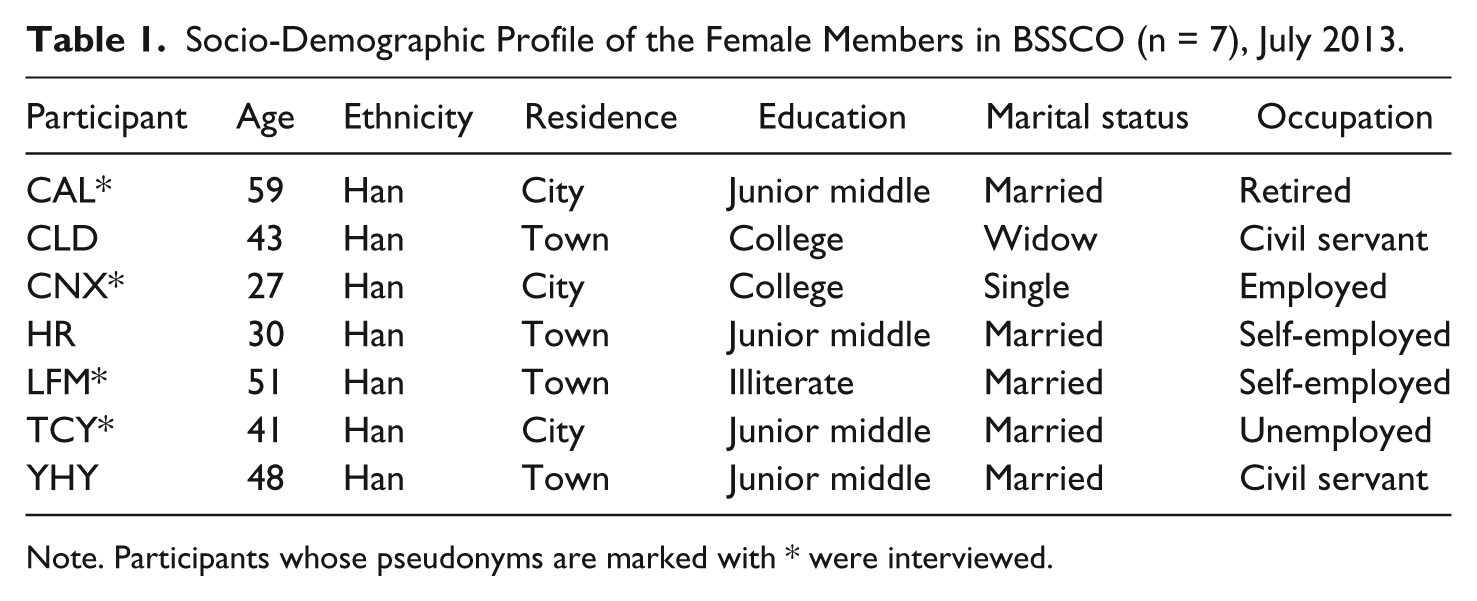
Note. Participants whose pseudonyms are marked with * were interviewed.
The Participants
All seven participants were mature women between 27 and 59 years of age. While 51-year-old LFM was illiterate, all others had completed secondary education or higher. Five were married with one or two children, one was single living with her boyfriend, and another was widowed. All participants were residing in urban China prior to arrests, and two were unemployed, two were self-employed, another two were civil servants, and one was a retired worker. Except LFM who lost both parents at a very young age and had an extremely deprived childhood, the participants were commonly brought up in ordinary families by both parents. None of the seven participants reported childhood abuses or victimization in adult life. Before turning to BSSCO, they lived an economically sustainable family life. None of them was addicted to drugs or alcohol, had previous convictions, or had their family members who had been convicted of crime.
Hence, the overall profile of the female BSSCO members differs considerably from that of the girls and young women typically depicted in gang studies in the U.S. and U.K. contexts in which the theories of pathways are drawn to link victimization, usually childhood abuses and the powerless and hopeless adult life conditions, to female lawbreaking (DeHart & Lynch, 2013). Here, the pathways model does not seem to be precisely applicable to the respondents in China whose life trajectory might have been too “ordinary” to render them to be potentially violent, amoral, or profoundly evil as their male counterparts are perceived. Therefore, perhaps female participation in criminal enterprises in contemporary China should be better understood in a broader socioeconomic environment that is marked by economic marginalization of under- and working-class women as well as gender inequality.
Motives for Turning to BSSCO
The interviews reveal that, as some gang girls in the United States and United Kingdom, the respondents typically flowed into BSSCO through connections with the existing members, usually the leaders, who were either their intimate partners or acquaintances known through gambling. However, a deeper analysis uncovered some structural factors that are associated with the women’s attachment or commitment to their groups, including social and gender inequalities in reform China, although economic gain seems to be their primary incentive.
BSSCO are typically profit driven. For the respondents, economic advantages associated with the criminal enterprise were certainly an attraction and BSSCO provided them with financial rewards which they would not otherwise have been able to gain through legitimate channels, as TCY noted:
The gambling den made me a successful woman. I had my own expensive cars and big apartments in the city . . . it made good money . . . and I was able to gamble in Macao’s casinos. What else could I do to get all these things?
Under the free-market economy, all relations are defined in monetary terms in China (Dutton, 2005) and money has become a key, if not sole, criterion to judge one’s value and capability. As a result, there is a general money-making mentality in the society as a whole, which has had a significant impact on people, including the respondents in this study. As Winlow and Hall (2013) highlighted, the power of money creates the “mediated images” that seduce individuals’ “private space of susceptibility” and begins to change the traditional values. Women are part of this cultural shift. Like men, they are expected to take the initiative to establish businesses and achieve economic successes (Chen, 2008). On the other hand, they are subjected to the deep-rooted gender discrimination (The Guardian, 2014) and opportunities are constrained to them, as CNX, the only female member of a BSSCO which primarily ran illegal gambling, remarked:
I graduated from a teaching college. Initially, I had a job in a foreigner owned company doing some basic statistical work. I got between 1,000 to 2,000 yuan per month (10 yuan = approximately US$1.6) . . . Six months later I met my boyfriend at a social gathering. He was the leader of a group of young men. Soon after that, I quit my job.
The free market does indeed create jobs, but they, as that CNX once had, typically offer little reward, financially or spiritually, to individual workers. According to CNX, the group did enable her dreams of “making a lot of money” to come true and her participation in it rewarded her with “freedom and space” - a “meaningful life” in her term.
Secondly, the data show that material consumption is a strong incentive for female participation in BSSCO. Commercialism, individualism, and consumerism—once viewed as bad Western influences and kept outside China—have now become the prevailing social norms (Liu, 2005). In Western industrial societies, the pervasiveness of consumption is seen to have inevitably produced criminogenic consequences (Hall, Winlow, & Ancrum, 2008), of which the gender impact is remarkable. In Britain, for example, the association between feminine consumption and female lawbreaking has been acknowledged (see Sharpe, 2012). The same link in China is supported by the stories of the respondents, as TCY illustrated:
At one point I had loads of money, which I used to buy luxury products, such as designer clothes, watches, bags, expensive cars, and apartments. They really made me feel a sense of achievement and success.
Indeed, feminine consumption in contemporary China is presented by spending on not only branded consumer goods but also products demonstrating social status, such as expensive cars and urban housing (Goodman & Zang, 2008). Moreover, leisure consumption has also been incorporated into consumer culture. According to CNX, a “meaningful life” also meant “to go out to have dinner . . . every day, and go to a Karaoke bar afterwards.” Here, the ability to spend in entertainment facilities, as “experiential consuming” (Malbon, 1999, p. 183), was apparently associated with the BSSCO membership and thus an incentive for the young woman to participate in the group activities.
Thirdly, the data show that the respondents might have turned to their groups for certain psychological needs—seeking a sense of belonging, self-worth, and (imaginary) welfare support. In the reform era, the collective life that featured so highly in socialist China over three decades ago has not survived the free-market rules. Consequently, the danwei (work units) system—used to symbolize a “public family” (Bray, 2005) and offered lifelong employment and social security to urban people—has fallen apart. As a result, job security and social protection are no longer provided by the state-owned danwei for their workforces; the private sectors offer limited welfare and benefits to their employees (Harvey, 2005). To solve the problem, the Party-state places increasing emphasis on individual capabilities and hopes to create opportunities, by spurring economic growth, to enable individuals to generate wealth and help themselves. In this context, individuals are compelled to work hard to make money and provide their own security. The result of this process is the disappearance of collective life (Baudrillard, 1998) and individuals’ feelings of loneliness, helplessness, and insecurity, as TCY explained:
After divorce, especially when my daughter was not with me, I felt I was lonely and bored to death. I had nowhere to go and nothing to do . . . I started to go with my brother to watch people gambling. Later I joined them and soon became addicted to it.
LFM was also a lonely woman, a small business owner selling hot snacks in a night market. Her husband was a taxi driver, with whom she has two grown-up children who both had left home:
I was so bored during the day . . . I went to gamble most days. After joining the company (the BSSCO), I went there every day. Sometimes I went just to chat with people and I felt lonely on my own.
For both women, the search for companionship, something to do, and some excitement initially led them to gambling and then the involvement with BSSCO. It was gambling and subsequently the group activities that filled in the lonely women’s empty lives. Thus, BSSCO seem to have provided a “suitable” environment which, to a certain extent, substituted danwei and satisfied the needs of the mature women who lived at the margins of mainstream Chinese society.
As the data show, the respondents turned to BSSCO for the economic advantages as well as certain psychological needs. Thus, despite the remarkable contextual differences between the gangs in the United States and United Kingdom and BSSCO in China and some contrasting socio-demographic characteristics between gang girls and mature women in BSSCO, there are shared rewards. The data also indicate that female participation in BSSCO appears to be the women’s responses to their living conditions in the reform era, which have been negatively affected by the fast changing environment shaped by neoliberal policy and practice.
Female Members’ Role and Status
The data show that none of the groups the respondents were involved in had a dominant organizational structure and that the internal organization of these BSSCO was typically fluid and transient. Although clearly money driven, they typically had no defined objectives, in which the respondents played a variety of roles.
Female leadership, although rare, did appear in this sample set and TCY was convicted of forming and leading a mixed-sex BSSCO, dominated numerically by men, which was primarily running illegal gambling. Prior to forming the group to pursue personal wealth through illicit activities, she had made a number of legitimate business attempts which, although failed, provided her with business management and leadership experiences:
I borrowed tens of thousands of yuan from my relatives and friends to start up the business. Initially, we lent money only to people whom we knew well, but later we lent to strangers, too. To get the loan and interest back, we started to use migrant workers . . . I had good guanxi (social networks). A lot of gamblers liked to come to my place. I looked after my friends (around 20 stable associates) and paid them good money. I had contacts in the local police . . . I had an influential friend, he always supported me.
Clearly, to hold the leadership position, in addition to experiences and skills, TCY had a number of distinct qualities—determination, strong personality, and extensive networks both in the deviant circles and with the corrupt police officers—a combination of these enabled her to be able to command in the patriarchal criminal world.
All other respondents appeared to have played a variety of auxiliary roles in their groups. LFM, who ranked herself as laosi (the fourth) in her group, was responsible mainly for debt collection. However, her lack of knowledge of the group suggested that she was in fact outside the leadership and only an ordinary member. CAL was in a similar position. Despite being the wife of a top leader for over 30 years, she was kept outside the decision-making processes, which she had accepted, “My husband did not discuss business with me but that’s ok.” CNX was part of a BSSCO led by her boyfriend. She was expected to perform traditional “feminine duty” and often asked to “hand out refreshments to gamblers” while “the guys were busy.”
Hence, although the female members played various roles, including being a leader, in their groups, there is overwhelming marginalization and inequality associated with female membership in BSSCO. Also, like girls and young women in the gang (see Steffensmeier, 1983), the female BSSCO members tended to be congruent with existing gender roles in group activities.
Female Members’ Activities in BSSCO
The groups, to which the respondents belonged, were typically engaged in running illegal gambling, loan sharking, and monopolizing markets with criminal methods, and the female members were involved in activities around these “businesses”.
As a leader, TCY’s activities were largely managerial and supervisory. According to herself, in addition to general organization, daily management, and networking, “I usually only oversaw (the performance of) my friends who were keeping an eye on the hired (migrant) workers.”
As an ordinary, female member, LFM’s job was yaozai (collecting debts), “I usually went to the debtors’ houses to ask for money. If they did not give it to me, I would swear at them and make a scene. Usually they would give in.” Although her methods included mainly personal harassment, verbal abuse, and threats, she sometimes ended up beating debtors up when they refused to pay, which was usually exercised along with her male associates. The activity of CAL—the wife of a leader—was primarily “house-keeping” for the BSSCO which operated behind an iron-ore company and which she saw belonged to her family, “I was always there to help look after the company, say, preventing people stealing raw materials from our warehouses and chasing debtors.”
The group that CNX was in was engaged in gambling, loan sharking, and forced trading. Perhaps because she was the leader’s girlfriend she was expected to do only “trivial things” and kept away from serious criminality. According to herself, she had been purposively protected by her boyfriend and other male associates from “getting into big trouble.” However, without speaking to the male members, this assertion remains her own.
The data indicate that violence and threat of violence were commonplace in the BSSCO concerned. However, unlike that observed with gang girls, no evidence here suggests that physical violence frequently involved the mature women in BSSCO, although the respondents reported that they commonly tolerated or even benefited from the violence exercised by the men. Although violence was not a theme in the lives of the female members, they were not completely free from it and it appears that female violence could be a strategy of the women to function in the male-dominated criminal environment: For LFM, “being able to beat debtors up along with the men” was perhaps a show of extra effort made to keep up with the male standard (Kanter, 1977); for TCY, being capable of using any available means, including violence, was necessary to defend her money-making method (Hall, 2013) and enable her to build up her reputation to command in the competitive criminal markets. Thus, the ability to utilize violence should be understood as a form of femininity that is situated within the social context of BSSCO like that girls and young women devised in the gang (see Skeggs, 1997).
The evidence here suggests that the female members’ group activities, although varied, were clearly “business” related and meaningful. Although compared with their male associates the respondents frequently carried out supportive activities and were outside decision-making, the data do indicate active agency of the women and their dynamic interactions with the male members.
Interrelation Between Female and Male Members
Existing evidence suggests that BSSCO are commonly male-led, and mixed-sex groups are typically male-dominated with male members as the vast majority. Unlike girl gangs in other geographical contexts such as the United States (Campbell, 1990) and Central America (Jütersonke et al., 2009), all-female BSSCO do not seem to exist. In the male-centered criminal enterprise, interactional dynamics are inevitable for women (Kanter, 1977).
Among the respondents, there were independent members as well as the intimate partners of the male leaders. The former, as discussed earlier, were able to either stand out and command or make extra effort to perform alongside the males, whereas for the latter, their domestic status was usually extended to determine their social status in the group: CAL was addressed within her group as “dasao” (respectably, the big brother’s wife); CNX was called by her male associates “laobanniang” (respectably, the boss’s wife) and both tended to shadow their male partners. This finding does not support the “desistance theory” (Laub & Sampson, 2003) which suggests that marriage promotes desistance from crime through informal social control exercised by the wife who is usually less criminal than the husband and thus marriage leads to the reduction of crime. For the theory to apply, two conditions must be satisfied: first, marriage needs to be a key life course transition that leads to the changes in individuals’ criminal behavior (Laub & Sampson, 2003). Contrastingly, the situation of CAL involved the gradual development of a criminal career on the part of her husband as the “criminal” partner during a long-established marriage, while CNX had not yet married the BSSCO leader; and second, the criminal partner needs to appreciate that his continued involvement in crime may jeopardize the comfortable lifestyle of a stable family (Laub & Sampson, 2003; Sampson, Laub, & Wimer, 2006; Skardhamar, Monsbakken, & Lyngstad, 2014). Apparently, this condition is not satisfied in the present data set: CAL did not even accept that her husband was wrong, “I had never thought he could be leading a criminal group. We have been married for over thirty years and he is a nice man.” A simplistic analysis would suggest this female BSSCO member showed no remorse. However, a more in-depth analysis may suggest this claim as not totally nonsense. As Hobbs (1995) pointed out, committed professional criminals also have families and all sorts of everyday needs. Thus, CAL and her husband could well be a loving couple but also associates in a criminal group.
Secondly, the data suggest that gender relations in BSSCO mirror precisely those of normative Chinese society. Traditionally, China was a strongly male-centered society. Despite the profound social changes in the recent few decades, patriarchy still dominates the social and familiar spheres (H. Zhang, 2014), including the sphere of criminal enterprises, as CNX illustrated:
I was not interested in gambling, but just wanted to be there with my boyfriend. Since I started to be with him, I stopped socialising with other friends . . . most of the time when they (the male members) were busy, I was just playing my phone or day dreaming.
It appears that, like women in the normative society, female BSSCO members were also expected to observe the traditional female virtue which is broadly defined in terms of sexual chastity, modesty in dress and speech, and obedience to their men (Bailey, 2012). Also, as observed in the U.S. studies (Joe-Laidler & Hunt, 2001; Moore, 1991), there is a double standard for female members in BSSCO, who had to earn respectability by maintaining their sexual reputation, according to CNX:
I was always quiet. I rarely joined them (the male members) when they were talking about business. I did not gamble, drink alcohol, or take drugs. I acted as a laobanniang, and no one made a (sexual) joke of me like they did to other women.
Apparently, to be respected by her similarly situated male peers, the young woman had to be “good”—conforming to the traditional female gender code, while sexual power and sexual appetite were allowed for the men. Thus, as Daly and Chesney-Lind (1988) argued, gender relations, even in the criminal world, are based on an organizing principle of men’s superiority and their social and political-economic domination over women. Here, taking the stories of the respondents as a whole, it may be added that in BSSCO, although women’s behavior is generally restricted in accordance with the traditional female gender norm, the ability of money-making increases women’s financial, social, and human capitals which may, to a certain extent, alter their social position. In this respect, gender power and gender relation in the criminal world reflects that in today’s mainstream Chinese society.
No evidence in this study indicates that the mature women in BSSCO were used for sex purposes or victimized in any way by their male associates as appeared in the gang literature. Although in the context of BSSCO women’s responsibilities were also largely determined by the men, they did have an active role to play in the group activities. Although their role might not be equal to that of men, they seemed to be recognized and not disrespected.
Conclusion
As a “self-conscious discipline”, feminist criminology constantly renews itself to include overlooked or new perspective (Barberet, 2014): In the 1980s, it questioned how theories would appear if they were fashioned from women’s experiences (Daly & Chesney-Lind, 1988); today it challenges the established feminist perspectives as we add more experiences of women in “unfamiliar” socioeconomic settings, such as China.
Female participation in criminal enterprises in China has long been neglected in criminological research. Consequently, the existing literature portrays BSSCO members as predominantly violent males, and little is known about female membership. Like in other social contexts, for example, Britain, where in gang research female experience used to be habitually neglected or conveyed through the experience of men (Pitts, 2007), research into BSSCO in China seems also to be “androcentric” (Young, 2009) and thus women’s problems are marginalized and often ignored in policy consideration. At the same time, China has also suffered neglect in international criminology as a cultural context outside the Western, developed world, in which literature on female criminal membership has been primarily construed while Chinese women’s experiences are rarely considered in theorization. As a result, the knowledge gaps have meant the possibly distorted representations of women and their behaviors. To respond to this, feminist criminology increasingly encourages empirical enquiries into women and crime in wider geographical and social settings; it also constantly reminds us of the structural-social as well as historical-cultural contexts when interpreting data. To follow this trend, this article has sought to explain female participation in criminal groups through a gendered as well as a cultural, comparative lens. A gendered lens has helped it to go beyond the traditional gender role analysis and to recognize also active agency of women in the criminal world; a cultural, comparative lens has enabled a better understanding of the impact of social changes, locally and globally, that have created an environment with few opportunities, little support, and hope for women, which makes them “vulnerable to crime commission” or even makes crime “part of their limited choice” (Barberet, 2014, p. 24), despite varied overall situational contexts in different socio-cultural systems.
Thus, based on original data, this study makes unique contributions to the international evidence on female participation in criminal enterprises which has shown that girls and young women turn to gangs for the welfare, empowerment, and protection, while the findings in the present study have broaden the previous perspective and suggest that mature women in reform China may participate in criminal enterprises for wealth, consumption power, freedom, as well as certain psychological satisfaction.
In line with the existing literature, it also suggests that female BSSCO members play a variety of, although mainly supplementary, roles in the group activities. However, it notes that, on the one hand, gender identity in the criminal world mirrors that in mainstream Chinese society, with men in the center and women in the margins of the familial and social lives; on the other hand, there are active agency of women and dynamic gender interrelation. As observed with the late-20th-century U.S. gang girls (J. Miller, 2002), participation in BSSCO indicates mature women’s acceptance of economic self-sufficiency and independence in the increasingly marketized Chinese society.
Towards the end of this article, it becomes clear that female criminal membership is a complicated social phenomenon which cannot be explained by one single theory. However, this study supports findings in other social contexts which suggest that group involvement can be both rewarding and destructive for girls/women (Batchelor, 2009). Although women are traditionally passive members in male-dominated criminal groups (Siegel, 2014), their position may change where they are compelled to respond to their living environments. As we have seen in this Chinese case, the free-market economy offers fluid opportunities and rewards such as wealth and power of consumption which seduce women into criminal organizations that facilitate to quickly crystallize the advantages in the criminal markets. To a certain extent, economic power alters gender position for women.
Finally, it is worth highlighting the issue of generalizability. As E. M. Miller (1983) pointed out, it is inappropriate to generalize a researcher’s interpretation of one cultural situation to female criminality elsewhere in the world. Thus, the findings in this article should not be attempted to portray women as a homogeneous group, nor should they be attempted to generalize Chinese women’s position in the criminal world. The findings here, which are open to replication, will hopefully encourage future research employing more rigorous sampling methods and more representative samples (Withrow, 2014).
Footnotes
Acknowledgements
I would like to sincerely thank all of the anonymous reviewers for their helpful comments and valuable advice on an early version of this article. Any errors remain my own.
Author’s Note
An earlier version of this article was presented at the British Society of Criminology Annual Conference in Liverpool (UK), July 2014.
Declaration of Conflicting Interests
The author(s) declared no potential conflicts of interest with respect to the research, authorship, and/or publication of this article.
Funding
The author(s) disclosed receipt of the following financial support for the research, authorship, and/or publication of this article: I would like to thank Teesside University (UK) for their support. The fieldwork that generated the data used in this article was funded under their International Visiting Academics Scheme, 2013-2014.