



Abstract
The current study aims to shed light on how masculinity threat and challenges from women translate into fantasies of mass and gender-based violence. These attitudes are evident among some self-proclaimed “incels,” who blame social liberalism, feminism, and sexually active men for their rejection from women. We developed a measure of “incel” traits, which was administered in an online self-report survey of 18- to 30-year-old heterosexual men in the United States. As hypothesized, stress in one’s inability to live up to norms of masculinity and endorsement of “incel” traits are associated with violent fantasies about rape and using powerful weapons against enemies.
Women experience intimate partner violence, stalking, and rape at higher levels than men. These disparities are particularly pronounced for stalking and rape, for which women are approximately 74% and 90% of victims (Smith et al., 2018). These statistics reflect a societal issue with gender-based violence that exists in countries across the world. The United States, however, is unique in that it has the highest mass shooting incidence rate in the globe, which disproportionately affects women (Christensen, 2017; “Global Firearms Holdings,” 2018). Family and romantic partners are targeted in 54% of mass shootings, leading to an overrepresentation of women and children compared with single-victim gun homicides (Everytown for Gun Safety, 2017; United Nations Office on Drugs and Crime, 2013). Various shooters have an explicit history of gender-based violence, further suggesting that mass and gender-based violence are intertwined (e.g., Lopez, 2017; Sakuma, 2019). Despite these patterns, and that men commit 94.4% of mass shootings, policy and mainstream debate tend to neglect a gender approach (Ramsey, 2015).
Further exemplifying a connection between mass violence and gender, several U.S. mass shooters in the past 5 years participated in online communities where men discuss frustration with sexual/romantic rejection and espouse sexist attitudes against women (Hines, 2019). Today’s “incel” discourses—short for “involuntary celibate”—blame feminism for their celibacy, claim that women are genetically inferior, and complain that women prefer more “genetically superior” men (Ging, 2017; Hines, 2019). Some members adopt more extreme views such as sexual slavery, redistribution of women, and violence against feminists. In May 2014, a college student killed six and wounded 14 in Isla Vista, California—his “Day of Retribution” for a lifetime of romantic and sexual rejection was outlined in a manifesto that embraced radical “incel” views (“Elliot Rodger: How Misogynist Killer Became ‘Incel Hero,’” 2018). Reddit, a website that contains thousands of forums where users share and comment on content, banned the “r/incel” subreddit (community forum)—which had over 40,000 members—for “hosting violent content” (Bell, 2017).
The Isla Vista shooter inherited the title of “incel hero” online, receiving praise from a community that shares his resentment of women and men who engage in sex (“Elliot Rodger: How Misogynist Killer Became ‘Incel Hero,’” 2018). One supporter drove his van into a crowd in Toronto, killing 10 and injuring 15. He stated in a Facebook post before the attack: “The Incel Rebellion has already begun!” and referred to the Isla Vista shooter as the “Supreme Gentleman” (Wendling, 2018). About 6 months later, a man shot and killed two women, wounding five others, in a yoga studio in Tallahassee, Florida. This shooter expressed “incel” sentiments in videos about women’s lack of understanding about the “societal pressure that’s put on an adolescent male” and expressed sympathy for the Isla Vista shooter (Chavez & McLaughlin, 2018). It has been estimated that seven mass shootings in the past decade involved a person who participated in “incel” online communities (Hines, 2019).
These three “incel” shooters—and some members of the online community of which they are a part—espouse attitudes long studied by gender scholars: hostile sexism, masculinity threat, gender role stress, and toxic masculinity. Decades of research has linked such attitudes to a host of negative outcomes, such as rape proclivity, intimate partner violence, and substance use among men (Casey et al., 2017; Munsch & Willer, 2012; Peralta et al., 2010). In particular, studies show that men who feel threatened by the social progress of women, and men who feel threatened by women in their lives and workplaces, are more likely to hyper-conform to masculine identity traits and exhibit anger and aggression toward women (Dahl et al., 2015; Eisler et al., 2000; Munsch & Willer, 2012; Reidy et al., 2014; Willer et al., 2013). In linking the “incel” phenomenon to the gender attitudes of men, we ask: are men who believe the status of men is threatened or exhibit gender role stress—as is evident in the “incel” community—more likely to fantasize about mass and gender-based violence?
We investigate these processes among 18- to 30-year-old men in the United States, the demographic of most mass shooters (Fox & DeLateur, 2014). Rather than directly studying self-proclaimed “incels,” we consider this group an “extreme” community in which masculinity threat and fantasy about (mass and gender-based) violence are heightened and crystallized. Most men are not “incels,” and most “incels” will never engage in the rare act of mass violence. But by examining traits embedded in this community, and the degree to which they exist in a broader sample, we test theoretical mechanisms without categorizing “incels” and non-“incels.” Given a potential link between “incels” and violence and the dearth of academic scholarship on the topic, we ask: what are the underlying traits of “incels?” We develop a 20-item scale with two underlying factors that tap into feelings of defeat and hatefulness reflected in “incel” discourse. We distribute a self-report online survey to 18- to 30-year-old men, exploring: are men who more strongly endorse “incel” traits more likely to fantasize about mass and gender-based violence? We propose that mass shootings—more specifically, one’s fantasies about committing such an act—can be understood through a gender lens and in relation to violence against women.
Group Position and Threat
Prejudice is rooted in a feeling of entitlement to certain privileges and resources among the dominant group; fears that the subordinate group is planning to take these resources results in the perception of threat (Blumer, 1958). Blumer (1958) outlines four feelings in dominant groups which could lead to prejudice: a feeling of superiority, the belief that the subordinate group is intrinsically different, a claim to areas of privilege, and a fear of threat from the subordinate group who desire the dominant group’s advantages. Group threat can lead to harassment in the workplace (McLaughlin et al., 2012), further justification of social inequality (Weaver & Vescio, 2015), and even laws or policies that aim to exclude specific groups of people (Obaidi et al., 2018).
Although Blumer (1958) mainly uses his framework for racial prejudice, it can be applied to many group hierarchies. Branscombe et al. (1999) further elaborated on the types of threat members of dominant groups experience. Acceptance threat is the sense of rejection and derogation for not truly belonging to the group. Status threat is the sense that the group’s value is undermined by outside sources. Acceptance threat involves an internal threat from the group (doubting your standing in the in-group), while status threat entails an outside threat to the group (men as a whole are threatened by reduction of the status as men). Both can be used to understand gender hierarchies and men’s response to women’s progress.
Threats and Masculinity Challenges
When a man’s gender identity is threatened, he is more likely to endorse traditional gender roles, overcompensating to appear more masculine. This form of acceptance threat includes displays of toughness, aggression, lack of empathy, devaluation of women, need for respect, competitiveness, and homophobia (Bird, 1996; Dahl et al., 2015; Harris, 2010; Harris et al., 2011; Kupers, 2005). In Munsch and Willer’s (2012) study, respondents were given false feedback about their gender identities and then asked their views on date rape and sexual coercion vignettes. Men whose gender identities were disconfirmed assigned more responsibility to victims and less to perpetrators than men whose gender identities were confirmed. Conversely, and consistent with expectations, women whose gender identities were disconfirmed assigned less blame to victims and more to perpetrators than women whose identities were confirmed (though the magnitude of difference between confirmed and disconfirmed respondents was larger among men than women). Munsch and Willer’s (2012) study is an example of acceptance threat in that those who perceived a threat to their group membership reacted by supporting their in-group more and blaming or rejecting the out-group.
When individuals feel their group as a whole is threatened, they may respond by emphasizing their status as members. Willer et al. (2013) test the masculine overcompensation thesis, which asserts that men who hold the belief that the status or position of men in society is under threat will react with extreme displays of masculinity. Men who more strongly agreed that “recent changes in our society often disadvantage men” were more likely to endorse war, homophobia, and misogyny—women’s attitudes were not significantly related in this way (p. 1000). By experiencing a status threat to their in-group identity, men “hyper-conformed” to in-group traits (Branscombe et al., 1999; Maass et al., 2003). This threat forces men to question their dominant group privilege; such a challenge to authority may result in attempts to “preserve the integrity and position of the dominant group” (Blumer, 1958, p. 5).
Feminist scholars have utilized notions of masculinity to understand gender-based violence for decades. There are multiple forms of masculinity, and they are all socially constructed; however, they are not all valued and treated as hegemonic (Everitt-Penhale & Ratele, 2015). Masculinity requires “doing gender” by continuously proving and seeking validation of one’s manhood (Vandello et al., 2008; West & Zimmerman, 1987). Exhibiting traditionally feminine behaviors, like nurturing, puts men at risk for being called out as “less of a man” (Glick et al., 2007). Furthermore, the idea of “not measuring up” to the hegemonic masculine ideal thereby creates a masculinity challenge for subordinated masculinities.
When one’s masculinity is challenged or threatened, men react to social situations or interactions that put their gender identity in question. These challenges motivate behaviors that aim to correct these subordinating assumptions, through situationally appropriate actions and scripts (Messerschmidt, 2000). Men draw on what Messerschmidt (2000) terms masculine resources to respond to these threats. This includes posturing, competitiveness, aggressiveness, abusing alcohol, objectifying women, and pursuing sex to appear more masculine, reduce ridicule, and command respect in the face of masculinity challenges (Bosson et al., 2009; Harris, 2010; Harris et al., 2011; Heinrich, 2012; Messerschmidt, 2000, 2018). Men may distance themselves from the out-group (women and subordinated men) through derogation as a means to discredit or minimize threat (Maass et al., 2003; Petriglieri, 2011).
Strain, Entitlement, and Mass Violence
Mass violence scholars offer a framework for understanding the relationship between masculinity, entitlement to women, and mass violence. Fox and Levin (1998) provide typologies of mass murder by examining predisposers, precipitants, and facilitators that are common among mass killers. “Predisposers” include intropunitive aggression (aggression turned inward), frustration, and externalizing blame, which contribute to fantasies of vengeful murder (Fox & DeLateur, 2014; Fox et al., 2018; Fox and Levin, 1998; Kalish & Kimmel, 2010). Using a stress perspective, predisposers can be thought of as chronic strains: long-term frustrations, like bullying or ostracism, that lead to social isolation, suspicion, and hostility (Levin & Madfis, 2009).
Fox and Levin (1998) also point to “precipitants,” events such as job loss and inspiration taken from other mass killers (p. 439). Precipitants can be thought of as acute strains in that they are short-term events that seem catastrophic in nature, such as “rejection by a girlfriend, a loss of academic standing, [or] an eviction from a community of peers” (Levin & Madfis, 2009, p. 1235; Madfis & Arford, 2008; Vossekuil et al., 2004). Levin and Madfis (2009) argue that this “cumulative strain” can lead to fantasies about mass violence, which is seen as a “masculine solution to regain lost feelings of control” (p. 1227; Silver et al., 2019).
Although not all individuals who fantasize about violence end up committing violent crimes (Collins, 2015; Smith et al., 2009), there is still a connection between aggressive fantasies and suicide, homicide, and mass violence (Murray, 2015, 2017a, 2017b). Those who fantasize about aggression and violence are more likely to inflict harm on themselves or others (Murray, 2015, 2017a, 2017b; Selby et al., 2007; Smith et al., 2009). In many cases, mass shooters fantasized about their acts before committing them as a means of escaping their feelings of worthlessness or self-doubt (Murray, 2017a). This violence ultimately allows these shooters to demonstrate themselves as powerful and superior for committing an act of dominance against others who they viewed as inferior. Fantasizing about these violent acts allowed men like the 2014 Isla Vista shooter and the 2009 LA Fitness shooter to plan their attacks beforehand, building confidence and justifying their hatred (Murray, 2017a). This period of planning is crucial to advancing their previously fantasized acts. While not all people who fantasize about violence will act on it, these fantasies may predispose one to act out their plans.
Failed relationships with specific women or women in general can operate as precipitants and predisposers to mass murder, respectively (Fox & DeLateur, 2014; Fox et al., 2018; Fox & Levin, 1998; Fridel, 2017; Taylor, 2018). For instance, a Washington teen shot four people in his high school cafeteria, including a girl who reportedly rejected him and the boy she was dating (Wagner, 2014). Eight of the 12 school shooters in Klein’s (2005) content analysis targeted girls because of rejection (or perceived rejection) or jealousy (Klein, 2005; Klein & Chancer, 2000). Entitlement to women and sex may also predispose men to enact mass violence, as evident by the aforementioned “incel” attackers in Isla Vista, Toronto, and Tallahassee. Rather than targeting a former partner, their target became generalized, turning their anger outward (Aggeler, 2018; Chavez & McLaughlin, 2018; Wendling, 2018). Through externalization of discrete or repeated frustration and access to deadly weapons, these men and boys hyper-conformed to violent masculinities through acts of mass violence.
The Current Study
The current study aims to understand the roles that masculinity threat, gender role stress, and “incel” traits play in men’s fantasies about mass and gender-based violence. Research on masculinity and group position and threat offer an explanation for how challenges to one’s masculine gender may result in hyperconformity and, thus, mass or gender-based violence (Blumer, 1958; Branscombe et al., 1999; Eisler et al., 2000; Ging, 2017; Munsch & Willer, 2012; Willer et al., 2013). More specifically, group position theory outlines differences between acceptance threat (not measuring up to hegemonic masculinity) and status threat (the belief that the dominant group is being threatened by the subordinate group). Patterns of threat can transform into feelings of hostility toward an out-group. In their school shooter study, Kalish and Kimmel (2010) demonstrate how the boys exhibited “aggrieved entitlement” in which they feel wronged by the world—rejected, defeated—and transformed that anger into revenge. In the current study, we test the idea that feelings of rejection and defeat translate into violent fantasies.
Such traits are exhibited in the Isla Vista manifesto and claims of “incel” shooters, who highlight their rejection by women (“Stacy’s”) and failure at being a strong, attractive man (like “Chads”), led to a “twisted world” in which they sought revenge. In his mind, the Isla Vista shooter was a victim, which fed his violent fantasies that were later proliferated through and celebrated by other “incels” (Langman, 2014; Larkin 2018). Larkin (2018, p. 80) argues “given hegemonic notions of masculinity, [the Isla Vista shooter] blamed women not only for his own victimization, but for his own inadequacies” and perceived women as the “enemy.” He acknowledged his failed masculinity performance (acceptance threat) and saw women, as a group, as a threat to men (status threat). Given these patterns in theory, masculinities research, and anecdotal “incel” shooting incidents, we expect that men who exhibit greater acceptance threat (Hypothesis 1) and greater status threat (Hypothesis 2) will report more frequent fantasies about mass and gender-based violence. Furthermore, we expect “incel” traits to mediate this relationship (Hypothesis 3). Although the three “incel” shooters described engaged in “incel” communities and have been hailed as heroes by some members of this online community, we do not directly study incels given issues of access to the population and the rarity of mass shootings. Instead, we use “incel” ideology to center our study, using this community to link masculinity threat to violent fantasy.
Method
Our study consisted of two steps. We first created the “incel” trait scale and then administered this scale in an online self-report survey to 18- to 30-year-old men in the United States, the demographic of most mass shooters (Fox & DeLateur, 2014). We outline these processes below.
“Incel” Trait Scale Development
Social psychological researchers developed measurement procedures that illuminate underlying traits or characteristics associated with identities (e.g., volunteer, mother, moral person) (Burke & Reitzes, 1981; Burke & Stets, 2009). Identity theory typically uses a two-step process in which researchers determine words and meanings associated with a particular identity, and then this set of bipolar measures is distributed to respondents and factor analysis is used to assess validity. The measure is then used to predict behaviors, emotions, or distress.
For instance, to determine characteristics of a moral identity, Stets and Carter (2011) used words in the morality literature to develop 12 bipolar continua anchored by their antonym (e.g., honest to dishonest, compassionate to hardhearted). Next, these measures were distributed to respondents. Responses were assessed using factor analysis to assess reliability. Respondents’ scores were averaged as a measure of “moral identity.” Similarly, Boyle (2016) conducted a pretest in which respondents provided “words that describe someone who is a victim”; these bipolar measures (e.g., helpless to capable, scared to brave) were used to develop a measure of “victim identity” later distributed in the second survey to predict distress.
We follow this approach to assessing underlying meanings of an identity to develop and test a measure of “incel” identity. Traits and characteristics that journalists associated with these individuals and this community regarding their relationships with women were gathered via Google News. We coded the top 10 stories about the “incel movement” for traits that were mentioned in writers’ descriptions of “incels” or “incels’” self-descriptions. Similar terms were collapsed into larger categories (e.g., “raw hatred” with “hatred”), resulting in 29 traits. We located antonyms for each using an online thesaurus. This led to more words being collapsed or discarded if they were too closely related to other terms or did not have a sufficient antonym (e.g., “sexless”). This resulted in the final list of 20 pairs. Respondents in the self-report survey were presented with 20 bipolar scales (e.g., from “weak” to “strong”). Respondents slid the scale to “indicate which word describes you better.” Each was scaled from 0 to 9.
As a scale of 20 items, the “incel” trait scale has a satisfactory Cronbach’s alpha (α = .92). However, there is variation in the strength of correlation, ranging from a high for “shunned” and “rejected” (r = .60, p < .001) to a low for “violent” and “weak” (r = .10, p < .05), two quite divergent terms. First, we conducted an exploratory factor analysis to better understand how these concepts relate to one another. These factor analyses resulted in the emergence of two underlying factors, listed in Table 1. The first factor contains 13 items (α = .91) and the second contains seven (α = .81). We name these two “incel” trait scales defeat and hateful after the highest factor loadings for each subscale.
“Incel” Traits and Factor Scoring Coefficients (N = 541).

Note. Items scaled from 9 (“incel” trait listed) to 0 (“incel” trait antonym).
After the exploratory factor analysis of all 20 items, we conducted a confirmatory factor analysis using only the first factor’s items (defeated). We used STATA’s post-estimation command PREDICT, which produces factor scoring coefficients that demonstrate the relative importance of each of the 13 defeated items. These factor scoring coefficients were used to weight respondents’ answers for each item, and their weighted responses were summed into a single index. We create this weighted index because simply averaging or summing treats measures as having “an identical loading; [which is] rarely the case” (Acock, 2013, p. 9). The result is a single continuous variable for defeated. This was followed for hateful.
Self-Report Survey
We use self-reported surveys to research the correlation between “incel” traits, masculinity threat, and violent fantasies. Centiment recruits survey-takers via social media such as Facebook, creating a pool of potential survey-takers who report their basic demographics. We provided Centiment with inclusion criteria for the study, and they notify users who fit these criteria. They do not indicate the topic, providing only a dollar amount and approximate minutes to complete. Respondents follow a link to Qualtrics, which contains the consent form and survey. After completing the survey, Centiment checks for quality and completion, pays the respondent via PayPal, and gives the data to researchers (Centiment does not tell researchers the payment amount given to respondents).
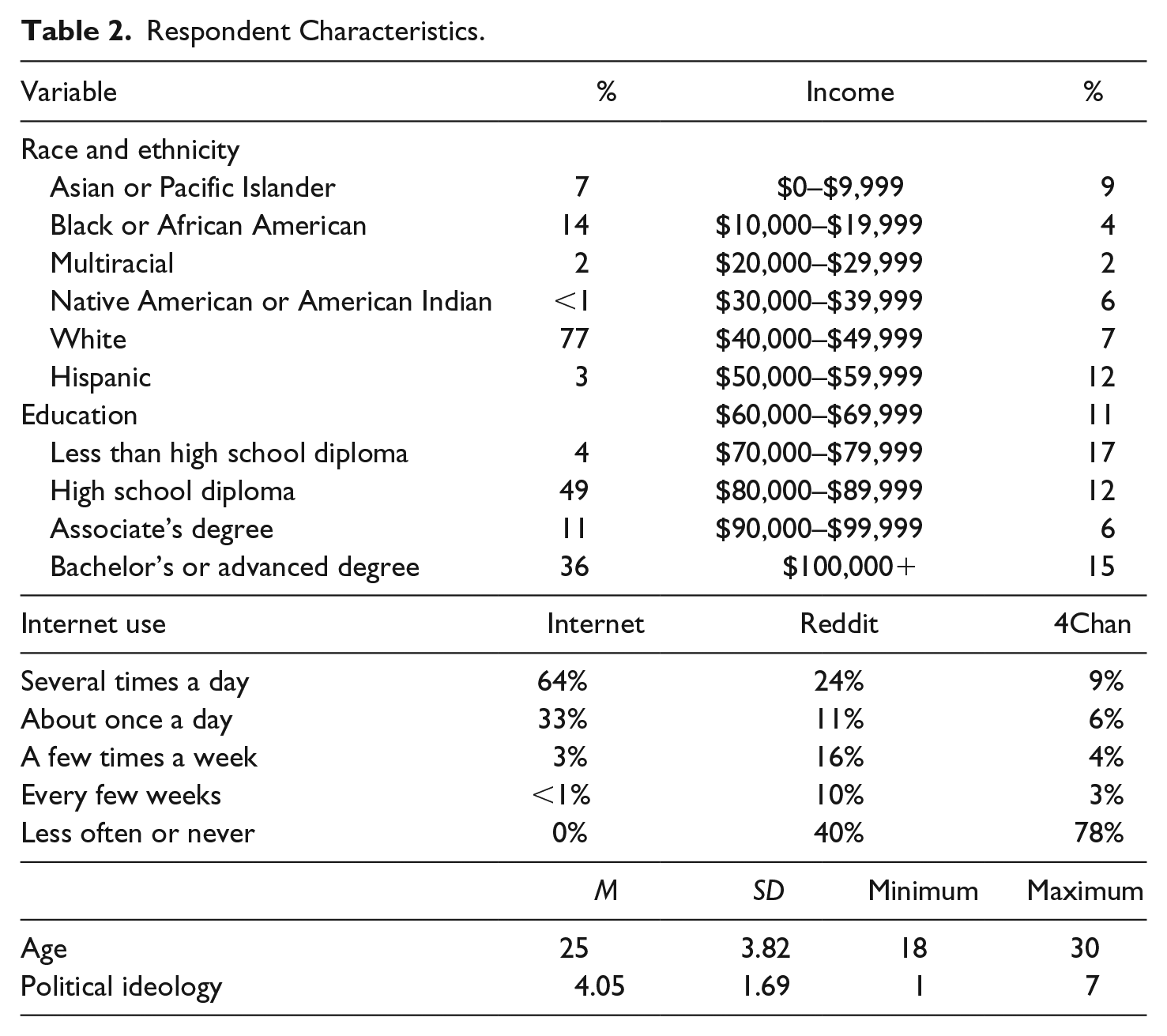
Of the 612 men who completed the survey, 88% identified as heterosexual or straight, while the rest identified as bisexual (5%), gay or homosexual (5%), or some other sexual orientation (<2%). Given our focus on profiles of incels and mass shooters who feel rejected by and target women, we isolate analyses to 541 heterosexual men (Table 2).
Respondent Characteristics.
Violent Fantasies
The Aggressive Fantasies measure refers to daydreams of a violent or destructive nature. The Aggressive Fantasies measure was originally created by Rosenfeld et al. (1982) in a larger assessment tool called the Children’s Fantasy Inventory, developed using psychoanalytic theory. Nadel et al. (1996) later adapted the Aggressive Fantasies measure for school-based intervention and violence-prevention programs for youth. We use two of these items: powerful weapon use to approximate mass violence (“do you sometimes imagine or daydream about using powerful weapons against your enemies?”) and rape, as a form of gender-based violence (“do you sometimes daydream or imagine rape scenes or forcing someone to have sex?”). Responses were “never,” “sometimes,” and “frequently.” While the majority of respondents “never” had such fantasies, 33% fantasized about destroying enemies with powerful weapons and 21% fantasized about raping someone “sometimes” or “frequently.” Because these variables have three levels, we use ordinal logistic regression and report odds ratios, which are exponentiated beta coefficients.
Masculinity Threats
The Masculine Gender Role Stress Scale (Eisler & Skidmore, 1987) was chosen to measure acceptance threat, men’s emotional struggle in trying to meet the socially constructed expectations of hegemonic masculinity (α = .91). Respondents reply on a 5-point Likert-type scale ranging from “not at all stressful” to “extremely stressful.” These 15 items were weighted by their factor scoring coefficients and summed into a single standardized scale: acceptance threat (M = 0.03, SD = 0.96). Like Willer et al. (2013) we measure status threat with the following: “Recent changes in our society often disadvantage men” (Pew Research Center, 2012). Responses are a 4-point Likert-type scale ranging from “strongly agree” to “strongly disagree.” About 50% of respondents disagreed or strongly disagreed with this statement, 35% agreed, and 13% strongly agreed.
Control Variables
We control for a number of factors, including race (1 = White non-Hispanic) and age. We include education and income as controls, which are reversed such that a positive coefficient indicates lower education attainment and less income, respectively. We control for frequency of Internet use; Reddit use, a website that contains thousands of online forums; and 4Chan, an anonymous set of online forums, because they have both been popular with “incels” and several “incel” shooters were known users (Lamoureux, 2019).
Given our gender lens, we include sexist attitudes as control variables. The Ambivalent Sexism Inventory (Glick & Fiske, 1996) contains 22 items and two subscales: Hostile and Benevolent Sexism. Measures of hostile sexism refer to hateful and resentful attitudes toward women, such as “women seek power by gaining control of men,” and benevolent sexism refers to “chivalrous” yet sexist beliefs, such as “a good woman should be set on a pedestal” (p. 500). For each subscale, responses were weighted by factor scoring coefficients and summed as benevolent sexism (M = 0.4, SD = 0.90) and hostile sexism (M = 0.08, SD = 0.91). Like Willer et al. (2013), we control for political ideology. Higher scores indicate a more conservative ideology (M = 4.05, SD = 1.69).
Results
While accounting for our control variables (e.g., race and sexist attitudes), acceptance threat is positively associated with endorsement of both “incel” trait scales. 1 Men with greater gender role stress more greatly endorse defeated (β = .27, p < .001) and hateful (β = .29, p < .001) “incel” traits. Status threat is positively associated with both “incel” trait measures on the bivariate level, but no longer reaches significance in multiple regression.
Next, we assess the relationship between threats, “incel” traits, and fantasies (Table 3). In Models 1 and 3, we see acceptance threat is positively associated with violent fantasies about using powerful weapons to destroy one’s enemies (odds ratio [OR] = 1.43, p < .01) and rape (OR = 1.48, p < .01) (Table 3). This supports Hypothesis 1, while Hypothesis 2 is not supported. Status threat is positively but not significantly associated with either type of fantasy.
Regressing Violent Fantasies on Threat, Incel Traits, and Control Variables (N = 541).
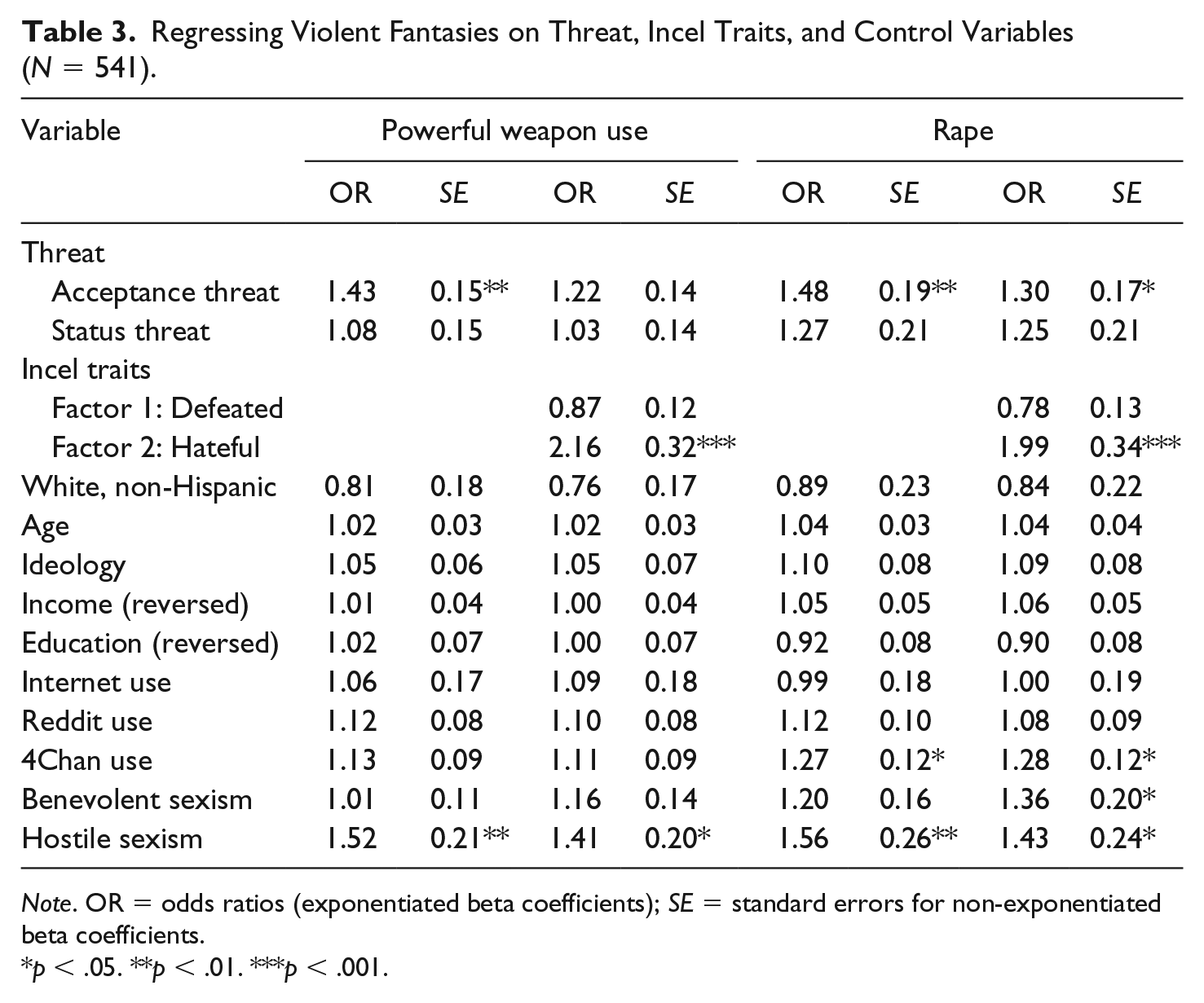
Note. OR = odds ratios (exponentiated beta coefficients); SE = standard errors for non-exponentiated beta coefficients.
p < .05. **p < .01. ***p < .001.
Hypothesis 3 predicts a positive effect of “incel” traits on violent fantasies, which mediates the relationship between threat and violent fantasy. Models 2 and 4 add in “incel” trait scales to predicting fantasies about powerful weapon use and rape, respectively. Scoring higher on hateful “incel” traits makes fantasizing about powerful weapons (OR = 2.16) and rape (OR = 1.99) about twice as likely (p < .001). This reduces the relationship between acceptance threat and fantasies about powerful weapons (OR = 1.22, n.s.) to non-significance. Although the odds ratio for rape is reduced when including “incel” traits, this relationship remains significant (OR = 1.30, p < .05).
While this suggests support for Hypothesis 3, we elaborate using Sobel–Goodman mediation tests. This calculates the direct, indirect, and total effects of independent variables (threat) on dependent variables (fantasies) given their association with mediating variables (“incel” traits). Using STATA’s SGMEDIATION, we also include the control variables listed in Table 3. Forty-seven percent of the effect of acceptance threat on weapon fantasies and 34% of the effect on rape fantasies are explained by “incel” trait endorsement (p < .001).
A few relationships between our key theoretical variables and demographics warrant mention. White non-Hispanic and lower income respondents more greatly endorse “incel” traits of defeat (but not hate). Benevolent sexism is negatively associated with both trait scales, and hostile sexism is positively associated with hate. Benevolent and hostile sexist attitudes are significantly (p < .05) associated with fantasies about rape (OR = 1.36, OR = 1.43), and hostile sexism is associated with using powerful weapons (OR = 1.41, p < .05). 4Chan participation is positively associated with fantasies about rape (OR = 1.28, p < .05), but not weapons.
Discussion
In American society, a history of gender-based violence is common in cases of mass violence. Shooters in Aurora, Illinois (2019); in Lafayette, Louisiana (2014); at Virginia Tech (2008); at Pulse Nightclub in Orlando, Florida (2016); at Marjory Stoneman Douglas High School in Parkland, Florida, (2018); at a church in Sutherland Springs, Texas (2017); and beyond have been accused, arrested, or convicted of harassing or threatening women, intimate partner violence, or rape (e.g., Smidt, 2018; Snyder, 2018). Cases of “incel” shootings further emphasize the relationships between gender, sex, masculinity, and mass violence. There, frustrated men are able to vent about rejection or their unattractiveness, and for some, it is a space to admire and celebrate “incel” shooters who targeted women and promoted violence (Hines, 2019).
Although most men are not “incels,” and most “incels” are not mass murderers, “incel” traits and attitudes serve as a reference point for our understanding of mass violence as a gender-based phenomenon. For instance, the Tallahassee yoga studio shooter was a self-identified “incel” (Chavez & McLaughlin, 2018). He had a history of sexual misconduct, expressed hatred of women, referred to the Isla Vista “incel” shooter with admiration, and fantasized about rape and murder in his journals before shooting six women, killing two (Etters & Burlew, 2019). He was like many mass shooters who prepare for their attacks months beforehand by amassing arsenals and repeatedly imagining their acts, fantasizing about revenge (Collins, 2015).
The goal of the current study was to explore the apparent links between “incel” traits, masculinity, and fantasies about sexual violence and mass murder. We study these fantasies because they are central to imagined domination and control of others and they precipitate mass shootings (Murray, 2015, 2017a, 2017b). Fantasizing about rape and mass murder are stepping-stones to perpetuating violence in real life, as we see in multiple mass shootings (i.e., Columbine, Isla Vista, Sandy Hook, Virginia Tech, and more). Our findings follow the literature on the “incel” movement, where masculinity threat and aggressive fantasies converge. In these online communities, men write about women in derogatory ways to the point of celebrating rape and murder. We see this in the celebration of the Isla Vista shooter, where community members herald him the “Supreme Gentleman” and buy his favorite latte on the anniversary of his mass shooting (Spampinato, 2018). While a majority of those online are not acting on these specific fantasies, they still can express this aggression in other ways that contribute to a toxic masculine culture that is harmful to women.
Measuring “Incels”: Traits, Emotion, or Strain?
We did not directly survey “incels,” nor did we directly ask respondents if they self-identify as an “incel.” Rather, we aimed to better understand whether traits common among “incel” mass shooters exist in a more general sample of heterosexual men, and furthermore, whether these traits are associated with violent fantasies proclaimed and carried out by these shooters. We contribute to understanding of this relatively new and unstudied identity by creating two measures of “incel” traits. We administered these measures to 18- to 30-year-old heterosexual, male Internet users living in the United States. The first factor is comprised of 13 items, such as defeated, rejected, insecure, weak, shunned, and unattractive. These seem to represent feelings of exclusion or rejection—perhaps due to their unattractiveness or weakness, complaints discussed at length in “incel” message boards (e.g., Hines, 2019). The second takes on a more volatile and dangerous tone present in angrier rants or manifestos and contains seven items (hateful, disgusted, paranoid, resentful, vengeful, enraged, and violent). Higher scores on these subscales reflect respondents who feel rejected and lonely, and those who externalize negative emotion into resentment and vengeance, respectively.
Not only are these two “incel” trait subscales positively correlated with one another, but they are both associated with heightened masculine gender role stress. This suggests that men who experience greater interpersonal challenges from women more closely align with “incel” traits, regardless of whether they participate in that community or not. However, only the second factor—which we termed “hateful”—is positively associated with hostile attitudes toward women and violent fantasies. For every unit increase in the “hateful” subscale, fantasies about destroying enemies with powerful weapons and rape increase twofold. Although this scale was developed by examining the “incel” community, given our sample, these traits extend to some men in general who may feel ostracized and vengeful.
We settled on the word “trait,” yet it is worth noting that various items in our “incel” trait scales are emotions, such as sadness and frustration. This harkens to the link between emotion and aggression in frustration-aggression and cumulative strain theory approaches (e.g., Berkowitz, 1989; Levin & Madfis, 2009). It could be men who score high on our “incel” scale have experienced chronic strain due to sexual/romantic rejection unmeasured here. Silver et al.’s (2019) comparison of “public mass shooters” and “lone actor terrorists” showed that the former were more likely to have experienced work stress, personal problems, degradation, and long-term stress than the latter. Including these strains in future research could better reveal the link between mass violence and “incel” traits, which may in fact mediate the relationship between chronic strain and these violent acts. Whether we are simply tapping into general strain processes (Agnew, 1992) could be assessed by narrowing our focus to emotions like frustration and anger.
Acceptance Threat, Gender Role Stress, and Violent Fantasy
These discourses are embedded in larger attitudes and beliefs about men’s entitlement to sex and relationships with women. An inability to perform or achieve the ideal masculine gender role, to prove one’s group membership among men, may lead to acceptance threat, which we operationalize using the Masculine Gender Role Stress Scale (Branscombe et al., 1999; Eisler & Skidmore, 1987). Respondents who felt more stress with letting women control a situation, losing in a sports competition, and other forms of failed masculinity reported more frequent fantasies about mass and sexual violence. With every unit increase in acceptance threat, men report a 43% increase in imagining destroying their enemies with powerful weapons and a 48% increase in rape fantasies. This parallels Munsch and Willer (2012), who found men generally rated male perpetrators of sexual assault as more likable than women did; but men who had their gender identity disconfirmed rated those male perpetrators as even more likable and less responsible. In our study, however, rather than imagining an instance of sexual assault through vignette, respondents reported how often they imagined committing rape themselves.
Men who believe that the status of men as a group is under threat—status threat—tend to overcompensate. This may push them to threaten other men to move up the in-group hierarchy, or to dominate other groups, such as women, people of color, and LGBTQ+ individuals (Branscombe et al., 1999; Kimmel, 1994). For instance, Willer et al. (2013) found that men who felt social changes were threatening men expressed greater support for war, pro-dominance attitudes, belief in male superiority, and homophobia. We did not, however, find support for the hypothesis that status threat is associated with violent fantasies. This could partially be explained by the fact that Willer et al. (2013) focused on attitudes while we focused on fantasies. In addition, the reaction to status threat—threat of the group—may be different than that to acceptance threat—threat of the individual. When the individual feels doubt in his gender role (acceptance threat), he can reassert and imagine dominance through fantasies of rape and murder as an internal justification of one’s masculinity. However, if the group is threatened by others doubting its superiority (status threat), some may feel the need to outwardly posture and project masculine traits to combat threat posed by others.
Limitations and Future Research
The current study contains several limitations that should be addressed in future research. First, our “incel” traits measure was created by analyzing media reports for the search term “incel movement” in Google News, which often used the shooters’ and incels’ own words. Focusing exclusively on the language of members themselves may provide a more accurate representation of how they see themselves. Another limitation is that respondents did not see the term “incel” in the survey and therefore did not have the option to identify as an incel or not. We feared the social stigma of incels could potentially result in selection bias if that word detracted and/or attracted individuals. The purpose of this study was to see to how identification of traits within the “incel” community relates to masculinity and violence beyond that community, though attempts at strengthening validity and reliability of the measure among “incels” are needed.
We have only two dependent variables: fantasies about destroying one’s enemies with powerful weapons and about rape. Multiple measures for each item would provide a more robust test of our hypotheses, and each item has its own limitation. The first refers to “powerful weapons” and enemies, insinuating mass violence but not directly stating it; the second does not ask about raping a woman, and we are most interested in violence against women. For the latter issue, we highlight that the sample is heterosexual men, and that the term “rape” is legally, historically, and culturally associated with male perpetrators and female victims (Richards & Marcum, 2014). Although these measures are incomplete and were developed to be tested among adolescents, they provide a preliminary understanding of the link between masculinity, “incels,” and mass and gender-based violence.
In terms of our sample and procedure, we only include self-identified heterosexual men aged 18 to 30 years. We did this because of trends seen in mass shooters and previous research shows that women do not respond similarly to gender identity threat with the endorsement of violence (Fox & Levin, 1998; Munsch & Willer, 2012; Willer et al., 2013). This means we cannot guarantee these processes do not exist among women or younger, older, or LGBTQ+ men. In future studies, it is important to include a broader range and background of respondents. Various mass shooters are older than 30 years (e.g., Las Vegas Strip shooting) and have specifically targeted LGBTQ+ spaces (e.g., the Pulse Nightclub shooting in Orlando), places of worship (e.g., Tree of Life Synagogue in Pittsburg), and racialized minorities (e.g., Emanuel African Methodist Episcopal Church in Charleston). This warrants broader samples and measures of and attention to not only sexist but homophobic, racist, and anti-Semitic attitudes, which could further highlight the relationship between masculinity, identity, hostility, and violence.
Finally, our use of cross-sectional data raises the possibility of reverse causation. It is difficult to imagine that aggressive fantasies would make a respondent feel threatened in their masculine gender role, as aggression is a fundamental aspect of toxic masculinity. Still, panel or diary data could better assess these processes by collecting both baseline measures of “incel” traits and repeated, more proximal measures of masculinity threat, emotion, and violent fantasy.
Conclusion
While mainstream discourses on mass violence tend to focus on mental illness, violent media consumption, and gun control, the link between gender-based violence and mass violence has begun to make headlines (e.g., Lopez, 2017; Ramsey, 2015; Sakuma, 2019). Despite this in-depth reporting, empirical research into the gender-based mechanisms underlying mass violence is rare. Studies often examine strains specific to domains central to masculinity—the home and workplace. We go further by addressing the absence of standard quantitative measures of (and thus, conclusions about) sexism in the study of this issue (e.g., Levin & Madfis, 2009; Silver et al., 2019). Women and children are overrepresented in mass shooting victims (Everytown for Gun Safety, 2017; United Nations Office on Drugs and Crime, 2013), yet analysis of patriarchal norms and attitudes that frame and encourage such violence—and its connection to sex-based or partner violence—is all but absent. Indeed, there has been a “long silence in the social sciences” on mass murder, and such inquiries have been empirically dominated by studies that emphasize terrorism or war, law and policy, or mental health (Bauman, 2000; Liwerant, 2007). Given the focus of feminist criminology on crimes that disproportionately affect women and children, as well as gendered socialization and processes in offending, we encourage scholars to further pursue understanding of mass violence through these lenses.
The goal of the current study was to better understand the connection between “incels” and masculinity threat in violent fantasy—a key component to preparing for and executing mass shootings and sexually sadistic killing (Collins, 2015; Fox & Levin, 1998; Murray, 2015, 2017a, 2017b). To understand how challenges to the group status of men and to individual men’s sense of masculinity may lead to violent fantasy, we developed an original measure of traits commonly associated with the “incel” community (e.g., defeat, rejection, and vengefulness). We find that men with greater gender role stress, more hostile attitudes toward women, and “incel” traits report more frequent fantasies about mass murder and rape. While most men will not commit such heinous acts, our focus on these prevalent and more general gender attitudes and processes is both worrisome and important. Actual shooters are, understandably, the focus of studies of mass murder (e.g., Levin & Madfis, 2009; Murray, 2015; Silver et al., 2019). Our approach, however, highlights the importance and possibility for exploring gendered, theoretical underpinnings of rare, extreme, tragic cases that exist in the larger population.
Footnotes
Acknowledgements
We would like to acknowledge the helpful recommendations of Ashley Reichelmann and Neal King.
Declaration of Conflicting Interests
The author(s) declared no potential conflicts of interest with respect to the research, authorship, and/or publication of this article.
Funding
The author(s) disclosed receipt of the following financial support for the research, authorship, and/or publication of this article: This research was supported by a grant from the Institute for Society, Culture and Environment (ISCE) at Virginia Tech, Blacksburg, VA.
