



Abstract
A mixed methods project was devoted to understanding college students’ justification for digital piracy. The project consisted of two studies, a qualitative one and a quantitative one. Qualitative interviews were conducted to identify main themes in students’ justification for digital piracy, and then the findings were tested in a quantitative manner using a different sample. This project thus proposes a model in which quantitative measures are guided by qualitative findings, and qualitative findings are in turn reexamined based on quantitative findings. This project offers a mixed methods model for theory testing in criminology.
Digital piracy has been defined as the illegal act of copying digital goods for any reason other than backup, without permission from or compensation to the copyright holder (Gopal, Sanders, Bhattacharjee, Agrawal, & Wagner, 2002). Digital goods include software, digital documents, digital audio files, and digital videos (Gopal et al., 2002). Every year huge financial losses are reported from business groups on account of digital piracy. For example, Business Software Alliance alleged worldwide roughly 41% of all software installed on personal computers is obtained illegally, and software piracy has cost the software industry $53 billion dollars annually (Business Software Alliance, 2009). Music piracy is another example that signifies the gravity of digital piracy. Based on the estimation of Recording Industry Association of America, millions of dollars are lost from the music industry every year due to online music piracy (Recording Industry Association of America, n.d.). An analytical study done by the Institute for Policy Innovation shows that as a result of sound recording piracy, the U.S. economy lost $12.5 billion and 71,060 jobs annually, whereas U.S. workers lost $2.7 billion in earnings per year and governments on all levels in total lost $422 million in tax revenues annually (Siwek, 2007). Furthermore, an increasing percentage of the financial losses are attributable to illegal downloading. It is estimated that about 20 billion songs were illegally downloaded worldwide (Siwek, 2007). These illegal downloads either from peer-to-peer (P2P) networks or from the Internet are considered responsible for recent declines in the number of legitimate CD sales (Siwek, 2007).
Needless to say, digital piracy has been a serious crime issue that entails huge financial impact, and some attention has been devoted to such an issue. Research has found that software piracy is linked to opportunities presented in the physical surroundings, such as the accessibility of original software materials (Kern & Pfeiffer, 2001). Other research also indicates that when access to the Internet is conveniently available, the computer and Internet usage increases. This increase lends itself to a greater likelihood that users will encounter opportunities of digital piracy online and a greater likelihood that users will be socialized or even conditioned to condone or participate in digital piracy (Hinduja, 2001). It was also found that the Internet’s anonymity provides offenders a sense of security when they estimate the risks (Kern & Pfeiffer, 2001). Pseudo-anonymity and true anonymity on the Internet, which can be accomplished by advanced information technologies, have been warned by former U.S. Attorney General Janet Reno to be new opportunities for criminal behavior (Chawki, 2006).
In addition, research testing deterrent effects in software piracy has consistently found punishment certainty is inversely correlated with software piracy, whereas severity is usually not significant (Higgins, Wilson, & Fell, 2005; A. G. Peace, Galletta, & Thong, 2003). The perceived anonymity on the Internet usually produces less perceived punishment certainty and thus lower risks. Moreover, informal sanctions (e.g., shame and social disapproval) are considered significant factors in research (Higgins et al., 2005). On the other hand, in terms of perceived benefits, costs play an important role in that the higher the price is, the more positive the attitude toward piracy will be (A. G. Peace et al., 2003).
The literature also suggests the virtual settings in cyberspace can lead to deindividuation and a reduction of public self-awareness aligned with an increase in private self-awareness (Joinson, 1999). Deindividuation is a psychological state of loss of public self-awareness, lower social inhibitions, and increased impulsivity (Kabay, 1998), which can make people prone to favor illegal activity, such as digital piracy (Bartol & Bartol, 2005; Hinduja, 2006). Moreover, when the costs are higher than the individual can afford, the economic strain will also lead people to consider digital piracy (Kern & Pfeiffer, 2001).
Furthermore, people who subscribe to a subculture that condones, tolerates, or encourages a certain behavior are more prone to have a positive attitude toward it or participate in it. A. G. Peace et al. (2003) found subjective norms are significant in affecting individuals’ intention to commit software piracy. Seale, Polakowski, and Schnieder (1998) found similar results, indicating that the social norms people uphold have a direct effect on self-reported piracy. When the norms do not deem software piracy unethical, digital piracy becomes acceptable. Research also suggests in a culture that emphasizes collectivism rather than individualism digital piracy will be more prevalent (Bagchi, Kirs, & Cerveny, 2006).
In line with learning theory, research found required expertise has a direct effect on piracy behavior and is shaped by the perceived ease of making unauthorized copies (Seale et al., 1998). Skinner and Fream (1997) used software piracy to test social learning theory and found strong support. Associations including friends and families who engage in software piracy appeared to be significant in learning it (Skinner & Fream, 1997). Hinduja (2006) also found social learning factors are the strongest predictors for the likelihood and amount of music piracy. Besides, past experience of software piracy has been identified in the literature to be correlated with software piracy (Higgins et al., 2005; Hinduja, 2001; Liang & Yan, 2005), which is consistent with reinforcement theory.
Self-control was also found related to digital piracy (Higgins et al., 2005). Higgins et al. (2005) examined the link between self-control and software piracy while controlling for measures of social learning theory, morality, and computer use, and the findings confirmed the existence of the link. Hinduja (2006) in his study found low self-control is significantly related to music piracy. Higgins, Fell, and Wilson (2007) also found low self-control accounts for movie piracy, although association with movie-pirating peers exacerbates the effect.
All these identified factors seem to foster a positive attitude toward digital piracy despite its criminality. Research found that people may agree on the illegality of cybercrime, but might not consider it unethical (Aukerman & Mott, 2002). When it comes to digital piracy, some people have a very lenient attitude toward it, due to personal or workplace ethics that tolerate or even encourage it (Seale et al., 1998). This implies digital piracy may not be considered morally wrong, contingent on circumstances and cultures. Justifications on moral grounds may be upheld by individuals, regardless of the law (Condry, 2004). Some people have advocated that information attainable on the Internet should be free of constraints and interference from the authorities (Spinello, 2001; Thomas, 2005). The literature suggests people are more likely to perform an act when they think it is less unethical (Higgins et al., 2005), and people seem to be have a lower sense of moral responsibility in cyberspace (Stephens, Young, & Calabrese, 2007). When people do not view digital piracy as unethical, their attitudes toward it would be more positive (Logsdon, Thompson, & Reid, 1994; Siegfried & Ashley, 2006).
Although all these above-mentioned correlational studies have established a list of factors in favor of digital piracy, a review of the literature revealed a lack of qualitative understanding regarding how people justify digital piracy. Hence, the purpose of this study was to explore college students’ moral justification in a qualitative sense. Based on this qualitative understanding, a scale was thus constructed to best measure justification for digital piracy with qualitatively affirmed construct validity. The scale then was tested in a quantitative manner.
Qualitative Inquiry
Research Questions
In a number of studies, college students have been identified as one of the groups that tend to manifest a favorable attitude toward digital piracy and are most likely to engage in digital piracy (Condry, 2004; Morris & Higgins, 2009; Siegfried, 2004; Skinner & Fream, 1997; Taylor, 2004). Hence, in this study we also focused on college students. How do college students perceive digital piracy? If seen as illegal, how serious is digital piracy a crime? If seen as justifiable, what are the justifications?
Method
In a state university located in western Pennsylvania, 40 students were interviewed regarding their perceptions of digital piracy. Participants were recruited from a computer lab inside the library, and face-to-face interviews were conducted individually right after the student agreed to participate. The only selection criterion was gender as the sample was controlled to consist of 20 males and 20 females. The sample included students from a variety of disciplines, such as criminology, political science, business, mathematics, psychology, and physics. Although not intended, racial diversity (including Caucasian, African American, Asian, and Hispanic) was also achieved. The interview lasted for 25 to 30 minutes on average. Digital voice recorders were used.
Participants were asked about how they perceive digital piracy (i.e., software piracy and music piracy) as a crime and compared digital piracy to other crimes (e.g., robbery or stealing) in terms of crime seriousness. In total, 23 crimes were involved in the comparison. 1 A card-sort technique was used to help organize the comparisons. Participants were asked to sort the cards according to crime seriousness by their own definition and ranked them in order. A formal definition was provided for each crime mentioned during the interview. Participants were asked to elaborate on why they think digital piracy is more serious or less serious compared with other crimes, according to their personal perceptions.
The recordings of interviews were transcribed into transcriptions. Content analysis was conducted, and the analysis was double checked by two researchers to avoid personal biases. The analysis was aimed to detect patterns in the participants’ justification for digital piracy.
Findings
Digital piracy in comparison
When asked about how they determine crime seriousness, most participants focused on physical harm, which is consistent with the literature (Blumstein, 1974; K. Peace, Ireson, & Thorpe, 1975; Rossi, Waite, Bose, & Berk, 1974; Roth, 1978; Sellin & Wolfgang, 1964; Stylianou, 2003). When the consequences conceivably involve greater physical harm, the crime would be considered more serious by the participants. Murder and terrorism as expected were invariably found on the top of the rankings, followed by rape. In general, most participants claimed they determined seriousness based on the harm to the victim. A few participants mentioned legal consequences, morality, and psychological effects when defining seriousness, but somewhat surprisingly, only two participants took financial losses into account. Nonetheless, mostly the predicted physical harm was still the predominant criterion.
In this sense, digital piracy was generally considered less serious or even favorable, because it does not usually cause physical harm in the participants’ perceptions.
You never heard people get hurt by downloading songs. Personally I think it’s harmless, if you ask me. It’s not like murder or rape . . . that’s bad. (Respondent 009)
Moreover, although most participants acknowledged digital piracy is illegal, many of them failed to recognize the victim.
When it’s free, more people are going to use it, and when more people are using it, it’s common sense, more folks are going to buy it. That’s more profit for them (software companies). (Respondent 027) It’s a crime. I know. Technically I guess I would say crime is bad. But, I don’t think downloading some songs is hurting anyone, because people do that only because it’s free, you know? If it’s not free, people won’t pay for stuff like that. I mean I can use computers in school. I don’t really need to buy PowerPoint, for example, at home. (Respondent 008)
It is important to note that not all the participants showed a positive attitude toward digital piracy. Some of them did believe it is a crime and people should not commit crime, although mostly digital piracy was not perceived as a serious offense by them. However, to some extent, they showed understanding on why people commit digital piracy.
I don’t know. Not everyone is rich. Some poor people would appreciate the free stuff, like music, movies, or that (computer software). It’s a way of living. (Respondent 025)
In summary, in comparison with other crimes, digital piracy, especially music piracy, was consistently found to be less serious or even the least serious. In terms of crime seriousness, it was often comparable to loitering, speeding, or email spam as the least serious type of crime. It was viewed as more serious only when the participants considered it parallel to theft or robbery, but this was a rare occurrence in this study. Even in these cases, participants could still justify digital piracy better than justifying theft or robbery. Only one participant regarded digital piracy, along with all other cybercrimes, as the most serious crime for he was concerned about the future growth of cybercrime. Overall, based on the interviews, digital piracy was not generally regarded as a heinous crime, and most participants did not even try to hide their approval of digital piracy. Even when they disapproved, their perceptions did not seem to despise digital piracy as much as they would despise street crimes, such as robbery, burglary, and theft, not to mention murder, rape, terrorism, or child pornography. One interesting contrast found in participants’ verbal accounts was while the prevalence of street crimes might call for more concern, the prevalence of digital piracy could actually account for a lenient attitude.
I know a lot of people are doing it (digital piracy), and they’re not bad people. So . . . no, I wouldn’t say they are criminals. It’s not that big a deal. I know it’s not legal, but . . . you know . . . it doesn’t feel the same. (Respondent 009)
Finally, the perceptions did not appear to be related to the participants’ demographic characteristics or academic backgrounds. The ways they justified digital piracy, either personally or vicariously, also did not seem to be related to their race, gender, or major.
Justification for digital piracy
From the findings derived from the interviews, a few common themes were found in the participants’ justification for digital piracy. First, the lack of perceivable harm makes it more justifiable. This is not to say digital piracy really creates no harm; rather, some people may have failed to recognize the harm. This could have something to do with the second theme, that is, the victim is often not acknowledged. In fact, some even claimed digital piracy is beneficial to the copyright holders by expanding the user population. Also, some participants argued they still would not pay for the software or music if digital piracy were not existent. They would find alternatives or simply live without it. Thus, they once again denied victimization since the profit could never have belonged to the copyright holders anyway. The third theme in their justification is blaming the victims for contributing to piracy. It was a common belief, even for those who did not approve digital piracy, that the price is generally too high. This perception was accentuated when the media touted the wealth of those alleged victims.
I don’t think music piracy is a crime. I don’t think they (the singers) need two Ferraris. (Respondent 014)
As far as the price is concerned, it also renders grounds for justification as some people simply cannot afford it. Fourth, the justification could involve diffused responsibility as it is also commonly perceived that most people (especially in a college setting) are doing it. As mentioned, the prevalence of digital piracy somehow makes it acceptable even to the people who probably do not engage in it. Apparently digital piracy is not seen as a big deal. The underlying rationale, according to the present study, lies in the denial of responsibility, the denial of victim, and the denial of injury. Moreover, blaming the price and resorting to poor people’s needs imply digital piracy is not primarily about morality. It is more of an economic and practical issue.
Thus far, our qualitative findings are fairly consistent with the theory and literature. Sykes and Matza (1957) proposed the techniques of neutralization, which posits the criminals do not defy social norms or rules, but they manage to neutralize their moral inhibition when committing crime (Vold, Bernard, & Snipes, 2002). These techniques include the denial of harm, the denial of victim, the denial of responsibility, condemnation of the condemner, and resorting to higher loyalty (Sykes & Matza, 1957). These techniques correspond with the common themes identified in our participants’ justification, and research has found support for this theory’s capacity in explaining digital piracy (Hinduja, 2007; Morris & Higgins, 2009; A. G. Peace et al., 2003; Ramakrishna, Kini, & Vijayaraman, 2001).
The implication derived from these findings is digital piracy could really lack moral intensity as suggested in the literature (Logsdon et al., 1994), which means a person does not need to have poor moral judgment to justify digital piracy. During the interviews in this study, there was no evidence suggesting the participants who tended to justify digital piracy all possessed low moral judgment, especially when most of them seemed to show a favorable or tolerant attitude toward digital piracy. When discussing other crimes, there was no sign suggesting their moral judgment was abnormal. If the crime was considered serious, students usually would recognize the harm, victim, and responsibility without problem. If the crime was not perceived as serious, such as email spam, they would dismiss the gravity due to the lack of perceivable harm, rather than attempt to justify it. Hence, the tentative conclusion at this point was college students’ tendency to justify digital piracy is unrelated to their general moral judgment. The justification is more attributable to the techniques of neutralization, which do not impede their ability to tell right from wrong but offer offense-specific justification for digital piracy.
Validity and Limitations
As in all research, there are reasons to doubt the validity of our findings. There are usually two primary threats in qualitative studies, including researcher bias and reactivity (Maxwell, 2005). In terms of personal bias, the analysis involved two researchers to examine each other’s interpretations. During the interviews, the participants were constantly offered chances to confirm the interviewer’s understanding of what they said was correct. During analysis, contradictory evidence was looked for in the participants’ accounts. Although not all participants perceived digital piracy in the same way, the justifications mentioned by them were similar as reported in the previous section. A few of them did not offer justifications, but this did not lessen the validity of our findings for it was never assumed that everyone would try to justify digital piracy. The purpose of the study was to explore the patterns in the justifications when they were posited. Consequently, it was found that the techniques of neutralization were applied in justifying digital piracy, even though the theory itself was never mentioned explicitly either by the interviewer or the interviewee during the interviews. The evidence simply emerged by itself.
In terms of reactivity, the influence of the researcher was reduced by incorporating a card-sort technique during the interviews. The participant could focus on sorting cards and explaining their sorting. The researcher’s questions were made relevant only to the cards sorted by the participant. In this manner, the participants’ responses were more about elaborating on the decisions they had made rather than creating impromptu answers to the researcher’s inquiries. In a sense, the researcher was the one reactive to the participant’s card sorts.
However, even if the findings are valid, they are not without limitations. First, due to the sampling limitation, the findings do not entail much generalizability. Second, the interviews were not designed to explore what affects their perceptions of digital piracy. In other words, we know how they justify digital piracy, but we did not attempt to verify the factors identified in the literature as the true causes of such justification. Also, although no personal characteristics seemed related in this study, personal characteristics were not really explored in depth. Other factors, such as culture or religion, were also left out in the interviews. These aspects were neglected in an effort to increase the participant’s willingness to participate in the interview. It became unappealing if the interview was meant to be too lengthy. Otherwise, a face-to-face interview should be able to generate rich data for finding the root causes of a favorable attitude toward digital piracy.
Despite these limitations, the data derived from the qualitative study were nonetheless sufficient for the current purposes, as the goal of this project was not to verify all theories related to digital piracy. We simply tried to understand college students’ justification for digital piracy qualitatively, and in the second part of the project, the aim was to test our current qualitative findings in a quantitative manner.
Quantitative Inquiry
Research Questions
Oftentimes, qualitative studies are criticized for not being generalizable (Higgins, 2009). This implies the findings in a qualitative study may not apply to other settings or populations (Maxwell, 2005). Hence, the second stage of the current project was aimed to test our qualitative justification for digital piracy using samples drawn from other universities.
The questions to be answered are the following:
Research Question 1: Is justification for digital piracy indicative of a low level of moral judgment?
Research Question 2: Do techniques of neutralization make digital piracy more justifiable?
Based on the previous qualitative findings, two hypotheses were proposed corresponding to the two research questions:
Hypothesis 1: Justification for digital piracy is not related to moral judgment.
Hypothesis 2: Digital piracy would become more justifiable when the techniques of neutralization are applied.
If the hypotheses failed to be rejected, it means our qualitative findings were capable of achieving external validity to some extent.
Method
Sampling
The sample was drawn from a few universities randomly selected from a list of all higher education institutions in the United States. Some selected institutions were excluded due to the unwillingness to participate or administrative difficulties. Six universities were eventually kept in the sampling frame, not including the university where the qualitative study took place. An online survey was used. Students had the discretion to decide if they would like to take the survey via an email invitation. The sampling procedure was anonymous. After excluding missing data, 359 responses were kept for analysis.
The sample consisted of 205 females (57.1%) and 154 males (42.9%). More than half of the respondents were Caucasian (51%), followed by Asian (26.5%), African American (17%), Hispanic (4.7%), and other (0.8%). The average age of this sample was 25.75 years. The median age was 25, and the mode was 22. The youngest respondent was 18 years old, whereas the oldest was 39. The sample was composed of both undergraduate and graduate students. The skewness (0.854) and kurtosis (0.016) signified the age distribution of this sample did not deviate from normal distribution too much.
Measurement
The participants’ verbal accounts provided guidance for constructing a scale measuring moral justification for digital piracy in terms of the techniques of neutralization (see Appendix A). In addition, a validity item was also proposed that states digital piracy is morally justifiable. All items were measured on a 5-point Likert-type scale, where a higher score indicates stronger tendency to justify digital piracy.
Another scale was constructed to measure general moral judgment, using items adopted from the Sociomoral Reflection Measure–Short Form (SRM-SF). It is a scale designed to measure the development of sociomoral reasoning (Gibbs, Basinger, & Fuller, 1992). SRM-SF assesses moral values, including contract, truth, affiliation, life, property, law, and legal justice (Gibbs et al., 1992). The reliability (interrater, test–retest, internal consistency) and validity (criterion-related and construct-related) of SRM-SF have been supported by empirical data (Basinger, Gibbs, & Fuller, 1995; Gibbs et al., 1992; Stevenson, Hall, & Innes, 2004). As for construct validity, the correlation was strong and significant between SRM-SF and Moral Judgment Interview (the most prominent measure of moral judgment; Basinger et al., 1995). Overall, SRM-SF is deemed a concise instrument that can sufficiently assess moral judgment (Basinger et al., 1995). There were 11 items in this morality scale (see Appendix B). In addition, a validity item was proposed that states criminal behavior is always morally wrong. This was intended to ensure this morality scale is conceptually relevant to our subject matter, crime. All items were measured on a 5-point Likert-type scale, where a higher score indicates a higher level of moral judgment.
Findings
Factor analysis and reliability
A factor analysis confirmed there were two main constructs as measured by the proposed scales: general moral judgment and digital piracy justification. A reliability test revealed the 11 items in the General Moral Judgment Scale were strongly correlated and scale manifested strong reliability as indicated by the Cronbach’s α (.959). No item if deleted would significantly improve the scale reliability. Hence, all 11 items were kept. As for the Digital Piracy Justification Scale, Cronbach’s α was .899, which also indicates good reliability. All six items were also strongly correlated. No item if removed would improve scale reliability.
Hypothesis testing
Based on the qualitative findings, Hypothesis 1 posits that there was no relationship between general moral judgment and justification for digital piracy. It means even a person with a high moral level could still tend to justify digital piracy. Our quantitative findings did not support this hypothesis, however. The two constructs in the current study were indeed negatively correlated at the 0.1% significance level. This follows that the higher the moral judgment is, the lower the tendency to justify digital piracy would be. The effect size was .398. The correlation can be considered moderate and statistically significant. However, general moral judgment only accounted for 15.9% of the variation in digital piracy justification, which indicates justifying digital piracy is more complex than merely low moral judgment. Assumptions of normality and linearity were not violated. The Variance Inflation Factor (1) signified no problem with multicollinearity. When age and gender were controlled, the relationship between moral judgment and digital piracy justification did not change. It appeared that age and gender in this study were of no significance in predicting digital piracy justification. As for general moral judgment, although age did not make a difference, gender differences were found as females scored significantly higher in this aspect. There was no racial difference found regarding moral judgment, but racial differences were detected in terms of digital piracy justification in that Asians scored higher than Caucasians and African Americans at the 5% significance level. These findings seem to suggest Asians favor digital piracy for a reason possibly unrelated to general moral judgment.
Hypothesis 2 asserts when techniques of neutralization are applied, the result would be a more positive attitude toward digital piracy justification. The Digital Piracy Justification Scale was constructed based on the techniques of neutralization. To test this, a validity item was proposed, which states that digital piracy is morally justifiable. This validity item was strongly correlated with the digital piracy justification score (r = .864) at the 0.01% significance level. The hypothesis thus could not be rejected. The finding suggests that when people agree with the techniques of neutralization, they indeed tend to think digital piracy is morally justifiable. Table 1 summarizes the correlations among the major numerical variables. In addition, the digital piracy justification score alone can account for 74.7% of variation in the validity item. Age again was of no significance. It means the techniques of neutralization were the best explanation for viewing digital piracy as justifiable.
Correlations of Major Variables
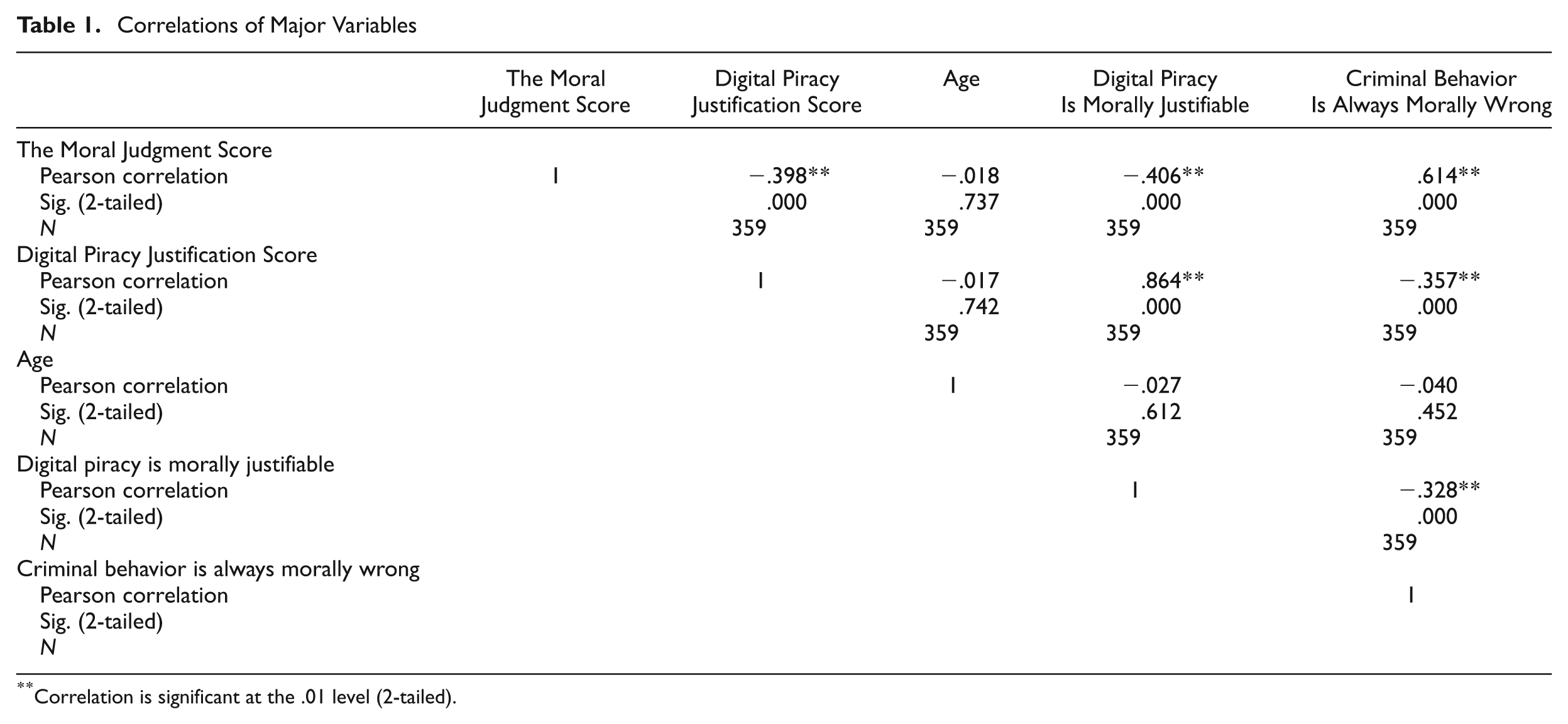
Correlation is significant at the .01 level (2-tailed).
Validity
First, the factor analysis confirmed the unidimentionality of the scales. This is to say at least we can be positive the two scales were indeed measuring two separate constructs, and the scale items were all relevant respectively in each scale, according to the reliability test results. These are the necessary conditions for construct validity.
Second, the Digital Piracy Justification Scale was constructed based on a well-established theory (i.e., techniques of neutralization) and also based on the findings derived from our qualitative study. The Moral Judgment Scale was based on SRM-SF, a scale that has been tested and supported in the literature. All in all, we have confidence in the content validity of these two scales.
Third, the Digital Piracy Justification Scale was validated by the validity item, which states that digital piracy is morally justifiable. As reported previously, the correlation between the scale and the validity item was more than substantial (r = .864), thereby attesting to the construct validity to a certain degree. Likewise, the Moral Judgment Scale was validated by its respective validity item, which states criminal behavior is always morally wrong (r = .614). The purpose of this validation was to ensure that the Moral Judgment Scale is conceptually relevant to the subject of crime. The finding shows that a higher level of moral judgment is related to the belief that criminal behavior is always morally wrong. Hence, it supports the validity to explore the relationship between moral judgment and digital piracy justification.
Another validity threat is the truthfulness of survey respondents (Nederhof, 1984). In this regard, we incorporated a social desirability scale in the survey. The scale used for this purpose was a 10-item short-form scale derived from the Marlowe–Crowne Social Desirability Scale (M-C SDS; Strahan & Gerbasi, 1972). This scale has been tested for reliability and validity and found good support (Strahan & Gerbasi, 1972). The highest score possible is 10 and the lowest is 0. A higher score follows the tendency to meet social expectation rather than provide truthful responses. In the current study, the mean was 2.64. This low social desirability could be attributable to the belief that people tend to be more truthful when taking a survey online (Joinson, 1999). Although this social desirability score was correlated with moral judgment (r = .268) and digital piracy justification (r = −.206), it is believed social desirability did not pose a big threat to validity in this study, given the low average score and the weak effect sizes. The statistical significance might have been overrated by the relatively large sample size, which bears little practical meaning when the effect size is small.
In sum, it can be confidently asserted that our scales were measuring the constructs as intended. There is no compelling reason to believe the responses were invalid, because the statistical analysis results are consistent with common sense as well as the literature, which constitutes face validity. Besides, the social desirability test revealed no imminent concern. All in all, there was no sufficient evidence to dismiss the internal validity of our quantitative findings.
Limitations
This quantitative study was limited in its scope for the inability to identify more factors that might account for digital piracy justification. As shown in the Findings section, although low moral judgment is correlated to such justification, it only accounts for less than 16% of the variation. Also, the racial or cultural influences on the attitude toward digital piracy were not addressed in this study, even though the findings seem to suggest the existence of such influences.
Future research should take more factors into consideration and explore the practical meaning of the relationship between these factors and digital piracy justification. Although an endeavor has been made in this study to reach out to students in multiple institutions, more studies are needed using different samples so as to verify external validity. The low response rates associated with online surveys also applied to this study. Moreover, it might be seen as a limitation that the theoretical framework of this study was solely based on one theory, but it should be emphasized this narrow focus was guided by our qualitative findings discussed before. The theory “techniques of neutralization” manifested itself as the most cogent and consistent theory during our qualitative interviews, whereas other theories did not emerge as such. Despite this, it certainly has merit if future research can adopt or incorporate other theoretical frameworks.
Discussion
Digital Piracy
This project consisted of two parts. In the first part, qualitative interviews were conducted to understand college students’ perceptions regarding digital piracy. According to their verbal accounts, it was found that most of them employed, unknowingly, the techniques of neutralization when justifying digital piracy. This was true even for those who claimed they did not engage in digital piracy themselves. Thus, justifying does not equal committing. It was also found that even though participants tended to justify digital piracy, there was no indication suggesting their general moral judgment was impaired. Built on these findings, the second part of the project involved a quantitative approach to testing the generalizability of these qualitative findings. The quantitative findings suggest general moral judgment does have a relationship with the tendency to justify digital piracy. When the moral judgment is lower, the tendency becomes stronger. However, low moral judgment alone is insufficient for explaining using the techniques of neutralization to justify digital piracy (R 2 = .159). On the other hand, the techniques of neutralization can well explain viewing digital piracy as morally justifiable (R 2 = .747), and because this scale was guided by qualitative findings, we can look back into the qualitative data to search for the relationship between moral judgment and digital piracy justification that we might have missed in the qualitative analysis at first. Further examination of our qualitative data did suggest a very small portion of participants tended to justify more than digital piracy. Although not elaborate, they also attempted to justify any crime they found least serious, such as speeding. This could be indicative of low moral judgment.
Combining both quantitative and qualitative findings, this project is contributive to the study of digital piracy in that our findings suggest justifying digital piracy at least in part stems from a lower level of moral judgment. Further qualitative analysis suggested that this lower moral judgment probably only affects crime perceived as not serious, such as digital piracy, but it is not low enough to justify other crimes that are considered more serious, such as rape, child pornography, or robbery. This corresponds to the theory of neutralization in that the theory argues that criminals are not totally immoral. They simply neutralize the moral inhibitions when they favor the crime (Vold et al., 2002). Our findings suggest perhaps people who tend to neutralize moral inhibitions already have lower moral judgment. It is not low enough to be regarded as immoral but enough to be susceptible to other factors that contribute to neutralization. An alternative interpretation could be that our participants during the interviews tried to hide their low moral judgment when discussing more serious crimes. Although it is not impossible, the possibility is small, for it is hard to believe most of our participants somehow all deemed rape, for example, justifiable.
Although it is not new to apply techniques of neutralization to digital piracy, the contribution in this project is that the measure was derived from real data not just theory. We did not try to fit the data into a theoretical model. Rather, we found the theory that fit our qualitative data before we tested it again with quantitative methods. This is very different from most studies aimed at theory testing in criminology. It is believed that this will result in better internal validity, because it allows us to know exactly what should be measured instead of what we want to measure.
In conclusion, when college students justify digital piracy, it is very likely they are applying the techniques of neutralization. Justifying digital piracy may partially result from low moral judgment; nonetheless, there must be other factors irrelevant to morality that contribute to such justification, as suggested by both qualitative and quantitative findings in this project. Future research can strive to identify these factors, and this project offers a mixed methods model for theory testing in criminology.
Mixed Methods
The debate over whether quantitative or qualitative methodology is better suited for the study of crime has never waned (Higgins, 2009; Tewksbury, 2009). Mixed methods in criminological studies very often only refer to qualitative studies that incorporate statistical analysis (i.e., triangulation). Essentially it means quantitative analysis on the existing qualitative data, which does not render much more validity to the findings. In contrast, the current project used a two-phase design consisting of one qualitative study and one quantitative study. They involved different methods of data collection and different samples. Hence, they were not subject to the same errors. Despite the independence, the quantitative instrument was guided by the qualitative findings, and the qualitative findings were in turn tested by the quantitative findings. When the qualitative findings were confirmed by the quantitative data, external validity could gain better certainty. If not, then we can probe into the qualitative data further to look for possible explanations for the inconsistency. This project is contributive to the literature of mixed methods because it shows how mixed methods can be applicable to the testing of criminological theories. Moreover, this project demonstrates a model in which qualitative data guide quantitative measurement and quantitative data help better make sense of qualitative data, even though the data were collected from different sources. The difficulty associated with this design is the quantitative measures must be compatible with the qualitative findings, which requires distinct and accurate themes to be found in the qualitative data. Without identifiable themes, qualitative data would fail to guide quantitative measures. Another difficulty is related to drawing separate samples. It can be very time consuming. If a one-sample model is preferred, a quantitative study may precede a qualitative study as an attempt to better interpret existing statistics. However, the conceivable weakness of relying on one single sample is that both studies will be subject to the same sampling errors and thus any consistency found between findings could be a result of the sampling errors. This would cast doubt on internal validity, let alone external validity.
Footnotes
Appendix A
Appendix B
Declaration of Conflicting Interests
The author(s) declared no potential conflicts of interest with respect to the research, authorship, and/or publication of this article.
Funding
The author(s) received no financial support for the research, authorship, and/or publication of this article.