



Abstract
In the explanatory sequential mixed methods design, methods-level integration occurs between quantitative and qualitative phases. In typical use of this design, statistical findings alone may inform the qualitative phase. However, in studies that apply a participatory approach in the second phase, this can be a missed opportunity to incorporate participant perspectives. This Research Note presents the integration of quantitative and qualitative survey results from phase one of an explanatory sequential study using a joint display, which is then used to inform the development of qualitative data collection prompts. This strategy contributes to the field of mixed methods research by detailing the process for undertaking building integration to inform an explanatory sequential study’s second participatory qualitative phase.
Keywords
Conceptual and empirical literature increasingly outlines and emphasizes the importance of integration in mixed methods research (MMR) (e.g., Guetterman et al., 2020). However, mixed methods scholars have found that quality descriptions (e.g., intent, procedures, and interpretation) of integration are often lacking or absent from articles (Creswell and Plano Clark, 2018), especially in non-core mixed methods journals (Morgan, 2022). Researchers continue to call for clear descriptions and examples of integration practices during mixed methods studies (McCrudden and McTigue, 2019; Zhou and Wu, 2022). Integration can occur at multiple levels: design, interpretation, and methods (Creswell and Plano Clark, 2018; Fetters et al., 2013). Methods-level integration practices include connecting, merging, and building. Building integration is the focus of this Research Note and takes place when results from phase one inform the data collection of phase two (Fetters et al., 2013). Most literature on building integration in sequential designs explicates how qualitative results inform the quantitative phase in exploratory sequential studies (e.g., Crede and Borrego, 2013; Howell Smith et al., 2020).
Relative to exploratory sequential studies, fewer explanatory sequential studies detail if or how the second phase (qualitative) builds from the first (quantitative). Even when other elements of a quality mixed methods study are reported, such as the intent of a design, details about how building integration is accomplished are not often described (e.g., Hyun et al., 2022; Thornberg et al., 2022). This gap in the explanatory sequential literature is widened when considering added complexity from applying a participatory qualitative phase (i.e., participants driving research processes), since the explanatory design is typically found to be quantitatively driven (Morgan and Hoffman, 2021). This is not to say that participatory studies cannot be quantitative, but that using findings from a quantitative measure selected by a research team to inform a subsequent participatory qualitative phase may not build to data collection prompts that optimally capture key ideas relevant to the community of interest. Relevance to focal populations is a key rationale among researchers who combine MMR and participatory approaches (DeJonckheere et al., 2019).
In addition to concerns about relevance, lack of description of building processes limits the assessment of study findings, as decisions about integrating between phases can limit MMR study validity (Ivankova, 2014). Decisions related to building include selecting the key quantitative results to explain in the qualitative phase, such as unexpected findings (Ivankova, 2014), significant or nonsignificant results, outliers, or group differences (Creswell and Plano Clark, 2018).
McCrudden and McTigue (2019) noted practical examples of integration during explanatory sequential studies are limited but needed to support the use of integration techniques. This need for practical integration examples extends to complex mixed methods designs where multiple research approaches intersect (Creswell and Plano Clark, 2018). Joint displays—visual presentations of quantitative and qualitative research components (e.g., results, data, and methods)—are examples of tools that can be used to support mixed methods integration and develop research insights (Guetterman et al., 2021). The current methodological discussion first describes the example explanatory sequential study used to discuss building and then outlines the process used for building integration by using a joint display to inform the development of qualitative prompts for a second participatory phase.
The Example Study
This methodological discussion stems from an explanatory sequential study about adolescent sexual violence prevention (ASVP) program sustainability (Jackson-Gordon, 2022). The study was approved by the authors’ affiliated Institutional Review Board. The primary purpose of the study was to develop recommendations for sustaining ASVP programs that are important and relevant for prevention practitioners doing this work. Figure 1 depicts the study’s procedural diagram. Procedural Diagram of Example Study About Sustainability of Programs (Jackson-Gordon, 2022). Note. See Vaughn and Lohmueller (2014) for more information on the GLA approach. qual = qualitative; ASVP = adolescent sexual violence prevention.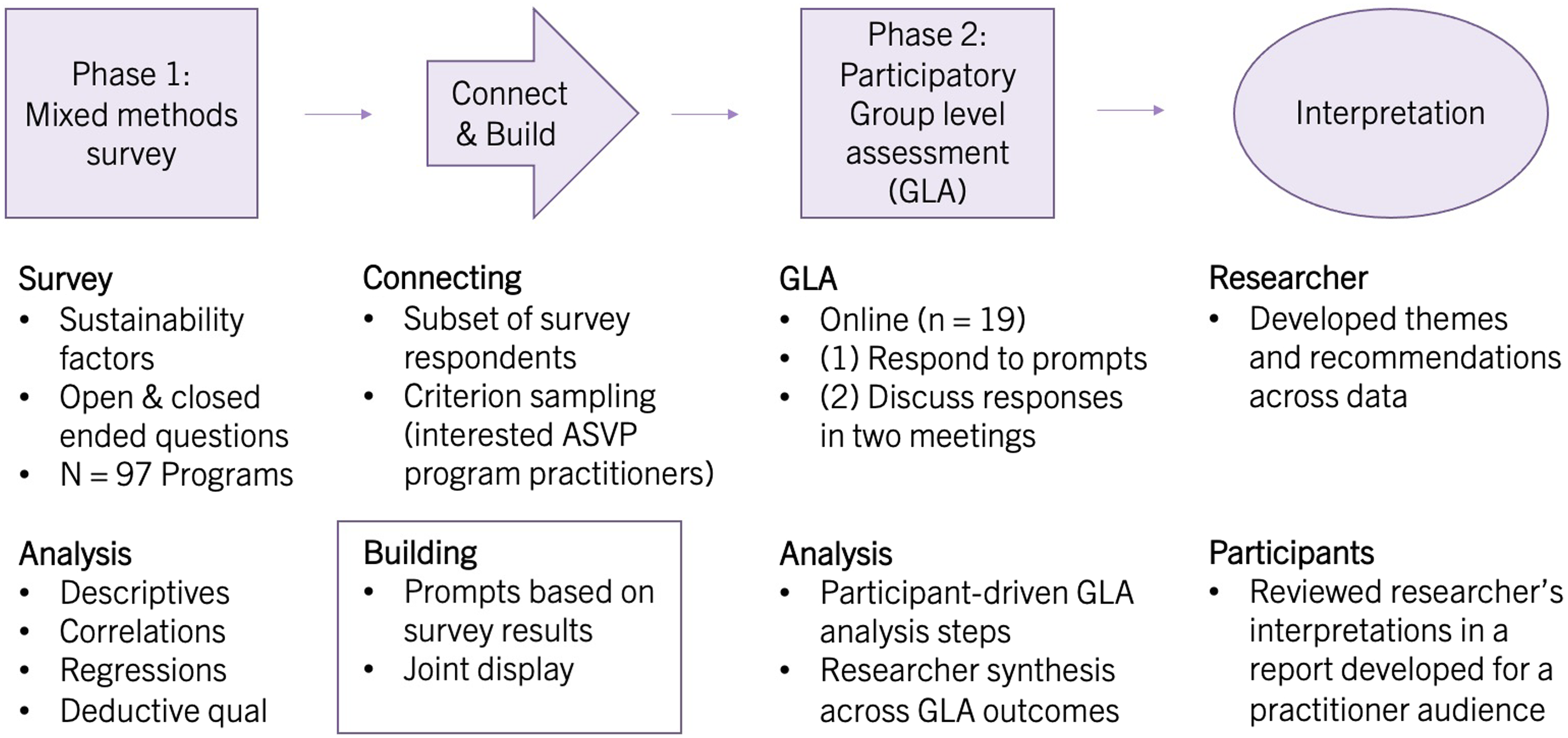
Methods-level study decisions were informed by the plan to apply a participatory approach, or research that involves those with insider knowledge for the purpose of action or change (Vaughn and Jacquez, 2020). We chose group-level assessment (GLA), a participatory qualitative method (Vaughn and Lohmueller, 2014), for study phase two because our goal was to develop recommendations for programs that would be useful to practitioners. We note that we do not describe our study as fully participatory, where participants are engaged from study inception to conclusion. To better prepare for the participatory phase of the study, we adjusted study plans to use open-ended survey responses from the first phase as a proxy for participant input and developed a joint display to inform the creation of phase two data collection prompts. This decision making is detailed in the Process Summary and Takeaways section of this manuscript.
The first phase of the study was a survey completed by 97 ASVP program professionals that included closed- and open-ended questions related to ASVP program sustainment. The survey data sources relevant to the current discussion include the following: (1) a measure of program sustainment as an outcome (Palinkas et al., 2020), (2) measures of determinants of program sustainment (e.g., funding, community networks, Palinkas et al., 2020), (3) a closed-ended question about the determinants that the respondents would like to learn more about, and (4) two open-ended questions (e.g., “What are the greatest barriers your program has experienced as it works to sustain over time?”) yielding qualitative data. The second phase applied a GLA with 19 prevention practitioners aimed at expanding upon survey findings and creating recommendations (the intent of this explanatory design). Interested readers can find further details about the study elsewhere (Jackson-Gordon, 2022).
As noted previously, explanatory sequential studies are usually quantitatively focused. However, the open-ended survey responses gathered in the first phase provided rich contextual information that described program-related experiences of the respondents. Because of the planned participatory approach in phase two, we decided to utilize the quantitative as well as qualitative survey results to integrate between the survey and qualitative phase. We created a joint display for qualitative phase prompt development to accomplish this building integration using both forms of survey results. We describe our display as a variant of the interview questions joint display type (Guetterman et al., 2021). This display served as an integration tool to ensure that the most important concepts for sustaining ASVP programs were addressed during the qualitative phase by informing the qualitative data collection prompts. Reflections from the first author on the study process and conversations with the second author informed this discussion.
Methodological Processes for Integration
Our methodological reflections are organized to provide insights on the process for developing the integrative strategy and then a description of the resulting joint display.
Process Summary and Takeaways
The initial building integration plan was to use quantitative survey findings from the first phase to develop prompts for the qualitative second phase. The qualitative survey responses were intended to provide context when reporting quantitative results. The plan changed for three reasons: survey open-ended responses had rich content (i.e., field-specific insights about survey topics); there was little variability in quantitative results across survey constructs (e.g., similar means), posing challenges for identifying what should be expanded upon in the qualitative phase; and we revisited phase two participatory principles. We realized that by excluding the open-ended survey responses during prompt development, the qualitative phase protocol may not capture what is most relevant for the prevention practitioners.
For example, although funding was found to be significantly correlated with sustainment and had the lowest-rated mean compared to other sustainment constructs, practitioners provided more open-ended responses related to the community networks determinant when compared to funding. Further, most community network-related qualitative survey responses revolved around schools, whereas the survey subscale did not address schools. As such, the phase two discussion prompts highlighted community networks and used the term “schools” to increase relevance to participants. In summary, because the survey tool about sustainability was general and not designed for ASVP programs alone, the added qualitative results aligned general perspectives on sustainability with field-specific sustainability. A joint display helped us identify these findings.
To develop the display, we made decisions about how to combine result types, organize the display, decide which results to include, and use the display to facilitate building to the qualitative phase. These decisions resulted in the following process: • Identify quantitative and qualitative results about each major construct in the survey. Open-ended responses typically fell into predefined constructs from Palinkas et al. (2020). As such, we deductively analyzed open-ended responses based on these constructs, consequently aligning with the categories of quantitative results for each construct (e.g., funding). • Organize the joint display by major constructs (rows) and type of results and interpretations (columns). • Include results that demonstrate the relative importance of each construct to the overall goal of program sustainment (e.g., correlation between constructs and overall sustainment score), as identified quantitatively and qualitatively through survey responses. • Create a column and describe the integrated takeaways derived from reviewing the quantitative and qualitative results. We weighed the relative importance of each construct for program sustainability with priority given to qualitative results (quantitative results were similar). Had quantitative results been more variable, there likely would have been more equal priority in this process.
A strong foundational study purpose, research questions, and guiding participatory goals directly guided and justified integration decisions between phases. For example, the planned use of a participatory method helped to justify the inclusion of qualitative survey responses for building integration. It should be noted that in a fully participatory study, the participants would have assisted in the actual creation of the joint display; this was not feasible for the current study due to advice about ensuring a short time frame between the survey and GLA to avoid disengagement. Participants were unknown to one another prior to the GLA and located across US time zones, posing difficulties for timely scheduling. Convening to develop the joint display may be more feasible for pre-established groups or when incentives are available.
Joint Display and Prompt Development
Excerpt From Joint Display for Developing Prompts for Two Sustainability Constructs.

Note. Subscale and items from Palinkas et al. (2020). (B) refers to barrier; (S) refers to strength. *p < .05. **p < .01. Qual = qualitative.
Intentions of Each Column Category of the Joint Display.
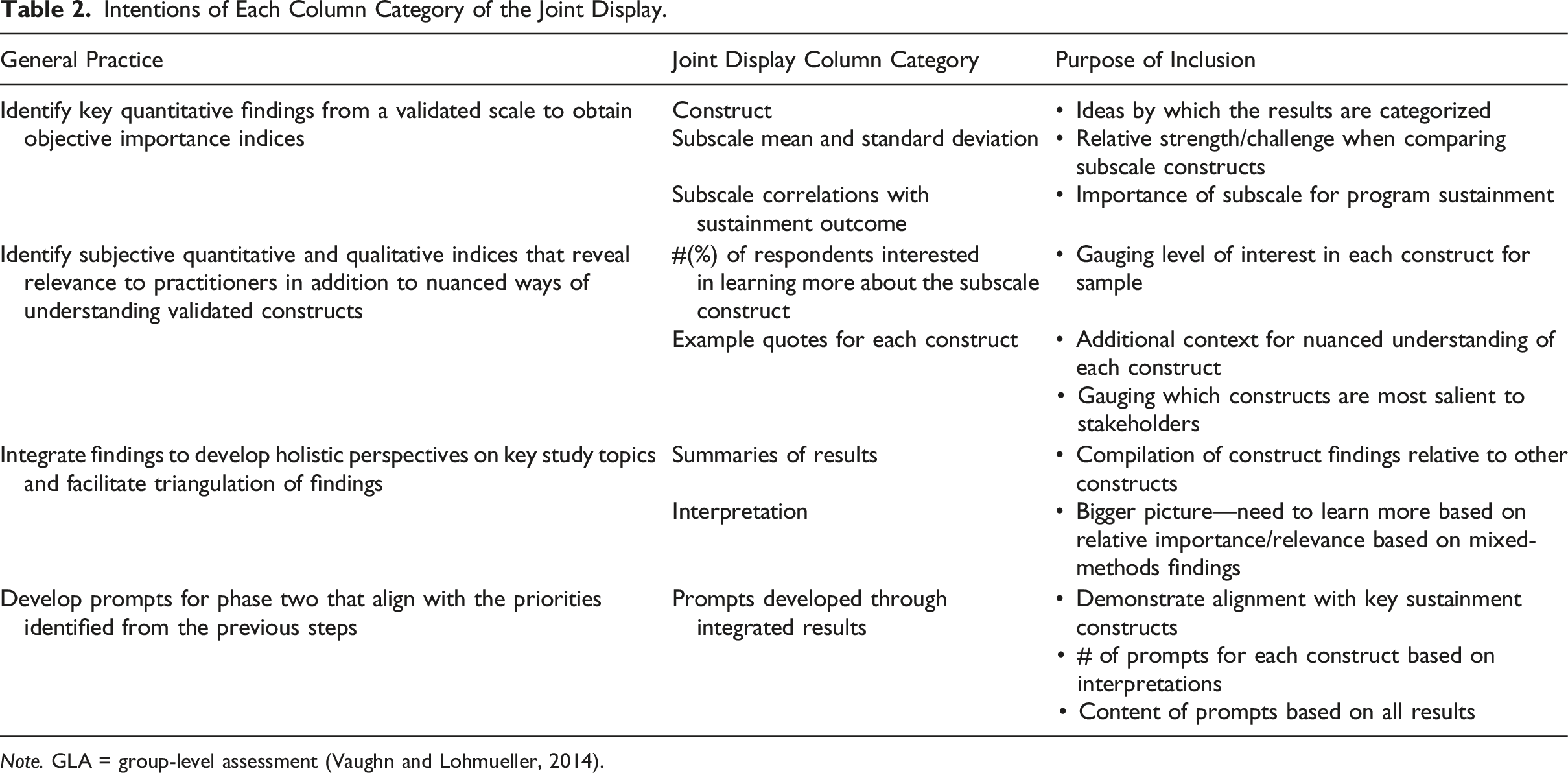
Note. GLA = group-level assessment (Vaughn and Lohmueller, 2014).
Prompts (24) were developed based on guidance from Vaughn and Lohmueller (2014), including recommendations for intentional redundancy, open-ended/structured, and fun/serious variations among prompts. Prompt responses develop a database of information available to participants to review and analyze during the GLA (Vaughn and Lohmueller, 2014). Most prompts were designed to address specific constructs, but some were intended to be broad to identify constructs that may not have been reflected in the survey. Some construct-specific prompts were developed to explain or gain additional information about repetitive ideas from the survey responses. Language for prompts was pulled directly from qualitative survey responses to increase relevance to the participants, as participants drive data production and analysis in this method.
Discussion
As mixed methods and participatory research approaches continue to grow in popularity, additional examples of meaningful integration—especially at the methods level—are needed in the scholarly community. The current example of intentional building by using closed- and open-ended survey responses to develop subsequent qualitative data collection prompts is well-suited for studies incorporating participatory frameworks; the prompts placed greater value on participant perspectives in moving the study forward when compared to statistics alone.
Contribution to Mixed Methods Research
This work contributes to understanding about the explanatory sequential design and use of joint displays for accomplishing building integration. Regardless of the philosophical or theoretical underpinnings of the study approach, using open-ended comments from quantitative phase surveys in an explanatory sequential design warrants further consideration and discussion among scholars. For example, this strategy may have potential to serve as an additional safeguard for validity of findings both after the first phase as well as when drawing final conclusions in a study. Integration between phases in the explanatory design is an important step to support overall study validity (Ivankova, 2014). Including qualitative survey content may reveal discordant findings, which could then be compared in the joint display and directly addressed through prompts for the next phase, further supporting validity. Accordingly, the strategies used here could transfer to the development of interview or focus group protocols following a survey. In light of a more fully participatory approach, researchers should also consider participant involvement in the development of the display or review of prompts.
The integration through the joint display and prompt development led to engaged conversations among the study participants during the GLA, which was valuable given the participant-driven data production and analysis method. In the future, researchers could conduct a methodological study to compare results for groups where survey-driven prompts did or did not integrate qualitative survey results. In summary, this discussion contributes an example of building integration in explanatory sequential designs with a participatory second phase, helping to fill the gap in academic literature focused on this specific mixed methods concept.
Footnotes
Acknowledgments
We thank study participants for their part in this study, as well as the funding provided by the University of Cincinnati Graduate Student Governance Association Interdisciplinary Research Fellowship. This work was previously shared at the 2022 American Educational Research Association (AERA) conference. Special thanks to Drs Foote, Sanders, Yang, and Toraman Turk for their review of this manuscript.
Declaration of Conflicting Interests
The author(s) declared no potential conflicts of interest with respect to the research, authorship, and/or publication of this article.
Funding
The author(s) received no financial support for the research, authorship, and/or publication of this article.
