




Abstract
Emergent digital technologies keep redefining the (porous, yet analytically useful) online/offline participation dichotomy, yet the study of this evolution remains fragmented across the fields of public management, digital governance, and civic culture. Drawing on a narrative literature review, this article offers a conceptual synthesis of three central debates at the intersection of digital media and citizen participation. First, whether online participation constitutes an authentic form of citizen involvement. Second, whether digital media fundamentally expand the repertoire of participatory practices or simply replicates offline forms in digital environments. Third, whether online participation mobilizes or demobilizes traditional offline participation. Anchored in a sociotechnical perspective, this article offers explanations of how affordances from emergent technologies and evolving citizenship norms are shaping offline and online participatory practices.
While online participation can mobilize offline participation, it can also lead to passive involvement (slacktivism), making it essential to design digital initiatives that encourage deeper citizen participation. Emerging trends suggest that citizens prefer personalized, expressive, and network-driven forms of participation, requiring public administrators to integrate digital tools that align with these preferences. To fully leverage online participation, policymakers should integrate insights from public management, civic culture, and digital governance to develop more effective participatory frameworks.
Introduction
With the Internet's pervasive influence on nearly every aspect of social life, it is no surprise that digital media have become central to citizen participation. Digital media have significantly shaped citizen participation, prompting extensive theoretical discussions about its implications (Feeney & Porumbescu, 2021; Bennett & Segerberg, 2012). This article contributes to these discussions by offering a conceptual synthesis of the key debates surrounding the role of digital media in shaping citizen participation. 1
The participatory innovations introduced by digital media have sparked debates about the definitions, nature, and impact of citizen participation. Three key debates dominate the literature on digital media's role in participation. First, there is no consensus on whether online participation qualifies as an ‘authentic’ form of citizen participation (Oser et al., 2014; Theocharis & Van Deth, 2018). This debate questions whether the new interactions enabled by digital media should be considered forms of participation. Second, there is discussion about whether digital media expand the repertoire of practices available for citizen participation (Gibson & Cantijoch, 2013; Bennett & Segerberg, 2012; Foos et al., 2021; Ohme, 2019; Bennett et al., 2014). Some argue that digital media enable new forms of participation that are not replicable offline, while others suggest it merely mirrors offline activities. Third, there is debate about whether online participation mobilizes or demobilizes traditional offline participation. A meta-analysis found evidence supporting both views (Boulianne & Theocharis, 2020), and empirical studies have produced mixed results (Oser et al., 2013; Xenos et al., 2014).
While these debates advance our understanding of citizen participation, they also highlight the need for further research. We still lack a comprehensive understanding of how digital media are affecting participatory practices in public administration. Although research has provided valuable insights, the discussion remains fragmented, with studies on online participation happening independently across various fields—such as civic culture, social movements, cyber activism, and public management—with limited connections between them. Additionally, research on online participation is often separate from offline participation, limiting our ability to understand their potential interactions and the full scope of citizen participation in the digital age. Therefore, bridging these gaps with more comprehensive, interdisciplinary research bridging these gaps through interdisciplinary research can deepen our understanding of the impact of digital media on citizen participation.
Integrating insights from various disciplines offers important contributions to better understand how digital media are shaping citizen participation in the public sector. In this article, we bring together recent contributions to these three debates from fields such as public management, digital government, and civic culture, which in terms of this topic have been relatively isolated from each other. Rather than presenting new empirical findings, this article offers a conceptual synthesis of the key scholarly debates on online participation and characterizes it as a socio-technical phenomenon. By integrating insights from multiple disciplines, we contribute to the refinement of existing theoretical frameworks and propose a future research agenda for understanding digital media's impact on citizen participation. To do so, we conducted a narrative literature review, 2 synthesizing research from fields such as public management, digital governance, and civic culture. Through this theory-driven approach, we critically assess existing frameworks and conceptual debates on online participation, identifying key gaps and proposing a future research agenda.
A socio-technical perspective allows us to capture the complexity of the topic and offer a more nuanced understanding of digital media's role in citizen participation. Understanding how information technologies impact citizen participation requires an approach that considers the mutual influence between evolving citizenship norms, participatory practices, and digital media. This article brings together the conceptual scaffolds of affordances and constraints, socio-technical, and socio-material approaches to identify the mechanisms through which digital platforms constitute participatory practices. For policymakers, platform designers, or public administrators seeking to foster deeper citizen participation, this article provides some initial ideas on how online and offline participation actually happen and, therefore, how they can influence people's behaviors in relation to their participatory practices.
This article is structured around three major theoretical debates in the literature. Section 2 defines key theoretical perspectives on citizen participation, situating them within broader discussions of digital governance and civic culture. Sections 3, 4, and 5 engage with existing conceptual disagreements, synthesizing prior research to highlight emerging patterns. Section 6 proposes a research agenda, outlining areas where further theoretical development is needed. Finally, Section 7 presents our conclusions.
Citizen Participation in Times of Collaborative Public Management, Digital Governance, and a Connected Civic Culture
This section describes the context of citizen participation in terms of two main elements: (1) a new generation of public management that values and fosters collaboration, and (2) the potential to build improved digital governance and a connected civic culture provided by recent technological advances.
Definitions of Citizen Participation and Online Participation and Theoretical Blocks
In the field of public administration, scholars tend to use the term citizen participation, which refers to the participation of citizens in the planning and administrative processes of government (i.e., citizens interacting with administrators or public managers) (Callahan, 2007; Yang & Callahan, 2005; Nabatchi et al., 2017). This form of participation is aimed at influencing the processes of planning or implementation of service delivery or policy issues. According to Callahan (2007), this concept seeks to differentiate from terms used in other fields (i.e., political participation or civic engagement), as it is narrowed to the impact of policy formulation and implementation, and excludes activities aimed at influencing political outcomes or community services.
Classic models of participation, such as Arnstein's (1969) ladder, emphasize a normative hierarchy of influence: from non-participation (manipulation and therapy) to several degrees of tokenism (informing, consultation and placation), until reaching more committed forms of citizen participation with more meaningful participation. 3 Others, like Callahan (2007), focus on procedural dimensions such as who participates, in what stages, and through which mechanisms. More recently, Cardullo and Kitchin (2019) highlight expressive and symbolic dimensions, pointing to how digital platforms reshape the meanings and expectations of participation.
Recent studies highlight how digital tools, including artificial intelligence, shape citizen participation in public decision-making while raising concerns about risks and legitimacy (Sieber et al., 2024). Digital governance encompasses technologies that enable citizen interaction in policy processes to promote democratic engagement and improve decision-making (Asimakopoulos et al., 2025). Consistent with prior literature, such interactions are understood as forms of online participation, involving various modes of electronic communication between governments and citizens (Asimakopoulos et al., 2025; Sharma et al., 2022).
In public management, citizen participation has traditionally been linked to the pursuit of ideal values such as efficiency, economy, effectiveness, equity, responsiveness, fairness, and transparency (Callahan, 2007), reinforcing a managerialist orientation in the public sector. In contrast, scholars like Denhardt and Denhardt (2000) and Nalbandian (1999) argue that public servants should engage citizens in shaping public policy within a deliberative community. Moynihan (2003) identifies three theoretical strands underpinning debates on participation: the postmodern critique of declining trust in traditional institutions (e.g., governments, political parties, and families), disillusionment with bureaucratic and hierarchical governance models that marginalize citizen voices, and the aspirational push for more direct and communal forms of democracy. Together, these perspectives highlight the enduring tension between normative ideals of participation and the practical challenges of realizing them in contemporary public management.
From a technological perspective, literature across various fields addresses e-governance and online participation. Based on a meta-analysis, Sharma et al. (2022) propose a conceptual framework for digital citizen participation composed of four components. The first involves building a robust governance infrastructure to support information sharing, transparency, accountability, and universally accessible service delivery. Subsequent components include platforms that promote digital activism and open government data to encourage citizen feedback (e.g., participatory budgeting). The final component emphasizes ICT-enabled tools for deliberative governance, such as platforms that support policy juries or committee decisions, aiming to foster transparency, acceptance, and sustainability in participatory initiatives. This stage aspires to create an information society grounded in sustainable participation and digital commons. The authors also highlight that digital citizen empowerment is inherently multidisciplinary, drawing from information systems, communication, management, behavioral, sociological, and political theories.
While both perspectives offer valuable insights into the bureaucratic conditions for effective citizen participation, this article adopts a broader socio-technical lens to examine participatory practices in digital contexts. Orlikowski (1992, 2000) introduces this framework to explain the relationships between the features of information technologies and social structures. Adopting the emerging technological structures and their enactment by agents from Gidden's original work, Orlikowski brings the idea of a practice lens grounded in structuration theory and the notion of causal responsiveness and repeated interaction between social structures and information technology (p. 406). Therefore, technologies-in-practice interact with agents through facilities (e.g., hardware, software), norms (e.g., protocols, rules) and interpretative schemes (e.g., assumptions, knowledge) in reciprocal relationships. This is known as the situated use of technology.
In the case of participatory practices in digital contexts, this framework is useful for a better understanding of the emergence of information technologies in use as agents interact recurrently within certain structural properties of the technology at hand. The socio-technical lens recognizes that interactions are situational and therefore different groups from different backgrounds can enact different properties of technologies used for motivating civic participation according to their own facilities, norms and interpretative schemes.
This approach emphasizes how participation is shaped in practice by the interactions among various actors—government officials, public servants, elected representatives, and citizens—and how the meanings of offline and online tools are enacted differently depending on technological, organizational, and institutional contexts (Orlikowski & Scott, 2008).
Citizen Participation and a More Collaborative Public Management
Many researchers believe the next phase of public management will integrate collaborative and participatory elements, which were largely overlooked by the previous New Public Management (NPM) paradigm (Alford & Hughes, 2008). Others suggest more nuanced approaches, pointing to hybrid models of public organizations, using terms like network governance, collaborative government, public-private partnerships, joined-up government, whole-of-government, holistic governance, and connecting government (Stoker, 2006). Many scholars have sought to link collaboration and participation among government agencies, citizens, and other actors, such as the media, academia, and the private sector, under the umbrella concept of governance (Vigoda, 2002).
Rather than viewing traditional public organizations as solely responsible for delivering public goods and services to citizens seen as clients—a classic NPM perspective—new approaches advocate for partnerships between public managers and citizens. These digital-era governance models emphasize integration, data sharing, and personalization of public services (Dunleavy et al., 2006), reshaping expectations of responsiveness but often focusing more on administrative efficiency than participatory empowerment. Reintegration refers to joined-up or holistic governance, where public agencies and social actors collaborate through digital tools to streamline services, reduce co-production costs, and deliver citizen-centric solutions (Alford & Hughes, 2008; Dunleavy et al., 2006; Yang et al., 2020). Digitalization encompasses these technological changes, including automation, disintermediation, data integration, and interactive service platforms, which collectively reshape organizational practices and citizen participation. Together, reintegration and digitalization underpin contemporary governance models that prioritize coordination, responsiveness, and user-driven service delivery.
Governance models such as networked, joined-up, holistic, and collaborative have become dominant in contemporary public management. Some even describe them as the “one best way” to manage the public sector (Alford & Hughes, 2008; Dunleavy et al., 2006; Vigoda, 2002). As Vigoda (2002) notes, governance has evolved from a coercive model—where public administration acted as ruler—to a responsive one under New Public Management (NPM), which treated citizens as customers. The current phase moves beyond responsiveness, emphasizing citizen empowerment and collaboration through digital channels to foster partnerships between administrators and the public.
Within public administration, contingency theory offers a useful lens to understand citizen–government interactions in varying contexts (Bovaird et al., 2016). Alford and Hughes (2008) argue that different service delivery situations require tailored managerial approaches—some favoring top-down tools, others more participatory dialogue. This perspective has informed studies on co-production, which simplifies the complex bureaucratic landscape into a purchaser–provider relationship (Nabatchi et al., 2017). More recently, co-production has expanded to include new actors—citizens, volunteers, community organizations, and multilevel government agencies—responding to digital innovation and fiscal pressures such as layoffs, budget cuts, and even public sector bankruptcies (Clark et al., 2013). These hybrid arrangements support deliberative and participatory processes across a range of public functions and services.
Citizen Participation in Times of Digital Governance and an Emergent Connected Civic Culture
Recent technological advancements have reshaped governance, enabling new modes of citizen participation and collaboration through platforms such as crowdsourcing, innovation labs, and online participation tools (Linders, 2012; Meijer & Boon, 2021). Likewise, research in public administration has extensively examined online participation, emphasizing how digital platforms facilitate citizen participation and influence citizen-government relationships (Bennett & Segerberg, 2012; Clark et al., 2013; Kim & Lee, 2012). However, this literature often overlooks how digital media reshape participation practices by interacting with civic culture and evolving citizenship norms (Meijer et al., 2018; Meijer, 2018; Feeney & Porumbescu, 2021). Specifically, they do not fully address how digital media are reshaping or creating new participatory practices, or how evolving citizenship norms influence the use and adaptation of digital media for online participation. To better understand the evolution of participatory practices in online settings, it is crucial to examine the socio-technical processes that shape the use of digital media in transforming traditional participation or enabling new participatory practices.
Digital media both reflect and shape emerging civic norms, characterized by personalized, expressive, and network-driven citizen participation. Citizens increasingly prefer horizontal interactions, identity-driven participation, and unconventional modes of expression enabled by platforms like social media (Dalton, 2008; Loader & Mercea, 2011). As digital media expand and new forms of participation emerge, online participation is becoming increasingly prominent. It is crucial to examine how digital media shape citizen participation. The previous sections briefly reviewed changes in managerial practices and civic culture driven by interactions with digital media. However, a deeper understanding of how these interactions influence contemporary online participation is needed. This is essential to recognizing the mobilizing potential of online participation as a new form of citizen participation. In the following sections, we will explore this by reviewing and integrating existing literature into the subject.
Is Online Participation an Authentic Form of Citizen Participation?
Traditionally, citizen participation is defined as acts directly aimed at influencing government decisions or administrative actions, typically performed within institutional spaces (Callahan, 2007). However, the rise of digital media have challenged this view, introducing actions that occur in non-institutional contexts and emphasizing symbolic, expressive, or passive modes of participation (Pitti, 2018). Over recent decades, there has been a decline in institutionalized participation and a rise in alternative forms (Dalton & Shin, 2014). These shifts reflect evolving citizenship norms, with citizens expanding their participatory repertoire and embracing unconventional methods (Dalton, 2008; Pitti, 2018). Increasingly, participation occurs in spaces not controlled by governments or political institutions but by non-profits, social movements, or private companies (Kersting, 2013). As a result, participation studies now include acts that take place in unconventional spaces and through alternative means (Pitti, 2018; Van Deth, 2014; Theocharis & Van Deth, 2018).
Digital media facilitate expressive participation—such as sharing political content, engaging in symbolic acts like hashtag activism, and consuming or disseminating online political information—which some argue constitute genuine forms of participation (Theocharis & Van Deth, 2018; Gibson & Cantijoch, 2013). For example, the social movement #MeToo—which was predominantly in digital media—impacted on changes in normative and organizational accountability in several sectors, including academia (Goncharenko, 2023).
The shift toward passive acts has reignited debate about the nature of participation. These acts often rely more on symbolism and self-expression than on direct action, making them difficult to fit within classical definitions (Van Deth, 2014). As a result, some scholars have called for an expanded definition of participation to encompass this broader, more diverse repertoire of actions. For instance, Norris (2002, p. 16) defines participation as “any dimension of social activity that is either designed directly to influence government agencies and the policy process, or indirectly to impact civil society or which attempt to alter systematic patterns of social behavior.”
The debate over the definition of participation has been further fueled by the rise of digital media, as its technological features promote a shift toward more expressive forms of participation (Ohme, 2019; Lilleker & Koc-Michalska, 2017). Digital media provide new ways for individuals to express opinions, such as joining Facebook fan pages, liking, sharing, or retweeting posts. It also facilitates the creation of participatory spaces outside of government control, often managed by private companies or non-profit organizations (Lilleker & Koc-Michalska, 2017). In these spaces, the government may not lead the conversation and, in some cases, may not be involved at all (Kersting, 2013).
Some scholars argue for expanding the concept of participation to reflect changes in participatory practices (Ruess et al., 2023). However, proponents of a narrower definition caution that including personal communication, passive acts, and non-institutional spaces could make the concept too broad for effective study. Digital media are often seen as spaces for social activity, which blurs the line between personal and political acts (Ruess et al., 2023). Additionally, online activity lowers the effort required for meaningful political change (Gibson & Cantijoch, 2013; Theocharis, 2015; Morozov, 2009). For instance, ‘slacktivism’ refers to activities that arguably fall below the threshold of meaningful effort (Kristofferson et al., 2014). This raises questions about the effort required for participation to be considered valuable and whether non-institutional spaces, such as those owned by for-profit companies like Facebook or Twitter, can be legitimate sites of participation. Critics argue that these platforms prioritize commercial interests over public deliberation, compromising their neutrality (Feeney & Porumbescu, 2021).
Proponents of expanding the concept of participation argue for incorporating new forms of expression into citizen participation (Theocharis & Van Deth, 2018). This perspective focuses on reinterpreting passive acts—such as reading news, creative expression, and social media interactions—as key elements of contemporary forms of citizen participation (Ekström & Sveningsson, 2019). A central argument is that digital media amplify the impact of passive acts through personalized news feeds, incidental exposure, and the virality of posts. Research shows that some passive online acts can influence political outcomes (Oser et al., 2013). For example, studies suggest that simply sharing political news on social media can affect the perceived relevance of a topic, as algorithms use user behavior to determine what information is shown to others (Valeriani & Vaccari, 2016).
The debate thus centers on a narrow conception of participation—focused strictly on institutional actions aimed directly at policy influence—versus a broader definition that acknowledges symbolic, expressive, and digitally-mediated actions as meaningful forms of participation. Therefore, this discussion could benefit from a deeper understanding of when and how digital media's affordances and constraints make passive acts practical tools for influencing government decisions. Table 1 outlines key features of traditional and emerging forms of citizen participation.
Comparison Between Traditional and new Forms of Citizen Participation.
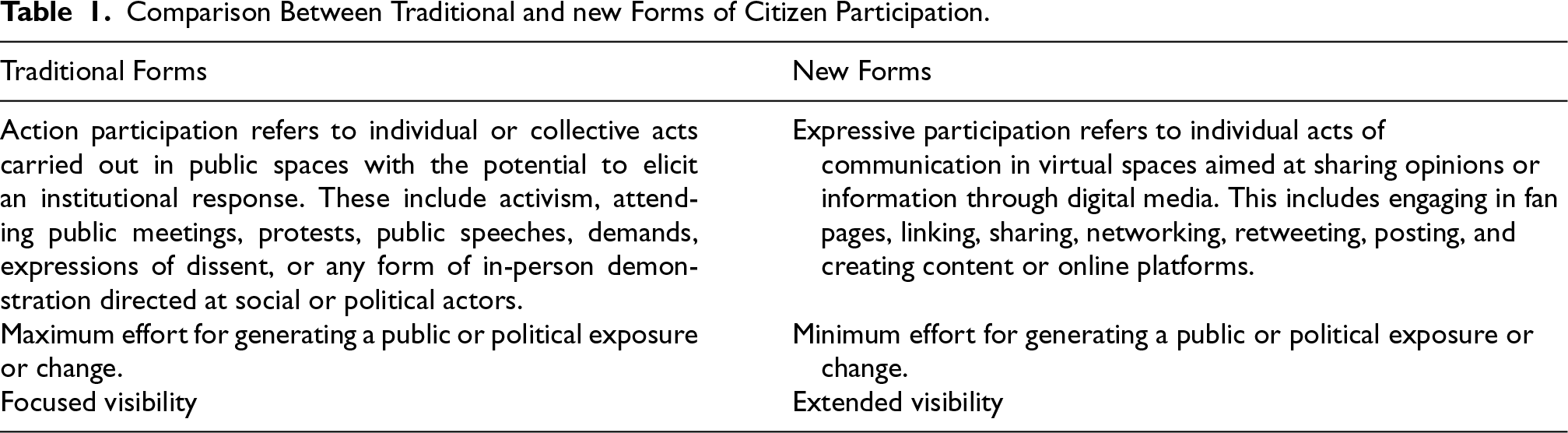
Comparison Between Traditional and new Forms of Citizen Participation.
These diverse participatory styles reflect not just citizen preferences and capacities, but also the affordances and constraints of digital platforms—such as visibility metrics, algorithmic amplification, and frictionless interfaces—that enable or restrict specific forms of participation. The following section integrates participatory styles with platform affordances to better understand contemporary participatory practices.
The literature on citizen participation has compared online and offline participation extensively, yet scholars disagree on whether these constitute distinct spheres or merely represent a continuum (Theocharis et al., 2021; Theocharis & Van Deth, 2018; Gibson & Cantijoch, 2013; Oser et al., 2013; Ruess et al., 2023). This debate often hinges on which criteria are considered, such as biases in participation (Van den Berg et al., 2020; Thijssen & Van Dooren, 2016; Clark et al., 2013), participation costs (Theocharis & Lowe, 2016; Bertot et al., 2012), trust in government (Kim & Lee, 2012), and the quality of resulting decisions or services (Linders, 2012; Meijer et al., 2018). Empirical findings are mixed, and the underlying reasons for observed differences remain unclear. For example, crowdsourcing initiatives have demonstrated both effective and ineffective outcomes (Harrison & Johnson, 2019).
Recognizing the need for a fresh approach, scholars have proposed shifting from outcome-based comparisons between online and offline participation to socio-technical or socio-material analyses of digital government (Meijer, 2018; Meijer et al., 2018; Feeney & Porumbescu, 2021). These perspectives emphasize not only how digital media shape participatory practices but also how social, organizational, and technical factors collectively influence media use (Orlikowski & Scott, 2008). Even nominally similar participatory activities may differ significantly in dynamics and experience when conducted online—for instance, an online town hall meeting offers distinct modes of interaction compared to its offline counterpart. Table 2 summarizes key differences between offline and online participation.
Comparative Between Offline and Online Participation.
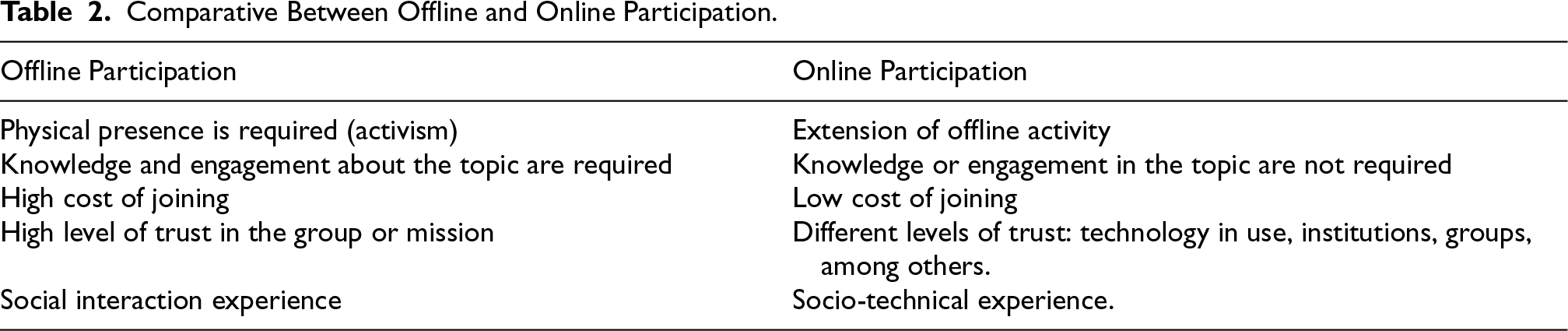
Comparative Between Offline and Online Participation.
The literature on this debate reveals two main perspectives. One stream suggests that evolving citizenship norms are shaping how certain technologies are used for participation. The other argues that digital media are driving new participatory practices and, in some cases, influencing the evolution of citizenship norms. In the following subsections, we explore these two perspectives.
Literature on civic culture has extensively documented the shift in citizenship norms toward more individualized participatory practices. Citizens today are less interested in group identities and more focused on expressing their values through their lifestyles (Dalton, 2008; Bennett & Segerberg, 2012). This shift has led to mobilizations driven by diverse and scattered motivations. Today, movements must appeal to a wide range of interests, identities, and topics; and citizens now play a more active role in organizing participation, a role traditionally held by organizations (Bennett et al., 2014).
The combination of personalized communication and the ability to organize large mobilizations individually defines contemporary online participation, a concept Bennett and Segerberg (2012) calls personalized politics. Bennett and Segerberg (2012) offer three key propositions to explain how this shapes participation. First, contemporary participation operates through personal action frames rather than collective ones, making citizen identification with causes more individualized. Second, mobilization is often driven by platform-based personal networks (e.g., Twitter, Facebook, Instagram), where messages are shaped and shared. Third, citizens participate through passive acts, such as consumption or lifestyle choices.
This approach helps examine how citizenship norms influence the use of technologies for participation. Rather than digital media shaping participatory practices, it is often chosen to align with evolving practices. Digital media enable personalized forms of participation, foster incidental exposure to information, and allow for individualized expressions (Bennett et al., 2014; Scherman & Rivera, 2021; Theocharis & Lowe, 2016). With mobile cameras and interactive platforms, citizens have shifted from passive consumers to active producers of information, sharing their opinions and content (Loader & Mercea, 2011; Bennett & Segerberg, 2012). From this perspective, it is valuable to study how citizens repurpose technologies to fit new participatory practices aligned with their citizenship norms. Table 3 highlights differences in citizenship norms and practices between offline and online participation.
Comparative of Citizen Norms and Practices Between Offline and Online Participation.
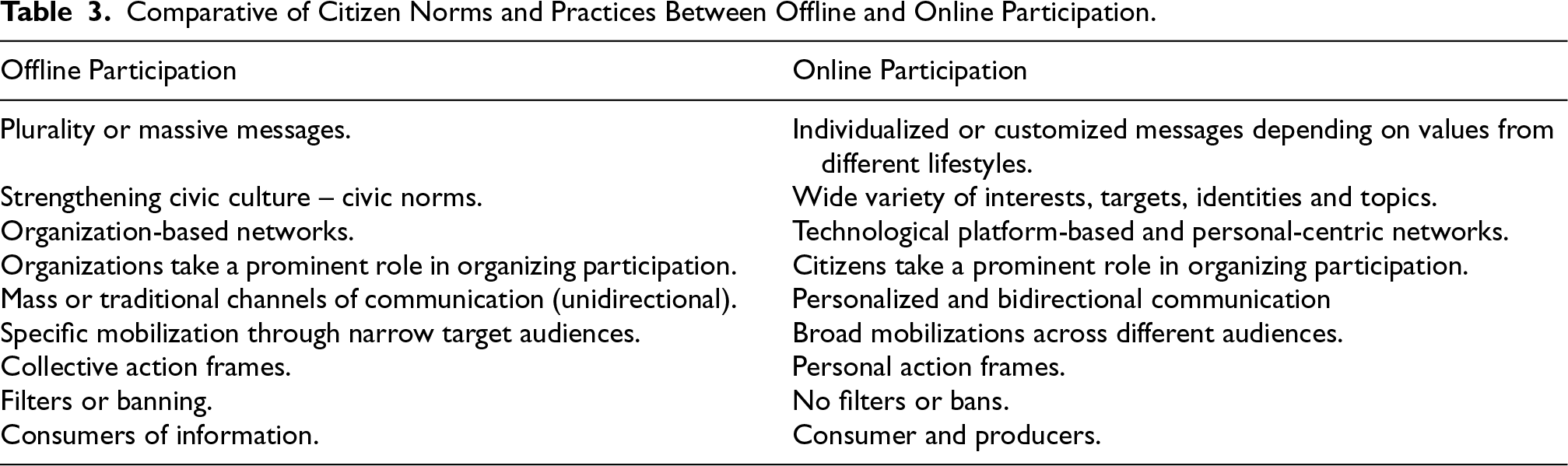
Comparative of Citizen Norms and Practices Between Offline and Online Participation.
Another stream of literature emphasizes how digital media affordances shape new participatory practices (Scherman & Rivera, 2021; Bennett & Segerberg, 2012; Ohme, 2019; Kim & Ellison, 2022; Foos et al., 2021; Zhu & Skoric, 2022). Specifically, digital media influence participation through four key mechanisms: (1) exposure, (2) expressiveness, (3) memes, and (4) stitching mechanisms. First, digital platforms increase deliberate and incidental exposure to information on public issues (Kim et al., 2021). Second, multimedia tools facilitate expressive communication through diverse formats—text, audio, video, and graphics—enabling playful and interactive participation on platforms like Facebook, YouTube, Instagram, TikTok, and messaging apps (Loader & Mercea, 2011; Kim & Ellison, 2022). Third, memes—symbolic content like multimedia images, WhatsApp forwards, or retweets—function as cohesive elements that unite individualized acts into collective mobilization, thanks to their adaptability and ease of sharing (Bennett & Segerberg, 2012). Finally, platforms offer “stitching mechanisms,” such as content curation, peer filtering, recommendations, and reputation systems, facilitating decentralized organization and shaping public discourse and citizenship norms (Zhu & Skoric, 2022; Bennett et al., 2014).
Stitching mechanisms are key to understanding how platforms enable new forms of participation. According to Bennett and Segerberg (2012), the primary stitching mechanisms on platforms are networking and diffusion, which enhance broadcasting and expression while expanding content through hypertext. Social media introduces new networking methods, such as joining Facebook groups, following accounts, friending users, and linking content via hypertext, email lists, WhatsApp groups, and wikis. Hashtags are an example of a diffusion mechanism, helping to aggregate, curate, and direct information (Loader & Mercea, 2011). Another expressive tool in digital media is emojis, which studies suggest may influence government decisions (Kariryaa et al., 2022). However, certain digital media affordances can negatively impact participation. For instance, social media's self-selection effect encourages connections with like-minded individuals (Foos et al., 2021), and it also facilitates the spread of misinformation (Jungherr & Schroeder, 2021). Table 4 outlines the differences between offline and online participation regarding the effects of digital media.
Comparative Between Citizen Norms and Practices Offline and Online Participation.
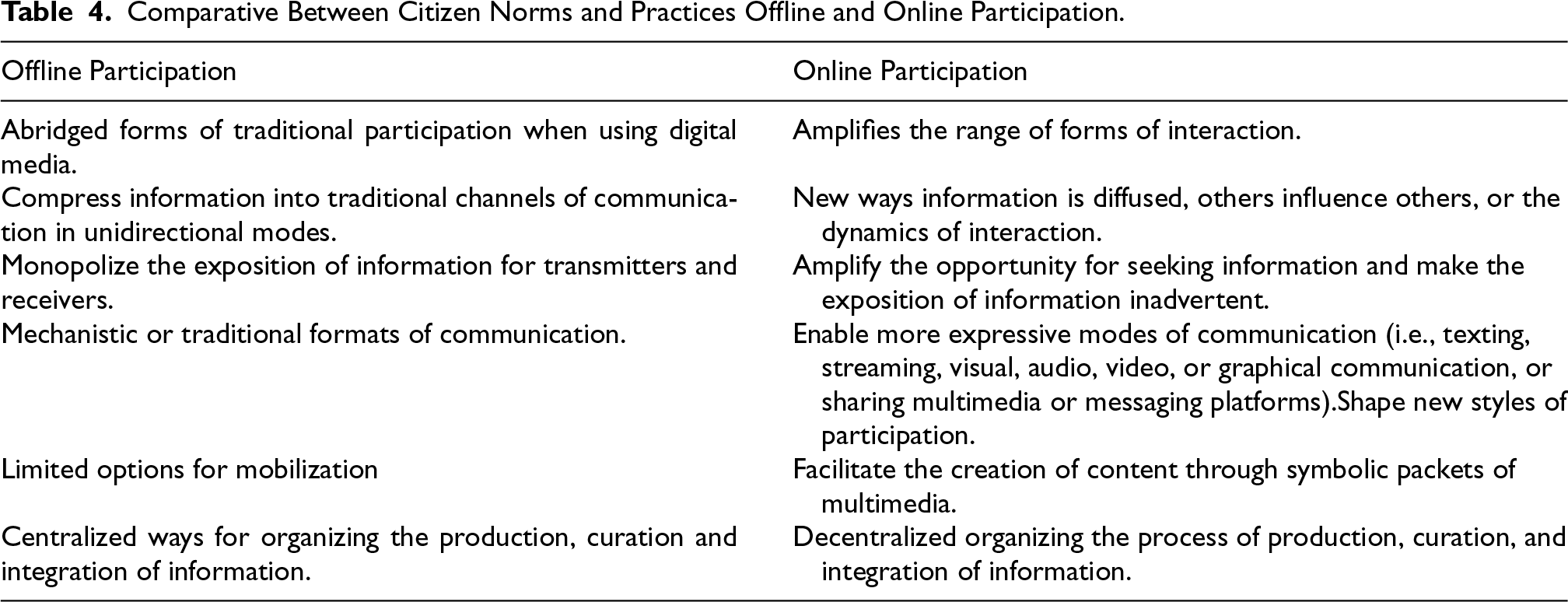
Comparative Between Citizen Norms and Practices Offline and Online Participation.
Although extensive research suggests a positive link between online and offline participation, theoretical explanations remain debated, primarily between the “mobilization” and “reinforcement” theses, 4 with empirical findings being mixed (Boulianne & Theocharis, 2020; Boulianne, 2009, 2015; Gibson & Cantijoch, 2013; Theocharis & Lowe, 2016; Oser et al., 2013). This section briefly describes these two explanations from a socio-technical perspective and highlights how they are related to the effects of digital media and changes in citizens’ norms and behaviors, explained in the previous section. Consistent with this, the mobilization thesis proposes that digital media promote online participation, which subsequently fosters offline participation, especially among previously disengaged citizens. From a socio-technical perspective, four mechanisms underpin this thesis: lowering participation costs to broaden citizen involvement (Oser et al., 2013; Vissers et al., 2012); strengthening social interactions and bonds among disengaged groups (Boulianne & Theocharis, 2020); facilitating incidental exposure to political information (Xenos et al., 2014); and enhancing individuals’ perceived self-efficacy by making participation outcomes more visible (Kahne & Bowyer, 2018).
Cantijoch et al. (2016) offer a second explanation, arguing that online participation involves a gradual transition from low-effort online activities—such as accessing political news or engaging in political consumerism—to more active offline participation, like signing petitions, joining forums, or voting. In this view, online participation acts as a preparatory gateway toward offline participation. Empirical studies consistently support the idea that online participation increases offline participation (Boulianne & Theocharis, 2020; Boulianne, 2015). For instance, Johnson and Kaye (2003) found a positive relationship between internet use and participation, while Weber et al. (2003) showed that individuals that are active online are more likely to engage politically offline. Boulianne and Theocharis (2020) describe this as a “gateway effect,” where digital media help users develop skills, such as networking and information processing, essential for broader citizen participation. However, in this perspective digital media is not necessarily the main driver to go from online to offline participation, which is consistent with the changes in citizens’ norms and behaviors explained in the previous section.
Advocates of the reinforcement thesis recognize that digital media promote online participation but contend it mostly benefits those already engaged. Consistent with a socio-technical perspective, they argue that digital media do not fundamentally alter existing participation structures, as socioeconomic factors continue to shape both offline participation and digital skill development. For instance, Oser et al. (2013) demonstrate that despite the emergence of new online participation forms, socioeconomic stratification persists consistently across both online and offline settings. This pattern aligns with digital divide research, which highlights that affluent individuals enjoy greater access to participatory channels, reinforcing existing inequalities (Tai et al., 2020). Consequently, online participation often functions as an echo chamber, amplifying rather than reducing offline disparities.
A third thesis, known as ‘demobilization’ or ‘slacktivism,’ argues that online participation loses value because it lowers participation costs and fosters a false sense of self-efficacy (Morozov, 2009). Passive acts, like changing a profile picture on Facebook, are seen as ineffective for influencing government decisions or operations (Boulianne & Theocharis, 2020). However, these acts give citizens a sense that their concerns have been expressed and acknowledged (Brown, 2017; Kristofferson et al., 2014). As a result, scholars argue that online participation may reduce the likelihood of engaging in more meaningful forms of participation (Kim et al., 2017; Brown, 2017; Morozov, 2009). This explanation puts more weight on the effect of digital media but acknowledges that social norms and individual motivations are also important.
Future research can contribute to existing literature by exploring the social and individual conditions under which digital media lead to participatory practices that demobilize citizens. Recent studies suggest that the visibility of participation plays a moderating effect. When participation is visible to others, citizens may engage to enhance their self-image (Kristofferson et al., 2014). This aligns with a key critique of ‘slacktivism'—that digital media are often used for identity construction. As Tufekci (2008, p. 21) explains, it is about ‘being seen by those we wish to be seen by, in ways we wish to be seen.’ Therefore, evidence shows that social media serves as a platform for entertainment and socializing, blurring the line between participation and self-presentation. Therefore, individual motivations and intentionality are important factors to consider in addition to the characteristics of the digital media being used.
Research Agenda: Understanding the Emergence of Online Participatory Practices
The literature remains inconclusive about how digital media affect citizen participation, both online and offline, and whether online participation fundamentally differs from traditional participation practices. Debates also continue over digital media's role in mobilizing offline participation. From a socio-technical perspective, such differences arise from diverse participatory practices enabled by platforms like Facebook, YouTube, Instagram, and TikTok, which users often repurpose beyond their original intent, resulting in varied modes of coordination and expression. As mentioned in the previous two sections, a common thread across these debates is the recognition of participation as a continuum shaped by individual preferences and capacities, alongside digital platforms’ affordances, constraints, and broader institutional contexts. Thus, online participation—like its offline counterpart—represents an authentic socio-material form of citizen participation. To fully understand participatory practices today, it is crucial to examine how digital affordances and constraints influence these varied styles of citizen participation.
The recognition of online participation as another form of participation allows us to compare it with offline versions of it. Our previous reflections about the two main streams in the literature suggest that although offline and online participation are different styles of citizen participation, they interact in the same socio-technical structure in a dual way. In one way, citizenship norms shape how certain technologies are used for participation, either offline or online platforms. In addition, digital media are driving new participatory practices and, in some cases, influencing the evolution of citizenship norms. Therefore, offline and online styles of participation are both inserted in the same dual socio-technical structure but with different meanings and practices that need to be studied.
Building on the debates presented earlier, this article examines whether online participation mobilizes or demobilizes offline participation. Existing research has not produced conclusive evidence about digital media's role in shifting citizens between different types of participation. Nevertheless, platforms like social media clearly facilitate diverse forms of participation, often blending political activities with entertainment, social interaction, and digital identity construction—thereby blurring boundaries between citizen participation and self-presentation. Given the nature of these dynamics, future research should adopt integrative approaches, particularly socio-technical or socio-material frameworks, moving beyond traditional perspectives that treat technology as an external, static influence. Such approaches emphasize the mutual shaping of citizenship norms, participatory practices, and digital media (Meijer, 2018; Meijer et al., 2018; Feeney & Porumbescu, 2021). Specifically, a socio-material perspective views digital media as performative, meaning technologies acquire meanings and properties through user interactions within specific institutional contexts (Orlikowski & Scott, 2008). Unlike traditional exogenous models, this approach highlights how new participatory practices emerge dynamically from relationships among users, technologies, and organizational environments, which is consistent with our previous explanation about the importance of both digital technologies and citizens norms.
The literature review conducted to discuss the three key debates has shed light on how the emergent digital media are shaping participatory practices. Following the sociotechnical approach, we argue that digital media provide affordances and constraints through which they shape participatory practices—a pattern we documented in Section 5. We analyzed the digital media related to participation identified in the literature review and identified their affordances and constraints. Based on this analysis, we identified five key affordances stemming from digital media: (1) networking, (2) expressiveness, (3) coordination, (4) collaboration, and (5) anonymity (see Table 5). While exploratory and non-exhaustive, these affordances help explain how digital media actively shape participatory practices.
Affordances of Digital media.
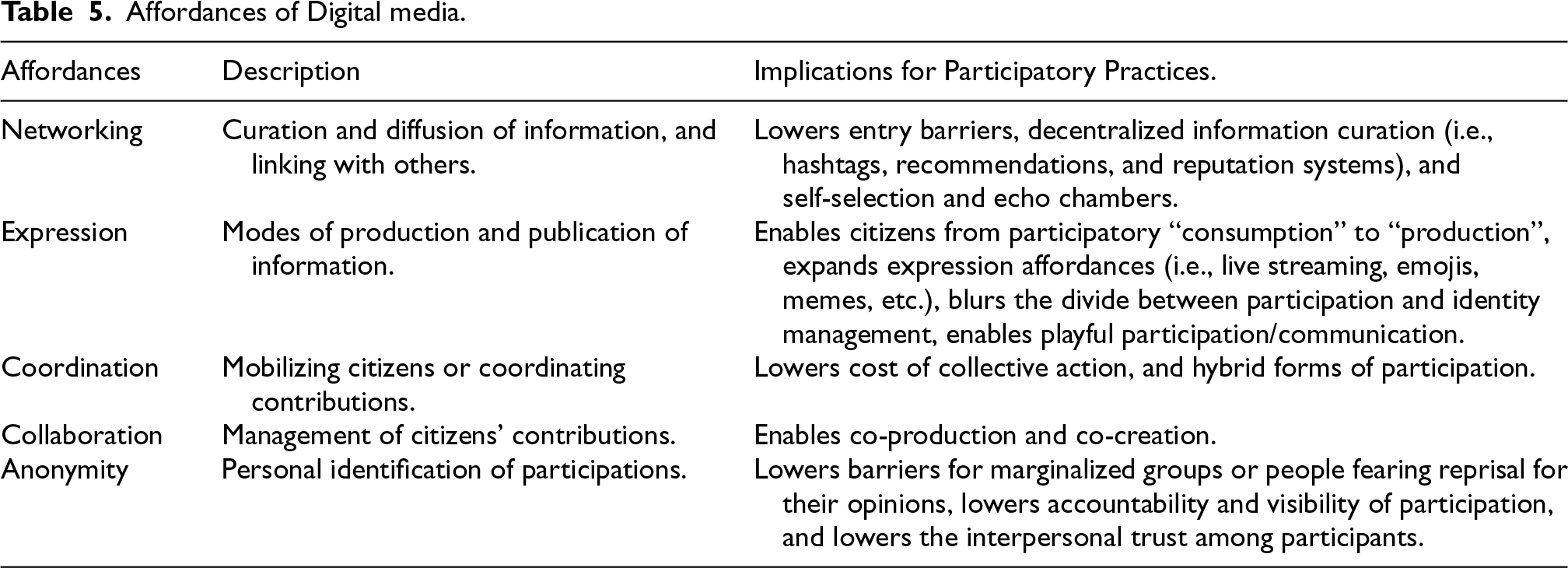
Affordances of Digital media.
As discussed in Section 5, networking refers to digital media's capacity to connect users and shape how information is curated and circulated within virtual networks. Expressiveness involves features that support various modes of sharing, such as live streaming or multimedia content (video, text, geo-tagged media). Coordination captures the tools that facilitate citizen mobilization, while collaboration includes features that support interaction, feedback, and collective contribution. Anonymity—or its absence—significantly influences user behavior on digital platforms.
Consistent with a socio-technical or socio-material perspective, understanding these practices requires examining how material technologies, human actors, and institutions interact to produce specific outcomes. It is therefore essential to map the digital media technologies involved and analyze how they enable or constrain participation. Future research should further classify these technologies and assess their affordances and limitations. Table 6 offers an exploratory (non-exhaustive) typology of digital media categories used to support online participation.
Digital media Technologies Used for Online Participation.
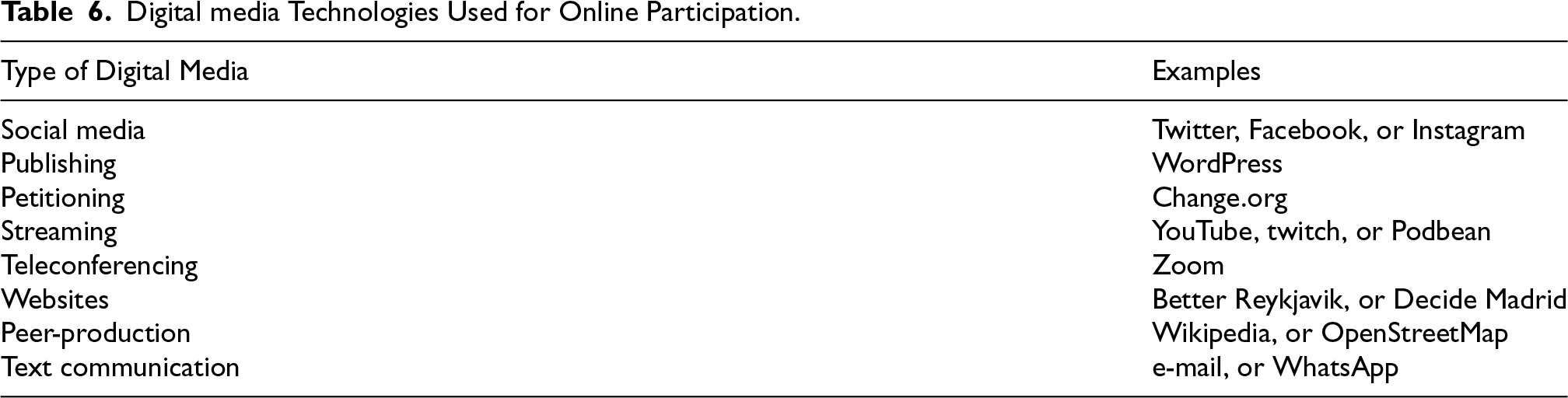
Participatory practices in the public sector have evolved significantly in recent decades, increasingly relying on digital media for their implementation. Recent literature identifies information technologies as central to emerging practices such as co-production, co-creation, crowdsourcing, collective intelligence, peer production, virtual labor markets, platform governance, citizen compliance, citizen sensing, hackathons, and tournaments (Meijer & Boon, 2021; Clark et al., 2013). These and other cases illustrate the scholarly suggestion that research on online participation should adapt their conceptual frameworks to better capture the socio-material nature and the increasingly hybrid repertoire of participatory practices (Marsh & Akram, 2015). In addition, our understanding remains limited regarding how specific technologies or their affordances shape these developments. This article proposes an alternative, though not novel, research approach that emphasizes the mutual shaping of technologies, human agents, and institutional structures. As Feeney and Porumbescu (2021) argue in their review of social media use in public administration, technologies must be seen as integral to the dynamics of citizen participation. We propose extending this view by identifying and analyzing the digital affordances and technological configurations that influence, but do not determine, the evolution of participatory practices.
Finally, it is important to emphasize the evolution of the discussion on citizen participation in the light of emerging technologies. For example, recent studies have shown that emerging technologies such as AI enable new forms of participatory practices, particularly by supporting participation through generative tools, or by enabling new means of interaction and data analysis (e.g., chatbots, or real-time sentiment analysis) (Rossello et al., 2025; van den Broek et al., 2024). This new ground for participatory practices brings into a broader perspective the academic contribution of this article in, at least, two ways. First, it shows that the discussion related to participatory practices is evolving beyond the traditional dichotomy of online vs offline participation, effectively incorporating hybrid forms of participation. Second, our proposal of weaving together the affordances and constraints of emergent technologies with the analysis of civic culture, expressive norms, and socio-material dynamics offers a valuable framework to assess emergent participatory practices in AI-supported forms of participation.
Our study highlights the significance of three key debates on the impact of digital media on citizen participation. Each debate addresses different aspects of citizen involvement, offering a comprehensive understanding of this relationship and valuable insights for future research. Through a review of existing literature, we identified the core principles of each debate, along with their commonalities and differences. The following paragraphs will delve into each debate, presenting new ideas to deepen our understanding of the interplay between online and offline citizen participation.
The first debate argues that online participation, like offline participation, can be an effective tool for influencing government decisions. It is viewed as a legitimate form of citizen participation, though it has distinctive characteristics such as varying levels of expression, visibility, and lower barriers to entry compared to traditional methods. Proponents argue that passive acts of participation should be reinterpreted as integral to modern citizen participation. This can be seen as a continuum from passive to active acts, but all representing some type of participation. Additionally, intentionality and effectiveness are key criteria for determining whether an act qualifies as participation. For example, both online and offline acts may or may not impact decisions, but they can still be considered forms of citizen participation.
The second debate highlights the differences between offline and online participation. Offline participation typically requires citizens to have a certain level of knowledge, incur significant costs, build trust, and be physically present, relying on traditional practices and norms with limited use of digital tools. In contrast, online participation introduces new practices that heavily use digital media, offering low costs to join, trust in different actors or systems, and no need for physical presence. Therefore, online participation has emerged as a distinct and accessible channel for citizen participation. An alternative view would be to characterize online and offline participation as a continuum of participation where socio-technical affordances shape not only whether an activity is experienced online or offline, but also the degree to which digital and physical elements reinforce one another. Our study did not use this perspective and we think this is an opportunity for future research.
The third debate explores four perspectives on the question: ‘Does online participation foster or discourage offline participation?’ These include the mobilization thesis, reinforcement thesis, demobilization (or slacktivism) thesis, and the role of digital media as a moderating factor. Although all have been studied, the results remain inconclusive. Some research suggests that online participation encourages offline participation, while others argue that by lowering participation costs and creating a false sense of being heard through passive acts, online participation discourages traditional forms of participation. Additionally, passive acts made possible by digital media are often seen as ineffective in driving government change. The main critique of online participation, particularly in the ‘slacktivism’ literature, is that digital media are often used for identity construction, meaning online political activism may be more about self-image than true participation. However, similar dynamics may occur in offline participation, raising the need for a deeper understanding of whether and how online and offline participation fundamentally differ, and under what circumstances.
As a companion to this article, we advocate for continued research to further elucidate the three crucial debates on the effects of digital media on citizen participation. This ongoing dialogue is essential for understanding the complex interplay between real-world phenomena and their digital counterparts, and the mutual influences they exert. In addition, one of the goals of this article is to identify an initial list of affordances, but understanding their interactions is an important next step, which we suggest as an idea for future research. Similarly, we acknowledge that affordances do not always have the same effect but depend heavily on the social and institutional context. Therefore, future studies should focus on understanding differences and similarities in the effects of specific affordances when embedded in very different organizational and social realities.
Footnotes
Funding
The authors received no financial support for the research, authorship, and/or publication of this article.
Declaration of Conflicting Interests
The authors declared no potential conflicts of interest with respect to the research, authorship, and/or publication of this article.
1.
We use the term citizen participation uniformly across the article, although different studies reviewed here are dedicated to political or civic participation/engagement. These concepts resemble each other in terms of the activities or participatory practices they describe but differentiate in the scope or purposes of participatory practices (i.e., political outcomes, planning and implementation of service delivery, or improving conditions for others) (Adler & Goggin, 2005; Ekman & Amnå, 2012; Marsh & Akram, 2015; Barrett & Brunton-Smith, 2014). As this article analyzes how digital media shape participatory practices, regardless of its ultimate goal, we incorporated literature on political participation and civic engagement (among a myriad of other related terms) into the analysis. The reader should note that while citizen participation helps gain conceptual uniformity, it does compromise conceptual precision.
2.
We recognize that a narrative literature review may be a weakness in terms of transparency and reproducibility in scientific publications, thereby a limitation of this discussion. Following  , we considered this a suitable approach for the purposes of this article: weaving together research progress in three fields of study (public management, digital governance, and civic culture), and presenting current unresolved issues around three debates on citizen participation. We proceeded by taking into consideration the quality criteria proposed by Byrne (2016), for example, defining the research fields (i.e., citizen participation, digital governance, and civic culture), checking for citation breadth and balance across these fields, and citing original references.
3.
Studies of participation have struggled with conceptual overlap and terminological ambiguity, as closely related notions (i.e., citizen participation, political participation, civic engagement, and political engagement) are often used interchangeably despite referring to analytically distinct phenomena (Ekman & Amnå, 2012; Adler & Goggin, 2005; Barrett & Brunton-Smith, 2014). define political participation narrowly as observable activities by citizens (e.g., voting, party membership, or protest) explicitly aimed at influencing governmental decisions or political outcomes. In contrast, their concept of civic engagement refers to observable citizen actions oriented towards improving societal conditions or helping others, without directly targeting political decision-makers. Adler and Goggin (2005) adopt a broader, more inclusive conception of civic engagement, defining it as “how an active citizen participates in the life of the community in order to help shape its future” (Adler & Goggin, 2005, p. 239), a definition that deliberately spans community-based action and political involvement. A further source of conceptual slippage is the frequent conflation of engagement with participation. Barrett and Brunton-Smith (2014) draw a sharp distinction: participation is behavioural (it refers to political and civic participatory behaviours), whereas engagement is psychological (it relates to interest, attention, knowledge of, attitudes, beliefs, and motivations) about either political or civic matters. Ekman and Amnå (2012) complement the notion of engagement by theorizing a “latent” dimension often missed in these conceptualizations; they argue that engagement (via latent participation) refers to citizens’ readiness or willingness to take action, but it does not represent actual participation.
4.
We present a brief—therefore restricted—overview of the main theoretical explanations for this debate. A more extended discussion could be found in Tai et al. (2020) and .