



Abstract
Attempts to improve poor academic performance in South African public schools resulted in the Schooling 2025 mandate, which stipulated the academic standards that learners needed to achieve by 2014. As school leaders must do this through their teachers the emotional tensions associated with such changes are likely to increase. This paper investigates the use of emotional competence by school leaders via the perceptions of their teachers. Exploratory and Confirmatory Factor Analyses of the data obtained from a random sample of 2386 teachers indicated that the postulated five sub-dimensions associated with emotional competence could be reduced to two, namely intrapersonal and interpersonal. The Structural Equation Model suggested a strong positive causal relationship between the two competences and hence a good understanding and regulation of one’s own emotions, influences, understanding and relationships with others. A school leader with a good understanding of their personal emotional competence will have a greater influence on social orientation towards others and possibly lead to improved interpersonal competence. In the South African context it was found that both competences are associated with gender, school type, socio-economic contexts of the learners and home language of the educators.
Keywords
Introduction
The mandate contained in Schooling 2025 (South Africa, 2010) links the South African Education system to external accountability standards by which principals, teachers and learners are responsible for meeting certain external academic standards in terms of target percentages that need to be realised. The content that learners need to master is set out in the National Curriculum and Assessment Policy Statement Grades R–12 as National Education Policy (South Africa, 2011). Learner achievement will be measured via annual national assessments in Grades R–11 and via the National Senior Certificate in Grade 12. The subject target percentages that need to be achieved in these grades are set out in the action plan for 2014 (Department of Basic Education, 2010a). The emphasis is thus on learner and teacher performativity, which is used as an indirect measure to determine how successful school leadership has been in achieving the set learning targets. School leaders in public schools are subject to these external accountability standards as mandated by the State, however, achieving results through other people is, among other things, emotionally challenging (Cline and Necochea, 2000). Furthermore, given the number of changes in national curricula during the last decade and the complexity of the cultural groups of most schools in South Africa it would be fair to assume that within the socio-cultural context in which school leaders operate that they will be exposed to a complex array of emotions, both personal and contextual (Wallace, 2010: 602).
This paper is concerned with the first part of a research project which investigated teachers’ perceptions of instructional and emotional competence in school leadership and the possible influence of these constructs on learners’ academic achievement. The first part only investigated the structure of emotional competence using the Analysis of Moment Structures (AMOS) via the perceptions of a random sample of teachers. The model was then tested for its goodness of fit using the sample data (Byrne, 2001: 7) and to predict possible associations between emotional competence as a dependent variable with independent groups, such as gender, type of school, socio-economic status of the learners and the four main ethnic language groups in South Africa. The second phase investigated the structure of instructional leadership and a possible causal relationship between its components, while the third investigated how emotional intelligence, instructional leadership and learner achievement are related.
Background to the problem
Curriculum 2005 in the form of Outcomes Based Education was introduced in the Foundation phase in 1997 in South Africa through the National Curriculum Statement (South Africa, 1998). Concerns from teachers and public alike led to a review in 1999, resulting in the revised National Curriculum Statement (RNCS) for General Education and Training (Grades R–9) and the National Curriculum Statement for Grades 10–12 (Department of Education, 2008). The confusion between the two curricula and concomitant implementation concerns resulted in the amended National Curriculum Statement Grades R–12: Curriculum Assessment Policy (CAPS) (South Africa, 2011). It is thus understandable that teachers and public have difficulty following the complicated changes that occurred in quick succession. Change is a complex process and while repeated government policy revisions may aim to prevent uncertainty in the behaviour of people (Hofstede, 1991: 110) they are often accompanied by unpredictable consequences that give rise to considerable emotional tensions in those responsible for implementing them.
One such consequence is illustrated by Fullan (1993): ‘you cannot mandate what matters’ and ‘change is a journey and not a blueprint’. When deriving this basic lesson, Fullan (1993: 22) was aware of the dialectic inherent in the change process which tends to set up a process of resistance and in turn undermines the initial attempt of change. Nevertheless, the curriculum in South Africa was mandated and accompanied by action plans such as that for 2014: Towards the realisation of Schooling 2025 (South Africa, 2010). This was meant as a blueprint, but the designers of education policies in South Africa do not subscribe to Fullan’s change forces, instead believing that the more one tightens mandates the more likely they are to be successfully implemented. Fullan (1993) also states that when complex change is involved people do not change by being told to do so. For the change to be effective the persons implementing the mandates need to use them as catalysts to re-examine what they are doing (Fullan, 1993: 24). Principals, as the ultimate implementers of the mandated curriculum at school level thus also need to learn how to control their emotional experiences arising from the contradictions associated with change. To obtain achievement targets through other people can be both cognitively and emotionally challenging, as the leader has to be able to manage their own emotions as well as those of others. The purpose of this research is to determine how school leadership utilises their emotional competence as perceived by their followers. School leadership as used here refers to the person who leads the School Management Team or who is held accountable for ensuring that the whole curriculum is taught. This researcher asked 20 different teachers what they believed school leadership referred to and in each case they indicated that it was the school principal. In this research school leadership thus refers to the principal.
In 2011 this researcher received a request from a group who provide financial support for principals to participate in the Advanced Certificate in School Management and Leadership. They requested an investigation of a relationship between the academic achievement of the principals participating in this programme and their schools’ achievement in the National Senior Certificate Examination. This indicated a belief that the cognitive abilities of the principals were related to the academic achievement of the learners in their schools. The analysis of the data revealed that only 11% of the variance present between the principals’ cognitive achievements and those of the learners in the school could be explained. In other words, the effect of the principals’ cognitive achievements could not be explained by learner achievement. This finding resonated with that of Schultz (2007: 2) and Emmerling and Goleman (2003: 6). Academic achievement by school principals in academic courses is largely the result of their own individual effort, while achieving high learner achievements probably involves competencies that integrate cognitive, emotional and social abilities.
This researcher agrees with Sternberg (1997) and Sternberg et al. (2002) that while cognitive ability is an important aspect of leadership it is not sufficient on its own in predicting personal effectiveness and adaptation to change. Successful school leadership is also about achieving results through other people and hence it is important to investigate their perceptions of the extent to which school principals as leaders will utilise emotional competence towards achieving such success.
Aim of the research
The main aim of this paper is to investigate the underlying structure of the perceived emotional competence of school leadership as a theoretical construct. The data was obtained from teachers’ perceptions of the extent to which the leadership in their schools utilised emotional competence. In order to achieve this aim the following objectives need to be realised. Investigate what is meant by emotional competence as a theoretical construct. Analyse the structure of emotional competence using exploratory factor analysis. Use confirmatory factor analysis to design an appropriate model according to the knowledge gained from the exploratory analysis and to investigate its goodness of fit to the sample data. Explore the postulated causal relationships between the latent variables identified in the confirmatory analysis by using structural equation modelling and to determine the goodness of fit of the postulated model to the data collected. Use the model to predict possible associations between independent groups such as gender, type of school, socio-economic status of the learners in the school, membership to the South African Democratic Teachers Union (SADTU), the four main ethnic language groups in South Africa and the constructs involved in emotional competence as dependent variables.
In order to realise the first research objective the literature on emotional intelligence was reviewed in order to derive a construct that contained the content relevant to the South African situation.
The construct of emotional intelligence
The interpretation of emotional intelligence in the work of school leaders depends on the theoretical lens through which one views it. For example, one can use a psychoanalytical, socio-cultural or feminist post-structural framework in the analysis of emotions (Wallace, 2010: 602). This research followed a psychoanalytical approach in that it investigated the structure of emotional competence as a multidimensional theoretical construct.
Although Gardner (1983, 1999) did not use the term ‘emotional intelligence’, his use of the concepts ‘intrapersonal intelligence’ and ‘interpersonal intelligence’ does provide a basis for the construct of emotional intelligence (Polychronoiu, 2009: 343). Intrapersonal intelligence is the ability to understand one’s own emotions whereas interpersonal intelligence is the ability to understand those of others. A theoretical model introduced by Goleman (1998) included 18 competencies arranged in four clusters, namely self-awareness (understanding oneself), self-management (managing oneself), social awareness (understanding others) and relationship management (managing others) (Hopkins, 2007: 684). It can be assumed that the clusters referred to are sub-dimensions and that self-awareness and self-management are related to intrapersonal emotional competence, while social awareness and relationship management are related to interpersonal emotional competence.
In an effort to make emotional intelligence more amenable to measurement, Boyatzis (1982: 21) introduced the concept of competency, namely ‘a job competency is an underlying characteristic of a person that may be a motive, skill, aspect of one’s self-image or social role, or a body of knowledge which he or she has’. In line with this definition the Consortium for Research on Emotional Intelligence in Organisations (CREIO, 1998) developed the emotional competence framework, consisting of the dimensions of personal competence (intrapersonal competence) and social competence (interpersonal competence). The former is composed of the sub-dimensions self-awareness, self-regulation and self-motivation, which each in turn consist of a number of competences. The competences are in turn measured by a number of indicators. The latter, meanwhile, has social awareness and social skills as sub-dimensions, which in turn each have numerous competences and their associated indicators. As clarification, the dimension of personal competence with its sub-dimensions, competences and indicators are provided in Table 1.
The sub-dimensions, competences and indicators for the dimension of personal competence.
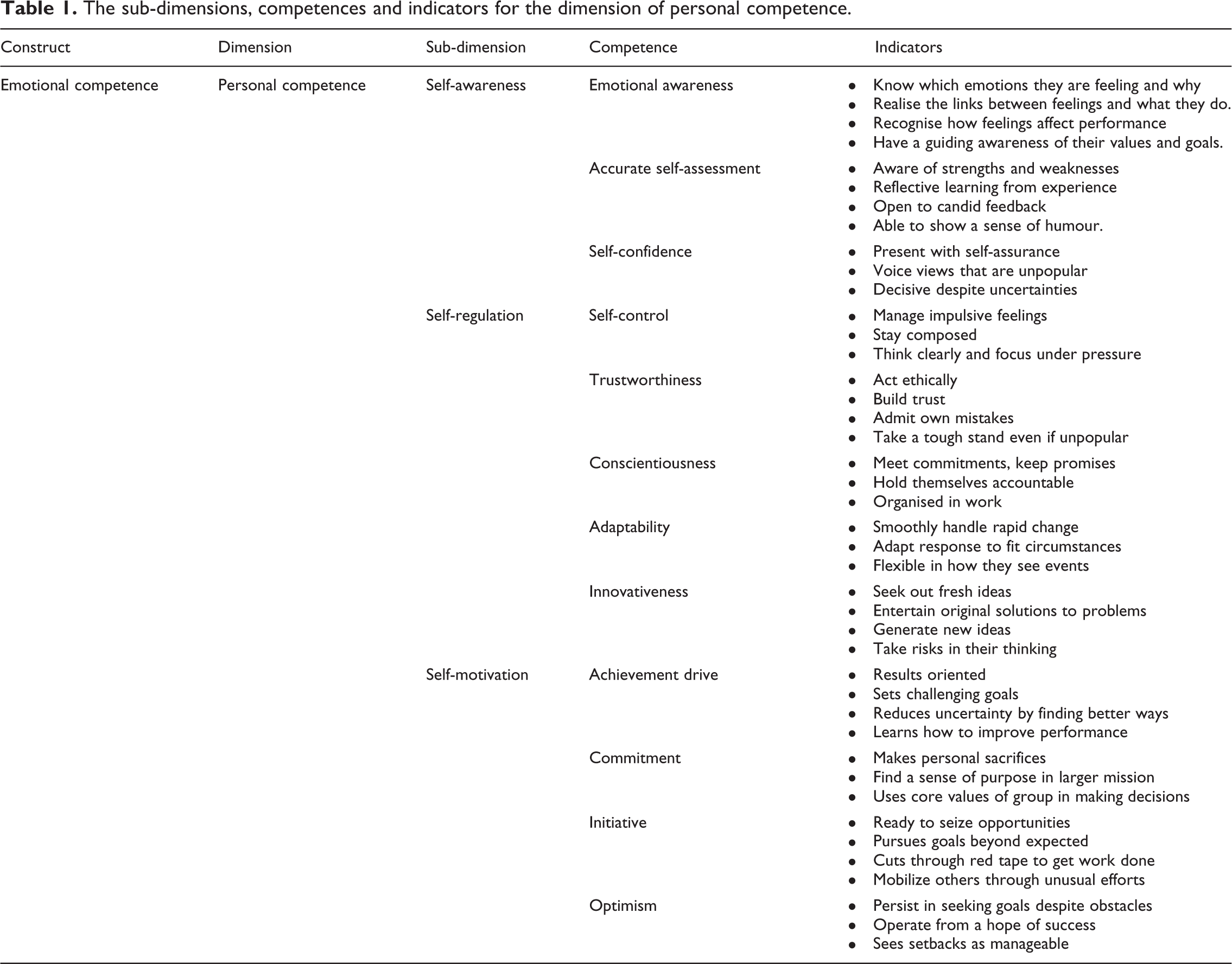
Arranging the competences as in Table 1 assists one to understand how one can make use of self-awareness and self-regulation as part of intrapersonal emotional competence. Gross (2002) indicates that the regulation of emotions can be categorised into antecedent and response focused regulation. In the former, leaders can employ situation selection by using a more teacher-friendly context, such as the classroom, in which the teacher feels more at ease than in an office. The leader could also use the feedback session and modify the situation by concentrating on the positive aspects observed. Negative emotions are stronger than positive ones (Baumeister et al., 2001) and as Boyatzis (2011) indicates, one would suspect that the contagion of negative emotion would ignite a stronger neural sequence than positive emotions. Leaders thus need to manage the possible contagion of emotions using a heightened sense of self-awareness (Boyatzis, 2011). This suggests that a strategy of antecedent emotional regulation should be utilised when dealing with situations that could result in strong negative emotional responses, such as providing feedback to teachers about their teaching performance. Furthermore the situation can be modified by the leader if they indicate that the performance of individual teachers is a mutual problem inherent in teaching and learning, and as such the leader has a supporting role to play. Antecedent focused regulation thus attempts to regulate any negative emotions before they occur. Gross (2002) identifies two ways that a leader can engage in response-focused emotion regulation, namely through strategies of reappraisal and suppression. An initial emotional response to an angry parent could, for example, be reappraised by attempting to define the situation from the parent’s point of view. A regulation strategy probably used by most school leaders is that of suppressing an initial emotional response by hiding it behind a pleasant countenance (Grandey and Brauberger, 2002). Suppression of one’s emotions is similar to what Fineman (1993) viewed as emotional work.
Because this research is using the perceptions of teachers of the extent to which school leaders make use of emotional competence in the workplace, a consideration of Fineman’s (1993: 3) research findings could also be valuable. Fineman (1993) differentiates between emotional work, that is the effort put into ensuring that private feelings are repressed or represented in such a way that they are in touch with the socially accepted norms of the teaching profession; and emotional labour, which is the commercial exploitation of this principle: when an employee is in effect paid to smile, laugh and be polite or to be caring (Wallace, 2010: 596). Fineman (2003: 8) furthermore implies that there is a subjective element of emotions in what one feels. The more observable feature is the one shown, the emotional performance, and this is heavily influenced by social conventions and the impressions one wishes to convey to others. Such impressions are also influenced by self-interest as to be perceived in a positive light, as the work one does for a living can benefit one’s promotion and communication with others. Teachers as the observers of the principal’s public performance of feelings may thus not be aware of the tension present between the performativity issues imposed by external agencies such as the Department of Education and the maintenance of a humanistic climate in the school (Cangemi et al., 2008: 1027). As such, most school leaders would not wish to be seen as losing control of the emotion of anger as it is not the social norm to ‘lose your cool’. It is thus unlikely that school leaders will easily display their anger by allowing it to ‘boil over’. Because teachers are more likely to base their perceptions of the emotional competence of school leaders on what they actually see, it is possible that only the emotional performance in the public role of school leader will be observed. As Wallace (2010: 602) states ‘as the principal mulls over his or her emotional performance options in the face of anger, fear, frustration and concern, his or her ultimate decision is not only personal but also political in that it has immediate and cumulative implications for career aspirations as well as for communicative engagement with teachers’. Thus, what ‘you see may not be the whole truth’ regarding the principal’s emotional competence. Perceptions of the emotional competence of the school principal is possibly best seen as an intertwining of perception, feeling and thinking (Lee, 2010: 652). Such an intertwined system is also influenced, by among other things, individual personalities, the ways one learns to use language, to think and establish relationships, and the myriad identities one takes on through participation in varied cultural communities. One could, however, make the assumption that the interpersonal competence of a school leader, being more visible to teachers, would elicit more positive perceptions from teachers than their intrapersonal competence.
This researcher used a framework similar to that of the Consortium for Research on Emotional Intelligence in Organisations, namely an emotional competence framework. Stone et al. (2005) used a similar framework to explore the relationship between emotional competence and school leadership of principals and vice-principals from nine school boards in Ontario. Among their findings were that total emotional competence was a significant predictor of successful school leaders, but that some dimensions of emotional competence were better predictors than others. They suggested that professional development programmes for school leaders should focus on developing the following abilities, namely emotional self-awareness, self-actualisation, empathy, interpersonal relationships, flexibility, problem solving, and impulse control. For this research project the construct of emotional competence was postulated to consist of five sub-dimensions, namely self-awareness, self-regulation, motivation of self and others, social awareness and social leadership skills. Each sub-dimension had five indicators associated with it which measured teachers’ perceptions as to the extent to which school leaders utilised these emotional competences. These five-sub-dimensions were based on the suggestions made by Wolff (2005) in the Technical Manual for the Emotional Competency Framework (ECI). Wolff (2005) recommends that the sub-dimension of self-awareness should contain emotional self-awareness, accurate self-assessment and self-confidence. In the self-management cluster, emotional self-control and either transparency or adaptability should be used. Additionally, a person should show an achievement orientation, optimism or initiative. In the social awareness cluster, empathy is mandatory. Besides empathy a person should also show an organisational awareness or a service orientation. Regarding social awareness the management of relationships is regarded as essential to the sub-dimension. In addition one should include something on leadership and the ability to act as a catalyst for change. Finally, one of the competences to manage conflict or to collaborate with others should be included. With respect to the internal consistency reliability (Cronbach’s alpha), Wolff (2005) indicates that the instrument had reliabilities ranging from 0.68 for transparency to 0.87 for emotional self-awareness with an overall average reliability of 0.78. The instrument also showed content, construct and discriminant validity (Wolff, 2005: 12–15).
However, the instrument designed for this research had a context different from the corporate management environment in which it was mostly tested, with items selected according to the suggestions made by Wolff (2005). In addition, the scale selected was different and hence the reliability and validity of this particular instrument need to be addressed. The Cronbach Reliability coefficients for the sub-dimensions used in this research were all above the recommended value of 0.7 (Field, 2009: 675), namely self-awareness (0.71 with Item 2 reflected), self-regulation (0.83), self-and other motivation (0.89), social awareness (0.90) and social leadership skills (0.89). The construct validity was ascertained via factor analysis as discussed under the research methodology.
Research methodology
This research is best described as being situated in the positivistic paradigm, using factor analysis (PCA) to investigate the structure of emotional competence. Confirmatory factor analysis (CFA) was then utilised to test this structure statistically. Structural equation modelling (SEM) was also used to investigate the causal influence of the emotional factors on one another (Byrne, 2001: 5). There are two major types of variables in SEM, namely observed (indicator) and latent (construct). Latent variables are not directly observable and hence are inferred constructs based on the observed variables that were selected to define them (Schumacker and Lomax, 2004: 196). Furthermore, in SEM there are two types of latent variables, namely latent dependent variables (endogenous latent variables) and latent independent variables (exogenous latent variables). For example, in this research one of the sub-dimensions involved in the composition of emotional competence, self-awareness, was measured by obtaining a respondent’s score on the particular items formulated. The scale used to measure their response was anchored by the polar opposites of ‘to no extent’ (1) at one end and ‘to a very large extent’ (5) at the other.
In this procedure, emotional competence served as the independent variable, the five sub-dimensions postulated as the dependent variables and the items designed to measure responses as predictors. Responses to the items in the structured questionnaire were analysed using the PASW 18.0 programme (Norusis, 2009; Field, 2009). However, as the factor analytic procedure is about seeking the most parsimonious way of representing the variables it is likely that the five sub-dimensions postulated would be grouped into a smaller number of latent dependent variables (Field, 2009: 629) than the five sub-dimensions, latent dependent variables or first-order factors used in this research.
The population and sample of the research
The data was collected by using a random sample of schools as it is not possible to sample every educator in the population of Gauteng teachers. The sampling frame was a list of public schools in the Gauteng province obtained from the Gauteng Department of Education. From this list of 1970 public schools in Gauteng (Department of Basic Education, 2010b), systematic sampling was used and every 18th school selected. Thus, 109 public schools were selected for the research, each of which received 30 questionnaires to complete. Of the 3270 questionnaires distributed, 2856 were completed, making a return rate of 87.3%, which was admirable. Unfortunately, 884 questionnaires had to be omitted due to incomplete data, leaving a sample size of 2386 educators, some 73% of the distributed questionnaires. Respondents who left data incomplete were removed as AMOS does not impute or replace missing data (Schumacker and Lomax, 2004). The questionnaire also allowed for stratification in that respondents were asked to indicate their present post levels as well as the quintile rating of their particular school. The composition of the sample is discussed under descriptive statistics.
Descriptive statistical analysis
The sample had a gender ratio of 1.83 females for every male respondent, compared to the Gauteng ratio of 2.49 (Department of Basic Education, 2010b: 18). The sample is thus reasonably representative of gender in Gauteng. The ratio of primary to secondary schools in the sample was 1.14:1 as compared to the Gauteng average of 2.03:1 (Department of Basic Education, 2010b: 22). The sample was thus over-representative of secondary schools in Gauteng. The quintile grouping of the sample indicated that 452 respondents were from quintile 1 schools, 362 from quintile 2 schools, 547 from quintile 3 schools, 525 from quintile 4 schools and 364 from quintile 5 schools. If the non-fee schools (Q1, 2 and 3) are collapsed to one group they may be classified as below average socio-economic status (SES) schools, 60.5% of the sample. There were 166 respondents who indicated that their learners came from above average SES contexts (7.0%), and 1249 (52.3%) from average SES contexts. The respondents who perceived their learners as below average SES were 947 (39.7%). If quintiles 1 and 2 (36.2%) schools are regarded as being below SES context this sample is representative of the SES of the sample (39.7%). Quintiles 3 and 4 schools (44.9%) should belong to the average SES schools (52.3%) sampled, and were also roughly representative of the sample. However, only 166 respondents (7.0%) indicated an above SES status, compared to the 16.2% who indicated they belonged to quintile 5 schools. The quintile grouping of schools does not correlate well with respondents’ perceptions of the SES of the learners in their schools. With respect to teacher union membership, the majority of educators in the sample (82.3%) indicated that they belonged to SADTU, while 17.7% indicated that they did not. The sample is thus representative of SADTU membership in Gauteng. The home languages were recoded to the four main ethnic groups, namely Nguni, Sotho, Afrikaans and English. The language groupings in Gauteng (Department of Basic Education, 2010b: 7) indicate that 43.1% spoke Nguni languages, 25.7% Sotho languages, 14.4% Afrikaans and 12.4% English. The sample home language composition was 36.5% Nguni, 33.7% Sotho, 15.1% Afrikaans and 14.2% English. The sample was roughly representative of the home languages in Gauteng.
Factor analytic procedure (PCA) of items representing emotional competence
The 25 items devised to test the perceptions of educators about the use of emotional competence in school leadership were subjected to a factor analytic procedure, and the resulting Kaiser-Meyer-Olkin measure of sampling adequacy was 0.978 with a Bartlett’s sphericity of p<0.05. The Monte Carlo parallel analysis indicated that two factors could be extracted, which explained 61.77% of the variance present. The removal of C2 and C6 (first inverted and then removed because of low reliabilities and communalities) produced two first-order factors explaining 63.54% of the variance. They were named: FC1.1 – Intrapersonal emotional competence (α = 0.953). FC1.2 –Interpersonal emotional competence (α = 0.926).
A second-order factor analysis on these two first-order factors resulted in only one factor, explaining 91.58% of the variance present, which was named perceptions of emotional competence of school leadership. It had an alpha Cronbach reliability of 0.966.
Confirmatory factor analysis
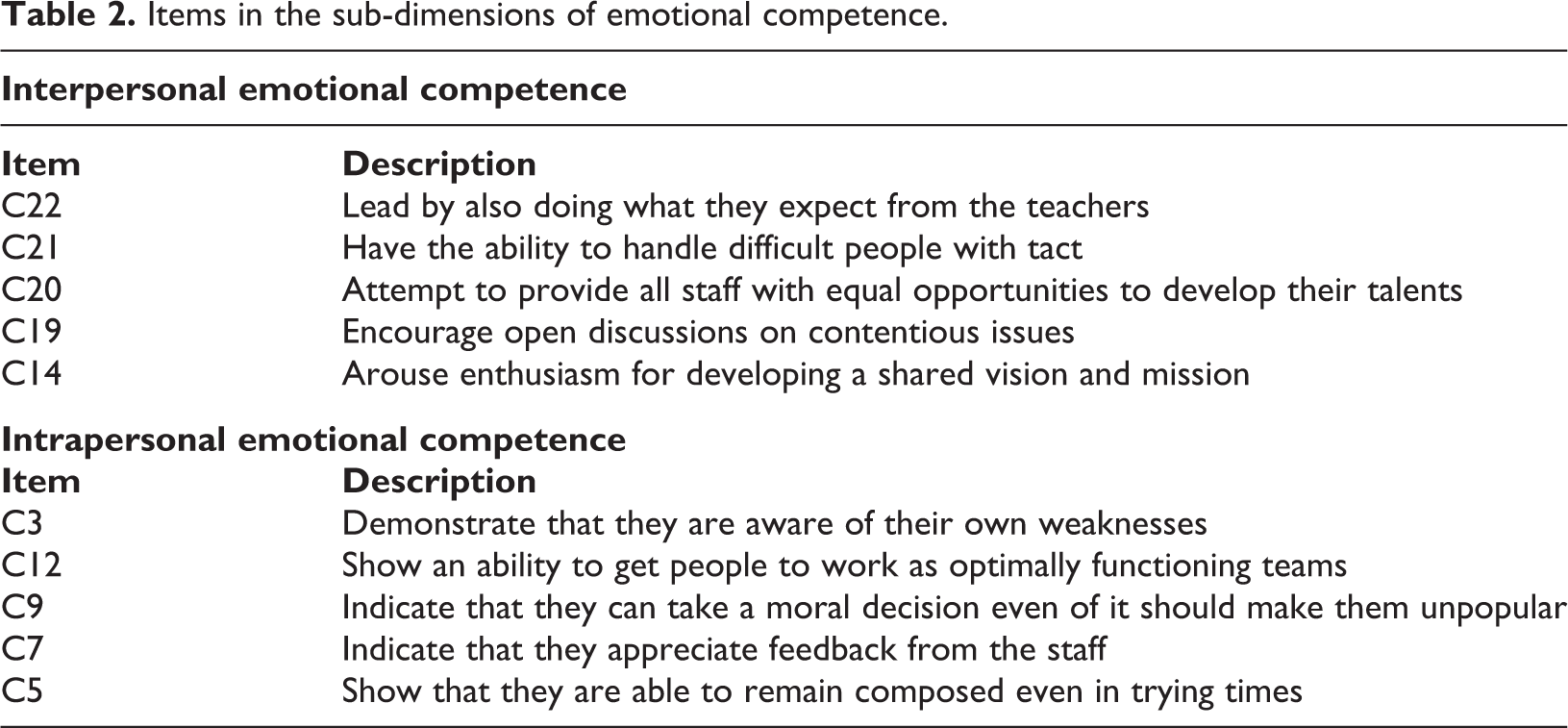
As the exploratory factor analysis indicated that emotional competence was composed of two underlying sub-dimensions this structure was tested via Confirmatory Factor Analysis using AMOS 20. According to Schumacker and Lomax (2004: 209) it is best to identify a few good indicators of each latent variable, with four indicators being recommended. This researcher identified five indicators from each of the latent first-order factors by using the highest factor loadings of the various items, with no or low cross-loadings (see Table 2). The reliabilities of these factors were both above 0.85. Item C14, one of the predictors of interpersonal competence also indicated a significant cross-loading with intrapersonal competence and hence it was also allowed to load onto intrapersonal competence. Such a cross loading also seemed theoretically justified as arousing enthusiasm for developing a shared vision and mission can be motivating to both oneself and to others. The measurement or CFA model (Model 1) postulated also shows a correlation between personal and interpersonal emotional competence (see Figure 1).
Items in the sub-dimensions of emotional competence.
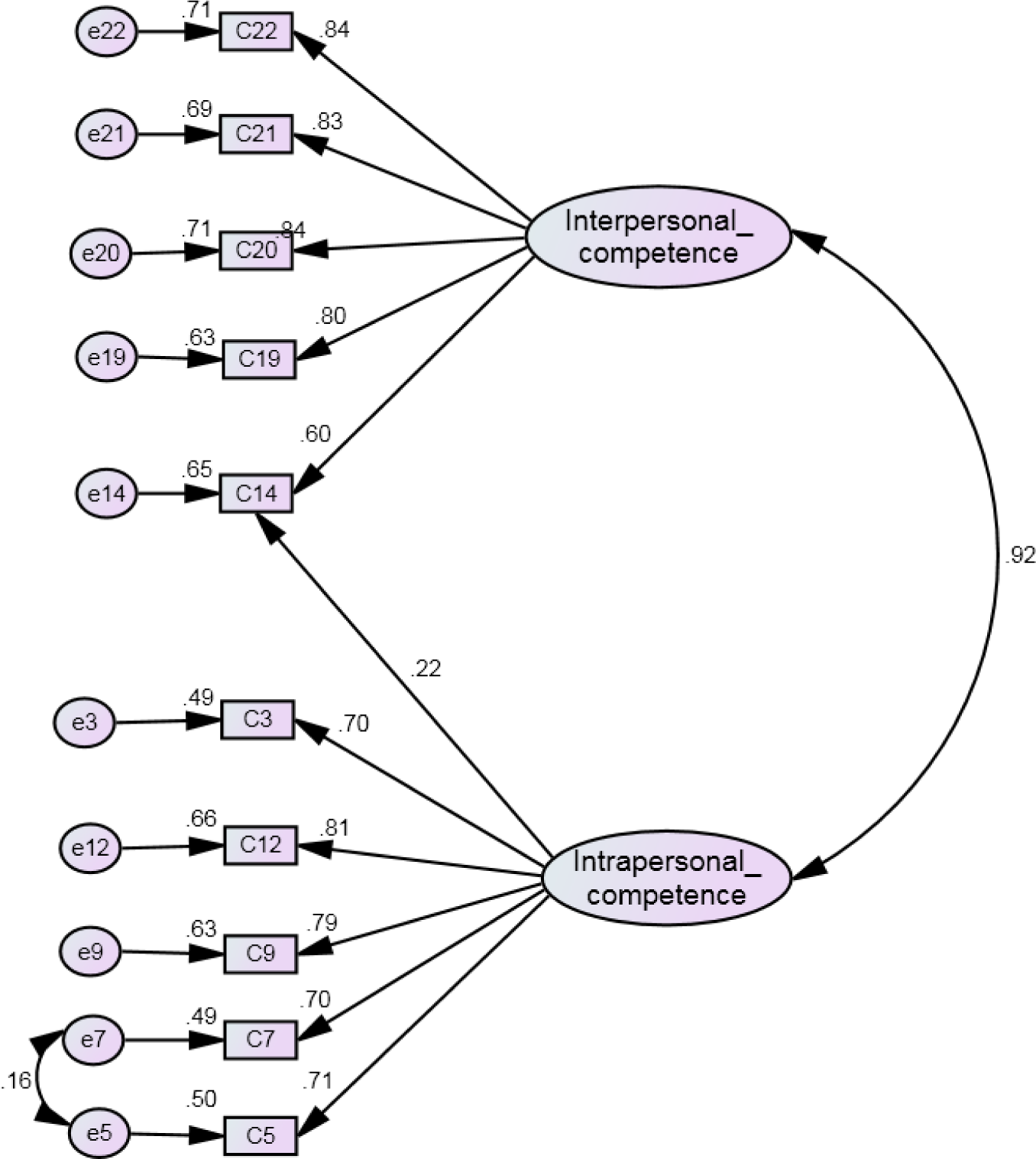
Model 1. The hypothesised CFA model of emotional competence.
The criteria for evaluating good model fits (see Amos 20 data for Model 1, supplementary file at http://emal.sagepub.com, DOI 10.1177/1741143213513184) were: Chi-square: The root mean square residual (RMR) and the standardised root mean square residual (SRMR): RMR = 0.019; SRMR = 0.017 where a good fit is indicated by values < 0.05. The goodness-of-fit index (GFI): GFI = 0.984 where values > 0.95 indicate a good fit. Comparative fit index (CFI): CFI = 0.990 where a good fit is indicated by values > 0.95. The root mean square error of approximation (RMSEA): RMSEA = 0.045 (CI.90 = 0.039 to 0.051; p = 0.897) where p-values > 0.05 indicates a good fit. The expected cross-validation index (ECVI) = 0.100
For the structural model the researcher postulated that intrapersonal competence would directly influence interpersonal competence and not vice versa. To improve the fit, items C5 and C7 with the highest Modification Index were allowed to co-vary. Model 2 drawn in AMOS 20 (See Amos 20 data for Model 2) is provided in figure 2.
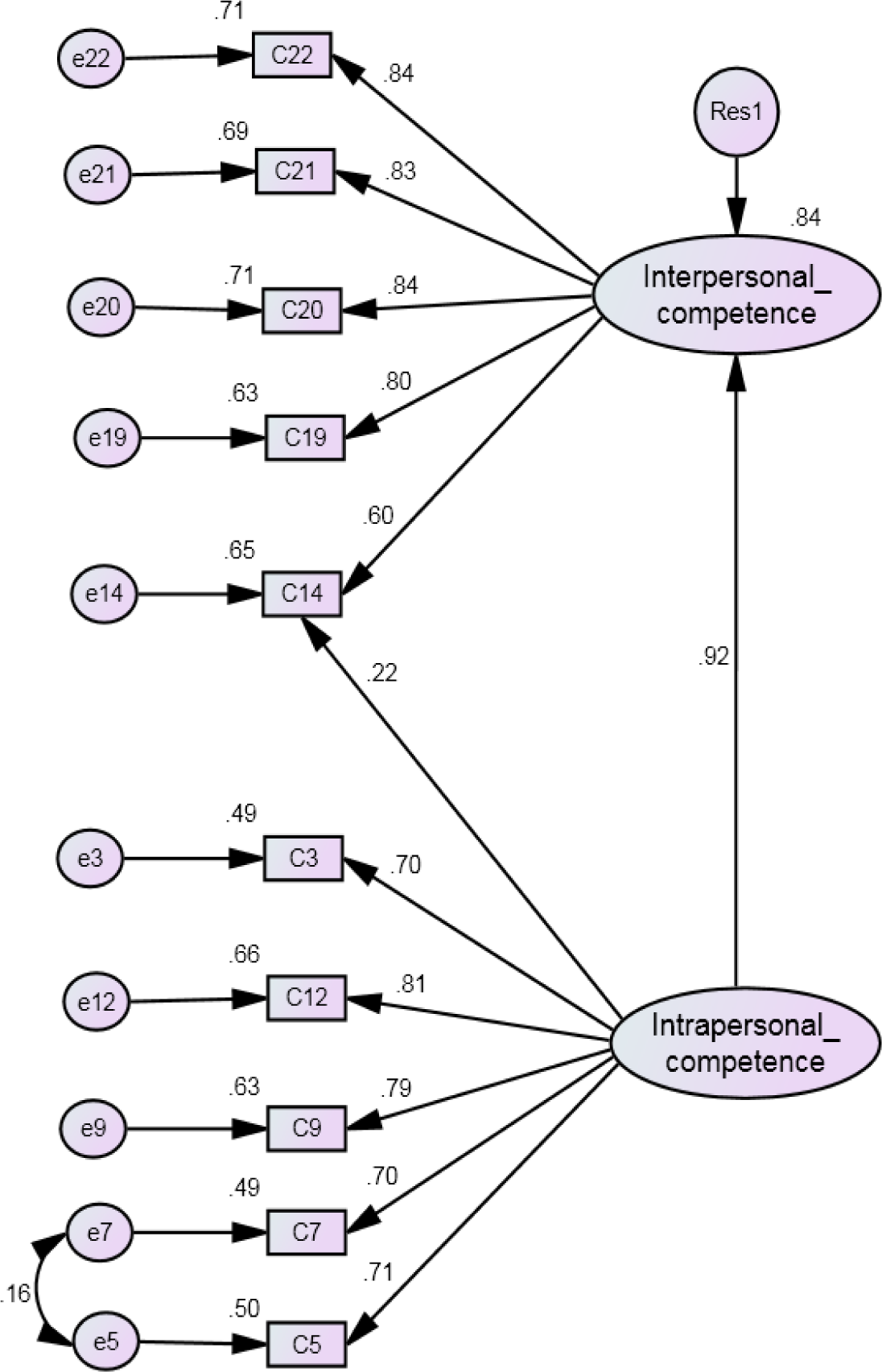
Model 2. The SEM model of the components of emotional competence.
The criteria for evaluating the model fit were the same as those used for Model 1. The values for Model 2 were: Chi-square: RMR = 0.016; SRMR = 0.014; GFI = 0.988; CFI = 0.993; RMSEA = 0.038 (CI.90 = 0.032 to 0.044; p = 0.999); ECVI = 0.079
Allowing for the co-variation of the two items thus improves all the fit criteria. Model 2 (the structural model) can thus be regarded as the most parsimonious model tested as it represents the best fit for the data overall (Byrne, 2001: 162). The ECVI value also dropped a little further, indicating that Model 2 was the best fit for the data. All the pathways in the model were statistically significant. Allowing the errors associated with C19 to co-vary with C22 does improve the model fit criteria, but as the measurement errors were negative and because of model parsimony this was ignored.
Discussion of Model 2
The model indicates that there is one unobserved (latent) endogenous variable, which was named intrapersonal emotional competence, with its five identified predictors all having significant factor loadings. The latent endogenous factor is easily identified as it has a single-headed arrow pointing at it (see Figure 2). Thus, the intrapersonal competence factor (composed of items representative of self-awareness, self-regulation and self-motivation) influences the interpersonal factor (concerned mostly with social awareness and social leadership skills) directly as was postulated. This lends credence to the saying ‘if you want to understand others it is important that you first understand yourself’. It also agrees with the findings of (Taylor et al., 1997), that the ‘ability to understand emotions in oneself are linked with one’s ability to understand it in others’. Furthermore, Boyatzis (2011: 3) confirms the importance of the intrapersonal dimension by suggesting that a heightened sense of self-awareness can promote a more social orientation to others. Techniques to assist a leader with a heightened sense of self-awareness are to know that one is having feelings and become aware of them, to label or understand what they are and then signal to oneself that one should do something to change one’s mood and state. Maree and Eiselen (2004: 497) also found a low yet significant correlation (r = 0.293) in the South African setting, between intrapersonal and interpersonal intelligence among academics in a merger setting. However, the instrument used was different from the one used in this research.
The squared multiple correlation of interpersonal emotional competence (FC1.2) was 0.835 indicating that its predictor, namely intrapersonal emotional competence (FC1.0), explains 83.5% of the variance present in the endogenous variable interpersonal emotional competence. This indicates the importance of intrapersonal competence as a predictor of interpersonal competence.
One can conclude that the causal path postulated for Model 2 was found to be statistically significant. This pathway indicates the impact of intrapersonal competence on interpersonal competence or the importance of managing one’s own emotions as a mechanism for influencing how one manages those of others. The pathway from interpersonal competence (the non-recursive model) to intrapersonal competence had a negative standardised regression weight of -0.37 and made no changes to any of the fit criteria. This again emphasises that a good understanding of one’s own emotions or personal competence facilitates the understanding of the emotions of one’s followers or one’s interpersonal competence. This corroborates what many leaders know instinctively, namely that one uses interpersonal competence to influence one’s interpersonal relationships with others. However, to believe something and to show that is so are two different things. It also shows that intuitive feelings as an attribute of self-awareness should not merely be ignored because they may be regarded as too emotional.
The model of emotional competence with its two interpersonal and intrapersonal sub-dimensions should be able to predict the presence of a significant association with some of the independent variables used in the research. For example, one would expect a significant association to be present between the sub-dimensions of emotional competence as dependent variables and gender as independent variable, with female respondents having more positive perceptions than males.
Significance of differences between two independent groups
Levene’s t-test was used for testing differences between the factor mean scores of two independent groups. If the variances between groups are similar (p > 0.05) then equal variances are assumed, and if they are significantly different (p < 0.05) then equal variances are not assumed. Gender and type of school were used as independent variables and interpersonal and intrapersonal emotional competence served as dependent variables. The null hypothesis was that there is statistically no significant difference between the factor mean scores of male and female respondents regarding their perceptions of the interpersonal- and intrapersonal emotional competence of school leadership. With respect to type of school the null hypothesis was that there is statistically no significant difference between primary and secondary school respondents regarding their perceptions of the interpersonal- and intrapersonal emotional competence of school leadership. An analysis of the data indicated that female respondents had a statistically significantly higher factor mean with respect to both interpersonal and intrapersonal emotional competence of school leadership than did male respondents.

Female respondents thus had a more positive perception of the extent to which school leadership utilises emotional competence than did the males. This indicates that female respondents may be more perceptive when it comes to recognising the emotional competence of leaders than males are. Hofstede (1991: 82) also indicated that females attach greater importance to relationships with leaders and colleagues than do males, and that this corresponds to the feminine, caring and social-environment role. Further analysis of interpersonal emotional competence indicated that the largest difference between female and male respondents was present in the perceptions of social awareness and social leadership skills (t = 2.4; r = 0.2). Female respondents had more positive perceptions than male respondents of school leadership attributes such as tactfulness, empathy, leading by example, providing equal opportunities for talent development, and encouraging open communication.
With respect to type of school, primary school respondents had a more positive perception of the utilisation of emotional competence by school leadership than did the secondary school respondents.

Further analysis indicates that the greatest differences in perceptions between primary and secondary school respondents was present in the self-awareness cluster (t = 3.97; r = 0.1), where emotional awareness, accurate self-assessment and self-confidence are regarded as essential. Primary school respondents seem to place a greater emphasis on intrapersonal competence than did secondary school respondents. This could be the result of working with relatively immature learners and hence being more aware of the emotions they were feeling, as primary school communities probably experience less conflict among learners than those of secondary schools. In addition, most teachers in primary schools are female and their caring role enables them to be more perceptive regarding the emotional self-awareness of their school leaders.
The socio-economic context of the learners attending a particular school was also associated with both the sub-dimensions of emotional competence. Respondents who had the perception that the learners were from average to above average socio-economic situations had more positive perceptions than those who indicated that their learners came from below average socio-economic situations.

Further analysis of the data indicated that the largest differences (t = 7.37; r = 0.2) were present between the clusters of social leadership skills. Respondents from schools with learners from average to above average socio-economic situations had more positive perceptions of their leaders regarding attributes such as managing conflict, guiding the performance of teachers while holding them accountable for learner performance and fostering open communication. Schools with learners from poor socio-economic backgrounds have fewer resources than those in more affluent communities and poorer schools are possibly more concerned with catering for the lower-order needs, making it more difficult to perceive the emotional competences associated with school leadership. Leaders in schools with learners from poor socio-economic situations thus probably need to influence the perceptions of their followers to a larger extent by, for example, becoming more visible, cultivating and maintaining extensive informal networks, and modelling the change which they expect from others by utilising their limited resources effectively.
Significance of differences between three or more independent groups
Analysis of variance was used to test for significance of differences. Any differences found among all three groups taken together were tested via post-hoc tests such as the Dunnett T3 test. The home languages were collapsed into the four main language groups in South Africa, namely Nguni, Sotho, Afrikaans and English. Statistically significant differences were found to be present between Nguni, Afrikaans and English home language groups, as well as between Sotho, Afrikaans and English home language groups. No significant differences were present between Nguni and Sotho or between Afrikaans and English home language groups. Regarding interpersonal emotional competence, the Afrikaans home language respondents had the most positive perception of their school leader’s utilisation of this competence followed by the English, Sotho and Nguni groups:

With respect to the perceptions of the utilisation of intrapersonal emotional competence, English home language respondents were most positive, followed by Afrikaans, Sotho and Nguni home language groups:

Further analysis of the data indicated that the largest differences between the four home language groups lay within the self-regulation cluster [F (93, 2308) = 34.63; p < 0.005; r = 0.21]. Pair-wise comparisons indicated that the significant differences were present between the Nguni and Afrikaans and English home languages and between the Sotho and Afrikaans and English home language groups. The cluster of self-regulation contains attributes such as self-control, transparency, trustworthiness and adaptability, and Afrikaans and English home language groups show more positive perceptions of these attributes in their school leadership than do the Nguni and Sotho home language groups. Self-regulation also refers to holding oneself accountable for meeting one’s objectives and as such it is linked to an internal locus of control. Not meeting one’s objectives will result in an individual feeling guilty because of an individually developed conscience. This, according to Hofstede (1991: 60), is characteristic of individualistic cultures. Blaming others when objectives are not met is more characteristic of persons with an external locus of control and not meeting one’s objectives results in shame which is group oriented and only felt if made known to others. Collectivistic cultures are characterised by shame based on a sense of collective obligation (Hofstede, 1991). In the South African context this can result in teachers who belong to a collectivistic group, such as SADTU, not accepting individual responsibility for the poor performance of their learners, because the performance evaluation system has been rejected by their labour union. In this research, 82.3% of respondents indicated that they belonged to SADTU, and respondents who did so differed statistically significantly from those who did not, with respect to both intra- and interpersonal emotional competence.

Respondents who did not belong to the Union had more positive perceptions of their leaders regarding both intra- and interpersonal emotional competence. A cross-tabulation of SADTU affiliation versus home language groups indicate that 89.0% of respondents who belonged to SADTU indicated Nguni or Sotho as their home language, whereas only 11.0% of respondents who were affiliated to SADTU indicated Afrikaans or English as their home language. One can thus conclude that respondents who had Nguni or Sotho as their home language and who belonged to the Union are largely collectivistic in their thinking. On the other hand, 73.4% of respondents who did not belong to SADTU belonged to the Afrikaans and English home language groups. As these teachers belong to teacher organisations not affiliated to the Congress of South African Trade Unions, they could be classified as largely individualistic. These two cultural dimensions of individualism and collectivism will also be used in an attempt to explain the differences between the four home language groups.
These different perceptions between the four ethnic groups in the sample are probably due to cultural differences between the four home language groups. The Afrikaans and English home language groups are probably more individualistically inclined, placing a greater emphasis on individual performance and the task at hand, whilst the Sotho and Nguni groups are more collectivistic, with the interest of the group prevailing over the interest of the individual (Hofstede, 1991: 64). When dealing with different cultural groups the management of disruptive emotions and impulses and the maintenance of high standards of honesty and integrity are important aspects of emotional competence. These findings are similar to those of Lottridge, Chignell and Jovicic (2011: 233), who suggest that persons from Western cultures (individualistic) may expect systems that cater to their individual needs and that promote positivity. Those from Eastern cultures (collectivistic) may prefer systems oriented toward their group affiliation and that focus on avoidance of failure. In the South African educational system a monetary incentive is given to individual teachers for superior performance, which is related to individualistic cultures. However, the majority of teachers in South Africa probably belong to a collectivist culture, in which incentives and bonuses should be given to the group (Hofstede, 1991: 65; Kotze, 1993: 2; Sewlall, 1996: 68). Van Onselen (2012) writes that SADTU has about two-thirds of all teachers in South Africa affiliated to it, and it makes it clear that one of its goals is to promote socialism, indicating that they are more collectivistic. In addition, they rejected, in March 2012, performance contracts for teachers and principals, the possible result of a notion that incentive bonuses are based on cultural assumptions developed in individualistic countries which may not hold in collectivistic cultures (Hofstede, 1991: 66). Hofstede (1991) also indicates that discussing a person’s poor performance openly with them is likely to clash head-on with the collectivistic culture’s harmony norm and may be felt by the subordinate as an unacceptable loss of face. Such feedback regarding poor performance should rather occur verbally, via an intermediary.
Regarding the intrapersonal competence of self-awareness, Leung et al. (2005: 190) indicated that Shipper, Rotondo and Hoffman (2003) found that self-awareness was also related to the cultural dimension of power-distance. Self-awareness of interactive skills appeared crucial to low power distance cultures, while self-awareness of controlling skills was crucial to high power distance cultures. The implication is that a participative open style of leadership may be effective for individualistic cultures where followers expect to be consulted, but ineffective in large power-distance collectivistic cultures where followers expect to be told what to do. Hence, in South Africa, where both collectivistic and individualistic cultures are present, greater self-awareness of both interactive and controlling skills by school leadership is necessary. Leadership capable of being effective in both low- and high-power distance cultures would require leaders who are socially and emotionally competent and who have the ability to regulate their own and others’ behaviour according to situational changes (Spannenberg and Theron, 2002).
Testing for significant differences between interpersonal- and intrapersonal emotional competence
Respondents had a statistically significantly higher mean score on the interpersonal emotional competence sub-dimension than on the intrapersonal emotional competence sub-dimension.

They were thus more positive in their perceptions of the interpersonal emotional competence of their leaders than they were of their intrapersonal emotional competence. This difference is possibly due to interpersonal competences being more easily observable in the behaviour of school leadership than it is when observing intrapersonal competences. However, this also indicates that more attention needs to be given to intrapersonal competences as they serve to enhance a more social orientation towards others. Leaders who are self-aware can also assist in enhancing the quality of decision-making as they can accurately and honestly assess their strengths in comparison to others in the school, and have the advantage of leveraging the attributes of others in the decision-making process (Hess and Bacigalupo, 2011).
Implications for school leaders
The construct of emotional competence is founded upon two sub-dimensions, namely interpersonal emotional competence and intrapersonal emotional competence. The latter has three sub-dimensions associated with it, namely self-awareness, self-regulation and self and other motivation; while the former, or social emotional competence, is associated with social awareness and social skills. There is a strong positive correlation between intrapersonal and interpersonal emotional competence. The research findings suggest a strong positive causal relationship from intrapersonal competence to interpersonal emotional competence and hence a good understanding and regulation of one’s own emotions influences, understanding and relationships with others. When dealing with situations which could result in strong negative emotional responses, such as providing feedback to teachers about their teaching performance, leaders need to be aware of strategies such as antecedent emotional regulation. The mandated results orientated achievements as stipulated in the Schooling 2025 document are bound to increase emotional tensions between school principals, teachers and learners, and a good understanding of emotional competence is an important precursor in the management of these tensions. Furthermore, this research indicates that a leader with a good understanding of their intrapersonal competence will have a greater influence on their social orientation towards others.
Perceptions of emotional competence in school leaders are associated with gender, type of school, such as primary or secondary, affiliation to SADTU, as well as to the socio-economic context of the learners in the school. Female respondents, teachers at primary schools, teachers who do not belong to SADTU, and respondents whose learners come from average to above average socio-economic situations, have more positive perceptions of their school leadership with respect to emotional competence. Perceptions of emotional competence are thus dependent on the context of the school situation. Respondents who do not belong to SADTU had more favourable perceptions about the utilisation of emotional competence in school leadership than those affiliated. As Joubert (2012: 6) argues, there is a perception that SADTU members are more prone to strikes and work fewer hours than members of other teacher unions. A concept resolution accepted in June 2012 at the national policy conference of the African National Congress (ANC), with the purpose the teaching of learners, may not be disrupted in any way. The proposed government policy is thus to declare teaching as an essential public service. This proposal has to be weighed against the Constitutional right of teachers to participate in strike action.
The perceptions of emotional competence of school leaders is also dependent on the home language of respondents and school leaders need to take cognisance of the cultural differences between the various home language groups by ensuring that they control emotions associated with the management of cultural differences. Teachers are more positive regarding the interpersonal emotional competence than they are about the intrapersonal aspect of emotional competence of school leadership. School leaders should be made more aware of how a better understanding of their own emotions can be used to influence teachers towards realising improved learner performance. In the South African context this could involve a better understanding of the various ethnic cultures present. This paper has made use of the four dimensions of national culture in an attempt to explain the differences present between various independent groupings, possibly as an attempt to obtain equity regarding perceptions of emotional competence.
Performance enhancing mandates such as CAPS are accompanied by stress and anxiety in those who must implement them. In this regard, Hargreaves (1997) suggests that these reform efforts are seldom sustainable as they are targeted only to influence the cognitive abilities of leaders, and that emotional competences are largely ignored. Societal pressure and self-interest teaches citizens not to take their emotions seriously as they hamper thinking capacity. However, suppressing emotion and intuition can be a barrier to good judgment and decision-making. Sergiovanni (1992) advocates school principals fighting for what they believe is right rather than making decisions on the grounds of political correctness and bureaucratic regulation. However, it has been the experience of this researcher, as a secondary school principal, that such leaders are extremely rare in South Africa, as the risk to future career aspirations and sanctions from macro-levels of the educational hierarchy are too great. It is more likely that such outrage or anger will be repressed so that it is in line with the socially accepted norms established by the educational hierarchy.
Having established the structure of emotional competence, this researcher intends using this structure to investigate its relationship to instructional leadership and then the possible influence of these two constructs on learner achievement.
Footnotes
Funding
This research received no specific grant from any funding agency in the public, commercial or not-for-profit sectors.