




Abstract
Educational leadership plays a significant role in school success, through its effects on teachers’ emotions, attitudes, and behaviours. However, the knowledge of how school leaders influence teachers’ emotions is very limited. Most existing evidence focuses on general explanations that are not the result of controlled research designs, which is why we lack solid operative knowledge on principals’ emotional support of teachers in emotional distress. The present study seeks to address this lacuna. Our approach focuses on interpersonal communication, aimed at expanding the operative knowledge about emotionally supportive communication in principal–teacher relations. The study is based on the experimental vignette method, which makes it possible to infer causality. The data were collected using a sample of 113 primary school teachers. The study found that principals’ empathic listening is associated with greater attributed emotional reframing (i.e. positive emotional change), irrespective of the message that principals communicate; however, it is only the presence of a reframing message, whether empowering or normalising, that influences the actual reframing of negative affect.
Introduction
Social support has been considered valuable in protecting employees against the negative mental and physical health implications of work-related stressors (House, 1981). Educational research shows that the most frequent sources of support that teachers use are peers, followed immediately by the school principal (Tatar, 2009). Thus, it seems that principals are key players in the social support extended to teachers. Principals identified as providing emotional support to teachers were able to help reduce the stress experienced by teachers better than those providing other types of support (Littrell et al., 1994). However, the literature on educational administration and management provides no explanations of how socio-emotional support works in principal–teacher relations. To address the lacuna in the literature on educational administration and management we turned to relevant works from the psychological and organisational literature in order to set the stage for empirical exploration of how principals’ socio-emotional support affects teachers’ emotions.
The nature of emotions
Emotions have been the subject of vivid debate in psychology for over 30 years (e.g. Ekman and Davidson, 1994; Frijda, 1986; Gross and Barrett, 2013; Izard, 2009; Lazarus and Lazarus, 1996). Two central objects of the scholarly discourse have been basic emotions theory (e.g. Ekman, 1992) and the cognitive theory of emotions (e.g. Lazarus, 1991; Oatley and Johnson-Laird, 1987). The presumption of basic emotions theory is that emotions are natural, discrete, automatic responses related to emotion-evoking events (Ekman and Cordaro, 2011; Ekman and Davidson, 1994). Ekman, one of the leading scholars associated with the approach, identified six basic emotions: anger, disgust, fear, happiness, sadness, and surprise (Ekman, 1992). He argued that each emotion has a unique profile of co-occurring reactions that include facial expression, voice, physiological indicators (e.g. heart rate, blood pressure, etc.), and subjective experience (Ekman and Cordaro, 2011). These response categories are said to be neurologically hardwired in human brains (Barrett, 2006). Emotions are therefore instinctive and universal phenomena shared across cultures. One explanation consistent with basic emotions theory of how leaders influence followers is ‘emotional contagion’ (Johnson, 2008). Emotional contagion is an automatic process, often non-conscious, occurring during observation, in which individuals copy the observed person’s emotional expression after experiencing a corresponding emotion to the one displayed by the observed person (Hatfield et al., 1994). Emotional contagion is limited in its ability to explain emotional influences in leader–followers relations because it is a simplistic account that presumes leaders to constantly embody the desired emotion.
The other important theory on the nature of emotions is the cognitive theory of emotions, also known as the appraisal theory of emotions (Ochsner and Gross, 2005). According to this theory, affect and cognition are considered to be entangled. Emotion is the result of a process in which an individual who faces a specific situation focuses attention on certain elements in it and interprets the event in a manner that generates psychological, physiological, and behavioural responses (Gross and Barrett, 2011). The result of this fusion between affect and cognition is that individuals can influence (a) what emotions they and others experience, (b) when the emotions are experienced, and (c) how they are experienced and expressed (a phenomenon also known as emotion regulation) (Gross and Thompson, 2007). The cognitive theory of emotions is especially appealing to the social sciences (psychotherapy, management, etc.) because it offers agentic possibilities for multiple paths of influence on emotionality. Scholars in the field of organisational psychology have suggested that interpersonal emotion regulation can be used as emotion management by managers to promote trust, collaboration, and effectiveness (Williams, 2007). An empirical review of studies in the field of educational leadership and emotions between 1992 and 2012 reveals several cases, obtained mostly through qualitative exploration, of principals using interpersonal emotion regulation to manage teachers’ emotions (Berkovich and Eyal, 2015). The attempt to conceptualise employee emotion management by leaders is in its early stages. Two integrative reviews concerning emotion management by leaders, published in recent years, list leaders’ knowledge, skills, personality traits, and social behaviours as influencing followers’ affect (Connelly et al., 2013; Kaplan et al., 2014). Despite the valuable contribution of these frameworks, they are general explanatory models rather than applicative ones, particularly because they do not break down the specific contents of broad social behaviours. As a result, these models provide little practical information about emotional support. To expand applicative knowledge in this area, we focus in the present study on principals’ interpersonal emotionally supportive communication.
Interpersonal emotionally supportive communication
The present research draws on the cognitive theory of emotions. Specifically, the rationale of the study relies on two theories linked with interpersonal supportive communication: one from the field of communication study – conversationally induced reappraisals theory (Burleson and Goldsmith, 1998), and the other from the field of psychotherapy – affective change process theory (Fosha, 2005). The first theory, by Burleson and Goldsmith (1998), focuses on conversationally induced reappraisals. The theory draws on Lazarus and Folkman’s (1984) stress and coping model, which emphasises cognitive reappraisal (change in judgment about the event and its personal significance) as a main mechanism of successful coping with negative emotions. In their appraisal-based comforting support theory, Burleson and Goldsmith suggest that in order to assist someone in altering his negative emotions, extenders of help must change the cognitive reappraisal of the situation of the person in need, adding that ‘comforting’ messages are the most effective in promoting such affective transformation (Burleson, 2010; Burleson and Goldsmith, 1998). Communication with another individual may lead a person to reinterpret a negative emotion-eliciting event in a more positive light (i.e. emotional reframing). At the same time, in addition to messages that are vital in such a process, listening is also said to play an important role in ‘building or sculpting meanings, ideas, insights, and solutions between people, none of which would have been generated individually’ (Phillips, 1999: 179). The second theory is affective change process theory (Fosha, 2005). This psychotherapeutic theory suggests that the supporting individual’s empathic listening can encourage the supported individual to experience a positive emotional change and a heightened sense of true self. Therefore, the present study explores the effect of principals’ communication (both listening and reframing messages) on teachers’ emotional reframing.
Managers’ listening and employees’ emotional reframing
Managers’ communication warrants specific attention because managers have the greatest influence on the workplace, given their supervisory role (Ashforth et al., 2007). Listening has been suggested to be an important managerial and leadership behaviour (e.g. Kluger and Zaidel, 2013). In particular, the manager’s empathic attitude has been noted as having the potential to increase effectiveness in the workplace (Kluger and Zaidel, 2013; Kubota et al., 1997). Empathic listening is defined as a form of responsive communication that indicates an understanding and acknowledgment of another person’s point of view and emotions (Hampson et al., 2009). Empathic listening is often considered to be an extremely effective form of listening (Bambacas and Patrickson, 2008; Kluger and Zaidel, 2013). Similar insights emerge from educational research. Slater (2005) found that both principals and teachers recognised the importance of educational leaders’ empathic listening. In a study simulating complaint interactions, Robinson and Le Fevre (2011) found that school principals who exhibited a deeper level of interest in the parent’s emotions (played by a trained actor) and who seemed to be listening carefully were perceived as more respectful.
As emphasised in the psychological literature, one contribution of listening lies in the change process occurring to the person being listened to (Myers, 2000; Rogers and Farson, 1957). Emotional experiences are considered key components in such a transformation (Fosha, 2001). Few empirical works have explored managers’ listening and its effect on employees’ affective outcomes. Researchers found that employees working under managers who have a high person-centred attitude, which includes listening, experienced less depression and anxiety than did those working under managers with a low person-centred attitude (Ikemi et al., 1992). Similarly, employees who worked under managers with a higher listening score reported relatively low psychological stress (Mineyama et al., 2007).
It has been suggested that from a cognitive perspective, listening interaction promotes emotional change by helping individuals interpret events and even modify their cognitive representations of events and of the social world (Nugent and Halvorson, 1995). The literature calls this affective experience emotional reframing. Emotional reframing involves increase in positive affect and decrease in negative affect after one alters one’s negative interpretation of an event following a communication with another individual (Ashforth and Kreiner, 2002).
Managers’ reframing messages and employees’ emotional reframing
The process of interpersonal supportive communication includes not only listening but also providing feedback and sending comforting messages (Burleson, 2008). Burleson (1994) defined comforting messages as ‘having a goal of alleviating or lessening the emotional distresses experienced by others’ (136). In the present study we are interested in one specific type of comforting messages, aimed at reframing and transforming others’ emotions. The literature on educational administration and management on this topic is scarce; however, Hanhimäki and Tirri (2009) reported that school leaders facilitate teachers’ ability to cope with negative emotions linked with ethically charged situations by assisting teachers to adopt a positive perspective toward the situations and thus altering their emotions and reducing the feeling of ethical conflict.
Prior works in the organisational literature have pointed to two types of messages that managers use to encourage emotional transformation among employees: empowering reframing messages and normalising reframing messages. Leaders’ empowering messages express confidence in subordinates and encourage them to take initiative regarding the situation at hand (Choi, 2006). Verbal persuasion resulting in empowerment is said to be accompanied by positive emotional change (Chiles and Zorn, 1995). Normalising reframing messages are used to transform the interpretation of affective events from extraordinary to ordinary (Ashforth and Kreiner, 2002; Ashforth et al., 2007). Burleson (2008) explored the effect of different levels of messages and found that high person-centred messages (such as ‘The same thing happened to me earlier this year’) were extremely helpful. This type of message seems to be the equivalent to normalising messages. Based on earlier findings regarding self-strategies aimed at promoting cognitive change, which are somewhat parallel in content with empowering and normalising messages (i.e. imagining positive outcomes to emotion-eliciting events and normalising emotion-eliciting ones) (Webb et al., 2012), it is expected that the principals’ reframing message (either empowering or normalising) will lead to the teachers’ emotional reframing.
Managers’ listening and reframing messages
Reframing messages can generate a psychological mode that supports an individual’s tendency to possess a positive self-view and attempt to self-enhance it (Baumeister et al., 1989; Diener and Diener, 1996). However, for a successful personal change to occur during interpersonal communication, individuals must be in a ‘core state’, in which they feel calm and authentic (Fosha, 2001). Scholars of psychology have stressed that a deeper core state can be promoted by collaborative dialogue that fosters the intense processing required for profound personal change (Fosha, 2001). As such, the presence of empathic listening, which is said to induce feelings of security and openness (Myers, 2000; Rogers and Farson, 1957), is expected to enhance this core state and help emotional reframing to occur. In contrast, when empathic listening is low or absent, individuals are less open to alter their emotional state, and the effect of the presence of reframing messages on emotional reframing should be weaker.
Research hypotheses
The present research explores the effect of principals’ communication with teachers on the emotional distress of the latter. The key question of the present study is: What are the emotional effects of principals’ communication (i.e. listening and issuing messages) with teachers after they experience emotional distress at work? Based on the literature review above, we hypothesise that (Hypothesis 1) when principals’ empathic listening is present, teachers are generally more likely to experience emotional reframing; (Hypothesis 2) when principals’ reframing message is present, teachers are generally more likely to experience emotional reframing; (Hypothesis 3) there is an interaction between principals’ listening type and principals’ reframing message, so that when empathic listening is present, teachers whose principal issued a reframing message are more likely to experience greater emotional reframing.
Method
Participants and procedure
Our preliminary efforts were aimed at developing authentic and relevant vignettes of principals’ emotionally transformative messages. We focused on identifying the type of messages principals use to promote positive change in teachers’ negative emotions (i.e. emotional reframing). These efforts included using data from in-depth interviews on the topic of emotional support in principal–teacher relations with 12 primary school principals and 24 teachers working in the Israeli public education system. Semi-structured interviews served to collect participants’ accounts. Semi-structured interviews make it possible to plan a focused conversation that is also open to ideas and topics raised by the interviewees (Patton, 1990). All interviews were recorded and transcribed. The two researchers analysed the textual data. Thematic coding was used to identify patterns in the data (Boyatzis, 1998). The texts were broken down to units of meaning and explored, after which the units were compared and categorised together according to a unifying idea or theme.
The main efforts of the present study were aimed at conducting a controlled exploration of the effects of principals’ communication practices on teachers’ emotional distress. Thus, an experimental vignette design (i.e. scenario study) was selected to explore the effect of principals’ listening and principals’ reframing message on teachers’ experiences of emotional reframing. A scenario study design has several advantages, including (Aguinis and Bradley, 2014): (a) the ability to incorporate aspects that are instrumental to the research question, and at the same time exclude those that might muddle the results, and (b) the ability to study sensitive topics that it is ethically impossible to manipulate in the workplace. The literature recommends using a representative sample of the larger population of interest in scenario studies to externally validate the results (Aguinis and Bradley, 2014). Participating in the study were 113 Israeli teachers (mean age = 41.78 years, SD = 9.01). All participants had teaching experience and were employed in public primary schools (mean experience = 15.93 years, SD = 7.83), and were therefore able to envision themselves in the role of the teacher in the scenario provided. The gender profile of the sample (101 females, 12 males) is similar to that of the national primary school system (CBS, 2013). Based on recommendations in the methodological literature, we chose to administer the scenarios and questionnaires to participants in their natural setting and in a single session (Aguinis and Bradley, 2014).
We used a mixed-scenario design, involving both a video vignette and a written (paper) vignette. Video vignettes provide a realistic experience and level of immersion of participants (Aguinis and Bradley, 2014). Paper vignettes are administered in written form, after which participants are asked to make explicit judgments (Aguinis and Bradley, 2014). Paper studies are suited to evaluate explicit processes and outcomes, as they demand the participants’ awareness (Aguinis and Bradley, 2014). Participants first view a video clip displaying a parent–teacher interaction, to elicit in them a sense of work-related distress and negative emotions. In the video, a parent confronted the teacher and argued that her daughter’s failure in the teacher’s classes is the result of the teacher’s lack of professional adequacy. Next, participants received a written scenario describing a follow-up conversation about the parent–teacher interaction that appeared previously in the video between the teacher and the school principal, in which the principal’s listening type and the type of the reframing message were manipulated. The study used a 2 (principal’s listening type: empathic vs. non-empathic) × 3 (reframing message type by principal: empowering vs. normalising vs. no message) experimental design. To each condition, participants were randomly assigned. Condition groups did not vary significantly in demographics. Finally, we measured the effects of the conditions on participants’ emotional reframing (attributed and actual).
Experimental manipulations
Principal’s listening type
We drew on the items Kluger and Zaidel (2013) used to explore the types of listening behaviour to develop manipulations for empathic and non-empathic listening. For empathic listening, the following text was used: The teacher came to the principal’s office and told the principal about the conversation with the parent. As the teacher was telling the story, the principal expressed interest in teacher’s recollection of the event, seemed to understand the teacher’s feelings, and gave indications that she is considering the view point expressed by the teacher. The teacher came to the principal’s office and told the principal about the conversation with the parent. As the teacher was telling the story, the principal expressed a wish to hear only the facts of the event and asked to hear from the teacher the technical information concerning the event in an efficient and orderly manner.
Reframing message type by the principal
Three types of principal’s reframing messages were manipulated in the study: (a) principal’s empowering message, (b) principal’s normalising message, and (c) principal’s no-reframing message (this condition did not include any text addressing the principal’s reframing message). See detailed information about the development of the vignettes of principals’ empowering and normalising reframing messages, based on the analysis of in-depth interview data, at the beginning of the results section.
Video stimulus and manipulation checks
The literature advises using manipulation check measures in vignette-based studies because ‘researchers cannot blindly rely on extant vignettes’ (Wason et al., 2002: 52). When tailoring manipulation checks to the vignettes, the goal is not to assess the latent phenomenon but the salient component in the vignettes. The literature strongly recommends making manipulated variables obvious (Wason et al., 2002: 54), therefore the manipulation checks themselves are traditionally shaped in a straightforward manner.
Experience of work-related distress
The relevance of the stimulus clip to eliciting teachers’ sense of distress related to their occupational proficiency was assessed using four adapted items derived from the Threat to Personal Identity scale of Berjot et al. (2012), which depicts a threat to one’s occupational proficiency related to one’s job, for example ‘If I was the teacher in this conversation, I would experience an attack on my credibility as a teacher’. We used a five-point Likert scale (1 = strongly disagree, 5 = strongly agree). Cronbach’s α for the scale was .80.
Principal’s listening type
The manipulation check for the principal’s empathic listening was a single-item adapted from the perspective-taking sub-scale of the Davis (1983) empathy questionnaire. The original item, used to assess one’s attempts to adopt the viewpoint of others and see events from their point of view, was adopted to other-report: ‘This principal makes an effort to understand better her teachers by grasping their point of view’. The item was scored on a seven-point Likert scale, ranging from 1 = strongly disagree to 7 = strongly agree.
Reframing message type by principal
We developed two single-item measures as manipulation checks for the reframing messages. The content of the items was validated and refined by the authors. The manipulation check item for empowering reframing message was: ‘The principal communicates that the conversation with the mother and its emotional outcomes can have positive results and that the teacher has the power to affect these results’. The success of the manipulation of the normalising reframing message was assessed by the following single-item measure: ‘The principal communicates that the conversation with the mother and its emotional outcomes are normal in a school setting and should be accepted as given’. The item was scored on a seven-point Likert scale (1 = strongly disagree, 7 = strongly agree).
Dependent variables
Attributed emotional reframing
Attributed emotional reframing was measured using six items adapted from Gross and John (2003), for example, ‘The conversation with the principal made me feel a more positive emotion, by changing the way I was thinking about the situation with the mother’. Items were ranked on a seven-point Likert scale extending from 1 (strongly disagree) to 7 (strongly agree). Cronbach’s alpha was excellent: .93.
Actual emotional reframing
The differences in average positive and negative affect between T1 (measured post-video stimulus before reading the manipulated script) and T2 (post-reading the manipulated script) were used to account for changes in participants’ actual affect (i.e. reduction in negative affect and improvement in positive affect). The situational emotions in both measurements were assessed by the Positive and Negative Affect Schedule (PANAS) developed by Watson et al. (1988). PANAS contains 20 items: 10 positive emotions (PA: e.g. enthusiastic) and 10 negative emotions (NA: e.g. upset). Participants were asked to rank their situational affective state on a Likert scale ranging from 1 (not at all) to 5 (extremely). Three items (interested, excited, and alert) were removed from the PA factor because of low loading (<.40) in both measurements. The reliabilities (Cronbach’s α) of the PA scales were good at both T1 and T2 (.73 and .85, respectively), and the reliabilities of the NA scales were excellent at both T1 and in T2 (.92 and .91, respectively). The improvement in positive affect was calculated by subtracting the average positive affect scores at T1 from those at T2. The reduction in negative affect was calculated by subtracting the average negative affect scores at T1 from those at T2 and multiplying the results by –1.
Covariates
Mood can influence one’s situational emotions (Nemanick and Munz, 1997), therefore we accounted for the participants’ mood in the analysis. Mood was measured using Denollet and De Vries’s (2006) Global Mood Scale. In addition, participants’ demographic data were used as controls: gender (coded 0 = man, 1 = female), age, and teaching experience, in accordance with suggestions in the literature that such variables may affect one’s emotional experiences (Cote and Morgan, 2002). No significant differences in covariates were found between condition groups.
Results
Following the thematic analysis of the data from the qualitative interviews with 12 principals and 24 teachers on the topic of emotional support in principal–teacher relations, we identified two themes that capture the type of messages principals use when reframing teachers’ emotions: empowerment and normalisation. The first theme had to do with principals’ empowerment message as an important communicative practice that alters teachers’ negative emotions. Interviewees described principals as emphasising teachers’ self-efficacy and the probability that teachers’ extra effort will lead to desired outcomes. One principal said that this practice aims to ‘point out teachers’ strengths and motivate them to be proactive’. The second theme addressed another type of message, normalisation, as a vital communication strategy that principals use in conversations with teachers to improve their negative affect. Principals and teachers outlined in their accounts the principal’s normalisation message as one that minimises the problem caused by the emotion-eliciting circumstances. For example, one teacher described how a principal limited her sense of responsibility when she felt that her efforts would probably fail. Other interviewees suggested that in some cases principals communicate that teachers’ negative emotions are normal given the reality of the ‘business’ of teaching and education. These two themes, and the texts classified in each theme, were used to develop, from the ground up, realistic manipulations of principals’ empowering and normalising reframing messages aimed at promoting teachers’ emotional transformation. To ensure the content validity of the manipulations, phrasing was refined by the two authors until they reached agreement. In addition to these two messages, a third no-reframing message condition was also included. The description of the conditions and the vignettes used in the manipulation of reframing message type by principal appear in Table 1.
Reframing messages used in the experimental vignette study.
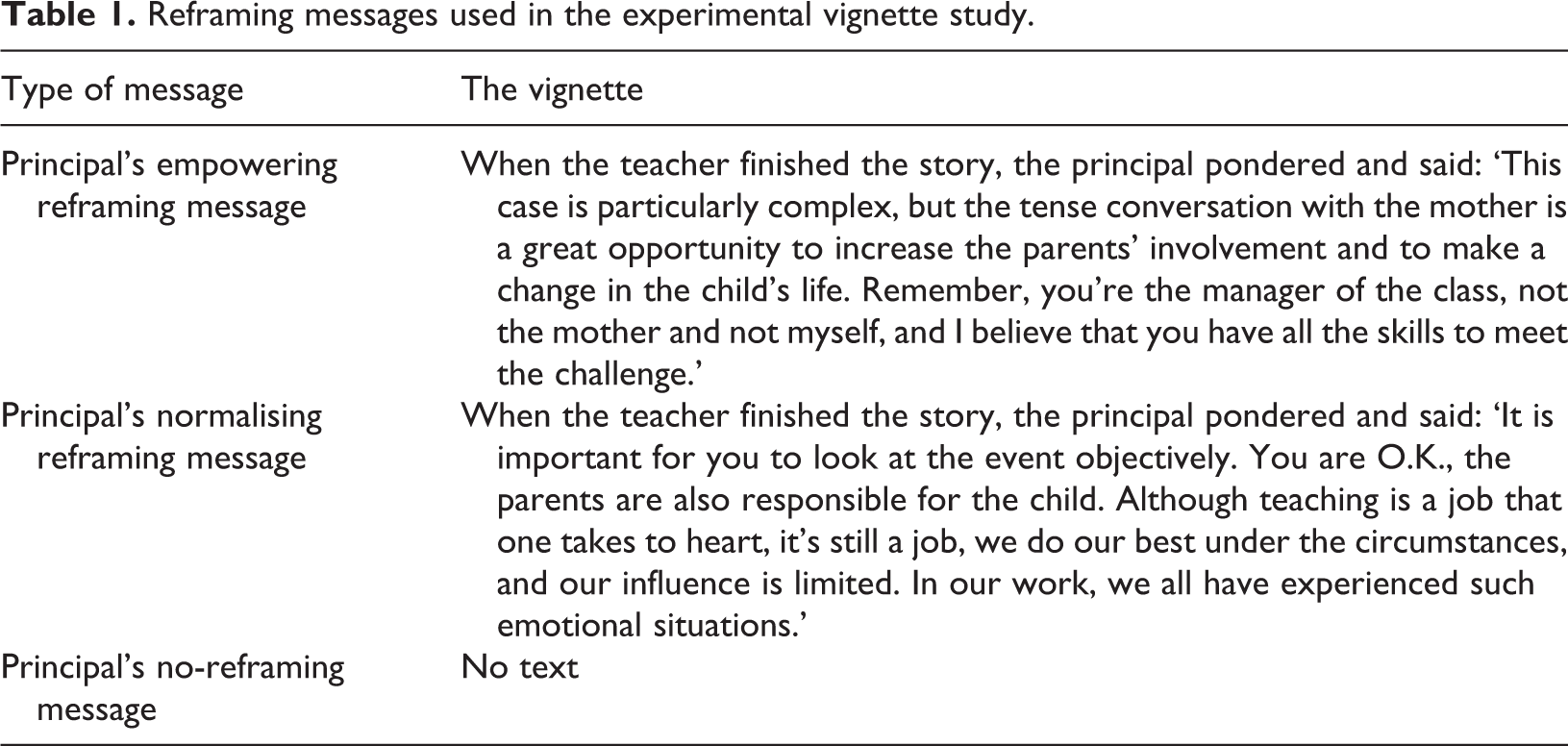
Experimental vignette study
Video stimulus check
The average score of the participants is taken as indicating that the situation in the clip represented a moderate threat to teachers’ occupational proficiency (M = 3.33, SD = 1.04; 1–5 Likert scale). A one-sample t-test compared this average with the scale’s midpoint (3). The analysis revealed a significant result, t(112) = 3.439, p < .01, meaning that the video stimulus was indeed perceived as relatively threatening. Participants’ agreement with the fact that the situation in the clip represented a threat to occupational proficiency showed a strong positive correlation with their average level of negative affect reported at T1 (r =.62, p < .001), and a weak negative correlation with their average positive affect scores reported at T1 (r = –.20, p < .05). Participants’ average negative affect level after watching the clip (T1) was medium-low (M = 2.08, SD = .86), the highest reported negative experiences being distress, upset, and nervousness (M = 3.63, SD = 1.11, M = 3.35, SD = 1.28 and M = 2.96, SD = 1.38, respectively). The distress scores relating to occupational proficiency and negative affect (measured pre-manipulation) did not differ significantly between condition groups.
Manipulation checks
To test the success of the principal’s listening type manipulation, we performed an independent sample t-test. As anticipated, the perception of principal as an empathic listener was higher in the empathic listening condition (M = 6.62; SD = 1.41) than in the non-empathic listening condition (M = 3.86; SD = 2.05) (t(88.52) = 5.21, p < .001). Therefore, the manipulation for the principal’s empathic listening was also successful.
The result of the one-way analysis of variance and of the Tukey’s Honestly Significant Difference (HSD) comparison procedure indicated that the principal’s reframing message manipulation has also been successful. The highest average rating on the empowering reframing message item was measured in the empowering reframing message condition (M = 6.02; SD = 1.20). The overall test was significant (F(2, 109) = 16.10, p < .001), as were the individual post hoc tests of the empowering condition, compared with the normalising condition (M = 4.20; SD = 1.77, p < .001) and the no-message condition (M = 4.35; SD = 1.68, p < .001). These results are consistent with the planned manipulation. The highest average rating on the normalising reframing message item was measured in the normalising reframing message condition (M = 5.37; SD = 1.35). The overall ANOVA test was significant (F(2, 109) = 12.29, p < .001), but only when the normalising message condition was compared with the no-message condition was the individual test significant (M = 3.91; SD = 1.76, p < .001), whereas compared with the empowering reframing message condition the individual test was non-significant (M = 5.36; SD = 1.21, n.s.). Thus, in general, the manipulation for the principal’s reframing message was successful.
Tests of hypotheses
Table 2 presents the means and standard deviations of the study variables, and the correlations between them. To further test the hypotheses, we conducted a series of multivariate analyses of covariance (MANCOVAs), and analyses of variance (ANOVAs).
Means, standard deviations and bivariate correlations among studied variables (N = 113).
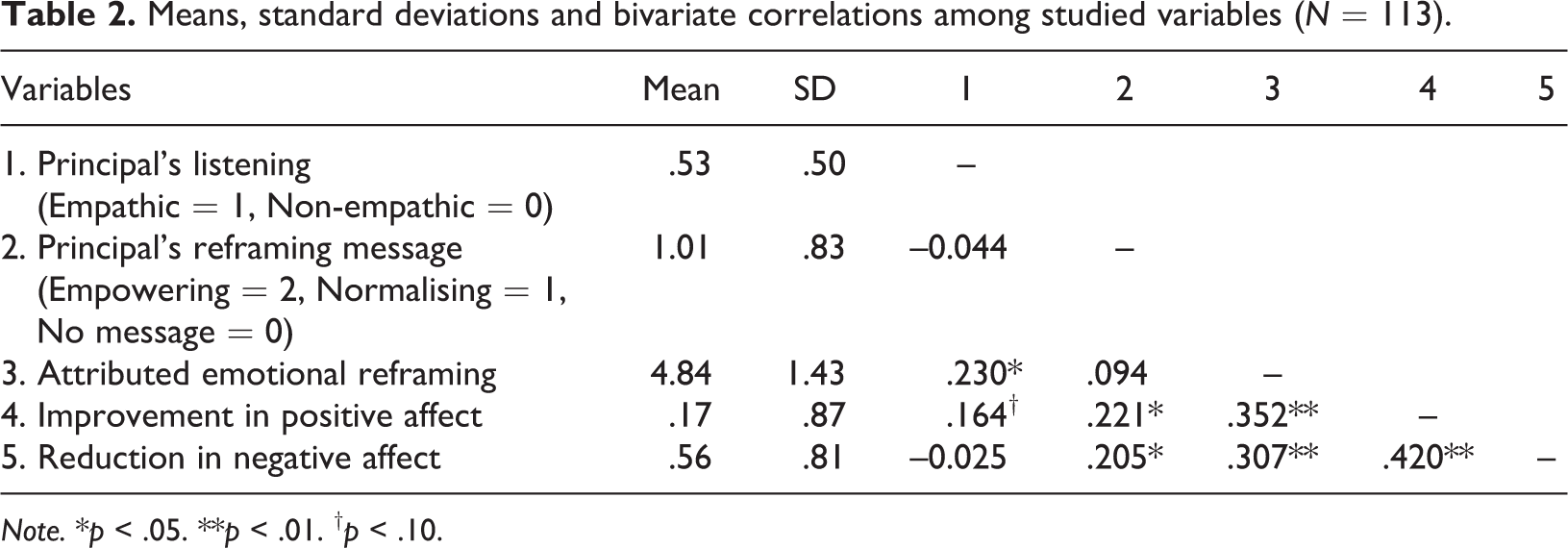
Note. *p < .05. **p < .01. † p < .10.
We used MANCOVA analysis to test the effect of the principal’s listening type and principal’s reframing message type on the overall affective outcomes. As all covariates showed non-significant effects (ps > .05), they were excluded from the follow-up ANOVAs. Principal’s listening type had a significant effect on teachers’ attributed emotional reframing (F(1, 106) = 7.11, p < .05,
The principal’s reframing message type had a significant effect on the reduction in participants’ negative affect (F(2, 106) = 3.52, p < .05,
The main effects of the manipulations on actual emotional reframing of positive affect were qualified by a significant interaction ((F(2, 106) = 3.54, p < .05,
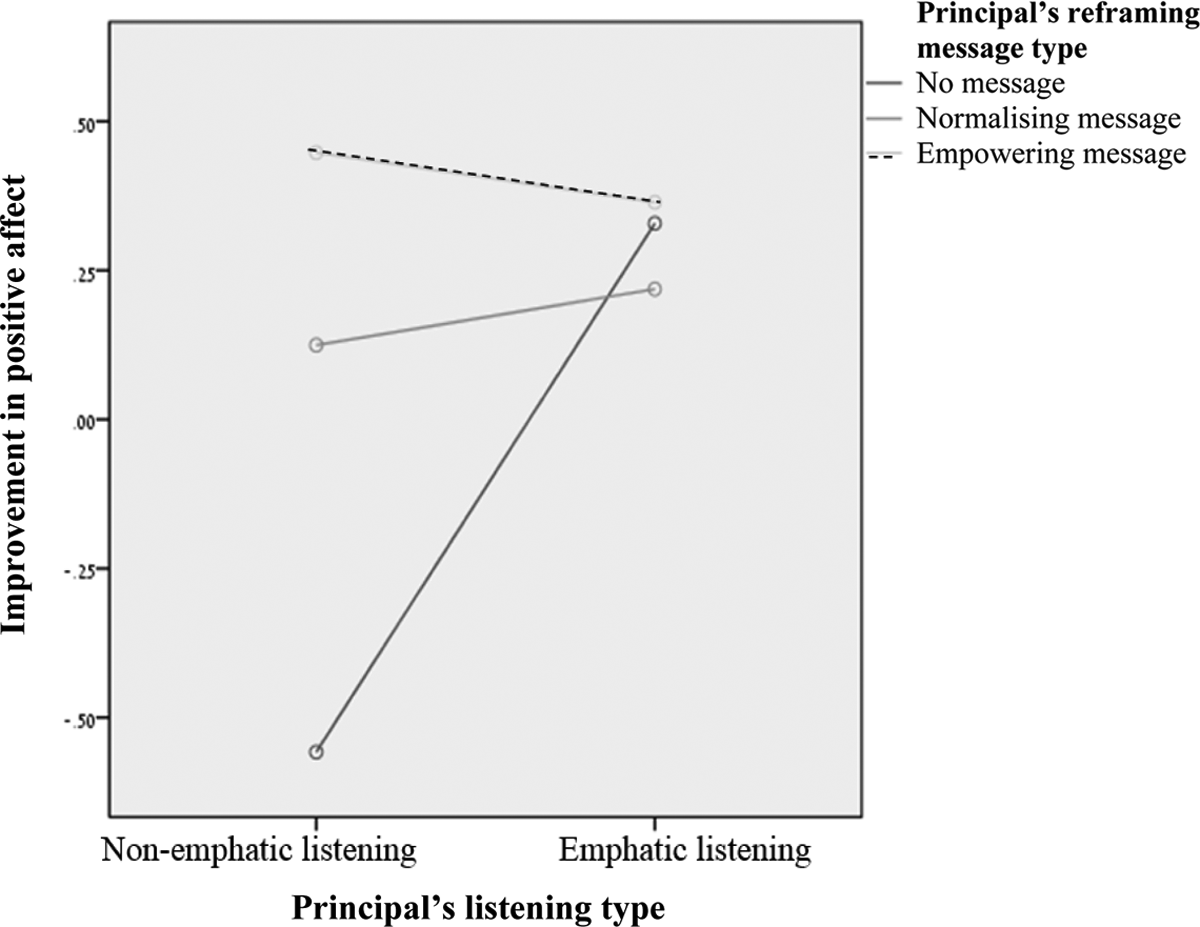
The interactive effect of principal’s listening type and principal’s reframing message type on improvement in positive affect.
Discussion
The present study draws on conversationally induced reappraisal theory (Burleson and Goldsmith, 1998) and expands it with affective change process theory (Fosha, 2005) in order to explore how principals’ listening and reframing messages transform teachers’ affect. The study reports the results of a randomised experiment based on the scenario method, in which various supportive communication manifestations follow teachers’ experience of negative affect associated with an occupational identity threat. The research is particularly important because education (and teaching in particular) is considered to be socially ‘tainted’ work owing to the low social status of education and the low social prestige of its practitioners (Hargreaves, 2009; Hoyle, 2001). Thus, often teachers experience an emotional ‘roller-coaster’ (Gallant, 2013).
Theoretical implications
The study offers several theoretical contributions. First, the findings shed light on the underexplored process of emotional support in principal–teacher relations and offer new insights into the effectiveness of the nuances of supportive practices. The findings show that the presence of principals’ empathic listening is associated with teachers’ attributed emotional reframing and improvement in positive affect, whereas the presence of reframing messages is associated with teachers’ actual reduction in negative affect and improvement in positive affect. The difference in the links between the predicators and the affective outcomes (attributed or actual) may be related to conscious cognitive emotional processing. Empathic listening allows a more aware processing of emotion-eliciting content because the teacher is proactive in self-interpreting and the listener, using a caring approach, supports the disclosure and processing (Gearhart and Bodie, 2011; Rogers and Farson, 1957). In addition, the study highlights the joint interactive effect of principals’ listening and reframing messages on teachers’ actual improvement in positive affect. However, the results suggest that reframing messages to some extent interrupt the effect of empathic listening, possibly by undermining the feelings of security and openness associated with it. This leads us to conclude that reframing messages creates cognitive demands that may reduce the processing and impact of empathic listening. This issue requires further research.
Second, the study offers an alternative model of what educational leadership in schools is, and of what it does. The findings shed light on the supportive aspect of principalship. Despite claims that school management has an aspect that supports teachers and promotes their growth (e.g. Blase and Blase, 2000), few theoretical and empirical works focus on breaking down the components of emotionally supportive school leadership. In schools, supportive leadership is particularly important because it is assumed that ‘people who do not receive care also refrain from giving care to others’, so that principals’ care for teachers is transmitted from the teachers to the students (van der Vyver et al., 2014: 62). Supportive school leadership emerged as playing a key role in maintaining teachers’ wellbeing. This model of supportive leadership elaborates on the dominant leadership model of transformational school leadership (Bush, 2014), for which supporting teachers’ needs is a key objective. The present study offers a detailed model of school leadership practices that support teachers’ emotional wellbeing.
Practical implications
The findings may have several practical implications. The results of this investigation suggest that principals should be trained on the communication of empathic listening. Some scholars claim that a good leader should leave space for followers to process challenges rather than provide answers, so as to avoid a potentially restrictive impact (Wiseman and McKeown, 2010). Empathic listening is a skill that can be learned by practice and mastered with training and awareness (Rogers and Farson, 1957). The study also advocates that principals adopt behaviours that are more reserved. Prior research indicates that the traditional assumption that leaders’ extroverted behaviours lead to higher performance does not hold true when subordinates are proactive (Grant et al., 2011). The present study may be interpreted as offering similar conclusion for principals with respect to teachers’ affective status.
The present work may be particularly important for new principals in the process of consolidating their managerial style, and for experienced principals in establishing new relations with inexperienced teachers. The psychotherapeutic literature suggests that dialogue aimed at creating emotional change might involve a process of ‘projective identification’. Projective identification occurs when one individual involves another in the processing of a negatively changed emotion, experienced as overwhelming and threatening, and ‘projects’ them onto the partner (O’Neill, 1993). The partner needs to engage in self-reflection, then react either in a defensive manner toward that same emotion, which then triggers a negative spiralling dynamic, or choose to take a complementary approach and react empathically in order to break the cycle (Tasey and Burke, 1989). Our results support this theory, showing that principals’ empathic listening improves teachers’ emotions. Therefore, principals’ empathy emerges as a promising possibility for breaking cycles of negativity.
Below we outline several recommendations for principals who wish to make emotional support a key part of their management style with the aim of helping teachers deal with emotional distress at work. Connect with the teachers by encouraging open two-way dialogue. Be aware of teachers’ affective state indirectly, through non-verbal observations, and directly, through respectful verbal inquiries about their general wellbeing, and specifically about their wellbeing at work. Adopt a containing approach to problems, which is non-judgmental and is tolerant of error. Encourage a work environment in which the staff openly discusses difficulties, because such a context cues normality when one faces one’s own difficulties. Promote emotional support as an organisational ability by offering workshops on communication and by establishing guidance mechanisms and mentoring practices.
In conclusion, the present research makes a valuable contribution to the understanding of the effects of interpersonal communication, being the first study to explore in a controlled manner how principals’ different communication practices affect teachers’ emotional reframing differently.
Footnotes
Declaration of Conflicting Interests
The authors declared no potential conflicts of interest with respect to the research, authorship, and/or publication of this article.
Funding
The author(s) received no financial support for the research, authorship, and/or publication of this article.