



Abstract
The aim of this study is to describe the influence that principals have on the hidden curriculum of induction (HCI). Our findings are based on a comparison of two case studies undertaken in primary schools in the Czech Republic, whose principals have different approaches to leadership and the management of induction. The data analysis leads to the conclusion that principals shape the HCI through mentor selection, management and development of the explicit curriculum of induction, creation of a social context in the school, and induction evaluation. The HCI is shaped by the specific realizations of these influences with content covering the meaning of induction, professional development, school context, and the principals themselves.
Introduction
‘Induction’ refers to any arrangement at the school level that aims to help novice teachers during their first years of teaching, thereby increasing the likelihood that the teacher will stay with the school and the profession (Fantilli and McDougall, 2009). Despite this key role of induction, in many countries neither its shape nor its existence, including the Czech Republic, where this research is taking place, have been formalized by jurisdictions. Whether induction takes place in a school and, if so, what shape it will take, has been influenced to a great extent by principals. It is the principals’ influence, particularly on the hidden curriculum of induction (HCI), that is dealt with in this paper.
Consistent with curriculum theory (Kelly, 2009), it may be assumed that a curriculum of induction involves not only an explicit curriculum (Athanases et al., 2008) but also an HCI. An explicit curriculum of induction reflects declared intentions of the educators and other learning planners, including the principal. An HCI, on the other hand, consists of intentional but undeclared content and unintended influences mediated by the ways in which induction is being planned and implemented (cf. Athanases et al., 2008; Kelly, 2009). Although the influence of hidden curricula has repeatedly been confirmed, it has been paid very little attention in induction research (Barrett et al., 2009). It may nevertheless be hypothesized that it is exactly through the HCI that novice teachers receive content that may be a key factor in their successful adaptation to the profession and the school environment.
Research on the HCI may therefore be a useful complement to existing induction research (Ingersoll, 2012). This research often addresses particular forms of induction (Howe, 2006), the importance of the school context for induction (Helms-Lorenz et al., 2012), the process of induction (Achinstein and Davis, 2014), or the influence that induction has on novice teachers’ teaching practice (Wang et al., 2008). Existing research also identities a number of issues associated with induction failure, for example, the attitudes of the teachers involved (Kidd et al., 2015), induction form selection (Howe, 2006), and the quality of support for induction in the school (Pogodzinski, 2015). The unintended effects of induction are rarely identified, even though they might be crucial for successful induction (Barrett et al., 2009; Pinto et al., 2012). An understanding of the HCI will contribute to existing knowledge by identifying unintended effects arising from the planning and implementation of induction. Moreover, explaining the influence of leadership and the management of induction on the HCI could be beneficial to the work of principals in practice.
The goal of this paper is to identify how leadership and the management of induction influences the HCI. Induction is described in terms of its purpose and possible forms. Induction in the Czech Republic, where this research was undertaken, is discussed in detail. The paper goes on to distinguish between principals’ direct and indirect influence on induction and the HCI is defined as one of the consequences of principals’ work. A justification of the research design is followed by two contrasting cases of induction leadership and management on the part of principals. The influence of induction leadership and management on the HCI manifests as messages that novice teachers get regarding their professional development, the school, the principal, and the importance of induction as such. These findings have been used to develop specific recommendations for induction leadership and management and to identify a potential direction for further research in induction leadership and management.
Induction
The purpose of induction is to help novice teachers cope with specific profession-related issues and support their socialization into the school environment and the profession (Klechtermans and Ballet, 2002). Successful induction increases both the effectiveness and job satisfaction of novice teachers and the likelihood that they will stay in the profession. Induction may also be viewed as the middle link between the two phases of teacher learning, that is, initial preparation and further professional development (Feiman-Nemser, 2001). As such, it plays an important role in resolving disharmony between theoretical preparation and the demands of real-life practice frequently experienced by novice teachers (Friedman, 2000). Despite this important role of induction, in many countries its implementation is managed entirely by school leadership and is not formalized by jurisdictions (Barrett et al., 2009). While this opens up space for conducting induction consistent with the needs of a specific school and specific teachers it also positions induction as an “extra activity.” Providing conditions and resources for induction may be difficult if it does not have a firm and unquestionable role in schools.
The most frequent form of induction is mentoring. An experienced teacher guides a novice teacher, with the particulars of this relationship varying both at the level of specificity and the intensity and duration of the interaction (Kidd et al., 2015). Howe (2006) uses an international comparative analysis of induction to suggest other potentially beneficial forms of induction such as extended internship programs, comprehensive in-service training, creating scope for reflected practice, and a specific approach to evaluating novice teachers’ work. This list may be further extended by classroom observations, small group instruction and meetings during the year, orientation sessions at the beginning of the school year, induction seminars, professional learning communities or other kinds of support for teacher cooperation (Brock and Grady, 1998; Moir and Gless, 2001). Another influential way to support novice teachers is reducing their teaching assignments or administrative load (Pogodzinski, 2015). However, given that mentoring is the dominant form of induction, this study focuses on induction involving mentoring.
According to Achinstein and Davis (2014), the explicit curriculum of induction based on mentoring should cover several areas. These include the socio-emotional area (stress management and personal support), introducing novice teachers to organizational and professional procedures, rules and norms, and content teaching and learning. In addition, Hudson (2012) lists a variety of issues that Australian novice teachers identified as needing inclusion in the explicit curriculum of induction. These included induction into interpersonal relations in the school and the school context in general, managing people, creating work–life balance, pedagogical knowledge development (classroom management and planning), and constructive feedback after observations of practice. Needs arising from practice thus identify relatively specific content that induction should cover emphasizing its importance as an autonomous measure bridging preservice training and professional development (Feiman-Nemser, 2001).
Induction in the Czech Republic
Czech education shows a strong tendency towards decentralization, leading to a significant level of accountability for school principals. The principal is accountable for financial administration, school educational program development and implementation, and human resources management. It is the principal who selects teachers, assigns teaching duties within the school and plans, implements and evaluates further professional development, including induction.
Teacher education in the Czech Republic consists of five-years of preservice study (bachelor’s and master’s level) and further professional development courses. Preservice teacher education gets criticized for the isolation of its theoretical courses, didactic courses, and practice (Darling-Hammond, 2006). Further professional development in the Czech Republic is implemented mainly through unrelated seminars held outside the school, and is provided by a variety of state and private organizations. Currently, there are no external incentives motivating teachers to attend these seminars.
Induction first received national legislative support in 1977 (Vyhláška, 1977), when the Ministry of Education issued a regulation establishing the role of an inducting teacher as a part of a system of further professional development. Induction by an experienced teacher, which could roughly be described as intuitive mentoring, lasted for one school year. The subsequent regulation of 1985 (Vyhláška, 1985) decreased the emphasis on pairing teachers and opened up scope for bypassing induction. Subsequent legislation gave up on supporting induction altogether and focused on courses throughout the career. Nevertheless, mentoring-based induction is now practiced at some schools thanks to their principals. Restoring the teacher-mentor role is expected to be a part of the career system for teachers now being developed by the Ministry of Education (Ministerstvo školství, mládeže a tělovýchovy, 2017).
The influence of the principal on induction
Principals directly influence induction at three distinct levels of which organization and management is the most conspicuous. According to Stoll et al. (2006) this includes managing structural resources for induction, allocating time and space for sharing and cooperation, interacting with external agents, and making partnerships and networking. The second level is influencing mentoring itself via mentor selection, mentoring oversight, and whether and how the principal organizes mentor training (Pogodzinski, 2015). The third level is the individualized interaction between the principal and the novice teacher. Elements of well-functioning personal principal support include addressing novice teachers’ goals and expectations, acknowledgment of their efforts, and protecting novice teachers from difficult tasks (Rosenholtz, 1989; Wood, 2005). Pogodzinski (2015) adds that principals’ beliefs influence both content and frequency of interactions between the mentee and the mentor. This finding is important as principals are often unaware of the significance of their role in direct support of novice teachers (Brock and Grady, 1998).
Principals also influence induction indirectly. This happens through value modelling (Haiyan et al., 2016) as well as co-shaping the social climate of the school (Billingsley et al., 2004; Kardos et al., 2001). Luft and Zhang (2014) state that novice teachers tend to be influenced by school culture more than by activities undertaken as a part of their induction as such. The importance of this broader context is supported by many other studies. For instance, sense of community has been confirmed as one of the sources preventing novice teachers from psychic exhaustion (Fernet et al., 2016). Moreover, novice teachers with stronger perceptions of an atmosphere of trust during their induction show more growth in terms of their pedagogical knowledge (Blömeke et al., 2015). The indirect influence of the principal on induction—through their influence on social climate—thus has a specific impact on the process and outcomes of induction.
Hidden curriculum of induction
The hidden curriculum includes socialization through immersion in the educational environment (Kelly, 2009), and unintended effects of educational activities and officially unrecognized content, passed on intentionally by the educators (Barrett et al., 2009). This implies that a hidden curriculum is a part of any educational activity, and cannot be avoided. The concept of hidden curriculum often bears a social–critical charge (Skelton, 1997). It can, however, also be used as a neutral umbrella concept covering phenomena that can be evaluated as either positive or negative (Cotton et al., 2013).
The HCI is formed by the social context of the school and through movements in it (Flores and Day, 2006; Klechtermans and Ballet, 2002), and through the actions of participants directly involved in induction, that is, primarily the mentor and the principal. The principal’s and the mentor’s actions contribute to building the HCI both unintentionally (content arising as a by-product of educational activities) and intentionally, but independently of the official requirements. The HCI produced by the social climate of the school and the principal has been discussed in part in the previous section. For the HCI arising through mentors’ actions, we join Barrett et al. (2009) in referring to the study by Cochran-Smith and Paris (1995) as a useful starting point. These authors distinguish two mentorship models. In the first, mentors’ actions are based on transmission of information, resulting in a hidden curriculum representing the teaching profession as the acquisition of predefined answers and not expecting a critical attitude on the part of novice teachers. The second model presents the school environment as a dynamic system and is largely based on asking questions. It involves a hidden curriculum encouraging innovation within the school and classroom. This importance of the school context, mentors and principals for the HCI supports the thesis that the HCI is always situationally grounded (Martin, 1976). The influence of specific participants on the HCI is strengthened by the fact that explicit mentoring-based curricula are often not elaborated in detail and not deeply grounded in theory (Athanases et al., 2008). This means that determining the nature and degree of influence that principals have on the HCI is of particular importance.
Methodology
The research question of whether, and if so, how, the HCI is influenced by the ways in which principals lead and manage induction can be subdivided into the following specific questions. Q1. What forms does the HCI take? Q2. How do principals lead and manage induction? Q3. What is the influence of principals’ leadership and management on the HCI?
To find the answers, the HCI had to be reconstructed and compared. These results were then linked with the methods that principals used to manage induction in their schools. To understand relations within a single system, we chose the case study design, with the school as the unit of analysis (Stake, 2013; Yin, 2009). The comparison of several forms of leadership and management of induction with the forms of HCI was accomplished within a multiple case study, specifically a case study based on comparing two contrasting cases of mentor-based induction (Flyvbjerg, 2006: 229). The case contrast was ensured by selecting two schools with contrasting leadership and management characteristics. Thanks to our previous research into teachers’ informal learning in Czech schools (Brücknerová and Novotný, 2017a; Brücknerová and Novotný, 2017b) we had several schools to choose from and our entry into the selected schools was viewed by respondents as natural.
The labelling of the selected schools is based on the relationship between the principal and the teachers: visibly discordant in the “disjointed school” and harmonious in the “coherent school.” The disjointed school is smaller in terms of the number of both pupils and teachers and it is on the outskirts of a city, with a greater concentration of pupils with specific needs (more details in Table 1). The principal (34 years old) has held her position for four years, which she assumed after only four years of teaching. The coherent school is larger serving a town of 100,000 inhabitants (see Table 1). The principal (57 years old) has had a teaching career of 24 years. The schools experience different leadership styles, social climates and induction processes. In both schools teachers believe that the principal has a strong influence on the social climate. In the disjointed school, the principal uses an authoritarian leadership style, which is not appreciated by the teachers. This is not just because it limits possibilities to influence the school operation, but also because they doubt the principal’s competence (partly because of her limited teaching experience), and most of all, they perceive the principal’s behavior as arrogant, and even endangering. The experienced social tension is viewed as a direct result of the principal’s conduct. On the other hand, in the coherent school, the principal, who is widely respected by the staff, places more trust in the teachers, and emphasizes clear and respectful communication as a fundamental principle of the school. This principal is seen by the teachers as the source and guarantor of the perceived positive social climate. Induction is also managed differently. In the disjointed school, induction mentors are assigned by the principal with little consideration of the individuals involved, evaluation is superficial, and the principal and teachers differ in their understanding of the purpose of induction. The principal views induction predominantly as an effective means of informing newcomers of their duties, while teachers emphasize the communication of teaching practices and provision of social support as the core of the induction. In contrast, the coherent school’s induction and its evaluation are prioritized, and the principal and the teachers have a shared understanding of the role and importance of induction. Our research focused on how the HCI was influenced by these differences.
Case descriptions.
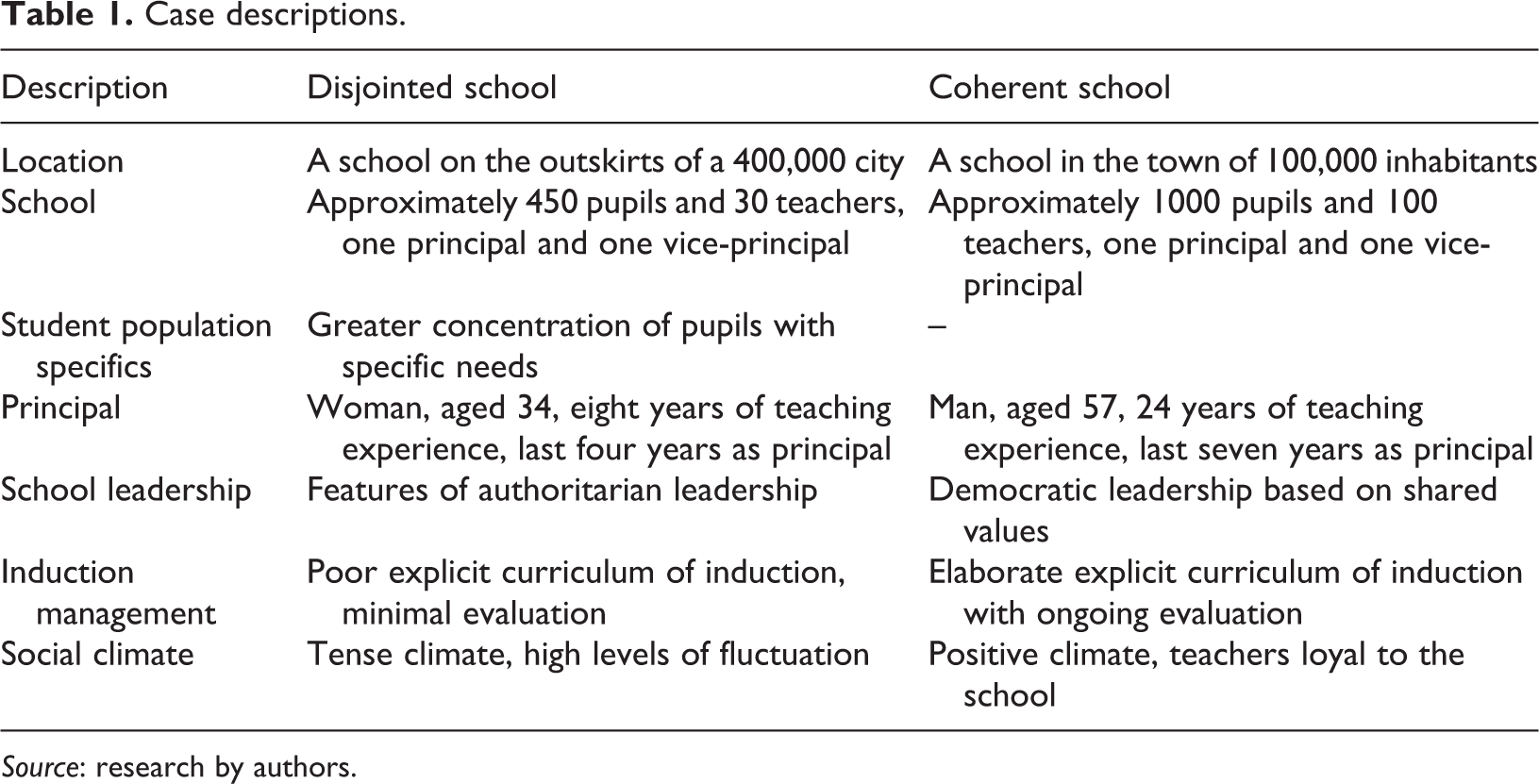
Source: research by authors.
The data were collected at the selected schools using several methods (see Table 2) in several overlapping stages. The HCI was reconstructed (to answer Q1) through semi-structured qualitative interviews with novice teachers as the key informants on the curriculum being acquired by them within the induction. The interview covered the implementation of induction, its perceptions, the roles of the principal and of the mentor in the process, and content acquired by the teachers. These data were paired with data from interviews—of the same structure—with their mentors. The goal was to triangulate the data in order to increase research validity as well as to find out about that part of HCI that mentors are aware of but which may escape the notice of novice teachers (Cotton et al., 2013). Principals were interviewed to determine their intentions and induction-related measures, activities and attitudes (to answer Q2). These data were supplemented by further interviews with novice teachers in order to determine how the given measures and attitudes taken and declared by the principal were perceived by them. Based on ongoing analysis, the semi-structured interviews were supplemented with interviews featuring questions concerning specific details. Observations in meetings and some less formal work interactions were also used to collect data. The observations were conducted in order to understand the induction context, to map interactions among teachers, and triangulate data from the principals and teachers on school leadership and social climate in the school. The total scope of the data is documented in Table 2.
Description of data material.
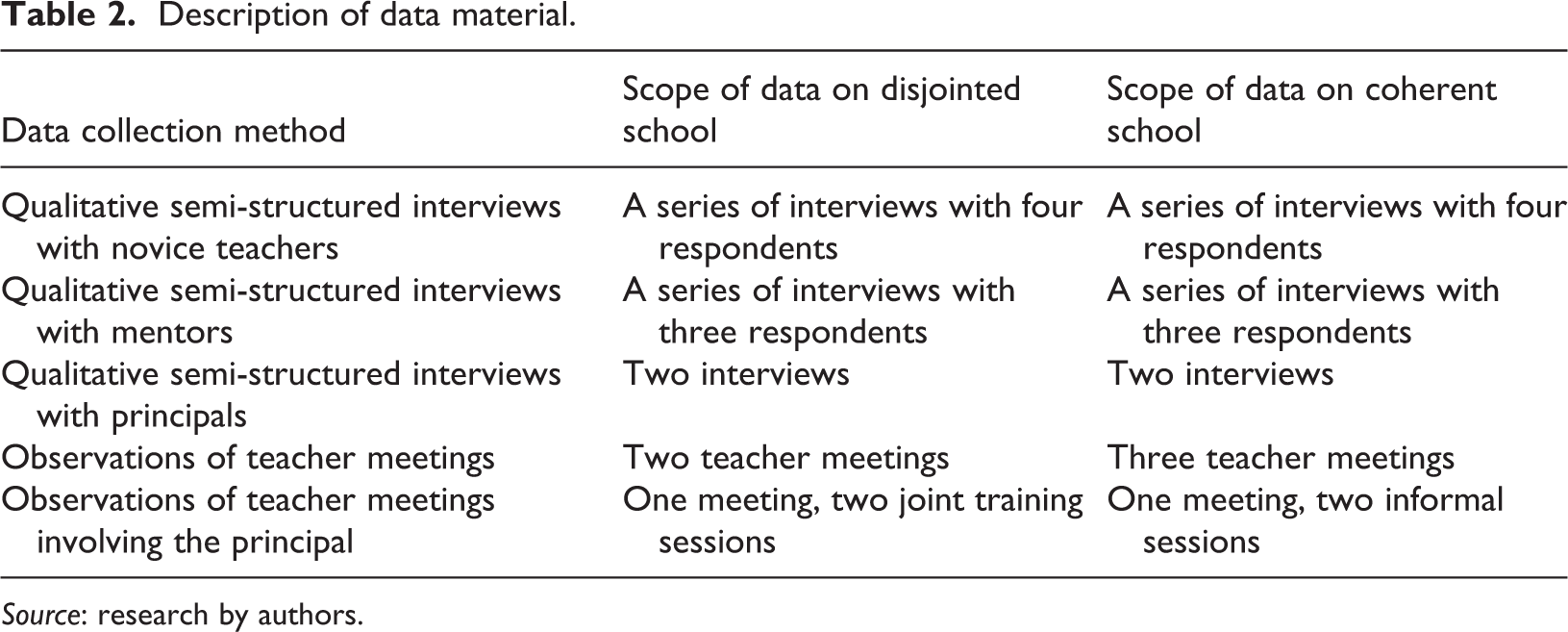
Source: research by authors.
The data analysis was based on selected constructivist grounded theory procedures (Charmaz, 2014). Notes were taken during the research process and included sketches of individual links and connections. The data from interviews and observations were analyzed by applying initial and focused coding, the result of which served as the basis for creating work diagrams and abstract situational maps for each school (Clarke, 2005). Gradual theorizing of these working models, particularly contrasting the cases, led to the conclusions presented below.
This study was conducted with an awareness of the interconnection of influences within the school’s eco-system (Elstad, 2008) and therefore we could not avoid certain simplifications. The study was limited in the following ways: only influences and relations emerging as the most saturated from the data could be selected for analysis (Charmaz, 2014), restricted case selection (Stake, 2013), and data collection methods that, in exploring hidden curricula, can never capture the phenomenon being studied directly (Cotton et al., 2013). Despite these limitations, this study helps to explain a neglected piece of reality and may support its research in the future.
Induction leadership and management
Induction leadership and management in a disjointed school
The disjointed school displayed features of authoritarian leadership, expressed by the principal as follows: “As for the important things, it is really necessary to have someone to say: ‘I don’t care what you are discussing; the school is going to move in this or that direction.’” As far as personnel management and leadership is concerned, the principal refused to consider individual personalities as she regarded the mixing of personal and professional life as unprofessional. She said: I’m not interested in why someone cannot do something or is saying they cannot, I just want to know who I can count on with the given task. […] And colleagues often don’t like when I say this to them.
Teachers responded to this kind of management by assuming a negative attitude to the principal, and perceived the social climate in the school as very tense. The label “disjointed school” was selected, as has been said above, due to the discordance between the principal and teachers.
In the disjointed school, induction consisted solely of mentoring with minimal involvement of the principal. The mentor and novice teacher were assigned to each other by the principal based on the duration of experience and a match of subjects taught. The teachers were informed only of their obligation to participate in the induction with the specific content left entirely up to the mentor. The mentor got neither further support nor was financially rewarded. Evaluation consisted of the principal asking whether the two teachers were meeting, to which a short positive answer was given.
Induction leadership and management in the coherent school
In the coherent school the principal envisaged a stable, top-ranking school, and conveyed this to teachers across the school. He continuously collected feedback from teachers on all measures he had introduced and supported teachers’ teamwork in projects where teachers had a considerable degree of autonomy. Teachers also respected his organizational skills: “He is such a good organizer that he makes it run smoothly although we are nearly 100 teachers.” Personnel management in this school could be characterized, for instance, by the way the principal selected mentors: There are a lot of circumstances to consider. One thing is how busy the teacher is with their duties. When, for instance, someone finishes with the ninth form as a form teacher, we give them a year to get some rest. From the professional point of view, some experience, at least years of practice. Then the subjects the teacher has. And personal characteristics. An empathy, friendliness, being able to empathize with the novice teacher. Such a person with whom I can count as with a support and with whom I am convinced he or she is doing a good job.
This shows that personal and professional features, as well as loyalty to the principal, were considered. The social climate co-created by the principal was described by one of the teachers as follows: “The spirit of the school is so good that teachers have never quarreled. Or one teacher looked down on someone else. This is really good about this school.” The positive climate, based on the high degree of agreement about school values, is reflected by referring, as has been said above, to the school as the coherent school.
The principal viewed induction as a process to help novice teachers to enter both the profession and the network of learning relations within the school. The principal gave careful consideration to the selection of each mentor and explained the benefits of induction to the mentee. It was hoped that this would lead to cooperation lasting beyond the one year of official induction. Induction was conceived as a sophisticated process featuring mutual classroom visits. The principal approved a year-long explicit curriculum proposed by the mentor and evaluated progress by making classroom observations. One of the mentors said of this evaluation: And you cannot do it just superficially because when the principal pays a classroom visit to the young teacher, he can see whether she can already do things. And when she’s not so good at something, he goes to you and asks you why you haven’t taught her.
Evaluation by the principal was thus not only a control but also a motivation mechanism.
The hidden curriculum of induction
The hidden curriculum of induction in the disjointed school
The first process influencing the HCI was mentor selection. The principal selected teachers only on the basis of subject specialization and duration of teaching experience. Personal characteristics were not taken into account, and no personal dimension of induction was expected. This approach to teacher selection often created pairs with contradictory personalities. Where this was the case, induction happened within an intuitively felt minimum scope, intending only that the induction would pass the principal’s superficial evaluation. This minimum consisted of the transmission of factual de-personalized content (administration and selection of teaching materials). When this information had been transmitted, induction was, effectively, over (although the official duration was one year) and carried on only through random talks in the corridors of the school. In contrast, where the two teachers found professional and personal resonances, despite the way they have been paired, intensive interactions arose. These interactions were, however, beyond the principal’s requirements and did not get the principal’s support as such. The HCI thus presents induction as a tool for transmitting practical information.
The explicit curriculum of induction was not dealt with by the principal. There was no direction from the principal regarding when and where induction should take place, sending a message that induction was not a priority. In this context, mentors provided mentoring without preparation. Some drew on their own experience as mentees, others kept occasionally updated notes in a drawer listing what a novice teacher should learn. Others let themselves be guided by what they could think of at the moment, expecting the curriculum to be formed mainly by the novice teacher’s questions: Well, mostly the first thing we tell each other is—kids are ok today or kids are nasty today. That’s the classics. And I often ask—what are you doing in Math now, what page are you on? Because I feel that I tend to get stuck with one topic, that I dwell on it for long. I like to make sure I’m really doing what I should be doing.
As both the mentees’ questions and the items on the lists were typically very practical and specific, the induction lacked an explicit direction; developmental goals were not being set nor were they evaluated. The message from the HCI concerning professional development was thus clear: professional development was based on intuition and contingency, there were no long-term goals, objectives or evaluation. Methods used by mentors to deliver the explicit curriculum also shaped the HCI. In poor relationships induction consisted almost exclusively of information transmission. In deeper relationships, sharing materials and learning through cooperation were used alongside transmission of information. However, since the principal did not offer the opportunity of mutual class visits, discussion of actual practice did not occur. The HCI implies that neither reflected practice nor an ability to accept and provide constructive feedback is necessary in order to become a good teacher. Additionally, the notion that teaching is an isolated process that takes place behind closed doors is strengthened.
The HCI is also influenced by the social climate co-created by the principal. Mentors intentionally transmitted an HCI that does not coincide with the principal’s assignment. In more interactive mentee–mentor relationships this often consisted of providing specific survival strategies. The mentor, for instance, recommends which orders of the principal to ignore, which to comply with and in what form, what to leave without commentary, and “what to go to argue out into the principal’s office.” The HCI therefore proliferated the use of defense mechanisms against the principal, thus strengthening the divide between the principal and the teachers, particularly those who have just joined the school. However, teachers reported that this very help made it possible for them “to avoid being fed up by work” and to concentrate on what was happening in classrooms without having to regard the school context. This aspect of the HCI therefore also serves as a mechanism for retention in school and profession. Evidence for this was provided by motivated novice teachers who did not manage to create a positive relationship with their mentor: I’m done here. I have found myself another school. And basically one of the reasons is that I’m looking for someone to give me a push forward. There is no major personality here from whom I’d like to learn or with whom I’d have a close relationship.
The novice teacher’s reaction to a negative social climate is directly related to the closeness of their relationship with their mentor. Where a close relationship is missing, a bond to the disjointed school tends not to form, while those in a close relationship tend to view the negative social climate as something that just has to be endured. Negatively perceived social climate thus leads to different forms of the HCI depending on the closeness of the mentor–mentee relationship.
Superficial evaluation by the principal also gets reflected in the HCI. Firstly, it supported the implicit message that reducing the induction to a minimum is desirable. Secondly, due to the superficial evaluation, the principal lost an opportunity to obtain information on processes some teachers regard as very important, which lowered the assessment of her competence by teachers even further. A novice teacher comments: “We always tell each other what we need, only no one knows […] So it [the principal’s instruction to share more intensively] only makes everybody pissed off even more.” The superficial evaluation meant that the principal was not aware of the intensity of some of the learning relationships, just as she was not aware of the HCI’s role in increasing the negative attitudes towards her.
The hidden curriculum in the coherent school
Mentor selection also contributed significantly to the HCI in the coherent school. The choice of mentors in the coherent school was perceived as a matter of prestige and was connected with material and non-material rewards: “You think you’re a good teacher when he refers to you in this way, saying you are a mentor. It’s a kind of evaluation you get.” This boosted positive inter-dependence among teachers as bringing the novice teachers to maximum levels of performance was a matter of prestige. The provision of significant professional and personal support together with highly engaged mentors clearly communicated the importance ascribed to induction as a tool for professional development.
The explicit curriculum placed high demands on the teachers involved. It included various forms of learning, as one mentor explains: It is an immense burden, extra work. You have to create a mentoring plan for the whole year and submit it to the principal for approval—what you will be doing, which month, which week. So you keep notes, all the time, on what, which day you discussed. What you did when you paid a classroom visit to her. You keep going to her classes for the whole year. And she comes to observe your classes. And consultations on a daily basis perhaps.
The explicit curriculum thus had a firm basis approved by the principal while remaining flexible enough to respond to the emerging needs of the novice teacher. Classroom visits enabled inclusion of content not only for what the novice teacher regarded as an issue, but also allowed issues with the novice teacher’s teaching that they might be totally unaware of to be addressed. The hidden curriculum of this intensive work was evident: one needs to work on oneself in this school. Novice teachers deciphered this message very easily, resulting in a situation where unmotivated teachers left the school relatively quickly, while the motivated ones rapidly became an integral part of the staff. The following story told by a mentor testifies to this: I also had one (…). She lasted some three months here. I told her what to focus on next. Or I showed her how to do the lesson plan, minute by minute. I told her I would go through it and tell her my comments. But she never did any of this. So the principal said goodbye to her.
The HCI thus acted as a sieve allowing only motivated teachers to remain with the school. These teachers regarded and kept regarding professional development, including reflected practice and feedback, as a natural part of their profession.
Here social context was an important factor influencing the HCI. Mentors’ loyalty supported the principal’s authority as well as social coherence in the school. Personal proximity of the pair was important both to support the meaningfulness of induction and to make integration into to the school easier. The originally asymmetrical mentor–mentee relationships often transitioned into mutually beneficial relationships that supported the positive climate among the staff and increased teachers’ loyalty to the school. Acceptance of the school’s vision and getting involved in personal relationships was an important step marking novice teachers’ identification with the school, supporting their retention in the profession and the school.
The principal’s evaluation consisted, as has been said above, of interviews with mentors and novice teachers and in visits to classes taught by novice teachers. These mechanisms allowed teachers to feel that the principal knew what was happening within induction. The HCI novice teachers were receiving through the evaluation confirmed the authority of both the mentors and the principal, while also demonstrating the principal’s interest in their professional development and themselves as people.
The influence of principals on the HCI
The previous sections described the HCI in the schools in separation. In this section the findings are compared and the principals’ influence on the HCI is summarized (see Table 3).
The influence of the principal on the hidden curriculum of induction (HCI).
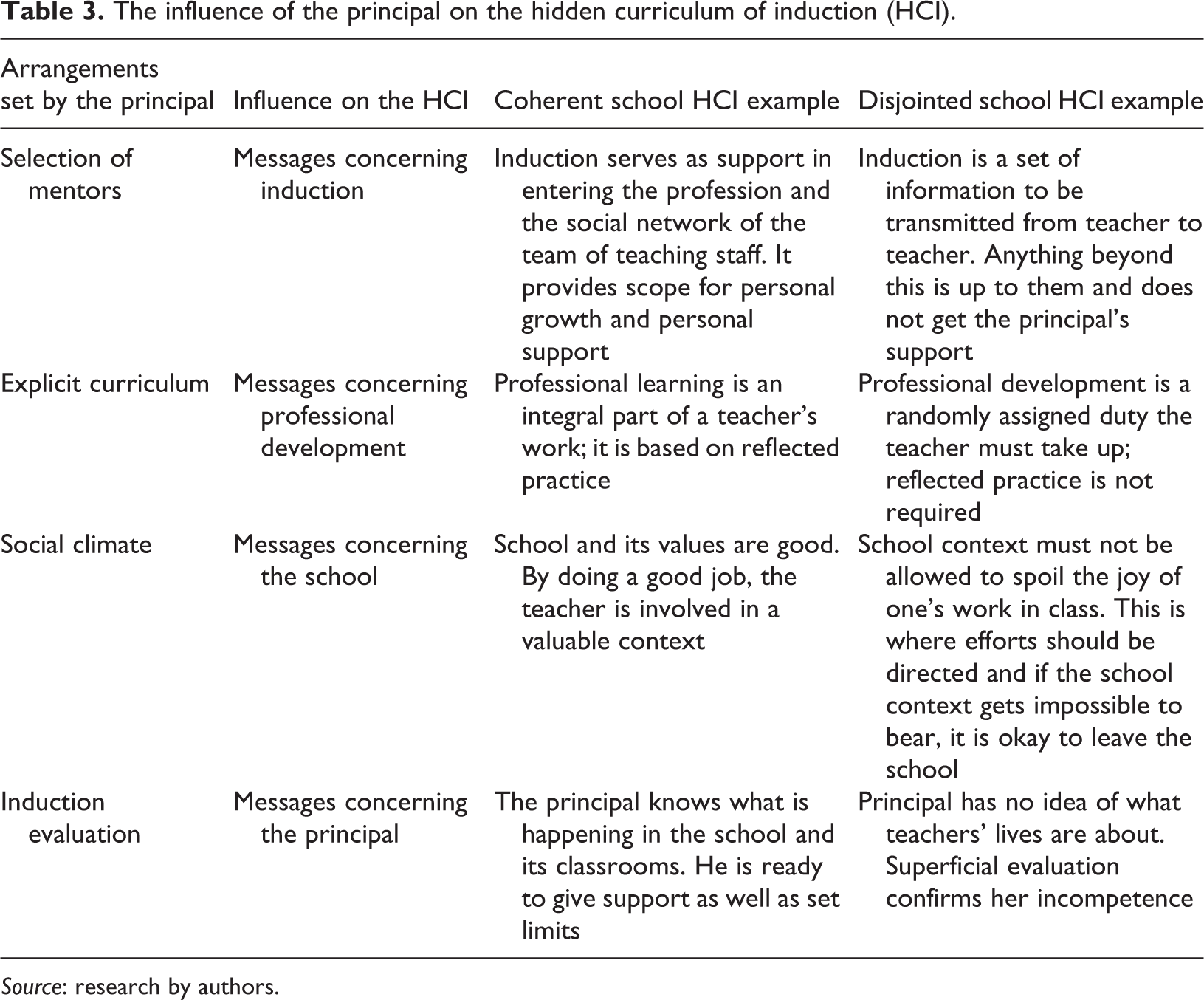
Source: research by authors.
The hidden curriculum’s message on induction
A significant factor for the HCI is the principal’s choice of the mentor–mentee pair. Where the two teachers do not connect at a personal level, the intensity of their contact is lower and the teachers mostly aim for the minimum they believe will get them a pass in the evaluation. Where the teachers do connect at a personal level, the intensity of meetings grows spontaneously and often beyond the limits set by the principal. In selecting the mentor–mentee pair, the principal forms an HCI based on the purpose, specific content and delivery of the induction.
The hidden curriculum’s message on professional development
The quality of the explicit curriculum provides teachers with important messages on professional development. Where the explicit curriculum is created on an ad hoc basis without consideration of the declared needs of the novice teacher, the message communicated is that professional development is a random thing without long-term visions. It is also clearly communicated that, while professional development is a teacher’s obligation, the teacher may not count on their principal’s support. The picture of professional development is entirely different where the explicit curriculum of induction features clearly defined topics, schedules them, and includes their evaluation. Moreover, whether the explicit curriculum of induction includes mutual classroom visits or not, the importance of reflecting practice and accepting and providing feedback for professional development forms the basis of the HCI. Where this dimension is missing, professional development is reduced to content which the teacher may simply accept through the transmission mode.
The hidden curriculum’s message on the school
The social climate co-created by the principal gets reflected in the HCI mainly in what teachers learn about the context of the school. If there is a tension in the school between the principal and the teachers, it becomes a part of the HCI as conflicts within the school are an inseparable part of the issues novice teachers are experiencing. Since mentors are typically in opposition to the principal, the HCI ensures that novice teachers are indoctrinated in this position. Where teachers view the school as a whole in a negative light, their learning within induction is motivated by a desire for personal development and improving their teaching only in the context of their own classroom. The school context hardly stimulates them at all and they do not view their career as associated with the given school. Where mentors do identify with the school’s values, the HCI is aligned with the school’s vision. Moreover, where teachers self-identify with the school, they associate their career plans with the given school, which increases the likelihood of staying on.
The hidden curriculum’s message on the principal
The last significant influence of the principal on the HCI is their evaluation of induction. Where teachers regard evaluation as meaningful and potentially beneficial in terms of their development, evaluation becomes a source of motivation to invest in induction. Teachers know that they are accountable and they care about how they are evaluated by the principal. In contrast, where teachers mistrust evaluation, they perceive it as a necessary evil, unconnected to the effort they put into induction. The principal’s evaluation also becomes subject to evaluation by teachers, serving as one of the sources of the HCI, and the basis on which they build their attitude towards the principal. The flat evaluation is perceived especially by mentors as a proof of the principal’s incompetence, or even as intruding into their personal space. In contrast, evaluation seen as competent confirms the status of both the principal and the mentor and indicates to teachers who are being inducted that they are an important part of the school. The quality of the principal’s evaluation thus provides novice teachers with an HCI on the principal’s competence.
Discussion
This study identifies how principals influence the HCI through their leadership and management of induction. The data lead to the conclusion that principals’ influence is most evident in the HCI on the meaning of induction, professional development, school context and on the principals themselves.
Previous research shows that the quality of induction is positively linked to the relationship between the mentor and the novice teacher (Pogodzinski, 2015: 52), overlap of their subject areas (Barrett et al., 2009), and the mentors’ attitude (Cochran-Smith and Paris, 1995). The principal’s decision concerning the mentor–mentee pair is thus a key influence on the process of induction, and naturally, its hidden curriculum. This was confirmed by our study. Where close relationships were neither considered nor supported in the choice, the transmissive view of induction prevailed. The HCI gives the novice teacher the message that induction is barely more than getting acquainted with the practicalities needed to do their job. Conversely, where the mentor–mentee pair selection did consider mentors’ personal characteristics, personal support and professional growth based on reflected practice took place. The novice teacher then views induction as a comprehensive development project.
The HCI is influenced by the explicit curriculum. The explicit curriculum of induction may suffer from a lack of theoretical grounding, being limited to instructions and manuals even in those countries where induction receives strong official support (Barrett et al., 2009). Principals in the Czech Republic are not provided with this support, hence explicit curricula of induction have varying levels of sophistication. In our data, we have not identified the theoretical background of explicit induction curricula; rather its characteristics were defined based on intuition and practical experience in both cases. Despite this, some principals’ (one of them in our sample) leadership and management of induction meet some criteria of quality of explicit curricula of induction described in the literature. These include: individualized mentoring support; grounding in school culture; adjustment to novice teachers’ needs (Wood, 2005); sufficient duration and intensity (Ingersoll, 2012); clear vision; education to professional standards; and taking the teacher’s actions in the classroom as the starting point (Moir and Gless, 2001). Through meeting these criteria, the HCI is transmitted, preparing novice teachers for a journey of systematic professional development which they perceive as a meaningful and inseparable part of their profession. One criterion of explicit induction curricula quality not met by our data was principals’ support of mentor education (Pogodzinski, 2015). This may indicate that even principals who perceive induction as a priority are unable to provide systemic induction support on their own.
The importance of social climate in the school, significantly co-created by the principal, is confirmed for teachers’ professional development in general, as well as for the induction process and its outcomes—teachers staying in the profession (Clement and Vanderberghe, 2000; Fernet et al., 2016). Our study shows that social climate in the school is significantly projected in the HCI. In a negatively perceived school climate, the school can be viewed as a hostile environment to be separated from the meaningful and important work of the teacher in the classroom. This HCI does not necessarily lead to leaving the profession, but teachers may leave the school if they do not form a strong bond. Conversely, HCI in schools with a positive climate lead to a strengthening of bonds with the profession as well as the specific school.
Evaluation by the principal can be an integral part of the explicit curriculum of induction but it is also an important part of the HCI. Intentional and meaningful evaluation both strengthens content relating to the importance of professional development, and also provides teachers with valuable information on the principal. Evans (1998) argues that when the principal is ignorant of what is happening in the school they become diminished in the eyes of teachers. This happens when induction is inadequately evaluated as it is seen as ignoring an important induction process. Since novice teachers do not get many opportunities for meeting the principal face-to-face (Bush and Middlewood 2013), meeting them during induction evaluation significantly influences the HCI on principal’s competence.
Induction leadership and management may be significantly improved if principals take factors known to influence the HCI into consideration. The HCI can be directly influenced through an explicit induction curriculum developed by the principal and by effective induction evaluation. Simplifying things, it can be said that the explicit induction curriculum and induction evaluation should reflect the way principals want teachers’ professional development to take place and to be perceived by teachers. Through the explicit curriculum, principals can influence not only the topics, but—perhaps even more significantly—the resources the mentor will have at their disposal, such as classroom visits, the space and time for meeting the mentee and the mentor, or defining mentoring as a priority over other duties. These resources, together with social factors, will influence the depth in which the topics in the explicit curriculum will be discussed. Principals should be aware that their evaluation of induction sets the framework for communication between the principal and the teachers, and that it is a source of information for teachers on the principal’s competence as an authority and as a person. The importance of mentor selection (Pogodzinski, 2015) has been confirmed by our research, which has shown that the HCI significantly reflects the mentors’ loyalty to the principal and to the school. Therefore, if the principal, for instance, intends to achieve social stability in the school, mentor loyalty should be prioritized. Ultimately, the part of the HCI which is formed by the social climate of the school can only be influenced indirectly. Induction can never be neutral and will always introduce the novice teacher to the school’s social network and its shared norms and values (Klechtermans and Ballet, 2002). It is therefore desirable that the principal is aware of the social relations in the school. In particular, where there are high levels of social tension, the principal should either initially integrate the novice teacher into the safe parts of the school’s social system, or offer them, together with their mentor, reflection and protection.
Conclusion
The aim of the study was to explain unintended effects of leadership and management of induction by principals. We have shown that particular measures in principals’ leadership and management of induction co-determine how novice teachers are going to perceive induction and professional development. It will also influence how they are going to perceive the school they teach in, and, ultimately, their principal. A principal who is aware of these possible unintended effects of induction can approach leadership and management of induction more knowledgeably and use these effects purposefully.
The research being presented shows the potential of comparing varying forms of leadership and management of induction with emphasis on the emerging HCI. The many characteristics differentiating the two principals and their schools (see Table 1) were useful in helping us to identify significantly different HCIs. Further research should be conducted to isolate individual factors with the potential to influence the HCI; in particular the years of teaching practice of the principal, the leadership and management style, mentor–mentee social relations and characteristics of the latter two. This can be done through a quantitative survey designed to verify and/or quantify the influence of the school, the principal and their leadership and management on the HCI. Research to verify, for instance, the link between duration of principals’ teaching practice and individual HCI characteristics, could have significant consequences for principals’ further professional development.
The research presented here describes only some key elements of leadership and management of induction, leaving out external relations between the school and the wider community, teacher–student relations, or pressures associated with being on probation. These phenomena may be addressed by leadership and management and, as they are directly or indirectly linked with induction, their influence on the HCI also deserves research attention.
All this said, this study emphasizes the role of the principal as a co-creator of the HCI. Authors of the study hope they have succeeded in calling attention to a topic requiring deeper understanding, particularly due to its significant application potential. It is exactly through the HCI that principals participate in influencing the effect that investment and effort put into induction has.
Footnotes
Declaration of conflicting interests
The authors declared no potential conflicts of interest with respect to the research, authorship, and/or publication of this article.
Funding
This work was supported by the Czech Science Foundation [GA 13-07234S].