



Abstract
In the context of educational decentralisation, school leadership encompassing different sources of leadership is significant for school performance. However, few studies have investigated the pathway regarding how principals and teachers as distinct sources of learning-centred leadership exert impact on teacher learning. To this end, survey data collected from 1340 junior high school teachers in Taiwan were analysed with structural equation modelling. The results suggest that both principal leadership and teacher leadership affect teacher learning through direct pathways, and that of teachers exhibits an even greater impact. In addition, principal leadership affects teacher learning through indirect pathways mediated by teacher leadership. By further investigating the mediating effects of different practices of teacher leadership, we found that teacher-led improvement of curriculum and instruction is a critical mediator for teacher learning.
Introduction
International assessments such as the Programme for International Student Assessment, Trends in International Mathematics and Science Study, and Progress in International Reading and Literacy Study have arisen from a worldwide initiative to prioritise the enhancement of student achievement in education reform. In addition, the four pillars of learning proposed by the United Nations Education, Scientific and Cultural Organization (2018) indicate the importance of equipping young students with high-order thinking and skills for facing the challenges of the 21st century. Professional learning is required to ensure skilful teaching and thereby meet heightened expectations for student learning. Principal leadership has been proven to be a crucial factor in learning not only for students (Bush et al., 2018; Leithwood et al., 2004) but also for teachers (Hallinger and Liu, 2016; Hallinger et al., 2017; Liu et al., 2016). The effect of principal leadership on student learning outcomes is second only to classroom instruction (Bush et al., 2018; Leithwood et al., 2004). However, the notion of ‘singular’ leadership exerted by the principal for improving the school has been challenged; the broad and specialised participation of teachers in leadership initiatives has gained widespread popularity (Lambert, 1998; Muijs and Harris, 2003). Teacher leadership involves the establishment of social linkages within a community and the building of collegiality so that teachers may share instructional practices (Harris, 2005). The recognition that teachers may also assume roles of instructional leadership has resulted in a call for models of shared educational leadership. Printy and Marks (2006) reported that principals and teachers practising shared instructional leadership influenced both teacher and student learning. The researchers asserted that only when principals and teacher leaders engaged in collective action or shared instructional leadership were the quality of instruction and the level of student achievement advanced. The argument has become prevalent in England, the United States and some other countries of the world.
Corresponding to the trend of decentralisation in the educational systems of Western countries, Taiwan has embodied the notions of school-based management and teacher empowerment since the mid-1990s (Pan, 2008, 2014). The structure of shared governance for school management consolidates the administrative foundation to promote teacher leadership. The concept that students should be equipped with competencies that will prepare them for future engagement in society was featured in Taiwan’s new Curriculum Guidelines of the 12-year Basic Education (Ministry of Education, 2014). Teachers have to engage in continual learning in order to expand their repertoires and meet the goals of curriculum reform. The means by which school leaders can facilitate teacher learning, especially in communities of practice, has become the focus of research (Cobb et al., 2003; Prestine and Nelson, 2005; Stein and Spillane, 2005). However, most studies on school leadership have been centred on the role of the principal (e.g. Hallinger and Liu, 2016; Hallinger et al., 2017; Liu et al., 2016). In response to school reforms for shared governance, teacher leadership should also be examined along with principal leadership.
School leadership incorporating the sources of principal and teacher has its impact on student engagement (Leithwood and Jantzi, 1999, 2000a, 2000c); and school development (Hallinger and Heck, 2010a, 2010b; Leithwood and Mascall, 2008; Printy and Marks, 2006). Prior studies mostly treated school leadership as an overarching construct that encompasses numerous sources of leadership (Hallinger and Heck, 2010a, 2010b; Heck and Hallinger, 2009). To map the influence exerted by different leadership roles, the present study examined the principal and teacher leadership as distinct but linked concepts (Sebastian et al., 2017). In response to enhancing student achievement as a central focus of the reform agenda worldwide, we assessed generic leadership behaviours that contribute to learning instead of measuring specific leadership models (e.g. transformational, instructional and strategic leadership). We expanded the scope of school leadership research by including teacher learning-centred leadership in the conceptual framework. It contributes to sketching a more holistic picture of school leadership practices in a decentralised context. As suggested by previous studies that principals performed both direct and indirect effects on teachers (Hallinger and Liu, 2016; Hallinger et al., 2017; Liu et al., 2016), a mediation model was employed in this study to examine how principals affect teacher learning through teacher leadership. Since teacher leadership can be manifested through various leadership behaviours (Leithwood et al., 2010; Murphy et al., 2007), we further examined what dimensions of teacher leadership were influential on teacher learning. It is an important but scarcely addressed question. Additionally, our study used Taiwanese schools as samples, which may expand our knowledge of educational leadership beyond the Western context. The following research questions were addressed: How do principal leadership and teacher leadership influence teacher learning? How do dimensions of teacher leadership mediate the effects of principal leadership on teacher learning?
Conceptual framework
Learning-centred school leadership
The significance of a principal with effective leadership has been advocated since the effective school movement (Edmonds, 1979). However, subsequent empirical studies have demonstrated that principals exhibited weak (Leithwood and Jantzi, 2000b; Witziers et al., 2003) or indirect influences on student achievements (Hallinger and Heck, 1996, 1998). Leaders affect student learning through their effects on other people or school conditions (Leithwood et al., 2004). The role of teachers is a crucial variable in student success. In the context of education restructuring, teachers are expected to fulfil expanded leadership roles to improve teaching and learning. In the 1980s, researchers returned their attention to teacher leadership (York-Barr and Duke, 2004). Related studies have encompassed formal and informal leadership. Formal leadership roles for teachers include coaching or serving as department heads or mentors. Informal leadership fulfils tasks spread among teachers such as planning and coordinating (Muijs and Harris, 2003; Murphy et al., 2007).
The emergence of studies in teacher leadership highlights the proposition that leadership is a collective action rather than an individual endeavour. Shared forms of leadership or leadership distribution can substantially improve school performance (Leithwood et al., 2004; Printy and Marks, 2006). These arguments reinforce the necessity of examining the effects of leadership from both principals and teachers in studies of school leadership. In adopting this line of reasoning, Murphy et al. (2007) identified a type of school leadership in high-performing schools that they labelled ‘learning-centred leadership’. Six dimensions were used to characterise learning-centred leadership: vision for learning; instructional, curricular and assessment programmes; communities of learning; resource acquisition and use; organisational culture; and social advocacy (Murphy et al., 2007). MacBeath and Dempster (2009) suggested five principles of leadership for learning, which are ‘a focus on learning’, ‘an environment for learning’, ‘a learning dialogue’, ‘shared leadership’ and ‘mutual accountability’. Connecting leadership and learning, Leithwood et al. (2008) identified four categories of leadership practices that contribute to school improvement and ultimately lead to favourable student outcomes: ‘building vision and setting directions’, ‘understanding and developing people’, ‘redesigning the organisation’ and ‘managing the teaching and learning program’. This study, in alignment with the reform movement toward collaborative forms of leadership, analysed the leadership demonstrated by both teachers and principals. The dimensions of learning-centred leadership proposed in the literature (Leithwood et al., 2010; Murphy et al., 2007) were used as a reference for designing our survey instruments.
Teacher learning
To improve student achievement, instructional practices must be reformed. The objective of professional development activities is to help teachers enhance their knowledge and develop new teaching approaches. However, conventional strategies for professional development have been criticised as fragmented, poorly conducted and neglectful of the role of adult learning (Borko, 2004; Fullan, 2007). Cole (2004) observed that instead of supporting teacher changes in educational practices, most conventional teacher training approaches facilitate teachers to acquire ideas, attitudes and skills in order to make changes. These kinds of efforts are often decontextualised from teachers’ classroom practice. Effective professional development requires teachers to manifest their learning processes in their roles in the classrooms and school communities (Fullan, 2007).
Sustained learning activities that are job embedded and collaborative have been promoted for school improvement (Darling-Hammond and Richardson, 2009). Lesson study, a Japanese system, has been practised as one such learning programme. It intends to improve instruction through ongoing teacher collaboration. Other Asian countries, such as Singapore, have even integrated this system into national policy as an approach of the professional learning community. Through the work of the Japanese scholar Sato (2012), an increasing number of teachers in Taiwan have become familiar with such a kind of live-instruction-based collaborative learning. To accommodate the needs of local teachers, an indigenous model of lesson study has been constructed (Pan et al., 2014, 2015). The model is based on a cycle in which teachers collaboratively plan a lesson; one teacher conducts the lesson while others observe; and then the teachers discuss the lesson based on the data collected (Lewis et al., 2006). Through organised social activities, teachers can learn and improve their practices in authentic contexts. Through these activities, Taiwanese teachers have improved their professional knowledge and skills, and developed more progressive ideas about pedagogy (Pan, 2017; Pan and Chen, 2015). Because lesson study has been promoted as a significant learning activity in Taiwan, we used it as an indicator to measure teacher learning in the present study.
Leadership effects on teacher learning
Research of principals’ effects on teachers has mostly focused on teacher commitment (Yu et al., 2002), motivation (Eyal and Roth, 2011), job satisfaction (Bogler, 2001) and academic optimism (Mascall et al., 2008). Studies of ‘leadership and teacher learning’ increased after Robinson et al. (2008) suggested that principal involvement in teacher professional learning considerably influences student learning. Investigations of the effects of principal leadership on teacher learning have been largely based on a mediation model. Li et al. (2016) discovered that principal leadership of teacher development, instruction and staff management was positively associated with teacher professional learning, and that the direct effect of principals on teacher professional learning was weaker than that mediated through school capacity. Hallinger and colleagues further explored how leadership influences teacher learning through teacher attitudes (i.e. teacher trust and teacher agency) (Hallinger et al., 2017; Liu et al., 2016). These studies have established empirical evidence that the leadership effect on teacher learning is partially mediated by teacher attitudes.
In addition to teacher attitudes, numerous forms of teacher leadership (e.g. departmental leadership and peer influence) have been identified as substantial factors which influence teacher learning in communities and teaching practice. Printy (2008) reported that departmental leadership affects teachers’ participation in communities of practice. Department chairs take on such leadership tasks as shaping the agenda for discussion, setting goals, encouraging teachers for collaborative learning and promoting improvement. Supovitz et al. (2010) indicated that peer influence also considerably affects teaching practice. Those who worked collegially with other teachers to observe classroom teaching and examine instruction have the most influence on their peers (Joyce and Showers, 1995; Wasley, 1991). These findings have identified the crucial practices of teacher leadership which are associated with increasing community participation and boosting instructional change.
Furthermore, studies of teacher leadership have revealed that shared leadership by principals and teachers facilitates school improvement (Leithwood et al., 2004; Printy and Marks, 2006). Neither principals nor teachers alone can offer sufficient leadership to enhance the quality of teaching and learning for an entire school. Principals must provide guidance for teachers in instructional matters and promote teacher leaders to reflect on their practice so that the efforts can be translated into school progress. In the study by Wahlstrom and Louis (2008), joint decision-making was determined as a significant predictor for instructional behaviours. This finding further validated the proposition that teachers exercising leadership promotes instructional changes.
Researchers no longer regard principals as the sole source of school leadership (Leithwood and Mascall, 2008). Since this recognition in the field, most studies have applied the inclusive construct of school leadership, which considers both principals and teachers as sources of leadership (e.g. Hallinger and Heck, 2010a, 2010b; Heck and Hallinger, 2009). Principals and teachers play different leadership roles (Sebastian et al., 2016); therefore, principal and teacher leadership may be treated as distinct but linked constructs for the examination of their relative effects. However, most studies use a broad construct of school leadership to subsume principal and teacher leadership (Sebastian et al., 2014, 2016, 2017).
In summary, although evidence has suggested that principals affect teacher learning, few studies have considered the influence of teacher leadership in the analysis of the relevant outcomes. Besides, relevant studies have only explored how teacher attitudes mediate the principal’s effect on teachers. Empirical investigation on the effect of principals in promoting teacher learning via teacher leadership is lacking.
Methodology
Sample
This study employed a survey design. The population studied comprised teachers in public junior high schools in Taiwan. In the pretest phase, 200 questionnaires were distributed among four junior high schools, and 145 valid questionnaires were collected (73% response rate). In the formal questionnaire phase, we used stratified cluster sampling to include samples from different areas and schools of various sizes. A total of 1870 questionnaires were issued, and the response rate was 80%. The number of effective samples was 1340 (72% response rate), and the respective numbers of male and female respondents were 483 (36%) and 857 (64%).
Instruments
Three variables were adopted in this study: learning-centred principal leadership (PL), learning-centred teacher leadership (TLp) and teacher learning (TLng). All variables were measured using a 6-point Likert-type scale (1 = strongly disagree; 6 = strongly agree). To develop the questionnaire, we conducted a literature review and used data from interviews with junior high school principals and teachers for reference. Twelve scholars and school practitioners were invited to review the initial draft of the questionnaire to ensure content validity. Item and consistency analyses were conducted on all valid questionnaires collected in the pretest phase to examine the quality of the items. The precise measures and the results of Cronbach’s alpha coefficients for variable measurement are presented subsequently.
Learning-centred principal leadership
Based on references from the literature, we developed a four-dimension scale with 20 items to measure learning-centred principal leadership (Leithwood et al., 2006, 2008; MacBeath and Dempster, 2009; Murphy et al., 2007; Robinson, 2011; Robinson et al., 2009). The first dimension evaluated the construction of a learning vision (e.g. ‘under our principal’s leadership, we all hold high expectations for student learning’). The second dimension assessed development of teachers’ professional competences (e.g. ‘our principal provides us with opportunities to participate in professional learning activities to enhance our teaching’). The third dimension measured the management of the curriculum and instructional programme (e.g. ‘our principal guides and encourages us to develop the curricular and instructional programmes’). The fourth dimension concerned the provision of a supportive environment (e.g. ‘our principal integrates relevant policies and programmes to allow us to concentrate on student learning’). Values of Cronbach’s α for the four subscales ranged from .92 to .94 and the value for the whole scale of learning-centred principal leadership was .98.
Learning-centred teacher leadership
Based on Leithwood and colleagues’ framework (Leithwood et al., 2006, 2008), we developed a four-dimension scale with 20 items to measure learning-centred teacher leadership. The first dimension regarded communication of a learning vision (e.g. ‘teachers provoke discussions regarding the learning vision for subjects and learning areas in meetings’). The second dimension covered support for teacher professional development (e.g. ‘teachers are engaged in continual learning and facilitate colleagues’ professional development’). The third dimension evaluated initiation of curricular and instructional improvement (e.g. ‘teachers actively discuss with colleagues how to help students think and explore’). The fourth dimension regarded enhancement of the teaching environment (e.g. ‘teachers offer support to colleagues who would like to try something new’). Values for the Cronbach’s α of the four subscales ranged from .92 to .94, and the value for the whole scale of learning-centred teacher leadership was .97.
Teacher learning
We referred to the analyses of Lewis et al. (2006) and Pan et al. (2014) on lesson study to develop a four-item instrument to measure teacher learning in the context of lesson study. The items were used to investigate teachers’ participation in lesson planning, opening of class, observing colleagues’ teaching and giving feedback, and collectively analysing student data to improve instruction. For example, one item was, ‘I observe colleagues’ teaching and give feedback’. The Cronbach’s α of the scale was .86.
Data analysis
To answer the research questions, structural equation modelling was used to test the hypothesised model. First, a simple mediation model with teacher leadership as the sole mediator was proposed. It was used to investigate the direct effect of principal leadership on teacher learning as well as the mediated effect of principal leadership on teacher learning via teacher leadership. The mediating effect occurred when the mediator, teacher leadership, carried the influence of principal leadership to teacher learning.
Second, a multiple mediation model which included the four dimensions of teacher leadership as mediators was tested. The aim of a multiple mediation model is to assess how independent variables influence dependent variables through more than one mediation variable (MacKinnon, 2008; Preacher and Hayes, 2008). Moreover, the total indirect effect of analysed variables may be broken down into specific indirect effects through individual mediators. In addition to the examination of the aggregate mediating effects of all mediators, the specific mediating effect of each mediator can be clarified (Preacher and Hayes, 2008). In the present study, the indirect effects mediated by four dimensions of teacher leadership behaviours were estimated in a multiple mediation model, which means the indirect effect of a particular dimension of teacher leadership behaviour could be examined when the direct effect of principal leadership and other teacher leadership behaviours were taken into account at the same time.
Following Preacher and Hayes’ (2008) recommendation, the significance of the specific indirect effects was tested via bootstrap analysis. Bootstrap analysis is a nonparametric sampling procedure. To bootstrap, the original sample is used to generate multiple samples with replacement that serves as the basis for repeatedly computing the statistic under investigation (Mallinckrodt et al., 2006). We used bootstrapping to resample the data 2000 times to yield a parameter estimate for both total and specific indirect effects. If the 95% bias-corrected confidence interval for the parameter estimate does not contain zero, then the specific mediating effect is statistically significant (Alvarez and Juang, 2010; Preacher and Hayes, 2008).
Results
Measurement model
We conducted a series of confirmatory factor analyses and used various indexes to assess the overall model fit and the fit of the internal structure of the measurement model (Bagozzi and Yi, 1988). The chi-square test is sensitive to sample size; thus, the root mean square error of approximation (RMSEA), Tucker Lewis index (TLI), comparative fit index (CFI) and standardised root mean squared residual (SRMR) are generally recognised and recommended indexes for overall model fit (Bagozzi and Yi, 2012). The following results indicated that the model exhibited good fit: RMSEA = .06; TLI = .98; CFI = .98; SRMR = .03.
Convergent validity and discriminant validity were used to examine the fit of the internal structure of the model. The data presented in Table 1 revealed that the square multiple correlations (SMCs) of all observation variables were higher than the standard of .50. The composite reliability (CR) values for principal leadership, teacher leadership and teacher learning were .97, .95 and .85, respectively, which all exceeded the desired level of .60. Moreover, average variance extracted (AVE) of the three latent variables also met the required standard (>.50). The three indexes indicated that the model’s convergent validity was satisfactory.
Descriptive statistics and convergent validity indexes of the measurement model.
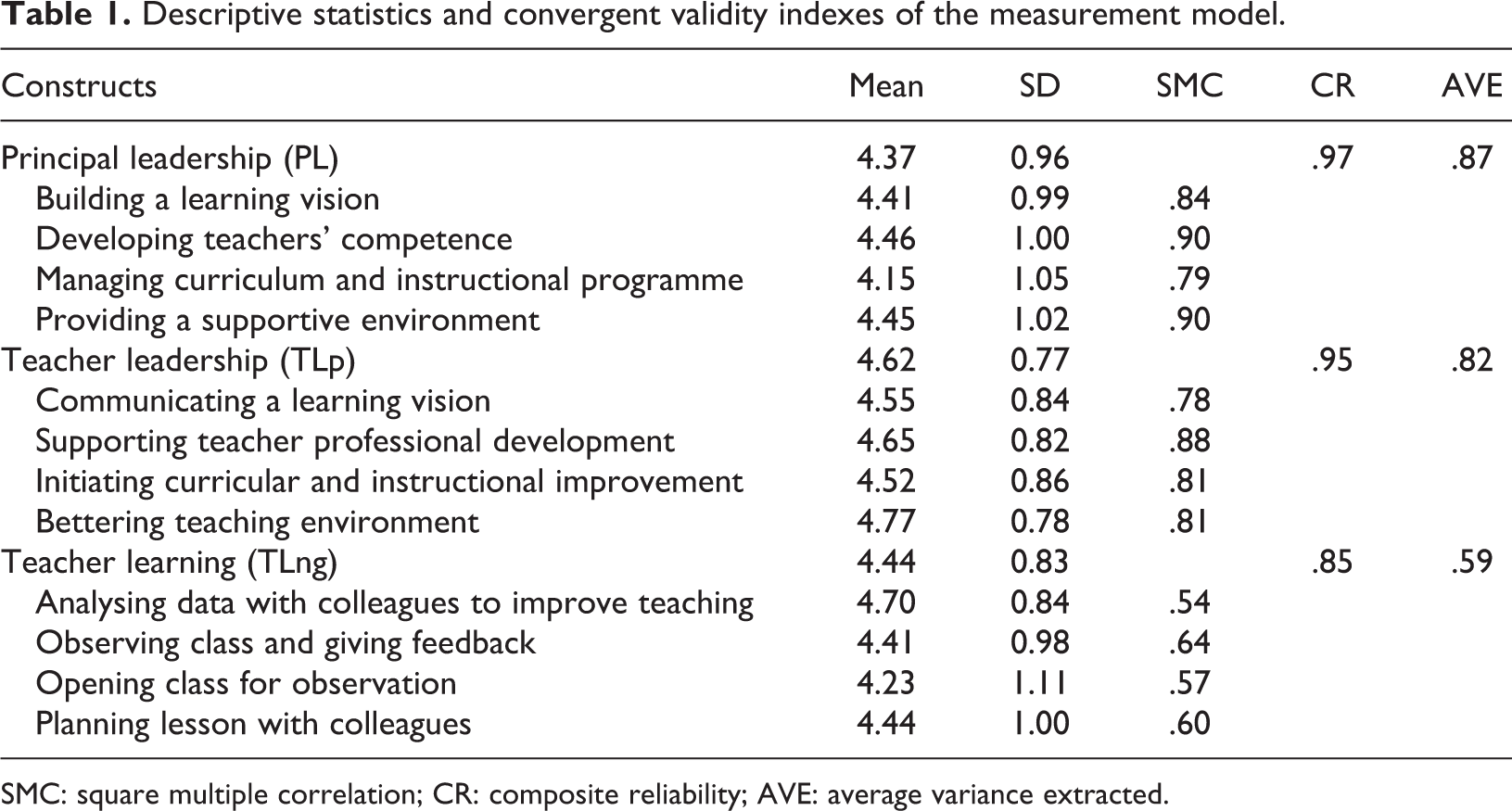
SMC: square multiple correlation; CR: composite reliability; AVE: average variance extracted.
To determine whether the latent variables in the model exhibited discriminant validity, we compared the square root of the AVE of each latent variable with the correlation coefficients of the latent variable and those of other latent variables (Fornell and Larcker, 1981). The results, as listed in Table 2, demonstrated that the square root of the AVE of each latent variable in the diagonal was greater than its contrasting correlation coefficients, indicating that the model exhibited favourable discriminant validity.
Discriminant validity of the main constructs.

Effects of learning-centred principal and teacher leadership on teacher learning
Simple mediation model
In the simple mediation model (Figure 1), the assumptions for mediation analysis were met, with a significant direct relationship between the principal leadership and the mediator (β = .51, p < .001), and between teacher leadership and teaching learning (β = .52, p < .001). As the direct effect of principal leadership remained significant after accounting for the indirect effect (β = .22, p < .001), the model reflected a partial mediation.
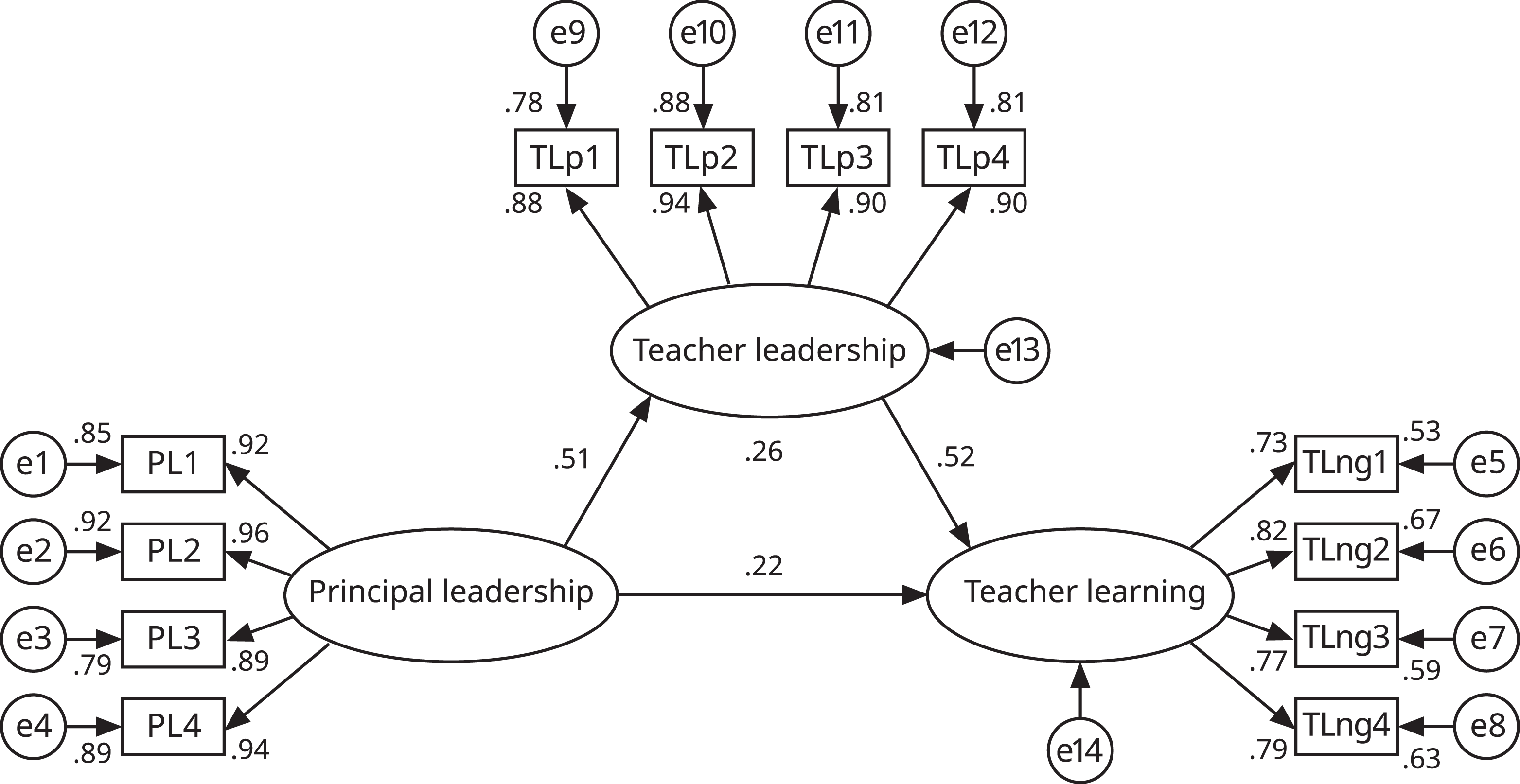
Simple mediation model of the relationship between principal leadership and teacher learning as mediated by teacher leadership.
Performing bootstrapping to confirm the significance of the effects, the results indicated that both the direct and indirect effects were statistically significant (see Table 3).
Effects of principal leadership on teacher learning through teacher leadership as determined in the simple mediation model.
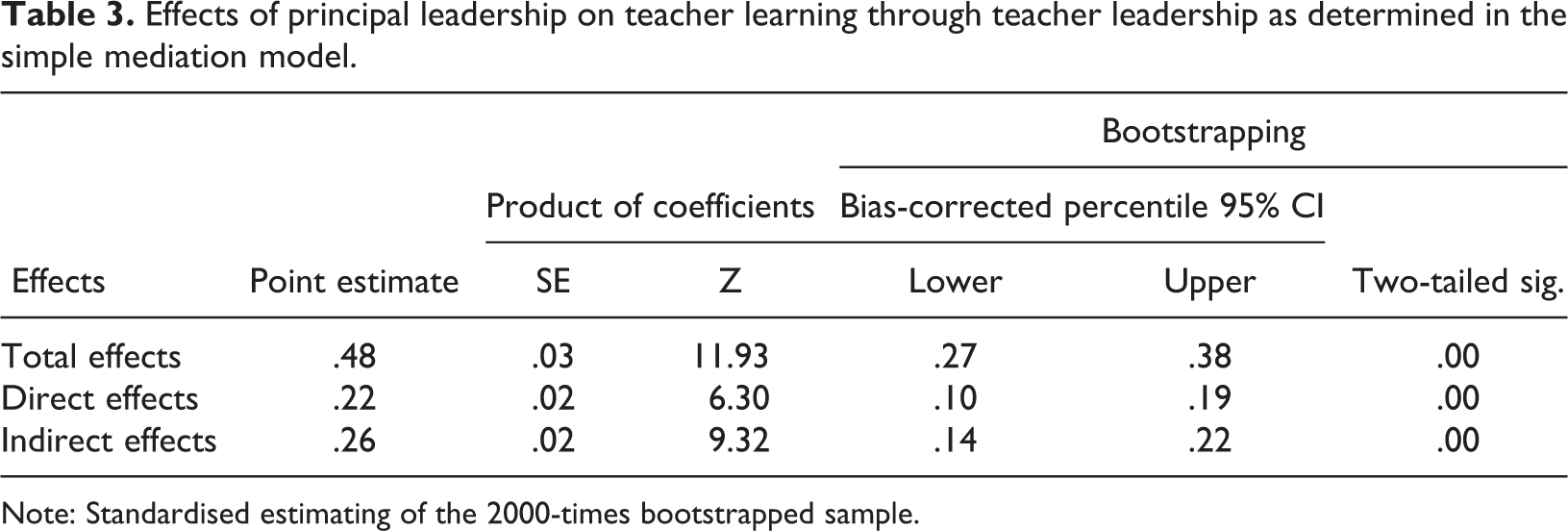
Note: Standardised estimating of the 2000-times bootstrapped sample.
Multiple mediation model
To determine the specific indirect effect of principal leadership on teacher learning through different teacher leadership behaviours, the four dimensions of teacher leadership were used as the mediators. This full-structure model provided an acceptable fit for the data (RMSEA = .07; TLI = .94; CFI = .95; SRMR = .03; Bagozzi and Yi, 2012). The model is depicted in Figure 2.
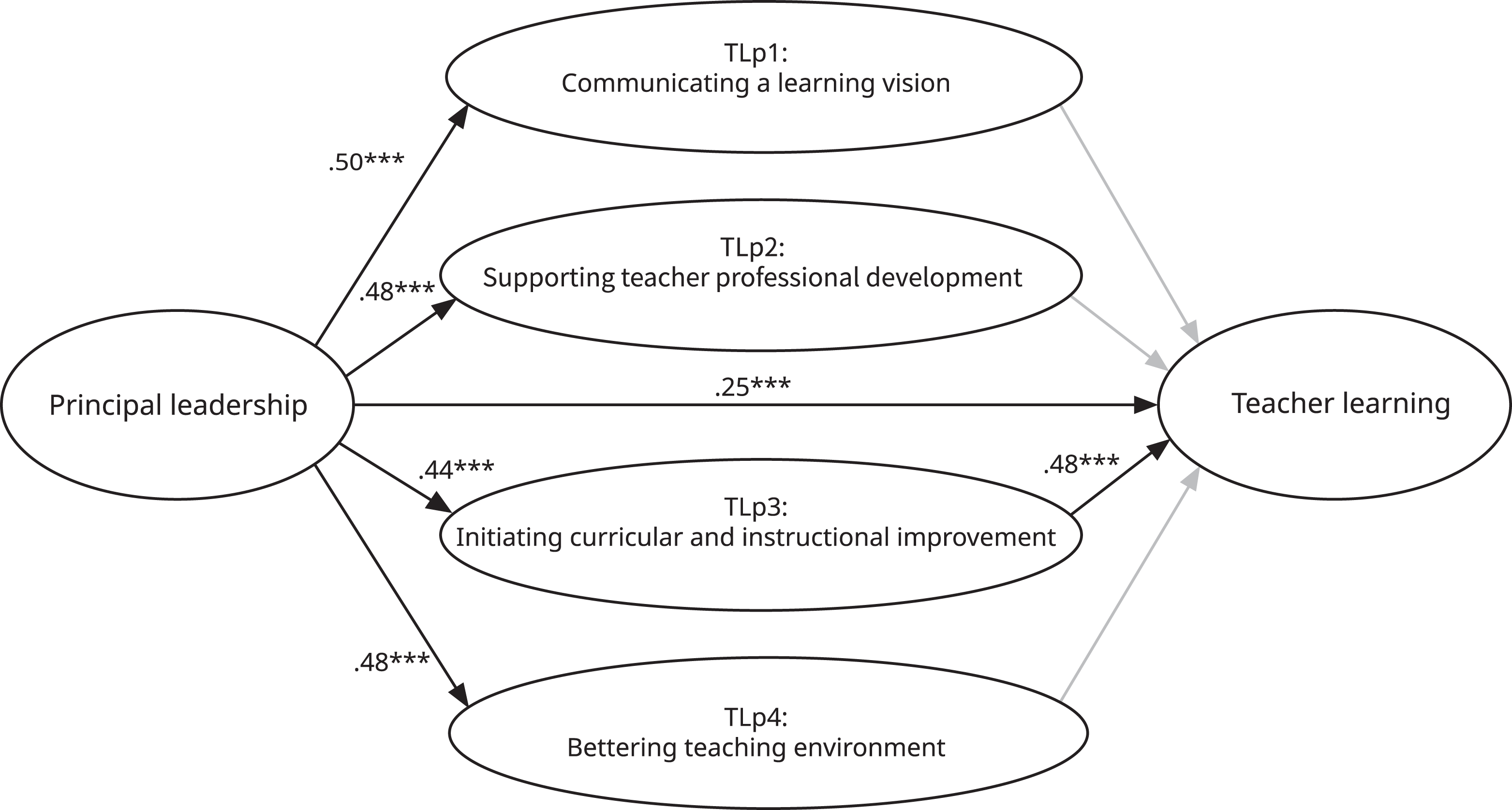
Multiple mediation model of the relationship between principal leadership and teacher learning as mediated by the dimensions of teacher leadership.
Simultaneously estimating the effects of the independent variable and mediators on the dependent variable, the results (see Figure 2) demonstrated that principal leadership still had significant direct effect on teacher learning (β = .25, p < .001) as the simple mediation model indicated. Principal leadership also had significant positive impact on the four mediators: communicating a learning vision (β = .50, p < .001); supporting teacher professional development (β = .48, p < .001); initiating curricular and instructional improvement (β = .44, p < .001); and enhancing teaching environment (β = .48, p < .001). However, among the four dimensions of teacher leadership behaviours playing the roles as mediators, only involvement in initiating curricular and instructional improvement (TLp3) exerted significant impact on teacher learning (β = .48, p < .001). The other three mediators did not exhibit significant mediating effects.
We further conducted significance tests of the mediators’ specific indirect effects using bootstrapping procedures with a 95% confidence interval. The results revealed that only the indirect effect through initiating curricular and instructional improvement (TLp3) was significant on teacher learning (see Table 4). Overall, the results suggested that besides the significant direct effect, the indirect effect of principal leadership on teacher learning was partially mediated only by a specific dimension of teacher leadership behaviours, namely teacher-led improvement of curriculum and instruction.
Effects of principal leadership on teacher learning through teacher leadership according to the multiple mediation model.
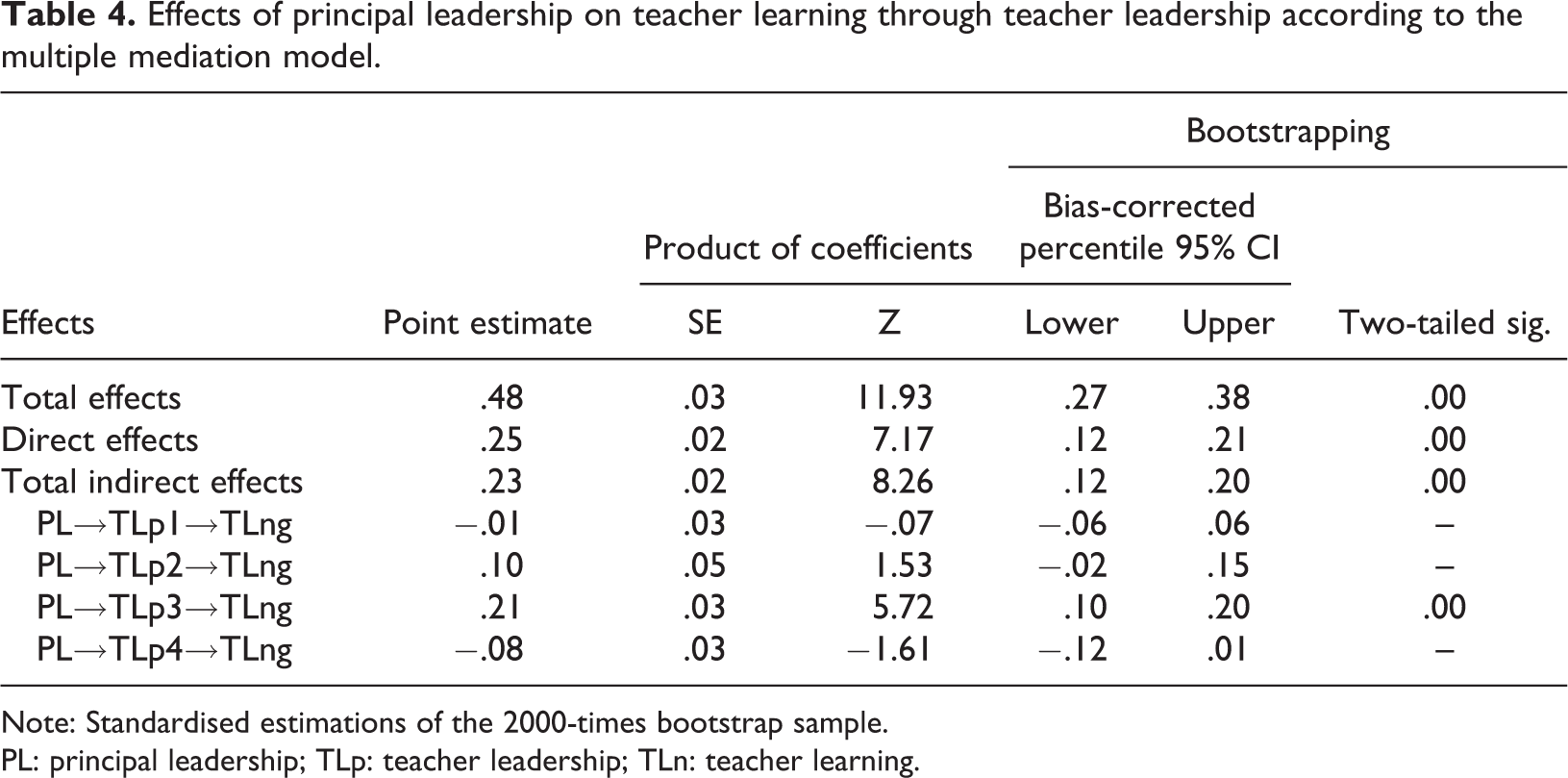
Note: Standardised estimations of the 2000-times bootstrap sample.
PL: principal leadership; TLp: teacher leadership; TLn: teacher learning.
Discussion
Since the 1990s, principals in Taiwan have been expected to act as instructional, curricular and transformative leaders to fulfil educational reform mandates. Reform initiatives have increased in complexity; consequently, decision-making in schools is more effective when more stakeholders are involved (Anderson, 2012; Gronn, 2008; Hallinger and Heck, 2010a, 2010b; Leithwood and Mascall, 2008; Marks and Printy, 2003; Youngs, 2014), and collaborative leadership (Hallinger and Heck, 2010a, 2010b), collective leadership (Anderson, 2012; Leithwood and Mascall, 2008) and distributed leadership (Bush, 2013; Crawford, 2012; Gronn, 2008; Spillane, 2005) have emerged, reflecting new trends in leadership practices in educational settings. Taiwanese principals have recognised and adopted the paradigm shift from ‘power over’ to ‘power with’. In this policy-related context, the conceptual framework of our study included teacher leadership as a focus of analysis alongside the widely researched role of principalship. Sebastian and his colleagues (2016: 71) argued that ‘attempts to capture distributed leadership have often simply combined multiple sources of leadership under conceptualisations such as shared, collaborative, and collective school leadership’. The present study treated principal and teacher leadership as two separate but linked constructs to examine how they affect teacher learning. Teacher leadership and the different practices of teacher leadership are used as mediators to assess the indirect pathways of principal effect on teacher learning. The findings are discussed as follows in response to the research questions.
First, the findings indicated that the leadership of principals directly affected teacher learning. Although principal leadership was effective in promoting teacher learning, its effect was partially mediated by teacher leadership. These findings regarding the direct and indirect effects of principals on teacher learning have also been suggested in prior research conducted in Western nations (Printy, 2008) and in Asia (Hallinger and Liu, 2016; Hallinger et al., 2017; Li et al., 2016; Liu et al., 2016). Regarding direct influence, Printy (2008) reported that American principals who communicated vision and supported teachers positively affected teacher learning by stimulating teacher participation in communities of practice. Hallinger and colleagues conducted a study in China (Hallinger and Liu, 2016; Liu et al., 2016), based on which they reported that principal learning-centred leadership in fostering teacher agency and building teacher trust was conducive to teacher devotion to workplace learning. However, the difference in outcome directly attributed to principal learning-centred leadership was small to moderate (β = .32–.53; Hallinger and Liu, 2016; Liu et al., 2016). Additionally, the magnitude of this influence was the weakest for urban schools (β = .32) (Hallinger and Liu, 2016). In the present study, we reported a similarly significant but weak principals’ direct effect in the Taiwanese context (β = .22). For the indirect path, we discovered that principals may catalyse teacher leadership that, in turn, significantly influences collaborative teacher learning.
Second, teacher leadership was found to directly affect teacher learning; thus, principals who wish to encourage collaborative teacher learning should encourage teachers to take on leadership roles. Teacher leaders with subject area and instructional expertise are able to share teaching practice with colleagues to advance student learning. Conveying ideas about improving the world, establishing communities of learning, nourishing a culture of success and contending for authenticity in their instructional practices are what teacher leaders usually do (Crowther et al., 2002). The effect of teacher leadership on teacher learning may be further discussed in the Taiwanese context. Pan et al. (2017) reported that although the responsibility for steering a school rests at the ‘top’ of the organization in a hierarchical system, Taiwanese principals employed both top-down and bottom-up approaches to facilitate school development. Numerous types of committees and teaching structures such as those based on class, grade or subject have been established to include stakeholders in formal shared governance. With structures of distributed leadership based on the coexistence of role-based leadership and emergent practices used in school management (Gronn, 2002; Youngs, 2014), teachers in Taiwan are able to exert parallel leadership (Andrews and Crowther, 2002) by assuming the responsibilities of curricular and instructional leadership.
Third, this study also revealed that teacher leadership exhibited a greater direct effect on teacher learning than did principal leadership. Principals, constrained by scant leadership content knowledge, normally do not fully connect their acts of leadership to subject matter, learning or teaching. Leadership content knowledge was defined by Stein and Nelson (2003) as knowledge of academic subjects and how students learn them. This is the type of knowledge which administrators need to be equipped with in order to be strong instructional leaders.
Fourth, through further inquiry into how the four dimensions of teacher leadership mediated the effects of principal influence on professional learning, we determined a critical path. Only one dimension, namely the involvement in initiating curricular and instructional improvement, was found to be a significant facilitator for collaborative teacher learning. In other words, when principals promoted teacher involvement in leading improvements of curriculum and instruction, teachers exhibited joint learning through lesson planning, classroom observation and provision of feedback for improvements in instructional practice. Initiation of peer-to-peer discussion among teachers regarding how to advance student learning was key to the teachers’ collaborative learning. This finding echoes with what was found by Graham (2007). Leadership strategies contributed to the success of professional learning community structure through which teaching quality was enhanced. Other practices of teacher leadership not directly related to instructional enactments (e.g. communication of a learning vision, support of colleagues’ professional development and enhancement of teaching environment) were found to exert weaker mediating effect on professional learning.
Finally, we acknowledge a few limitations of our study. School leadership subsumes numerous sources of leadership (Hallinger and Heck, 2010a, 2010b); we only explored principal and teacher leadership. Middle leadership could be another option for future investigation (Hammersley-Fletcher and Strain, 2011; Wise and Bush, 1999). Moreover, teacher learning is involved with various types of professional activities; lesson study as a significant activity in Taiwan was the sole measure that we provided.
Conclusions and implications
Teachers must continually engage in professional learning to maintain their ability to prepare students with high-order skills (Darling-Hammond and Richardson, 2009). Principals and teachers should both exercise leadership by working together to improve instructional practices. This study explored the separate effects of principal and teacher leadership on teacher learning and examined whether teacher leadership as well as its different dimensions mediate the relationship between principal leadership and teacher learning. The results demonstrated that direct effects were from the leadership of principals and teachers. The impact of principal leadership on teacher learning was partially mediated by teacher leadership. The impact was also mediated by a specific dimension of teacher leadership behaviours, which are teacher-led improvements of curriculum and instruction. The implications of these findings for school leadership are discussed subsequently.
Although most principals were found to have a weak grasp on teaching and learning (Bush et al., 2010), expectations for principals to improve teaching and learning in schools are increasing. Principals must be able to prompt teachers to incorporate learning into their professional practices. In our study, teacher leadership compared with principal leadership was found to be a more significant direct driver on teacher learning. The leadership of teachers partially mediated principals’ initiatives to encourage teacher engagement in professional learning. Thus, principals need to encourage greater teacher leadership. Fostering teacher leadership has become a top priority for principals. However, bureaucratic and hierarchical structures in schools inhibit the development of teacher leadership (Wheatley, 2000). To cultivate teacher leadership, shared decision-making processes that incorporate teacher opinions should be implemented (Pellicer and Anderson, 1995; Wasley, 1991). Principals also need to encourage collaborative practice through which teachers may learn how to take on leadership roles in the groups. Moreover, as teachers shift their paradigm of leadership and recognise that everyone can take the lead as appropriate to task and context (MacBeath and Dempster, 2009), the possibility for teacher leadership to flourish in schools becomes much greater.
In addition to cultivating teacher leadership, principals may further equip themselves with leadership content knowledge. Through a combination of content knowledge and leadership knowledge, principals can identify strong instructional practices and guide teachers toward them. Mastery of at least one subject and related teaching and learning processes enables principals to discuss instruction with teachers, encourage effective teaching practices and create conditions for professional learning among the members of their staff (Stein and Nelson, 2003). Principals with the understanding of teachers as learners and the capacity to facilitate teachers’ sustained learning may effectively perform learning-centred leadership.
Footnotes
Declaration of conflicting interests
The author(s) declared no potential conflicts of interest with respect to the research, authorship, and/or publication of this article.
Funding
The author(s) disclosed the following financial support for the research, authorship, and/or publication of this article: This research received grant from the Ministry of Science and Technology, Taiwan (R.O.C.).
