



Abstract
Principal succession is an inevitable phenomenon in school systems. Given the relevance of principal succession for leadership quality and school improvement, there has been a lack of research in recent decades that has synthesized principal succession. This study aims to review the literature from 2003 to 2019 on principal succession in schools. Using a systematic review as the methodological approach, the eight core educational management and administration leadership journals were selected to collect the sources. Among this corpus of data, four main topics emerged: (a) factors affecting principal succession; (b) the dilemma between change and continuity; (c) the impact of principal succession on teachers; and (d) the evaluation of succession programs. We found that the volume of evidence on principal succession in K-12 schools is low and narrow, even with the importance of the topic. Given the increasingly common pattern of principal movements across the school system, it is urgent to research principal succession in greater detail. Otherwise, the association between principal succession and school failure will be maintained.
Introduction
Principal succession is an inevitable process of change in all school systems (Zepeda et al., 2012). This process implies, for both the principal and the school, changes in terms of power relationships (Lee, 2015; Miskel and Cosgrove, 1985), school culture and working environment (Fink and Brayman, 2004; Papa, 2007), school performance (Dillon, 2011; Hart, 1991; Miller, 2013), teacher morale (Meyer et al., 2009), job responsibilities (Miskel and Cosgrove, 1985), goals and expectations (Béteille et al., 2012) and organizational and personal trust (Lee, 2015; Macmillan et al., 2004) among other aspects. Thus, leadership succession is an important force of social and cultural dynamics within schools (Hart, 1991).
Internationally, principal succession processes have increased due to the high levels of principal mobility (Snodgrass, 2018). For instance, Goldring et al. (2014), based on a national representative sample in the United States using data from 2011 to 2012, indicated that 6% of principals moved to another school (public or private) and 12% left the principalship during that time frame. According to research carried out by Miller (2013), this percentage is higher: about 20% of school principals working in US public school systems leave their roles each year. Previous studies also reported that principals move between six to eight times during their leadership career (Gabarro, 1987). Unfortunately, this phenomenon is detrimental to school performance, and particularly harmful for high-poverty schools, low-achieving schools and schools with many inexperienced teachers (Béteille et al., 2012: 904).
Principal succession itself is not a negative process; however, if a principal’s transitions are rapid and repeated, detrimental effects can be observed on the organizational culture, the teacher–principal relationship, staff commitment, goal setting and fundamentally on the school’s capacity to sustain long-term improvements (Dillon, 2011; Fink and Brayman, 2004). These potential consequences increase when principal succession is unplanned and neglected (Hargreaves and Fink, 2006; Hargreaves et al., 2003; Lee, 2015). Therefore, how systems ensure the conditions for an effective and planned principal succession might diminish the threats for leadership sustainability (Fink, 2010).
Even given the relevance of principal succession for leadership quality and school improvement, there has been a lack of research in recent decades that has synthesized this topic. In the 1980s, Miskel and Cosgrove (1985) developed a literature review of leadership succession. The main contribution of this research was the elaboration of a leadership succession framework to study the theme. The framework specified three important components in regard to leadership succession: (a) prearrival factors (e.g. reasons for succession, selection process, reputation and orientation of leaders); (b) arrival factors (e.g. demography, school effectiveness and successor actions); and (c) succession effects (e.g. changes in reputation, orientation and arrival factors). Then, in the early 1990s, Hart (1991) refocused the leader succession research using organizational and professional socialization to frame the review. The main contribution of this review was to highlight that leadership succession and socialization are two sides of the same process involving the same people – the one side focusing on the group’s influences on the newcomer, the other interested in the newcomer’s influence on the group (Hart, 1991: 469). Since this review, a systematic review focusing on principal succession considering new empirical evidence has not been published. Therefore, the current study contributes to mapping the knowledge about principal succession in schools (K-12) in the last decade to provide potential future directions for researchers and practitioners, with the aim of sustaining the quality of leadership in schools.
With a growing interest in the role of the principal for school improvement, it is crucial to understand what we know and what we do not know about principal succession in schools. Thus, this study aims to review the literature from 2003 to 2019 on principal succession. The following question is the main inquiry addressed in this study: RQ: What is the composition of the principal succession literature (2003–2019) in terms of volume, geographic distribution, topics and research methods?
To address this research question, the paper is structured as follows. First, we describe a conceptual framework for principal succession and the methodological approach employed. Then results are presented in terms of volume, geographic distribution, topics and research methods. Next, the discussion section is presented, and the paper ends with potential research limitations.
Conceptual framework and methodological approach
In the research literature, school principal succession is commonly connected with diverse terms; for example, rotation, turnover, tenure, transition and mobilization. In a broad definition, Hart (1991) stated that ‘succession is a process of replacing key officials in organizations’ (451). From Miskel and Cosgrove (1985)’s point of view, leadership succession is a disruptive process because it changes (positively or negatively) the dynamics of communication, power and decision making and usually disrupts the organizational equilibrium. In the same line, Meyer et al. (2009) indicated that succession events have the potential to disrupt the normal flow in a school year. As Fink and Brayman (2004) indicated, principal succession in schools is a transition process that sustains, alters or eliminates important changes within schools. Based on these conceptualizations and in congruence with the purpose of this research, principal succession is defined here as a leadership transition process produced by the departure of a principal and the arrival of another (Hargreaves et al., 2003). As such, empirical studies of principal succession in K-12 schools are considered for this study. Research focused on succession of other roles in the system (e.g. school district leaders, heads of departments or university leaders) is not considered in this study due to the study’s focus on principal leadership succession in schools rather than general leadership positions.
The present research employed a systematic review built on the methodology developed by Aravena and Hallinger’s (2018) previous work. This methodology employed bibliometric methods to reveal trends to map the knowledge base, while content analysis was used to provide patterns and trends about topical focus of the reviewed articles (Hallinger, 2013). The scope was to collect empirical research focusing on principal succession in K-12 schools. The criteria used to include sources were as follows: topical focus (principal succession), time period of the review, and type of publication. Following previous studies (Aravena and Hallinger, 2018; Gough, 2007; Hallinger and Chen, 2015; Hallinger and Hammad, 2017), the eight core educational management and administration leadership journals were selected to collect the sources. This decision was taken to ensure the quality of the empirical studies and the scope of the review. The journals included were Educational Administration Quarterly (EAQ), Journal of Educational Administration (JEA), School Effectiveness and School Improvement (SESI), Educational Management Administration and Leadership (EMAL), International Journal of Leadership in Education (IJLE), International Journal of Educational Management (IJEM), Leadership and Policy in Schools (LPS) and School Leadership and Management (SLM). These eight journals employ double-blind peer review and have an h-index above 30 (Aravena and Hallinger, 2018). As these journals are written in English, we acknowledge this as a limitation of the review. Thus, the review does not constitute a comprehensive review of the full research on principal succession in K-12 schools. To ensure a high standard of research, non-peer-reviewed journal articles, chapters, books and monographs were not included in this review. The process of identification of articles started by searching in each journal database the following keywords: ‘school’, ‘principal’, ‘head teacher’, ‘succession’, ‘replacement’, ‘transition’ and ‘movement’. After this process, we double-checked in Google Scholar using the same keywords to confirm the database. When the articles were identified (n = 24), titles, abstracts, methods and keywords were reviewed to clarify whether the study was aligned with the focus of this research (Snodgrass, 2018). However, nine studies were excluded because reported data were coming from districts rather than schools (e.g. Baker et al., 2010; Mascall and Leithwood, 2010; Tekleselassie and Villarreal, 2010; Tran and Buckman, 2017). Regarding the time period of the review, the first empirical study after 1991 identified in these journals was in 2003. Thus, this review systematized empirical research from 2003 to 2019.
Data extraction and data analysis
Articles were downloaded and reviewed. In an Excel spreadsheet, each article was coded according to author names, year of publication, title of article, journal name, topics, country of study, and research methods (Aravena and Hallinger, 2017; Hallinger and Hammad, 2017). Descriptive statistics were used to analyze gathered data and to identify patterns and gaps in the research literature of principal succession in K-12 schools. We also employed content analysis to reveal the knowledge base concerning principal succession in schools. Following previous studies using descriptive content analysis (Hallinger and Chen, 2015; Hallinger and Hammad, 2017), two researchers reviewed the content of each article and generated a list of codes in terms of topical foci, concepts used and findings reported. Then the codes were compared to establish differences; when differences were identified, the researchers discussed the issue to achieve a consensus (Hallinger and Chen, 2015).
Results
The results are presented in terms of volume, geographic distribution, topics and research methods identified in the eight core journals between 2003 and 2019.
Volume
From 2003 to 2019 more than 4200 articles were published in the eight core journals of leadership. Of these articles, a small number of empirical studies focusing on principal succession in K-12 schools were identified (n = 15) (see Table 1). This represents less than 0.4% of the total of publication articles of that period. Even though principal succession is one of the most significant events experienced by schools (Hargreaves and Fink, 2006), the volume of the studies reporting this process in schools is marginal, averaging at one article per year between 2003 and 2015. The most productive year was 2011 with four published articles. A concerning point is that during the last three years (2016–2019) no articles on principal succession in schools were published in the selected journals. In terms of journal distribution, six journals have between two and three articles. However, two journals did not supply any identifiable articles related to the limited scope of the review (SESI and IJEM).
Studies selected in this review.
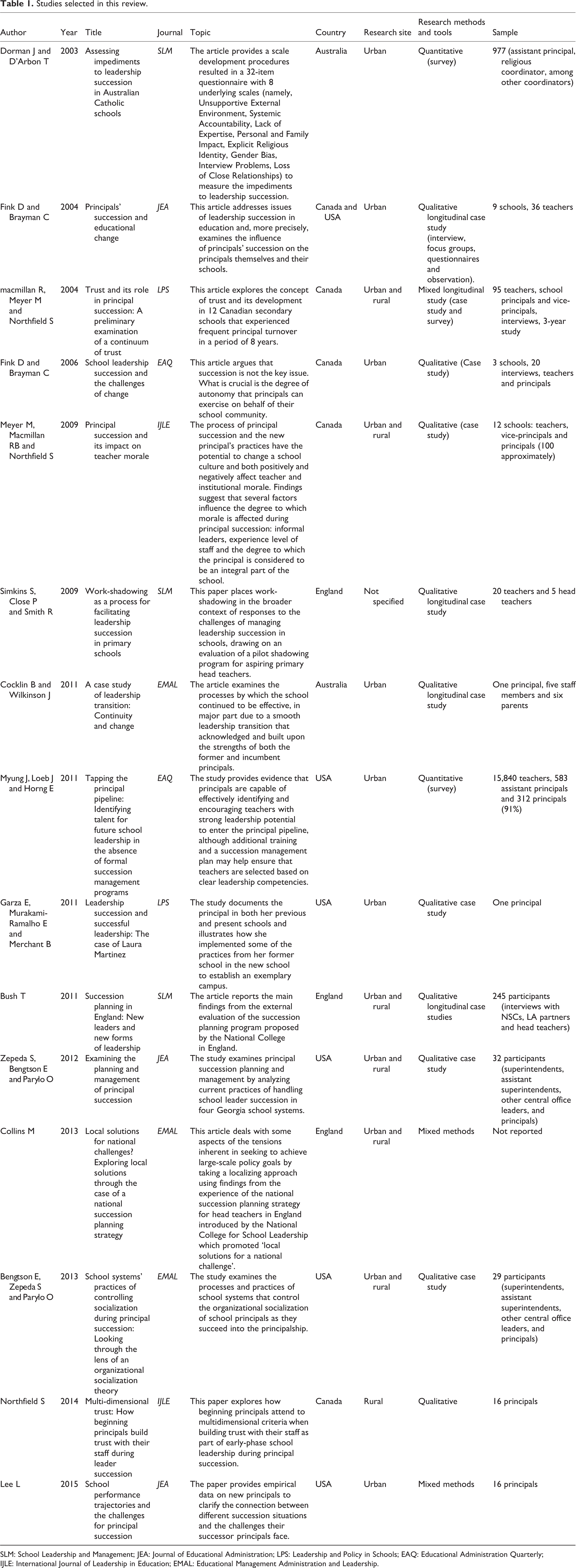
SLM: School Leadership and Management; JEA: Journal of Educational Administration; LPS: Leadership and Policy in Schools; EAQ: Educational Administration Quarterly; IJLE: International Journal of Leadership in Education; EMAL: Educational Management Administration and Leadership.
Geographic distribution
Based on the results of this literature review, principal succession in schools research presents evidence from only four countries – the United States (33.3%), Canada (26.6%), England (20%) and Australia (13.3%) – and only one cross-cultural study (Ontario and New York). As a result of the limited keyword term search to identify applicable data sources, there is no evidence from Arabic, Asian, Latin American, African and Eastern European societies. These are blank spots (Heck and Hallinger, 2005) in terms of geographical distribution of what we know about principal succession in schools. One of the possible reasons to explain why other parts of the world are under-represented in principal succession research in the eight core journals could be the ability to write academic papers to a high standard of English (Aravena and Hallinger, 2018). This situation could potentially be generated by limited English-language proficiency (Aravena and Hallinger, 2018). There is a need to know more about how principal succession occurs in different parts of the world, as well as the need to cross-culturally compare principal succession processes.
In terms of the research sites, most of the articles reported evidence from large urban districts (46.6%) and used evidence from both urban and rural school settings (40%). Only one study did not specify the research site (Cocklin and Wilkinson, 2011), and one author carried out his study in ‘small to large rural townships with relatively large geographic catchment areas and student busing’ (Northfield, 2014: 414). One article established differences between principal succession in urban and rural schools. For example, Zepeda et al. (2012: 144) indicated as a result that ‘while the large urban system in the study expressed a great sense of urgency for succession planning and management, the smaller rural systems expressed concerns for succession planning to a lesser degree’. However, this interesting finding was not observed in other studies as a significant difference between principal succession in urban or rural schools. Therefore, research evidence needs to be robust in the understanding of differences and similarities when the principal succession occurs in large urban settings or when it is in rural areas.
Topics in principal succession research
Based on the content analysis of the data sources of this study, four broad topics emerged: (a) factors affecting principal succession; (b) the dilemma between change and continuity; (c) the impact of principal succession on teachers; and (d) the evaluation of succession programs.
Factors affecting principal succession
A group of studies focused on factors that affect principal succession. Dorman and D’Arbon (2003) explored the impediments to leadership succession in Australian Catholic schools. In the Australian context, ensuring the supply of quality leaders is a high concern. The authors developed a useful instrument, ‘the Impediments to Leadership Succession Inventory’, to measure structural factors that affect the intention to move from a teacher’s role to the principalship. The instrument can be applied to three groups of respondents: ‘teachers who do not intend applying for a principalship, teachers who are unsure about applying for a principalship, and teachers who intend applying for a principalship’ (Dorman and D’Arbon, 2003: 26). The authors identified eight impediments for principal succession in Australian Catholic schools: (a) unsupportive external environment; (b) systemic accountability; (c) explicit religious identity; (d) lack of expertise; (e) personal and family impact; (f) gender bias; (g) interview problems; and (h) loss of close relationships (Dorman and D’Arbon, 2003: 33). Additionally, Lee (2015) indicated that another impediment for effective succession is the amount of available information about the school that the incomer principal receives from the system. Having limited information and knowledge about the school impedes principals in making adequate decisions. Thus, one of the first actions for new principals in transition is to gather information using existing networks (Lee, 2015). Macmillan et al. (2004) highlighted that during a principal succession, teachers appear to analyze everything that a new principal does. In this analytical process, teachers are observing social interactions and the principal’s behavior cautiously as the same principal observes teachers individually and collectively. This process of mutual understanding and acknowledging between principal and teachers is another critical factor during a principal succession (Lee, 2015; Northfield, 2014; Zepeda et al., 2012). Various studies stressed the external factor based on a wider school district context connected with the degree of planning and continuity of the succession (Bengtson et al., 2013; Fink and Brayman, 2004, 2006; Garza et al., 2011; Zepeda et al., 2012). If the succession is well planned and involves significant contact with and mentorship from the previous principal, the new principal will step into his/her new role having abundant information about the school, its staff, its students and parents and its community (Lee, 2015: 268). The research evidence is consistent in indicating that unplanned or poorly planned successions limit the improvement efforts and affects the new principal’s job (Lee, 2015).
The dilemma between change and stability
A group of studies framed principal succession in line with educational change theories (Bengtson et al., 2013; Cocklin and Wilkinson, 2011; Fink and Brayman, 2004, 2006; Garza et al., 2011; Zepeda et al., 2012). During a period of ‘frenetic change’ (Fink and Brayman, 2004: 447), leadership stability is threatened. A leadership transition changes (positive or negatively) the organizational school culture (Fink and Brayman, 2004), teacher morale (Meyer et al., 2009) and organizational and personal trust among the community (Macmillan et al., 2004). Principal succession in schools stresses the dilemma between change and stability. Facing this challenge implies focusing on principal succession planning and management practices (Bengtson et al., 2013; Lee, 2015; Zepeda et al., 2012). Ironically, in most cases principal succession is ‘unplanned, arbitrary and ethically questionable’ (Fink and Brayman, 2006: 83). The approach to preventing the detrimental effects of rapid changes of principal succession is planning and managing the arrival and departures of principals (Cocklin and Wilkinson, 2011; Fink and Brayman, 2004, 2006; Zepeda et al., 2012). Two case studies exemplified successful experiences in which principal succession as an organizational change was not perceived as an enemy of sustainability (Cocklin and Wilkinson, 2011; Garza et al., 2011). The research literature on principal succession highlighted the relevance of understanding the dilemma between change and sustainability. Factors such as building organizational capacity (Zepeda et al., 2012), planning and management practices (Fink and Brayman, 2004) and smooth leadership transition acknowledging the social capital of schools (Cocklin and Wilkinson, 2011) can contribute to increasing the possibilities for creating effective principal succession processes.
The impact of principal succession on teachers
Principal succession implies changes in terms of principal–teacher relationships. Two studies associated the impact of principal succession with trust between teachers and principals (Macmillan et al., 2004; Northfield, 2014). In schools in which principal succession is frequent,
the development of trust between principals and teachers can be described as a four-phase continuum that begins at the time of a principal’s entry. Perceived ability (knowledge, skills, competence and consistency), the degree to which interpersonal relations develop, and the rate of principal turnover influence whether trust between principals and teachers progresses along the continuum or becomes stalled. (Macmillan et al., 2004: 275)
However, this study did not identify the extent to which key factors such as school context, experience level of teachers or experience with succession affect trust. Following the same framework of Macmillan et al. (2004), Northfield (2014) concluded that trust for new principals is an intentional goal within their own organizations. Therefore, principals are aware that their interpersonal skills that demonstrate care, character and integrity affect the strength of trust earned by the principal. Meyer et al. (2009) added that principal succession also affects teacher morale, especially when this process is rapid. Three main factors affect teacher morale when a principal succession process occurs: (a) informal leadership; (b) experience level of staff; and (c) marginalization of the principal. Teacher cynicism is stated as another influence on the success of a principal succession (Fink and Brayman, 2006). Staff cynicism increases when succession is accelerated and frequent, and this also increases change resistance (Fink and Brayman, 2006; Lee, 2015). However, these consequences of principal mobility are not reported in depth. Overall, these studies highlighted the relevance of studying principal succession not only from the top down, but also from the bottom up, considering the teacher voice.
Evaluation of succession program
Several studies evaluated a succession program in the English context (Bush, 2011; Collins, 2013; Simkins et al., 2009). These three studies evaluated a program implemented by the National College for School Leadership. Bush (2011) concluded that the succession program implemented in England between 2007 and 2009 was successful in appointing school principals. This successful measure is explained by several factors: (a) a systemic perspective; (b) effective recruitment; (c) leadership development; and (d) new models of leadership (e.g. federations, co-headship and executive headship). Collins (2013) reinforced this idea because the succession program encourages local solutions to address the issue of principal succession. However, local solutions are not the ‘magic formula’, because they can bring multiple local problems. To avoid this, a common understanding of principal succession is key (Bush, 2011; Collins, 2013). In the same line of the previously mentioned studies, Simkins et al. (2009) evaluated a program titled ‘Tomorrow’s Leaders Today’ as another initiative of the National College for School Leadership. The authors suggested work-shadowing as a meaningful learning strategy to promote self-reflection of the participants. Four types of shadowing were presented: (a) pure shadowing; (b) shadowing plus in-depth discussion; (c) understanding the role; and (d) investigating a personal issue. The participants involved in the program felt that these work-shadowing experiences were successful in terms of addressing concerns about leadership transition (Simkins et al., 2009).
Research methods
A high concentration of qualitative research (62.5%) is observed in the principal succession literature (Bengtson et al., 2013; Bush, 2011; Cocklin and Wilkinson, 2011; Fink and Brayman, 2004, 2006; Garza et al., 2011; Meyer et al., 2009; Northfield, 2014; Simkins et al., 2009; Zepeda et al., 2012). All these types of research employed the case-study approach, developing interview protocols (individual and group). The number of case studies analyzed varied from 1 to 12 (principals, schools or systems). Most of the findings were analyzed using emergent coding (56.25%). Quantitative research and mixed-methods research are equal in terms of volume in the principal succession literature (18.25%). Quantitative research used surveys and sophisticated statistical analysis such as Cox proportional hazard models and regression models (Dorman and D’Arbon, 2003; Myung et al., 2011). The samples used within this set of research studies varied from 977 to 15,840 participants. Studies using mixed-methods research combined individual interviews with surveys (Collins, 2013; Lee, 2015; Macmillan et al., 2004). However, these studies used less sophisticated quantitative research methods (e.g. descriptive statistical).
The existing principal research literature showed an effort to carry out longitudinal studies (Bush, 2011; Cocklin and Wilkinson, 2011; Fink and Brayman, 2004, 2006; Macmillan et al., 2004; Simkins et al., 2009). These five studies stressed the relevance of exploring principal succession from a long-term perspective rather than an episodic one. Additionally, there is a lack of presence of other stakeholders such as parents (Cocklin and Wilkinson, 2011) or students.
Discussion
This study aimed to review the research literature from 2003 to 2019 on principal succession in the eight core journals of leadership in education. Based on the results, it is clear that our understanding of principal succession in K-12 schools is limited. This is because the volume of research focusing on principal succession within schools is sparse. Additionally, the empirical evidence in the eight core leadership journals is based on only four countries (Australia, England, United States and Canada). Regarding these countries, it seems that local solutions rather than national strategies are taken to address the leadership movements within schools. England, through the National College, responded to this problem by initiating a succession planning program (Bush, 2011). This initiative represents an important effort to adopt a strategic and national approach to succession planning. The National College developed a comprehensive guide, including key themes for school governors (e.g. selecting the right leader, providing induction and exploring co-headships and federations). A national strategy with a clear policy framework and general guidelines to ensure effective principal successions is positive; however, this does not mean imposing a centrally determined model (Bush, 2011). In contrast, it is important to recognize regional and local responses to address principal succession because this process is highly sensitive to the context in which the transition occurs.
A broad response in these countries (for example in England, the United States and Canada) to ensure and effectively support the arrival of a new principal has been developing leadership support programs for new appointees to principal positions. Zepeda et al. (2012) indicated specifically that mentoring programs are associated with effective successions. Connecting the effects of mentoring on principal succession is relevant to understanding how principals socialize and build their own role identity. This challenges the educational system to design a mentoring program that adopts a ‘personalized’ approach, supporting the learning needs of the arrival principals (Bush, 2011). Studies are consistent in concluding that mentoring programs reduce the potential negative impacts of principal succession (Bush, 2011; Lee, 2015; Zepeda et al., 2012). In sum, the principal succession research evidence from other countries is still an invisible terrain that constrains the possibility of constructing a global base knowledge (Hallinger and Kovačević, 2019). Therefore, it is fully understandable that findings reported in the existing research literature largely fail to understand cultural and social differences that influence the quality and frequency of principal succession. Future research from other countries outside the western world is needed on principal succession in schools.
In terms of research methods, qualitative research is predominant in the principal succession literature. This is interesting because qualitative evidence provides stories and examples of how principal succession looks in specific contexts. However, as our understanding of principal succession in schools is relatively weak, it is important also to carry out quantitative studies to reveal in a broad sense with large samples the main trends on this topic. As Snodgrass (2018: 45) stated, ‘the first, and most basic step to improve our understanding of a topic is to replicate existing studies’. Following this idea, it will be helpful, for example, to replicate the survey developed by Dorman and D’Arbon (2003) to measure the impediments to leadership succession to compare with the Australian results. Additionally, it would be helpful to carry out longitudinal studies to evidence both the immediate and long-term effects of principal succession, especially in terms of teaching performance and academic results. Clearly, longitudinal studies are especially necessary because principal succession is consistently viewed as a process and not merely as an isolated event that occurs in schools.
From the content analysis of the articles reviewed, four main topics emerged: (a) factors affecting principal succession; (b) the dilemma between change and continuity; (c) the impact of principal succession on teachers; and (d) evaluations of succession programs. Based on these topics, studies are consistent in viewing principal succession as a process of change and continuity in which a wide range of internal and external factors affect the quality of the process, especially in terms of how the relationship between incoming principals and the existing teacher culture is changed. There is a clear tendency to report successful cases of principal succession to exhibit that it is necessary to focus on this process to reduce the negative impact on short- and long-term improvement efforts. Also, there is a consensus that a more planned succession is key to facing the challenges of the arrival of a new principal (Bengtson et al., 2013; Cocklin and Wilkinson, 2011; Fink and Brayman, 2004, 2006; Garza et al., 2011; Lee, 2015; Meyer et al., 2009; Northfield, 2014; Zepeda et al., 2012). This is because the nature of how the succession is produced is causally related to the potential challenges that a principal might experience (Lee, 2015).
Based on existing studies, some further lines of research can be drawn, including a broad range of other geographical locations and school types. First, the relationship between principal succession and emotions has not been extensively investigated. Given the nature of principal succession as an organizational change, it is likely that this also provokes emotional changes within school members. As Hargraves et al. (2003) stated, principal succession is rarely treated with indifference; in fact, a wide range of positive or negative emotions can emerge during this process. Similarly, Cocklin and Wilkinson (2011) argued that ‘school staff sit at the forefront of the leadership succession, an experience which might bring about a range of mixed emotions, of expectation, apprehension, relief and fear, among others’ (666). However, it is not clearly stated what types of emotions are expressed, nor how, and in which situations they are mixed. Most of the studies approached principal succession from a rational perspective rather than an emotional one. Studies framing principal succession from an emotional perspective might stress the idea that this process is not merely technical, and therefore it cannot be solved easily through simple technical acts in schools (Dorman and D’Arbon, 2003). Research focusing on how principals and teachers emotionally experience principal succession is relevant to understanding and supporting the changes produced when a new principal arrives.
Second, a growing interest in analyzing leadership from gender theories is an international trend. However, the association between gender and principal succession in schools is limited. For example, Cockline and Wilkonson’s (2011) research, based on the case of Ken (male principal), and Garza et al.’s (2011) study, exploring the case of Laura (female principal), reported on how these leaders defined their leadership style and agenda during an effective succession process. Ken adopted a more informal and a closer way to approach teachers, students and parents, which the authors described as ‘walking and talking with everyone’; meanwhile, Laura was very resilient and had a strong sense of self-efficacy during the whole transition process. However, there is no clear connection between a principal’s actions and their gender. These findings should be expanded and enriched if a correlation to gender theories is to be made.
Third, more studies are necessary to report the effects on teacher performance when principal succession occurs. There is no clear evidence about what factors affect teacher performance during principal succession. Addressing this topic is crucial for understanding long-term school performance trajectories because teacher performance is critical for school improvement. Most of the studies have reported that one of the most visible effects is the change on principal–teacher relationships; however, this is not directly expressed in terms of professional performance. For both the incoming principal and the teachers, leadership succession is a vulnerable chapter in the school system. There is a lack of research that has examined to what extent principal succession brings vulnerability to teaching practices; for example, examining whether there is any modification in terms of planning learning activities or in how teachers collaborate.
Finally, ‘principals are facing issues for which they were not trained and with which they have no experience’ (Fink and Brayman, 2004: 445). Following this idea, school systems are facing issues connected with rapid and repeated principal succession processes for which they were not designed and have not previously been used. In this context, providing guidelines for school systems to endure the challenge of principal succession to sustain improvements in schools is key. This is urgent because it seems that most principal successions in schools are still problematic and unplanned (Fink and Brayman, 2006).
Limitations
Despite the fact that this study followed an acknowledged methodology, several limitations can be drawn. First, this review considered only the eight core journals in educational leadership. Therefore, the database was limited and did not necessarily include every academic paper relevant to the topic of principal succession. It is likely that the decision to use a select set of resources narrowed the results of this review. In contrast, this ensures academic quality because the selected journals use high standards of review (peer review). Second, the eight core journals accept manuscripts only in English. This prevents the inclusion of other studies reporting results from non-English-speaking countries (Aravena and Hallinger, 2018; Hallinger and Hammad, 2017). Future literature reviews that collect data sources in other languages might address this limitation. Connected with these limitations, a third limitation is linked with the type of publication. Solely peer-reviewed articles were included in the database. Future research reviews need to incorporate findings from other types of publications. However, within these limitations, our review found that the volume of evidence on principal succession in K-12 schools needs to grow. Given the increasing trend for principal movements across the school system, it is urgent to undertake more research about principal succession. Otherwise, the association between principal succession and school failure, problems and crises will be maintained.
Footnotes
Declaration of conflicting interests
The author declared no potential conflicts of interest with respect to the research, authorship, and/or publication of this article.
Funding
This research received no specific grant from any funding agency in the public, commercial or not-for-profit sectors.
