




Abstract
Long central to the exercise of sovereignty and symbolic power, border surveillance and policing are not only being amplified in the name of crime control and counter-terrorism, but exist as mass-mediated sources of fascination and entertainment. Interrogating Border Security: Australia’s Front Line as an example of the emergent genre of border-based reality television, this article examines the program’s cultural meanings and political functions. Through media spectacles that construct government authorities as heroic defenders protecting the nation from an array of external threats and fearful others, the program: legitimates state agendas; addresses anxieties associated with neoliberal globalization; and enrolls citizens as co-producers of national security. Accordingly, beyond representing, the program constitutes and prefigures the ‘reality’ of border enforcement, rendering it inevitable, necessary, and desirable.
Introduction
Upon airing on the Seven Network in 2004, Border Security: Australia’s Front Line (BSAFL) has garnered consistently high ratings, at times being Australia’s most watched program. Now on its 14th season, BSAFL has been broadcast in numerous countries, inspired multiple spin-offs, and established border enforcement as an emergent field of reality television. 1 Embedded ‘behind-the-scenes’ with customs, immigration, and quarantine officers, the program’s crew ostensibly provides authentic and unscripted portrayals of border surveillance and policing, filming authorities’ daily activities as they detect and expose violators of immigration and customs law. As the first of its kind, BSAFL reveals that, alongside their physical intensification, gatekeeping and border security are being experienced through mass-mediated spectacles transgressing boundaries of information and entertainment, documentary and drama. Just as the ‘wars’ on crime and drugs beget reality-based crime programming (COPS, America’s Most Wanted, Crimewatch UK; Cavender and Fishman, 1998), in the post-9/11 context the genre now encompasses border enforcement and national security, transforming the latter into seductive sources of amusement, fascination, and desire.
Based on a content analysis of fifty episodes from BSAFL’s first eight seasons, the following interrogates their cultural meanings and political functions. Demonstrating how the show mobilizes fears of invading and harmful others that are readily exaggerated, commodified, and consumed, it suggests BSAFL represents a cultural text that is constitutive and performative. By framing the border through idioms of risk and insecurity and exploiting the drama of the ‘front line’, the program amplifies public anxieties, inculcates citizens in the logics and practices of policing, and naturalizes borders and their enforcement as sources of order, stability and coherence, all of which complement the exigencies of the neoliberal ‘safety state’ (Lyon, 2007). Accordingly, alongside detailing BSAFL’s history and content, the following assesses its implications for understandings of sovereignty, surveillance, and securitization within late-modern societies.
After discussing the socio-structural context underpinning BSAFL, this article analyzes its consequences as a cultural artifact and tool of sovereignty. In particular, the show’s selection and portrayal of events coheres with official narratives, reproducing a clear-cut framework of vulnerability in which unregulated mobility presents a security risk and government authorities safeguard the nation against external threats. Because BSAFL’s contents are positioned as objective and unfiltered, audiences are more likely to accept their truth claims as factual, disinterested, and non-ideological. Before providing a brief summary and conclusion, the program’s status as a technique of governmentality is discussed. Characteristic of ‘plural’ (Loader, 2000; cf. Garland, 2001) forms of policing, BSAFL represents a partnership between the state, media, and public. Reflecting neoliberal priorities, security spectacles are constructed to generate profits and consumption while advancing governmental imperatives, whether reproducing territorial sovereignty, maintaining internal order and external protection, subject-making and the articulation of collective identity, or enrolling citizens in risk management and securitization.
Border enforcement in times of insecurity
BSAFL’s power and symbolic currency is characteristic of neoliberal globalization’s dislocating features and their attendant consequences for social order, political regulation, and popular orientations to crime, disorder, and insecurity. Under such conditions borders provide condensations of anxiety and desire, features readily exemplified in BSAFL.
While a comprehensive assessment exceeds this paper’s ambit, three trends inform the program’s emergence. Typified in ‘space-shrinking’ technologies and transnational networks of production and consumption, capitalism has entered a global phase of flexible accumulation (Boltanski and Ciapello, 2005). Additionally, to promote flexibility, efficiency, and competitiveness, developed countries have disembedded the market from society, dismantled Keynesian institutional arrangements, and embraced neoliberal doctrines. Reflecting the marketization of politics and social relations, such developments entail privatization, social retrenchment, and the promotion of a “market-based sociality that valorizes entrepreneurialism and self-sufficiency” (Walsh, 2014a: 281).
Finally, the disruptiveness of late-modernity, whether the blurring of sociocultural boundaries, pervasive economic insecurity, or the removal of safety nets, has heightened public anxiety, with many perceiving their values, safety, and ‘way of life’ slipping away (Reiner, 2007). To retain legitimacy, state authorities have routinely mobilized stable moral referents (god, legality, family, country, etc.) and dangerous and undeserving ‘others’ (welfare recipients, criminals, minorities, etc.), dynamics producing intensified social exclusion, moral discipline, and a punitive ‘culture of control’ (Garland, 2001; cf. Wacquant, 2009). In diverting attention from structural transformation, crystallizing popular fears, and providing an outlet for addressing collective disenchantment, the construction and policing of popular scapegoats functions to restore feelings of order and solidarity, thereby ‘evad[ing] more intractable and unwelcome problems’ (Scheingold, 1995: 165; cf. Sparks, 1992).
Borders represent privileged sites in these processes. In disrupting social boundaries and the presumed isomorphism between place, people, and culture, mobility represents a perennial source of insecurity, with foreigners, strangers and outsiders often approached with suspicion and hostility (Honig, 2009). Such observations are particularly salient at present. While capitalist restructuring requires transnational flows of information, capital, tourists, and key personnel, travellers deemed suspect and unauthorized are increasingly approached as sources of danger, risk, and ‘unease’, whether in relation to health and disease, economic stability, social well-being, national identity, or crime and, increasingly, terrorism (Bigo, 2002; cf. Aas, 2007). Their vilification stems, in part, from displaced popular anxiety. During punctuated moments of social transformation ‘differences between … “inside/outside”, and “us/them”’ assume renewed significance as ‘structuring feature[s] of social relations and culture’ (Loader and Sparks, 2002: 104). As such, public disquiet routinely attaches itself to migrants’ concrete encroachment on state sovereignty and territoriality, transforming borders into screens on which popular fears are projected, and desires for stability, certitude, and security performed (McNevin, 2007). In these regards, border militarization and the criminalization of migration provide palliatives for uncertainties stemming from globalization and the unsettling of horizons (Brown, 2010).
Torn between the antimonies of ‘economic transnationalism and securitized nationalism’ (Sparke, 2006 153), states have loosened borders to facilitate desired mobilities, while devoting unrivaled energy and resources to policing movements designated undesirable. Underpinning this ‘mobility regime’ are sophisticated technologies of surveillance and social sorting oriented towards separating safe from risky, and deserving from undeserving (Shamir, 2005). For privileged travellers (tourists, nomadic professionals, etc.) borders provide entryways in which surveillance is ‘thin’. For asylum seekers, irregular migrants, and other unwanted arrivals surveillance is ‘thick’, exclusionary, and expulsive (Torpey, 2007).
Such processes are distinctly visible in Australia. While always displaying a ‘paranoid’ relationship with foreigners (Hage, 2003), by the mid-1990s a popular turn against migrants, particularly those of non-European origin, was apparent. Citing their effects on employment, the welfare state, and national identity, public antipathy was linked to the dissolution of the ‘Australian settlement’ – a foundational set of regulatory arrangements involving commitments to full employment, social security, class abatement, consensual capital-labor relations, and white hegemony (Kelly, 2008). To address resentment and balance the demands of ‘(global) accumulation and (national) legitimation’ (Barrow, 2005 125), John Howard’s newly-elected Liberal government vigorously promoted economic restructuring, while intensifying border enforcement to authoritatively control ‘who comes to this country and the circumstances in which they come’ (Brett, 2003: 208). Ultimately, immigration control provided a critical dimension in the politics of consent and was designed to re-instill common distinctions, values, and a sense of territorialized nationhood; reassuring citizens that the interests of ‘mainstream Australia’ were promoted (Walsh, 2014a).
Most significant in these trends was the government’s response to unauthorized asylum seekers or ‘boat people’. The issue entered public consciousness in August 2001 when the Tampa, a Norwegian freighter that had rescued asylum seekers from their sinking vessel, was refused entry. More than denying refuge, Howard utilized the incident to: exploit existing fears about foreigners and attenuated sovereignty; secure electoral advantage; and justify a constellation of draconian measures representing the harshest approach to asylum seekers in the developed world (Welch, 2011). Consequently, Australia’s borders were transformed into ‘defensible space’ and the dangers and punitive consequences of unauthorized entry were escalated to deter and incapacitate offenders. Officially labeled the Pacific Solution, Howard’s approach entailed: mandatory detention in remote desert camps and offshore processing centers; increased powers of deportation and naval interdiction; the enlistment of military personnel in maritime surveillance; the excision of several islands from Australia’s ‘migration zone’; and restrictions on judicial intervention (Burke, 2007). Reflecting developments in the United States and Europe, enforcement reflected a ‘severity revolution’ (Simon, 2007) defined by unchecked sovereign power and the suspension of ‘normal politics’ in which considerations of justice were subordinated to demands for administrative efficiency (Loader, 2002).
Underpinning these changes was the tightening of the migration/security nexus. While media and government discourse initially framed asylum seekers as bogus, fraudulent, and undermining sovereignty, following 9/11 and the 2002 Bali bombings, more than undeserving, they were constructed as dangerous and threatening. ‘Boat people’, particularly Muslims from Iraq, Iran, and Afghanistan, were cast as ‘invaders’, ‘hijackers’, and ‘criminals’, with government ministers asserting an ‘undeniable link’ to transnational terrorism (Klocker and Dunn, 2003: 71). The electorate readily accepted such associations, and Howard’s approach has endured despite no asylum seekers being assessed as actual security risks. 2
The diffusion of such narratives hinged on the state’s monopolization and distortion of media representations, a tradition BSAFL is subtly implicated in. Under the Pacific Solution journalists were denied access to asylum seekers; authorities responsible for them were given ‘no communication orders’; and government officials were instructed to refrain from humanizing them in media commentary, arrangements rendering the public reliant on official accounts of events (Watson, 2009: 102–3). Moreover, in the days preceding the 2001 election, Howard accused intercepted asylum seekers of throwing their children overboard in an effort to pressure Australian naval patrols to bring them onshore. Later discovered to be fabricated, such portrayals heightened public animus, further bolstering support for official policy. In constructing ‘boat people’ as inimical, ineffable, and monstrous others, official discourse sought to demarcate and align national and moral boundaries, ensuring the meaning and value of Australian citizenship and identity hinged on the alienation and insecurity of others (Burke, 2007).
Securing the front line
These variegated developments coalesce in one particular cultural artifact: Border Security: Australia’s Front Line. As a ‘docusoap’ fusing the observational qualities of cinema verite with the suspense of a crime drama, the program’s popularity highlights the border’s symbolic significance, and, like other reality-based crime programs, reflects emerging cultures of visibility and insecurity. On the one hand, BSAFL reflects the rise of a scopic ‘viewer society’ defined by the seductiveness of the gaze (Mathiesen, 1997). Described as ‘fly-on-the-wall entertainment’ (McEachen, 2004) that exposes authorities’ ‘backstage’ behavior, BSAFL encourages viewers to engage with powers of seeing, and official surveillance – the coordinated watching of others for regulatory purposes – provides voyeuristic pleasure associated with ‘see[ing] that which was meant to remain unseen’ (Dovey, 1996: 127). Moreover, BSAFL assembles an economy of anxiety representative of more deep-seated concerns, whether material insecurity, ethnoracial difference, or crime, disorder, and terrorism, leading critics to label it a ‘barometer of the times’ reflecting an increasingly ‘cautious and xenophobic Australia’ (Kalina, 2006) in a ‘post-9/11, post-Tampa World’ (McEachen, 2004).
To fully comprehend BSAFL’s sociopolitical effects, it is necessary to assess its contents and representational style. The program’s central elements are the detection and neutralization of threats to Australia’s territorial sovereignty, and physical, biological, and economic security. Episodes display an interwoven narrative structure and are organized around three to four segments, which involve, among others, officers examining travellers at the country’s airports; mail inspectors screening international parcels for illicit objects; naval patrols intercepting illegal fishermen and asylum seekers; and immigration agents pursuing unauthorized workers within the country’s interior. Each segment concludes with a dramatic dénouement, which, for unauthorized residents and travellers, involves punitive spectacles of arrest and expulsion. Such portrayals invite viewers to be a silent witness and partner as state officials profile and differentiate travellers and objects according to their anticipated risk and value. As characterized in promotional material, BSAFL depicts authorities’ efforts to ‘separate the honest mistakes…[of] innocent holidaymakers’ from the ‘sinister deeds of criminals’. Moreover, authorities explain techniques of detection, informing viewers of the ‘microphysics’ of surveillance and the institutions, technologies, and procedures implicated in its effectuation. As depicted, securitization combines the ‘anatomo-politics of the body’ with the ‘bio-political regulation of populations’ (Foucault, 1990): travellers’ bodies, affective states, and personal (luggage and belongings) and institutional (passports, visas, boarding passes) artifacts are surveyed and deconstructed to preserve the vitality of ‘massified’ entities whether economies, territories, or populations (Foucault, 2003).
BSAFL’s primary source of action and suspense is produced when officers develop suspicions about travellers and objects and attempt to expose the dangers or secrets they are concealing. Contributing to BSAFL’s drama are tactics of dissimulation, dynamics positioning the border as a deceptive landscape devoid of trust. Vignettes include, among others, agents: discovering drugs concealed in luggage, passenger’s bodies, and everyday items (photo albums, cans of soup, etc.); identifying ‘bogus’ tourists and forged identity documents; and revealing hidden compartments in unauthorized fishing vessels. Reflecting such conditions, BSAFL instructs viewers in the processes and cues implicated in risk assessment. For illicit objects – drugs, weapons, undeclared currency, invasive species and biological risks, forged identity documents, and counterfeit goods – several detection techniques, whether sniffer dogs, X-ray and ultrasound machines, expert document examiners, or atomizers and ion scanners, are employed. To gauge their authenticity, travellers must undergo ‘confessionals’ (Salter, 2007) and answer several by-the-book questions – why are they in Australia, what are they bringing with them, where they are staying, what are their travel plans? In addition to providing inadequate responses, markers of nefarious intent include flying last-minute, travelling light or without proper funds, possessing a ticket purchased by someone else, and failing to display deference towards authorities. Individuals’ behaviors and micro-expressions are also assessed to identify physiological signs of nervousness, anxiety, and deceit. As the narrator notes, ‘Officers get a lot of information just from physical appearance’, and, when explaining the profiling of an unauthorized Romanian traveller, an immigration agent observers: ‘He did a couple of eye flicks. He’s very dry-mouthed. He’s sitting very tensely, very upright. He is very nervous.’ Accordingly, authorities approach travellers’ bodies in their primal form as repositories of affective states that, if properly read and categorized, reveal passengers’ inner thoughts and true intentions (Adey, 2008).
The ‘reality’ of Border Security
While resting on claims of immediacy, authenticity, and privileged access to the ‘real’, like other reality-based programs, rather than indexical portrayals of ‘exactly what’s happening’ (Price and Nethery, 2012: 152), BSAFL imparts a highly selective vision of border enforcement. While its producers claim ‘we can’t tamper with these stories: they tell themselves’ (Meade, 2006), they also note that BSAFL employs dramatic devices and ‘story-telling technique[s] for the audience’(Price and Nethery, 2012: 152). Specifically, the program alters representations of its subject matter according to the institutional demands of the media and government authorities.
To create captivating narratives and ‘edge-of-the-seat’ television (Kalina, 2006), footage is edited to provide engaging, action-packed sequences and concise, unambiguous storylines. With the assistance of commentary from officers and voiceover narration, BSAFL draws on familiar themes and idioms (‘goodies-versus-baddies’; cops-and-robbers, ‘the anatomy of a lie’, etc.), to establish coherence from what would otherwise be an indecipherable mélange of images. Moreover, the Seven Network’s access to authorities hinges on the government’s power to veto footage it does not want aired. Customs and Border Protection provides senior media officers to chaperone camera crews, and completed episodes are screened for content control (Shipping Australia, 2011). While protecting sensitive information concerning operational and intelligence-gathering procedures, these arrangements allow authorities to control the televised depiction of themselves, thereby compromising BSAFL’s informational and investigative qualities, and rendering it a safe haven where authorities will neither be scrutinized nor challenged.
Reflecting these constraints, BSAFL delivers recurrent, predictable formats which include heroes to identify with, villains to fear, and tidy storylines with clear resolutions. Accordingly, its depiction of ‘reality’: avoids controversy; ensures certain meanings and interpretations predominate; and reinforces the existing order of things. Such features are witnessed on two levels. First, BSAFL amplifies threats to the nation, reinforcing understandings of borders as vulnerable spaces critical to the nation’s safety. Additionally, it creates folk heroes and folk devils for public consumption, valorizing and privileging authorities’ perspectives, while dehumanizing and essentializing offenders. As such, BSAFL represents a dramatized and ‘well-directed social production’ (Young, 1991: 4) in which spectacles of securitization naturalize border enforcement, while promoting it as a source of entertainment and pleasure.
Constructing Insecurity: The Inflation of Border Threats
As its name suggests, BSAFL presents itself as documenting a dangerous and ongoing struggle along the border and other ‘areas of national security’(Fidgeon, 2004). The metaphor of the ‘front line’ is intentional, channeling idioms of warfare and social defense and implying the ever-present possibility of cataclysmic events. Such tropes are exemplified in the opening credits which feature an image of Australia in a set of crosshairs with ‘target’ superimposed on it, positing the existence of cunning, persistent, and shadowy enemies and ‘a world that…sees menace’ (Middendorp, 2006). While authorities are portrayed as efficient and effective, such imagery communicates the need for constant vigilance, reminding viewers that threats are legion and will resurface next week.
The continuum of threats officials face range from ecological destruction to terrorism. While BSAFL often centers on quotidian forms of screening (inspecting food or confiscating pocket knives and undeclared currency), BSAFL reminds viewers that, in an era of ubiquitous and ineffable risk, where civilians double as combatants and unremarkable objects (box cutters, shoes, backpacks, the mail, etc.) can produce unspeakable destruction, such practices assume added significance. As the narrator states in one episode, ‘the most innocent items can [often] be the most dangerous’. While never featured, BSAFL is replete with references to terrorism and viewers are continuously told of the destructive potential of seemingly mundane items. A bag of seeds could introduce pathogens and diseases with ‘catastrophic effects’; mosquitos on an Indonesian fishing vessel could carry malaria; snack foods containing poultry from China could introduce a ‘deadly strain’ of avian influenza, costing Australian agriculture billion of dollars. Additionally, in an episode featuring undeclared currency, a supervisory officer notes its potential connections to money laundering: ‘Money laundering is a global problem. Moving undeclared cash between countries can help organized crime and terror groups conceal the true source of their income.’ Ultimately, such depictions widen the frame of security (Buzan et al., 1998) as sovereignty and territorial integrity provide alibis for tethering disparate risks together within the common rubric of national security. Finally, like the news media’s depictions of crime, BSAFL conforms to the ‘law of opposites’ (Reiner, 2007: 36) where routine infractions are downplayed while more serious offenses are accentuated, arrangements leading viewers to perceive foreign threats as more numerous and menacing than they typically are. As conveyed in Table 1, drug smuggling, refusals of entry, and round-ups of unauthorized residents were significantly overrepresented, providing over half of the program’s suspected offenses verses seven percent of actual offenses recorded in 2012–13.
Suspected Offenses Featured on Border Security*.
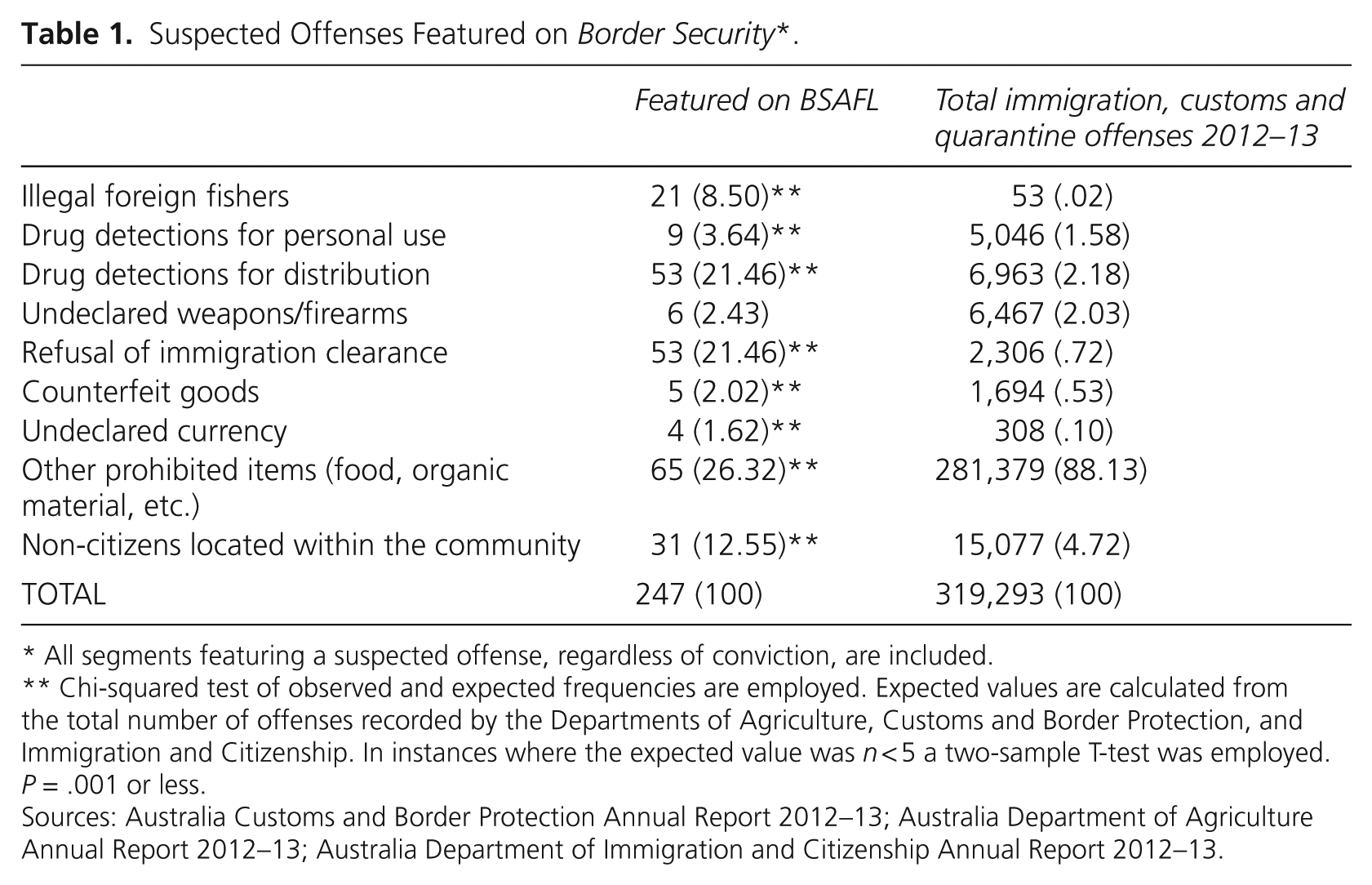
All segments featuring a suspected offense, regardless of conviction, are included.
Chi-squared test of observed and expected frequencies are employed. Expected values are calculated from the total number of offenses recorded by the Departments of Agriculture, Customs and Border Protection, and Immigration and Citizenship. In instances where the expected value was n < 5 a two-sample T-test was employed. P = .001 or less.
Sources: Australia Customs and Border Protection Annual Report 2012–13; Australia Department of Agriculture Annual Report 2012–13; Australia Department of Immigration and Citizenship Annual Report 2012–13.
More than selecting and framing events, BSAFL operates on an emotional level, suggesting how viewers should feel about particular characters and situations. Post-production editing, whether, among others, ominous music with driving rhythms, fast-motion video, or dramatic narration provide visual and aural stimulation and amplify BSAFL’s affective impact. To further create a ‘roller coaster of emotions’ (Price and Nethery, 2012: 152), segments build to a point of suspense, then break to a commercial or another segment before returning for the big reveal. Camerawork is also employed to produce drama. The crew frequently zooms in on passengers’ nervous faces, and, for travellers with criminal records, tattoos, piercings, and other physical stigmata. Fundamentally, when combined with inflated depictions of ‘security risks’, alarmist portrayals allow state agencies to visibly perform their role as guarantors of safety and normalcy, rendering BSAFL an important node in the wider constellation of practices that fetishize borders and the law as sources of order and ontological security.
Heroes and Villains: Border Security’s Characters
Another story-telling technique is characterization, as BSAFL presents clear protagonists and antagonists. Alongside minimizing ambiguity and maximizing entertainment value, by aligning particular characters with risk and danger, while portraying others as heroic defenders, the program establishes divisions between an in-group of respectable, law-abiding individuals and an out-group of undesirable others. In doing so it unites viewers in collective opprobrium, affirming their morality and identity as good, appropriate, and respectable (Jewkes, 2010; Sparks, 1992). Accordingly, beyond depicting the policing of spatial and legal boundaries, BSAFL articulates moral standards of worth, reinforcing dominant narratives in which it is natural that certain persons belong here and others there, and unregulated mobility is innately disruptive.
Protagonists
According to BSAFL’s creators its ‘real heroes’ (Meade, 2007) are government personnel who ‘patrol our airports and coastlines and protect our country from drug runners, illegal immigrants, potential terrorists, harmful pests, and disease’ (Price, 2006). Framed as legitimate and authoritative guardians, they are depicted as competent, rational, and overwhelmingly effective. BSAFL over-represents the number of crimes solved, while downplaying obstacles to border control, whether the sheer volume of cross-border flows or official corruption. 3 Such representations suggest authorities know the true reality of events and retain control over the chaos of the border. In the process officials are portrayed as folk heroes acting in ‘defense of normality, stability, and “our way of life”’ (Hall et al., 1978: 150), or, for one critic, ‘honest souls…defending our…values against those who might trample on them’ (Elder, 2006). Even in segments where individuals and objects placed under suspicion are later found to be legitimate and are granted entry, officers’ judgments are portrayed as warranted. 4 In two segments involving innocent travellers suspected of drug smuggling, for example, viewers are informed that chemicals in shampoo and cosmetics often produce false positives; and American currency is known to contain traces of cocaine.
BSAFL ensures that authorities occupy the subject position of its narratives in several ways. By highlighting the instruments and procedures through which threats are detected and addressed viewers are invited to identify with state officials and adopt their point of view. Additionally, like reality-based crime programming, BSAFL is obviously incapable of portraying agents’ actions when not being filmed, and, consequently, naturalizes authorities’ edited, on-camera behavior as their routine behavior (Doyle, 2003). When footage is used that is not filmed by BSAFL’s crews, it is always taken from agents’ equipment, whether X-rays, radar screens, or CCTV cameras, further reinforcing authorities’ perspectives.
BSAFL also places viewers in a personal relationship with authorities. Many agents appear across several episodes, and the first time an officer addresses the camera their name, official title, and agency affiliation are displayed. In certain instances biographical information is provided. Officers may reveal information about their family, length of employment, and perceptions of their job. Moreover, BSAFL allows viewers to accompany officers through various aspects of the latter’s everyday routines, making their interiority the show’s central focus. In several segments camaraderie is established as agents are shown joking with each other and certain travellers. In others, officers commiserate over troublesome individuals and situations. In the latter instance, after a suspected drug smuggler from South Africa refuses consent to an internal search, a customs agent tells the camera: I think it’s frustrating when the person keeps denying that he’s got something. You really do get the shits with it…[Y]ou think he’s telling me a lie…and he just keeps sticking with it. [We] think something different…we think he’s loaded.
Agents also express the pleasure and satisfaction derived from their work. Shown smiling in front of contraband about to be incinerated, a mail inspector proclaims: ‘This really challenges the myth of Customs officers losing the game.’ Referencing the thrill of identifying dangerous items, the same agent states, ‘You just look at these parcels…and wait for that one…that’s going to make your day. You know when you see it on the [X-ray] screen. It’s what brings me to work each day.’ Later, when cocaine is found concealed in a parcel, he declares: ‘Now I feel like a winner!’
Agents are also portrayed as compassionate and express a human side of their work, thereby establishing emotional depth and complexity lacking in other characters. One example involves officers giving an elderly Australian couple found carrying undeclared produce a warning after discovering it is their first time overseas and that they have been robbed while abroad. Agents also occasionally sympathize with offenders. In reference to a young Korean woman who is deported for not possessing sufficient funds, an immigration officer notes: ‘Sometimes you go home and you have a lot of sleepless nights. Did I make the right decision? What is her family going to say? Am I sending her back to poverty?…That’s a human being. You can’t avoid it.’
Finally, episodes are structured so authorities or the narrator are given the last word. While offenders are typically portrayed in a depersonalized fashion, in a handful of cases, BSAFL does provide more detailed treatments of certain travellers, giving them space to tell their stories. The example of Deborah, a British woman returning from New Zealand who, acting on the advice of a registered immigration attorney, has unknowingly violated the terms of her visa and is deported, is particularly instructive. As the segment unfolds it is revealed she has been working in Australia for two years and has a partner she intends to marry. Viewers are shown her partner, an Australian citizen, tearfully telling the camera how he was unable to see her before her deportation, and, later in the episode, Deborah offers a heartfelt plea to an Immigration officer: I have a partner here. I have a bank account…I’ve been a bit ignorant. I’ll put my hand up to that…But…this is a disgrace for me…I haven’t been [to the UK] for two years. I don’t even know where to stay when I go back…I’m no fucking drug smuggler, I’ve never broken any laws.
The trauma produced by her deportation and separation from her partner challenges claims of the border’s protective functions and the presumed benefits of harsh enforcement. By exposing the humanity of ‘others’ such situations open spaces of moral ambiguity as viewers are given the opportunity to sympathize with antagonists and question the extent external ‘threats’. While threatening to unsettle BSAFL’s entertainment value and overriding vision of enforcement, to maintain coherence content is edited so agents and the narrator are given the opportunity to provide concluding commentary, arrangements that maintain authorities’ subject position and provide a neat sense of closure. As noted above, while agents may acknowledge the difficult circumstances created by their decisions, they ultimately rationalize their actions. For Deborah, while officers express concern for her situation, in the final instance viewers are met with the refrain that ‘rules are rules’ and are told, “she’s been a bit naïve” and “knew she overstayed” and breached the conditions of her visa. In another episode viewers are instructed that, while the government’s procedures may appear harsh, they are done to ‘be fair to the Australian public and the Australian community’. Finally, such last words may reinforce official ideologies of law and order. A segment involving Oleh, a Ukrainian taxi-driver who is deported for working without authorization, closes with an officer telling the camera: The impression I got…is that he is very relieved. That he knows or has a clearer idea where his future will be heading, rather than a sense of apprehension or uncertainty…I know he’s missing his family. Its not unusual for a person to say… ‘I actually think I’d be better off in detention…than out of detention.’
Alongside offering closure this statement, and others like it, portray deportation as a benevolent act, while downplaying the role of the law and state practice in producing migrant ‘illegality’ as well as experiences of precarity, uncertainty, and ‘social death’ and abjection (Coutin, 2000; DeGenova, 2004).
Antagonists
The program’s antagonists are an ensemble of dangerous, impure, and unwanted travellers whose presence is presented as suspect and transgressive. Alongside irresponsible individuals, who are found transporting unauthorized goods (high-risk food, organic material, etc.) and depicted in more forgiving terms, are a surplus of archetypal others representative of broader social problems and anxieties, including dependency, identity theft, drug use, criminality, violence, and other antisocial behaviors.
BSAFL represents such characters very differently. While authorities’ perspectives and interiority are privileged, the program downplays the humanity of unauthorized travellers, by essentializing them as dangerous and pathological and neglecting their interpretation of events. Offenders are almost never allowed to address the camera directly and little context regarding their history and alleged crimes is provided. When contextual information is provided it is almost always a summary of past misdeeds, whether previous criminal offenses or violations of immigration and quarantine laws. Additionally, offenders often have their faces blurred to presumably conceal their identities and many can only communicate in broken English or through an interpreter, arrangements further dehumanizing them. Finally, antagonists are frequently portrayed as physically and morally impure and characterized in negative language. For example, referencing a Czech tourist who is deported for lacking sufficient funds, the narrator notes: ‘Thomas looks more like a tramp than a tourist. Here for ten days without so much as a change of clothes.’
Additionally, BSAFL makes no attempt to explain or understand criminal behavior. Despite its ostensible ethnographic approach, BSAFL is devoid of ‘thick description’ (Geertz, 1973). There is no discussion of the social origins of events or the world beyond the space of the border, arrangements neglecting the structural and historical conditions contextualizing social action. One prominent example is the program’s depiction of drug smuggling which, alongside quarantine violations, is the most common offense on BSAFL. Footage predominantly emphasizes the dangers of illicit substances, whether harming citizens or funding criminal and terrorist organizations, and fixes viewers’ gaze on methods of concealment, and techniques of identification, seizure and destruction. Specifically, such segments feature the ‘deconstruction’ of objects believed to contain narcotics, the extraction and chemical testing of suspect substances, and the collection and cataloging of evidence for the Australian Federal Police.
By highlighting the immediate problem at hand, BSAFL occludes the inequalities and social processes underpinning the production and circulation of illicit substances, thereby reducing criminal behavior to the irrational and pathological nature of individuals. The program never seriously assesses the backgrounds, circumstances, or motivations of drug couriers, and no effort is made to explain the factors prompting individuals to engage in such high-risk activity. Further, BSAFL’s depiction of ‘outlaw economies’ ignores the significance of local demand, as well as patterns of global inequality and integration derived, in part, from the economic policies of the Global North. In particular, cross-border markets in illicit substances embody the ethos of global capital, constituting ‘the most perfect [expression] of…unfettered principles of supply and demand’ (Comaroff and Comaroff, 2008: 5), and, much like legitimate economic sectors, are facilitated by trade liberalization, financial deregulation, and advances in transport and communications, ensuring they provide steady employment in impoverished regions. BSAFL also avoids broader questions concerning the human consequences and political and structural dimensions of legal enforcement. Research suggests that a central effect of border control and drug policy is to inflate prices for illegal goods and services (drugs, human traffickers, counterfeit documents) and create opportunities for mafia-esque criminal networks (Andreas, 2009). More than highlighting how ‘law and lawlessness….are conditions of each other’s possibility’ (Comaroff and Comaroff, 2008: 21), such outcomes underscore how criminalization may undermine official commitments to security. Since considering such issues would unsettle the program’s coherence and claims of the border’s protective role, their exclusion is unsurprising.
By decontextualizing antagonists’ behavior BSAFL provides conservative accounts of criminality, restricting the range of potential meanings in its narratives and implying punitive deterrent-based enforcement is the only effective response. Such depictions also comfort the audience and absolves their responsibility by constructing border crime and unauthorized migration as in no way linked to social inequality, blocked opportunities, or discrimination – factors society might bear responsibility for. The significance of these arrangements is profound. Research indicates that individuals adopt less punitive attitudes when possessing a ‘deeper knowledge’ of offenders’ past experiences and circumstances (Gillespie and McLaughlin, 2002).
Finally, depictions of antagonists and their surveillance by authorities reflect and intensify patterns of social exclusion and inequality. Specifically, BSAFL legitimates group-based profiling as suspicion and scrutiny target not only outsiders but those displaying shared social attributes. The frequency of suspects from low-income, non-Western countries suggests surveillance is highly selective and that visible markers of difference incite suspicion and register otherness and illegality. Since BSAFL never questions officers’ judgments, and successful enforcement is the norm, viewers are ultimately made to trust their suspicions, reinforcing associations between marginalized groups and criminality.
BSAFL does little to contest dominant imaginaries of the ‘immigration problem’ as a problem of racial difference. As conveyed in Tables 2 and 3, when compared to the actual demographic profile of travellers and authorities, BSAFL under-represents minorities as government officials, while over-representing offenders and those placed under suspicion as non-White, non-Australian, and non-English-speaking. Such depictions complement and reinforce the sentiments of many audience members. Market research indicates that viewers reporting greater enjoyment of BSAFL (white males of rural, working-class background) are more likely to harbor xenophobic sentiments (Elder, 2006). When coupled with similar portrayals in other media, constructions of lawbreakers as overwhelmingly persons of color reinforce the racialization of suspicion, encouraging forms of ‘prejudicial perception…racialized ways of looking and judging in the name of national security’ (Butler, 2006: 77).
Profile of Travellers Placed under Suspicion*.
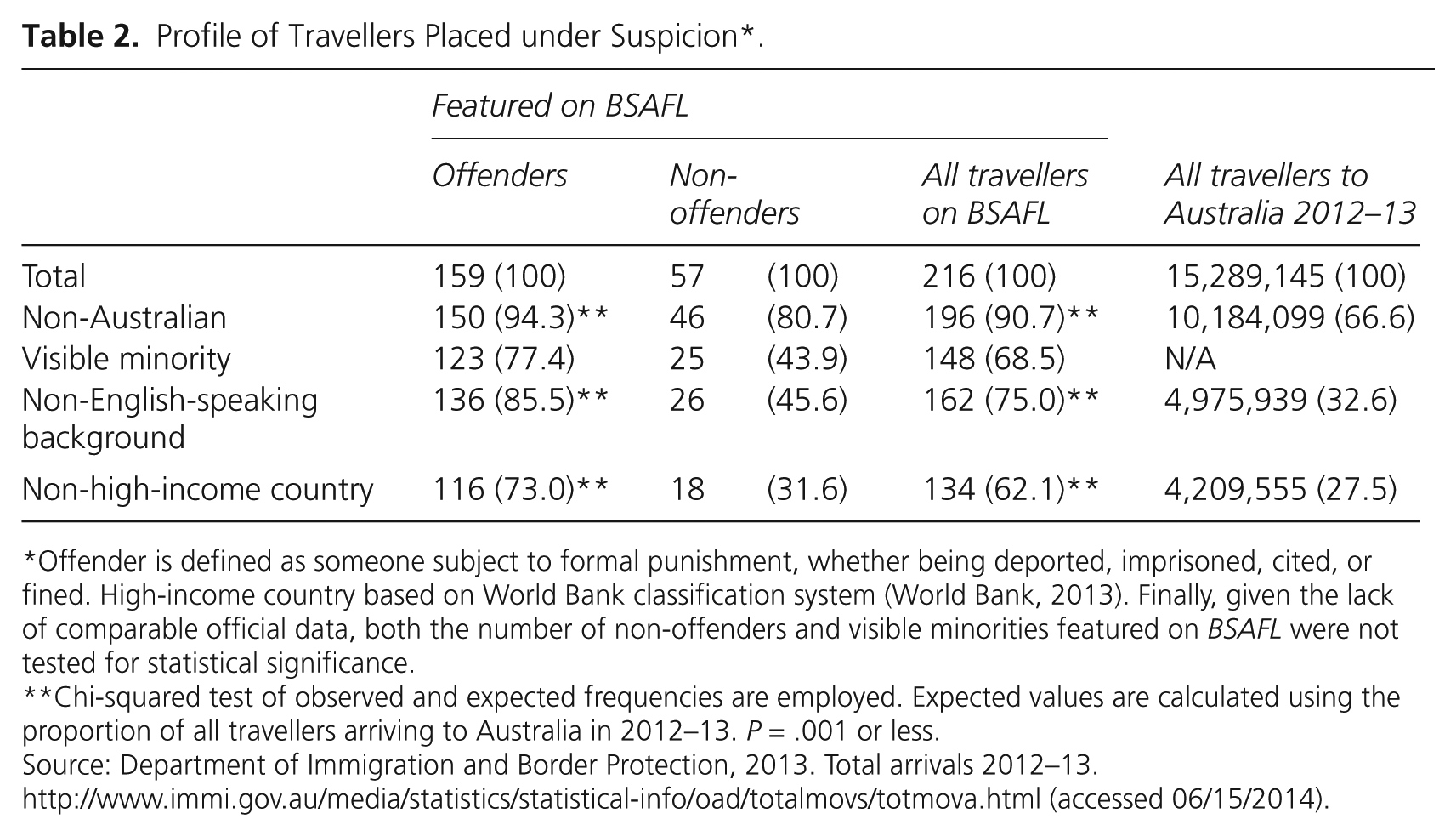
Offender is defined as someone subject to formal punishment, whether being deported, imprisoned, cited, or fined. High-income country based on World Bank classification system (World Bank, 2013). Finally, given the lack of comparable official data, both the number of non-offenders and visible minorities featured on BSAFL were not tested for statistical significance.
Chi-squared test of observed and expected frequencies are employed. Expected values are calculated using the proportion of all travellers arriving to Australia in 2012–13. P = .001 or less.
Source: Department of Immigration and Border Protection, 2013. Total arrivals 2012–13.
http://www.immi.gov.au/media/statistics/statistical-info/oad/totalmovs/totmova.html (accessed 06/15/2014).
Profile of Authorities.

Authorities appearing across more than one segment were counted for each vignette they appeared in.
Data from Customs and Border Protection is based on the proportion of the workforce of non-English Speaking Background.
Chi-squared test of observed and expected frequencies are employed. Expected values are calculated using the proportion of visible minorities within the staff of Customs and Border Protection in 2011. P = .001 or less.
Source: ACBPS 2011. Annual Report 2010–11. ACBPS: Canberra.
BSAFL also highlights how border enforcement embodies determinations of worthiness in the context of global consumer-based capitalism (Weber and Bowling, 2008). Demonstrating how capacities of consumption are translated into license to enter, those arriving from low-income countries or travelling with few possessions and without sufficient funds or other signs of affluence are subject to intensive surveillance (see Table 2). In the case of a South African tourist later revealed to be smuggling cocaine, the interrogating officer explains why he was initially scrutinized: ‘He had a bag…[that] a businessman would carry. Just looking at him through his appearance, he looks quite shabby and is trying to appear as a business type traveller.’ Even in instances where no laws have been broken, such individuals are framed as prone to dependency, displaying ‘the failure of the self to take care of itself’, attributes which constitute markers of ‘irrationality’ and undesirability in the present neoliberal context (Greco, 1993: 361). By highlighting such dynamics BSAFL underscores border enforcement’s significance in perpetuating cross-national asymmetries. In translating morally arbitrary statuses – accidents of geography or the fact of being born here and not there – into powerful determinants of social destiny, escalations of border surveillance and policing have transformed citizenship into a central axis of global inequality. As Bauman notes, the ‘reinforcement of immigration controls…lays bare…that…“access to global mobility”…has been raised to the topmost rank among the stratifying factors’ (Bauman, 1998: 87). This comment accurately depicts the experiences of the program’s ‘vagabonds’ (Bauman, 1998), whether asylum seekers removed from coastal waters, unauthorized workers detained during workplace raids, or travellers with limited funds and no bank or credit cards, all of whom are summarily denied entry.
Governing through media: Border Security’s political functions and effects
Alongside boundaries between information and entertainment, BSAFL blurs and complicates distinctions between state and market. More than converting border enforcement into an object of voyeuristic pleasure, the program contains powerful political functions and effects, whether the legitimation of state activities, sculpting of collective identity, or enrollment of citizens in governmental tasks. As such, it sutures commercial representation with techniques of government, occupying a gray area where entertainment and political project merge.
Subverting classical formulations of the fourth estate, BSAFL represents a public–private collaboration where the state and media are co-implicated. According to one producer, ‘it’s a two-way trade between us…and Customs’ (Shipping Australia, 2011: 23). BSAFL relies on the government’s cooperation and gatekeeping efforts to create drama and suspense and increase ratings and profits. Alternately, by ensuring representations occur on terms dictated by authorities, and providing a forum for framing the security and immigration agendas, the program represents a subterraneous tool of impression management. Following its debut, Australia’s Immigration Minister labeled it an inexpensive form of public relations, and, in 2014, BSAFL received the Department of Agriculture’s Biosecurity Lifetime Achievement Award for its ‘outstanding contribution to biosecurity integrity’ and support in the department’s ‘re-branding’ (Department of Agriculture, 2014: 5). BSAFL’s high ratings suggest its success as a tool of legitimation, and market research commissioned by Customs and Border Protection indicates audiences have embraced its message. 5 Accordingly, BSAFL can be viewed as essential in establishing the requisite trust and credibility to persuade viewers to embrace and align themselves with authorities.
As an artifact of political power BSAFL functions ideologically to normalize state efforts. While rejecting claims of a direct, one-to-one correspondence between media consumption and audience behavior, scholars acknowledge that, by selecting and organizing stories and highlighting particular accounts over others, media representations are important sources of symbolic power that figure prominently in naming issues as public concerns, structuring popular beliefs and orientations, and reiterating taken-for-granted assumptions that anchor social meanings and reproduce social order. Accordingly, beyond documenting events, BSAFL ‘participate[s]…in the processes by which events are constituted and exist in the world’ (Ericson, 1991: 219; cf. Doyle, 2003), both spectacularizing border security and reinforcing the state’s monopoly on providing authoritative accounts of reality.
Moreover, by marshaling and managing risk and anxiety, BSAFL legitimates state activities while valorizing their accomplishments. Put differently, the show’s framing of events associates border insecurity with a series of threatening outsiders and confers government policy with an aura of political necessity and moral authority. Given that visual evidence and first-hand accounts convey veracity and authenticity, the program naturalizes that which it airs, and ‘organize[s] collective understandings of the world, its dangers, and preferred responses to them’ (Monahan, 2010: 3). To be sure, BSAFL does not fabricate risks and dangers, but it provides exaggerated performances, reaffirming border enforcement as the solution, rather than the source, of insecurity. As such, it creates ‘surplus visibility’ (Donovan, 1998: 122) for border security, while positioning intrusive regimes of gatekeeping, surveillance, and policing as necessary, reasonable, and largely benign. As such, BSAFL buttresses demands for securitization, exonerating disproportionate and authoritarian responses – often towards those who have not caused serious harm to others.
By highlighting the state’s vigilance, BSAFL also functions as an instrument of fear abatement. According to executive producer Dan Meenan it provides ‘reassurance in the post 9/11 era’, depicting the border as an orderly and protective space, a buffer between the nation and its chaotic exterior (Kalina, 2006). The significance of such dynamics can hardly be overestimated. According to Andreas (2009: xiv) enforcement displays politically important ‘perceptual and symbolic dimensions’, which are amplified through programs like BSAFL. By depicting official effectiveness, and broadcasting what amount to mass-mediated rituals of closure and expulsion, BSAFL recuperates the protection, coherence, and integration promised by territorial sovereignty and invites viewers to feel empowered through the removal of fearful others. As such, it functions theatrically, delivering images of secure bounded horizons and a powerful sovereign state, thereby providing an outlet for viewers to engage fantasies for order, safety, and certitude (Brown, 2010: 25).
The program’s ideological dimensions also stem from what is excluded and invisible. By privileging the security of an exclusive national community, BSAFL evades discussions of human security and the very real dangers of a security-obsessed state. For border enforcement, the latter include, inter alia, poverty and immiseration, constrained social mobility, detention and imprisonment, abuse and exploitation at the hands of smugglers, fatalities associated with irregular migration, and psychic trauma stemming from the separation of families and dissolution of entire communities (Walsh, 2013). Ultimately, the program neglects the hard kernel of sovereignty and legal order: the law’s role in obscuring the arbitrariness of national background, while escalating the latter’s significance as a determinant of life chances. In these ways, BSAFL provides an important vehicle through which meanings, values, and categories of thought and practice ensure certain risks are labeled threatening and others inconsequential.
BSAFL is also implicated in subject-making, providing an important site in the nation’s articulation as a primary ‘idiom of contemporary feeling’ (Bosniak, 2008: 135). While often associated with cosmopolitanism, hybridity, and post-national consciousness (Appadurai, 1996), the media remain a powerful agent of nationalization (Calhoun, 1997). In the case of BSAFL, its episodes constitute everyday forms of ‘banal’ nationalism (Bilig, 1995), which harden distinctions between member/stranger and promulgate popular understandings of the nation’s character and place in the world. Through forms of collective address (‘we’ Australians; ‘our’ borders, jobs, health, and safety) viewers are interpellated to feel joined to an ‘imagined community’ and national audience that is ‘inherently sovereign and limited’ (Anderson, 1991: 6). Moreover, since ‘membership…is meaningful only when accompanied by rituals of entry, access, [and] belonging’ (Benhabib, 2004: 1), BSAFL and other highly visible performances of sovereignty reiterate boundaries of political community, and render overarching frameworks of sovereignty, territoriality, and nationality axiomatic and uncontested, thereby reinforcing a world where political boundaries designate the limits of human collectivities and moral concern.
Finally, BSAFL embraces the media’s power to educate, instruct, and deter, and represents an important instrument in the toolkit of the neoliberal state. By anchoring viewers’ fears and voyeuristic desires, it elicits punitive responses, encourages action, and amounts to a technique or ‘rationality’ of government (Dean, 2010) that enlists citizens in practices of gatekeeping, risk management, and securitization.
Reflecting forms of ‘pedagogical policing’ (Linneman et al., 2013) BSAFL functions directly and indirectly. On the one hand, it validates the escalation of surveillance along and within Australia’s territorial perimeters, reminding viewers ‘to be good citizens we must allow ourselves to be watched’ (Murray and Ouellette, 2009: 9). Moreover, it extends neoliberal doctrines of responsibilized risk management in which citizens are activated to play a direct role in managing hazards facing themselves, their communities, and the nation (O’Malley, 1996). By underscoring the risks of certain behaviors and activities (importing high-risk food and other items), BSAFL attempts to deter legal infractions and exhorts citizens to actively participate in identifying and neutralizing threats. Citing its importance in communicating the need for individual vigilance, especially in relation to quarantine and biosecurity, Customs and Border Protection has labeled BSAFL an ‘effective educational tool’ (Meade, 2011), and its narrator, Grant Bowler, notes: The show has helped educate people…It has helped people realize what they…cannot bring into the country and how to fill out customs forms properly…[It] has helped…officers with the trivial and mundane stuff, and let them concentrate…more on the big stuff. (Williams, 2007)
Supporting such claims, market research reveals roughly two-thirds of audience members are now more: cautious about completing their incoming passenger cards; vigilant about what they bring into the country; and likely to provide information to visitors from overseas (Meade, 2011).
BSAFL also contains the implicit message that, given the magnitude and ubiquity of external threats, individuals must not only act responsibly, but actively aid the state in surveillance and detection. In these respects, the program participates in sculpting ‘insecurity subjects’ (Monahan, 2010) and ‘watchful citizens’ (Walsh, 2014b): individuals willing and capable of identifying and reporting suspicious persons, events, and activities. By informing viewers of official practices of risk assessment, BSAFL equips citizens with the skills and competencies to effectively deploy suspicion. As noted by an officer on the program, Customs and Immigration are engaged in a ‘partnership with the Australian community; we work together to keep Australia safe’ (Middendorp, 2006). Accordingly, BSAFL implies that the state cannot unilaterally guarantee security and relies on the cooperation of informed and vigilant citizens. Vignettes involving workplace raids often reference how agents were tipped off by community members, while other segments depict passengers ‘snitching’ on fellow travellers. Immigration officials interrogate a Mongolian woman, later cleared of any wrongdoing, after her seatmate reports her for bragging about intending to work without authorization. Another segment reveals a concerned traveller has informed officers that a Korean woman has hid something in her jacket. Later discovered to be a ‘high-risk’, non-native plant, the narrator observes: ‘Officers might have missed this concealment if they hadn’t received a tip-off from an observant passenger.’
Such messages are not insignificant and complement broader efforts to establish “chains of enrollment” (Barry et al., 1996), which activate citizens as ‘junior partners’ (Johnston, 1992) in the duties of law enforcement and intelligence agencies. Like the USA, UK, and EU, in the post-9/11 period, the Australian government has launched several public service announcements warning citizens of internal terrorist strikes and imploring them to report suspicious situations. In the realm of immigration enforcement, the recently created Dob-in-Line – an anonymous tip-line for reporting violations of immigration law – encourages the public to serve as the state’s ‘eyes and ears’ and actively assist in identifying and removing unauthorized residents (Walsh, 2014b). Reflecting broader developments in criminal justice, such integrated, cooperative, and joined-up forms of policing and ‘government at a distance’ (Coleman and McCahill, 2011; Loader, 2000) are establishing a ‘ubiquitous border’ that can be enacted by disparate actors and surface in varied and unpredictable sites (Weber, 2013: ch. 6). Embodying such efforts, one episode featuring a workplace raid at a chicken-processing factory concludes by soliciting the audience’s assistance: ‘Information about illegals in Australia should be reported by phoning 1800009623.’ Given these wider initiatives, BSAFL not only documents official procedures, but interpellates citizens as surveillors, informants, and, thus, adjuncts of the various agencies of border security.
Conclusion
In designating the state’s spatial and sovereign limits, borders are zones where law and order are vigorously enforced and surveillance is distinctly pervasive and encroaching. While frequently associated with transnational flows, mobilities, and networks, globalization equally involves the hardening of borders, criminalization of migration, and intensification of ‘closure, entrapment, and containment’ (Shamir, 2005: 199; cf. Aas, 2007). In addition to their material consequences – whether social exclusion, political marginalization, or the creation of legally invisible subjects and hyper-exploitable workers – such moves display significant symbolic and interpretive dimensions, whether sending signals of control to anxious publics or maintaining consent and recuperating solidarity amid the depth and alacrity of social transformation.
Through an interrogation of BSAFL this research suggests that the border’s status as a stage or theatrical domain transcends the realm of high politics, and has been converted into an important dimension of popular culture and media production and consumption. Detailing the program’s content and format, the preceding analysis suggests BSAFL structures popular perceptions of borders, mobility, and security, while extending ‘advanced’ or neoliberal modalities of government (Rose, 1999). Despite claims of providing accurate, neutral, and value-free transcriptions of the ‘real’, BSAFL domesticates complex social realities and imposes a grid of intelligibility on its contents. Specifically, the program’s producers select a handful of events and transform them into vignettes or stories that convey meaning, advocate solutions, link certain groups with particular risks and behaviors, and offer broader visions of the world that structure viewers’ frame of reference. By magnifying and amplifying the dangers of unregulated borders as well as constructing heroic and capable authorities and threatening, devious offenders, BSAFL prioritizes official conceptualizations of security at the expense of human-centered versions. In the final instance, such positioning renders border securitization inevitable, necessary and desirable, foreclosing discussions of policy alternatives.
More than conditioning perceptions of mobility and its relationship to the nation and social order, BSAFL is profoundly political and reflects contemporary governmental rationalities. On the one hand, the program accentuates the dispersed and less obvious sites through which sovereignty is produced and reiterated on a daily basis. Put differently, beyond depicting state practices, BSAFL is complicit in the nation-state’s confirmation and enactment as a natural container and anchor of social relations and identities. Moreover, by encouraging viewers to engage in individualized risk management and observe and report suspicious persons and activities, BSAFL constitutes a form of responsibilized government that reflects and extends the privatization and ‘pluralization’ of policing, security, and order enforcement. In persuading viewers to align themselves with state objectives, the program promotes a ‘carceral archipelago’, a partnership between the media, state, and public that diffuses control even deeper into the fabric of society (Cohen, 1985: 76–77; Cavender, 1998).
In analyzing such dynamics this article contributes to understandings of the media–crime nexus and emerging literatures on how political and legal order are dependent upon and constituted by image-making and visuality (Hayward, 2009; Lynch, 2002; Young, 1991). Additionally, in cultivating support for securitization and law-and-order ideologies, BSAFL’s emergence and popularity display significant implications for Australian society and its relationship with the outside world. According to Molotch (2013: 205) border militarization ‘changes not only what happens at the border, but…the quality of life on both sides’. While carried out in the name of a bounded and integrated community requiring protection, intensified enforcement and its mass-mediated performance threaten to produce a ‘collective ethos and subjectivity that is defensive, parochial…and militarized’ (Brown, 2010: 40). Ultimately such dynamics cultivate a climate of fear, (often racialized) suspicion, and enmity, while eroding bonds of trust and community, dynamics at odds with democratic principles, and conditions of global interdependence. Accordingly, while, in the short term, BSAFL may promote an insular and superficial sense of solidarity, in the long term, it may corrode communal bonds, and undermine commitments to justice and recognition in societies that are increasingly mobile, pluralistic, and transnational.
Footnotes
Funding
This research received no specific grant from any funding agency in the public, commercial, or not-for-profit sectors.