



Abstract
Recently, numerous police organisations have made a strategic decision to employ humour on social media, via memes and other comical posts, to increase community engagement with their content and manage their public image. One key example of this practice comes from New South Wales Police, a state-based Australian police force whose self-described ‘meme strategy’ led to considerable increases in the organisation’s social media following. Through analysing the content of NSW Police’s memetic copaganda, in this article we unpack this approach to police public relations, detailing its rationale and implications. Police on social media, we argue, must address two very different regimes of visibility: ‘policing’s new visibility’, characterised by the increased visibility of police indiscretion as a result of citizen-produced content, and a ‘threat of invisibility’, in which the visibility of police-produced content on social media is always provisional, never assured. We consequently argue that the humorous turn in police image work represents a countermeasure to not only policing’s new visibility but also the ‘threat of invisibility’ facing police-produced content on social media.
Keywords
Introduction
In 2017, the New South Wales (NSW) Police Force enacted a new strategy on its social media accounts to increase engagement with its posts and present a more approachable image of the force. At the centre of this self-described ‘meme strategy’ was the use of humorous posts, often taking the form of Internet memes 1 . In at least one respect, this humour-based strategy met the organisation’s goals. In the wake of its ‘meme strategy’, NSW Police’s social media followers increased significantly, reaching one million followers on August 16, 2017 2 . Further, NSW Police’s self-described ‘meme strategy’ generated significant mainstream news media attention throughout 2017 (Butler, 2017), much, though not all (Reid, 2017), of which lauded the strategy for ‘humanising’ the force.
Though perhaps the most well-publicised police purveyors of humour on social media, NSW Police are far from alone amongst police departments in turning to humour on social media (Hu and Lovrich, 2019; Schneider, 2016). Examples of police departments in the United States (Kalish, 2019), United Kingdom (Raymond, 2018), New Zealand (Zhou, 2019) and elsewhere employing similar humour-based social media strategies point to its increasingly widespread use by police to increase user engagement with content – both humorous and serious – and enhance the public image of police.
Moreover, police organisations are far from the first public sector organisation to deploy humour and memes to increase the reach of their messaging. Humour has long been a staple of viral marketing, and humour-based viral marketing strategies have come to be adopted by private, public and political organisations alike in an attempt to increase the reach of their messaging. Humorous campaigns can be found in public health messaging (Freeman et al., 2015; Gough et al., 2017), in disaster preparation messaging (Fraustino and Ma, 2015) and in emergency paramedic and fire services (Rasmussen, 2017), with research indicating that such humour-based campaigns can expand the reach of campaign messaging (Campo et al., 2013; Kruvand and Silver, 2013), as well as increase user engagement with such messaging (Gough et al., 2017; Lee et al., 2018). However, the use of humour-based memetic strategies by police forces specifically raises a number of questions that take such strategies well beyond a simple ‘laughing matter’ (not that they ever really are).
This article takes NSW Police’s ‘meme strategy’ as a case study to examine the rationale and implications of this turn to humour on police social media. In line with a key question Ahmed (2013: 4) poses – ‘what do emotions do?’ – we addressed the following question: what do the memes and humour posted by NSW Police on its social media accounts seek to do? Through our analysis of NSW Police’s memes and humorous posts, we conclude that the organisation’s ‘meme strategy’ had two aims, the implications of which we unpack in our article. NSW Police’s ‘meme strategy’ and similar humour-based police social media engagement work aim to: (1) shore-up legitimacy; and (2) ensure visibility within algorithmically-curated information environments.
A large body of research has explored the rise of what Goldsmith (2010) terms ‘policing’s new visibility’: the implications smartphones, video-sharing platforms and other forms of digital and social media have had on the ability to capture and distribute sousveillance or counterveillance footage of police, and with it, for police to manage their image (Brucato, 2015; Ellis, 2020; Goldsmith, 2015; Wall and Linnemann, 2014; Wood and Thompson, 2018). The rise of policing’s new social and mobile media-facilitated visibility means that certain forms of police misconduct have never been so visible. Yet at the same time, we suggest that whilst grappling with the issue of its ‘new visibility’ (Thompson, 2005), policing in the wake of social media has also been faced with a threat of invisibility: that the content posted on police social media accounts will reach only a limited audience within these algorithmically curated information environments (Bucher, 2012). Given social media has eroded the dominance of legacy media in the ‘post-broadcast era’ we now inhabit (Merrin, 2014), this represents no small threat to the distribution of police communications and image-work.
Our article proceeds as follows. In the following section we survey, firstly, research that has sought to understand the nature and social roles of humour and, secondly, research examining the impact of social media on police legitimacy and image work. We then detail our methodology – an explanatory sequential mixed method design that drew together content analysis and multimodal discourse analysis. In the two data-driven findings sections that follow, we then detail respectively, six attributes of NSW Police’s meme strategy content that explain the strategy’s success in increasing engagement with the organisation’s social media platforms and instances where the organisation’s use of humour led to backlash. Finally, in the two discussion sections, we examine the implications of each of the respective aims of NSW Police’s ‘meme strategy’: shoring-up legitimacy and ensuring visibility within algorithmically-curated social media information environments. To unpack the relationships between humour, (dis)respect and police legitimacy, we draw, firstly, on Radcliffe-Brown’s (1952) influential theory of joking relationships and, secondly, on Lee and McGovern’s (2013b) theory of ‘simulated policing’ to explain the significance of virtual or hyperreal image work to police legitimacy. The second discussion section then concludes our paper by detailing our afore-discussed thesis that policing’s new visibility on social media coincides with a threat of invisibility (Bucher, 2012), and that this threat of (algorithmically-driven) invisibility helps explain the rise of humour-based engagement work practices such as NSW Police’s meme strategy.
Literature review
Crime, criminal justice and humour
There exists a considerable body of literature on the emotions of crime, justice and social control. From the emotional foreground of offending (Katz, 1988) to the role of emotion in punitive responses to offending (De Haan and Loader, 2002), emotion and affect have long been of interest to criminologists. Perhaps understandably, much of these studies have focused on negative affect: states such as anger, disgust, fear, nervousness, contempt and moral indignation. Fewer criminologists, by contrast, have examined positive or pleasurable affect, for example, feelings of happiness, love, joy, excitement or calmness (see Presdee, 2003; Young, 2009). Humour, in particular, is one positive affect that has yet to receive considerable attention from criminologists. Where humour has been investigated within criminology, it has generally been examined as a workplace stress-management tool (Pogrebin and Poole, 1988), a feature of occupational culture (Holdaway, 1988), an institutionalised aspect of prison life (Nielsen, 2011; Terry, 1997) and a dimension of offenders’ self-narratives (Dickinson and Wright, 2017). Such studies demonstrate that the ‘emotions of crime, punishment and social control’ (De Haan and Loader, 2002: 243), are not exclusively negative. Joy, contentment and mirth have a key role to play in how we may experience crime, criminal justice and their respective practitioners.
In examining the ‘affective value’ of emotions, Ahmed (2013: 11) notes that emotion may represent a form of cultural politics, and that ‘attention to emotions allows us to address the question of how subjects become invested in particular structures’ (see Ahmed, 2013: 12). Philosophers have, indeed, long waxed lyrical on the power positive emotions such as joy and amusement can have in influencing public opinion, and reconstructing norms. Plato (1978), for example, observed that humour may represent a vehicle for manipulating political views and shoring up legitimacy. Such observations are particularly pertinent in the wake of ‘meme culture’, where Internet memes may, as Shifman (2014: 129) notes, ‘serve as pivotal links between the personal and the political’.
Though a variety of theories have been proposed by philosophers, psychologists and social theorists to explain humour, two have proven particularly prevalent: the superiority theory and the incongruity theory. Usually attributed to Hobbes (1840), Plato (1978) and Aristotle (1941), the superiority theory argues that the pleasure of humour is derived from our feelings of superiority over the subject of humour. As Carroll (2014: 11) explains, for the superiority theory of humour, ‘laughter is a sign of pleasure, and the pleasure we take in the foolishness of others is putatively the recognition that we are better than they are’. Powerful as it is to explain certain forms of humour, the superiority theory has some key limitations. For one, not all comic amusement can be attributed to feelings of superiority over the subject of a humorous jibe (Carroll, 2014). Further, as Carroll notes, the recognition of our superiority to others is not a sufficient condition for laughter; superiority theory is unable to explain why we laugh at certain individuals or situations we feel superior to, and not others.
Owing to these limitations, many philosophers reject the superiority theory in favour of the incongruity theory. Originally proposed by the philosopher Arthur Schopenhauer (1883), incongruity theory posits that comic amusement arises from the apprehension of incongruity. Schopenhauer (1883: 271) explains the key assumptions of the incongruity theory as follows:
The cause of Laughter in every case is simply the sudden perception of the incongruity between a concept and the real objects which have been thought through it in some relation, and laughter itself is just the expression of this incongruity. It often occurs in this way: two or more real objects are thought through one concept and the identity of the concept is transferred to the objects; it then becomes strikingly apparent from the entire difference of the objects in other respects, that the concept was only applicable to them from a one-sided point of view.
The incongruity theory is productive as it can help us to identify the intentional object of comic amusement (Carroll, 2014: 48). It is also a theory that, in its revised contemporary form (see Kulka, 2007), might be partnered with other humour theories, including the aforediscussed superiority theory. As we will later detail, incongruity is particularly useful in helping us to understand the often-self-referential nature of the humour employed by NSW Police’s digital communications team.
Social media, police legitimacy and user engagement
To paraphrase Mawby (2002: 8), gaining the goodwill, trust and cooperation of the public – achieving legitimacy – has been an ongoing ‘problem’ for police organisations worldwide. One of the ways in which police have responded to this ‘problem’ has been through their image management activities which, amongst other things, have involved proactive media engagement. The establishment of professionalised public relations and media departments within policing organisations came at a time when police themselves were less (physically) visible to the public; the move from beat policing to the patrol car was seen to have alienated police from the public and led to increased public scrutiny (Finnane, 1999; Garland, 2001). Such scrutiny was compounded by the growth of the mass media, which served to make police more (figuratively) visible, often referred to as secondary visibility (Goldsmith, 2010; Mawby, 2001). The introduction and subsequent expansion of professional police media departments therefore has served to address the reduction in police-public contact and the associated image problems that came with that, as well as ameliorate the media-driven narrative of police and police work. In embarking on a project of becoming media content producers in their own right then, police have come to acknowledge how important managing and controlling their public image is, and how such activities are a significant step towards (re)building legitimacy in a landscape where police are at the same time less and more ‘visible’ to the public than ever before.
Whilst these professional media departments have helped many police organisations achieve their goal of being able to communicate ‘key messages to the community’ (NSW Police, 2016), police were still often at arm’s length from the public; the dissemination of police messaging to the public has traditionally been reliant upon its uptake by media gatekeepers, journalists and editors who printed or broadcast stories within which such messages were contained. Further, whilst the police had been able to craft their messages in particular ways, there were no guarantees that these messages would be delivered either in the way they were intended, or in their entirety. This often left police at the mercy of these media gatekeepers in terms of what was granted coverage and how. As Lee and McGovern (2013b) point out though, the arrival of the Internet has changed this landscape for police. As they note, ‘not only has the Internet created a new space through which police organisations can now share information and communicate with their ‘stakeholders’, but it has also enabled a greater capacity for the police to respond to never-ending demands for information and content from the public and the media on issues of crime’ (Lee and McGovern, 2013b: 124). The emergence of social media in particular provided police organisations with new opportunities to build legitimacy.
This reshaping of police/public communications through social media has a number of key implications. Firstly, social media gives police departments greater control over the content of the messages they put out to the public. Before the Internet and social media, members of the public primarily accessed police messages through traditional news media. As noted above, these messages, however, were liable to be heavily edited or filtered according to the news values of media institutions (see Jewkes, 2015). By giving police departments the capacity to speak directly to the public (Lee and McGovern, 2013a, 2013b) and bypass the filters associated with traditional media, social media can help ensure that members of the public receive the full, unedited message that police departments put out. This might not only include expected content, such as information about crime incidents or warnings about a particular threat to the community, but also messages with a more image management flavour, such as stories about the newest litter of police puppies, or the latest batch of police recruits.
Secondly, as Leishman and Mason (2003: 41) note, social media allow police departments to control the context of their press releases. That is, social media allow police departments to release messages to the public on their terms, rather than those of news media institutions. For instance, police organisations with sufficient resources are in a position now to curate their own content, with the look, style and feel of a traditional news story, all of which can be shared across their social media channels or, as is increasingly the case, taken up by resource and time poor news organisations for inclusion in their broadcasts (see e.g. ABC Television, 2018). Notably, these content creation activities almost eliminate the need for police to provide access to news organisations to film their activities and operations, allowing police complete control over this content.
Finally, as a communications tool, social media offers police departments innovative and interactive strategies for engaging the public. Initiatives such as Project Eyewatch, which was created with the intention of using Facebook to mobilise modern-day Neighbourhood Watch groups, show at least a willingness by police to foster relationships with the public that co-opt them into the police’s ‘crime fighting’ agenda, arguably enhancing trust and confidence. Of course, as Kelly (2015: 38) points out, however, ‘[m]ost studies of police engagement on social media have found that police organisations are not yet capitalising on the dialogic potential of the medium, and are instead using the web to transmit information to the public and giving little consideration to public feedback’.
Yet the opportunities that social media provide for police to better connect and communicate with the public are not limitless. As Lee and McGovern (2013b: 125) explain, ‘the world of social media is crowded’. In such a crowded marketplace, police have had to be agile in their efforts to engage with audiences, NSW Police’s ‘meme strategy’ being one such example. Addressing this example, Wood (2020) examines the degree to which NSW Police’s ‘meme strategy’ increased user engagement with the organisation’s Facebook account between June 2016 and May 2018. During the period examined, NSW Police’s Facebook account recorded marked increases in user engagement driven by likes, shares and comments on ‘meme strategy’ posts. Further, in 10 of the months during the first year the ‘meme strategy’ was implemented (2017), ‘meme strategy’ posts received over 50% of total monthly user engagement – in 1 month, 89.3% – on NSW Police’s Facebook page (Wood, 2020). Such strategies, which encompass but go beyond standard image work practices, represent what Wood (2020) termed police social media engagement work: ‘strategies intended to increase the reach of police messaging on social media’.
Methods and data sources
To examine the mechanics and rationale of NSW Police’s meme strategy, we employed an explanatory sequential mixed method design (see Creswell and Clark, 2007). This was comprised of three phases. Firstly, we undertook an inductive quantitative content analysis of all meme strategy posts uploaded to the organisation’s Facebook account between May 2017 and May 2018. Having identified key themes in our dataset, we then purposively sampled the most highly-engaged with meme strategy posts using a critical case sampling method (Patton, 2002). These posts were then analysed using a qualitative multimodal critical discourse analysis approach to unpack how they employed humour as a vehicle for legitimation and image-work. Finally, to understand the rationale of NSW Police’s meme strategy, we conducted an inductive thematic analysis of publicly available interviews with sworn officers of NSW Police, and other employees of the organisation, explaining the reasons and goals behind the approach.
To collect our corpus of social media posts, we employed the data scraping tool NextAnalytics to download ‘meme strategy’-related content posted by NSW Police between May 2017 and May 2018. In total, our sample comprised of material pertaining to 201-posts, the overwhelming majority of which included images or videos. This data was subsequently uploaded to the mixed methods analysis software Dedoose and analysed using quantitative content analysis to establish the frequencies of different themes amongst the posts. As noted afore, several of the posts that garnered the highest engagement rates in terms of like, comment, and share counts, were then further analysed through a multimodal critical discourse analysis (see Milner, 2013) to unpack the meaning, values and aesthetics of posts.
Findings
The ‘lols’ (and ‘six Ps’) of police social media engagement
To understand the role of NSW Police’s ‘meme strategy’ in increasing the organisation’s Facebook engagement rates, it is important to acknowledge that the strategy is as viral as it is memetic. That is, whilst the department makes use of memes (amongst other vehicles for humour) to foster engagement with its social media accounts, their strategy hinges, in large part, on users sharing this content with their own social networks. In the attention economy of social media, where users’ attention represents the rarest and most precious commodity (Davenport and Beck, 2001), ‘going viral’ is a key strategy for increasing the number of individuals engaging with a producer’s content. Though, strictly speaking, not all NSW ‘meme strategy’ posts would qualify as viral material, understanding what increases the probability of online content going viral is central to understanding the success of the strategy.
Drawing on Berger and Milkman’s (2012) study of online sharing practices, Shifman (2014: 66) identifies ‘six Ps’ that increase the probability of content ‘going viral’ online: positivity, provocation of high-arousal emotions, participation, packaging, prestige, and positioning. Each of these factors are key to understanding the success of NSW Police’s ‘meme strategy’. As an organisation with a high amount of social prestige that already had a relatively large social media following, NSW Police was well positioned to launch its posts into viral territory. Further, the ‘meme strategy’ utilises positivity to provoke high-arousal positive emotions such as joy and amusement. Such emotions are clearly exhibited in many of the comments left on ‘meme strategy’ posts, including the following comments left on NSW Police’s popular ‘Keep your eyes on the road’ meme (see Figure 1):
NS: nsw police back at it with the strong meme game KGC: I’m literally dead LW: they’ve done it again  11/10
11/10
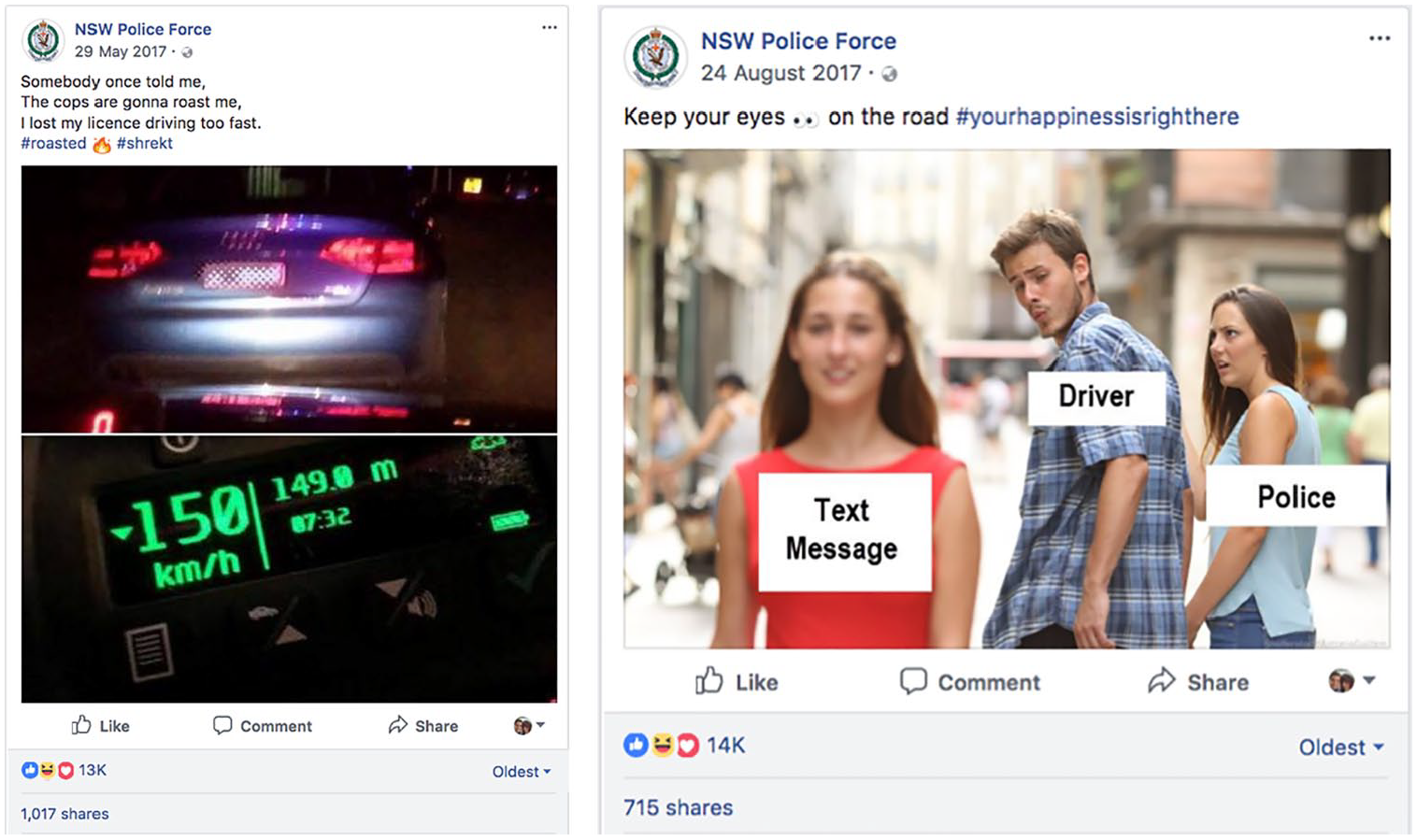
Highly shared examples of a #Roasted motorist image (left) and a road safety meme (right) posted by NSW Police’s digital media team. The road safety meme pictured makes use of the ‘distracted boyfriend’ meme.
Through the provocation of high-arousal emotions (both positive and negative) social media posts may also deflect attention away from larger, structural concerns about the institution of policing itself, a question that has become even more pertinent in both local (e.g. see Lewis, 2020) and global contexts (e.g. see Karlis, 2020) in recent times. In doing so, such posts may also facilitate what Haack et al. (2014) have termed vertical legitimacy spillovers, whereby ‘legitimacy generated by one unit of an organisation [in this case, NSW Police’s digital communications team] spills over into the organisation in general [frontline police officers]’ (Wood, 2020: 55).
In addition to eliciting positive emotions, the ‘meme strategy’ encourages participation: users are encouraged not only to share on humorous memes and posts, but also to obey the different laws contained in their messaging. This is illustrated in two forms of ‘meme strategy’ posts utilised by NSW Police: the road safety meme (n.29), which co-opts popular memes for road safety messaging, and the ‘roasted motorist’ image (n.12), which derides (‘roasts’) drivers who break road laws, usually through speeding (n.10). Roasted motorist images followed a similar format that usually incorporated all four of the following elements: an image of a car pulled over by police for road-related offences (see Figure 1), vehicle-related puns (‘Mazda been in a bit of a hurry’), emojis and a #roasted hashtag. Such posts make use of clear and simple packaging. For the meme connoisseur, such images are easily decoded and offer an easy-to-digest message regarding road rules. Yet importantly, such memes are also a marker of insider knowledge; to properly appreciate them requires a familiarity with ‘meme culture’ and popular culture more broadly.
In noting this, it is worth returning to one of the stated goals of the ‘meme strategy’: to engage a new audience for the police’s social media accounts (YouthSense, 2017). In several interviews given by NSW Police digital media employees, this ‘new audience’ is specified to be a younger demographic – precisely the demographic most readily associated with ‘meme culture’ and the same audience that are less likely to encounter police messages on other, more traditional, media platforms. As an image-work strategy, NSW Police’s use of memes is, therefore, a highly directed one, drawing in young audiences with humour, whilst at the same time (hopefully) exposing them to more ‘serious’ posts that are also made on their social media pages, enabling police to meet their other objectives, such as ‘warning people of dangers of threats’ and ‘maximis[ing] assistance and information from the public to help solve crime’ (NSW Police, 2016: 3). For the Internet user unfamiliar with ‘meme culture’, the organisation’s use of memetic humour would likely be utterly confounding; insider knowledge of their referents is required to decode such posts. Yet in demonstrating this insider knowledge, NSW Police also demonstrates affinity with those who consume humorous memes – a fact that likely accounts for the ‘meme strategy’s’ success in winning over a new audience for the organisation.
When humour fails
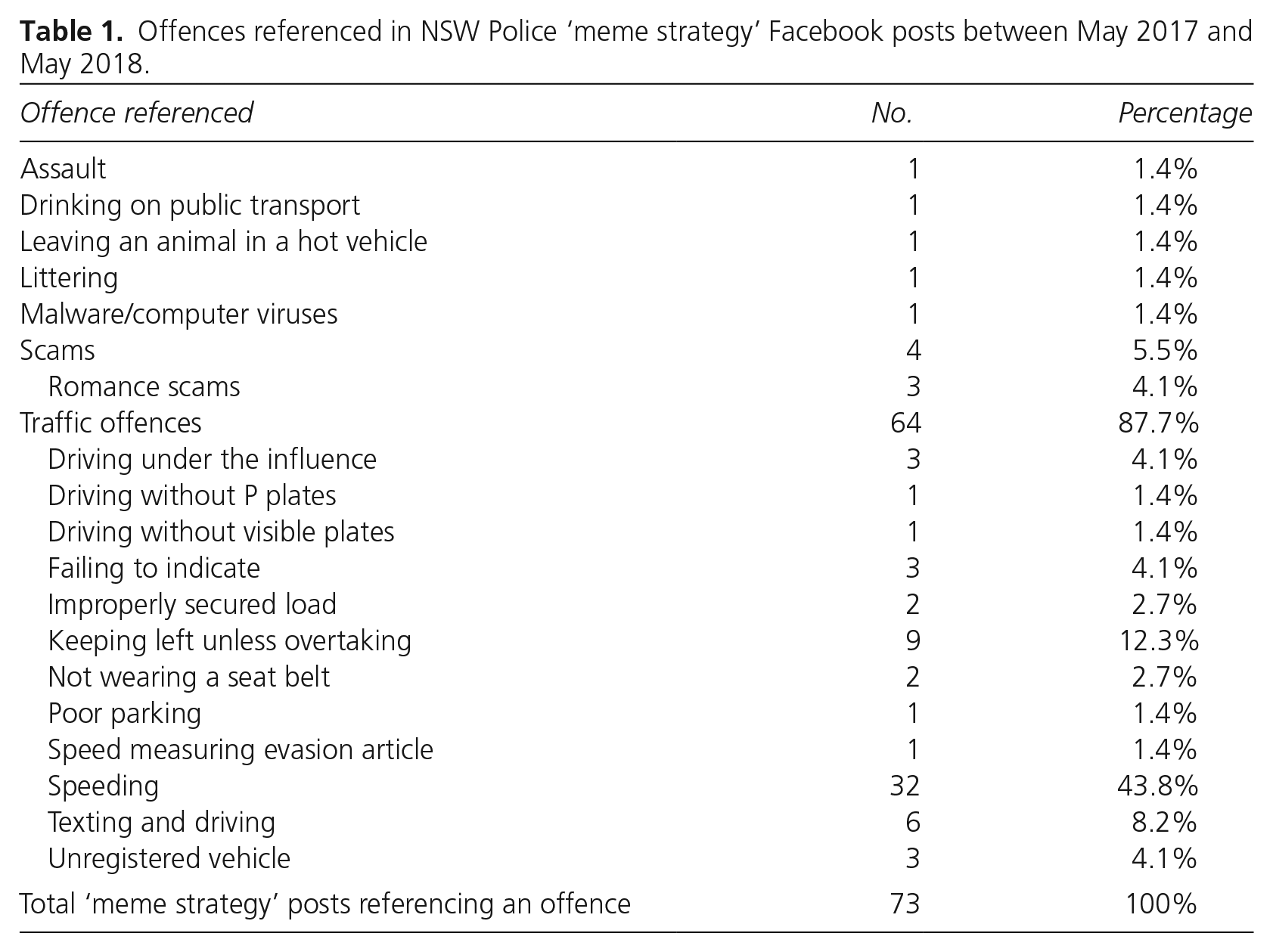
In most of NSW Police’s memes, humour is deployed as a critique (see Sandberg and Tutenges, 2019) of individuals who break laws, usually minor road-related infractions, such as speeding or failing to indicate (see Table 1). Here, the relatively minor nature of the infractions pilloried is instructive. Though philosopher Henri Bergson (1911: 5) famously argued that humour involves ‘a momentary anaesthesia of the heart’, certain subjects require significantly more aesthetic than others to engender amusement. For this reason, ‘black humour’ or ‘gallows humour’ is notably absent from NSW Police’s memes and humorous posts.
Offences referenced in NSW Police ‘meme strategy’ Facebook posts between May 2017 and May 2018.
It is notable then that in instances where police social media accounts have used humour in reference to more serious forms of harm, these have not always gone down well in the eyes of the public or the media. Police attempts at humour may instead come off as trivialising the seriousness of policing-related issues, effectively alienating the audiences they are seeking to engage with. This has been seen in a number of instances where Australian and international police departments have posted memes that might be interpreted as making light of issues including sexual assault and road accident casualties. Such cases often garner significant negative news media attention, undoing some of the work achieved by employing memes in the first place. In 2018, for example, NSW Police came under fire for their reworking of a Beyoncé song (Figure 2), which many argued engaged in victim blaming by implying women should take responsibility for their own safety when online dating (Noyes, 2018). Similarly, in 2017 NZ Police faced heavy criticism for sharing an ‘insensitive’ and ‘tone deaf’ meme (Figure 2) on Twitter about road deaths (Graham, 2017). Public backlash was swift and after quickly deleting the tweet, NZ Police issued an apology on social media for their poor judgement (Figure 3).
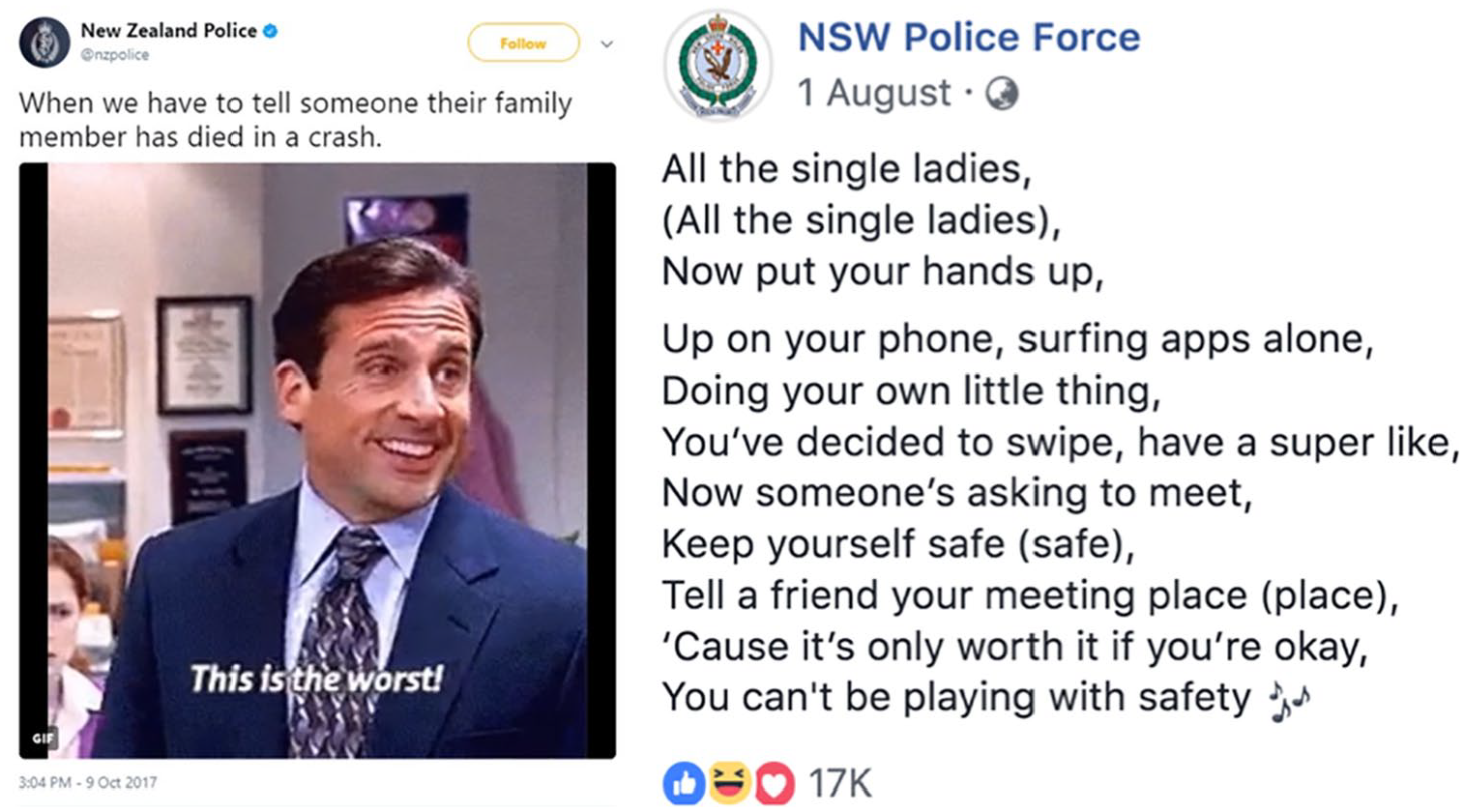
When police attempts at humour fail. Left: New Zealand Police’s heavily criticised The Office meme; Right: NSW Police Force’s Beyoncé-referencing ‘All the Single Ladies’ post.

When police attempts at humour fail. New Zealand Police’s apology for posting a meme from The Office.
Yet, these criticisms of police use of humour on social media also go beyond one-off examples of poorly crafted memes. As some commentators have argued, police deployment of humour on social media may serve as a tool of distraction, not only presenting a ‘sanitised’ version of police work that is at odds with the reality of policing, but also diverting audience attention away from some of the more problematic and controversial aspects of policing, such as police brutality and violence, especially against young people and minorities, and police (mis)use of power more generally (Kalish, 2019; Reid, 2017; Zhou, 2019). Arguably then, memetic police humour goes hand in hand with other police ‘visual self-representational practices’, such as police trophy shots, as a way ‘to gain acceptance, recognition and admiration’ and, consequently, legitimacy (Linnemann, 2017: 58, 71).
Incongruency, recuperation, and the triply-parodic nature of police-generated memes
In considering the humour content of NSW Police memes – or to use Carrol’s (2014) term, their ‘humour tokens’ – it is worth noting that they contain two layers of humour. The first layer of humour is located in the content of the memes-as-texts themselves. The second indexical layer of humour is located outside the text and concerns the very incongruity of a police force demonstrating knowledge proficiency in employing Internet memes. It is this second layer of humour that, arguably, accounts for the comic amusement many derive from viewing such texts. In laughing at NSW Police’s memes, many of which are uninspired in bluntly inserting police messaging into recent memes, people are laughing not at quality of the meme, but at the fact that it is an official police social media account that is authoring it. Amusement is a product less of the joke itself, but of who is making it. Indeed, whereas the humour of memes is generally derived from their content, the humour of many of NSW Police’s memes is derived entirely from the conditions of their authorship.
In this incongruency between the police as social control agents and the police as entertainers and meme-masters, we can locate the doubly-, and sometimes even triply-parodic nature of NSW Police’s use of memes and other forms of popular-culture referencing humour. Namely, in employing memes and other pop-culture referencing parodies in their messaging, NSW Police not only parody the forms of popular culture that they draw upon, but they also self-parody policing practices and stereotypes. Parody, as Hutcheon (2000: xii) defines it, is ‘a form of repetition with ironic critical distance, marking difference rather than similarity’, and as Hutcheon and Hannoosh (1989: 113) note, parody hinges on self-reflexivity – it can ‘reflect critically back upon itself, not merely upon its target’. We can readily locate such self-reflexivity in police-generated humour that encourages audiences to laugh at policing practices and stereotypes, whether this be patrolling highways for traffic infringements or eating donuts (see Figure 4).
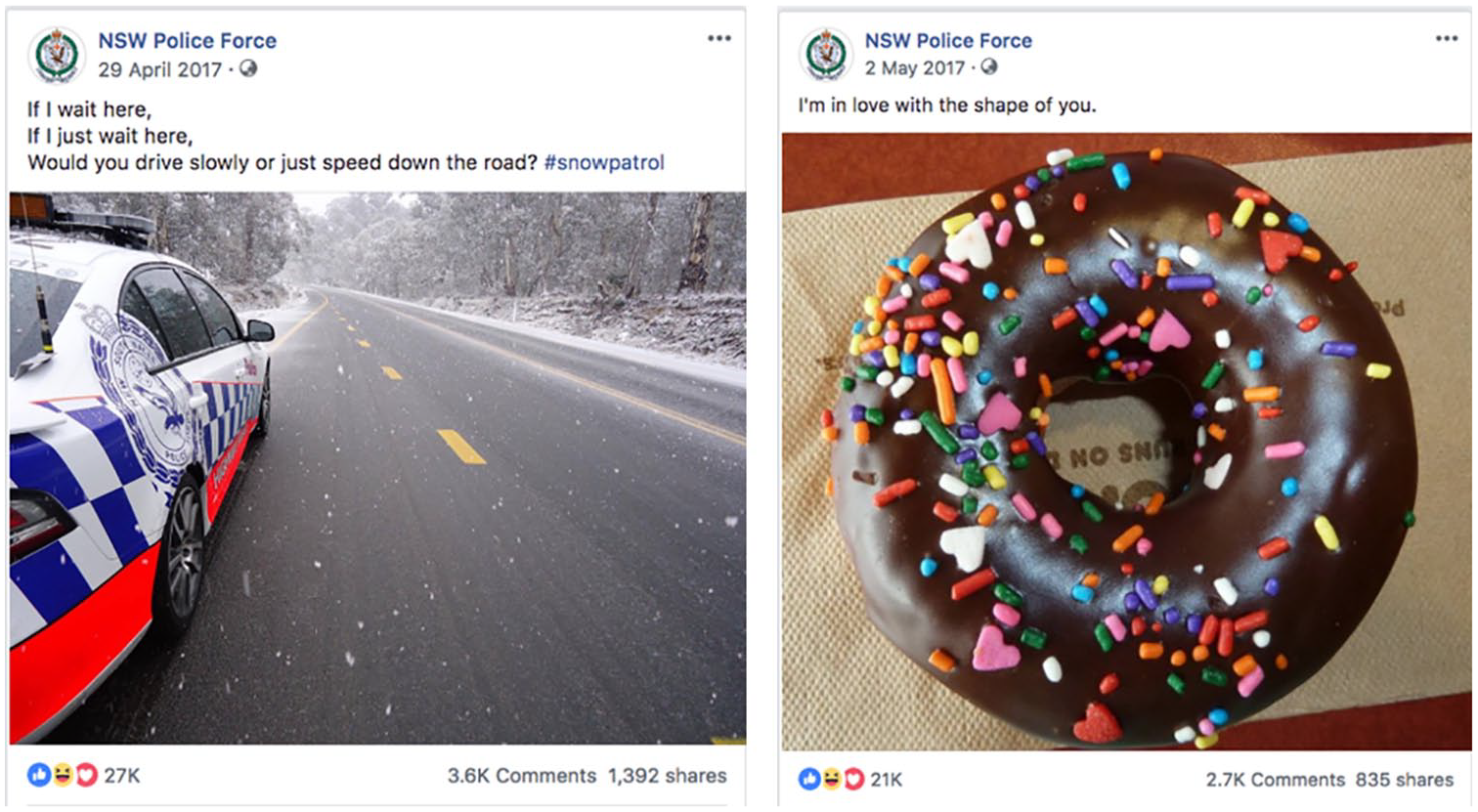
Left to right: a post parodying the lyrics of ‘Chasing Cars’, a song by the Northern Irish-Scottish band Snow Patrol, and a post parodying the Ed Sheeran song, ‘Shape of You’. Both posts are also doubly-parodic in parodying not only the lyrics of these songs but also self-parodying policing practices (highway patrol) and stereotypes (eating donuts).
Yet as Hutcheon (2000: 26) emphasises, ‘in imitating, even with a critical difference, [parody] always reinforces’. For this reason, Hutcheon (2003: 97) notes that, ‘as form of ironic representation, parody is doubly coded in political terms: it both legitimises and subverts that which it parodies’. In other words, the doubly parodic nature of police-generated memes can serve as a technique of legitimation even as individuals are encouraged to laugh at the police. Even with their ‘ironic critical difference’ in representing police practices and hegemonic policing discourses, police-generated memes ultimately serve to reinforce rather than subvert these practices and discourses.
In addition to being doubly-parodic, we might go as far as to say that police memes are often triply-parodic. Namely, they simultaneously parody not only popular culture and policing practices, but also the subversive form of Internet memes themselves (see Figure 5). For these reasons NSW Police’s use of memes may readily be read as what the Situationalist International termed an act of recuperation: the cooptation, absorption, and subsequent diffusion and commodification of radical ideas, images, and messages, into the spectacle of social control (Debord, 1983). NSW Police’s memes ‘literally turn [. . .] oppositional tactics into ideology’ (Kurczynski, 2008: 295), repackaging subversive works as social control messaging. In other words, in recuperating meme culture, police forces such as NSW Police not only subject it to the logic of ‘copaganda’ (see Shantz, 2016) but also neuter the ‘subversive plagiarism’ of détournement (Downing, 2000: 59) associated with many of the memes they draw upon.
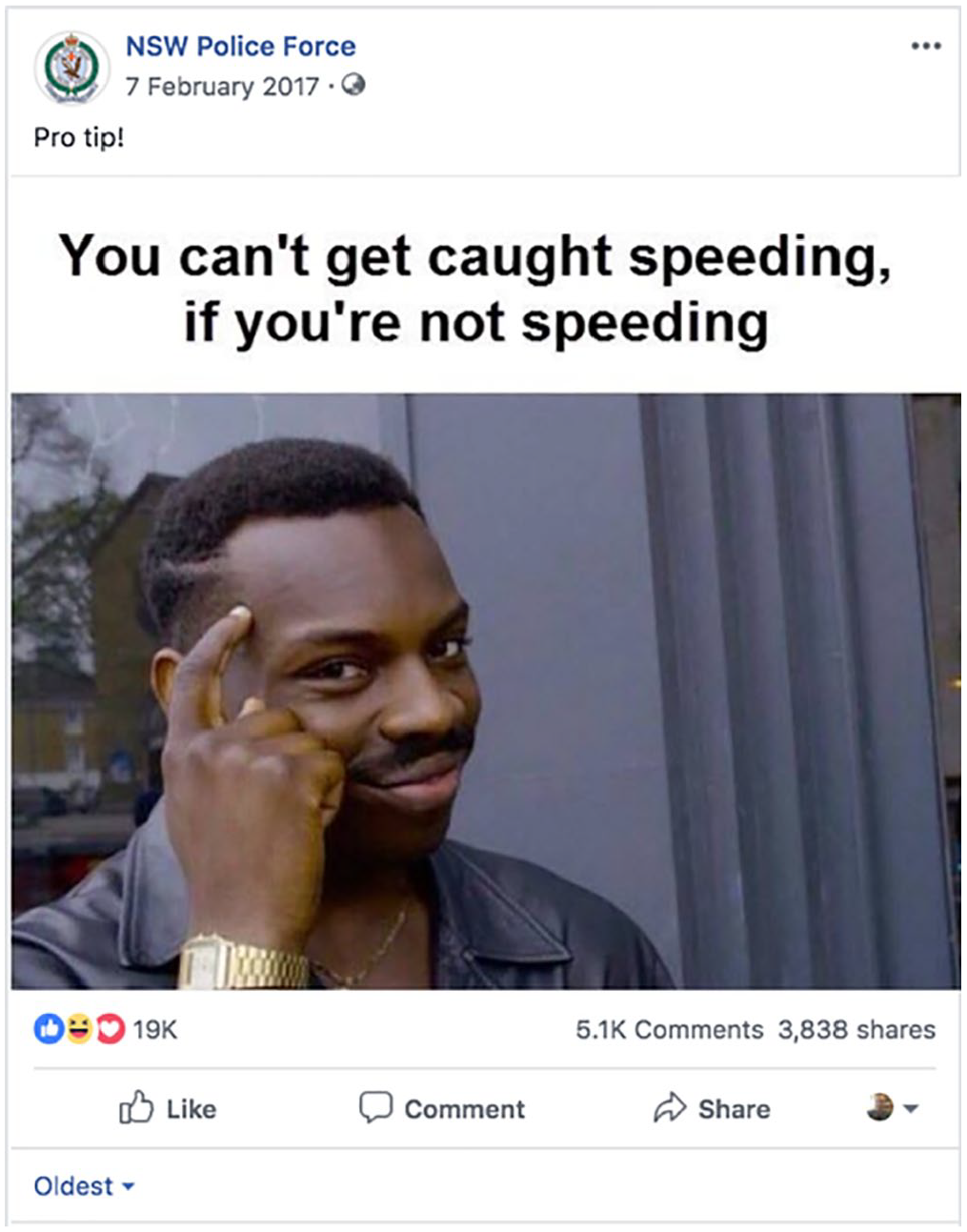
A NSW Police meme drawing on the ‘Roll Safe’ meme, which, ironically, is used to illustrate flawed logic and bad decision making rather than truisms. The meme is triply-parodic in parodying both the Roll Safe meme format, NSW Police’s memetic-cathexis on speeding, and the subversive form of Internet memes.
Discussion
Joking relationships, police memes and legitimacy through simulated policing
Given that NSW Police’s memes are (for the most part) not a product of sworn officers, but rather its specialised digital communications team, we would be ill-advised to assume that they bear the hallmarks of authentic police humour. Indeed, whereas humour functions within police organisational culture as a tool of occupational coping (Pogrebin and Poole, 1988) and as a mechanism for reinforcing organisational culture (Charman, 2013; Holdaway, 1988), the humour of NSW Police’s meme strategy has an altogether different set of goals. To put it in anthropologist Alfred Radcliffe-Brown’s (1940, 1952) terms, NSW Police’s meme strategy attempts to establish a symmetrical ‘joking relationship’ between the police and members of the public. Joking relationships are, as Radcliffe-Brown (1952: 90) explains,
a relation between two persons in which one is by custom permitted, and in some instances required, to tease or make fun of the other, who in turn is required to take no offence.
Importantly, joking relationships take two forms: symmetrical – in which both individuals may make fun of the other – and asymmetrical – in which one party may make fun of the other, and the other may not retaliate (Radcliffe-Brown, 1952: 90). Joking relationships mediate social relationships beset by tension, competition or potential conflict (Radcliffe-Brown, 1952); here, humour has a key role in ‘mediating (and creating) social rupture’ (Carty and Musharbash, 2008: 214). ‘A peculiar combination of friendliness and antagonism’, the joking relationship is, as Radcliffe-Brown (1952: 91) puts it, a ‘relationship of permitted disrespect’. Indeed, in formulating the notion of joking relationships Radcliffe-Brown (1952) argues that we must contextualise such relationships within a larger conceptual apparatus of respect; ‘any complete theory of it,’ Radcliffe-Brown (1952: 91) writes, ‘must be part of, or consistent with, a theory of the place of respect in social relations and in social life generally’. For this reason, Radcliffe-Brown (1952) distinguishes the joking relationship from what he terms the avoidance relationship. As Radcliffe-Brown (1952: 107) states, ‘[t]he avoidance relationship is in one sense an extreme form of respect, whilst the joking relationship is a form of familiarity, permitting disrespectful behaviour, and in extreme instances, licence’. Both joking and avoidance relationships are a mechanism of social regulation – a means of maintaining and regulating social relationships. Read through Radcliffe-Brown (1952), whether police and the majority of a community are ‘on joking terms’ might represent something of a litmus test for community policing. By making themselves the ‘butt of a joke’ and allowing themselves to be laughed at, NSW Police endorse a ‘permitted disrespect’ (Radcliffe-Brown, 1952: 99) of themselves that aims to mediate tension between themselves and members of the public.
However, this symmetrical joking relationship remains a veneer on two levels. Firstly, though individual members of the public and police may be ‘on joking terms,’ the relationship between the police and the public is, foremost, a contractual relationship. And secondly, there is a marked asymmetricity of power between the police and most members of the public, such that only certain individuals are permitted to be ‘on joking terms’ with the police. Indeed, even the NSW Police Force’s Official Use of Social Media Policy and Procedures allows for moderators of police social media pages to delete or ban public users if they engage in using ‘insults and ‘jokes’’ (NSW Police, 2018: 30).
Research into image work’s role in shaping public attitudes towards the police highlights the need for a model of police legitimacy that considers more than individuals’ first-hand encounters with police. Such a model can be readily found in Lee and McGovern’s ‘simulated policing’ framework, which draws upon the work of Pat O’Malley (2010) to argue that ‘policing is increasingly occurring at the level of the policing image, through simulated representations of policing’ (Lee and McGovern, 2013b: 71-72). For Lee and McGovern, those working in specialised digital communications teams see their work as playing just as important a role as operational policing in gaining public trust and confidence. And whilst Lee and McGovern’s framework was developed prior to the proliferation of police memes, we argue that it is just as applicable to this form of police communication. Indeed, police memes fulfil a number of components of Lee and McGovern’s framework: they have virtually unlimited reach, ‘insinuat[ing] [themselves] into the public consciousness’ (2013b: 72) perhaps more than any other police-produced content, whilst at the same time seeking to increase public compliance and cooperation.
Yet whilst memes may show that police have a sense of humour and are capable of laughing at themselves whilst delivering their message, this image work is no less marked by asymmetrical power and attempts at image management. Whilst humorous posts may create a sense within the community that police are on their level, ‘just like us’ – as others have found in relation to police use of social media more broadly (see e.g. Lee and McGovern, 2013b: 166 and Colbran, 2020) – in practice humourous memes serve to reinforce the legitimacy of the police as an institution. In an environment where public perceptions of policing are a key performance indicator (McGovern, 2017), memes have become yet another mechanism through which police can engage in image management, building public trust and confidence by appearing to be both good at what they do, and a reflection of the community that they police. Put simply, whether we view the police as legitimate and accept their authority is a product of how we feel about the police, and how we feel about the police is a product of a broad range of factors, from our first-hand encounters with officers, to our consumption of images, narratives and representations of policing. Much of the research on police legitimacy has examined the former, with fewer studies examining the impact cultural representations of policing have on individuals’ attitudes towards the police. Yet as Harkin (2015) notes, police support can owe just as much to indirect experiences and ‘fantasy content’ as it can to individuals’ direct experiences with police. Through memes then, police are able to both create an atmosphere of transparency whilst simultaneously evading questions over their authority and accountability. Consequently, to understand police legitimacy, we must unpack the role that police image workers – professional digital media specialists – play in producing hypothetical images of policing.
Policing’s new visibility meets the threat of invisibility
Much of the literature examining the impact of social media on policing has rightly concerned what Goldsmith has termed ‘policing’s new visibility’ – the increased visibility of police and, with it, police misconduct, as a result of the ubiquity of mobile and social media. Drawing on Thompson’s (2005) influential work on mediated visibility, Goldsmith’s (2010) notion of ‘policing’s new visibility’ acknowledges that police are less in control of their image than ever before, due largely to the increased capacity that new media platforms and digital technologies, such as mobile phone cameras, have provided citizens to capture and distribute ‘non-preferred’ police images to wide audiences. Whilst the notion of policing’s new visibility remains compelling, and accounts particularly well for the increased visibility of police misconduct, Thompson’s (2005) new visibility theory work was written before the rise of algorithmically-driven visibility. As a result, his theory treats mediated visibility as a given; a fait accompli as opposed to an accomplishment. Within Thompson’s account, visibility can be managed but never ceded. The way that social media platforms in particular have evolved in recent years is such that ‘policing’s new visibility’ is contingent, reliant upon algorithmic interventions and ordering that occur on social media and impact what is made visible and what is not (Carmi, 2020). In the context of the police image work that this paper discusses then, we argue that visibility is far from assured for police on social media.
For this reason, we suggest that what Goldsmith terms policing’s new visibility represents one of (at least) two regimes of visibility (Brighenti, 2010) police face on social media. The other is a threat to policing’s visibility, shaped, in part by the ‘algorithmic power’ that sorts, categorises, recommends and shapes the content social media users encounter within their curated newsfeeds (Beer, 2009; Bucher, 2012). Here, we refer to Bucher’s (2012: 1171) work on Facebook’s visibility regimes, and what she refers to as the ‘threat of invisibility’ facing users of the platform:
In Facebook there is not so much a ‘threat of visibility’ as there is a ‘threat of invisibility’ that seems to govern the actions of its subjects. The problem as it appears is not the possibility of constantly being observed, but the possibility of constantly disappearing, of not being considered important enough. In order to appear, to become visible, one needs to follow a certain platform logic embedded in the architecture of Facebook.
Bucher’s observations on Facebook’s regimes of visibility are particularly useful for understanding threats to the visibility of individuals on Facebook but less relevant to understanding the visibility regimes impacting public organisations such as police forces. Here, the issue is not one of NSW Police being either visible or invisible on social media, but of the kinds of images of police work that are rendered visible/invisible within these domains. To understand the rise of NSW Police’s ‘meme strategy’, other similar uses of humour and cute content by police forces on social media, and the current ecology of police image management, then, we must address the dialectical interplay between the two regimes of visibility detailed above: policing’s new visibility, and the threat of invisibility.
Both regimes are driven by a key mechanism – the social media button-enabled sharing of content – and characterised by a distinct ecosystem: the like economy of social media. As Gerlitz and Helmond (2013) note, within the ‘like economy’ of Facebook, Twitter and other social media, ‘like’ and ‘share’ buttons enable users to quickly share content on to their social networks. Within this like economy, the diffusion of content is driven by a series of engagement metrics, including a post’s like count, share count, number of comments, and post engagement. On social media, as elsewhere, content that creates a particularly strong affective or emotional response in users is likely to foster longer periods of engagement and higher like and share counts. This content is then boosted by social media algorithms and syndicated to a larger number of users’ personal social media feeds, leading to an ‘intensification’ of affecting content on these platforms. As such, like economies are as much underwritten by ‘algorithmic power’ (Bucher, 2012) as they are by social media buttons (Beer, 2009; Wood et al., 2019).
This intensification of affect – in both its positive and negative forms – is, we would argue, key to understanding both the rise of policing’s new visibility, and the set of countermeasures police have employed to address threats to their social media visibility – countermeasures which we term police engagement work (see Wood, 2020). Police engagement work has, in this way, become much more than just having a keen eye for stories that might be of interest and paint police in a positive light. Indeed, understanding social media logics – ‘the processes, principles, and practices through which these platforms process information, news, and communication, and more generally, how they channel social traffic’ (Van Dijck and Poell, 2013: 5) – has become central to police image work. NSW Police’s meme strategy demonstrates how building a campaign around these logics can increase the reach and visibility of its messaging. As detailed earlier, NSW Police’s Facebook account increased its following significantly after enacting its meme strategy, reaching one million followers in August 2017. NSW Police employees have directly attributed this increase in reach to meme strategy posts (Butler, 2017; Rota, 2017) – a claim lent credence by mixed methods research tracking the page’s engagement rates (Wood, 2020).
Without an understanding of social media logics, the reach and visibility of content produced by police social media accounts can languish amidst the crowded, algorithmically-curated information environments of Facebook, Twitter and other prevalent platforms. As comments by NSW Police personnel such as Sheehy (in YouthSense, 2017) indicate, members of the organisation demonstrate a knowledge of the ‘algorithmic sociality’ of social media (Powell et al., 2018), where social algorithms shape the information users encounter. Indeed, as then head of the NSW Police Public Affairs Branch, Strath Gordon, explains (in Butler, 2017: np), their use of memes represents an active attempt to ‘game’ Facebook’s Top Stories algorithm, which as noted before, boosts the content of pages that receive a high degree of engagement. Similar strategies have also been deployed by US police forces, with leaked documents from the New York Police Department showing that those running their social media accounts are encouraged to be ‘funny’, ‘cheery’, ‘cutesy’ and ‘share emojis’ because ‘“[f]unny tweets are more likely to be shared,”’ (cited in Haskins, 2019), and may act as a countermeasure to stories of police misconduct shared on social media.
As these New York Police Department documents demonstrate, engagement work strategies, unlike many other viral campaigns by public sector organisations, have a dual function, and it is this dual function that distinguishes them from many viral marketing campaigns run by other public sector organisations, such as public health campaigns (Freeman et al., 2015; Gough et al., 2017). Whereas the use of humour within viral public health campaigns is directed not at changing the image of public health organisations but instead at behaviour-change, NSW Police’s meme strategy and similar police humour-based campaigns have the explicit aim of altering the image of policing itself. Moreover, a catalyst for organisational image change is woven into the fabric of police memes that are directed at changing behaviour. NSW Police’s memes skewering motorists who speed and fail to indicate attempt to change the driving behaviour of motorists; however, owing to the doubly-parodic form these memes take, they may simultaneously operate to legitimise the organisation that authors them (Hutcheon, 2003). Indeed, NSW Police representatives have been extremely forthright in detailing the dual function of its ‘meme strategy’:
Our memes are designed to create a positive image for the Force (we are human) and secondly to help generate enhanced engagement [so] that our fan-base can see more of our other posts, based on the way the algorithm works. We have surveyed our fans several times and they definitely want to see as much of our content as we can provide, so the meme strategy is our method of achieving that. People trust the police. Our information is authentic (in YouthSense, 2017: np).
This claim that NSW Police’s information is wholly authentic is, however, undercut by the acknowledgment (in YouthSense, 2017: np) that ‘meme strategy’ content is manufactured by researching trends in meme culture:
Being able to stay on top of emerging trends in pop culture and memes has enabled us to build a reputation of having an innovative online communication strategy. Memes are fickle in nature i.e one minute they’re popular, and the next they’re not. To avoid potential criticism from our audience, we try and always use a reference when it’s at the height of the potential popularity cycle.
The humour employed in NSW Police’s meme strategy is not, in other words, authentic or organic police humour derived from serving officers. Rather, it is carefully curated by a digital communications specialist, who recuperates memes ‘at the height of their potential popularity cycle’ to target a younger demographic of social media users. Furthermore, as the departments overseeing the curation and dissemination of this content are comprised of experts with experience in the fields of journalism, communications, public relations, and political advising (Surette, 2001; Lee and McGovern, 2013a) even when content is conceptualised or created by frontline officers, it often needs to negotiate an approvals process before dissemination (NSW Police, 2016, 2018). Meme strategies and other forms of police engagement work therefore bear the signature of ‘copaganda’, presenting an ersatz image of police humour and officers au fait with the latest trends in memes and youth culture.
As we hope to have demonstrated, to understand the landscape of police image-work on social media we must examine how affecting content diffuses within new media ecologies. Given the crowded state of social media, where an abundance of content competes for the attention and engagement of users, it is by no means assured that messages produced by policing organisations will reach a large audience. Whether utilising humour, cuteness or other forms of positive affect, police engagement work is an an attempt to fight virality with virality – to counter the new visibility of police misconduct with the algorithmically-curated visibility of police image work. At the same time though, engagement work is not only an attempt to manage policing’s visibility, but also to hang on to it within mediated environments in which it is no longer assured.
Footnotes
Acknowledgements
The authors would like to thank Dr Phillip Wadds and Assistant Professor Travis Linnemann for their thoughts and contributions to earlier parts of this work. We would also like to thank the two CMC reviewers for their helpful suggestions and comments, which we think improved the article considerably.
Declaration of conflicting interests
The author(s) declared no potential conflicts of interest with respect to the research, authorship, and/or publication of this article.
Funding
The author(s) received no financial support for the research, authorship, and/or publication of this article.
