



Abstract
Ultrasound-guided lumbar puncture (LP) could be beneficial in situations where anatomical landmarks are difficult to identify. There is some evidence that it is associated with increased success rates and procedural ease. Its effect on complication rates has not been explored. This mixed retrospective-prospective case-control study over 6 months compares unguided (retrospective data, n = 28) and ultrasound-guided LPs (prospective data, n = 23) in non-emergency patients. Presence of factors making LPs difficult (DF) i.e. BMI ≥30 kg/m2, scoliosis and previous lumbar spinal surgery were recorded. There was a significant difference in attempt rates between unguided and ultrasound-guided LPs (median 2 vs. 1; p = 0.01) with complication rates of 50% and 26.1%, respectively (p = 0.15). In a subgroup analysis, complication rates were significantly different in those with DF (76.9%, unguided LPs (n = 13) vs. 33.3%, ultrasound-guided LPs (n = 12); p = 0.03), with an absolute risk reduction of complications of 43.6% (NNT of 2.3) in ultrasound-guided vs. unguided LPs. In those with DF, the back pain rates were significantly reduced (53.8% unguided LPs vs. 8.3% ultrasound-guided LPs; p = 0.02). In the ultrasound-guided LP group, there was no blood contaminated cerebrospinal fluid samples, whereas this occurred in 14% of unguided LPs.
Ultrasound-guidance significantly reduced the number of LP attempts. In those with DF, the use of ultrasound significantly reduced post-procedural complication, particularly back pain. Ultrasound-guidance during LP procedures can reduce patient discomfort and encourage patient safety, thereby improving clinical practice.
Introduction
Lumbar Puncture (LP) is a bedside procedure used to sample cerebrospinal fluid (CSF) for the diagnosis of a range of neurological conditions. Currently, medical practitioners predominantly conduct these procedures by palpating anatomical landmarks to determine the site of optimal spinal needle introduction. 1 The two most common complications of these procedures are headache, reported in ∼40% of patients, 2 and back pain, reported in ∼33% of patients. 3 It is a reasonable hypothesis that with increased attempts, due to difficulty in identifying landmarks, back pain would be more likely. Patient-related factors can make it difficult to identify these landmarks: obesity, generalised oedema or spinal deformity, as can inexperience of the practitioner. When a practitioner is faced with a difficult LP, the current practice is either further attempts with the aid of a senior colleague, initiation of empirical treatment without obtaining CSF or conducting the LP under X-ray guidance. More attempts may cause further discomfort to the patient and increased risk of complications, including traumatic LPs that can confuse CSF results. 4 Starting empirical treatment without a diagnosis is rarely good medical practice. LP under X-ray guidance exposes the patient to radiation and can delay the procedure – important if the LP needs to be done within a timeline (e.g. subarachnoid haemorrhage).
There is some evidence that the use of ultrasound to mark the entry point for the needle during an LP, referred to in this study as ultrasound-guided LPs, could be beneficial in patients in whom anatomical landmarks are difficult to identify. 5 – 10 In obese individuals, ultrasound is able to identify relevant anatomical landmarks in 75% of cases. 10 Ultrasound-guided LP has been shown to have a greater success rate in both non-obese patients and obese patients (BMI ≥30 kg/m2) and overall reduce the number of failed LPs. 9 Ultrasound has also been shown to facilitate spinal anaesthesia in patients with difficult surface anatomic landmarks, 6 which is a similar process to LP.
We conducted a mixed retrospective-prospective case-control study to determine whether ultrasound-guided LPs were, in comparison to unguided LPs, associated with a reduction in the number of LP attempts, reduced complication rates and improved diagnostic yield.
Methods
Study design
The study was performed in the St Mary’s Neurology Day Unit on patients having elective LP for investigation or treatment of non-emergency conditions. This was a mixed retrospective-prospective case-control study design over a 6-month period. The retrospective part of this study included all patients that had an unguided LP over a 3-month period. The prospective part of this study included all patients that required an LP on the initiation of this study and for a period of 3 months. No patients were excluded either in the retrospective or prospective part of this study. Relevant data were obtained from all patients and no patients were lost to follow-up. The use of ultrasound-guidance for LP procedures was implemented as a standard in our unit at the point of initiation of the prospective part of this study and thereby ultrasound was not solely used for the purpose of this study. This project was reviewed by the local ethics committee, who concluded that it did not qualify as a research project and that ethical approval was not necessary. They defined it as a quality improvement project or clinical audit. This was therefore reviewed by the new intervention committee i.e. review committee, who approved it as a clinical audit and approved the use of ultrasound-guided LPs at our institution.
Written consent was obtained from the women in the pictures in Figure 1.
Illustrative explanation of how to perform ultrasound-guided lumbar puncture (LP) with model in left lateral position. (a) The ultrasound probe is held in transverse position with a line drawn to mark the midline of the spine. (b) Ultrasonograph obtained with the ultrasound probe in the transverse position and the spinous process can be visualised as a hypoechoic structure (large asterisk). (c) The ultrasound probe is held in the longitudinal position and the line drawn to mark the middle of the interspinous space. (d) Ultrasonograph obtained with the ultrasound probe in the longitudinal position and it shows the spinous processes (small asterisks) and the interspinous space between (large arrow)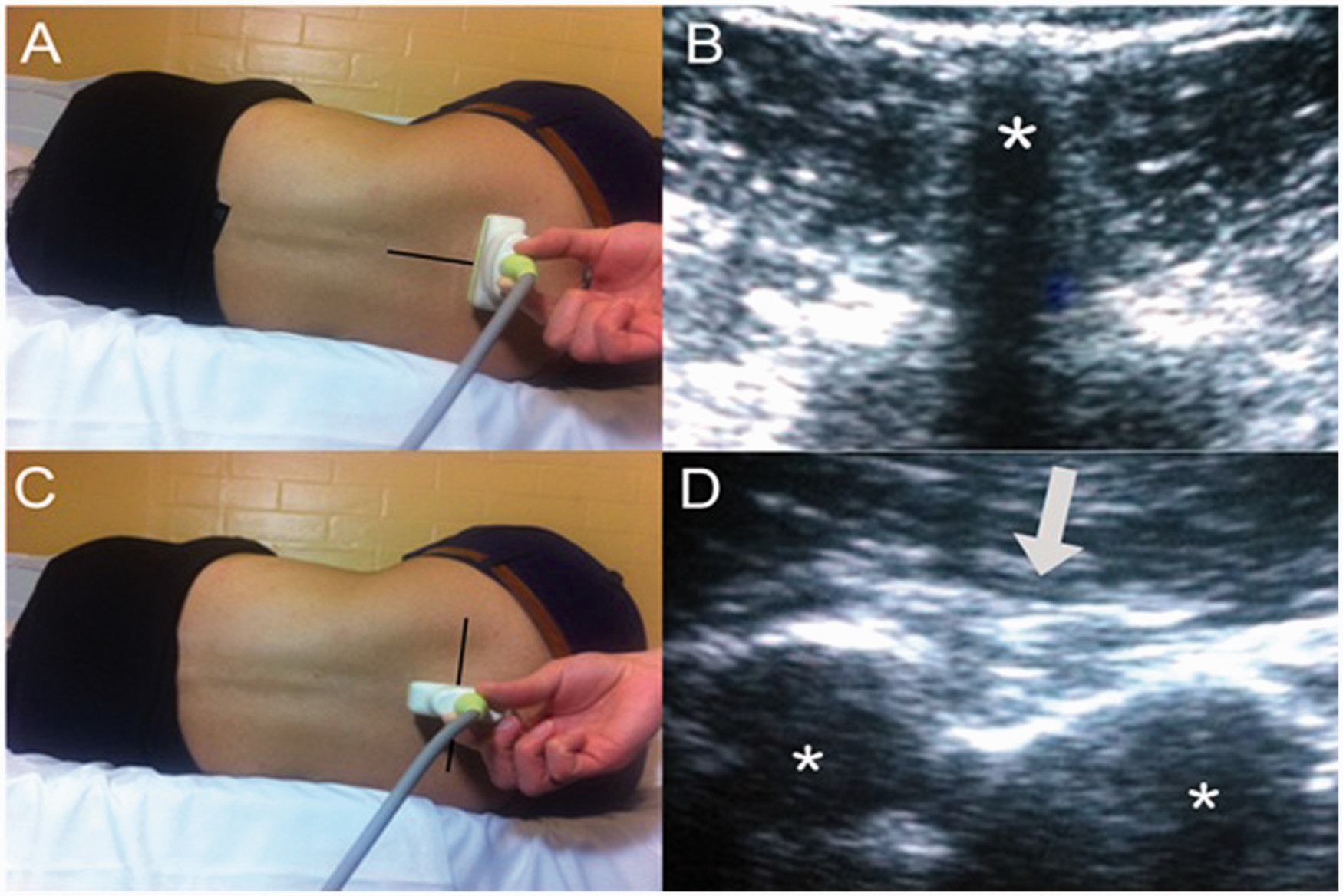
Data collection
The data on unguided LPs was collected from the clinical notes retrospectively including the number of LP attempts and CSF red blood cell count (RCC), as well as difficulty factors (DFs) i.e. BMI ≥30 kg/m2, scoliosis and previous lumbar spinal surgery. Patients were contacted via telephone regarding post-procedural complications. To reduce operator bias during this process, the patients were not contacted by the person that had performed the LP or been in contact with the patient. When the patients were contacted, they were specifically asked about any symptoms that they experienced following their procedure. These questions followed a pre-arranged questionnaire, which further helped to reduce bias. We classified a complication in accordance to well-documented complications following an LP, including headache, back pain, nerve root irritation, cranial neuropathies, infection and bleeding complications.2,3 We also assessed whether any of these patients had pre-existing headache, back pain, cranial neuropathies and/or nerve root irritation prior to their LP. As the retrospective part of this study involved a 3-month period, patients were contacted on average 1 day to 3 months following their LP.
Between September and November 2011, all LPs were conducted under ultrasound-guidance and all data were included in this study with no exclusions. The same data were collected as per the retrospective part of this study. These patients were contacted at the end of the study period to ensure the follow-up period was similar in the retrospective and prospective parts of the study. Therefore, these patients were contacted on average 1 day to 3 months following their LP. The average time patients were contacted following their LP was similar in the retrospective and prospective part of this study (1 month 16 days vs. 1 month 10 days, respectively).
At the 6-month stage of this study, operators were due to switch jobs as part of their clinical training, resulting in new operators. Therefore, the study period was set at 6 months to reduce further operator bias. We prospectively reviewed the number of patients that were due to undergo ultrasound-guided LPs and took into account the potential additions and loss of patients due to altered appointments. This was highly suggestive that a similar proportion of patients would be in the ultrasound-guided LP group as there were in the unguided group.
These LP procedures were arranged as part of the patient’s medical management and were thereby not directly influenced by this study. To avoid bias in this process, these LPs were arranged by healthcare professionals that had no link or beneficial gain from this study.
Difficulty factors
DFs were identified to be either present or absent. To ensure consistency in regard to the classification of DFs, the two operators worked together when reviewing the clinical parameters used in making this decision. Strict parameters were used to ensure that there was no discrepancy when classifying a patient as having a DF i.e. we used clear BMI cut offs (≥30 kg/m2) and included patients with scoliosis or any previous lumbar spinal surgery including microdiscectomy. No patients in this study had more than one DF.
Ultrasound-guided LP method
Consent was obtained using the same principles as with unguided LP. LPs were predominantly performed using 22-gauge Quincke tip spinal needles. A 20-gauge needle was used in 4/28 and 3/23 cases in the unguided and ultrasound-guided LP groups, respectively, as a 22-gauge needle was not available. To avoid placebo effect, patients that underwent ultrasound-guided LPs were not told that the procedure would potentially reduce complication rates. These patients were given the standard explanation of LP procedures that is currently used in medical practise. The same pre-procedure measures were taken and patients were placed in the left lateral position. An ultrasound machine (Toshiba Famio 8, EBME number 15854) and 3.75 MHz curved transducer probe was used to identify the relevant landmarks using the following steps:
The ultrasound probe was placed in the transverse position (Figure 1(a)). The image obtained on the ultrasound screen was identified, with the spinous process being visualised as a hypoechoic structure (identified with a large asterisk in Figure 1(b)). This landmark was used to identify the midline of the spine and a longitudinal line was drawn on the skin (Figure 1(a)). The ultrasound probe was then held in the longitudinal position along the spine (Figure 1(C)). The ultrasound image at this position was used to identify the interspinous space (marked with the large arrow in Figure 1(d)). A transverse line was drawn on the skin at the point of the interspinous space (Figure 1(c)). The transection of the longitudinal and the transverse lines was used as the point of entry with the spinal needle. An attempt was classified as the entry of the spinal needle through the skin. Repositioning of the needle without re-puncturing the skin was not classified as an attempt. There was no significant change in the depth on the machine between patients and gain was appropriately changed to ensure good definition of the image.
Operator skills
There were three operators involved in conducting the LPs in this study. One of the operators conducted the LPs in the first 2 months of the retrospective part of the study. The other two operators conducted the remaining LPs. All operators were postgraduate years 3–4 trainees. They had obtained the same level of basic training for unguided LPs. They had also performed a similar number of procedures at the same level of difficulty as part of their clinical experience prior to the initiation of this study. The two operators that conducted the ultrasound-guided LPs both received 1 day of training on the procedure and on the machine settings, such as how to adjust depth and gain to obtain an optimal image.
Data analysis
Data was statistically analysed using commercial statistics software (SPSS 17.0, SPSS Inc, Chicago). Non-parametric testing using Mann-Whitney was used for pair-wise comparisons for unguided LPs and ultrasound-guided LPs and for patients without and with a DF, and uncorrected p values are shown. Correlation testing was performed using Spearman’s rho. To control for operator skill, logistic regression analysis was performed with OPERATOR (3 operators), DF (present or absent) and METHOD (US-guided or unguided) as covariates and with COMPLICATIONS (present or absent) or BACKPAIN (present or absent) as the dependent variable.
For all statistical tests, statistical significance was defined as p < 0.05.
Results
A total of 51 patients were included in this study. All the required data were obtained and analysed from all patients. There was clear documentation in all clinical notes in regard to LP attempts. Unguided LPs were carried out in 28 patients. Thirteen patients had a DF present that could have contributed to making an LP more difficult (11 with BMI ≥30 kg/m2 and 2 with scoliosis). Ultrasound-guided LP was carried out in 23 patients. Out of these patients, 12 had a DF present (2 with previous lumbar spinal surgery, 8 with ≥30 kg/m2, 1 with scoliosis and 1 other). The patient defined as other represented a patient that had alteration to their lumbar anatomy as a result of their underlying medical condition.
Number of attempts
Shows the median number of lumbar puncture (LP) attempts and complication rates with or without difficulty factors (DF), with unguided and ultrasound-guided LPs
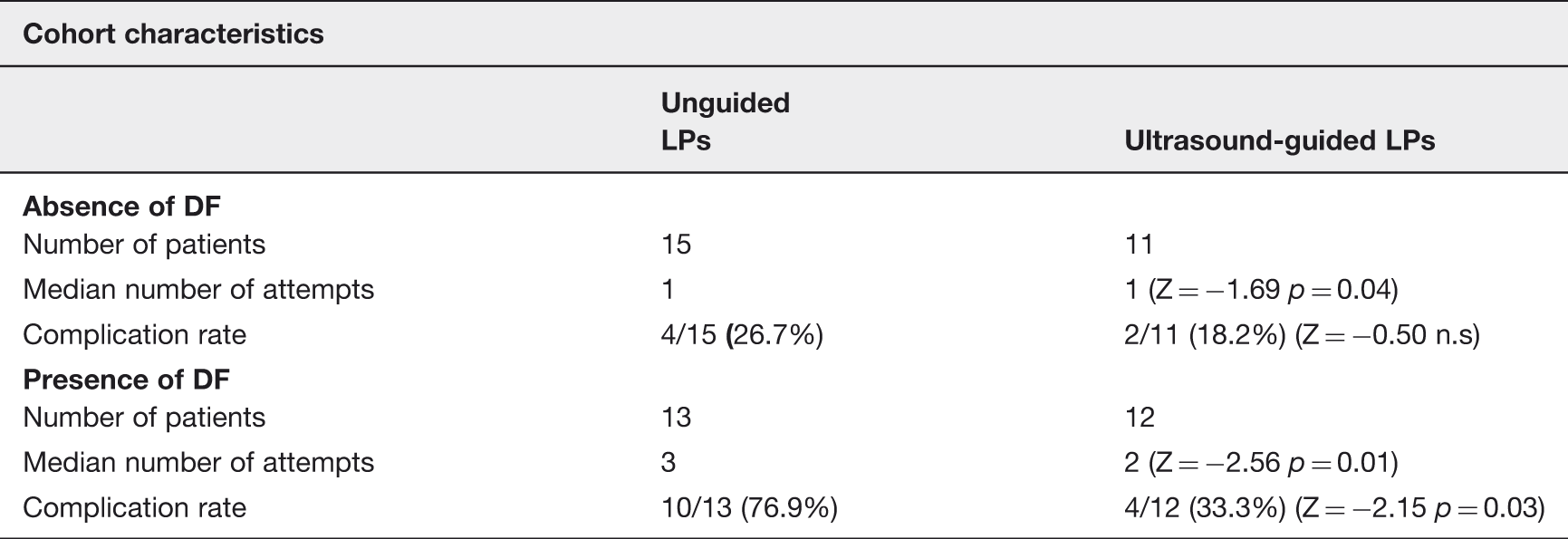
Of the 25 patients with a DF, 4 had an LP as management of idiopathic intracranial hypertension. These patients were part of the retrospective and prospective part of this study and thereby underwent unguided and ultrasound-guided LPs. In these four patients, the median number of LP attempts with unguided LPs was three whilst with ultrasound guidance it was two.
Complication rates
The complications that patients experienced in this study following an LP were back pain and/or headache. No other complications were reported. None of these patients had back pain, nerve root irritation, cranial neuropathies and/or headache prior to their LP. The overall complication rate in the unguided LP group was 50% (14/28) compared to 26.1% (6/23) in the ultrasound-guided LP group (Z = −1.45, p = 0.15). In terms of specific complications, back pain rates were 28.6% (8/28) in the unguided LP group and 4.3% (1/23) in the ultrasound-guided LP group (Z = −1.47, p = 0.14). The headache rates were 21.4% (6/28) and 26.1% (6/23) in these two groups, respectively (Z = −0.27, p = 0.79).
For patients without a DF, the complication rate including back pain and/or headache was 26.7% (4/15, unguided LP) and 18.2% (2/11, ultrasound-guided LP) (Z = −0.50, n.s.). For patients with a DF, the complication rate, including back pain and/or headache, was 76.9% (10/13, unguided LP) compared with 33.3% (4/12, ultrasound-guided LP) (Z = −2.15, p = 0.03). This is summarised in Table 1. The absolute risk reduction was 43.6% for patients with a DF when comparing ultrasound-guided LP and unguided-LP, producing number needed to treat (NNT) to provide benefit of 2.3.
In terms of specific complications, for patients without a DF, there was no significant difference in back pain rates between those who had unguided LPs and those who had ultrasound-guided LPs (13.3% vs. 0%; n.s.). For patients with a DF, there was a significant difference in back pain rates between those who had unguided LPs and those who had ultrasound-guided LPs (53.8% vs. 8.3%; Z = −2.39, p = 0.02). There was a weak correlation between back pain and number of LP attempts (Spearman’s ρ = 0.38, p = 0.01). In terms of headache rates, there were no significant differences in those without a DF (2/15, 13.3% unguided vs. 2/11, 18.2% ultrasound-guided; n.s.) and in those with a DF (4/13, 30.7% unguided vs. 4/12, 33.3% ultrasound-guided; n.s.).
There was no association between the gauge of needle used and the overall complication rate and back pain rate (data not shown).
Blood-contaminated CSF rates
CSF samples with RCC >100 were defined as blood-contaminated (in the context of a procedure in non-emergency patients without a history of an intracranial or intraspinal bleeding). Blood-contaminated CSF rates between unguided LPs and ultrasound-guided LPs was approaching statistical significance (14% vs. 0%; U = 276, Z = −1.87, p = 0.06).
To control for operator technical skill, a logistic regression was performed using OPERATOR, DF and METHOD as covariates and COMPLICATIONS as the dependent variable. This produced a model (Χ2(4) = 13.0, p = 0.002; Nagelkerke R2 = 0.305), and with only a significant effect for DF (Wald’s Χ2 = 5.87, p = 0.015), near significant effect of METHOD (Wald’s Χ2 = 3.82, p = 0.051) and no effect of OPERATOR (n.s.). However, if a logistic regression was performed using BACKPAIN as the dependent variable and identical covariates, this produced a much better predictive model (Χ2(4) = 16.8, df = 4, p = 0.002; Nagelkerke R2 = 0.448). There was an effect of DF (Wald Χ2 = 4.97, p = 0.026) and METHOD (Wald Χ2 = 7.34, p = 0.007), but no effect of OPERATOR.
Discussion
In this mixed retrospective-prospective study, including 51 patients, we investigated whether using ultrasound-guidance when conducting LPs would be associated with reduced procedural attempts and complications rates. Our results demonstrate that with ultrasound-guided vs. unguided LPs, there was a reduction in the number of LP attempts in all patients (p = 0.01). Further to this, with ultrasound-guided LPs in those with a DF there was a significant reduction in overall complication rates (p = 0.03) and back pain rates (p = 0.02), with an absolute risk reduction of complication of 43.6% in these patients when comparing with unguided LPs (NNT of 2.3).
The commonest complications with LPs based on current evidence are headache and back pain.2,3 We found that headache frequency was unaffected by whether the LP was unguided or ultrasound-guided, which has been previously demonstrated. 11 The predominant reduction in complication rates was in back pain as confirmed by the logistic regression model. Our reported back pain rates in the DF group were higher than that previously reported by Evans. 3 The previous reported back pain rates are in a general population, whilst the rate we report is solely in patients with a DF. We therefore believe these higher back pain rates in our group with DF are a result of these patients having undergone more LP attempts due to the difficulty in identifying landmarks during the unguided procedure, which is supported by the correlation between back pain rates and number of LP attempts. We did not assess the amount of CSF that was removed, however, we do not expect this to alter the risk of post-procedural back pain.
It is a known fact that high RCC levels in CSF (especially when >1000) can make interpretation difficult. 4 In our study there was tendency to show that ultrasound-guided LPs reduced the risk of blood-contaminated CSF rates i.e. traumatic taps, even though this did not reach significance.
In agreement with previous studies,9,10,12 our results have shown that ultrasound can be useful in patients in whom anatomical landmarks are difficult to identify. To our knowledge there has been no previous study presenting data on complication rates related to the use of ultrasound and thus these findings are a novel observation in this field. However, this study has two identified limitations: the first limitation is that this study is comparatively small with only 51 subjects, and a larger study with clinicians of different technical skill would allow the results to be more generalised. The second limitation is that it is not randomised and is based on comparing retrospective and prospective data. A randomised controlled trial could further strengthen the significance of these findings. There is a risk of recall bias, as the questionnaires were conducted 1–3 months following the LP procedure. However, the patients could readily recall their post-procedural experience, making recall bias less likely. Further to this, the average time patients were contacted following their LP was similar in both parts of the study.
It needs to be noted that in this study, ultrasound was used for marking the entry point for the needle during the LP and not for real time visualisation. In this study, ultrasound was not used to estimate the depth of the needle, however, this could be a useful adjunct to guide spinal needle introduction. 8
Taking all into account, ultrasound-guided LP has a favourable role in practice, but some training in the technique is required and the availability of an ultrasound machine is of course essential. As the use of ultrasound-guided procedures becomes more common, it is likely that this will be less unfamiliar.
Conclusions
Our study has shown that LPs conducted with the use of an ultrasound machine for surface marking has a potential benefit in all patients, particularly those in whom anatomical landmarks are difficult to identify by manual palpation. Ultrasound-guided LP is associated with a reduced number of attempts, reduced back pain and non-traumatic LPs, which helps to avoid diagnostic errors. Ultrasound-guided LPs could therefore be a means for clinicians to improve current clinical practice with greater patient safety and satisfaction and optimised diagnostic yield.
Footnotes
Acknowledgements
We would like to thank the Friends of St Mary’s Hospital for funds to purchase the ultrasound machine and Dr Parashkev Nachev for successfully applying for this award.
DECLARATIONS
 .
.