



Abstract
Ultrasound scanning is provided by a range of health professionals who need to be trained to a proficient level. In respect of education and training in ultrasound scanning, little attention has been given to how scanning skills are acquired and what assists and hinders the learning process. This study aims to develop a framework for guiding learning in ultrasound scanning. Overt participant observation and semi-structured interviews generated data on four learners undertaking a 12-month postgraduate ultrasound programme. Narrative analysis of the interview data was used to reveal dominant themes related to stages in learning to scan. Dominant themes associated with learning to scan were communication with the patient, navigation skills, image interpretation skills, observation of expert practice, feedback on performance and random practise. Detailed interpretation of the themes through narrative analysis provided characteristics of learning for each stage of a four staged process. This study provides an insight into the key features of scan performance and how scanning skills are acquired over a four-staged approach. These themes and characteristics are presented in a framework for guiding learning in ultrasound scanning.
Introduction
Medical ultrasound scanning has significantly influenced health care provision in the UK since the 1980s. Ultrasound offers non-ionising, cost-effective, real-time imaging and is an integral part of many types of clinical service provision. An increase in the quality of portable and hand-held ultrasound devices has improved decision support in emergency medicine, 1 point-of-care ultrasound 2 and community based services.3,4 As a result of these changes, an ever broadening community of health professionals are using ultrasound as part of their daily practice; they all need to be trained to a proficient level according to their scope of practice.
In parallel with the expansion of ultrasound has been the growth in education and training provision, and this ranges from formal academic qualifications to short courses. This mix of programmes has seen practitioners emerging with different levels and types of ultrasound qualifications. Despite the variety of training on offer, little attention has been given to how scanning skills are acquired and what assists the learning process.
Academic programmes combine evidence-based knowledge with competency to scan. Increasing demands on ultrasound training departments, however, is impacting on clinical learning time. There is a need therefore to explore how trainees may acquire ultrasound knowledge and skills more efficiently. Having a better understanding of the learning processes could go some way to improving ultrasound programmes and better support clinical learning.
Method
A qualitative approach was adopted to investigate the scanning performance and learning experiences of four trainees in ultrasound. Purposive sampling 5 was used to select participants. Those eligible for inclusion had to be registered on an accredited ultrasound programme with no prior experience of scanning. Obstetric ultrasound was chosen as the focus of this study due to the popularity of the module; past records showed that this was more likely to be the first ultrasound topic encountered by those registering for an ultrasound award. Participants had to successfully complete module assessments and were excluded if they failed to complete 12 months of learning. Local Ethical Committee approval was given, and written consent was obtained prior to commencing the study.
Overt participant observation and semi-structured interviews were undertaken during four visits throughout a 12-month training period. Observation of each participant took place during a morning or afternoon scan session, typically lasting between 3 and 5 hours. Each interview took place after the scan session in a quiet room away from the main department and lasted for 1–2 hours. The interview data were recorded and later transcribed professionally. The purpose of the semi-structured interview was to generate narratives of learning experiences. This approach sought to gain an insight into scan performance whilst allowing participants to ‘tell their own story’. An interview guide was used as a framework for inclusion of content from the observational notes.
At the end of the 12-month training period, and after successful completion of course assessments, each learner participated in a further interview. This provided an opportunity to seek agreement on the emerging themes and served as a way of authenticating the data. 6 A total of 20 semi-structured interviews were undertaken during the study which represented 34 hours of interview data.
Data analysis is seen as a challenging aspect of qualitative research. Narrative analysis has been used in previous studies to explore meaning and understanding in learning experiences.7,8 In this study, a systematic approach to narrative analysis was derived from the literature (Figure 1) and used to examine the interview data.9–13 The first step was to identify narrative text within each interview transcript.
9
Commonly reported content was then coded and cross referenced,
14
and content comparison made between transcripts. Cross referencing of coded data within and across the transcripts led to the emergence of themes for each stage of learning. Themes were refined as new data were generated through ongoing observation and interviews, to develop dominant themes. Dominant themes were selected for the purpose of developing the four-stage framework.
Narrative analysis process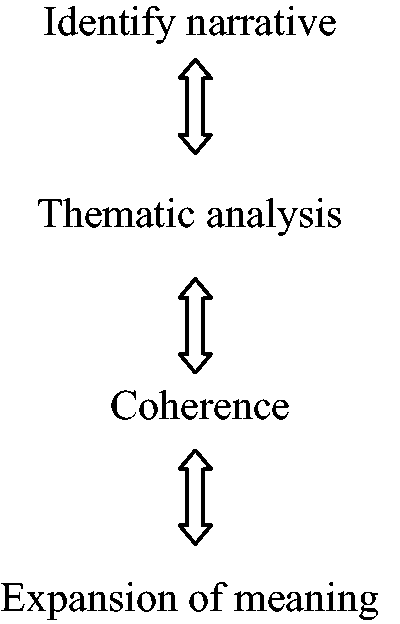
Results
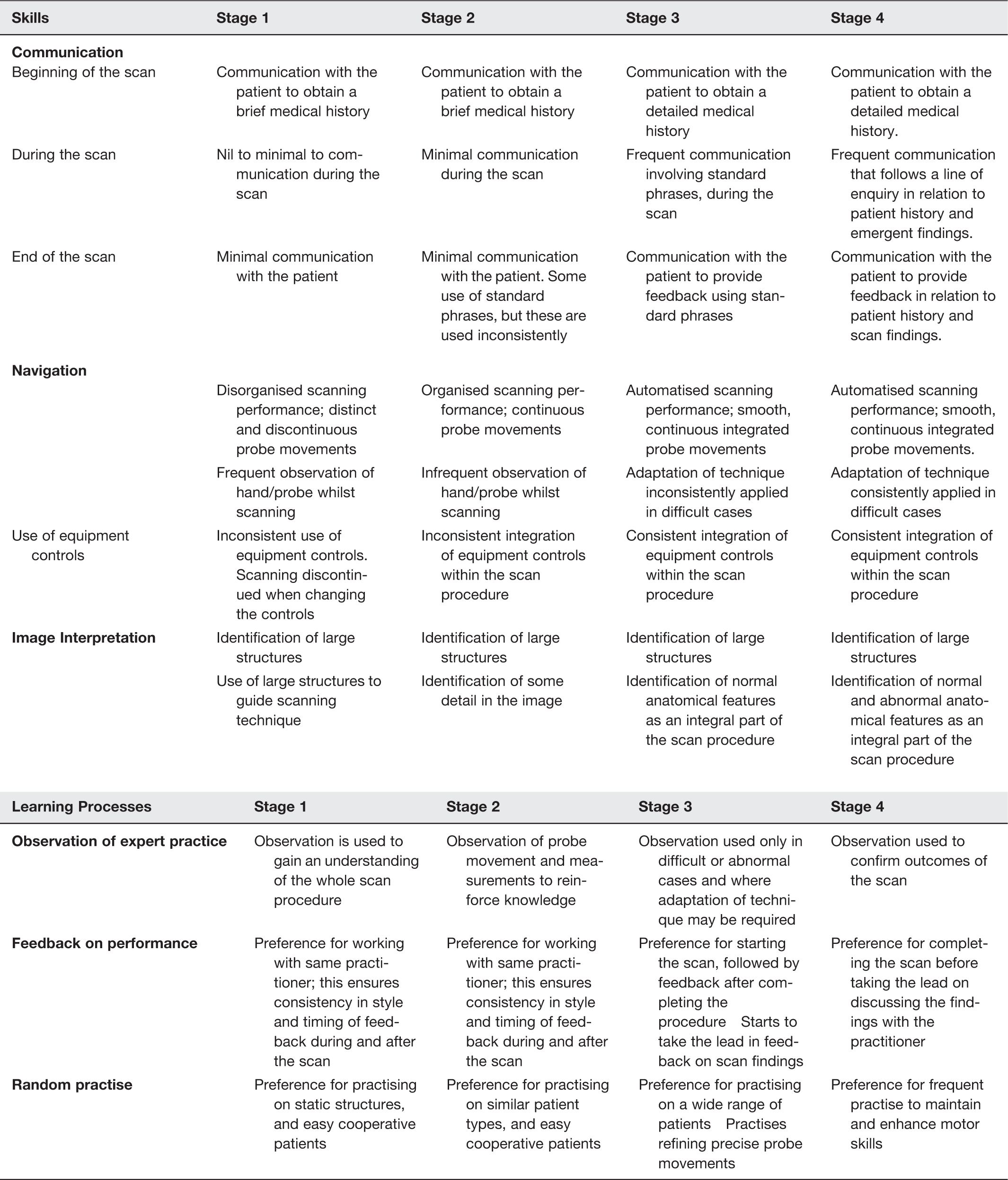
The dominant themes are presented in The Framework for Guiding Learning in Ultrasound Scanning (Table 1). The four stages (numbered 1–4) show progression in scanning from being a novice scanner (Stage 1) to a competent scanner (Stage 4) over a 12-month period. Each stage represents a three-month period of learning. The dominant themes derived from the data fall broadly into two categories:
Skills acquired to become competent. In this category, the dominant themes were:
Communication with the patient; Navigation skills and Image interpretation. Learning processes supporting skill acquisition. In this category the dominant themes were:
Observation of expert practice; Feedback on performance and Random practise. A framework for guiding learning in ultrasound scanning
Presenting the themes in a framework was a convenient way of comparing the development of ultrasound skills over the four observation periods.
Discussion
Each of the dominant themes presented in the framework will be discussed. Firstly, the three themes on the skills acquired in becoming competent will be outlined followed by an overview of the three themes on the associated learning processes.
Communication with the patient
During the early stages of learning, communication between learner and patient occurred infrequently with very little exchange taking place during the examination. In the later stages, frequency of communication with the patient increased during the scan session as learners became more confident. Progress in communication was shown across the four stages leading to detailed discussions on the scan findings in the later stages.
High levels of concentration are needed15,16 in early stages of skill acquisition, which is likely to impact on trainees’ ability to communicate whilst scanning. Once scanning becomes more practised 17 by Stage 3, the level of concentration required is less intense,17,18 which means attention can be focussed more on communication with the patient during the scan.
Navigation skills
Navigation skills in ultrasound scanning involve a range of probe movements. For example, large scoping movements to cover a wide area quickly, to finely controlled probe movements when examining structures more carefully. According to Fitts, 17 when hand movement tasks are performed proficiently, they should appear smooth and continuous.
During Stage 1, learners’ scan technique was disorganised and unstructured, probably caused by poor hand eye coordination skills. 19 For example, learners often watched the probe instead of the screen when they found it difficult to relate structures in the image with the probe position on the patient. Having a systematic approach to scanning improved hand–eye coordination. This in turn led to the development of continuous scanning movements during Stage 2.
By Stage 3, scanning movements were better coordinated and more fluent, which according to Fitts 17 represent an automatised stage of skill acquisition. During Stage 4, learners demonstrated smoother scanning actions with continuous movements of the probe; these findings are consistent with Fitts’s description of proficient performance. 17
Image interpretation
Image interpretation skills developed over the four stages of learning from identifying large and obvious structures in Stage 1 (for example, foetal head, foetal body and heart beat), to analysis and image interpretation in Stage 4.
Being able to see large structures consistently provided learners with a basis to recognise more complex structures. In Stage 2, pattern recognition skills were developed through repeated visualisation of the same types of structure. With practise, learners were able to identify more image detail alongside larger features and this developed their ability to recognise complete structures within the ultrasound image. Being able to see fine detail in the context of large structures has been reported in pilot training during development of situation awareness skills. 20 By Stage 3, identification of normal appearances had become an integral part of the scan.
Image interpretation skills were further developed during Stage 4, enabling learners to scan efficiently and adapt technique according to what they saw in the image. Concurrent image analysis and interpretation are an integral part of the decision-making process. 21 Stage 4 learners could differentiate between normal and some abnormal features and confidently report on scan findings.
Observation of expert practice
Observation of practice is important for integrating theory into practice. 22 Watching expert practitioners scan helped early stage learners orientate the image as they were able to view both the image and positioning of the probe at the same time.
In Stage 2, observing practitioners scan helped learners identify more complex structures. Observation served to develop pattern recognition skills 15 and reinforce knowledge. Learners found observation of expert practice in later stages useful for developing scan technique in difficult cases.
Feedback on performance
Feedback on performance is an integral part of learning; 22 how feedback is given and when it is provided are important factors to consider. Feedback given during the scan benefitted early-stage learners as they were able to make corrective measures to their practice. Working with the same practitioner during Stage 1 provided a consistent approach for learners to receive guidance and feedback on technique.
Studies report that feedback given after completion of a skilled task is more beneficial for supporting learning in the longer term.23–25 During Stage 3, the preferred method for giving feedback was after the examination as this enabled learners to scan unhindered. Working with different practitioners during Stage 3 also helped learners to diversify their practice by introducing alternative approaches to scanning.
Random practise
Random practise is when practising a skill takes place under a range of different conditions, and is how learners in this study acquired their scanning skills. Although learning ‘in situ’ is known to lead to better long-term knowledge retention and skill transferability,26,27 it was found to have some limitations for learning scanning. This included being too time consuming, particularly for Stage 1 learners who did not have the skill set to complete a scan. Instead, they benefitted by focussing their attention on developing navigation skills and locating large structures.
Practising to scan on static structures in cooperative patients was seen as most desirable during the early stages, because poorly controlled probe movements made it difficult to scan moving targets. Once learners were more confident in scanning, they were able to focus on refining probe movements, scanning moving structures and observing smaller and more detailed structures.
Evaluation of the research process
Whilst this was a small group of participants, the methodology provided a rich source of data generated in a clinical context. It provided a way to better understand learning experiences 6 and for developing theory around practice. 7
Participant observation is usually used to seek direct observation of events 28 whilst allowing the researcher to be an integral part of the situation. 29 This had advantages for experiencing behaviours and clinical interactions first hand, but my presence could have impacted on the participant’s behaviour even though they were in their usual clinical setting.
Each participant saw records of observation data and interview transcripts which provided a way of authenticating the data. 6 All reports were agreed as a fair representation of events. Narrative enquiry has been used previously to explore learning experiences in the classroom 30 and has now been shown to be a useful approach for providing insight into learning ultrasound scanning.
The Framework has recently been used to provide guidance for training individuals in focussed areas of muskuloskeletal ultrasound. We reported high levels of reliability 31 based on a trainee’s performance after undergoing such training. Further work is warranted, however, to evaluate the framework more fully across a wider range of ultrasound domains.
Conclusion
The Framework for Guiding Learning in Ultrasound Scanning consists of a four-staged approach. It is designed to provide guidance in learning for students and clinical practice educators, and shows progression in scan performance across the stages. The skills and learning processes presented here could contribute to monitoring of trainee development. Exploration into how the framework could inform ultrasound simulator training is also warranted.
Ultrasound scanning is a complex dynamic imaging modality and this framework presents a simplified overview of ultrasound. The time taken to acquire high levels of scanning proficiency should not be underestimated. The framework is therefore offered as a basis for further evaluation and development.
Footnotes
Declarations
Acknowledgements
The author thanks all stakeholders who contributed to the data-generation process during the development of the framework.