



Abstract
Recent studies investigating chronic cerebrospinal venous insufficiency highlighted that intracranial venous return has not yet been routinely investigated by ultrasound in the normal population. This creates an absence of a reference standard and raises concerns that the approach introduces variations into the results. The primary objective of this study was to develop reference standards for the assessment of the internal jugular vein in a normal population. A prospective small-scale study was conducted. Internal jugular veins of 31 normal candidates were examined using B-Mode and PW Doppler. Measurements at proximal and mid-point internal jugular vein were taken in sitting (90°) and supine (0°) positions. Area measurements were taken during passive respiration in cm2. Time average velocity measurements were taken during passive respiration over a 3-second period. Reflux measurements were taken after apnoea and reflux was recorded from any reversed flow. Measurements were taken three times; an average was calculated and statically analysed. Of the 31 participants, one was excluded from the study and 30 were suitable. The Mann-Whitney U test was used to analyse the results; all results (area, time average velocity and reflux) showed that there was a significant difference between the two positions with p < 0.05 (two-tailed). This pilot study does suggest that there is a significant difference in area, time average velocity and reflux measurements of the internal jugular vein when taken in the sitting and supine position, which could affect the outcome of chronic cerebrospinal venous insufficiency. A further large-scale study is required to validate and standardise the assessment of the internal jugular vein.
Introduction
McDonald criteria (revised 2005) 4

Research by Zamboni et al. 2 trialled percutaneous venoplasty as a treatment for CCSVI and reported that quality of life and venous pressure were positively influenced by the procedure with a low complication rate. Published research evidence relating to CCSVI, however, has given conflicting information. Although several studies using catheter venography and magnetic resonance venography have given reasonably consistent findings of abnormal venous flow patterns in participants with MS, 2 studies using duplex ultrasound have provided a less consistent picture, with wide variation in the findings. This may be in part due to the heterogeneity in the methodology and the lack of a definitive protocol for the assessment of the extra-cranial venous circulation. In March 2012, the National Institute for Health and Clinical Excellence (NICE) produced guidance on the use of percutaneous angioplasty for CCSVI, which advised that the current evidence for percutaneous venoplasty for CCSVI had limited research, which was inadequate in quality and quantity. The NICE guidelines recommend that this procedure should only be used within the context of research and that further research into cerebral venous blood flow was required before this procedure can be considered for clinical practice.
Rationale for research
Current guidelines for the ultrasound assessment of the internal jugular vein (IJV) are very limited and lack supporting evidence. Intracranial venous return has not yet been routinely investigated with ultrasound in the normal population, which creates an absence of a reference standard when assessing the IJV for CCSVI. In addition, it is well documented that patient positioning affects the venous flow patterns in the IJV with maximum outflow through the IJV occurring in a supine position whilst a portion of the venous outflow from the brain diverts through the vertebral veins in the upright position.5,6
This pilot study examined variation in flow patterns in the IJV with the aim of determining the feasibility of defining the normal range of variation in flow characteristics in the IJV and whether this is significantly affected by the position in which the patient is scanned (sitting or supine).
Methods
Sampling and recruitment
A convenience sample of 30 healthy volunteers was recruited for this pilot study from the staff members in the Department of Medical Physics and Bioengineering at University Hospitals Bristol NHS Foundation Trust (UH Bristol). In accordance with the revised edition of Governance Arrangements for Research Ethics Committees (GAfREC), National Research Ethics Committee (NRES) approval was not required for the study. Approval for the study was granted by the University of the West of England Research Ethics Sub-Committee of the School of Health and Life Sciences and the Research and Development office at UH Bristol.
The exclusion criteria for this study were based on exclusion criteria from previous studies that used healthy controls.1,2,5,7,8 The exclusion criteria were participants with MS, steroid treatment during the 30 days preceding participation in the study, pre-existing medical conditions known to be associated with brain pathology (e.g. cerebrovascular disease and a positive history of alcohol abuse), a history of cerebral congenital vascular malformation (e.g. Klippel-Trenaunay, Parkes-Weber and Servelle-Martorell), any neurologic or other relevant medical conditions (e.g. a history of cerebral venous thrombosis or history of central line placement) and any participants that were unable to lie flat. Prior to commencing data collection, participants provided written informed consent.
Data collection methods
Data collection took place at the Vascular Studies Unit in the Bristol Royal Infirmary. Ultrasound was performed using a Logiq 9 (GE Medical Systems, Hatfield, UK.) equipped with a 10-MHz linear transducer. The equipment setting was the standard superficial venous pre-set, which was adjusted as required for each patient for optimum imaging. All ultrasound assessments were undertaken by a single clinical vascular scientist with 3 years’ experience in performing vascular ultrasound and a postgraduate certificate in medical ultrasound.
The unit area, time average velocity (TAV) and reflux duration were assessed in the right IJV of each participant in both the seated position (90°) and the supine position (0°) (see Figure 1). Two measurement sites were selected: the proximal IJV and mid IJV at the level of the laryngeal prominence of the thyroid cartilage. A set of three measurements was taken at each site for each parameter and an average was calculated (see Figure 2).
Scanning the internal jugular vein at 90° (sitting position) Ultrasound image of the internal jugular vein at 0° (supine position)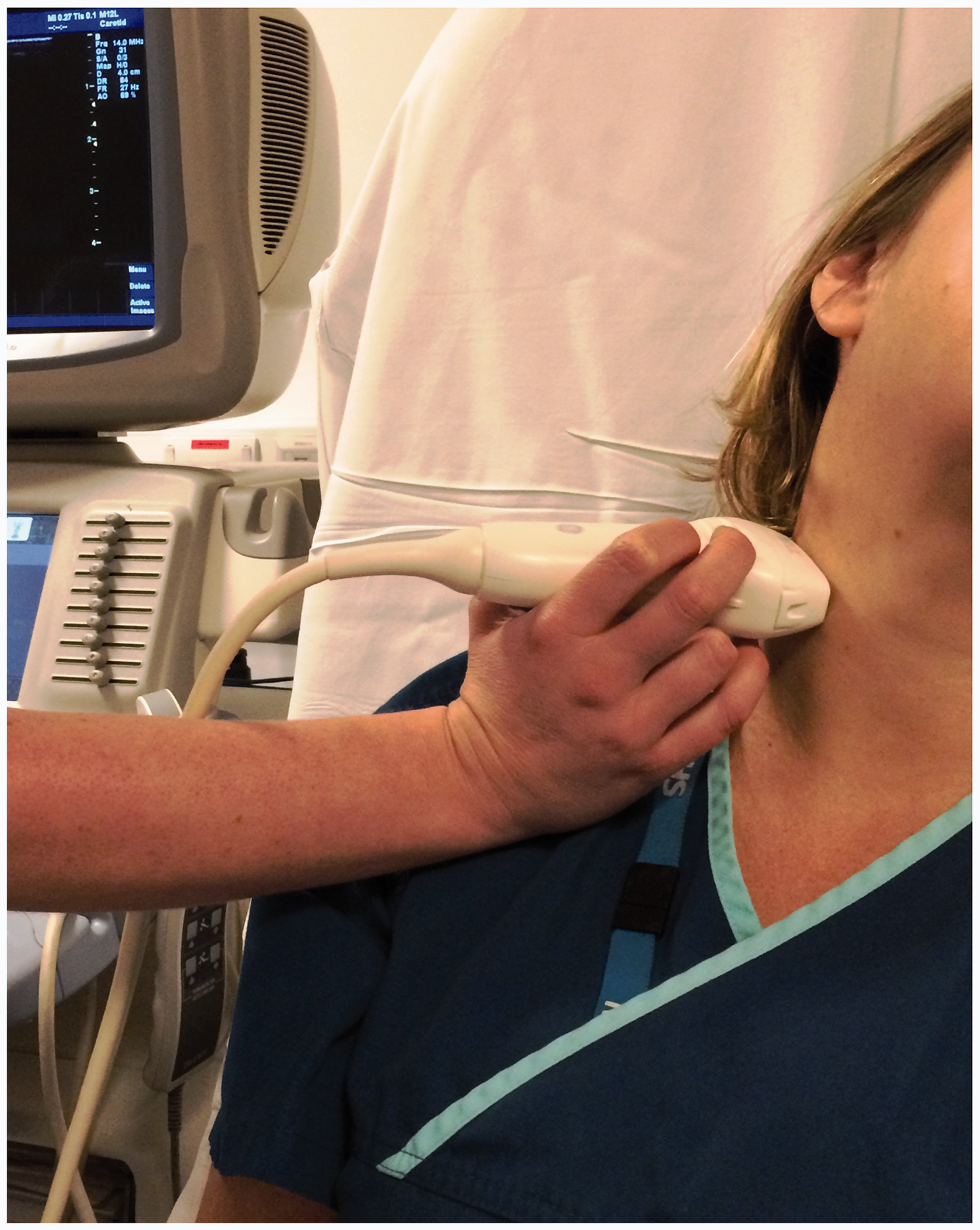
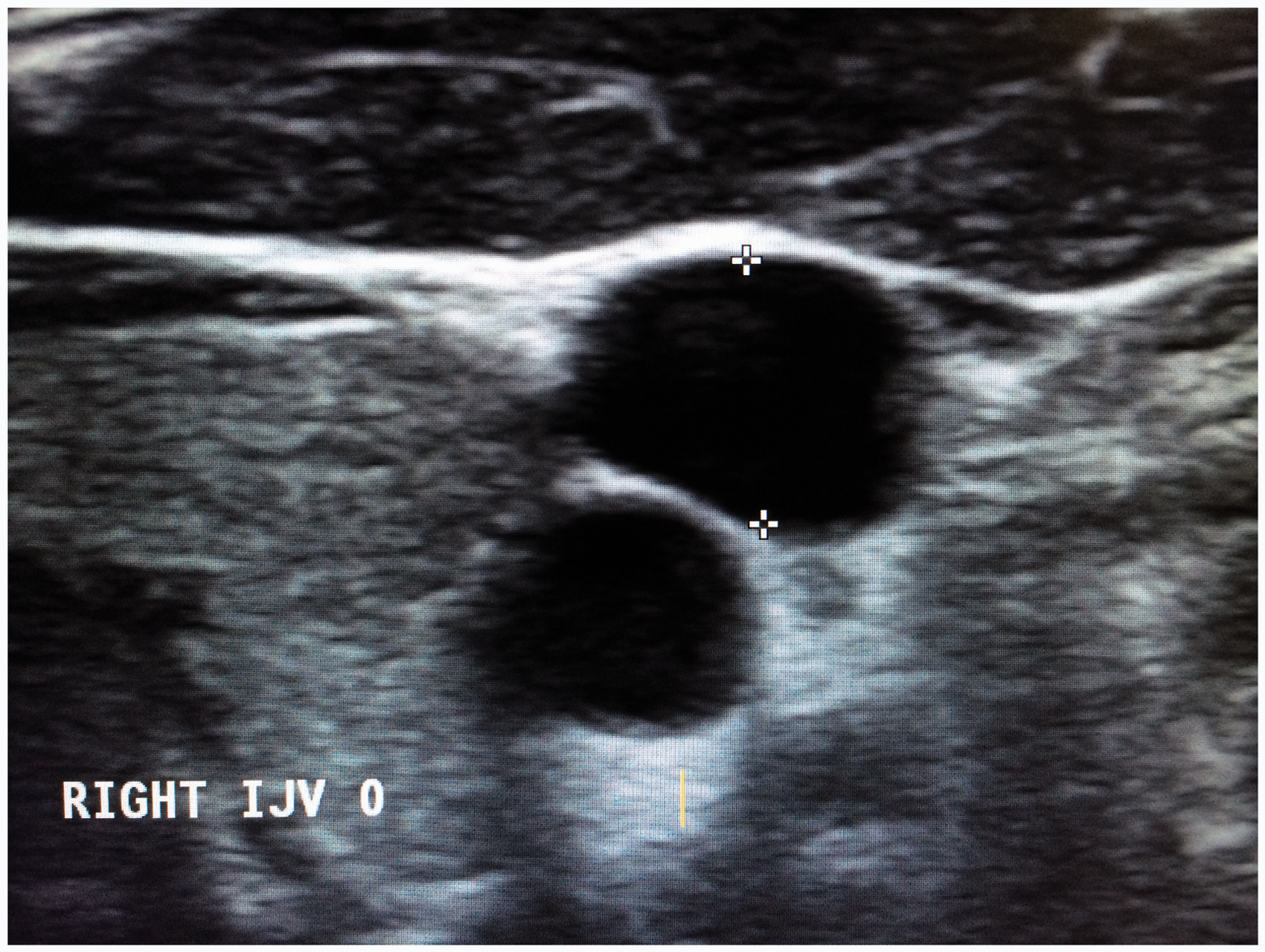
Measurements of unit area (cm2) were taken during normal respiration. Care was taken to ensure minimal pressure was used when taking the measurements to avoid compressing the vein. TAV was measured to minimise variability issues relating to taking absolute velocity measurements in a pulsatile vein such as the IJV. TAV was measured during normal respiration over a period of 3 seconds. Reflux assessment was made following a short period of apnoea then exhalation. Participants were not asked to perform the Valsalva manoeuver. Reflux (if any) was measured from the exhalation. The image was paused and flow reversal was measured from the Doppler spectral trace. Reflux duration was recorded in milliseconds (ms) and abnormal reflux was defined as flow reversal for >0.88 seconds based on a study of reflux time cut-off values in the IJV. 9
Data analysis
The ratio data obtained were tested for normal distribution using the Shapiro-Wilk test. A 5% significance level was used to determine the level at which the null hypothesis is rejected. The area measurement data from the proximal and mid-IJV at 0° were not normally distributed. Area data from the proximal and mid-IJV taken at 90° were also significantly different from normal (p < 0.001). TAV data from the proximal IJV at 90° were normally distributed, however, all other TAV data were not normally distributed. Reflux data taken at 0° were significantly different from normal (p < 0.001). All reflux measurements at 90° had a constant result of 0 and were therefore omitted from the test. As the data sets were not normally distributed, the Mann-Whitney U test was used to test for significant differences in results between the two positions.
Results
Measurements obtained in the 0°and 90° position

TAV: time average velocity
The data obtained from the two different positions were compared using the Mann-Whitney U test. Proximal IJV mean area in the 0° supine position was greater (0.77 ± 0.36 cm2) compared to mean area in the 90° seated position (0.10 ± 0.08 cm2). The Mann-Whitney U test demonstrated a significant difference in mean area between the two positions with U = 14.500 and p < 0.01 (two tailed). Mean area in the mid IJV was also greater in the 0° supine position (0.56 ± 0.29 cm2) compared to mean area in the 90° seated position (0.11 ± 0.08 cm2). The Mann-Whitney U test again demonstrated a significant difference in mean area between the two positions with U = 23.500 and p < 0.01 (two tailed).
The mean TAV (41.92 ± 23.82 cm/s) in the proximal IJV was greater at 90° compared to the mean TAV (18.22 ± 13.61 cm/s) at 0°. The Mann-Whitney U test showed a significant difference between results from the two positions with U = 189.000 and p < 0.01. The mean TAV (21.27 ± 13.72 cm/s) in the mid IJV was greater at 90° compared to the mean TAV (14.70 ± 11.26 cm/s) at 0°. The Mann-Whitney U test showed a significant difference between results from the two positions with U = 316.000 and p < 0.05.
Results of Mann-Whitney U test
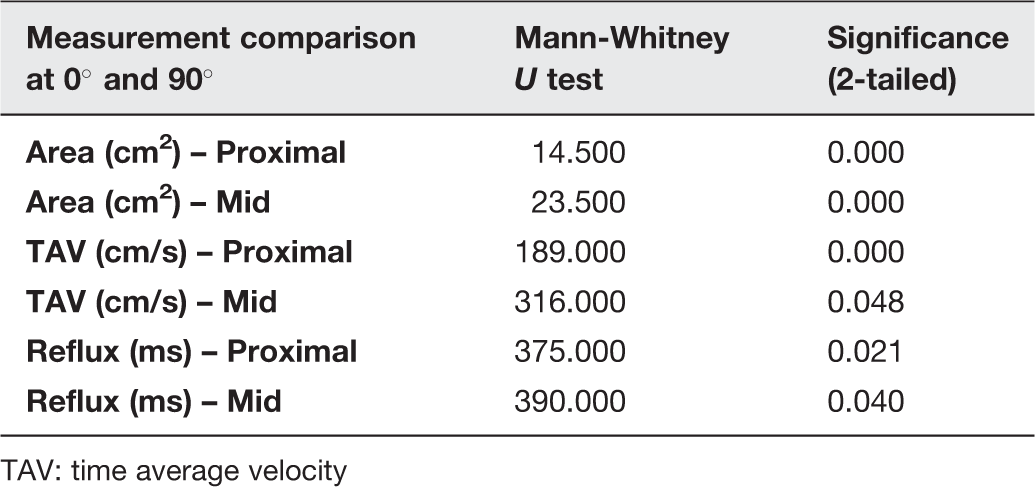
TAV: time average velocity
Discussion
Although it is difficult to make direct comparisons with the findings of previous research due to heterogeneity in the methodology used, some limited parallels can be drawn with studies previously undertaken in this field.
Area and flows
Blinkenberg et al. 10 examined CCSVI using ultrasound and MRI. Part of the study measured cross-sectional area (CSA) in the proximal IJV of 15 healthy controls (HCs) at 0° and 90°. The results demonstrated a mean CSA at 0° of 103.8 mm2 on the right and 74.4 mm2 on the left. At 90° the mean CSA was measured as 34 mm2 on the right and 16.8 mm2 on the left. Mean right-sided proximal IJV CSA measurements in our study were smaller in comparison to those from the Blinkenberg et al. 10 study with a mean CSA of 77 mm2 at 0° and a mean CSA of 10 mm2 at 90°. Bellazzini et al. 11 performed a study examining methods of increasing IJV area in 52 HCs. This study compared CSA measurements taken in the 0° supine position with CSA measurements taken in the Trendelenburg position. This study found a mean CSA of 1.02 cm2 in the 0° supine position, which was again larger than that found in our study.
Nedelmann et al. 12 investigated different modalities for assessing the IVJ. Part of this study used ultrasound to assess diameter measurements of the proximal IJV in the 0° supine position. Results from this study showed a diameter range of 0.29–1.06 cm on the right and 0.25–0.88 cm on the left. Although direct comparison with CSA measurements from our study is not possible due to heterogeneity in the method of measurement, both studies demonstrate a large range in the results, illustrating the challenge of defining normal IJV dimensions.
Doepp et al. 5 compared the presence of CCSVI in MS patients and HCs. The IJV was examined in 20 HCs using a detailed protocol. The right and left IJV were assessed in both the 0° supine position and the 90° seated position, but measurements were obtained from a more distal location near the mandibular region compared to our study. CSA and TAV were measured in both positions. This study found a mean right IJV CSA of 50 mm2 in the 0° supine position and 14 mm2 in the 90° seated position, results which are similar to the findings from our pilot study. Results for TAV measurements, however, conflicted with those from our study. Doepp et al. reported a mean right IJV TAV of 24 cm/s in the 0° supine position which decreased to 18 cm/s in the 90° seated position. Conversely, our study measured a mean TAV of 14.70 cm/s in the mid IJV at 0° which then increased to 21.27 cm/s in the 90° seated position.
The study by Gisolf et al. 6 examining the effect of positioning on venous pressure and outflow found that the IVJs are the main venous outflow pathway when in the supine position but collapse in the standing position as blood is shunted through other vessels. This was demonstrated by a smaller mean IJV CSA in the supine position, which is consistent with our findings.
Findings in relation to the McDonald criteria
Criterion 1 (IJV reflux >0.88 seconds)
None of the participants from this pilot study demonstrated reflux in the IJV of >0.88 seconds in either position, which is consistent with the findings from the Zamboni et al. study 2 in which IJV reflux of >0.88 seconds was also found in none of the HCs. Mayer et al. 1 and Doepp et al. 5 also found no HCs with reflux of >0.88 seconds in the IJV, in either the sitting or supine position. In contrast, the study by Tsivgoulis et al. 7 did, however, demonstrate reflux >0.88 s in the IJV of one HC and Nedelmann et al. 9 demonstrated reflux >0.88 seconds in 18 IJVs from 20 HCs (40 IJVs assessed).
Criterion 3 (CSA ≤0.3 cm2)
In all, 3% of participants (1/30) from our study demonstrated a CSA ≤ 0.3 cm2 in the proximal IJV and 20% (6/30) demonstrated a CSA ≤ 0.3 cm2 in the mid IJV in the 0° supine position. An overall trend towards a smaller CSA was noted with participants in the 90° seated position with 96% (29/30) revealing a proximal IJV CSA of ≤0.3 cm2 and 96% (29/30) with a mid IJV CSA of ≤0.3 cm2. These results conflict with the results from the Zamboni et al. 2 study in which 0% (1/235) of HCs achieved an IJV CSA of ≤ 0.3 cm2. However, the participant position in this study is poorly described, making it difficult to draw a comparison. A study by Tsivgoulis et al. 7 assessed 43 HCs at 0° and 90° and also found no HCs exhibited an IJV CSA measurement of ≤0.3 cm2 in either position. Details of the IJV measurement site were not described, however, which again makes it difficult to compare the findings with our own.
A study by Mayer et al. 1 investigated the presence of CCSVI in MS patients and HCs. In contrast to the Zamboni et al. 2 study, 16/20 of the HCs in the Mayer study had an IJV CSA measurement of ≤ 0.3 cm2 when measured in the 0° supine position. This is a much larger proportion than was found in the supine position in our study, however, the protocol for the Mayer et al. study stated that the IJV measurement was obtained at its smallest point rather than at defined sites as with our study.
Limitations of the study
This study was a small-scale pilot study using a convenience sample of volunteers in a single geographical location. These methodological compromises were driven by time constraints for an MSc project and ethical considerations relating to use of ultrasound technology for research during clinical hours, but the authors acknowledge that these factors will have reduced the external validity of the study. Some previous studies have identified a right-sided dominance in the IJV. Studies by Nedelmann et al., 12 Furukawa et al. 13 and Blinkenberg et al. 10 all identified a trend towards larger area measurements in the right IJV compared to the left IJV. In a larger scale study, collecting data from both sides would be necessary.
The authors also acknowledge that the technical challenges of an ultrasound assessment of the IJV may impact on the reliability of the data. The IJV is anatomically superficial and therefore relatively easy to compress. This makes taking an accurate area measurement technically challenging as it is important to make sure the IJV is not compressed. In addition, obtaining accurate Doppler flow measurements from the IJV is difficult due to the pulsatile nature of flow in this vein. It was for this reason that TAV was used to assess reflux rather than peak systolic velocity. The technically challenging nature of this type of ultrasound assessment is therefore likely to create a degree of inter-sonographer variability, which would be prudent to examine in any future large-scale study. These limitations aside, data for this study were collected prospectively from a good age range of participants (23–73 years) by a single experienced vascular scientist using a clearly defined protocol.
Conclusion
This pilot study demonstrated that participant positioning does alter the area, TAV and venous reflux measurement of the IJV. The study found that the mean IJV area was larger in the 0° supine position, TAV was higher at 90° and that venous reflux was higher when measured in the in the 0° supine position. Statistical analysis showed a statistically significant difference in area, TAV and reflux measurements between the two positions. It was noted that one part of the CCSVI criteria measures area with the bed ‘tilted’; a further measurement could be taken and compared to expand this study at a 45° tilt.
Although this pilot study did not provide sufficient evidence to determine criteria for the assessment of the IJV, it did provide a useful insight into IJV characteristics which could be further investigated with a much larger study and has defined a suitable protocol for performing such a study. The research undertaken for this pilot study has also highlighted the need for further investigation into ultrasound assessment for CCSVI and its impact on MS.