




Abstract
This paper analyses the predominance of the ‘negativity’ factor as the primary determinant of news coverage in the German press – Süddeutsche Zeitung, Frankfurter Allgemeine Zeitung, Die Tageszeitung and Der Spiegel – of events in Latin America. Based on a sample of 3831 articles published between January 2000 and December 2014, this study finds a general concentration of negative events (43.05%) with regard to 20 Latin American countries. However, since this number does not exceed 50%, the research assumption of a conflict-oriented news reporting has to be relativised. The ‘negativity’ rate stands out as sectorial depending on specific countries and areas of news coverage. Considerable interest in cultural issues helps to provide a more balanced image. While Honduras, Haiti, Ecuador, the Dominican Republic and Paraguay exhibit a strong negative balance, Costa Rica, Uruguay, Chile and Cuba boast a dynamic, positive image. Brazil and Mexico account for two ambivalent cases.
Keywords
Introduction
Several studies confirm that the ‘negativity’ factor has become one of the most substantial media’s selection criteria. An analysis of the excessive attention paid to negative news showed, for instance, that although the total number of aviation incidents has decreased over the years, its relative media attention has escalated (van der Meer et al., 2018). Harcup and O’Neill (2017) have defined bad news as ‘stories with particularly negative overtones, such as conflict or tragedy’.
The debates within the context of the New World Information and Communication Order (NWICO) in the 1970s drew attention to the adverse way in which the Third World was depicted in Western media (Masmoudi, 1979; Samarajiwa, 1984; Sreberny-Mohammadi, 1984). Regarding Latin America, Wilke and Quandt (1987: 30–31) scrutinised several studies about the region’s image produced in the 1960s and the 1970s in Germany. They concluded that since the continent does not belong to ‘elite nations’ and due to the lack of other news factors such as ‘geographic’, ‘political’ or ‘economic proximity’, ‘negativity’ was the most relevant factor for its media attention (ibid.).
Nevertheless, how various Latin American countries have been connecting to the rest of the globe is utterly different from the way it used to be from the 1960s until the 1990s (Lowenthal and Baron, 2015: 25). The continent became substantially different over these years not only politically, but also economically and socially. Following the end of the Cold War and its influence over the region, the last two South American military dictatorships – in Chile and Paraguay – ceased to exist, indicating the consolidation of representative democracies in the region. The influence of the USA on various South American states decreased considerably with regard to domestic affairs. Moreover, many countries developed extraordinarily diversified and often relevant global connections, not only within the continent, but also with Europe, Africa, Asia and the Middle East (ibid.). Furthermore, since the beginning of the millennium, political leaders in the continent have turned left, starting with Hugo Chávez in Venezuela in 1998.
The German government has recognised this new social, political and economic evolution in Latin America. The Bundesregierung (Federal Cabinet) declared in 2010 a new foreign policy for the region as a reaction to the ‘increased economic and political significance of Latin America’ (Auswärtiges Amt, 2010: 6). One can quickly identify this importance by observing the more than 1,300 German-Brazilian companies responsible for employing about 250,000 people (Auswärtiges Amt, 2017).
Given the particular importance of the ‘negativity’ factor and this new political framework at the beginning of the 21st century, this article aims at investigating the role of ‘negativity’ in the image formation of Latin America within this recent political order. In particular, it focuses on the news produced by the German press, and it provides, therefore, an update on the literature within the theme. If world news reveals the power and structures of the global system, it is necessary to explore whether or not Latin America might be receiving a different news treatment by the press, when compared to earlier decades. The assumption of Wilke and Schenk (1987: 31) that ‘negativity’ is the only relevant news factor related to Latin America might be partially obsolete.
Theoretical framework and state of research
The relevance of foreign reporting
With the end of the Cold War, the world moved into an era of globalisation that further reinforced the significance of international news coverage. Its importance lies in the fact that foreign news can ‘shape our perceptions of other countries and cultures’ (Hanitzsch et al., 2015: 105). Since obtaining, classifying and analysing information from all parts of the world is a considerably complicated task, the majority of people are highly dependent on information provided by mass media about events in the world at large. Without a continuous news flow, the information society would not be achievable (Cippitelli et al., 2003: 15). Several scholars have demonstrated the effect of mass media – in particular of international news – on their audience’s image of countries, that is, on the media influence on public perceptions of foreign countries (McNelly and Izcaray, 1986).
Pertinent here is the theoretical notion of ‘agenda setting’, which discusses the mass media’s activity in selecting specifics topics and describing them regularly and prominently to the audience. Hence, a substantial number of citizens understands such chosen events or countries as more relevant and meaningful than others (Coleman et al., 2009). The traditional approach of agenda setting discusses a moderate media influence on social cognition – or, to put it differently, how the public learns about the relevant topics of the day or what they are going to talk about, according to the amount of coverage given by the media to a specific theme or state (Salwen and Matera, 1992: 623; Wanta et al., 2004: 364).
On the other hand, a recurrent second level of analysis considers the agenda of attributes or how the public is going to think about a specific country or issue (Wanta and Hu, 1993). This type of studies brings together two strands of research, agenda setting and frame analysis, thus indicating that the media also sets the frames agenda for the audience. Wanta and Hu (1993) have shown, for instance, that four specific themes of international news coverage have more robust agenda-setting influence, namely ‘international conflict involving the United States; terrorism involving the U.S.; crime/drugs; and military/nuclear arms’ (Wanta and Hu, 1993: 250). Moreover, Wanta et al. (2004: 364) have indicated that negative coverage leads to negative perception of a country, which confirms the second level of agenda setting.
Within this context, it is worth questioning how often Latin American states appeared in the German press (salience) over the first 15 years of the 21st century and how the media framed these countries. Apart from analysing the visibility of these states in the German press, this article aims at investigating the thematic topics associated with the continent to determine if the German press coverage presents them within a positive, negative or neutral framework.
International news flow
In the 1970s, there was a critical discussion on the lack of balance in international news coverage. Most of the foreign news at the time originated within the Global North and reported primarily about its achievements. Events about the Global South – if covered at all – looked only at natural or political disasters, that is, framed regarding negative news (Golan, 2006: 324). This imbalance was responsible for an ill-informed public sphere across the globe, in contradiction to a period in history when global societies were becoming more and more economically and politically interconnected (Boyd-Barrett and Rantanen, 1998). A significant point of criticism was the uneven and biased representation of the developing world (often labelled the ‘Third World’).
Researchers argued that the international news flow between developed and developing countries should be more balanced in amount, direction and subject (Kim and Barnett, 1996: 324). On the other hand, the role of the primary international news agencies as agenda setters was pointed out as a reason for the dominance of Western industrialised countries in the global news flow (Kim and Barnett, 1996). Moreover, the ‘Foreign News Study’ by the United Nations Educational, Scientific and Cultural Organisation (UNESCO) demonstrated that the USA, followed closely by Western Europe, received much more attention from the global media system than Asia, Africa and Latin America (Sreberny-Mohammadi et al., 1985: 39–43). The strong presence of Western Europe and the USA revealed the majoritarian North–South relationship among countries and the neglect of South–South communications (Hafez, 2005: 47–48).
The composition of foreign news remained unbalanced over the years, even though a few countries in Asia (such as China) gained more visibility. Recently, Wu conducted a comparative study of newspapers from 44 countries and concluded that the USA continued to be the country with the highest visibility, followed by the UK, France, Russia and China (2004). Other studies concerning news on television channels and websites also confirmed this discrepancy. A multinational project (Wilke et al., 2012) analysed foreign reporting on television in 17 countries and concluded that Europe was the most covered continent, followed by North America and the Middle East. There is ‘hardly any indication that the news geography has become less Euro-centric’ (Wilke et al., 2012: 319).
When compared to other continents, Latin America remains a blind spot in international reporting in Germany and other media systems in Europe and around the world. As a regional correspondent noted, if ‘South America or Latin America disappear, no one would even notice in Hamburg’ (Wienand, 2008). Thus, one can expect that Latin America would receive little visibility in the German press and that the attention paid to its various countries would reflect the power structure within the continent.
‘Negativity’ as a news factor in the media
Empirically, academics have been operationalising the ‘negativity’ factor in different ways. ‘Negativity’ for Schulz (1976), for instance, was coded through ‘conflict’ (only based on political issues), ‘crime’ and degrees of ‘damage’. In contrast, Staab (1990: 220–225) analysed ‘controversy’ separately from ‘aggression’ and also distinguished between real and possible damage. In his analysis, Bohle (1986: 789) pointed out that the factor has been defined simply as ‘information about events, objects or other referents which are themselves generally considered to be unpleasant or harmful’. Bohle identified various classifications of negative news such as ‘international wars and disputes, life-threatening mishaps to individuals and nations’ economic troubles and frauds’ (1986: 789). Caple and Bednarek (2016: 439) defined the ‘negativity’ factor as ‘the negative aspect of an event or issue’, for example, ‘conflict, death, disaster, accidents, negative consequences’ (Bednarek and Caple, 2014: 136). Harcup and O’Neill (2017: 13) described the factor similarly: ‘stories with particularly negative overtones, such as conflict or tragedy’. In their analysis of negativity within financial reporting, Boukes and Vliegenthart (2017) differentiated between ‘negative’, ‘mostly negative’, ‘mixed negative’ and ‘positive’ news.
Negative news better coincides with the frequency of daily papers and news channels than positive events (Galtung and Ruge, 1965: 69–70). On the other hand, they are more unexpected than the good news since the occurrences themselves are scarcer and hence less predictable (ibid.). Several analyses of international news coverage and image of countries in the German media explore the ‘negativity’ factor, even if using different methodological approaches. Nafroth, for example, could not immediately sense the trend of negativism in the case of Japan’s foreign news reporting. As noted, overall, ‘there is no evidence of the dominance of negative events concerning Japan’ (Nafroth, 2002: 122).
In the case of China’s news coverage in the German media in 2008 (Richter and Gebauer, 2010: 11), a qualitative thematic analysis identified an existing conflicting message. Indeed, despite ‘the quantified diversity of topics, there is a core agenda in the area of conflict and violence’ (ibid.). Another empirical study about China (Bieber, 2011: 79–89) takes into consideration the reporting of the country based on thematic cycle analysis. The author concluded that the correspondents presented crises more often in a negative rather than positive light (Bieber, 2011: 87).
Another study concerning news reporting about Africa in the German press (Mükke, 2009: 111) investigates the negative image of the continent based on a thematic selection rather than an evaluation of events. When considering topics such as war, crisis, conflict, corruption, natural disasters and disease, the degree of ‘negativity’ among Africa’s news coverage varies from 46% (Der Spiegel) to 33% (Süddeutsche Zeitung, SZ). In an extended period study of North Africa and the Middle East, Hafez noted that the coverage of this region is mostly neutral, negative-neutral and negative, while positive developments (merely 3.1%) appear only marginally (Hafez, 2002a: 60).
Against the trend of international news coverage worldwide, Pütz (1993: 217–223) concluded that only 13.5% of articles about Italy in Germany took into account the ‘negativity’ factor. Finally, research about the image of Brazil in the German press also showed a relatively good balanced image (Cazzamatta, 2014: 142).
With specific regard to Latin America, Wilke and Quandt (1987: 30–31) analysed studies of the image of the region produced in the 1960s and the 1970s in Germany. They concluded that ‘negativity’ appeared to be the most substantial factor in the foreign coverage of the continent. Accordingly, due to the geographical distance, the ‘regionalism’ factor did not apply to the continent. The ‘political’ and ‘economic proximity’ factors were applicable only in exceptional cases since the former Federal Republic of Germany maintained a less strong relationship with Latin American countries than other European countries. Moreover, it is worth considering that the continent belongs more to the Hispanic cultural sphere. Lastly, Latin America did not belong to the ‘elite nations’ club and could hardly be described as influential in the international scenario (ibid.).
Although the ‘geographic proximity’ factor remains unchangeable, the current international relations literature has been increasingly discussing ‘a transformed Latin America in a rapidly changing world’ (Lowenthal and Baron, 2015: 25). For this reason, this study assumes as an initial premise that the ‘negativity’ factor as the principal determinant of news coverage on Latin America might not be so accurate any more. Following on that, the following hypotheses are formulated:
Method
The primary goal of this article is to review the tendency towards ‘negativity’ in the case of news coverage of Latin America as described by the news value theory. Events selected by the German press are distinguished as positive, negative and neutral. The categories ‘negativity’ and ‘crisis’ are closely related, but even among negative topics such as the civil war in Colombia, it is possible to identify positive developments such as an attempts at negotiations, peace efforts, rapprochement or liberation of hostages. Crucial for the coding decision was the motivation of the article, what event provoked it and not necessarily just the underlined theme.
Hafez (2002b: 125) argues that both the quantity of the information flow – or the frequency with which a nation was mentioned in a negative context – and the total image balance is fundamental for image formation. To calculate the image’s evaluation of a country, I attributed the weight of –1 to negative articles, +1 to positive, and zero to neutral pieces. I then classified the events responsible for the articles’ publication according to their characteristics:
(A)
(B)
(C)
Unit of analysis
The content analysis includes at first the two main market-leading nationwide papers with the most substantial network of correspondents in the region: the Süddeutsche Zeitung (SZ, liberal and politically broad) and the Frankfurter Allgemeine Zeitung (FAZ, economically liberal and politically conservative). Additionally, the most important weekly political magazine of the country – Der Spiegel – was incorporated. Along with these three long-established publications, I also took into account the alternative paper Die Tageszeitung (taz) due to its relevance in the agenda-building process. In general, the unit of analysis in this study is grounded in three main arguments: readership, opinion leadership between reporters, and political scope.
Sample
I extracted every contribution in the printed editions of the SZ, FAZ, Der Spiegel and taz with direct mentions of the 20 Latin American countries from January 2000 until December 2014, thus totalling 15 years. Initially, I listed the articles and categorised them based on the publication, date of issue, and size of reports to organise the primary unit of analysis (21,929 news stories). I did not consider pieces from the SZ.de, FAZ.net, taz.de and Spiegel Online. This decision was taken based on a study of newspapers and online news services among 18 states in Europe, which concluded that 70% of the most significant online news articles are generally indistinguishable from the published versions (Wurff, 2008: 70).
The search principle took into account every mention of the word ‘Latin America’ or the names of its 20 countries and capitals in the title area as well as in the first paragraph. The correlated adjectives regarding the countries and its German declination were also entered to optimise the search specifications. SZ and FAZ have newspaper archives (reachable online), while articles from taz und Der Spiegel were available in the LexisNexis database. To make sure that all countries would have the same probability of being selected for the empirical analysis, I drew a sample of 20% of the produced articles from each country. This sample structure guarantees not only an accurate representation of every country, but also the incorporation of the most frequent and relevant (negative) occurrences during the 15 years of analysis. One finds notable adverse events during this period, such as:
The Argentinian economic crisis of 2001–2002.
The political turbulence in Venezuela in 2002–2003 and the coup attempt against Hugo Chávez.
The rebellion in Haiti and the coup against President Jean-Bertrand-Aristide between the years of 2003 and 2004.
Organised crime in Mexico and the ‘war on drugs’ from 2006 onwards.
The political crisis and the coup against Manuel Zelaya in Honduras in 2009.
The 2010 earthquake in Haiti and its consequences.
The civil war in Colombia in general. Manoeuvres of the Revolutionary Armed Forces and confrontations between guerillas, the army, the government and right-wing paramilitaries over the 15 years studied.
Furthermore, small contributions (of less than 150 words) were excluded since they provided almost no news factors. Each n-4th published articles (25% of the total) of a country within a newspaper were chosen based on the rotation principle. The requirement for a layered sample was satisfied considering prior knowledge over the distribution of the population from the previous listing. The final sample consisted of 3831 news stories. Then, I classified each contribution according to the area of coverage, central theme and sub-theme. Subsequently, I conducted a reliability test with a sample of 5% (227 news articles). Initially, I calculated the Holsti coefficient since I was dealing with small content analysis (Früh, 2011: 181; Rössler, 2005: 202) – less than 30 categories, just two coders and no missing values. The accordance between the two researchers reached 94.3%. However, considering the sharp criticism relating to the weakness of this parameter (Hayes and Krippendorff, 2007; Raupp and Vogelgesang, 2009; Swert, 2012), I also calculated the more precise Krippendorff’s alpha (.91), using the Hayes’ SPSS macro.
Findings
When considering the entire continent, the results demonstrate that adverse events dominate the news coverage of Latin American, even though one cannot confirm the theory of a ‘conflict perspective’ since the number of unfavourable articles does not exceed 50% (Hafez, 2002a: 63). Figure 1 shows that 43.05% of reporting on Latin American focuses on negative events, while 32.58% are related to positive occurrences and developments. Lastly, 24.36% of the reports describe neutral processes. When analysing the ‘negativity’ among individual papers, the amount varies from 39.6% (FAZ) to 48% (SZ), a similar pattern of reporting.
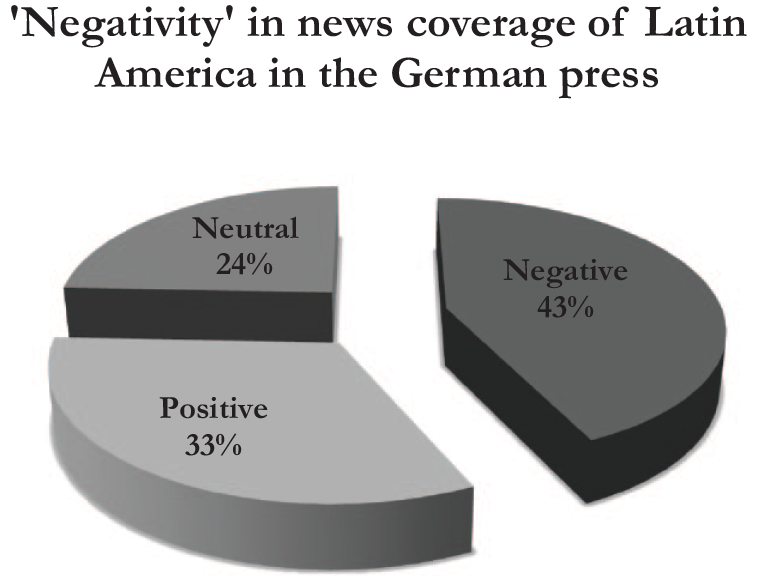
Number of positive, negative and neutral articles about Latin America in the German press.
According to Hafez (2002a: 63), the absence of positive events is even more problematic than a high proportion of ‘negativity’. However, the discussed under-representation of positive events in reporting on Latin America is also not the case, since 32.58% of the contributions concern positive developments. On the other hand, one can certainly speak about sectorial ‘negativity’, regarding not only several issues but also particular countries. Specific areas of reporting and countries have a considerably higher degree of ‘negativity’.
This definition of news reporting based on a ‘conflict perspective’, which is common in the literature and was discussed in the global study, ‘Foreign News in the Media’ (Sreberny-Mohammadi et al., 1985: 52), applies in particular to Honduras, Haiti, Ecuador, Colombia and the Dominican Republic. These specific countries have a degree of ‘negativity’ higher than 50%, as shown in Figure 2.
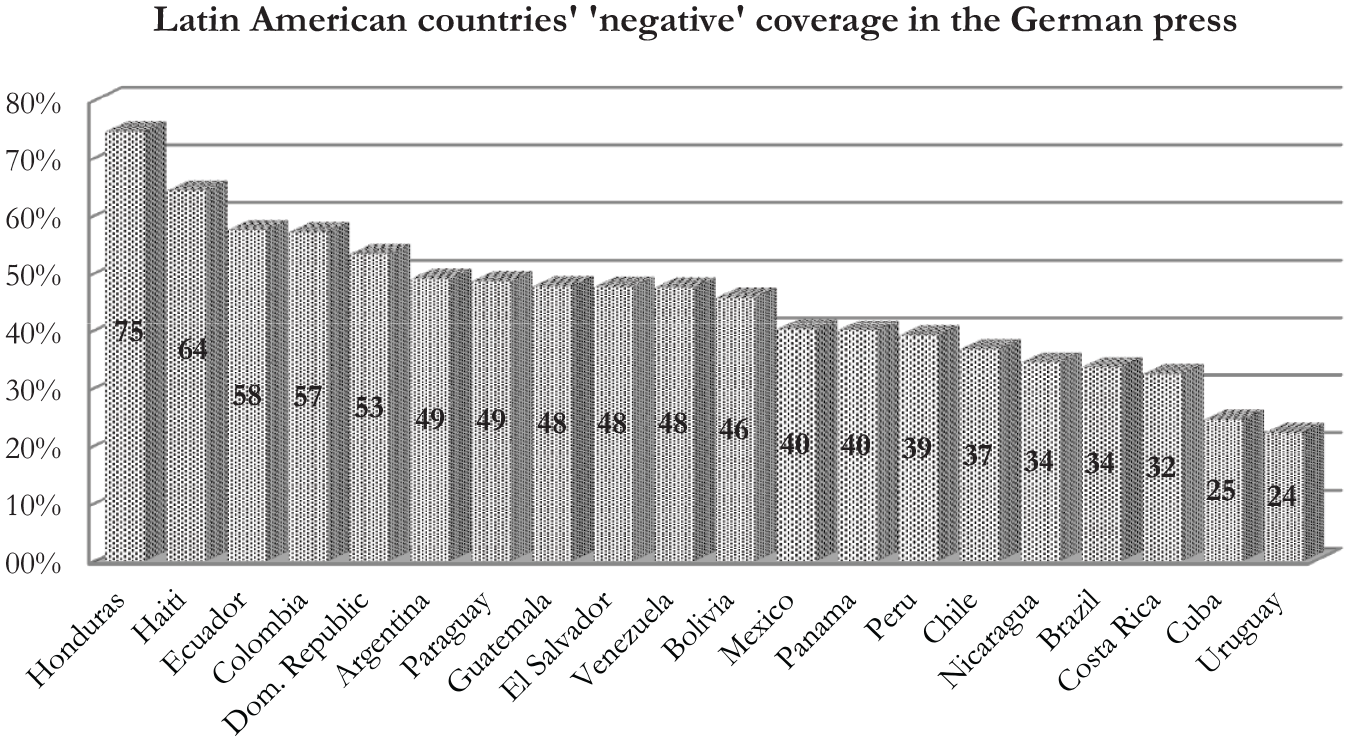
‘Negativity’ as a news factor in the reporting on Latin American countries.
However, to decide if a country has a balanced image in the German press or not, one should look at the percentage of positive, negative and neutral events within the news coverage of the country independent of the amount of press attention it has received – in other words, the extent to which positive-neutral reporting compensates for unfavourable coverage. Table 1 shows the amount of press coverage for each country and its evaluation of events.
Image balance of Latin American countries produced by the German press.
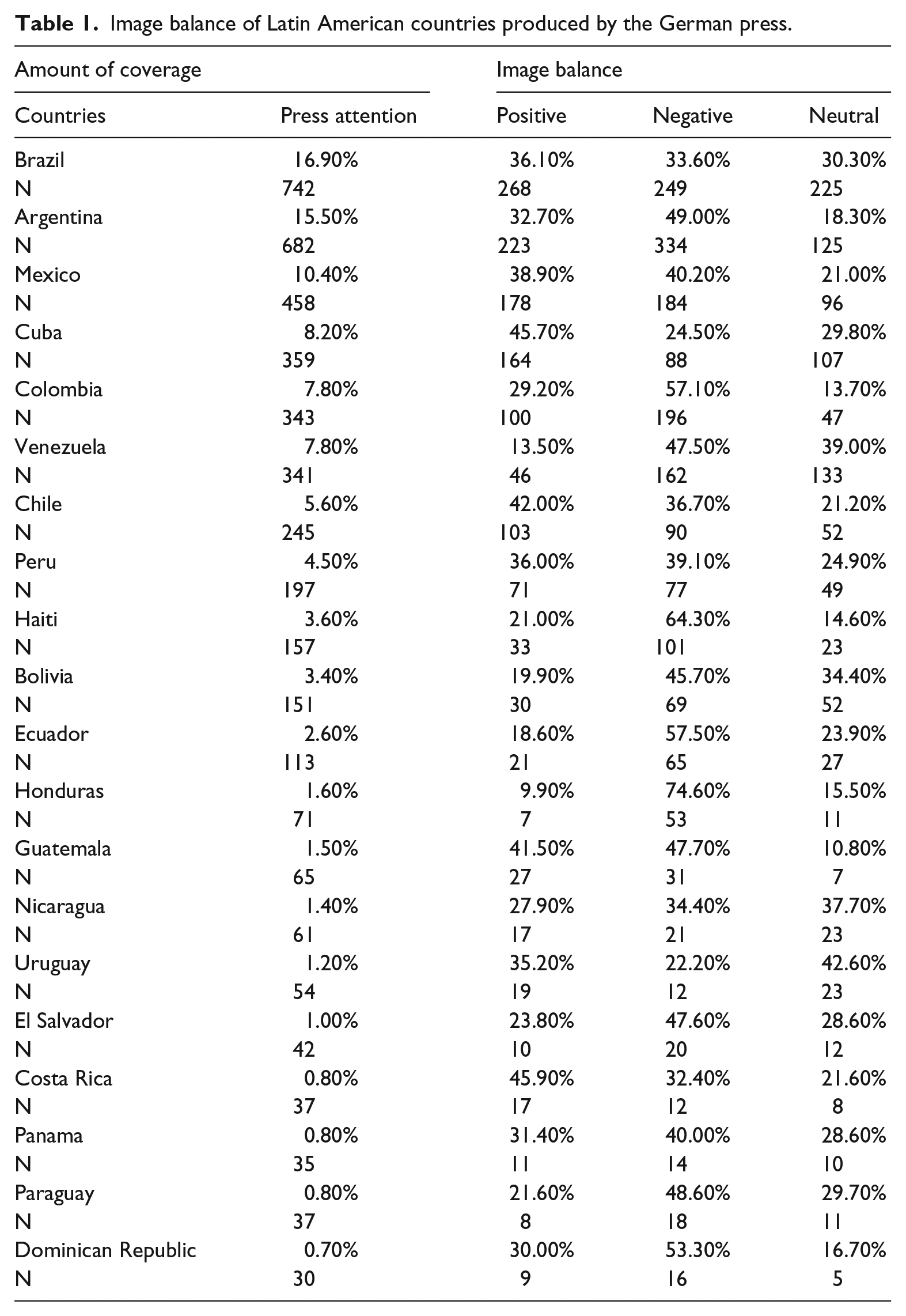
Argentina, for instance, has 49% of its coverage marked by ‘negativity’, mainly because of the prolonged economic crisis that started there in 2001. Despite being mentioned in negative contexts, one can still note a good balance since 37.70% and 18.30% of the other contributions, respectively, are associated with positive and neutral events. In the case of Brazil, the most reported country in the German press (16.90% of the total coverage), the balance of news reporting exhibits a well-balanced image with 36.10% positive, 33.60% negative and 30.30% neutral events.
In general, the most reported countries tend towards positive and/or neutral news reporting such as Brazil, Argentina, Mexico and even Venezuela (positive and neutral events compensate for the ‘negativity’). Cuba and Colombia, however, prove to be exceptions. The first showed an unexpectedly positive image (45.70% of Cuban coverage is positive and 29.80%, neutral). Cuba has substantial news value because of its peculiar politic and economic systems and its conflict with the USA. However, at the same time, the country has also secured media attention through positive cultural events and negotiating-oriented reporting. News on Colombia, on the other hand, is characterised by an intense ‘negativity’ and a conflict-oriented reporting style (57.10%) despite substantial media attention.
Furthermore, Honduras, Haiti, Ecuador, the Dominican Republic and Paraguay have a very negative and unbalanced image. These are countries that have been less perceived by the German press and therefore do not have a significant absolute amount of negative news. Nevertheless, when they can break the gatekeeper barrier, they are mostly associated with unfavourable events. Two clear examples are Honduras and Haiti. The first was almost invisible until 2009 when the country found itself the focus of press attention globally due to the coup against its former president, Manuel Zelaya. Haiti received the most reporting in 2010 as a consequence of the violent earthquake that happened there. Nevertheless, one can consider their foreign reporting as event-centred and not continuous.
Press visibility and image balance
In Figure 3, this association between press visibility and ‘negativity’ is more perceptible. The X-axis displays the number of published articles per country, while the Y-axis indicates the value of the image balance, which can vary from –1 (100% negative articles) to +1 (100% positive articles). Neutral items received weight zero. When considering neutral reporting as zero, the image balance of several countries will tend to become negative.

Relation between countries’ visibility and image balance.
The majority of countries, in this case, are found to reside in the lower left quadrant, i.e. they receive less attention from the German press, and also have a negative image balance (between –1 and zero). Among these countries are Panama, Guatemala, Nicaragua, the Dominican Republic, El Salvador, Bolivia, Paraguay, Ecuador, Haiti and Honduras. When reported on, these countries are mostly associated with unfavourable developments and events. Taking into consideration the first level of the agenda setting, which claims that salience is a significant factor of influence on the public perception of foreign countries (Wanta et al., 2004), one can assume that the German public sphere scarcely perceives these countries, since their coverage is insufficient.
One finds the two exceptions – Costa Rica and Uruguay, two countries that despite less attention from the press have generated a positive image balance – in the upper left quadrant. The three most covered areas of Costa Rica’s news reporting were ‘Domestic Politics’, ‘Tourism’ and ‘Environment’. Although ‘negativity’ marked its political and environmental coverage, in comparison to other states on the continent, Costa Rica has a long history of democratic stability (Freedom House, 2017). Uruguay is also quite unusual politically – ‘it is a robust consolidated democracy in a region prone to instability’ (Cason, 2000: 86). Due to the rights of women, labour and other groups, as well as the advantages of a welfare state, Uruguay is considered the ‘Switzerland of Latin America’ (ibid.). The country’s income distribution was astonishingly equal when compared to other states on the continent, and one associates its political history with the dominance of Left-leaning parties (Grassi, 2014: 126). The low visibility of these countries could be explained precisely due to their political stability, which shows no news value at all.
Countries in the upper right quadrant (Chile, Cuba, Brazil) boast excellent press visibility and tend to display a more favourable or at least more neutral balance. Mexico is on the borderline between the upper and lower right quadrants with substantial press attention and a slightly negative balance. Chile, with Uruguay and Costa Rica, is among the freest societies in Latin America. After the end of Pinochet’s military dictatorship, the visibility of the state in the German press decreased substantially.
In the case of Brazil, one can explain the balanced image through its ‘economic proximity’ to Germany. Indeed, the most reported area of the news reporting on Brazil is ‘Economy & Finance’ (29.5%), followed by ‘Domestic Politics’ (15.9%) and ‘Culture & Society’ (14.7%). Compared to other countries, the Brazilian coverage in the German press is not extremely politicised (at least not until 2014). As a result, high ‘negativity’ is not a determinant of the country’s coverage. However, with the outbreak of the Brazilian political crisis, accompanied by the impeachment of the former president Dilma Rousseff in 2016 and the election of the Right-wing populist Jair Bolsonaro in 2018, one can suppose that its coverage might have become more politicised and negative, at least in the short run. Future empirical analysis should investigate its impact in the long term and observe if positive cultural coverage will still be able to balance the negativity generated by the political crisis. On the other hand, the Cuban news coverage is intensely politicised (29.5% of ‘Domestic Politics’ and 28.1% of ‘Foreign Affairs’). However, the sizeable attention paid to ‘Culture & Society’ (28.1%) – the highest in the region – accounts for positive articles, which compensates for the eventual negative coverage of Cuban politics.
Similar to Brazil, Mexico has intense ‘economic proximity’ to Germany and great cultural coverage. The most reported area in the Mexican news coverage was ‘Economy & Finance’ (15.5%), followed by ‘Domestic Politics’ (19.4%) and ‘Culture & Society’ (19.4%). We can credit the slightly negative balance to the coverage of ‘Crimes & Delinquency’ (10.3%) associated with drug trafficking and organised crime. Among the 20 analysed countries, Mexico was the only one with a clear trend line over time. While other countries presented a more or less constant amount of negative coverage in the long term, Mexico showed a considerable increase in negative news, especially after 2006, due to the ‘War on Drugs’ declared by the former president, Felipe Caldéron. Despite that, the cultural coverage counterbalances the increase in negativity.
In the case of Brazil, crime reporting is considerably low (3.2%). Argentina receives similar news treatment as Brazil and Mexico, even though it was placed in the lower right quadrant (much visibility with a negative balance), which means a less politicised news reporting pattern (only 24.3% of ‘Domestic Politics’) and solid economic (35%) and cultural (16.1%) coverage. The problem area in Argentina was the news reporting about the financial crisis and its consequences and developments over the years, which is responsible for its negative image balance.
The most troublesome cases from the perspective of agenda setting are Colombia and Venezuela in the right lower quadrant (high visibility and negative thematic framework). Since they have sufficient salience and enough associated adverse topics, one can perceive them quite negatively. In the case of Colombia, 74% of the news coverage concentrates on ‘Domestic Politics’ and ‘Foreign Affairs’, but the country still gets, to a certain extent, cultural coverage (9.60%). The low negative image is due to the substantial attention that the civil war and the clashes between the guerrillas and the paramilitary forces have been receiving over the years.
Venezuela has a stronger negative image than Colombia since its cultural coverage is only 3.8%. Due to its internal political crises as well as the clash between Chávez’s government and the local opposition and his anti-American discourse, the political news reporting about Venezuela reaches 76.8%. Topics such as conflicts involving the USA, crimes, drugs and the military, which have a substantial impact on the public perception, according to studies about the agenda-setting effect of international news coverage (Wanta and Hu, 1993), marked both countries.
‘Negativity’ and thematic framework
By analysing the relationship between the areas of news coverage and the events’ evaluation, it is evident that ‘negativity’ profoundly marked the sectors, ‘Crime & Delinquency’ and ‘Disasters & Accidents’ (89%). Moreover, it is noticeable that the news reporting about Latin America offers, in general, a broad range of topics and issues, as demonstrated in Figure 4. Although ‘domestic policy’ comes first, one cannot talk about the over-representation of politics because the percentage is much lower (34.3%) as compared to other regions covered by the German press and does not exceed the limit of 50%. Taking the events’ evaluation into consideration, 51% of the articles about ‘domestic politics’ are negative. This value is even more substantial in the case of environmental reporting, with 64% of ‘negativity’.
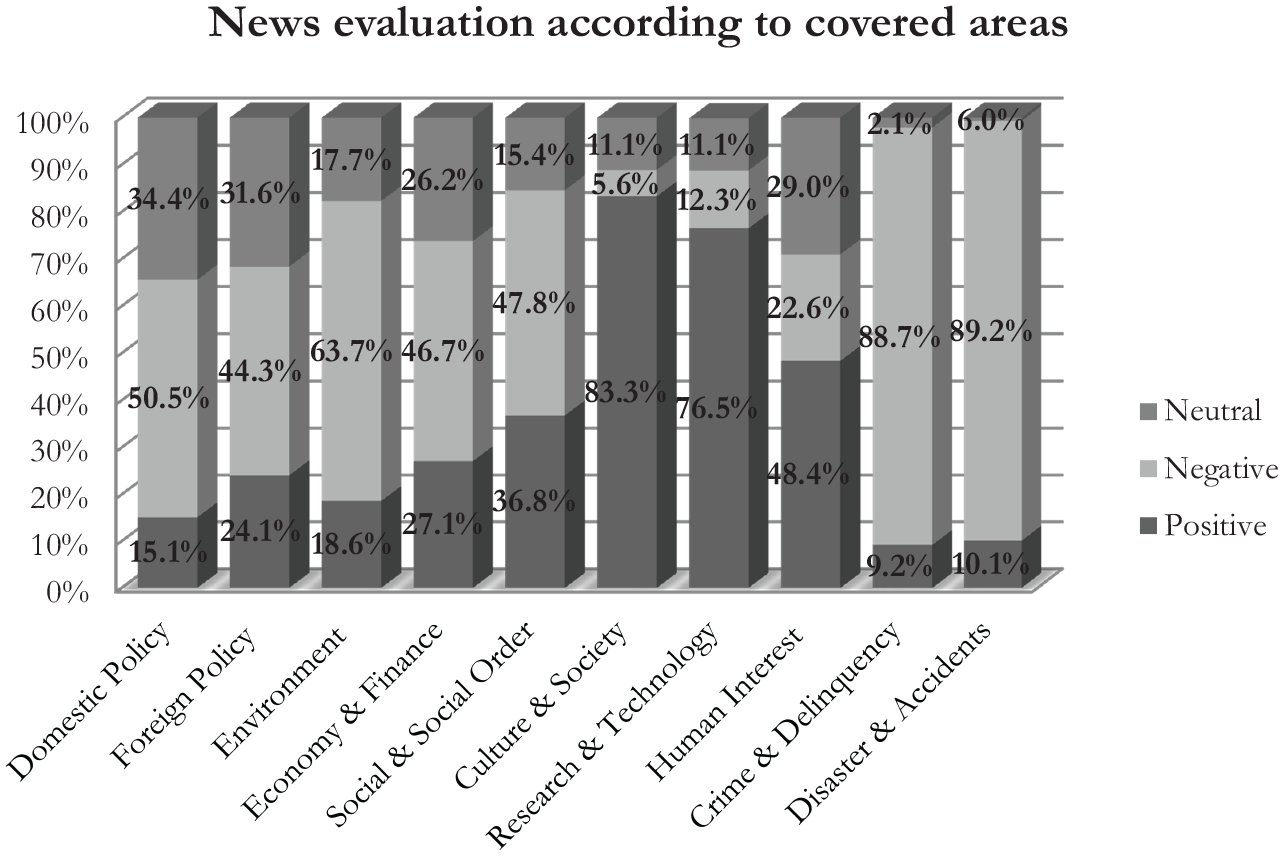
Image balance according to areas of news reporting.
On the other hand, there is a clear correlation between cultural reporting and positive events. The subject areas, ‘Culture & Society’, ‘Research & Technology’ and ‘Human Interest’, are especially positive, i.e. one perceives entertainment topics mostly positively. Undoubtedly, the image’s formation – a significant aspect of whether a country offers the press a negative or positive image – is based on the thematic orientation. The cultural coverage balances the negative image produced by other subject areas. That means that if the distribution of the covered areas is more balanced and does not concentrate solely on negative ‘domestic politics’, the image of a specific country will also tend to be more or less balanced.
Another unit of analysis is the relationship between the main topics reported within the areas of coverage and their evaluation tendencies, i.e. which themes were mostly hamstrung by ‘negativity’. Concerning only negative contributions, five main issues are dominant: (1) ‘political conflicts’, (2) ‘Argentinian economic crisis’, (3) ‘the relationship between the USA and Latin America’, (4) ‘natural disasters’ and (5) ‘organised crime’. These five topics account for 41.6% of adverse reporting. In the category, ‘political conflicts’, 86.3% of the contributions were characterised as unfavourable.
Examining specific topics within the theme (1) ‘political conflicts’, the following sub-topics received special attention from the press: the civil war in Colombia (73.1% of the articles burdened with ‘negativity’); the political crisis and coup in Honduras in 2009 (92.1% of negative stories); the uprising in Haiti in 2004 (90.9% negative); the political crisis followed by the two-day coup against Hugo Chávez in Venezuela in 2002 (100% negative); and the political crisis in Argentina as a result of the national bankruptcy in 2001–2002 (100% negative).
The literature distinguishes between two different types of conflict reporting – a ‘negotiation-oriented reporting style’ and a ‘more violence-oriented reporting style’ (Hafez, 2002a: 94). Even though the long-term conflict in Colombia has been comparatively less negative (73.1% of the articles), one can still note the tendencies of conflict perspective and ‘negativity’ on the subject. One possible explanation for the relatively more neutral reports on Colombia is undoubtedly the duration of the discussion and the continuing presentation of the conflict. The most violent conflicts reach the press only with the onset of burning violence, and only after the cessation of the acute stage, they are still occasionally portrayed.
The problem is that effective diplomatic negotiations are much less reported upon and reflected during the acute period. The comparatively few adverse reports of the civil war in Colombia emerge because the press, due to the long duration of the conflict, not only focuses exclusively on violent actions but also observes diplomatic and political developments and therefore portrays other facets of conflict developments. The press reports on the one hand about guerrilla violence such as raids, bombings and kidnappings or its confrontation with the government and paramilitary groups. On the other hand, it also covers exploratory talks, peace negotiations, progress in dialogue and other diplomatic negotiations, even if not with the same intensity as the violent acts.
There is a consensus in newsroom research that conflicts are a primary attractor of journalistic attention and, as a result, represent a significant news factor. In the present work, it was also realised that one usually presented crisis negatively. For example, in the (2) ‘Argentinian economic crisis’ within the ‘Economy & Finance’ coverage area, I classified 82.7% of the articles as unfavourable (another 9.9% as positive and 7.4% as neutral). Another topic that is relatively marked by ‘negativism’ is the (3) relationship between the USA and Latin America (47.4% negative, 36.4% neutral and 16.2% positive), with the 50% limit not being exceeded.
If one observes the ranking of countries’ names within the negative contributions about the US’ relationship with Latin America, the results are as follows: Cuba (18.8%), Mexico (17.8%), Colombia (15.8%), Venezuela (9.9%) and Brazil (9.9%). In the case of Cuba, the press reported several clashes between that country and the Bush administration in the US, including, for example, the increasing pressure for further sanctions on Cuba or visa refusals to Cuban artists. However, after 11 September 2001 and the new orientation of US foreign policy, Latin American countries almost wholly disappear from Washington, DC’s ‘political radar screen’ (Annen and Mark, 2009: 194).
Nevertheless, there are still adverse developments in the press, such as the failure of the US immigration reforms and the construction of a border fence, which is severely damaging the relationship between Mexico and the US. The sub-themes within the main topic, the US–Latin America relationship, also covered the drug warfare by the controversial Plan Colombia, which was responsible for militarising security institutions in the country, and Chávez’s support for anti-Americanism in Latin America.
Lastly, the predominant topics within (4) ‘natural disaster & accidents’ (85.4% negative, 13.5% positive and 1.1% neutral) were mostly about the Haiti earthquake in 2010, Hurricane Jeanne in Haiti and the Dominican Republic in 2004 and the landslides in Brazil in 2011. The main topic (5) ‘Organised Crime’ (83.7% negative, 14% favourable and 2.3% neutral) plays a significant role with regard to the Mexican drug war, as also the activities of the Mara groups in Central America.
Conclusion and discussion
The image of a country and how it communicates across borders is crucial in the era of globalisation, considering that the economies of developing countries tend to be much more susceptible to misinformation (Thussu, 2004: 54). The image of Latin America produced by the Western media can shape public opinion not only in the North but also in the South since the bulk of news flows from the North to the South and interaction between the countries of the South remains limited (ibid.).
Although the European Union (in particular Spain, Switzerland, France, the UK and Germany) is the leading investor in Latin America (Cepal, 2013), a report showed that the main perceived obstacles to foreign direct investment (FDI) in Latin America by European companies are political instability, corruption, violence, social problems and local safety, among others (Vodusek and Inter-American Development Bank, 2001).
If the press overemphasises just adverse reports, this image might be perpetuated and reinforced. However, in the case of the German press, despite a predominance of negative events (43.05%), one cannot entirely confirm the initial assumption of predominance of ‘negativity’ since this number does not exceed the limit of 50%. Reporting on Latin America also consists of 32.58% positive and 24.36% neutral contributions, a more or less balanced image. An under-representation of positive events was also not found. Not everything about Latin America was negative. In summary, we must relativise the theoretical hypothesis of ‘negativity’. Contrary to the findings of Wilke and Schenk (1987), this factor is heavily dependent on countries and subjects, and it is not possible to generalise as a determinant news value for Latin America.
In general, the interest in cultural topics helps to generate a more positive and balanced image of Latin America as a whole. After ‘Domestic Politics’ (34.3%), the most reported areas of news coverage on Latin America in the German press are ‘Culture & Society’ (17.3%), ‘Economy & Finance’ (15.2%) and ‘Foreign Policy’ (14.3%). A broader range of topics contributes to a more balanced image. Because of the Christian influence, Latin American culture might be more comprehensible to German and European audiences than those of other continents (Cazzamatta, 2018). That might be a reason why the ‘negativity’ factor is not so determinant, especially when compared to other regions of the world.
On the other hand, the recurrent assumption in the literature that ‘negativity’ is a crucial news factor for developing countries still holds true, especially in Honduras, Haiti, Ecuador, Colombia and the Dominican Republic, which show a level of ‘negativity’ higher than 50%. All these countries exhibit the typical combination of under-reporting (except Colombia) and negative coverage, as discussed by previous research on international communication (Adegbola et al., 2018). The number of country mentions in negative contexts and the balance of all articles composition are both crucial for the emergence of national images. If one does not consider the neutral coverage in Figure 3 as a counterbalance for unfavourable reporting, the majority of the small countries with little visibility will tend to bear an even more negative image.
The significant exceptions are countries such as Brazil, Chile, Costa Rica, Uruguay and Cuba, which appear more positively or neutrally. Large countries like Brazil and Mexico with substantial ‘economic proximity’ with Germany, that is, crucial economic trade, present a more balanced image. Apart from financial news reports, these countries also show a necessary amount of cultural news coverage, which neutralises the eventual ‘negativity’ in other areas. Further empirical analysis should re-evaluate, however, the image of Brazil after the end of the Left era. States such as Chile, Costa Rica and Uruguay have a positive image due to their relative stability.
Cuba shows a very positive image despite lack of ‘economic proximity’ or ‘power status’ and the long-term conflict with the US. Contrary to the coverage of the Arabic world (Hafez and Grüne, 2015), for instance, the press accentuates the cultural and social aspects of Cuba, contributing to a more balanced image. Although the worry of Islamic terrorism has replaced the fear of communism in the press since 9/11 (Thussu, 2006: 144), Cuba still attracts press attention and often positively. The country is still considered ‘sexy’ (Lange, 2002) due to the continuing fascination for revolutionary figures such as Fidel Castro and Che Guevara and the anachronistic existence of the communist state. Hence, several factors explain the positive coverage of Cuba: the catalytic effects of its cultural boom at the end of the 1990s through projects such as Buena Vista Social Club (Stehlik, 2006); the Cuban diaspora in Europe and in the US (Franzbach, 2003); and the increase of German tourists in the island and their interest in reading about its culture (Auswärtiges Amt, 2016).
In any case, the category of events’ balance – a determining factor in whether a country generates a positive or negative image in the press – depends on the distribution of the news coverage over the thematic areas. Thus, it is not surprising that the five states which received the most negative news reporting have their coverage concentrated on ‘Domestic or International Politics’ (Honduras, Ecuador and Colombia), ‘Crime & Delinquency’ and ‘Disaster & Accidents’ (Haiti and the Dominican Republic).
Thus, one must relativise both hypotheses. The factor ‘negativity’ is indeed dominant for the majority of the small Latin American countries (the unreported world in Thussu’s words), which receive less attention from the press, especially if one does not take into account the neutral reporting as a counterbalance. Whether you consider the neutral reporting or not, small countries such as Costa Rica, Uruguay, Chile and Cuba have a sharp positive image in the press, unlike our first assumption. The second hypothesis that big countries with larger press visibility might boast a balanced image applies only to Brazil and Mexico, although Mexico has a slightly negative image. Countries such as Venezuela, Colombia and Argentina have – differently than thought – a negative evaluation despite considerable press attention.
These results might be similar to other media systems in Europe. For example, despite methodological differences and period of analysis, a study of Latin American frames in the Spanish press 1 (Igartua et al., 2005) also found ‘considerable differences’ in the analysed variables regarding the different countries. According to their results, armed conflicts, natural disasters, crime and accidents imprint the foreign reporting on Venezuela and Colombia. One associated Brazil also with its economy and evaluated the country primarily positively. Moreover, Cuba was related to foreign affairs and culture. Although Spain has much deeper historical and cultural bonds with Latin America and a more significant flow of immigration than Germany, the results are not so divergent.
For this reason, one can state that this pattern of attention of ‘media-praised’ and ‘media-discredited’ countries might be similar in other European countries. Considering that the majority of European newsrooms orient themselves according to the reporting of the international news agencies (Boyd-Barrett and Rantanen, 2004; Paterson, 2011), similar models of event selection and thematic choice might be reproduced around Europe or even the world. However, further empirical research of Latin America’s image in other European media systems might be necessary to confirm the phenomenon.
Footnotes
Funding
The author disclosed receipt of the following financial support for the research, authorship, and/or publication of this article: This article received financial support from the DAAD/Cnpq/Capes partnership [290017/2014-9].
