



Abstract
This study focuses on the institutional evolution of Finnish business schools 1909–2009. Its theoretical starting point is institutional theory, which attempts to explain change and inertia in societies, industries and organizations. When making sense of the evolutionary process, we capitalize on three perspectives on institutional theory related to business schools: the market demand approach, the national heritage approach and the professional system approach. Based on extensive historical evidence gathered for our study, we provide a narrative and a theorization of the evolution of the Finnish business school institution as ‘oscillations’ in certain clearly visible trends related to our research framework, for instance from early private ownership to nationalization and regionalization from the 1970s onwards, and again to privatization and reduced governmental control in 2009. Finally, we conclude that the scattering of small, barely viable business school units around the country combined with a dual system of Finnish- and Swedish-language business schools has led to a situation in which the Finnish business school institution has not yet been able to produce a truly competitive global business school, attractive to foreign students, faculty members and global corporations.
Introduction
The latter decades of the twentieth century saw the influence of business schools on modern society increase considerably. It can be claimed that management concepts developed and disseminated by business schools have become a global lingua franca extending to practically all sectors of society (Engwall 2007: 9; Marglin 2008). Western-style management has become a more or less accepted canon all around the world (see Durand and Dameron 2008; Engwall 2007; Spender 2008). Due to the vast expansion of business education, research on business schools has also increased substantially (Bennis and O’Toole 2005; Burke and Rau 2010; Datar et al. 2010; Elliott and Reynolds 2002; Ghoshal 2005; Korpiaho et al. 2007; Maerki 2008; Mintzberg 2004; Pfeffer and Fong 2002; Simon 1967; Starkey and Tempest 2009). However, strongly national models of business schools still exist (Engwall 2000, 2004; Kipping et al. 2004; Starkey et al. 2004).
Of the range of topics of interest, critical perspectives on business schools have recently received the most attention and visibility. The rise of business schools as ever more successful businesses in their own right has been tracked by the ongoing debate in the literature on management education over the value that business schools bring (or fail to bring) to the practice of management. The majority of criticism has focused on the failure of business schools to provide their graduates with managerially useful knowledge and sufficient leadership skills (Bennis and O’Toole 2005; Mintzberg 2004; Pfeffer and Fong 2002). In addition, in the wake of the recent financial crisis, corporate scandals and managerial malpractice such as surrounded the Enron case, ethical concerns have also been raised and business schools have been accused failing to instill professional and moral standards in a whole generation of business leaders they have educated (Ferraro et al. 2005; Ghoshal 2005).
Since the 1980s, research has also been undertaken on the historical development of the business school as an institution (Engwall 2009; Engwall and Zamagni 1998; Kipping et al. 2004; Khurana 2007; Locke 1989, 1996). It seems relevant to ask how and why business schools have obtained their powerful position as the institutions preserving, creating and providing access to management knowledge. Regardless of the popularity of research on business schools, the above-mentioned studies represent a rarer stream of research examining business schools from a more historical point of view.
Research on the evolution of business schools tends to be mainly focused on the USA (Khurana 2007; Locke 1989, 1996) and the key Western European countries (Dameron and Durand 2008; Locke 1989; McGlade 1998; Möslein and Huff 2008; Thomas 2008), leaving the business schools in other parts of the world rather under-researched. The current study will make a contribution to the historical business school research by studying key developments in Finland during the last 100 years. Despite the disadvantages conferred by its small population, peripheral location and language unrelated to any major European examples, Finland, like the other Nordic countries, has enjoyed strong economic success, created some world-class firms and a high gross domestic product (GDP) per capita. Therefore, it is relevant to study the evolution of Finnish business schools as an institution centrally underpinning the economic success of the nation.
Research site and aims
Finland has made a significant investment in business schools during the past 100 years. Business degrees are currently awarded at 10 universities: Aalto university (formerly Helsinki School of Economics, HSE, established 1911); Swedish School of Economics (SSE, established 1909 and gained university status 1927); Åbo Akademi (1927); University of Turku (formerly Turku School of Economics, TSE, 1950); University of Tampere (1965); University of Vaasa (VSE, 1966); University of Jyväskylä (1967); University of Oulu (1991); Lappeenranta University of Technology (1991); and the University of Eastern Finland (2010). Finnish business schools have traditionally been relatively research-focused. The first business doctorate in the Nordic countries was completed at the HSE in 1937. To date, Finnish business schools have produced more than 1,000 doctoral theses, equalling the number from Sweden despite the difference in the size of the two countries (cf. Swedish dissertations in business administration 1950–2007 in Engwall 2009: 231–84).
Although several individual business school histories (Fellman and Forsén 2009; Kanerva 2000; Michelsen 2001; Perälä 1975; Pöykkö and Åberg 2010; Saarsalmi 1961; Sandström 1977; Ulkuniemi 1978; Westerlund 1984) have been written in Finland, there is no historical study covering the entire ‘business school industry’ and the first 100 years of its existence. In more academic literature, Finnish business schools have been primarily approached from an educational or a pedagogical perspective, while the evolution of the entire institution has been left unexposed. To study Finnish business schools as one institution is justified because business schools in Finland have traditionally been rather homogeneous owing to close cooperation between the schools, faculty exchange and the governance of the Ministry of Education. Despite their relative importance to the evolution of the managerial profession in Finland, we exclude industrial engineering departments and polytechnics from our study since they have never awarded any formal academic degrees in business administration.
In our study, institutional evolution refers to the contextual development that has been common to all business schools over a certain period of time. Essentially, we follow Khurana’s (2007) recent study of the institution of the American business school. In line with Khurana (2007: 5), we define institutions as ‘the complex and interacting systems of norms, structures and cultural understandings that shape individual and organizational behavior’. In our study, therefore, we address the following research question: ‘How has the Finnish business school institution evolved and been shaped by increasing market demand for business school graduates, the national heritage and the evolving system of professions?’
Our historical study
Our data collection began by gathering a variety of documentation focusing on the history of Finnish business schools. The empirical material that was collected consists of: (1) the annual reports of business schools including notes on the rectors’ speeches; (2) histories of individual business schools; (3) historical studies on Finnish business education and research; (4) biographies; (5) archival material including magazine and newspaper articles; (6) reports and studies conducted by the Ministry of Education and professional associations; and (7) statistical material, for example about students, degrees, faculty members, sources of finance and scientific publications. Appendix 1 contains a detailed record of the empirical sources and justifications for their use.
In the first phase of the analysis, the key events in the history of the particular business school were identified by analyzing the official histories of the various business schools. Second, a more thorough search for and analysis of various qualitative and quantitative materials, including annual reports, magazines, biographies and statistics, was conducted in order to form a more detailed understanding of the people, organizations, events, debates and tensions relevant to business schools at different points in their history. Triangulation by combining different types of empirical material played an important role in constructing the historical narrative. Moreover, we identified five distinct periods in the evolution of Finnish business schools, which we term the eras of: Establishment (1909–45); Stabilization (1945–65); Growth and Politicization (1965–80); Pre-Internationalization (1980–95); and Globalization (1995–2009). Finally, we tested our research framework (Figure 1) with our understanding of the different eras and summarized our findings on institutional evolution in the given context (Table 2).
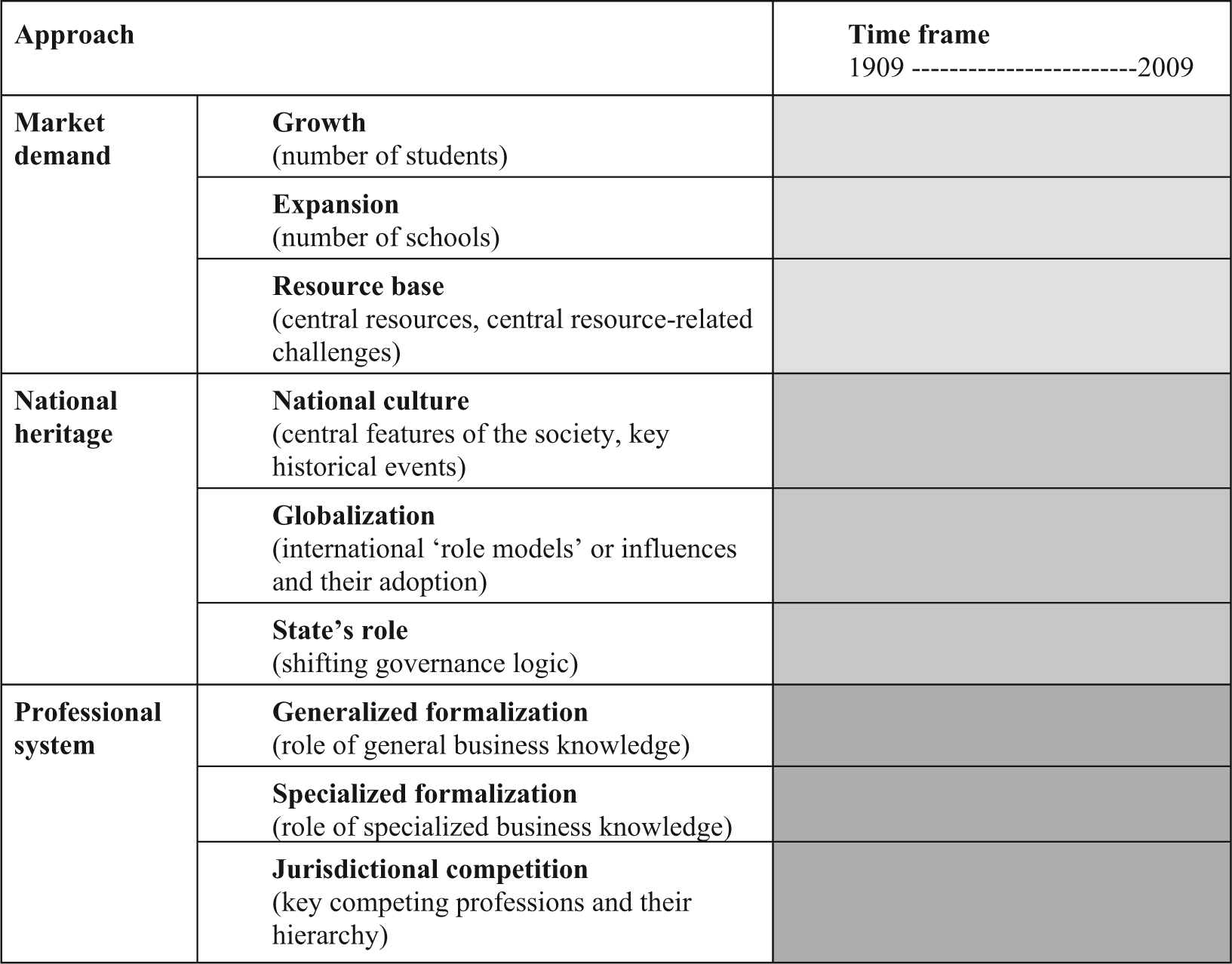
Research framework
Theory
Institutional theory and the business school institution
Regardless of the early institutional theoretical work of the late nineteenth to mid-twentieth century in the field of economics, political science and sociology, it was not until the rise of ‘new institutionalism’ in the 1970s that the institutional arguments started to truly gain ground in organization studies (Scott 2008: 3–20). New institutionalism or neoinstitutionalism built on early twentieth-century institutional work (Durkheim 1933; Parsons 1951; Weber 1952, 1968), but managed to revive interest in institutional theory by introducing new emphases and insights (Khurana 2007: 12–13; Scott 2008: 26). Some of the most influential ideas introduced were Meyer and Rowan’s (1977) and DiMaggio and Powell’s (1983) notions of the powerful effect external environments have on organizations. Organizations that conform to their institutional environments and attain legitimacy, bureaucratize and become institutionalized are more likely to survive than organizations that fail to do so (DiMaggio and Powell 1983: 147–50; Meyer and Rowan 1977: 360–1).
When studying business school as an institution, institutional theory offers one potential approach, albeit one as yet unutilized. Institutional theoretical perspectives combined with historical analysis provide a fertile ground for a more thorough understanding of contemporary institutions. Our historical study includes several elements of recent institutional theory. DiMaggio and Powell (1983: 147–9) argue that the modern bureaucratization of organizations stems from isomorphic processes that result in the fact that organizations that face the same environmental conditions end up resembling each other. These isomorphic processes, which may be coercive, mimetic or normative, are all evident in the evolution of business schools in Finland (DiMaggio and Powell 1983: 147–52). First, coercive isomorphism that typically stems from political pressures and the problem of legitimacy has resulted in a certain homogeneity in how business schools and other institutions for higher education have been governed and organized. Second, mimetic isomorphism driven by uncertainty inherent in the organizations’ environment has resulted in both intentional and unintentional borrowing of business school models both from abroad and from home. Third, normative isomorphism that relates to professionalization pressures has resulted in the members of the management profession and business schools struggling to establish a common cognitive base and legitimation for occupational autonomy (cf. DiMaggio and Powell 1983: 147–52).
Research framework
When making sense of the evolutionary process, we capitalize on three perspectives on business schools inspired by institutional theory: the market demand approach, the national heritage approach and the professional system approach.
The first approach has been built around the growing market demand for professional managers. Chandler (1977) and Engwall (2000, 2004, 2007, 2009) represent the most prominent examples of this market demand approach. This perspective sees industrialization as a starting point for the emergence of the business school institution (Chandler 1962: 1; Engwall 2007: 7; Kokko 2003: 46; Spender 2008: 9). Business schools were established because of ‘the expansion in the size and complexities of managerial hierarchies’ (Chandler 1977: 466). The emergence of large hierarchies and the fragmentation of company ownership structures generated a number of new managerial challenges, which enhanced the need for formal management education (Chandler 1962: 1; Engwall 2007: 7). This stream of research can also be considered a culture-free approach where the evolution of business schools is primarily seen as a universal solution to the tendency of western corporations to expand and adopt a managerial hierarchy (van Baalen and Karsten 2010: 154). When analysing our empirical material, we particularly focus on three aspects of the market demand approach: growth (number of students); geographical expansion (number of schools); and the financial and human resource base (central resources, central resource-related challenges) of business schools.
The second approach to the emergence of business schools has pointed to significant differences in management education systems attributable to national cultural heritages and university traditions. Despite the global expansion and convergence trend in management education, several studies have shown that differences between national systems of management education persist (Amdam 1996; Engwall 2000, 2004, 2007; Kipping et al. 2004; Locke 1989). As Kipping et al. (2004: 99) point out, the emulation of the American model of management education prevalent throughout the latter half of the twentieth century has not led to local replicas but rather to hybrid forms and institutional fields that have varied across countries. For instance, Locke (1989) has shown how national institutions have had a complex and vivid influence on the evolution of the business school system in different countries. Amdam (1996), who focuses on management education in Europe, Japan and the USA, emphasizes the fact that differences exist in national business systems, and those systems show significant strength in resisting tendencies of educational convergence, resulting in a unique style of management and consequently, management education (Amdam 1996: 3). Furthermore, Locke’s (1989) principal focus is on the different national traditions of management education and their more or less explicit influence on the economic performance of these countries. In his work on the historical development of management education in West Germany, Great Britain and France, and, later, in the USA and Japan, Locke asserts that national cultures offer a significant explanation and that comparative historical studies are appropriate means for illustrating relative performance. In our analysis, we foreground the following aspects of the national heritage approach: Finland’s national culture (central features of the society, key historical events); the globalization of business education (international ‘role models’ or influences and their adoption); and the role of the state in the governance of higher education (shifting governance logic).
Third, as van Baalen and Karsten (2010: 155–6) suggested, based on Abbott’s (1988) professional systems model, the rise of business schools can be explained by the motives of the specific professionals who were involved in the founding and development of the schools. Abbott (1988: 2–3) recognizes that the evolutionary paths of different professions are interrelated, arguing that the development of professions arises from continuous competition and power struggles over jurisdictional control that take place between different professions, such as law, medicine and management. In line with the above argument, Spender (2005: 1285) emphasized that a profession is essentially not only about building a rigorous body of knowledge in a given professional field, but also about the possession of this body of knowledge and the resulting monopolistic power. Finally, van Baalen and Karsten (2010: 155–6) argue that professional schools have a crucial role to play in the abstraction of professional knowledge, which, in turn, helps the professions to survive in a total ‘system of professions’. The power of abstraction lies in the defending of a professional body of knowledge against competing professions, but it also creates opportunities to expand the professional field (van Baalen and Karsten 2010: 155–6; cf. Abbott 1988: 98–108). According to Abbott (1988: 102), there are two types of abstraction: specialized and generalized formalization (cf. van Baalen and Karsten 2010: 155). In business schools, van Baalen and Karsten (2010: 156) continue, ‘specialized formalization takes place within the functional fields of management, whereas generalized formalization occurs within the area of general management’. Thus, the power, but also the paradox of abstraction, lies in balancing these two: generalized formalization allows the profession to expand its field whereas specialized formalization helps the profession to defend its field. In our analysis of the professional system approach, we specifically focus on three aspects: generalized formalization (the role of general business knowledge), specialized formalization (the role of specialized business knowledge) and jurisdictional competition (the key competing professions and their hierarchy).
Figure 1 depicts our research framework for the institutional evolution of Finnish business schools.
Evolution of the institution of the Finnish business school
Era of Establishment 1909–45
Founding the first business school. Industrialization and urbanization started in Finland in the late nineteenth century, decades later than in Central Europe. The shift from an agricultural economy to a more industrialized society led to the emergence of large corporations. Industrialization and urbanization were followed by more and more complex business organizations and the need for higher education in business became a topic of discussion. Towards the end of the nineteenth century, nearly 10 commercial schools had been established in different parts of Finland, mainly dedicated to the training of bookkeepers and other clerical workers (Michelsen 2001: 14–19; Näsi and Näsi 1996: 201).
The next step in the establishment of higher business education in Finland was the advent of Suomen Liikemiesten Kauppaopisto (‘The Commercial School of Finnish Businessmen’), which was established in Helsinki in 1898 (Järvinen 1907: 6; Michelsen 2001: 19–22). Under the management of its rector, Kyösti Järvinen, Suomen Liikemiesten Kauppaopisto actively sought an opportunity to raise its standard of education and to become a genuine business school (Järvinen 1907; Michelsen 2001: 19–22). With some financial support from the state, it managed to establish special parallel classes for students with baccalaureate degrees (Kukkonen 1995: 16). The new curriculum was designed to reflect those of some key European business schools that the rector Järvinen had visited (Järvinen 1907: 12–34).
By the beginning of the twentieth century, technology, agriculture and forestry had infiltrated higher education: agriculture and forestry found their way into the University of Helsinki in 1907 and technology gained its own institute for higher education, Helsinki University of Technology, in 1908 (Michelsen 2001: 15, 23). This provided the evidence that the political atmosphere in Finland was becoming more favourable to higher-level business studies as well, (Michelsen 2001: 23).
Consequently, in 1911 Finland’s first (Finnish-language) business school, Kauppakorkeakoulu (later Helsingin Kauppakorkeakoulu i.e. HSE), was established (Saarsalmi 1961: 31). Following the German model, HSE, the name of which was a direct translation of the German term Handelshochschule, was established as a private, stand-alone business school (Engwall 2007: 13–17). Nevertheless, there was some disagreement on the necessity of having a business school in a country as small as Finland and some even considered HSE as ‘merely a manifestation of national vanity and an unnecessary luxury’ (Näsi and Näsi 1996: 201–2).
The influence of Finland’s bilingual heritage. The well-educated upper class in nineteenth-century Finland was mostly Swedish speaking. One consequence of a rise in Finnish nationalism in the bilingual country was the strengthening of Finnish as an official language alongside Swedish (Westerlund 1984: 12). This raised concerns over the future of the Swedish-speaking minority of the population, awakening their interest in higher business education (Sandström 1977: 11; Westerlund 1984: 12).
This development led to the establishment of Högre Svenska Handelsläroverket i Helsingfors (‘The Higher Swedish Commercial School in Helsinki’) in 1909. In 1917, the student union suggested that the school should be redesignated a business school, Svenska Handelshögskolan, Swedish School of Economics (Westerlund 1984: 25–6). However, owing to the intrerruption of the Finnish Civil War in 1918, it took until 1927 before the plans were implemented and Svenska Handelshögskolan i Helsingfors (‘The Swedish School of Economics’, SSE) was established as a university-level institution (Kukkonen 1995: 22; Westerlund 1984: 25–6).
Moreover, the Swedish-speaking population’s interest in higher business education did not stop at establishing a business school in Helsinki. At the same time in the early twentieth century, similar ideas were also brought up in Turku where the country’s Swedish-speaking university, Åbo Akademi, was located. Due to public opposition and financial difficulties it took until 1927 before the plans were realized and the business school, Handelshögskolan vid Åbo Akademi (HHÅA), was established (Sandström 1977: 11–14).
Search for academic legitimacy in the Humboldtian cultural context. Being influenced by the Humboldtian university model, Finnish universities were traditionally autonomous institutions, considered to have the primary task of improving human civilization and which should not be subordinate to any external interests. Thus, there was a paradoxical mismatch with the applied nature of privately financed business schools and the predominant Humboldtian tradition. To achieve academic legitimacy, however, it was crucial for business schools to successfully operate in the university field as well.
As a private, stand-alone business school, HSE did not enjoy the same governmental protection as, for instance, the Helsinki University of Technology. During its first decade, the government granted only short-term financial support to HSE, forcing the school’s administrators into an ongoing struggle to keep the institution afloat (Saarsalmi 1961: 40). Consequently, it was crucial that the business school forge and maintain good relationships with local firms (Michelsen 2001: 30). The same was also true of the Swedish-speaking Handelsläroverket (Westerlund 1984: 24).
The 1920s and 1930s, however, were a period of considerable economic growth in Finland. Although the global depression of the early 1930s did have an effect, over the two decades most businesses boomed and earning a living from business became more and more important. For instance, between 1920 and 1940, the number of people who earned their living from trade grew by 275 per cent, while the total population grew by 140 per cent (Saarsalmi 1961: 50). As a consequence, the employment situation of business school graduates notably improved and that, in turn, attracted a growing number of new students to business schools (Saarsalmi 1961: 50). The growth in the student enrolment in business schools in 1910–50 is illustrated in Figure 2. The relatively rapid increase in student numbers, especially in the Finnish-language HSE, increased the costs borne by business schools resulting in a severe lack of resources that forced the schools to apply strict intake control measures. For instance, in 1935 only 55 per cent of applicants could be accepted and by the 1939 the acceptance rate had dropped to 35 per cent (Kauppakorkeakoulu 1930: 3; Saarsalmi 1961: 65).

Business school students and faculty prior to World War Two
Achieving academic legitimacy in the Finnish university system required both time and effort but was of crucial importance for the HSE and its supporters (Kukkonen 1995: 29). The first important step in legitimizing the business schools’ position among the other academic institutions was the establishment of the first professorships. In HSE, the first professorships were taken up in 1920, whereas SSE received its own first professors in 1934 (Kukkonen 1995: 29; Westerlund 1984: 39). In HHÅA, professorships existed from the point of its establishment in 1927 (Westerlund 1984: 39).
Moreover, the education that Finnish business schools offered was focused on the practical side of business administration and students were mainly educated in a ‘set of best practices’ (Kettunen 1986: 8). Another important decision that made the business schools’ degrees more easily comparable to other university-level degrees was the founding of the Master’s Degree in Business Administration. During the first 10 years of HSE, the basic one-year business degree that was offered had also evolved into a two-year degree consisting of both theoretical and practical elements (Michelsen 2001: 86–7). The master’s degree established at HSE in 1920 brought about an increase in the proportion of theoretical subjects in the curriculum (Kauppakorkeakoulu 1921: 3; Michelsen 2001: 87). Formally, the degree was crafted in accordance with the University of Helsinki’s master’s degree and it could be completed on top of the two-year basic degree in two to four years (Kukkonen 1995: 29).
Established in 1927, HHÅA designed its curriculum in accordance with the HSE and received the right to grant master’s degrees right from its inception (Sandström 1977: 15). SSE, on the other hand, was not granted a similar right until 1928, one year after its establishment (Westerlund 1984: 38).
The central milestones that made HSE a fully fledged academic institution were the state’s authorization to grant doctoral degrees received in 1931 and the right to hold formal doctoral promotions in 1945 (Kauppakorkeakoulu 1932: 3; Korhonen 2010: 59; Saarsalmi 1961: 59). In the SSE, the plans for the establishment of the doctoral degree were not launched until the end of the 1930s (Westerlund 1984: 39). The right to grant doctoral degrees was finally received from the Ministry of Education in 1944 (Westerlund 1984: 39–41). On the other hand, HHÅA had to wait until 1954 for the right to grant its doctoral degree (Sandström 1977: 47).
Research, during the Era of Establishment, was at best scarce. The researchers’ work was merely limited to their doctoral theses and after graduation typically very little postdoctoral research was conducted (Kettunen 1986: 8). The rarity of research at the time is well described by the fact that the first doctoral thesis from HSE was not published until 1937 (Vilho Nurmilahti: Der formale Aufbau der Jahresvermögensbilanz) and that from SSE not until 1944 (Axel Grandell: Äldre redovisningsformer i Finland). On the other hand, Nurmilahti’s doctoral thesis was the first in business administration in any of the Nordic countries (Lehtonen 2008). The first research institute for business, ‘Liiketaloudellinen tutkimuskeskus’, was established in 1938 at HSE (Saarsalmi 1961: 66).
During the early establishment period, however, business schools laid important foundations for future business education in Finland. For instance, the first Finnish textbooks on business administration were authored almost exclusively by the professors of HSE (Kettunen 1986: 8, 2007). Among the disciplines, accounting dominated the early development of business administration. Bookkeeping and calculus, in particular, gained an undisputed place in the curriculum (Näsi and Näsi 1996: 203–6).
Regardless of the dominant practical orientation, it was well understood by the founders of HSE that in order to become a serious academic institution it had to raise its standards to the level of the University of Helsinki and the Helsinki University of Technology. In addition, the school had to build its own scientific profile that would differentiate it from the lower-level commercial schools (Michelsen 2001: 43, 74–5).
The Winter War between Finland and the Soviet Union broke out in November 1939. During the 105-day war, most business schools were closed and many of the faculty members and students went to war (Kauppakorkeakoulu 1941: 18–19; Saarsalmi 1961: 70; Sandström 1977: 28; Westerlund 1984: 45). The HSE’s main building was requisitioned by the emergency services (Michelsen 2001: 114). Shortly after the war, the school was reopened and, considering the circumstances, the academic year 1940–41 progressed relatively normally. The Continuation War between Finland – now informally allied to Germany – and the Soviet Union broke out in June 1941 and caused severe interruptions to business school activities for the next three years (Sandström 1977: 29–30; Westerlund 1984: 45–6).
Era of Stabilization 1945–65
In search of a professional title. During the 1950s, business schools and their student numbers grew significantly when both HSE and SSE were able to move into their new facilities in Töölö in downtown Helsinki, and to considerably increase their student intake. As a new entrant to the Finnish business school market, the private, stand-alone, Finnish-speaking TSE was established in 1950.
In the Finnish business schools, the post-war decades were a time marked by the active development of curricula and degree structures. The first significant curriculum reform took place shortly after the war when the two-year basic degree was extended to three years and officially labelled an ‘ekonomi’ degree by one business school after another in the late 1940s (Kukkonen 1995: 35–6).
The professional title was a problematic issue for the students during the early stages of the business schools’ history. The schools did not generally have a good reputation among Finnish academics, and neither business graduates nor their profession garnered the respect accorded the established professions such as engineering or law, not to mention medicine. The first initiatives for the establishment of a professional title were launched in the first decade of the twentieth century by the business school graduates who quite naturally wanted to stand out in the job market (Kukkonen 1995: 32). However, among the business school faculty and even among some of the students, the idea of a professional title was treated with amusement and disbelief (Kukkonen 1995: 32).
Unfortunately, one must once again here clarify the title issue that has every year come up on agenda. The title is claimed by the first year students who have not yet been able to get their wise heads to understand that they will become assistants, clerks who at the beginning of their business careers are no better than any other clerks from whom they wish so radically to be distinguished. (Akseli Valio, the annual report of HSE’s student union 1914–15, cited in Kukkonen 1995: 32; translated from Finnish)
It took over 30 years from the establishment of HSE before the business school graduates received their official professional title (ekonomi, or diplom ekonom in Swedish), although ekonomi was already used as a courtesy or honorary title in the 1930s (Kukkonen 1995: 31–6). However, after its establishment the title gained value incrementally and also achieved widespread recognition within Finnish society. For instance, it was crucial for the newly established business schools later in the 1970s and the 1980s to receive permission to award ekonomi degrees.
Establishment of executive education. In the 1960s, business school graduates began to face increasing competition from graduates of executive education programmes. The first significant programme was organized by the Finnish Institute of Management (LIFIM). LIFIM was founded jointly by HSE, SSE and Helsinki University of Technology in 1964 (Kässi 1978: 14–15). The objective of the institute was to develop Finnish executive education in accordance with the American model, particularly that of the Harvard Business School. The establishment of LIFIM was merely a result of a few enthusiastic HSE professors who had visited the USA and been inspired by American executive education programmes (Fellman 2007: 13).
LIFIM’s one-year duration “long-courses” proved tremendously popular with Finnish corporations from the late 1960s and continued to be so for the next three decades. Along with the business schools, LIFIM became an influential management educator. Almost all top managers and later also junior managers were trained at LIFIM. The number of participants increased rapidly and the demand for the LIFIM programmes repeatedly exceeded available places (Fellman 2007: 14). Although more than 6,000 managers completed a long course, the program was able to attain an elite status in Finnish business life and maintain it until the late 1990s. A significant proportion of the participants were engineers by vocation.
Lack of qualified faculty and depletion of resources. Doctoral studies also started to increase in popularity at HSE at the beginning of the 1950s. This was partly due to a few new, ambitious and research-oriented professors who had been recruited to the school during the post-war years and partly due to new resources available for hiring doctoral students to fill teaching positions (Michelsen 2001: 146–7). In addition, the Finnish government supported doctoral studies through the scholarship programme established in 1949 by a new research foundation, the Academy of Finland (Michelsen 2001: 147).
The investments in research paid off quickly (Michelsen 2001: 147). By the beginning of the 1940s, HSE had managed to produce only one doctoral graduate, whereas in 1945–55, eight new doctors graduated. After the post-war peak in the number of doctoral degrees, however, research activities seem to have slowed down (Honko et al. 1983: 7; Pihkala 2000: 589). In the Swedish-speaking sector, on the other hand, the whole period from the 1940s to the mid-1960s was quiet in terms of research. During this time at SSE, only two doctoral theses were defended, whereas HHÅA did not produce its first doctors until the 1970s (Halme 1971: 94; Kukkonen 1995: 40; Pihkala 2000: 590).
The small number of doctors produced by the business schools in the late 1950s and the early 1960s resulted in a severe lack of qualified business teachers and professors (Honko et al. 1983: 7; Pihkala 2000: 587). Building new facilities impoverished both HSE and SSE and forced them to turn to the State for support (Kauppakorkeakoulu 1950; Westerlund 1984: 50). As a consequence in 1949, HSE and SSE submitted a proposal for a law that would guarantee a stable governmental subsidy for both business schools located in Helsinki (Kauppakorkeakoulu 1950; Westerlund 1984: 52). Up to that point, SSE had got approximately 40–50 per cent of its annual costs covered by governmental subsidy and, HSE, in turn, 70–80 per cent. However, the problem was that the percentage varied significantly from year to year, making it difficult to balance the schools’ annual budgets (Michelsen 2001: 175; Westerlund 1984: 51).
The statutory state subsidy to the business schools was finally granted for the first time in 1951 (Westerlund 1984: 53). The state was now obliged to financially support business schools subsidizing up to 70 per cent of the schools’ accepted expenses (Louhivuori 1951: 74). The costs that could be offset against the subsidy were also regulated by law and included, for instance: salaries, pensions, rent, equipment, library, laboratory, heating, lighting, cleaning, printing and insurance premiums (Louhivuori 1951: 74). The law secured both the legal and financial position of the business schools and defined them as autonomous, private institutions that would operate under the supervision of the Ministry of Trade and Industry, to which the schools were obliged to report (Kukkonen 1995: 37; Louhivuori 1951: 76; Westerlund 1984: 53).
Americanization. Until the end of the Second World War, the German influence on Finnish business education and research had been strong. This was due to Finland’s close business and cultural connections with Germany, the Humboldtian tradition being particularly strong in higher education. German was also commonly studied as the first foreign language in the Finnish school system until the 1970s. Finally, the core discipline, accounting, was very advanced in Germany during the first decades of the twentieth century (Näsi and Näsi 1996: 206–7; cf. Lukka et al. 1984).
Until the 1950s, Finnish business studies were in fact built around a single discipline: accounting. At the beginning of the century, bookkeeping and calculus were taught as independent courses, whereas practical business studies were taught as a part of the courses in economics (Näsi and Näsi 1996: 221).
The 1950s can be considered a turning point in the history of Finnish business education. Finnish business scholars started to adopt the ideas and ideals of their American counterparts, gradually replacing the German tradition (Kettunen 1986: 7). The American influence started to flow into the Finnish business schools with professors who visited Finnish business schools with the help of Fulbright and ASLA (‘Amerikan Suomen-lainan apuraha’) scholarship programmes and the grants of the Ford Foundation (Perälä 1975: 132–3; Saarsalmi 1961: 104; Sandström 1977: 49–50). In fact, these scholarships were a form of Marshall Aid in disguise, since Finland, under the pressure from the Soviet Union, had declined all American aid in the 1940s. The visiting lecturers made an important contribution to the business schools’ courses that at the time suffered from a shortage of qualified professors (Perälä 1975: 133; Sandström 1977: 49–50). The Fulbright scholarship programmes also allowed Finnish business school professors, like HSE accounting professor, Henrik Virkkunen, to visit the USA (Saarsalmi 1961: 104; Salmi 2007). These professors reflected the American influence in their books and research reports (Vironmäki 2007: 113–14). Furthermore, Finnish business schools were also able to acquire American literature with ASLA funds (Perälä 1975: 42; Sandström 1977: 60).
In 1952, business studies were divided into two sub-fields: Business Administration 1 (BA1) and Business Administration 2 (BA2), each with a different methodological emphasis (Pihkala 2000: 587; Vironmäki 2007: 69). Reflecting the strong dominance of the accounting major, BA1 encompassed accounting-related studies, whereas all the rest, namely sales and marketing, commercial law, statistics, distribution and the various aspects of management, were included in BA2 (Näsi and Näsi 1996: 221; Vironmäki 2007: 69).
Era of Growth and Politicization 1965–80
Increasing student enrolment. The continuous growth of student enrolment started to exert internal pressures on business schools in the 1960s. The new facilities inaugurated in the early-1950s no longer met the requirements of the massive student intake by mid-1960s. For instance, at HSE, the facilities had been planned for 1,200–1,400 students and were expected to be capable of satisfying the school’s demand for several decades. Nevertheless, the number of entrants reached the 1,400 capacity as early as 1961 (Honko et al. 1983: 130). The relatively small number of professors made the situation even worse (Halme 1960: 88–104, 1961: 55, 1962: 50–9; Heinänen 1965: 84–96, 1966: 115–27; Säntti 1963: 50–9; Svenska Handelshögskolan 1961: 59–63; Virkkunen 1963: 92–105). In the Swedish-speaking sector, where the language barriers with the other Nordic countries did not exist, the migration of the academically educated population, especially to Sweden, in pursuit of better salaries was considered a significant threat (Svenska Handelshögskolan 1961: 60). In order to match student intake with the resources and job market demand, business schools along with other universities and institutions of higher education were forced to enforce a rather strict numerus clausus, or intake ceiling, which was considered undemocratic at the time (Michelsen 2001: 218). For instance, in the academic year 1966–67, HSE could accept fewer than 45 per cent of those who applied to it (Statistical Yearbook of Finland 1967). The leftist opponents of the system essentially claimed that many more eligible students should have been admitted.
The Finnish government responded to the pressing need for more university-level education by expanding the university system. The first step in the expansion process was the establishment of the University of Oulu in 1959 (Michelsen 2001: 220). By the end of the decade, plans for the establishment of universities in Jyväskylä, Tampere and Eastern Finland (Kuopio and Joensuu, later the University of Eastern Finland) were also introduced (Michelsen 2001: 221). Among the existing universities and institutions of higher education, the plans were viewed with scepticism.
Disregarding the criticism, resistance and promises made, the Ministry of Education continued to implement its expansion strategy in business education in the 1960s. Approval was granted for the establishment of the private Vaasa School of Economics (VSE) in 1966 and the first students started there in 1968 (Ulkuniemi 1978: 67). VSE was established on a private, stand-alone basis but due to growing financial difficulties, it was nationalized in 1977 and had developed into the multidisciplinary University of Vaasa by 1980–81 (Palomäki 1984: 73).
For the first time in Finnish history, business schools were also founded in established universities. Consequently, the Faculty of Economics and Administration was founded in 1965 at the University of Tampere (Kaarninen et al. 2000: 31). The Department of Economics at the University of Jyväskylä was established in 1967 (Kukkonen 1995: 70). Although offering business studies, neither the University of Tampere nor the University of Jyväskylä was permitted to grant ekonomi degrees from the very beginning. In Tampere, the ekonomi programme was launched in 1966 but in Jyväskylä it was not until the sizeable curriculum reform in 1977 that the granting of ekonomi degrees was permitted (Kettunen 1992: 14). Furthermore, in 1980 SSE established a separate Swedish-speaking business school campus in Vaasa (Westerlund 1984: 117–22).
The transfer of governance from the Ministry of Trade and Industry to the Ministry of Education in 1971 was a significant event for the future of Finnish business education as it increased the state’s influence over the business schools and in that sense, represented the next step towards the complete nationalization of the schools (Kukkonen 1995: 57). Towards the end of the 1960s, the financial standing of business schools started to deteriorate rapidly (Heinänen 1968: 121; Honko et al. 1983: 107; Palomäki 1981: 62–9; Westerlund 1984: 100). This was mainly due to the growing number of students pressurizing business schools to increase their teaching resources and to commission new facilities, which needed to be at least partly financed with bank loans (Honko et al. 1983: 106, 152–226, Westerlund 1984: 100).
Nationalization. The political atmosphere of the late 1960s increased the pressure for the nationalization of the country’s private universities. At the beginning of the 1970s, the state committed to the principle of free higher education (Kukkonen 1995: 58). Nationalization would have solved the financial difficulties of the business schools at a stroke, however, at the same time it was recognized that it may have harmed the schools’ relationships with the business world (Michelsen 2001: 260). Although the state subsidy system had already made the private business schools practically state-governed, they considered themselves still to be private institutions whose primary task was to serve the Finnish business community (Michelsen 2001: 260). In 1974, HSE was nationalized and became the first state-owned business school (Kauppakorkeakoulu 1974: 11). Also the school’s official name Kauppakorkeakoulu (‘School of Economics’) was now changed to Helsingin Kauppakorkeakoulu (‘Helsinki School of Economics’ – the school had always referred to itself in English as HSE). Following the nationalization of HSE, the other business schools followed developments with both interest and uncertainty. SSE was nationalized only one year later in 1975 (Westerlund 1984: 103).
Once the business schools were nationalized, the state accepted full responsibility for their financing. Alongside nationalization, business schools also passed their own regulations that guaranteed their internal autonomy, originality and unique position. In the private business schools, nationalization also led to an administrative reform that ended the direct executive influence on the schools’ decision-making. A byproduct of those reforms was that students were granted representation on the schools’ administrative committees. The old administrative bodies were dissolved and generally replaced by a new tripartite administration, where professors, other personnel and students were equally represented (Kukkonen 1995: 59).
Era of Pre-Internationalization 1980–95
More emphasis on student and faculty exchange. In the 1980s, Finnish business schools started to focus on their core activities, especially on developing their research. In the previous decades, international cooperation had been sporadic. For instance, lectures were mostly given in Finnish, international publications were very rare and student and faculty exchange was an exception at best. Finnish researchers had already started to participate in international conferences in the 1970s, but those activities very seldom resulted in publications in refereed international journals.
HSE was clearly a forerunner in the internationalization of the student body. The first significant steps were the American-style Master of Business Administration (MBA) and Bachelor of Business Administration (BBA) programmes established in 1984 and 1989 (Urmas 2010: 53–5). The programmes were offered fully in English and taught mainly by visiting professors from the USA (Urmas 2010: 53–5). International student exchange started in the early 1980s as well, but due to the lack of established exchange programmes or relationships with foreign business schools, the exchanges had to be organized by the students themselves and therefore few participated (Airila 2010: 82).
At HSE, the international MBA programme became an important enabler of mutual student exchange relationships between the university and foreign business schools as it increased the number of English-language courses in the curriculum and enabled the foreign students to study full time (Airila 2010: 82). In the 1990s, numbers of both incoming and outgoing exchange students increased and the partnership network of business schools expanded considerably.
Emerging international publishing activity. In the 1980s, international publishing activity was to all intents and purposes in its infancy and, the number of international refereed publications originating from HSE never exceeded thirteen in any one year in that decade (Ratilainen 2010: 73). However, the first significant attempts were made towards integration with the international research community. As has been noted by Seeck and Laakso (2010: 42), the growing research orientation further increased the Finnish business schools’ interest in the USA as more and more American course textbooks were used (see also Engwall 2004). The new international research focus is illustrated by Rector Arvi Leponiemi’s (1984: 106) statement in his inaugural speech for the 1981–82 academic year: ‘People no longer disagree on the nature of the research. The time of domestic duties is over. Research is international and only by aspiring to international forums can spontaneous interaction between researchers in the same field emerge’ (translated from Finnish).
Traditionally, the appointment of full professors proved difficult in Finnish business schools. The main reasons can be identified in the lack of graduates with doctoral degrees in business administration: the German academic tradition demanding professorial candidates demonstrated three independent research areas or three “doctoral dissertations” (i.e., successive habilitation); lengthy appointment processes; the right of appeal for unsuccessful candidates and internal politics within the schools.
In the early 1990s, however, international publications became a key criterion when appointing professors. However, since major candidates did not usually have many journal articles in their portfolio, it was often impossible to implement this criterion. The turning point actually occurred as late as the end of the 1990s, when articles published in an international refereed journal became a central evaluation criterion.
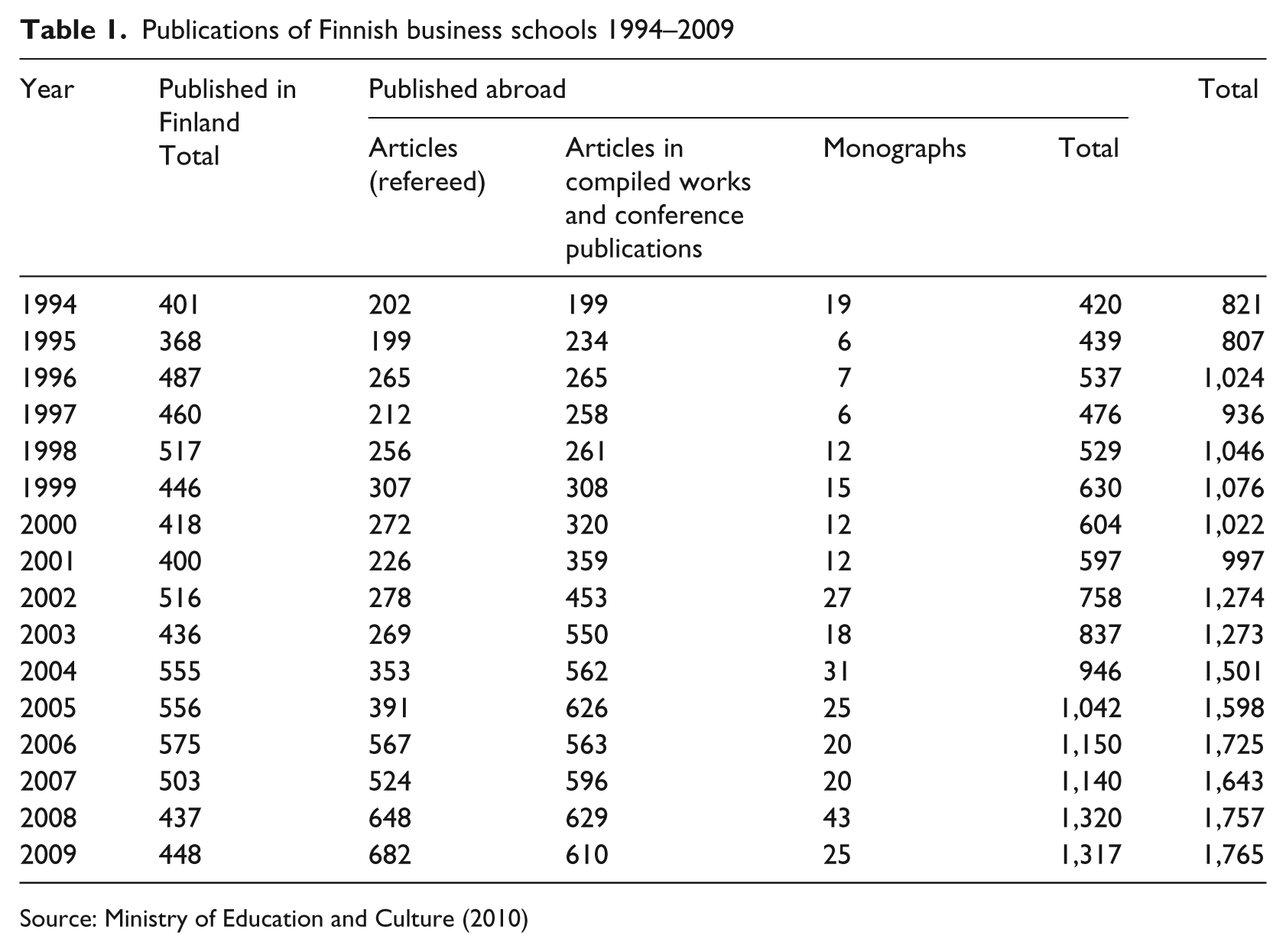
Approaching the new millennium, publications in international refereed journals became increasingly common (cf. Virtanen and Kinnunen 2010: 108). In 1994–2009, the total number of domestic publications remained almost constant, whereas the number of international publications more than tripled (Table 1).
Publications of Finnish business schools 1994–2009
Managerial ideals enter the governance of universities. As a response to the political changes in higher education that occurred during the 1960s and the 1970s, business schools became a more accepted part of the Finnish higher education system. As a result, they needed to follow the same rules and were evaluated by the same Ministry of Education measures as any other university.
Näsi (2000: 5) argues that one of the most powerful forces that has contributed to changes in the university system from the mid-1980s to the turn of the new millennium has been the adoption of corporate concepts and models, such as management by objectives (MBO) in the public sector.During the late 1980s and the 1990s, the traditional Humboldtian ideals of the university were to a large extent abandoned and replaced by corporate ideals such as effectiveness and accountability. In addition, the increasing acquisition of external financing has also brought universities and institutions of higher education closer to the corporate world: unlike the traditional budget allowance from the state, in external financing, money comes from the market and must be competed for. Kivinen et al. (1993: 193–5) refer to the period from the late 1980s onwards as the time of the ‘profitability doctrine’ that emphasizes the role of the universities as service providers asked to address the diverse needs of society and to produce the desired services such as executive education or applied research.
As Figure 3 indicates, business schools’ total funding (including budget funding, structural investment and external financing) increased significantly from the end of the 1980s. The growth continued relatively steadily until 1992 when the economic recession brought a reduction in public expenditure (see also Kaarninen et al. 2000: 323–5). The decreasing government funding pushed business schools, along with the other universities, to turn to external sources of financing such as The Finnish Funding Agency for Innovation and Technology (Tekes) to an increasing extent from the mid-1990s onwards (Kaarninen et al. 2000: 326).
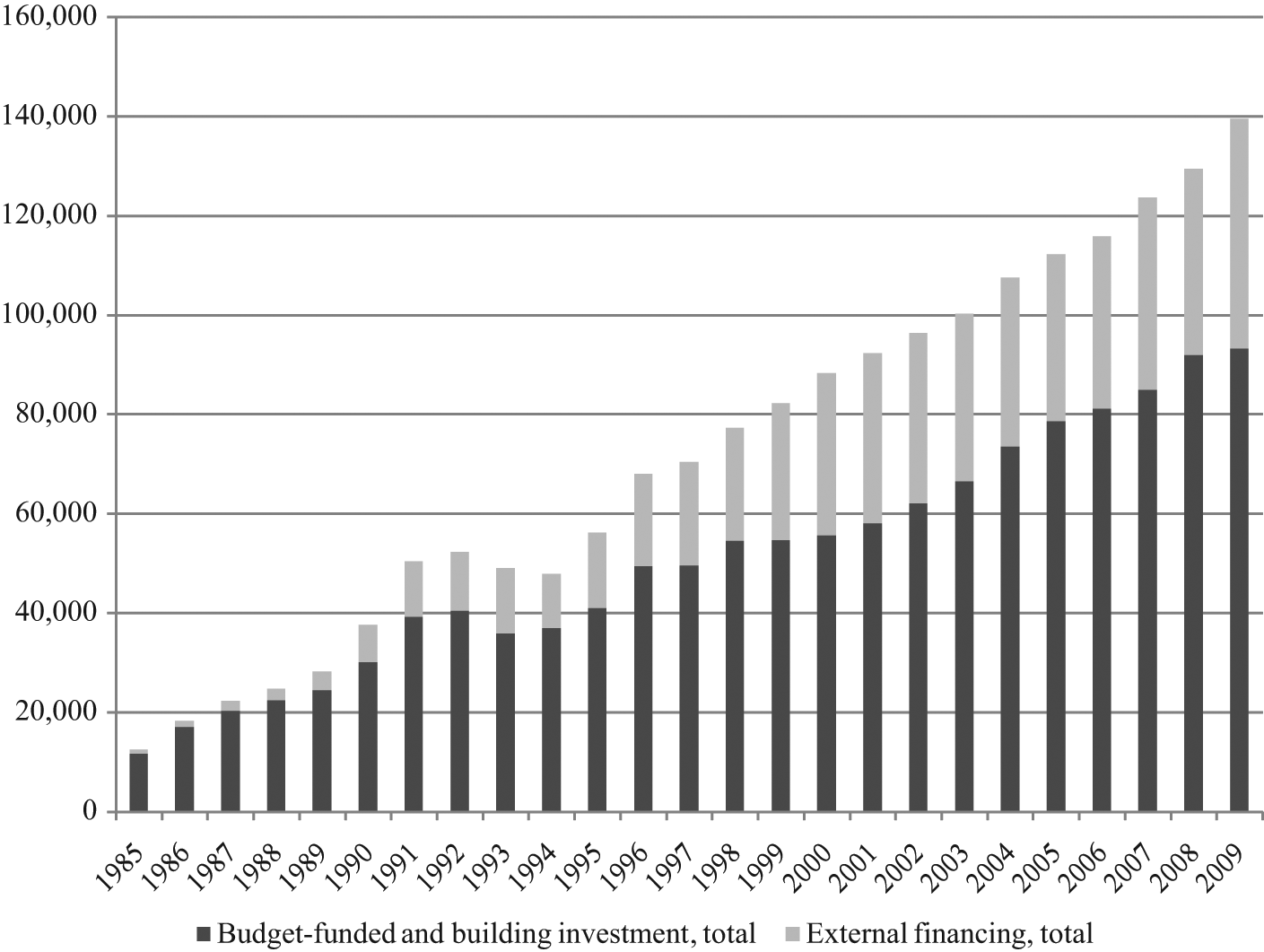
Business schools’ funding 1985–2009 (in thousands of euros)
Era of Globalization 1995–2009
Increasing domestic competition. Since Finland joined the European Union (EU) in 1995, pressure has grown to increase the international comparability of higher education degree structures. The Finnish ekonomi degree having a status equivalent to a master’s degree elsewhere has sometimes been difficult to understand for foreign commentators (Peltonen 2010: 50). In response to the Bologna agreement signed in 1999 by 29 European countries, the Finnish university degree structure has been reformed. Since the 2005 curriculum reform, universities have reverted to offering a two-tier degree structure.
From the 1990s, the Finnish higher education system has been based on the dual model that refers to two separate paths of education: universities on the one hand and polytechnics or universities of applied sciences on the other. Polytechnics were created during the 1990s in order to complement the Finnish higher education sector (Kankaala et al. 2004: 45). Today, there are 25 polytechnics in Finland (Ministry of Education and Culture 2011), the majority of which offer both bachelor- and master’s-level business degree programmes. In practice, graduates from both institutions often compete for the same jobs, especially in the early phases of their careers.
Although not officially defined as higher education degrees in the Finnish education system, the MBA and BBA programmes have intensified competition. Furthermore, for certain job positions, competition has emerged between business school graduates and other graduates, such as industrial engineers who will often have taken business studies courses as elective elements of their degrees.
Since the late 1980s, the number of students in business schools has continued to increase steeply (Figure 4). Regardless of the increasing demand for business education, the number of teaching faculty staff has remained relatively small and stable. With more than 29,000 applications in 2009, business degrees are the most popular education choice in Finland (Education and Technology being the second and third most popular, respectively) (Ministry of Education and Culture 2010). Consequently, business schools can afford to be rather selective in their student intake. In 2009, on average only 13.1 per cent of the total applicants were admitted (Ministry of Education and Culture 2010). However, there are significant differences in this respect between different business schools, HSE being the most difficult to gain admission to.
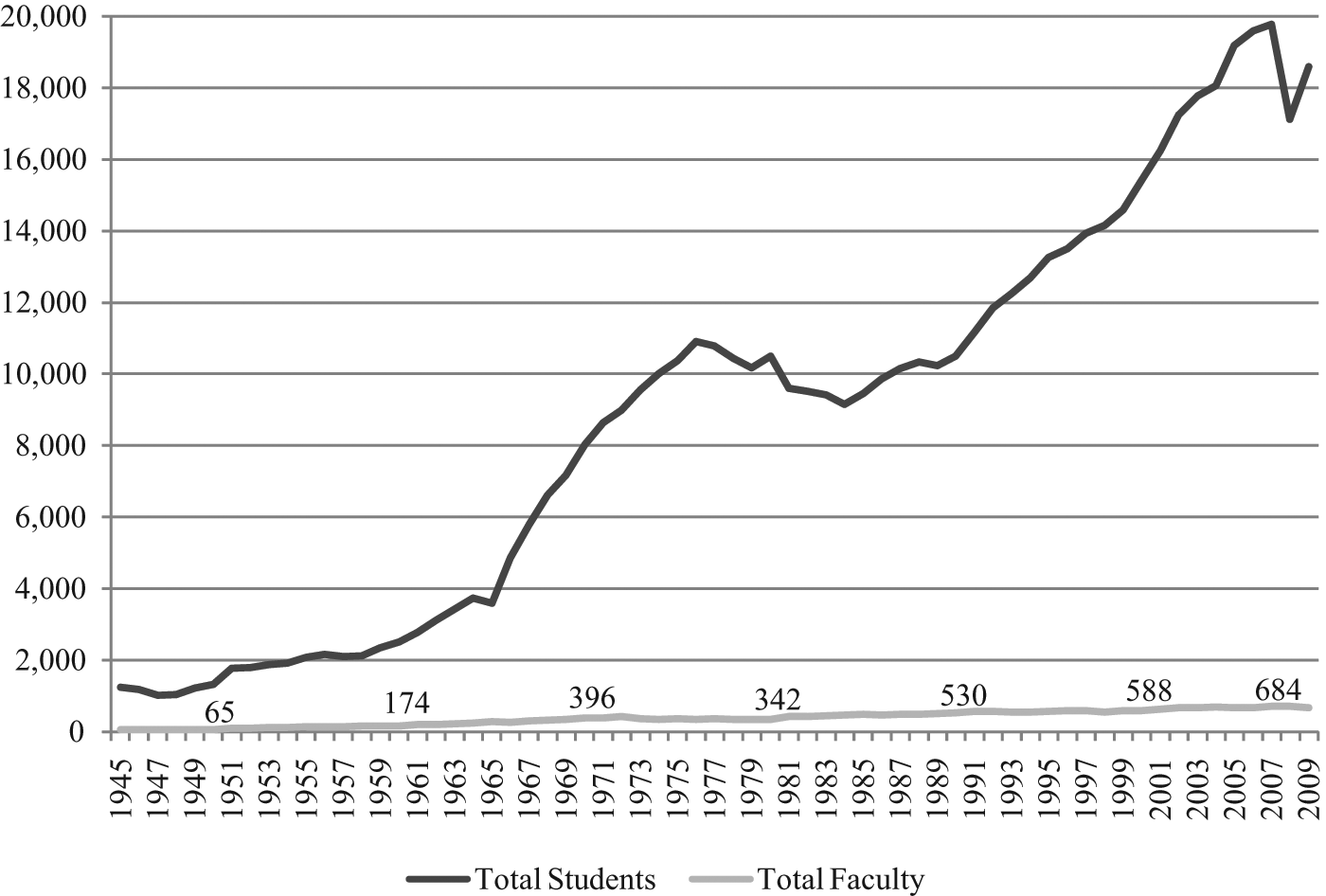
Business school students and faculty after World War Two
Increasing requirement for societal impact. In the 1970s, nationalization and the administrative and curricular reforms distanced business schools from the business world. The 1990s saw the start of the process to rebuild those connections.
After the regional policy-driven expansion in the 1970s, it took until 1991 before the Finnish business school institution was further expanded with two new business schools established within the University of Oulu and the Lappeenranta University of Technology.
More recently, the universities and institutions of higher education have been facing increasing expectation from the state to pay attention to their relationships with society at large. For business schools, this will most naturally translate to close relationships with the executive segment. It is nevertheless rather ironic that the relationship with the business community that the academic community once considered one of the unappealing characteristics of business schools is now promoted by the new Universities Act that encourages (and practically forces) universities to search for external funding. For instance, in HSE the proportion of the total budget contributed by external funding was 15–20 per cent in the mid-1990s, whereas in 2010, nearly half of the school’s total funding was derived from external sources, often the business community (Pöykkö 2010: 31).
International accreditations and rankings. In order to survive amidst the international competition for top students that marks this century, it has become necessary for a business school to meet international quality standards and hold accreditation from one or more of the major accreditation bodies: the Association to Advance Collegiate Schools of Business (AACSB), European Quality Improvement System (EQUIS) and Association of MBAs (AMBA). Another popular measure of a business school’s quality for prospective students is the international rankings published for instance by the Financial Times and Business Week.
In terms of accreditations and rankings, HSE and SSE are well ahead of the other Finnish business schools, which have, to date, lacked the critical mass both in terms of students and faculty to even consider being ranked or accredited. Hanken holds both EQUIS (since 2000) and AMBA (since 2008) accreditations, whereas HSE holds the full ‘triple crown’, namely AACSB (since 2007), EQUIS (since 1998) and AMBA (since 1997). At the time of compiling this research in 2009, HSE remained the only Nordic business school with the AACSB accreditation (Hanken 2010a, 2010b; HSE Executive Education 2010). The individual accreditation processes are often laborious and time-consuming for business schools, but provide an important mechanism to harmonize the Finnish business school model with the dominant international models. HSE has also been ranked relatively highly by the Financial Times: in the paper’s 2009 European Business school ranking, HSE was ranked 18th in the top 70 European business schools (Financial Times 2009). In addition to the accreditations and rankings, HSE is also a member of certain elite business school networks, including the Community of European Management Schools (CEMS).
In order to address the new competitive challenges both nationally and internationally, Finnish business schools are also encouraged by the new Universities Act to reinvent themselves through various structural development projects. The most important examples are HSE’s merger with the Helsinki University of Technology and the University of Art and Design in Helsinki (to form Aalto University) and TSE’s union with the University of Turku in 2010. Although it is as yet too early to evaluate the outcome of the mergers from the business schools’ standpoint, it is nevertheless interesting to see how the two oldest Finnish-language business schools will adapt to their roles as a part of these new multidisciplinary university consortia.
Discussion and conclusions
The focus of our study is on the evolution of the Finnish business school institution between 1909 and 2009. Convinced of the value of a qualitative, historical approach to the study of institutions, we draw on multiple sources of empirical data to develop a historical narrative that traces the economic, cultural and professionalization-related development trajectories of Finnish business schools during the first 100 years of the institution. Table 2 summarizes the main characteristics of the ‘Finnish business school model’ in terms of the research framework.
Institutional evolution of Finnish business schools

As shown in Table 2 (see also Figures 2 and 4), the Finnish market demand for business school education grew constantly but modestly during the first 40 years of the existence of business schools as the agrarian society gradually urbanized and industrialized. At the end of the Second World War, the number of students was still well below 2,000. During Finland’s rapid industrialization burst from the late 1940s until the mid-1960s, the number of business students more than doubled to about 4,000. However, at this time, engineers strongly dominated the managerial echelons of Finnish companies and most inevitably had an engineering education background. This was natural since most larger companies operated in the metalworking, machinery, construction or related technical industries. Business graduates were primarily employed in the financial services and retailing sectors and in accounting and finance positions in companies. Private funding and tuition, which were the dominant modes of resourcing the business school during the first few decades, gradually gave way to increasing funding from the state in the 1950s and 1960s. The fact that business schools were governed by the Ministry of Trade and Industry also enabled the cooperative relationship between business schools and the industry to flourish.
The first real boom in business education took place between 1965 and 1975. The number of students grew from less than 4,000 to over 10,000. The total number of faculty members also doubled from around 200 to almost 400, but not in line with the rapidly increasing number of students. An increasing number of smaller companies started to recruit business school graduates as the Finnish economy grew, prospered and internationalized rapidly. The ekonomi degree became a respected professional degree. At the same time, American influence on Finnish management education increased rapidly and superseded the traditional German influence, a transition typical in the other Nordic countries too (see Engwall 2000). However, as Seeck and Laakso (2010: 43) note, unique, local dynamics were still present in Finnish business schools. One specific national characteristic is the country being bilingual. Both the Finnish-speaking majority and the Swedish-speaking upper middle- and upper-class minority originally founded their own business schools. This polarization has endured into the 2000s. For instance in Helsinki, both HSE and SSE are located in the same street, both are internationally accredited and a large part of their teaching is in English. However, cooperation between the two schools is still relatively rare in practice.
Political interest in business schools and other universities further increased due to the growing number of students from the baby-boomer generation, rising leftist student activism and the state’s objectives related to regional policy in the late 1960s. The increasing financial difficulties caused by the rapid increase in the number of students combined with the state’s interest in gathering all business schools and universities under the governance of the Ministry of Education eventually led to the nationalization of all Finnish business schools in the 1970s. Consequently, the development of business schools was no longer driven solely by the business schools’ and the business community’s own interests.
In the late 1970s and the early 1980s, however, there was a temporary decrease in student enrolment. At the same time, the government also let the total number of faculty members to decrease by about 10 per cent to less than 350. This was mainly due to the economic crisis of the 1970s and its repercussions for the Finnish university system. At the time, the government did not perhaps fully realize the importance of business school education in a rapidly developing service economy. After 1985, the number of business school students again started to increase rapidly: from around 10,000 students in 1990, the total number grew to around 15,000 in the year 2000 and to almost 20,000 in 2008. These were the years of the second and the biggest boom in the Finnish business school system. On the other hand, the total number of faculty members that had increased to 530 in 1990 had not exceeded the 700 level by 2008.
The curriculum reform of 2005 brought about a slight decrease in student enrolment in 2008–09 (owing to a high number of students graduating before the structural reform took place), after which the numbers quickly recovered. The rapid growth in student enrolment was mainly due to the founding of new regional business schools, as the annual student intakes in the more established business schools did not grow significantly. Growth cannot be attributed to foreign applicants as there has not yet been any significant inflow of foreign degree students to Finnish business schools. Educational policy that had until then strongly favoured engineering education, quickly shifted at the turn of this century to favour business. By 2009, business schools were the largest university-level educator in the social sciences, surpassing, for instance, educational sciences.
All in all, the evolution of the Finnish business school institution was tightly coupled with the evolution of Finland’s industrial structure that transformed from one dominated by a few industrial firms and banks prior to the 1950s to an emerging service economy in the 1980s and the 1990s, leading to the open global service economy of this century with some dominating global industrial corporations such as Nokia and Kone. The first business schools, HSE, SSE, HHÅA and TSE, were founded through strong private initiatives. After the Second World War, however, in accordance with its regional industrialization programme, the government saw a need for regional universities and business schools. The founding of a relatively large number of small business schools related to regional universities with rather limited number of faculty members and resources can be seen as a reflection of the strong regionalization policy. The curricula and the organization of these units were often practically copied from HSE (or, in the Swedish-language case, SSE). At the same time, the size of the oldest and largest business schools has long remained largely unchanged.
At the regional level, the establishment of a business school was generally seen as a means to improve the competitiveness and attractiveness of a city or a region. At the national level, the business schools are recognized as generating the business knowledge that provides a means to improve Finland’s competitiveness in the global economy. What is more, Finnish business schools have been successful in introducing business-related concepts and knowledge into the national language. Business schools have disseminated managerial knowledge and concepts to all sorts of organizations: profit and non-profit organizations, and the sectors of education, government and health care in Finland. Business schools have succeeded in expanding the general use of managerial language and in developing specialized knowledge around certain business functions. Thus, they seem to have been especially efficient in professionalizing the fields of finance and market research.
From a theoretical point of view of the market demand, the national heritage and the professional systems approaches, it is interesting to note how certain, clearly visible trends oscillate between polar opposites during the first 100 years of the Finnish business school institution. This is the first and primary theoretical contribution of the present study highlighting the special characteristics of the Finnish business school model along its 100-year evolutionary path.
First, there is the trend that oscillates between a private and centralized business school system versus a regionalized and public system. The Finnish business school institution started with just two private schools in central Helsinki, and was regionalized and nationalized in the latter half of the twenty-first century, starting from the early 1970s. However, the strong governmental control has recently been somewhat relaxed with the new university legislation of 2009 and the renewed privatization of key universities. For instance, since 2010, HSE in now a part of Aalto University, governed by a private foundation.
Second, another trend oscillates between a European/Nordic influence on the one hand, and an increasing American influence on the other. As mentioned, the traditional German influence during the first three decades of the life of Finnish business schools led to accounting holding an unusually strong position on the business school curricula. To some extent, this accounting and finance dominance maintains today, albeit its theoretical underpinnings have shifted from a continental focus to a totally dominating American influence. With the increasing emphasis on international (i.e. US) academic publications in the 2000s, and, for instance, the creation of a US-style tenure track system in Aalto University the American influence in Finnish business schools is currently overwhelming. Regional business schools, on the other hand, have retained some features of the characteristically “domestic business school model” that emerged during the years of strong growth between 1985 and 2005.
Third, a trend oscillates between strongly generalized formalization and specialized formalization. Strongly generalized curricula with a strong focus on accounting-related skills developed after the Second World War into ever more specialized curricula. Until very recently, all Finnish business students had to choose a relatively specialized major already at undergraduate level. However, this trend may now have reversed as, in accordance with most American and international high-ranking business schools, Finnish schools have recently started to steer their undergraduate degrees back towards a more generalized form (e.g. by increasing the number of general courses on methodology and decreasing major-specific courses). Again, Aalto University is at the forefront of this development.
Fourth, there is a trend oscillating between the dominance of non-business versus business graduates in the jurisdictional competition between professions. When business school graduates started to enter the job market, senior management positions in the major Finnish corporations were occupied mostly by lawyers, and later by engineers. This traditional dominance of engineers of the upper echelons of the Finnish economy gradually gave way to business school graduates, depending on the industry, in the 1980s and 1990s. However, although they have been able to establish a strong identity for the ekonomi title, business school graduates still do not enjoy an exclusive claim on senior management positions.
Finally, when it comes to the evolution of the Finnish business school institution in general, one conclusion is obvious: the scattering of small, barely viable business school units around the country combined with a dual system of Finnish- and Swedish-language business schools has led to a situation in which the Finnish business school as an institution has not yet been able to produce a single truly competitive global business school, attractive to foreign students, faculty and global corporations.
Footnotes
Appendix
Sources used in the study
| Main type of empirical data | Most important data sources | Justification/Purpose |
|---|---|---|
| Annual reports of individual business schools including rectors’ speeches | Helsinki School of Economics (HSE) 1920–90
Swedish School of Economics (SSE) 1928–70 (occasional issues) Handelshögskolan vid Åbo Akademi (HHÅA) 1934–56 (occasional issues) Turku School of Economics (TSE) 1950–2008 Vaasa School of Economics (VSE) 1968–90 |
Contemporaries’ views, opinions and interpretations on the historical events |
| Histories of individual business schools and universities | Helsinki School of Economics (HSE) 1911–61, 1961–80, 1911–2001, 2010
Swedish School of Economics (SSE) 1909–84, 1909–2009 Handelshögskolan vid Åbo Akademi (HHÅA) 1927–77 Turku School of Economics 1950–75, 1950–2000 Vaasa School of Economics (VSE) 1968–78 University of Tampere 1960–2000 University of Jyväskylä, department of economics 1967–92 University of Oulu 1958–93 Lappeenranta University of Technology 1969–94 |
Coherent and compact analyses about the series of events that have taken place in the history of individual business schools |
| Historical studies of business education and research | Suomen tieteen historia: Taloustieteet (’Finland’s Science History: Economics’) (Pihkala 2000)
Ekonomikoulutus Suomessa (’Ekonomi Education in Finland’) (Kukkonen 1995) Käytäntöä vai tiedettä – kauppatieteellinen koulutus ja työ kansainvälisessä vertailussa (’Practice or Science – Business Graduates’ Studies and Work in Various Countries’), Doctoral thesis (Kokko 2003) Academic Marketing in Finland: Living up to Conflicting Expectations, Doctoral thesis (Vironmäki 2007) Yliopiston huomen: korkeakoulupolitiikan historiallinen suunta Suomessa (‘University’s Tomorrow: Higher Education Policy’s Historical Direction in Finland’) (Kivinen et al. 1993) |
Historical analyses of the development of business schools’ research and education at an institutional level, based on evidence from more than one business school |
| Biographies | Ei se mitään kun sen tietää: Henrik Virkkunen – liikkeenjohdon kouluttaja (‘It Doesn’t Matter when You Know It: Henrik Virkkunen – Management Educator’) (Salmi 2007) Pohjoismaiden ensimmäinen kauppatieteiden tohtori Vilho Paavo Nurmilahti 1899–1943 (‘First Business Doctor in Nordic Countries Vilho Paavo Nurmilahti 1899–1943’) (Lehtonen 2008) |
Histories of key individuals related to the evolution of business schools |
| Articles in magazines and newspapers | Ekonomi magazine early 1960s – mid-1970s Contactor newspaper 1960s – mid-1970s |
Contemporaries’ views and opinions on the topical issues related to business schools |
| Reports | SEFE’s research reports and publications | Well-grounded data and evidence on the latest developments of the business schools |
| Statistics | Statistical Yearbooks of Finland 1910–1980 Ministry of Education and Culture’s (2010) online database, KOTA 1980–2009 |
Statistical evidence on the evolution of business schools |
| Web pages | Ministry of Education 2009–11
National Board of Education 2010 HSE 2010 SSE 2010 Financial Times 2009 |
Up-to-date information about the current business school/higher education system |

Acknowledgements
We are grateful to the anonymous reviewers of Management & Organizational History for their constructive comments and suggestions. We would also like to express our gratitude to Matthias Kipping and George David Smith for their insightful comments presented on the paper at the Business History Conference 2011 Annual Meeting, in St. Louis. Moreover, thanks for important comments and suggestions are owed to Juha-Antti Lamberg, Jaakko Aspara, Pertti Kettunen and Risto Tainio.
Notes
Author biographies
Kimmo Alajoutsijärvi is a Professor at the Jyväskylä University School of Business and Economics, Department of Marketing, Jyväskylä, Finland. His research interests include industrial marketing, business cycles, business relationships and business schools.
Kerttu Kettunen is a Doctoral Student at University of Oulu, Oulu Business School, Department of Marketing, Oulu, Finland. Her doctoral dissertation work concerns the history of business schools and management education in Finland. The empirical data used in this paper has been collected as a part of Kerttu Kettunen’s doctoral dissertation project.
Henrikki Tikkanen is a Professor and Head of Department at Aalto University School of Business, Department of Marketing, Helsinki, Finland. His research interests include corporate-level strategic marketing, customer relationship management, business networks, international business strategies and project marketing.