




Abstract
Much of the research on identity formation of early-career researchers (ECRs) emphasizes how neoliberal restructuring of academia has impacted processes of becoming an academic. As a marginalized population in the academy, this is especially acute for women and female-read bodies. This study illuminates “academic identity crafting” processes based on sixteen interviews with ECRs in the United States and Austria who identified as women. Findings point to forms of identity crafting that are connected to “thriving for autonomy,” “having a community,” and “finding purpose.” In addition, challenges of academic identity crafting, which are related to the neoliberal influence on the academy as well as the perceived absence of role models and mentors, were identified. This study highlights the need to improve the ways in which higher education institutions support early-career women researchers in crafting their academic identities.
Keywords
Introduction
Amidst drastic changes of academic work in the neoliberal university including rising precarity, increasing mental health problems, and diminishing academic autonomy, early career researchers (ECRs) are confronted with a multitude of pressures and challenges as they strive to establish their professional academic identities (Fleming, 2022; Nikunen, 2012; Nonaka, 2020). The dynamics of professional identity formation have garnered significant scholarly attention (Jones et al., 2022; Martin et al., 2020; Nästesjö, 2023). However, a notable gap exists in the literature concerning early-career women researchers’ (ECWRs) perceptions and experiences of developing a professional identity as an academic (Lindahl et al., 2021).
Researching experiences in neoliberal and marketized academia has been identified as a difficult, yet rewarding exploration (Fotaki and Pullen, 2023), making this study an important step towards a better understanding of early-career women researchers’ academic identity formation. Despite substantial scholarship highlighting that experiences and barriers are not uniform across all academic positions (Clarke et al., 2024; Drake and Svenkerud, 2024; Johnson, 2018), literature has so far predominantly focused on women in mid-range or senior posts, leaving a dearth of insight for ECWRs and a need for research in this area. Furthermore, alongside shared experiences of women and men in early careers, it can be expected that neoliberal academia affects them and their academic identity formation differently (Jones, 2023; Karacan-Ozdemir and Gurbuz-Akcay, 2025). Being marginalized as a woman scholar in higher education intersecting with being an early-career researcher can create unique challenges as highlighted, for example, by Squazzoni et al. (2021) showing that ECWRs submitted a significantly smaller proportion of academic articles during the COVID-19 pandemic, and by Suarez et al. (2023) showing that ECWRs are still less likely to secure research funding than early-career men researchers.
This paper attempts to improve understandings of and the heterogeneity within the group of ECWRs, including ways in which they can be better supported during their academic and professional journey by answering the following research question: How do early-career women researchers form their academic identities, and what challenges can arise with regard to such formation? Understanding dynamics of academic identity formation is paramount for addressing structural barriers and for developing more equitable and supportive institutional policies. Thus, shedding light on ECWRs academic identity formation and experiences form a critical case of researching the implications of marginalization and neoliberalism in academia, making an important contribution to current research in this field. By taking into consideration not only the forms of identity crafting employed, but also the two national contexts in which said crafting is located in, critical analyses of experiences of ECWRs in academic institutions can be made.
This study investigates the research question in two national contexts: the United States and Austria. Both authors have conducted individual research projects in these two countries. In these projects, data on women’s experiences in the academy were collected (see also subsection “Method, sampling and participants”). This provided the unique opportunity for a comparative study to investigate both the universality but also the contextual embeddedness of ECWRs’ experiences and identity formation processes. The two countries offer a fruitful basis for a comparative study due to their differences but also similarities, which can be expected to be relevant for shaping ECWRs’ experiences: Differences relate to the doctoral education and how the academic career system is structured, offering insights into the potential role of various career path types for shaping ECWRs’ academic identity formation (see also subsection “Rationale underpinning the comparative design”). Despite such differences, similarities can be observed regarding the history of women in the academy, which has been marked by a slow but steady increase in participation in both countries. Women’s enrollment at U.S. and Austrian HEIs has continued to grow and surpassed men’s enrollment (Statista, 2023; OECD, 2025). Nevertheless, gender-related challenges in the academy persist in both countries: For example, men do not only earn more on average in all academic ranks than women, but they are also still overrepresented at associate and full professorial level (AAUP Faculty Compensation Survey, 2023; Unidata, 2024). In addition, to some extend both countries are influenced by neoliberal tendencies, albeit to varying degrees (e.g., introduction of market-driven principles and increasing competition) (Lynch, 2006; Pechar, 2010). This allows us to reflect upon the wider implications of how neoliberal restructuring of academia impacts processes of becoming an academic.
Literature review
Identity formation refers to individuals attaching attributes reflexively to themselves in response to questions such as “who am I?” and “who do I want to be in the future?” (Sveningsson and Alvesson, 2003). Identity formation is accomplished continuously by actors both in dialogue with others and personal soliloquy as they seek, not always consciously, to fashion desired versions of who they are (Brown and Coupland, 2015). With regard to scientific careers, identity formation processes are considered as an important part of building and maintaining an academic career. However, this process is situated today in a context of neoliberalism—where identity formation has been further complicated by conflicting pressures (such as rising precarity and insecurity) in the organizational arena of the academy (Bourabain, 2021; Clarke and Knights, 2015; Johnson, 2018). The impact of the neoliberal restructuring of academia on processes of becoming an academic and how this process is subjectively constructed (Griffin, 2022; Jones, 2023; Portnoi, 2015), is echoed by research showing that PhD students are increasingly perceiving their academic identity and their development in terms of their “market value” (Mantai, 2019) and describing researchers’ identities as being contemporary intellectual-entrepreneurial academics (Edwards, 2022). Furthermore, research shows that academic identity formation is compelled by the pre-tenure period that can be a challenging emotional and intellectual process (Monereo and Liesa, 2022) but central to the emergence of an academic identity (Callagher et al., 2021; Coryell et al., 2013; Nonaka, 2020) and crucial to ECRs’ professional success (Castelló et al., 2021).
However, identity formation processes and the attributed experiences and challenges are not uniform for all, they can vary not only across academic positions but also with regard to characteristics such as gender, sexual orientation and social class (Clarke et al., 2024; Drake and Svenkerud, 2024; Johnson, 2018). With regard to gender, research found that while some challenges are universal (e.g., increasing competition to secure third-party funding, “publish or perish” culture) (Reynolds, 2018), there are certain challenges unique to women in the academy such as lack of support in career pathways as well as certain work–life balance challenges due to gender-based expectations and assigned responsibilities outside the academy (Llorens et al., 2021; Rosa, 2022; Russo, 2024; Struppe-Schanda, 2024). Forming an academic identity under these circumstances is not only challenging, but also often disrupted by what scholars have referred to as the “leaky pipeline” or a “self-selection process” (Sleeman et al., 2019).
Nevertheless, most work that has been done on women illuminates the experiences of those in middle to senior posts, which illustrates the need for work on women in ECR positions. One exception is the work of Bourabain (2021) who analyzed experiences of early career researchers on the intersection of gender and ethnicity showing that most women shared experiences of sexist and gendered racist events that have been produced, reproduced, and transmitted in various forms in the academic workplace.
To summarize, significant emphasis has been put on how the neoliberal restructuring of academia have impacted on processes of becoming an academic (Griffin, 2022; Jones, 2023; Portnoi, 2015). However, little is still known about academic identity formation of early-career women researchers. We aim to address this gap by illuminating the experiences of women in ECR positions in the United States and Austria to gain a deeper understanding of how they form their academic identities.
Organizing theoretical framework for the research
This research began with drawing on the job crafting framework originally developed by Wrzesniewski and Dutton (2001) and later utilized and expanded by Berg et al. (2013). Job crafting theory is a particularly salient framework for exploring processes of professional identity formation as it emphasizes the active role employees play in shaping their work, that is, the tasks they perform, their perception of those tasks, and their collaborations to achieve their goals and objectives (Berg et al., 2013; McNaughtan et al., 2022). By engaging in task, relational, and cognitive crafting, individuals can align their work with their evolving skills, values, and career aspirations (Berg et al., 2013), thus facilitating a dynamic and personalized professional identity.
This concept of crafting one’s job can be closely related to the idea of crafting one’s “academic identity,” which encompasses how academics understand their professional roles, relationships, values, and beliefs, and how they want to be perceived by others in their field (Carra et al., 2017). Because of this overlap of how academics craft both their jobs and professional identities, job crafting theory presents an effective tool for further exploration of how scholars form their academic identities.
Building on Wrzesniewski and Dutton’s (2001) foundational work subsequent research has highlighted both positive and negative implications of job crafting for identity. For example, relational crafting can provide much-needed social support and collective resilience, yet may simultaneously reproduce or amplify identity threats, as Callagher et al. (2021) demonstrate in their analysis of ECRs whose reliance on informal peer collectives provided a sense of security but also reinforced feelings of isolation. Similarly, Kira and Balkin (2014) show that alignments between work and identity may foster thriving, while misalignments can generate devaluation and negative emotions. The authors also point out that an extensive identity alignment may have paradoxical effects on well-being and performance. Mudrak et al. (2025) trace a developmental trajectory in which ECRs move from “crafting dependence” on senior mentors, to “crafting independence” through competitive grants and research autonomy, and finally toward “crafting interdependence” where they leverage central institutional positions to sustain themselves and others. These shifts show how relational crafting can evolve into more autonomous or even collective resource-building, but also how limited access to resources can constrain such transitions. The literature demonstrates that ECRs’ job crafting operates on a spectrum: it can generate resilience and access to opportunities, but it can also perpetuate dependency or even drive exit from academic pathways altogether (Lam and De Campos, 2015).
Studies of diverse professions further underscore that job crafting is an identity project as much as a work-redesign effort: medical trainees craft their roles to reconcile autonomy with liminality (Bochatay et al., 2020), musicians use job crafting to sustain work identity in precarious artistic careers (Pradhita, 2022), and hospital porters creatively redefine “low-grade” work to claim dignity and expertise (Fuller and Unwin, 2017). For ECRs, these insights point to a repertoire of strategies that can mitigate the precarities of the neoliberal university. Yet, as the literature shows, such strategies are double-edged. While they are capable of enabling resilience and identity formation, they also potentially expose individuals to new forms of strain or unintended identity costs.
Organizing theoretical framework of “academic identity crafting.”
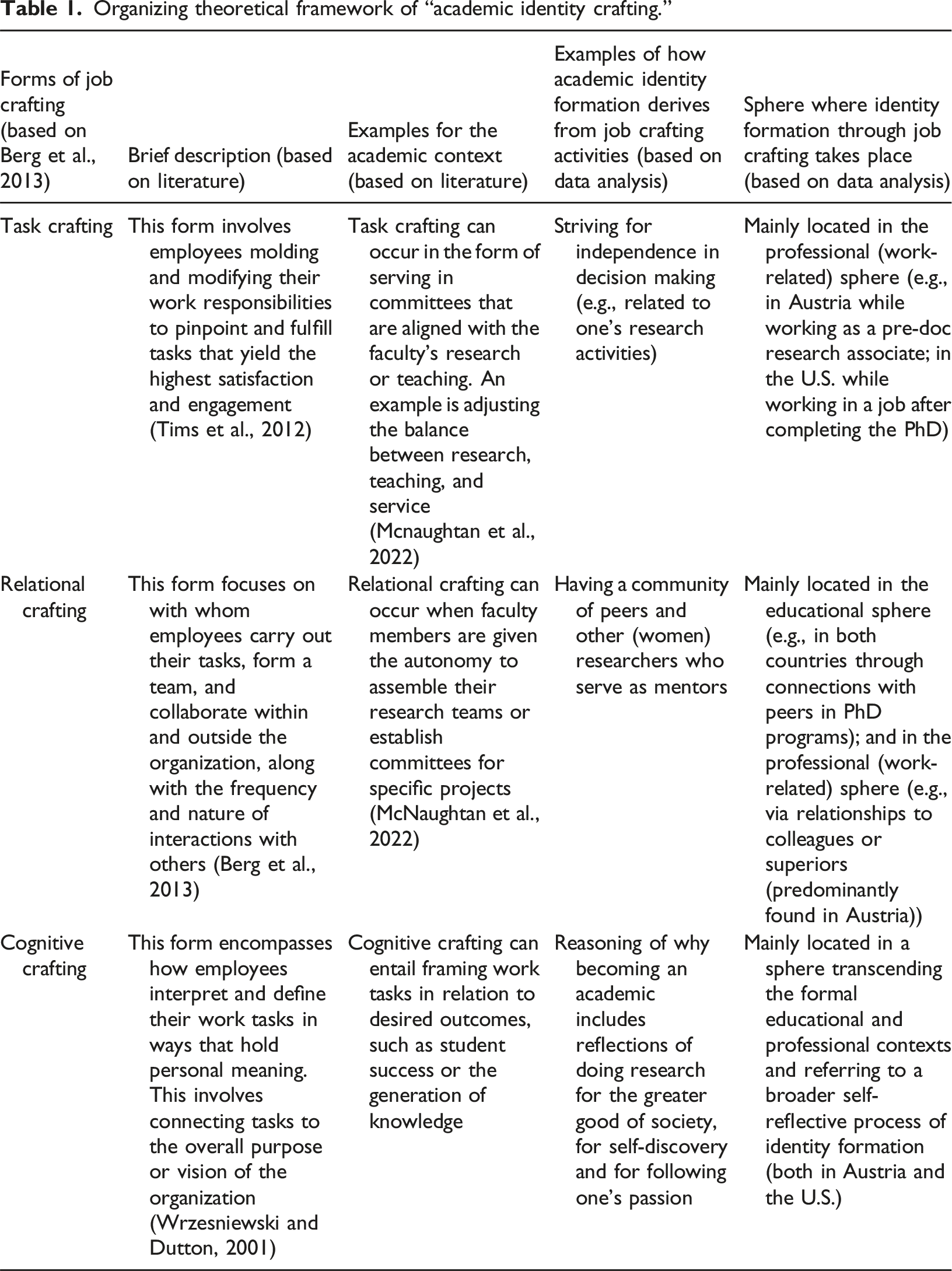
This refined framework, which we call “academic identity crafting framework” includes examples of each form of crafting, how it can be applied to the higher education context, and how it is related to academic identity formation. Theorizing processes of academic identity formation through the lens of job crafting allowed us to gain a deeper understanding of ECWRs’ agency in shaping identity formation and being cautious about the active role individuals take in crafting their identities as researchers.
Methodological considerations
Rationale underpinning the comparative design: U.S. and Austrian higher education
To address the aim of this paper, illuminating early-career women researchers’ experiences in two national contexts and explore their academic identity formation, it is crucial to pay attention to contextual differences but also similarities of the higher education systems of both countries under investigation, the U.S. and Austria. Important national differences that are likely to shape ECRs’ experiences and trajectories are (1) the ways in which doctoral students are integrated into the scholarly community and (2) the structures of the academic career path types. However, national higher education systems globally operate under (3) a guiding principle of neoliberalism (Bleiklie, 2020; Eisch-Angus and Arantes, 2024), which we discuss as an important aspect underlying both systems in addition to their national differences.
Doctoral students’ integration into the scholarly community
PhD students in the U.S. are predominantly enrolled full-time. Some of them are employed part-time by their institution or department as research assistants. However, they are typically perceived as full-time students or emerging researchers but are not seen as ECRs until they complete their PhD programs and obtain a postdoc or faculty position (Park and Bahia, 2022). On the contrary, in the Austrian system, doctoral students are predominantly perceived as ECRs and are often employed full-time within or outside of higher education (e.g., as research and teaching associates, casual lecturers, or investigators in third-party funded research projects). In contrast to the United States, there are relatively more students starting a PhD program, but a higher proportion does not (intend to) pursue an academic career after completing their doctoral studies (Muller-Camen and Salzgeber, 2005).
Career path types
In terms of academic career structures, the U.S. system is characterized by a more homogenous pathway to professorship meaning that after completing a PhD and a short postdoc period, the entry-level faculty role is typically the assistant professor, who traditionally progress to associate professor and, finally, to the rank of full professor based on their research, teaching, and service contributions (Gravestock, 2011). However, in recent decades, the landscape has seen changes, with an increase in non-tenure-track positions, reflecting a shift towards more flexible employment arrangements and a growing emphasis on teaching-focused roles. In Austria, the so-called “survivor” model” (Enders and Musselin, 2008) is characterized by an absence of a clear career structure, meaning there are more heterogeneous pathways to the full professorship (e.g., via the positions of lecturers, assistant professors with or without tenure-track, fixed-term postdocs, and post-docs in third-party funded research projects).
Neoliberal principles in the academy
Neoliberalism has become an important guiding principle in academia both the United States and Europe (Bleiklie, 2020). Neoliberal principles in the academy include market-driven competition, a focus on performance-based metrics and a clear emphasis on individual responsibility and entrepreneurialism among academics (Burton and Bowman, 2022; Oliveira et al., 2025). Such an environment prioritizes measurable outputs like publication counts and citation metrics. This “competitive approach” to the academic profession, where fellow academics are seen more as competitors than colleagues, contributes to increased precarity and intensified pressures, especially among ECRs (Robinson et al., 2017). In the U.S., neoliberal principles are arguably deeper entrenched that in European higher education, which has been historically rooted in more centralized and public funding models (Eisch-Angus and Arantes, 2024). However, it has also experienced substantial neoliberal shifts. A major milestone were the Bologna Process reforms aimed at enhancing competitiveness and international comparability, favoring a more competitive mindset among institutions (Giovanardi and Silvagni, 2021; Kushnir, 2020). Consequently, European institutions have increasingly adopted neoliberal practices in areas such as evaluation and funding, mirroring aspects of the U.S. academic landscape. Therefore, both contexts reflect neoliberal tendencies through a quantification of academic success and the pervasive framing of education as a marketable commodity. To summarize, there are some considerable differences but also similarities which we took into account when analyzing the empirical data.
Method, sampling and participants
To explore academic identity crafting in the U.S. and Austria, we applied a comparative case study design (Yin, 2009). This approach allows for “an in-depth analysis of a case” (Creswell and Creswell, 2018: p. 14) in two national contexts and for conclusions surpassing those drawn from merely a single case in a specific national setting (Lieberson, 2000). Reflexive thematic analysis (Braun and Clarke, 2022) was conducted to illuminate the participants’ experiences of academic identity crafting. Since this study was conducted by two bilingual ECWRs, this methodology embraces and acknowledges the authors’ involvement, reflective stance, and subjectivity throughout the analysis process. The initial theoretical framework of “job crafting” guided coding and identification of themes but was continually refined during the analysis, ultimately leading to the presented framework of “academic identity crafting” presented in section three (see Table 1).
The data was drawn from two larger projects on higher education research identity in the United States and Austria. In the U.S. context, the semi-structured interviews were conducted in English via Zoom in 2022, in the Austrian Context they were conducted in German (except for one, which was conducted in English). The interviews in Austria took place either face-to-face or via Zoom from 2022 to 2024. Each interview lasted between 30 and 70 min. For the study in the U.S. higher education context, the sample (N = 9) already consisted only of participants who identified as women and met the following criteria: (a) considers themselves an ECR, (b) has either already completed their PhD or is in the progress of obtaining their degree, and (c) was or is enrolled in a Social Science PhD program. For the study in Austria, the sample (N = 12) consisted of both men and women, who considered themselves an ECR and who have either completed their PhD or are in their final year. They were also enrolled in PhD programs related to Social Sciences (Business, Education Sciences, Political Sciences, Psychology, Social and Economic Sciences, and Sociology). Creating the sub-sample for this comparative research, the total sample consist of nine early-career women researchers in the United States and seven early-career women researchers in Austria (total of 16 interviews).
At the time of the interviews, in the U.S. context, four women were still enrolled in their PhD programs and full-time students, three women had recently graduated and were currently on the academic job market, and two women were faculty members (post doc) at a U.S. university. In Austria, while completing their PhD, four women had positions as research and teaching associates (pre doc) at universities, two women worked as general/professional university staff and one woman was employed as a postdoctoral researcher at an external research institute.
Findings: Forms of crafting and their role for academic identity formation
Task crafting: Thriving for independence and autonomy
We found that task crafting was practiced by both the interviewed U.S. and Austrian ECWRs in the form of seeking or creating a sense of independence in one’s work, specifically in research activities. The participants mentioned task crafting experiences mainly regarding the professional sphere. This can be illustrated by Charlie, for example, who worked at a public university in Austria and who emphasized the importance of independence and autonomy for making research-related decisions: “Yes, well I had, well I had after my Master's degree, umm, I then had a position at the university as a research and teaching associate and actually had all the freedom in the world to choose a PhD topic.
Another example is Toni, who also worked at a university in Austria and did her PhD as part of a research and teaching associate role. She stated in the interview that at first, she had “a lot of work for very little output.” But then, the institute got a third-party funded project “and that was basically my data, and that was basically my entry into real… well, university research.” Having an own project, in which they can make independent decisions, but being embedded in wider research projects as part of their roles at university was a common pattern in the Austrian cases as most of the interviewed ECWRs worked as researchers during their PhD. The interviewed U.S. women researchers also emphasized the importance of independence. Melissa, a recent graduate and current post doc, for example, shared that “because research, teaching, all of that…You know, you’re very flexible with your time, but the rest of the time you have to yourself”.
However, experiencing independence and autonomy also proved to be tricky. Riley, who values the freedom that her job and PhD project offers her, also acknowledges the constraints within academia by describing how a lack of flexibility and a tendency towards a “publish or perish culture” often made her question whether academia and research was the right path for her. On top of these stressors, obtaining truly independent positions often seemed to be more luck than a merit-based outcome of the job search process. For example, this experience was described by Kim, an Austrian researcher, ironically as: “thoroughly planned, very strategic, it all sounds very strategically planned, but truly it was a series of fortunate events.”
Jessica, a U.S.-based researcher preparing to defend her dissertation at a public university, described her struggle as “a disconnect always between what you study and sometimes where you’re at and working wise or what you do and what your purpose is.” Lara, a recent graduate of a Humanities PhD program at a university in the U.S., for example, shared how the pressures of academia, family expectations, and miscommunication both resulted in her divorce during the pursuit of her PhD: “So eventually we got into a situation where we got divorced. Simply because he thought that I chose a career rather than a family. Just because of this misunderstanding
While attempting a delicate balance between personal and professional lives, many of the interviewed women also felt like they were being taken advantage of in professional academia. Mika, an Austrian scholar working at an independent research institute while being enrolled in a PhD program at a public university, described this tension by saying: “I feel like universities take advantage of their students’ cheap labor. And I just don’t appreciate this elbow mentality and the constant fight for positions. That’s not me.” Hannah, a U.S.-based researcher and adjunct faculty member at a university actually shared that she made it a point to “fight back at what is actually nasty about academia, that they’re trying to turn you into an unpaid researcher, and you will never make more like they want you to be a lab rat.” This statement holds particular gravity as it is made by an ECR in the Social Sciences, where working in labs usually does not take place. That she chose to use this analogy impressively reflects her perceived lack of power to make autonomous choices and her feelings of exploitation.
To summarize, findings show that academic identity formation took place by crafting tasks to fit both the ECWRs’ personal and professional lives. In this regard, striving for independence in decision making has proven to be a particularly important aspect in the interviewed ECWRs’ academic identity formation.
Relational crafting: Having a community of peers and mentors
Relational crafting fostered identity formation by establishing connections to peers and mentors. Austrian ECR Riley, for example, described the importance of collaboration, networks, and what she calls “power of collective mindset,” particularly for researchers in the beginning stages of their careers. This became particularly salient to her when COVID-19 disrupted her usual relational crafting: “Mostly it affected us, the young, young scholars, because I think the academics, they already had their established networks, and they were probably also happy to rest and breathe a bit and not travel so much.”
U.S.-based researcher Daniela, a recent graduate of a Social Sciences PhD at a U.S. university, described a similar sentiment and points out the importance of both her peers and scholarly mentors in forming her identity as a researcher: “[...] what helped was developing these peer mentorships and figuring out what resources my friends had access to that maybe I was not aware of. [...] But for me, it's been more explicit in some of my connections with mentors in other departments and how they treat me or how they provide feedback, you know.
We found that relational crafting happened in both spheres—the professional and the educational. Austria-based researcher Jordan, for example, undertook her Master’s thesis as part of a research project at the department at her university. In the interview, she shared how her co-workers played a huge role in defining her identity as a researcher when she shared that she stuck with research because of the collegial environment in addition to her interest in the topic: “Yes, well, I started at the Department of [anonymized] this January – because I thought I'd give it a try. I could always quit if I didn't like it – and then, yes, I actually liked it quite a bit right away. Simply because the environment is very nice, and I have great colleagues here.”
In the U.S. sample, relational crafting appeared to predominantly happen among the student peers, since none of the U.S. ECWRs engaged in pre-doc, research-based work outside of their PhD programs. Melissa described a memory of her bonding with her PhD cohort and breaking into dance as a much-needed break from research activities: “[...] my PhD colleagues, the students who went through the journey together, we literally cried on each other's shoulders. [...] We were writing in this little office in one of the buildings and we didn't realize it was midnight. […] We cranked up the music really loud and we just danced for, like, half an hour.”
In their relational crafting, the women, however, also mentioned challenges in connecting with other researchers. Austrian scholar Riley described academia as a space that is “slow and it’s lonely sometimes.” In the same vein, U.S.-based scholar Lisa, a recent graduate of a Humanities PhD and currently on the academic job market, described feelings of loneliness and isolation, stating that she “was constantly feeling guilty that I should be doing some research or publication. […] And that was really…draining mentally. And I felt like I was in a mental prison and that prison was created by myself, by myself alone.”
A perceived lack of (women) role models and mentors emerged as another challenge in women’s relational crafting efforts in academia. Austrian ECR Alex, who works as professional staff at a university but is also enrolled as a PhD student at the same institution, stated that “it is not easy to find a woman advisor.” U.S.-based ECR Jessica emphasized how rare it was in her PhD program to find scholars willing to collaborate with graduate students: “So it's very unheard of, especially even in the PhD program my advisor is the only one who kind of encourages, like publishing and researching.
The interviewed women also talked about experiences of extreme competition and a strong focus on strategy among their PhD cohorts. The Austrian scholar, Alex, stated that she had very inspiring exchanges with women in professional networks, but it was only in communities outside her PhD program that she found women with whom she could truly connect. “We always meet up, and that's a fixed point for me because it's maybe once a month where we meet up on Friday or Saturday, we spend a day or half a day, umm, and then we have writing sessions. So, usually, we tell each other what we're currently working on, and then we set a goal. And at the end of the session, we have to report whether we've achieved it. And that helps me a lot. It really helps a lot.”
To summarize, by relational crafting, for example, collaborating with others and finding mentors, academic identity formation was established. Actively crafting an academic identity through such activities has been challenged, however, if meaningful connections—particularly to other women—couldn’t be established due to competition and a lack of representation.
Cognitive crafting: Finding purpose and reasoning for becoming an academic
Perspectives on cognitive crafting were often reflected by the ideal of conducting research for the greater good and an ultimate betterment of society as a whole. Mika for example, who is an Austrian based PhD candidate, talked about seeing research as more than a way to generate an income and expressed her disappointment about research often being shamed as not “economical enough” and how to her it is “sad when people accuse research or science in general of being worthless.” Jordan, following a similar mindset. In her doctoral thesis, she worked on the topic of resilience and educational inequalities, focusing on experiences of university students from less privileged backgrounds. In the interview, she expressed how important fighting social injustices is to her as a researcher: “I'm interested in this topic because it's important to me that social inequality might, well, be defeated one day (laughs). And education is definitely the key to that. That's why I'm so interested in this subject area. That's why I've stuck with it.”
Some of the U.S. participants also expressed cognitive crafting by engaging in research as an act of self-discovery and following their passion. Jessica contextualized her journey of becoming a researcher as a journey of self-development. She emphasized the tight knit relationship between her research and her identity stating that “I feel like there’s a lot of independence in that journey. Like there’s realizing who you are and what you are and that self-reflection. […] That’s kind of like my every day just knowing what, you know, what am I and what is my purpose.”
Manifestations of cognitive crafting among the Austrian and U.S. researchers appeared to be less attached to the educational and professional context and seemed to belong to a third, overarching and more personal and internal sphere. Austria-based ECR Kim even went as far as equating her affinity to research with a character trait, more so than an interest or skill: “You have to be a specific type of person to feel drawn to that field and to keep that reflective attitude.” Challenges in their cognitive crafting were experienced by some of the interviewed ECRs as feeling limited in their potential and interests. They felt “unable to do everything I am interested in” and it seemed difficult to combine their ideals and values with the realities of the job search and availability of positions.
To summarize, cognitive crafting played an important role in academic identity formation as it is connected to the perceived purpose of one’s work and is attached to a personal reflection about the self, what it means to be an academic and how the self aligns with this perception.
Discussion
This study aimed to illuminate how early-career women researchers form their academic identities, and what challenges might arise during the process of academic identity formation. By drawing on sixteen interviews with ECWRs in the U.S. and Austria, we analyzed three forms of crafting: task, relational, and cognitive crafting. Regarding the first, task crafting, findings showed that this form was mainly performed through a striving for independence in decision making processes in both country contexts. Especially in times of scholarly freedom of speech being increasingly under attack (Honeycutt et al., 2023), the importance of this element of task crafting to build an academic identity in the academy presents an interesting finding. However, for some of the interviewed ECWRs in Austria, rather than in the educational sphere (i.e., their PhD programs), it was in the professional sphere (i.e., employment context) where they expressed feelings of freedom to pursue their own ideas and felt they can make independent decisions as researchers. This might be partly due to the structure of the Austrian system, in which PhD candidates are often employed within or outside of higher education while doing their PhD.
The second form, relational crafting, for example, connecting with peers and mentors, aligns with literature recognizing the importance of networks (Edwards, 2022; Mantai, 2019; Tomlinson and Jackson, 2021) and having other, usually more senior, researchers in mentor roles for forming scholarly identities (Meuleners et al., 2023; Monereo and Liesa, 2022). This form of crafting took similar forms for both the U.S. and Austrian ECWRs; however, the Austrian PhD students seem to particularly benefit from institutional structures within their employment settings that partly provide opportunities for relational crafting, such as built-in teaching responsibilities, involvement in larger research projects, and funding for conferences. This echoes into the different ways of how PhD candidates are integrated into the scholarly community in the two national contexts under investigation.
The third form, cognitive crafting, which refers to the subjective reasoning for why becoming an academic, was performed by narratives of doing research for the greater good of society, self-discovery and following one’s passion in both countries. In today’s context of neoliberal higher education (Fleming, 2022; Lynch, 2006), interestingly the interviewed ECWRs in the U.S. and Austria reject notions of identity formation described in the literature as contemporary intellectual-entrepreneurial academics (Edwards, 2022) who perceive their academic identity in terms of their “market value” (Mantai, 2019). They related the cognitive crafting of their identities more to intrinsic motivation and general aspirations of a betterment and development of themselves and society as a whole. This might partly be explained by the selected field of study, the social sciences, where research suggests that “knowledge for knowledge’s sake” is (still) subjectively highly valued by academics even though this field is put under much pressure, while technological and medical disciplines are strengthened (Rhodes, 2017).
Our findings showed that the interviewed ECWRs also expressed challenges regarding identity formation that can be connected to the broader neoliberal tendencies of the academic workplace in both countries. For example, the “publish or perish culture” mentioned by participants in both country contexts reflects the need to produce a continuous stream of high-impact publications in order to secure tenure or promotion (Schadeberg et al., 2022), which places immense pressure on ECRs in general (da Silva, 2021; Mertkan et al., 2022; Van Dalen and Henkens, 2012). The relentless, neoliberal emphasis on quantifiable outputs has been found to shift the focus away from meaningful, long-term research toward short-term projects that are more likely to yield quick publications (Mertkan et al., 2022). ECRs, who are typically navigating precarious working conditions, are even more vulnerable to this pressure that can lead to burnout or even an exit from the academy (Koumachi, 2019). In addition, our data (e.g., “they want you to be a lab rat”) as well as the scholarly literature shows that ECRs are particularly vulnerable to exploitation within the neoliberal academy (Ballif and Zinn, 2024). As universities increasingly adopt market-oriented models, cost-cutting measures often come at the expense of ECRs, who are expected to do their job with little security or long-term prospects. Their precarious status makes it difficult to advocate for fair compensation or balanced workloads, as many fear jeopardizing future employment opportunities (Burton and Bowman, 2022).
In neoliberal higher education systems, ECRs are often positioned as disposable workers whose enthusiasm for their discipline is exploited to sustain the academic machinery. Within this machinery, feelings of loneliness and isolation are expressed, not only in the narratives of our participants but also in the scholarly literature (Macaulay, 2023). Another challenge for ECRs in the neoliberal academy relates to the finding of a perceived difficulty to combine their ideals and values with the realities of the job search and availability of positions aligns with the literature on the blurred lines between academia as a profession and a calling (Berthoin Antal and Rogge, 2020). Being an academic unavoidably blends structured employment with a deep personal investment in and passion for knowledge creation and teaching. This duality of extrinsic (e.g., generating income and moving up the academic ranks) and intrinsic motivation (e.g., personal fulfillment and intellectual curiosity) can indeed be a two-edged sword, as the passion that drives academic work is frequently exploited under neoliberal pressures for output and performance (Morgan and Wood, 2017).
Finally, our data also reflects challenges that are discussed in feminist literature (Lipton and Lipton, 2020; Morris et al., 2024) associated with family obligations and commitments that can complicate career aspiration of women in academia (Ahmad, 2017; Struppe-Schanda, 2024; Viglione, 2020). Both data and the literature highlight a perceived lack of (women) role models and mentors (Browning et al., 2016). In the data, this becomes evident in two ways: First, the lack of narratives of supportive mentors in the ECWRs’ interviews. In qualitative research, silences and the unspoken can also reflect existing structures, which for example have been illustrated in relation to gender, race and class in the academy by Sue and Robertson (2019). Second, if mentors or role models are explicitly mentioned, the interviewees emphasized how difficult it is to find a woman who could serve as a role model (e.g., “it is not easy to find a woman advisor”) or someone who is willing to guide them (e.g., “my advisor is the only one who kind of encourages, like publishing and researching”). This finding presents a barrier for ECWRs as limited access to mentorship and a general uncertainty about how to navigate challenges within the academy can be associated with a self-fulfilling prophecy, in which this absence cannot only reinforce gender inequities but can also deprive academia of the diverse perspectives and support networks ECWRs particularly need (Kent et al., 2022). Due to the nature of our data, we cannot analyze whether challenges related to family obligations and commitments would also be articulated in the narratives of male ECRs to the same extend. Our findings, however, echo previous feminist literature that examined such perceived challenges of women in more senior roles (Nonaka, 2020).
Interestingly, as precarious and challenging the realities of ECRs may be, we also identified resources the interviewed ECWRs used to circumvent the neoliberalist structures of the academy. One of those “pieces de resistance” was the acknowledging of a certain “power of collective mindset.” A collective mindset among ECWRs offers a powerful counterbalance to the individualistic and highly competitive ethos of neoliberally structured academia (Collective, 2019). To counteract the mentioned challenges of isolation and lack of mentorship, some of the interviewed ECWRs, much like other marginalized faculty groups, are in fact building networks of solidarity among each other, share resources and are engaging in mutual mentorship (Wright-Mair and Ieva, 2022). In addition, besides tapping into the “power of collective mindset,” the interviewed ECWRs utilized cognitive academic identity crafting to purposefully highlight their profession as their passion. Engaging in research as a creative act of self-discovery allows scholars to reclaim intellectual autonomy and resist the instrumental logic of neoliberal academia (Vella, 2023). When framed as a personal and reflective journey, research becomes a space for curiosity and critical engagement rather than mere quantifiable productivity. This strategy can help ECRs reclaim a field they often experience as difficult to access (Berthoin Antal and Rogge, 2020).
Implications
To support early-career women researchers in not only forming but also living their academic identities, we offer the following implications for policy and practice based on the findings of this study. Given the identified potential of networking and sense of community, institutions should think about programs that aim at connecting ECWRs with more senior scholars and peer support networks. These structures could be within the discipline or cross-disciplinary and should offer community, emotional support and shared strategies for navigating the neoliberal academy. Since finding passion and personal fulfillment in one’s job emerged as an important strategy to succeed in academic identity crafting, we suggest including reflective workshops on purpose and positionality in professional development offerings for ECRs. These programs should address the broader context of neoliberalism in higher education and provide tools specifically for cognitive crafting through for example narrative-building and values alignment given that our findings suggest that, while educational and professional settings provide important opportunities for development, the interviewed ECWRs often additionally engaged in deeper, more personal reflection and self-conceptualization outside these formal environments. Within this intrinsic sphere, an ongoing negotiation of personal values, beliefs, and experiences intersect with professional roles and ultimately shape a more holistic sense of academic identity. Consequently, academic identity crafting for ECWRs in academia appears to be a process that transcends traditional academic and professional boundaries, highlighting the importance of considering personal and contextual influences in understanding their professional development.
Conclusion
Major changes in the academy (e.g., rising precarity and increasing mental health problems) have impacted academic identity formation and early career researchers’ perception of academia as a desirable field to work in (Zhang and Gong, 2024). Even though the number of women in academia is on the rise, many of the challenges that come with academia being a gendered space remain (Clarke et al., 2024; Teelken et al., 2021). By illuminating ECWRs academic identity formation processes this study presents three major contributions: First, we present an “identity crafting framework” that can be used to guide empirical analysis aimed at gaining a deeper understanding of ECWRs’ agency in crafting their academic identities. Second, we emphasized the role of context by being sensitive about wider developments in the academy (e.g., the rise of neoliberalism) as well as country specifies when analyzing academic identity formation. Third, we found that while the academic environment supports the crafting of an identity (by providing spaces and opportunities for task, relational, and cognitive crafting), it falls short in facilitating the practice and living of that identity. The “neoliberalization” of academia in both countries, in which the interviews took place, points towards a focus on individuals, however we were also able to identify a “we-ness” (Burnard et al., 2022: p. 448) of academic identities, allowing for similar patterns of academic identity crafting to emerge. We therefore conclude that it is essential to understand identity crafting not only from a perspective of individual agency, but also within specific contexts.
Footnotes
Acknowledgments
We would like to thank all participants of this study for generously sharing their experiences in the interviews and dedicating their time to our research. We would also like to thank Magdalena Fellner, Sabine Weiss, Flora Petrik, and Larissa Bartok for contributing to the data collection of this research.

Ethical considerations
This study was approved by the University of Innsbruck Research Ethics Committee (approval no. 15/2024) on February 26, 2024.
Consent to participate
Respondents gave written consent for review and publication before starting interviews.
Funding
The authors disclosed receipt of the following financial support for the research, authorship, and/or publication of this article: This study was partly funded by Sciences Po as part of the Gender Studies Visiting Faculty Programme 2025–2026 and the Austrian Higher Education Research Network (Hofo). Proofreading was funded by the Faculty of Educational Sciences of the University of Innsbruck.
Declaration of conflicting interests
The authors declared no potential conflicts of interest with respect to the research, authorship, and/or publication of this article.