




Abstract
In recent decades, the ability to represent others’ mental states (i.e., theory of mind) has gained particular attention in various disciplines ranging from ethology to cognitive neuroscience. Despite the exponentially growing interest, the functional architecture of social cognition is still unclear. In the present review, we argue that not only the vocabulary but also most of the classic measures for theory of mind lack specificity. We examined classic tests used to assess theory of mind and noted that the majority of them do not require the participant to represent another’s mental state or, sometimes, any mental state at all. Our review reveals that numerous classic tests measure lower-level processes that do not directly test for theory of mind. We propose that more attention should be paid to methods used in this field of social cognition to improve the understanding of underlying concepts.
Every psychologist and psychiatrist, every child development expert, most cognitive scientists and ethologists, as well as most people interested in consciousness, know what theory of mind and empathy are. And every contributor to this field of social cognition is able not only to provide a definition for these terms but also to propose specific ways to evaluate their content. Unfortunately, however, definitions and assessments are extremely variable. This variability continues despite the unprecedented interest in social processes over recent decades. Fifty years after the emergence of the first tools designed to measure social-cognitive abilities (Hogan, 1969; Carkhuff & Truax, 1965), the very structure of social cognition still suffers from insufficient clarity (e.g., F. Happé, Cook, & Bird, 2017). One obvious reason for this stems from the highly heterogeneous sources of knowledge in this particular field, which was formed by the confluence of incommensurable approaches such as ethology, psychology and psychiatry, and developmental psychology.
In our view, two main and interacting factors have contributed to the insufficient understanding of the functional architecture of social cognition. The first factor has been noted by several authors in recent years (F. Happé et al., 2017; Quesque & Rossetti, 2019): the vocabulary for sociocognitive abilities is highly heterogeneous and nonspecific (see Fig. 1 for an illustration). In addition, several terms are used to describe a single concept (convergence of meaning). For example, the “ability to distinguish and represent one’s own and others’ mental states” can be referred to as “theory of mind” (e.g., Premack & Woodruff, 1978), “mentalizing” (e.g., Frith & Frith, 2012), “mindreading” (e.g., Gallese & Sinigaglia, 2011), “perspective-taking” (e.g., Galinsky, Ku, & Wang, 2005), “empathy” (e.g., Preston & de Waal, 2002), “cognitive empathy” (e.g., Baron-Cohen & Wheelwright, 2004), or “empathic perspective-taking” (e.g., de Waal, 1996) depending on the authors and/or contexts. However, a given term can also be used to depict distinct processes (divergence of meaning). For example, Batson (2009) identified at least nine different psychological constructs that are referred to as “empathy,” and more recently, Cuff, Brown, Taylor, and Howat (2016) distinguished 43 different definitions proposed for this term.
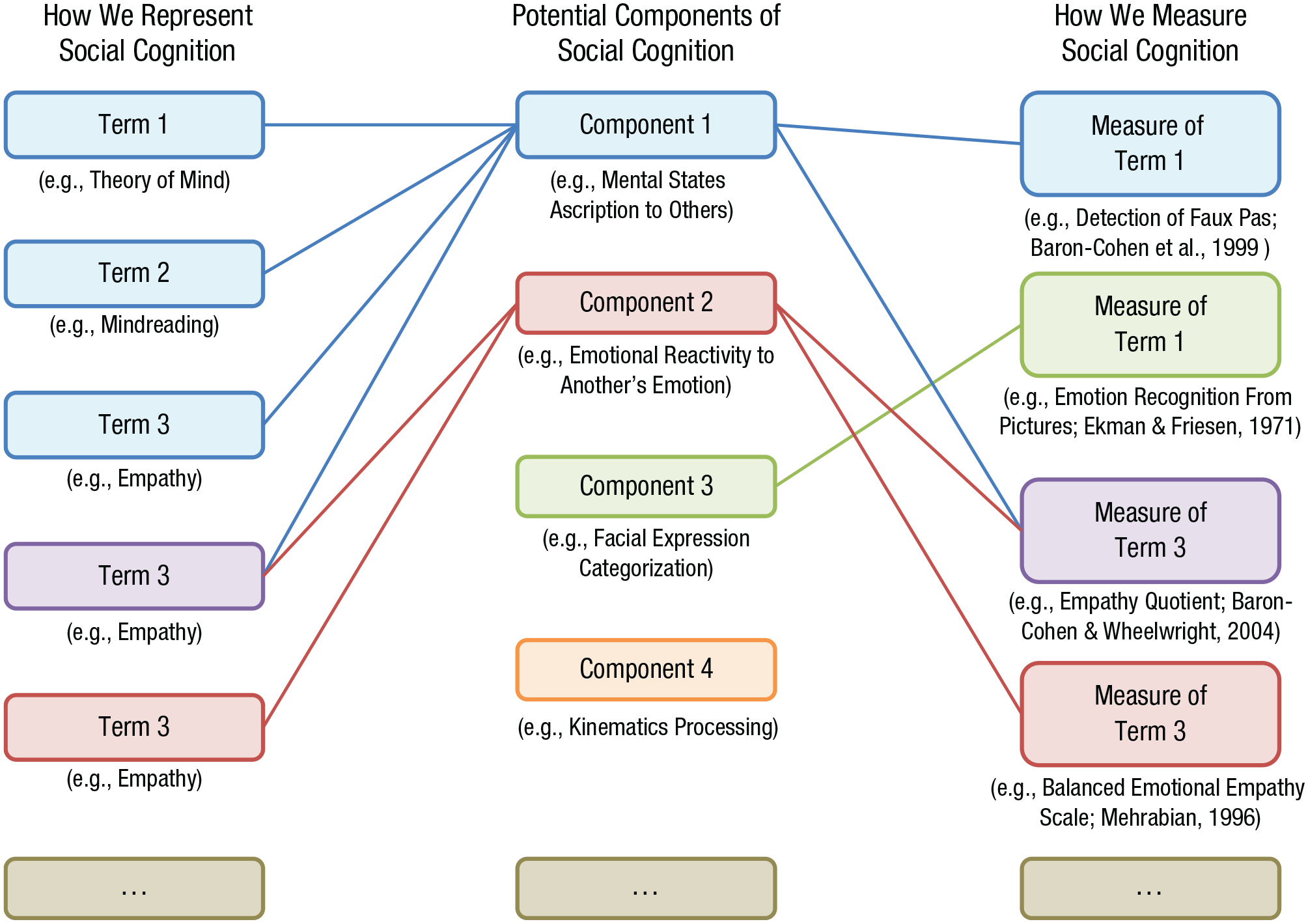
Schematic representation of the current heterogeneity and nonspecific aspects in the conceptualization of social cognition and its measures. Heterogeneity: Different terms are currently used to refer to the same theoretical construct (e.g., Terms 1, 2, and 3), and tests that are supposed to measure different constructs actually investigate the same component (e.g., measure of “Term 1” and measure of “Term 3”). Nonspecificity: The same term can be used to refer to distinct constructs (e.g., Terms 3). The same term can also be used to simultaneously include different constructs (e.g., purple Term 3). Tests that are conceived to quantify a particular construct actually measure different components of social cognition (e.g., Measures of Term 1), and some of these tests simultaneously measure different constructs (e.g., purple Measure of Term 3). A nonexhaustive list of examples (in parentheses) illustrates the current heterogeneity and nonspecific aspects of social cognition.
The second factor that we identified has received less critical attention and originates from the measures themselves. As is the case for the vocabulary and definitions, it turns out that classic measures of social-cognition mechanisms are also heterogeneous and nonspecific (for an illustration, see Fig. 1). The semantic divergence and convergence described above for terminology also occur at the level of practical evaluation. Obviously, numerous tests coexist to estimate theory of mind (for a review, see Achim, Guitton, Jackson, Boutin, & Monetta, 2013). Some of these tests (e.g., The Reading the Mind in the Eyes test, RMET; Baron-Cohen, Wheelwright, Hill, Raste, & Plumb, 2001) are however also frequently used as indexes of empathy (Chapman et al., 2006), emotion decoding (Maurage et al., 2011), or even the precise ability to read a person’s mind through their eyes (Declerck & Bogaert, 2008).
What Is Theory of Mind and How Do We Believe We Measure It?
Among the numerous components of social cognition (Fiske & Taylor, 2013; Goldman & de Vignemont, 2009), some have benefited from privileged attention from scientists. This privileged attention is typically the case for the ability to represent other mental states. Despite the aforementioned terminological heterogeneity, researchers seem to agree on a definition (Apperly, 2012). Theory of mind is classically defined as the ability to impute mental states to oneself and others (Wimmer & Perner, 1983) or the ability to attribute mental states (such as emotions, intentions, or beliefs) to other persons (Gallese & Sinigaglia, 2011). The term theory of mind was originally used to qualify the ability of nonhuman primates to infer other agents’ intentions (Premack & Woodruff, 1978). Subsequent studies investigated a wide range of populations (newborns, younger and older infants, adults, as well as numerous other animal species), which led to the development of an important variety of tests and experimental measures. This variety encouraged us to question whether theory of mind depicts a single entity or refers to a large family of abilities in terms of the breadth, homogeneity, and specificity of the functions involved (Apperly, 2012).
Classic definitions suppose that theory of mind includes belief, intention, and emotional inferences (Frith & Frith, 2006). Recent correlational (Erle & Topolinski, 2015; Kanske, Böckler, Trautwein, Parianen Lesemann, & Singer, 2016; Mattan, Rotshtein, & Quinn, 2016) and experimental (Erle & Topolinski, 2017), as well as clinical (Hamilton, Brindley, & Frith, 2009) evidence, however, validates that theory of mind also encompasses the ability to represent how another would perceptually represent the surrounding world. 1 Supporting this idea, early studies reported that the efficient representation of others’ false beliefs (e.g., Wimmer & Perner, 1983) and others’ visuospatial perspectives (Flavell, Everett, Croft, & Flavell, 1981) emerged around the same age during child development. In addition, it has been possible to identify brain areas (e.g., the dorsal part of the temporo-parietal junction) responsible for representing other perspectives in a domain-general fashion (Aichhorn, Perner, Kronbichler, Staffen, & Ladurner, 2006; Schurz, Aichhorn, Martin, & Perner, 2013; Zaitchik et al., 2010). Integrating these findings, theory of mind would correspond to the general ability to infer others’ mental states, regardless of which precise function they support, even if it is possible that different subcomponents of social cognition (kinematics processing, mirroring, stereotypes, etc.) are recruited depending on the type of judgment (emotional, intentional, etc.) and on available stimuli (full body, gaze, verbal information, etc.).
Assuming that theory of mind is conceived of as a unitary process that relies on assorted lower level mechanisms (Gallese & Goldman, 1998; Gangopadhyay & Schilbach, 2012; Rizzolatti & Craighero, 2004), it remains to be determined which aspects are common to all of the relevant types of social inference. According to Epley and Caruso (2009; see also Erle & Topolinski, 2017), all kinds of perspective-taking processes rely on the same set of abilities; they all require the ability to represent mental states that differ from what is directly experienced in the here and now, distinguishing one’s own from others’ mental states. This ability to corepresent—or to switch between—different perspectives seems to represent the core component of all types of theory-of-mind judgments. As a practical implication, it would be inappropriate to speak about theory of mind in cases in which there is no evidence for this ability. In accordance, two main criteria should be systemically met by measures of theory of mind. First, a valid assessment of theory of mind should necessitate more than just attributing a mental state to another person. Importantly, it should also imply that the respondents maintain a distinction between the other’s mental state and their own (we refer to this as the “nonmerging criterion”). In the particular case of applying theory of mind to the self, the distinction that has to be maintained is between the present and the imagined mental state (for a congruent account concerning the emergence of the ability to pretend, see Leslie, 1987). Although crucial, this is rarely the case in theory-of-mind tasks. Second, lower-level processes (e.g., attention orientation, associative learning) should not possibly account for successful performance on any theory-of-mind task (“mentalizing criterion”; for discussion, see Heyes, 2014). When these simpler processes can provide sufficient explanatory value, one should definitively favor the more parsimonious explanation when interpreting performances. In our view, if a task does not meet these two criteria (“mentalizing” and “nonmerging”), it should no longer be discussed as a measure of theory of mind.
Emotional attribution from others’ faces is often used as an index of theory of mind (see Table 1). Success in this type of task may, however, be interpreted as mere visual discrimination (when the task consists of categorizing pictures between different categories) or as emotional contagion (in situations where the same emotional state is shared by the observer). These two cognitive operations also represent sociocognitive mechanisms but certainly should not be regarded as involving theory of mind. It is interesting that such caution is classically evoked when conducting experiments with nonhuman animals. In nonhuman animals, emotion discrimination from selected parts of the human face is interpreted as mere discrimination and not as a manifestation of theory of mind or other higher-level sociocognitive mechanisms (Müller, Schmitt, Barber, & Huber, 2015).
Descriptions of the Different Tests and Experimental Tasks Used to Estimate Theory of Mind
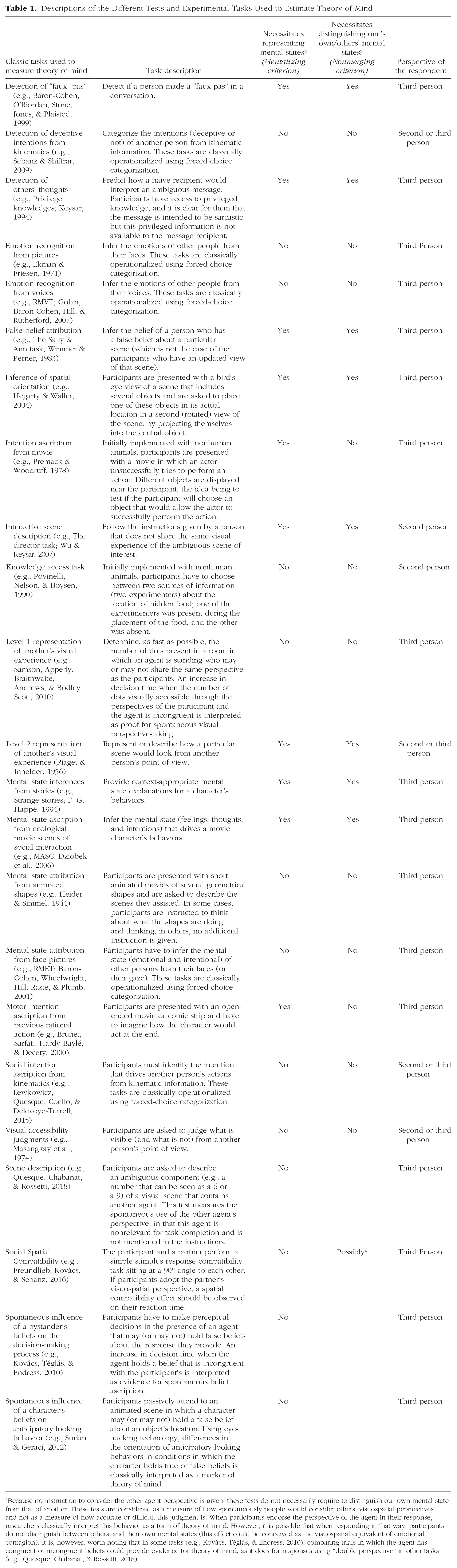
Because no instruction to consider the other agent perspective is given, these tests do not necessarily require to distinguish our own mental state from that of another. These tests are considered as a measure of how spontaneously people would consider others’ visuospatial perspectives and not as a measure of how accurate or difficult this judgment is. When participants endorse the perspective of the agent in their response, researchers classically interpret this behavior as a form of theory of mind. However, it is possible that when responding in that way, participants do not distinguish between others’ and their own mental states (this effect could be conceived as the visuospatial equivalent of emotional contagion). It is, however, worth noting that in some tasks (e.g., Kovács, Téglás, & Endress, 2010), comparing trials in which the agent has congruent or incongruent beliefs could provide evidence for theory of mind, as it does for responses using “double perspective” in other tasks (e.g., Quesque, Chabanat, & Rossetti, 2018).
When dealing with humans, scientists sometimes tend to be less parsimonious in their interpretations (e.g., Baron-Cohen, Jolliffe, Mortimore, & Robertson, 1997), presumably because we all have naive folk ideas about the way our brains work (e.g., “If I can remember your phone number, then I have a memory,” or “If I can recognize your emotion, then I have a theory of mind”). When we see a fish changing direction and following another fish swimming quickly, we do not imagine that it is a manifestation of the follower’s intentions (at the best, we will consider that it learned, by conditioning, that this behavior favors survival). It is striking that when we observe humans’ responses to tests, we seem to frequently fall in the trap of less parsimonious interpretations. For example, as noted by Obhi (2012), human performance on two-alternative forced-choice categorization of action kinematics is classically interpreted as evidence for intention reading, whereas such results actually inform us only about humans’ visual-discrimination abilities. Obviously, scientists should actively struggle to avoid such interpretation biases. A simple rule to apply would be to systematically consider explanations at the simplest level before considering the involvement of any higher-level cognitive processes.
When one considers the theoretical arguments listed above and the need for parsimonious and unbiased interpretations, it seems of critical importance to verify whether each of the classically used theory of mind tests actually necessitates the ability to switch from an ego-centered perspective. For those tests in which this ability is not required, we may have to redefine what they actually measure. As a first step in that direction, we examined the tests and experimental procedures commonly used to assess theory of mind (see Table 1). For each task, we assessed (a) whether success in that task could be attributed to lower-level processes rather than to a mental state (mentalizing criterion) and, critically, (b) whether the task requires representing a mental state that differs from that of the respondent, implying that the participant needs to distinguish between their own and others’ mental states (nonmerging criterion).
What Do We Actually Measure?
What do classic theory-of-mind tasks and tests measure? Table 1 presents the most commonly used tests and tasks for evaluating theory of mind. To underline how tasks that do not meet the two abovementioned criteria differ from tasks that do, here, we arbitrarily focused on two measures. First, as noted by Heyes (2014), when discussing the nonspecificity of most implicit tasks of theory of mind (but see also Kulke, Johannsen, & Rakoczy, 2019; Kulke, Reiß, Krist, & Rakoczy, 2018; Kulke, von Duhn, Schneider, & Rakoczy, 2018; Schuwerk, Priewasser, Sodian, & Perner, 2018 for recent experimental evidence), it is crucial that success in tasks cannot be explained by lower-level processes. A typical example of a task that would not meet this first criterion would be the knowledge-access task (e.g., Povinelli, Nelson, & Boysen, 1990). Participants must choose between two contradictory sources of information (two agents) to determine the location of a hidden item. Typically, one of the agents attended to the placement of the item, and the other did not. Success in such tasks is sometimes interpreted as evidence for belief ascription (e.g., “this agent knew the actual item’s location”), but basic associative learning mechanisms would allow the production of the very same behavior (e.g., “this agent was presented at the same time as the item”).
Second, as emphasized earlier, a valid measure of theory of mind should require the participant to represent a mental state that differs from the one experienced by the respondent. A typical example of a task that would not meet this second criterion would be the “ascription of intention from previous rational action” task (e.g., Brunet, Sarfati, Hardy-Baylé, & Decety, 1990). In this task, participants are presented with an open-ended story involving an agent, and they have to select a suitable ending. Again, if success in such tasks can be interpreted as evidence for intention ascription (e.g., “this agent wanted to grasp that item”), there is no evidence that participants distinguish their own intentions from the agent’s (e.g., “I now want to grasp that item”). Such merging with others’ minds or bodies could be compared with what occurs when we watch movies: We project ourselves onto the character and experience their intentions and emotions at the first-person level, sometimes even losing contact with reality. We may experience the same mental states as the character (interestingly, not the same states as the actor!) and thus may be primed to act in a congruent way, leading us to successfully pass classic tests of theory of mind.
In fact, it seems that evaluations that (a) involve mental state representation and (b) actually require a respondent to distinguish between representations of the self and those of others are not evenly distributed among the different types of mental-state inferences. Some types of judgments are addressed by several tasks that positively meet our nonmerging criterion; for example, this is the case for belief ascription and for level 2 visuospatial perspective-taking (i.e., representing how the world is seen by another person; Flavell et al., 1981). Conversely, there are at least three types of mental-state inferences for which the tasks currently in use suffer from a lack of specificity and do not meet the two abovementioned criteria: visual accessibility judgments, emotion ascription, and intention ascription tasks.
Visual accessibility judgments (i.e., representing what is and what is not visible to another person, without considering how this representation will be perceived), which is also referred to as level 1 visuospatial perspective-taking (Flavell et al., 1981), is typically estimated through tasks that are independent from another person’s frame of reference (mentalizing criteria). Yaniv and Shatz (1990) proposed that computing the line of sight of another agent is analogous to actually drawing a line from the agent to the target object. As a consequence, visual accessibility tasks have been parsimoniously described as relying predominantly on egocentric processes (Kessler & Rutherford, 2010).
Emotion ascription also suffers from the same problem. The majority of the tasks exploring emotional ascription require recognizing emotions, or merely categorizing them, from facial expressions, voices, and animations. Such tasks are likely to assess lower-level processes such as perceptual emotion recognition rather than genuine theory-of-mind abilities (mentalizing criteria). A critical test for this interpretation has actually been conducted by comparing the performances of clinical populations known to present specific impairment in theory of mind or emotion recognition on the Reading the Mind in the Eyes test (RMET; Baron-Cohen et al., 2001), which is the most used test of theory of mind for emotional judgments. Compatible with our current interpretation, the results suggested that the RMET measures emotion recognition rather than theory-of-mind ability (Oakley, Brewer, Bird, & Catmur, 2016).
Finally, most intention-ascription tasks (and some emotion-ascription tasks) also present an important limit because they do not require the distinction between one’s own and others’ mental states (nonmerging criterion). Success in these tasks may be obtained on the mere basis of mirroring processes such as motor contagion, which would, in fact, involve a merging between representations of the self and others (Brass, Ruby, & Spengler, 2009). Because no distinction is made between the observer’s own mental state and the character’s mental state, it is rather unwise to assume that we ascribe a particular mental state to the character, and we should consequently avoid referring to “theory of mind” in this context.
A Necessary Shift: What We Need to Change Moving Forward
In this last section, we discuss the changes that could be made to overcome the current lack of specificity in many “tests of theory of mind,” as well as their conceptual and theoretical benefits. First, we will see how the general call for more ecological validity when studying social processes (Schilbach et al., 2013) would address many of the presently raised issues. Second, we will examine how the suggested paradigm shift would encourage terminological clarity in social cognition. Finally, we will review how the use of the mentalizing and nonmerging criteria would allow the conciliation of findings that may appear contradictory.
In recent years, several researchers have called for a shift in the methods used to investigate social cognition, supporting an approach based on actual interactions and emotional engagements between people rather than mere observation (e.g., Schilbach et al., 2013). This strategy is obviously at odds with classic paradigms in which the participants are presented with written or verbal stories, puppets, comic strips, or movies (i.e., always from a third-person, or outsider’s, perspective). The initial motivation for a shift toward second-person perspective studies originates from the idea that social cognition is fundamentally different when we are directly engaged with another person compared with when we remain an external observer (Gallotti & Frith, 2013). For example, recent studies demonstrated that when we are involved in an interaction with another person, we spontaneously represent the motor affordances of the surrounding environment from their perspective, which is not the case when observing a passive partner (Coello, Quesque, Gigliotti, Ott, & Bruyelle, 2018; Freundlieb, Kovács, & Sebanz, 2016).
In the present case, one extremely important outcome of the recommendation to examine first-person engagement in social interactions is that such a paradigm shift would also allow the aforementioned limits (e.g., lack of specificity, distinction between the mental states of the self and others) of most classic tests of theory of mind to be overcome. As underlined by Barsalou (2013), our social interactions require significantly more complementary actions than mirrored actions. When facing a character expressing anger, most participants experience fear (not anger). When facing a character throwing a ball at them, participants are primed to catch (not to throw) the ball. Therefore, their own mental state differs from that of the observed character, even though they will have correctly inferred their emotion or intention. In addition, directly involving participants in tasks would constitute a means to limit alternative lower-level explanations (e.g., motor contagion) to participants’ performances, in addition to enhancing ecological validity. As a representative example, the director task, used by Wu and Keysar (2007), requires participants to interpret the message (e.g., “give me the big book”) of a partner who has a different point of view (e.g., only two books are visually accessible to the partner, whereas a third book that is even bigger can be seen only from the participants’ perspective) and to act accordingly. In this case, participants should not only represent the point of view of another person but also distinguish between what they see and what the partner sees. This uncommon feature for level 1 visuospatial perspective-taking tests allows for an efficient exclusion of low-level interpretations of participants’ performance.
Participants’ first-person engagement is not the only strategy one can rely on, as long as the test involves distinguishing between the participant’s and the character’s mental states. Other tests in which participants are mere observers of a social scene also meet the mentalizing and nonmerging criteria (e.g., the false-belief task; Wimmer & Perner, 1983). As previously underlined, not all types of mental-state inferences benefit from such tests, but the same logic can be virtually transferred to any type of mental-state inference. This was, for example, the case of the MASC (movie for the assessment of social cognition; Dziobek et al., 2006), in which participants have to infer the mental states (both emotional and cognitive) that drive a character’s actions within a complex social interaction, in movie scenes displaying multiple agents. To our knowledge, the MASC seems to represent the only available test that allows an assessment of the inference of others’ emotions, excluding alternative lower-level accounts (such as visual or auditory categorization). Careful attention should be paid to address this issue in future test development.
Regardless of the precise strategies chosen to address the presently discussed criteria, we argue that an important theoretical shift is needed for the designers of clinical and experimental measures of theory of mind. The crucial point is that tasks aimed at estimating any aspect of theory of mind should minimally ensure that participants distinguish between their own and others’ mental states. This point is especially true when participants experience a mental state similar to that of the stimulus character (e.g., when facing a big spider with my partner, I know that both of us are scared, but I also know that each of us has our own qualitative and quantitative experience of fear).
It is likely that numerous classic tests of theory of mind measure lower-level social-cognitive processes such as kinematics processing (see Obhi, 2012), social attention (see Heyes, 2014), emotion recognition (e.g., Oakley et al., 2016), or even prosodic information discriminations rather than theory of mind abilities (see Fig. 2). Although this route may turn out to be challenging, especially for tests with a long-standing tradition of being associated with theory of mind, tasks that do not meet the mentalizing and the nonmerging criteria should no longer be considered valid assessments for theory of mind (see Table 1 for an evaluation of each task regarding the mentalizing and nonmerging criteria). A long-term consequence of this change will be whether the concept of “theory of mind” will survive in its current operational fuzziness.
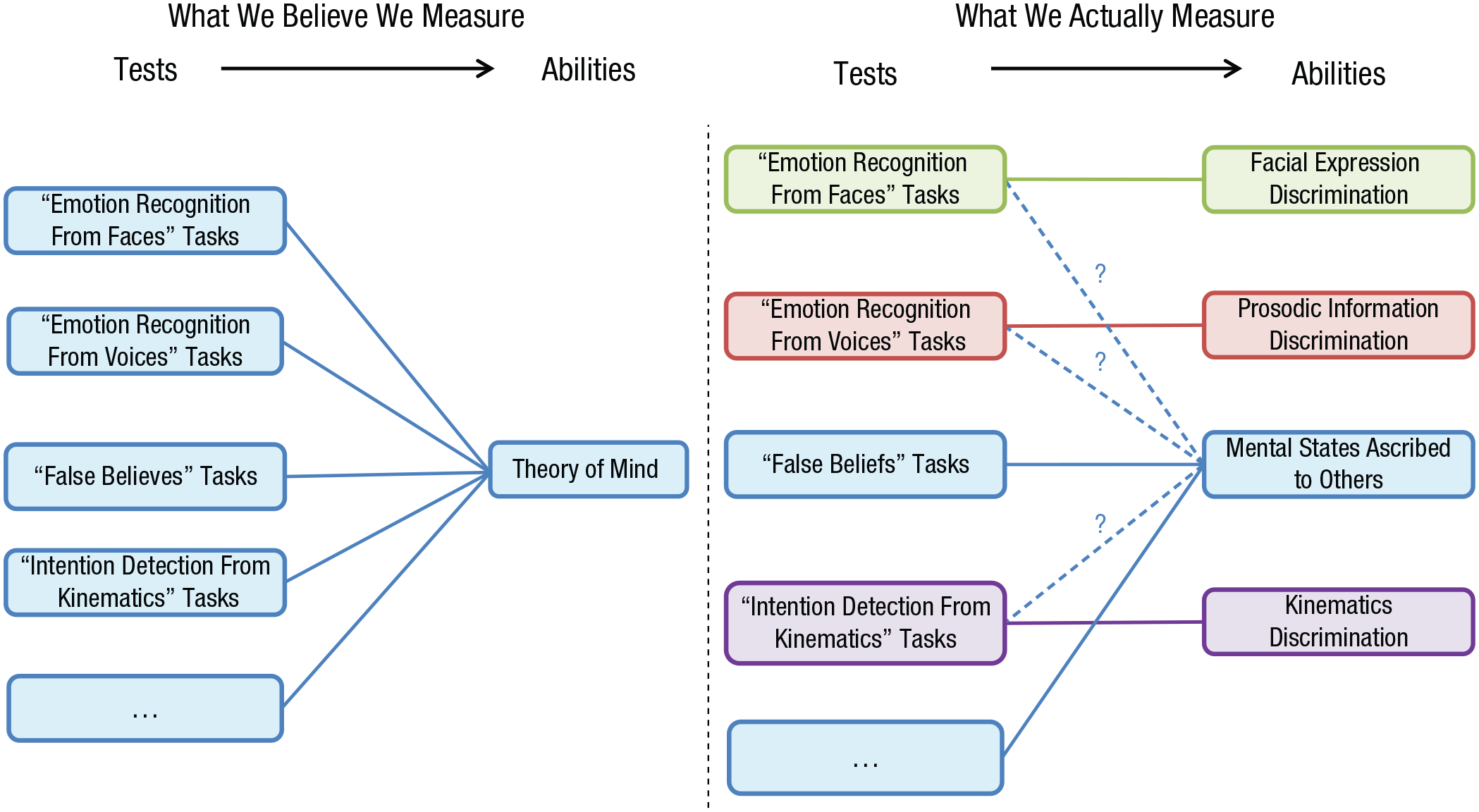
Illustration of the fact that most classic tasks used to measure theory of mind actually quantify lower-level cognitive processes.
The suggested paradigm shift is in line with the urgent need for conceptual clarification in the field. As we emphasized earlier, two main efforts will be required to develop a general model of the structure of social cognition, which may be necessary for this field to be considered a unitary domain of science. The first level is terminological, and the second is methodological. Clarity and consensus in the field of social cognition cannot arise without pruning ambiguities and confusion at both the theoretical and the practical levels of this scientific area. Specific hierarchical organizations can be postulated (e.g., “theory of mind” involves “emotion categorization,” which relies on “face processing,” which requires “social attention”), but in the absence of sufficiently specific evaluations, no conclusive argument should be drawn. By determining more strictly which tests actually measure theory of mind and which tests do not, a clearer outline of theory of mind will be delineated. Therefore, the paradigmatic and conceptual levels of clarification inherently and dialectically depend on each other.
An old (Ford, 1979; Kurdek, 1978; Underwood & Moore, 1982) but still unsolved question is whether there is a general mechanism supporting the different types of theory-of-mind judgments (e.g., “beliefs ascription,” “emotion ascription”) or whether different independent constructs coexist and support each type of inference. Current experimental evidence is available in support of both hypotheses (Bons et al., 2013; Cook, Brewer, Shah, & Bird, 2013; Erle & Topolinski, 2015, 2017; Hamilton et al., 2009; Kanske et al., 2016; Mattan et al., 2016; Maurage et al., 2016; Shamay-Tsoory & Aharon-Peretz, 2007). Unfortunately, the arguments collected by a variety of authors are based on the use of a heterogeneous set of evaluations, which is responsible for the incommensurability and confusion. Careful selection within the existing tests for theory of mind, associated with high-levels of caution concerning mentalizing and nonmerging criteria in the development of new tasks, would allow the reconciliation of findings that may appear contradictory (e.g., evidence supporting both the presence and the absence of theory of mind in a given animal species). It has been recently argued that the involvement of a common mechanism for all types of theory-of-mind judgments could be consistent with the existence of apparent double dissociations between different types of inferences (Quesque & Rossetti, 2019).
Finally, from an ontogenetic point of view, refining the tasks that provide actual measures of theory of mind will also help clarify the extensive developmental variability across the different types of mental states’ inferences (Quesque & Rossetti, 2019). This preliminary step will enable a more accurate view of the actual development of theory-of-mind abilities and the definition of more precise stages in this development.
In the above paragraphs, we have seen that the systematic use of mentalizing and nonmerging criteria to determine whether a task is a valid measure of theory of mind would provide many benefits. At the conceptual level, this paradigm shift is consistent with the need for terminological clarification, whereas at the theoretical level, this pruning would allow us to clarify a currently divided body of scientific literature. These considerations prompt scientists in the field, both authors and reviewers, to systematically assess whether methodological choices allow us to elaborate on acceptable discussions of theory of mind abilities. Most disagreements in the field are likely to stem from the insufficient attention given to this methodological dimension, resulting in overgeneralized interpretations. It is at the level of interpretation, rather than fact, that these disagreements take place, and reunifying experimental findings with legitimate interpretations is an open door to unifying the field.
