



Abstract
Research on executive function in early childhood has flourished in recent years. Much of this work is premised on a view of development of executive function as the emergence of a set of domain-general component processes (e.g., working memory updating, inhibitory control, shifting). This view has shaped how we think about relations between executive function and other aspects of development, the role of the environment in executive-function development, and how best to improve executive function in children who struggle with it. However, there are conceptual and empirical reasons to doubt that executive function should be defined in this way. I argue that the development of executive function is better understood as the emergence of skills in using control in the service of specific goals. Such goals activate and are influenced by mental content such as knowledge, beliefs, norms, values, and preferences that are acquired with development and are important to consider in understanding children’s performance on measures of executive function. This account better explains empirical findings than the component-process view; leads to specific, testable hypotheses; and has implications for theory, measurement, and interventions.
Keywords
Executive function is fundamental to human cognition and achievement—we use it when we need to exercise control over our thoughts and behavior, especially when we are trying to do something that competes with our habits, impulses, and desires. More formally, it often has been defined as the use of (higher) cognitive processes to engage, direct, or coordinate other (lower) cognitive processes, typically in the service of goals (e.g., Miyake et al., 2000; Zelazo, 2004). However, in recent years it has also been increasingly defined reductively as a set of separable but related component processes involved in goal-directed thought and action. Often this is specified as three executive “functions”—updating working memory, shifting between task sets, and inhibiting prepotent thoughts and responses (e.g., Best & Miller, 2010; Diamond, 2013; Miyake et al., 2000)—but other proposals also exist (e.g., Carlson & Moses, 2001; Miyake & Friedman, 2012; Simpson & Carroll, 2019).
Over the past several decades, research on executive function has flourished in developmental psychology. Performance on measures of executive function improves with age in early childhood (Best & Miller, 2010; Carlson, 2005), even when taking into account other factors such as verbal knowledge and intelligence (e.g., Carlson & Moses, 2001; Zelazo et al., 2013). In addition, numerous studies have found concurrent and longitudinal relations between measures of children’s executive function and measures of diverse skills and outcomes (e.g., academic achievement; social, logical, and biological reasoning; Best, Miller, & Naglieri, 2011; Blair & Razza, 2007; Carlson & Moses, 2001; Doebel, Rowell, & Koenig, 2016; Richland & Burchinal, 2013; Zaitchik, Iqbal, & Carey, 2014). Deficits in executive function are linked to a range of clinical outcomes (e.g., attention-deficit/hyperactivity disorder, autism, depression; Pennington & Ozonoff, 1996; Snyder, 2013). Thus, two key goals of psychological science are understanding how executive function develops and how it can be improved.
The Development of Executive Function as the Emergence of Domain-General Components
The development of executive function is widely understood as improvements in domain-general components that are thought to underlie self-regulatory and complex goal-directed behaviors, which in turn are subserved by prefrontal cortical development (Diamond, 2013; Miyake et al., 2000). Correspondingly, executive function is also thought to be best understood in isolation from the particulars of the task situation (e.g., Carlson & Moses, 2001; Miyake & Friedman, 2012; Miyake et al., 2000). Some historical context can elucidate why. Research on executive function has a long history, with origins in neuropsychology and the desire to understand the cognitive capacities and impairments of patients with frontal lobe injury. Some of this desire can be traced to the partly apocryphal story of Phineas Gage, who, after experiencing extensive injury to one of his frontal lobes following a work accident, showed a pattern of behavioral changes across numerous life domains, suggesting impaired self-control (Damasio, Grabowski, Frank, Galaburda, & Damasio, 1994). In adults, tasks nominated as measures of executive function have typically been linked with frontal lobe injury (e.g., the Wisconsin Card Sorting Test and the color-word Stroop test) and many common measures of children’s executive function can be thought of as adaptations of these tests (e.g., dimensional-change card-sort test and day–night Stroop test; Gerstadt; Hong, & Diamond, 1994; Zelazo, 2006). A key utility of these measures is that they provide an unambiguous signal that prefrontal cortex and executive function are involved in some cognitive operation (e.g., when a patient with a frontal lobe injury or young child persists with an incorrect response in the face of clear opposing feedback; Demakis, 2003; Zelazo, 2006). For example, in the dimensional-change card-sort test, children must sort cards by one dimension (e.g., shape) for several trials before being asked to switch and sort the same cards by another dimension (e.g., color). Children between the ages of 3 and 4 years typically persist (or perseverate, in neuropsychological terminology) in sorting the cards by the old dimension despite rule reminders and knowledge of how to sort by each dimension, whereas typically developing children 5 years and older tend to switch easily (Doebel & Zelazo, 2015).
Before the seminal work of Miyake and colleagues (2000), definitions of executive function proliferated that bore family resemblances to one another but were often complex. There was also a “homunculus” problem in which executive function was explained by positing what could be thought of as an agent-like entity that was responsible for coordinating control processes (e.g., “the central executive”; Baddeley & Hitch, 1974). Miyake and colleagues addressed these issues by examining the structure of executive function via latent variable analysis. One rationale was that by examining executive function using multiple measures and extracting latent variables, one can be sure they are getting the signal of executive function(s) instead of noise that is due to various idiosyncratic task demands (e.g., task-specific motor and conceptual knowledge demands). Miyake et al. focused on measures of particular posited executive functions—the inhibition of prepotent responses, set shifting, and updating working memory—in part because these measures were relatively simple to operationalize, and there were already numerous measures of each putative executive function that could be drawn on for latent variable analyses (Miyake et al., 2000). This work identified separate factors that mapped to each set of tasks measuring the three executive functions and a common factor (“common executive function”) that is highly heritable (Friedman et al., 2008). 1 Developmental researchers have undertaken similar analytic approaches to investigating the structure of executive function in childhood (e.g., Wiebe, Espy, & Charak, 2008; Wiebe et al., 2011). Even without latent variables, lab measures of executive function are commonly thought to be abstracted from real-world motivational contexts (Zelazo & Carlson, 2012) and made more reliable and “pure” via the construction of composite measures (Carlson & Moses, 2001). It has been suggested on the basis of such work that executive function may be reducible to one to three component processes that may become more differentiated with age (Karr et al., 2018).
Performance on measures of executive function dramatically improves in early childhood and is associated with prefrontal cortical development (Bunge & Zelazo, 2006; Diamond, 2013; Hodel, 2018). Accordingly, executive function has been suggested to develop through a number of theorized neurocognitive mechanisms such as inhibition (Kirkham, Cruess, & Diamond, 2003), changes in consciousness and reflection (Marcovitch & Zelazo, 2009; Zelazo, 2004), active maintenance of abstract representations (Munakata, Snyder, & Chatham, 2012), and interactions between frontal and posterior brain regions (Buss & Spencer, 2018). Each of these developmental cognitive neuroscience accounts emphasizes the role of endogenous, neural mechanisms in supporting the emergence of executive-function component processes.
These component processes have been theorized to underlie self-regulatory behavior. Countless empirical articles on executive function begin with statements to this effect (e.g., Blair & Razza, 2007; Buss & Spencer, 2014; Doebel, Dickerson, Hoover, & Munakata, 2018; Miyake & Friedman, 2012). For example, Diamond (2012) writes that “there is general agreement that there are three core EFs. . . . Inhibition is important for . . . controlling one’s behavior—for example, by overriding habitual responses, exerting self-control (i.e., resisting temptations).” Along similar lines, tasks measuring putative components of executive function have been viewed as assessing executive function at a relatively low level and thus as building blocks for more complex executive-function skills, such as planning (e.g., Diamond, 2012; Miyake et al., 2000).
How This View of Executive Function and its Development Has Shaped Thinking About Its Relation to Other Processes, the Role of Environment, and How to Improve It
Relations between executive function and other aspects of development tend to be explained reductively, with the assumption that executive-function component processes develop and are applied to specific cognitive developmental domains. For example, executive function has been proposed as a mechanism underlying cognitive developments such as analogical reasoning (Richland & Burchinal, 2013), theory of mind (Carlson & Moses, 2001; Devine & Hughes, 2014), and mature biological reasoning (Carey, Zaitchik, & Bascandziev, 2015). Executive-function components are also proposed to underlie socioemotional development and academic skills (Bull, Espy, Wiebe, Sheffield, & Nelson, 2011; Diamond, 2013).
Conceptualizing the development of executive function as improvements in component processes has also influenced thought about how the environment shapes executive function. In interpreting associations between socioeconomic status (SES) and children’s performance on measures of executive function, for example, researchers have used “disparity” models that focus on factors such as neglect and poverty as interfering with healthy brain development, leading to broad deficits in executive function in children from lower SES backgrounds (e.g., Hackman, Gallop, Evans, & Farah, 2015; Hodel, 2018). Likewise, associations between language and executive function in childhood (e.g., Carlson & Moses, 2001) have been explained in terms of influences of language on neurocognitive mechanisms the underlying development of executive function (e.g. Alderson-Day & Fernyhough, 2015; Diamond, Barnett, Thomas, & Munro, 2007; Kirkham et al., 2003).
This conception has also influenced ideas about how executive function can be improved. Numerous studies have tested the possibility that executive function can be improved in children (and adults) broadly by exercising executive-function components on lab tasks or via particular activities thought to require executive function, such as switching between two languages, engaging in pretend play, and doing martial arts (Bialystok, 2001; Diamond, 2012; Lillard et al., 2013), or by supporting underlying developmental mechanisms such as reflection (e.g., Espinet, Anderson, & Zelazo, 2013; Zelazo, Forston, Masten, & Carlson, 2018). Improvements in executive-function components are then expected to lead to improvements in different but related domains that require executive function (e.g., so-called far transfer). Others working within the disparity framework have targeted factors such as parenting skills, nutrition, and even economic factors that likely support healthy brain development and, in turn, executive function (e.g., Noble, 2017; Obradović et al., 2019). School curricula have been developed to support socioemotional and academic skills by teaching skills that are thought to develop executive-function components (e.g., Promoting Alternative Thinking Strategies and Tools of the Mind curricula; Bodrova & Leong, 2006; Riggs, Greenberg, Kusché, & Pentz, 2006).
Problems With This View of Executive Function and Its Development
There are empirical and conceptual reasons to doubt that executive function can be reduced to a few component processes that support other developmental phenomena or self-regulation. First, evidence that exercising putative executive-function components improves executive function or abilities in other domains is limited. Lab-based executive-function training may not be effective, at least not at obtaining far transfer (Kassai, Futo, Demetrovics, & Takacs, 2019), which is the holy grail of cognitive training. Such training typically involves multiple sessions in which a child completes executive-function tasks that ostensibly engage and exercise one or more executive-function components (e.g., Johann & Karbach, 2019; Pozuelos et al., 2019). Well-powered training studies with adults often show no evidence of transfer and even sometimes show positive evidence of a lack of transfer (e.g., De Simoni & von Bastian, 2018). In addition, some of the early school-curricula findings have not been replicated (e.g., Wilson & Farran, 2012). Moreover, findings that bilingualism, pretend play, and martial arts strengthen executive function are in dispute (e.g., Lillard et al., 2013; Mercer, 2011; von Bastian, De Simoni, Kane, Carruth, & Miyake, 2017; von Bastian, Souza, & Gade, 2016).
Second, there is mounting evidence that standard lab measures of executive function do not consistently relate to questionnaire measures of self-regulation (Duckworth & Kern, 2011; Saunders, Milyavskaya, Etz, Randles, & Inzlicht, 2018; Toplak, West, & Stanovich, 2013) or many real-world outcomes of interest, even at the level of latent variables (Eisenberg et al., 2019; but see Friedman & Banich, 2019). These findings seem to undermine the notion that executive-function components, which are thought to be best measured by standard lab tasks, play a broad role in supporting self-regulation.
Third, although correlations between performance on lab measures of executive function and other outcomes are often cited as evidence that executive-function components support these outcomes, it is difficult to draw strong conclusions from such work. In many analyses only a single lab measure of executive function is included (for examples, see Devine & Hughes, 2014), and therefore it is problematic to conclude that covariation between performance on that measure and that of another construct, such as theory of mind, is indicative of the role of an executive-function component. Correlational and longitudinal studies also often do not adequately address third-variable explanations. If covariates are included, they are often noisy approximations of constructs (e.g., using a single vocabulary measure such as the Peabody Picture Vocabulary Test to account for individual differences in language skills). As a result, confounds usually are not well controlled, making it difficult to draw causal conclusions (Westfall & Yarkoni, 2016). Thus, correlations between measures of executive function and outcomes, even in the presence of covariates, are not compelling evidence that executive-function components play a mechanistic role in those outcomes.
Finally, a closer examination of the origins of the components view casts severe doubt on the notion. Researchers routinely cite Miyake et al. (2000) as evidence that executive function is indeed three components, but this is not what the article demonstrates. As already noted, Miyake et al. focused on the three putative executive functions partly because of practical considerations, and it is reasonable to assume that if additional sets of tasks were added to a latent variable analysis to account for other posited executive functions (e.g., planning or delaying) one might obtain a new pattern of results with additional differentiable components (for a similar argument, see Karr et al., 2018). In other words, the separable components identified in latent variable analyses may reflect common task demands of the exemplars in the task class (e.g., all shifting tasks require using control to shift between mental operations) rather than the structure of executive function per se. 2
Likewise, claims have also been made that executive function in early childhood is unitary and later differentiated into components (Wiebe et al., 2008, 2011), despite the fact that different tasks have been used with children, with some task classes being omitted entirely (e.g., shifting). Contrary to strong claims about the ontology of young children’s executive function, it is reasonable to assume that if suitable measures of shifting (or planning, delaying, etc.) were included in confirmatory factor analyses of data from young children, then additional factors might be identified.
The components view is further challenged by a recent systematic examination of the accumulated data. In child and adult samples the number of executive-function components identified varies. Three-factor models (and other models) of executive function are often rejected as a poor fit to the data (Karr et al., 2018). Even tasks that are commonly used to measure a single putative executive-function component such as inhibitory control do not always correlate well or load onto a single factor (Gärtner & Strobel, 2019).
An Alternative View: the Development of Executive Function as the Emergence of Skills in Using Control for Specific Goals
If the development of executive function is not the emergence of a set of domain-general components, then what is it? I suggest that instead of thinking of the development of executive function as the emergence of separable components that can themselves be meaningfully separated from “task-specific demands,” we ought to think of it as the development of skills in using control in the service of specific goals. Critically, specific goals activate mental content such as relevant knowledge, beliefs, values, norms, interests, and preferences that children acquire with development in a specific sociocultural context, shaping how they use control. Knowledge may include specific concepts that make a particular goal more appealing or easy to keep in mind (e.g., concepts of mind that help one tune into others’ expectations or desires; Wellman, Cross, & Watson, 2001); relevant motor, procedural, and embodied knowledge (Goldstein & Lerner, 2018; Lillard, 2017); verbal concepts, skills, rules, or strategies (Doebel et al., 2018; Legare, Dale, Kim, & Deák, 2018; Winsler, Fernyhough, & Montero, 2009); and even knowledge about others’ control behavior (Leonard, Lee, & Schulz, 2017). Beliefs may include ideas about how one’s group behaves in relation to similar goals (e.g., Doebel & Munakata, 2018) or expectations about the likely benefits or consequences of using control (Kidd, Palmeri, & Aslin, 2013; Michaelson & Munakata, 2016). Values and norms may include ideas about when and how control should be used (e.g., Carlson & Zelazo, 2011; Doebel & Munakata, 2018; Lamm et al., 2018). Interests and preferences may include inclinations toward certain activities or stimuli (Lillard, 2017). Such content, rather than being noise to partial out or generalize over, should be taken into account when trying to understand how children develop executive function. Thus, from this viewpoint, well-established age-related improvements on measures of executive function may in part reflect the acquisition of knowledge, beliefs, values, and more that shape how control is used in the service of particular goals.
For example, in this proposal, children do not simply develop an inhibitory process that they then apply across a wide range of situations. Rather, they develop skills in using control in specific ways in the service of specific goals, such as avoiding hitting a playmate who takes one of their toys (Fig. 1). Factors that may contribute to these skills include knowledge of what it feels like to get hit by someone and awareness of others’ capacity to feel pain, values related to avoiding harming others, knowledge of socially acceptable alternatives to hitting, social skills to retrieve a toy without hitting, beliefs that one may be scolded for engaging in hitting, and more. As another example, children may develop skills in using executive function to coordinate different mathematical operations such as adding and subtracting in part by consolidating relevant conceptual knowledge (e.g., what it means to add and multiply things) and procedural knowledge (e.g., practice doing each operation). And, as prior work suggests, children may use executive function more effectively in the service of such operations when the task situation is concrete and meaningful (e.g., working out the amount of change to give to a customer; Saxe, 1988). Thus, executive function, from this viewpoint, simply cannot be reduced to component processes that are isolable from specific task goals and contexts and the diverse mental content that invariably comes into play.
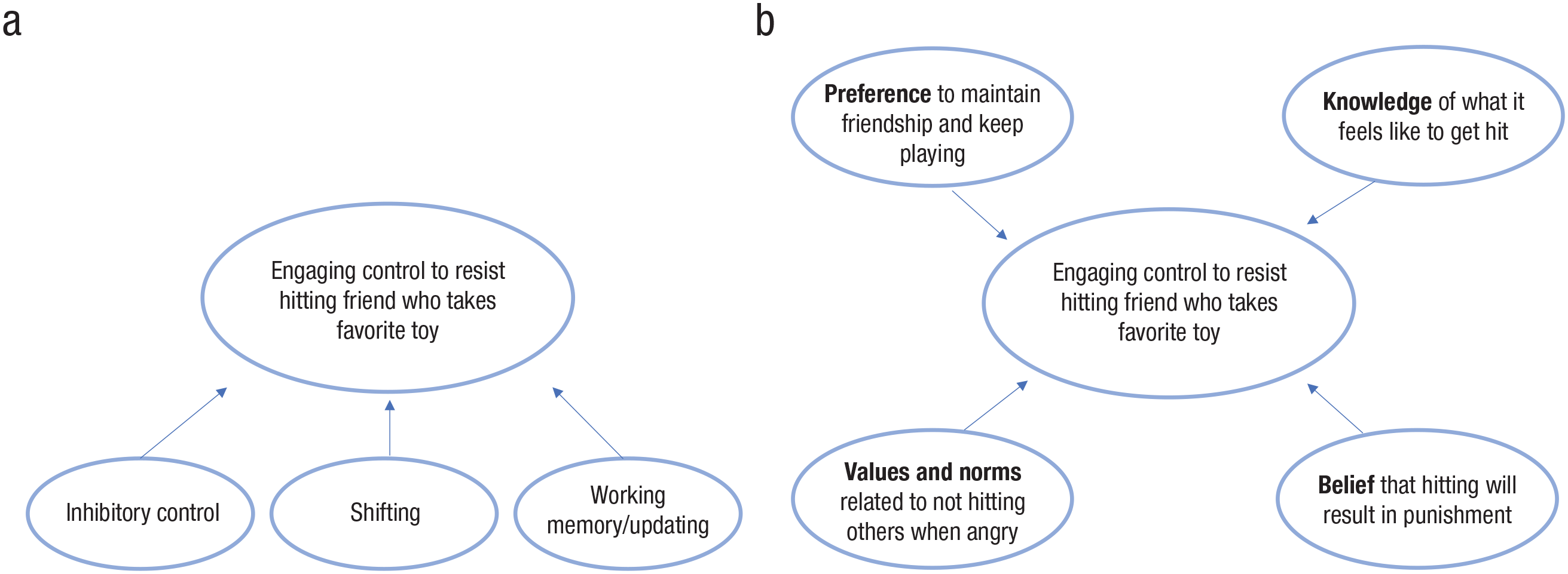
Contrasting views of the development of executive function. The prevalent view of executive-function component processes (a) is that they develop endogenously and support development in various domains, such as self-regulation vis-à-vis peers (e.g., avoiding hitting a friend who takes a favorite toy). Support for brain development is expected to strengthen components, and, in turn, help children self-regulate. For example, a child may use their inhibitory-control ability to inhibit hitting their friend and may use their shifting ability to shift to playing with another toy instead and working memory to maintain the goal of not hitting. The proposed view (b) posits that engaging control is not decomposed into or explained in terms of components; rather, one simply engages control in a particular way, which is enabled by mental content that is acquired with development, such as values, norms, beliefs, knowledge, preferences, and more. This conception is neutral about how executive function is instantiated at the neurological level.
This account does not imply that executive function is nothing more than the knowledge, beliefs, values, and more that are activated by a particular goal. Evidence suggests that measures of executive function (especially latent variables or composites) tap stable individual differences (Carlson & Moses, 2001; Friedman, Miyake, Robinson, & Hewitt, 2011; Friedman et al., 2008), which may reflect differences in a basic capacity to maintain goal information (Miyake & Friedman, 2012). These individual differences are in turn influenced by various factors such as sleep, stress, nutrition, drug use, and overstimulation (e.g., Carter et al., 2010; Lillard, Drell, Richey, Boguszewski, & Smith, 2015; Obradović et al., 2019; Peterson, Rothfleisch, Zelazo, & Pihl, 1990; Turnbull, Reid, & Morton, 2013). Targeting executive function via these and other factors is a worthwhile endeavor. However, understanding how executive function develops and can be improved requires taking into account that executive function is always engaged in the service of a particular goal, whether in the lab or in the real world. These goals activate mental content that shapes how executive function is engaged and develops in relation to particular situations.
Implications of This Perspective
The current proposal would have limited value if it were simply another way of thinking about executive function that did not better explain the data or generate testable hypotheses that favor the theory. Next I summarize a variety of implications of this account and related predictions.
New ideas about how the development of executive function relates to other developmental phenomena
In the proposed account, correlations between canonical measures of executive function and measures of domain-specific abilities such as theory of mind do not reflect the mechanistic role of executive-function components but rather indicate that both types of measures assess control engaged in the service of particular goals achieved via the activation of relevant knowledge, beliefs, and more (Fig. 2). The relation between false belief and executive function, for example, has often been explained in terms of the mechanistic role that executive-function components play in the expression or emergence of theory-of-mind understanding. In these accounts, executive-function components are thought to be necessary for the expression of existing conceptual knowledge (e.g., inhibiting one’s own knowledge state when needing to respond on the basis of another’s belief state, Baillargeon, Scott, & He, 2010; Powell & Carey, 2017) or the acquisition of that knowledge (Benson, Sabbagh, Carlson, & Zelazo, 2013). In the proposed account, however, executive function and false-belief reasoning are much more entwined: Thinking through the correct response on a false-belief task occurs through the engagement of control, and engaging control in this context is achieved in part through the activation of relevant knowledge, such as that conferred by prior opportunities to think about others’ mental states. For example, a child may have learned through experience that others can prefer foods that they themselves do not like, and they may have had this experience in relation to particular individual, such as a sibling. This knowledge should help the child to engage control to choose a food for their sibling that they themselves do not like versus giving a food that they like but the sibling does not (Repacholi & Gopnik, 1997). On the other hand, they may fail to effectively engage control on another version of this task that does not activate relevant mental-state knowledge that they can draw on, for example, when asked to choose a food for an unfamiliar creature.
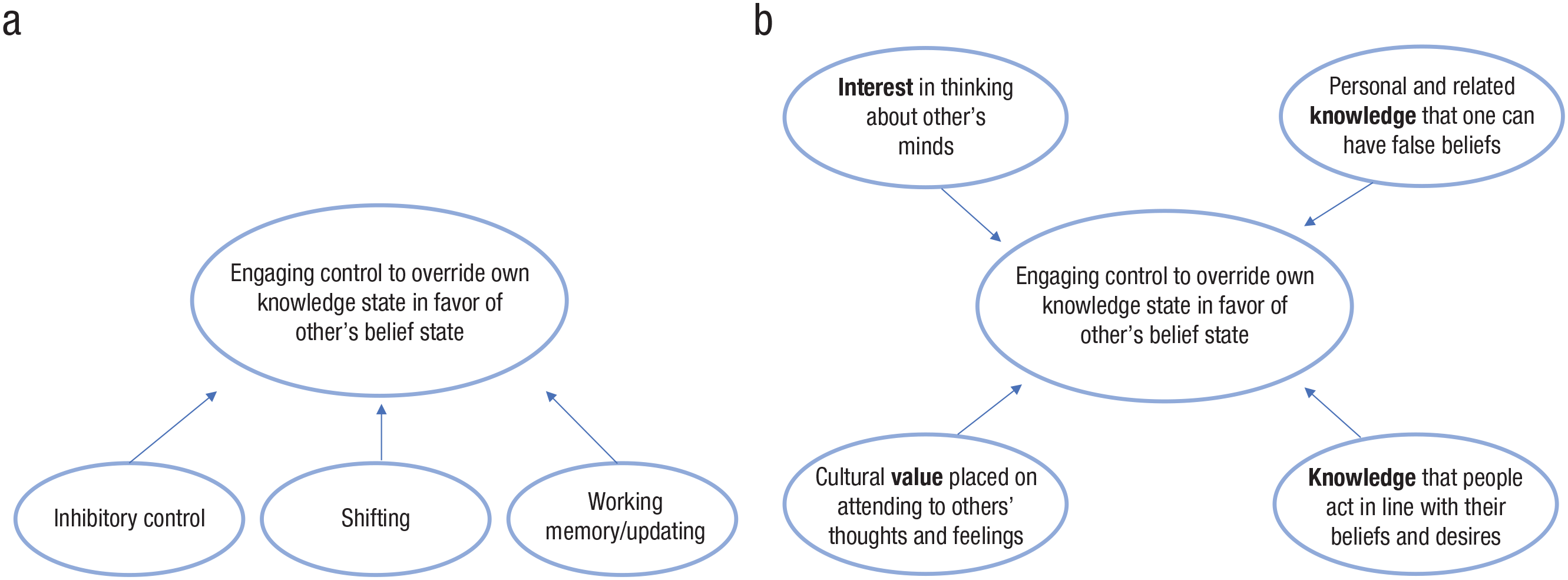
Contrasting views of how executive function relates to false-belief reasoning. The “expressionist” view (a) is that executive-function component processes mechanistically support false-belief reasoning. For example, developing inhibitory control allows individuals to express their existing competence at false-belief reasoning. The proposed view (b) suggests that using control to exercise false-belief reasoning may be supported by various kinds of mental content acquired with development, such as personal and related knowledge about false beliefs.
Conversely, mental-state knowledge may support performance on some behavioral measures of executive function, which may partially account for some of the correlational findings between performance on theory-of-mind and executive-function tasks. For example, with age some children may increasingly perceive that the experimenter desires that they perform well on the task, which may interact with their own values (e.g., complying with other’s wishes) and thereby influence how they approach the task goal. Although prior work has not found a relation between children’s executive-function task performance and understanding that different people can have different desires (Henning, Spinath, & Aschersleben, 2011), in the proposed view, it is not an understanding of diverse desires that supports children’s use of executive function in various contexts but rather their tendency to think about desire states generally, which is likely shaped by their experience learning about their own and others’ desires.
This account can explain a range of findings in the literature, including cross-cultural findings of dissociations between theory of mind and executive function. Chinese children perform better than U.S. children on lab executive-function tasks but not on theory-of-mind tasks (Sabbagh, Xu, Carlson, Moses, & Lee, 2006), which may be because Chinese children are better equipped with knowledge and values that support using executive control on lab measures of executive function (e.g., stronger cultural values related to complying with others’ requests; Chen et al., 2003) but are not as well equipped with mental-state knowledge that supports the use of control on theory-of-mind tasks (e.g., less experiential knowledge of others’ mental states, perhaps as a result of having fewer siblings; Perner, Ruffman, & Leekam, 1994; Sabbagh et al., 2006).
Moreover, providing children with experience with false beliefs (their own and those of others) improves false-belief task performance (e.g., Hale & Tager-Flusberg, 2003; Slaughter & Gopnik, 1996; Lohmann & Tomasello, 2003). Children are also more likely to pass false-belief tasks when knowledge of their own prior (false) belief state is cued (Freeman & Lacohée, 1995) or when the experimenter explicitly highlights the protagonist’s false belief (Wellman et al., 2001). This pattern of findings is consistent with the notion that rich knowledge about mental states is part of what enables children to effectively engage executive function to think from another’s perspective and override their own. 3
This account makes several predictions related to theory of mind and executive function that can be tested in future work, a few of which are described briefly. One is that children with more experiential knowledge related to false belief should be able to engage control better on false-belief tasks, as indexed by online behavioral or physiological measures of executive function (e.g., reaction time and pupillometry indices). By contrast, engaging executive function via lab measures of executive function or other activities should not help children on false-belief tasks. Children should also perform better on measures of executive function when the experimenter’s desire or value states are highlighted. Likewise, providing training in understanding others’ desires and values may confer benefits to performance on some untrained measures of executive function that involve an experimenter delivering instructions, whereas standard training of putative executive-function components would not be expected to do the same.
New ideas about how executive function relates to self-regulation broadly
This proposal also provides a new explanation of the relation between lab and questionnaire assessments that accounts for findings that performance on lab measures of executive function does not consistently relate to scores on questionnaires (e.g., Eisenberg et al., 2019; Toplak et al., 2013). Rather than executive-function components mechanistically supporting self-regulation as assessed by questionnaires (or lab tasks and questionnaires tapping entirely different constructs, as has been recently suggested; Eisenberg et al., 2019; Enkavi et al., 2019; Friedman & Banich, 2019), lab tasks and questionnaires assess control engaged in very different ways with different kinds of knowledge, beliefs, values, and so on coming into play. For example, the dimensional-change card sort assesses a child’s success at engaging control in the service of shifting between sorting by color and shape dimensions, whereas a questionnaire asking about a child’s ability to shift from one activity or situation to another likely assesses control used in the service of typical classroom or home activities (Gioia, Isquith, Guy, & Kenworthy, 2000). Thus, it is not surprising that scores on these different measures are not always related. On the other hand, different patterns may emerge when executive function is operationalized as a composite or latent variable (e.g., “common EF”), which may more sensitively tap the capacity for executive function (Miyake & Friedman, 2012). Here correlations with questionnaire measures may still be inconsistent because questionnaires may not reveal variance in capacity as much as variance in skills in using executive function in life outside the lab. However, in clinical samples there may be stronger relations between latent variables and composites on the one hand and questionnaires and outcomes on the other, as it may be harder to develop skills in using executive function when executive-function capacity is impaired because of neurological disorders.
New challenges to developmental theories of executive function
In the current proposal, neurocognitive developmental accounts of executive function do not adequately take into account that executive function is always used in relation to specific goals that affect how it is used and develops. That is, instead of proposed mechanisms such as reflection or maintenance of abstract representations driving general developments in executive function, I suggest that skills in using executive function develop through the acquisition of various kinds of mental content such as knowledge, beliefs, and values that support its use in relation to specific goals.
For example, one enduring account of the development of executive function posits a critical role for increases in the capacity for reflection (Zelazo, 2004). Although reflection may be critical to engaging executive function in many contexts and neurologically based deficits may be characterized by poor reflection, the propensity for reflection may vary greatly depending on the relevant mental content the child can bring to bear on a specific goal. It has been argued, for example, that children successfully switch on the dimensional-change card sort when they can reflect on the structure of the task and recognize that there are two conflicting ways of sorting the test cards (e.g., by color or shape; Zelazo, 2004). I suggest this may occur in part through specific conceptual knowledge involved in the task (e.g., of the shape and color dimensions). Viewing such influences as idiosyncratic to the task misses the point; in all uses of executive function—in the lab and beyond—conceptual and other knowledge may be key to reflecting and engaging control (for a similar point, see Legare et al., 2018). Importantly, there may be variation in the cultural knowledge, beliefs, and values that children learn that can support reflection and using executive function in various contexts (Doebel & Munakata, 2018; Lamm et al., 2018; Legare et al., 2018; Lillard, 2017; Obradović et al., 2019). Thus, instead of training children to reflect while performing on executive-function tasks (e.g., Espinet et al., 2013; Zelazo et al., 2018), it may be more fruitful to provide them with experiences that could help them value using control more, which may, in turn, improve their awareness of the need for control in critical moments. Likewise, children who gain extensive concrete experience learning about shape and color dimensions in their preschool classrooms (such as children in Montessori preschools) may perform better on the dimensional-change card sort than children in play-based preschools, in part because they are more capable of reflecting on diverse aspects of the task at hand and engaging control accordingly (Lillard, 2017).
Another prominent view is that executive function improves through general, prefrontally supported increases in robust abstract representations in working memory (Morton & Munakata, 2002; Munakata et al., 2012). However, in the proposed view, the capacity to maintain abstract representations in working memory will vary depending on the specific goal at hand and the availability of relevant mental content that could enhance the meaningfulness of the goal for the child and support them in engaging control. For example, with age children improve in how proactively they engage control on certain tasks, which has been explained in terms of developmental changes in the capacity to maintain goal information (Chatham, Frank, & Munakata, 2009; Munakata et al., 2012). A contrasting hypothesis stemming from the proposed account is that children will learn to engage control proactively if they have relevant knowledge, values, beliefs, and so on to support doing so. For example, if children have the goal of completing a foot race as quickly as possible, they may engage control early and prepare (i.e., getting into the right stance and listening carefully for a signal) if they have knowledge that doing so benefits running performance (e.g., from observing or listening to others), if they believe that running fast will please their friends or family, if it is normative in their community to compete fiercely, if they value planning ahead generally, and so on. Here, the failure to engage control proactively is not explained in terms of a general developmental neurocognitive constraint in activating and maintaining goal representations but rather in terms of the availability of relevant information that children can draw on to support their effective engagement of control. In this view, what develops in typical children is not best thought of as a general, content-free capacity to maintain abstract representations but rather as skills in engaging control capacity strategically in the service of countless specific goals that are increasingly meaningful in light of acquired knowledge, beliefs, values, and other mental content.
This account also contrasts with the proposal that there are distinct “hot” and “cool” executive-function processes, with hot processes supporting the use of executive function in affectively and motivationally significant contexts (Zelazo & Carlson, 2012). This hot/cool distinction is supported by differential performance on tasks that have face validity as hot versus cool tasks, evidence of distinct but overlapping neural systems, and a conceptual analysis that would suggest that “cool” tasks are devoid of affective and motivational context (Zelazo & Carlson, 2012). Regarding the proposed account, however, this dichotomized view, although elegantly accounting for and describing many findings, oversimplifies how affect and motivation shape executive-function engagement. Rather than classifying tasks as hot or cool, it is critical to take into account the nature of the specific goal when seeking to understand and predict children’s performance. Even on standard lab tasks such as the dimensional-change card sort there are representations with affective and motivational properties that come into play that influence performance and skill. Children may maintain the task goal more robustly if they value using control and doing well on tasks assigned by others; if they believe that their performance on the task matters to someone such as a parent, sibling, or the experimenter; or if they have knowledge that they bring to the task that makes it more meaningful and exciting (e.g., prior extensive experience sorting by shapes and colors). The point is not that these variables will explain children’s performance on the task entirely but that it is unlikely that executive function can ever be engaged without there being any notable motivational or affective significance for the child. Likewise, the influence of hot-task contexts involving social stimuli or cues will vary depending on how the social content relates to the goal. For example, children perform better on an ostensibly hot executive-function task—the marshmallow test—when told that a peer group waited for two marshmallows and an out-group did not compared with children who were told the opposite (Doebel & Munakata, 2018). Thus, the current account predicts that there are not general developmental differences in performance on hot versus cool tasks that are supported by distinct underlying mechanisms; rather, executive-function performance will vary depending on the specific goal at hand and the mental content it evokes.
New ideas about interventions to improve executive function
Future interventions to support executive function can try to influence it with a view to specific goals and related knowledge, beliefs, values, and more. So if one is interested in supporting the development of executive function in the preschool classroom, for example, it will be useful to consider the specific goals of interest (e.g., talking about feelings instead of crying or hitting, cleaning up when playtime is over instead of continuing to play) and target the various kinds of knowledge, norms, values, and interests that may support their pursuit and achievement. Likewise, parenting interventions to support executive function, which until now have tended to be quite broad (e.g., covering things as disparate as positive parenting and nutrition; Obradović et al., 2019), could zero in on aspects of parenting and socialization processes that may be more likely to help children engage executive function in the service of particular goals.
A related prediction is that providing values-based training (e.g., teaching children about the value of using control in different situations through language, stories, modeling) may have a broader impact on executive function than practicing using executive function on lab tasks or parenting interventions designed to improve executive-function components through general support for brain development.
Interventions should also take into account that the same goals can activate different knowledge, beliefs, and values in different children, for example, in children from different SES and cultural backgrounds. As discussed, it is common in the field to assume that poor task performance in children from lower-SES backgrounds is primarily a function of “deficits” induced by disparity in support for brain development (and similar assumptions have long been made about non-Western children; see Rogoff, 2003). However, beliefs, values, and other mental content may also shape these children’s performance on measures of executive function. For example, a belief that the environment and the people in it are not reliable may affect how well control is engaged in particular contexts (Kidd et al., 2013; Ma, Chen, Xu, Lee, & Heyman, 2018; Michaelson & Munakata, 2016). Children may also struggle to use control in contexts that have questionable significance for them in part because of the absence of prior experience to suggest that rewards are forthcoming (Michaelson & Munakata, 2020; Pepper & Nettle, 2017). They may also have limited experience with researchers, so any mental-state reasoning about what experimenter wants or values may be disrupted. Conceptual knowledge may also vary by SES, which seems plausible given what is known about SES differences in language development (Hoff, 2003; Rowe, 2008). For example, children from higher-SES backgrounds may be provided with more opportunities to learn about a range of concepts (e.g., shape, color, number, mental states) that can support engaging executive function in myriad ways. Children from higher-SES backgrounds may also be more often exposed to regulatory language that may help them acquire and subsequently activate representations of rules and norms related to various goals (Vygotsky, 1934/2012).
Children with deficits in executive function that are linked to neurological impairments could also potentially benefit from interventions that target relevant mental content such as knowledge, values, and beliefs that could make it easier for them to use their capacity for executive control to good effect. Conversely, interventions should also target factors that may affect executive-function capacity (e.g., noise, sleep, television, nutrition; Carter et al., 2010; Erickson & Newman, 2017; Lillard et al., 2015; Turnbull et al., 2013) and that may make it difficult for children to acquire and put into practice knowledge, norms, values, and more that support the use of executive function in particular contexts.
New ideas about measuring executive function
Age-related improvements on executive-function lab tasks such as the dimensional-change card sort are among the most robust findings in developmental psychology. But the current proposal suggests that we ought to think about how we can measure executive function in more ecologically valid ways rather than measuring it using standard lab tasks and extrapolating to real-world functioning. That is, rather than assuming that the lab tasks measure component processes that mechanistically support real-world functioning, we should aim to measure executive function in ways that are more relevant to specific outcomes of interest beyond the lab (for a similar point, see Enkavi et al., 2019). For example, instead of asking children to inhibit pressing a button on a screen, they could be asked to inhibit touching attractive unattended toys on display for a period of time or to periodically switch between practical tasks. Tasks along these lines have been developed (e.g., Carlson, 2005) but are not as widely used as tasks such as the dimensional-change card sort and day-night Stroop, perhaps in part because of the belief that the latter kinds of tasks are “purer” indices of putative components of executive function.
Advocating for more ecologically valid measures does not imply that we should abandon standard lab measures or particular classes of measures (e.g., shifting or working-memory tasks). The tasks one uses depends on one’s research goals (Enkavi et al., 2019; Miyake & Friedman, 2012). Standard tasks have been found to predict independent variance in outcomes compared with questionnaires (Friedman & Banich, 2019), and specific task classes have been found to differentially relate to different outcomes (Bernier, Carlson, Deschênes, & Matte-Gagné, 2012; Carlson & Moses, 2001; Friedman et al., 2008; Miyake et al., 2000). The argument here is simply that one should not assume that these standard measures are capturing executive function most purely or in ways that are highly relevant for real-world outcomes.
Conclusion
The development of executive function is critical to a broad range of human capacities, skills, and achievements, and the capacity for executive function is supported by prefrontal cortical integrity and a wide range of factors that influence it. But the notion that the development of executive function can be characterized as an improvement in a few components is not justified conceptually or empirically and fails to properly acknowledge that executive function is always engaged in the service of particular goals that activate and are influenced by diverse mental content such as knowledge, beliefs, and values. Future work should avoid reifying executive function as components. This account generates numerous predictions about how executive function develops and relates to other developmental phenomena that should be tested in future work. Key challenges for the field are understanding more about how knowledge, values, beliefs, and other mental content shape how children engage control and how these factors may partially explain group, developmental, and individual differences in control; developing more ecologically valid measures that are tailored to research questions and outcomes of interest; and creating interventions that take into account specific goals and contexts to support the development of executive function in diverse children.
Footnotes
Acknowledgements
I thank the action editor and reviewers for their constructive suggestions and comments on early versions of the manuscript. I also thank those with whom I have had many interesting discussions over the years on topics addressed herein, including Jane Barker, Ivan Kroupin, Michael Maratsos, Laura Michaelson, Akira Miyake, Yuko Munakata, Nicole Stucke, Claudia von Bastian, and Phil Zelazo.
Transparency
Action Editor: Laura A. King
Editor: Laura A. King
