



Abstract
Surveys indicate that at all educational levels students often use relatively ineffective study strategies. One potential remedy is to include learning-strategy training into students’ educational experiences. A major challenge, however, is that it has proven difficult to design training protocols that support students’ self-regulation and transfer of effective learning strategies across a range of content. In this article we propose a practical theoretical framework called the knowledge, belief, commitment, and planning (KBCP) framework for guiding strategy training to promote students’ successful self-regulation of effective learning strategies. The KBCP framework rests on the assumption that four essential components must be included in training to support sustained strategy self-regulation: (a) acquiring knowledge about strategies, (b) belief that the strategy works, (c) commitment to using the strategy, and (d) planning of strategy implementation. We develop these assumptions in the context of pertinent research and suggest that each component alone is not sufficient to promote sustained learning-strategy self-regulation. Our intent in developing this learning-strategy training framework is to stimulate renewed interest and effort in investigating how to effectively train learning strategies and their self-regulation and to guide systematic research and application in this area. We close by sketching an example of a concrete training protocol based on the KBCP framework.
It is evident from numerous surveys that students often use relatively ineffective study strategies (e.g., for the college level, see Bjork, Dunlosky, & Kornell, 2013; Karpicke, Butler, & Roediger, 2009; for middle school and high school levels, see Agarwal, D’Antonio, Roediger, McDermott, & McDaniel, 2014), thereby limiting their academic achievement (Dansereau et al., 1979; Hartwig & Dunlosky, 2012). This state of affairs is perhaps not surprising when one considers the challenges confronting students in terms of developing effective study strategies and the paucity of learning-strategy training in educational curricula. In this article, after briefly outlining the factors that limit students’ development of effective study strategies, we develop a theoretical framework to guide strategy training intended to promote students’ successful self-regulation of effective strategies across a range of academic content.
One set of inherent difficulties faced by learners is associated with using personal experience to judge the effectiveness of strategies. According to Koriat (1997) and others (e.g., Kirk-Johnson, Galla, & Fraundorf, 2019), learners do not have objective or direct access to the potency of learning strategies (i.e., to the strength of the memory traces that result from using particular strategies) and instead use a variety of cues and heuristics to infer the effectiveness of learning strategies. Many studies have shown that judgments of learning frequently do not accurately predict learning results (e.g., Karpicke & Roediger, 2008; Kirk-Johnson et al., 2019). One reason for this is that people tend to use immediate access to judge the effectiveness of strategies, and nearly all educationally relevant strategies (including relatively ineffective ones; Miyatsu, Nguyen, & McDaniel, 2018) tend to yield good immediate access. For example, Shaughnessy (1981) asked college students to learn some pairs of words using rote repetition and other pairs using interactive imagery. During the study, participants also estimated the extent to which they would later be able to recall the pairs. Despite finding that interactive imagery led to much better memory than rote repetition on a later recall test (by at least 59%), participants’ immediate judgments of learning were nearly identical when using the interactive imagery and rote-repetition strategies. Several basic laboratory studies support the finding that immediate judgments of learning are relatively inaccurate indicators of learning (Dunlosky & Tauber, 2016).
Another factor is that our biases tend to limit our ability to accurately gauge the effectiveness of strategies. Kirk-Johnson et al. (2019) recently argued that learners’ perceived mental effort in using a strategy affects their judgment of the strategy’s effectiveness. According to their “misinterpreted-effort hypothesis,” when learning seems more difficult or effortful, learners assume (often incorrectly) that they are not learning much and that the strategy they are using is not effective. In results consistent with this hypothesis, Kirk-Johnson et al. also found that learners’ ratings of high mental effort for a strategy (after having used that strategy for learning a set of materials) were associated with lower levels of perceived learning and a lower likelihood of indicating that they would choose to use that strategy on a similar task.
Still another factor that limits the accuracy of personal experience in evaluating the effectiveness of strategies is that it is difficult to control all of the relevant variables affecting performance. For example, using a poor strategy (e.g., rote rehearsal) will sometimes—and perhaps often in the early years of education—lead to good performance (on an immediate test or an easy test) despite being a strategy that does little for long-term retention. Another general challenge in developing effective strategies is that even if learners are aware that the strategy is ineffective, they can persist in using it for the expediency of getting the job done (Garner, 1990). Thus, as noted by Pressley, Goodchild, Fleet, Zajchowski, and Evans (1989), it is not surprising that “many students are committed to ineffective strategies” (p. 302; see also Dunlosky, Rawson, Marsh, Nathan, & Willingham, 2013).
As mentioned at the outset, however, another problem that limits the development of effective learning strategies is that students receive little or no comprehensive instruction in learning strategies, as noted, for example, in self-reports (Hartwig & Dunlosky, 2012). In recent years, educational and cognitive psychologists have identified key study strategies that have substantial effects on learning and long-term retention (Dunlosky et al., 2013). These strategies have been shown to have considerable utility across academic domains and across individuals, and yet students rarely receive instruction on how to use them (Dunlosky et al., 2013; Pomerance, Greenberg, & Walsh, 2016). This is because teachers and curricula tend to emphasize the acquisition of content and the development of critical-thinking abilities and not learning strategies (Dunlosky et al., 2013). Moreover, teachers do not receive extensive training in learning techniques (Dunlosky et al., 2013; Pomerance et al., 2016). However, even if teachers had a strong understanding of effective study strategies, there is currently a serious gap in understanding how to teach students these strategies such that they will spontaneously deploy them in appropriate situations (Manalo, Uesaka, & Chinn, 2018). Indeed, as pointed out by Manalo et al. (2018), the basic research on this issue has stalled: “A search through educational research databases reveals that very few studies focusing explicitly on the issue of spontaneous [self-guided] strategy use have been undertaken since the Borkowski, Carr, and Pressley (1987) and Garner (1990) papers” (p. 4).
In this article, we provide a provisional framework and accompanying justification for the framework based on existing research and theory to guide learning-strategy training that supports students’ self-guided strategy use. The purpose of developing this framework is two-fold. First, numerous books are now appearing that offer teachers and students information on evidence-based techniques to improve learning (Agarwal & Bain, 2019; Brown, Roediger, & McDaniel, 2014; McGuire, 2018; Rhodes, Cleary, & DeLosh, 2019). Initial instructional efforts are also under way (including commercial efforts and exploratory research efforts) to provide this information in school (middle school through college) settings to increase students’ learning effectiveness. As Winne and Marzouk (2019) recently noted, “every postsecondary institution that we know of offers some” degree of support (workshops, coaching, online materials) to help students develop effective learning strategies (p. 698). Yet little has been offered about how to effectively train this information so that students will initiate using these learning strategies on their own for their learning challenges (e.g., schoolwork) and sustain the use of these strategies. This gap is all the more serious in light of the evidence (outlined in subsequent sections) suggesting that strategy self-regulation, maintenance, and transfer are difficult to train. Accordingly, we build on a range of research to propose a framework to start to fill that void. The second purpose of presenting a provisional framework is to help guide and stimulate renewed research interest in examining the training of learning strategies to promote self-guided (spontaneous) use of those strategies.
Before proceeding, it is critical to highlight how the current framework is situated within a fairly extensive theoretical and intervention literature on the broader concept of self-regulated learning. Self-regulated learning is “an active, constructive process whereby learners set goals for their learning and then attempt to monitor, regulate, and control their cognition, motivation and behavior, guided and constrained by their goals and the contextual features in the environment” (Pintrich, 2000, p. 453). We first emphasize that there are a number of in-depth models of self-regulated learning that describe the complexity and nuances of the processes and knowledge involved. For instance, the motivation-and-affect-in-self-regulated-learning model (Efklides, 2011) identifies a number of core components, including self-concept, affect, motivation, metacognitive knowledge (composed of declarative knowledge, beliefs, and people’s theories about tasks and strategies), and metacognitive skills (procedure knowledge and strategies concerning planning, self-monitoring, and evaluation; Veenman & Elshout, 1999). Greene and Azevedo (2009) proposed five macro-level self-regulated learning processes (planning, monitoring, strategy use, perceptions of task difficulty and demands, and interest); further, 35 micro-level processes are embedded in these macro-level processes (Azevedo, Mudrick, Taub, & Bradbury, 2019; for an information-processing theory of self-regulated learning, see also Winne & Hadwin, 2008).
Such frameworks have been influential in describing, detecting, and mapping the unfolding of self-regulated learning processes and in examining how these processes relate to academic achievement (e.g., Neuenschwander, Röthlisberger, Cimeli, & Roebers, 2012); however, this brief description of a few contemporary models makes clear that a framework for a concrete, integrative training intervention does not organically emerge from the detailed specification of self-regulated learning processes. Moreover, these models do not specifically address how to train learning strategies for self-guided or spontaneous transfer. Our framework is intended to delineate a concrete approach for effective strategy training (to support self-regulated strategy use and transfer), using the models of self-regulated learning as touchstones.
Second, although a substantial amount of research on learning-strategy instruction is directed at improving self-regulated learning, a hallmark of this research is that the learning strategies target particular subject-matter domains, most often strategies for reading and writing or for mathematics. For instance, a recent meta-analysis of learning-strategy interventions conducted within school settings reported that of 95 interventions, 46% were directed at math-learning strategies (problem solving), and 41% were directed at reading and writing strategies (Donker, de Boer, Kostons, Dignath van Ewijk, & van der Werf, 2014). Just a handful involved strategies for learning science (9%). Another consideration is that one meta-analysis found that the most effective training interventions were those in which the use of strategies reflected near transfer (Hattie, Biggs, & Purdie, 1996). (It should be emphasized that we are not referring to the transfer of knowledge acquired when the learner is prompted to use a particular learning strategy; content knowledge acquired with a prompted learning strategy can show far transfer; e.g., Wong, Lawson, & Keeves, 2002).
By contrast, the goal of our framework is to guide interventions for learning strategies that can be applied across subject-matter domains, thereby potentially requiring learners to modify and adjust trained strategies to various challenges (e.g., subject-matter domain, different types of assessment tasks). Although our framework is directed at training learners with relatively domain-general learning strategies (e.g., as reviewed in Dunlosky et al., 2013) for self-regulated learning across a range of academic challenges, our approach is informed by the outcomes of this prior work on learning-strategy instruction. In particular, as developed in the next section, a core foundation of our framework derived from this prior work is that the most effective training interventions should be multidimensional and include cognitive strategies, metacognitive components, and motivational components (at least, according to the existing evidence, for younger students; Dignath, Büttner, & Langfeldt, 2008; Donker et al., 2014).
It should be noted that in this article we do not prescribe particular cognitive strategies that might best apply across subject-matter domains. Recent excellent reviews and monographs address that issue, and we refer the interested reader to those sources (Dunlosky et al., 2013; Fiorella & Mayer, 2015, 2016; Pashler et al., 2007). In general, we note that strategies requiring the learner to actively engage with the to-be-learned material (generative strategies; Fiorella & Mayer, 2015, 2016) and that help learners more accurately gauge their level of learning (i.e., increase their metacognitive accuracy; for combining judgments of learning with retrieval practice for benefits on deeper understanding, see Nguyen & McDaniel, 2016) have been found to be effective across subject-matter domains and learners ranging from primary school to college. The thorough reviews indicated that three strategies in particular seem to be particularly robust in terms of their potential for enhancing student achievement across content domains and student ages—spacing study over time, retrieving to-be-learned information (Dunlosky et al., 2013), and constructing self-explanations, such as answering why particular relations exist (Pashler et al., 2007; e.g., for benefits of this strategy in college biology, see Smith, Holliday, & Austin, 2010; for benefits of self-explanation in improving high school math problem solving, see Wong et al., 2002). We caution, however, that some generative strategies that are potent in laboratory settings, such as drawing to learn (Fernandes, Wammes, & Meade, 2018), may not necessarily generalize to more complex classroom content (e.g., Alexandrini, 1981; Jaeger, Velazquez, Dawdanow, & Shipley, 2018).
One final remark is warranted. In evaluating different types of interventions and training components across a range of studies, some researchers have found it convenient to classify those components as focusing on cognitive strategies (e.g., rehearsal, elaboration, organization), metacognitive strategies (e.g., planning, monitoring, and evaluation), and motivation (e.g., self-efficacy beliefs and task value; Donker et al., 2014). We appreciate the value and economy of summarizing components of intervention studies along these lines. In presenting our framework, however, we opted not to adopt this classification scheme for two main reasons. First, the components in our framework could align with several categories within the classification scheme just mentioned, and, accordingly, we could not unambiguously assign some of the training components into a single category within that classification scheme (e.g., our belief component likely has metacognitive and motivational implications, as noted later). Second, and compounding that challenge, the term metacognitive has been used to encompass a broad range of constructs and processes in the literature. Many view metacognitive knowledge fairly broadly, such that it includes knowledge about particular learning strategies, beliefs, declarative knowledge, and tasks; moreover, metacognitive knowledge is assumed to be related to motivation (e.g., see Efklides, 2011). When viewed from this broad reach, all of the components trained in our framework could be termed metacognitive components. As previously mentioned, however, other researchers might restrict metacognitive processes in studying (when considering intervention research) primarily to planning and monitoring (Donker et al., 2014). Accordingly, to avoid confusion, we instead emphasize the framework’s focus on the set of concrete training components that we suggest are necessary for stimulating effective and transferable self-regulated strategy use.
Knowledge, Belief, Commitment, and Planning Theory of Learning-Strategy Training
Our theoretical framework proposes that there are four critical components for training use and the transfer of learning strategies. First, students need to acquire knowledge about the strategies and how to use them (e.g., Borkowski et al., 1987; Borkowski, Carr, Rellinger, & Pressley, 1990; Manalo & Henning, 2018). Second, students need to develop a belief that the strategies are effective for them (e.g., Brigham & Pressley, 1988; Garner, 1990). Third, students need to develop a commitment to implementing the strategies (i.e., a commitment to action), which involves recognizing the value to their lives—for example, academic performance (e.g., Harackiewicz, Canning, Tibbetts, Priniski, & Hyde, 2016). Commitment is not sufficient, however, as revealed in a large social/motivational literature (e.g., Gollwitzer, 1999). Thus, fourth, students need to formulate an action plan for implementing the strategies (Duckworth, Kirby, Gollwitzer, & Oettingen, 2013).
We emphasize that each of these components has been individually identified, in one form or another, as theoretically important for producing and sustaining the self-regulated use of effective learning strategies (or strategies for achieving emotional and health-related goals) by researchers and theorists (see Manalo et al., 2018). However, the four components have not been considered in concert in extant research or explicitly integrated into an overarching training approach. Our central premise is that all four components must and can be explicitly targeted in a training program to maximize self-guided transfer of effective learning strategies (we label this the KBCP theory to reflect each component).
In the following sections, we examine findings that relate to each component and highlight the behavioral consequences that have been associated with each component. We suggest that effective self-regulated use depends on all four components, and we close by offering an example of a set of concrete training features that target each component.
Strategy Knowledge
The importance of knowledge about the strategy and how to use it is self-evident and has been identified by theorists as an essential component of effective, self-regulated (spontaneous) strategy use (and by extension strategy training). In basic laboratory and classroom research, the most frequent and unembellished method used to provide strategy knowledge is to explicitly instruct learners to apply a particular strategy to the target learning task. For instance, children and college students can be instructed to use a mnemonic (keyword) method to learn a list of unfamiliar vocabulary item–definition associations (Atkinson & Raugh, 1975; Miyatsu & McDaniel, 2019; Pressley et al., 1980; Pressley, Levin, & Miller, 1981) or state-capital associations (Levin, Shriberg, Miller, McCormick, & Levin, 1980); eighth-grade students benefit from learning to use a self-explanation strategy in their reading of a passage about the circulatory system (Chi, de Leeuw, Chiu, & LaVancher, 1994), ninth-grade students benefit from a self-explanation strategy in learning geometry theorems (Wong et al., 2002), and children and college students can be instructed to generate causal elaborations to learn target content (Bransford et al., 1982; Pressley, Symons, McDaniel, Snyder, & Turnure, 1988; Stein et al., 1982). A voluminous amount of research (for a meta-analysis of classroom-strategy instruction, see Donker et al., 2014) has generally shown that learners can use these instructed strategies and improve their learning on the material for which they were instructed to use the strategy relative to uninstructed control participants (especially those that do not spontaneously adopt the strategy; e.g., McDaniel & Tillman, 1987).
The critical issue for our current purposes is whether this type of instruction (and practice) promotes self-regulated use of that strategy on subsequent tasks (transfer). The general result is that it does not, at least not for pre-high school learners (e.g., Keeny, Cannizzo, & Flavell, 1967; Levin et al., 1980; O’Sullivan & Pressley, 1984, Experiment 1a; for an overview, see Manalo et al., 2018). However, instructing learners to use a strategy for a particular learning task does not convey broader knowledge about the strategy, its utility, and even that a learner should consider such an approach as a learning strategy. Indeed, this kind of instruction is most commonly used to empirically demonstrate the effectiveness of a strategy relative to other conditions—not to inform students about the strategy or to promote transfer of the strategy. More elaborated knowledge training about the strategy might well promote transfer (for theoretical details, see Borkowski et al., 1987). Consistent with this analysis are findings that when training of the keyword strategy provided fifth- and sixth-grade students with comprehensive information about the strategy, including details and demonstrations of the type of task for which this strategy worked (and did not work), students transferred the use of the strategy from a city-product learning task to a Latin-vocabulary learning task (within the context of the experiment; see O’Sullivan & Pressley, 1984). In so doing, the elaborated-knowledge group significantly improved learning levels relative to a noninstructed control group and a group that was instructed in the keyword method for the city-product task (without broader information about the strategy).
A central remaining question is whether such elaborated knowledge instruction on relatively simple strategies is sufficient to prompt self-regulated use of the strategy outside of the setting of the training context (see Garner, 1990), for example, in classroom learning tasks. So far, the sparse evidence is not promising. In an authentic learning task, fourth and fifth graders were given materials to support a keyword-like imaginal strategy to learn some state-capital associations (Levin et al., 1980). These materials supported better learning than was found for the state-capital associations not supported with the keyword-like strategy. The researchers remarked that students actively sought the materials from the experimenter for use in the classroom for additional study of the state capitals; however, there was no evidence that students generalized the method to any other learning tasks.
A handful of efforts that have incorporated more involved training of relatively complex learning strategies have also typically reported positive results with regard to apparent self-regulated use of the strategy on tasks that are similar to the training tasks. In one laboratory training study (Chmielewski & Dansereau, 1998), college students were given a 2-hr “course” on knowledge mapping (creating an organized network of the key content in an expository text). From our perspective, this study is an excellent example of implementing a fairly detailed and elaborate instruction about a strategy and how to use it (strategy knowledge). The instruction included a lecture on nine types of links with examples (students reproduced the links and were given feedback); reading and discussion of a map on an example passage; a lecture on how maps can be formatted for different types of information; an exercise that involved rating the clarity of 30 knowledge maps; and practice constructing a map on a hobby or sport of choice. This instructed group and an uninstructed control group that had filled out a set of individual-difference tests for 2 hr returned 2 days later. The knowledge-mapping group was first given a 15-min review of knowledge mapping (the control group spent 15 min on paper-and-pencil tasks). All participants were then given two short passages (263 and 483 words) to read and study for 6 min each, and no notes were allowed during study. Free recall was tested 5 days after reading. In two experiments, the knowledge-mapping group consistently outperformed the control group, especially for recall of macro-level ideas (see Fig. 1).
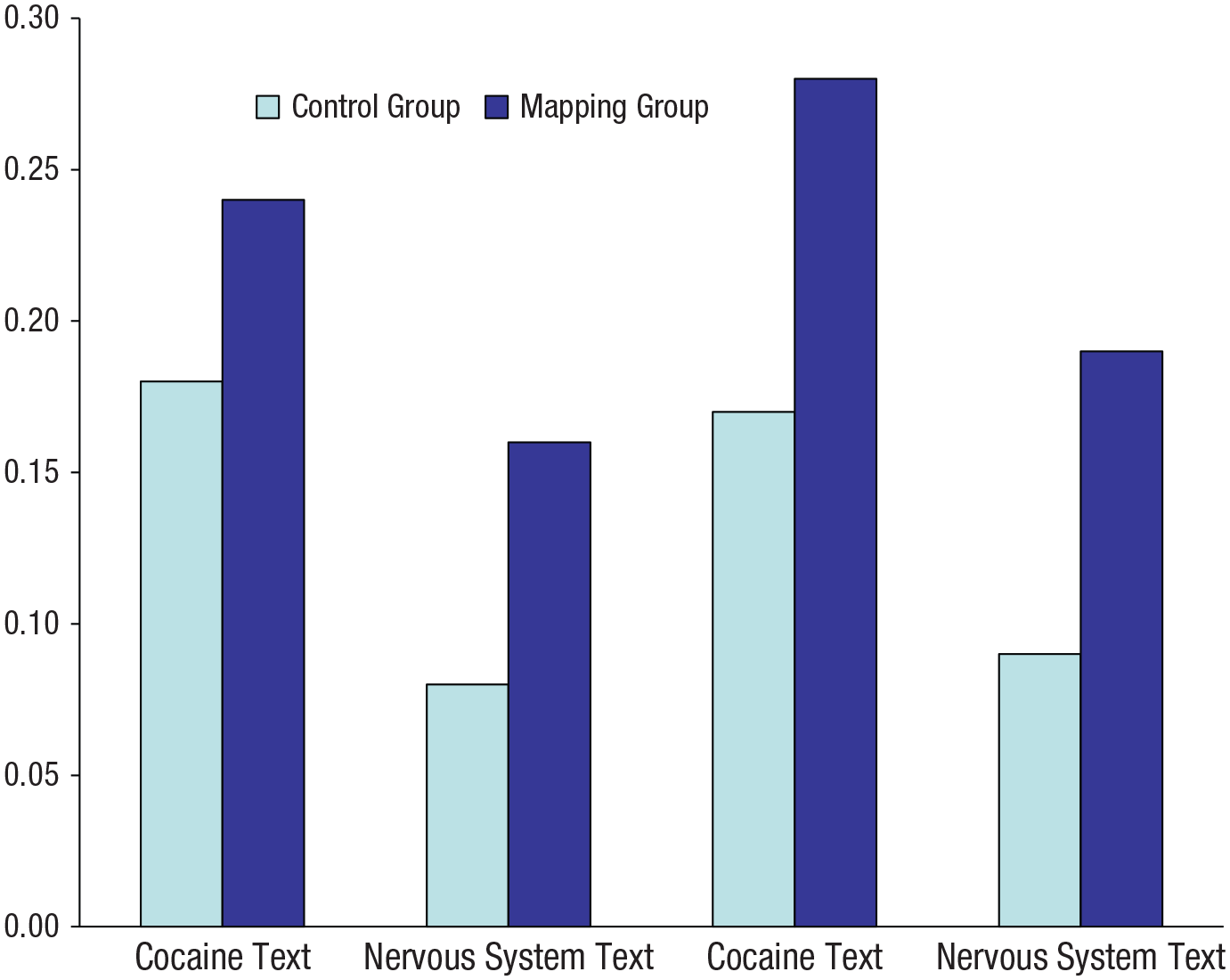
Proportion of free recall of macro-level ideas for control and mapping-strategy-trained participants across two experiments (means from Chmielewski & Dansereau, 1998).
Several features of this study urge caution, however, in concluding that the self-regulated use of the strategy might be sustained over time and translate to more complicated materials. First, there was no delay between activation of the training (the review session) and the test task. The immediacy of the strategy training just before the test task might easily have prompted students to use the strategy. Another study, also with a relatively extensive strategy-training protocol, may somewhat mitigate this concern. Cook and Mayer (1988) trained students for 8 to 9 hr on identifying several types of didactic text structures and accompanying organizational strategies for each text structure. Training passages were from the students’ chemistry textbook, whereas the test passages were from the students’ biology textbook. The interval between training and testing was not identical for every student because after initial group sessions, training was administered to individuals. However, the test phase was separated from the training phase, and the study was completed within a 2-week time frame; it seems probable that the interval between the completion of training and the administration of the test was on the order of a day or two (the report left this unspecified). Training produced significant gains relative to a no-training control group on recall of highly important ideas and application questions. This finding thus appears to represent an unprompted transfer of the organizational strategies to new material. Still, the time frame over which unprompted strategy use may have occurred was relatively short—on the order of several days at most.
A second concern is that in both studies it remains unclear what strategies students were applying on the test texts. Indeed, Chmielewski and Dansereau (1998) showed that students did not seem to be consciously applying the trained knowledge-mapping strategy. Self-reports from the knowledge-mapping-trained group did not differ in their reported approaches to processing the texts compared with self-reports from the control group, leading the authors to conclude that the strategy was “implicitly transferred” (Chmielewski & Dansereau, 1998). Of course, the application of an organizational strategy, whether consciously regulated or not, would be positive. But a clear question remains about the extent to which the acquired strategy would be explicitly regulated after this kind of training and for how long after training. It is worth mentioning that a similar concern holds for the strategy-training research situated in particular subject domains in classrooms. In an early meta-analysis of studies in which strategy application was not required (as in typical laboratory studies), in only 16 of 566 articles was there reasonable evidence that students applied the strategies they were taught (Hadwin & Winne, 1996). In a more recent meta-analysis (Donker et al., 2014), strategy instruction (e.g., using elaboration or self-explanation in mathematics) produced significant effects in increasing academic performance; however, as the authors note, it was unclear whether the instructed strategy was actually used by students after the strategy instruction ended.
A third concern is that, although the test passages were educational in nature, they were relatively short—about a page or two in both Chmielewski and Dansereau (1998) and Cook and Mayer (1988)—and not necessarily reflective of the kinds of longer reading assignments college students would face. Reinforcing this concern are the results of an ambitious experiment that involved an extensive 12-week learning-strategy training program implemented in a 2-hr college-credit course (Dansereau et al., 1979). One subgroup of students in the course focused on training in knowledge mapping (two other subgroups focused on paraphrasing/imagery and identifying key ideas, respectively); class sessions were oriented to conveying the technique and practice on the technique. A posttest on learning from a 3,000-word passage from a geology textbook found modest gains in learning performance relative to learning on a pretest (another 3,000-word passage on educational psychology), gains that were statistically only marginally better than those found for pretest versus posttest performances in a no-strategy-training control group. Thus, training on these learning strategies—focusing mostly on what the strategy is and practice using the strategy—seems to have produced limited benefits to students, even with very extensive training.
We emphasize that there is limited research implementing reasonably extensive training that conveys knowledge about a learning strategy and practice using the strategy. As reviewed above, those studies have provisionally suggested that learners can self-regulate the use of the strategy within a brief time frame after training and within the context of participating in the experimental study. However, these transfer findings within a tightly constrained context do not necessarily inspire confidence that knowledge-focused training will support sustained self-regulated strategy use outside of the training context and for a range of learning challenges with authentic educational assignments.
Belief
Following others (Borkowski et al., 1987; Pressley et al., 1989; Wecker & Hetmanek, 2018), we suggest that for sustained self-regulated strategy use, learners must be convinced that the target strategy improves their learning—the belief that the strategy works for them. As noted by Yan, Bjork, and Bjork (2016), learners tend to think that they are unique and that learning strategies that work for others may not work for them. Thus, providing explanations for the benefits of a particular strategy and/or evidence-based research results regarding that strategy are unlikely, by themselves, to be convincing for many students. To put forth the effort needed to implement a new strategy, it seems reasonable that learners must be convinced (i.e., believe) that it works for them (Garner, 1990; Pressley et al., 1989). We propose that direct experience may be a powerful way to generate belief and drive the self-regulated use of learning strategies, which is consistent with results showing that experiencing the effects of different strategies improves metacognitive accuracy (Koriat & Bjork, 2006; Yan et al., 2016). Although belief has sometimes been discussed within the category of general strategy knowledge (Wecker & Hetmanek, 2018), we prefer to highlight this component with its own label to stress its importance. Specifically, we speculate that belief has possible multiple benefits for transfer, such as a deeper metacognitive knowledge of the strategy and how to use it and, as elaborated below, increased motivation perhaps through enhancing self-efficacy.
Although very little research has directly examined the influence of belief on the self-regulated use of learning strategies, Brigham and Pressley (1988) showed that young adults are more likely to choose to use a more effective learning strategy on a future task after experiencing its benefits on a prior task (see also Pressley, Ross, Levin, & Ghatala, 1984). Participants in their research were given a vocabulary task that involved learning the meaning of rare English words and were trained to use two learning strategies. Participants showed no significant preference for one strategy over another. They then practiced learning the vocabulary items using each strategy. For half of the items in a list, they used a highly effective keyword strategy, and for the other half of the items they used a less effective semantic strategy (generating a meaningful sentence that incorporated the word). As expected, participants’ ability to recall the definitions of the words was much higher when they used the keyword method.
After practice at studying and recalling the vocabulary items using both strategies, participants were given the choice of which strategy to use on a new list of vocabulary items. Young adults (but not older adults) showed marked preference for the keyword strategy (indeed, 98% chose the keyword method). Moreover, when asked to explain their preference for the strategy, nearly all of them connected their strategy preference to its effects on their recall (e.g., “With [the keyword method], you can picture things and remember the meaning better”; Brigham & Pressley, 1988). Thus, experiencing performance with each strategy helped young adults reflect on their learning states and recognize the benefits of the more powerful strategy, and they subsequently indicated that they were much more likely to use it in a similar context.
As mentioned above, older adults in the study by Brigham and Pressley (1988) did not use their relative performance on the first list of items to guide their future strategy selection, perhaps because they had difficulty monitoring the effectiveness of the strategies on this type of task. Research indicates that explicit feedback about the usefulness of a strategy can help learners evaluate strategy effectiveness. Ringel and Springer (1980) asked first, third, and fifth graders to sort sets of 20 pictures into two to seven categories and then tested their recall of the pictures. After initial experience sorting the items using their own strategies, several groups were trained to sort the items based on meaning. Two of these groups received explicit feedback about their recall performance using the semantic sorting strategy (e.g., your recall performance is “much better” than it was on the initial lists when you were using your own strategy), whereas one group received no feedback about their recall performance. In the transfer phase of the experiment, occurring about 5 min after the training phase, the participants were given new lists of pictures to learn and sort. The oldest children (fifth graders) continued to use the semantic sorting strategy on the transfer task, regardless of whether they received feedback. By contrast, the youngest children (first graders) were more likely to spontaneously use the semantic sorting strategy on the transfer task when they received explicit feedback on their performance, presumably because they had difficulty self-monitoring the benefits of their strategy use. These results indicate that the benefits of experience with different strategies will be more effective, at least with certain populations (e.g., young children, older adults), when that experience includes direct feedback that helps learners monitor or appreciate the mnemonic benefits of the more powerful strategies.
These results support our view (see also Borkowski et al., 1987; Garner, 1990; Manalo et al., 2018; Pressley et al., 1989) that experiences with differentially effective study strategies, particularly if they include explicit feedback, can help convince students that a target strategy works for them and thus can enhance students’ self-regulated use of strategies. Recent research by Yan et al. (2016) further suggests that the experiences with different strategies are much more convincing for students when they are clearly separated so that students can more easily appreciate their differential effects. In an inductive-learning task involving the learning of artists’ painting styles, Yan et al. found that experiencing the benefits of interleaving (relative to blocked presentation) did little to change learners’ illusion that blocking was more effective when practice (and feedback) with the two strategies was mixed on a trial-by-trial basis. Only when the experiences with the two strategies were separated (i.e., learners studied a set of artists via blocking and then another set of artists via interleaving, or vice versa) did the majority of learners appreciate the benefits of interleaving.
Although the evidence thus far is suggestive, it is important to note that there is currently little research that clearly isolates the impact of a belief component (i.e., direct experiences with strategies) on the self-regulated use of strategies. To do so, one would have to compare a knowledge-alone condition in which participants receive instruction about different strategies, how to use them, and their relative effectiveness with a knowledge-plus-practice condition in which participants also receive practice learning and recalling with each strategy. Moreover, to fully examine whether it is important for students to develop a belief that the strategies work for them, one would also want to examine the effects of this type of training with more realistic delays (the delays in the above studies were on the order of several minutes) and with transfer tasks that are more educationally relevant (the transfer tasks in the above studies were identical to the practice tasks).
One way that this type of training could be efficaciously implemented in educational settings is with classroom demonstrations (the more general recommendation is that the benefit of using the strategy should be illustrated during training; Dignath & Büttner, 2008; Schraw, 1998). Brief classroom demonstrations could be an efficient and effective way to convince students that their strategy use affects performance and thereby inculcate the belief that a particular strategy works for them. For example, after a brief classroom demonstration and discussion of the results, Bugg, DeLosh, and McDaniel (2008) found that students indicated that they were now much more likely to use a semantic strategy in their future studying (relative to their intentions before the demonstration). Although demonstrations hold much promise for increasing belief and self-regulated strategy transfer, it is important to note that further research is needed. The few existing studies that have examined the benefits of classroom demonstrations on the self-guided use of strategies did not isolate the demonstration (as opposed to the lecture in which it was embedded) as the cause of the increase in the self-reported use of the trained strategy (e.g., Bugg et al., 2008; Einstein, Mullet, & Harrison, 2012). Moreover, these studies have tended to rely on global self-report measures and not actual strategy use on educationally relevant transfer tasks.
Most theories of self-regulated learning assume that self-reflection plays a central role in helping students evaluate whether their strategies were successful in achieving their academic goals (e.g., Efklides, 2008; Pintrich, 2000; Zimmerman, 2008). That is, these theories assume that it is important for students to evaluate their performances and relate them back to their study behaviors. The idea is that this type of self-reflection ultimately leads students to distinguish between effective and ineffective approaches to learning and to adjust their behavior accordingly. We suggest that demonstrations can stimulate a particularly powerful type of self-reflection in that they allow students to compare strategies under relatively controlled conditions. That is, in demonstrating that a particular strategy (e.g., self-explanation) is more effective than another (e.g., rote rehearsal), the instructor can control study time, the difficulty of the materials, the delay of testing, and the difficulty of the test, thereby isolating the study strategy as the cause of the difference in performance. As described earlier, under naturalistic conditions, self-reflection can often lead to faulty conclusions because factors other than study strategy are likely to be varying. With easy materials, short delays, and/or easy tests, students can mistakenly conclude that ineffective strategies lead to high performance (Hartwig & Dunlosky, 2012). Thus, demonstrations may be an especially promising method for promoting self-reflection and encouraging students to embrace potent learning strategies.
Like knowledge, the notion that students must believe in the effectiveness of a strategy to spontaneously apply it is self-evident. Demonstrations may serve an important role in convincing students that a strategy works for them, and this belief component may be critical for applying the strategy to one’s educational tasks. More generally, participatory demonstrations that include feedback likely help students realize that there is a connection between their study strategies and their learning outcomes, making it more likely that they will expend the effort to use trained strategies in relevant learning contexts. Moreover, this belief component likely carries motivational aspects (e.g., Borkowski et al., 1987; Manalo et al., 2018). When students learn that a strategy works for them and develop a belief in the strategy, they more generally learn to attribute their learning outcomes to their behavior and develop a sense of self-efficacy. As expanded on in the next section, there is a wealth of theory and data indicating that self-efficacy (the belief that you have the ability to attain the desired result) is positively associated with behavior change and the persistence of behavior change (Bandura, 1977, 1982). For example, self-efficacy has been shown to predict exercise adherence (Marcus & Owen, 1992), smoking cessation (Clyde, Pipe, Reid, Els, & Tulloch, 2019), medication adherence (Horne & Weinman, 1999), and student academic achievement (Usher & Pajares, 2008). Thus, generating belief likely produces multiple benefits for optimal strategy training.
Commitment
We suggest that strategy knowledge and belief are not sufficient for the self-guided application and transfer of learning strategies, consistent with theories of self-regulated learning (e.g., Efklides, 2011; Pintrich, 2000). For example, students may know an effective strategy and believe that it works for them but fail to exert the effort required to implement the strategy. One potential reason is that their commitment level for using the strategy may be insufficient. In educational settings, commitment or motivation for mathematics (as measured by self-ratings of intrinsic and extrinsic motivation and self-efficacy) is highly associated with growth in mathematics achievement from fifth to 10th grade (Murayama, Pekrun, Lichtenfeld, & vom Hofe, 2013). In clinical-psychology applications, the commitment-behavior link is well established. For instance, in clinical settings lower commitment to a cognitive-behavioral strategy is associated with reduced use of the strategy in appropriate situations (Amrhein, Miller, Yahne, Palmer, & Fulcher, 2003). Accordingly, increasing commitment levels to strategy implementation is a central feature of the motivational-interview intervention in clinical psychology. This technique, developed to help treat drug and alcohol addiction, involves assisting the client in perceiving the utility value of implementing behaviors designed to counter addiction (Miller & Rose, 2009). The idea is to increase the client’s motivation to engage in more positive behaviors. The motivational-interview intervention has enjoyed such success in treating addictions that it has been generalized for use across a range of clinical problems, including anorexia nervosa (Price-Evans & Treasure, 2011), depression (Keeley et al., 2016), and generalized anxiety disorder (Westra, Constantino, & Antony, 2016).
Enhancing commitment to a strategy using a utility-value intervention
In a similar vein, recent research in educational settings shows that utility-value interventions designed to increase students’ perceived value of a task (e.g., learning math or learning science) increase interest, motivation, and persistence in activities related to that task (e.g., Hulleman & Harackiewicz, 2009; Hulleman, Kosovich, Barron, & Daniel, 2017). For example, Johnson and Sinatra (2013) showed that enhancing students’ value for a reading task (about the common cold) increased their self-rated engagement in the task and led to increased conceptual change regarding prevalent misconceptions about the common cold. As applied to training strategies, a utility-value intervention might take the form of having learners think through the value of using a particular strategy (e.g., “using the trained strategy will help me get good grades in my courses, and this will help me get accepted into the college of my choice”). Utility-value interventions are also reported to improve course performances, with this improvement mediated by increases in motivation and task engagement (Canning et al., 2018; Harackiewicz et al., 2016; Hulleman et al., 2017; Priniski et al., 2019). Further, a recent follow-up study showed that 2 years after the students were given the utility-value intervention (in introductory biology), they generally showed more persistence in a biomedical track than students in a control group (Hecht et al., 2019). With regard to primary and secondary school settings, learning-strategy interventions that included a task-value component were among the most effective in enhancing student-performance outcomes (Donker et al., 2014).
Attribution approaches
Another motivation-oriented approach to increasing students’ adoption and spontaneous use of learning strategies is based on attribution theory (Borkowski et al., 1987; Dweck, 1975; Marsh et al., 2018; Murayama et al., 2013). According to this view, learners’ effort and persistence are tied to their self-attributions about causes for their successes and failures. Some learners can inappropriately attribute successes and failures to either external events (was lucky or unlucky; task was easy or hard) or to the assumption that learning skills (or particular abilities such as solving math problems) are an immutable trait of an individual (e.g., a “fixed mind-set”; Dweck, 2006). Learners can feel on the basis of these attributions that they have little control over their academic achievement and consequently are not motivated to adopt effective strategies (even if they are aware of the strategies), which often require effort and attentional control. The use of effective learning strategies can be motivated on the basis of this framework by altering self-defeating attributions and encouraging learners to embrace attributions that correctly recognize the relation between effective strategies and learning and performance, thereby enhancing learners’ sense of self-efficacy. Several particular kinds of interventions have emerged from this attributional framework.
One type of intervention focuses on guiding self-attributions within the context of training particular learning strategies. For instance, Reid and Borkowski (1987) reviewed self-control strategies with hyperactive second, third, and fourth graders and then discussed attributions for failures on particular items during a practice task. They then gave the children a chance to successfully perform the failed items using the particular steps being trained and then prompted reflection on the causes of the subsequent success. After reviewing a particular learning strategy, discussion was then directed at noting the strategy the child used for several correct items and the strategy the child used for several incorrect items. This discussion helped tie successful learning to the use of the targeted strategy. The researchers compared this attribution-plus-strategy-intervention condition with two conditions in which participants received only strategy training (an associative-learning strategy and an organizational strategy), one with the self-control component and one without it.
Three weeks after training, the children were given a new (relative to the training task) associative learning task and a new task benefiting from organization. The attribution-plus-strategy condition outperformed the other two conditions on the associative-recall task and used more sophisticated strategies during learning. A similar but somewhat weaker effect was found for the learning task relying on organization. Children’s attributions were probed to determine the reasons for their performance on several items they had successfully recalled and several items they had missed. Children given attribution-plus-strategy training were more likely to underscore effort in their attributions for both correct and missed items than children in the other two conditions.
In a long-term follow-up (not frequently included in such studies) 10 months after training, the children were again presented with the associative learning task used in training. The attribution-plus-strategy training condition continued to show more strategic approaches to the task than the other two conditions; however, recall performances did not differ across conditions. Personal-effort attributions continued to be more frequent in the attribution-plus-strategy condition than the self-control-plus-strategy condition, but there was no longer a significant difference relative to the strategy-only condition. Thus, the results were promising in showing that strategy training coupled with attribution training can promote persistent use and generalization of the strategies and alter children’s attributional beliefs (at least in the context of the experimental learning tasks) toward the idea that personal effort is important for successful learning. Further research is needed to determine the extent to which this attributional training approach is effective with non-special-needs children) and other age groups; moreover, the scalability and effects of this kind of intervention to classroom learning are also uncertain.
Another type of attribution-based intervention targets a global attribution that students may adopt about intelligence: the attribution that intelligence is flexible and incremental (termed a growth mind-set) or that intelligence is fixed and unalterable (termed a fixed mind-set). These interventions encourage learners to adopt a growth mind-set (rather than fixed mind-set). The idea is that a growth mind-set motivates students to persist in their learning efforts and to embrace challenging learning opportunities, whereas a fixed mind-set (“Why try, I don’t have the ability for science”) discourages students from exerting effort toward learning. Growth-mind-set interventions typically have students read an article that claims the brain is malleable and that effortful practice can stimulate and strengthen new connections in the brain. Further, the article suggests that even if people struggle in a given domain, by taking on challenges (solving complex problems) and developing new learning strategies, they can improve their ability in that domain (e.g., Yeager, Walton, et al., 2016). After reading the article, students write reflections about it centered on endorsing its value in their own efforts (for particular interventions involving the growth mind-set, see Fink, Cahill, McDaniel, Hoffman, & Frey, 2018; Yeager, Romero, et al., 2016).
The growth mind-set intervention has been shown to be scalable and effective in the classroom. In line with the theoretical grounding, a growth-mind-set intervention implemented in a seventh-grade class (25 min per week for 8 weeks) produced increased classroom motivation relative to a control group (Blackwell, Trzesniewski, & Dweck, 2007). Moreover, the intervention changed the typical downward trajectory in math grades over the course of the school year. Whereas the control group showed a steady decline in math grades across three time periods, after the growth-mind-set intervention, the decline in math grades was eliminated. In a large-scale study across 10 schools and thousands of students, an Internet-based growth-mind-set intervention for ninth graders produced increases in core-course grade point averages (Yeager, Romero, et al., 2016). And in a general college chemistry course, a growth-mind-set intervention was shown by Fink et al. (2018) to increase performance on the final exam relative to a strong control group that received readings and wrote reflections on study skills and time management (as similarly shown by Blackwell et al., 2007). For a relatively low-cost intervention, both in terms of intervention time and expense, these are notable findings with respect to enhancing classroom achievement.
An important thread runs through these studies, however. In all cases, the effects of the interventions were demonstrated with only lower-achieving students (Blackwell et al., 2007; Yeager, Romero, et al., 2016) or underrepresented minority students (Fink et al., 2018). And the effect size, when determined, was small (d = 0.10 in Blackwell et al., 2007; d = 0.38 in Fink et al., 2018; A. Fink, personal communication, December 2, 2019). A recent meta-analysis reinforces and extends this observation (Sisk, Burgoyne, Sun, Butler, & Macnamara, 2018). This meta-analysis showed generally weak mind-set-intervention effects. This observation is certainly not to undervalue reliable and important effects for groups of underserved or at-risk students; in the current context our focus is to identify components of training that might hold value for a wide range of student abilities, backgrounds, and achievement levels.
A final interesting point is that the degree to which the presumed attributional mechanism plays a role in the effects, when found, is uncertain. In the Sisk et al. (2018) meta-analysis, for a number of studies that showed benefits of growth-mind-set interventions in achievement, self-reported mind-set attributions did not change. In a similar vein, sometimes the intervention changed student mind-set attributions to a growth attribution, but there was no improvement in achievement. Accordingly, the mechanisms by which the growth-mind-set interventions produce positive outcomes may be more complex than that originally construed. Nevertheless, for the current purposes one might wonder whether motivational interventions alone might produce similar robust increases in students’ classroom learning performances as when the interventions are combined with increasing strategy knowledge and belief in the strategies. This is clearly a question for future research. However, our speculation, based on many findings that indicate that students are committed to ineffective strategies (noted at the outset of this article), is that increased motivation may have limited effects if students are relying on ineffective strategies. Indeed, in a recent utility-value-intervention study, the increases in course performance relative to a control (in an introductory university biology class) reflected small effect sizes (ranging from d = 0.11 to 0.27; Priniski et al., 2019; but for a meta-analysis of motivational interventions, see Lazowski & Hulleman, 2016). We believe that it is sensible to expect that increased motivation when students know effective learning strategies would seem much more beneficial than increased motivation when students are predominantly relying on ineffective learning strategies.
Planning
Despite accurate knowledge and belief about effective learning strategies, good intentions, and reasonable levels of motivation, students may still fail to use the strategy. As one striking example, in a survey administered to undergraduates attending a variety of institutions (universities, four-year colleges, and community colleges), nearly all students (85%) endorsed the strategy of “studying the material in multiple sessions” over “studying the material in one longer session” (Susser & McCabe, 2013). In addition, when asked how they would ideally apportion 5 hr of study time during the 4 days before an upcoming test, the most frequent response was that they would do so over 4 days (about 50% of the participants), with percentages decreasing as spacing diminished; only about 10% of the students indicated that they would not space but instead mass study in a single day. When students were asked to indicate what they would do under realistic study demands, spacing was still endorsed but over fewer days (2 days was the most favored). Thus, all indications pointed to students’ accurate knowledge of the benefits of spaced study relative to massed study. However, when queried about the strategies that they actually used to study for a test, students did not endorse using spaced study statistically more often than using massed study (both strategies were reported at an intermediate level of usage). In other words, the metacognitive knowledge of the value of spacing generally did not translate into students’ use of the strategy in their classes.
There are likely a host of factors that contribute to students’ failure to use optimal strategies despite sufficient knowledge of their effectiveness (e.g., Gollwitzer, 1999; Marsh, Hicks, & Landau, 1998; Susser & McCabe, 2013). We speculate that two factors may be prominent. One is that students may not adequately plan how and when to study (e.g., Hartwig & Dunlosky, 2012). This possibility is reflected in metacognitive training interventions that prompt students to develop study plans for upcoming exams. More generally, the advice to generate study plans is often included in study-skills books for students (Mayer, 2019; McGuire, 2018; Rhodes et al., 2019), suggesting that this is a component that students may ignore.
Another factor that may contribute to the ineffective implementation of study strategies is that even when students record a plan, they seem willing to preempt intended study time for other activities. An informative finding in this regard was reported by Marsh et al. (1998), who queried students about their plans for the upcoming week. In addition to studying, other types of plans included meeting appointments, returning borrowed items, and taking medication. At the conclusion of the week, students reported whether each plan had been completed and why a particular plan had not been completed. Students failed to complete study plans for one overwhelming reason: reprioritization (indicated as doing something else more important or more favorable). In sharp contrast to other types of plans, study plans were rarely forgotten or canceled (less than 2% of the time). Thus, students may be well intentioned in terms of implementing study strategies that are effective (e.g., spacing or retrieval practice) but “talk themselves out of the plan” if there are more attractive options.
These results turn out to index a general characteristic of human behavior. A key finding in the social-motivational literature is that people’s intentions (plans) are only modestly correlated with their behavior, accounting for just 20% to 30% of the variance in behavior (Gollwitzer, 1999). The primary reason for this is that people fail to act on their good intentions (Orbell & Sheeran, 1998), partly because self-regulatory skills are necessary to initiate the plans. Plans get derailed by competing temptations, and successfully initiating a plan (e.g., studying) depends on people (students) shielding themselves from distractions. Accordingly, successfully following through on plans can require implementing techniques to overcome distractions (e.g., Kuhl, 1984).
In light of the above considerations as well as (a) the fact that planning is a prominent feature of theories of self-regulated learning (e.g., Efklides, 2011; Greene & Azevedo, 2009; Pintrich, 2000) and (b) findings showing that training planning as a component of self-regulated learning instruction yields large effects on primary school students’ strategy use (Dignath et al., 2008) and in secondary education (Donker et al., 2014), we suggest that a fourth component of effective strategy instruction is necessary—a planning component. From our perspective, the planning component would focus on two features: encouraging students to develop a plan for how they will apply the trained strategies in particular courses and for particular learning challenges and explicitly linking the concrete study plan with the situations (where and when) in which the study plan will be implemented. This second component has been termed implementation intentions. In the next section we develop the characteristics and benefits of implementation intentions.
Implementation intentions
An implementation intention is a concrete formulation of a plan that is designed to help overcome the tendency for a plan to be hijacked by competing temptations. The implementation intention takes the form of “When situation x arises, I will perform response y” (Gollwitzer, 1999, p. 494). The theoretical premise is that forming this condition–action pairing will “automatize the intended goal-directed behavior once the critical situation is encountered” (p. 495). As a consequence, the plan is initiated in an efficient manner without requiring a consideration of alternative possible actions. For instance, a plan to eat more healthy foods when dining out might be realized as the following implementation intention: “After looking at the menu tonight, I will order broccoli.” In theory, the behavior (order broccoli) will be strongly stimulated by the situation (looking at the menu), thereby taking precedence over considering ordering less healthy foods.
Although there is uncertainty regarding the degree to which implementation intentions truly automatize behavior (see, e.g., McDaniel & Scullin, 2010), there is little question that implementation intentions can improve people’s follow-through on plans. For instance, of college students who were asked to form the plan to engage in vigorous exercise during the upcoming week and were given information about the health benefits of doing so (a motivational component), only 39% exercised that week. By contrast, 91% of the students who constructed an implementation intention exercised the following week (Orbell & Sheeran, 2002). Similar dramatic effects of implementation intentions have been reported for increasing positive medically related behaviors in adults (e.g., Liu & Park, 2004; Orbell, Hodgkins, & Sheeran, 1997).
With regard to our current purposes, implementation intentions are attractive because they are effective in helping people get started on their plans. In one relevant study, Gollwitzer and Brandstatter (1997) investigated the degree to which forming implementation intentions would help students initiate activity toward various plans during the winter break. Of interest here were the plans that encompassed difficult goals. One difficult goal mentioned by students was to write a term paper, a project that many would likely attest is hard to begin, especially while on winter break. Students who formed implementation intentions were three times more likely to complete their difficult goals over the break than students who did not form implementation intentions. In a second study, all students were assigned a report to complete within 2 days after Christmas Eve, and the use of implementation intentions was experimentally manipulated. Again, implementation intentions dramatically increased the completion of the assignment within the 2-day deadline (71% in the implementation-intention group vs. 32% in the control group). These results strongly suggest that having students incorporate implementation intentions into their study plans should significantly increase follow-through on study plans, especially for study activities that might be somewhat difficult (e.g., spacing study, using retrieval practice).
Implementation intentions have also been shown to be effective in educational contexts with young children (Duckworth et al., 2013). Working with fifth graders, Duckworth et al. had children either form implementation intentions along with engaging in mental contrasting (mental contrasting with implementation-intention condition) or simply think about a positive outcome associated with their schoolwork (control condition). Specifically, the mental contrasting involved thinking of an educationally relevant desired goal (e.g., making an A in biology) and potential obstacles to reaching the goal (e.g., attending to social media during class). The implementation-intention instructions involved having the children form if/then plans for overcoming the obstacles (e.g., if I get the urge to check my phone during class, then I will ignore it and check it after class). Impressively, forming implementation intentions for addressing the identified obstacles or temptations led to significant increases in report-card grades, attendance, and conduct (relative to the control condition).
In summary, implementation intentions have been shown to be remarkably effective in a variety of contexts and with a variety of individuals in helping them fulfill their intentions and accomplish their goals (producing on average a medium to large effect size; see Gollwitzer & Sheeran, 2006). Thus, forming an implementation intention appears to be a promising, and perhaps critical, component for promoting the self-guided use of learning strategies in school-age children.
A Sample KBCP Training Protocol
We have summarized the key ingredients of a KBCP learning strategy-training regimen in Table 1, and in this section we present an example of how one could implement the training of a learning strategy in a classroom setting. For illustration purposes, assume that we want to train the strategy of generating understanding in a seventh-grade science course. Generating understanding, which involves producing meaningful explanations for learning material, promotes retention by encouraging the integration of new learning with one’s knowledge base, and this facilitates memory consolidation (Tse et al., 2007). In many respects, this is an ideal strategy to teach children to use in a self-regulated manner early in their educational careers because it has been shown to have strong effects on learning across multiple domains in fourth-grade to college-age students (Pashler et al., 2007). We acknowledge at the outset that there are many potentially effective ways to actualize the key components of the KBCP framework, and we offer the following as one possible example of a training program. It is also important to note that there is no evidence at this time for the effectiveness of this training program. We offer it here to present a specific and concrete implementation of our framework and to demonstrate that the essential components of the framework could be actualized in a relatively efficient manner. We envision that the proposed intervention could be implemented within two class periods on successive days or weeks along with brief (5-min) weekly follow-up sessions in which students regularly review, and perhaps also refresh, their commitment and implementation-intention plans.
Overview of the Ingredients Needed in a Comprehensive Intervention Designed to Train the Self-Regulated Use of Strategies
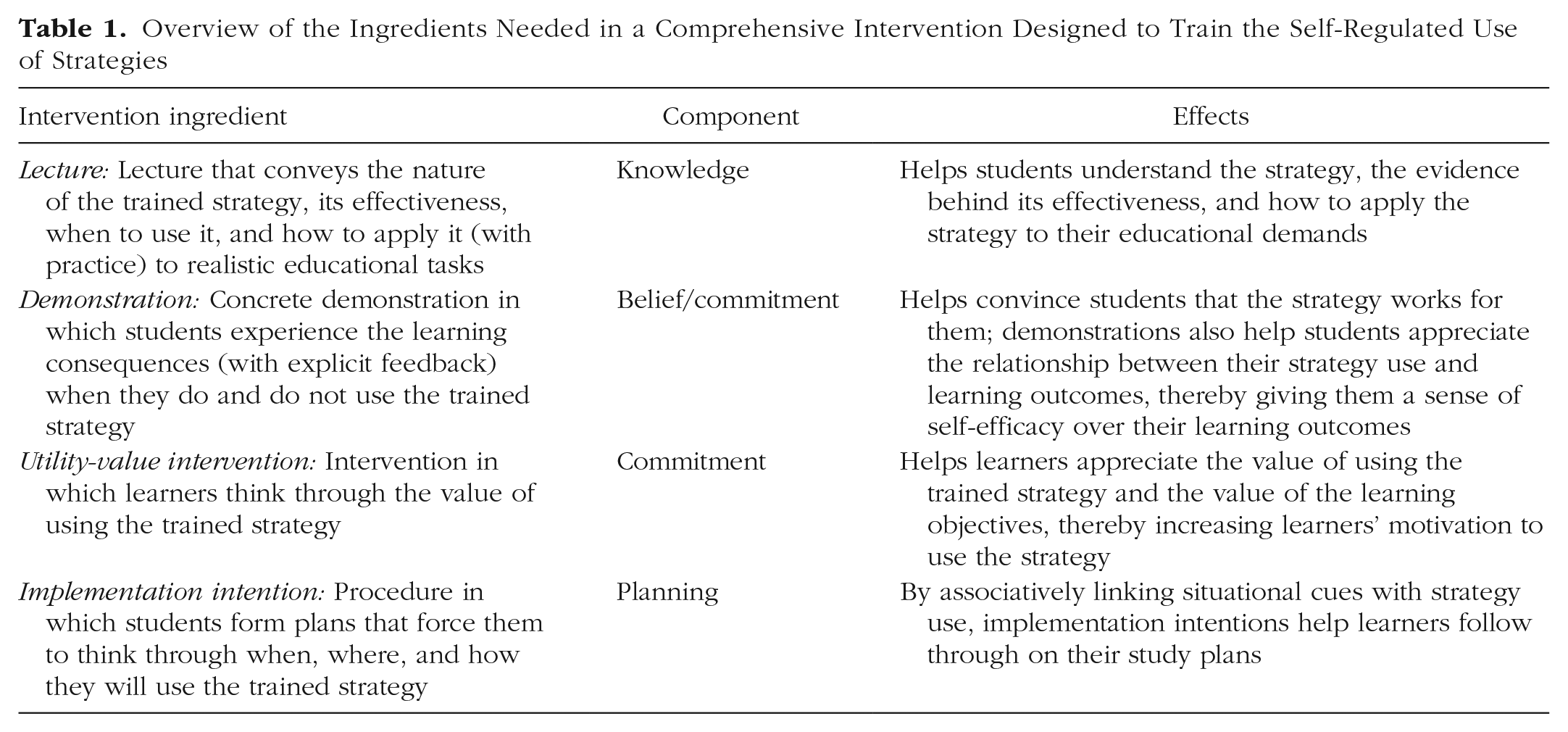
Knowledge about the generating-understanding strategy could initially be communicated with a lecture that first emphasizes that effective learning involves using good strategies and that strategy use is malleable. Students could then be told about the learning and memory benefits of the generating-understanding strategy and presented with evidence (the methods and results of a couple of studies) demonstrating its effectiveness (e.g., Seifert, 1994).
At this point, a teacher could instill belief in the usefulness of the target strategy with a demonstration. A potent demonstration that we have often used for teaching students about the importance of generating understanding involves presenting students sentences that take the form of a particular man performing a particular action such as “The brave man ran into the house” (from Bransford et al., 1982; see also Pressley, McDaniel, Turnure, Wood, & Ahmad, 1987). The students would first be presented with a set of 10 sentences, one at a time for a brief period each (e.g., 5–10 s), and instructed to learn the sentences for a memory test using their own strategy or instructed to use a rote-repetition strategy (familiar to most children). After giving a cued-recall test on the sentences (e.g., “Who ran into the house?”), the teacher would give the students the answers and ask them to record the number they answered correctly.
Next, the students would be reminded of the lecture on the importance of generating understanding and taught that an effective way to do that with these materials is to try to explain for themselves (covertly) why the particular man performed that particular action (e.g., “to save the kitten who was in a house that was on fire”). This self-explanation strategy would be illustrated and discussed with several sample sentences. After students understand how to use this self-explanation strategy, they would be presented with a new set of 10 sentences (at the same presentation rate) and then tested on their memory. After scoring their responses, the students would compare their performance on the second set relative to the first set. In many similar demonstrations that we have conducted, nearly everyone remembers substantially more on the second set than the first.
These activities should give students a good understanding of the importance of generating understanding and should foster belief in its effectiveness. At this point, perhaps in the following class period, it would be important to elaborate or enrich the knowledge component by showing students how to apply this strategy to their actual school material. Specifically, teachers could instruct students that an effective and general method for generating understanding for the course material is to use the strategy of self-explanation. This involves regularly stopping and asking yourself what the just read section of the text means to you, what you are learning that is new, and how this new information relates to what you already know (Dunlosky et al., 2013; Fiorella & Mayer, 2015). Teachers could help students understand and become familiar with how to use this strategy with a lecture and discussion as well as practice using actual course material.
As noted earlier, clinical and educational research is clear in showing that people are more likely to change their behavior when they are highly motivated or committed to using it (Amrhein et al., 2003; Harackiewicz & Priniski, 2018). Increased commitment could be induced by using a utility-value intervention, which helps students generate motivation for change by increasing the perceived value of engaging in an activity. As applied to strategy training, this would involve asking students to write a couple of paragraphs in which they reflect on how using the generating-understanding strategy can benefit their educational and/or career goals (e.g., “using the generating-understanding strategy will help me achieve my short- and long-term goals of making good grades in my science course and getting into college”; Harackiewicz et al., 2016; Hulleman et al., 2017). Utility-value interventions can be easily implemented in large classes and do not require extensive class time.
As described earlier, high motivation is often not sufficient for optimally changing behavior (Gollwitzer, 1999; Gollwitzer & Crosby, 2018; Sheeran & Webb, 2018). Successfully carrying out an action (like using a strategy) involves overcoming human tendencies such as engaging in routine actions and succumbing to distractions and temptations. To help students overcome these tendencies, teachers could encourage students to engage in planning by forming implementation intentions for using the generating-understanding strategy. Specifically, they could ask students to think through their upcoming reading and study opportunities and to develop a precise action plan for using the generating understanding strategy in studying for each, using the form “When situation x arises, I will perform response y!” (Gollwitzer, 1999, p. 494). The teacher should work with the students to ensure that the implementation intentions are concrete and specific, such as “When I study for my science test in my bedroom after dinner, I will try to explain each paragraph to myself after reading each paragraph.” After generating action plans for upcoming study opportunities, the teacher should ask students to rehearse their plans and to imagine using each strategy in each context. Students could keep a copy of their utility-value and implementation-intention responses, and the teacher could prompt them to review them regularly; perhaps a few minutes of class time could be devoted to reviewing and updating these at the beginning of each week.
Summary
We know that when prompted and given appropriate scaffolding, even fifth graders can use powerful learning strategies and benefit from those in educational settings (but not necessarily self-regulate these strategies). We also know that there are a number of learning strategies that are effective across domains in authentic educational contexts (Dunlosky et al., 2013; Pashler et al., 2007). In light of this knowledge, it is discouraging that students often use relatively ineffective study strategies (e.g., Agarwal et al., 2014; Bjork et al., 2013; Karpicke et al., 2009; Miyatsu et al., 2018), thus limiting their academic achievement (e.g., Dansereau et al., 1979; Hartwig & Dunlosky, 2012). The reason for students’ commitment to ineffective strategies is at least two-fold. First, using personal experience to accurately evaluate the effectiveness of particular study strategies faces a number of pitfalls (Pressley et al., 1989); second, students are rarely taught effective learning strategies. For instance, in one survey 80% of college students indicated they were not taught to use their favored (and sometimes ineffective) strategies (Kornell & Bjork, 2007; see also Hartwig & Dunlosky, 2012).
A plausible remedy to this unfortunate state of affairs is to include learning-strategy training in educational curricula. One major challenge in doing so, however, is that it has proven difficult to design training protocols that support students’ self-regulation and transfer of effective learning strategies across a range of learning challenges and materials (see Manalo et al., 2018). Perhaps even more disheartening, for the past 30 years, little research has been directed at developing training protocols to support the self-guided transfer of strategies (Manalo et al., 2018, p. 4; but for reviews of training learning strategies for specific content domains and for application with particular challenges such as reading and solving math problems, see Dignath et al., 2008; Donker et al., 2014). Accordingly, at present, there is a large gap in educators’ and psychologists’ understanding of how to train students to use and apply effective strategies across content domains and on their own.
In this article we presented a practical theoretical framework based on a range of research to guide the design of learning-strategy training protocols to support students’ self-regulation of targeted study strategies. The core components of the framework—knowledge, belief, commitment, and planning—have currency from available theoretical and empirical work. To our knowledge, however, these components have not been integrated into a coherent, evidence-based training approach. Our hope in presenting this theoretical framework of learning-strategy training is (a) to stimulate renewed interest and effort toward investigating how to train effective learning strategies and their self-regulation, (b) to guide theory-based and systematic research that evaluates the components that help learners sustain and transfer their strategy training, and (c) to provide guidance in current efforts to include metacognitive (learning-strategy) training into the precollege and college curricula. As noted repeatedly, we acknowledge that much remains to be learned on this front, and we see this as a highly fertile area for further research. We believe that it is imperative that researchers and practitioners pay attention to training learning skills to foster the development of students who maximize their learning potential and become effective lifelong learners.
