



Abstract
Market access strategy is a pressing and important issue for almost all pharmaceutical and medical technology companies. Yet the content of market access strategy is poorly defined and is often confused with process, objective and operational activity. Further, little is known about the differences between strong and weak market access strategies. Based on four in-depth case studies, this article proposes a tested definition of what market access strategy is. It identifies nine factors that characterise the strength of any market access strategy and proposes a graduated scale for those nine factors that enables the objective assessment of the strength of market access strategies prior to execution.
Introduction
Many authors have commented on the fundamental changes in market environment of the pharmaceutical and medical technology industries and the responses to those changes made by firms in the sector.1,2 Prominent and arguably dominant amongst these changes and responses are those concerning the acceptance of new but usually more expensive new products by those governmental authorities responsible for funding the larger part of many healthcare systems. Typically, this subject area is given the shorthand label of market access and although arrangements vary in detail in different national markets they share a common fundamental approach. 3 – 7 In essence, market access is granted or refused according to the outcome of some health technology assessment, often performed by a government body (e.g. NICE in the UK). Whilst individual methods of health technology assessment vary, the common and fundamental principle is that the health economic outcomes enabled by the new product are weighed against any additional costs implied by that product. In both developed and emergent markets, it is increasingly difficult to gain market access unless the product provides not only clinical advantages over the incumbent product but also significant and demonstrably superior health economic outcomes. To a large degree, market access now determines the success or failure of any new pharmaceutical or medical technology.
In response to this important shift in the way that governments and other payers define the value of new products, the pharmaceutical and medical technology industries have attempted to develop new processes and capabilities. 8 – 10 These have the intent of demonstrating health economic value of new products and so gaining market access. However, the published literature in this area is not extensive and what there is suggests that this is an emergent capability within the sector, one that is embryonic, poorly defined and not yet well developed in many companies. Accordingly, the work described in this article attempts to contribute to our knowledge of market access strategy in the pharmaceutical and medical technology sector. It does so by combining existing knowledge of the content and characteristics of competitive strategy in the sector with new, qualitative, empirical work in the form of four in-depth case studies in major companies.
Research objectives and methodology
The objective of this work was to address three, related primary research questions:
What is the definition of market access strategy? In particular, the work sought to develop a valid definition of market access strategy that met the criteria of a strong definition, namely:
A definition that is inclusive of all cases of market access strategy, independent of detailed context. A definition that is exclusive to the content of market access strategy and distinguishes it from other related constructs such as market access process (the set of activities intended to achieve market access), market access objectives (e.g. granting of market access under certain conditions) and market access tactics (e.g. health economic studies, government relations activity or preparation of submission dossiers to health technology assessment bodies). A definition that is sufficiently descriptive to guide the development and assessment of market access strategy (e.g. one that described the content of market access strategy with sufficient specificity and clarity as to allow pharmaceutical and medical technology companies to improve their practice). A definition that is non-circular (e.g. avoids the definition of market access strategy as being that strategy which is created or implemented by the market access function).
What are the characteristics of a market access strategy, as defined by question 1, which might determine its strength, where strength is defined as the probability of achieving profitable market access?
What are the differences between strong and weak market access strategies when assessed in terms of the characteristics uncovered by question 2?
The research methodology selected was one of action research, as originally defined by Lewin,
11
using the action science guidelines developed by Gummeson.
12
Action research methodology, sometimes called action science methodology, has been described by Hult and Lennung
13
as:
“Action research simultaneously assists in practical problem-solving and expands scientific knowledge, as well as enhances the competencies of the respective actors, being
performed collaboratively in an immediate situation using data feedback in a cyclical process aiming at an increased understanding of a given social situation, primarily applicable for the understanding of change processes in social systems and undertaken within a mutually acceptable ethical framework”
Case 1: A large, global pharmaceutical company. In this case, the research focussed on the market access, marketing and related functions of one large and commercially significant business unit that had global responsibility for a single therapeutic area. Case 2: A large, global medical technology company. In this case the research focussed on the marketing, market access and related functions of a diverse product range across three product categories but on a sub-regional (i.e. Northern European) basis only. Case 3: A large, global medical technology company. In this case, the research focussed on the marketing, market access and related functions of two large business units, organised around product categories, on a regional (i.e. Europe, Middle East, Africa) basis only. Case 4: A large, global pharmaceutical company. In this case, the research focussed on the marketing, market access and related functions across all therapy areas but on a sub-regional (i.e. Eastern Europe) basis only Development of an in-depth, semi-structured interview guide based on a body of extant literature about the nature of competitive strategy in medical markets.
14
–
19
The execution of in-depth interviews with 6–12 senior executives most closely involved in market access strategy in the participating business units. The development of a qualitative on-line questionnaire based on both the extant literature and the outcomes of the in-depth interviews. The execution of the on-line survey with a large number of executives, beyond the in-depth interview group, who were significantly involved with the development and execution of market access strategy. In each case, between 20 and 60 executives responded. The content analysis of both the interview transcripts and the survey results.
In all four cases, the research methodology adopted consisted of six stages:
The results flowing from this work were grouped into three major categories, based upon the three primary research questions:
The definition of market access strategy. In this part of the work, responses were grouped to draw out any consensus about the definition of market access strategy. The characteristics of market access strategy. In this part of the work, responses were grouped to identify criteria against which the strength of market access strategy, as defined in part 1 of the analysis, might be evaluated. The differences between market access strategies. In this part of the work, responses were grouped to identify variances of market access strategy strength according to the criteria developed in part 2 of the analysis.
Overall, some 39 in-depth interviews were executed and 145 surveys collected. Content analysis was carried out manually, using only word processing and spreadsheet software.
Results and findings
Part 1: The definition of market access strategy
All respondents were asked to provide their definition of what market access strategy is. In all four cases, the results demonstrated that there was no single, agreed definition of what constituted a market access strategy within that company. To quote one respondent:
“In (our company), there are as many definitions of market access strategy as there are employees”
Respondent 4, Case 1.
For the most part, attempts to define market access strategy fell into three categories:
Descriptions of the aim of market access activity, such as achieving market access or enabling sales activity. Descriptions of discrete, short-term operational activity aimed at achieving market access, such as health economic studies, government lobbying and the preparation of dossiers for submission to health technology assessment bodies. Descriptions of decisions concerning the nature of the health economic proposition to be made to the market place and the targets at which those propositions were addressed.
Responses in the first two categories constituted the largest volume of comments in the analysis, especially in the initial responses. Responses in category 3 were concentrated in the responses to the secondary, clarifying questions in which respondents were asked to distinguish market access strategy content from its process, intended outcomes or its associated operational activity. Further, these category 3 answers matched more closely than those comments in categories 1 and 2 the definitions of strategy proposed prior researchers in the strategy field, such Drucker 20 and Mintzberg. 21 For those reasons, the category 3 comments were used to develop the definition of market access strategy discussed later this article.
Part 2: Characteristics of market access strategy
All respondents were asked to describe what characteristics of market access strategy were related to the probability of the strategy achieving its goals. In both survey and interviews, this question was posed in two parts: an open question (What considerations are important in the design of a market access strategy?) followed by closed questions (Which of these stated considerations are important in the design of market access strategy?). The closed questions were selected based upon the characteristics of strong competitive strategy in medical markets identified in prior work (see above) but were adapted in each case to reflect the prior responses of the respondents to the open question.
Interestingly, the responses in this section were rather wider than the characteristics suggested by prior literature. Whilst the prior work (used in the secondary, closed questions) suggested 5 characteristics by which to assess market access strategy, the results of the data analysis in this part of the research confirmed those 5 characteristics and suggested another 4. All 9 characteristics are discussed in the findings section of this article and were used to develop the content analysis framework for part 3 of the data analysis.
Part 3: The differences between market access strategies
All respondents were asked to describe differences between market access strategies with which they had direct experience. Further, they were asked to attribute those differences to the relative success or failure of the market access strategy. This section of the research used open questions only (e.g. What is it about successful market access strategies that distinguishes them from weak market access strategies?). However, the 9 characteristics of a market access strategy (which had not yet been identified at the time of the interviews) were used in the content analysis of the data.
Importantly, a gradation of differences between market access strategies emerged along all nine dimensions. This gradation was not a discrete, binary measure (i.e. strong vs. weak) but indicated that the strength of market access strategy was a continuous variable along all 9 dimensions. Descriptions of this continuous gradation are given later in this paper.
Hence the analysis of the data provided findings relevant to all three research question, as described in the following three sections of this article.
Finding 1: The definition of market access strategy
As already described, many of the respondents’ answers gave support to the idea, expressed in the respondent quote above, that market access strategy is not a well-defined, unambiguous concept in the case study companies and presumably in the industry as a whole. In particular, many of the responses to these questions failed the tests of good definition described above and conflated the content of market access strategy with the process by which it is formulated and implemented, with operational market access activity and with the intended goals of that activity. However, from that third category of responses that related to management decisions, a clear definition of market access strategy emerged that is best understood in the context of other levels of strategy. These are summarised in Figure 1.
Definitions of market access strategy in the context of other levels of strategy.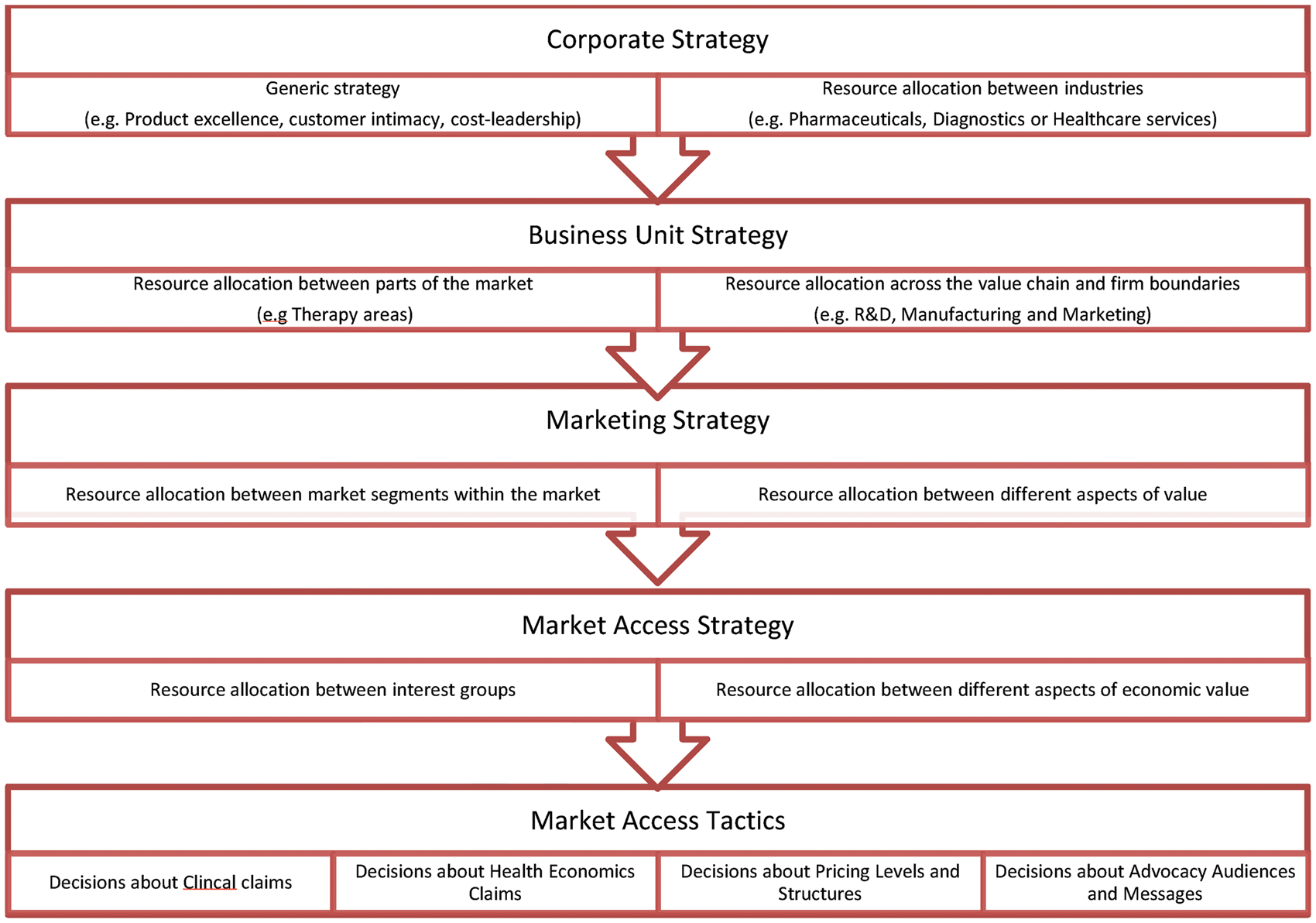
In this context, therefore, market access strategy may be defined as follows:
Market access strategy is that pattern of resource allocation and activity decisions about what health economic value proposition to make to the market and which audiences within the market access decision making process to whom to address that proposition.
Finding 2: The characteristics of market access strategy
The nine differentiating characteristics of a market access strategy
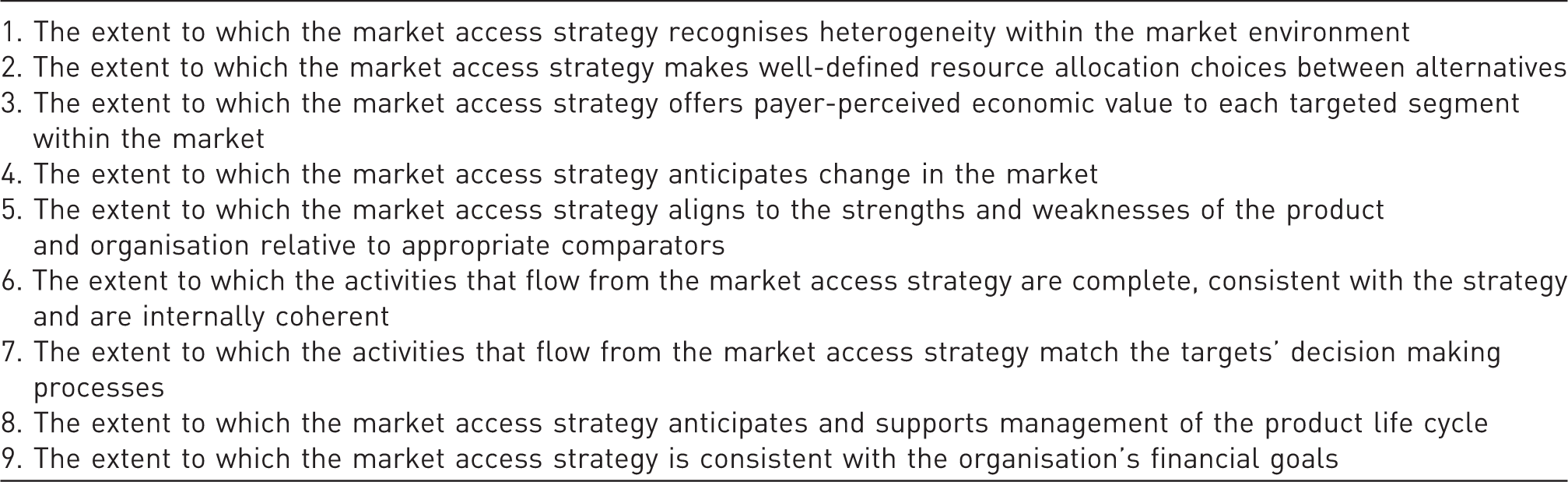
Finding 3: The differences between market access strategies
“An excellent market access strategy is one which meets the nine criteria of market access strategy strength to a degree that is clearly and demonstrably superior to any relevant competing market access strategy”
Graduated differences between market access strategies
A definition of market access strategy has been developed that meets the four criteria of a good definition, thus allowing differentiation of market access strategy from other, related concepts.
A set of nine characteristics has been identified that are associated with the probability of that strategy achieving profitable market access, thus identifying the criteria against which any market access strategy might be assessed.
The differences between strong and weak market access criteria in terms of those nine characteristics have been identified on a graduated scale, thus enabling a semi-quantitative and objective evaluation a market access strategy prior to implementation and comparison between alternative or competing market access strategies.
Limitations and implications for further research and for practice
This work has two major limitations, each of which suggests the opportunity for further work. Firstly, the research is based on the respondents’ qualitative perceptions of those factors that contribute to the success of a market access strategy. This is necessarily and obviously subjective and thus subject to numerous cognitive biases. The method therefore places limits on the internal validity or reliability of the findings, which might be tested by quantitative work that seeks to correlate the characteristics of market access strategy with its final outcome. However, the consistency of the responses both within and between cases suggests that the findings have a high level of internal validity in the context of these companies. Secondly, the research is based on a small sample of four cases with a bias towards large companies and a European market access context. This sampling bias necessarily limits the external validity or generalisability of the work, which might be tested by replication of the work with a broader, more geographically spread, sample. However, the consistency of the responses across national boundaries suggests that the findings have a reasonable level of external validity in the context of European and European-like healthcare systems. Notwithstanding these limitations, therefore, this first, exploratory work still represents a valuable contribution to knowledge in this field.
Similarly, whilst recognising the limitations of this work, these findings have three interesting and commercially important implications for practice.
By defining market access strategy content as distinct from market access objectives, operational activity or the market access strategy process, these findings help pharmaceutical and medical technology companies to define a target outcome for the extensive and expensive investments they are making in market access activity. By identifying those characteristics associated with market access strategy strength, these findings help pharmaceutical and medical technology companies to define the fundamental design parameters of a strong market strategy, so helping the design of their market access processes and organisational structures. By developing a graduated scale for the characteristics of market access strategy, these findings enable their assessment both in absolute terms and in comparison to other market access strategies. Importantly, this work makes possible such assessment prior to the commitment to the large real and opportunity costs associated with execution and so allows optimisation of market access strategy before implementation.
The author hopes that this work makes a valuable contribution to management practice in the pharmaceutical and medical technology sectors and so, given the importance of these sectors, to society as a whole.
Footnotes
Funding
This research received no specific grant from any funding agency in the public, commercial or not-for-profit sectors.
Conflict of interest
None declared.
Professor Brian D Smith, researches competitive strategy in pharmaceutical and medical technology markets at SDA Bocconi, Milan, Italy and the Open University Business School, Milton Keynes, UK. He also runs Pragmedic.com, a specialist strategy consultancy.