




Abstract
This article uses two groups of case-study episodes to explore the complexities and perplexities that arise from the long-running use of a ‘floating timeline’ within The Simpsons. First, the conflicting representations of the youths of Homer and Marge in two ‘flashback’ episodes (‘The Way We Was’ and ‘That 90’s [sic] Show’) are examined. The logical quandaries presented by departing from a floating timeline and introducing fixed (but multiple and contradictory) historical reference points in individual episodes are outlined, and it is suggested that it may be better to accept the fictional paradoxes created rather than to try to resolve them. Second, the episodes featuring ‘Sideshow Bob’ are surveyed, and Bob is offered as being granted the unusual capacity (within The Simpsons’ fictional universe) to experience the passage of time and accumulate and retain an eventful history. This is contrasted with the temporal experiences of the Simpsons themselves, for whom there is eventfulness without progression. The article concludes by suggesting that The Simpsons’ status as an animated programme allows it to exhibit in a particularly pure and sustained form some of the relationship to time, history and the everyday of situation comedy and television more broadly.
Keywords
Introduction: ‘Floating timelines’ and other ‘TV tropes’
It is not unusual for animated television series to run for years without time seeming to pass in the show’s fictional world. Very occasionally, changes will connote the passage of time: Fred and Wilma Flintstone eventually have a daughter, Pebbles (and Wilma’s pregnancy was included in the show); Stan, Kyle, Kenny, and Cartman eventually progress from the third grade to the fourth in South Park (1997–present). But these events are uncommon in the animated sitcom, and even in and of themselves they are limited in scope; changes happen rarely in animated sitcoms, and tend to be permanent when they do occur. Pebbles never progresses beyond an infant stage in the original run of The Flintstones (1960–1966). 1 The boys of South Park Elementary have been in the fourth grade since 2000, with no sign that they will move up to the fifth grade anytime soon. Similar changes occur in The Simpsons (1989–present). Apu and Manjula’s octuplets are conceived, born, and grow to toddler stage, where they have remained for years. Maude Flanders dies, and Ned goes through a long period of mourning before beginning to date, eventually falling in love with and marrying Edna Krabappel (who herself later dies, a decision made due to the death of actress Marcia Wallace, who provided Krabappel’s voice).
The popular wiki TV Tropes offers brief and incisive descriptions and apposite labels for the various, often overlapping rules of fictional works which are produced and consumed over extended periods, which can help to begin to explain some of the curious ways in which time works in animated series, alluded to above. Four of these ‘tropes’ are of particular relevance to this article: ‘Not Allowed to Grow Up’, ‘Frozen in Time’, ‘Comic-Book Time’, and ‘Floating Timeline’.
The trope ‘Not Allowed to Grow Up’, concerns those instances where child characters in a fiction do not appear, or are ‘not … allowed,’ to grow up. The entry suggests that this trope is a staple of animated series, in which it is possible to keep a character the same age year after year without major psychological harm to the actor (who, in a cartoon, is usually an adult anyway). 2 Implicit in the description for this entry is the idea that the lack of ageing is restricted to the child characters, whereas for the adult characters and for the world at large, time can be assumed to be passing more or less as usual (although of course there is room for ambiguity here, since the difference between one year and the next is much more prominent in the case of children and adolescents than it is in the case of many adults).
‘When the concept behind a series is so tightly bound to a particular period of history that the series cannot leave that era’, TV Tropes explains, ‘it is Frozen in Time’. Care is taken to distinguish this from a related trope: ‘Note that this trope is about the setting not advancing. If the setting advances but the characters don’t age, that’s Comic-Book Time.’ 3 Comic-Book Time, it is suggested, uses ‘the illusion of time passing. You never refer to specific dates if you can help it, and you let characters change, but only a little’ (emphasis in original). This trope, it is claimed, ‘is also quite frequently called a floating timeline’ (emphasis in original), and it is that label this article will use, as it captures well the idea of a fictional world which lacks a fixed timeframe with respect to both period and duration.
The Simpsons does not adhere neatly and consistently to any one of the above tropes. Predominantly, we will suggest, it utilizes a ‘floating timeline’, but not, as we point out, without deviations or complications. Moreover, as we demonstrate, the sustained deployment of a predominantly floating timeline over a period of decades creates a range of time-based perplexities for animated series like The Simpsons, perplexities which do not present an ultimate solution, and which encompass issues including how our understandings of fictional characters and of our own lives are informed by time-dependent phenomena including coming of age at particular points in world history, growing older, experiencing and expecting change, and accumulating experience and a biography to inform our sense of past, present and future. Sustained theoretical discussion of these issues is beyond the scope of a short article and the disciplinary territories of its writers. What follows is offered principally as a critical discussion of a popular and culturally-significant animated television series, which also attempts to relate the experience of time offered by The Simpsons to the varied experiences of time offered elsewhere on television, but which is ultimately committed to demonstrating the peculiarity, perhaps even the uniqueness, of how time works in The Simpsons, which it has achieved by virtue of being (i) an extraordinarily long-running, (ii) animated, and (iii) a television sitcom.
Our discussion is organised principally around two sets of case study episodes. The first set (in fact, a pair) comprises the conflicting representations of the youths of Homer and Marge in two ‘flashback’ episodes, which allow us to reflect upon what happens when a floating timeline is anchored to a historical reference point, and then, much later, anchored, contradictorily, to a second such reference point. The second set comprises the episodes in which recurring occasional character Sideshow Bob appears. In these episodes, Bob’s accumulating biography and history are foregrounded, suggesting that time does not work in the same way for all characters in The Simpsons’ universe, thus throwing into sharper relief some of the effects that time not seeming to advance or to accumulate has upon the programme’s main characters (principally, the Simpson family).
Floating timelines with specific (though variable) pasts: The youths of Homer and Marge
As noted above, one of the ‘rules’ of the ‘comic-book time’ or ‘floating timeline’ trope is that ‘you never refer to specific dates’. The Simpsons occasionally eschews such a restriction – for example, in two famous (one of them, perhaps, infamous) episodes in which we learn about Homer and Marge’s courtship(s).
On 31 January 1991, mid-way through The Simpsons’ second season, Fox aired ‘The Way We Was’, an episode in which, when the family’s television breaks down, forcing its members to turn to one another for entertainment, Marge tells Bart and Lisa how she and Homer met and fell in love. The story is told through flashbacks to Marge and Homer’s senior year at Springfield High School. At several points throughout the episode, the year is confirmed to be 1974. The main timeframe the episode flashes back to (after first flashing back to Homer and Marge receiving the news that Marge is pregnant – with Bart, presumably – and using several aesthetic details to suggest that we are in the early 1980s) is introduced by a transition from the Simpsons’ living room in the programme’s present to Homer’s old car driving down a Springfield street with ‘Springfield 1974’ written in Simpsons font at the bottom of the frame. The same year appears on the banner at the Springfield High School senior prom, which also features the prom’s theme, Elton John’s ‘Goodbye Yellow Brick Road’ (first released as a single in late 1973).
‘The Way We Was’ is the inaugural flashback episode of the series, and it is clear that the writers and artists took care to include as many visual and auditory cultural references to the specific year as they could manage: hairstyles and wardrobes (on primary and secondary characters alike), colours, décor, automobiles, graffiti, and music. Even current events relevant to 1974 are included, as Homer is invited to argue for the ‘con’ side of a debate on the lowering of the national maximum speed limit to 55 miles per hour (a change made in that year throughout the United States).
By cementing elements of the Simpsons’ family history within the specific cultural context of a 1970s and 1980s America, the episode’s writers and artists eschewed the floating timeline to provide fans with a plethora of solid new facts to add to their ever-growing, shared, online, (unofficial) Simpsons encyclopaedia. On 1 February 1991, alt.tv.simpsons users took to the forum to discuss the episode. ‘Bart’s illegitimate!’ is the title of one of these discussions, referring to the aforementioned first flashback in ‘The Way We Was’ in which it is implied that, upon learning in Dr Hibbert’s office that Marge is pregnant with Bart, Homer proposes marriage to her. The discussion’s creator (user name: ‘rex jones’) writes in the discussion’s inaugural entry: Amazing! But then, Bart’s now about 10, which would mean that Homey and Marge didn’t get married ‘til about ’81, which would mean a 7-year courtship. [Unless] of course, there’s the Simpson nobody knows about! Or if Marge miscarried or had an abortion. But still, they got married because Marge was pregnant, and the obvious angle is that Bart was conceived out wedlock! [sic] Groenig [sic] triumphs again!
4
‘jones’ recognizes that a fairly significant aspect of Simpson family history from the flashback (with the information being provided in a short 10-second scene) has been revealed. He or she takes care to work out other possible implications of this piece of information, and how this new knowledge fits into the developing Simpson family timeline (his reference to the ‘7-year courtship’ is drawn from Marge’s second flashback).
On 27 January 2008 (that is, almost exactly 17 years after ‘The Way We Was’ first aired), during The Simpsons’ 19th season, Fox premiered the episode ‘That 90’s [sic] Show’. 5 The show begins with the Simpson family burning objects in their fireplace to keep warm after Homer has failed to pay the heating bill. Bart is about to toss a box on the fire when Marge objects, stating that it is her ‘memory box’. The box comes open, and Marge’s hitherto undisclosed degree from Springfield University spills out, along with a graduation photo. ‘Mom, I didn’t know you went to college!’ Lisa exclaims, while Bart chimes in: ‘Yeah, you always said that after high school, Dad “blessed you” with the unplanned miracle of me.’ Lisa then scribbles some math, deducing out loud: ‘You know, Mom and Dad are almost forty. Bart is ten. That means you didn’t have him until way after high school!’ Homer and Marge decide to reveal a ‘turbulent part’ of their past to their children, and Homer sets the scene: ‘It was the middle of a wild decade known as the nineteen-nineties.’ Bart interrupts: ‘The nineties? Never heard of it.’ Homer continues: ‘Oh, it was a wonderful time. The Iraq war was over, once and for all. A struggling Matt Groening created Futurama! Young people believed in their dreams, thanks to a TV show called Melrose Place.’ The self-reflexivity in this scene is a wink at the audience by the writers, who, for the next 19 minutes, would undo and eradicate large pieces of Simpsons history.
In ‘That 90’s Show,’ through a series of flashbacks (by this point in the series’ life a familiar feature), the audience comes to know part of Homer and Marge’s history in which they cohabited (celibately) while Homer put Marge through university and pursued his musical career. Though specific dates are avoided, the episode abounds with details that indicate its setting in the early 1990s, to include the advent of Grunge rock (which Homer seems to invent), the Melrose Place (1992–1999) references, and period touches such as the inclusion of slow, dial-up internet and the popularity of laser tag. As ‘That 90’s Show’ unfolds, Marge becomes infatuated with her ‘worldly’ and ‘progressive’ professor, who is intent on seducing her. Homer, feeling rejected and alienated in Marge’s academic world, becomes despondent, and his band joins him in abandoning their R&B style for angry grunge rock. The episode is as replete with ‘90s references as ‘The Way We Was’ is filled with ‘70s references. The flashback story is awash with the mid to late ‘90s hairstyles and wardrobes, colours, décor, automobiles, graffiti, music, and current events. This includes a focus on Homer’s Nirvana-inspired grunge rock and his descent from rock-god status into deep and isolated depression, which echoes that of real-life Nirvana singer Kurt Cobain.
‘That 90’s Show’ undoes nearly every piece of history established in ‘The Way We Was’. The fact that Homer and Marge first had intercourse in the castle on a mini-golf course, established in the late-1991 episode ‘I Married Marge’, is one notable element of early continuity that is retained in ‘That 90s Show’. However, in the earlier episode, this event (which results in Bart’s conception) takes place the same night that Homer and Marge see The Empire Strikes Back (USA, 1980) in a cinema. As they exit the cinema, Homer ruins the plot twist for the people queuing for the next screening, who jeer at him for his lack of consideration. This establishes that he and Marge saw the film during its first run, and thus places Bart’s conception squarely in the year 1980. Thus, in the updated version, even though the event itself was retained, its historical context has been rewritten completely.
While immediately after the episode’s airing some fans on alt.tv.simpsons and the newer (and bigger) NoHomers.net forgave both the retroactive continuity (or ‘retcon’, the alteration of hitherto established facts of a particular fictional universe) and the timeline shift (even giving the episode favourable reviews), others expressed their outrage. NoHomers user ‘ruggeder’ pans the episode passionately, even invoking the fan-parody line ‘worst episode ever’ favoured by Simpsons writers, saying: that was the worst episode i have ever seen. Nothing was in character, and they threw out 19 years’ worth of continuity. Total garbage. The writer should be fired, along with anyone who approved that steaming pile of corkscrew excrement. (ruggeder, 2008)
Meanwhile, alt.tv.simpsons user ‘bhart…@gmail.com’ was more conflicted about the episode’s quality, but equally offended by the retcon: I thought some parts of the episode were funny … but I was appalled that they chucked continuity out the window … It was okay when the writers fudged the continuity a little bit in the movie, since the wedding video was an important part of the plot. But the way they did it last night was kind of shameless. (bhart, 2008)
When, as in the case of The Simpsons, a predominantly floating timeline is deployed in a programme that runs for over two decades, then the persistent use of flashbacks to the youths of middle-aged characters is particularly likely to bring to the foreground perplexing continuity issues. As indicated at the very beginning of this account, what a ‘floating timeline’ is often taken to mean is that the principal characters do not age. If Homer and Marge, then, do not age, and remain in their mid- to late-30s, flashbacks to their youths present viewers (and writers, and fans) with three options.
First: Homer and Marge’s period of youth has a fixed historical location in the mid-1970s, as established in ‘The Way We Was’. Following one chain of logic, this would mean that if the characters remain in their mid-to late-30s, then The Simpsons is forever tied to an early-to mid-90s present-day time setting, regardless of how far beyond that point the programme continues to be produced and broadcast. Thus, The Simpsons’ universe would not actually be a ‘floating timeline’ at all, but would in fact be ‘Frozen in Time’.
Second: regardless of what the present year is (presumably, the default option is to take the presents of the production of The Simpsons and the series’ fictional world to be approximately the same), Homer and Marge will always be in their mid to late 30s, meaning that, by another chain of logic, the period of their youth gradually creeps forward. This is the option enacted by ‘That 90’s Show’, as is acknowledged near the beginning of that episode by Lisa’s calculation, quoted above.
This second option is particularly mind-boggling if one is trying to hold onto a realist understanding of characters and their biographies, especially in a programme such as The Simpsons, which is so invested in a play with socio-cultural types, which are in part generational types. If Homer is in his mid-30s in 1990, that means he was born in the mid-1950s and came of age in the 1960s and ‘70s. In other words, he is a late baby-boomer, with all that this entails. As Chris Turner (2004: 89) has observed: As the most coddled subgroup (white males) of what might well be the most coddled generation in human history, Homer and his peers have had their every whim catered to since birth … And as a product of the very end of the Baby Boom, Homer’s been particularly coddled. He was too young to be scarred by Vietnam; he bumbled through his teens listening … to the lunk-headed riffs of 1970s arena rock and the vacuous melodies of 1970s novelty pop … he walked into a career right out of high school with no previous experience. Every aspect of Homer’s comfortable life has simply fallen into his fat lap.
However, if Homer is the same age in the second decade of the 21st century, then he is on the younger side of Generation X – many of whose members are themselves the children of Baby Boomers (and, if Bart and Lisa had aged ‘in real time’ over the course of the series, they would now be very close to Homer and Marge’s ages at the start of season one – and of course, their ages ever since).
One can sidestep the dilemma presented by the first two options, and choose instead the third option, not to impose more logic upon a work of fiction than the work allows. Paradoxes, philosopher of aesthetics Kendall Walton (1990: 174–183) urges, are a frequent feature of fiction that we should learn to live with. Whereas some fans and fan communities have relegated ‘That 90’s Show’ to ‘non-canonical’ status due to its perceived trashing of continuity (a feature which may well have been a source of delight for the writers involved, not least because of the often needling relationship that exists between them and the vocal online fan communities), we should perhaps be prepared to accept that, paradoxically, it is a fact of The Simpsons’ peculiarly ordered universe that Homer and Marge courted and came of age in ‘the 1970s’ and ‘the 1990s’ (just as it is a fact that the Simpsons family have observed many Christmases and Halloweens and yet have not advanced in years). We might wish to add, however (and this moves us closer again to the aforementioned fans and fan communities), that we might lend more weight (as the programme does) to one of these sets of fictional truths than the other.
The combination of a floating timeline and fixed historical anchors is one important element of the complexity of The Simpsons’ handling of time; another can be explored with the help of a well-loved secondary character.
Doing time: Sideshow Bob as a challenge to Springfield’s (temporal) event horizons
There is at least one character on The Simpsons for whom a lot of time passes: Robert Underdunk Terwilliger, better known as Sideshow Bob. Increasingly as the series progresses, Bob’s occasional reappearances are framed and defined by the time that has passed and the experiences that have accrued to Bob during his absence. Often, this will be pointedly contrasted with the lack of progress experienced by other characters, thus highlighting this lack and rendering it temporarily strange. Consequently, this pushes the temporal logic of the series as a whole briefly away from a ‘floating timeline’ and towards the idea that characters’ not being ‘allowed to’ grow up/age is determined not by their being children or adults, but by their being more or less central characters, and by their living in or away from Springfield.
First appearing fairly early in season 1, Sideshow Bob emerges both as a speaking character and a criminal mastermind (at least in his own head) in ‘Krusty Gets Busted’ (29 April 1990). Over the following seasons, Sideshow Bob has returned, intermittently, as a featured character in (as of season 26) 12 episodes (and has also been included in several episodes where he participates very briefly, speaking no more than a couple of lines). 6 Despite his rare appearances on the show, Bob is a very popular, beloved, and memorable character: it is surprising to realise just how infrequent his appearances actually are. Perhaps Bob feels like a more frequent visitor to the show because he is given the unusual capacity, within the world of Springfield, to continue to live and experience and develop in the years between his featured episodes. Good-sized chunks of time come between each of Bob’s episodes – anything from a year to four years – and when Bob enters into the narrative of each of his featured episodes, we are always updated as to what he has been doing in the intervening time. More often than not, Sideshow Bob has spent at least part of that time in prison (indeed, 9 of his 12 episodes begin with Bob still in custody but about to escape, be paroled, released, pardoned, or turned over for use as a test subject). Yet time has passed for him there nonetheless, and we are given a privileged glimpse into this. What is more, the Simpson family (and other characters on the show) likewise acknowledge that Bob has a past that spans the history of The Simpsons.
In the episode ‘Sideshow Bob Roberts’ (9 October 1994), an unusual (for Springfield) event occurs (unusual, that is, in the programme’s ‘present’, outside of flashback episodes of the kind discussed above) – definite numerical dates are applied, and are done in such a way as to fit within the chronology of the broadcast history of the show’s episodes. In an expositional explanation to Homer about who Sideshow Bob is, Lisa explains that, ‘Sideshow Bob used to be Krusty the Clown’s sidekick. But in 1990, he framed Krusty for armed robbery and Bart got him put in jail. When he got out, he married Aunt Selma and tried to murder her.’ In saying this, Lisa references two previous episodes of the show: ‘Krusty Gets Busted’, which originally aired in the US on 29 April 1990, and ‘Black Widower’, which was first broadcast on 9 April 1992.
That time passes for Sideshow Bob comes through with particular clarity in the episode ‘The Italian Bob’ (11 December 2005), which marks Bob’s return to the programme after a three-year absence. While on a trip to Italy, the Simpsons end up stranded in the small Tuscan village of Salsiccia, where it turns out that Bob is the mayor. Upon encountering the Simpson family, Bob is desperate that the family not reveal to his wife (and to the citizens of the town) that, in America, he is a criminal with a long and violent record. Falling to one knee, Bob begs them: ‘Surely even the most heinous criminal deserves a seventh chance!’ – a reference to his six previous crimes in earlier episodes. 7 These episodes – and Bob’s plea for a seventh chance – indicate that Bob carries his past with him, and it weighs heavily on him. In telling the Simpsons about his life in his adopted hometown, he says that his ‘acceptance [amongst the town’s citizens] came slowly’, but notes that his massive feet made him a hero when the time to stomp on the grape harvest came, culminating in his being elected mayor the following spring. Indeed, the fact that Bob has a son of toddler age, Gino, by his Italian wife, Francesca, demonstrates that several years must have passed, as he says that it was after his election as mayor that he and Francesca met, fell in love, were married, and then conceived, gave birth to, and began raising their son. This would fit (albeit tightly) into an approximately three-year period: the same number of years that separate ‘The Italian Bob’ (11 December 2005) and ‘The Great Louse Detective’ (15 December 2002). Initially, things go well between Bob and the Simpsons, but Lisa becomes intoxicated during a town banquet and reveals Bob’s criminal past. The Simpsons quickly leave, and Bob loses his position as mayor. However, Francesca and Gino stand by him, and they swear a vendetta against the Simpson family. They fail to exact revenge during this episode, but their chance comes in Bob’s next appearance two years later.
‘Funeral for a Fiend’ (25 November 2007) includes a passage that acknowledges in a particularly emphatic way the now well-established fact that each of Bob’s episodes reintroduces him with an account of what has happened for him since we saw him last.
Now, since last we met …
[bored] Aw, great. Here it comes: all the boring things you’ve done since the last time you didn’t kill us.
You never ask what we’ve been up to [excitedly]! We went to the strawberry patch, and I picked the most strawberries!
Shut up! This time, to liven up our tale, I’ve brought along some visual aids. Just call me ‘Slideshow Bob’!
It is an interesting exchange: Bart (as well as the slideshow that Bob shares with them afterwards) acknowledges that a significant period of time has passed since they met in Italy. Yet Lisa’s remark implies that nothing much has happened for the Simpsons; indeed, her excitement about picking strawberries suggests that it has been too short a time for anything more interesting to have happened, almost as if none of the adventures contained within the two years of episodes since Bob’s last appearance (which included, amongst many other things, Marge suffering total amnesia, Lisa befriending Fat Tony’s son and watching him become a mobster in turn, Homer and Bart being temporarily lost at sea, and Santa’s Little Helper becoming a police dog) had happened.
There is another very important – and for The Simpsons, highly unusual – indication that time has passed for the Terwilliger family: Gino, Bob’s son, has grown older. When we first meet Gino in ‘The Italian Bob’, he is small enough for Francesca to hold him in her arms; when he stands next to his parents, Gino is only tall enough for his head to come just past their knees (not counting his huge hair, inherited from his father) (see Figure 1). But in ‘Funeral for a Fiend’, when we see them walking into the church for Bob’s (fake) funeral, he comes up to his mother’s waist, and his body proportions, voice, and face are no longer those of a toddler (see Figure 2). 8 In other words, during the two years since ‘The Italian Bob’, Gino has grown. Whether this growth has continued, we cannot know at present: although since this episode Bob has made two more featured appearance plus two speaking cameos, there has been no mention of Gino. But his ageing at all sets him apart from the Simpson children, and indeed from most of the children in Springfield (with the notable exception of the Nahasapeemapetilon octuplets, though even they age only to toddler stage before becoming ‘Not Allowed to Grow Up’ further). Yet it is again indicated that Bart and Lisa remain 10 and 8 years old when Bob, dismissing Lisa’s correcting his quoting of Shakespeare, remarks, ‘Yes, I’m sure you’ve studied the Immortal Bard extensively under your … Miss Hoover.’ Miss Hoover, of course, is (and as of 2007, had been, for 18 years) Lisa’s second grade teacher.
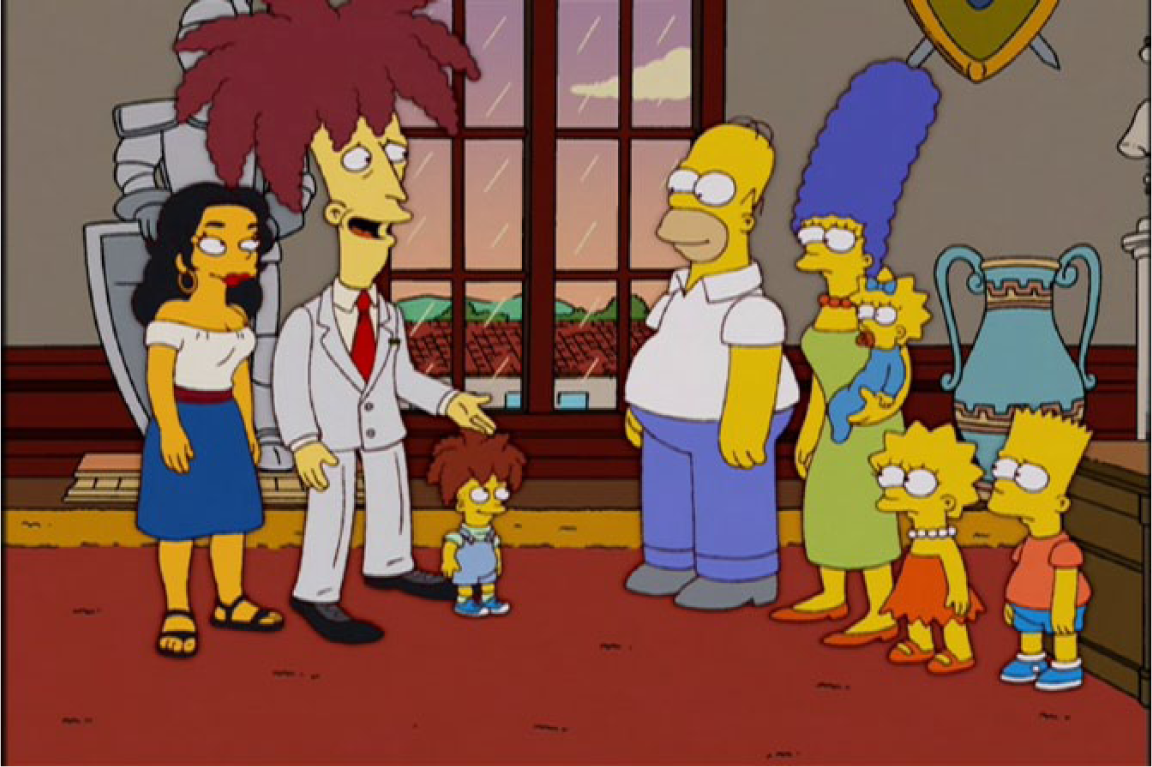
Gino as a toddler, alongside his parents. Frame grab from ‘The Italian Bob’. Director: Mark Kirkland, The Simpsons (season 17, episode 8 [HABF02], 11 December 2005).

Gino has grown! Frame grab from ‘Funeral for a Fiend’. Director: Rob Oliver, The Simpsons (season 19, episode 8 [KABF01], 25 November 2007).
In his most recent episode at the time of writing, ‘The Man Who Grew Too Much’ (9 March 2014), there is again ample evidence that time has passed for Bob: he has been in prison before becoming first a test subject, then a scientist, for Monsarno Corporation, where he has created GMO vegetables and has 16,000 patents to his credit. We have an acknowledgement that his past deeds are still with him: his face peels off accidentally (a leftover side-effect from his ‘face-switching’ surgery with Walt Warren in ‘The Bob Next Door’, 16 May 2010), and he must rescue it from Maggie (who has rolled it up and is about to suck on it) before gluing it back to his head.
‘The Man Who Grew Too Much’ also has one of the most interesting instances to date of the Simpsons themselves contrasting their frozen status with Bob’s ever-changing one. In the same episode, as a secondary narrative, Marge finds herself saddled by Reverend Lovejoy with the job of convincing a group of teens to abstain from pre-marital sex. Each of her attempts has led to failure, leaving her unsure how to proceed. She and Homer are talking when Marge complains that, ‘I just wish I could connect with those teenagers … since it seems like we’ll never have any.’ On the one hand, it is an incredible remark to be made by a woman with a 10-year-old son and an 8-year-old daughter! They are only three and five years (respectively) from becoming teenagers, after all. On the other hand, of course, they had (by March 2014) been 8 and 10 years old for 25 years. In other words, Marge’s quip shows that all are aware that time can – and does – pass for some, but not for them. They may not question or challenge this bizarre status quo, but they recognise it nonetheless. Earlier in the episode (and indeed, as the catalyst for the Sideshow Bob storyline), Lisa learns from Lunchlady Doris that the school cafeteria has been re-using the same tray of ‘fresh’ vegetables for quite some time; this is possible, Doris tells Lisa, because the vegetables (tomatoes and lettuce to be served on the school’s ‘Taco Tuesdays’) have been genetically modified to remain forever fresh. The links between the unnatural vegetables, perpetual ‘tweendom’, and the Simpson family’s own lack of natural change and growth, are obvious.
Time, it would seem, does not work in the same way in all parts of The Simpsons universe. The Simpson family in the programme’s present seems to exist in the centre of a zone where time does not move forwards. The family has a past (indeed, more than one!), but, as Marge acknowledges with her comment about teenagers, it does not seem to be moving towards a future (there have, of course, also been episodes predicting futures for the family, though these seem to be presented as imaginings couched in a conditional tense). However, if one moves outside the sphere of the programme’s central family, progression and change become possible. The Nahasapeemapetilons have octuplets who grow to toddler stage. Even the Simpsons’ next door neighbour becomes a widow two times over during the course of the programme. Spending time away from Springfield appears to be the best way to lead an eventful life whose events actually ‘stick’, as Sideshow Bob’s rich, cumulative biography indicates.
As a way of drawing together and rounding off our discussion of floating timelines, retroactive continuity and fan responses in the case of ‘The Way We Was’ and ‘That 90’s Show’ and our discussion of the variable presence and weight of the past emphasised by Sideshow Bob’s appearances, we would like, before proceeding to a more general conclusion, to offer a third brief case study for consideration: the episode featuring ‘Homer’s enemy’, Frank Grimes.
Obligations versus resources: Frank Grimes versus Homer, and creators versus fans
The Simpsons’ creators and fans alike share an investment in details. For example, in the DVD audio commentary for ‘Who Shot Mr. Burns, Part One’, David Merkin (the showrunner for that episode) draws the viewer’s attention to several small pieces of information hidden as clues for their most observant and dedicated fans (Merkin, audio commentary). He states that the producers have, in this episode and others, included information that could only be caught if the viewer was using freeze-frame during viewing. Turner (2004: 40) describes the series as a whole as: … a treasure trove of obscure references and incidental details – the very sort of things, in fact, that were becoming prime commodities on the Internet, which by momentous coincidence had just begun to emerge as a mass medium. The show’s unparalleled density meant that it rewarded its fans each week for deepening their obsession, offering up a wealth of allusions and asides and in-jokes to trade and catalogue.
However, as the quotations from fan discussions of ‘That 90’s Show’ begin to suggest, sometimes fans are more invested in continuity than are the series’ creators, who may, understandably, be more interesting in doing something new, and not being constrained too heavily by the past. A focus on details helps to elucidate fans’ discontent when the cultural capital they have accumulated in the form of encyclopaedic knowledge of Simpsons trivia is undermined by retroactive continuity in newer seasons (particularly as these seasons are largely considered to be inferior in quality to the earlier ones).
Indeed, while The Simpsons’ handling of time deserves to be vaunted as something complex and even slightly mysterious, this should not cause us to overlook or deny that it can also often be justly described as opportunistic. Some fans want the programme’s history to be treated as an obligation; the programme’s writers treat it as a resource, to be called upon, ignored, or even rewritten at will. Yet even this cavalier treatment can possess thematic suggestiveness. For example, Frank Grimes, ‘Homer’s Enemy’ (in an episode of that name, first broadcast 4 May 1997), visits the Simpsons’ house and looks at framed photographs on the wall (which appear, of course, in this episode only) of Homer standing next to President Gerald Ford, on tour with the Smashing Pumpkins, and in outer space. Grimes, whose life has been a grim-lipped struggle to overcome obstacles and misfortunes (including being the victim of a grain silo explosion) as he seeks to achieve hard-earned goals (including a correspondence-course degree in nuclear physics) is incensed at the way that everything has, to quote Turner again, simply fallen into Homer’s lap. Grimes’s past, like Bob’s, weighs heavily upon him; in Homer’s charmed life, which intersects with a series of major and minor historical figures, nothing sticks.
Conclusion: Time, animation, sitcom, and television
The relationship of The Simpsons to time – overall, its ability to elude substantially the passing of time – is a consequence not only of its internal narrative organisation and its representation of characters, which this article has focused on thus far, but also of other aspects of its form and content, which we now turn to in conclusion. The programme’s status as animation affects how time and its passing register in the programme and its reception, in a way that distinguishes it from live-action television. On the other hand, the programme’s adherence to the format of the situation comedy, and in particular the suburban variant of that genre, gives it a relation to time and history that is similar to much live-action television.
The overall ambition of The Simpsons not to date itself too precisely is greatly assisted by its status as animation. Writing in 1984, from a US perspective, about television’s rapid stylistic turnover, David Marc (1996: 8) observed that: Styles materialize and vanish with astonishing speed. Series such as Dragnet, The Mod Squad, and Ironside surrender their credibility as ‘serious’ police mysteries after only a few years in syndication. They self-destruct into ridiculous stereotypes and clichés, betraying their slick production values and achieving heights of comic ecstasy that dwarf their ‘serious’ intentions. This is an intense comedy of obsolescence that grows richer with each passing television season.
Marc’s observation encompasses not only stylistic devices and narrative tropes that we might describe as specific or ‘internal’ to television, but also details of fashion and material culture: clothes, haircuts, cars, interior decor, and so on. In The Simpsons, by contrast, the characters’ clothes, haircuts, cars and so on, do not date like those of live action material because, aside from the fact that each character by default wears the same clothes almost all of the time, they are not as specific, and therefore not as historically specific. Homer’s shirt has a collar but no visible buttons. Details such as the cut of a shirt, the fabric used, the shape of the collar, the width of the placket, and so on, remain unspecified. The distance that opens up between the things that a live-action camera records in their every detail and the schematic, stylised rendering of such things in animation also pertains to the Simpsons’ haircuts. Bart and Lisa’s hairstyles are extensions of their heads: we see no hairline in either case, just an unbroken mass of yellow (which in Bart’s case is altered in shape when he is in his Sunday best). Homer possesses a few solitary hairs. Marge has a blue beehive that is too tall to be either strictly realistic or easily coded as ‘fashionable’ or ‘unfashionable’.
Thus we can begin to see how The Simpsons and other animated series elude the process of rapid ageing that almost all other television finds inescapable: animation permits the construction of characters and settings less anchored to a very precise historical setting, and thus more ‘floating’, than its live-action counterparts. When a show wishes to depict a precise historical setting, it will tend to rely upon exaggerated, even caricatured, markers of the period. Indeed, the representations of ‘the ‘70s and ‘the ‘90s in ‘The Way We Was’ and ‘That 90’s Show’ respectively correspond to Fredric Jameson’s (1991: 281) description (and critique) of popular culture’s reified representations of the past, which focus upon ‘cultural stereotypes of years … labeled and defined in terms of generational decades’. We have already explored how such episodes constitute a departure from the programme’s default mode of representation, but the issue of representing ‘decades’ using their prevailing styles allows us to make the point one more time: the hairstyles, wardrobes and so on of the characters in ‘That 90’s Show’ are not the same as those that we see in the episodes of The Simpsons broadcast in the early 1990s. The setting of those episodes could be the early 1990s, but is not as emphatically and exclusively so as in ‘That 90’s Show’.
The situation comedy’s approach to and orientation towards time is perhaps best captured by contrasting it with one of broadcasting’s other most enduring and popular genres, soap opera. Soap operas present an endless series of events (very often family events), and even though the viewer is conscious of being made to wait, the emphasis is on what happens next; hence, the most common type of soap opera episode ending is a cliff-hanger (waiting not only within but between episodes is part of the soap opera experience). Sitcoms, by contrast, certainly include events, but of a different order of experience from the landmark moments of biography that soap operas favour; the end of a sitcom episode, typically, will take us back to where we were at the beginning, or at least usually will do nothing to challenge our tacit assumption that the events of this particular episode will have minimal bearing on our understanding of the next. (This feature of sitcoms is labelled ‘Status Quo is God’ by TV Tropes, and possesses clear affinities and overlaps with the main ‘TV tropes’ we have discussed throughout this article. It is also what makes sitcoms particularly attractive candidates for being repeated and syndicated: the pleasures of individual episodes may well be deepened by an acquaintance with the series as a whole, but are not reliant, as they are in the case of serialised fictions, upon knowing where – or rather, when – one is in relation to an unfolding series of events.)
Where sitcom and soap opera overlap is in their frequent emphasis on the domestic and the everyday. The events of soap opera are certainly cyclical in the sense that we can be sure that we will soon see more births and deaths, disagreements and reconciliations, but it is sitcoms rather than soap operas that, through their form, can make us feel the cyclical and sometimes static nature of the experiences of daily life, which continue, relatively unchanged, by evolutions in technologies, culture, and historical events.
Very often, sitcoms and soap operas alike will represent the structures and rhythms of the everyday as experienced by children, housewives, and workers living in the post-war suburbs (as a way, of course, of addressing these key television audiences). In the suburbs, where people live their domestic lives in residential properties, the passage of time is often less visible than it is in spaces more marked by the updating of commercial or municipal buildings, visual culture, and so on, or than it is in places where History, News, and Politics happen. The Springfield of The Simpsons, then, might be seen, thanks to its animated status, as a particularly pure and long-lived instance of the kind of representation of small-town or suburban communities, full of events but strangely outside of history, in which television specialises.
The Simpsons’ particular use of and relationship to narrative and historical time is a product of its status as animation and situation comedy. Animation allows for the creation and sustenance of a ‘floating timeline’ much more effectively than live-action: the visual details of the programme do not ‘date’ it as definitively as those from a contemporary live-action series, and this, to an extent, ‘future-proofs’ the programme, preventing it from becoming rapidly or overly ‘dated’ in the manner of much live-action television. This source of The Simpsons’ ability to elude historical and temporal anchoring, which it possesses in contrast to live-action television, is bolstered further by its utilisation of a format shared by live-action and animated television. The small-town/suburban sitcom format delivers humorous tales of domestic and working life which lack longstanding ramifications within a built environment that changes at a much slower rate than elsewhere, allowing the situations and their comedy to resonate across a long span of years without being pinned down to any single year in particular. These features of The Simpsons have, of course, emerged, become prominent, and outstripped those of other sitcoms due to the extraordinary longevity of the series. Although frequently, and rightly, celebrated as a programme that brims with contemporaneous cultural reference points and one which captures (and skewers) features of the Zeitgeist (that, to paraphrase the title of Turner’s book, documents an era and defines a generation), we have tried to demonstrate that as well as capturing history, The Simpsons also, in many ways, seeks to escape it.
Footnotes
Funding
This research received no specific grant from any funding agency in the public, commercial, or not-for-profit sectors.
Notes
Author biographies
Email:
Email:
Email: