



Abstract
Recent research has suggested that sequential changes in the prospect of performance-contingent rewards may influence the balance between cognitive flexibility and stability: whereas constant high reward prospect seems to promote cognitive stability, increasing reward prospect has been shown to promote flexible behaviour in voluntary task-switching paradigms. Previous studies, however, confounded cognitive flexibility regarding voluntary task choices with control processes during task execution. We present five experiments to dissociate these two processes by means of a double registration procedure, in which task choice is registered prior to task execution. The data yielded clear evidence for reward-driven modulation of the flexibility-stability balance already at the level of task choices, with higher voluntary switch rates when reward prospect increased compared with situations in which reward prospect remained high. This effect was further modulated by the specific type of registration procedure, suggesting that only deliberate task choices are affected by the reward sequence. These results thus confirm that the prospect of performance-contingent reward can indeed promote either cognitive stability or flexibility depending on the immediate reward history.
Introduction
Cognitive control processes are often employed in motivated contexts, and there is an ongoing and growing research interest in how different aspects of cognitive control are shaped by motivational factors (Botvinick & Braver, 2015; Braver, 2016; Dreisbach & Fischer, 2012). This research has shown robust and strong modulatory effects of motivation on cognitive control, and for the specific case of self-control, motivation has even been suggested as an inherent component and fundamental prerequisite of successful control (Inzlicht, Schmeichel, & Macrae, 2014).
But what exactly is cognitive control? Prominent theories distinguish at least two control modes: the control dilemma theory (Goschke, 2003, 2013) and the metacontrol state model (Hommel, 2015) suggest a dynamic balance between cognitive stability and flexibility, and the dual mechanisms of control modes framework (Braver, 2012; Braver, Gray, & Burgess, 2007) rests on a similar distinction between proactive and reactive control. So, on one hand, cognitive control comprises the ability to maintain current goals and to shield them against distraction (stability or proactive control) and, on the other hand, the ability to flexibly change and update goals according to significant changes in the environment (flexibility or reactive control). 1 With respect to motivational effects on cognitive control, it has been suggested that especially the former aspect is boosted by motivation. This becomes evident in numerous studies that showed that the prospect of performance-contingent reward promotes cognitive stability and proactive control (Chiew & Braver, 2013, 2014; Fröber & Dreisbach, 2014, 2016a; Hefer & Dreisbach, 2016; Jimura, Locke, & Braver, 2010; Locke & Braver, 2008; Padmala & Pessoa, 2011), which, however, comes at the cost of decreased flexibility (Hefer & Dreisbach, 2017; Müller et al., 2007). These findings seem to suggest that motivational processes such as reward anticipations do promote cognitive control exclusively in terms of increased stability. The aim of this study is, however, to provide direct evidence that the prospect of a high reward can not only promote stability but also flexibility depending on the immediate reward history.
Recent task-switching studies (Fröber & Dreisbach, 2016b; Fröber, Raith, & Dreisbach, 2018; Kleinsorge & Rinkenauer, 2012; Shen & Chun, 2011) have suggested that not the mere prospect of reward defines how cognitive control is affected by motivation but rather the immediate reward history. More precisely, only continued prospects of potential rewards foster cognitive stability, whereas increases in reward prospect promote cognitive flexibility instead as first demonstrated by Shen and Chun (2011). These authors cued the prospect of either a low reward or a high reward on each trial of a task-switching paradigm. High reward cues in the current trial could thus indicate either an increase in reward expectation, if the previous trial had been a low reward trial, or a remaining high reward expectation, if the previous trial had already been a high reward trial. Taking the immediate reward history into account, Shen and Chun found an increase in reward prospect to be followed by increased flexibility in terms of the fastest reaction times (RTs) in switch trials and the smallest switch costs. In contrast, ongoing high reward prospect was followed by the fastest RTs in repetition trials and increased switch costs indicating the well-known effect of enhanced cognitive stability by reward (see also Kleinsorge & Rinkenauer, 2012). Theoretically important, all the experiments used task-switching procedures, where it was predetermined by the experimenter whether a given trial would require flexibility (= switch trials) or stability (= repetition trials). Therefore, Fröber and Dreisbach (2016b) tested whether this sequential reward effect would generalise to conditions where flexibility is truly optional. To this end, they used different variants of the voluntary task-switching paradigm, in which participants can themselves decide whether to repeat or to switch the task in a given trial, and analyse the voluntary switch rate (VSR) as a more direct indicator of cognitive flexibility. One experiment (Experiment 5) used a typical voluntary task-switching procedure with a global instruction to perform both tasks about equally often but in random order (as first established by Arrington & Logan, 2004), while the other experiments (Experiments 1-4) used a new hybrid task-switching paradigm combining forced- and free-choice trials, which allows to investigate the spontaneous VSR under unrestricted free choice. That is, unlike in the standard voluntary task-switching paradigm, which requires frequent task switching by instruction, participants were not explicitly instructed to switch the task. In both voluntary task-switching variants (restricted and unrestricted task instructions), the lowest VSR was found when reward expectation remained high, while VSR was significantly higher in all other reward sequences (remain low, increase, or decrease). This data pattern confirmed that it is specifically ongoing high reward prospect that motivates for increased stability. However, when the same high reward is announced following a lower reward—that is, reward prospect increases—participants are still more motivated (as indicated by faster RTs) but they remain rather flexible (as indicated by a relatively high VSR). Importantly, reward receipt was only contingent on task performance and never on task choice, that is, reward receipt depended on fast and accurate responses, irrespective of the chosen task. Nonetheless, task choice as indicated by VSR was modulated by sequential changes in reward prospect suggesting a true modulation of cognitive flexibility versus stability (Fröber et al., 2018).
A limitation of our previous studies (Fröber & Dreisbach, 2016b; Fröber et al., 2018) is, however, the use of a voluntary task-switching design in which task choice and task performance cannot be disentangled: on voluntary task-switching trials, always two stimuli (instead of one) occurred simultaneously on the screen. Participants then freely chose the stimulus (and thus the task), and then applied the respective task rule by key press. Each task was assigned to one response hand, so that task choice could be determined on the basis of the chosen hand. At the same time, the specific response key and the speed of responding was used to determine accuracy and RT—and thereby also reward receipt—in the chosen task. Thus, this procedure confounded task choice and task execution because both were prompted by the same stimulus and were captured simultaneously in one response. With such a procedure, it is therefore unclear whether the sequential reward effect on task choice is really independent from task execution. This might especially be problematic with respect to performance-contingent reward manipulations: performance-contingent reward means that reward receipt is contingent on accomplishing a prespecified performance criterion. In the lab, this is usually operationalised by asking participants to respond both accurately and especially fast, because this is both easy to instruct and to measure. This procedure is, however, often criticised, because changes in reward expectation also imply changes in response strategy (for replies to such concerns see Chiew & Braver, 2013; Fröber & Dreisbach, 2014, 2016a, 2016b; Hefer & Dreisbach, 2017; Shen & Chun, 2011). Furthermore, in a standard voluntary task-switching paradigm additional bottom-up influences on VSR cannot be excluded either. For example, Mayr and Bell (2006) demonstrated that VSR was increased (reduced) when the target stimulus switched (repeated; Butler, Arrington, & Weywadt, 2011; Demanet, Verbruggen, Liefooghe, & Vandierendonck, 2010; Orr & Weissman, 2011). Likewise, previously established associations between a specific stimulus and a task can influence subsequent voluntary task choice (Arrington, Weaver, & Pauker, 2010; Demanet et al., 2010). And also the specific tasks itself can influence task choice, sometimes in unexpected ways like a task bias towards the more difficult task (Liefooghe, Demanet, & Vandierendonck, 2010; Yeung, 2010).
This study therefore aimed at providing a more direct test of the impact of reward sequences on flexibility versus stability by dissociating task choice and task execution in the voluntary switch paradigm. This was done by employing the double registration method (Arrington & Logan, 2005), which disentangles task choice and task execution by using a task choice prompt preceding the target stimulus (see also Arrington, Reiman, & Weaver, 2014; Millington, Poljac, & Yeung, 2013; Pfister, Wirth, Schwarz, Steinhauser, & Kunde, 2016). Participants were thus first informed about the upcoming reward prospect and then asked to indicate their task choice. Critically, participants were not put under time pressure for this task choice! After this choice, the target followed. Reward receipt was contingent on this target response only. Now, if sequential changes in reward expectation indeed modulate the balance between cognitive stability and flexibility as hypothesised, participants should more often decide to switch tasks when reward prospect increases—pointing towards an increase in flexibility—and less often when reward prospect remains high—indicating an increase in stability.
To foreshadow, Experiment 1 aimed at testing whether sequential changes in reward expectation indeed modulate cognitive flexibility already at the level of task choice, even though reward receipt was always dependent on task performance and independent from task choice. Experiment 2 was done to confirm this effect with a different variant of the double registration paradigm, in which participants did not preregister the choice of a specific task (letter or digit) but their choice of transition (switch or repeat). Both experiments used a global instruction asking participants to perform both tasks about equally often but in random order, to ensure reliable switch rates (Arrington & Logan, 2004). In a second step (Experiments 3-5), flexibility was made even more optional by using unrestricted task instructions regarding task choice. That is, in a hybrid task-switching paradigm combining forced- and free-choice trials, participants were never explicitly encouraged to switch the task in free-choice trials, and we measured the spontaneous VSR without any necessity to switch.
Experiment 1
In Experiment 1, we used a voluntary task switching with double registration procedure as first described by Arrington and Logan (2005, Experiment 6). Participants were given the choice between a number task (categorising three-digit numbers as smaller or larger than a reference value) and a letter task (categorising letters according to their position in the alphabet). In addition, we presented cues announcing rewards in two different magnitudes prior to each trial. Reward magnitude varied randomly from trial-to-trial, resulting in four different reward prospect conditions (remain low, increase, remain high, and decrease). Based on our previous results (Fröber & Dreisbach, 2016b; Fröber et al., 2018), we expected to find that a high reward prospect is followed by the lowest VSR when reward expectation remains high (increased stability), but a significantly higher VSR when reward expectation increases (increased flexibility). Such a finding would show that the modulating impact of reward prospect on task choices in our former studies cannot be explained by time pressure for (high) reward reception because participants can take all the time they need to make their choices.
Methods
Participants
Thirty students from the University of Regensburg (Mage = 23.3 years, SD = 2.2 years; 24 female; 28 right-handed) participated for course credit and the opportunity to win an Amazon gift card. We determined sample size based on the results of Experiment 1 of Fröber and Dreisbach (2016b) dz = t/sqrt(n) = 2.58/sqrt(22) = .55. The power.t.test function of R 3.3.0 suggested at least 28 participants to achieve a power of 1 − β = .80 for a two-tailed test, which was rounded up to an even number of 30 participants. In all experiments of this study, participants gave written informed consent and were fully debriefed after completing the experiment in accordance with the ethical standards of the German Psychological Society and the 1964 Declaration of Helsinki.
Apparatus, stimuli, and procedure
The experiment was run on a PC with E-Prime 2.0 (Psychology Software Tools, Sharpsburg, PA). Stimuli were presented on a CRT display (30 × 37.5 cm, display resolution at 1280 × 1024 pixels, refresh rate 60 Hz) situated approximately 60 cm from the participant. Task choice and target responses were collected with a QWERTZ-keyboard. Participants had to indicate task choice with their right hand, using N and M as the left and right keys, and to respond to the target with their left hand, using Y and X as the left and right keys.
All stimuli were presented in black on a light grey background. Four different geometrical shapes (circle, square, diamond, or hexagon; size 38 × 38 pixels) were used as reward cues. Line width of the frame announced reward magnitude with a normal frame indicating a low reward (+1 point) and a bold frame indicating a high reward (+7 points). The four cue shapes appeared centrally on screen in random order with direct repetitions excluded, so that a lower VSR could not be explained by a direct repetition of the reward cue (Mayr & Bell, 2006). Participants could choose between a number task and a letter task. As a prompt for task choice the symbols </> and A/Z were presented 10% left or right from the screen centre—that is, about 120 pixels from the reward cue—and participants chose a task by pressing a corresponding left or right key with their right hand. The spatial mapping of the task symbols was fixed for each participant but counterbalanced across participants. Target stimuli for the number task were 125, 132, 139, 146, 160, 167, 174, and 181 2 in 28-point Arial font, which had to be categorised as smaller or larger than 153. Target stimuli for the letter task were B, D, F, H, S, U, W, Y in 28-point Arial font, which had to be categorised as nearer to A or nearer to Z in the alphabet. An intuitively compatible mapping was used in both tasks with “smaller” and “nearer to A” mapped to the left response key (Dehaene, Bossini, & Giraux, 1993; Gevers, Reynvoet, & Fias, 2003).
Figure 1 shows a schematic of the trial procedure. Each trial started with the presentation of a reward cue. After 500 ms the task symbols appeared left and right from the reward cue as a prompt to choose the task. The participant’s response terminated the initial display, which was replaced by a target stimulus corresponding to the chosen task. Each response was followed by informative feedback: in a low reward trial, participants had to be accurate to get 1 point, so feedback was either “Correct!+1 point” written in green or “Error! No points” written in red. In a high reward trial, participants had to be both accurate and fast enough to earn 7 points. Thus feedback messages were “Correct!+7 points” in green, “Too slow! No points” in blue, or “Error! No points” in red. Each trial ended with a blank screen with the inter-trial interval lasting between 150 and 250 ms after a correct response and between 900 and 1200 ms after an error.

Design of Experiment 1. Upper panels: trial structure of a high reward trial in the voluntary switching procedure with double registration. Lower panels: reward cues and corresponding reward sequences.
The experiment started with two single-task practice blocks with 16 trials each (task order counterbalanced across participants), followed by 16 practice trials of voluntary task switching to familiarise participants with the double registration procedure. A baseline block without reward manipulation (174 trials) followed to determine individual response thresholds for the then following reward phase. Reward was manipulated contingent on performance, that is, for receipt of a low reward participants had to respond accurately and for a high reward both accurately and fast enough to the target. For determination of individual RT criterions, correct responses in the baseline block were collected separately for repeat and switch trials, sorted by RT, and RT thresholds were set at the 33rd percentile in each condition. In practice and baseline trials, there was no reward cue but a fixation display instead and feedback messages featured only either “Correct!” or “Error!.” The reward phase comprised 352 trials, half-low reward and half-high reward trials. Trial order followed prespecified pseudo-randomised sequences that were constructed with the restrictions that direct repetitions of target stimuli were not allowed and the four reward sequences (remain low, increase, remain high, decrease) were roughly equally distributed. Trial numbers for each reward sequence were not allowed to deviate more than ±2 trials from an equal distribution.
As common in voluntary task-switching paradigms (Arrington & Logan, 2004) participants were instructed to choose both tasks about equally often but in random order, as if they would flip a coin before each trial. There was no response deadline on either task choice or on target response, but participants were instructed at the beginning of the experiment to respond both as fast and accurately to the target as possible. In addition, they were informed before the reward block that they would have to respond to the target especially fast to get a high reward. With the points earned during the experiment each participant entered a competition between all participants. The best scoring participant was rewarded with a €15 Amazon gift card, and the second and third best participants were rewarded with a €10 and €5 gift card, respectively. Participants were informed about this reward schedule before the experiment.
Design
The main dependent variable was VSR (in %) as a function of Reward sequence (remain low, increase, remain high, decrease). For the sake of completeness, we will also report analyses on choice RTs (CRT in ms; RT to the choice prompt), target RTs (in ms), and error rates (in %) with the additional repeated-measures factor Transition (repeat, switch).
Results
Data analysis
The first trial was excluded from all analyses. All remaining trials including errors were used to calculate VSR to cover all attempts of deliberate switching (Arrington & Logan, 2004). Error trials and trials following errors as well as trials with CRT or RT differing by more than ±3 standard deviations from individual cell means were excluded prior to CRT and RT analyses (19.18% data loss). 3 Raw data files for all experiments are provided online: https://doi.org/10.5283/epub.38033.
Two participants were excluded from all analyses because they had extremely low mean VSRs (<5.5%) and never chose to switch the task in one of the reward sequence conditions, resulting in single empty design cells in RT and error rate analyses. This resulted in a reduced sample size of 28 participants. As a manipulation check for the global voluntary task-switching instruction to perform both tasks about equally often, we calculated the task bias for the number task in the baseline block. Participants chose the number task in 51.1% of all trials (SE = .77%), which was not significantly different from an equal distribution of 50%, t(27) = 1.48, p = .151. This indicates that the participants as a group complied fairly well with the global instructions. In addition, we also calculated the task bias within the reward phase (M = 51.7%, SE = 1.06%), which likewise did not differ from an equal distribution of 50%, t(27) = 1.59, p = .123. Task bias did also not differ significantly between the four reward sequence conditions (F = 2.28, p = .085).
VSR
A one-way repeated-measures analysis of variance (ANOVA) resulted in a significant main effect of Reward sequence, F(3, 81) = 12.93, p < .001, ηp2 = .324 (see Figure 2). Planned comparisons showed that VSRremain_high (M = 26.3%, SE = 3.49%) was indeed significantly lower than VSRincrease (M = 42.1%, SE = 3.73%; p < .001) and also significantly lower than both low reward sequences (ps < .001). VSRincrease and VSRdecrease (M = 44.4%, SE = 3.55%) did not differ significantly from each other (p = .224). VSRremain_low (M = 34.7%, SE = 3.31%) was somewhat intermediate, significantly lower than VSRdecrease (p < .05) and marginally significantly lower than VSRincrease (p = .051).

Mean voluntary switch rate (in %) in Experiment 1 as a function of Reward sequence (remain low, increase, remain high, decrease). Error bars indicate ±1 standard error of paired differences computed separately for conditions with high (increase, remain high) and low reward (remain low, decrease) in the current trial (Pfister & Janczyk, 2013).
CRT
A 2 (Transition) × 4 (Reward sequence) repeated-measures ANOVA revealed a significant main effect of Transition, F(1, 27) = 6.38, p < .05, ηp2 = .191. Participants were faster to choose a repetition (M = 498 ms, SE = 24.35 ms) compared with a switch of the task (M = 558 ms, SE = 34.63 ms). This indicates switch costs (60 ms) already in task choice responses. The main effect of Reward sequence (F = 2.20, p = .094) and the interaction of Transition × Reward sequence (F < 1, p = .985) did not prove reliable.
Target RTs and error rates
A 2 (Transition) × 4 (Reward sequence) repeated-measures ANOVA resulted in significant main effects of Transition, F(1, 27) = 7.75, p < .01, ηp2 = .223, and Reward sequence, F(3, 81) = 5.35, p < .01, ηp2 = .165. Participants were faster in task repetition trials (M = 494 ms, SE = 9.60 ms) compared with task switch trials (M = 512 ms, SE = 13.59 ms), indicating small but significant switch costs (18 ms). Furthermore, participants were faster in high (Mincrease = 487 ms, SEincrease = 12.31 ms; Mremain_high = 494 ms, SEremain_high = 13.54 ms) compared with low reward trials (Mremain_low = 516 ms, SEremain_low = 13.17 ms; Mdecrease = 515 ms, SEdecrease = 11.07 ms; p < .05). RTs did not differ significantly between remain low and decrease trials (p = .753) or between increase and remain high trials (p = 327). The interaction of Transition × Reward sequence did not prove reliable (F = 2.06, p = .112). But descriptively, repetition RTs were the fastest in remain high trials (M = 479 ms, SE = 10.22 ms) and switch RTs in increase trials (M = 494 ms, SE = 16.31 ms), which is in line with previous findings for sequentially changing reward prospect (Fröber & Dreisbach, 2016b; Fröber et al., 2018; Kleinsorge & Rinkenauer, 2012; Shen & Chun, 2011). The same ANOVA on mean error rates did not reveal any significant effects (Fs < 1, ps > .422). Mean error rate was 9.3%.
Discussion
The VSR results from Experiment 1 indeed pointed towards increased cognitive flexibility in the face of increasing reward prospect: increasing reward prospect led to a high VSR, whereas VSR was the lowest when reward expectation remained high indicating increased stability specifically in this condition. Target RTs further showed that participants were equally motivated to enhance their performance for a high reward in both increase or remain high trials. Extending our previous findings (Fröber & Dreisbach, 2016b; Fröber et al., 2018), this systematic impact of reward sequences emerged in a voluntary task-switching paradigm with double registration, where task choice was disentangled from the response to the target. Critically, the results demonstrate that it is not time pressure that modulates task choices on high reward trials because here, in contrast to previous work on reward sequences, task choice was done without any time pressure. This demonstrates that the sequential reward effect is independent from response strategies, and also from the target stimulus itself and potential bottom-up influences thereof. Thus, these results provide direct evidence for differential influences of motivation by reward prospect on cognitive stability versus flexibility depending on the immediate reward history.
Experiment 2
Experiment 1 brought up clear evidence that participants choose to switch the task more often when reward prospect increased compared with unchanged high reward. Because we have reason to assume that task switches are more difficult than task repetitions (given the usually observed switch costs), this seems like a rather irrational choice. With the instructions to choose each task equally often but in random order, the most rational choice would be to choose task repetitions when a high reward is at stake—and an especially fast target response is required—and to choose a task switch when a low reward is at stake. However, obviously, participants do not apply such a strategy. This may either be due to the fact that the choice is not so much driven by rational considerations. That is, an increase in reward prospect may generally lower the updating threshold in working memory and thereby increase flexibility (cf., Goschke & Bolte, 2014). Alternatively, participants might base their choices more on the specific task and less on the task transition. This in fact seems plausible given that participants in the double registration paradigm are usually asked to choose one of two tasks (here: digit or letter) but are not asked whether they want to repeat or switch. Note that a recent study by Bratzke and Bryce (2018) suggests that participants are well aware of the costs that come with a switch. So, maybe asking participants directly whether they want to switch or repeat will make the rational choice more obvious and change choice behaviour accordingly. Therefore, in Experiment 2, we used the same procedure as before but this time asked participants to decide whether they wanted to repeat the same task or to switch to the other task. If we find that participants still choose to switch more often when reward increases (compared with unchanged high reward), this would provide even more evidence that an increase in reward prospect generally increases flexibility thereby making the choice for a task switch more probable.
Methods
Participants
Another 30 students from the University of Regensburg (Mage = 22.3 years, SD = 6.32 years; all female; 28 right-handed) participated for course credit and the opportunity to win an Amazon gift card.
Apparatus, stimuli, and procedure
The apparatus, stimuli, and procedure were identical to Experiment 1 except for the following changes: the task (number or letter) in the first trial of each block was randomly determined. On the following trials the task choice prompt was replaced by a transition choice prompt. The words “repeat” and “switch” (German: “wiederholen” and “wechseln”; 26 point, Calibri font, black ink) were presented 20% left or right from the screen centre—that is, about 220 pixels from the reward cue—and participants chose a transition by pressing a corresponding left or right key with their right hand. The spatial mapping for transition choice was fixed for each participant but counterbalanced across participants. A global instruction again emphasised to perform both tasks about equally often but in random order as if flipping a coin before each trial. The number of trials was increased to 288 baseline trials (subdivided into two blocks with 144 trials each) and 480 reward trials (subdivided into three blocks with 160 trials each).
Design
The design was the same as in Experiment 1.
Results
Data analysis
Data preprocessing was the same as in Experiment 1 (20.99% excluded trials prior to CRT and RT analyses). Raw data files for all experiments are provided online: https://doi.org/10.5283/epub.38033.
Three participants were excluded from all analyses. One participant had a VSR of 100% in all conditions during the reward phase and therefore clearly did not comply with instructions. Two additional participants were identified per boxplots as outliers based on mean RT (>1800 ms) or error rate (>25%) in the baseline block. Exclusion of these participants resulted in a reduced sample size of 27 participants.
As a manipulation check for the global voluntary task-switching instruction to perform both tasks about equally often, we calculated the task bias for the number task in the baseline block for the remaining sample. Participants chose the number task in 49.9% of all trials (SE = .74%), which was not significantly different from an equal distribution of 50%, t(26) = −.14, p = .890. This indicates that the participants as a group complied with the global instructions. In addition, we also calculated the task bias within the reward phase (M = 49.2%, SE = .78%), which likewise did not differ from an equal distribution of 50%, t(26) = −1.02, p = .319. Task bias did also not differ significantly between the four reward sequence conditions (F < 1, p = .788).
VSR
A one-way repeated-measures ANOVA resulted in a significant main effect of Reward sequence, F(3, 78) = 8.31, p < .001, ηp2 = .242 (see Figure 3). Planned comparisons showed that VSRremain_high (M = 32.6%, SE = 3.20%) was again significantly lower than VSRincrease (M = 36.7%, SE = 3.07%; p < .05) and also significantly lower than both low reward sequences (ps < .01). VSRincrease was also significantly lower than both low reward sequences (ps < .05). VSRremain_low (M = 43.1%, SE = 3.45%) and VSRdecrease (M = 47.4%, SE = 3.52%) did not differ significantly from each other (p = .235).

Mean voluntary switch rate (in %) in Experiment 2 as a function of Reward sequence (remain low, increase, remain high, decrease). Error bars indicate ±1 standard error of paired differences computed separately for conditions with high (increase, remain high) and low reward (remain low, decrease) in the current trial (Pfister & Janczyk, 2013).
CRT
A 2 (Transition) × 4 (Reward sequence) repeated-measures ANOVA revealed a significant main effect of Reward sequence, F(3, 78) = 6.35, p < .001, ηp2 = .196. Participants were fastest to choose the transition when reward prospect remained low (M = 422 ms, SE = 23.95 ms), and slowest when reward prospect increased (M = 513 ms, SE = 42.81 ms). All the conditions differed significantly from each other (ps < .05) except for CRTremain_high (M = 470 ms, SE = 37.00 ms) and CRTdecrease (M = 453 ms, SE = 28.60 ms, p = .323). The main effect of Transition (F = 2.51, p = .125) and the interaction of Transition × Reward sequence (F < 1, p = .528) did not prove reliable.
Target RTs and error rates
A 2 (Transition) × 4 (Reward sequence) repeated-measures ANOVA resulted in significant main effects of Transition, F(1, 26) = 19.48, p < .001, ηp2 = .428, and Reward sequence, F(3, 78) = 12.71, p < .001, ηp2 = .328. Participants were faster in task repetition trials (M = 484 ms, SE = 8.06 ms) compared with task switch trials (M = 501 ms, SE = 9.66 ms) indicating small but significant switch costs (17 ms). Furthermore, participants were faster in high (Mincrease = 485 ms, SEincrease = 9.66 ms, and Mremain high = 481 ms, SEremain_high = 9.29 ms) compared with low reward trials (Mremain low = 504 ms, SEremain_low = 9.09 ms, and Mdecrease = 501 ms, SEdecrease = 8.42 ms; ps < .01). RTs did not differ significantly between remain low and decrease trials (p = .307) or between increase and remain high trials (p = 124). The interaction of Transition × Reward sequence did not prove reliable (F < 1, p = .450). The same ANOVA on mean error rates did not reveal any significant effects. In this analysis, the main effect of Transition just missed the conventional threshold of significance (F = 3.62, p = .068; all other effects Fs < 1.03, ps > .384). The mean error rate was 9.1%.
Discussion
In Experiment 2, participants were asked to choose between task transitions (switches versus repetitions) rather than choosing between different tasks. This new double registration procedure seemed to have two effects: first, choosing transitions seems to promote a more random choice of transitions than choosing tasks (i.e., mean VSR in Experiment 2 was closer to 50% than mean VSR in Experiment 1, cf. Figure 2 vs 3) without compromising an equal choice between both tasks (task bias in both experiments was close to an equal distribution of 50%). Second and more importantly, making an explicit choice of task transitions seems indeed to promote more rational choices under increased reward prospect, which is in line with recent evidence for conscious awareness of task switch costs (Bratzke & Bryce, 2018): participants chose less often to switch the task when a high reward was at stake—that is, when an especially fast response to the subsequent target was necessary—compared with both low reward sequences. But, nonetheless, VSR was still significantly higher when reward prospect increased compared with remaining high reward prospect, replicating the critical effect found in Experiment 1 and in previous voluntary task-switching studies without double registration procedure (Fröber & Dreisbach, 2016b; Fröber et al., 2018). This significant difference appears even more remarkable when the CRT results are taken into account. Participants seem to strategically slowdown their choice response when reward prospect increases, but this additional time is not used to decide for a task repetition as often as is seen when reward prospect remains high. So, again, only when reward remains high cognitive stability is promoted, while participants remain relatively more flexible when reward prospect increases. So, increasing reward prospect still seems to facilitate flexibility and increase the probability of a voluntary switch.
One drawback of the voluntary task-switching paradigm (with or without double registration) is the commonly used global instruction to perform both tasks about equally often and in random order. First, this procedure strongly restricts the actual voluntariness of the task choice (Arrington et al., 2014): task choice is indeed voluntary in the sense that there is no predetermined correct choice on a given trial. But participants are, for example, not free to choose to always repeat or always switch the task, which would be a valid choice pattern under unrestricted free choice. Second, the instruction to perform both tasks about equally often and in random order creates a kind of dual task situation for participants with an especially challenging task—namely random sequence generation (Baddeley, Emslie, Kolodny, & Duncan, 1998; Nickerson, 2002)—which is, moreover, rather low in ecological validity. 4 So, why is it common procedure to use this global instruction in voluntary task-switching paradigms? Studies without the global instruction resulted in very low mean VSRs, that is, participants predominantly avoided switching (Arrington et al., 2014; Kessler, Shencar, & Meiran, 2009). Thus, the global instruction is used to assure that participants indeed switch frequently during voluntary task switching to ensure sufficient data for analyses. Recently, three studies from our lab (Fröber & Dreisbach, 2016b, 2017; Fröber et al., 2018) demonstrated that spontaneous switching behaviour can also be promoted with a new hybrid task-switching paradigm without an explicit instruction to switch. In this paradigm, forced-choice task-switching trials—repetition or switch is predetermined by the experimenter—are mixed with interspersed free-choice task-switching trials—like in typical voluntary task-switching paradigms repetition or switch is determined by the participant. There, we could show that with a high amount of forced task switches participants are also more willing to deliberately switch the task in free-choice trials (Fröber & Dreisbach, 2017). So, this paradigm can be used to investigate voluntary switching behaviour without having to instruct participants to switch the tasks in random sequence. In Experiment 3, we employed this hybrid design to replicate the results from Experiments 1 and 2 with a double registration procedure under unrestricted task choice, that is, under conditions where flexibility is even more optional and less artificial.
Experiment 3
In Experiment 3 we used a hybrid task-switching paradigm with a high proportion of forced-choice trials (about 80%), which has been shown to result in a relatively high mean spontaneous VSR in previous studies without explicitly instructing participants to switch (Fröber & Dreisbach, 2016b, 2017; Fröber et al., 2018; Jurczyk, Fröber, & Dreisbach, 2018). Similar to the procedure of Experiment 1 we implemented a double registration procedure that required indicating the task choice before presentation of the target stimulus. Importantly, task choice in free-choice trials was truly free, that is, no restrictions whatsoever were given in instructions. Because we employed only a rather low amount of free-choice trials (about 20%), only high reward cues were presented on these trials and reward sequences were limited to either increase or remain high. We expected to find a higher spontaneous VSR in reward increase compared with remain high trials.
Methods
Participants
Another 30 students from the University of Regensburg (Mage = 22.3 years, SD = 2.5 years; 28 female; 28 right-handed) participated for course credit and the opportunity to win an Amazon gift card.
Apparatus, stimuli, and procedure
The apparatus, stimuli, and procedure were identical to Experiment 1 except for the following changes: in forced-choice trials only one task symbol appeared left or right from the reward cue (or fixation in practice and baseline trials) in the task choice prompt, and participants were instructed that they had to “activate” the task by a corresponding key press. This was done to keep the procedure in forced-choice trials as similar as possible to the free-choice procedure. In free-choice trials, both task symbols appeared in the choice prompt like in Experiment 1, but now participants were instructed that whenever two task symbols appear they were free to choose whichever task they wanted to perform. That is, there was no restriction on task choice in free-choice trials.
The baseline block comprised again 174 trials, but now 144 trials thereof were forced-choice trials (72 number task and 72 letter task trials) and the remaining 30 were free-choice trials. Repetition and switch trials were roughly equally distributed in forced-choice trials. After 3-6 forced-choice trials a single free-choice trial was interspersed. The reward block comprised 352 trials (288 forced-choice, 64 free-choice). Free-choice trials were always high reward trials, half increase, and half remain high trials, while the four reward sequences were approximately evenly distributed in the forced-choice trials (cf., Fröber & Dreisbach, 2016b, Experiments 1-4).
Design
The main dependent measure was spontaneous VSR in free-choice trials as a function of Reward sequence (increase, remain high). CRT, target RT, and error rates were analysed separately for free- and forced-choice trials with the additional factor Transition (repeat, switch) and all four reward sequences (remain low, increase, remain high, and decrease) in forced-choice trials. Note that CRT in forced-choice trials corresponds to the time participants need to activate the predetermined task.
Results
Data analysis
Data preprocessing was the same as in Experiment 1 (20.58% excluded trials prior to CRT and RT analyses). Because no restrictions on task choice in free-choice trials were given, no manipulation check was necessary. Raw data files for all experiments are provided online: https://doi.org/10.5283/epub.38033.
VSR
VSR in increase (M = 49.5%, SE = 2.02%) and remain high trials (M = 49.8%, SE = 1.91%) was almost identical (see Figure 4, left bars) and did not differ significantly from each other, t(29) = −.31, p = .914 (two-tailed). Also, both VSRs did not differ significantly from chance level (ps > .798).
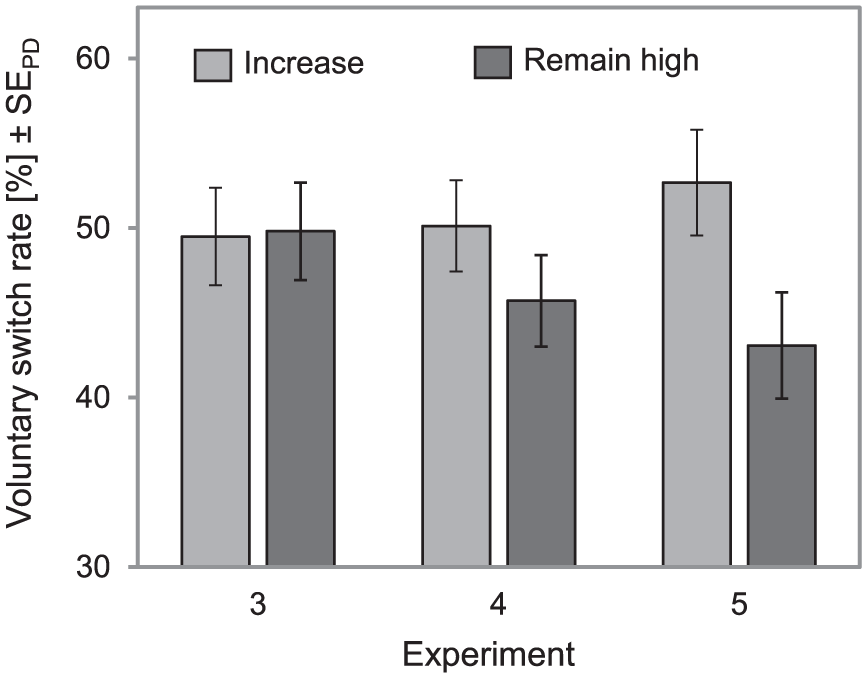
Mean voluntary switch rate (in %) in Experiments 3-5 as a function of Reward sequence (increase, remain high). Error bars represent ±1 standard error for the paired differences of the means (Pfister & Janczyk, 2013).
CRT
A 2 (Transition) × 4 (Reward sequence) repeated-measures ANOVA on CRTs in forced-choice trials (i.e., the time it took participants to “activate” the task) revealed a significant main effect of Transition, F(1, 29) = 14.42, p < .001, ηp2 = .332. Participants showed typical switch costs (37 ms) already when activating the task with a higher CRT in switch trials (M = 613 ms, SE = 41.67 ms) compared with repetition trials (M = 576 ms, SE = 35.41 ms). The main effect of Reward sequence (F = 2.10, p = .106) and the interaction of Transition × Reward sequence (F = 2.10, p = .111) did not prove reliable. No significant effects were found in the analysis of free-choice trials. In this analysis, the main effect of Transition just missed the conventional threshold of significance (F = 3.84, p = .06; all other effects F < 1.16, p > .29).
Target RTs and error rates
A 2 (Transition) × 4 (Reward sequence) repeated-measures ANOVA on target RTs in forced-choice trials revealed a significant main effect of Reward sequence, F(3, 87) = 9.47, p < .001, ηp2 = .246, which was further qualified by a significant interaction of Transition × Reward sequence, F(3, 87) = 3.0, p < .05, ηp2 = .094. The main effect of Transition did not prove reliable (F = 1.42, p = .242). Again participants were significantly faster in high (Mincrease = 498 ms, SEincrease = 12.14 ms; Mremain_high = 498 ms, SEremain_high = 10.81 ms) compared with low rewarded trials (Mremain_low = 518 ms, SEremain_low = 11.75 ms; Mdecrease = 520 ms, SEdecrease = 12.90 ms, p < .01). In addition, planned contrasts on the significant interaction showed that in reward-increase trials, RTs were significantly faster in switch (M = 490 ms, SE = 11.96 ms) than in repetition trials (M = 507 ms, SE = 13.23 ms) resulting in a switch benefit of 17 ms (p < .05). In all other reward sequences, no significant differences between switch and repetition trials were found (ps > .382). No significant effects were found in the analysis of free-choice trials (Fs < 1, ps > .325).
No significant effects were found in error rates analyses, neither in forced-choice trials (Fs < 2.18, ps > .151) nor in free-choice trials (Fs < 2.32, ps > .138). Mean error rate was 9.5% in forced-choice trials and 10.2% in free-choice trials.
Discussion
Mixed results were found in Experiment 3: forced-choice target RTs suggested that increasing reward prospect again promoted cognitive flexibility, whereas no corresponding VSR effect was found in task choice data under unrestricted free choice. Additional, exploratory analyses showed that although overall mean VSR was at chance level, almost half of the participants (46.7%) showed a sizable sequential reward effect on VSR (see the online data archive, https://doi.org/10.5283/epub.38033). On closer inspection, CRTs were slower and modulated by reward sequence in the typical VSR effect group, but not in the non-typical group.
One possible explanation for this pattern of results could be that not all of our participants deliberately chose the task on free-choice trials. Most of the trials were forced-choice trials, which only required a mere “activation” of the current task without an actual task choice. That is, on forced-choice trials participants simply had to make a spatially corresponding key press to a single task symbol that appeared left or right on the screen. This procedure might have resulted in a relatively automatic response directly primed by the onset of the task symbol. When one of the rare free-choice trials appeared, in which both task symbols were presented simultaneously left and right on the screen, participants might have automatically responded to the task symbol that first caught their attention. That is, participants might have ended up in a rather reactive mode as evidenced by the remarkably high VSR of nearly 50%. Alternatively, participants might have used their unrestricted free choice to decide on a preferred task, which was then automatically chosen on a free-choice trial. Given that trials preceding a free-choice trial were on chance level a number or a letter task trial, such a strategy would also result in VSRs around 50%. Both possibilities would mean that participants did not deliberately choose a task on free-choice trials, which might have prevented the stabilising effect normally found under remaining high reward prospect (cf., Fröber & Dreisbach, 2016b; Fröber et al., 2018). In contrast, the sub-group of participants with a typical VSR effect showed some indications of a more deliberate task choice: CRTs were generally slower and modulated by the reward sequence. Taken together, this post hoc analysis suggests that the automatic activation of task choices might have prevented the typically observed choice pattern in terms of lower VSR when reward remains high (Fröber & Dreisbach, 2016b; Fröber et al., 2018; Jurczyk et al., 2018). So, to test whether the task choice procedure in Experiment 3 was indeed responsible for the failure to replicate the sequential reward effect, we ran Experiment 4 where response execution in the task choice procedure was made more demanding to promote more deliberate decision making on free-choice trials.
Experiment 4
In Experiment 4 we again used a hybrid task-switching paradigm with double registration similar to Experiment 3 without imposing any restrictions on task choice in free-choice trials. But this time we aimed at rendering response execution in task choice more demanding by replacing the simple key press to signal the task choice by joystick movements. With this modification we hoped to promote more deliberate task choices due to the increased complexity regarding trajectory planning as well as biomechanical differences of the whole movement compared with a simple key press. Again, we expected to find a higher spontaneous VSR in reward increase compared with remain high trials.
Methods
Participants
Another 30 students from the University of Regensburg (Mage = 22.3 years, SD = 3.6 years; 25 female; 24 right-handed) participated for course credit and the opportunity to win an Amazon gift card.
Apparatus, stimuli, and procedure
The apparatus, stimuli, and procedure were identical to Experiment 3 except for the following changes that aimed at making response execution in the task choice procedure more demanding: in practice and baseline trials, a new geometrical shape (a star) similar in size to the reward cues was shown at the beginning of a trial instead of a simple fixation cross. The shape appeared 10% below the centre of the screen and a cursor had to be moved with a joystick from the centre of the screen into the shape (about 100 pixels). After a dwell time of 500 ms, one task symbol (forced-choice trials) or two task symbols (free-choice trials) appeared left or/and right on the screen and participants had to move the cursor onto the predetermined or chosen task symbol (about 120 pixels left or right from screen centre) to activate the task. The same procedure was used in reward trials, except that participants had to move the cursor into the reward cue at the beginning of the trial. With this procedure, automatic task activation should be prevented as a consequence of which we expected to find more participants would make a deliberate task choice. We predict again higher VSR when reward increases from one trial to the next and, conversely, lower VSR when reward remains high.
Design
Design was the same as in Experiment 3.
Results
Data analysis
Data preprocessing was the same as in the previous Experiments (20.32% of trials excluded prior to CRT and RT analyses). One participant was identified per boxplots as an outlier based on mean error rates in the baseline block (>18%). Exclusion of this participant resulted in a reduced sample size of 29 participants. CRTs with the joystick movement procedure were measured from onset of the choice prompt until one of the target symbols was reached. That is, they comprise both initiation and movement time. Raw data files for all experiments are provided online: https://doi.org/10.5283/epub.38033.
VSR
VSRincrease (M = 50.1%, SE = 10.25%) was again not significantly different from VSRremain_high (M = 45.7%, SE = 13.00%), t(28) = 1.64, p = .112 (two-tailed). Descriptively, however, there was a numerical difference of 4.4% in the predicted direction (see Figure 4, middle bars). Again both VSRs did not differ significantly from chance level, if tested with a two-tailed t-test (ps > .085). With a one-tailed t-test VSRremain_high was significantly lower than chance. As in Experiment 3, we again looked into individual differences. This time, 17 out of the 29 participants (58.6%) showed a typical sequential reward effect with a mean difference between VSRincrease and VSRremain_high of 14.5%.
CRT
A 2 (Transition) × 4 (Reward sequence) repeated-measures ANOVA on CRTs in forced-choice trials revealed a significant main effect of Reward sequence, F(3, 84) = 6.43, p < .001, ηp2 = .187. CRT was significantly higher (M = 676 ms, SE = 61.81 ms) in increase trials compared with all other reward sequences (ps < .05). Furthermore, CRTremain_high (M = 630 ms, SE = 49.57 ms) was significantly higher than CRTremain_low (M = 592 ms, SE = 42.80 ms, p < .01) but not CRTdecrease (M = 606 ms, SE = 41.53 ms, p = .169). CRT did not differ significantly between both low reward conditions (p = .259). The main effect of Transition and the interaction did not prove reliable (Fs < 1, ps > .421). No significant effects were found in the analysis of free-choice trials (Fs < 1.01, ps > .322).
Target RTs and error rates
A 2 (Transition) × 4 (Reward sequence) repeated-measures ANOVA on RTs in forced-choice trials revealed a significant main effect of Reward sequence, F(3, 84) = 12.8, p < .001, ηp2 = .314. RTs were faster in high reward (Mincrease = 456 ms, SEincrease = 8.93 ms; Mremain_high = 452 ms, SEremain_high = 8.43 ms) compared with low reward trials (Mremain_low = 497 ms, SEremain_low = 12.63 ms; Mdecrease = 495 ms, SEdecrease = 13.35 ms, p < .001). No significant difference was found for RTs between either increase and remain high trials (p = .141) or between decrease and remain low trials (p = .501). The main effect of Transition, F(1, 28) = 3.6, p = .068, and the interaction, F(3, 84) = 1.81, p = .151, did not prove reliable. Descriptively, a typical RT pattern with higher switch costs and fastest repetition RTs in remain high trials was found. No significant effects were found in the analysis of free-choice trials (Fs < 2.62, ps > .116).
A 2 (Transition) × 4 (Reward sequence) repeated-measures ANOVA on error rates in forced-choice trials revealed a significant main effect of Reward sequence, F(3, 84) = 4.26, p < .01, ηp2 = .132. Participants made significantly less errors in remain low trials (M = 7.12%, SE = 1.03%) compared with all other reward sequences (ps < .05). No significant differences were found between the other sequences (ps > .129). The main effect of Transition and the interaction did not prove reliable (Fs < 1, ps > .554). No significant effects were found in the analysis of free-choice trials (Fs < 1.8, ps > .19). Mean error rate was 9.1% in forced-choice trials and 9.2% in free-choice trials.
Discussion
Our modifications of the task choice procedure influenced behaviour in the intended way: a descriptive—although not significant—difference between VSRincrease and VSRremain_high in the expected direction emerged and more participants than in Experiment 3 (58.6% vs 46.7%) showed the typical sequential reward effect on spontaneous VSR.
Mean CRT in Experiment 4 (forced-choice: 626 ms, free-choice: 701 ms) was only slightly higher than mean CRT in Experiment 3 (forced-choice: 595 ms, free-choice: 679 ms), which suggests that our modifications of the task choice procedure might not have been sufficiently strong enough. Therefore, we ran Experiment 5 with an even more demanding double registration variant via mouse movements.
Experiment 5
In Experiment 5, we used again a hybrid task-switching paradigm with double registration similar to Experiments 3 and 4 without restrictions on task choice in free-choice trials. This time a more challenging registration procedure via the computer mouse was implemented in task choice to further boost the descriptive trends found in Experiment 4. Additional, exploratory mouse tracking analyses (see online Supplementary Material) were conducted to examine the task choice process in more detail (Freeman, Dale, & Farmer, 2011). Again, we expected to find a higher spontaneous VSR in reward increase compared with remain high trials.
Methods
Participants
Another 30 students from the University of Regensburg (Mage = 22.9 years, SD = 2.8 years; 22 female; 29 right-handed) participated for course credit and the opportunity to win an Amazon gift card.
Apparatus, stimuli, and procedure
The apparatus, stimuli, and procedure were identical to Experiment 4 except for the following changes that aimed at further increasing the demands during response execution in the task choice procedure: the star symbol (practice and baseline trials) or the reward cue symbol appeared farther below the screen centre (200 pixels). Participants had again to navigate a cursor from the screen centre, this time with the mouse, into the symbol and dwell there for 500 ms before the task symbol(s) appeared (one in forced-choice trials, two in free-choice trials). Task symbols now appeared 200 pixels left or right and 200 pixels above the screen centre and participants had again to move the cursor onto a task symbol to “activate” (forced-choice) or to choose the task (free-choice). Thus, in this task choice procedure the distance to move the cursor was larger than in Experiment 4, and, in addition, the cursor velocity was slower compared with the joystick procedure in Experiment 4.
Design
The design was the same as in Experiments 3 and 4.
Results
Data analysis
Data preprocessing was the same as in the previous experiments (22.79% excluded trials prior to CRT and RT analyses). Three participants were identified per boxplots as outliers based on mean CRT (>1500 ms) and/or RT (>1200 ms) in the baseline block. Exclusion of these participants resulted in a reduced sample size of 27 participants. Again, CRTs comprise both initiation and movement time. Raw data files for all experiments are provided online: https://doi.org/10.5283/epub.38033.
VSR
As predicted, VSRincrease (M = 52.7%, SE = 2.62%) was significantly higher than VSRremain_high (M = 43.1%, SE = 3.15%), t(26) = 3.07, p < .01, d = 1.98 (see Figure 4, right bars). So, like in Experiments 1 and 2 participants were significantly more willing to voluntarily switch the task when reward prospect increased compared with when it remained high. In Experiment 5, 20 out of the 27 participants (74.1%) showed the typical sequential reward effect with a mean difference between VSRincrease and VSRremain_high of 12.8%.
CRT
A 2 (Transition) × 4 (Reward sequence) repeated-measures ANOVA on CRTs in forced-choice trials revealed a significant main effect of Reward sequence, F(3, 78) = 5.72, p < .01, ηp2 = .180. Participants were significantly slower to choose the task in high reward trials (Mincrease = 1008 ms, SEincrease = 103.94 ms; Mremain_high = 979 ms, SEremain_high = 98.25 ms) than low reward trials (Mremain_low = 809 ms, SEremain_low = 31.61 ms; Mdecrease = 810 ms, SEdecrease = 35.08 ms, p < .05). Furthermore, participants were slower to choose the task in increase trials compared with remain high trials (p < .05). No significant difference was found within low reward trials (p = .921). All other effects did not prove reliable (Fs < 1.33, ps > .272). A 2 (Transition) × 2 (Reward sequence) repeated-measures ANOVA on CRTs in free-choice trials revealed a significant main effect of Reward sequence, F(1, 26) = 6.0, p < .05, ηp2 = .188. Like in forced-choice trials, participants were slower to choose the task in increase trials (M = 1162 ms, SE = 135.24 ms) compared with remain high trials (M = 1034 ms, SE = 106.61 ms). The main effect of Transition (F < 1, p = .404) and the interaction (F = 3.00, p = .095) did not prove reliable.
Target RTs and error rates
A 2 (Transition) × 4 (Reward sequence) repeated-measures ANOVA on target RTs in forced-choice trials revealed a significant main effect of Reward sequence, F(3, 78) = 17.95, p < .001, ηp2 = .408. Participants were significantly faster to respond to the target in high reward trials (Mincrease = 443 ms, SEincrease = 8.52 ms; Mremain_high = 443 ms, SEremain_high = 9.26 ms) compared with low reward trials (Mremain_low = 531 ms, SEremain_low = 17.92 ms; Mdecrease = 517 ms, SEdecrease = 15.70 ms, p < .001). No significant differences were found between remain low and decrease trials (p = .066) or between remain high and increase trials (p = .96). The main effect of Transition, F(1, 26) = 3.45, p = .075, and the interaction did not prove reliable (F < 1, p = .894). No significant effects were found in the analysis of free-choice trials (Fs < 1, ps > .414).
A 2 (Transition) × 4 (Reward sequence) repeated-measures ANOVA on mean error rates in forced-choice trials revealed a significant main effect of Reward sequence, F(3, 78) = 7.41, p < .001, ηp2 = .222. Participants had a significantly lower error rate in low reward trials (Mremain_low = 7.10%, SEremain_low = 1.06%; Mdecrease = 7.31%, SEdecrease = 1.08%) compared with high reward trials (Mincrease = 12.50%, SEincrease = 1.64%; Mremain_high = 12.73%, SEremain_high = 1.44%, p < .01). No significant differences were found within low reward trials (p = .811) or high reward trials (p = .858). All other effects did not prove reliable (Fs < 1.14, ps > .296). No significant effects were found in the analysis of free-choice trials (Fs < 1.94, ps > .175). Mean error rate was 14.0%.
Discussion
Results from Experiment 5 suggest that we succeeded with our modifications to make response execution in the task choice procedure even more demanding than in Experiment 4, as indicated by a considerable slowdown in CRTs of 276 ms in forced-choice trials and 397 ms in free-choice trials. VSR results this time successfully replicated the sequential reward effect in a double registration procedure found in Experiments 1 and 2, but this time with unrestricted task choice. So, like in our previous studies (Fröber & Dreisbach, 2016b; Fröber et al., 2018), ongoing high reward prospect promoted cognitive stability, whereas increasing reward prospect was associated with increased flexibility. The present results extend previous findings by demonstrating this effect in the absence of bottom-up factors that might possibly confound task choices and with a task choice procedure that was dissociated from the performance-contingent reward requirements.
Analysis of mouse movement trajectories (see online Supplementary Material) found no significant effects of reward sequence, but they provided additional evidence for deliberate choices in free-choice trials of Experiment 5: movement trajectories were attracted towards the non-chosen option more strongly in free-choice trials than in forced-choice trials, indicating a concurrent activation of both choice options and, in turn, a more deliberate choice in this condition. To further substantiate our speculation regarding the impact of automatic versus deliberate task choices, we compared VSR and CRT data of Experiments 3 with 5 directly in a pooled analysis.
Exploratory pooled analysis of Experiments 3, 4, and 5
Of the three experiments using the hybrid task-switching paradigm with double registration and unrestricted task choice in free-choice trials, only the last experiment resulted in the typical sequential reward effect on VSR that has repeatedly been found in previous studies without double registration (cf., Fröber & Dreisbach, 2016b; Fröber et al., 2018). After Experiment 3, we had speculated that the task choice procedure in the frequent forced-choice trials might have resulted in a relatively automatic task choice response. To prevent such a reactive mode and to promote a more deliberate choice of the task the double registration procedure was modified in Experiments 4 and 5 with a joystick and mouse procedure. To directly compare the influence of the double registration procedure on task choice behaviour in the hybrid task-switching paradigm, we therefore compared VSR and CRT results across Experiments 3, 4, and 5.
VSR
A 3 (Registration procedure: key press, joystick, mouse) × 2 (Reward sequence: increase, remain high) mixed factors ANOVA on VSR revealed a significant main effect of Reward sequence, F(1, 83) = 7.46, p < .01, ηp2 = .082. VSR was higher in increase trials (M = 50.7%, SE = 11.61%) than in remain high trials (M = 46.2%, SE = 13.52%). Descriptively, this difference increased from Experiments 3 to 5 (see Figure 4), but the interaction of Registration procedure × Reward sequence failed to reach the conventional level of significance, F(2, 83) = 2.91, p = .06. Also the main effect of Registration procedure was not significant (F < 1, p = .735).
CRT
A 3 (Registration procedure) × 2 (Transition) × 4 (Reward sequence) mixed factors ANOVA on CRT in forced-choice trials revealed significant main effects of Registration procedure, F(2, 83) = 10.85, p < .001, ηp2 = .207, and Reward sequence, F(3, 249) = 11.35, p < .001, ηp2 = .120, which were further qualified by significant interactions of Transition × Registration procedure, F(2, 83) = 5.33, p < .01, ηp2 = .114, Transition × Reward sequence, F(3, 249) = 2.72, p < .05, ηp2 = .032, and Registration procedure × Reward sequence, F(6, 249) = 3.2, p < .01, ηp2 = .074. CRT differed significantly between all double registration procedures (ps < .001). CRTs were the fastest with key presses (M = 594 ms, SE = 49.43 ms), followed by the joystick (M = 626 ms, SE = 50.28 ms) and the mouse procedure (M = 902 ms, SE = 52.10 ms). Planned contrasts on the significant interaction of Transition × Registration procedure showed significant switch costs in CRT only with the key press procedure (37 ms, p < .001), but not with the joystick (8 ms, p = .451) or mouse procedure (−11 ms, p = .317). Planned contrasts on the significant interaction of Transition × Reward sequence showed significant switch costs only when reward prospect decreased (23 ms, p < .05), but not when reward prospect remained low (14 ms, p = .181), increased (−16 ms, p = .223), or remained high (25 ms, p = .07). Planned contrasts on the significant interaction of Registration procedure × Reward sequence showed significantly slower CRTs in high reward compared with low reward trials in the mouse procedure only (Mincrease = 1008 ms, SEincrease = 75.92 ms, Mremain_high = 979 ms, SEremain_high = 66.85 ms vs Mremain_low = 809 ms, SEremain_low = 38.23 ms, Mdecrease = 810 ms, SEdecrease = 38.15 ms, p < .001). CRT did not differ significantly between high and low reward trials in the key press (p = .612) or joystick procedure (p = .222). The main effect of Transition, F(1, 83) = 3.54, p = .064, and the three-way interaction (F < 1, p = .804) did not prove reliable.
A 3 (Registration procedure) × 2 (Transition) × 2 (Reward sequence) mixed factors ANOVA on CRT in free-choice trials revealed significant main effects of Registration procedure, F(2, 83) = 8.5, p < .001, ηp2 = .17, and Reward sequence, F(1, 83) = 5.36, p < .05, ηp2 = .061, which were further qualified by a significant interaction of Registration procedure × Reward sequence, F(2, 83) = 4.97, p < .01, ηp2 = .107. Planned comparisons on the significant effects showed that CRT differed significantly between all registration procedures (ps < .001). CRTs were fastest with key presses (M = 679 ms, SE = 77.81 ms), followed by the joystick (M = 701 ms, SE = 79.14 ms) and the mouse procedure (M = 1098 ms, SE = 82.02 ms). Furthermore, CRTs were significantly slower in increase trials compared with remain high trials only in the mouse procedure (Mincrease = 1162 ms, SEincrease = 88.92 ms vs Mremain_high = 1034 ms, SEremain_high = 78.14 ms, p < .001). The main effect of Transition and all other interactions did not prove reliable (Fs < 2.33, ps > .104).
Discussion
These results seem to corroborate that the sequential reward effect on VSR under unrestricted task choice only arises when participants choose their tasks deliberately. The simple key press procedure used in Experiment 3 seemed not sufficient but using a more demanding double registration procedure via joystick or mouse seemed to promote deliberate decision-making. Especially with the task choice via mouse procedure in Experiment 5, results suggest that participants made more deliberate choices and even strategic use of the task choice response, similar to the CRT pattern seen also in Experiment 2: in the present experiments, participants had to respond fast and accurate to the target to get a reward on high reward trials, while there was no time pressure on the task choice responses. The forced-choice data from Experiment 5 suggest that participants strategically slowed down task choice responses in high reward trials to prepare for a fast response to the target. That is, in this experiment CRTs were significantly slower and target RTs significantly faster in high reward trials. In comparison of Experiments 3-5, this slowdown in CRTs was only significant with the mouse procedure and the difference in target RTs between low and high reward trials was the largest (Experiment 3: 25 ms, Experiment 4: 42 ms, Experiment 5: 81 ms). This finding makes the significant sequential reward effect on VSR in Experiment 4 even more remarkable. Participants obviously made a deliberate, slow task choice in high reward trials to facilitate a fast response to the target, but they nonetheless decided more often to switch the task in trials with an increase in reward prospect compared with an ongoing high reward prospect without any necessity to switch the task at all. Task switches are more demanding as typically indicated by higher RTs and error rates—that is, the typical switch costs—and are therefore not rational task choices to achieve an especially fast response. But even under this unrestricted choice conditions without time pressure only a repetition of a high reward—but not the same high reward announcement in an increase trial—increased the probability to repeat the task.
General discussion
This study investigated the impact of sequential changes in reward prospect on cognitive flexibility in terms of task choice behaviour. To disentangle task choice from task execution, we employed a double registration variant of the voluntary task-switching paradigm (Arrington & Logan, 2005), where task choice and task execution are prompted by different stimuli and are separated in time. Within this paradigm, participants’ task choice was either restricted by instruction (Experiments 1 and 2) or unrestricted (Experiments 3-5). Confirming previous findings from our lab (Fröber & Dreisbach, 2016b; Fröber et al., 2018), the results of Experiments 1, 2, and 5 demonstrate that the prospect of a high reward is able to promote either cognitive stability or flexibility, depending on the immediate reward history and this effect can be observed for both restricted and unrestricted task choice: ongoing high reward prospect increases stability, whereas increasing reward prospect promotes flexibility as indicated by a lower VSR in the former and a higher VSR in the latter condition. Moreover, Experiments 3 and 4 show that, if participants are led to make their task choice less deliberately, the impact of the reward sequence on task choice is reduced. The present results thus extend previous findings by providing direct evidence for a modulation of task choice independent from task execution and bottom-up influences on choice alike provided that choices are made deliberately.
This study also corroborates the usefulness of the VSR as a behavioural marker of stability versus flexibility (see also Armbruster, Ueltzhöffer, Basten, & Fiebach, 2012; Braem, 2017; Dreisbach & Fröber, 2018; Fröber & Dreisbach, 2016b, 2017; Fröber et al., 2018). Especially under unrestricted task choice conditions, where participants usually refrain from frequent task switching (Arrington et al., 2014; Kessler et al., 2009), an increasing effect on VSR can be seen as proof for a flexibility-inducing influence. With respect to the sequential reward effect, our previous studies already provided evidence that increasing reward promotes cognitive flexibility even when flexibility is truly optional. But in those studies, VSR was not measured independently from task execution and potential bottom-up influences of the target stimulus (Arrington et al., 2010; Butler et al., 2011; Demanet et al., 2010; Mayr & Bell, 2006). By using a double registration paradigm in this study, we disentangled task choice from task execution and enabled a measurement of VSR independent from bottom-up influences of the target stimulus and also independent from the performance-contingent reward criterion. Based on the present results, we can now conclude that increasing reward prospect indeed promotes flexibility even when the actual decision and the decision time are self-determined by the participant (see Experiments 1, 2, and 5).
There are numerous studies demonstrating how the prospect of performance-contingent reward promotes cognitive stability and proactive control (Chiew & Braver, 2013, 2014; Fröber & Dreisbach, 2014, 2016a; Hefer & Dreisbach, 2016, 2017; Jimura et al., 2010; Locke & Braver, 2008; Müller et al., 2007; Padmala & Pessoa, 2011), but only few studies so far that show how reward prospect, or—to be more precise—increasing reward prospect, may also promote cognitive flexibility (Fröber & Dreisbach, 2016b; Fröber et al., 2018; Kleinsorge & Rinkenauer, 2012; Shen & Chun, 2011). How reward can promote flexibility was also the focus in a recent task-switching study by Braem (2017). In that study, participants in a forced task-switching phase were either disproportionally rewarded for repeating or for switching the task. In a then following voluntary task-switching phase, VSR was higher in the group where task switches had been associated with a higher reward. The difference between this study and ours is that Braem actually rewarded participants more for switching than repeating which then resulted in higher rates of VSR. In contrast, in our study, the mere prospect of getting more reward than before promoted flexibility (i.e., VSR), even though reward was provided independently from task choice. That is, participants would also have received the higher reward if they had chosen to repeat the task. So, in Braem’s study an association between high reward and task switching was established, and this selective reinforcement of forced task switching then also promoted voluntary task switching. Such a mechanism cannot explain the sequential reward effect found in our study, where no association between task switching and a reward increase had been fostered by selective reinforcement.
So, why does an increase in reward prospect promote flexibility? The adaptive gain theory (Aston-Jones & Cohen, 2005a, 2005b) provides a possible answer to this question: according to this theory, changes in reward expectation have a modulating influence on the dynamic balance between the two control modes, exploitation and exploration (which are closely related to stability and flexibility). The exploitative mode aims at optimising performance in a given task by increasing task engagement as long as this task is sufficiently rewarded. Exploration, on the other hand, is associated with disengagement from a given task and facilitated re-engagement with alternative tasks. This mode is supposed to be triggered, whenever a given task is no longer sufficiently rewarded or when no sufficient reward is offered in the first place. So, the exploitative mode aims at optimising gain within a given task, while the explorative mode aims at optimising gain across tasks, because it serves to identify new sources of reward somewhere else. In this way, the explorative mode is associated with increasing reward prospect. Applied to the sequential reward effect, remaining high reward prospect should lead to exploitative, stable behaviour, whereas decreasing and remaining low reward prospect should lead to explorative, flexible behaviour, which is exactly what we found in the VSR data in Experiments 1 and 2, and elsewhere (Fröber & Dreisbach, 2016a, Experiment 5; Fröber et al., 2018). Theoretically important, a high reward cue only promotes a shift towards exploitation if given repeatedly. Instead a high reward cue following a low reward cue—thereby announcing an increase in reward—motivates an explorative state instead. So, maybe the explorative mode that is associated with finding new sources for reward can also be triggered by announcing an increase in reward, suggesting a bidirectional association. This would mean that associative knowledge could have mediated the sequential reward effect after all, but, in contrast to Braem’s study (2017), it is not an experimentally induced association, but instead a long-term association built by every-day experience. This would explain why participants do not refrain from switching after a reward increase even when there is no necessity to switch at all and unlimited time for their choice (Experiment 5).
On a more general level, the sequential reward effect on VSR makes an important contribution to the question of how cognitive control is controlled itself (meta-control; cf., Hommel, 2015). As emphasised by Goschke (2003, 2013), adaptive goal-directed behaviour in a constantly changing environment needs a dynamic balance between stability and flexibility adjusted to situational demands. Identifying and understanding modulating factors in this self-regulatory balance is of utmost importance also from an applied, clinical perspective, because mental disorders are often characterised by a dysregulation of the cognitive system (Goschke, 2014). For example, persistent intrusive thoughts and repetitive behaviours found in obsessive-compulsive disorder can be understood as a consequence of a dysregulation towards extreme stability (Rolls, Loh, & Deco, 2008). In non-clinical populations, affective and motivational modulations of the flexibility-stability balance have been of special interest in recent years (Botvinick & Braver, 2015; Chiew & Braver, 2011; Dreisbach & Fröber, 2018; Goschke, 2014; Notebaert & Braem, 2016). Converging evidence shows that performance-contingent reward typically increases stability, whereas positive affect and performance non-contingent reward increase flexibility instead (Dreisbach & Fischer, 2012). Positive affect is obviously an inherent component of performance-contingent reward (Berridge, Robinson, & Aldridge, 2009), but the influence of positive affect is easily overridden by the oppositional motivational effect of performance-contingent reward as first demonstrated by Fröber and Dreisbach (2014, 2016a). But maybe increasing reward prospect represents a special case in this respect. The results of the target RTs in this study suggest that high reward prospect has an immediate motivational impact on task performance, which is nonetheless accompanied by increased flexibility. So, maybe expecting an increase in reward elicits considerably more positive affect than ongoing high reward expectation, which would hint to affect as an additional mediating factor of the sequential reward effect. While this speculation suggests a special role of increases in reward prospect, adaptive gain theory as explained above suggests rather a special role of remaining high reward prospect instead. Recent evidence demonstrates that both seems to be the case depending on the current context: within a global context that promotes stability (Fröber et al., 2018) or when switching to a more difficult task is required (Jurczyk et al., 2018) only an increase in reward prospect led to increased voluntary switching. But within contexts of relatively high flexibility in general or equal task difficulties (Fröber & Dreisbach, 2016b; Fröber et al., 2018), low reward prospect (most notably when reward decreases) and increasing reward prospect are likewise associated with increased flexibility as suggested by the adaptive gain theory.
According to the control dilemma theory (Goschke, 2003, 2013) the two control modes come with inherent, antagonistic costs (Dreisbach & Goschke, 2004; Hefer & Dreisbach, 2017; Müller et al., 2007). For example, with respect to task switching, it has been shown that in flexibility-requiring task switches distractibility is increased by irrelevant features, whereas in repetition trials that allow stability performance is shielded from irrelevant features (Dreisbach & Wenke, 2011; Reisenauer & Dreisbach, 2014; Rogers & Monsell, 1995). The same pattern of increased flexibility and reduced shielding/increased distractibility can also be found in Braem’s recent study (2017). He used bivalent stimuli (words that could be categorised as either living vs non-living or as small vs large), which allow to measure—in addition to the VSR—the task rule congruency effect, that is, the amount of interference by the non-relevant task. Selective reinforcement of forced task switching was not only followed by a higher VSR but also by a higher task rule congruency effect, indicating that the induced flexibility is indeed accomplished by a reduction of between-task shielding, which increases distractibility and interference from non-relevant information (Dreisbach, 2012). So, in sum, the immediate reward history clearly modulates the dynamic balance between cognitive stability and flexibility, and VSR—and the complementary measure of the task rule congruency effect—seem to be ideal measures to investigate this process.
Last but not least, we would like to emphasise that the non-significant findings from Experiments 3 and 4 should not be taken as a simple failure to replicate. Instead we believe that they provide important insight into the procedural parameters necessary to find a sequential reward effect in a hybrid task-switching paradigm with unrestricted task choice and double registration. Most importantly, the double registration procedure should be designed in a way that promotes deliberate choice responses. These findings also suggest that the sequential reward effect truly derives from expectations about reward magnitudes rather than bottom-up priming induced by low-level features: in all three experiments using the hybrid paradigm (Experiments 3-5) reward cues and task symbols were identical—that is, there should be identical bottom-up influences of low-level features—but only in Experiment 5 did we find a significantly higher VSR in reward increase compared with reward remain high trials just as in Experiments 1 and 2. That is, only with a deliberate choice, either induced by a global instruction on task choice (Experiments 1 and 2) or by a demanding response execution procedure in task choice (Experiment 5), does the immediate reward history modulate task choice. In our previous studies (Fröber & Dreisbach, 2016b; Fröber et al., 2018), this problem did not emerge because there participants always had to give a deliberate response because the task choice was confounded with the actual task execution (which cannot be done without deliberation). In other words, task selection was intrinsically tied to task execution and reward was contingent on task performance (but not task choice). Therefore, participants could not have risked imprudent responses. In this study, however, task choice responses under unrestricted conditions were without immediate consequences, which obviously invited some participants to adopt a relative automatic, reactive mode instead of making a deliberate choice. Theoretically interesting, the percentages of participants with a typical sequential reward effect in Experiments 3 and 4 could mean that some participants nonetheless made deliberate choices. It might be an interesting topic for future studies to further investigate these inter-individual differences and to further increase understanding of the boundary conditions of finding the sequential reward effect under unrestricted choice conditions.
Conclusion
Extending previous results (Fröber & Dreisbach, 2016b; Fröber et al., 2018; Jurczyk et al., 2018), this study provides direct evidence for reward-driven modulation of the flexibility-stability balance already at the level of pure task choices: Although task choice was independent from reward receipt and without any time pressure, the prospect of an increase in reward promoted voluntary task switching, whereas the prospect of remaining high reward promoted repeating the task. This demonstrates that prospect of the same high reward can either promote cognitive flexibility or stability depending on the immediate reward history.
Supplemental Material
QJE-STD-18-083.R2-Supplemental_Material – Supplemental material for Increasing reward prospect promotes cognitive flexibility: Direct evidence from voluntary task switching with double registration
Supplemental material, QJE-STD-18-083.R2-Supplemental_Material for Increasing reward prospect promotes cognitive flexibility: Direct evidence from voluntary task switching with double registration by Kerstin Fröber, Roland Pfister and Gesine Dreisbach in Quarterly Journal of Experimental Psychology
Footnotes
Declaration of conflicting interests
The author(s) declared no potential conflicts of interest with respect to the research, authorship, and/or publication of this article.
Funding
The author(s) disclosed receipt of the following financial support for the research, authorship, and/or publication of this article: This research was supported by a grant within the Priority Program SPP 1772 from the German Research Foundation (Deutsche Forschungsgemeinschaft, DFG), Grant no. DR 392/8-1.
Open Practices

Supplemental material
Supplemental material for this article is available online.
Notes
References
Supplementary Material
Please find the following supplemental material available below.
For Open Access articles published under a Creative Commons License, all supplemental material carries the same license as the article it is associated with.
For non-Open Access articles published, all supplemental material carries a non-exclusive license, and permission requests for re-use of supplemental material or any part of supplemental material shall be sent directly to the copyright owner as specified in the copyright notice associated with the article.
