



Abstract
Extending the self-reference effect in memory to the level of social identity, previous research showed that processing information in reference to one’s ingroup at encoding enhances memory for the information (i.e., the group-reference effect). Notably, recent work on the self-reference effect has shown that even simply co-presenting an item with self-relevant vs. other-relevant information (e.g., one’s own or another person’s name) at encoding can produce an “incidental” self-memory advantage in the absence of any task demand to evaluate the item’s self-relevancy. In three experiments, the present study examined whether this incidental self-memory advantage extends to the level of social identity using newly created, minimal groups (Experiments 1 and 2) and pre-existing groups (Experiment 3; one’s own or another study major). During encoding, participants judged the location of each target word in relation to a simultaneously presented cue (Ingroup-cue or Outgroup-cue in Experiments 1 and 3; Ingroup-cue, Outgroup-cue, or Neutral-cue in Experiment 2). Consistent across all experiments, a subsequent recognition test revealed a significant memory advantage for words that were presented with the Ingroup-cue. Crucially, this incidental ingroup-memory advantage was driven by ingroup-memory enhancement rather than outgroup-memory suppression relative to memory for words presented with the Neutral-cue (Experiment 2), and was positively correlated with self-reported levels of ingroup identification (i.e., self-investment to one’s ingroup; Experiment 3). Taken together, the present findings provide novel evidence that mere incidental associations between one’s ingroup and to-be-remembered items in a non-referential, non-evaluative encoding context can produce a memory advantage for the items.
Having a sense of a continuous self that exists across time and space is an essential aspect of human experience (James, 1890/1983; Neisser, 1988). The pivotal status of self in social-cognitive functioning and its multifaceted role in general (e.g., a perceiver, action-initiator, self-reflector, self-regulator) are reflected in different aspects of self that have been emphasised in philosophy, psychology, and neuroscience (Baumeister et al., 2007; Boyer et al., 2005; Conway & Pleydell-Pearce, 2000; Damasio, 1999; Gallagher, 2000; M. K. Johnson, 1991; Klein et al., 2002; Neisser, 1988). In particular, in psychology and more recently in neuroscience, understanding the role of self in memory has been one of the major research focuses.
Considerable work has shown that using the self as a reference point at encoding produces a memory advantage over other types of encoding activities (for review, see Symons & Johnson, 1997). Termed the self-reference effect (SRE; Rogers et al., 1977), this self-memory advantage has typically been observed in a task that explicitly requires people to evaluate the self-relevancy of given stimuli. For example, the most widely used self-referential task, a trait-evaluation task, involves asking people to judge whether personality-trait words are descriptive of themselves or another person (“Does the word generous describe you [Albert Einstein]?”) at encoding. When memory for the words is later tested, words encoded in reference to the self are better remembered than those encoded in reference to another person (e.g., Conway & Dewhurst, 1995; Ferguson et al., 1983; Kuiper & Rogers, 1979). The SRE has been suggested to arise because self-referential encoding promotes enhanced elaboration afforded by the use of rich structure of self-knowledge and/or semantic organisation (me vs. not me) of incoming information (Conway & Dewhurst, 1995; Keenan & Baillet, 1980; Klein & Kihlstrom, 1986; Klein & Loftus, 1988; Symons & Johnson, 1997).
More recent studies have moved beyond explicit self-referencing paradigms to examine the role of self in memory under everyday contexts in which the self is likely to form associations with external stimuli in the absence of explicit self-reflection or evaluation of the stimuli’s self-relevancy. These studies showed that a self-memory advantage can arise even when the stimuli are only incidentally associated with the self, for instance, when people imagine owning an object (Cunningham et al., 2008; Van den Bos et al., 2010). Of particular relevance to the current study, Turk et al. (2008) showed that simply presenting a self-relevant cue simultaneously with a to-be-processed target stimulus can produce a self-memory advantage under a non-evaluative, non-self-referential encoding context. In their study, participants were asked to indicate the location of personality-trait words in relation to a simultaneously presented cue at encoding (“Is the word above the cue in the middle?”). The cue was either self-relevant (one’s own name or face) or other-relevant (the name or face of a familiar celebrity). In a subsequent memory test, words presented with the self-relevant cue were better remembered than those presented with the other-relevant cue, suggesting that a mere incidental association between the self and a stimulus at encoding in the absence of any explicit task demand to evaluate the stimulus’ self-relevancy is sufficient to produce a self-memory advantage. This “incidental” self-memory advantage has been replicated in a number of recent studies (e.g., Cunningham et al., 2014; Kim et al., 2018, 2019). The self-memory advantage arising from incidental self-stimuli associations is suggested to be underpinned by individuals’ tendency to preferentially attend to self-relevant information (i.e., the “attention-capture” capacity of self-relevant information; e.g., Alexopoulos et al., 2012; Bargh, 1982; Gray et al., 2004; Moray, 1959). Specifically, preferential attention to self-relevant information is thought to promote enhanced encoding of a stimulus presented in close spatiotemporal proximity to the self-relevant information (Cunningham et al., 2014; Turk et al., 2008, 2011).
Past research suggests that one’s concept of self comprises two distinct aspects: personal identity and social identity (Brewer & Gardner, 1996; Tajfel, 1981; Turner, 1985). Personal identity is concerned with an individual’s core, idiosyncratic traits and characteristics (“I” and “me”) whereas social identity concerns “that part of an individual’s self-concept which derives from his knowledge of his membership in a social group (or groups) together with the value and emotional significance attached to that membership” (Tajfel, 1981, p. 255) (“we” and “us”). While the majority of research on the role of self in memory has focused on one’s personal self, a number of studies have moved beyond such a focus to examine the role of one’s social self as a mnemonic device. For example, C. Johnson et al. (2002) asked university students to process a series of personality-trait words with reference to themselves (“Does the word calm generally describe you?”), their own group (“Does the word trustworthy generally describe your family [students at your university]?”), or semantic properties (“Does the word candid mean the same as honest?”) at encoding. In a subsequent free recall test, Johnson et al. found that both the self-referential and group-referential encoding conditions produced significantly better memory for words compared with the semantic encoding condition, with no significant memory difference between the self-referential and group-referential encoding conditions. Notwithstanding that a null difference does not constitute unambiguous evidence for lack of an effect, these findings suggest that processing information in reference to one’s social self may afford some of the same processing/encoding advantages as processing information in reference to one’s personal self, thereby resulting in the group-reference effect (GRE) in memory (C. Johnson et al., 2002). The GRE has been subsequently replicated not only when semantic encoding served as a control condition but also when non-ingroup, other-referential encoding was used as a stricter control condition (e.g., Bennett et al., 2010; Bennett & Sani, 2008; Liu et al., 2015; Stewart et al., 2007). Yet, the magnitude of this memory advantage was found to vary according to the type of social group used as a reference (e.g., a group based on gender, age, family, religion, and university membership). It has been suggested that the magnitude of the GRE might be positively related to the accessibility and level of knowledge about specific exemplars of the ingroup (C. Johnson et al., 2002), the extent to which individuals identify with their ingroup (Bennett et al., 2010), and the intensity/salience of one’s social identity at a given moment (Liu et al., 2015).
Notably, to our knowledge, the ingroup-memory advantage has only been demonstrated in an experimental paradigm that explicitly asked the participants to relate to-be-remembered information to their ingroup vs. outgroup (e.g., a trait-evaluation task). Therefore, it remains unknown if and the extent to which mere incidental associations between one’s ingroup and stimuli under a non-referential encoding context would influence memory for the stimuli. Would an incidental self-memory advantage extend beyond information highly relevant to one’s personal identity such as one’s own name or face to include information relevant to one’s social identity? Or, is explicit, evaluative reference to one’s ingroup at encoding necessary for the ingroup-memory advantage to emerge? Support for the former possibility comes from previous demonstrations of perceptual, attentional, and memory biases towards one’s own groups that are thought to arise from individuals’ strong tendency to favour their ingroups over other groups (i.e., ingroup favouritism; Brewer, 1979; Tajfel & Turner, 1986; for review, see Hewstone et al., 2002). For example, individuals tend to pay greater attention to ingroup-relevant than outgroup-relevant stimuli (Mullen, 1987), thereby showing enhanced perceptual processing of ingroup-relevant stimuli (e.g., Enock et al., 2018; Moradi et al., 2015, 2017). In addition, the enhanced perceptual performance for the ingroup-relevant stimuli has been shown to be positively correlated with individuals’ collective identification with their ingroup, in particular, their positive feelings about belonging to their ingroup (i.e., satisfaction with ingroup; Moradi et al., 2015). Individuals are also better at remembering events and stimuli related to their own group (e.g., own-group bias; e.g., Brigham et al., 2007; Hourihan et al., 2012; for review, see Meissner & Brigham, 2001). Even merely categorising individuals into two distinct groups on the basis of arbitrary and trivial distinctions (i.e., the minimal group paradigm; Tajfel et al., 1971) has been shown to induce preferential attention to and enhanced memory for stimuli belonging to one’s ingroup (e.g., Bernstein et al., 2007; Van Bavel & Cunningham, 2012), with the ingroup-memory advantage being positively correlated with the degree to which individuals identify with their ingroup (Van Bavel & Cunningham, 2012).
In a series of three experiments, the present study examined whether incidental associations between to-be-processed target stimuli and one’s ingroup under a non-evaluative, non-referential encoding context would produce an ingroup-memory advantage using a modified version of Turk et al.’s (2008) design. Specifically, under incidental encoding, participants were presented with target words appearing above or below a centrally presented cue. The cue was either ingroup-relevant or outgroup-relevant on the basis of newly created, minimal groups (Experiments 1 and 2; a colour-filled rectangle representing the participants’ newly assigned ingroup vs. outgroup) or pre-existing group affiliations (Experiment 3; an abbreviated code for the participants’ own or another study major). 1 In Experiment 2, a group-irrelevant, neutral cue (i.e., a colour-filled rectangle that had no relevance to participants’ assigned ingroup or outgroup) was also introduced as a “control” condition against which memory for words presented with an ingroup-relevant or outgroup-relevant cue was compared. Across all experiments, the participants’ task was to judge the location of each target word (“Does the word appear above or below the cue in the middle?”). Participants’ recognition memory for target words was subsequently tested. Following the memory test, the extent to which participants identified with their ingroup was accessed using a single-item measure (Experiments 1 and 2) or a multicomponent ingroup identification scale (Experiment 3; Leach et al., 2008).
Based on previous findings of attentional and memory biases towards not only pre-existing but also newly assigned minimal ingroups (Bernstein et al., 2007; Enock et al., 2018; Moradi et al., 2015, 2017; Van Bavel & Cunningham, 2012), we expected to find a memory advantage for words presented with an ingroup-relevant cue over those presented with an outgroup-relevant cue in all experiments. We also expected that this ingroup-memory advantage would be positively correlated with the degree to which the participants identified with their ingroup. In addition, for Experiment 2 in which a neutral cue was introduced, we expected to observe either of the three informative patterns of results depending on whether the incidental ingroup-memory advantage emerges due to ingroup-memory enhancement, outgroup-memory suppression, or both: (a) enhanced memory for words presented with an ingroup-relevant cue compared with those presented with an outgroup-relevant cue or a neutral cue, with no significant difference between the latter two conditions; (b) impaired memory for words presented with an outgroup-relevant cue compared with those presented with an ingroup-relevant cue or a neutral cue, with no significant difference between the latter two conditions; or (c) enhanced memory for words presented with an ingroup-relevant cue and impaired memory for words presented with an outgroup-relevant cue relative to memory for those presented with a neutral cue.
Experiment 1
Method
Participants and design
Participants were 36 undergraduate students at Wesleyan University (17 females; mean age = 18.86 [SD = 1.15], age range = 18–22). The sample size was predetermined based on the effect size from Turk et al. (2008) using G*Power 3 (Faul et al., 2007; dz = 0.44, α = .05 [one-tailed], power = 0.8, required N = 34). All participants were native English speakers with normal or corrected-to-normal vision and normal colour perception. Participants provided written informed consent and were compensated with course credit in accordance with the human subject regulations of Wesleyan University. Data from six additional participants were excluded from analysis due to poor performance on the encoding task (below 50% accuracy).
The experiment used a single-factor design with Cue Identity (Ingroup-cue or Outgroup-cue) as a within-subjects factor.
Stimuli
A total of 120 personality-trait words drawn from Anderson (1968) were divided into three lists of 40 words each that were matched for word length, syllable length, likeability, and meaningfulness based on Anderson’s (1968) norms, all Fs < 1, all ps > .6. Two lists served as critical “old” items that were presented in the encoding phase. The assignment of critical lists to the Ingroup-cue or Outgroup-cue condition was counterbalanced across participants. A random half of the critical words in each Cue Identity condition were presented at the top of the screen, and the other half were presented at the bottom of the screen. The remaining list served as “new” items in the subsequent memory test.
The cue stimuli consisted of two colour-filled rectangles (blue or yellow) that were used to represent the participants’ newly assigned ingroup (i.e., Blue or Yellow group) and outgroup (i.e., Yellow or Blue Group; opposite of the assigned ingroup), respectively.
Procedure
The experiment consisted of three phases: minimal group assignment, encoding, and a memory test. Similar to Otten and Moskowitz (2000), the minimal group assignment phase was ostensibly described to the participants as a task measuring individuals’ perceptual style in perceiving and structuring pictorial information (i.e., figure-based or ground-based perceptual style). Participants were presented with a total of 10 Escher ambiguous pictures (Escher, 1992) one at a time and were asked to choose what features stood out to them the first by pressing one of two key buttons. For example, an ambiguous, gestalt-like picture that can be perceived as either two animals or a tree was displayed, and the participants indicated whether they first noticed the animals or the tree. Each picture remained on screen until the participants made their response. After all the decisions were made, the screen displayed a message “Processing your responses . . .” for 5 s, followed by either a blue- or yellow-filled rectangle presented in the centre of the screen which supposedly represented the participant’s own perceptual style. The participants were told that the “blue” group represents the “figure-based” perceptual style while the “yellow” group represents the “ground-based” perceptual style with a brief explanation of their ostensible perceptual style. The assignment of the “blue” or “yellow” group to each participant was randomly determined with a constraint that there were equal number of participants (N = 18) in each group.
The encoding phase immediately followed the minimal group assignment phase. Each trial began with a 500 ms fixation cross that was followed by a colour-filled rectangle (either blue or yellow) presented in the centre of the screen for the remaining trial duration (2.5 s). Five-hundred milliseconds after the onset of the rectangle, a target word was presented either at the top or the bottom of the screen in red lower-case letters (48-point Arial font) for 2 s. For each trial, the participants were asked to indicate, by a button press, whether each word appeared above or below the centrally presented rectangle, regardless of its colour. There were a total of 80 trials (40 Ingroup-cue and 40 Outgroup-cue trials) that were presented in a random order for each participant.
Immediately following the encoding phase, participants were given a surprise memory test. The 80 old words from the encoding phase along with 40 new words were presented individually in the centre of the screen in black lower-case letters (48-point Arial font). For each word, participants were asked to indicate, by a button press, whether or not they had seen the word in the previous phase (i.e., old/new recognition). Participants had to respond within 4 s. Trials were separated by a 500 ms fixation period and the presentation order of words was randomised for each participant.
After the experiment, participants completed a post-experimental questionnaire that assessed the extent to which they identified with their assigned ingroup and outgroup separately on a 7-point scale from 1 (not at all) to 7 (very much) as well as their awareness of the experimental hypothesis. None of the participants correctly guessed the experimental hypothesis.
Results and discussion
Identification with ingroup vs. outgroup
A paired-samples t-test revealed that participants’ identification ratings were significantly higher for their assigned ingroup (M = 5.28, SD = 0.88) than for outgroup (M = 3.31, SD = 1.33), t(35) = 6.12, p < .001, d = 1.02. In addition, one-sample t-tests revealed that whereas participants’ identification ratings for the ingroup were significantly higher than the neutral midpoint “4” on a 7-point scale, t(35) = 8.69, p < .001, d = 1.45, their identification ratings for the outgroup were significantly lower than the neutral midpoint, t(35) = −3.14, p = .003, d = 0.52. Collectively, these findings suggest that our manipulation of ingroup and outgroup using the minimal group paradigm was successful.
Encoding task performance
Encoding task accuracy was calculated as the proportion of trials associated with correct location judgements. The mean response time was calculated based on correct trials only. Paired-samples t-tests revealed no significant difference in location judgement accuracy, t(35) = –0.44, p = .66, or in response times (RT), t(35) = 1.00, p = .33, between when the target words were presented with the Ingroup-cue (accuracy: M = .986 [SD = .019]; RT: M = 484.68 ms [SD = 109.59 ms]) and when they were presented with the Outgroup-cue (accuracy: M = .988 [SD = .022]; RT: M = 478.83 ms [SD = 107.18 ms]).
Recognition memory for target words
Participants’ hit rates and false-alarm rates were calculated by computing the proportion of “old” words correctly recognised as old and the proportion of “new” words incorrectly identified as old, respectively (Table 1). Corrected hit rates were calculated by subtracting the false-alarm rates from the hit rates and were submitted to a paired-samples t-test. As shown in Figure 1, participants’ memory for target words was significantly better when the words were presented with the Ingroup-cue (M = .286, SD = .118) than when they were presented with the Outgroup-cue (M = .242, SD = .095), t(35) = 2.39, p = .022, d = 0.40. 2
Mean proportions (standard deviations) of hits and false alarms as a function of Cue Identity in Experiments 1, 2, and 3, respectively.
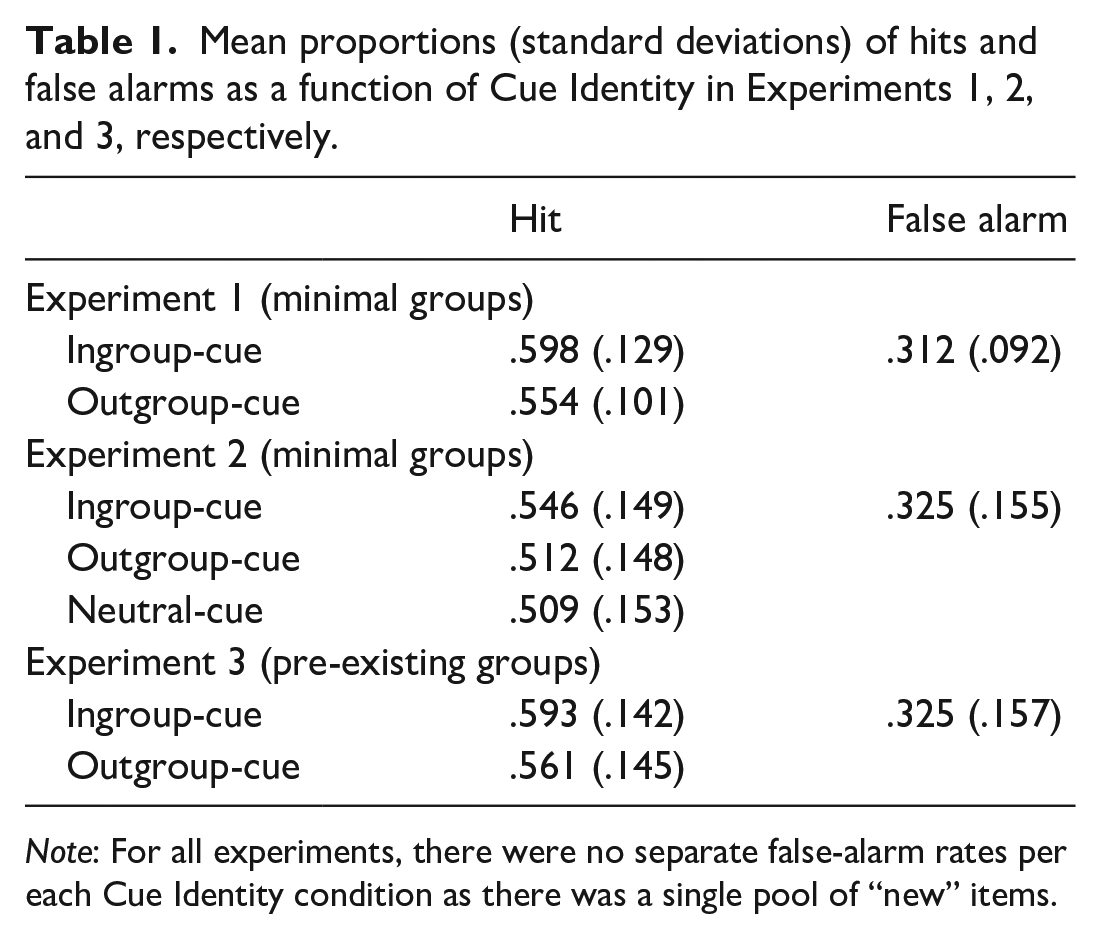
Note: For all experiments, there were no separate false-alarm rates per each Cue Identity condition as there was a single pool of “new” items.
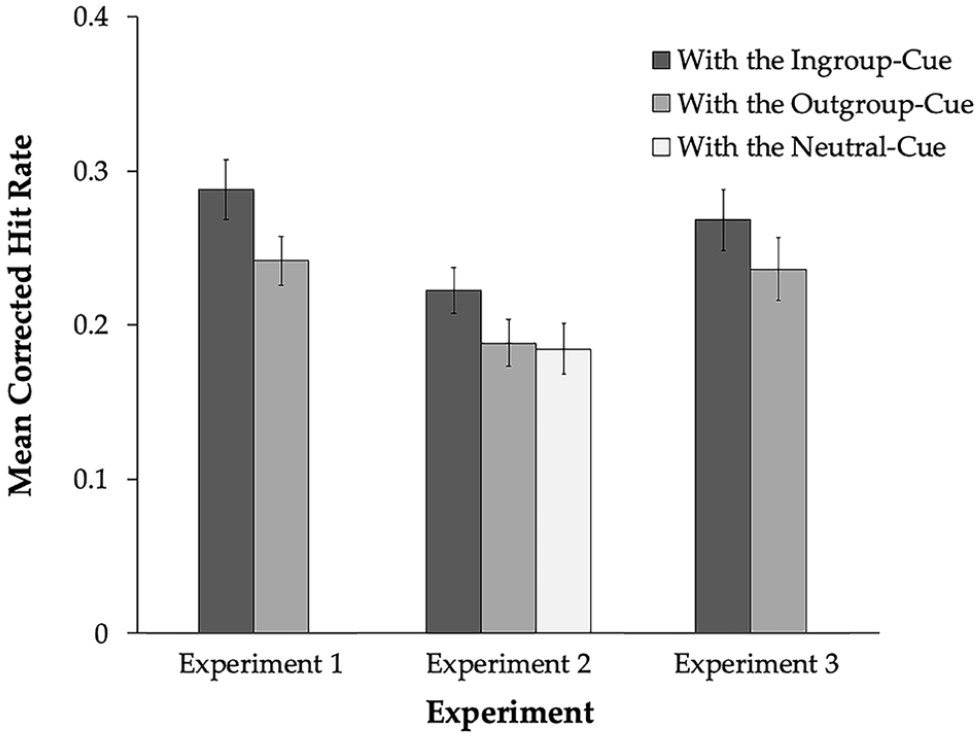
Recognition memory for target words as a function of Cue Identity in Experiments 1, 2, and 3, respectively. Error bars represent standard error of the mean.
To test a potential relationship between participants’ identification with their ingroup and the magnitude of the ingroup-memory advantage (i.e., the difference in memory accuracy for words presented with the Ingroup-cue vs. the Outgroup-cue), we conducted a bivariate correlation analysis. There was no significant relationship between ingroup identification and the ingroup-memory advantage, r(34) = –.020, p = .91.
By showing enhanced memory for stimuli co-presented with an ingroup-relevant vs. outgroup-relevant cue, Experiment 1 provided evidence that an ingroup-memory advantage can emerge not only when individuals are explicitly required to process to-be-remembered items’ ingroup-relevancy (Bennett et al., 2010; Bennett & Sani, 2008; C. Johnson et al., 2002; Liu et al., 2015; Stewart et al., 2007) but also when an ingroup-relevant cue is incidentally associated with to-be-remembered items under a non-referential encoding context. However, a few methodological aspects in Experiment 1 prevent drawing a strong conclusion that an incidental ingroup-item association is sufficient to produce an ingroup-memory advantage. First, the sample size of Experiment 1 was quite small, which limited statistical power and the generalisability of the results. Second, the assignment of ingroup and outgroup was not completely counterbalanced with respect to the descriptions provided to the participants. That is, although participants were randomly assigned to either blue or yellow group, the “blue” and “yellow” groups were always described as representing the “figure-based” and “ground-based” perceptual styles, respectively. Although it is unlikely that these descriptions on an arbitrary, trivial dimension have significantly contributed to the observed pattern of the results, replication of the findings with complete counterbalancing of ingroup and outgroup descriptions is necessary to provide solid evidence for the presence of an incidental ingroup-memory advantage.
We addressed these issues in Experiment 2 by (a) increasing statistical power with a larger sample size and (b) fully counterbalancing the ingroup and outgroup descriptions given to the participants. In addition, in Experiment 2, we introduced a group-irrelevant, neutral cue (i.e., a colour-filled rectangle that had no relevance to participants’ assigned ingroup or outgroup) to examine to what extent an incidental ingroup-memory advantage is due to ingroup-memory enhancement, outgroup-memory suppression, or both.
Experiment 2
Method
Participants and design
Participants were 72 undergraduate students at Wesleyan University (42 females; mean age = 18.83 [SD = 1.11], age range = 18–24). The sample size was predetermined based on an effect size slightly lower than that observed in Experiment 1 (d = 0.40) using G*Power 3 (Faul et al., 2007; f = 0.175 [d = 0.35], α = .05 [two-tailed], power = 0.8, required N = 54). All participants were native English speakers with normal or corrected-to-normal vision and normal colour perception. Participants provided written informed consent and were compensated with course credit in accordance with the human subject regulations of Wesleyan University.
The experiment used a single-factor design with Cue Identity (Ingroup-cue, Outgroup-cue, or Neutral-cue) as a within-subjects factor.
Stimuli
A total of 128 personality-trait words drawn from Anderson (1968) were divided into four lists of 32 words each that were matched for word length, syllable length, likeability, and meaningfulness based on Anderson’s (1968) norms, all Fs < 1, all ps > .4. Three lists served as critical “old” items that were presented in the encoding phase. The assignment of critical lists to the Ingroup-cue, Outgroup-cue, or Neutral-cue condition was counterbalanced across participants. A random half of the critical words in each Cue Identity condition were presented at the top of the screen, and the other half were presented at the bottom of the screen. The remaining list served as “new” items in the subsequent memory test.
The cue stimuli consisted of three colour-filled rectangles (blue, yellow, or green) that were used to represent the participants’ newly assigned ingroup (i.e., Blue or Yellow group) or outgroup (i.e., Yellow or Blue group; opposite of the assigned ingroup), or served as a group-irrelevant, neutral cue (i.e., a green-filled rectangle) which was presented during the encoding phase only.
Procedure
The procedure for the minimal group assignment phase, the encoding phase, and the memory test was exactly the same as in Experiment 1 except the following: (a) in the minimal group assignment phase, both Blue and Yellow groups were described as representing the “figure-based” style for half of the participants and the “ground-based” perceptual style for the other half, (b) in the encoding phase, the Neutral-cue was presented along with the Ingroup-cue and the Outgroup-cue (32 trials for each Cue Identity condition), and (c) in the memory test, participants were allowed to take as much time as needed to make their memory decision for each word.
As in Experiment 1, upon completing the experiment, participants were asked to complete a post-experimental questionnaire that assessed the extent to which they identified with their assigned ingroup and outgroup separately on a 7-point scale from 1 (not at all) to 7 (very much) as well as their awareness of the experimental hypothesis. None of the participants correctly guessed the experimental hypothesis.
Results and discussion
Identification with ingroup vs. outgroup
A paired-samples t-test revealed that participants’ identification ratings were significantly higher for their assigned ingroup (M = 4.71, SD = 1.38) than for outgroup (M = 2.64, SD = 1.41), t(71) = 8.93, p < .001, d = 1.05. In addition, one-sample t-tests revealed that whereas participants’ identification ratings for the ingroup were significantly higher than the neutral midpoint “4” on a 7-point scale, t(71) = 4.36, p < .001, d = 0.51, their identification ratings for the outgroup were significantly lower than the neutral midpoint, t(71) = –8.21, p < .001, d = 0.97. Together, these findings suggest that our manipulation of ingroup and outgroup using the minimal group paradigm was successful.
Encoding task performance
A repeated-measures analysis of variance (ANOVA) with Cue Identity (Ingroup-cue, Outgroup-cue, or Neutral-cue) as the within-subjects factor revealed no significant effect of Cue Identity for location judgement accuracy (Ingroup-cue: M = .991 [SD = .033]; Outgroup-cue: M = .991 [SD = .035]; Neutral-cue: M = .994 [SD = .024]), F(2, 142) = 0.80, p = .45, or for RT (Ingroup-cue: M = 519.10 ms [SD = 126.51 ms]; Outgroup-cue: M = 511.60 ms [SD = 119.21 ms]; Neutral-cue: M = 516.30 ms [SD = 117.43 ms]), F(2, 142) = 1.44, p = .24.
Recognition memory for target words
Participants’ hit and false-alarm rates are presented in Table 1. A repeated-measures ANOVA performed on the corrected hit rates with Cue Identity as the within-subjects factor revealed a significant effect of Cue Identity, F(2, 142) = 7.68, p = .001,
To examine a potential relationship between participants’ identification with their ingroup and the magnitude of the ingroup-memory advantage, we conducted a bivariate correlation analysis. The result showed no significant relationship between ingroup identification and the ingroup-memory advantage, r(70) = .067, p = .58.
Experiment 2 successfully replicated and extended the results of Experiment 1 by showing enhanced memory for words presented with the Ingroup-cue compared with those presented with the Outgroup-cue or the Neutral-cue, with no significant memory difference between the latter two conditions. These findings suggest that an incidental ingroup-memory advantage is driven by ingroup-memory enhancement rather than outgroup-memory suppression.
Of note, both Experiments 1 and 2 used the minimal group paradigm in which participants were assigned a group membership immediately prior to the encoding phase. Therefore, a question remains as to whether the observed incidental ingroup-memory advantage would extend to naturally occurring, existing group affiliations in which no “on-site” group assignment is necessary. In addition, in both Experiments 1 and 2, the magnitude of the incidental ingroup-memory advantage showed no significant relationship with participants’ self-reported levels of ingroup identification assessed by a single-item measure. Potentially, the crude one-item measure of ingroup identification might not have fully captured the different ways in which participants identified with their ingroup, limiting our ability to detect any meaningful relationship between one’s ingroup identification and the ingroup-memory advantage.
We addressed these issues in Experiment 3 by using pre-existing group affiliations (i.e., one’s own or another study major) and a previously validated multicomponent measure of ingroup identification (Leach et al., 2008) to further elucidate if and to what extent different facets of ingroup identification are related to the incidental ingroup-memory advantage.
Experiment 3
Method
Participants and design
Participants were 56 undergraduate students (34 females; mean age = 21.04 [SD = 0.69]; age range = 20–23) at Wesleyan University whose study major was either psychology or economics (N = 28 in each). The sample size was predetermined based on the effect sizes from Experiments 1 and 2 using G*Power 3 (Faul et al., 2007; d = 0.4, α = .05 [two-tailed], power = 0.8, required N = 52). All participants were native English speakers with normal or corrected-to-normal vision and normal colour perception. Participants provided written informed consent and were compensated with payment in accordance with the human subject regulations of Wesleyan University. Data from two additional participants were excluded from analysis due to poor performance on the encoding task (below 50% accuracy).
The experiment used a single-factor design with Cue Identity (Ingroup-cue or Outgroup-cue) as a within-subjects factor.
Materials
Stimuli
The personality-trait adjectives and the assignment of critical lists to the Ingroup-cue or Outgroup-cue condition were exactly the same as in Experiment 1. The cue stimuli consisted of two abbreviated codes for participants’ own and another study majors (i.e., PSYC, ECON).
Multicomponent Ingroup Identification Scale (MIIS)
This 14-item scale, developed by Leach et al. (2008), assesses five distinct components of ingroup identity: solidarity (i.e., a sense of belonging and the feeling of a bond with one’s ingroup; 3 items), satisfaction (i.e., positive feelings about belonging to one’s ingroup; 4 items), centrality (i.e., salience and the subjective importance of ingroup for one’s self-concept; 3 items), individual self-stereotyping (i.e., perception of oneself as similar to an ingroup prototype; 2 items), and ingroup homogeneity (i.e., perception of one’s ingroup as a coherent, cohesive entity that is distinct from outgroups; 2 items). These five components are organised into two higher level dimensions of ingroup identification: self-investment (incorporating solidarity, satisfaction, and centrality) and self-definition (incorporating individual self-stereotyping and ingroup homogeneity). The scale included statements such as “I am glad to be [ingroup],” “The fact that I am [ingroup] is an important part of my identity” and “I have a lot in common with the average [ingroup] person,” and the participants rated the extent to which they agreed with each statement on a 7-point scale from 1 (strongly disagree) to 7 (strongly agree). Scores for each dimension of ingroup identification were calculated by summing each participant’s responses to all items associated with a given dimension, with higher scores indicating higher levels of ingroup identification. In the present study, we found acceptable to good levels of internal consistency for both the two high-level dimensions and the five components: self-investment (10 items; α = .88 [solidarity: α = .77; satisfaction: α = .83; centrality: α = .85]) and self-definition (4 items; α = .82 [individual self-stereotyping: α = .87; ingroup homogeneity: α = .86).
Procedure
The experiment consisted of two phases: encoding and a memory test. The procedure for the encoding phase and the memory test was exactly the same as in Experiment 1 except that (a) in the encoding phase the code “PSYC” or “ECON” was presented in the centre of the screen to serve as the Ingroup-cue or the Outgroup-cue (or vice versa depending on a participant’s own study major) and (b) in the memory test, participants were allowed to take as much time as needed to make their memory decision for each word.
After the experiment, participants completed the MIIS and then a post-experimental questionnaire that assessed their awareness of the experimental hypothesis. None of the participants correctly guessed the experimental hypothesis.
Results and discussion
MIIS ratings
The mean ratings and the standard deviations for the two dimensions of ingroup identification were as follows: self-investment (M = 50.32, SD = 9.50) and self-definition (M = 16.61, SD = 4.13). 4
Encoding task performance
Paired-samples t-tests revealed no significant difference in location judgement accuracy, t(55) = –1.70, p = .10, or in RT, t(55) = 0.21, p = .84, between when the target words were presented with the Ingroup-cue (accuracy: M = .988 [SD = .027]; RT: M = 479.92 ms [SD = 145.39 ms]) and when they were presented with the Outgroup-cue (accuracy: M = .992 [SD = .023]; RT: M = 479.03 ms [SD = 143.62 ms]).
Recognition memory for target words
Participants’ hit and false-alarm rates are presented in Table 1. As shown in Figure 1, a paired-samples t-test conducted on corrected hit rates revealed that participants’ memory for target words was significantly better when the words were presented with the Ingroup-cue (M = .268, SD = .148) than when they were presented with the Outgroup-cue (M = .236, SD = .152), t(55) = 2.13, p = .038, d = 0.28. 5
Finally, to test whether ingroup identification dimensions of MIIS were associated with the magnitude of the incidental ingroup-memory advantage, we conducted a bivariate correlation analysis. As shown in Figure 2, the magnitude of the incidental ingroup-memory advantage was positively correlated with self-investment, r(54) = .384, p = .004, but showed no significant correlation with self-definition, r(54) = –.009, p = .95. 6
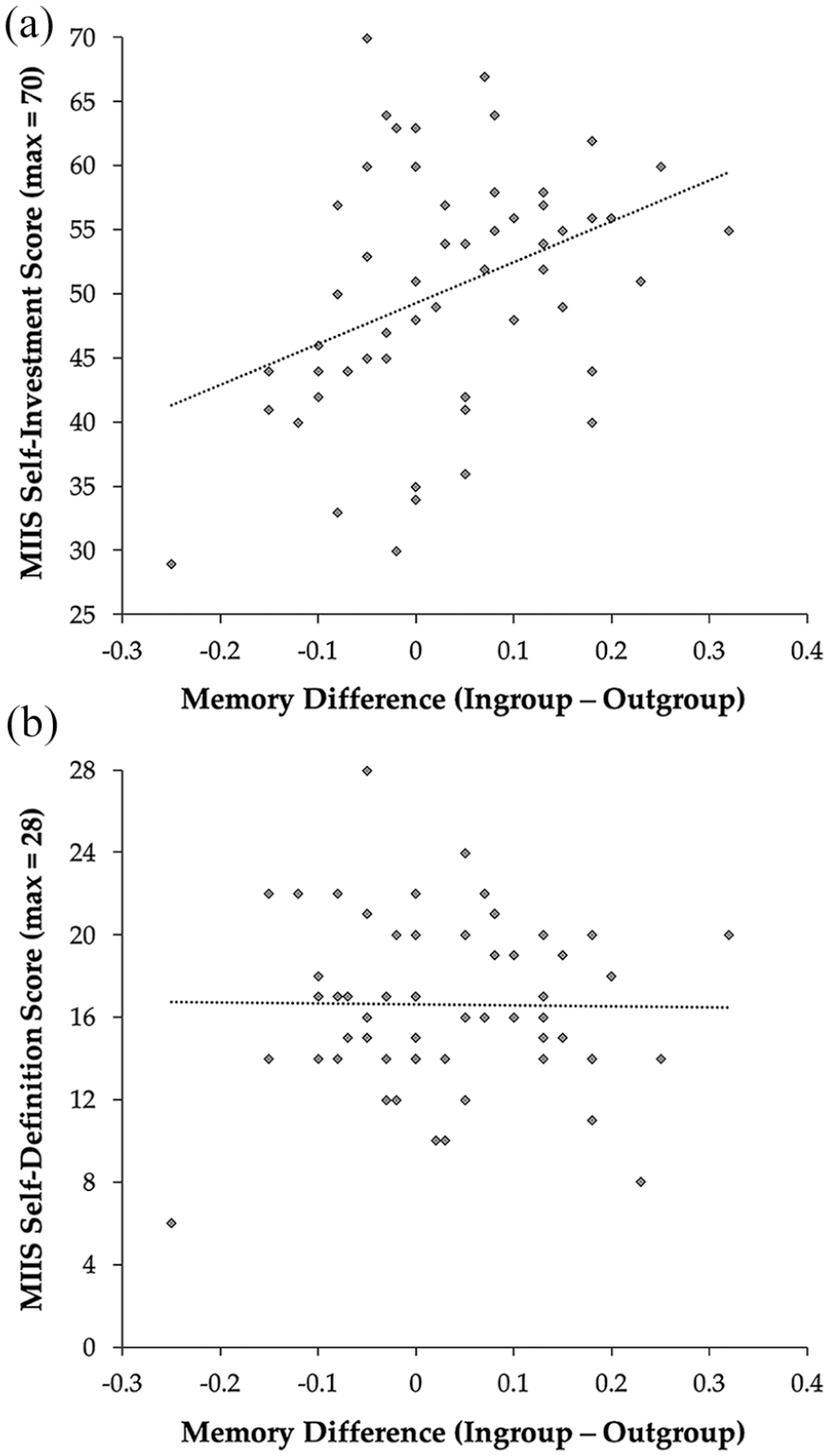
Correlations between (a) the ingroup-memory advantage and MIIS self-investment ratings and (b) the ingroup-memory advantage and MIIS self-definition ratings.
Experiment 3 replicated and extended the results of Experiments 1 and 2 by showing that an incidental ingroup-memory advantage can emerge under a pre-existing group context and that the magnitude of this ingroup-memory advantage varies as a positive function of individuals’ identification with their ingroup in terms of their self-investment to the ingroup.
General discussion
In three experiments, the present study examined whether simply co-presenting to-be-remembered target items with an ingroup-relevant vs. outgroup-relevant cue at encoding facilitates memory for the items in the absence of any explicit task demand to evaluate the items’ relevancy to one’s ingroup.
Consistent across experiments, we found a significant memory advantage for target items presented with an ingroup-relevant cue compared with those presented with an outgroup-relevant cue under both minimal group and pre-existing group contexts, in line with previous research showing attentional and memory biases towards one’s ingroup and ingroup-associated stimuli (Bernstein et al., 2007; Enock et al., 2018; Moradi et al., 2015, 2017; Van Bavel & Cunningham, 2012). Given that better perceptual and memory performance for self- or ingroup-relevant stimuli is suggested to be underpinned by individuals’ tendency to preferentially allocate attentional resources to aspects of the environment that are personally/socially significant (Cunningham et al., 2014; Humphreys & Sui, 2016; Sui & Rotshtein, 2019; Turk et al., 2008, 2011; Van Bavel & Cunningham, 2012), the emergence of an incidental ingroup-memory advantage under non-referential encoding context may suggest that ingroup-relevant information, by virtue of its pronounced significance/salience compared with outgroup-relevant information, preferentially attracts attention, which in turn promotes enhanced encoding of simultaneously presented target items (see also Englert & Wentura, 2016). Of note, the fact that experimentally assigning participants to novel groups was sufficient to produce an ingroup-memory advantage attests to the incidental, non-referential nature of this memory advantage, and further suggests that pre-existing knowledge, expertise, or schema about one’s in/outgroup is not a prerequisite for the emergence of the ingroup-memory advantage. Nevertheless, given that the degree to which different groups are included in one’s self-concept varies (Tajfel, 1982), future studies may use a wider range of social groups or manipulate the salience of social identity (e.g., via subliminal priming; Liu et al., 2015) to examine how the magnitude of the incidental ingroup-memory advantage may vary according to the perceived salience of a given social identity.
In line with past research suggesting that intergroup bias primarily takes the form of ingroup favouritism rather than outgroup derogation, particularly in minimal group situations (Brewer, 1999, 2001; Hinkle & Brown, 1990), we found that the incidental ingroup-memory advantage was driven by ingroup-memory enhancement rather than outgroup-memory suppression. According to a number of previous suggestions, outgroup derogation is more likely when outgroups are associated with stronger emotions such as threat (Brewer, 2001; Chang et al., 2016; Hewstone et al., 2002; Mummendey & Otten, 2001) or when positive ingroup status are undermined (i.e., social identity threat; Branscombe & Wann, 1994). Future studies may benefit from examining whether a specific nature of intergroup context (e.g., involving outgroups with a long history of rivalry or conflict, relative underrepresentation of ingroups) characterises the relative contribution of ingroup-memory enhancement and outgroup-memory suppression to the emergence of an incidental ingroup-memory advantage.
A number of past studies (e.g., Cadinu & Rothbart, 1996; Otten & Epstude, 2006; Otten & Moskowitz, 2000; Otten & Wentura, 2001; Van Veelen et al., 2011) suggest that ingroup identification can arise from self-anchoring process in which individuals construe their ingroup using the self as a reference point, especially when one’s ingroup is relatively unknown (e.g., under a minimal group context). Given that most individuals have a positive view of themselves (Baumeister, 1998; Taylor & Brown, 1988), the process of self-anchoring entails the projection of self-positivity onto one’s ingroup, thereby resulting in ingroup favouritism even in the absence of explicit social comparison. In the present study, the encoding task required neither an explicit resort to one’s concept/knowledge of the ingroup nor a comparison between ingroup and outgroup. Thus, it is possible that the enhanced memory for items co-presented with an ingroup-relevant cue may have arisen, at least in part, due to the mere transfer of self-positivity and/or personal/affective significance from the self to newly created or pre-existing ingroups. Future studies may examine if and the extent to which this self-to-ingroup generalisation of self-positivity contributes to the incidental ingroup-memory advantage. In this regard, it is worth noting that recent studies have shown that the self-prioritisation effect in perceptual processing is mainly driven by association between the stimuli and positive aspects of the self (i.e., the “good” self) rather than negative aspects of the self (i.e., the “bad” self) (Hu et al., 2020) and that the experience of negative mood reduces the magnitude of the self-prioritisation effect (Sui et al., 2016).
In Experiment 3 in which we used pre-existing group affiliations and a previously validated multicomponent measure of ingroup identification (Leach et al., 2008), the magnitude of the incidental ingroup-memory advantage was positively associated with individuals’ self-reported levels of self-investment to the ingroup, but did not show any significant relationship with group-level self-definition. In particular, the more individuals attributed positive feelings and salience/importance to their group membership, the more they exhibited ingroup-memory advantage. This finding joins recent studies showing that the magnitude of perceptual, attentional, and memory biases towards one’s ingroup depends on the level of individuals’ ingroup identification (e.g., Moradi et al., 2015; Van Bavel & Cunningham, 2012). According to Leach et al. (2008), the self-investment dimension of ingroup identification is manifested in individuals’ positive feelings about, and their perceived significance of their ingroup membership as well as a sense of close psychological bond with the ingroup. In comparison, the self-definition dimension is manifested in individuals’ perceptions of themselves as similar to an ingroup prototype. Our finding that ingroup-memory advantage arises in the absence of explicit reference to individuals’ ingroup knowledge/schema aligns with previous findings showing that self-investment, as relatively more affective “hot” component of ingroup identification, is more predictive of group-serving cognition and behaviour compared with self-definition (e.g., Masson & Barth, 2020). In addition, the observed correlation between self-investment and the magnitude of the ingroup-memory advantage provides further support for the idea that the positivity and social significance assigned to one’s ingroup may be the critical factors that drive preferential attention to ingroup-relevant stimuli. Nevertheless, it should be noted that in Experiments 1 and 2 in which we used a minimal group paradigm and a single-item measure of ingroup identification, the magnitude of the incidental ingroup-memory advantage did not significantly correlate with the degree of ingroup identification. We reason that there are at least two possibilities that can account for the inconsistent findings across the present experiments. First, it is possible that an ingroup-relevant cue must pertain to meaningful social identities such as pre-existing group affiliations for a relationship between ingroup identification and the incidental ingroup-memory advantage to emerge. Another possibility, of a more methodological nature, is that the single-item measure of ingroup identification used in Experiments 1 and 2 failed to encompass all facets of ingroup identification, or simply was not reliable enough to reveal a correlation between ingroup identification and the incidental ingroup-memory advantage. Future studies can use a psychometrically validated multi-item measure that captures different dimensions of ingroup identification (e.g., positive feelings about the assigned ingroup, salience/importance of belonging to the assigned ingroup, perceived self-ingroup similarity, etc.) to examine whether and how the degree to which individuals identify with their ingroup relates to the magnitude of the incidental ingroup-memory advantage in a minimal group context.
It has been shown that the relative magnitude of the SRE and GRE under an evaluative, referential encoding context depends on the type of social groups used. For example, whereas using one’s family as an ingroup produced a comparable level of the GRE and SRE (Bennett et al., 2010; C. Johnson et al., 2002), using one’s university as an ingroup produced a significantly weaker GRE than the SRE (Stewart et al., 2007; but see C. Johnson et al., 2002). Thus, one fruitful avenue for future research may be to examine the relative magnitude of the self- and ingroup-memory advantages under a non-referential encoding context using social groups with varying degrees of centrality/significance to one’s self-concept. Relatedly, different theories of social categorization (Brewer & Gardner, 1996; Tajfel, 1982; Turner et al., 1987) all share the idea that an individual’s sense/concept of self extends beyond the physical boundary to incorporate significant ingroups, thereby suggesting an inextricable link between one’s personal and social self (Coats et al., 2000; Smith et al., 1999; Smith & Henry, 1996). In this regard, another interesting future avenue may be to examine whether the magnitudes of the incidental self- and ingroup-memory advantages correlate with each other and whether this potential correlation is moderated by the degree of shared representations between the self and ingroup (see also Enock et al., 2018).
Finally, it is worth noting that although we found an ingroup-memory advantage under both the minimal and pre-existing group contexts, the effect size was relatively smaller when the ingroup-relevant and outgroup-relevant cues pertained to individuals’ pre-existing groups. Given previous findings that enhancing the salience of social categorization increases intergroup bias (e.g., Espinoza & Garza, 1985; Liu et al., 2015; Mummendey et al., 2000), it is possible that assigning a group membership on-site immediately prior to the encoding phase in the minimal group context might have rendered the categorization between one’s ingroup and outgroup relatively more salient, thereby increasing the likelihood that an ingroup-relevant cue would attract preferential attention during encoding. Alternatively, in the minimal group context when participants are not provided with information about other ingroup members, the self becomes the only exemplar of the ingroup member, which in turn may increase the salience of oneself as well as the proximity of the ingroup to the self (Ostrom & Sedikides, 1992). In the case of pre-existing social groups, in particular one’s study major as used in the present study, there may be more distinguishable, idiosyncratic members within the ingroup, which could potentially reduce the salience of oneself as an exemplar of the group (C. Johnson et al., 2002). For future studies, it would be interesting to explore how increasing the salience of oneself as an exemplar of one’s ingroup influences the magnitude of an incidental ingroup-memory advantage.
Overall, the present study provides novel evidence that mere incidental associations between one’s ingroup and to-be-remembered items in a non-referential, non-evaluative encoding context can produce an ingroup-memory advantage. By extending the incidental self-memory advantage from the level of personal identity to the level of social identity, our findings provide strong support that one major function of the self-system is to ensure information of potential relevance to the self is preferentially attended and retained (Cunningham et al., 2013, 2014; Turk et al., 2008).
Supplemental Material
iGRE_SupplementaryMaterial – Supplemental material for Social group membership and an incidental ingroup-memory advantage
Supplemental material, iGRE_SupplementaryMaterial for Social group membership and an incidental ingroup-memory advantage by Youngbin A Jeon, Alexis M Banquer, Anaya S Navangul and Kyungmi Kim in Quarterly Journal of Experimental Psychology
Footnotes
Acknowledgements
We thank research assistants Gabriella Feder and Stacey Zuo for assistance with data collection.
Declaration of conflicting interests
The author(s) declared no potential conflicts of interest with respect to the research, authorship, and/or publication of this article.
Funding
The author(s) disclosed receipt of the following financial support for the research, authorship, and/or publication of this article: This work was supported by a Grant in Support of Scholarship (GISOS) from Wesleyan University.

Data accessibility statement
Notes
References
Supplementary Material
Please find the following supplemental material available below.
For Open Access articles published under a Creative Commons License, all supplemental material carries the same license as the article it is associated with.
For non-Open Access articles published, all supplemental material carries a non-exclusive license, and permission requests for re-use of supplemental material or any part of supplemental material shall be sent directly to the copyright owner as specified in the copyright notice associated with the article.
