



Abstract
It is often put forward that in-group members are imitated more strongly than out-group members. However, the validity of this claim has been questioned as recent investigations were not able to find differences for the imitation of in- versus out-group members. A central characteristic of these failed replications is their mere focus on movement-based imitation, thereby neglecting to take into consideration the superior goal of the movements. By using a computerised version of the pen-and-cups task, we disentangled movement- from goal-based imitation to shed further light onto the link between group membership and imitation. As previous research demonstrated that out-group members (as compared with in-group members) are represented psychologically distant and as psychological distance shifts the degree to which participants engage in goal- versus movement-based imitation, we predicted that in-group members (as compared with out-group members) shift the degree to which individuals imitate movements versus goals. The results did not confirm our predictions, as group membership does not modulate the degree of movement- versus goal-based imitation. Theoretical implications and the question whether imitative behaviour is socially modulated are discussed.
It is widely known that individuals have the propensity to automatically imitate each other (Heyes, 2011). For example, previous research has found that individuals imitate facial expressions (Dimberg, 1982), emotions (Hess & Fischer, 2016), postures (LaFrance, 1982), gestures (Cracco, Genschow, et al., 2018), and simple movements (Genschow et al., 2013; Genschow & Florack, 2014; Genschow, Hansen, et al., 2019; Genschow & Schindler, 2016). Such imitative behaviour has been found to fulfil an important social function as it bonds humans together by creating feelings of affiliation (Lakin & Chartrand, 2003), closeness (van Baaren et al., 2004), and liking for each other (Chartrand & Bargh, 1999; Sparenberg et al., 2012).
Classic perception-action theories (Chartrand & Bargh, 1999; Dijksterhuis & Bargh, 2001; Greenwald, 1970; Prinz, 1990, 1997) explain imitative behaviour with the notion that the observation of an action evokes similar mental representations as the engagement in the same action. For example, ideomotor theory (Prinz, 1990, 1997) proposes that the visual image of an action is part of its motor representation. As a consequence, observing a movement executed by another person activates similar motor representations in the observer increasing the likelihood that the observer executes the same movement as the other person. Support for the shared mental representation between observed and executed action comes from a variety of behavioural experiments (e.g., Brass et al., 2000, 2001; Craighero et al., 2002; Kilner et al., 2003) as well as neurophysiological studies including functional magnetic resonance imaging (fMRI) (e.g., Gazzola & Keysers, 2009; Keysers & Gazzola, 2010), motor Transcranial Magnetic Stimulation (TMS) (e.g., Catmur et al., 2007; Fadiga et al., 1995), and single-cell recordings (Mukamel et al., 2010).
An often-alleged claim in the literature is that human imitation as a social process should be modulated by social factors. For example, motivational theories of imitation (e.g., Chartrand & Dalton, 2009; Wang & Hamilton, 2012) postulate that people use imitation either consciously or unconsciously as a tool to affiliate with others. Consequently, individuals should imitate others more strongly when they have an affiliation goal. A somewhat other process is proposed by self-other overlap theories (e.g., Brass & Heyes, 2005; Greenwald, 1970; Heyes, 2010; Prinz, 1990, 1997). These theories suggest that imitative tendencies are learned responses that develop as a result of self-observation and interaction with other, often similar (Efferson et al., 2008) individuals (Brass & Heyes, 2005; Cook et al., 2014; Heyes, 2010; Ray & Heyes, 2011). Thus, individuals who are perceived as more similar both at a physical (Press, 2011) and a conceptual level (Cracco, Bardi, et al., 2018) should be imitated more strongly (Genschow, Cracco, et al., 2021).
In this respect, an often-implied social moderator of imitative behaviour is group membership. Belonging to a social group and establishing a stable and cohesive bond with members from this group have an evolutionary important impact (Baumeister & Leary, 1995; Dunbar, 2012; Dunbar & Shultz, 2010). Moreover, recognising a member of the in-group influences perceived distance to this person (Fini et al., 2020) and prompts an affiliation motivation (Van Der Schalk et al., 2011). In line with this notion, previous research has suggested that individuals should imitate members from the in-group more strongly than members from the out-group (e.g., Genschow & Schindler, 2016; Gleibs et al., 2016).
However, the empirical basis for the idea that imitative behaviour is moderated by social group membership is less clear than previously assumed. Although some researchers find that in-group members are more strongly imitated in automatic imitation paradigms than out-group members (Genschow & Schindler, 2016; Gleibs et al., 2016), others were not able to replicate this finding (De Souter et al., 2021; Genschow, Westfal et al., 2021; Rauchbauer et al., 2015, 2016; Weller et al., 2020). For example, De Souter et al. (2021) did not find a difference in automatic imitation between the imitation of in- and out-group members in a multi-agent paradigm. Most recently, Genschow, Westfal et al., 2021 did not find evidence for the hypothesis that group membership modulates automatic imitation within a classic automatic imitation task (Brass et al., 2001). Moreover, the authors’ data did not support the idea that perceived similarity or affiliation motives moderate the influence of group membership on automatic imitation.
A central characteristic of the previous experiments assessing the influence of group membership on imitative behaviour is that all these studies solely assessed movement-based imitation and thereby neglected to take into consideration the superior goal of the movements. Based on the theory of Goal Directed Action (GOADI; Bekkering et al., 2000; Gleissner, Bekkering, et al., 2000; Wohlschläger & Bekkering, 2002), imitative behaviour is mainly driven by the adoption of action goals. That is, observing an action activates the most relevant motor programme that allows achieving the goal of that action. Accordingly, GOADI predicts that when instructed to imitate an action, individuals focus more strongly on the action’s goal than on its underlying movement. In other words, when imitating a behaviour, people aim at pursuing the same goal as the observed person without necessarily mirroring the exact same underlying movements. Support for this idea comes from research on the so-called pen-and-cups task (Bekkering et al., 2000; Wohlschläger et al., 2003). In this task, participants observe a model moving a pen into one of two coloured cups (object), using either the right or the left hand (effector), while grasping the pen with the thumb pointing up or down (grip). Afterwards, participants are instructed to imitate the observed behaviour as fast as possible. A typical observation in such a task is that participants make fewer cup errors than hand errors and fewer hand errors than grip errors (Avikainen et al., 2003; Leighton et al., 2008; Wohlschläger et al., 2003). Based on the assumption that the primary goal of each action is to place the pen into the correct cup, this cup < hand < grip error pattern is typically taken as support for goal-directed imitation (for a critical examination, see Bird et al., 2007).
Applying different paradigms within different populations, this view has been supported by a number of similar findings (e.g., Gattis et al., 2002; Gleissner, Meltzoff, et al., 2000; Want & Gattis, 2005). For example, borrowing the logic of the pen-and-cups task, Wohlschläger and Bekkering (2002) presented participants with videos of a model moving one of two fingers towards two different targets (e.g., dots). Replicating previous findings on goal-based imitation, the authors found that when instructed to imitate the observed action, participants committed more errors by selecting the correct finger (i.e., movement errors) than approaching the correct target (i.e., goal errors).
When applying a computerised version of this task, Genschow, Hansen, et al. (2019; for a review, see Hansen & Genschow, 2020) recently investigated whether psychological distance influences goal- versus movement-based imitation. Based on the assumptions put forward by Construal Level Theory (Trope & Liberman, 2003, 2010), the authors predicted that psychological distance increases participants’ focus on the model’s goal and psychological proximity increases the focus on the underlying movements. As a result, when imitating observed actions, presenting the actions psychologically distant, as compared with proximal, should lead to fewer goal errors (as compared with movement errors). To test this prediction, participants observed on a computer screen a model pressing a key located either on the right or left side of the keyboard with either her left or right index finger. In multiple trials, participants were instructed to imitate the observed actions as fast as possible. Crucially, the observed actions were presented in either a psychological proximal or distant way. The results indicate that when imitating the actions, psychological distance (vs. proximity) decreased participants’ rate of goal errors. In the same time, the spatial location of the observed actions did not affect participants’ movement errors.
Present research
Taken together, social modulation theories of imitation (e.g., Chartrand & Dalton, 2009; Wang & Hamilton, 2012) suggest that group membership should affect the way individuals imitate in- versus out-group members. However, the empirical basis for this effect is rather unclear, as recent studies were not able to find an influence of group membership on automatic imitation (De Souter et al., 2021; Genschow, Westfal et al., 2021; Weller et al., 2020). A disadvantage of previous research investigating the link between group membership and imitation is that researchers confounded movement-based with goal-based imitation. In this research, we aimed at disentangling movement- from goal-based imitation to shed further light onto the link between group membership and imitation. We derived our predictions regarding the influence of group membership on imitative behaviour based on literature showing that out-group members are perceived in an abstract and in-group members in a concrete fashion (e.g., Fiedler et al., 1995; Werkman et al., 1999). Consequently, in-group members are represented psychologically proximal and out-group members psychologically distant (Trope & Liberman, 2003, 2010). Given that psychological distance shifts the degree to which participants imitate goal- versus movement-based, a reasonable prediction is that imitating in-group members (as compared with out-group members) should lead to less movement errors as compared with goal errors.
Method
All stimuli and data are made open accessible at the Open Science Framework (OSF; https://osf.io/vsjt5/). We preregistered the experiment online at aspredicted.org (https://aspredicted.org/pp6y2.pdf).
Participants and design
Based on previous research using similar tasks (e.g., Genschow, Hansen, et al., 2019), we estimated an effect size of approximately dz = .4 for the effect of group membership on goal- versus movement-based imitation. To detect such an effect size with a power of 1 – β = .8 and p = .05 in a within-subject design, 52 participants are needed. To compensate for the preregistered participant exclusions, we invited 60 students of the University of Cologne (Germany) to take part in our study. As preregistered, we excluded six participants from which too many trials were missing (i.e., missing trials > 3 SD [standard deviation] from the sample mean), one participant who made too many errors (i.e., more than 3 SD of the sample means), and one participant who reported to know the applied minimal group paradigm. The final sample of our experiment contained 52 participants (42 female and 10 male) with normal or corrected-to-normal vision. Forty-five participants were right-handed and seven participants were left-handed. Ages ranged from 18 to 27 years (M = 21.27, SD = 2.24).
The experiment consisted of a 2 (error type: hand vs. key) × 2 (group membership: in-group vs. out-group) within-subject design.
Procedure and materials
Participants took part in the experiment in single sessions. First, we applied a minimal group paradigm (Tajfel et al., 1971) in which participants had to estimate the number of dots that were presented on a picture for 3 s (e.g., Gerard & Hoyt, 1974; McClung et al., 2013). After participants estimated the number of dots, the experimenter told the participants that people would either systematically underestimate or overestimate the numbers of dots and that the degree to which individuals overestimate or underestimate is related to their personality. Then, the experimenter informed the participants that they would learn whether they are an over- or under-estimator at the end of the study. The experimenter continued by saying that based on their estimation, they would belong to one of the two groups: Group “blue” or Group “green.” Unbeknownst to participants, they were randomly assigned to either the blue or green group. To strengthen the manipulation, participants were instructed to wear either blue or green rubber gloves.
As soon as participants were wearing the respective rubber gloves, they learned that they were going to imitate photographed hand movements of two randomly chosen other participants. One of these alleged participants was claimed to be part of the blue and the other to be part of the green group; as an indicator of their membership, the models wore either blue or green rubber gloves. To reinforce the participants’ belief that the pictures depicted actual other participants, the experimenter told the participants that they are going to take some pictures that will later be presented to other participants. Using the same camera settings as for the actual stimuli, the experimenter then took several pictures of the participants’ hand performing the same hand movements as they were going to imitate later on.
Subsequently, participants engaged in an computerised pen-and-cups-task (Bekkering et al., 2000; Genschow, Hansen, et al., 2019; Wohlschläger et al., 2003) that was programmed using E-Prime software (Schneider et al., 2002). Participants sat in front of a computer and a Mac keyboard. On the number pad of the keyboard, the Numbers 1, 3, 7, and 9 were marked with coloured stickers. On the computer screen, participants read that they would watch a model pressing either the red-marked “7” or the black-marked “9” key with either the right or left forefinger. Participants’ task was to imitate the model’s action as quickly and as accurately as possible. To train this task, participants completed two exercise blocks in which the model did not wear any gloves.
In the first exercise block, participants had to press and hold the yellow-marked “1” and “3” keys with their forefingers to start a trial. That is, they held the “1” key with their left forefinger and the “3” key with their right forefinger. As soon as participants pressed these keys, a blank screen appeared for 500 ms. Then, a picture showed a model’s hands in the same starting position—spatially aligned with participants’ hands. This picture was presented for a randomly selected time of either 475 or 525 ms. Afterwards, the target picture occurred: This picture showed the model pressing either the “7” or the “9” key with either her left or right forefinger. The target picture was presented until participants responded or for a maximum duration of 500 ms. Participants were instructed to imitate the model’s behaviour as fast as possible as soon as the model pressed one of the two keys. Afterwards, participants returned to the starting position by pressing and holding the yellow-marked “1” and “3” keys with their forefingers to initiate the next trial. This exercise block contained each possible finger–key combination twice, resulting in eight trials in total (for an overview, see Figure 1).
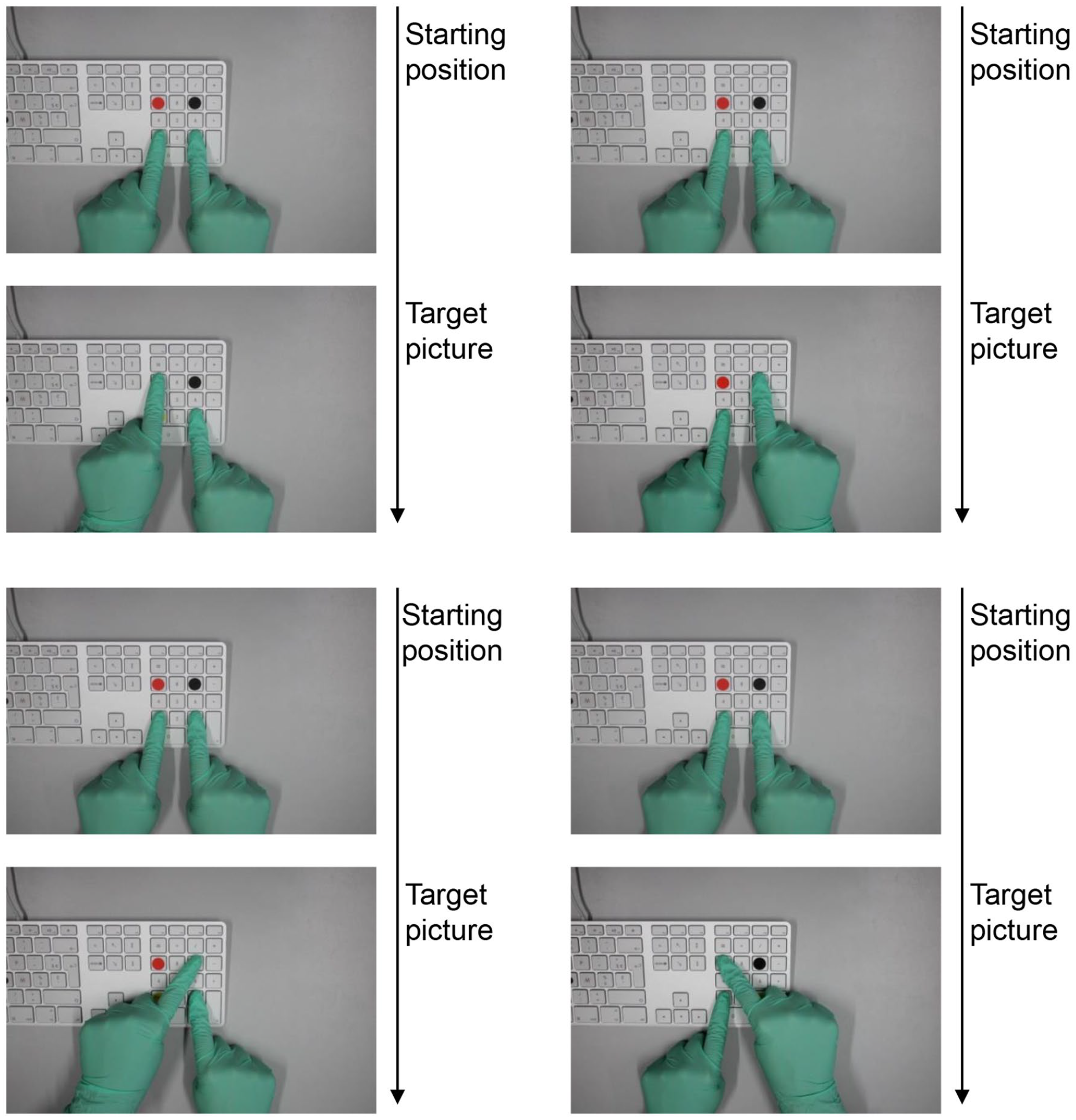
Overview over all possible finger–key combinations in the imitation task.
In the second training block, we increased the speed—and thereby the difficulty—of the task. That is, we presented the target picture (i.e., the model pressing the “7” or the “9” key with either her left or right forefinger) for merely 50 ms. Afterwards, the screen became blank and participants had up to 575 ms to imitate the observed behaviour. If participants did not press one of the target keys within 375 ms, the words “too slow” appeared on the screen for 1,000 ms. After participants pressed one of the two target keys or after they saw the feedback “too slow,” they returned to the starting position. The second training block contained eight trials, again with each finger–key combination occurring twice.
After the second training block, the actual experimental phase started. We told participants that in the experimental blocks, participants would be presented with the hands of two other randomly chosen participants. These participants would be wearing either blue gloves, indicating they shared the character traits of the blue group, or green gloves, indicating they shared the character traits of the green group. To make sure participants understand which of the two models belonged to their own group, participants then indicated which hand shared the same coloured glove. All participants answered this question correctly. Note that throughout the whole task, participants themselves still wore the gloves, which represented their own group.
The trial structure of the experimental blocks was identical with the second exercise block except that the presenting hands were wearing green or blue rubber gloves (for an example trial, see Figure 2). Participants completed 10 experimental blocks, each containing 16 trials. In half of these blocks, the model wore blue gloves, whereas in the other half, the model wore green gloves. For half of the participants, the experimental blocks started with a blue block; for the other half, the blocks started with a green block. After the first block, blue and green blocks alternated. Before each block, an instruction announced to which colour group the following model would belong. In total, participants ran through five blue and five green blocks.
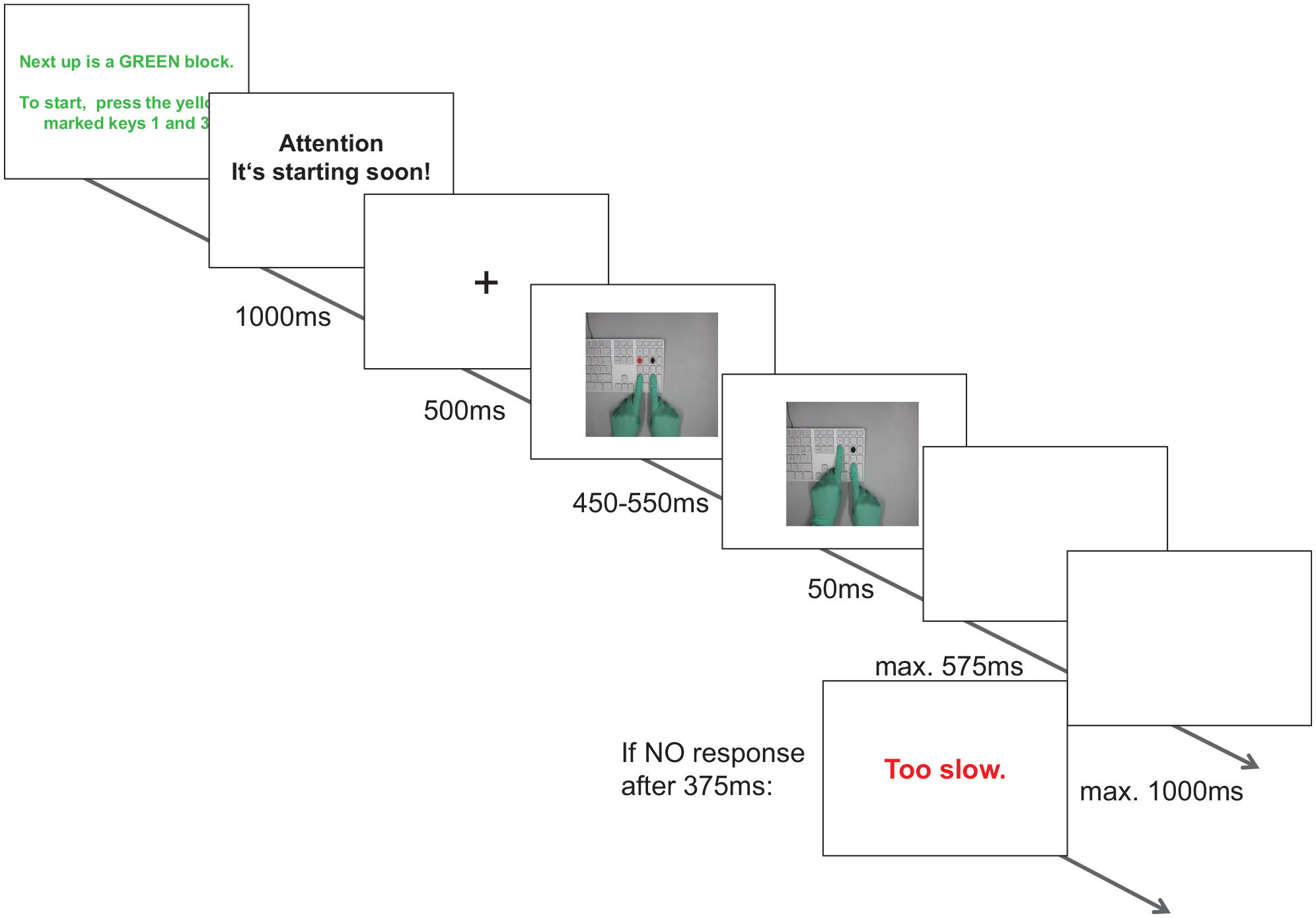
Example of the first trial of a model from the green group.
After finishing the imitation task, participants indicated basic demographic data. In addition, participants indicated whether they were familiar with any of the applied tasks. At the end, participants were debriefed, thanked, and dismissed.
Data preparation
To prepare data for analyses, we first computed an accuracy score for hand use (movement). A movement was considered as accurate if participants released the same key as the model. Second, we computed an accuracy score for key press (goal) that was made during both the response window phase and the feedback display phase.
Due to the small response window, it was likely that participants would aim for the correct key but accidentally hit one of the keys next to the target key. Thus, we considered responses as accurate when participants pressed the same key as the model (76.65% of all trials) or when they pressed a key that unambiguously belonged to one of the target keys (9.53% of all trials). Such keys were, for example, the number “4” or “6.” Key presses that could belong to both target keys (e.g., “8” or “5”) or were performed outside of the response time window were coded as missing (13.82% of all trials). More details on how we coded the responses can be found in the coding scheme on OSF (https://osf.io/vsjt5/). To prepare data for analysis, we summed up the errors of each error type (i.e., movement and goal) separately for in- and out-group trials.
Results
Preregistered analyses
To test our hypotheses, we conducted a 2 (error type: movement vs. goal) × 2 (group membership: in- vs. out-group) repeated-measures analysis of variance (ANOVA). The results are depicted in Figure 3. In line with previous research on goal- versus movement-based imitation, we found a significant main effect of error type indicating that participants made significantly more movement errors (M = 12.17%, SD = 7.87) than goal errors (M = 3.51%, SD = 3.95), F(1, 51) = 60.80, p < .001,

Movement and goal errors as a function of group membership.
Additional exploratory analyses and robustness checks
Our preregistered analysis did not reveal support for the idea that group membership influences imitative behaviour. A reason for this might be that the block order (i.e., in-group block vs. out-group block first) masked any potential effects. Thus, in an exploratory analysis, we inserted block order as an additional between-subjects factor to the ANOVA. However, this did not change the results, as neither the main effect of group membership nor any of the two- or three-way interactions were significant (Fs < 1.68, ps > .20).
Another explanation for the null finding might be that due to the short response time window, some participants have ended up with more trials than others and that the number of recorded trials accounts for the null finding. We tested this explanation by adding the number of recorded trials as covariate to the 2 (error type: movement vs. goal) × 2 (group membership: in- vs. out-group) repeated-measures ANOVA. This did not change the main results as the main effect of error type remained significant, F(1, 50) = 5.69, p = .021,
To prepare data for the previous analyses, we considered responses as accurate when participants pressed the same key as the model or when they pressed a key that unambiguously belonged to one of the target keys. In an additional analysis, we repeated the preregistered ANOVA by including trials in which only correct key presses (i.e., “7” and “9”) and correct key releases (i.e., “1” and “3”) were recorded. The results mirror the previous results, as the main effect of error type, F(1, 51) = 133.60, p < .001,
In a final series of analyses, we ran Bayesian statistics using JASP software (JASP Team, 2021; Version 0.9.2) to estimate the probability that our data would occur if the null hypothesis was true. That is, we computed a 2 (error type: movement vs. goal) × 2 (group membership: in- vs. out-group) Bayesian repeated-measures ANOVA with the default priors (i.e., 0.707), which allows comparing the different effects (i.e., both main effects and the interaction). For each effect, we report the BFinclusion, which reflects how well the effect predicts the data by comparing the performance of all models that include the effect to the performance of all the models that do not include the effect (Rouder et al., 2012). For the main effect of error type, there is overwhelming evidence in favour of its inclusion (BFinclusion = ∞). However, for the main effect of group membership (BFinclusion = 0.180) and the interaction between error type and group membership (BFinclusion = 0.159), there is moderate evidence against inclusion. Taken together, the Bayesian analyses support the null hypothesis indicating that group membership does not influence imitative behaviour.
Discussion
An often-alleged claim in the imitation literature is that group membership should modulate imitative behaviour in the sense that in-group members are imitated more strongly than out-group members. However, the empirical basis for this idea is less clear than previously assumed, as recent investigations were not able to find differences for the imitation of in- versus out-group members (De Souter et al., 2021; Genschow, Westfal et al., 2021; Rauchbauer et al., 2015, 2016; Weller et al., 2020). A central characteristic of previous experiments assessing the influence of group membership on imitative behaviour is that all these studies merely focused on movement-based imitation and thereby neglected to take into account the superior goal of the movements. By using a computerised version of the pen-and-cups task (Genschow, Hansen, et al., 2019; Wohlschläger & Bekkering, 2002), in this research, we disentangled movement- from goal-based imitation to shed further light onto the link between group membership and imitation. Previous research demonstrated that out-group members are represented psychologically distant while in-group members are represented psychological proximal (e.g., Fiedler et al., 1995; Werkman et al., 1999) and that psychological distance shifts the degree to which participants engage in goal- versus movement-based imitation (Genschow, Hansen, et al., 2019; for a review, see Hansen & Genschow, 2020). Thus, we predicted that imitating in-group members (as compared with out-group members) should lead to less movement errors as compared with goal errors. However, in contrast to this prediction, the results demonstrate that group membership does not modulate imitative behaviour. This has important theoretical implications and raises the question why we did not find evidence for the assumption that group membership influences imitative behaviour.
Reasons for the null effect
There might be different reasons for the found null effect. First, it could be that in our experiment, group membership was not salient enough. However, by letting participants wear the same or different rubber gloves as the observed models, we took great care that participants were able to perceive the other persons as either in- or out-group members. Moreover, we asked participants to identify the other persons as member of the same colour group or a different colour group. As all participants answered this question correctly, we regard it as rather unlikely that our manipulation was too subtle.
Second, one might argue that hidden moderators account for the influence of group membership on imitative behaviour. For example, based on motivational theories (Chartrand & Dalton, 2009; Wang & Hamilton, 2012) or motor learning theories of imitation (e.g., Brass & Heyes, 2005; Greenwald, 1970; Heyes, 2010; Prinz, 1990, 1997), perceived similarity and/or affiliation motives might moderate the influence of group membership on goal- versus movement-based imitation. As we did not assess perceived similarity and affiliation motives, we were not able to test whether these moderators would influence imitative behaviour. However, as recent investigations (Genschow, Westfal et al., 2021) were not able to find support for the link between group membership, perceived similarity, affiliation motives, and movement-based imitation, we do not believe that these moderators would have played a crucial role in our experiment.
Third, it might be that our sample was with N = 52, too small to detect the influence of group membership on imitative behaviour. In this respect, it is important to note that the assessed sample gave us sufficient power to detect a small to medium-sized effect. Moreover, our Bayesian analyses give at least moderate evidence for the null hypothesis. Thus, we would like to argue that, most likely, the effect of group membership on goal- versus movement-based imitation does not exist, or if it exists, it is so small that it might be neglectable.
Fourth, one may argue that the minimal group paradigm we used was not ideal to detect the predicted effects. Indeed, a disadvantage of typical minimal group paradigms is that they manipulate group membership in a somewhat artificial manner which is not necessarily comparable with real-life encounters with members of different groups (e.g., Otten, 2016). Thus, it might have been that by using a minimal group paradigm, participants in our experiment did not identify with their in-group as strongly as when we would have presented participants with more realistic groups. This leads to the question whether one would find an effect on goal- versus movement-based imitation when applying more realistic group membership manipulations. A disadvantage of such manipulations, however, is that they oftentimes confound group membership with other factors (e.g., stereotypes about the group, valence, etc.) leaving open whether mere group membership or other factors drive the effect at hand. Nevertheless, to test the robustness of our null finding, future research should aim at replicating our results by manipulating groups that are more salient and more meaningful to participants.
Theoretical implications
Our results may limit the range of predictions derived from theories claiming social modulation of imitative behaviour. Motivational theories (Chartrand & Dalton, 2009; Wang & Hamilton, 2012) put forward that individuals use imitation to affiliate with other individuals. As people have the propensity to affiliate stronger with in- than with out-group members (Van Der Schalk et al., 2011), people from the in-group should be imitated more strongly than people from the out-group. Based on the principles of motor learning theories (e.g., Brass & Heyes, 2005; Greenwald, 1970; Heyes, 2010; Prinz, 1990, 1997), one would predict that individuals imitate in-group members more strongly than out-group members, because the former, but not the latter, are perceived as more similar to the self. As we do not find evidence for the influence of group membership on imitative behaviour, our results limit the range of predictions derived from motivational theories and motor learning theories of imitation. This interpretation is in line with previous research, finding no evidence for the influence of group membership on movement-based imitation (De Souter et al., 2021; Genschow, Westfal et al., 2021; Rauchbauer et al., 2015, 2016; Weller et al., 2020). However, going one step further than previous research, our experiment shows that even when disentangling movements from its goals, group membership does not relate to imitative behaviour. This strengthens the interpretation that imitative behaviour is not modulated by group membership.
Thereby, our research contributes to a current debate about the degree to which imitation is actually modulated by social processes. For example, recent research indicates that previously assumed correlations between automatic imitation and different interindividual differences including autism-like traits, narcissism, empathy, perspective taking, and free will beliefs are not related with imitative behaviour (Butler et al., 2015; Cracco, Bardi, et al., 2018; Galang & Obhi, 2020; Genschow et al., 2017; Müller et al., 2013; Newey et al., 2019; Westfal et al., 2021). Together with these findings, our results raise the question whether imitative behaviour is actually socially modulated, and if it is socially modulated, which social factors contribute to human imitation. Based on our experiment and other recent investigations (De Souter et al., 2021; Genschow, Westfal et al., 2021; Rauchbauer et al., 2015, 2016; Weller et al., 2020), one can conclude that at least in the case of group membership, imitative behaviour is not socially modulated. At the same time, it is important to note that other investigations indicate that certain social factors can modulate imitation. For example, research demonstrated that human as compared with non-human actions (Klapper et al., 2014; Liepelt & Brass, 2010; Press et al., 2005, 2006), the observation of social as compared with antisocial gestures (Cracco, Genschow, et al., 2018), or a focus on others as compared with the self (Cracco et al., 2019; Genschow, Schuler, et al., 2019; Hogeveen & Obhi, 2011; Leighton et al., 2010; Wang & Hamilton, 2013) increased automatic movement imitation in different experiments. As some, but not all, of these studies investigated rather small samples, future research should try to replicate these findings with larger samples. The results will advance our understanding on the social processes underlying imitative behaviour.
Footnotes
Author Note
Oliver Genschow is now affiliated to Leuphana University Lüneburg, Lüneburg, Germany.
Declaration of conflicting interests
The author(s) declared no potential conflicts of interest with respect to the research, authorship, and/or publication of this article.
Funding
The author(s) disclosed receipt of the following financial support for the research, authorship, and/or publication of this article: This work was supported by a grant from the German Research Foundation (DFG; funding ID: GE 3040/2-1) as part of the DFG Research Unit “Relativity in Social Cognition” (FOR 2150).
